ARTIGO ORIGINAL
Perinatal Outcome in Relation to Chorionicity in Twin
Pregnancy
Impacto da Corionicidade nas Complicações Perinatais
da Gestação Gemelar
1. Serviço de Pediatria. Centro Hospitalar do Baixo Vouga. Aveiro. Portugal. 2. Serviço de Pediatria. Centro Hospitalar Tondela-Viseu. Viseu. Portugal.
3. Serviço de Neonatologia. Maternidade Daniel de Matos. Centro Hospitalar e Universitário de Coimbra. Coimbra. Portugal.
Autor correspondente: Marta Machado. [email protected]
Recebido: 27 de outubro de 2015 - Aceite: 21 de março de 2016 | Copyright © Ordem dos Médicos 2017
Marta MACHADO1, Elsa LIMA TEIXEIRA2, Lígia MariaFERREIRA2, Filipa RODRIGUES1, Raquel HENRIQUES3, Eulália AFONSO3
Acta Med Port 2017 Jan;30(1):12-16 ▪ http://dx.doi.org/10.20344/amp.7133
RESUMO
Introdução: A incidência da gestação múltipla tem vindo a aumentar em todo o mundo e vários estudos têm demonstrado taxas de morbilidade e mortalidade mais elevadas nos gémeos monocoriónicos comparativamente com os bicoriónicos. Os objetivos deste trabalho foram: caracterizar a população de gémeos fruto de gravidez bifetal nascidos num hospital nível três e avaliar o impacto da corionicidade na morbimortalidade perinatal.
Material e Métodos: Estudo retrospetivo de todos os gémeos fruto de gravidez bifetal nascidos num hospital nível três entre janeiro de 2004 e dezembro de 2013.
Resultados: Neste período nasceram 1051 gémeos, fruto de 540 gestações (26,7% monocoriónicos; 73,3% bicoriónicos). Não houve diferença estatisticamente significativa entre os dois grupos no respeitante às complicações obstétricas. No grupo monocoriónico
veri-ficou se uma incidência mais elevada de restrição do crescimento intra-uterino (20,5 vs 11,3%, p < 0,001), idade materna mais baixa
(29,9 vs 31,9 anos, p < 0,001), idade gestacional mais baixa (33,4 vs 34,3 semanas, p < 0,05) e peso de nascimento mais baixo (1943
vs 2147 g, p < 0,001). Os gémeos monocoriónicos tiveram uma incidência mais elevada de doença de membrana hialina (7 vs 4%,
p < 0,05), sépsis (10,3 vs 5,8%, p < 0,05) e anemia (9,5 vs 5,4%, p < 0,05). Não se encontrou diferença estatisticamente significativa
relativamente à ocorrência de enterocolite necrotizante, hemorragia intraperiventricular ou retinopatia da prematuridade. A mortalidade
perinatal foi mais elevada no grupo monocoriónico (5,2 vs 2,9%, p < 0,05).
Discussão: Os gémeos monocoriónicos representam um desafio para obstetras e neonatologistas, devendo a vigilância pré-natal e o parto ser realizados em centros de referência.
Conclusão: A gemelaridade tem atualmente um importante impacto nos nascimentos, pelo que seria interessante desenvolver proto-colos que uniformizassem a prática clínica na abordagem a estes recém-nascidos.
Palavras-chave: Complicações na Gravidez; Córion; Gravidez de Gémeos; Resultado da Gravidez ABSTRACT
Introduction: The incidence of multiple gestations is increasing worldwide and many studies have shown higher perinatal morbidity and mortality rates in monochorionic twins compared to dichorionic. The aim of this study was to assess the twin population born at a tertiary center and to evaluate the impact of chorionicity on perinatal outcomes of twin pregnancies.
Material and Methods: Retrospective study of all twins born in a tertiary center from January 2004 to December 2013.
Results: In this period, 1051 twins were born, related to 540 gestations (26.7% monochorionic; 73.3% dichorionic). There was no statistical significant difference between the groups concerning obstetric complications. The monochorionic group had a higher
incidence of intrauterine growth restriction (20.5 vs 11.3%, p < 0.001), lower mean maternal age (29.9 vs 31.9 years, p < 0.001), lower
mean gestational age (33.4 vs 34.3 weeks, p < 0.05) and lower mean birth weight (1943 vs 2147 g, p < 0.001). Monochorionic twins
had a higher incidence of hyaline membrane disease (7 vs 4%, p < 0.05), sepsis (10.3 vs 5.8%, p < 0.05) and anemia (9.5 vs 5.4%,
p < 0.05). There were no statistical significant differences concerning necrotizing enterocolitis, intraperiventricular hemorrhage or
retinopathy of prematurity. Perinatal mortality was higher in the monochorionic group (5.2 vs 2.9%, p < 0.05).
Discussion: Monochorionic twins represent considerable challenges to both obstetricians and neonatologists and should be monitored and delivered at tertiary centers.
Conclusion: Currently gemelarity has a major impact on total births. It would be interesting to develop protocols to standardize clinical approach to twins.
Keywords: Chorion; Pregnancy Complications; Pregnancy Outcome; Pregnancy, Twin
INTRODUCTION
The worldwide incidence of multiple gestation has increased, representing approximately 3-4% of all pregnancies,1-3 mainly due to delayed childbearing (associated with higher multiple birth rate) as well as to the use of assisted reproductive techniques (ART).4-11
Twin pregnancy is the most common type of multiple pregnancy (98%).1 While a relatively unchanged incidence
ARTIGO ORIGINAL
recent study showed an approximately 60% higher risk for monozygosity with the use of ART when compared to spontaneous pregnancies.15
Higher maternal as well as foetal and neonatal morbidity and mortality in multiple vs. singleton pregnancies is related not only to the number of foetuses but also to the type of chorionicity.1,2,6-8,13 Different studies have shown higher morbidity and mortality rates in monochorionic when compared to dichorionic twins,1,4,9,16 which may be explained by the frequent presence of vascular anastomoses between foetuses as well as the presence of abnormal cord insertion and by frequent unequal placental sharing, corresponding to factors responsible for twin-to-twin transfusion syndrome (TTTS), intrauterine growth restriction (IUGR) and twin growth discordance (TGD), with potentially subsequent poor outcome for both foetuses.4,11-13,16,17
This study aimed at the characterisation of the twin population delivered at a type-3 hospital, as well as the assessment of the impact of chorionicity in perinatal morbidity and mortality.
MATERIAL AND METHODS
This was a descriptive and analytical study with retrospective data analysis based on clinical records of all twins delivered at a level-3 hospital over a 10-year period, between January 2004 and December 2013.
Pregnancies were classified as diamniotic MC or DC according to ultrasonographic criteria and to postpartum histological assessment of the placenta. Monoamniotic
pregnancies were excluded from the study.
Clinical evolution was characterised according to the following definitions: an IUGR diagnosis was established in antenatal examination according to the criteria used by our Department; a TGD diagnosis was established when a 20% weight difference between twins or beyond was found;1,7,9 TTTS was diagnosed according to ultrasonographic criteria;10,18 preterm birth (PTB) was defined as labour before the 37th week of gestational age; peri/intraventricular haemorrhage (PIVH) was diagnosed according to the Volpe classification;19 anaemia was established according to the consensus definition by the Neonatology Section of the Portuguese Paediatrics Society;20 retinopathy of prematurity (ROP) was diagnosed according to the ROP international classification;21 perinatal mortality included foetal deaths later in pregnancy (at 28 weeks of gestation or more) and infant deaths of less than seven days (according to the definition of the Instituto Nacional de Estatística), excluding major foetal abnormalities.
The following variables were analysed: maternal age, conception type (spontaneous or resulting from ART), chorionicity (MC or DC), antenatal events, gestational age (GA), birth weight (BW), gender, labour type, admission to the Neonatal Intensive Care Unit (NICU), perinatal and neonatal morbidity and mortality.
Chi-square and Student’s t-test were applied in data assessment, with a 95% confidence interval, using SPSS version 18.0 software.
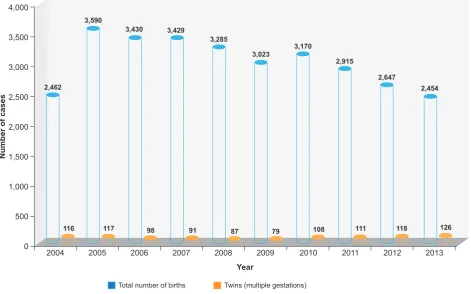
Figure 1 – Chart showing the total number of twins delivered at our Department on each year of the study as a result of multiple gestations in relation to the overall number of births
0 500 1,000 1,500 2,000 2,500 3,000 3,500 4,000
Total number of births Twins (multiple gestations)
2004 2,462
3,590
3,430 3,429
3,285
3,023 3,170
2,915
2,647
2,454
116 117 98 91 87 79 108 111 118 126
2005 2006 2007 2008 2009 2010 2011 2012 2013
Year
ARTIGO ORIGINAL RESULTS In total, 1,051 twins (51% female) were delivered over this period of time, as a result of 540 twin gestations (73.3% DC; 26.7% MC), corresponding to 3.5% of all infants delivered at our Department on this decade (1,051 out from 30,405), with lowest incidence from 2007 to 2009 (2.6%) and highest in 2013 (5.1%) (Fig. 1).
Lower maternal age (29.9 vs. 31.9 years, p < 0.001) and higher spontaneous pregnancy rate (92.4 vs. 64.9%, p < 0.001) were found in MC vs. DC pregnancies. The use of ART resulted mostly in DC pregnancies (92.7%). Even when pregnancies resulting from ART were excluded, maternal age is lower in MC pregnancies (29.5 vs. 31.3 years, p < 0.001).
Higher IUGR incidence was found in MC pregnancies (20.5 vs. 11.3%, p < 0.001), even though statistically significant differences were not found between both groups as regards the remaining obstetric complications, namely gestational diabetes, amniotic fluid abnormalities (oligohydramnios) and threat of PTB (Table 1). In total, 16
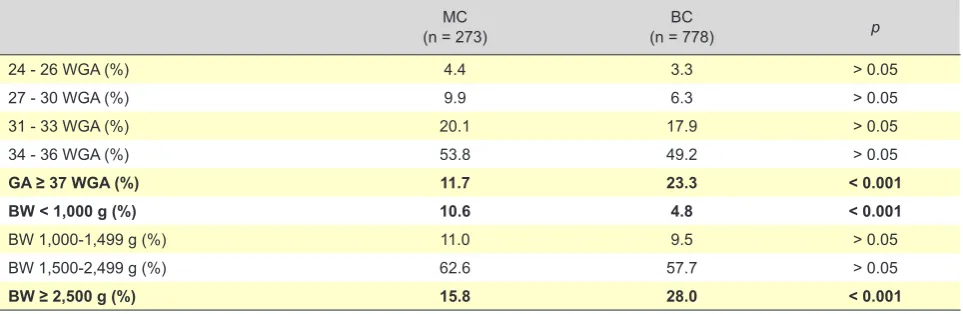
TTTS cases were found in 144 MC pregnancies (11.1%). A higher incidence of caesarean section delivery was found in MC pregnancies (65.3 vs. 54.2%, p < 0.05) (Table 2). A high percentage of PTB (79.7%) was found in our group of patients (Table 3), mostly in late-preterm infants (63.2% with GA 34-36 weeks), corresponding to 29.7% of overall preterm infants delivered at our Department over the same period of time. A significant difference in GA was found and was lower in the MC group (33.4 vs. 34.3 weeks, p < 0.05). Mean BW was also lower in this group (1,943 vs. 2,147 grams, p < 0.001; range 450-3,850 grams) and 16.2% weighed under 1,500 grams (Table 3), corresponding to 27.2% of all very-low weight infants delivered over that period of time. No significant differences were found as regards 5-minute Apgar score.
In total, 513 (49%) twins were admitted to the NICU, corresponding to 17% of all infants admitted over that period of time. A higher admission rate (54.9 vs. 46.7%, p <
0.05) and a similar average stay in the hospital were found in the MC group (MC: 19.2 days; DC: 16.2 days; p > 0.05). Table 1 – Maternal and obstetric complications
MC
(n = 144) (n = 396)DC p
Mean maternal age (years) 29.9 31.9 < 0.001
IUGR (%) 20.5 11.3 < 0.001
Gestational diabetes (%) 2.1 6.1 > 0.05
Amniotic fluid abnormalities (%) 5.6 4.8 > 0.05
PTB (%) 2.8 6.1 > 0.05
TGD (%) 27.8% 20.2% > 0.05
Table 2 – Infants characteristics
MC
(n = 273) (n = 778)DC p
Caesarean-section deliveries (%) 65.3 54.2 < 0.05
Mean GA (WGA) 33.4 34.2 < 0.05
Mean BW (g) 1943 2147 < 0.001
Mean 5-minute Apgar score 9.4 9.5 > 0.05
NICU admission rate (%) 54.9 46.7 < 0.05
g: grams; WGA: Week of gestational age
Table 3 – Infants ranked by GA and BW
MC
(n = 273) (n = 778)BC p
24 - 26 WGA (%) 4.4 3.3 > 0.05
27 - 30 WGA (%) 9.9 6.3 > 0.05
31 - 33 WGA (%) 20.1 17.9 > 0.05
34 - 36 WGA (%) 53.8 49.2 > 0.05
GA ≥ 37 WGA (%) 11.7 23.3 < 0.001
BW < 1,000 g (%) 10.6 4.8 < 0.001
BW 1,000-1,499 g (%) 11.0 9.5 > 0.05
BW 1,500-2,499 g (%) 62.6 57.7 > 0.05
BW ≥ 2,500 g (%) 15.8 28.0 < 0.001
ARTIGO ORIGINAL
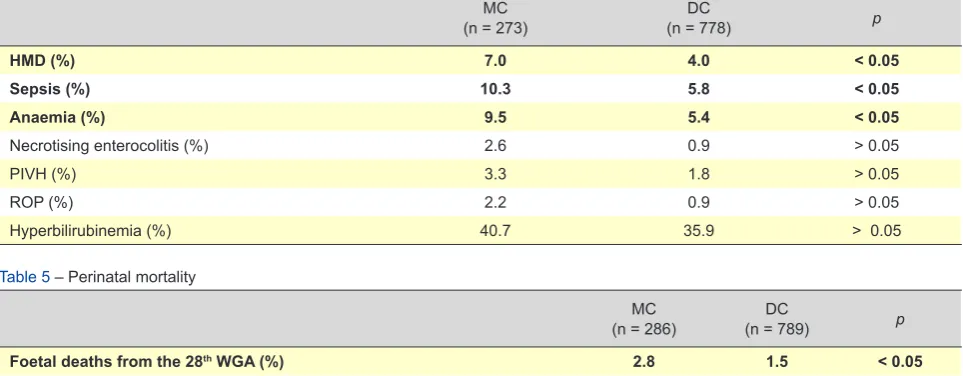
MC twins showed a higher incidence of hyaline membrane disease (HMD) (7.0 vs. 4.0%, p < 0.05), sepsis (10.3 vs. 5.8%, p < 0.05) and anaemia (9.5 vs. 5.4%, p <
0.05). No statistically significant differences were found as regards the presence of necrotising enterocolitis, PIVH, ROP or hyperbilirubinemia (Table 4).
Higher foetal mortality rate was found in MC pregnancies (2.8 vs. 1.5%, p < 0.05), 50% (4/8) of which occurred in foetuses with TTTS. One patient with hydrops fetalis (DC pregnancy) was found and the remaining deaths occurred from an undetermined cause. A higher percentage of deaths occurring over the first week of life was found in the MC group (2.4 vs. 1.4%, p < 0.05) and a 5.2% vs. 2.9% perinatal mortality rate was found in the DC group (p < 0.05) (Table 5).
DISCUSSION
Multiple gestation absolute number and rate have increased over the past few years, in line with what has been found worldwide.2,3,6 The use of ART has greatly contributed to this reality.6,9,13 In this study, delayed childbearing, apart from ART, has been increasingly a determinant factor for chorionicity; even when only spontaneous pregnancies were analysed, a significant difference remained between both groups regarding mean maternal age and was higher in DC vs. MC pregnancies.3,13
A higher incidence of IUGR in MC vs. DC pregnancies has been found, as expected.1,11,17 TTTS has been found in 11.1% of MC pregnancies, in line with what has been described in other studies.10-12,16,17,22 A higher incidence of caesarean section deliveries has been found in MC vs. DC pregnancies, in line with what has been described by a different Portuguese study.1
Higher incidence of PTB has also been found in MC
vs. DC pregnancies, as well as lower mean BW, in line with literature.1,10,11,13,16,23 These parameters had a relevant influence on NICU admission rate.13,17
Chorionicity also seemed to have a relevant role in neonatal morbidity: in our group of patients, a higher incidence of HMD,1,3,17 sepsis,3 anaemia and PIVH 1,10,11,17 was found in MC vs. DC twins, with no statistically significant differences.
Different studies have shown a higher risk for foetal and perinatal mortality in MC when compared to DC and singleton pregnancies,1,4,10-13,16,23 in association with a higher incidence of IUGR, TGD and TTTS in the first group.4,16,17,22 However, some case series studies have shown that even uncomplicated MC pregnancies involved a higher mortality risk,24,25 suggesting that natural history of multiple gestation and particularly MC is still not fully understood.4,22
The impact at different levels of twin pregnancies on a central maternity hospital has been shown in this study, on the overall number of births, on the number of very-low-weight infants, on prematurity and on NICU admission rate, in line with what has been described by other authors.2,3,11,12,22,26
The retrospective nature of the study and the dimension of our sample (even though it is relevant nationwide, it does not allow for any relevant comparisons between groups, namely the incidence of neurological morbidity as regards chorionicity) were the major limitations of the study.1,10,11,17 A higher incidence of neurological morbidity (brain paralysis, autism spectrum disorders, attention deficit hyperactivity disorders) has been described in MC vs. DC twins, mainly in those affected by TTTS,13,27,28 the reason why further prospective studies allowing for a school-age assessment of psychomotor development would be very useful.
Table 4 – Neonatal morbidity
MC
(n = 273) (n = 778)DC p
HMD (%) 7.0 4.0 < 0.05
Sepsis (%) 10.3 5.8 < 0.05
Anaemia (%) 9.5 5.4 < 0.05
Necrotising enterocolitis (%) 2.6 0.9 > 0.05
PIVH (%) 3.3 1.8 > 0.05
ROP (%) 2.2 0.9 > 0.05
Hyperbilirubinemia (%) 40.7 35.9 > 0.05
Table 5 – Perinatal mortality
MC
(n = 286) (n = 789)DC p
Foetal deaths from the 28th WGA (%) 2.8 1.5 < 0.05
Early neonatal mortality (1 - 7 days) (%) 2.4 1.4 < 0.05
Late neonatal mortality (8 - 28 days) (%) 1.0 0.8 > 0.05
Perinatal mortality 5.2 2.9 < 0.05
ARTIGO ORIGINAL CONCLUSIONS In conclusion, multiple gestations currently have a relevant impact on births, the reason why the development of protocols for a standard clinical approach to these infants would be crucial. Monochorionic twins are particularly challenging for obstetricians as for neonatologists and antenatal monitoring and labour should both take place at reference centres.
ACKNOWLEDGEMENTS
The authors wish to acknowledge the Department of Obstetrics at the Maternidade Daniel de Matos do Centro
Hospitalar e Universitário de Coimbra for their contribution
in antenatal monitoring.
OBSERVATIONS
Part of this study was presented at the 1st Congress of Joint European Neonatal Societies (jENS) in Budapest - 16 - 20 September 2015.
HUMAN AND ANIMAL PROTECTION
The authors declare that the followed procedures were according to regulations established by the Ethics and Clinical Research Committee and according to the Helsinki Declaration of the World Medical Association.
DATA CONFIDENTIALITY
The authors declare that they have followed the protocols of their work centre on the publication of patient data.
CONFLICTS OF INTEREST
The authors declare that there were no conflicts of interest in writing this manuscript.
FINANCIAL SUPPORT
The authors declare that there was no financial support in writing this manuscript.
REFERENCES
1. Manso P, Vaz A, Taborda A, Silva IS. Chorionicity and perinatal complications in twin pregnancy: a 10 years case series. Acta Med Port. 2011;24:695-8.
2. Hayes EJ, Paul D, Ness A, Mackley A, Berghella V. Very-low-birthweight neonates: do outcomes differ in multiple compared with singleton gestations? Am J Perinatol. 2007;24:373-6.
3. Burgess JL, Unal ER, Nietert PJ, Newman RB. Risk of late-preterm stillbirth and neonatal morbidity for monochorionic and dichorionic twins. Am J Obstet Gynecol. 2014;210:578.e1-9.
4. Russo FM, Pozzi E, Pelizzoni F, Todyrenchuk L, Bernasconi DP, Cozzolino S, et al. Stillbirths in singletons, dichorionic and monochorionic twins: a comparison of risks and causes. Eur J Obstet Gynecol Reprod Biol. 2013;170:131-6.
5. Endres L, Wilkins I. Epidemiology and biology of multiple gestations. Clin Perinatol. 2005;32:301-14.
6. Rodrigues CT, Branco MR, Ferreira ID, Nordeste A, Fonseca M, Taborda A, et al. Multiple gestation epidemiology -15 years survey. Acta Med Port. 2005;18:107-11.
7. Almeida P, Domingues AP, Belo A, Fonseca E, Moura P. Triplet pregnancies: perinatal outcome evolution. Rev Bras Ginecol Obstet. 2014;36:393-7.
8. Domingues AP, Fonseca E, Belo A, Moura P. Twins prematurity – the influence of prenatal surveillance. J Matern Fetal Neonatal Med. 2015;28:1108-11.
9. Adegbite AL, Ward SB, Bajoria R. Perinatal outcome of spontaneously conceived triplet pregnancies in relation to chorionicity. Am J Obstet Gynecol. 2005;193:1463-71.
10. Trevett T, Johnson A. Monochorionic twin pregnancies. Clin Perinatol. 2005;32:475-94.
11. Rao A, Sairam S, Shehata H. Obstetric complications of twin pregnancies. Best Pract Res Clin Obstet Gynaecol. 2004;18:557-76. 12. Gomella TL, Cunningham MD. Neonatology: management, procedures,
on call problems, diseases, and drugs. 6th ed. New York: McGraw-Hill
Companies, Inc; 2009.
13. Shrim A, Weisz B, Gindes L, Gagnon R. Parameters associated with outcome in third trimester monochorionic diamniotic twin pregnancies. J Obstet Gynaecol Can. 2010;32:429-34.
14. Ville Y. Chorionicity and mode of fertilization: a long-standing misconception. Ultrasound Obstet Gynecol. 2006;28:635-6.
15. Parazzini F, Cipriani S, Bianchi S, Bulfoni C, Bortolus R, Somigliana E. Risk of monozygotic twins after assisted reproduction: a population-based approach. Twin Res Hum Genet. 2016;19:72-6.
16. Lewi L, Jani J, Blickstein I, Huber A, Gucciardo L, Van Mieghem T, et al. The outcome of monochorionic diamniotic twin gestations in the era of invasive fetal therapy: a prospective cohort study. Am J Obstet Gynecol. 2008;199:514.e1-8.
17. Acosta-Rojas R, Becker J, Munoz-Abellana B, Ruiz C, Carreras E, Gratacos E, et al. Twin chorionicity and the risk of adverse perinatal outcome. Int J Gynaecol Obstet. 2007;96:98-102.
18. Gratacós E, Deprest J. Current experience with fetoscopy and the Eurofoetus registry for fetoscopic procedures. Eur J Obstet Gynecol Reprod Biol. 2000;92:151-9.
19. Volpe JJ. Neurology of the newborn. 5th ed. Philadelphia: WB Saunders
Elsevier; 2008.
20. Secção de Neonatologia da Sociedade Portuguesa de Pediatria, 2013. Consenso clínico: anemia da prematuridade. [consultado 2015 set 10]. Disponível em:http://www.lusoneonatologia.com/pt/consenso/73/ consensos-e-recomendacoes/.
21. International Committee for the Classification of Retinopathy of Prematurity. The international classification of retinopathy of prematurity revisited. Arch Ophthalmol. 2005;123:991-9.
22. Smith NA, Wilkins-Haug L, Santolaya-Forgas J, Acker D, Economy KE, Benson CB, et al. Contemporary management of monochorionic diamniotic twins: outcomes and delivery recommendations revisited. Am J Obstet Gynecol. 2010;203:133.e1-6.
23. Carroll SG, Tyfield L, Reeve L, Porter H, Soothill P, Kyle PM. Is zygosity or chorionicity the main determinant of fetal outcome in twin pregnancies? Am J Obstet Gynecol. 2005;193:757-61.
24. Barigye O, Pasquini L, Galea P, Chambers H, Chappell L, Fisk NM. High risk of unexpected late fetal death in monochorionic twins despite intensive ultrasound surveillance: a cohort study. PLoS Med. 2005;2:e172.
25. McPherson JA, Odibo AO, Shanks AL, Roehl KA, Macones GA, Cahill AG. Impact of chorionicity on risk and timing of intrauterine fetal demise in twin pregnancies. Am J Obstet Gynecol. 2012;207:190.e1-6. 26. Martin JA, Hamilton BE, Sutton PD, Ventura SJ, Menacker F, Kirmeyer
S, et al. Births: final data for 2005. Natl Vital Stat Rep. 2007;56:1-103. 27. McIntosh J, Meriki N, Joshi A, Biggs V, Welsh AW, Challis D, et al. Long
term developmental outcomes of pre-school age children following laser surgery for twin-to-twin transfusion syndrome. Early Hum Dev. 2014;90:837-42.