ISSN-L: 2501 - 1235 Available on-line at: www.oapub.org/edu
doi: 10.5281/zenodo.1285919 Volume 4 │ Issue 7 │ 2018
THE IMPACT OF FORCE EXERCISES ON VO2MAX INDICATORS
AND IMPROVEMENT THROUGH DIFFERENT EXERCISE PROGRAM
THROUGH CIRCUIT WEIGHT TRAINING
Kukeli, R., Skenderi, Dh.
Sports University of Tirana, Albania
Abstract:
Introduction: Cardiorespiratory endurance has long been recognised as one of the fundamental components of physical fitness. (Anstrand, 1986 and Maughan, 1969). The purpose of this scientific paper is to identify whether exercises affect the improvement of VO2max indicators after intervening with a special training program for a 12-week period for bodybuilding. Also, to find out whether circuit system training exercises with weights increases VO2max among bodybuilders. Methods: The data was collected from 23 bodybuilders in Tirana took part in the study (22 years SD 3.9) (12 male performed the intervention program while 11 male were control group that did the usual training program). Ergometer test were used to evaluate the VO2 Max. The intervention training program lasted 12 weeks on frequency 6 times per week, 60 minutes for each training session. It was used circuit weight routine with an intensity between 60% to 80% on 2 group muscles in a session (8 – 10 exercises, 3 – 5 circuits, 12 – 20 reps). Results: The results showed that the baseline mean values for intervention group were 32.1 ml/kg/min and control group 37.9 ml/kg/min. After the intervention the results showed that intervention group had a mean values 37.8 ml/kg/min while control group 37.6 ml/kg/min. Discussion: In conclusion the results show significant improvement on VO2 Max on intervention group (mean diff=5.7; p= 0.000) and no significant improvement on control group (mean diff=0.3; p= 0.276). Finally, it was found out that strength exercises affect the optimal level in improving VO2max.
Keywords: force, cardiorespiratory fitness, bodybuilder
1. Introduction
(VO2max). Cardiorespiratory endurance has long been recognised as one of the fundamental components of physical fitness. (Anstrand 1986 and Maughan 1969). Aerobic literally means with oxygen, and it is the only type of exercise which burns body fat to meet its energy needs. Bodybuilders engage in aerobic workouts to develop additional cardiorespiratory fitness, as well as to burn off excess body fat to achieve peak contest muscularity. Common aerobic activities include running, cycling, swimming, dancing and walking. Depending on how vigorously you play them, most racquet sports can also be aerobic exercise. The main two apparatuses utilized for studying endurance performance are the treadmill and the cycle ergometer. These are the classic and main tools of the exercise physiologist, as such, most studies in concurrent training are performed either with the athlete running or cycling. The purpose of this scientific paper is to identify whether exercises affect the improvement of VO2max indicators after intervening with a special training program for a 12-week period. for bodybuilding., also to find out whether circuit system training exercises with weights increases VO2max among bodybuilders (20-40 years). We hypothesize that intervening with a special training program for a 12-week period of exercise in bodybuilding sports will bring significant improvements to: VO2max indicators and respiratory cardiovascular system.
2. Methods
In this study, two groups of randomly selected subjects of bodybuilders were included at study protocol. The data was collected from 23 bodybuilders in Tirana took part in the study (22 years SD 3.9) (12 male performed the intervention program while 11 male were control group that did the usual training program).
2.1 Measurement
Ergometer test were used to evaluate the VO2 Max. All bodybuilding athletes have made initial testing on the Ergometric Bicycle to identify the level of Vo2max. In the measured measurements, the test protocol was followed as follows: Maximum oxygen volume (VO2max_ml_kg_min) absolute (l / min) and relative (ml / kg / min), aerobic capacity. The measurements were performed before and after the program. The subject completed a continuous graded exercise test on an electronically braked cycle ergometerto determine maximal oxygen consumption (VO2peak) and the peak power output in watts at VO2peak. The athlete began pedaling at a cadence of 60 to 80 rpm at a workload of 20 W. The workload increased 1 W every 3 seconds (20 W/min) until he was unable to maintain 60 to 80 rpm oruntil volitional fatigue.
2.2 Intervention study protocol
between 60% to 80% on 2 group muscles in a session (8 – 10 exercises, 3 – 5 circuits, 12 – 20 reps).
The training program was designed in this way:
Monday, Wednesday, Friday: Exercise exercises with weights according to the circus system. Two muscles for each training session, 8-12 exercises, 3 circles, 12-20 reps for each exercise, with 60-80% of the maximum force on short breaks.
Tuesday functional workout.
Thursday: Cardio drill: jogging on the runway, bicycle or steps, various games (basketball, mini-football, ping-pong, etc.)
Saturday: core training & abdominal,
2.3 Statistical analysis
All variables evaluated in this study were tested for normality. The ANOVA (one way) test followed by an in-depth LSD test (post hoc) was used to compare the results of the difference between the control group and the intervention group in the first (pre) and post-intervention measurements. Level p <0.05 (Significant Change) was accepted in this study. All statistical analyzes were performed using SPSS 20.0 software.
3. Results
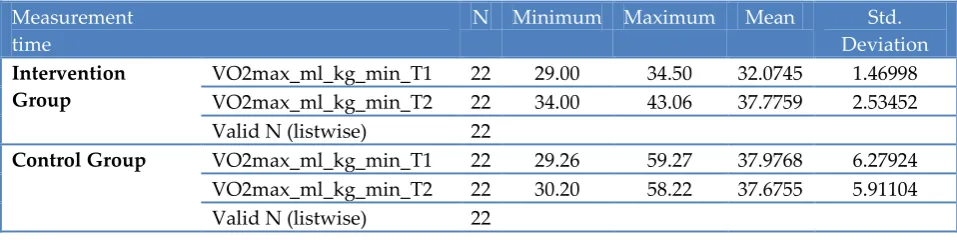
Table 1 gives data on average indicators, standard deviation of VO2max and minimum & maximum oxygen quantity for 22 individuals (N = 22) in T1 & T2 of training group (Intervention Group), who underwent circular exercise with weight.
Also data show average indicators, standard deviation of VO2max and minimum & maximal oxygen quantity for 22 individuals (N = 22) in T1 & T2 (N = 22) of control group (Control Group).
The Intervention Group: the first test (T1), (N = 22), (minimum = 29), (maximum = 34.5), (average = 32.1), (DS = 1.5). The second test (T2), (N = 22), (minimum = 34), (maximum = 43.1), (average = 37.7), (DS = 2.5)
Control Group: The first test (T1), (N = 22), (minimum = 29.1), (maximum = 59.3), (average = 38), (DS = 6.3). The second test (T2), (N = 22), (minimum = 30.2), (maximum = 58.2), (average = 37.7), (DS = 5.9)
Table 1: Average descriptive data, standard deviation of VO2max and minimum & maximum oxygen consumption
Measurement time
N Minimum Maximum Mean Std. Deviation
Intervention Group
VO2max_ml_kg_min_T1 22 29.00 34.50 32.0745 1.46998 VO2max_ml_kg_min_T2 22 34.00 43.06 37.7759 2.53452 Valid N (listwise) 22
Control Group VO2max_ml_kg_min_T1 22 29.26 59.27 37.9768 6.27924
Table 2 shows the difference in T1 of VO2max_ml_kg_min between the Intervention Group and the Control Group on the first test (T1)..
The statistical analyzes show: the comparison Intervention and Control Group T1 (sum of square = 383.2), (mean square = 383.2) and (F = 18.4) (Sig= 0.00). Intervention and Control group T2 (sum of square = 0.1), (mean square = 0.1) and (F = 0) (Sig= 0.94).
Table 2: Data on comparison between groups in T1and T2
Sum of Squares df Mean Square F Sig
VO2max_ml_kg_min_T1 Between Groups 383.205 1 383.205 18.428 0.00 Within Groups 873.384 42 20.795
Total 1256.589 43
VO2max_ml_kg_min_T2 Between Groups .111 1 .111 .005 .942 Within Groups 868.649 42 20.682
Total 868.760 43
Table 3 shows average descriptive data, the standard deviation of the maximum amount of oxygen per ml / min (VO2max_ml_kg_min) for the Intervention Group and the Control Group on the T1 & T2 tests.
Training group (Intervention Group) first test (T1) (VO2max_ml_kg_min_T1) (average = 32.1), (N = 22), (DS = 1.5). The second test (T2) (VO2max_ml_kg_min_T2) (average = 37.8), (N = 22), (DS = 2.5). Control Group (T1) (VO2max_ml_kg_min_T1) (average = 37), (N = 22), (DS = 6.3). The second test (T2) (VO2max_ml_kg_min_T2) (average = 37.6), (N = 22), (DS = 5.9).
Table 3: Average descriptive data, standard deviation of VO2max and minimum & maximum oxygen consumption
Paired Samples Statistics
Measurement time Mean N Std. Deviation
Intervention Group Pair 1
VO2max_ml_kg_min_T1 32.0745 22 1.46998 VO2max_ml_kg_min_T2 37.7759 22 2.53452 Control Group Pair
1
VO2max_ml_kg_min_T1 37.9768 22 6.27924 VO2max_ml_kg_min_T2 37.6755 22 5.91104
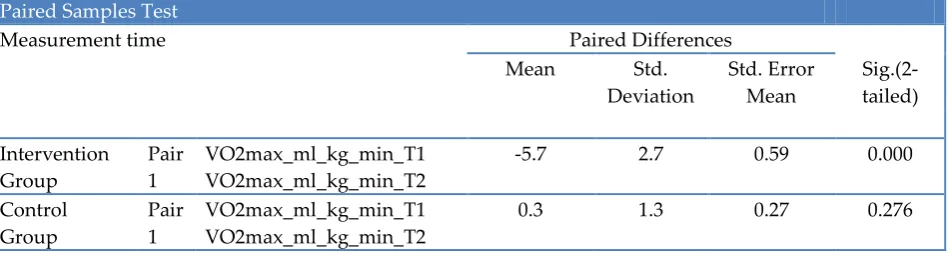
Table 4 gives the comparative data in T1 and T2 of the two groups for maximum oxygen consumption (VO2max_ml_kg_min) on the T1 & T2 tests of the Intervention Group and the Control Group.
Table 4: Comparative data of groups between T1 and T2 of the maximum amount of oxygen Paired Samples Test
Measurement time Paired Differences
Mean Std. Deviation Std. Error Mean Sig.(2-tailed) Intervention Group Pair 1 VO2max_ml_kg_min_T1 VO2max_ml_kg_min_T2
-5.7 2.7 0.59 0.000
Control Group Pair 1 VO2max_ml_kg_min_T1 VO2max_ml_kg_min_T2
0.3 1.3 0.27 0.276
4. Discussion
The results of this study serve to compare the level of VO2max before and after the application of special training programs with strength exercises adapted to various forms with the aim of improving VO2max in the body. This means that the use of weight exercises increases aerobic performance if we use moderate interval intervals with multiple repeats, which amount to 20.
The results showed that the baseline mean values for intervention group were 32.1 ml/kg/min and control group 37.9 ml/kg/min. After the intervention the results showed that, intervention group had a mean values 37.8 ml/kg/min while control group 37.6 ml/kg/min.Only 3 out of 17 Ozzaki (2013) studies involving new subjects following weight training have shown significant increases in Vo2max, while six out of nine studies in older adults have reported significant improvements in Vo2max. There is a significant negative correlation between initial Vo2max and weight training that promotes change in Vo2max, because the growth of Vo2max through weight exercises is dependent on the subject's initial Vo2max. To see more clearly the effect of circular exercise exercises with weights, the initial indicators of Vo2max should be below 25 ml / kg / min for subjects younger than 40 ml / kg / min. Thus, young and old subjects with low levels of physical performance are expected to undergo improvement at the same time and within a single way of two components: muscular and cardiovascular (Ozaki, 2013). Thus, strength in strength not only improves body constituents, but also increases oxygen capability as the main input of a well-developed cardio-vascular system that is efficient for a better quality of life.
it is important to understand that there are some published studies that are in line with the results obtained from this study.
According to author Ozaki (2013) in his paper, it is undeniable fact that weight training is a powerful stimulus for muscle hypertrophy and gaining strength, but this is less understandable if weight training can increase aerobic capacity (VO2max). The purpose of this brief review is to discuss whether exercise in the circus exercise system increases Vo2max among young people (20-40 years), while in older subjects (> 60 years) there has been a significant increase in VO2max.
Recent studies have shown that different types of weight training in the circuit system can improve aerobic fitness (Phillip Garrison, NASM Elite Trainer). For aerobic exercise weight training should be quite intense with very short periods of rest between the series and the one-on-one exercise, in order to keep the heartbeats constantly elevated. Studies have shown that short breaks, regular and correct exercise by the weight system circuit system, reduce the heart rhythm in tranquility, increases VO2 max and improve aerobic power, unlike traditional cardiovascular training.
Of note, many of the physiological changes observed including an elevation in cortisol, reduction in testosterone, reduction in immune function, alterations in mood status, and decreases in physical performance and maximal heart rate that occurred during the preparation period are consistent with markers of overtraining. (Cunha et al., 2006; Fry et al., 1998; Fry & Kraemer 1997) While these changes may be considered, a negative outcome in many sports judged or scored on physical performance, these outcomes having little bearing on the subjective outcome of a bodybuilding competition. In fact, these alterations may be almost a prerequisite for achieving an optimal physique for bodybuilding. One month after competition, total mood disturbance improved while aerobic performance began to increase. Two months after competition, strength and anaerobic performance began to recover while the hormonal profile returned to pre-preparation (baseline) levels within 3 months of the competition. In contrast to the physical changes that occurred before the bodybuilding competition, preparation for other competitions that do not cause such reductions in body fat may also not elicit changes in either strength or aerobic fitness and may actually enhance anaerobic capabilities.
In conclusion of our study the results show significant improvement on VO2 Max on intervention group (mean diff=5.7; p= 0.000) and no significant improvement on control group (mean diff=0.3; p= 0.276). Finally, it was found out that strength exercises affect the optimal level in improving VO2max. Our study confirms Nul's hypothesis that weight exercises designed according to circular program software affect the improvement of VO2max indicators and cardiovascular system and respirator.
5. Impact of the study
under the circus exercises with weight can improve the VO2max and aerobic performance levels. Strength only improves bodily constituents, but increases oxygen capability as the main input of a well-developed cardio-vascular system. Taking into account all these positive effects on the body, this study suggests that training fitness training programs is always room for improvement by applying different weight training methods for this purpose, as discussed above.
5.1 Strengths and Limitations
Although randomized controlled trials are the norm in scientific literature, it has been satirically and accurately demonstrated that they are not always the best source of information (Smith & Pell 2003). We believe that our sample size is thus a strength of our study, as it enabled us to frequently perform a plethora of measurements for a full year in a difficult-to-study subject population. We are of the opinion that not many bodybuilders preparing for a competition would agree to regular fasted testing, maximal cycling tests, and maximal-strength assessments.
References
1. Astrand P.-O., Rodahl K. Textbook of work physiology. New York: McGraw-Hill Book Company, 1986
2. Phillip Garrison “Will resistance training help to improve my cardiorespiratory fitness?” NASM Elite Trainer https://www.sharecare.com/user/phillip-garrison/blog Expert health information
3. Maughan R. J. Marathon running. In: Reilly T, Snell P, Williams C, et al., editors. Physiology of sports. London: Spon, 1969: 121-52
4. Ozaki. H, Jeremy. P, Loenneke, Robert. S, Thiebaud, Takashi. A,“Resistance training induced increase in VO2max in young and older subjects” European Review of Aging and Physical Activity (2013); ·
5. Lingor R. J., Olson A. Fluid and diet patterns associated with weight cycling and changes in body composition assessed by continuous monitoring throughout a college wrestling season. J Strength Cond Res. 2010;24(7):1763–1772. PubMed doi:10.1519/JSC.0b013e3181db22fb
6. Cunha G., Ribeiro J., Oliveira A. Overtraining: theories, diagnosis and markers. Rev Bras Med Esporte. 2006;12(5):297– 302. doi:10.1590/S1517-86922006000500014 7. Fry A. C., Kraemer W. J., Ramsey L. T. Pituitary-adrenal-gonadal responses to high-intensity resistance exercise overtraining. J Appl Physiol. 1998;85(6):2352– 2359. PubMed
9. Karila T. A., Sarkkinen P., Marttinen M., et al. Rapid weight loss decreases serum testosterone. Int J Sports Med. 2008;29(11):872–877. PubMed doi:10.1055/s-2008-1038604
10.Ireland M., Nattiv A. The Female Athlete. Philadelphia, PA: Saunders; 2003. 11.Smith G. C., Pell J. P. Parachute use to prevent death and major trauma related to
Creative Commons licensing terms