ISSN: 2501 - 1235 ISSN-L: 2501 - 1235 Available on-line at: www.oapub.org/edu
doi: 10.5281/zenodo.2581683 Volume 5 │ Issue 5 │ 2019
PHYSICAL ACTIVITY IMPACT ON MENTAL HEALTH
IN 11-14 AGE OLD PUPILS IN SHKODRA, ALBANIA
Ermal Milla1,
Fatjon Nurja2i 1Msc, University of Shkodra
"Luigj Gurakuqi" Shkodra, Albania 2Dr., University of Shkodra
"Luigj Gurakuqi" Shkodra, Albania
Abstract:
Introduction: Physical activity and sports have always been considered as an unseparated part of physical training and mental health condition of the human being. Most adolescents prefer to do sport activity but only when driven by teachers or parents. They spend more time watching TV or playing on computer than playing in open spaces with their friends. Methods: This study employed in total 302 pupils, 154 boys & 208 girls 11-14 years old, in public & private school representing different socioeconomic attributes. Objective measurements of height & weight were obtained. BMI is measured by measuring weight and height at 9:00-10:00 a.m. Questionnaires of time expenditure (based on EPAQ2, Source: Wareham et al. IJE 2002) and mental health (Rate yourself from Poul M. Insel and Walton T. Roth, 1988) are fulfilled within one week with the parents support. Results: Our study is meant to be realistic, honest and true. BMI itself seem to be lower than the WHO standards, so we have no overweight and obesity. In Shkodra, the correlation between them, mental health (>16 according to the scale) and time expenditure goes in right proportion, higher the PA (PA games Home Help, Walk, Sp, GYM), higher Mental Health scale results we have got. Conclusions: In this study proved that the addition of school sports activity, improves the quality of mental health "as in all groups there is a strong correlation between mental health and active time.” Physical education in school shows to have significant role in normalizing stress and aggression rate among pupils and improving mental health. Study confirms that mental and emotional health are influenced by gender and type of school sports activities, as in the different categories of variables correlation is strong in different classes and schools of different genres.
Keywords: mental health, BMI, physical activity, time expenditure
1. Introduction
Physical activity and sports nowadays are taking increasingly less space on the children’s daily occupation. Most adolescents prefer to do sport activity but only when driven by teachers or parents. They spend more time watching TV or playing on computer than playing in open spaces with their friends. This pattern of behaviour with lack of physical activity and sport on one hand, but also the strong bullying psychological receiving from the computer or TV on the other, and especially lack of socialisation from sports activity group, is a direct cause to increased psychological distress at children development of adolescents with an unknown impact on mental health. The WHO has now tentatively recommended the use of BMI for age as indicator of overweight or obesity. High BMI in adolescence is predictive of adult mortality. But, which is the correlation between time expenditure, mental health and BMI related to anxiety & aggressive behaviour in secondary school pupil’s age in Albania?
The scientific task of this paper is to study:
the role and impact of physical activity and school sports activity related to the improvement of mental health scale of 11-14 years old age group,
assessment of mental health scale of 11-14 years old age group, evidencing the impact of school sport and physical activity in mental health of the age group 11-14 years,
highlight the level of mental health for both men and women of this age group, identification of influencing factors changes in the school environment, family
and extracurricular environment on mental health, evidence of the impact of physical activity & school sports on mental health.
2. Methodology
2.1 Objectives
The objective is to investigate the relationship between PA, sport activity, weakly time expenditure on mental health, and BMI of the age group 11-14 years in Albania.
2.2 Subjects
3. Results
3.1 BMI in our study
It is evident from data where the index is the first phase and the latter does not change the shape significantly on Average data, either the SD.
Table 1: BMI in Base-Line
BMI Base-line GRD 7 GRD 8 GRD 9 GRD 10
(M) (F) (M) (F) (M) (F) (M) (F)
School. PUB. AVE 20,82 23,23 20,53 20,73 21,92 21,54 23,55 20,95
ST DV ±2,76 ±4,78 ±2,84 ±2,53 ±3,87 ±3,90 ±3,48 ±2,06
School. Non PUB. AVE 23,11 23,18 21,24 22,59 22,33 22,48 23,17 20,86
ST DV ±2,12 ±2,14 ±2,08 ±2,36 ±3,16 ±2,14 ±2,37 ±2,99
The changes observed from the table are the differences caused by the rapid natural physical development of the skeleton where growth is found at approximately an average of 1.8 cm in general for the period between the two measurements.
Table 2: BMI in end-lane
BMI end-line GRD 7 GRD 8 GRD 9 GRD 10
(M) (F) (M) (F) (M) (F) (M) (F)
School. PUB. AVE 20,79 23,21 20,03 20,89 22,17 21,51 23,65 20,12
ST DV ±2,72 ±4,72 ±4,42 ±2,48 ±3,98 ±3,77 ±3,49 ±4,60
School. Non PUB. AVE 23,14 23,68 21,39 22,70 22,41 22,58 23,23 20,91
ST DV ±2,20 ±1,96 ±1,99 ±2,34 ±3,14 ±2,07 ±2,30 ±3,01
Both height and weight also is an indication was found to change at the same rate and this seems to be natural for the period of growth at age 11-14 years.
3.2 Time expenditure in our study
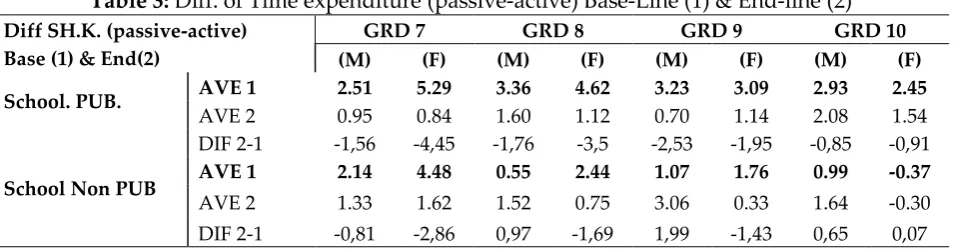
Table 3: Diff. of Time expenditure (passive-active) Base-Line (1) & End-line (2)
Diff SH.K. (passive-active) Base (1) & End(2)
GRD 7 GRD 8 GRD 9 GRD 10
(M) (F) (M) (F) (M) (F) (M) (F)
School. PUB. AVE 1 2.51 5.29 3.36 4.62 3.23 3.09 2.93 2.45
AVE 2 0.95 0.84 1.60 1.12 0.70 1.14 2.08 1.54 DIF 2-1 -1,56 -4,45 -1,76 -3,5 -2,53 -1,95 -0,85 -0,91
School Non PUB AVE 1 2.14 4.48 0.55 2.44 1.07 1.76 0.99 -0.37
3.3 Mental Health in our study
Table 4: Diff. of Mental Health
Mental Health Base (1) & end (2)
GRD 7 GRD 8 GRD 9 GRD 10
(M) (F) (M) (F) (M) (F) (M) (F)
School. PUB. AVE 1 20.47 19.40 19.51 19.39 19.18 19.53 18.83 19.42
AVE 2 20.40 19.80 20.83 21.00 19.93 20.03 19.06 19.52 DIF 2-1 -0,07 0,4 1,32 1,61 0,75 0,5 0,23 0,1
School Non PUB AVE 1 19.00 19.38 18.36 19.21 20.06 20.20 19.65 18.95
AVE 2 19.93 19.62 20.45 19.72 20.25 20.73 19.94 19.40 DIF 2-1 0,93 0,24 2,09 0,51 0,19 0,53 0,29 0,45
3.4 Correlation PA Mental Health
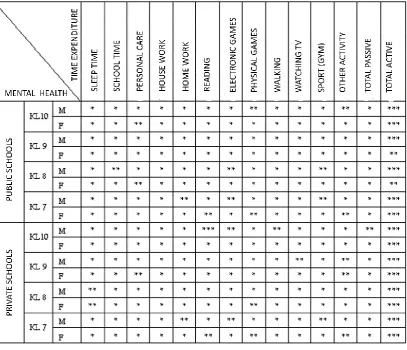
Table 5:Correlation Pearson between Mental Health & Time Expenditure
4. Discussion
right proportion, higher the PA (PA games Home Help, Walk, Sp, GYM), higher Mental Health scale results we have got.
Adding deliberately three hours of PA per week (time expenditure), for an eight-week period, cannot change BMI, but only mental health was found to improve. The reduction of aggressive and anxiety behaviour was found to be reduced in pupils who were involved in social games more than the others.
4.1 First questionnaire
From these activities it is confirmed the hypothesis of the study that there should be a selection of physical activity and activities that are not sedentary. Therefore, if select Exercises, Games and Physical GYM Walking as physical activity for the confirmation of cases to increase physical activity during the day.
4.2 Second questionnaire
The list of differences in interpretation of values (mean) the average is: a very important and positive value, the greater the difference in the degree of improvement of mental health assessment at the end of the period.
The differences are shown in the table, the interpretation of values such Advance Standard: positive values indicate an expansion of the scale of the performance of the group, while negative values should be interpreted as a result of the increasing homogeneity of the group considering the second. When the average value increases and is associated with a low / negative that once we have an increase in mental health associated with increasing homogeneity of the group is obvious that this phenomenon occurs only in those groups where the ratio of increased physical activity is of at least 0.5 hours a day, with the participation of the Gym (GYM).
5.Conclusions
1) Both genders have similar attitudes in regard to PA & sports activity participation.
2) Groups did not represent qualitative changes in relation to impacts on increasing physical activity.
3) In this study proved that the addition of school sports activity, improves the quality of mental health "as in all groups there is a strong correlation between mental health and active time.
1) Physical education in school shows to have significant role in normalizing stress and aggression rate among pupils and improving mental health.
2) Study confirms that mental and emotional health are influenced by gender and type of school sports activities, as in the different categories of variables correlation is strong in different classes and schools of different genres.
4) Indicators showed similar values as the literature and in the same orientation of impact.
5.1 Recommendations
The education managers should be aware of stress and aggression problem and educational interventions to undertake normalizing their appearance at this group age.
Physical education teachers should give a clear message to student performance and goals to be achieved in the class, guidance motivations from the implementation of the tasks rather than competition, but social interaction and fair-play.
Physical education teachers should take care to increase the time in which pupils work in aerobic function as a normal function that allows the student’s body to work in conditions of oxygen added as basic for technique learning F.I.
Reform of the sports categories should be a priority task for the education system in Albania.
Gender stereotype should be kept in consideration both psychological and social aspects should be careful in dealing with mental health rate.
The family must be informed of the therapeutic effect of children involved in physical activity and sport activities, especially in those areas where the process of socialisation is centred.
References
Atkinson J.W. & Litwin H., Achievement motive and test anxiety. Journal of Abnormal and Social Psychology, 1960, pg. 52-63
Baron, R.A., Byrne, O., & Kantowitz B.H.: Psychology, Understanding behavior. Philadelphia. 1977, pg. 14-18
Canaj F. Psikologjia sportive. ShBLU. 2006. pg. 133-138
Colley, A., Roberts, N., & Chipps, A.: Sex-role identity, personality and participation in team and individual sports by males and females. International Journal of Sport Psychology, 1985, pg.16, 103-112.
Cratty J. Bryant. Social dimension of physical activity. New Jersey, USA, pg. 7-11.
Emily M. Haymes; Christine C. Wells. Environment and Human Performance. 1986. p 65-72.
Engeland A., Bjorge T., Sogaard A.J., and Tverdal A. Body mass index in adolescence in relation to total mortality: 32-year follow-up of 227.000 Norwegian boys and girls. Am J Epidemiology. 2003; pg. 157: 517-23.
James, W.P.T. 1995. A public health approach to the problem of obesity. International Journal of Obesity and Related Metabolic Disorders 19 (Suppl.3): S37-S43.
Selye, H.: The stress concept and some of its implications. V. Hamilton & Warburton, D.M. (Eds). Human stress and cognition. 1979. pg 89, 126.
Spielberger, C.D., Understanding stress and anxiety. 1979. pg. 43, 47, 50.
Creative Commons licensing terms