PRENATAL EXPOSURE TO ORGANOPHOSPHORUS PESTICIDES AND CHILDHOOD NEURODEVELOPMENTAL PHENOTYPES
Melissa A. Furlong
A dissertation submitted to the faculty at the University of North Carolina at Chapel Hill in partial fulfillment of the requirements for the degree of Doctor of Philosophy in the Department of
Epidemiology in the Gillings School of Global Public Health.
Chapel Hill 2016
Approved by:
Stephanie M. Engel
Amy H. Herring
Julie L. Daniels
Larry Engel
iii ABSTRACT
Melissa A. Furlong: Prenatal Exposure to Organophosphorus Pesticides and Childhood Neurodevelopmental Phenotypes
(Under the direction of Stephanie M. Engel)
Background: Neurodevelopmental traits are often treated as independent in etiological studies, although neurological functions exhibit complex correlational structures. Allowing traits to cluster into phenotypes may produce outcomes that are more clinically and biologically relevant. Additionally, environmental exposures often occur in a mixture. Accounting for such a possibility may reduce bias that results from assuming exposures are independent. We sought to estimate associations between organophosphorus pesticides and neurodevelopment after accounting for these possibilities.
Methods: A prospective birth cohort of 404 mother/infant pairs were followed from pregnancy until the children were 6 and 7-9 years of age. Factor analysis was performed on parent-report measures of child executive functioning and behavior, and performance-based measures of IQ. We estimated associations between demographic characteristics, maternal characteristics and environmental exposures during pregnancy and early childhood, and the neurodevelopmental factor scores after accounting for correlations among the factors.
Conclusions: Associations between prenatal exposure to OPs and worse internalizing behaviors and working memory scores are supported by prior findings in both human and animal studies. Associations with improved executive functioning are not supported by prior literature and may be a result of residual confounding by maternal executive functioning and dietary sources of OPs.
v
ACKNOWLEDGEMENTS
I have the most inspiring mentor who provides amazing guidance and settles for nothing less than my best effort. Stephanie Engel is an extraordinarily talented and caring advisor and has imparted wisdom in so many different aspects of life, both academic and personal. I could not have done even a tenth of this dissertation without her mentorship. My committee has also been invaluable and consistently available to answer questions and offer guidance. The quality of instruction, research, and resources at the University of North Carolina has been excellent and I must acknowledge the institution for enabling my work, and the department of
TABLE OF CONTENTS
LIST OF TABLES ... x
LIST OF FIGURES ... xi
LIST OF ABBREVIATIONS AND SYMBOLS ... xii
CHAPTER I. INTRODUCTION AND SPECIFIC AIMS ... 1
Introduction ... 1
Specific Aim 1 ... 4
Specific Aim 2 ... 4
CHAPTER II. BACKGROUND ... 5
Source, Route, and Estimation of Organophosphorus Pesticide Exposure ... 5
Organophosphorus Pesticide Use in the United States ... 5
Environmental Fate, Breakdown, and Metabolism of Ops ... 5
Source of Exposure ... 8
Associations between Prenatal Exposure to Organophosphorus Pesticides and Neurodevelopmental Outcomes ... 8
Overview ... 8
OPs and Neurodevelopment: Birth Cohorts ...10
PON1 and Other Modifying Factors ...11
PON1 ...11
Race and Sex ...12
Other Xenobiotics and Neurodevelopmental Outcomes ...13
Confounding and the Mixture Problem ...15
vii
Clustering Outcomes Data ...16
Advantages of Clustering Outcomes Data: Clinically Relevant Outcomes ...17
Advantages of Clustering Outcomes Data: Relevance to Biological Interpretations of OP Mechanisms ...18
Advantages of Clustering Outcomes Data: Spotlight on ADHD ...19
Innovation ...22
CHAPTER III. METHODS ...29
Study Design/Research Strategy Overview ...29
Study Population ...29
Exposure, Outcome, and Covariate Assessment ...30
Chemical Exposures ...30
Outcomes...31
Covariates ...32
Data Analysis ...33
Outcomes: Factor Analysis ...33
Association Models ...35
Comparative Analyses ...35
CHAPTER IV. EARLY LIFE CHARACTERISTICS AND NEURODEVELOPMENTAL PHENOTYPES IN THE MOUNT SINAI CHILDREN’S ENVIRONMENTAL HEALTH CENTER ...38
Introduction ...38
Methods ...39
Study Population ...39
Child Behavior and Executive Functioning ...40
Psychometric Intelligence Testing ...41
Covariates ...42
Statistical Methods ...44
Study Population Characteristics and Follow-up...46
Principal Components Analysis ...47
Early Life and Neurodevelopment Factors...49
Discussion ...51
Summary...51
Factor Structure ...52
Early Life Characteristics and Neurodevelopmental Factors ...53
Maternal Prenatal Smoking and Neurodevelopment ...54
Strengths and Weaknesses ...56
CHAPTER V. ASSOCIATIONS BETWEEN PRENATAL EXPOSURE TO ORGANOPHOSPHORUS PESTICIDES AND CHILDHOOD NEURODEVELOPMENTAL PHENOTYPES ...65
Introduction ...65
Methods ...67
Study Recruitment and Population ...67
Exposure Biomarker Measurements ...67
Child Behavior, Executive Functioning, Psychometric Intelligence Testing ...68
Statistical Methods ...70
Neurodevelopmental Factor Analysis and Outcomes ...70
Coexposures ...71
Bayesian Exposure Mixture Analyses ...71
Covariate Selection ...73
Interaction Analyses ...74
Sensitivity Analyses ...74
Results ...75
Bayesian Exposure Mixture Modeling of Neurodevelopmental Factors ...76
ix
Sensitivity Analyses ...77
Discussion ...77
Strengths and Limitations of Study ...83
CHAPTER VI. CONCLUSIONS ...90
Summary of Findings ...90
Strengths and Limitations ...92
Strengths...92
Limitations ...93
Public Health Significance ...97
Directions for Future Research...99
Conclusions ... 100
APPENDIX 1 DSM V CRITERIA FOR ADHD ... 101
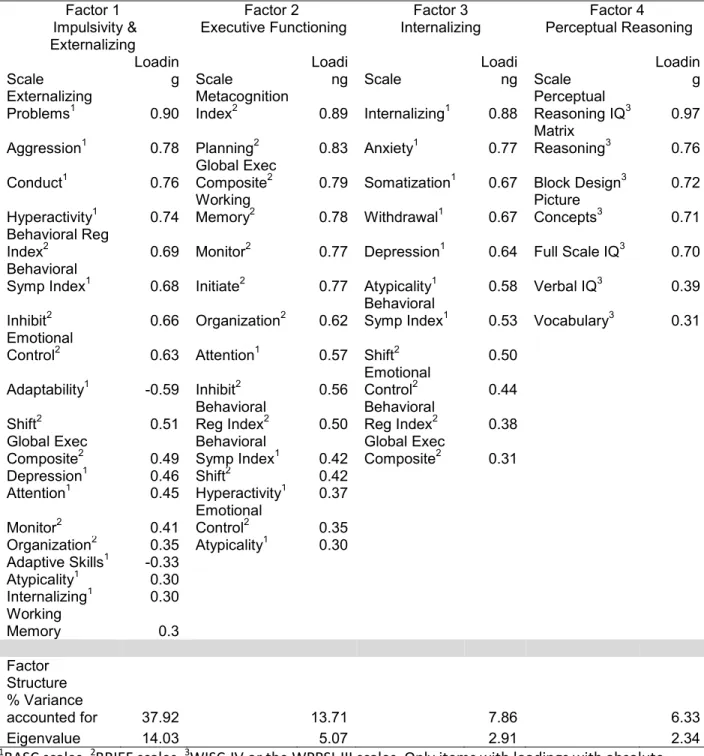
APPENDIX 2 PROMAX ROTATED FACTOR PATTERN STRUCTURE AND ITEM LOADINGS OF CHILDHOOD NEURODEVELOPMENTAL SCALES (N=210) ... 102
APPENDIX 3 ASSOCIATIONS BETWEEN SMOKING AND NEURODEVELOPMENTAL OUTCOMES, BY OUTCOME MEASUREMENT METHOD ... 104
APPENDIX 4 BIVARIATE ASSOCIATIONS BETWEEN EARLY LIFE CHARACTERISTICS AND NEURODEVELOPMENTAL FACTORS1 IN THE MOUNT SINAI CHILDREN’S ENVIRONMENTAL HEALTH CENTER ... 105
APPENDIX 5 FREQUENTIST ASSOCIATIONS BETWEEN OPS AND NEURODEVELOPMENTAL FACTOR SCORES, WITH AND WITHOUT ADJUSTMENT FOR CO-EXPOSURES ... 108
APPENDIX 6 CODE USED IN DISSERTATION ... 109
LIST OF TABLES
Table 1 Common Metabolites of Selected Organophosphorus Pesticides ...26 Table 2 Summary of Prenatal Exposure to OPs and Associations with
Neurodevelopment in Children's Environmental Health Center Cohorts ...28 Table 3 Characteristics of Study Population at Enrollment and Follow Up, Mount Sinai Children's Environmental Health Cohort ...36 Table 4 Instruments Included in Factor Analysis of Behavior, Executive Functioning, and IQ ...37 Table 5 Varimax Rotated Factor Pattern Structure and Item Loadings of Childhood
xi
LIST OF FIGURES
LIST OF ABBREVIATIONS AND SYMBOLS
ASD Autism Spectrum Disorder
ADHD Attention Deficit Hyperactivity Disorder BASC Behavioral Assessment System for Children BSID-II Bayley Scales for Infant Development 2nd edition CBCL Child Behavior Checklist
BRIEF Behavioral Rating Inventory of Executive Functioning DAPs Dialkylphosphates
ΣDEPs Summed Diethylphosphates ΣDMPs Summed Dimethylphosphates
FA Factor Analysis
EF Executive Functioning
IQ Intelligence Quotient LOD Limit of Detection
MCMC Markov Chain Monte Carlo MDI Mental Development Index PDI Psychomotor Development Index OCD Obsessive Compulsive Disorder ODD Oppositional Defiant Disorder OPs Organophosphorus Pesticides PDD Pervasive Developmental Disorder WISC Wechsler Intelligence Scale for Children
1
CHAPTER I. INTRODUCTION AND SPECIFIC AIMS
Introduction
Prenatal exposure to organophosphorus pesticides has been associated with a wide range of neurodevelopmental outcomes at different stages of childhood, including deficits in childhood cognition (Bouchard et al., 2011a; S. M. Engel et al., 2015; S. Engel et al., 2011; V. Rauh et al., 2011), social responsiveness (Furlong et al. 2014), and behavior (Marks et al., 2010). The affected domains are either hallmarks of, or are highly associated with, Attention-Deficit Hyperactivity Disorder (ADHD) (Willoughby 2003), a syndrome characterized by
inattention, hyperactivity, and impulsive behaviors, suggesting a plausible association between OPs and this overarching disorder. However, epidemiological studies that have considered prenatal exposures and childhood neurodevelopment or ADHD behaviors generally model exposures and outcomes in a 1:1 analytic framework (i.e., one chemical metabolite and one neurodevelopmental scale). There are several limitations to this approach.
Using exposure mixture models can account for confounding by correlated
contaminants.Women are actually exposed to complex mixtures of pollutants, and modeling exposures as though they are independent may result in biased estimates. Chemicals may be correlated with each other due to similar sources, such as plasticizers in products or insecticides for pest control (Engel and Wolff 2013). Interestingly, toxicology studies have begun to show that chemicals that initially act via different biological pathways may still result in similar downstream neuronal outcomes (such as increased neurotoxicity or altered neuronal
Examining neurological scales and subscales singly is an overly simplistic
representation of a complex system. Neurological development and functioning is a complex, interdependent system. Scientists have compartmentalized neurological functioning into bins (i.e., working memory, inhibitory control, perceptual reasoning, aggression), although the human brain evolved as an interdependent system. There are two major advantages in consolidating outcome data and considering phenotypes of neurodevelopment rather than using models that assume independence of each neurodevelopmental outcome. First, examining
neurodevelopmental outcomes in the context of other impairments is clinically relevant.Several neurological functions rely on each other (for instance, the “higher-level” inhibitory control relies on more “basic” processing speed capability (Ridderinkhof and van der Molen 1997)), and deficits in one area are oftentimes compensated for by other areas. For instance, a deficit in working memory alone was only associated with poor social skills when accompanied by deficits in attention, hyperactivity, and impulsivity (Kofler et al. 2011), and working memory may only be associated with poorer academic achievement when accompanied by symptoms of inattention (Rogers et al. 2011). Second, patterns of correlations across scales may also point to different clinical phenotypes – when aggression problems are accompanied by high impulsivity,
researchers note a different profile of aggressive behavior (reactive-impulsive) than when aggression is accompanied by higher levels of self-control (controlled-instrumental) (Vitiello and Stoff 1997), and these differences are associated with different patterns of behaviors and criminality (Nelson and Trainor 2007). Therefore, examining performance on scales within the context of other instruments can provide clinically relevant profiles of neurodevelopment that are also differentially associated with later life outcomes.
3
serotonergic processing (Aldridge et al. 2005b; Aldridge et al. 2004; Slotkin et al. 2008b; Slotkin and Seidler 2005). Serotonin, in turn, can influence aggression, social behaviors, depression, and ADHD (Cadoret et al. 2003; Eley et al. 2004; Zoroğlu et al. 2002), and these symptoms may cluster in response to a global disruption in upstream processing like serotonergic functioning. Animal and human studies do support that OPs may be associated with those behavioral outcomes (Bouchard et al. 2010; Eskenazi et al. 2007; Furlong et al. 2014; Middlemore-Risher et al. 2010; Ricceri et al. 2003; Ricceri et al. 2006), which are perhaps mediated by serotonergic functioning (Slotkin and Seidler 2008; Venerosi et al. 2010). However, aggression is also
influenced by non-serotonergic mechanisms, including disruptions to the frontal and prefrontal cortex, GABA, oxytocin, dopamine, and MAO-A systems (reviewed in (Nelson and Trainor 2007)). OPs do not necessarily influence all of these systems, and patterns of behaviors that are influenced by serotonin are not associated with all of these systems either. However, when outcomes such as aggression are analyzed individually outside of the context of other
symptoms, aggression from any neurological source is lumped, including aggression that is the result of non-OP-influenced mechanisms. By instead considering behavioral and cognitive clusters, we may characterize patterns of development (such as ADHD (Castellanos et al. 2006; Mattison and Mayes 2010; Semrud-Clikeman et al. 2010; Sinzig et al. 2008)) that theoretically represent common etiologies.
Using data from the prospective Mount Sinai Children’s Environmental Health Center cohort, we take advantage of multi-pollutant exposure and multidimensional and longitudinal neurodevelopmental outcome data to create a model that: 1) is a more accurate depiction of real-life exposure mixtures, and 2) takes into consideration the interdependency of
Specific Aim 1
To create phenotypes of neurodevelopment, using measures of cognition (Wechsler Preschool and Primary Scale for Infants and Toddlers [WPPSI], Wechsler Intelligence Scale for Children-IV [WISC-IV]), behavior (Behavioral Assessment System for Children [BASC]), and executive functioning (Behavioral Rating Inventory of Executive Functioning [BRIEF]), in the Mount Sinai Children’s Environmental Health Center Cohort.
Aim 1.1: To create phenotypes using a principal components analysis with orthogonal varimax rotation.
Aim 1.2: To estimate associations between prenatal and early life characteristics and neurodevelopmental factors created in Aim 1.1.
Aim 1.3: To compare estimates of associations between prenatal smoking and
neurodevelopment using 1) factors derived from an orthogonal rotation, 2) factors derived from an oblique rotation, and 3) instrument-specific composite scores.
Specific Aim 2
To estimate associations of OPs with phenotypes of neurodevelopment in a mixture model, and assess modification by potentially important characteristics.
Aim 2.1: Estimate associations between OPs and neurodevelopmental phenotypes in a mixture model that accounts for possible confounding by other classes of xenobiotic chemicals (phthalates, phenols, and pyrethroids) in a Bayesian framework.
5
CHAPTER II. BACKGROUND
Source, Route, and Estimation of Organophosphorus Pesticide Exposure
Organophosphorus Pesticide Use in the United States
Organophosphorus pesticides (OPs) refer to a group of pesticides that contain an organic phosphorus(V)-containing compound, which in most cases is O,O-dialkyl substituted, where the alkyl groups are either dimethyl or diethyl (Mileson et al. 1998). Forty OPs are currently registered for use in the United States. In 2001, the EPA banned OPs for most
residential uses, although stocks were allowed to run out and container-bait traps were allowed to remain on the market. OPs also remain in use for agricultural purposes and nonresidential uses such as for golf courses, greenhouses, and for mosquito and fire ant control. The EPA recently proposed revoking food tolerances for chlorpyrifos, one commonly used OP insecticide, and will issue a final ruling in December 2016 (EPA, 2016). In 2000, 88 million pounds of OPs were applied in the United States, and by 2007, this number had dropped to 33 million pounds (EPA 2011). Biomarker levels of OPs also dropped after 2001, although over 25% of the population still had detectable levels of OP metabolites in 2003-2004, as did over 50% in selected subgroups (mainly Mexican-Americans and non-Hispanic Blacks) (CDC 2009).
Environmental Fate, Breakdown, and Metabolism of Ops
Breakdown and metabolism of OPs is a complex process. Several OPs do not exhibit primary toxicity in the parent pesticide form, but rather confer toxicity after undergoing
enzymatic conversion to the oxon form; an oxon is a chemical in which the phosphorus-sulfur bond has been replaced by a phosphorous-oxygen bond. This oxon form is toxic and
biologically active due to the electrophilicity conferred on the phosphorous ion. The oxon is then hydrolyzed, and in most cases forms a general dialkyl phosphate (DAP) metabolite (usually either dimethyl or diethyl phosphorous derivatives, including diethylphosphate,
diethylthiophosphates, diethyldithiophosphates, dimethylphosphate, dimethylthiophosphate, and dimethyldithiophosphate), along with a specific metabolite moiety (such as t-CPY for
chlorpyrifos and methyl chlorpyrifos, or 4-nitrophenol for methyl parathion and parathion). Seventy five percent of OPs break down into 1 to 3 of the general metabolites (Wessels et al. 2003). Figure 1 shows an example of these processes in the metabolism and breakdown of chlorpyrifos (reprinted from (Wessels et al. 2003)). However, any given pesticide-specific metabolite moiety in the urine tends to have a low frequency of detection in the US population relative to the common metabolites (Barr et al. 2004), which derive from several different OPs (see Table 1).
As a result, a common approach to the estimation of OP exposure is through summary urinary biomarker measures of the non-specific diethylphosphate (ΣDEPs) and
dimethylphosphate (ΣDMPs) metabolites, despite the limitations of these biomarkers as internal dosimeters (Wessels et al. 2003)). In brief, these limitations include that 1) a number of
different OP pesticides can be metabolized into the same DEP or DMP metabolites, preventing investigators from making any definitive link to the parent compound of exposure, 2) the
7
2003; Zhang et al. 2008). Nonetheless, use of ΣDEP and ΣDMP metabolites remain the most common method of exposure ascertainment in the general population, since the pesticide-specific moieties have detection frequencies that are too low to warrant widespread measurement.
Individual susceptibility to toxic effects of OPs may also vary by genotype. The
conversion of the pesticide to the oxon is in part governed by cytochrome p450 metabolism, and the conversion of the oxon to the metabolites is in part governed by paraoxonase 1 (PON1) (Costa et al. 1999). A number of polymorphisms have been described in PON1 that affect either gene expression or substrate-specific catalytic efficiency. These include the coding
polymorphisms Q192R and L55M, as well as the promoter polymorphism -108C>T. Roughly, Q192R determines catalytic efficiency, while L55M and -108C>T are associated with levels of the enzyme, although the latter two are in strong linkage disequilibrium and enzyme levels may only be determined by one of the two SNPs. Those with an M allele in the L55M SNP have lower PON1 levels on average (Brophy et al. 2001).The Q192R SNP is associated with faster catalytic efficiency in a substrate-specific manner. Some pesticides are more efficiently
detoxified by the Q allele (diazoxon, sarin, soman), while others are more efficiently detoxified by the R allele (paraoxon) (Costa et al. 1999). Further, OPs that break down into dimethyl moieties may have limited potential for detoxification by PON1 (Geldmacher‐von Mallinckrodt & Diepgen, 1988; Li et al., 2000).There is also significant overlap of enzymatic levels and activities across genotypes, and thus some researchers recommend assessing the overall “PON1 status” of an individual, and considering genotype and phenotype of PON1. Unfortunately, since PON1 levels are inducible, in some cases it is unclear whether the levels or activity reflect
et al. 2001; Li et al. 2003), although the protective alleles often vary by cohort and population (Li et al. 2003).
Source of Exposure
In the general population, levels of DAPs are likely to predominantly arise from dietary exposure (Lu et al. 2006). Both parent pesticide residues and the dialkylphosphate metabolites are found on fruits and vegetables, with one study suggesting that a slight majority of the molar ratio of OP residues were preformed DAPs rather than the parent oxon or pesticide, from strawberries collected in 2003 (Zhang et al. 2008). Additionally, in a study of OP exposure using the specific metabolites for chlorpyrifos and malathion, median metabolite levels were reduced to non-detectable levels after changing children’s fruit and vegetable consumption to completely organic sources for two weeks (Lu et al. 2006). Thus, metabolites measured from dietary exposure likely reflect a combination of exposure to the preformed, non-toxic DAP metabolites, and to the parent pesticide. However, in populations exposed to OPs either through agricultural or residential use (particularly in some highly-exposed residential populations prior to 2001), DAP levels may mainly reflect exposure to the parent pesticide.
Associations between Prenatal Exposure to Organophosphorus Pesticides and Neurodevelopmental Outcomes
Overview
9
factors (Crumpton et al. 2000), and/or alterations in serotonergic and dopaminergic synaptic activity (Aldridge et al. 2005a; Aldridge et al. 2005b).
Low level prenatal exposure to OPs has been associated with a wide range of
neurological outcomes in both animal and human studies. These include a cross-sectional study that reports associations with ADHD (Bouchard et al. 2010), and prospective biomarker-based studies that report associations with decrements in attention (Barr et al. 2010; Marks et al. 2010; Rauh et al. 2006), IQ (Bouchard et al. 2011; Engel et al. 2011; Rauh et al. 2011), social responsiveness (Furlong et al. 2014), and Pervasive Developmental Disorder (Eskenazi et al. 2007), although Eskenazi et al. also reported no association with measures of attention at 24 months of age. Other studies that relied on occupational histories or self-reported residential exposure have associated OP exposure with decrements in attention, short-term memory, and design copying on the Stanford Binet IQ test (Grandjean et al. 2006; Ruckart et al. 2004). In animals, prenatal OP exposure has been associated with deficits in neurocognitive functioning (Levin et al. 2002; Timofeeva et al. 2008), impulsivity and attention problems (Cardona et al. 2011; Chanda and Pope 1996; Middlemore-Risher et al. 2010), animal models of depression (Aldridge et al. 2005a), and other behaviors (Gupta et al. 1985). Further, many of these associations have been shown to be sex-specific in animals (Levin et al. 2002; Levin et al. 2010; Slotkin et al. 2008b), and race- and sex-specific in humans (Engel et al. 2011; Furlong et al. 2014). Many of these behaviors (inattention, impulsivity, social problems) are
characteristic of ADHD, but no prospective epidemiological studies have evaluated this
OPs and Neurodevelopment: Birth Cohorts
A few children’s environmental health centers were formed in the late 1990’s and early 2000’s to address questions of associations between prenatal exposure to neurotoxicants and reproductive outcomes and/or childhood development. These included the CHAMACOS cohort in Berkeley, with participants composed predominantly of Hispanic agricultural workers; the Mount Sinai cohort in New York City, a multiethnic cohort with participants recruited both from the Bronx and the Upper East Side of Manhattan; the Columbia cohort, a cohort of Dominican and African American women in New York City; and the Cincinnati Health Outcomes and Measures of the Environment Study (HOME) cohort, with participants recruited from the Cincinnati metropolitan area. Mount Sinai enrolled participants from 1998 to 2001, Berkeley’s CHAMACOS enrolled from 1999-2000, Columbia enrolled from 1999-2006, and the Cincinnati cohort enrolled from 2003-2006. These cohorts thus vary by geography, socioeconomic status, and enrollment time period before/after the OP ban.
Reported associations between prenatal OP exposure and child neurodevelopmental outcomes have not been entirely consistent across cohorts (Table 2), which in part may be due to the fact that sources of exposure, prevalence of different parent compounds, and the ratio of of preformed DAP to parent compound exposure may vary across study cohorts. As discussed in section 1.1, cohorts typically use ΣDEPs and ΣDMPs as a summary measure of OP exposure (with the exception of the Columbia cohort, which has mostly relied on a blood biomarker of chlorpyrifos), but since various parent pesticides may break down into the same metabolites (Table 1), and not all of these parent pesticides have similar toxicities, the toxicity of ΣDEPs and ΣDMPs may not be highly comparable across populations with different exposure sources. Participants in the Mount Sinai cohort were primarily exposed to pesticides used for urban pest control measures or through pesticide residues from their diet, while in CHAMACOS,
11
study, the cohort is primarily semi-urban or suburban, and participants were generally exposed to pesticide residues in their diet, since the cohort began enrollment two years after the ban on most residential uses of chlorpyrifos and diazinon. HOME is the only cohort to have reported a positive association between OP pesticide metabolites and neurodevelopment, which is likely confounded by consumption of fruits and vegetables, the primary vector for OP metabolites in this population. Additionally, fruit and vegetable consumption may result in a high consumption of preformed metabolites, which are non-toxic and reduce the accuracy of the ΣDAP
metabolites as a measure of exposure to the toxic OP oxon. Findings from this cohort on associations between prenatal OP exposure and later neurodevelopmental outcomes have not yet been published at the time of the present study, thus, it is unknown whether these positive associations are maintained throughout childhood. Differences in source, type, and dose may explain why some studies report different associations with different metabolites (see Table 2 for summary of associations). Indeed, a recent pooled study that incorporated DAPs across the four cohorts reported substantial heterogeneity by cohort, with DMPs from CHAMACOS
resulting in the strongest adverse associations with the Bayley’s MDI at age 2 (S. M. Engel et al., 2015).
PON1 and Other Modifying Factors
PON1
Associations of the PON1 polymorphisms (PON1 Q192R, L55M and -108C>T) and PON1 enzyme levels have been assessed as potential modifiers (and as main effects) in the associations between prenatal exposure to OPs and childhood neurodevelopment. However, results have not been consistent with regards to the important polymorphism or the oxons that appear to be modified. For instance, Engel et al (2011) report that Q192R modifies the
However, this effect is absent in the 24-month MDI and in the 6-to-7-year WISC IQs. In CHAMACOS, Eskenazi et al (2010) reported that the -108T allele itself resulted in lower MDI scores, although there was no interaction between genes and OPs on Bayley MDIs or PDIs among 2-year-olds. They also measured maternal arylesterase and paraoxonase activity levels, and reported that children of mothers with higher activity levels were slightly less likely to display PDD (pervasive developmental disorders). Regardless of inconsistent evidence, PON1
genotype and phenotype may play important roles in modifying the associations between OPs and neurodevelopment in the Mount Sinai cohort.
OPs not only impart toxicity through the mechanisms discussed earlier, but they also generate oxidative radicals (Qiao et al. 2005). Thus, while much of the research on PON1 as a modifier of organophosphorus pesticides has been driven by its potential to detoxify
organophosphorus pesticides, PON1 may also be important in reducing oxidative stress responses to these pesticides.
Race and Sex
In animal models, OPs and other prenatal exposures appear to have sex specific effects (Aldridge et al. 2004; Levin et al. 2010; Slotkin et al. 2008a), and this has been partially borne out in the epidemiological literature on OPs (Furlong et al. 2014). Additionally, a small-scale fMRI study of children who were highly exposed to chlorpyrifos reported suggestive neurological differences by sex (Rauh et al. 2012). In general, the developing male brain may be more susceptible to environmental insults (Barrett 2009), although behavioral issues may be under-diagnosed in females (Begeer et al. 2013; Bruchmüller et al. 2012), possibly leading to substantial outcome misclassification which may obscure associations.
13
cohort members were restricted to blacks and Hispanics (predominantly Dominicans); in Cincinnati, mothers were predominantly upper-middle-class whites; while in Mount Sinai,
participants were a mix of both whites from Manhattan and blacks and Hispanics from the Bronx and East Harlem. Notably, Mount Sinai is the only cohort to have reported any modifications by race, probably because this is the only cohort which has sufficient racial/ethnic variability, and also because the racial differences reflect drastic differences in socioeconomic status. In Mount Sinai, studies generally report stronger adverse associations between OPs and
neurodevelopment among blacks, and little or no effect of OPs among whites. Cincinnati is the only cohort to have reported positive associations between OPs and any childhood outcome. These differences by race may be due to differences in exposure source, or access to resources. For instance, higher SES mothers may be more likely than lower SES mothers to access early intervention services for their children, which might obscure possible effects of pesticide exposure in these children. Race in this cohort will thus be assessed as a modifier.
Other Xenobiotics and Neurodevelopmental Outcomes
may be associated with outcomes that are also associated with OP exposures, although potentially through different biological mechanisms.
Phenols (BPA in particular) have been associated with measures of behavior, typically in a sex-selective manner (Braun et al. 2009; Evans et al. 2014; Harley et al. 2013; Perera et al. 2012). Spot urine of BPA measures, however, may be an unreliable measurement of BPA throughout pregnancy, since intra-class correlation coefficients are typically <0.20 (Braun et al. 2010; Mahalingaiah et al. 2008).
The literature on prenatal pyrethroid insecticides and neurodevelopment is small, perhaps due to the relatively recent rise in pyrethroid use. Nevertheless, two recent studies have reported associations between prenatal exposure to pyrethroids and adverse
neurodevelopment (Qi et al., 2011; Watkins et al., 2016), while another reports associations between exposure during childhood and adverse verbal and working memory scores (Viel et al., 2015). Another study found no association between prenatal permethrin exposure and
neurodevelopment, but did report an association between piperonyl butoxide, a permethrin synergist, and adverse scores on the BSID-II (Bayley II) Mental Development Index in 3-year-olds (Horton et al. 2011). Finally, another study examined associations between a permethrin metabolite, PBA, and birth outcomes and head circumference, and reported no association (Berkowitz et al. 2004). In animal models, prenatal exposure to pyrethroids have been associated with altered cholinergic functioning and decreases in learning and memory performance (Sinha et al. 2006), and studies commonly report changes in motor activity and acetylcholinergic receptor density (reviewed in (Shafer et al. 2005)).
15 Confounding and the Mixture Problem
Toxicology
Few epidemiologic studies have taken mixtures into account in the modeling process.As described above, prenatal exposure to several ubiquitous chemicals have been implicated in neurodevelopmental outcomes during childhood. These chemicals may impact
neurodevelopment either by disrupting the endocrine system (Colborn 2004), through interference with neurotransmitters (Kwong 2002; Picciotto et al. 1998; Slotkin and Seidler 2008), or by interfering with DNA repair and inducing general neurotoxicity (Jamal et al. 2002). Since exposure is ubiquitous (Castorina et al. 2005; Neta et al. 2010), people are generally exposed to these and other chemicals as a mixture. However, previous studies have modeled associations as if chemical exposures occur independently. This is despite the fact that several of these chemicals have similar mechanisms of action (phthalates and some phenols are endocrine disrupting chemicals), while others have correlated reasons for use (pesticides). Additionally, exposures may be correlated due to demographic features. For example, chemical exposure overall is higher in individuals of lower socioeconomic status (Evans and Kantrowitz 2002), although this might not be true for all chemical classes. In a select few epidemiologic studies, researchers have found that accounting for mixtures produces different results from analyzing them individually (Rull et al. 2006; Wickerham et al. 2012).
In sum, accounting for mixtures may yield different results than considering compounds as if they were independent.
Statistical Approaches
likelihood, which maximizes the log-likelihood but also implements a penalty favoring coefficients close to zero, in order to address these problems of high dimensionality and collinearity (Genkin et al. 2007; Tibshirani 1996).
Lasso and ridge regression are two methods that rely on penalized maximum likelihood. Lasso penalizes the sum of the absolute values of the regression coefficients, while ridge regression penalizes the sum of the squared coefficients (Genkin et al. 2007; Tibshirani 1996). Both methods stabilize the estimation and result in lower mean squared error than standard maximum likelihood estimation (MLE) by shrinking coefficient estimates toward zero. These methods work well compared to standard MLE when sample size is relatively small and the number of parameters to estimate is relatively large.
In Bayesian models, a prior distribution is assigned and estimates are shrunk towards the prior to an extent determined by the likelihood of the observed data. Estimates from the lasso produce estimates that are equivalent to the posterior estimates in a Bayesian regression that implements a double-exponential prior distribution on the coefficients (Park and Casella 2008; Tibshirani 1996). Use of independent normal priors on coefficients in a Bayesian model results in posterior estimates that are equivalent to those from a ridge regression (Griffin and Brown 2010). Ridge and lasso, however, do not account for uncertainty in the “priors” or penalties, and may result in over-shrinkage of important exposures. In Bayesian modeling, we are free to adopt alternate priors which may avoid this problem and account for uncertainty in prior assignment (Dunson et al. 2008; Herring 2010).
Clustering Outcomes Data
17
associations within one instrument at a time, possibly presenting the results of multiple instruments in a single manuscript, but rarely considering results across instruments with phenotypic groupings. For instance, for the Wechsler Intelligence Scale for Children- IV (WISC-IV), researchers may report associations with scores on individual scales such as memory, processing speed, verbal comprehension, perceptual reasoning, and also on Full Scale IQ scores, which reflects performance on several scales. Or, if studying behavior and considering the Behavioral Assessment System for Children (BASC), researchers may report individual associations with aggression, hyperactivity, anxiety, depression, somatization, and attention. If a researcher finds associations between OPs and both behavioral measures and IQ subscales, researchers may interpret that OPs have separate impacts on both behavior and cognition. This interpretation might be faulty for several reasons reviewed below.
Advantages of Clustering Outcomes Data: Clinically Relevant Outcomes
Phenotyping of individuals using data from multiple instruments is not a unique
with poorer academic achievement when accompanied by symptoms of inattention (Rogers et al. 2011).
Patterns of correlations across scales may also point to different clinical phenotypes – when aggression problems are accompanied by high impulsivity, researchers see a different profile of aggressive behavior (reactive-impulsive) than when aggression is accompanied by higher levels of self-control (controlled-instrumental) (Vitiello and Stoff 1997), and these differences are associated with different patterns of behaviors and criminality (Nelson and Trainor 2007). Similarly, children with ADHD who display both inattention and hyperactivity, but not hyperactivity alone, have significantly lower cognitive scores than their non-ADHD
counterparts (Ramos et al. 2013). Different subtypes of ADHD may have different executive function profiles, although this is a debated topic [reviewed in (Geurts et al. 2005), and discussed in further detail in section 1.5.3]. Therefore, examining performance on subscales within the context of other instruments may provide clinically relevant profiles of
neurodevelopment that are also differentially associated with later life outcomes.
Advantages of Clustering Outcomes Data: Relevance to Biological Interpretations of OP Mechanisms
Clustering outcome data may help reveal mechanisms of OP toxicity. Behavioral and cognitive deficits that are clinically and statistically correlated may reflect a common etiological insult. For instance, OPs influence serotoninergic processing (Aldridge et al. 2005b; Aldridge et al. 2004; Slotkin et al. 2008b; Slotkin and Seidler 2005). Serotonin, in turn, can influence
19
Venerosi et al. 2010). However, aggression is also influenced by non-serotonergic mechanisms, including disruptions to the frontal and prefrontal cortex, GABA, oxytocin, dopamine, and MAO-A systems (reviewed in (Nelson and Trainor 2007)). OPs do not necessarily influence all of these systems, and patterns of behaviors that are influenced by serotonin are not associated with all of these systems either. When outcomes such as
aggression, are analyzed individually outside of the context of other symptoms, all aggression is lumped, including aggression that is the result of non-OP-influenced mechanisms. By instead considering behavioral and cognitive clusters, we can characterize patterns of development (such as ADHD (Castellanos et al. 2006; Mattison and Mayes 2010; Semrud-Clikeman et al. 2010; Sinzig et al. 2008)) that theoretically represent common etiologies.
While correlated deficits may reflect a common etiological insult, behavioral deficits in one area may also interfere with appropriate development of other behaviors or cognitive functions. For instance, aggression may interfere with the development of intellectual functioning
(Huesmann et al. 1987), and the development of successful social skills and emotional self-regulation are potentially reliant on some levels of inhibitory control at earlier ages (Carlson and Wang 2007). Inattention and impulsivity are correlated with lower IQs later (Ramos et al. 2013). The correlation in these deficits may be in part because proper functioning in one area relies on appropriate development of earlier behaviors. Thus treating outcomes that are clinically and statistically correlated as independent may obscure the underlying mechanism of OP toxicity.
Advantages of Clustering Outcomes Data: Spotlight on ADHD
1, which may reflect diagnostic bias, with notable under-ascertainment among females (Bruchmüller et al. 2012). Risk factors for ADHD include having a relative with the disorder (Biederman et al. 1992), alcohol use or smoking during pregnancy (Milberger et al. 1996) (although there is controversy on whether the smoking/ADHD relationship is confounded by genetics), preterm birth, and possibly prenatal exposure to high levels of PCBs, lead, and pesticides (Polańska et al. 2013; Sioen et al. 2013).
A gold-standard ADHD diagnosis is based on observations from a clinical exam, home, and school reports. The DSM-V criteria states that children must meet at least six of the criteria established for hyperactivity and impulsivity, or six of the criteria established for inattention (criteria included in Appendix 1). Symptoms must be present in at least two different settings, and behavioral or clinical assessments are often given to provide further evidence of behavioral abnormalities.
However, this categorical construct of ADHD has been recently challenged in the literature, with psychologists proposing that a dimensional view of ADHD is a more relevant model than the categorical view (Coghill and Sonuga‐Barke 2012). Children with high levels of ADHD symptomatology may not qualify for an ADHD diagnosis, but these children still often experience similar difficulties in social adjustment and academic achievement (Loe and
Feldman 2007). Further, deficits that are typically considered specific to ADHD, such as deficits in basic information processing and inhibitory-based executive functioning, are linearly
21
Horwood 1995). From an etiological perspective, using continuous measures of behaviors associated with ADHD may be more appropriate for assessing degree of symptomatology. Increasing symptomatology likely reflects increasing deficits in neurological functioning, which may itself have a dose-response relationship with an environmental factor, such as OPs. Using continuous measures of trait severity will also lend increased power in statistical analyses.
Recently, psychologists have shifted away from the hypothesis that attention deficits are the primary construct underlying ADHD and have moved towards the theory that ADHD may be a disorder characterized by deficits in EF, with a primary deficit in inhibitory control (Barkley 1997). This general theory has undergone much refinement in the last 15 years. Executive functioning refers to the ability to plan and execute actions with a future goal in mind. Five domains are typically considered in EF: response inhibition, planning, cognitive flexibility/set shifting, working memory, and verbal fluency. However, while deficits in EF are certainly
implicated in ADHD (Marije Boonstra et al. 2005; Woods et al. 2002), these deficits also occur in people with Oppositional Defiant Disorder(ODD) and Conduct Disorder (CD), though there is substantial comorbidity among the three disorders (Biederman et al. 1991; Maughan et al. 2004). People with ADHD display deficits in non-EF cognitive areas as well (Marije Boonstra et al. 2005; Woods et al. 2002). While the specificity of EF deficits as a diagnostic tool for ADHD has been debated because of these issues (Willcutt et al. 2005), recent research in psychology has focused on examining how patterns across different domains of executive functioning are associated with ADHD, rather than EF as a whole.
(Eslinger 1996), and ADHD is associated with other behavioral problems, such as internalizing and externalizing behaviors, aggression, and other behaviors that are assessed by the
Behavioral Assessment System for Children (BASC). Social problems have also consistently been associated with ADHD. Deficits in all of these areas are likely not independent in ADHD, however, and considering them together may present a more comprehensive picture of the clinical phenotype. This approach may also help distinguish associations between OPs and specific behavioral patterns, if OPs act on one overarching pathway that affects all of these domains.
Finally, performing dimension reduction results in a small number of discrete phenotypes that can be used as outcomes. This provides an advantage in reducing type I error rates – traditional models warrant the testing of associations between an exposure and each composite scale and subscale. This can lead to a high number of tests and results may be subject to multiple testing bias. However, the use of factors as outcomes limits the number of tests with a single exposure to the number of factors – typically this is under 10 tests, compared with the potential for over 50 or even 100 tests if we used the individual instrument-specific scales. Dimension reduction not only improves statistical performance by reducing type I error, but also increases the digestibility of results by only requiring the interpretation of a few results by the reader.
Innovation
Previous epidemiologic research on prenatal exposures to xenobiotics and childhood neurodevelopment has typically used the 1:1 exposure-outcome approach to describe associations. While some researchers may control for one or two other xenobiotics, such as PCBs and/or lead, most cohorts have limited power to address issues of possible interaction and confounding by more than one or two other co-exposures with the use of traditional
23
with individual neurological outcomes, although many of the outcomes are correlated and interpreting associations with single subscales may be less clinically relevant and biologically meaningful. This dissertation is innovative because it a) addresses the issue of potential uncontrolled confounding between OPs and other co-exposures using methods that can account for small sample size, b) considers neurodevelopmental outcomes in a clinically meaningful manner that addresses problems of correlated outcomes and c) creates a potential model for other cohorts to use in assessing associations with neurodevelopment.
Bayesian hierarchical models allow the incorporation of prior knowledge into regression analyses, which may result in more precise “confidence intervals” (actually termed posterior or credible intervals) with less data. These models also provide flexibility in model building when there is little prior knowledge, and allows shrinkage towards chemical class means. This shrinkage process is responsible for the increase in precision and provides some advantages when using a small cohort (<400 mother-child pairs). Thus, this dissertation is innovative in that it addresses problems of small sample size and uncontrolled mixture effects of co-exposures by using novel analytical methods.
Factor analysis tackles problems associated with correlated outcomes and multiple testing. This technique groups variables that are highly correlated and is one method of
dimension reduction. Aside from the Faroese birth cohort that examined associations between prenatal mercury exposure and neurodevelopment (Budtz-Jørgensen et al. 2002), such
25 1Chemicals enclosed in boxes are excreted in the urine.
Table 1 Common Metabolites of Selected Organophosphorus Pesticides
OP Dialkylphosphate
Dimethylphosphate
Dichlorvos DMP
Dicrotophos DMP
Mevinphos DMP
Naled DMP
Tetrachlorvinphos DMP
Trichlorfon DMP
Acephate DMP DMTP
Chlorpyrifos methyl DMP DMTP
Fenitrothion DMP DMTP
Fenthion DMP DMTP
Methamidophos DMP DMTP
Methyl Parathion DMP DMTP
Oxydemeton methyl DMP DMTP
Primiphos methyl DMP DMTP
Temephos DMP DMTP
Azinphos methyl DMP DMTP DMDTP
Dimethoate DMP DMTP DMDTP
Malathion DMP DMTP DMDTP
Methidathion DMP DMTP DMDTP
Phosmet DMP DMTP DMDTP
Diethylphosphate
27
Chlorpyrifos DEP DETP
Coumaphos DEP DETP
Diazinon DEP DETP
Ethyl parathion DEP DETP
Sulfotepp DEP DETP
Disulfoton DEP DETP DEDTP
Ethion DEP DETP DEDTP
Phorate DEP DETP DEDTP
Phosalone DEP DETP DEDTP
Terbufos DEP DETP DEDTP
Table 2 Summary of Prenatal Exposure to OPs and Associations with Neurodevelopment in Children's Environmental Health Center Cohorts
Birth Characteristics and Measures of
Behavior Measures of Cognition
OP Age
at Test Mount Sinai Colu mbia CHAMAC OS Cincinna ti Mount Sinai Colu mbia CHAMAC OS Cincinn ati
DEPs ≤1
yr Abnormal primitive reflexes, head circumfer ence1, birth weight1 Birth length, birth weight, Abnormal primitive reflexes Birth weight2, Improved attn Null MDI, null PDI Null PDI, MDI
DMPs ≤ 1
yr Abnormal primitive reflexes1 , birth length1 Gestati onal age Abnormal primitive reflexes, gestational age Gestational age and birth weight2
MDI1,2 Null PDI, MDI,
DEPs 2 yr Null PDD Null
PDI, MDI Null MDI, PDI Null PDI, MDI
DMPs 2 yr PDD Null
PDI, MDI
Adverse MDI1, no PDI
DEPs 3 yr Attn/A
DHD PDD
Null
attn/ADHD MDI, PDI
DMPs 3 yr Null
attn/ADHD
DEPs >3 –
6 yr Attn & ADHD
indicators
DMPs >3 –
6 yr Attn & ADHD
indicators
DEPs >6
yr SRS, 7-9 years2 Null IQ Working
Memor y, FSIQ
Processing Speed
DMPs >6
yr Null SRS, 7-9 years Percept ual Reasoni ng1 Working Memory, Verbal Comprehen sion, FSIQ
PDI – Psychomotor Development Index of the BSID-II; MDI- Mental Development Index of the BSID-II; PDD – Pervasive Developmental Disorder as measured by the Child Behavior Checklist (CBCL); SRS - Social Responsiveness Scale; FSIQ – Full Scale IQ from WISC-IV
1Modification by PON1 genotype or PON1 levels 2Modification by race and/or sex
29
CHAPTER III. METHODS
Study Design/Research Strategy Overview
We used Bayesian hierarchical mixture models to assess the associations between organophosphorus pesticides (OPs) on neurodevelopment in a multiethnic cohort in New York City (n=404 mother/infant pairs at birth, see Table 3 for demographic characteristics).
Specifically, we shrunk estimates for individual xenobiotic biomarkers towards a common class mean, and also estimated these associations by assigning a more commonly used prior with a mean of 0 and variance of 1 to the individual biomarkers. The model included the OPs and controlled for phthalates, pyrethroids, and phenols. Other important modifiers, including race, sex, and PON1 genotype, were assessed for interaction with OPs in individual models.
Covariates of interest are described below and were included in a DAG to determine inclusion in final models. Outcomes are continuous factor scores derived from scales of instruments
collected at 6 and 7-9 years of age (instruments described in further detail in Chapter 3 Section: Outcomes, and factor analysis described in further detail in Chapter 3 Section: Factor Analysis).
Study Population
enrollment, mothers were predominantly young (67.9% < 25 years), non-white (68.7%),
unmarried (71.0%), with high school educations or less (71.8%). An additional group of women did not have prenatal data available but did have neurodevelopmental assessments performed for their children (n= 48). These women were not included in any analyses that required
prenatal data but were included in the factor analysis.
Although the population is highly mobile due to their socioeconomic status and the cohort experienced a relatively high degree of drop out over follow up (188 out of 404 pairs were ultimately re-contacted in follow-up at either the 6 or 7-9 year visit), the missingness of the data has not substantially altered findings and women at follow-up were only slightly different than the cohort at enrollment. Women who returned for follow-up were more likely to be single at enrollment (Table 3).
Exposure, Outcome, and Covariate Assessment
Exposures, outcomes, and covariates were measured with a variety of instruments, including biomarkers, parent/caregiver surveys, and validated child assessments.
Chemical Exposures
31 Outcomes
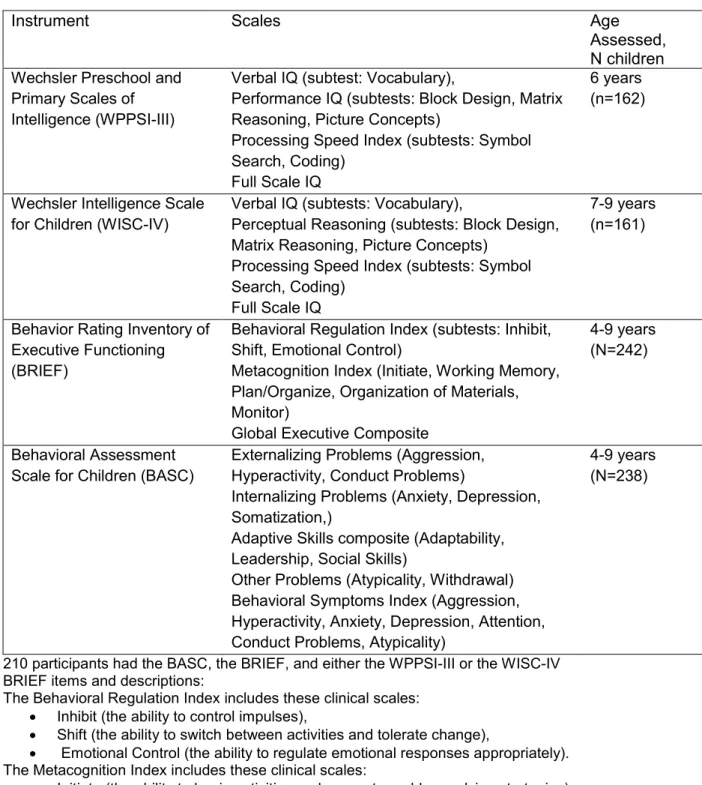
Participants were followed up when children were 4.5-5 years, 6-6.5 years, and 7-9 years of age. At follow-up, children were assessed for IQ, behavior, and executive function using validated and age-appropriate scales described below and in further detail in Table 4.
Wechsler Preschool and Primary Scale of Intelligence, 3rd edition (WPPSI-III), and
Wechsler Intelligence Scale for Children, 4th edition (WISC-IV) (n=210 children had scores from either the WPPSI or the WISC at 6-9 years; correlations between the WISC-IV and the WPPSI-III historically are 0.89) (Engel et al. 2011). Administered to children under the age of 7, the WPPSI-III provides measures of Verbal, Performance, Processing Speed, and Full-Scale IQ. The WISC-IV provides measures of Composite Verbal, Perceptual Reasoning, Working
Memory, Processing Speed, and Full-Scale IQ. These composite scales are also composed of subscales (see Table 4 for full lists).
Behavior Rating Inventory of Executive Functioning (BRIEF) (n=210 with a measurement at any time point). The BRIEF is an 86-item parent report questionnaire designed to assess executive cognitive function in children 5-18 years of age. Executive functions are used to achieve goals that require planning and holding in memory a multi-step sequence of thoughts or actions, to monitor and control attention and emotion, to inhibit inappropriate behaviors, and to formulate mental models based on life experiences. The BRIEF is composed of 8 clinical scales, including
1) Inhibit- ability to control impulses,
2) Shift- ability to transition between situations,
3) Emotional control- ability to modulate emotional responses, 4) Initiate- the ability to begin a task,
5) Working memory – the ability to retain information for task completion,
7) Organization of materials – the ability to keep workspace orderly, and
8) Monitor – the ability to assess personal performance and to register the effect of one’s own behavior on others.
These eight scales generate two broad indices: the Behavioral Regulation Index (BRI) and the Metacognition Index (MI). An overall score, the Global Executive Composite (GEC), is obtained from the raw scores for the MI and BRI.
Behavioral Assessment Scale for Children (BASC) (n=210 with a measurement at any point). The BASC is designed to evaluate problematic behaviors in children and adolescents 2.5 to 18 years of age. The BASC includes nine clinical scales to assess a child’s adaptive and problem behaviors in home and community settings. Parents respond to 130 items on a 4 point scale that ranges from never to almost always. Externalizing problems is a composite scale derived from the hyperactivity (including both hyperactivity and impulsivity items), aggression, and conduct problems scale items. Internalizing problems is a composite of the anxiety, depression, and somatization scale items. Three additional scales are attention problems, atypicality, and withdrawal. The adaptive behavior skills composite combines information from the adaptability, social skills, and leadership scale items. The Behavioral Symptoms Index (BSI) is the apical summary score that assesses the overall level of behavioral functioning.
Taken together, these instruments provide details on several aspects of
neurodevelopment, including IQ, behavior, and executive functioning. Table 4 describes the instruments used and when they were administered. All outcomes were analyzed as continuous variables.
Covariates
33
maternal smoking during pregnancy. All prenatal covariates were obtained through a questionnaire administered at the time of biomarker collection (mean gestational age 31.2 weeks). Child sex and other features of the delivery were determined through the perinatal database at the hospitals where they were delivered.
Data Analysis
The proposed aims seek to 1) comprehensively account for correlations among the outcomes and to reduce the dimensionality of these outcomes in a factor analysis, 2) to estimate associations between prenatal and early life characteristics and the
neurodevelopmental factors and to 3) consider OPs as part of a mixture, and to account for possible correlations and confounding by other xenobiotics in Bayesian hierarchical models.
Outcomes: Factor Analysis
Factor analysis (FA) allows items that are highly correlated with each other to cluster. The degree to which any given variable contributes to that overall factor is known as a factor loading. Squared factor loadings represent the amount of variance explained by any given variable for that factor. In deciding what factor loading values indicate an important variable, generally analysts use a rule of thumb of loadings > 0.3 to indicate important variables (Field, Miles, & Field, 2012). Loadings are also related to the eigenvalues, which indicate the
substantive importance of a factor. Relatively high eigenvalues indicate that a factor should be retained, while relatively low eigenvalues indicate that a factor should be discarded. A general rule of thumb that is commonly used dictates that eigenvalues above 1 should be retained, although more sophisticated methods are also available for choosing number of factors. A scree plot plots each eigenvalue against the factor with which it is associated, and generally is
characterized by a steep decline followed by a leveling off. In parallel analysis, a random dataset with the same number of observations and variables is drawn, eigenvalues are
dip below those from the randomly drawn data, this indicates that the later factors are mostly noise. We considered both the eigenvalue cutoff method and the factor solution that is one above and below the number indicated by parallel analysis.
Factor rotation methods impose either a correlated or uncorrelated structure on the factors. In etiological analyses, we primarily adopted an orthogonal varimax rotation, in order to assess associations with factors that are linearly independent of other neurodevelopmental domains. However, in Aim 1 we compared models using orthogonal rotation, oblique rotation, and instrument-specific composite scores, to evaluate the utility of adopting the varimax rotation.
Factor scores are assigned to each participant to measure how highly they rate on any given factor. For instance, if a participant scores highly on a factor that measures problems with attention, then that participant likely displays more problems with attention than the rest of the cohort. Similarly, if a participant has a low score on that factor, then she has fewer attention problems than the rest of the participants in that cohort. These scores can be extracted and used as outcomes in the Bayesian methods described in Chapter 3. To determine factor scores, we used the standardized factor score regression coefficients.
35 Association Models
For Aim 1, we used a series of multivariable linear regressions to estimate associations between prenatal exposure to smoking and other early life characteristics and
neurodevelopmental factors. Aim 2, however, involves correlated exposures with a potentially high number of variables relative to sample size. Linear regressions of models with such characteristics can produce effect estimates that are notoriously unstable and inflated.
Therefore, in Aim 2 we used a hierarchical Bayesian mixture model (BMM) to account for both correlated variables and to stabilize models with high numbers of parameters relative to the sample size (de Vocht et al. 2012; Herring 2010; Wakefield et al. 2010). Bayesian statistics allows for the incorporation of prior knowledge into analyses, typically with the result of shrinking effect estimates towards the specified prior and creating more precise posterior 95% intervals. In this dissertation, we shrunk estimates towards a mean of 0 with a variance of 1, and
performed sensitivity analyses where estimates were shrunk towards chemical class means. Exposure values below the LOD were modeled as truncated normal, with values above the LOD modeled using log normal distributions (Herring 2010). Missing covariate values were imputed using full information maximum likelihood methods under the missing-at-random assumption (MAR). Modeled outcomes were factor scores derived from structural equation models/factor analysis described further in Chapter 3.
Comparative Analyses
For comparison purposes, we also presented results from a traditional linear regression that considers associations between OPs and the composite scores of the instruments, along with the other instrument-specific items that comprise the factors. These models used
Table 3 Characteristics of Study Population at Enrollment and Follow Up, Mount Sinai Children's Environmental Health Cohort
Enrolled at Birth N=404
Followed-up ages 6-9
years N=1621
Not Followed-Up ages 6-9
years N=242 Maternal Age at delivery (years)
<20 142 (35.2) 50 (30.9) 92 (38.0) 20-24 132 (32.7) 55 (34.0) 77 (31.8)
≥25 130 (32.2) 57 (35.2) 73 (30.2)
Maternal Race/ethnicity
White 86 (21.3) 30 (18.5) 56 (23.1) Black/other 118 (29.2) 50 (31.9) 68 (28.1) Hispanic 200 (49.5) 82 (50.6) 118 (48.8)
Maternal Education during pregnancy
High School or Less 288 (71.8) 118 (73.3) 170 (70.8) Some College or higher 113 (28.2) 43 (26.7) 70 (29.2)
Marital Status during pregnancy2
Married 117 (29.0) 37 (22.8) 80 (33.1) Living with Partner 98 (24.3) 37 (22.8) 61 (25.2) Single/Divorced/Widowed 189 (46.8) 88 (54.3) 101 (41.7)
Alcohol use during pregnancy
None 337 (85.1) 132 (83.0) 205 (86.5)
Any 59 (14.9) 27 (17.0) 32 (13.5)
Smoking during pregnancy
No smoking during pregnancy 337 (83.4) 134 (82.7) 203 (83.9) Any smoking during pregnancy 67 (16.6) 28 (17.3) 39(16.1) Smoking only during 1st
trimester 46 (11.4) 17 (10.5) 29 (12.0) Any smoking during 2nd or 3rd
trimester 21 (5.2) 11 (6.8) 10 (4.1)
1 Population included in the multivariate adjusted regression models of associations between early life characteristics and the factor scores.
37
Table 4 Instruments Included in Factor Analysis of Behavior, Executive Functioning, and IQ
Instrument Scales Age
Assessed, N children Wechsler Preschool and
Primary Scales of Intelligence (WPPSI-III)
Verbal IQ (subtest: Vocabulary),
Performance IQ (subtests: Block Design, Matrix Reasoning, Picture Concepts)
Processing Speed Index (subtests: Symbol Search, Coding)
Full Scale IQ
6 years (n=162)
Wechsler Intelligence Scale for Children (WISC-IV)
Verbal IQ (subtests: Vocabulary),
Perceptual Reasoning (subtests: Block Design, Matrix Reasoning, Picture Concepts)
Processing Speed Index (subtests: Symbol Search, Coding)
Full Scale IQ
7-9 years (n=161)
Behavior Rating Inventory of Executive Functioning (BRIEF)
Behavioral Regulation Index (subtests: Inhibit, Shift, Emotional Control)
Metacognition Index (Initiate, Working Memory, Plan/Organize, Organization of Materials, Monitor)
Global Executive Composite
4-9 years (N=242)
Behavioral Assessment Scale for Children (BASC)
Externalizing Problems (Aggression, Hyperactivity, Conduct Problems)
Internalizing Problems (Anxiety, Depression, Somatization,)
Adaptive Skills composite (Adaptability, Leadership, Social Skills)
Other Problems (Atypicality, Withdrawal) Behavioral Symptoms Index (Aggression, Hyperactivity, Anxiety, Depression, Attention, Conduct Problems, Atypicality)
4-9 years (N=238)
210 participants had the BASC, the BRIEF, and either the WPPSI-III or the WISC-IV BRIEF items and descriptions:
The Behavioral Regulation Index includes these clinical scales: Inhibit (the ability to control impulses),
Shift (the ability to switch between activities and tolerate change),
Emotional Control (the ability to regulate emotional responses appropriately). The Metacognition Index includes these clinical scales:
Initiate (the ability to begin activities and generate problem-solving strategies), Working Memory (the ability to hold information when completing a task), Plan/Organize (the ability to set goals, develop steps, and anticipate events),
CHAPTER IV. EARLY LIFE CHARACTERISTICS AND NEURODEVELOPMENTAL PHENOTYPES IN THE MOUNT SINAI CHILDREN’S ENVIRONMENTAL HEALTH CENTER
Introduction
Neurodevelopment is a complex interdependent system, and yet epidemiological studies of neurodevelopment generally consider performance across dimensions of neurodevelopment in isolation. For example, studies may report on the relationship between a sociodemographic variable and childhood intelligence, executive functioning, or behavior, but not on all three dimensions simultaneously. Modern approaches have emphasized the need for “deep phenotyping” (Robinson, 2012). This approach uses statistical models that reflect the known complexity and interrelatedness of neurodevelopmental processes, and considers sources of variability within and across developmental or psychopathological domains (Baynam et al., 2015; Calkins et al., 2015; Robinson, 2012).
One statistical approach to deep phenotyping involves dimension reduction techniques, which take advantage of information in patterns of covariance across instruments. There are major conceptual advantages in jointly modeling domains of neurodevelopment. Accounting for interrelatedness between developmental domains may be more clinically relevant, since
39
Despite these co-occurring patterns, there is a trend in etiological studies to either focus on a holistic outcome such as ADHD, or to adopt a trait-driven approach and to assume
characteristics that such as anxiety or depression are independent. However, in a general population sample, a more nuanced approach that accounts for correlational patterns across traits may be more neurologically and clinically relevant.
Many perinatal, social, behavioral, environmental, and demographic characteristics have been associated with individual dimensions of neurodevelopment (Bradley, Caldwell, Rock, & Ramey, 1989; Gale et al., 2008; Indredavik, Brubakk, Romundstad, & Vik, 2007; Piper & Corbett, 2012; Willford, Leech, & Day, 2006). However, few etiological studies have attempted to jointly model domains of neurodevelopment while accounting for their interrelationships. As neurological capabilities scaffold into phenotypes during childhood, examining the associations between prenatal and early life characteristics and neurodevelopmental phenotypes may provide more insights into underlying etiological pathways. Our goal was to estimate associations between perinatal, social, demographic and behavioral characteristics and neurodevelopmental phenotypes while accounting for outcome interdependencies using a phenotyping approach.
Methods
Study Population
exclusions, there were 404 women with available birth data. Additionally, a small number of women who enrolled after birth and participated in follow-up visits are included in the neurodevelopmental factor analysis (n = 48). Participants were invited to return for
neurodevelopmental follow-up visits with their child at ages 1, 2, 4, 6, and 7-9 years (Figure 1).
Child Behavior and Executive Functioning
We measured children’s executive functioning with the Behavior Rating Inventory of Executive Functioning (BRIEF). The BRIEF is a parent-report assessment of the child’s
executive functioning (Gioia, Isquith, Guy, & Kenworthy, 2000), which consists of 86 items that are rated on a 3-level scale from “never” to “almost always”. Validity studies report good reliability with high test-retest reliability (mean rs=0.81 for parents across scales) and internal consistency (Cronbach’s alphas range from 0.80-0.98 across scales)(Gioia et al., 2000). Individual items are summarized into eight clinical scales and their age-normed T-scores. Clinical scales are then collapsed into two indices, which also include age-normed T-scores. The Behavioral Regulation Index includes the following three clinical scales: Inhibit (the ability to control impulses), Shift (the ability to switch between activities and tolerate change), and
Emotional Control (the ability to regulate emotional responses appropriately). The Metacognition Index includes five clinical scales: Initiate (the ability to begin activities and generate problem-solving strategies), Working Memory (the ability to hold information when completing a task), Plan/Organize (the ability to set goals, develop steps, and anticipate events), Organization of Materials (the ability to put work, play, and storage spaces in order), and Monitor (the ability to check one’s own work and performance). The Behavioral Regulation and Metacognition indices are then combined into one overarching Global Executive Composite score. Mothers completed the BRIEF at the 4, 6, and 7-9 year follow-up visits. We used the average T-scores across visits.