Supported Programming for Beginning Developers
A Thesis presented to
the Faculty of California Polytechnic State University, San Luis Obispo
In Partial Fulfillment
of the Requirements for the Degree Master of Science in Computer Science
by
COMMITTEE MEMBERSHIP
TITLE: Supported Programming for Beginning Developers
AUTHOR: Andrew Gilbert
DATE SUBMITTED: March 2019
COMMITTEE CHAIR: John Clements, Ph.D.
Professor of Computer Science
COMMITTEE MEMBER: Aaron Keen, Ph.D.
Professor of Computer Science
ABSTRACT
Supported Programming for Beginning Developers Andrew Gilbert
ACKNOWLEDGMENTS
• Thanks to Andrew Guenther for uploading this template. • GNU Parallel [49] was helpful in running many tests quickly.
TABLE OF CONTENTS
Page
LIST OF TABLES . . . viii
LIST OF FIGURES . . . ix
CHAPTER Glossary . . . xi
1 INTRODUCTION . . . 1
1.1 Operation . . . 2
1.2 Thesis Layout . . . 4
2 BACKGROUND . . . 6
2.1 Concolic Testing . . . 6
2.2 Directed Test Case Generation . . . 7
2.3 SMT Solvers. . . 8
3 METHODS . . . 16
3.1 Python . . . 16
3.2 Types. . . 17
3.2.1 Z3 Types. . . 17
3.2.2 Python Types . . . 18
3.2.3 Type Mapping . . . 19
3.3 Cartesian Product Algorithm . . . 20
3.4 Type System. . . 21
3.4.1 No Type System . . . 22
3.4.2 Statically CheckingAnyVariants . . . 22
3.4.3 Static Expression Extraction . . . 23
3.4.4 Type Checking . . . 24
3.5 Standard of Truth . . . 26
3.6 Function Substitution . . . 26
3.7 Preprocessor . . . 27
4 MODEL . . . 30
4.1 Overview . . . 30
4.1.1 SSA IR Reduction . . . 30
4.1.2 Compilation of SSA IR to Z3 Expressions . . . 31
4.2 Examples . . . 37
4.2.1 Identity Function. . . 37
4.2.2 Basic Expression in Function . . . 38
4.2.2.1 What about passing type sets down? . . . 39
4.2.3 Conditional . . . 40
4.2.4 Pairs and Mutation. . . 41
5 EVALUATION . . . 44
5.1 Grade Boosting . . . 45
5.2 Student Tests vs. TestBuilder Tests . . . 46
6 RESULTS . . . 48
6.1 Grade Boosting . . . 48
6.2 Student Tests vs. TestBuilder Tests . . . 48
6.3 Refactoring Legacy Code . . . 50
7 CAPABILITIES AND LIMITATIONS . . . 52
7.1 Capabilities . . . 52
7.2 Limitations . . . 54
8 TOOLS . . . 55
8.1 Libraries . . . 55
8.1.1 Dataclasses . . . 55
8.2 Testing . . . 56
8.2.1 pytest . . . 56
8.2.2 Hypothesis . . . 57
8.2.3 unittest.mock . . . 57
8.3 Typing . . . 62
8.3.1 mypy . . . 62
8.3.2 MonkeyType . . . 64
8.4 Debugging . . . 65
8.4.1 breakpoint(). . . 65
8.4.2 pdb . . . 65
8.4.3 Pdb++ . . . 65
8.4.4 Embedded IPython . . . 65
8.5 Formatting and Style. . . 66
8.5.1 Black. . . 66
8.5.2 isort . . . 67
8.5.3 flake8 . . . 67
8.5.4 Vulture . . . 67
8.6 CLI . . . 68
8.6.1 Docopt. . . 68
9 RELATED WORK . . . 69
9.1 Automatic Test Generation . . . 69
9.2 Concolic Testing . . . 74
10 FUTURE WORK . . . 76
10.1 Obvious Deficiencies. . . 76
10.2 Alternative Applications . . . 77
10.2.1 Property Proving. . . 77
10.2.2 Test Case Minimization . . . 77
10.3 Additional Capabilities . . . 77
10.3.1 Boundary Test Case Generation . . . 77
10.3.2 Concolic-style Testing . . . 78
10.3.3 Mutation-Driven Test Generation . . . 78
11 CONCLUSION . . . 79
LIST OF TABLES
Table Page
LIST OF FIGURES
Figure Page
1.1 Code under test. . . 3
1.2 TestBuilder interface.. . . 3
1.3 Generated test cases. . . 4
2.1 Simplified grammar of Z3 terms . . . 15
3.1 Rules without typing information . . . 22
3.2 Rules forBinOp Addwith static type checking . . . 23
3.3 Rule for addition with static extraction of values from wrappers. . . 23
3.4 Typechecking rule for addition . . . 24
3.5 Additional typechecking rules for addition with Any typed variables. . . . 24
3.6 Using a variable as both of its parent types. . . 29
4.1 Grammar of SSA IR . . . 31
4.2 Reduction of SSA IR . . . 32
4.3 Reduction of SSA IR expressions . . . 33
4.4 Definition of𝛿for SSA IR . . . 33
4.5 Compilation of binary operator. . . 37
6.1 Project breakdown . . . 49
6.2 Mutation killing performance of student and TestBuilder tests. . . 50
7.1 Not-quite type error . . . 54
8.1 Example pytest run on a module with inline tests . . . 58
8.3 Example Hypothesis inputs . . . 60 8.4 Example test usingunittest.mock. . . 61 8.5 Example of Python class with PEP 484 type annotations . . . 63 8.6 Stubs for golden masterLinkedListimplementation generated by
Glossary
Duck typing See definition in [38].
Chapter 1
Introduction
“Why write comments?” “Why write unit tests?” “It works — if it ain’t broke, don’t fix it.” While most programmers would agree on the importance of commenting or unit testing or refactoring, students may not understand the importance of these practices. Unit testing, in particular, seems like a waste of time, since running the program often suffices to remove the obvious bugs. But obvious bugs are obvious. The harder bugs to find are those caused by edge cases1and unexpected inputs. These require creativity and care on the part of the tester to catch. Computers are supremely uncreative, but they are very good at carefully trying everything. By applying computers to the problem of testing code, we can help students discover the unexpected edge cases which cause their programs to fail.
What does it mean to say that software “fails” or “has a bug?” One meaning of software “having a bug” is that the software crashes: it does an operation which is illegal, such as division by zero, or it throws an exception because some part of the code produces improper values. On the other hand, sometimes when we say that software is incorrect we mean that it does not perform as the user desires: perhaps a function which, instead of adding its inputs, multiplies them. How do we convert these concepts into rules which a computer can apply? The simplest rule is 1Recall that there are two hard problems in computer science: cache invalidation, naming things,
to find valid inputs on which the software terminates unexpectedly. But software can terminate correctly for every input and still never produce the desired result.
Automatically determining the desired result is challenging. It might seem that if programmers wrote better specifications, we could compare the software with them automatically. But Jack Reeves argues that software is itself the design which results from the software engineering process [41], much like how a blueprint is the result of a civil engineering process. The best documentation of how the software is to work is in fact its own source code. Nevertheless, we still want to find the logical inconsistencies or the incorrect behaviors that may be present in it.
This is the basis of software testing: providing a necessarily-incomplete specifi-cation of the intended behavior of the program, with the goal of discovering both logical inconsistencies and incorrect results. The programmer specifies that, given these inputs, the program should produce this output. Much effort has gone into finding ways to write more effective tests. Yet beginners struggle to do enough testing [13].
By automatically generating test cases which exercise every line in the program, we can assist beginning programmers in confirming that their code works, while reducing the burden of manually finding inputs which result in execution following a particular path. The program presented in this thesis, TestBuilder, is a small step toward that goal. It is able to generate test cases for a limited subset of Python which includes mutation but which does not include unbounded loops. The ideas in this work should be extensible to a subset of Python suitable for beginning programmers.
1.1
Operation
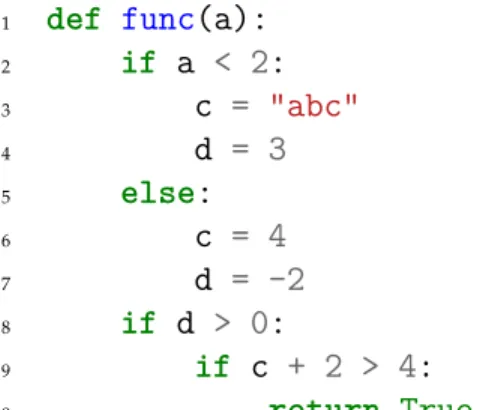
1 def func(a): 2 if a < 2: 3 c = "abc"
4 d = 3
5 else:
6 c = 4
7 d = -2
8 if d > 0:
9 if c + 2 > 4:
10 return True
Figure 1.1: Code under test.
Figure 1.2: TestBuilder interface.
error. Thus TestBuilder will fail to generate a test case for line 10, and will print out a note to the user. For lines 3, 4, 5, and 6, however, TestBuilder will generate test cases. The test cases for lines 3 and 4 and for lines 5 and 6 are expected to be duplicates of one another, as each pair of lines has the same set of conditionals needed to reach it.
func = import_module("clements_example").func def test_func():
a = 2
actual = func(a) expected = None
assert convert_result(actual) == expected func = import_module("clements_example").func def test_func_3():
a = 0
with pytest.raises(TypeError): func(a)
Figure 1.3: Generated test cases.
The resulting test cases are shown in fig. 1.3.2 Note that the duplicate test cases are omitted; there is an additional copy of each of the test cases shown for the other line in the pair, as discussed above. Also note that theexpectedvalue in the first test is exactly what we specified at the prompt in fig. 1.2 on the previous page. The second test case confirms that aTypeErroroccurs when we try to run the code with 𝑎 = 0. Both test cases are in pytest style. The unusual import technique involving import_moduleallows TestBuilder to handle files with names which are not valid Python identifiers. This could be easily changed to use thefrom file import name form, should that be considered more desirable.
1.2
Thesis Layout
Chapter 2 provides background information on the techniques we are using. Chap-ter 3 describes our approach to test case generation, which draws heavily on concolic testing. Chapter 4 presents a formal model of the compilation process we use. Chap-ter 5 presents the evaluations conducted on TestBuilder, while chapChap-ter 6 describes the results. Chapter 7 describes the specific abilities of TestBuilder. Chapter 8 presents
Chapter 2
Background
2.1
Concolic Testing
In their 2005 paper [23], Godefroid, Klarlund, and Sen present an early concolic testing tool named DART. Their tool integrates three factors: “[automated] extrac-tion of the interface of a program,” “[random] testing to simulate the most general environment the program can operate in,” and “dynamic analysis of how the pro-gram behaves under random testing and automatic generation of new test inputs to [direct] systematically the execution along alternative program paths.”
found are exhausted. At this point, complete path coverage has been achieved on the program, under optimal conditions.1
Notably lacking from the description above is any discussion of how a concolic tester determines whether the system under test is behaving as expected. DART, for example, looks for “program crashes, assertion violations, and non-termination.”
TestBuilder uses the concept of solving a list of conditionals with an SMT solver in order to choose inputs to reach a point in a program. However, rather than generating that list of conditionals dynamically during program execution, TestBuilder statically analyzes the program and converts the required conditionals into constraints for the SMT solver.
Due to the nature of the basic concolic algorithm, where all conditionals taken to reach a point are solved, concolic testing seeks full path coverage. TestBuilder, on the other hand, aims for full statement coverage. Thus, when constructing the expression to pass to the SMT solver, it includes the conditionals from every path which could lead to the desired statement. This allows the SMT solver to choose any path it desires when constructing a solution. By being careful about how the conversion is done, it avoids the exponential explosion of paths which might be expected.
2.2
Directed Test Case Generation
In order to support the generation of tests on code with existing test coverage, we designed TestBuilder to allow the user to choose specific lines to generate test cases for. Requesting a test case for a specific line causes TestBuilder to find all code paths that may reach that line and solve for inputs which follow one of them. The desire to 1One of the problems which can befall a concolic tester is if the code uses operations it cannot
support this use case makes concolic testing an extension of the current TestBuilder system, as directing concolic testing to a specific part of the code would require initial code analysis to determine the possible paths which would lead execution to the desired line. As a potential future adaptation, TestBuilder could be extended to support concolically executing one of the available paths. This would likely provide many of the benefits of concolic testing, while still allowing the user to only generate test cases for specific lines.
2.3
SMT Solvers
An SMT solver is used to solve for inputs which meet the required conditions to navigate to the desired line. SMT solvers use a system of theories combined with a SAT solver to find satisfying assignments of variables. Typically, SMT solvers support theories such as “integers,” allowing them to reason about expressions on integer values, rather than only the boolean logic SAT solvers are natively able to work with. In TestBuilder, we use the Z3 SMT solver, initially described by Moura and Bjørner [29].
One note on terminology: Z3 refers to the type of a variable as its sort. For simplicity, I will use type to refer to Z3 sorts below.
As an example of what an SMT solver can do, suppose we wish to find an integer that is less than fifty using Z3. We will need to do two things: declare a variable to represent some integer, and then constrain that variable to be less than fifty. Z3 can then be instructed to find a value for the variable which satisfies the constraints upon it. Using the Z3 bindings for Python, we would write2
import z3
x = z3.Int('x') # Create a new Z3 variable
z3.solve(x < 50) # Find a value for x which meets this constraint
This will print a solution to the expression provided tosolve, such as
𝑥 = 49
Notice that Z3 variables are declared with static types. Constructors likeIntare provided by Z3 for all of the built-in types. In Python, they will return special objects that have some Python operators redefined to produce Z3 values representing the symbolic result of the operations.
For example, the expressionx < 50is legal due to redefinition of the less-than operator on instances of Z3 integers in Python. Thus, the Python expressionx < 50 turns into an instance of a Z3 class representing the expression𝑥 < 50.
If we have multiple constraints, we can create logical expressions using provided Z3 logical operators:
z3.solve(z3.And(x > 38, x < 50))
This will require that𝑥 > 38and𝑥 < 50. A satisfying value for𝑥will be printed, such as
𝑥 = 49
Now suppose we also had some boolean constraints we wished to impose. Sup-pose that we want to find a boolean𝑏and an integer𝑥such that either𝑏 ∧ (𝑥 > 50) or¬𝑏. We could write something like this:
import z3
x = z3.Int('x') b = z3.Bool('b')
Z3 might then produce a result such as
𝑏 = 𝑇𝑟𝑢𝑒 𝑥 = 51
which satisfies this set of constraints.
As mentioned above, Z3 also supports custom datatypes, which are tagged unions. If we wish to describe a binary tree with integer leaves and no values on the interior nodes, we might write the following:
import z3
mktree = z3.Datatype('tree')
# The first argument is the name of the constructor, the other # arguments define the fields and their types. In this case, both # fields contain trees themselves.
mktree.declare('Node', ('left', mktree), ('right', mktree)) # z3.IntSort() defines the val field to store Z3 integers. mktree.declare('Leaf', ('val', z3.IntSort())
tree = mktree.create()
Functions likez3.IntSort(), used in the declaration ofLeaf, are provided by Z3 for all the built-in types it supports, allowing for the definition of fields that store values of those types. When defining a datatype, theDatatypeobject used to define it can also be used as the type of recursively defined fields, as seen in the definition ofNode.
which creates a new Leaf tree with34as its value.
The custom type also has methods to constrain variables of its type to only use certain constructors. For example, suppose we want a tree which has aNodeat the root, rather than being a singleLeaf. We would write
# This declares a variable of type Tree, just like z3.Int declares a # variable of type Int
t = z3.Const('t', tree)
z3.solve(tree.is_Node(t))
and Z3 might return something like
𝑡 =Node(Leaf(0),Leaf(1))
It chooses values to satisfy the constraint presented — in this case, requiring that the resulting value use theNodeconstructor oftree.
As mentioned above, Z3 is statically typed. However, custom datatypes offer a way to provide a sort of dynamic typing for Z3. We can define a type which can wrap values of various types, and then all the values can be treated as having one type. This is rather reminiscent of the Any types used in typecheckers for dynamic languages, such as the mypy typechecker for Python [30]:
import z3
mkany = z3.Datatype('Any')
# Make a constructor named Int which has one field, i, which holds # an integer
mkany.declare('Bool', ('b', z3.BoolSort())) Any = mkany.create()
Using this, we can declare a variable3of Any type: a = z3.Const('a', Any)
and we can now write a Z3 query such as # define a new variable of Any type a = z3.Const('a', Any)
z3.solve(Any.is_Int(a), Any.i(a) > 50)
to ask Z3 to choose a value for a which is an instance of theInt constructor containing a value for theifield which is greater than 50. This might produce a result like
𝑎 =Int(51)
which would mean that the expressions provided are satisfied ifais constructed with theIntconstructor and theifield of that constructor contains 51.
Notice that we used two constraints here: both that the value of thei field is greater than 50, and thataitself is constructed with theIntconstructor. If we omit this latter constraint, as here:
z3.solve(Any.i(a) > 50)
then Z3 will only apply the constraint if it happens to choose theIntconstructor fora. Running this, we get the result
3Z3 refers to variables as “constants;” for Z3, variables are the things quantified in first-order
𝑎 =Bool(𝐹𝑎𝑙𝑠𝑒)
which clearly is not the integer we would like to get. Thus, when using this technique to define dynamically-typed values, we need to add constraints on the constructors used for the result, as well as the constraints on the fields of those constructors.4
We use this form of definition for dynamic values extensively throughout Test-Builder. Thus, for the rest of this thesis, we will use the grammar defined in fig. 2.1 on page 15 to write the Z3 expressions involved.
Note that, in Z3, equality is defined between all types. This has been omitted from the grammar for clarity.
A few examples should clarify the use of this grammar.
First, consider our original example of searching for an integer less than 50. Using Python and our Any type, along with theavariable from before, we could express this as
z3.And(Any.is_Int(a), Any.i(a) < 50)
Running a solve on this in Z3 produces the result
𝑎 =Int(0)
4This appears to arise from the SMT-LIB specification, which Z3 supports as one of its input
formats. The specification reads
[Remark 11] (Partiality of selectors). As in classical first-order logic, all function symbols in a signatureΣare interpreted as total functions in aΣ-structureA. This means in particular that if𝑔 ∶ 𝜎𝜎𝑖∈ Σis a selector, the function𝑔Areturns a value
even for inputs outside the range of𝑔’s constructor. Definition 8 imposes no constraints on that value, other than it belongs to𝜎A
𝑖 . For instance, in a structureAwith a sort
for integer lists with constructors nil and insert and selectors head and tail for insert, the function headAmaps nilAtosomeinteger value. Similarly, tailAmaps nilAtosome
which is a zero wrapped in theIntconstructor of the Any type, a result which does indeed fulfill our constraints.
Using our new grammar, we can rewrite the input expression as
isInt? (𝑎) ∧ 𝑎i < 50
Notice the shorthand 𝑎i to represent field extraction of thei field of the Int constructor, and the isInt function to express the constraint that𝑎is an integer. All variables in this grammar are of Any type, thus we can assume that𝑎has Any type.
TheAny.Intconstructor is elided in this grammar. It can be inferred from the context: when an expression is applying an operation which can only be done on an instance of Any, such as assigning a value to a variable, assume the appropriate wrapper constructor is present.
For another example, consider how to write the expression𝑏 ∧ (𝑎 > 50) ∨ ¬𝑏 using our new Any type. We will need two variables,aandb. They will both be of Any type, butbwill need to be constrained to use theBoolconstructor andawill need to be constrained to use theIntconstructor. Thus, our expression will look like
𝐸𝑥𝑝𝑟 ∶∶= 𝐵𝑜𝑜𝑙 ∣ 𝛼 = 𝐴𝑛𝑦 ∣ 𝑠𝑡𝑜𝑟𝑒 = 𝑆𝑡𝑜𝑟𝑒 ∣ 𝐸𝑥𝑝𝑟 ∧ 𝐸𝑥𝑝𝑟 ∣ 𝐸𝑥𝑝𝑟 ∨ 𝐸𝑥𝑝𝑟
| isInt? (𝐴𝑛𝑦) ∣isBool? (𝐴𝑛𝑦) ∣isString? (𝐴𝑛𝑦) ∣isReference? (𝐴𝑛𝑦) 𝐴𝑛𝑦 ∶∶= 𝛼 ∣ 𝐵𝑜𝑜𝑙 ∣ 𝐼𝑛𝑡 ∣ 𝑅𝑒𝑎𝑙 ∣ 𝑆𝑡𝑟𝑖𝑛𝑔 ∣ 𝑅𝑒𝑓 ∣Nil
| 𝑃𝑎𝑖𝑟.left∣ 𝑃𝑎𝑖𝑟.right
𝐵𝑜𝑜𝑙 ∶∶= 𝐴𝑛𝑦b ∣ 𝑏𝑜𝑜𝑙 ∣ 𝐵𝑜𝑜𝑙 ∧ 𝐵𝑜𝑜𝑙 ∣ 𝐵𝑜𝑜𝑙 ∨ 𝐵𝑜𝑜𝑙 ∣ ¬𝐵𝑜𝑜𝑙 ∣ 𝐴𝑛𝑦 = 𝐴𝑛𝑦 | 𝐼𝑛𝑡 < 𝐼𝑛𝑡 ∣ 𝐼𝑛𝑡 ≤ 𝐼𝑛𝑡 ∣ 𝐼𝑛𝑡 > 𝐼𝑛𝑡 ∣ 𝐼𝑛𝑡 ≥ 𝐼𝑛𝑡
𝐼𝑛𝑡 ∶∶= 𝐴𝑛𝑦i ∣ 𝑖𝑛𝑡 ∣ −𝐼𝑛𝑡 ∣ 𝐼𝑛𝑡 + 𝐼𝑛𝑡 ∣ 𝐼𝑛𝑡 − 𝐼𝑛𝑡 ∣ 𝐼𝑛𝑡 ∗ 𝐼𝑛𝑡 ∣ 𝐼𝑛𝑡/𝐼𝑛𝑡 𝑅𝑒𝑎𝑙 ∶∶= 𝐴𝑛𝑦r ∣ 𝑟𝑒𝑎𝑙
𝑆𝑡𝑟𝑖𝑛𝑔 ∶∶= 𝐴𝑛𝑦s ∣ 𝑠𝑡𝑟𝑖𝑛𝑔 ∣Concat(𝑆𝑡𝑟𝑖𝑛𝑔, 𝑆𝑡𝑟𝑖𝑛𝑔) 𝑅𝑒𝑓 ∶∶= 𝐴𝑛𝑦r ∣ 𝑖𝑛𝑡
𝑆𝑡𝑜𝑟𝑒 ∶∶= 𝑠𝑡𝑜𝑟𝑒 ∣Empty ∣ 𝑆𝑡𝑜𝑟𝑒[𝑅𝑒𝑓 → 𝑃𝑎𝑖𝑟] 𝑃𝑎𝑖𝑟 ∶∶= Pair(𝐴𝑛𝑦, 𝐴𝑛𝑦) ∣ 𝑆𝑡𝑜𝑟𝑒[𝑅𝑒𝑓 ]
𝛼 ∈Names 𝑠𝑡𝑜𝑟𝑒 ∈StoreNames 𝑖𝑛𝑡 ∈ ℤ 𝑟𝑒𝑎𝑙 ∈ ℝ 𝑠𝑡𝑟𝑖𝑛𝑔 ∈Strings 𝑏𝑜𝑜𝑙 ∈ {true,false}
Chapter 3
Methods
TestBuilder seeks to generate inputs to a Python function which will result in the execution of a specified line of code. By doing this, we hope to create a series of inputs which, when combined, will produce a test suite with complete line coverage.
3.1
Python
3.2
Types
In contrast, as we mentioned before, Z3 requires that values be typed. Thus, we need to compare the types Python and Z3 use and determine the best mapping between them.
3.2.1 Z3 Types
Z3 provides a helpful range of supported types, along with custom data types, which are tagged unions. Of the built-in types, we use Int, Real, Bool, and String values. The Z3 documentation does not seem to make it clear what the precise semantics of its types are, but Moura and Bjørner’s original paper indicates that “the SMT-LIB input format” is supported [29]. We assume, therefore, that the semantics of Z3’s types are those described by the SMT-LIB standard, and experience seems to confirm this.
For the Int type, the SMT-LIB spec requires that models interpret “the sort Int as the set of all integer numbers [47]”1It also requires that division be implemented “according to Boute’s Euclidean definition” [9] (citation in original) and that nega-tion, addinega-tion, subtracnega-tion, and multiplication be implemented “as expected [47]”. Thus, we conclude that Z3’s Int type is intended to have the standard semantics of the integers, with the definitions for integer division and modulus being spelled out. Note that there are no bitwise operators defined for Int.
Similarly, for the Real type, the SMT-LIB spec requires that models interpret “the sort Real as the set of all real numbers [48]”, division “as a total function that coincides with the real division function for all inputs x and y where y is non-zero [48]”, and “the other function symbols of Reals as expected [48]”.
1Recall thatsortis the term used in logic for something like what is commonly called atypein
For booleans, the SMT-LIB spec requires the set of values to be{𝑡𝑟𝑢𝑒, 𝑓 𝑎𝑙𝑠𝑒}[46], and that “the other function symbols of Core denote the standard Boolean operators as expected [46]”
There is not a theory for strings in SMT-LIB. The Z3 C API provides a function Z3_mk_string_sort, which “creates a sort for ASCII strings. Each character is 8 bits [62].” This seems to indicate that Z3 strings are sequences of ASCII characters. We support only length and concatenation on strings. The functions for those seem to support the expected semantics of those operations: theLength function will “Obtain the length of a sequence ‘s’ [63]”, and the C API function called to actually
execute concatenation is said to “Concatenate sequences [62].”
3.2.2 Python Types
Python has an extensive set of built-in types [54]. However, the only ones of interest to us are None, integers, floats, booleans, and strings.
Python’s None value is a singleton of a unique type with one value [50].
Python’s Integer type provides “numbers in an unlimited range, subject to avail-able (virtual) memory only [50].”
Python floats “represent machine-level double precision floating point num-bers. You are at the mercy of the underlying machine architecture (and C or Java implementation) for the accepted range and handling of overflow [50].”
In Python, “…Boolean values behave like the values 0 and 1, respectively, in almost all contexts, the exception being that when converted to a string, the strings ”False” or ”True” are returned, respectively [50].”
3.2.3 Type Mapping
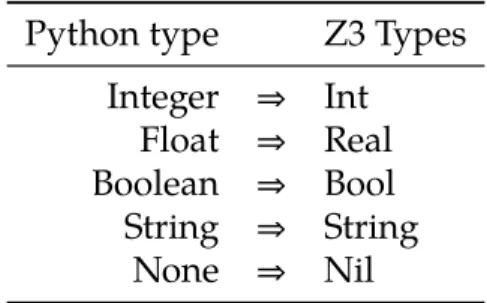
We need to represent Python types with the appropriate types from Z3, in order to be able to translate between the two languages. The mapping we chose is described below and summarized in table 3.1 on the next page.
We chose to represent Python’s integers with Z3 Ints. This is the most correct type available from a theoretical standpoint, because Python integers, as noted above, are of unlimited length, and therefore no overflow effects should be observable.
Having chosen Ints to represent Python integers, we were forced to model Python floats with Z3 Reals. This is not ideal, as Z3 supports a true floating-point type, which should more closely align to the semantics of the Python implementation. However, there are no functions available in Z3 to translate directly between integer expressions and floating-point expressions. 2 Thus, we would be unable to intermix the types in expressions, which would prevent us from translating some expressions which are legal in Python. Z3 Reals seem like the best compromise, particularly as we do not anticipate user code relying on the differences between floating-point numbers and true reals.
Naturally, Python’s Boolean values were modeled with Z3’s Boolean values. The None type is translated to a Nil constructor of no arguments which is present on the Z3 datatype we use as an Any type, following the pattern described in section 2.3 on page 8.
Python strings are translated to Z3’s String type. Since only two operations are available for strings, concatenation and length, they are translated directly to their Z3 equivalents. As mentioned before, Z3 strings are ASCII. If a string literal is used which contains non-ASCII characters, it will crash TestBuilder. We accept this. If a 2There do exist functions to convert integer values to real values, and functions to convert real
Table 3.1: Mapping from Python to Z3 types.
Python type Z3 Types Integer ⇒ Int
Float ⇒ Real Boolean ⇒ Bool
String ⇒ String None ⇒ Nil
string were to somehow be constrained to contain non-ASCII characters without using a literal, TestBuilder would simply be unable to find a test case.
3.3
Cartesian Product Algorithm
triggering a type error would be counter-productive. Thus, we choose only type tuples such that no type errors will occur. By doing this, we are able to reduce the number of possible cases from the square of the number of available types (currently five, for a total of52possible type tuples) to two: aandbare integers andaandb
are strings.
3.4
Type System
As described in section 3.3 on the previous page, TestBuilder does Cartesian prod-uct type inference in order to handle Python’s dynamic type system. In theory, we could do Cartesian product inference separately for every partial expression, returning values to Any type between operations, but by tracking the type of each subexpression, we can generate much cleaner expressions. As we will show below, this optimization is almost free.
Note that this type tracking is only necessary for optimization purposes. We do not need to track types for correctness, as Z3 internally requires that variables have consistent types throughout an expression.
Also note that the typing judgments presented below are non-standard. Rather than indicating that an expression has a type, they indicate that an expression may have a type. Because the goal of this type system is to allow solving for values which satisfy all the type constraints upon an expression, this is sufficient information.
𝑖 ⇓Int(𝑖)
𝑒1 ⇓ 𝑣1 𝑒2 ⇓ 𝑣2
BinOp(𝑒1,Add, 𝑒2) ⇓⎧{⎨ { ⎩
𝑣𝑖1+ 𝑣𝑖2 isInt? (𝑣1) ∧isInt? (𝑣2)
Concat(𝑣𝑠1, 𝑣𝑠2) isString? (𝑣1) ∧isString? (𝑣2)
Figure 3.1: Rules without typing information
Note: values are Any structures, as defined in fig. 2.1 on page 15 and the expressions are e structures, as defined in fig. 4.1 on page 31.
3.4.1 No Type System
In the completely dynamic case, we would wrap each sub-expression in an Any type, and then extract the correct type for the next operation. Simple addition, such as 1 + 2would use the two rules shown in fig. 3.1 to generate an expression something like this:
⎧ { { ⎨ { { ⎩
Int((Int(1))𝑖+ (Int(2))𝑖) isInt? (Int(1)) ∧isInt? (Int(2))
String(Concat((Int(1))𝑠, (Int(2))𝑠)) isString? (Int(1)) ∧isString? (Int(2)) (3.1) The case for strings might surprise you, but because + is the concatenation operator in Python, and we have no typing information, we are forced to generate cases for both possible types which could be in the Any values (even though those values are staticallyIntAny values).
Notice how we’re forced to dynamically check the types of values we can statically determine the type of.
3.4.2 Statically CheckingAnyVariants
𝑒1 ⇓ 𝑣1 𝑒2 ⇓ 𝑣2 isInt?(𝑣1) isInt?(𝑣2)
BinOp(𝑒1,Add, 𝑒2) ⇓Int(𝑣𝑖1+ 𝑣𝑖2)
𝑒1 ⇓ 𝑣1 𝑒2 ⇓ 𝑣2 isString?(𝑣1) isString?(𝑣2)
BinOp(𝑒1,Add, 𝑒2) ⇓String(Concat(𝑣𝑠1, 𝑣𝑠2))
Figure 3.2: Rules forBinOp Addwith static type checking
Values are as in fig. 3.1 on the preceding page; the isInt? and isString? functions checks at compile time that a value is an Any Int or String wrapper, respectively.
𝑒1 ⇓ 𝑣1 𝑒2 ⇓ 𝑣2 isInt?(𝑣1) isInt?(𝑣2) 𝑖1 =int(𝑣1) 𝑖2 =int(𝑣2) BinOp(𝑒1,Add, 𝑒2) ⇓ 𝑖1+ 𝑖2
Figure 3.3: Rule for addition with static extraction of values from wrappers Values and functions are as in fig. 3.2; the int function extracts an integer value from an Int
wrapper at compile time.
Int((Int(1))𝑖+ (Int(2))𝑖) (3.2)
Notice that we are now able to omit theisInt? checks, because we can statically determine that the values are integers.
3.4.3 Static Expression Extraction
We might want to execute the extraction from the 𝐼𝑛𝑡 wrapper at compile time as well, by swapping our addition rule to that in fig. 3.3. This gives us the result expression
⊢ 𝑖 ∶ 𝑖𝑛𝑡
⊢ 𝑒1 ∶ 𝑖𝑛𝑡 ⊢ 𝑒2 ∶ 𝑖𝑛𝑡
⊢BinOp(𝑒1,Add, 𝑒2) ∶ 𝑖𝑛𝑡
⊢ 𝑒1 ∶ 𝑠𝑡𝑟 ⊢ 𝑒2 ∶ 𝑠𝑡𝑟
⊢BinOp(𝑒1,Add, 𝑒2) ∶ 𝑠𝑡𝑟
Figure 3.4: Typechecking rule for addition
⊢ 𝛼 ∶ 𝑎𝑛𝑦
⊢ 𝑒 ∶ 𝑎𝑛𝑦 ⊢ 𝑒 ∶ 𝑖𝑛𝑡
Figure 3.5: Additional typechecking rules for addition with Any typed variables
3.4.4 Type Checking
From here, it is a simple observation to note that we could omit the wrapper and check the type of the subexpressions directly using the typechecking rule in fig. 3.4, obtaining this expression:
1 + 2
We started with no types and built a simple type system in order to reduce clutter in the generated expressions. Introducing variables of indeterminate type, such as function arguments, causes an interesting wrinkle. We can no longer statically check which form of addition is intended by the author, so we need to maintain two possible interpretations of the expression, one for strings and one for integers. In addition, we need to constrain the type of the variables to be in accord with the interpretation used in the expression. By adding the rule shown in fig. 3.5 to the rules in fig. 3.4, we enable type checking of expressions with Any type:
⎧ { { ⎨ { { ⎩
Int(𝑎𝑖+ 𝑏𝑖) isInt? (𝑎) ∧isInt? (𝑏)
String(Concat(𝑎𝑠, 𝑏𝑠)) isString? (𝑎) ∧isString? (𝑏)
Recall that isInt and isString are Z3 constraints as in eq. (3.1) on page 22, rather than compile-time checks.
Now we have two possible expressions, and we need to carry them around together and handle both possibilities when compiling. If we are assigning the result of this expression to a variable, as in𝑐 = 𝑎 + 𝑏, we would get the expression
(𝑐 =Int(𝑎𝑖+ 𝑏𝑖) ∧ 𝑖𝑠𝐼𝑛𝑡(𝑎) ∧ 𝑖𝑠𝐼𝑛𝑡(𝑏)) ∨
(𝑐 =String(Concat(𝑎𝑠, 𝑏𝑠)) ∧ 𝑖𝑠𝑆𝑡𝑟𝑖𝑛𝑔(𝑎) ∧ 𝑖𝑠𝑆𝑡𝑟𝑖𝑛𝑔(𝑏))
(3.5)
Suppose, on the other hand, that the entire line was𝑐 = 1 + (𝑎 + 𝑏). Now we can tell that only the integer solution will be well-typed, and we can generate the following:
{𝑐 =Int(1 + (𝑎𝑖+ 𝑏𝑖)) 𝑖𝑠𝐼𝑛𝑡(𝑎) ∧ 𝑖𝑠𝐼𝑛𝑡(𝑏) (3.6)
There is no other possible value. Since, as explained above, we need to avoid generating type errors, we cannot use the String interpretation.
3.5
Standard of Truth
As described in section 9.2, many concolic testing tools rely on crashes to determine the correct result of user code. In our case, we want to generate test cases for the user. Further, we would like to identify incorrect code which doesn’t crash. Thus, we need a stronger standard of truth than merely “does the code crash.” We chose to ask the user for the expected results of each test case. This allows us to generate test cases which are based on examples and check that the code produces the expected result. By asking the user what the expected output is, we encourage them to think about what their code is actually expected to do in a concrete context. We hope that this will help them discover even more bugs, via a similar process to rubber duck debugging [26]. In addition, even though we don’t have any way to generate test cases for missing conditions, there is a possibility that, by automatically generating test cases, we will hit upon values which the user would not have considered and will expose unknown bugs.
3.6
Function Substitution
Some preliminary testing suggested that defining functions in Z3 led to significantly longer solving times than substituting their definitions into the result expressions. It would be preferable to define the functions in Z3, as this would allow proper support for recursive functions (at the cost of no longer being a decision procedure, since it seems function definitions require universal quantification). In the interest of execution speed, however, TestBuilder does substitution of called functions to a depth of one.3 When a function is encountered which has not been substituted with its definition, either because of the depth limit or because of a lack of a definition, 3I.e., it substitutes known functions in the code under test, but not functions appearing within
TestBuilder treats the function as producing whatever return value is desirable. Note that this is not treating the function as returning an arbitrary value; to do so would result in type errors which would only be present in TestBuilder when the real function implementation does not produce some values. An alternative to this would be to refuse to generate tests for functions with missing definitions, but, due to the limitation on substitution depth, this would result in TestBuilder being unable to generate test cases for recursive functions.
3.7
Preprocessor
TestBuilder provides support for aPairclass which stores two values. ThisPair has two attributes: left andright. Student code, however, may use internally-consistent but different names for its equivalent data structures. In order to support testing such code, we provide a preprocessor. This preprocessor is able to rewrite parts of the AST of the user’s code before test case generation, in order to adjust it to the configuration used by TestBuilder. For example, the user may define a rewrite rule which specifies that any attribute named “first” is to be rewritten to “left”, and that any attribute named “rest” is to be rewritten to “right.” Adding these as preprocessor rules means that the preprocessor will rewrite the code before tests are generated.
code with an object with answers to all the methods which are called on it, perhaps by subclassing both the classes the value is treated as. Such as subclass would pass evenisinstancetests. See fig. 3.6 on the following page for an example.
As a result, the preprocessor should be viewed as a stop-gap measure designed to increase compatibility with user code, rather than as a permanent solution. It does not map attributes semantically, changing the internal name of the attribute in TestBuilder. Rather, it modifies code on-the-fly to follow TestBuilder’s expected conventions, without permanent changes, allowing semantically-equivalent con-structions to be unified to the format supported by TestBuilder. Ultimately, support for custom objects would eliminate the need for this preprocessor.
Code class TypeA:
def __init__(self, a):
self.a = a
class TypeB:
def __init__(self, b):
self.b = b
def uses_both(val):
if isinstance(val, TypeA):
print(val.a)
if isinstance(val, TypeB):
print(val.b)
class TypeBoth(TypeA, TypeB):
def __init__(self, a, b):
super().__init__(a)
self.a = a
self.b = b
val = TypeBoth(1, 2)
uses_both(val)
Result
python3 multireference.py
1 2
Chapter 4
Model
4.1
Overview
We convert a Python AST into a loop-free SSA [42, 2] IR, adding phi nodes at join points and substituting functions with their definitions. The resulting IR grammar is defined in fig. 4.1 on the next page.
4.1.1 SSA IR Reduction
Reduction on the IR is defined by 𝐯, as defined in fig. 4.2 on page 32 using 𝐞as defined in fig. 4.3 on page 33. 𝐯 is a mapping from a basic block, a list of basic blocks, a store (𝜎), and an environment (𝜌) to a basic block, a list of basic blocks, a store, and an environment. 𝐞is a mapping from an expression, a store (𝜎), and an environment (𝜌) to modified versions. Note that the environment is never modified by an expression, although the store may be. This occurs when a Pair is created, which requires allocation from the store.
𝐵𝑎𝑠𝑖𝑐𝐵𝑙𝑜𝑐𝑘 ∶∶= BB([𝑆𝑡𝑎𝑡𝑒𝑚𝑒𝑛𝑡, … ], 𝑛𝑒𝑥𝑡) ∣Result(𝑣) 𝑆𝑡𝑎𝑡𝑒𝑚𝑒𝑛𝑡 ∶∶= Set(𝑖𝑑, 𝑒) | Assert(𝑒)| Setattr(𝑒, 𝑎𝑐𝑐𝑒𝑠𝑠, 𝑒)
𝑛𝑒𝑥𝑡 ∶∶= Next(𝑖) ∣ReturnExpr(𝑒) ∣Return∣Conditional(𝑒, 𝑖, 𝑖) 𝑒 ∶∶= 𝑣 ∣BinOp(𝑒, 𝑜𝑝, 𝑒) ∣USub(𝑒) ∣ (𝑒) ∣ 𝛼
| Attr(𝑒, 𝑎𝑐𝑐𝑒𝑠𝑠)
𝑣 ∶∶= 𝑖 ∣ 𝑠 ∣ 𝑏 ∣ 𝑓 ∣None∣Pair(𝑒, 𝑒)
𝑜𝑝 ∶∶=Add∣Sub∣Mult∣Div∣Lt∣LtE∣Gt∣GtE∣Eq ∣And∣Or 𝑎𝑐𝑐𝑒𝑠𝑠 ∶∶=left∣right
𝛼 ∈ 𝑖𝑑 𝑖 ∈ ℤ 𝑠 ∈ 𝑙𝑜𝑛𝑔𝑠𝑡𝑟𝑖𝑛𝑔𝑖𝑡𝑒𝑚∗ 𝑏 ∈ {true,false} 𝑓 ∈Float Figure 4.1: Grammar of SSA IR
Definitions:
𝑖𝑑is the set of valid Python identifiers, as defined by [51].
𝑙𝑜𝑛𝑔𝑠𝑡𝑟𝑖𝑛𝑔𝑖𝑡𝑒𝑚is the set of valid characters in a Python triple-quoted string, as defined by [52].
Next and Conditional use indices into the list of basic blocks to indicate the block to jump to.
4.1.2 Compilation of SSA IR to Z3 Expressions
During compilation, the enclosing function for the specified line is converted into the language of the Z3 SMT solver. Z3 is then used to solve the resulting expression, and the variables representing the function arguments are extracted. A simplified grammar of Z3 expressions was presented in fig. 2.1 on page 15 and will be reused here.
For the purposes of exposition in this section, all sub-expressions have been treated as being executed and converted immediately back into Z3 Any types. This leads to many small assignments and avoids the need to model a type system. In addition, this means that larger expressions become a chain of assignments, all Anded together.
⟨[𝛽1, … ], [], [], []⟩ 𝐯 ⟨𝛽1, [𝛽1, … ], [], []⟩
⟨BB([Set(𝑖𝑑, 𝑒), 𝑠, … ], 𝑛𝑒𝑥𝑡), 𝛽, 𝜎, 𝜌⟩ 𝐯 ⟨BB([𝑠, … ], 𝑛𝑒𝑥𝑡), 𝛽, 𝜎, 𝜌[𝑖𝑑 → 𝑣]⟩ if ⟨𝑒, 𝜎, 𝜌⟩ 𝐞 ⟨𝑣, 𝜎1, 𝜌⟩ ⟨BB([Setattr(𝑡,left, 𝑒), 𝑠, … ], 𝑛𝑒𝑥𝑡), 𝛽, 𝜎, 𝜌⟩ 𝐯 ⟨BB([𝑠, … ], 𝑛𝑒𝑥𝑡), 𝛽, 𝜎2[𝑟 → 𝑣], 𝜌⟩
if ⟨𝑒, 𝜎, 𝜌⟩ 𝐞 ⟨𝑣, 𝜎1, 𝜌⟩ ⟨𝑡, 𝜎1, 𝜌⟩ 𝐞 ⟨𝑡𝑣, 𝜎2, 𝜌⟩ ⟨BB([Setattr(𝑡,right, 𝑒), 𝑠, … ], 𝑛𝑒𝑥𝑡), 𝛽, 𝜎, 𝜌⟩ 𝐯 ⟨BB([𝑠, … ], 𝑛𝑒𝑥𝑡), 𝛽, 𝜎2[𝑟 → 𝑣], 𝜌⟩
if ⟨𝑒, 𝜎, 𝜌⟩ 𝐞 ⟨𝑣, 𝜎1, 𝜌⟩ ⟨𝑡, 𝜎1, 𝜌⟩ 𝐞 ⟨𝑡𝑣, 𝜎2, 𝜌⟩ ⟨BB([Assert(𝑒), 𝑠, … ], 𝑛𝑒𝑥𝑡), 𝛽, 𝜎, 𝜌⟩ 𝐯 ⟨BB([𝑠, … ], 𝑛𝑒𝑥𝑡), 𝛽, 𝜎1, 𝜌⟩
if ⟨𝑒, 𝜎, 𝜌⟩ 𝐞 ⟨true, 𝜎1, 𝜌⟩ ⟨BB([Assert(𝑒), 𝑠, … ], 𝑛𝑒𝑥𝑡), 𝛽, 𝜎, 𝜌⟩ 𝐯 ⊥ if ⟨𝑒, 𝜎, 𝜌⟩ 𝐞 ⟨false, 𝜎1, 𝜌⟩
⟨BB([],Next(𝑖)), 𝛽, 𝜎, 𝜌⟩ 𝐯 ⟨𝛽𝑖, 𝛽, 𝜎, 𝜌⟩
⟨BB([],ReturnExpr(𝑒)), 𝛽, 𝜎, 𝜌⟩ 𝐯 ⟨Result(𝑣), 𝛽, 𝜎1, 𝜌⟩ if ⟨𝑒, 𝜎, 𝜌⟩ 𝐞 ⟨𝑣, 𝜎1, 𝜌⟩
⟨BB([],Return), 𝛽, 𝜎, 𝜌⟩ 𝐯 ⟨Result(None), 𝛽, 𝜎, 𝜌⟩
⟨BB([],Conditional(𝑒, 𝑖, 𝑗)), 𝛽, 𝜎, 𝜌⟩ 𝐯 ⟨𝛽𝑖, 𝛽, 𝜎1, 𝜌⟩ if ⟨𝑒, 𝜎, 𝜌⟩ 𝐞 ⟨true, 𝜎1, 𝜌⟩
⟨BB([],Conditional(𝑒, 𝑖, 𝑗)), 𝛽, 𝜎, 𝜌⟩ 𝐯 ⟨𝛽𝑗, 𝛽, 𝜎1, 𝜌⟩
if ⟨𝑒, 𝜎, 𝜌⟩ 𝐞 ⟨false, 𝜎1, 𝜌⟩
Figure 4.2: Reduction of SSA IR
⟨𝑃𝑎𝑖𝑟(𝑙𝑒𝑓 𝑡, 𝑟𝑖𝑔ℎ𝑡), 𝜎, 𝜌⟩ 𝐞 ⟨𝑘, 𝜎2[𝑘 → 𝑃𝑎𝑖𝑟(𝑙𝑣, 𝑟𝑣)], 𝜌⟩ if
⟨𝑙𝑒𝑓 𝑡, 𝜎, 𝜌⟩ 𝐞 ⟨𝑙𝑣, 𝜎1, 𝜌⟩ ∧
⟨𝑟𝑖𝑔ℎ𝑡, 𝜎1, 𝜌⟩ 𝐞 ⟨𝑟𝑣, 𝜎2, 𝜌⟩ ∧
𝑘is a fresh index ⟨𝛼, 𝜎, 𝜌⟩ 𝐞 ⟨𝜎[𝛼], 𝜎, 𝜌⟩
⟨BinOp(𝑙, 𝑜𝑝, 𝑟), 𝜎, 𝜌⟩ 𝐞 ⟨𝛿(𝑜𝑝, 𝑙𝑣, 𝑟𝑣), 𝜎2, 𝜌⟩ if ⟨𝑙, 𝜎, 𝜌⟩ 𝐞 ⟨𝑙𝑣, 𝜎1, 𝜌⟩ ∧ ⟨𝑟, 𝜎1, 𝜌⟩ 𝐞 ⟨𝑟𝑣, 𝜎2, 𝜌⟩
⟨USub(𝑒), 𝜎, 𝜌⟩ 𝐞 ⟨𝛿(−, 𝑣), 𝜎1, 𝜌⟩ if ⟨𝑒, 𝜎, 𝜌⟩ 𝐞 ⟨𝑣, 𝜎1, 𝜌⟩
⟨ (𝑒), 𝜎, 𝜌⟩ 𝐞 ⟨𝛿(not, 𝑣), 𝜎1, 𝜌⟩ if ⟨𝑒, 𝜎, 𝜌⟩ 𝐞 ⟨𝑣, 𝜎1, 𝜌⟩
⟨Attr(𝑒,left), 𝜎, 𝜌⟩ 𝐞 ⟨𝑙, 𝜎1, 𝜌⟩ if ⟨𝑒, 𝜎, 𝜌⟩ 𝐞 ⟨Pair(𝑙, 𝑟), 𝜎1, 𝜌⟩
⟨Attr(𝑒,right), 𝜎, 𝜌⟩ 𝐞 ⟨𝑟, 𝜎1, 𝜌⟩ if ⟨𝑒, 𝜎, 𝜌⟩ 𝐞 ⟨Pair(𝑙, 𝑟), 𝜎1, 𝜌⟩
Figure 4.3: Reduction of SSA IR expressions
Note:𝛿is defined in fig. 4.4. Values are as defined in fig. 4.1 on page 31. See text for description of𝐯,𝐞,𝜎and𝜌.
𝛿(Add, ⌜𝑚⌝, ⌜𝑛⌝) = ⌜𝑚 + 𝑛⌝ 𝛿(Sub, ⌜𝑚⌝, ⌜𝑛⌝) = ⌜𝑚 − 𝑛⌝ 𝛿(Mult, ⌜𝑚⌝, ⌜𝑛⌝) = ⌜𝑚 ⋅ 𝑛⌝
𝛿(Div, ⌜𝑚⌝, ⌜𝑛⌝) = ⌜𝑚/𝑛⌝ 𝛿(Lt, ⌜𝑚⌝, ⌜𝑛⌝) = ⌜𝑚 < 𝑛⌝ 𝛿(LtE, ⌜𝑚⌝, ⌜𝑛⌝) = ⌜𝑚 ≤ 𝑛⌝ 𝛿(Gt, ⌜𝑚⌝, ⌜𝑛⌝) = ⌜𝑚 > 𝑛⌝ 𝛿(GtE, ⌜𝑚⌝, ⌜𝑛⌝) = ⌜𝑚 ≥ 𝑛⌝ 𝛿(Eq, ⌜𝑚⌝, ⌜𝑛⌝) = ⌜𝑚 = 𝑛⌝ 𝛿(And, ⌜𝑚⌝, ⌜𝑛⌝) = ⌜𝑚 ∧ 𝑛⌝ 𝛿(Or, ⌜𝑚⌝, ⌜𝑛⌝) = ⌜𝑚 ∨ 𝑛⌝
Figure 4.4: Definition of𝛿for SSA IR
𝜖 ⟦𝑥⟧ is a function mapping the location tag ⟦𝑥⟧ to a variable. At times, this location tag will be represented with Python syntax, which is to be understood to refer to the tag on that expression after conversion to SSA form.
The 𝛾(𝛼) function maps from a Python name to a Z3 name. To distinguish variable names deriving from Python from those added by TestBuilder, the imple-mentation adds a prefix ofpyname_to each of the original variables when converting to the SSA IR.𝛾(𝛼)may be considered to add such a prefix.
Compilation of reference types into the SMT domain requires a store, in order to handle aliasing of references. If we model a mutable reference type without a store, mutation of the referenced value in one aliased variable will not mutate the value referenced by its alias. For the current version of TestBuilder, we have only implemented support for pairs, although it should be possible to extend to tuples of other lengths.
The store is modeled as a Z3 array indexed by an integer𝑖. Allocation of store indices occurs statically at compile time for variables with store accesses: those where one of the subscripts is referenced. Variables for which no type restriction prevents them from being references, but which also do not have store accesses, will not have store locations allocated. As the store is never accessed, this does not affect the result of the computation.
We begin with function compilation. Function compilation is the result of com-piling the first basic block in the function and following labels from it to other basic blocks, which are then also compiled.
Several forms of basic block exist. We can have a simple code block, which also holds the label of the next block:
𝐶𝐵𝐵(BB(𝑠𝑡𝑚𝑡𝑠,Next(𝑗)), [𝛽1, … , 𝛽𝑛]) =
𝐶𝐵𝑜𝑑𝑦(𝑠𝑡𝑚𝑡𝑠)
∧𝐶𝐵𝐵(𝛽𝑗, [𝛽1, … , 𝛽𝑛])
(4.2)
Or we can have a return expression block, which terminates the function and returns a value:
𝐶𝐵𝐵(BB(𝑠𝑡𝑚𝑡𝑠,ReturnExpr(𝑒)), [𝛽1, … , 𝛽𝑛]) = 𝐶𝐵𝑜𝑑𝑦(𝑠𝑡𝑚𝑡𝑠) ∧ (𝑟𝑒𝑡 = 𝜖 ⟦𝑒⟧) ∧ 𝐶𝐸(𝑒) (4.3) Or the simple return block, which terminates the function and does not return a value:
𝐶𝐵𝐵(BB(𝑠𝑡𝑚𝑡𝑠,Return), [𝛽1, … , 𝛽𝑛]) = 𝐶𝐵𝑜𝑑𝑦(𝑠𝑡𝑚𝑡𝑠) (4.4)
Finally, we may have a conditional block, which evaluates an expression and goes to one of two labels depending on its value. The conditional block is converted into a disjunction, with one expression for each of its branches:
𝐶𝐵𝐵(BB(𝑠𝑡𝑚𝑡𝑠,Conditional(𝑒, 𝑖, 𝑗)), [𝛽1, … , 𝛽𝑛]) = 𝐶𝐵𝑜𝑑𝑦(𝑠𝑡𝑚𝑡𝑠)
∧𝐶𝐸(𝑒)
∧⎛⎜⎜⎜⎜ ⎝
(𝜖 ⟦𝑒⟧ ∧ 𝐶𝐵𝐵(𝛽𝑖, [𝛽1, … , 𝛽𝑛])) ∨ (¬𝜖 ⟦𝑒⟧ ∧ 𝐶𝐵𝐵(𝛽𝑗, [𝛽1, … , 𝛽𝑛]))
⎞ ⎟ ⎟ ⎟ ⎟ ⎠
To compile the body of a basic block, we form a conjunction of all the assignment statements in it, along with the assertions in it:
𝐶𝐵𝑜𝑑𝑦(𝑠𝑡𝑚𝑡𝑠) = ⋀
𝑠𝑒𝑡∈𝑠𝑡𝑚𝑡𝑠
𝐶𝑆𝑒𝑡(𝑠𝑒𝑡) ∧ ⋀
𝐴𝑠𝑠𝑒𝑟𝑡(𝑒)∈𝑠𝑡𝑚𝑡𝑠
𝐶𝐸(𝑒) ∧ 𝜖 ⟦𝑒⟧ (4.6)
The right hand side of each assignment statement is compiled:
𝐶𝑆𝑒𝑡(Set(𝛼, 𝑒)) = (𝛼 = 𝜖 ⟦𝑒⟧ ∧ 𝐶𝐸(𝑒)) (4.7)
Compilation of simple values proceeds as expected: Integers, strings, and booleans all compile to their corresponding Z3 objects:
𝐶𝐸(𝑖) = (𝜖 ⟦𝑖⟧ = 𝑖) (4.8)
𝐶𝐸(𝑠) = (𝜖 ⟦𝑠⟧ = 𝑠) (4.9)
𝐶𝐸(𝑏) = (𝜖 ⟦𝑏⟧ = 𝑏) (4.10)
𝐶𝐸(𝛼) = (𝜖 ⟦𝛼⟧ = 𝛾(𝛼)) (4.11)
𝛼 ∈ 𝑆𝑡𝑟𝑖𝑛𝑔𝑠
Binary operators compile to the equivalent operations in Z3, as shown in fig. 4.5 on the following page.
𝐶𝐸(BinOp(𝑙, +, 𝑟)) =
⋁ ⎡⎢ ⎣
(𝜖 ⟦BinOp(𝑙, +, 𝑟)⟧ = 𝜖 ⟦𝑙⟧i+ 𝜖 ⟦𝑟⟧i) ∧isInt? (𝜖 ⟦𝑙⟧) ∧isInt? (𝜖 ⟦𝑟⟧)
(𝜖 ⟦BinOp(𝑙, +, 𝑟)⟧ =Concat(𝜖 ⟦𝑙⟧s, 𝜖 ⟦𝑟⟧s)) ∧isString? (𝜖 ⟦𝑙⟧) ∧isString? (𝜖 ⟦𝑟⟧) ⎤ ⎥ ⎦ ∧ 𝐶𝐸(𝑙) ∧ 𝐶𝐸(𝑟)
(4.12)
Figure 4.5: Compilation of binary operator.
4.2
Examples
4.2.1 Identity Function
Consider the identity function defined in Python: def ident(x):
return x
Translating this function into the SSA IR results in the following list of basic blocks:
[BB([],ReturnExpr(𝑥))] (4.13)
Conversion of this SSA IR to an expression in the Z3 language is very direct:
(𝑟𝑒𝑡 = 𝜖 ⟦𝑥⟧) ∧ (𝜖 ⟦𝑥⟧ = 𝛾(𝑥)) (4.14)
4.2.2 Basic Expression in Function
We now demonstrate the conversion of the following simple function into a Z3 expression:
def twothings(a, b): return a + b
Translating this function into the SSA IR results in the following expression:
[BB([], 𝑅𝑒𝑡𝑢𝑟𝑛𝐸𝑥𝑝𝑟(𝐵𝑖𝑛𝑂𝑝(𝑎,Add, 𝑏)))] (4.15)
We now begin the conversion process to Z3 expressions. This proceeds in a depth-first fashion. Thus, we depth-first convert both the variables, then convert the addition operation on them. The variable conversions looks like this:
(𝜖 ⟦𝑎⟧ = 𝛾(𝑎)) ∧ (𝜖 ⟦𝑏⟧ = 𝛾(𝑏)) (4.16)
Having converted the variables, we now convert the addition operation: ⎡ ⎢ ⎢ ⎢ ⎢ ⎢ ⎢ ⎢ ⎢ ⎣ ⎛ ⎜ ⎜ ⎜ ⎜ ⎝
(𝜖 ⟦𝑎 + 𝑏⟧ = 𝜖 ⟦𝑎⟧i+ 𝜖 ⟦𝑏⟧i) ∧isInt? (𝜖 ⟦𝑎⟧) ∧isInt? (𝜖 ⟦𝑏⟧)
⎞ ⎟ ⎟ ⎟ ⎟ ⎠ ∨⎛⎜⎜⎜⎜ ⎝
(𝜖 ⟦𝑎 + 𝑏⟧ =Concat(𝜖 ⟦𝑎⟧s, 𝜖 ⟦𝑏⟧s)) ∧isString? (𝜖 ⟦𝑎⟧) ∧isString? (𝜖 ⟦𝑏⟧)
⎞ ⎟ ⎟ ⎟ ⎟ ⎠ ⎤ ⎥ ⎥ ⎥ ⎥ ⎥ ⎥ ⎥ ⎥ ⎦ ∧ (𝜖 ⟦𝑎⟧ = 𝛾(𝑎)) ∧ (𝜖 ⟦𝑏⟧ = 𝛾(𝑏))
(4.17)
We have now processed the entire expression which is supposed to be returned. Thus, we now produce a non-deterministic return of the possible values from the result. Each expression is wrapped in the constructor for theAny wrapper of its type:
𝑟𝑒𝑡 = 𝜖 ⟦𝑎 + 𝑏⟧ ∧ (eq. (4.17)) (4.18)
4.2.2.1 What about passing type sets down?
initial instantiation types of the variables falls into the category of optimizations, rather than alternative solutions.
4.2.3 Conditional
Consider this code:
def conditional(a, b): if a < 3:
c = a + 2 else:
c = a + 3 return c
Translating this to SSA IR results in this:
[BB([],Conditional(𝑎 < 3, 2, 3)), BB([𝑐 = 𝑎 + 2],Next(4)),
BB([𝑐 = 𝑎 + 3],Next(4)), BB([],ReturnExpr(𝑐))]
(4.19)
Expression evaluation over BB(… )proceeds as standard:
𝜖 ⟦𝑎⟧ = 𝛾(𝑎) (4.20)
and the addition:
(𝜖 ⟦𝑎 + 2⟧ = 𝜖 ⟦𝑎⟧i+ 2) ∧isInt? (𝜖 ⟦𝑎⟧) ∧ (𝜖 ⟦𝑎⟧ = 𝛾(𝑎))
(4.21)
The compilation of the test expression proceeds as follows:
(𝜖 ⟦𝑎 < 3⟧ = (𝜖 ⟦𝑎⟧i < 3)) ∧isInt? (𝜖 ⟦𝑎⟧) ∧ (𝜖 ⟦𝑎⟧ = 𝛾(𝑎)) (4.22)
Compilation of the conditional to Z3 results in the following:
⎛ ⎜ ⎜ ⎜ ⎜ ⎝
𝜖 ⟦𝑎 < 3⟧ ∧ 𝛾(𝑐) = 𝜖 ⟦𝑎 + 2⟧ ∨ ¬𝜖 ⟦𝑎 < 3⟧ ∧ 𝛾(𝑐) = 𝜖 ⟦𝑎 + 3⟧
⎞ ⎟ ⎟ ⎟ ⎟ ⎠ ∧ 𝜖 ⟦𝑎 + 2⟧ = 𝜖 ⟦BinOp(𝑎,Add, 2)⟧ ∧ 𝜖 ⟦𝑎 + 3⟧ = 𝜖 ⟦BinOp(𝑎,Add, 3)⟧
∧ (𝜖 ⟦𝑎 < 3⟧ = (𝜖 ⟦𝑎⟧i < 3)) ∧isInt? (𝜖 ⟦𝑎⟧) ∧ (𝜖 ⟦𝑎⟧ = 𝛾(𝑎))
(4.23)
Finally, compilation of the return statement yields
𝑟𝑒𝑡 = 𝜖 ⟦𝛾(𝑐)⟧ (4.24)
4.2.4 Pairs and Mutation
Support for a Pair datatype is present. Consider this Python code: a = Pair(1, 2)
b = a
a.left += 1
Translating the Python above into SSA IR results in the following list of expres-sions:
[BB([
Set(𝑎,Pair(1, 2)), Set(𝑏, 𝑎),
Set(Attr(𝑎,left), 𝐴𝑡𝑡𝑟(𝑎,left) + 1) Assert(Attr(𝑏,left) = 2)
])]
(4.25)
We compile the pair creation into an assignment of the store index to the 𝑎 variable and a mutation of the store array to assign a new pair to that index. The pair itself is a Z3 datatype.
(𝜖 ⟦𝑎⟧ = 0)
∧ (𝑠𝑡𝑜𝑟𝑒1 =Store(𝑠𝑡𝑜𝑟𝑒, 0, 𝜖 ⟦𝑃𝑎𝑖𝑟(1, 2)⟧))
∧ (𝜖 ⟦𝑃𝑎𝑖𝑟(1, 2)⟧ =Pair(𝜖 ⟦1⟧ , 𝜖 ⟦2⟧)) ∧ (𝜖 ⟦1⟧ = 1)
∧ (𝜖 ⟦2⟧ = 2)
(4.26)
appropriately. It is worth noting that the value in𝑎does not change, because only the referenced value changes.
isReference? (𝜖 ⟦𝑎⟧) ∧𝜖 ⟦𝑎⟧ = 𝛾(𝑎)
∧𝜖 ⟦𝑎.𝑙𝑒𝑓 𝑡⟧ = (𝑠𝑡𝑜𝑟𝑒[𝜖 ⟦𝑎⟧r]) .𝑙𝑒𝑓 𝑡 ∧isReference? (𝜖 ⟦𝑎⟧) ∧𝜖 ⟦𝑎.𝑙𝑒𝑓 𝑡 + 1⟧ = 𝜖 ⟦𝑎.𝑙𝑒𝑓 𝑡⟧ + 1 ∧isInt? (𝜖 ⟦𝑙𝑒𝑓 𝑡1⟧)
∧ ⎛ ⎜ ⎜ ⎜ ⎜ ⎜ ⎜ ⎜ ⎜ ⎜ ⎜ ⎜ ⎜ ⎜ ⎜ ⎜ ⎜ ⎜ ⎝
𝑠𝑡𝑜𝑟𝑒2 =Store
⎛ ⎜ ⎜ ⎜ ⎜ ⎜ ⎜ ⎜ ⎜ ⎜ ⎜ ⎜ ⎜ ⎜ ⎜ ⎜ ⎜ ⎜ ⎝
𝑠𝑡𝑜𝑟𝑒1, 𝜖 ⟦𝑎⟧r,
Pair ⎛ ⎜ ⎜ ⎜ ⎜ ⎜ ⎜ ⎜ ⎜ ⎜ ⎜ ⎜ ⎝
𝜖 ⟦𝑎.𝑙𝑒𝑓 𝑡 + 1⟧ ,
(𝑠𝑡𝑜𝑟𝑒[𝜖 ⟦𝑎⟧r]) .𝑟𝑖𝑔ℎ𝑡 ∧isReference? (𝜖 ⟦𝑎⟧)
⎞ ⎟ ⎟ ⎟ ⎟ ⎟ ⎟ ⎟ ⎟ ⎟ ⎟ ⎟ ⎠ ⎞ ⎟ ⎟ ⎟ ⎟ ⎟ ⎟ ⎟ ⎟ ⎟ ⎟ ⎟ ⎟ ⎟ ⎟ ⎟ ⎟ ⎟ ⎠ ⎞ ⎟ ⎟ ⎟ ⎟ ⎟ ⎟ ⎟ ⎟ ⎟ ⎟ ⎟ ⎟ ⎟ ⎟ ⎟ ⎟ ⎟ ⎠ (4.27)
Chapter 5
Evaluation
In order to determine the effectiveness of TestBuilder, three evaluations were un-dertaken. For all of these assignments, a “golden master” implementation of the assignment was used which was produced by the author. In practice, the “golden master” might be the implementation created by the instructor in developing the assignment.
Mutation testing is a technique for evaluating the quality of a test suite. It involves modifying the code of a program to deliberately insert errors, and then counting how many of the errors are caught by the test suite. For the evaluations conducted in this thesis, a mutation testing tool was written which implements a variant of the deletion mutation operator presented by Deng, Offutt, and Li [15].
For testing purposes, we used a collection of 347 anonymous student projects from the Spring 2017 edition of CSC 202 (officially 103 at the time). We ran Test-Builder against each project, and the ones which successfully ran without crashes were gathered as the sample code for this evaluation.
Table 5.1: Top three most common final lines of output from failed TestBuilder runs.
74 RuntimeError: Don't know what to do with a
For(<class '_ast.For'>); no such attribute exists TestBuilder does not support PythonFor(see chapter 7 on page 52) 37 Timeout!
TestBuilder was stopped if it ran for more than 5 minutes on a file. 11 RuntimeError: Unknown target type <class '_ast.Call'>
These appear to be assignments to tuples. TheCallin the error is due to the pre-processor we applied, which converts Python tuples into Pair instances, including when they are the targets of assignments.
5.1
Grade Boosting
We ran TestBuilder on submitted student code with the goal of discovering bugs which were also found by the professor’s grading test suite. To simulate a professor’s grading system, we used the test suite from our “golden master” implementation of the students’ project.
We compared the bugs found by our grading test suite and TestBuilder. In those cases where both test suites found the same bug, we can conclude that running TestBuilder on the student’s code could have saved them the points they lost due to the bugs found by our simulated grading suite. This quantifies TestBuilder’s direct benefit to the student. Potentially, this kind of test could also be run on submissions regularly, with the results reported upon assignment submission.1
To implement this technique in an educational setting would require the inter-faces to the tested methods to exist in both the student’s and professor’s code, but as this limitation already exists with grading test suites it is not expected to pose a problem.
5.2
Student Tests vs. TestBuilder Tests
In order to compare the quality of hand-written tests written by students and test cases generated by TestBuilder, we ran a mutation testing procedure on each of ten student linked list projects. We selected the student projects by shuffling the list of projects on which TestBuilder ran successfully and selecting the top ten working projects from the shuffled list. If the student’s tests did not run as submitted, we omitted that project and chose the next project on the shuffled list.
For one run of the mutation testing, we used the TestBuilder generated test suite to attempt to kill the mutants. For the other run, we used the student’s handwritten tests to do the same. This allowed us to compare the relative performance of the two test suites in killing mutants.
1For example, as a message of the form “If you use TestBuilder, you could find errors that may
5.3
Refactoring Legacy Code
Rather than attempting to write tests around legacy code, TestBuilder can be used to canonize2the current behavior of the program in order to prepare for refactoring. To test its effectiveness in generating a test suite for code, a test suite was generated for the golden master program, treating the current behavior of the code as correct. Mutation testing was then applied to each program, and the number of mutations not caught by the test suite was counted. This number, as a fraction of the total number of mutations generated, quantifies the performance of the generated test suite in catching potential regressions. This is a valid measurement, as every mutation is by definition a potential regression from the previous behavior of the program.
Chapter 6
Results
6.1
Grade Boosting
We ran the tests written for the golden master across all the student projects in our list of 158 working student projects. We then gathered the 22 projects which failed the golden master’s tests,1and ran TestBuilder on each of them, using the golden master linked list implementation to determine expected outputs. Only three of the resulting test cases failed (two from one project and one from another), and all of them failed due to a difference in implementation of the empty list between the project they were testing and the golden master. Thus, they would not have failed if the user had given the correct expected output. See fig. 6.1 on the next page for a table of project counts.
6.2
Student Tests vs. TestBuilder Tests
We shuffled the list of student projects which work with TestBuilder and selected projects from the top of the list until we had ten which had both tests and student code and worked well with TestBuilder. We then ran mutation tests on both sets of 1This does not include projects which broke the test runner. Typically, this seemed to happen due
347 projects
343 withlinked_list.py 185 crash TestBuilder 158 build successfully
22 failed golden master tests
2 failed master-driven TestBuilder tests Figure 6.1: Project breakdown
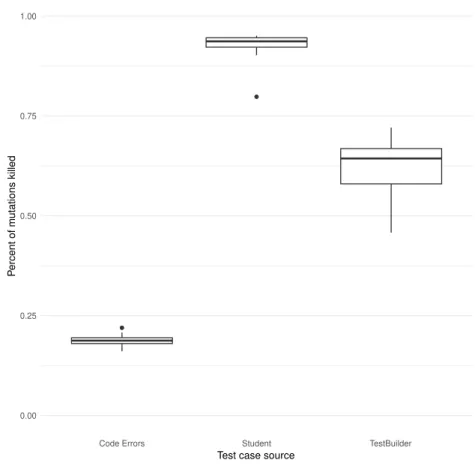
tests: the tests written by the students as part of the course requirements and the tests generated by TestBuilder. The percentage of mutations which were caught by each test suite was calculated for each project, and the results may be seen summarized in fig. 6.2 on the following page.
A Shapiro-Wilk normality test was performed on the results for each test suite, but the results were not normally distributed (𝑝 < 0.0002). A Wilcoxon signed-rank test was used to determine that the mean fraction of mutations2killed by each test suite differed (𝑝 < 0.002) with a 95% confidence interval of 24to39 percentage points difference. We conclude that the tests written by students are better at killing mutants than those written by TestBuilder, at least in its current configuration.
Python includes a built-incompilefunction which catches some basic errors in code and converts it into a Python code object [53].3 To confirm that TestBuilder tests were doing more than merely eliminating the mutations with such basic errors, we gathered data on the total number of mutations which were eliminated by failure to compile. A Wilcoxon signed-rank test was used to confirm that the mean fraction of mutations killed bycompilediffered from the mean fraction of mutations killed by running the TestBuilder tests (𝑝 < 0.002) with a 95% confidence interval of36to 49percentage points difference. We conclude that TestBuilder tests are better than 2I.e., for each project, we divide the number of mutations killed by the total number of mutations,
producing a percentage. The test is on the mean of these percentages.
3I believe this is similar to the operations which are executed when a file is loaded by the Python
0.00 0.25 0.50 0.75 1.00
Code Errors Student TestBuilder Test case source
P
ercent of m
utations killed
Figure 6.2: Mutation killing performance of student and TestBuilder tests.
merely runningcompileon the code.4 The number of mutations eliminated by the compilefunction is shown in fig. 6.2 under the name “Code Errors”.
While reviewing these results, we wondered what effect the lack of statement coverage by TestBuilder was having on the results. We found that the median coverage of the TestBuilder test suites used in this section was 78%, whereas the median coverage of the students’ test suites was 100%.
6.3
Refactoring Legacy Code
We ran a mutation test using the generated test suite for our golden master linked list implementation. The results are presented in table 6.1 on the following page.
4To the best of my understanding, this should be equivalent to saying, TestBuilder is better than
Table 6.1: Results of mutation testing.
Test suite Percent of mutations killed TestBuilder 76.1
Golden master 94.3
In order to give a better standard for comparison of the results, we also ran a mutation test using the test cases which were written for the golden master linked list implementation. This test suite had full coverage.
We also ran coverage tests on both test suites. As mentioned above, the hand-written tests had full coverage. The generated test suite had 76% coverage, which was surprising, as its statement-by-statement technique for generating tests would have been expected to result in full coverage. Further investigation revealed two factors which contributed to this surprisingly low result. First, TestBuilder does not generate tests which trigger errors, leaving all but one of the lines which raise IndexErrors untested.5 This accounted for three out of eleven of the uncovered lines. Second, TestBuilder does not understand functions with higher-order arguments. Two of the functions—foreachandsort—both involved a higher-order function, and in both cases TestBuilder provided an integer instead of a function. As a result, the test cases it generated for those parts of the functions merely assert that an error is thrown, rather than executing the code meaningfully. Finally, four of the lines which were not covered were in theremovefunction. This seems to have been due to the recursive call inremove, which, after the first substitution, would have been treated as an arbitrary return value (see section 3.6 on page 26).
5It is unclear why one of the test cases was generated to trigger anIndexError; I believe it is due
Chapter 7
Capabilities and Limitations
7.1
Capabilities
TestBuilder currently supports the following constructs from Python (this listing is derived from [56]):
Builtins: int,string,bool
Python treats booleans as a subtype of ints; we currently treat them as a distinct type. If the user intentionally uses a boolean as an integer, TestBuilder will find a type error. However, it seems more likely that in student code, booleans used as integers are a mistake. This decision could be revisited at a later point if desired.
Singletons: True,False,None
Statement: FunctionDef,Return,Assign,AugAssign,While,If,Pass,Raise,Expr, Assert