i
THE EFFECTS OF EARLY LIFE FACTORS AND PRECONCEPTION STRESS ON BIRTH WEIGHT IN A NATIONAL SAMPLE OF U.S. WOMEN
Kelly Kathryn Strutz
A dissertation submitted to the faculty of the University of North Carolina at Chapel Hill in partial fulfillment of the requirements for the degree of Doctor of Philosophy in
the Department of Maternal and Child Health.
Chapel Hill 2013
Approved by:
Jon M. Hussey, PhD
Carolyn Tucker Halpern, PhD Vijaya K. Hogan, DrPH
ii ©2013
iii
ABSTRACT
KELLY KATHRYN STRUTZ: The Effects of Early Life Factors and Preconception Stress on Birth Weight in a National Sample of U.S. Women
(Under the direction of Dr. Jon M. Hussey)
iv
v
For Beatrice Lee Strutz, with apologies for the preconception
vi
ACKNOWLEDGEMENTS
I found this to be the most difficult section of the dissertation to write, because I have so many people to thank. First, I couldn’t have asked for a better advisor and chair than Jon Hussey. Jon provided me with just the right mix of independence and oversight, challenged me to think more deeply and critically about my research, and modeled thoughtful and reasoned scholarship while maintaining balance in life. Our collaborations with Liana Richardson have been particularly enriching; I am grateful to Liana for her additional mentorship on so many aspects of research and
professional development.
I’m very thankful to my committee members who’ve supported me, not just during the dissertation process, but throughout my doctoral program. Anna Maria Siega-Riz and the other faculty and trainees on the Reproductive, Perinatal, and Pediatric Epidemiology Training Grant (NICHD T32-HD052468-02) taught me to think like an epidemiologist and to situate my research in a wider disciplinary
conversation. Vijaya Hogan expanded and refined everything I thought I knew about health disparities, and helped me to get my first first-authored paper published
vii
humor). Chirayath Suchindran was always generous with his time, providing extensive answers to my analysis questions for this and other projects.
The Department of Maternal and Child Health provided a collaborative environment in which I could do my best work. I am very grateful for departmental financial support through the Cynthia H. Cassell Doctoral Dissertation Award in MCH, a nomination for the Graduate School Doctoral Merit Assistantship, and GRA positions. Thanks to all of the MCH faculty who’ve provided me with opportunities to develop my research and professional skills, especially Sherri Green and Jonathan Kotch. Thanks also to Yvette Thompson, Carrie Aldrich, and Lisa Perry for keeping me and the other students organized and on track. I feel fortunate to have spent this time around so many impressive MCH students, and would particularly like to thank my cohortmates Laili Irani, Layla Lavasani, Winnie Luseno, Martha Skiles, and Khadija Turay: Martha, Layla, and Winnie, for sharing so many meals and
conversations over the years; Laili, for the fun we’ve had on conference trips; and Khadija, my fellow last woman standing, for filling our last year with commiseration, motivation (WWHRCD?) and CSA produce. Thanks also to Shoshana Goldberg and Leslie deRosset for being great collaborators, and to Alane Murdock, Khadija, and Shoshana for helpful feedback on my defense presentation.
My education was also enhanced by my traineeship with the Carolina
viii
designed by J. Richard Udry, Peter S. Bearman, and Kathleen Mullan Harris at the University of North Carolina at Chapel Hill, and funded by grant P01-HD31921 from the Eunice Kennedy Shriver National Institute of Child Health and Human
Development, with cooperative funding from 23 other federal agencies and foundations. Special acknowledgment is due Ronald R. Rindfuss and Barbara Entwisle for assistance in the original design. Information on how to obtain the Add Health data files is available on the Add Health website
(http://www.cpc.unc.edu/addhealth). No direct support was received from grant P01-HD31921 for this analysis. All Add Health procedures were approved by the Public Health Institutional Review Board (IRB) at the University of North Carolina at Chapel Hill; the present dissertation analyses were deemed exempt. I would especially like to thank the Add Health Stress Measures Working Group for identifying available measures of acute and chronic stressors, and Joyce Tabor, Eric Whitsel, Quynh Nguyen, Ping Chen, and Mariah Chang for assistance in navigating this rich and complex data source.
ix
TABLE OF CONTENTS
LIST OF TABLES ...xi
LIST OF FIGURES ... xiii
LIST OF ABBREVIATIONS ... xiv
CHAPTER 1: INTRODUCTION ... 1
REFERENCES ... 10
CHAPTER 2: PRECONCEPTION STRESS, BIRTH WEIGHT, AND BIRTH WEIGHT DISPARITIES AMONG U.S. WOMEN ... 17
INTRODUCTION ... 17
METHODS ... 20
RESULTS ... 26
DISCUSSION ... 28
FIGURES AND TABLES ... 33
REFERENCES ... 43
CHAPTER 3: MATERNAL AND OFFSPRING BIRTH WEIGHT CORRESPONDENCE AND PRECONCEPTION STRESS IN A NATIONAL U.S. COHORT ... 48
INTRODUCTION ... 48
METHODS ... 50
RESULTS ... 55
DISCUSSION ... 57
x
xi
LIST OF TABLES
Table 2.1. Characteristics of the Study Population by Parity, National Longitudinal Study of Adolescent Health,
1994-2008. ... 34
Table 2.2. Correlations among Preconception Acute and Chronic Stressors and Depressive Symptoms by Parity, National Longitudinal Study of Adolescent
Health, 1994-2008. ... 37
Table 2.3. Linear Regression Results for the Effects of Preconception Acute and Chronic Stressors and Depressive Symptoms on Birth Weight by Parity, National Longitudinal Study of Adolescent Health,
1994-2008. ... 38
Table 2.4. Linear Regression Results for the Associations between Maternal Race/Ethnicity and Preconception Acute and Chronic Stressors by Parity, National Longitudinal Study
of Adolescent Health, 1994-2008. ... 39
Table 2.5. Linear Regression Results for the Effects of Maternal Race/Ethnicity and Preconception Chronic Stressors on Birth Weight by Parity, National Longitudinal Study of
Adolescent Health, 1994-2008. ... 40
Table 2.6. Linear Regression Results for the Effects of
Preconception Acute Stressors on Birth Weight for Second Births by Maternal Race/Ethnicity, National
Longitudinal Study of Adolescent Health, 1994-2008. ... 41
Table 3.1. Characteristics of the Study Population by Parity, National Longitudinal Study of Adolescent Health,
1994-2008. ... 62
Table 3.2. Correlations between Maternal and Offspring Birth Weight by Maternal Race/Ethnicity and Parity, National
xii
Table 3.3. Linear Regression Results for the Associations between Maternal Race/Ethnicity and Maternal and Offspring Birth Weight by Parity, National Longitudinal Study of
Adolescent Health, 1994-2008. ... 64
Table 3.4. Linear Regression Results for the Effects of Maternal Race/Ethnicity, Maternal Birth Weight, and
Preconception Stress on Offspring Birth Weight for First Births, National Longitudinal Study of Adolescent Health,
1994-2008. ... 65
Table 3.5. Linear Regression Results for the Effects of Maternal Race/Ethnicity, Maternal Birth Weight, and
Preconception Stress on Offspring Birth Weight for Second Births, National Longitudinal Study of
xiii
LIST OF FIGURES
Figure 2.1. Conceptual Model Depicting Hypothesized Relationships among Maternal Race/Ethnicity, Preconception Stress, Depression, and Offspring Birth Weight, National Longitudinal Study of
Adolescent Health, 1994-2008. ... 33
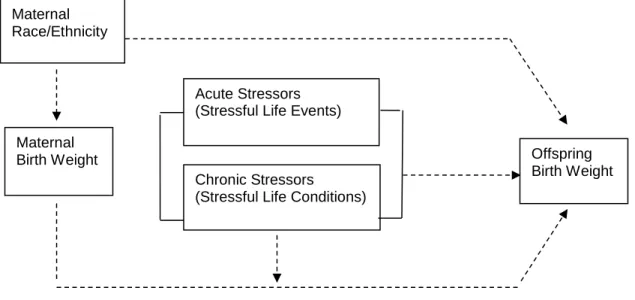
Figure 3.1. Conceptual Model Depicting Hypothesized
Relationships among Maternal Race/Ethnicity, Maternal and Offspring Birth Weight, and Preconception Stress, National Longitudinal Study of Adolescent Health,
xiv
LIST OF ABBREVIATIONS
Add Health The National Longitudinal Study of Adolescent Health
BMI body mass index
BRFSS Behavioral Risk Factor Surveillance System
CARDIA Coronary Artery Risk Development in Young Adults CES-D Center for Epidemiologic Studies – Depression scale
CFI comparative fit index
CI confidence interval
kg kilograms
m meters
MCH maternal and child health
MEPS Medical Expenditure Panel Survey
PRAMS Pregnancy Risk Assessment and Monitoring System PSID Panel Survey of Income Dynamics
TLI Tucker-Lewis index
U.S. United States
1
CHAPTER 1
INTRODUCTION
Birth Weight and Preconception Health
Birth weight is a marker of infant health at birth and an important predictor of an infant’s survival and subsequent health status. Low birth weight, defined as weight at birth of less than 2500 grams, is associated with an increased risk of developing both short-term and long-term health and educational problems.1 In 2007, 8.2% of infants in the United States (U.S.) were born at low birth weight; the Healthy People 2020 target calls for a 5% improvement over this baseline to 7.8%.2,3 Although copious risk factors for restricted birth weight have been identified, they have failed to explain how the prevalence of restricted birth weight has increased over time2 or how marked racial/ethnic disparities persist.1,4-6 In addition, birth weight has been demonstrated to be correlated across generations, in a relationship believed to have genetic, environmental, and gene-environment interaction
2
course perspective,11-13 acknowledges that birth outcomes are affected by maternal development prior to the nine-month prenatal period. Preconception health includes interconception health, or health between pregnancies, and is equally important for promoting women’s own well-being and healthy development.14
Although
“preconception” could theoretically describe any period in the life course prior to a pregnancy, this term is often used in clinical and public health practice to refer specifically to the reproductive years of women (and, to a lesser extent, men).
Interest in preconception health was rooted in prenatal care,15 and has since expanded beyond the health care sector to encompass social and behavioral determinants of health and preventive interventions for women and their potential offspring.10 Efforts to examine the prevalence and impact of preconception risk and protective factors in women of childbearing age have been hindered by the lack of comprehensive surveillance systems for preconception health in the U.S.16 To address this limitation, state maternal and child health (MCH) epidemiologists compiled a list of measures available in existing state-level surveys such as the Pregnancy Risk Assessment and Monitoring System (PRAMS) and the Behavioral Risk Factor Surveillance System (BRFSS).17 These surveys provide some
3
factors on health outcomes also have been limited, research is developing on the effects of preconception exposures for women and their infants.
Life Course Theory
The increased emphasis on preconception health exemplifies the growing interest in life course theory in the fields of MCH and epidemiology. Originally developed by sociologist Glen Elder, Jr.19,20 and popularized in public health by Lu and Halfon21 and Kuh and Ben-Shlomo,11 life course theory emphasizes the health consequences of exposures across an individual’s entire life span rather than
limiting to proximal determinants of health conditions.13 Key principles of life course theory pertinent to preconception and infant health include the principle of timing, which proposes that the timing and chronology of exposures, including duration and sequencing, is as influential as the exposures themselves, and the principle of linked lives, which acknowledges the interconnection among family members and other social networks in altering health status.12,22
Three life course models have been propounded in the public health
4
relationship between early life factors and the outcome of interest, or a combination of the above. In addition, the influence of a mother’s own health at birth on her offspring could represent a critical period or the beginning of an accumulation or pathway of exposures. The application of life course theory to empirical testing of MCH topics is relatively nascent and will require further refinement to distinguish among competing models or model combinations.
Stress Theory and Mechanisms
The health effects of stress throughout the life course have been of particular interest to public health and social science researchers alike. One key theory linking social stress to health conditions is Pearlin’s stress process model.26-28
This model posits that social characteristics including gender, race/ethnicity, and socioeconomic status lead to stress exposures such as stressful life events (acute stressors) and stressful life conditions (chronic stressors). These stressors, in turn, affect physical and mental health status. The model also accounts for effect modification of the relationship between stressors and health by social and personal resources.29 The stress process model has been explicitly integrated with life course theory,30 and is increasing in popularity as a framework to understand elevated risks of adverse health outcomes among minority groups and groups with low social status.29,31
In perinatal health research, physiologic mechanisms have been
5
chronic stress has been hypothesized to result in accelerated aging, or “weathering”, wearing down the body’s adaptive systems and affecting hormones during
pregnancy.32-36 These neuroendocrine and immunological dysregulation pathways represent possible biologic mechanisms by which stress over the life course can lead to low birth weight and birth weight disparities. In addition, other mechanisms, including depressive symptoms, are likely to mediate the relationship between stress and physical health outcomes, including birth outcomes.37 Depressive symptoms can result from stressors and are thought to affect the same neuroendocrine
pathways as stress itself.38 Because African-American women report higher levels of depressive symptoms than non-Hispanic White women, this has also been
proposed as a contributor to the Black-White disparity in adverse birth outcomes.39-41
Stress Measurement
It is difficult to operationalize a complex construct such as stress. Therefore, studies of the health consequences of stress have utilized varied measures.
6
timing of the events with respect to the health outcome of interest can bias estimates of associations, and thus researchers must be careful in defining the relevant period of exposure.43 Despite their limitations, counts of stressful life events remain the most common measure of stress in health research,42 likely due to the relative ease in obtaining these measures and to consistency with prior studies.
In contrast, more recent studies have defined stress using measures of
stressful life conditions.36 These chronic stressors recur or accumulate throughout a respondent’s life; examples include persistent socioeconomic disadvantage or daily exposure to hassles.36,37 Moreover, chronic stressors include measures specific to particular racial/ethnic groups or subgroups thereof, such as exposure to racial discrimination/racism and to negative aspects of immigrant acculturation.36,44,45 Consistent with a life course perspective on health and with hypothesized
mechanisms of biologic dysregulation resulting from stress, the use of chronic life conditions as indicators of stress has increased rapidly in recent years. However, measurement of stressful life conditions is less standardized across studies than that of stressful life events; while validated scales of acute events have been
7
Stress and Birth Outcomes
The vast majority of studies assessing the effects on birth outcomes of stress and depression have relied on measurement during the prenatal period only.36,48-64 Not surprisingly, results of these studies have been mixed. It is likely that much of the variation in the results can be attributed to variations in definitions and
measurement of stress36 or of variations in sampled populations. While these studies suggest an effect of stress on infant health status, the prenatal period may not have been the most appropriate window of time in which to measure stress and related factors. It is likely that the more robust effects of chronic stressors measured in pregnancy were capturing cumulative exposures from the preconception period.
A smaller number of studies have examined the effects of acute or chronic stressors in the reproductive period on birth outcomes,65-67 with no studies including both acute and chronic stressors. Although the examination of stressful life events is common in the prenatal literature, only one study examined preconception stress as measured by a psychosocial hassles scale,65 demonstrating a negative but
8
prospective measures reported only in a narrow window of time prior to the
pregnancy.70 Moreover, none of these studies examined nationally representative samples of U.S. women or compared racial/ethnic differences for racial/ethnic groups besides non-Hispanic White and non-Hispanic Black. The sole nationally representative study of preconception mental health on birth outcomes72 did not examine depressive symptoms specifically, but instead used a global mental health rating. In this analysis of data from the Medical Expenditure Panel Survey (MEPS), self-reported fair or poor mental health was associated with increased odds of low birth weight and other pregnancy complications.
It is worth acknowledging that an additional line of inquiry has focused on the effects of chronic stressors early in a woman’s life (prior to the reproductive period). Studies of household or neighborhood poverty at the time of the mother’s own birth suggest an effect of poverty in early life on offspring birth weight that may be
independent of or modified by maternal socioeconomic status measured during pregnancy,73-76 while evaluations of the weathering hypothesis, using age as a marker for the accumulation of social stressors, have shown some support for the hypothesis for low birth weight and other infant outcomes.35,77-84 These studies of early life provide evidence that stressors prior to pregnancy affect offspring health.
9
earlier in her life,85,86 although evidence is mixed.87,88 No studies examined
socioeconomic factors in the reproductive period, or additional aspects of chronic or acute stress.
Study Overview
To address a number of gaps in the literature reviewed above and in further detail in the following chapters, this dissertation evaluates the effects of both acute and chronic preconception stressors on birth weight. Informed by life course and stress theories, it tests hypotheses about the effects of acute stressors (stressful life events) and chronic stressors (stressful life conditions) in the preconception period on birth weight, including the roles of acute and chronic stressors in racial/ethnic disparities in birth weight and in the intergenerational transmission of birth weight. Further, this project explores preconception depressive symptoms as a pathway through which stress may impact birth weight. By assessing preconception
10
REFERENCES
1. Committee to Study the Prevention of Low Birth Weight. Preventing Low Birth Weight. Washington, DC: National Academies Press, 1985.
2. Martin JA, Hamilton BE, Sutton PD, et al. Births: final data for 2007. Natl Vital Stat Rep 2010;58:1-85.
3. Public Health Service. Healthy People 2020. Washington, DC: US Department of Health and Human Services, 2010. Available at http://www.healthypeople.gov. Accessed 6/4/13.
4. Hogan VK, Richardson JL, Ferre CD, Durant T, Boisseau M. A public health framework for addressing black and white disparities in preterm delivery. J Am Med Womens Assoc 2001;56:177–180.
5. de la Rosa IA. Perinatal outcomes among Mexican Americans: a review of an epidemiological paradox. Ethn Dis 2002;12:480-487.
6. Goldenberg RL, Cliver SP, Mulvihill FX, et al. Medical, psychosocial, and behavioral risk factors do not explained the increased risk for low birth weight among black women. Am J Obstet Gynecol 1996;175:1317-24.
7. Drake AJ, Walker BR. The intergenerational effects of fetal programming: non-genomic mechanisms for the inheritance of low birth weight and cardiovascular risk. J Endocrinol 2004;180:1-16.
8. Collins JW, David RJ, Prachand NG, Pierce ML. Low birth weight across generations. Matern Child Health J 2003;7:229-237.
9. Sanderson M, Emanuel I, Holt VL. The intergenerational relationship between mother’s birthweight, infant birthweight, and infant mortality in black and white mothers. Paediatr Perinat Epidemiol 1995;9:391-405.
10. Johnson K, Posner SF, Biermann J, et al. Recommendations to improve
preconception health and health care – United States. MMWR Morb Mortal Wkly Rep 2006;55:1-23.
11. Kuh D, Ben-Schlomo Y, eds. A Life Course Approach to Chronic Disease Epidemiology. 2nd edition. New York: Oxford University Press, 2004. 12. Elder GH. Life Course Perspective. In: Ritzer G, ed. The Blackwell
Encyclopedia of Sociology. Malden, MA: Wiley-Blackwell, 2006.
11
14. Moos MK. From concept to practice: reflections on the preconception health agenda. J Womens Health 2010;19:561-567.
15. Moos MK, Cefalo RC. Preconceptional health promotion: a focus for obstetric care. Am J Perinatol 1987;4:63-7.
16. Posner SF, Broussard DL, Sappenfield WM, et al. Where are the data to drive policy changes for preconception health and health care? Womens Health Issues 2008;18(Suppl):S81-S86.
17. Broussard DL, Sappenfield WM, Fussman C, et al. Core state preconception health indicators: a voluntary, multi-state selection process. Matern Child Health J 2011;15:158-168.
18. D’Angelo D, Williams L, Morrow B, et al. Preconception and interconception health status of women who recently gave birth to a live-born infant – Pregnancy Risk Assessment Monitoring System (PRAMS), United States, 26 reporting areas, 2004. MMWR Morb Mortal Wkly Rep 2007;56(SS10):1-35.
19. Elder GH. Age differentiation and the life course. Annu Rev Sociol 1975;1:165-190.
20. Elder GH. Historical Change in Life Patterns and Personality. In: Baltes PB, Brim OG, eds. Life-Span Development and Behavior. New York: Academic Press, 1979.
21. Lu MC, Halfon N. Racial and ethnic disparities in birth outcomes: a life-course perspective. Matern Child Health J 2003;7:13-30.
22. Elder GH. Time, human agency, and social change: perspectives on the life course. Soc Psychol Q 1994;57:4-15.
23. Berkman LF. Social determinants of health in the United States: are we losing ground? Annu Rev Public Health 2009;30:27-41.
24. Hertzman C. The Life-Course Contribution to Ethnic Disparities in Health. In: Anderson NB, Bulatao RA, Cohen B, eds. Critical Perspectives on Racial and Ethnic Differences in Health in Late Life. Washington, DC: National Academies Press, 2004.
25. Kuh, D, Ben-Shlomo Y, Lynch J, et al. Life course epidemiology. J Epidemiol Community Health 2003;57:778-783.
26. Pearlin LI, Lieberman MA, Menaghan EG, Mullan JT. The stress process. J Health Soc Behav 1981;22:337-356.
12
28. Pearlin LI. The Stress Process Revisited: Reflections on Concepts and Their Interrelationships. In: Aneshensel CS, Phelan JC, eds. Handbook of the Sociology of Mental Health. New York: Springer, 1999.
29. Turner RJ. Understanding Health Disparities: The Promise of the Stress Process Model. In: Avison WR et al, eds. Advances in the Conceptualization of the Stress Process: Essays in Honor of Leonard I. Pearlin. New York: Springer, 2010.
30. Pearlin LI, Skaff MM. Stress and the life course: a paradigmatic alliance. Gerontol 1996;32:239-247.
31. Dowd JB, Goldman N. Do biomarkers of stress mediate the relation between socioeconomic status and health? J Epidemiol Community Health 2006;60:633-639.
32. Seckl JR. Physiologic programming of the fetus. Emerg Concepts Perinat Endocrinol 1998;25:939-962.
33. Hertzman C. The biological embedding of early experience and its effects on health in adulthood. Ann NY Acad Sci 1999;896:85-95.
34. Soumi SJ. Early determinants of behavior: evidence from primate studies. Br Med Bull 1997;53:170-184.
35. Geronimus AT. Black/white differences in the relationship of maternal age to birthweight: a population-based test of the weathering hypothesis. Soc Sci Med 1996;42:589-597.
36. Hobel CJ, Goldstein A, Barrett ES. Psychosocial stress and pregnancy outcome. Clin Obstet Gynecol 2008;2:333-348.
37. Hoffman S, Hatch MC. Stress, social support and pregnancy outcome: a reassessment based on recent research. Paediatr Perinat Epidemiol 1996;10:380-405.
38. Alder J, Fink N, Bitzer J, Hosli I, Holzgreve W. Depression and anxiety during pregnancy: a risk factor for obstetric, fetal, and neonatal outcome? A critical review of the literature. J Matern-Fetal Neonat Med 2007;20:189-209. 39. Bromberger J, Assmann S, Avis N, et al. Persistent mood symptoms in a
multiethnic community cohort of pre- and perimenopausal women. Am J Epidemiol 2003;158:347-356.
13
41. Rickert V, Weimann C, Berenson A. Ethnic differences in depressive symptomatology among young women. Obstet Gynecol 2000;95:55-60. 42. Chen MJ, Grobman WA, Gollan JK, Borders AEB. The use of psychosocial
stress scales in preterm birth research. Am J Obstet Gynecol 2011;205:402-434. 43. O’Campo P, Schempf A. Racial inequalities in preterm delivery: issues in the
measurement of psychosocial constructs. Am J Obstet Gynecol 2005;192(suppl):S56-S63.
44. Giscombe CL, Lobel M. Explaining disproportionately high rates of adverse birth outcomes among African Americans: the impact of stress, racism, and related factors in pregnancy. Psychol Bull 2005;131:662-683.
45. Hogue CJR, Bremner JD. Stress model for research into preterm delivery among black women. Am J Obstet Gynecol 2005;192(suppl):S47-S55. 46. Brunner E. Socioeconomic determinants of health: stress and the biology of
inequality. BMJ 1997;314:1472-1476.
47. Obradovic J, Boyce WT. Individual differences in behavioral, physiological, and genetic sensitivities to contexts: implications for development and adaptation. Dev Neurosci 2009;31:300-308.
48. Glynn LM, Wadhwa PD, Dunkel-Schetter C, et al. When stress happens matters: effects of earthquake timing on stress responsivity in pregnancy. Am J Obstet Gynecol 2001;184:637-642.
49. Lederman SA, Rauh V, Weiss L, et al. The effects of the World Trade Center event on birth outcomes among term deliveries at three lower Manhattan hospitals. Environ Health Perspect 2004;112:1772-1778.
50. Levi R, Lundberg U, Hanson U, et al. Anxiety during pregnancy as related to obstetric outcome. J Psychosom Obstet Gynecol 1989;10:221-230.
51. Hedegaard M, Henriksen TB, Sacher NJ, et al. Do stressful life events affect duration of gestation and risk of preterm delivery? Epidemiology 1996;7:339-345.
52. Dole N, Savitz DA, Hertz-Picciotto I, et al. Maternal stress and preterm birth. Am J Epidemiol 2003;157:14-24.
53. Paarlberg KM. Psychosocial factors and pregnancy outcome: a review with emphasis on methodological issues. J Psychosom Res 1995;29:563-595. 54. Hedegaard M, Henriksen TB, Sabroe S, et al. Psychological distress in
14
55. Paarlberg KM, Vingerhoets AJ, Passchier J, et al. Psychosocial predictors of low birthweight: a prospective study. Br J Obstet Gynaecol 1999;106:834-841.
56. Pritchard CW, Teo PY. Preterm birth, low birthweight and the stressfulness of the household role for pregnant women. Soc Sci Med 1998;38:89-96.
57. Orr ST, James SA, Blackmore Prince C. Maternal prenatal depressive symptoms and spontaneous preterm births among African-American women in Baltimore, Maryland. Am J Epidemiol 2002;156:797–802.
58. Li D, Liu L, Odouli R. Presence of depressive symptoms during early pregnancy and the risk of preterm delivery: a prospective cohort study. Hum Reprod
2009;24:146–153.
59. Neggers Y, Goldenberg R, Cliver S, Hauth J, et al. The relationship between psychosocial profile, health practices, and pregnancy outcomes. Acta Obstet Gynecol Scand 2006;85:277–285.
60. Steer RA, Scholl TO, Hediger ML, Fischer RL, et al. Self-reported depression and negative pregnancy outcomes. J Clin Epidemiol 1992;45:1093–1099. 61. Field T, Diego M, Hernandez-Reif M, Deeds O, Holder V, Schanberg S, et al.
Depressed pregnant black women have a greater incidence of prematurity and low birthweight outcomes. Infant Behav Dev 2009;32:10–16.
62. Dayan J, Creveuil C, Herlicoviez M, Herbel C, Baranger E, Savoye C, et al. Role of anxiety and depression in the onset of spontaneous preterm labor. Am J Epidemiol 2002;155:293–301.
63. Andersson L, Sundstrom-Poromaa I, Wulff M, Astrom M, Bixo M. Neonatal outcome following maternal antenatal depression and anxiety: a population-based study. Am J Epidemiol 2004;159:872–881.
64. Chung TK, Lau TK, Yip AS, Chin HF, Lee DT, et al. Antepartum depressive symptomatology is associated with adverse obstetric and neonatal outcomes. Psychosom Med 2001;63:830–834.
65. Weisman CS, Misra DP, Hillemeier MM, et al. Preconception predictors of birth outcomes: prospective findings from the Central Pennsylvania Women’s Health Study. Matern Child Health J 2011;15:829-835.
66. Richardson LJ. The Social Structural Context of Pregnancy and Adverse Birth Outcomes: The Role of Race, Place, and Time. Doctoral dissertation, The University of North Carolina at Chapel Hill, 2009.
15
68. Gavin AR, Chae DH, Mustillo S, Kiefe CI. Prepregnancy depressive mood and preterm birth in black and white women: findings from the CARDIA study. J Womens Health 2009;18:803-811.
69. Haas JS, Fuentes-Afflick E, Stewart A, et al. Prepregnancy health status and the risk of preterm delivery. Arch Pediatr Adolesc Med 2005;159:58-63.
70. Phillips GS, Wise LA, Rich-Edwards JW, et al. Prepregnancy depressive
symptoms and preterm birth in the Black Women’s Health Study. Ann Epidemiol 2010;20:8-15.
71. Radloff L. The CES-D scale: a self-report depression scale for research in the general population. Appl Psychol Meas 1977;1:384-401.
72. Witt WP, Wisk LE, Cheng ER, et al. Preconception mental health predicts pregnancy complications and adverse birth outcomes: a national population-based study. Matern Child Health J [in press]. DOI: 10.1007/s10995-011-0916-4. 73. Astone NM, Misra D, Lynch C. The effect of maternal socio-economic status
throughout the lifespan on infant birthweight. Paediatr Perinat Epidemiol 2007;21:310-318.
74. Colen CG, Geronimus AT, Bound J, James SA. Maternal upward socioeconomic mobility and black-white disparities in infant birthweight. Am J Public Health 2006;96:2032-2039.
75. Collins JW, David RJ, Rankin KM, Desireddi JR. Transgenerational effect of neighborhood poverty on low birth weight among African Americans in Cook County, Illinois. Am J Epidemiol 2009;169:712-717.
76. Collins JW, Wambach J, David RJ, Rankin KM. Women’s lifelong exposure to neighborhood poverty and low birth weight: a population-based study. Matern Child Health J 2009;13:326-333.
77. Love C, David RJ, Rankin KM, Collins JW. Exploring weathering: effects of lifelong economic environment and maternal age on low birth weight, small for gestational age, and preterm birth in African-American and white women. Am J Epidemiol 2010;172:127-134.
78. Collins JW, Rankin KM, Hedstrom AB. Exploring weathering: the relation of age to low birth weight among first generation and established United States-born Mexican-American women. Matern Child Health J 2012;16:967-72.
79. Rauh VA, Andrews HF, Garfinkel RS. The contribution of maternal age to racial disparities in birthweight: a multilevel perspective. Am J Public Health
16
80. Rich-Edwards JW, Buka SL, Brennan RT, et al. Diverging associations of maternal age with low birth weight for black and white mothers. Int J Epidemiol 2003;32:83-90.
81. Collins JW, Simon DM, Jackson TA, et al. Advancing maternal age and infant birth weight among urban African-Americans: the effect of neighborhood poverty. Ethn Dis 2006;16:180-186.
82. Buescher PA, Mittal M. Racial disparities in birth outcomes increase with maternal age: recent data from North Carolina. NC Med J 2006;67:16-20. 83. Holzman C, Eyster J, Kleyn M, et al. Maternal weathering and risk of preterm
delivery. Am J Public Health 2009;99:1864-1871.
84. Wildsmith E. Testing the weathering hypothesis among Mexican-origin women. Ethn Dis 2002;12:470-79.
85. Emanuel I, Kimpo C, Moceri V. The association of maternal growth and socio-economic measures with infant birthweight in four ethnic groups. Int J Epidemiol 2004;33:1236-1242.
86. Currie J, Moretti E. Biology as destiny? Short and long-run determinants of intergenerational transmission of birth weight. J Labor Economics 2007;25:231-263.
87. Collins JW, Rankin KM, David RJ. Low birth weight across generations: the effect of economic environment. Matern Child Health J 2011;15:438-445. 88. Conley D, Bennett NG. Race and the inheritance of low birth weight. Soc Biol
17
CHAPTER 2
PRECONCEPTION STRESS, BIRTH WEIGHT, AND BIRTH WEIGHT DISPARITIES AMONG U.S. WOMEN
INTRODUCTION
Birth Weight and Preconception Health
Birth weight is a marker of infant health at birth and an important predictor of an infant’s survival and subsequent health status. Low birth weight, defined as weight at birth of less than 2500 grams, is associated with an increased risk of developing both short-term and long-term health problems.1 The prevalence of restricted birth weight has been increasing since the 1980s in the United States (U.S.);2 and marked differences in birth weight persist by race/ethnicity3,4 Although copious risk factors for restricted birth weight have been identified, they have failed to explain the increase over time or the disparities in prevalence.1,5
18
infants are affected not only by maternal exposures in the nine-month prenatal period, but also by maternal development before the pregnancy.
Stress Theory and Measurement
One preconception exposure of interest is stress. Pearlin’s stress process model posits that social characteristics including those surrounding race/ethnicity in the U.S. lead to stress exposures that affect health,11-13 and has been used to understand elevated risk of adverse health outcomes among minority groups.14,15 It is worth noting that elevated stress is not inherent to persons of minority
race/ethnicity, given that race/ethnicity is a social construct and not a biological one. Rather, stress results from historical and societal constraints leading to differential life chances across groups.16
19
Stress and Birth Outcomes
Physiologic mechanisms have been hypothesized to link maternal stress to maternal and infant health.20-22 For example, cumulative exposure to stress has been hypothesized to result in accelerated aging, or “weathering,” wearing down the body’s adaptive systems.21,22
Weathering in particular was proposed as a source of racial/ethnic disparities in perinatal health, such that the higher stress experienced by African-American women causes their reproductive functioning to deteriorate more rapidly than that of White women.22 Other possible pathways through which stress can lead to birth outcome disparities include infection23 and nutrition.19 In addition, depressive symptoms can result from stressors and may mediate the relationship between stress and birth outcomes by affecting the same
neuroendocrine pathways as stress itself.18,24
The vast majority of studies assessing the effects on birth outcomes of stress and related factors have relied on measurement during the prenatal period, with mixed results.19,24-26 A smaller number of studies have examined effects of acute stressors, specific chronic stressors, or depressive symptoms in the reproductive period on birth outcomes.27-32 Although several of these analyses suggested
20
Study Objectives and Hypotheses
To address these gaps in the literature, the objective of this study was to examine the impact of maternal preconception acute stressors (or stressful life events) and preconception chronic stressors (or stressful life conditions) on offspring birth weight and racial/ethnic birth weight disparities, including exploration of
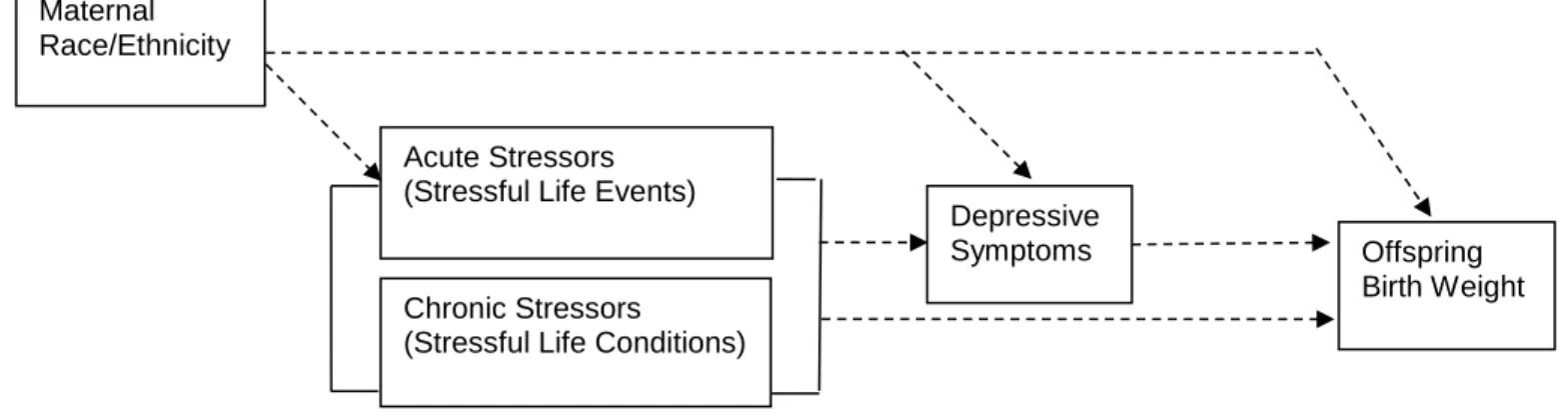
preconception depressive symptoms as a pathway through which stress may impact these outcomes. Our hypotheses were as follows: 1) acute and chronic stressors will be inversely associated with birth weight; 2) preconception depressive symptoms will be inversely associated with birth weight and will partially mediate associations between stress and birth weight where such associations exist; 3) the distributions of birth weight and stress will vary by maternal race/ethnicity; and 4) stress will partially explain racial/ethnic differences in birth weight where such differences exist. The conceptual model guiding our hypotheses is shown in Figure 2.1.
METHODS
Data Source and Analytic Sample
21
guardian. Three follow-up in-home interviews of the same panel of respondents have been completed: Wave II in 1996 (88% response rate); Wave III in 2001-2002 with 15,170 respondents aged 18-26 years (77% response rate); and Wave IV in 2007-2008 with 15,701 respondents aged 24-32 years (80% response rate). The Wave IV interviews included a full pregnancy and birth history assessed within each relationship for each respondent. For this study, responses from Wave II were not included because the participants who were in 12th grade in Wave I were not surveyed at Wave II; follow-up of these participants was restored for Waves III and IV. Further information on Add Health is available elsewhere.33
The analytic sample consisted of all first or second singleton live births conceived and born between Waves I and IV to non-Hispanic White (hereafter, “White”), Mexican-origin Latina, other-origin Latina, and non-Hispanic Black (“Black”) female respondents with valid sampling weights. Only live births were included for comparability of outcome and completeness of reporting, and only singleton births were assessed because the causes and consequences of low birth weight for multiple births differ from those of singleton births.34 Further, births to women of other racial/ethnic groups were excluded due to small sample size. The total sample sizes were 3512 first births (2035 White, 349 Mexican-origin Latina, 295 other
22
Measures
Preconception acute and chronic stressors were examined as exposures and modeled as indicators of continuous latent factors. A list of acute stressors reported at Waves I and III has been established for Add Health,35,36 composed of negative events of sudden onset and limited duration occurring within 12 months before the interview. Items reported at both Waves I and III, or for which comparable measures are found at both waves, are listed in Table 2.1. The acute stressors came from Wave I for births conceived before Wave III, and from Wave III for births conceived after Wave III. Items from the prior studies35,36 that were available on the Wave I interview only, on the Wave III interview only, or pertaining to parenting were
excluded from the present study to maintain comparability across waves and across analyses by parity. Additionally, items that loaded poorly onto the acute stressors factor in the confirmatory factor analysis were also excluded.
A list of chronic stressors was identified to reflect occurrences of longer duration pertaining to similar broad domains. These items are listed in Table 2.1. Chronic stressors pertaining to the respondent’s family of origin and early
experiences came from Wave I for all births regardless of conception date, while the others came from responses before or during the preconception Wave as shown in Table 2.1. Additional items had been considered and rejected if loaded poorly onto the chronic stressors factor in the confirmatory factor analysis.
The outcome, birth weight, was utilized as a continuous measure.
23
grams (where 1 pound = 453.59 grams) to be consistent with clinical measurements of birth weight.37
The direct effects of preconception depressive symptoms on birth weight were assessed, as well as depressive symptoms as a potential mediator of associations between preconception stressors and birth weight. Depressive
symptoms from the preconception Wave (I or III) were represented by a latent factor with self-reported indicators based on the Center for Epidemiologic Study of
Depression scale (CES-D), specifically designed to measure depressive symptoms in general population samples.38 The 9 questions from the CES-D in common between Waves I and III used here are listed in Table 2.1.
Moreover, variations in the distributions of birth weight and preconception stress by maternal race/ethnicity were determined, and the potential for
preconception stress to explain racial/ethnic differences in birth weight was
assessed. Race, ethnicity, and Hispanic/Latina background were self-identified by the respondent on the Wave I questionnaire.
Although parity is often treated as a confounder in perinatal epidemiologic analyses, it is likely that the effects of stress on birth weight differ for primiparas vs. multiparas. Therefore, parity was used as an effect modifier here; more specifically, as a stratification variable. The respondent’s parity at the time of the birth was constructed from pregnancy outcome variables in the respondent’s pregnancy
24
Those respondents whose first birth occurred before Wave I and second birth occurred afterward were included in the models for second births.
Proposed confounders may be associated with birth weight and with stress or depression. Respondent’s preconception weight status was calculated as body mass index (BMI) from respondent height and weight (self-reported at Wave I or measured at Wave III) at the same Wave from which preconception stressors and depressive symptoms were taken. Respondent’s preconception cigarette smoking was calculated from the number of cigarettes reported in the last 30 days on the preconception Wave, and dichotomized into none versus any. Respondent’s preconception alcohol consumption was calculated from number of drinks per day and drinks per week in the past year reported at the preconception Wave, and dichotomized as heavy alcohol consumption (yes/no) defined as consuming more than 3 drinks per day or more than 7 drinks per week.39 Respondent’s age at the birth was calculated from date of respondent’s birth and the date of the child’s birth. The respondent’s marital or cohabitation status at the time of birth was categorized as married, cohabiting, or neither married nor cohabiting from respondent report at Wave IV. The time between the preconception interview and the birth was
calculated by subtracting the date of the Wave I or Wave III interview from the infant’s birth date as reported at Wave IV.
Statistical Analyses
25
factor analysis to generate factor scores. Based on the findings, adjustments to the measurement of the latent variables were made. Specifically, potential indicators that did not load onto the factors were removed and errors were correlated among the variables as suggested by modification indices with theoretical justification (e.g., among the three neighborhood indicators of the chronic stressors factor). This confirmatory factor analysis was conducted using Mplus40 software v.7 and accounted for categorical variables and other non-normality in the data using weighted least squares estimation.41
Factor scores were exported to Stata and linear regressions were used to test the study hypotheses, generating risk differences with 95% confidence intervals (CIs). Thus, coefficients represent the change in grams of birth weight for a one-unit change in each predictor. Sensitivity analyses were run as logistic regression
26
RESULTS
Sample Characteristics
Descriptive characteristics of the sample by parity are shown in Table 2.1. In each of the two subsamples, approximately two-thirds of the mothers were White and one in five were Black. Among the Latina mothers, two-thirds were of Mexican origin and one-third were of other origin. Prevalence of each acute stressor was fairly low, with the exception of having forgone needed medical care in the past year. In contrast, chronic stressors were more prevalent. The distributions of responses to the CES-D questions varied across symptoms; “(not) feeling just as good as others” was most prevalent symptom while “feeling disliked” was least prevalent. Mean preconception BMI was 23.6 before first births and 25.3 before second births. Preconception smoking and heavy drinking were prevalent. The mean age at first birth was 22 and at second birth was 24, and the proportions of women who were married and cohabiting increased for second births compared to first births. The average time between the preconception interview and birth was over 4 years for each birth.
Preconception Stress and Depression
27
90% CI:0.013, 0.017); with good fit defined as CFI and TLI>0.95 and
RMSEA<0.05).43 All correlations among acute and chronic stressors and depressive symptoms were significant (Table 2.2). Before and after controlling for confounders, chronic stressors were inversely associated with birth weight for both first and
second births (Table 2.3). Neither acute stressors nor depressive symptoms were significantly associated with birth weight for either parity subsample.
Maternal Race/Ethnicity
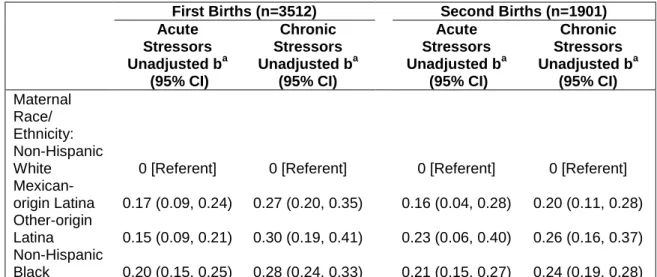
Mexican-origin Latinas, other Latinas, and Black women had higher factor scores than White women for both acute and chronic stressors in both the first and second birth subsamples (Table 2.4). In addition, first births to women in all three of these racial/ethnic groups had significantly lower birth weights than White women, while only Black women had significantly lower birth weights for their second births (Table 2.5, Model 1). After including chronic stressors in the models, the magnitudes of the coefficients for each racial/ethnic group decreased, and the coefficient for first births to other-origin Latinas was no longer significant (Table 2.5, Model 2). Chronic stressors remained significantly associated with birth weight for first but not for second births in these models. Interaction terms between maternal race/ethnicity and chronic stressors were tested but omitted due to lack of significance. Although acute stressors were not significantly associated with birth weight, models were run testing interactions between maternal race/ethnicity and acute stressors (not
28
2.6). Only other-origin Latinas demonstrated a significant inverse association
between acute stressors and birth weight in the stratified models, although it was no longer significant after controlling for chronic stressors.
DISCUSSION
We found partial support for our first hypothesis, as preconception chronic stressors but not acute stressors had a statistically significant inverse association with birth weight among both first and second births. Our results for acute stressors were consistent with a study from Central Pennsylvania,27 which demonstrated a negative but nonsignificant effect of high preconception psychosocial hassles on birth weight. In addition, our findings for chronic stressors were consistent with studies of low birth weight or a related outcome, preterm birth, suggesting that stressful life conditions in adolescence such as neighborhood and family
disadvantage28 and family structure disruptions or contact with social services29 affect perinatal outcomes.
We did not find support for our second hypothesis, as preconception depressive symptoms were not significantly associated with birth weight and therefore did not meet the second Baron and Kenny criterion42 for mediation
between stress and birth weight. The lack of association in our study was consistent with two studies finding no relationship between preconception depressive
29
Artery Risk Development in Young Adults (CARDIA) study in which higher depressive symptoms slightly increased the odds of preterm birth.32
Our third hypothesis was supported, as women in all minority racial/ethnic groups had higher scores for acute and chronic stressors and lower offspring birth weights for first births than White women. Additionally, Black women had lower birth weights for their second births. Our findings for racial/ethnic differences in stress and for the Black-White disparity in birth weight were consistent with
expectations.5,14 Although Mexican-origin Latinas have similar rates of low birth weight as non-Hispanic White women,4 our use of a continuous birth weight measure allowed detection of more subtle differences in birth weight distribution. Birth weight distributions vary across Latina subgroups,44 and our data source allowed us to assess effects separately for women of Mexican origin vs. all other origins. Our finding that the relationship between acute stressors in the
interconception period and birth weight was moderated by race/ethnicity, such that acute stressors impacted second births for other-origin Latinas, was new to the literature, suggests a weathering role of acute stressors, and merits further investigation.
30
hypothesis have addressed the Black-White disparity in birth outcomes,21,45-48 extensions of this hypothesis to Mexican-origin women found no evidence of weathering.49,50 Our findings for Latina mothers contrast with these studies, suggesting that weathering among both Mexican- and other-origin Latinas should not be discounted but instead examined longitudinally in national samples.
Limitations
Limitations of the study include those inherent in using secondary data. All measures are based on self-report, and may be recalled inaccurately or reflect social desirability. Information is limited to that collected in the interviews, and may not reflect the complete stress history of each participant. Of particular relevance, the Add Health data are missing preconception measures of racism and discrimination which may represent the most important elements of stress for racial/ethnic
disparities in birth outcomes.51 In the absence of these measures, however, the effects we found for stress are likely to be conservative estimates.
In addition, the dataset is limited in its coverage of pregnancy information. Birth weight assessment is reliant on maternal recall rather than clinical report, although this method has been validated in other data sources.52-55 In addition, the distribution of birth weights in Add Health is comparable to those in birth certificates.2 Further, the Add Health data also contain no measures of prenatal stress.
Therefore, we cannot evaluate whether preconception stress operates
31
examine other potential pathways, such as perinatal infections or gestational weight gain, through which stress could affect birth weight.
An additional limitation of this study is that only births occurring to women up to 32 years of age could be examined. Although this age range represents the majority of births in the U.S.,2 the timing of birth may be associated with exposure to acute or chronic stressors.56 This study ameliorates this limitation somewhat by controlling for time between the interview and the birth, but the results likely are not generalizable to births at older ages.
Conclusions
Despite these limitations, the study contains a number of strengths. To our knowledge, it is the first to apply prospective measures of both acute and chronic stressors to the study of preconception stress and birth weight, and to evaluate disparities in preconception stress and birth weight across multiple racial/ethnic groups in a diverse, nationally representative sample. Results of the study suggest that broad social policies mitigating stressful conditions throughout the life course will be needed to improve birth weights and decrease birth weight disparities. In addition, our results provide support for inclusion of Latinas in studies of
32
33
FIGURES AND TABLES
Figure 2.1. Conceptual Model Depicting Hypothesized Relationships among Maternal Race/Ethnicity, Preconception Stress, Depression, and Offspring Birth Weight, National Longitudinal Study of Adolescent Health, 1994-2008.
Generation 1 Preconception Period Generation 2 Early Life (Adolescence/Young Adulthood) Outcome
Chronic Stressors
(Stressful Life Conditions)
Depressive
Symptoms Offspring
Birth Weight Acute Stressors
(Stressful Life Events) Maternal
Race/Ethnicity
34
Table 2.1. Characteristics of the Study Population by Parity, National Longitudinal Study of Adolescent Health, 1994-2008.
Characteristic
First Births (n = 3512)
Second Births (n = 1901)
Birth weight, mean (SE), grams 3271 (15) 3320 (17)
Maternal race/ethnicity, % Non-Hispanic White Mexican-origin Latina Other-origin Latina Non-Hispanic Black 69.7 8.3 4.9 17.1 67.1 8.6 4.1 20.3
Acute Stressorsa
Death of parent, % 1.5 1.6
Friend committed suicide, % 3.9 3.4
Relative committed suicide, % 1.3 1.6
Suicide attempt, % 5.1 4.0
Forgone medical care, % 23.0 23.0
Saw violence, % 8.8 7.9
Threatened by knife or gun, % 6.6 5.9
Threatened other with knife or gun, % 2.4 2.2
Shot by or shot someone, % 1.2 1.0
Stabbed, % 2.4 1.9
Jumped, % 5.6 5.2
Injured in a physical fight, % 5.1 5.5
Hurt other in a physical fight, % 10.1 7.1
Chronic Stressors
Low parent educational attainment,b % 68.2 71.3 Parent received public assistance,c % 37.3 39.7
Low parent income,b % 31.5 35.8
Parent could not pay bills,b % 16.6 18.2 Low respondent educational attainment,a % 18.3 22.3
No health insurance,d % 19.4 28.0
English as a second language,b % 6.4 6.0
Not born a U.S. citizen,b % 3.2 3.0
Living without either bioparent,b % 51.2 56.3 Low neighborhood household education,d % 16.3 20.7 High neighborhood poverty,d % 31.4 40.4 High neighborhood unemployment,d % 29.9 38.3
35
Feeling bothered by things that don’t usually bother, % Never or rarely
Sometimes A lot of the time Most or all of the time
52.1 36.0 8.7 2.9 47.0 40.2 9.5 3.3 Feeling unable to shake off the blues, %
Never or rarely Sometimes A lot of the time Most or all of the time
65.2 23.2 7.9 3.5 65.8 23.2 7.7 3.2 Feeling just as good as others, %
Never or rarely Sometimes A lot of the time Most or all of the time
10.3 21.7 29.2 38.5 9.3 20.3 24.7 45.5 Having trouble keeping mind on activities, %
Never or rarely Sometimes A lot of the time Most or all of the time
41.5 41.9 12.7 3.7 45.1 39.8 12.1 3.0 Feeling depressed, %
Never or rarely Sometimes A lot of the time Most or all of the time
57.6 30.4 8.2 3.4 59.0 28.5 8.7 3.8 Feeling too tired for activities, %
Never or rarely Sometimes A lot of the time Most or all of the time
43.1 42.8 10.6 3.4 39.5 44.0 11.5 4.9 Enjoying life, %
Never or rarely Sometimes A lot of the time Most or all of the time
4.0 19.4 28.6 48.0 3.8 17.7 29.4 49.1 Feeling sad, %
Never or rarely Sometimes A lot of the time Most or all of the time
47.5 42.1 7.1 3.1 44.6 44.6 7.7 3.1 Feeling disliked, %
Never or rarely Sometimes A lot of the time Most or all of the time
70.2 24.2 4.0 1.4 70.3 24.7 3.3 1.6 Confounders
36 Marital/cohabitation status at birth, %
Married Cohabiting Neither
44.3 25.7 30.0
54.5 29.0 16.6 Time between preconception interview
and birth, mean (SE), days
1599 (22) 1494 (20)
Abbreviations: %, weighted percent; BMI, body mass index; kg, kilograms; m, meters; SE, standard error of the mean; U.S., United States
a
Reported at the immediate preconception Wave.
b
Reported at adolescence (Wave I) for all respondents.
c
Reported by the parent at Wave I or retrospectively for childhood by the respondent in later Waves.
d
37
Table 2.2. Correlations among Preconception Acute and Chronic Stressors and Depressive Symptoms by Parity, National Longitudinal Study of Adolescent Health, 1994-2008.
First Births (n=3512) Second Births (n=1901)
Acute Stressors
Chronic Stressors
Depressive Symptoms
Acute Stressors
Chronic Stressors
Depressive Symptoms Acute
Stressors 1
a,b
1 Chronic
Stressors 0.38 1 0.38 1
Depressive
Symptoms 0.50 0.25 1 0.53 0.25 1
a
Correlations are based on weighted data.
b
All correlations are significant p<0.001.
38
Table 2.3. Linear Regression Results for the Effects of Preconception Acute and Chronic Stressors and Depressive Symptoms on Birth Weight by Parity, National Longitudinal Study of Adolescent Health, 1994-2008.
First Births (n=3512) Second Births (n=1901)
Unadjusted ba
(95% CI)
Adjusted ba,b
(95% CI)
Unadjusted ba
(95% CI)
Adjusted ba,b
(95% CI) Acute
Stressors -45 (-124, 34) -30 (-118, 54) -36 (-124, 53) -20 (-110, 70) Chronic
Stressors -210 (-291, -130) -192 (-270, -113) -181 (-297, -65) -178 (-313, -43) Depressive
Symptoms -52 (-125, 22) -59 (-139, 22) -52 (-154, 50) -49 (-153, 56) Abbreviations: CI, confidence interval.
a
Coefficients are based on weighted data.
b
39
Table 2.4. Linear Regression Results for the Associations between Maternal Race/Ethnicity and Preconception Acute and Chronic Stressors by Parity, National Longitudinal Study of Adolescent Health, 1994-2008.
First Births (n=3512) Second Births (n=1901)
Acute Stressors
Unadjusted ba
(95% CI)
Chronic Stressors
Unadjusted ba
(95% CI)
Acute Stressors
Unadjusted ba
(95% CI)
Chronic Stressors
Unadjusted ba
(95% CI) Maternal Race/ Ethnicity: Non-Hispanic White Mexican-origin Latina Other-origin Latina Non-Hispanic Black 0 [Referent] 0.17 (0.09, 0.24) 0.15 (0.09, 0.21) 0.20 (0.15, 0.25)
0 [Referent] 0.27 (0.20, 0.35) 0.30 (0.19, 0.41) 0.28 (0.24, 0.33)
0 [Referent] 0.16 (0.04, 0.28) 0.23 (0.06, 0.40) 0.21 (0.15, 0.27)
0 [Referent] 0.20 (0.11, 0.28) 0.26 (0.16, 0.37) 0.24 (0.19, 0.28) Abbreviations: CI, confidence interval.
a
40
Table 2.5. Linear Regression Results for the Effects of Maternal Race/Ethnicity and Preconception Chronic Stressors on Birth Weight by Parity, National Longitudinal Study of Adolescent Health, 1994-2008.
First Births (n=3512) Second Births (n=1901)
Model 1:
Adjusted ba,b
(95% CI)
Model 2:
Adjusted ba,c
(95% CI)
Model 1:
Adjusted ba,b
(95% CI)
Model 2:
Adjusted ba,c
(95% CI) Maternal Race/Ethnicity Non-Hispanic White Mexican-origin Latina Other-origin Latina Non-Hispanic Black 0 [Referent] -144 (-246, -42) -130 (-240, -19) -180 (-253, -106)
0 [Referent] -112 (-219, -4)
-86 (-204, 32) -146 (-229, -64)
0 [Referent] -124 (-270, 22)
-45 (-179, 89) -171 (-278, -64)
0 [Referent] -104 (-253, 46) -13 (-153, 126) -148 (-261, -34)
Chronic Stressors -139 (-233, -45) -124 (-266, 18)
Confounders
BMI -2 (-8, 4) -2 (-8, 4) 11 (6, 17) 12 (6, 17)
Smoking -47 (-113, 20) -39 (-106, 28) -78 (-168, 12) -75 (-164, 14) Heavy drinking 91 (29, 152) 90 (28, 152) 29 (-44, 102) 28 (-45, 101) Age at birth 1 (-10, 12) -2 (-13, 9) -13 (-25, -0.4) -15 (-28, -2) Marital/cohabitation
status at birth Married Cohabiting Neither
0 [Referent] -79 (-160, 1) -35 (-116, 45)
0 [Referent] -66 (-146, 13) -30 (-110, 50)
0 [Referent] -79 (-168, 10) -69 (-172, 35)
0 [Referent] -67 (-156, 21) -58 (-161, 44) Time to birth -0.008 (-0.04, 0.03) -0.008 (-0.04, 0.02) 0.03 (-0.03, 0.1) 0.04 (-0.03, 0.1)
Abbreviations: BMI, body mass index; CI, confidence interval.
a
Coefficients are based on weighted data.
b
Adjusted for preconception BMI, cigarette smoking, heavy drinking; age at birth; marital/cohabitation status at birth; and time between preconception interview and birth.
c
Adjusted for preconception chronic stressors, BMI, cigarette smoking, heavy drinking; age at birth; marital/cohabitation status at birth; and time between preconception interview and birth.
41
Table 2.6. Linear Regression Results for the Effects of Preconception Acute Stressors on Birth Weight for Second Births by Maternal Race/Ethnicity, National Longitudinal Study of Adolescent Health, 1994-2008.
Second Births (n=1901) Model 1:
Adjusted ba,b
(95% CI)
Model 2:
Adjusted ba,c
(95% CI)
Non-Hispanic White (n=1072)
Acute Stressors 109 (-15, 233) 154 (5, 303)
Chronic Stressors -165 (-384, 54)
Confounders
BMI 9 (2, 16) 9 (2, 17)
Smoking -128 (-226, -31) -125 (-222, -28) Heavy drinking 45 (-52, 141) 40 (-57, 136) Age at birth -11 (-26, 4)) -13 (-28, 3) Marital/cohabitation status at birth
Married Cohabiting Neither
0 [Referent] -111 (-221, -1)
36 (-92, 164)
0 [Referent] -97 (-208, 14)
47 (-80, 174) Time to birth 0.05 (-0.02, 0.1) 0.05 (-0.02, 0.1)
Mexican-origin Latina (n=216)
Acute Stressors -53 (-299, 193) 74 (-208, 355)
Chronic Stressors -346 (-807, 116)
Confounders
BMI 3 (-23, 29) 7 (-17, 31)
Smoking 69 (-213, 351) 32 (-236, 300)
Heavy drinking 32 (-146, 210) -4 (-169, 161) Age at birth -10 (-49, 30) -2 (-52, 47) Marital/cohabitation status at birth
Married Cohabiting Neither
0 [Referent] -221 (-438, -4) -10 (-407, 212)
42 Other-origin Latina (n=128)
Acute Stressors -238 (-460, -16) -220 (-489, 48)
Chronic Stressors -58 (-406, 290)
Confounders
BMI -8 (-32, 17) -8 (-32, 17)
Smoking -19 (-250, 213) -31 (-262, 201)
Heavy drinking -69 (-215, 77) -69 (-218, 80) Age at birth -17 (-40, 5) -18 (-40, 5) Marital/cohabitation status at birth
Married Cohabiting Neither
0 [Referent] -92 (-347, 162) -402 (-702, -101)
0 [Referent] -88 (-341, 165) -396 (-693, -99) Time to birth 0.03 (-0.1, 0.2) 0.03 (-0.1, 0.2)
Non-Hispanic Black (n=485)
Acute Stressors -147 (-333, 39) -106 (-303, 92)
Chronic Stressors -126 (-380, 128)
Confounders
BMI 16 (7, 24) 16 (7, 25)
Smoking 121 (-85, 328) 107 (-102, 316)
Heavy drinking -40 (-220, 141) -49 (.236, 137) Age at birth -12 (-35, 12) -12 (-35, 12) Marital/cohabitation status at birth
Married Cohabiting Neither
0 [Referent] -11 (-207, 186) -153 (-324, 23)
0 [Referent] -1 (-201, 199) -147 (-327, 32) Time to birth 0.04 (-0.5, 0.1) 0.04 (-0.05, 0.1)
Abbreviations: BMI, body mass index; CI, confidence interval.
a
Coefficients are based on weighted data.
b
Adjusted for preconception BMI, cigarette smoking, heavy drinking; age at birth; marital/cohabitation status at birth; and time between preconception interview and birth.
c
43
REFERENCES
1. Committee to Study the Prevention of Low Birth Weight. Preventing Low Birth Weight. Washington, DC: National Academies Press, 1985.
2. Martin JA, Hamilton BE, Sutton PD, et al. Births: final data for 2007. Natl Vital Stat Rep 2010;58:1-85.
3. Hogan VK, Richardson JL, Ferre CD, Durant T, Boisseau M. A public health framework for addressing black and white disparities in preterm delivery. J Am Med Womens Assoc 2001;56:177–180.
4. de la Rosa IA. Perinatal outcomes among Mexican Americans: a review of an epidemiological paradox. Ethn Dis 2002;12:480-487.
5. Goldenberg RL, Cliver SP, Mulvihill FX, et al. Medical, psychosocial, and behavioral risk factors do not explained the increased risk for low birth weight among black women. Am J Obstet Gynecol 1996;175:1317-24.
6. Johnson K, Posner SF, Biermann J, et al. Recommendations to improve
preconception health and health care – United States. MMWR Morb Mortal Wkly Rep 2006;55:1-23.
7. Strutz KL, Richardson LJ, Hussey JM. Preconception health trajectories and birth weight in a national prospective cohort. J Adolesc Health 2012;51:629-36. 8. Kuh D, Ben-Schlomo Y, eds. A Life Course Approach to Chronic Disease
Epidemiology. 2nd edition. New York: Oxford University Press, 2004. 9. Elder GH. Life Course Perspective. In: Ritzer G, ed. The Blackwell
Encyclopedia of Sociology. Malden, MA: Wiley-Blackwell, 2006.
10. Richardson LJ, Hussey JM, Strutz KL. A Life Course Perspective on Maternal and Child Health. In: Kotch JB, ed. Maternal and Child Health: Programs, Problems, and Policy in Public Health, 3rd edition. Sudbury, MA: Jones and Bartlett Publishers, 2013.
11. Pearlin LI, Lieberman MA, Menaghan EG, Mullan JT. The stress process. J Health Soc Behav 1981;22:337-356.
44
13. Pearlin LI. The Stress Process Revisited: Reflections on Concepts and Their Interrelationships. In: Aneshensel CS, Phelan JC, eds. Handbook of the Sociology of Mental Health. New York: Springer, 1999.
14. Turner RJ. Understanding Health Disparities: The Promise of the Stress Process Model. In: Avison WR et al, eds. Advances in the Conceptualization of the Stress Process: Essays in Honor of Leonard I. Pearlin. New York: Springer, 2010.
15. Dowd JB, Goldman N. Do biomarkers of stress mediate the relation between socioeconomic status and health? J Epidemiol Community Health 2006;60:633-639.
16. Jones CP. Invited commentary: “race,” racism, and the practice of epidemiology. Am J Epidemiol 2001;154:299-304.
17. Chen MJ, Grobman WA, Gollan JK, Borders AEB. The use of psychosocial stress scales in preterm birth research. Am J Obstet Gynecol 2011;205:402-434. 18. Hoffman S, Hatch MC. Stress, social support and pregnancy outcome: a
reassessment based on recent research. Paediatr Perinat Epidemiol 1996;10:380-405.
19. Hobel CJ, Goldstein A, Barrett ES. Psychosocial stress and pregnancy outcome. Clin Obstet Gynecol 2008;2:333-348.
20. Seckl JR. Physiologic programming of the fetus. Emerg Concepts Perinat Endocrinol 1998;25:939-962.
21. Geronimus AT. Black/white differences in the relationship of maternal age to birthweight: a population-based test of the weathering hypothesis. Soc Sci Med 1996;42:589-597.
22. Geronimus AT. The weathering hypothesis and the health of African-American women and infants: evidence and speculations. Ethn Dis 1992;2:207-221. 23. Culhane JF, Rauh VA, Goldenberg RL. Stress, bacterial vaginosis, and the role
of immune processes. Curr Infect Dis Rep 2006;8:459-464.
24. Alder J, Fink N, Bitzer J, Hosli I, Holzgreve W. Depression and anxiety during pregnancy: a risk factor for obstetric, fetal, and neonatal outcome? A critical review of the literature. J Matern-Fetal Neonat Med 2007;20:189-209.