Rapid Communications
Phase shift of cyclotron orbits at type-I and type-II multi-Weyl nodes
M. Breitkreiz,1,2N. Bovenzi,1and J. Tworzydło3
1Instituut-Lorentz, Universiteit Leiden, P.O. Box 9506, 2300 RA Leiden, The Netherlands
2Dahlem Center for Complex Quantum Systems and Fachbereich Physik, Freie Universität Berlin, 14195 Berlin, Germany
3Institute of Theoretical Physics, Faculty of Physics, University of Warsaw, ulitsa Pasteura 5, 02-093 Warszawa, Poland
(Received 3 July 2018; published 4 September 2018)
Quantum oscillations of response functions in high magnetic fields tend to reveal some of the most interesting properties of metals. In particular, the oscillation phase shift is sensitive to topological band features, thereby helping to identify the presence of Weyl fermions. In this work, we predict a characteristic parameter dependence of the phase shift for Weyl fermions with tilted and overtilted dispersion (type-I and type-II Weyl fermions) and an arbitrary topological charge (multi-Weyl fermions). For type-II Weyl fermions our calculations capture the case of magnetic breakthrough between the electron and the hole part of the dispersion. Here, the phase shift turns out to depend only on the quantized topological charge due to the cancellation of nonuniversal contributions from the electron and the hole part.
DOI:10.1103/PhysRevB.98.121403
Introduction. Electrons moving along cyclotron orbits in a homogeneous magnetic field are subject to the quantization condition [1]
l2S=2π(m+γ), m∈Z, (1) whereSis the zero-field area enclosed by the cyclotron orbit in momentum space,l =√h/eB¯ is the magnetic length, and the offsetγincludes quantum corrections, which can be expanded in powers of the magnetic field B [2]. In the semiclassical regime when the magnetic length is much larger than the Fermi wavelength, field-dependent corrections toγ are suppressed and the remaining number of zeroth order in B encodes valuable information about the electronic properties of the system. In particular, the offset includes contributions coming from topological features in the band structure [3–6], which makes it the subject of high current interest. Experimentally, it can be deduced from quantum oscillations in the de Haas– van Alphen or the Shubnikov–de Haas effects, widely used nowadays to identify Weyl, Dirac, and nodal-line semimetals [7–11].
Interestingly, in some well-studied systems the offset mea-sures the topological features independent of the specifics of the band structure. So, e.g., in graphene and graphene bilayer exposed to an out-of-plane magnetic field, the offset turns out to be given by a winding number—the number of full turns made by the direction of the electron’s pseudospin degree of freedom during a single turn around the cyclotron orbit [3,5]. This integer winding number is a robust feature, determined by the type of the band touching, and is sometimes called the topological charge of the Weyl or Dirac fermion [12]. In contrast to the common belief, however, the topological charge contributes to the offset in such a robust manner only in exceptional cases, namely, when particular symmetry constraints are satisfied [6]. In general, the offset is sensitive also to other parameters of the band touching and it is the aim of this work to characterize this sensitivity.
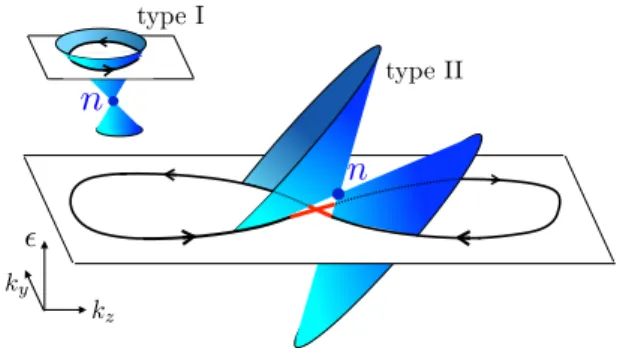
One important parameter is a linear tilt of the dispersion at the Weyl node, which is generically present in material realizations and, most importantly, leads to the occurrence of two types of Weyl nodes, as sketched in Fig.1. Upon the type-I to type-II transition, the tilt exceeds a critical value, above which an equienergy surface near the node cuts both bands [13]. The closed cyclotron orbit at a type-I Weyl node is thereby replaced by two open branches, which can be closed at large momenta by higher-order corrections to the Weyl Hamiltonian, resulting in two cyclotron orbits, one electronlike and one holelike. Band details determine a critical magnetic field, above which the two separate cyclotron orbits effectively merge into a single orbit via magnetic breakthrough [14,15]. This critical field is zero if the energy and the parallel momentum are exactly at the node where the two contours touch [16,17], and is larger than zero if the gap between the contours is finite. The magnetic breakdown contributes an additional phase to the offsetγ, so one would expect that the offset is even more sensitive to details of the orbit than in the case without magnetic breakdown.
In this Rapid Communication, we analyze the offset for orbits at both types of Weyl nodes and find a characteristic
type I
n
kz ky
type II
n
dependence ofγon the Weyl-node parameters. Most surpris-ingly, the offset of the breakthrough orbit at a type-II Weyl point turns out to depend only on the topological charge. This striking result is based on two facts, the universality of the phase jump ofπacquired in the magnetic-breakthrough region and a robust phase shift of nπ induced by the topological charge. The insensitivity of the latter on details of the orbit comes from a cancellation of a nonuniversal part of the phase in the two loops of the breakthrough orbit, which are traversed in opposite directions.
Model. We consider a set of Hamiltonians that govern the physics close to topologically distinct band touchings, H0=k−σ++k+σ−+u kzσ0, (2a) Hn=k−nσ++k+nσ−+u kzσ0+kzσz, n∈ {1,2, . . .}, (2b)
where k±=kx±iky, (kx, ky, kz)=k are momenta (scaled
by velocities),σ±=σx±iσy,σx,y,z are Pauli matrices, and
σ0the identity matrix. The band touching atk=0described by Hn corresponds to a topologically protected multi-Weyl
node of ordern[18], whileH0describes a trivial, nonprotected band touching (a gap is produced by a perturbation∝σz). The
parameteru >0 controls the tilt of the Weyl cone; foru <1 andu >1 the Weyl cone is of type I and II, respectively.
The magnetic field pointing in thex direction moves the particles along equienergy contours kz(ky) at fixed energy
and parallel momentum component kx. The contours are
determined by the Schrödinger equation
Hn|un± =|un±, (3)
where±denote the two bands.
In the quantization condition (1) one can distinguish three phase shifts that contribute to the offset,
γ = 1
2π(φ0+φb+φt). (4) Here,φ0andφbare phase shifts that occur at singular points on the orbit. Specifically, turning points give rise to the Maslov phaseφ0[19], in which each turning point contributes a phase jump of±π/2, the sign determined by the sign of the curvature at the turning point. In particular, one finds thatφ0=π and φ0 =0 for orbits that can be deformed into a circle and into a figure-8 shape, respectively. Withφb we denote the phase shifts that occur due to magnetic breakdown. Finally, φt is the topological phase shift, which includes the Berry phase accumulated during a full turn around the orbit and the effect of the orbital magnetic moment [4–6,20]. The explicit calculation of φb andφt is the main result of this work, which will be presented in the following.
Topological phase shift. The topological phase shift of a closed contour at energyand the fixed momentum component kxis given by [5,21]
φt=
dky
A−dkz(k
y)
d M
. (5)
Here, the first term is determined by the Berry connection projected onto the contour,
A=iu|∇k|u · dk
dky
=iu| d dky
|u, (6)
which contributes to φt the usual Berry phase of the closed orbit. The second term is the correction to the zero-field areaS coming from the orbital magnetic moment projected onto the direction of the magnetic field [20],
M= i
2[(∂kyu|)(−H)(∂kz|u)
−(∂kzu|)(−H)(∂ky|u)]. (7) The eigenfunctions of the HamiltonianHican be written as
|u0± = √1 2
∓
e−iα
1
,
|un+ =
−sinβ2e−inα
cosβ2
, |un− =
cosβ2e−inα
sinβ2
, (8)
where the anglesαandβare defined as
cosβ= kz
k, sinβ= k2
x+k2y n
2
k ,
α=arg(kx+iky), k= kx2+k2y n
+k2
z. (9)
For the topologically trivial case we obtain from (6)–(9) A0±= kx
2 k2
x+ky2
, M0±=0, (10)
and the topological phase shift vanishes as it should, φ±t =
dkyA0±=
dky kx 2k2
x+(ky)2
=0 (n=0),
(11) independent of the integration contour. For the nontrivial case, we obtain
An±=
nkx kx2+ky2 n−1
2k(k±kz)
, Mn±= −
nkx k2x+k2y n−1
2k2 . (12) To calculate the topological phase shift, we consider the explicit expression for the equienergy contours, which is derived from (3) in the form
kz±(ky)=
u±
(u2−1) k2
x+k2y n
+2
u2−1 . (13)
Foru >1, the contours given byk±z(ky) are disjoint and we
need to introduce an additional orbit segment that connects the two open ends ofkz±(ky) atkz→ ±∞. These connecting
segments can be realized by an additional mass termηk3
zσzin
the Hamiltonian, with an infinitesimalη >0. The reconnection then occurs at large momentakz, with|kz|>(u−1)/η→ ∞.
In the expressions (12) forAandMthe additional mass term replaces kz→kz+ηk3z. On the connecting segment,Aand
Inserting (12) and (13) into (5) we obtain
φt±= ∓
dky(u+1)nkx
k2
x+(ky)2 n−1
2[k±±kz±][k±z ∓uk±]
. (14) For a type-II cone (u >1) we use the substitutionκ =ky/kx
and obtain φ±t =
∞
−∞
dκ n(κ
2+1)n−1 2(κ2+1)n+cot2θ
×((κ2+1)n+cot2θ±cotθ)−1, (15) where the parameterθencoding contour details is defined as
θ= ⎧ ⎨ ⎩
arctan knx √
u2−1
, u >1, arctanh kxn
√ 1−u2
, u <1.
(16)
The integral in (15) needs to be calculated numerically (see below); for the special casen=1, we find the closed-form solution
φt±= π
2(1∓sgnθ)±θ (n=1). (17) While φ±t are the topological phase shifts of the two (electron/hole) orbitsk±z(ky), the sumφt++φt−≡φtbr is the topological phase shift of the breakthrough orbit, i.e., the figure-8 orbit that encloses both the electron and the hole pocket. Using the substitutionz=(κ2+1)n, the integral for φbr
t simplifies to φtbr=
∞
1
dz 1
z2nn+1 −z2
=nπ, (18)
where the θ-dependent part cancels out. As a result, the topological phase shift of the figure-8 orbit only depends on the quantized topological chargen, in contrast to theθ-dependent phase shifts of the separate orbits.
For type-I Weyl fermions (u <1) k±z are two parts of a single closed contour, whose topological phase is denotedφt. A closed-form solution for the integral (14) is found forn=1, φt=πsgnθ (n=1), (19) in agreement with Refs. [3,5,22]. Forn2, we find in the limitsθ →0±andθ→ ±∞[23],
φt=−−−→θ→0± n πsgnθ,
φt=−−−→θ→±∞ √n πsgnθ. (20) The fullθdependence will be discussed below.
Breakthrough phase shift. To calculate the additional phase shift of the figure-8 orbit due to magnetic breakdown, we follow a standard route [15] and calculate the scattering matrix that relates the exact wave function of the magnetic-breakdown region with the in- and outgoing semiclassical wave functions. We start with the nontopological HamiltonianH0. Intro-ducing the magnetic field via Peierls substitutionkz→kz+
il−2∂ky, followed by a unitary transformation, ˜
H0=e−il2(kz−/u)kyH 0eil
2(k
z−/u)ky, (21) we arrive at
˜
H0 =kxσx+kyσy+i u l−2∂kyσ0+. (22)
Rescaling the variables ask=lky/
√
u,δ0=lkx/
√
u, the Schrödinger equation ˜H0ψ=ψreads
[σxδ0+σyk+i∂k]ψ=0. (23)
The exact solution of (23) is known from the Landau-Zener problem [24]. To obtain the phase shift in comparison to the semiclassical solution of (23), the exact wave functions are matched with the incoming semiclassical wave functions at k −δ0, denoted ψi±, and outgoing ψf± at kδ0. From this standard procedure (recapitulated in the Supplemental Material [23]) we obtain the scattering matrixS that relates the final state in the basis (ψf+, ψf−) to the incoming state in the basis (ψi+, ψi−),
S=
√
1−W eiα −i√W
−i√W √1−W e−iα
, (24)
where
W =e−π δ20, α=π
4 + δ02
2 − δ20
2 ln δ02
2 +arg iδ 2 0 2 . (25) The breakthrough orbit dominates ifδ01,W ≈1, in which case each band transition in the breakthrough region con-tributes a phase jump of π/2 giving in total the phase shift φb=πfor the breakthrough orbit.
For the topological case, we linearize the HamiltonianHn
inky, leading to
Hn=kxnσx+nkxn−1kyσy+kzσz+ukz. (26)
After Peierls substitution we apply the unitary transformation given by
˜ Hn=e−il
2[k
z−/(u2−1)]kyH ne
il2[k
z−/(u2−1)]ky. (27) Rescaling and transforming the variables as
k=lky(u2−1)−1/4
nkxn−1, (28a)
δn=lsgn()
2+(u2−1)k2n x
(u2−1)3/4k(n−1)/2
x
, (28b)
we obtain the Schrödinger equation [δn
u2−1 sinθ σ
x+k
u2−1σ
y
+i∂k(u+σz)+δncosθ(1+uσz)]ψ=0. (29)
Multiplying (29) from the left withM=diag[(u+1)−1,(u− 1)−1] and applying a transformation given by
T = −i 1−u
√
u2−1 u−1
√
u2−1
1 1
σze−iσyθ/2, (30)
we again arrive at the differential equation of the Landau-Zener form (23),
ˆ
Hψˆ(k)=(δnσx+k σy+i∂k) ˆψ(k)=0, (31)
n= 1
n= 2
n= 3
n
= 4
θ
1
3 2
2
5 2
√
2 + 1 2
√
3 + 1 2
√
4 + 1 2
γ
FIG. 2. Parameter dependence of the offsetγof orbits at a type-I Weyl node.
topological phase of the full solution induced by the nontrivial topology of the Hamiltonian.
TheSmatrix is obtained by matchingψ(k) with the semi-classical solution of (29). SinceHnis topologically equivalent toH1 (note that the dynamical variables areky andkz, while
kx is fixed), the topological phase shift of the semiclassical
solution is given by (17), which cancels theθphase of the full solution and the result is the sameθ-independent scattering matrix (24), withδ0 replaced by δn. In particular, the
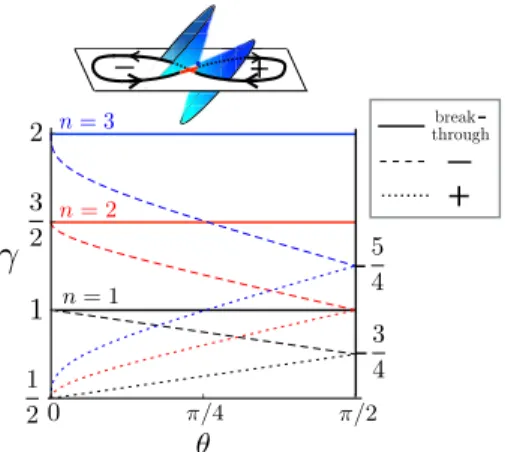
break-through phase shiftφb =πalso holds in the topological case. Discussion. Having thus calculated the phase shifts, we now show the fullθdependence of the offsetγ, defined in Eq. (4), in Figs. 2 and 3 [25]. For the figure-8 orbit, the magnetic breakthrough contributes an offset 1/2 and the topological charge adds an extra contributionn/2. The θ independence is based on the cancellation of the θ-dependent parts from the hole and the electron pockets. The universality of the breakthrough phase shift is, instead, less surprising, since the same universal value was found previously for nontopological band touchings [15].
In contrast, without breakthrough (dashed/dotted curves in Fig.3) or in case of a type-I Weyl node (Fig.2), the offset has a nontrivial dependence on the orbit details that are encoded inθ. The only exception is the casen=1 of the type-I Weyl node, which shows noθdependence owing to the higher symmetry of the dispersion [6]. This is also the only case with a known full quantum-mechanical solution [3,5,22]; it agrees with our semiclassical result. In quantum oscillation experiments, the measured phase shift would likely be averaged over a range of values of the energy and of the parallel momentum kx,
corresponding to a weighted (depending on details of the
FIG. 3. Parameter dependence of the offsetγof orbits at a type-II Weyl node. The offsets of separate orbitsk+z andkz−(without magnetic breakthrough) depend on the band parameter θ, while the offset of the figure-8 breakthrough orbit only depends on the topological chargen.
experimental realization) average over the parameter θ. In general, this averaging does not destroy the θ dependence, still allowing to discriminate the two cases of quantized and continuously varyingγ.
With regard to the figure-8 breakthrough orbits, our calcu-lations explain recent numerical findings for the offset of a thin-film Weyl semimetal [26] and a type-II Weyl semimetal [16], showing, respectively,γ =1/2 andγ =0. In the case of the thin film, the Hamiltonian at the figure-8 crossing, given in the Appendix of Ref. [26], is equivalent to the nontopological HamiltonianH0, thus the only phase contributing is the break-through phaseφb=π, which explains the offsetγ =φb/2π= 1/2. In case of the type-II Weyl semimetal, the Hamiltonian is equivalent toH1, where the additional topological phaseφt= π cancels the breakthrough phase, which explains the vanish-ing offset. This contradicts a previous interpretation that relates the vanishing offset of the latter to a vanishing Berry phase and neglects the contribution of the breakthrough phase [17]. In the Supplemental Material [23] we present extensions of the nu-merical calculations to the casesn=2 andn=3, tilted type-I Weyl cones, and several values ofθ. Also these calculations are in agreement with the analytical results of this work.
Acknowledgments.The authors would like to thank C. W. J. Beenakker, A. Alexandradinata, and M. J. Pacholski for valu-able discussions. This research was supported by the Nether-lands Organization for Scientific Research (NWO/OCW) and an ERC Synergy Grant.
[1] L. M. Roth,Phys. Rev.145,434(1966).
[2] Y. Gao and Q. Niu,Proc. Natl. Acad. Sci. USA114,7295(2017). [3] G. P. Mikitik and Y. V. Sharlai,J. Exp. Theor. Phys.87,747
(1998).
[4] G. P. Mikitik and Y. V. Sharlai, Phys. Rev. Lett. 82, 2147
(1999).
[5] J. Fuchs, F. Piéchon, M. Goerbig, and G. Montambaux,
Eur. Phys. J. B77,351(2010).
[6] A. Alexandradinata, C. Wang, W. Duan, and L. Glazman,
Phys. Rev. X8,011027(2018).
[7] Y. Zhang, Y.-W. Tan, H. L. Stormer, and P. Kim,Nature (London)
438,201(2005).
[8] L. P. He, X. C. Hong, J. K. Dong, J. Pan, Z. Zhang, J. Zhang, and S. Y. Li,Phys. Rev. Lett.113,246402(2014).
[9] X. Huang, L. Zhao, Y. Long, P. Wang, D. Chen, Z. Yang, H. Liang, M. Xue, H. Weng, Z. Fang, X. Dai, and G. Chen,
Phys. Rev. X5,031023(2015).
[10] J. Hu, Z. Tang, J. Liu, X. Liu, Y. Zhu, D. Graf, K. Myhro, S. Tran, C. N. Lau, J. Wei, and Z. Mao,Phys. Rev. Lett.117,016602
[11] S. Pezzini, M. R. van Delft, L. Schoop, B. Lotsch, A. Carrington, M. I. Katsnelson, N. E. Hussey, and S. Wiedmann,Nat. Phys.
14,178(2017).
[12] A. Burkov,Nat. Mater.15,1145(2016).
[13] A. A. Soluyanov, D. Gresch, Z. Wang, Q. Wu, M. Troyer, X. Dai, and B. A. Bernevig, Nature (London) 527, 495
(2015).
[14] M. H. Cohen and L. M. Falicov,Phys. Rev. Lett.7,231(1961). [15] M. I. Kaganov and A. A. Slutskin,Phys. Rep.98,189(1983). [16] T. E. O’Brien, M. Diez, and C. W. J. Beenakker,Phys. Rev. Lett.
116,236401(2016).
[17] A. Alexandradinata and L. I. Glazman,Phys. Rev. Lett. 119,
256601(2017).
[18] C. Fang, M. J. Gilbert, X. Dai, and B. A. Bernevig,Phys. Rev. Lett.108,266802(2012).
[19] J. B. Keller,Ann. Phys. (NY)4,180(1958).
[20] G. Panati, H. Spohn, and S. Teufel,Commun. Math. Phys.242,
547(2003).
[21] D. Xiao, M.-C. Chang, and Q. Niu,Rev. Mod. Phys.82,1959
(2010).
[22] Z.-M. Yu, Y. Yao, and S. A. Yang,Phys. Rev. Lett.117,077202
(2016); S. Tchoumakov, M. Civelli, and M. O. Goerbig,ibid. 117,086402(2016); M. Udagawa and E. J. Bergholtz,ibid.117,
086401(2016); G. P. Mikitik and Y. V. Sharlai,Phys. Rev. B94,
195123(2016).
[23] See Supplemental Material athttp://link.aps.org/supplemental/ 10.1103/PhysRevB.98.121403for details of analytical calcula-tions andadditional numerical calculacalcula-tions supporting the ana-lytical results.
[24] L. D. Landau and E. M. Lifshitz,Course of Theoretical Physics
(Elsevier, Oxford, UK, 1977).
[25] In practice, the offset can only be measured modulo one, corresponding to one Landau-level spacing. Nevertheless, in Figs.2and3we plot the fullγfor clarity of the graphic. [26] N. Bovenzi, M. Breitkreiz, T. E. O’Brien, J. Tworzydło, and