COMPUTATIONAL VIDEO ENHANCEMENT
Eric P. Bennett
A dissertation submitted to the faculty of the University of North Carolina at Chapel Hill in partial fulfillment of the requirements for the degree of Doctor of Philosophy in the Department of Computer Science.
Chapel Hill 2007
Approved by:
Leonard McMillan
Gary Bishop
Guido Gerig
Sing Bing Kang
Marc Pollefeys
c
2007
ABSTRACT
ERIC P. BENNETT: Computational Video Enhancement (Under the direction of Leonard McMillan)
During a video, each scene element is often imaged many times by the sensor. I propose
that by combining information from each captured frame throughout the video it is possible
to enhance the entire video. This concept is the basis of computational video enhancement.
In this dissertation, the viability of computational video processing is explored in addition to
presenting applications where this processing method can be leveraged.
Spatio-temporal volumes are employed as a framework for efficient computational video
processing, and I extend them by introducing sheared volumes. Shearing provides spatial
frame warping for alignment between frames, allowing temporally-adjacent samples to be
pro-cessed using traditional editing and filtering approaches. An efficient filter-graph framework
is presented to support this processing along with a prototype video editing and manipulation
tool utilizing that framework.
To demonstrate the integration of samples from multiple frames, I introduce methods
for improving poorly exposed low-light videos to achieve improved results. This integration is guided by a tone-mapping process to determine spatially-varying optimal exposures and
an adaptive spatio-temporal filter to integrate the samples. Low-light video enhancement is
also addressed in the multispectral domain by combining visible and infrared samples. This
is facilitated by the use of a novel multispectral edge-preserving filter to enhance only the
visible spectrum video.
Finally, the temporal characteristics of videos are altered by a computational video
re-sampling process. By rere-sampling the video-rate footage, novel time-lapse sequences are found
that optimize for user-specified characteristics. Each resulting shorter video is a more
faith-ful summary of the original source than a traditional time-lapse video. Simultaneously, new
To My Father, Robert A. Bennett,
ACKNOWLEDGMENTS
I would like to thank my advisor, Leonard McMillan, for working with me for five years and
guiding my development as a researcher. I will certainly miss our enthusiastic brainstorming
sessions, where Leonard’s drive to explore the limits of computer science was most evident.
I would also like to thank the rest of my committee: Gary Bishop, Guido Gerig, Sing
Bing Kang, Marc Pollefeys, and Carlo Tomasi. I am honored to have such a distinguished
committee and I appreciate their time and feedback on my work.
I want to thank John Mason for the multispectral datasets in Section 4.3 as well as Aaron
Block, Tim Malone, Terry McMahon, and John Moriconi for appearing in my videos.
My thanks as well to my collaborators on projects outside of this dissertation: Jason
Stewart, Jingdan Zhang, Sing Bing Kang, Rick Szeliski, Matt Uyttendaele, and Larry Zitnick.
Discussions with friends and colleagues at UNC have also influenced my work: Aaron Block, Dave Borland, Fred Brooks, Brian Eastwood, Russ Gayle, Justin Hensley, Tyler
Johnson, Luv Kohli, Anselmo Lastra, E. Scott Larsen, Brandon Lloyd, Ketan Mayer-Patel,
Chris Oates, Rick Skarbez, Josh Steinhurst, Russell Taylor, Chris VanderKnyff, Jeremy
Wendt, Jingyi Yu, and many more. Thanks also to my friends from around the country:
Derek Jarvis, Zac Johnson, Liz Koster, John Moriconi, and Zak Vassar.
Finally, I would like to thank my parents, Robert and Marilyn, for being such wonderful
inspirations throughout my life. Both teachers, they instilled in me a deep appreciation for
eduction I have since carried with me. I dedicated this work to my father for being the Ph.D.
role model I have always aspired to and also for introducing me to the wonders of computer
technology, going all the way back to the TI-99/4A and later including some of the first digital
video editors. Finally, thanks to my brother Rob and his wife Kristie for their support (and
TABLE OF CONTENTS
LIST OF TABLES x
LIST OF FIGURES xi
LIST OF ABBREVIATIONS xiv
1 INTRODUCTION 1
1.1 Contributions . . . 3
1.2 Dissertation Overview . . . 5
2 PREVIOUS WORK 6 2.1 Video Editing . . . 6
2.2 Spatio-Temporal Volumes . . . 8
2.3 Noise Filtering . . . 10
2.3.1 Spatial Filtering . . . 10
2.3.2 Video Filtering . . . 14
2.4 HDR Processing . . . 17
2.4.1 HDR Capture . . . 18
2.4.2 HDR Tone Mappings . . . 19
2.5 Multispectral Fusion Techniques . . . 21
2.6 Computational Photography . . . 22
2.7 Computational Video . . . 24
2.7.1 Video Summarization . . . 25
2.7.2 Temporal Resampling and Compositing . . . 26
3 SPATIO-TEMPORAL VIDEO PROCESSING 28
3.1 Spatio-Temporal Volumes . . . 29
3.2 A Spatio-Temporal Video Editing Framework . . . 32
3.2.1 Spatio-Temporal Volume Representation . . . 32
3.2.2 Spatio-Temporal Volume Shearing . . . 34
3.2.3 Proscenium Filter Graphs . . . 36
3.2.4 Spatio-Temporal Operators . . . 38
3.3 Spatio-Temporal Video Editing . . . 40
3.4 Results . . . 43
3.4.1 Object Removal . . . 43
3.4.2 Aspect Widening . . . 44
3.4.3 Temporal Painting . . . 46
3.5 Summary . . . 47
4 LOW-LIGHT VIDEO ENHANCEMENT 49 4.1 LDR Video Characteristics . . . 50
4.2 The Virtual Exposure Camera for the Enhancement of LDR Video . . . 52
4.2.1 The ASTA Filter . . . 55
4.2.1.1 The Spatial Bilateral Filter . . . 55
4.2.1.2 Bilateral Filtering in Time . . . 57
4.2.1.3 Alternate Dissimilarity Values . . . 57
4.2.1.4 Spatial Neighborhood Dissimilarity Value . . . 58
4.2.1.5 Implementing ASTA . . . 59
4.2.2 LDR Tone Mapping . . . 61
4.2.3 Results . . . 65
4.3 Multispectral Low-Light Video Enhancement . . . 73
4.3.1 Fusion Overview . . . 74
4.3.2 RGB Video Noise Reduction . . . 75
4.3.3 Video Decomposition Techniques . . . 76
4.3.3.2 Dual Bilateral Filtering . . . 78
4.3.4 Multispectral Bilateral Video Fusion . . . 80
4.3.5 Results . . . 83
4.4 Summary . . . 85
5 COMPUTATIONAL TIME-LAPSE VIDEO 90 5.1 Traditional Time-Lapse Techniques . . . 91
5.2 Non-Uniform Temporal Sampling . . . 94
5.2.1 1D Signal Approximation . . . 95
5.2.2 Min-Error Video Time-Lapse Sampling . . . 96
5.2.3 Min-Change Error Metric . . . 98
5.2.4 Enforcing Uniformity . . . 99
5.2.5 Efficient Calculation . . . 101
5.3 Virtual Shutter . . . 103
5.3.1 Virtual Shutter Features . . . 103
5.3.2 Virtual Shutter Filters . . . 104
5.4 Results . . . 107
5.5 Summary . . . 111
6 CONCLUSIONS 114 6.1 Directions for Future Research . . . 115
6.2 Closing Remarks . . . 118
A PROSCENIUM PFILTER SPECIFICATIONS 119 A.1 PFilter Specification . . . 119
A.2 Example PFilter Implementations . . . 120
A.2.1 Simple Color Correction . . . 120
A.2.2 Video Framing . . . 121
A.2.3 Background Restoration . . . 122
A.2.4 Caching . . . 123
A.2.6 Video Shearing . . . 125
LIST OF TABLES
4.1 VEC example video statistics . . . 69
4.2 Table of LDR input video statistics . . . 70
4.3 VEC post-processing statistics . . . 70
LIST OF FIGURES
1.1 Spatio-temporal volume visualized as planes . . . 3
2.1 Images comparing Gaussian and bilateral decompositions . . . 13
2.2 Comparison of existing spatial filtering techniques . . . 15
2.3 Additional comparison of existing spatial filtering techniques . . . 16
2.4 Tone mapping pipeline of Durand and Dorsey (2002) . . . 21
3.1 Screenshot of an 8 second spatio-temporal video volume . . . 29
3.2 Spatio-temporal volume visualized as a solid . . . 30
3.3 Spatio-temporal cut plane . . . 31
3.4 Shearing of a spatio-temporal volume . . . 32
3.5 Spatio-temporal volume showing neighborhood interaction . . . 33
3.6 Illustration of the shearing process . . . 35
3.7 PFilter interconnections in a Proscenium filter graph . . . 37
3.8 Proscenium pixel query ordering . . . 38
3.9 A Proscenium filter graph for edge color tinting. . . 39
3.10 Proscenium video editing application architecture . . . 42
3.11 Two frames from a Frisbee throwing video . . . 44
3.12 Stabilized Frisbee video visualization . . . 45
3.13 Stabilized Frisbee video frames . . . 45
3.15 Before and after widening the aspect ratio of the Frisbee sequence. . . 46
3.16 Temporal painting of a walking teapot video . . . 47
4.1 A teapot video frame processed using the Virtual Exposure Camera . . . 53
4.2 The Virtual Exposure Camera model . . . 53
4.3 Bilateral filter shot noise processing . . . 56
4.4 Illustration of the spatial neighborhood dissimilarity value . . . 59
4.5 Illustration of the ASTA filter’s adaptive kernel . . . 61
4.6 Flowchart of the entire VEC process . . . 63
4.7 Plots of the non-linear mapping function . . . 64
4.8 A frame of video (forest) processed using the VEC . . . 67
4.9 A frame of video (hand) processed using the VEC . . . 67
4.10 Color histograms during VEC processing . . . 68
4.11 Four example LDR videos . . . 69
4.12 Plot of SNR for four videos . . . 71
4.13 Plot of luminance distribution for four videos . . . 72
4.14 Illustration of the prototype multispectral imaging setup . . . 74
4.15 Illustration of the luminance processing of the fusion technique . . . 75
4.16 Comparison of image decomposition methods . . . 81
4.17 Images at various stages of multispectral fusion . . . 82
4.19 Fusion results from walking person video . . . 86
4.20 Fusion results from dancing robot video . . . 87
4.21 Photograph of multispectral capture setup . . . 87
4.22 Comparison of multispectral fusion mean spatial variances . . . 88
4.23 Joint bilateral versus dual bilateral comparison . . . 89
5.1 Sequences of time-lapse frames illustrating video aliasing . . . 92
5.2 Diagram of the data flow within the computational time-lapse video system. . 93
5.3 1D Plots of uniform and non-uniform samplings . . . 100
5.4 Illustration of the virtual shutter exposure window . . . 104
5.5 Unprocessed time-lapse input frames . . . 107
5.6 Video of car headlights extended with virtual exposures . . . 109
5.7 Multiple virtual shutters processing video of a car defrosting . . . 111
5.8 Resulting samplings of test videos . . . 112
5.9 Two examples of dense motion tails . . . 113
A.1 PFilter class structure and components . . . 120
A.2 PShear video volume shearing . . . 125
LIST OF ABBREVIATIONS
1D One-Dimensional
2D Two-Dimensional
3D Three-Dimensional
ACM Association for Computing Machinery
A/D Analog to Digital
ADC Analog to Digital Converter
API Application Programming Interface
ASTA Adaptive Spatio-Temporal Accumulation
AVI Audio Video Interleave
CCD Charge-Coupled Device
CMOS Complementary Metal-Oxide-Semiconductor
codec Compression/Decompression
CPU Central Processing Unit
DLP Digital Light Processing
DV Digital Video
FAQ Frequently Asked Questions
FIFO First In, First Out
fps Frames Per Second
GB Gigabyte
GHz Gigahertz
GPU Graphics Processing Unit
HDR High Dynamic Range
IEEE Institute of Electrical and Electronics Engineers
InGaAs Indium Gallium Arsenide
IR Infrared
LCD Liquid Crystal Display
LED Light-Emitting Diode
LS Large-Scale
LSI Linear Spatially/Shift Invariant
MiniDV Miniature Digital Video (IEC 61834)
NIR Near Infrared
nm Nanometer
NTSC National Television Systems Committee
OpenCV Open Source Computer Vision Library
OpenGL Open Graphics Library
PAL Phase Alternating Line
PC Personal Computer
PFilter Proscenium Filter
RAM Random Access Memory
RGB Red Green Blue
RGBα Red Green Blue Alpha
ROAD Rank-Order Absolute Difference
s Second
µs Microsecond
SAD Sum-of-Absolute-Differences
SIGGRAPH Special Interest Group on Graphics and Interactive Techniques
SNR Signal-To-Noise Ratio
SSD Sum-of-Squared-Differences
SUSAN Smoothing over Univalue Segment Assimilating Nucleus
SWIR Short Wave Infrared
VEC Virtual Exposure Camera
CHAPTER 1
INTRODUCTION
The popularity of digital video camcorders has ushered in a desktop digital video revolution
for both professional and amateur users. High quality video can be captured, imported, and
processed on commodity computers at minimal cost and with unprecedented ease. Having
such video available on a computer lends itself to traditional video editing applications. Thus,
along with the availability of digital video hardware came software editing tools of varying
complexities for many different skill levels. However, these tools focused primarily on the
temporal rearrangement of short video clips as they were imaged. The problem of making the
underlying footage better, to significantly improve its visual quality and enhance its content,
presents the next challenge and opportunity for digital video.
I first consider traditional video processing approaches for enhancing the quality of video.
Simple tasks such as the global adjustment of brightness, contrast, color balance, and other
characteristics are all well understood and are the limit of functionality in most video editors.
Few local enhancements, such as noise reduction, are available and those that are offered are
typically simple linear filters considering at most na¨ıve frame-by-frame filtering or very small temporal neighborhoods, being an outgrowth of analog processing. However, with modern
digital hardware and random access to all pixels in all video frames simultaneously, far more
complex, adaptive, and non-linear approaches can now be taken that require the storage and
computational power that has only recently become available.
When considering the possibilities of such processing, it is worthwhile to consider
simi-lar work on still images. Specifically, the field of computational photography addresses the
enhancement of still images by considering information in a small number of similar images
together with computational methods, a image superior to anything possible to capture with
a physical camera is created. For instance, visual elements that appear in only one image
may be combined with visual elements from other images taken minutes apart to create a realistic composite image. Or, images taken at different exposures allow a combined image
with dynamic range beyond that of the sensor to be computed. Lighting may be transferred,
noise reduced, spectra fused, or many other effects not possible in-camera that leverage both
computation and the fact that many images can be taken at no additional cost.
Bringing the benefits of computational photography to traditional video processing, the
emerging field of computational video addresses combining elements between frames to
gen-erate an enhanced video output. Computational video has vast potential because so much
information is available for processing when capturing at video rates. For example, at 30
frames per second, 1,800 individual frames are captured every minute, and 108,000 frames
are captured every hour.
Along with this additional data comes new issues that uniquely arise in computational
video in comparison to computational photography. First, the output is a video sequence
as opposed to a single frame. Thus, frame-to-frame enhancement decisions must be made
consistently so they do not introduce artifacts when played back at full speed (temporal
coherence). Second, the number of input images makes identification of the most useful
information difficult. In addition, the infrastructure and underlying data structures must be
able to support the increased quantity of data.
Overcoming these issues enables many powerful new video tools. Tasks such as video
compositing and object removal can be performed in a temporally coherent manner. Videos
may be adaptively filtered and enhanced using large kernels that span space, time, and even
across multiple spectra. The linear progression of time can be altered and resampled to change
the underlying structure of the original video.
Thus, given this potential of computational video, my thesis statement is:
Computational video enables a new class of processing tools for
enhancing and improving video capture quality by leveraging
1.1
Contributions
My research makes the following contributions:
• I employ spatio-temporal video volumes as a domain for computational video operations
and extend them with shearing. Spatio-temporal volumes stack the frames of a video
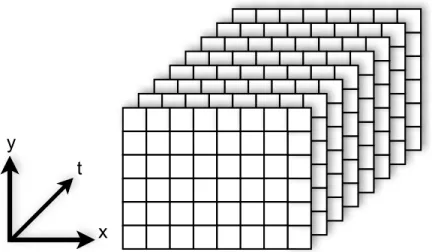
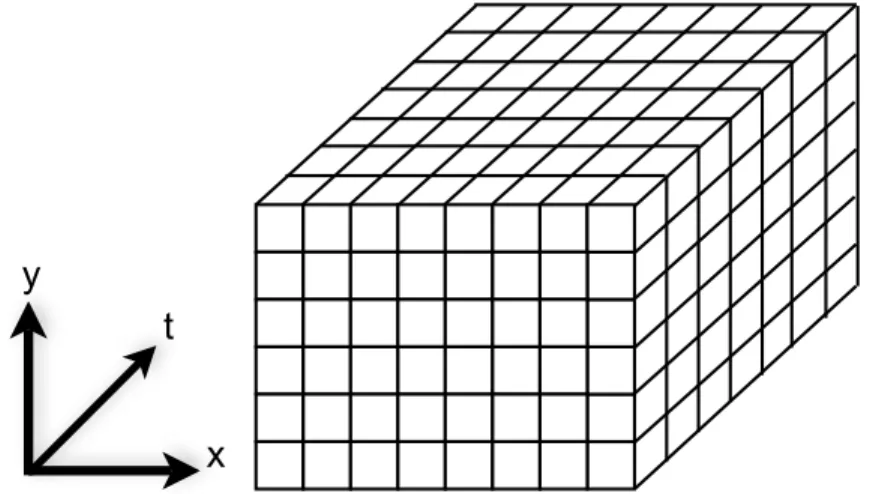
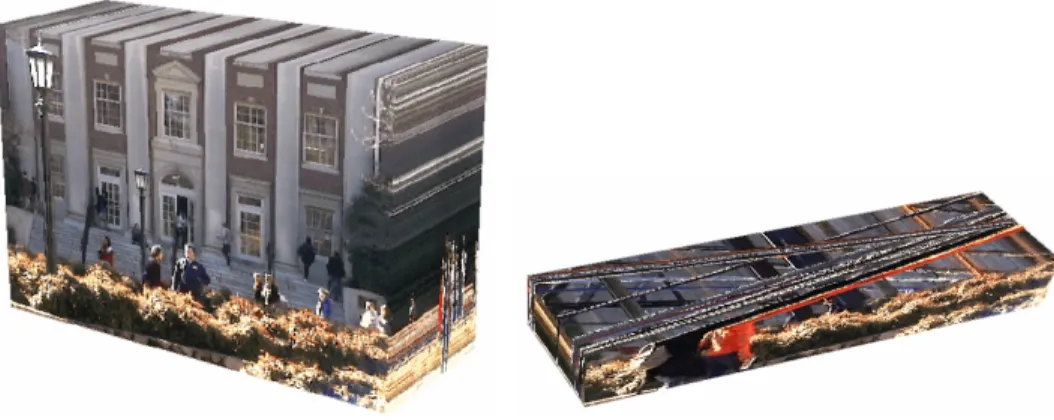
in chronological order to create a 3D volume, as shown in Figure 1.1, thus emphasizing
relationships between adjacent spatial and temporal samples. Shearing is the process
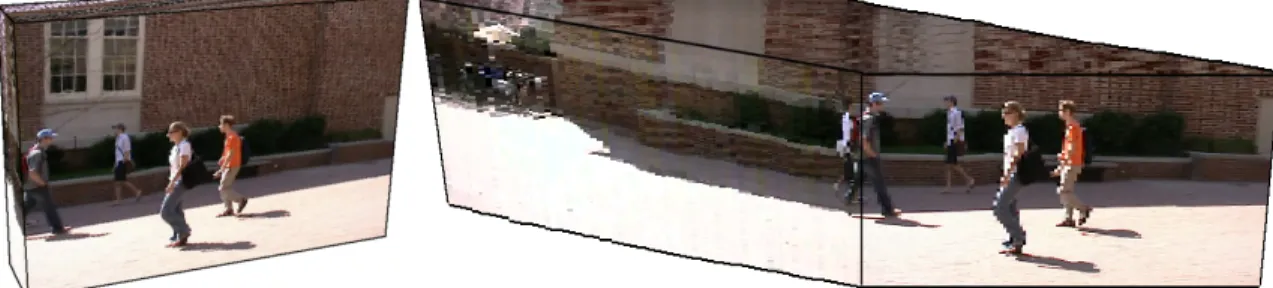
of spatially warping the frames of the volume to align temporally-adjacent samples to greatly assist the processing of moving objects and non-static cameras.
• I develop the Proscenium spatio-temporal video editing framework to address the
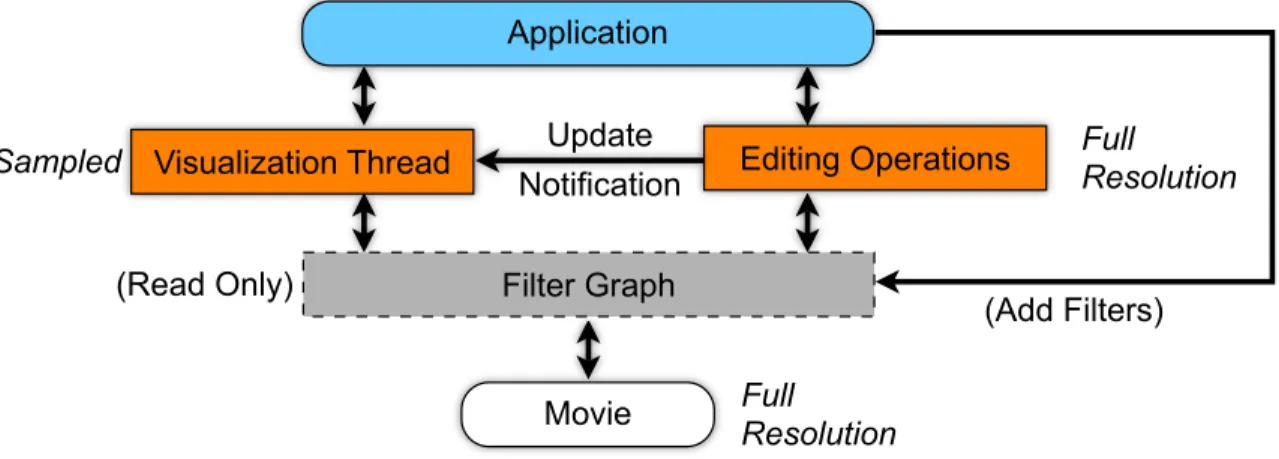
mem-ory and processing requirements of computational video and spatio-temporal volumes.
This framework encapsulates spatio-temporal volumes within aper-pixel, bi-directional,
lazily-evaluated filter graph model. This model also supportsvirtual shears that can be
created and removed dynamically to support editing. This framework is then used to
develop a prototype video editor that performs computational video manipulation tasks
such as object removal, temporal filtering, and multi-frame editing.
• I present a computational video approach to improving the quality of captured low-light,
LDR (Low Dynamic Range) video by virtually extending the exposure times of each
x
y
t
sample (pixel). This is possible with the non-linear integration of information from
large neighborhoods of temporally and spatially adjacent samples. Two interconnected
concepts make this possible. First is a spatially-varying LDR tone mapping algorithm
that finds the optimal exposure time in a well-exposed image. This is used as an
ob-jective for theintegration and noise reduction ASTA (Adaptive Spatio-Temporal
Accu-mulation) filterwhich extends the exposure time to find the correct original luminance
had it been properly exposed. When used together, this combined method is referred
to as theVirtual Exposure Camera model.
• To improve captured video in a different context,I also address enhancing low-light video
using spectra outside of the standard visible red, green, and blue channels. Specifically,
information from registered video in the IR spectrum is used to enhance noisy RGB
footage. My approach differs from previous multispectral fusions because it enhances the
RGB footage using the IR, but without introducing elements imaged only in IR. This is
accomplished through edge-preserving decomposition and cross-spectral normalization,
assisted by a novel dual bilateral filter. This filter preserves edges detected in both
spectra but only uses samples from the visible-spectrum video.
• Having considered video manipulation and enhancement as examples of computational
video,I then consider temporal resampling of videos to alter their duration. Specifically,
the problem of time-lapse video generation from video-rate footage is considered. A
non-uniform sampling algorithm is presented that optimizes the sampling of the input
video to match the user’s desired duration and visual output characteristics. This can
be either to generate time-lapse videos that preserve motion, avoid fast motion, control
the uniformity of the output sampling, or a combination of these characteristics. By
considering the entire video as a whole, the optimal sampling can be found.
• To complement the computational video resampling,I extend ideas from computational
photography to combine the input frames together to alter the aliasing characteristics of
the video output. Thisvirtual shutter combines many frames together using both
median filtering, and more complex effects, such as compositing. Thus, new synthetic
exposures are created which are related to both the low-light ASTA exposures and the
spatio-temporal filtering performed in Proscenium.
1.2
Dissertation Overview
My approaches to computational video are presented as follows:
To begin, the field of computational video will be reviewed in Chapter 2. Because this
field is an outgrowth of image processing, video processing, and computational photography,
relevant topics from those areas are discussed as well.
In Chapter 3, the use of spatio-temporal volumes for computational video processing is
examined. This is presented along with volume shearing, the Proscenium spatio-temporal video editing framework, and discussion of how computational video operations, in this case
video editing and enhancement, can be performed within these volumes.
In Chapter 4, a computational approach to video enhancement is discussed for improving
the quality of noisy low-light videos, showing the strengths of adaptive filtering with large
spatio-temporal kernels. Visible-spectrum-only enhancement is discussed, with the Virtual
Exposure Camera model, combining LDR tone mapping and the ASTA filter. Multi-spectral
video enhancement is then addressed with a focus on the new dual bilateral filter.
In Chapter 5, a computational video approach to video resampling and frame combination
is presented to shorten the duration of videos into time-lapse sequences. This demonstrates the
ability of computational video to dramatically alter the content of an input video. The sampler
is presented along with a variety of metrics to achieve many output sampling characteristics.
The output frames are then generated by the virtual shutter that combines all the frames in
the original video using linear and non-linear techniques.
CHAPTER 2
PREVIOUS WORK
In this chapter, I provide an overview of the previous literature regarding computational video.
Computational video is an outgrowth of video processing and computational photography,
both of which are based on image processing. Thus, to consider computational video is
to consider each of these component fields. Specifically, the common thread through this
discussion is that the potential of computational video is derived from its ability to enhance
the samples in a video by combining observations from other similar frames.
I begin this literature review by considering the established methods for processing digital
video: traditional video editors and video processing frameworks. I then review recent work
in spatio-temporal volumes, which present an alternate representation of video that lends
itself to filtering and enhancement applications. Further investigation of traditional filtering
is then discussed in the context of the classic image processing area of noise reduction. The
focus then shifts to computational photography, specifically in the domains of High Dynamic
Range (HDR) imaging, multispectral fusion, and multi-image combination. Given all this
work as a basis, computational video is then considered, addressing both the summarization and compositing of video sources.
2.1
Video Editing
The most common interface for processing or enhancing video is through a dedicated video
editing application. Therefore, I begin by discussing the goals of these applications along
with those of the low-level frameworks often used to encapsulate video processing.
The primary function of most modern digital video editing systems, such as Apple Final
clips, and then assemble those clips with transitions along some timeline into a finished video.
Such editors perform cuts, cropping, editing, color-correction, and insertion of transitions
be-tween clips. Applications such as Adobe After Effects focus on making modifications primarily on individual clips (often a few seconds long). These modifications are often more complex
and concentrate on the modification of video pixels and less on temporal arrangement. These
operations are closer to the type of actions considered by computational video.
The visual interface used for interaction in all of these applications is a timeline plus
a frame-by-frame viewer. Thus time and space dimensions are treated inherently different
from each other. This does not lend itself well to the incorporation of samples and other
elements from multiple frames that are necessary for computational video. Alternate
repre-sentations, such as 3D spatio-temporal volumes, discussed in Chapter 3, consider the entirety
of a video at once. However, there have been recent efforts in mixing standard 2D image
editing user-interface metaphors with such 3D visualizations. Ideas from Adobe Photoshop,
a popular commercial image-editing tool, are, in fact, frequently applied to both 3D and video
applications because of its ease of use, flexibility, and rich set of tools. Furthermore, systems
have been proposed to extend Photoshop’s rich image-editing environment to volumetric data
(Zwicker et al., 2002). By extension, such techniques may hold promise for processing video in spatio-temporal volumes.
Many video processing systems are based upon filter graphs which have been utilized for
many applications in the area of image and multimedia processing (Pratt, 1997).
Conceptu-ally, the idea is that individual processing components can be ordered and arranged so that
data flows from the input of a filter graph to the output; passing through the interconnected
components that lie along that path. Each component (often called a filter) may modify data
before passing it along to the next filter. Each filter is only responsible for processing data
in a standardized manner without knowledge of what filters might be connected to it. This
allows a uniform interface with components that are interconnected in any order, as in the
Decorator design pattern (Gamma et al., 1995). These filters are often representative of the
common operations that occur throughout video editing: color correction, smoothing, scaling,
For instance, Apple’s QuickTime (Apple Inc., 2007) framework and Microsoft’s
Direct-Show (Microsoft Corporation, 2007) framework implement multimedia filter graphs for video
and audio. At a higher level of abstraction, the Berkeley Continuous Media Toolkit (Mayer-Patel and Rowe, 1997) implements a powerful filter graph in the form of a scripting protocol,
as opposed to a compiled API. Filter graphs treat video data as a stream that flows in buffers
of entire frames of pixels from the graph’s input to the graph’s output. This is ideal when an
entire frame’s output is desired, but is not ideal to calculate small sub-frame regions.
As mentioned, the frame-by-frame timeline nature of these video editors and frameworks
differs from the needs of computational video to consider many frames simultaneously for
enhancement. Thus, a different method for thinking about video, the spatio-temporal volume,
is now discussed.
2.2
Spatio-Temporal Volumes
Considering videos as three-dimensional volumes of their stacked constituent frames was first
proposed in the epipolar video processing research of Bolles et al. (1987). In this work, object
and scene motion are measured by taking a planarcutof a spatio-temporal volume containing
the video. Each cut results in a still image that contains portions of many frames, allowing
for correlations to be made in 2D between position and time to measure object velocity. An
underlying assumption of these measurements is that the camera that captured the source
video was static so that spatial positions in the video are constant through time.
These volumes and planar cuts were later realized as an interactive visualization in
“Inter-active Video Cubism” (Fels et al., 2000). These spatio-temporal cuts (originally planar and
later spherical) again provide a view into the video, but do not modify the underlying data.
More advanced applications are then explored in (Klein et al., 2001) and (Klein et al., 2002),
which both use multiple spatio-temporal cuts to create artistic video interpretations of the source material. In an extreme case, “Making Space For Time in Time-Lapse Photography”
(Terry et al., 2004) scales the cut plane concept to visualize the total contents of multiple
days of video footage in a single image. Alternatively, Zomet et al. (2003) identified
different from the projection of the imaging device. These works demonstrate a wide range
of visualizations that motivate the possibilities of spatio-temporal processing.
The spatial-alignment of individual frames is essential to video processing within a spatio-temporal volume. As will be further discussed in Section 3.1, this alignment guarantees that
a consistent spatial pixel location in the volume is always imaging the same scene element.
Thus, enhancement algorithms can access other samples of the same object at the same
(x, y) coordinate but at different tvalues (time). I call this spatial remapping of the volume
shearing. Planar cuts of a sheared volume represent non-planar cuts of the original
spatio-temporal volume. Non-planar spatio-spatio-temporal cuts have since been used as an interface to
specify multi-frame compositing operations (Wang et al., 2005).
It follows then that the parameters for shearing are derived from stabilizing a scene element
through time. Shearing can be used to stabilize each element one-at-a-time, allowing each
visual element to be edited, processed, or enhanced independently. This approach is influenced
by the video layers concepts of Wang and Adelson (1994) who developed the notion that
general planes of motion in a video should be edited independently.
To solve for a spatio-temporal volume’s underlying shear function, a variety of
stabi-lization methods exist. Buehler et al. (2001) demonstrate how foreground and background stabilization can be used to generate novel videos with refined camera and object motions.
Their work relies on extensive offline analysis for dense feature tracking, local warping, and
iterative smoothing of the source sequence. More recently, Sand and Teller (2004) presented
a “Video Matching” method for aligning slightly different video sources. This alignment is
between videos, and is able to robustly handle cases of missing scene elements between those
videos. At a lower-level, single visual elements (trackable points) or sparse sets of points can
be tracked through a video using a feature tracker such as the Lucas-Kanade algorithm (Shi
and Tomasi, 1994). An efficient implementation of this technique is publicly available as part
of the OpenCV toolkit (Bouguet, 2000).
Spatio-temporal volumes can serve as the basis for a wide range of computational video
techniques, as further explored in Chapter 3. I next consider another class of video processing
enhanced result. For example, noise filtering can be considered as a computational video
method.
2.3
Noise Filtering
A unique strength of computational video is its ability to improve or enhance every pixel
value of a video by considering the additional temporal and spatial information within a local
neighborhood of samples. Similarly, the standard concept of filtering changes the value of a
signal’s sample based upon a kernel of surrounding samples, using either linear or non-linear
methods. Such filtering is an essential part of computational video.
One particularly useful class of filters is for noise reduction. The noise apparent in images
and video sources is due to many factors, including sensor noise, low signal strength, and data corruption (noise characteristics, measurement, and modeling are discussed in Section 4.1).
Here, an introduction to 2D spatial noise filtering is presented along with an overview of the
video filtering literature.
2.3.1 Spatial Filtering
Noise filtering methods have a long history throughout the signal processing literature. First,
I discuss noise filters for processing still images and then I consider noise reduction methods for video in the next section as an extension of those methods.
The most basic noise filter to consider is Gaussian smoothing (and its discrete
approxima-tions), which results in a spatial low-pass filter of the image (Bovik, 2000). While Gaussian
smoothing is effective at removing random shot noise (noise characteristics are discussed in
more detail in Section 4.1), high-frequencies are also removed, thus blurring the image edges
and textures. The formula for a general n-dimensional Gaussian filter with equal support in
all dimensions (i.e., a 1D Gaussian falloff based on Euclidean proximity) is given below:
Js=
P
p∈Ω
g(kp−sk, σh)Ip
P
p∈Ω
g(kp−sk, σh)
g(x, σ)≡ 1 σ√2πe
−x2
2σ2. (2.2)
Gaussian smoothing is an LSI (Linear Spatially/Shift Invariant) filter, incorporating
in-formation from nearby samples in its 2D kernel Ω and weighting their importance uniformly
based on the proximity of each pixel to the filter’s center (its output pixel). It can be
consid-ered as a “domain” filter of the kernel’s samples. The weighting is center biased and falls off
as a normalized Gaussian function (Eq. 2.2), hence its name.
An alternate class of filters, called range filters, combine samples whose weights are based
instead upon photometric proximity rather than their spatial proximity. One popular range
filter, the Sigma filter (Lee, 1983), combines samples within the spatial kernel Ω that are
within 2σ of the value at the kernel’s center. The value of σ can be determined by the standard deviation of the original image itself. Sigma filtering is very sensitive to the size of
Ω because faraway samples can make equivalent contributions to those at the center of the kernel, potentially corrupting edges due to its non-regularizing formulation.
To overcome the edge blurring artifacts of the Gaussian filter and the potential edge
corruption artifacts of the Sigma filter, edge-preserving filters can be used from the anisotropic
diffusion and bilateral filter families. These filters attempt to filter pixels within smooth areas
while avoiding crossing over contours of significant change (i.e., edges). Anisotropic diffusion
of images (Perona and Malik, 1990) provides an iterative filtering method that adapts to the
image’s gradient, based upon heat flow equations:
It=div((c(x, y, t)∇I) =c(x, y, t)∆I+∇c· ∇I, (2.3)
c(x, y, t) =υ(||∇I(x, y, t)||), (2.4)
υ(∇I(x, y, t)) =e(−(||∇I||/K)2) or υ(∇I(x, y, t)) = 1 1 +||∇KI||2
. (2.5)
The value of K determines which edges are preserved and which are smoothed, based on their gradient magnitudes. In the discrete implementation of anisotropic diffusion given by
to smooth large neighborhoods many iterations of the diffusion process are required. This
results in the most significant downside to anisotropic diffusion: its slow execution speed.
Alternatively, bilateral filtering (Tomasi and Manduchi, 1998) provides a single-pass noise removal process that shares many of the advantages of anisotropic diffusion, as discussed by
Barash et al. (2002). It is simultaneously a range and a domain filter, weighting samples
based on both spatial proximity and photometric similarity. The bilateral filter is also a
specific instance of the more general range and domain SUSAN filter of Smith and Brady
(1997). Bilateral filtering requires two parameters: σh, the Gaussian spatial falloff, and σi,
the Gaussian intensity difference falloff. The bilateral filter is formulated as:
Js =
P
p∈Ω
g(kp−sk, σh)g(D(p, s), σi)Ip
P
p∈Ω
g(kp−sk, σh)g(D(p, s), σi)
, (2.6)
D(p, s)≡Ip−Is. (2.7)
The utility of bilateral filtering goes beyond applications in edge-preserving noise
reduc-tion filtering. The output of the bilateral filter contains smooth regions separated by sharp
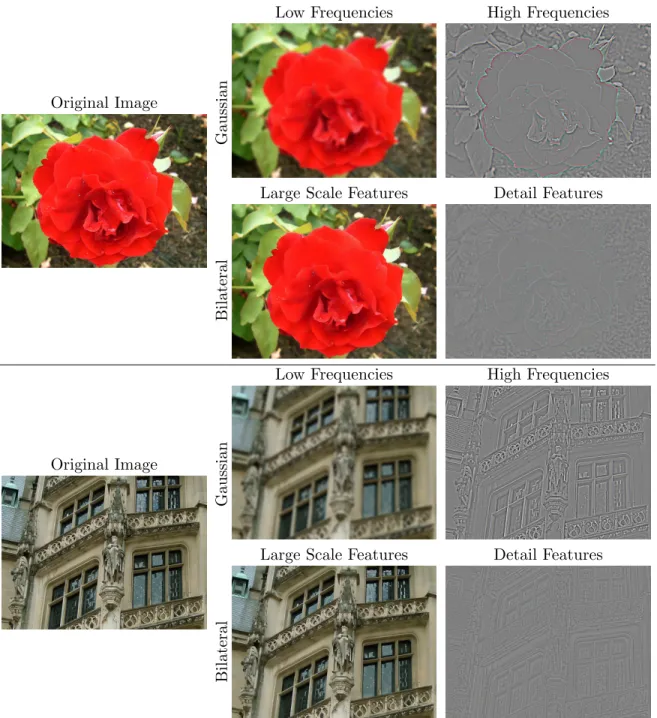
edges, which are commonly called the large-scale features. These large-scale features can be
considered a piecewise-constant approximation of the original image. The differences between
the original image and the bilateral filter’s output are the detail features which contain the
textures, as shown in Figure 2.1. The utility of this large-scale/detail decomposition was
orig-inally discussed in terms of High Dynamic Range (HDR) processing by Durand and Dorsey
(2002), where each component was processed separately. More generally, the decomposition
and recomposition of image components is related to earlier work by Peli and Lim (1982),
who used high-pass and low-pass frequency separation of signals in a similar manner.
There have also been many extensions to the bilateral filter. Boomgaard and Weijer (2002)
posed the question of how to improve the robustness of the bilateral filter’s noise-handling
by considering alternate dissimilarity values (Eq. 2.7) that measure photometric differences. The trilateral filter (Choudhury and Tumblin, 2003) takes a different approach to improving
the bilateral filter model by biasing its kernel away from edges and dynamically choosing the
Original Image
Low Frequencies
Gau
ssian
Large Scale Features
Bilateral
High Frequencies
Detail Features
Original Image
Low Frequencies
Gau
ssian
Large Scale Features
Bilateral
High Frequencies
Detail Features
functions in the limit. Although the quality of filtering is improved, performance is decreased.
If speed is required, a fast bilateral implementation (O(log r), where r is the kernel radius) is presented by Weiss (2006) that assumes no spatial falloff (i.e.,σh =∞).
To specifically address the reduction of severe shot noise and salt-and-pepper noise,
statistically-motivated rank order filters were introduced. These filters sort the values in
the kernel Ω and use that information to select only certain values to use, such as the median,
minimum, or maximum. The most popular of these is the median filter (Tukey, 1971), which
chooses the median intensity from all intensities in the kernel. This reduces noise, but can
corrupt edges by growing or shrinking them (dilation or erosion) similar to Sigma filtering,
as they are influenced by the kernel’s samples.
The “bilateral median” filter described by Francis and Jager (2003) combines bilateral
filtering and median filtering to reject outliers from the bilateral kernel. Garnett et al. (2005)
used a robust Rank Order Absolute Difference (ROAD) metric to robustly detect if the
bilateral kernel itself is centered on a sample of shot noise. This metric is the sum of the
absolute differences of the n most similar neighboring pixels to the kernel’s center value Is.
The original bilateral filter preserves shot noise because it is considerably different from its
neighbors, but the ROAD metric distinguishes shot noise from actual edges that appear in neighboring pixels.
To demonstrate the effects of many of these standard filters, comparisons are provided in
Figures 2.2 and 2.3. These filters are designed for 2D still images, so their kernels are entirely
spatial. For video noise reduction, however, 3D kernels that utilize temporal information
become possible.
2.3.2 Video Filtering
When processing videos, as opposed to still images, noise filtering can be performed
consid-ering information from adjacent temporal samples to introduce more samples into the kernel
and improve consistency in the filtering from frame-to-frame (temporal coherence). For
in-stance, Dubois and Sabri (1984) perform non-linear temporal noise filtering assisted by optical
Original Image Gaussian Filter
Sigma Filter Median Filter
Anisotropic Diffusion Filter Bilateral Filter
Figure 2.2: Comparison of existing spatial filtering techniques. The original image exhibits a high noise level in both luminance and chrominance. The Gaussian filter (σ = 5.0) blurs the edges but removes the noise. The Sigma filter (σ = 30) preserves some of the edges but corruption begins to occur at this Ω kernel size (11x11). The 11x11 median filter preserves many eges, but introduces new distortion in blotchy regions. Anisotropic diffusion (50 iter-ations with K = 7) does an excellent job, save some stray pixels in the background. The bilateral filter (σh = 5 and σi = 30) also does an excellent job filtering in a single pass with
Original Image Gaussian Filter
Sigma Filter Median Filter
Anisotropic Diffusion Filter Bilateral Filter
Figure 2.3: Additional comparison of spatial filtering techniques with a surveillance data source of a stairwell. In very low-light, the original amplified image suffers from very high noise levels. The Gaussian filter (σ = 3.0) blurs the edges, making the scene difficult to interpret. The Sigma filter (σ = 20 with a Ω kernel size = 7x7) does a good job, but is somewhat blotchy. The 5x5 median filter also results in a blotchy image. Anisotropic Diffusion (50 iterations with K = 4) has some trouble reducing the large amount of shot noise, especially on the walls. The bilateral filter (σh = 5 andσi = 15) does the best overall
temporal filter weighted by the reliability of the displacement estimate. This method requires
well-exposed, easy-to-track video to correctly filter.
Jostschulte et al. (1998) presented a spatio-temporal shot noise filter that first spatially and then temporally filters video while preserving edges that match a template set. A
motion-sensing algorithm is used to vary the amount of temporal filtering. Thus, its filtering can be
considered as a 2D spatial filter augmented by temporally-adjacent samples, thus time and
space are treated differently. Alternatively, “Spatio-Temporal Anisotropic Diffusion” (Lee
and Kang, 1998) uses a three-dimensional kernel to remove video noise, treating temporal and
spatial dimensions similarly. This approach is a 3D variant of the 2D anisotropic diffusion
already discussed in Section 2.3.1.
As opposed to filtering in the local spatio-temporal neighborhood, the NL-means noise
reduction of Buades et al. (2005) searches for matching neighborhoods, which may or may
not be spatially aligned or temporally continuous, to attenuate noise. These neighborhoods
are used to refine the information about the correct underlying values in the original, noisy
neighborhood. In contrast, by finding a statistical mapping of a known video to a set of many
small spatio-temporal training patches “Video Epitomes” (Cheung et al., 2005) allows the
simultaneous enhancement of many similar video regions. This is used for noise reduction in addition to super-resolution and the estimation of dropped video frames.
Video noise filtering is effective because each pixel can incorporate information from many
frames to estimate its true value using images (frames) that are very similar to it. This is
analogous to HDR capture, where each luminance value is combined from a set of registered
images with varying exposures.
2.4
HDR Processing
The real world has a much higher luminance dynamic range than the standard 8-bit sensors and displays in the imaging pipeline, only capable of a 256:1 maximum dynamic range. High
Dynamic Range (HDR) imagery that can represent more realistic dynamic ranges, often
on order of 10,000:1 or 100:000:1, has thus been long recognized as essential for accurately
There are two problems that quickly become evident working with HDR. First, capture
of HDR imagery is impeded by sensors and digitizing precision, requiring multiple images at
different exposures to properly image all visual elements. Even worse, HDR video capture requires the use of specialized imaging hardware. Another problem is display on 8-bit devices,
requiring a remapping of the image luminances (tone mapping) to match the display’s low
dynamic output range. Thus, HDR processing is a class of computational photography
prob-lem because the correct answers cannot be obtained through a single image or standard image
capture process. Instead, through the combination of multiple images and computation, a
more accurate and useful result is obtained.
2.4.1 HDR Capture
Methods for real-world HDR capture are now considered for both still images and video.
Special consideration is given to the handling of low luminance levels (common in low-light
video) in addition to more typical bright HDR luminance levels. Further low-light imaging
characteristics are addressed in detail in Chapter 4.
Debevec and Malik (1997) developed computational methods for assembling individual
still HDR images from a series of photographs with increasingly long exposure times, using a
common photographic process known as bracketing. The exposure curve of the camera used
to capture these images can be solved for, allowing the determination of a luminance estimate
at each photosite, which is no longer limited by the precision of the source images. This work
relies upon the stillness of the scene over a period of time sufficient to capture each of the
bracketed exposures, making it impractical for video.
Researchers have more recently also constructed prototype HDR video capture systems. Kang et al. (2003) built a system based on a camera that can sequence through different
exposure settings for each frame. Once the images are registered using optical flow, it is
possible to combine exposures to increase the dynamic range. The small number of exposures
combined into each output frame suggests that a high signal-to-noise ratio (SNR) is assumed
for all exposure settings, and therefore, it is designed for well-lit HDR scenes.
is placed in front of the CCD. The LCD’s per-pixel transparency is varied to modulate the
exposure of image regions based on the previous frame’s luminance. Along with the hardware,
they also discuss a local and global tone mapping approach that addresses temporal coherence issues. Using LCDs implies attenuation of some minimum percentage of the incoming light,
which complicates capturing dark pixels. Nayar and Branzoi (2004) also introduce a variant
to this method using a DLP micromirror array to modulate the exposure, via time-division
multiplexing (like a camera shutter), throughout the image. In theory, such systems could
provide continuous exposure control at each pixel given the additional hardware requirements.
Note that both of these approaches rely on causal filtering to determine the exposure of each
pixel at capture time. If any pixel is over or underexposed because of an incorrect exposure
time, the photosite’s measurement becomes unusable.
Instead of blocking light reaching the sensor, the sensor itself may be modified for HDR
video capture. Acosta-Serafini et al. (2004) describe an HDR camera that selectively resets a
pixel based on a prediction of when it will saturate. Here, the reset interval and the digitized
pixel intensity level combine to form a floating-point intensity value. They primarily focus on
high-speed HDR sensing and do not specifically address low-light capture. Liu and El Gamal
(2003) combine high-speed samples to reduce noise and improve dynamic range by using specific imaging device features such as high-speed non-destructive reads. Their filtering
is based on a combination of linear filters and motion detection at each individual pixel.
Bidermann et al. (2003) describe an HDR high-speed CMOS imaging platform with per-pixel
ADCs and storage, which could use the underlying algorithms of Liu and El Gamal (2003) to
capture HDR in well-lit scenes.
2.4.2 HDR Tone Mappings
Using the discussed HDR capture techniques to create images with dynamic ranges larger than
256:1, the images must then be tone mapped for display while minimizing loss of perceived
detail and contrast.
The tone mapping problem was formalized by Tumblin and Rushmeier (1993) and has
and spatially varying (Tumblin and Turk, 1999) (Durand and Dorsey, 2002)(Fattal et al.,
2002) tone mappings. By spatially varying the tone mapping, a technique may locally adapt
to maximize displayable contrast. For example, Retinex approaches, such as the multiscale Retinex (Jobson et al., 1997), suggest that a Gaussian-like kernel can be convolved at each
point in the image and subtracted from the original image in log space, resulting in a more
“viewable” version of an HDR still image. The Retinex approach is fast due to it being
non-iterative, but it can generate unwanted edge blurring artifacts because of its underlying
Gaussian nature.
The tone mapper of Durand and Dorsey (2002) presents a similar system, but uses bilateral
filtering to maintain sharp edges and to reduce fringing artifacts. It operates by separating
the large-scale features from the detail features and processes them separately. As shown
in Figure 2.4, this processing is done in the log-luminance domain, which models the detail
features as modulations to the large-scale features (contrast modifications), instead of being
additive. Once the separation has occurred, the large-scale features are attenuated by some
factor k < 1, then recombined into the output. The resulting image then has a reduced dynamic range. The technique works because, after compression, all of the uniform regions
fall within an 8-bit range. The lower magnitude textures are also visible because they are modulating luminances in that displayable range. The results still look plausible because the
contrast ratios are unchanged in smooth regions, only the absolute luminances are modified,
and by Retinex theory (Jobson et al., 1997), the human visual system is not sensitive to
smooth absolute luminance changes over large spatial areas.
Other HDR work includes that of Pattanaik et al. (2000) who present an approach that
mimics the time dependent local adaptation of the human visual system. They also discuss
temporal coherence issues to avoid introducing frame-by-frame tone mapping “flicker” when
processing videos. In “Gradient Domain HDR Compression” (Fattal et al., 2002), the gradient
field of an image is locally attenuated and then reintegrated. It should be noted that they
also describe a method for improving images that already use the display’s full 8-bit dynamic
range. This is the closest problem addressed in the literature to the reverse problem of
HDR Input ln exp Tone-MappedResult
Bilateral *k
+
-Large-ScaleFeatures
Detail Features
HDR Input Large-Scale Features Detail Features Tone-Mapped Result
Figure 2.4: Illustration of the HDR tone mapping pipeline described by Durand and Dorsey (2002). The result of the bilateral filter, the large-scale features, are attenuated by a factork
while everything else, the detail features, remain unchanged. The tone mapping is performed in the log domain so that the detail features modulate the large-scale features (images shown have been converted to the linear domain for display). Values ofk < 1 cause dynamic range compression (as originally published) while values ofk >1 expand the dynamic range.
By using multiple images, HDR capture and tone mapping create resulting images that
were not otherwise possible to capture. Another approach that combines multiple images is
multispectral fusion. Because these images are now each from a distinctive spectrum, their
fusion creates enhanced results not visible to the human eye.
2.5
Multispectral Fusion Techniques
Multispectral fusion involves the depiction of multiple, potentially non-visible, spectral bands
as a visible image. The goal can be to communicate information from all sources, or to
augment a poor quality signal in one band with a higher quality one (such as augmenting noisy
night-vision video with heat-detection imagery). In this section, two classic multispectral
applications are summarized: remote sensing (aerial and satellite imagery) and night-vision.
a neural network to create false-color (pseudo-color) images from a learned opponent-color
importance model. Many other false-color fusion models have been suggested in the remote
sensing community. A summary of popular techniques is provided by Pohl and Genderen (1998). Another common fusion approach is to combine pixel intensities across spatial scales
using multiresolution Laplacian or wavelet pyramid decompositions, as in (Toet, 1990) and
(Li et al., 1994). Also, physically-based models that incorporate more than per-pixel image
processing have also been suggested (Nandhakumar and Aggarwal, 1997).
Therrien et al. (1997) introduce a method to decompose visible and IR sources into their
respective high and low frequencies, and processes them in a decomposition/recomposition
framework inspired by Peli and Lim (1982). A non-linear mapping is applied to each set
of spectral bands to fuse them into the result. Therrien et al. (1997) address normalizing
luminance responses between spectra to overcome differences in surface reflectivity between
bands. These normalized luminances are mapped to a new space defined by a Sammon
mapping (Sammon, 1969). Issues regarding the temporal coherence of such a mapping in
video are not mentioned.
IR colorization algorithms, such as those by Welsh (2002) and Toet (2005), attempt to
learn a mapping from IR to natural chrominance to construct a plausible colorized output. For that reason, colorization can be considered a class of fusion that estimates chrominance
based on image priors from IR footage. However, acquiring a prior and performing accurate
matching from prior to IR is often difficult and does not guarantee temporal coherence for
video processing.
2.6
Computational Photography
Having considered combining elements from multiple spectra together (often imaged
simulta-neously), we next consider combining exposures taken with the same imager, but at different times. This allows for existing imagers, such as digital cameras and camcorders, to achieve
enhanced results with the assistance of computational methods.
Therefore, I now present techniques that are typically labeled as computational
to create an optimal composite image. Specifically, multiple images are used as input, and a
still image is the result. These combination techniques draw on the wealth of algorithms and
techniques that have already been discussed in this chapter.
“Image Stacks” (Cohen et al., 2003) considered the idea of using multiple temporally
adjacent frames to enhance knowledge about a pixel’s true or desired value. Multiple images
are registered and then each pixel of the output image is computed as a function of its temporal
neighbors. “Image Stacks” includes methods for automatically selecting and combining image
regions using compositing and min, max, median, and temporal low-pass filtering. An α -blended “over” compositing (Porter and Duff, 1984) (Eq. 2.8) is also used to illustrate the
passage of time by compositing so that recent motions occlude past motions:
Over =α·F oreground+ (1−α)·Background. (2.8)
The concept of combining sequential frames of motion together can be traced back to
the stroboscopic multiple exposure photographs of Harold Edgerton (Edgerton and Killian,
1979) and the motion studies of Muybridge (Muybridge, 1955) and Marey (Braun, 1995),
all performed using traditional film capture. The combination of images to create motion
studies was also addressed by Freeman and Zhang (2003) with the use of stereo depth data
to influence each pixel’s compositing order.
As an extension to “Video Stacks”, “Interactive Digital Photomontage” (Agarwala et al.,
2004) allows the user to choose individual parts of a few images through a simple drawing
interface to quickly specify the best composite image. This fusion is accomplished using both graph-cut (Kwatra et al., 2003) and gradient domain algorithms (see below).
“Space-Time Scene Manifolds” (Wexler and Simakov, 2005) combined the concept of using
spatio-temporal volumes (Section 2.2) with a similar goal of combining multiple sequential
video frames captured with a non-static camera. The resulting optimized non-planar cuts are
chosen to maximize the visual information in the resulting cut image while simultaneously
mosaicing the constituent video frames.
The seamless integration of scene elements from multiple images has been explored in
solvers have already been mentioned in the context of HDR tone mapping (Section 2.4.2).
Techniques such as Poisson Image Editing (Perez et al., 2003), and day/night fusion (Raskar
et al., 2004) generate gradient fields that contain visual elements from multiple images. The ratio-image work of Liu et al. (2001) transfers illumination between multiple images
with the assistance of known illumination priors. The capture of these priors requires images
taken in controlled lighting environments, which are suited for still images, but not for video.
New variants of the bilateral filter, discussed in Section 2.3.1, have been developed for use
in computational photography. The “joint bilateral filter” uses a second image as the source
of comparison for edge identification, thus transferring its edges to the original image. This
filter was used by Petschnigg et al. (2004) and by Eisemann and Durand (2004) (who refer
to it as “the cross bilateral filter”). Both of these papers consider the problem of combining
the qualities of an image captured with the use of a flash with the “look” of a noisy image
captured under ambient illumination. A joint bilateral filter is created by changing Equation
2.7 to instead perform its photometric comparisons in a second image, indicated asI0:
D(p, s)≡Ip0 −Is0. (2.9)
The extent of noise removal depends on how well exposed a given region is in the flash
image. These papers also address flash shadows, which introduce visible edge differences
between the sources. These flash shadows resemble some of the differences seen between
RGB and IR spectra mentioned in Section 2.5.
These approaches are all designed to output a single image as a function of its input frames. In the final section, computational video techniques that result in video outputs are
considered.
2.7
Computational Video
Computational video is a more recent field than computational photography, so its seminal
literature is not yet established. In this dissertation, computational video involves processing
This is accomplished using techniques enabled by modern computational power and the
si-multaneous processing of many frames enabled by the low cost of storage. One type of
computational video is the temporal resampling of a video to change its duration. Com-putational video techniques are thus allowed to warp both space and time, compressing or
extending the video’s duration and intermixing frames.
2.7.1 Video Summarization
Temporal resampling is commonly used for multimedia summarization. Early work in Video
Skimming (Smith and Kanade, 1997) looked for short, representative video segments that,
when pieced together, could tell the story of the video in a reduced period of time. Segments were chosen based on characteristics including scene change detection, camera motion, object
recognition, and audio. The documentary films they targeted had distinct scene changes
providing the algorithms additional hints. An alternate summarization approach proposed
by Hua et al. (2003) searched for video segments that contain scene and camera motion
between shot boundaries and combined them to match the rhythm of an audio source to
create music videos.
Using similar documentary films to (Smith and Kanade, 1997) and standard,
uniformly-sampled summarization (fast-forward), Wildemuth et al. (2003) explored how fast videos can
be played back while remaining coherent to the viewer. The result was that showing 1 out
of every 64 frames typically allowed the viewer to comprehend most of the content. Note
that in addition to documentary-style video sources, summarization can also be applied to
static-camera, time-lapse sources. In particular, time-lapse has been shown to have many
applications for viewing slowly changing processes. Time-lapse techniques are regularly used in fields as varied as biological microscopy (Riddle, 1979) and cinematic effects (Kinsman,
2006).
“Video Summarization By Curve Simplification” (DeMenthon et al., 1998) presents an
algorithm to choose a non-uniform temporal sampling based upon simplification of tracked
motion-path curves. These motion curves can be considered a subset of all motion activity
curve-fitting algorithm (Douglas and Peucker, 1973). Note that slower, but optimal, dynamic
programming-based curve-fitting solutions (Perez and Vidal, 1994) are possible.
In “Video Summarization Using MPEG-7 Motion Activity and Audio Descriptors” (Di-vakaran et al., 2003), short video sub-clips identified as containing significant motion are
played at real-time speeds and assembled into a shorter video. The combined duration of
these essential sub-clips forms the lower bound of the output video’s duration. Longer videos
are constructed by padding the result with less interesting frames.
Rav-Acha et al. (2006) summarize long videos by allowing events to occur without the
strict chronological ordering of the source footage, thus events may overlap. The events are
identified and then combined in a manner determined via a spatio-temporal Markov random
field optimization and simulated annealing.
2.7.2 Temporal Resampling and Compositing
Computational video considers a wider range of temporal resamplings and frame
combina-tions. For instance, a class of operations exist that extend the length of videos by repeating
segments. “Video Textures” (Sch¨odl et al., 2000) looks for transitions within a video that are
least noticeable in an attempt to indefinitely extend its playing time. A dynamic programming
solver is used along with a pairwise error metric to evaluate potential jumps.
Other approaches have also attempted to warp time, both globally (full frame) and locally
(region-by-region). “Flow-Based Video Synthesis and Editing” (Bhat et al., 2004) rearranges
repeating patterns of natural phenomena, such as waterfalls, that have reoccurring flow
char-acteristics, to extend their play time. “Evolving Time Fronts” (Rav-Acha et al., 2005a) plays
videos with differing speeds in multiple image regions for the effect of altering their outcomes or for artistic effects. “Dynamosaics” (Rav-Acha et al., 2005b) carries this idea further by
improving the blending between regions with graph-cuts (Boykov et al., 1999). “Panoramic
Video Textures” (Agarwala et al., 2005) also finds frame-to-frame jumps within non-static
camera videos to create panoramas.
Videos can also be processed to alter their component visual elements. “Motion
changing the underlying temporal sampling, thus increasing apparent object velocity.
Al-ternatively, “Space-Time Super-Resolution” (Shectman et al., 2005) creates a composite of
multiple videos using their relative frame rates and spatial positions to maximize spatial and temporal information while reducing overall aliasing.
As a parallel to these computational video methods, user-assisted, temporally-aware video
compositing algorithms have also been developed. “Video Matting of Complex Scenes”
(Chuang et al., 2002) approaches the problem using Bayesian methods. “Interactive Video
Cutout” (Wang et al., 2005) combines compositing with spline-based, non-planar
spatio-temporal volume cuts in its interface for extracting foreground elements. In this interface,
the user can specify hints to the alpha compositing engine across multiple frames by painting
directly onto the cut plane. The VideoShop project (Wang et al., 2007) composites
multi-frame visual elements from video clips together in the gradient domain through the use of a
3D multigrid Poisson solver.
2.8
Summary
A wide range of literature related to computational video and its foundations was reviewed to
act as a background for the techniques and applications presented throughout the remainder of
this dissertation. The common element in all of these works is the visualization, combination,
and enhancement of still images and videos to create improved outputs by utilizing all the
information in the source material. As a first step to building efficient computational video
tools, a framework is now presented for working with a new class of spatio-temporal volumes
CHAPTER 3
SPATIO-TEMPORAL VIDEO
PROCESSING
In this chapter, I explore approaches to computational video where videos are abstracted as
spatio-temporal volumes. Computational video often relies on using nearby spatial and
tem-poral samples in order to enhance the underlying video. Likewise, spatio-temtem-poral volumes
provide a representation for accessing and organizing these samples. Furthermore, I extend
spatio-temporal volumes to include sheared volumes that spatially align frames to bring
to-gether important scene elements into a common spatio-temporal neighborhood. This shearing
can be done in relation to the background to stabilize a moving camera, or in relation to a
moving object to stabilize its motion.
Frequently, shears are not meant to be permanent. Therefore it is desirable after
process-ing that the original camera and object motions be restored. Thus, modifications made to
these sheared volumes must be applied to the source data and are formulated as mapping
functions, thus making the shearvirtual. Furthermore, there are significant performance
is-sues involved in manipulating and visualizing uncompressed spatio-temporal video volumes in sheared and un-sheared states. To handle these issues, an efficient graph-based processing
framework called Proscenium is introduced to encapsulate and abstract away the details of
such processing. Finally, as a proof-of-concept, a simple video editor is developed that
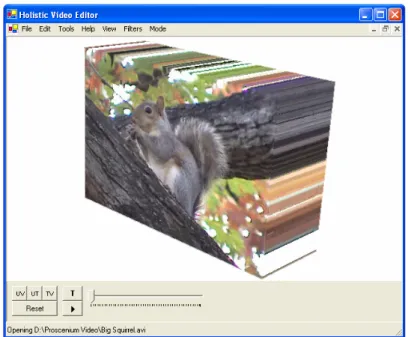
visual-izes, edits, and filters in a manner that leverages the capabilities of spatio-temporal volumes
(Figure 3.1).
The chapter begins with discussions of previous spatio-temporal volumes and then an
overview of the new shearing extension. Then, spatio-temporal video processing with