Community effectiveness of pyriproxyfen as a
dengue vector control method: A systematic
review
Dorit Maoz1,2, Tara Ward3, Moody Samuel4, Pie Mu¨ ller1,2, Silvia Runge-Ranzinger4, Joao Toledo5, Ross Boyce6, Raman Velayudhan7, Olaf Horstick4*
1 Department of Public Health, Swiss Tropical and Public Health Institute, Basel, Switzerland, 2 University of
Basel, Basel, Switzerland, 3 Public Health Specialist, Accra, Ghana, 4 Institute of Public Health, University of Heidelberg, Heidelberg, Germany, 5 Public Health Specialist, Ministry of Health, Brasilia, Brazil, 6 Division of Infectious Diseases, University of North Carolina at Chapel Hill, Chapel Hill, North Carolina, United States of America, 7 Department for the Control of Neglected Tropical Diseases, World Health Organization, Geneva, Switzerland
Abstract
Background
Vector control is the only widely utilised method for primary prevention and control of den-gue. The use of pyriproxyfen may be promising, and autodissemination approach may reach hard to reach breeding places. It offers a unique mode of action (juvenile hormone mimic) and as an additional tool for the management of insecticide resistance among Aedes vectors. However, evidence of efficacy and community effectiveness (CE) remains limited.
Objective
The aim of this systematic review is to compile and analyse the existing literature for evi-dence on the CE of pyriproxyfen as a vector control method for reducing Ae. aegypti and
Ae. albopictus populations and thereby human dengue transmission.
Methods
Systematic search of PubMed, Embase, Lilacs, Cochrane library, WHOLIS, Web of Sci-ence, Google Scholar as well as reference lists of all identified studies. Removal of dupli-cates, screening of abstracts and assessment for eligibility of the remaining studies
followed. Relevant data were extracted, and a quality assessment conducted. Results were classified into four main categories of how pyriproxyfen was applied: - 1) container treat-ment, 2) fumigation, 3) auto-dissemination or 4) combination treatments,–and analysed with
a view to their public health implication.
Results
Out of 745 studies 17 studies were identified that fulfilled all eligibility criteria. The results show that pyriproxyfen can be effective in reducing the numbers of Aedes spp. immatures a1111111111
a1111111111 a1111111111 a1111111111 a1111111111
OPEN ACCESS
Citation: Maoz D, Ward T, Samuel M, Mu¨ller P,
Runge-Ranzinger S, Toledo J, et al. (2017) Community effectiveness of pyriproxyfen as a dengue vector control method: A systematic review. PLoS Negl Trop Dis 11(7): e0005651.
https://doi.org/10.1371/journal.pntd.0005651
Editor: Pattamaporn Kittayapong, Faculty of
Science, Mahidol University, THAILAND
Received: January 30, 2017
Accepted: May 19, 2017
Published: July 17, 2017
Copyright:©2017 Maoz et al. This is an open access article distributed under the terms of the
Creative Commons Attribution License, which permits unrestricted use, distribution, and reproduction in any medium, provided the original author and source are credited.
Data Availability Statement: All relevant data are
within the paper and its Supporting Information files.
Funding: The authors received no specific funding
for this work.
Competing interests: The authors have declared
with different methods of application when targeting their main breeding sites. However, the combination of pyriproxyfen with a second product increases efficacy and/or persistence of the intervention and may also slow down the development of insecticide resistance. Open questions concern concentration and frequency of application in the various treatments. Area-wide ultra-low volume treatment with pyriproxyfen currently lacks evidence and cannot be rec-ommended. Community participation and acceptance has not consistently been successful and needs to be further assessed. While all studies measured entomological endpoints, only two studies measured the reduction in human dengue cases, with inconclusive results.
Conclusions
Although pyriproxyfen is highly effective in controlling the immature stages of dengue trans-mitting mosquitoes, and–to a smaller degree–adult mosquitoes, there is weak evidence for a reduction of human dengue cases. More well designed larger studies with appropriate standardised outcome measures are needed before pyriproxyfen is incorporated in routine vector control programmes. Additionally, resistance to pyriproxyfen has been reported and needs investigation.
Author summary
There is evidence that pyriproxyfen may effectively reduce the density of immature mos-quito stages when applied to identified breeding sites. Various formulations are commer-cially available, and easy to use without a health threat to the user. However, questions remain regarding its use as a single agent in a community setting. Considering its mode of action, it would not be the product of choice for use in an acute outbreak setting. How-ever, for a sustainable community approach, especially slow-release pyriproxyfen formula-tions seem promising, because they are the longest lasting choice. The analysis suggests, that combination with a second vector control chemical, preferably an adulticide tackling different stages of mosquito development, increases the efficacy of pyriproxyfen and pro-longs the duration of a single application. This systematic literature review clearly shows that there is a need for further studies, preferably utilising cluster-randomised controlled (cRCT) designs, to investigate the community effectiveness of pyriproxyfen and to link entomological outcomes to human dengue transmission.
Introduction
Over the past five decades, the global burden of dengue is estimated to have increased massively: Bhatt et al. [1] postulated that in 2010 there were 96 million apparent, and 294 million unappar-ent infections worldwide, with 22,000 registered dengue-related deaths reported in 2014 [2].
Transmission of dengue is through infective bites of femaleAedes aegypti (L.) (Diptera:
Culi-cidae)mosquitoes and, to a lesser extent, ofAe.albopictus (Skuse). The immature stages of the
Aedesmosquitoes are found in water filled containers [3].
intervention. Larvicides have most often been implemented againstAe.aegyptias it breeds almost exclusively in domestic water containers.Ae.albopictususes both, artificial and natural breeding sites [7] and is therefore more difficult to tackle.
Pyriproxyfen is an insect growth regulator (IGR) with a slow-acting larvicidal activity against a broad spectrum of public health insect pests [8] and it is being used extensively worldwide both in public and private settings. Acting on the endocrine system of insects by mimicking the juvenile hormone, pyriproxyfen hinders molting and subsequently inhibits reproduction. In addition, it causes morphological and functional aberrations in emerging adults, such as decreased fecundity and fertility. Due to its very low mammalian toxicity [9], pyriproxyfen is approved by the World Health Organization (WHO) for the treatment of pota-ble water against mosquitoes [10].
Pyriproxyfen has been studied extensively in experimental, i.e. controlled laboratory or semi-field settings, with evidence of efficacy against immatureAedes spp. [11,12]. Yet, in field application studies, pyriproxyfen demonstrated mixed outcomes regarding its effectiveness as well as persistence. To date, no systematic review of the scientific literature has been under-taken to examine the evidence for the effectiveness of pyriproxyfen against dengue vectors. Therefore, the objective of this study is to review systematically the available literature for evi-dence on the community effectiveness (CE) of pyriproxyfen as a vector control method
reduc-ingAe.aegyptiandAe.albopictuspopulations and dengue transmission.
Methods
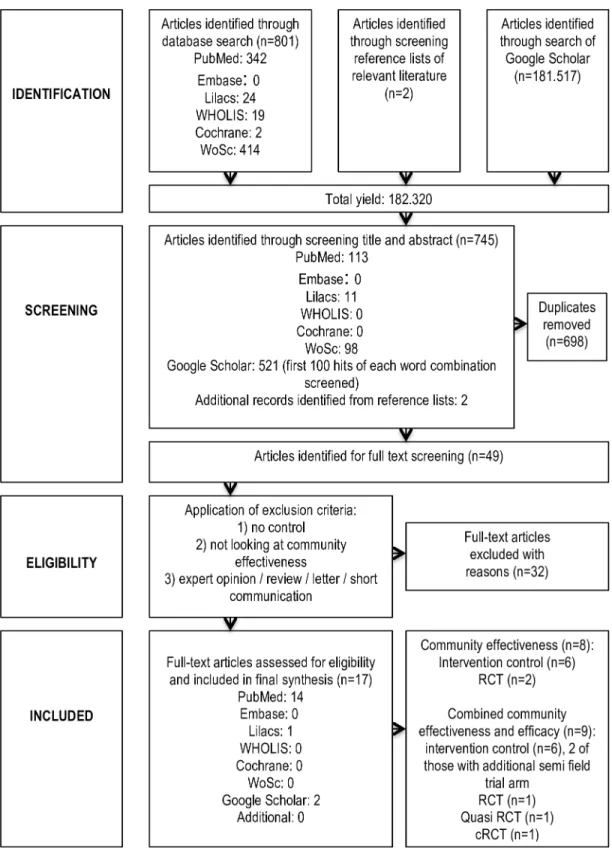
This review follows the reporting guidelines set forth in the PRISMA (Preferred Reporting Items for Systematic Reviews and Meta-Analyses) Statement for systematic reviews and meta-analyses [13] (Fig 1).
Inclusion and exclusion criteria
The following inclusion criteria were used: 1) Studies providing original research dealing with the CE of pyriproxyfen—alone or in combination with other chemical vector control products. 2) As for study types, included were any cRCTs or randomised controlled trials (RCT); non-RCTs (nRCT) only if they were relevant to the research question and using a control, e.g. quasi-randomised controlled trials (quasi-RCTs), intervention control trials, controlled before and after studies. Unlike in RCTs, allocation in quasi-RCTs is performed in a way that is open to systematic bias, i.e. chances of being in one group or another are not equal. In cRCTs, pre-existing groups of participants are allocated to (or against) an intervention. Intervention con-trol studies use methods designed to examine efficacy or effectiveness of an intervention in a group but do not use randomisation. 3) Any study that applied pyriproxyfen in the field— defined as any community or environment where dengue vectors naturally occur—was con-sidered CE and included in the analyses.
Efficacy studies, defined as trials performed under laboratory conditions were excluded. Of the studies that undertook both methods, only the CE component was considered. Inclusion criteria included the above-mentioned study types, to give a broader picture of existing studies, since vector-control studies have varying designs and information may be useful.
Search strategy
databases to locate peer-reviewed studies: PubMed, Web of Science, EMBASE, LILACS, WHOLIS and Cochrane. In addition, grey literature using Google Scholar has been searched.
Search terms were divided into three broad categories, including 1) disease relevant terms, 2) vector relevant terms and 3) intervention relevant terms. For the disease category, the terms
were: Dengue, Dengue haemorrhagic fever, Dengue shock syndrome, along with the abbrevia-tions DF (dengue fever), DHF (dengue haemorrhagic fever), DS (dengue syndrome), and DSS (dengue shock syndrome); for the vector category:Aedes,Aedes aegypti,Aedes albopictus;and for the intervention category: pyriproxifen, and insect growth regulator.
Once screened for duplicates by author, title, journal and publication date, eligible studies were screened against the inclusion criteria. At first, titles and abstracts were screened by two independent reviewers, in a second step articles were reviewed in full and relevant information was extracted into the evidence table (Table 1). A third reviewer was available for the potential case of disagreement between the two independent reviewers. Studies were assessed for quality using the assessment of multiple system reviews (AMSTAR) [14]. For the purpose of this review, the overall quality of studies was not used to exclude studies, but as a tool for evaluating the impact of the reported outcomes.
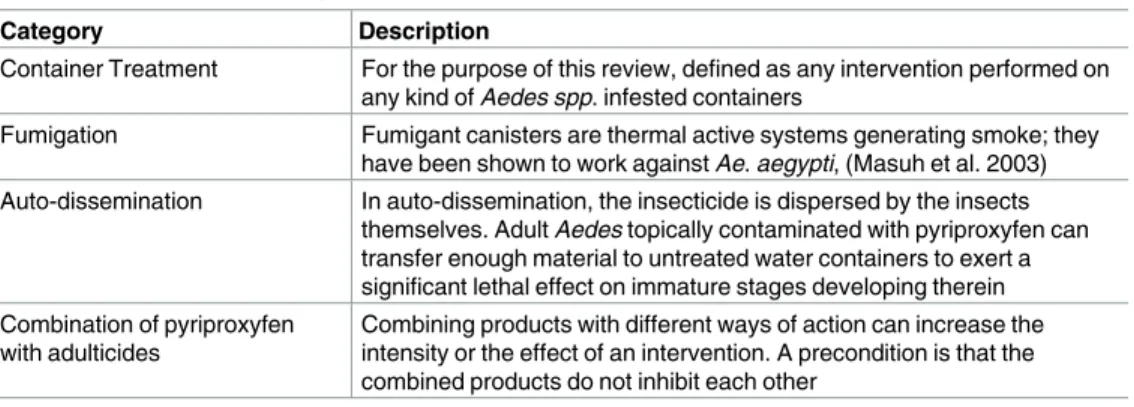
A comparative analysis of the main study outcomes was conducted, using the quality of each individual study as a weighing tool. The use of randomisation, the calculation of sample sizes and the size of the unit of allocation all impacted the weight individual studies were assigned. Finally, analytical categories were developed based on the method of pyriproxyfen application. These categories were: 1) container treatment, 2) fumigation, 3) auto-dissemina-tion, and 4) combination of pyriproxyfen with adulticides. As for 1), ‘container treatment’ is for the purpose of this review defined as any intervention performed by using any kind of
Aedes spp. infested containers (Table 2).
Results
745 articles were identified from the different databases for assessment (Fig 1). After removing duplicates (n = 698), 47 were left for closer analysis. An additional two studies were identified from the reference lists of the above. Applying full inclusion and exclusion criteria on these 49 studies, 17 met the pre-specified eligibility criteria. Eight of the studies were classified as CE studies, while nine reported both efficacy as well as CE components.
Common reasons for the exclusion of potentially relevant studies included the following: 26 studies reported only efficacy; one study was a meta-analysis without original data [15]; and for one study [16] the pyriproxyfen component of the intervention was not accepted by the community and therefore not analysed. Another CE study [17] had multiple study arms, but the arm in which pyriproxyfen was tested againstAedeswas a simple intervention design with-out a control and was therefore excluded. Similarly, another study [18] described the use of pyriproxyfen against Aedes only as a simple intervention and did not use it in its RCT part. One proved to be a simple intervention [19] and one combined efficacy and CE study [20] was excluded as it did not use pyriproxyfen in its CE part.
General study characteristics
The included studies were published between 2005 and 2014 (Table 1). One was in Thai the others in English. Seven of the studies were conducted in Central or South America (four in Argentina [21,22,23,24], one in Colombia [25], two in Peru [26,27]; four in Southeast Asia (one in Cambodia [28], two in Thailand [29,30], one in Vietnam [31]); two in the USA [32,
33], two in Martinique [34,35], and two in Europe (Italy [36], Netherlands [38]).
Table 1. Evidence table. 1st author, year, country, vector Study design Objectives Pyriproxyfen formulation / application Intervention (a) / control (b) group Duration F/U Sample size / unit of allocation Outcome measures Results (only pyriproxyfen considered) Conclusion Caputo et al. 2012; Italy; Ae alb int. control Study the feasibility of an autodissemination approach to control Ae. albopictus in a highly urbanised neighbourhood 5% grinded to powder pyriproxyfen (Proxilar, I.N.D.I.A. Industrie Chimiche S.p.A.) a) Verano Cemetery (98 ha) and enclosed garden of Sapienza University (1 ha) Sentinel sites with 200 ml tap water, 0.07 g of cat food and 25 3rd-instar Ae. albopictus larvae b) Control sites similar to SS but closed with nets to prevent mosquitoes from entering the beakers and transferring pyriproxyfen 12 days each in 2 consecutive years 2x 10 dissemination stations in 2 sites + either 10 sentinel sites or 10 control sites; the dissemination stations filled with tap water, covered with pyriproxyfen-dusted cloth Pupal mortality in sentinel sites 50–70% (controls < 2%); Mortality was always significantly higher in sentinel sites than in control sites and almost exclusively limited to the pupal stage Pyriproxyfen was transferred by mosquitoes into sentinel sites and had a lethal effect. The study supports the potential feasibility of the autodissemination approach to control Ae. albopictus in urban areas. Dantur Juri et al. 2013; Argentina; Ae aeg int. control To compare the efficacy of a ULV formulation and fumigant canister, containing both permethrin and pyriproxyfen, with that of standard permethrin applications in a field assay Formulations (Chemotecnica S.A. Argentina): A: 10% permethrin as emulsifiable concentrate. 10 mL / ha. B: 3% pyriproxyfen plus 10% permethrin as emulsifiable concentrate; 100 mL / ha. C: fumigant canister with 1% permethrin + 0.2% pyriproxyfen. Fumigant components and inert c. s.p. 50 g. One tablet each 25–50 m 3/10–20 m 2 Zone A: Formulation A via cold fogger truck mount ULV Zone B: Formulation A via cold fogger truck mount ULV plus Formulation C employed at all dwellings Zone C: untreated control Zone D: Formulation B using cold fogger truck mount ULV E: Formulation A by portable aerosol generator ULV treatment a) 64.591 people in five treatment areas; effects of A, B and C formulations were compared among 4 zones and among container types (250 ml and 20 lcontainers and adult cages) b) The fifth area was left untreated = control 10 weeks Five areas (A—E) in the city, approx. nine blocks each, separated from one another by green areas / defined urban areas plus containers to measure the infestation rate in and around dwellings BI; EI %; number of dead larvae; pupal survival Treatment produced the most larval lethality; most larvae died after 2 weeks. The lowest BI (11) value was 1 week post-treatment in the area treated with formulation C but reached 118 by week 2; the next lowest BI (50), in the areas treated with formulation A, was stable for 1 week after application. After treatment, BI values of the area treated with formulation B took 3 weeks to recover, indicating better performance of this formulation. Comparing 250mL and 20L containers, container size seemed to influence insecticide dilution, which possibly affected EI%. Permethrin + pyriproxyfen provides better (longer lasting) control of Ae. aegypti and could be a new alternative for vector control Darriet et al. 2010; Martinique; Ae aeg int. control To evaluate the operational efficiency of a mixture of pyriproxyfen and spinosad against a population of Ae. aegypti from Martinique resistant to pyrethroid and organophosphate insecticides. a) pyriproxyfen (0.02 mg/l), 3 with spinosad (0.1 mg/l) b) mixture of both (0.02 mg/l + 0.1 mg/l) c) controls a) 1. step (simulated): evaluation of the efficacy of pyriproxyfen and spinosad when used alone, or in combination. 2. step: containers in natural conditions as above (only 2. step considered in this review) b) 3 untreated containers in same setting 7 months 15 containers EI % / rate of adult emergence 1. step: the mixture of pyriproxyfen + spinosad remained active for minimum 8 months, compared with 3 months for spinosad alone, and 5 months for pyriproxyfen alone. 2. step: the rate of adult emergence was maintained at 20% for 3 wks (pyriproxyfen) / 3.5 months (spinosad). The mixture
pyriproxyfen+spinosad remained effective
Table 1. (Continue d ) 1st author, year, country, vector Study design Objectives Pyriproxyfen formulation / application Intervention (a) / control (b) group Duration F/U Sample size / unit of allocation Outcome measures Results (only pyriproxyfen considered) Conclusion Limpawitthayakul & Sornpeng 2011; Thailand; Ae aeg int. control To compare efficacy and sustainable killing effect of temephos with that of pyriproxyfen in the lab and in the field Temephos 1% SG and pyriproxyfen 0,5% G a) 4 villages 12 weeks -Temephos maintained its ability to kill 50% of larvae within 24hrs for 12 weeks in store water containers and 8 wks in used water containers. Pyriproxyfen 0.5% G acted longer: 13 and 9 wks, respectively. Most deaths at pupal stage or 3–15 days after water contact. In villages: similar effect shown -Lucia et al. 2009; Argentina; Ae aeg int. control To evaluate a new ULV formulation of permethrin + pyriproxyfen that is effective against adult and immature aquatic mosquitoes Formulation A: Permethrin 15% as emulsifiable concentrate Formulation AL: (experimental) permethrin 15% plus pyriproxyfen 3% as emulsifiable concentrate (all by Chemotecnica S. A, Argentina) Polyethyleneglycol 1000 as antievaporant for ULV treatments. a) Two areas were sprayed—one with pyriproxyfen 2g/ha + Permethrin 10g/ha, one with Permethrin 10g/ha only b) One area was left untreated 10 wks 2 areas of approx 36 ha each, plus 1
control. Atotal
Table 1. (Continue d ) 1st author, year, country, vector Study design Objectives Pyriproxyfen formulation / application Intervention (a) / control (b) group Duration F/U Sample size / unit of allocation Outcome measures Results (only pyriproxyfen considered) Conclusion Ocampo et al. 2014; Colombia; Ae aeg quasi RCT (int. control) To describe a vector control strategy, its operationalization, the prioritization and control of breeding sites, and the subsequent entomological and epidemiological results, in an endemic town in southwestern Colombia Each catch basin was treated monthly with 2 g of pyriproxyfen (approx 0.05 mg/mL) a) Guadalajara de Buga, Colombia: 97.262 people, 32.224 houses b) neighboring town (Palmira) chosen as control for dengue case incidence 7 months 603 houses (indoors) in six communes 4800 street catch basins BI; CI Stegomya indices from the entomological surveys in
houses larval/pupal mortality dengue
case incidence phase 1: 1) most common type of potential breeding sites were ground level water storage tanks for laundry 2) outside, 58,3% of basins positive for Ae. aegypti 3) 100% of adult EI was observed with pyriproxyfen phase 2: 1) statistically significant reduction of Ae. aegypti in street catch basins 2) when the intervention stopped, dengue cases increased 1) highlights the importance of catch basins as Ae. aegypti breeding sites 2) high resistance to temephos shown > should not be used anymore 3) pyriproxyfen highly efficacious, no known cross resistance with temephos 4) reduction in +ve catch basins suggests an effect of pyriproxyfen on mosquito density and hence on larval infestation 5) targeting street catch basins in such areas (urban, endemic dengue) could help to decrease dengue transmission Ponlawat et al. 2013; Thailand; Ae aeg 1 = int.
control 2=
RCT Evaluation of pyriproxyfen-treated devices on Ae. aegypti populations within an dengue-endemic village Pyriproxyfen (Sumilarv 0.5G, Sumitomo Chemical Corporation, Osaka, Japan) at a 0.05 g AI/m 2 a) Ban Chon village with 65 houses with 160 inhabitants b) Neon Mayom village (71 houses, 171 inhabitants) was untreated = control 30 weeks Four random houses in the inner circle of the treatment village received one device/ house BG-trap 1/house (4 houses in inner and 8 houses in outer area) Sentinel containers: 3 l plastic buckets with tap water placed randomly in ten selected houses in both inner and outer circles of each village CDC backpack aspirator collections in houses w/o BG-trap only BG-sentinel trap count was significant: adult density parity % step 1: Egg production was significantly reduced in females exposed to pyriproxyfen early in their development step 2: presence of the pyriproxyfen-treated device significantly reduced adult counts during the study period This device can reduce fecundity and change the age structure of the Ae. aegypti population in the field. The device may suppress increases in Ae. aegypti populations Pyriproxyfen has a significant effect on egg production and deposition (and hence adult productivity) when females are exposed shortly after a blood meal Seccacini et al. 2014; Argentina; Ae aeg
int. control +semi- field
trial To evaluate natural long-lasting materials containing pyriproxyfen to improve control strategies of Ae. aegypti Chemicals: Paraffin, stearin and beeswax (Parafarm Saporiti,
Argentina) Pyriproxyfen (China
Table 1. (Continue d ) 1st author, year, country, vector Study design Objectives Pyriproxyfen formulation / application Intervention (a) / control (b) group Duration F/U Sample size / unit of allocation Outcome measures Results (only pyriproxyfen considered) Conclusion Sihuincha et al. 2005; Peru; Ae aeg int. control To provide a comprehensive examination of the effects of a granular formulation of pyriproxyfen on field Ae. aegypti. To report on the effects of pyriproxyfen on 1) adult emergence from exposed 4th instars and pupae 2) egg eclosion, 3) use of adults as vehicles for transfer of lethal larvicide doses to previously untainted oviposition sites 4) effect of adult exposure on fertility and fecundity 5) repellency of pyriproxyfen to ovipositing adults 6) residual effects of pyriproxyfen applied to large storage tanks in the field Pyriproxyfen formulation Sumilarv 0.5 G (Sumitomo Chemical Co., Osaka, Japan)—a granular formulation of 0.5% (AI) (wt:wt) (5000 ppm) a) 16 tanks (200, 300, 600 l) in households b) control pots with tap water 5 months 16 tanks in households, positive for Ae. aegypti before intervention, in constant use as water sources for washing and bathing larval/pupal mortality 88–96% mortality of larvae in water tanks for 5 months adult blood-fed females exposed to residues of 0.003 ppb can transfer enough pyriproxyfen to untreated sites to keep larvae from emerging no difference in number of eggs laid per female if treated with various pyriproxyfen concentrations or tap water presence of organic material (hay) in the water greatly increased the number of eggs laid In the field: water collected from tanks treated with 50– 83 ppb remained effective (88.0–96.0% mortality) for 5-months. Pyriproxyfen was effective at 0.01ppb (the lower end of the range reported for this compound) Exposure on the day of blood feeding led to drastically decreased eclosion of eggs As for pyriproxyfen transfer: 5 treated females per new site result in over 70% EI; length of exposure had no impact Ae. aegypti show no preference for ovipositing in nontreated water over pyriproxyfen treated water Pyriproxyfen is a highly effective larvicide with the potential to be an excellent intervention against dengue it is clear from our data on repellency and the horizontal transfer of pyriproxyfen that it might be possible to exploit adults as vehicles for dissemination Snetselaar et al. 2014; Netherlands; Ae aeg int. control To describe the development of a new type of ovitrap, a multi-impact contamination device for Aedes mosquitoes, with the aim to create a user-friendly control device that does not rely on electricity or chemical insecticides. To demonstrate the potential adulticidal, autodissemination and larvicidal impacts of the agents deployed in the trap. Pyriproxyfen (Chemos GmbH, Regenstauf, Germany) mixed with fungal spores and inert dust particles to create a dust mixture suitable for application on the gauze a) 50 free-flying Aedes females b) Two plastic cups with tap water, 20 larvae and fish food, placed outside the experimental cage 18 days 50 free-flying Aedes females larval mortality; EI % Dissemination of pyriproxyfen led to > 90% larval mortality in alternative breeding sites and 100% larval mortality in the trap itself, against a control mortality of around 5% The trap also has an effect on breeding sites in its’ vicinity and could therefore be a useful tool in integrated vector management campaigns to provide protection around the house and in public places. Suman et al. 2014; USA; Ae alb int. control To test the hypothesis that contaminated gravid females would transfer pyriproxyfen to new larval habitats. NyGuard IGR concentrate -MGK Corp., Minneapolis, MN, USA) containing 10% pyriproxyfen, formulated as an emulsifiable concentrate. Pyriproxyfen was applied as per
manufacturers recommendation (789.23
Table
1.
(Continue
d
)
1st
author,
year,
country,
vector
Study design
Objectives
Pyriproxyfen formulation
/
application
Intervention
(a)
/
control
(b)
group
Duration
F/U
Sample
size
/
unit
of
allocation
Outcome measures
Results
(only
pyriproxyfen
considered)
Conclusion
Tsunoda
et
al.
2013;
Vietnam;
Ae
aeg
RCT
To
determine
whether
covering
the
lids
of
domestic
water
storage
containers
with
OlysetW
Net
would
help
controlling
Ae.
aegypti
To
test
the
effectiveness
of
applying
an
IGR
in
flower
vases
and
ant
traps
inside
and
around
houses.
To
examine
the
abundance
of
immature
Ae.
aegypti
before
and
after
the
intervention,
and
also
compare
the
change
in
abundance
between
the
trial
and
control
areas
EcoBio-BlockS: neutralized cement
(40.6%
w/w),
aggregate
(pumice
stone, 52.1%
w/w),
a
mixture
of
aerobic
bacteria
and
nutrient medium
(4.1%
w/w),
and
0.5%
granular
formulation
of
pyriproxyfen
(SumilarvW
0.5
G,
Shinto
Fine
Co.,
Ltd., Osaka,
Japan,
3.2%
w/w). Content
of
pyriproxyfen
in
the
block:
0.016%
(w/w).
a)
Tan
Chanh
commune,
313
trial
households;
12.000
total
residents
b)
363
control
households
5
months
flower
vases,
ant
traps
(pyriproxyfen)
major
types
of
water
containers
(ceramic
jars,
cylindrical
concrete
tanks,
other
concrete
tanks,
plastic
drums,
and
plastic
buckets),
covered
with
Olyset
Net
(permethrin)
CI;
HI
pupae/container anti
Dengue
IgM
&
IgG
The
Container
Index
in
the
trial
area
gradually
decreased
from
Oct-Feb.
The
total
CI
in
the
trial
area
decreased
in
Oct
and
continued
to
be
<
20%
until
February. Number
of
pupae
per
container
decreased
for
all
three
states
of
lid
in
the
trial
area
in
Oct.
Treatment
by
Olyset
Net
and
pyriproxyfen
had
a
strong
negative
effect
on
the
prevalence
of
the
immature
Ae.
aegypti,
which
persisted
for
at
least
5
months
after
treatment. Seroprevalence
rates
were
not
significantly
different
between
the
trial
and
control
areas.
Number
of
positive
containers
and
of
pupae
in
the
trial
area
were
both
less
than
in
the
control
area
after
Olyset
Net
and
pyriproxyfen
treatment,
suggesting
that
suppression
of
mosquitoes
is
due
to
the
treatments
tested.
https://do
i.org/10.1371/j
ournal.pntd.
0005651.t
The most common study design was nRCT, used in 12 studies. Three were RCTs, one quasi-RCT and one cRCT. Regarding the vectors,Ae.albopictusalone was studied in two of the included studies [33,36], one study [32] tackled both,Ae.aegyptiandAe.albopictus, both laboratory-reared. The remaining 14 studies looked atAe.aegyptionly.
Study objectives and interventions. While all included studies had a CE element, some also examined the efficacy of pyriproxyfen [25,27], or resistance [35]. Others looked at differ-ent application forms, including auto dissemination [26,27,33,36,37], fumigation [22], ULV application [21,32], long-lasting materials [24,31], and controlled-release application [28,31]. Some tested the combination of pyriproxyfen with another active ingredient; seven of the eight CE studies used it either in combination with another product—permethrin [22,23,31], Beau-veria bassiana [37]—or compared it to other products [21,29].
Among the studies with both CE and efficacy arms, three used pyriproxifen either in com-bination with spinosad [34] or temephos [29] or compared its effects with other vector control methods (temephos, diflubenzuron,Bti, spinosad; [35]).
Sample sizes and units of allocation. Various methods of pyriproxyfen application were used and information on sampling and reporting of sample size was often limited, making comparisons between the studies difficult. The largest study included communities with a total of 97,262 people [25], followed by 64,591 people [21]. Both studies were conducted in urban settings, facilitating a high coverage. Tsunoda [31] performed their intervention in a town of 12,000 inhabitants, while Marcombe [35] and Darriet [34] chose smaller settings, described as ‘three separate villages’, though the exact size population-wise is not specified. Two studies [27,30] were conducted in rural areas and reported a sample size of two villages (65/71 houses with 160/171 inhabitants) and 16 households, respectively. Likewise, [29] was undertaken in four villages in Thailand.
The included studies also differed regarding the scale of the intervention; and, again, the reporting of this information varied widely. Sizes and makings of containers were most com-monly reported as units of allocation. Others treated defined surface areas with different formula-tions and concentraformula-tions of pyriproxyfen. Some had more than one unit of allocation depending on method and study design. The smallest intervention was a cage with 50 free-flyingAedes mos-quitoes [37], followed by [24] with 3 x 200 liter tanks and [34] with 15 containers of various sizes. The largest intervention [25] comprised the catch basins of a whole town (32.224 houses).
The follow up-periods—defined as the total intervention period from the first intervention day to the last day at which the endpoints were measured and reported—varied greatly. They ranged from 12 days [36] to nine months [35] with a median follow-up time of five months.
Table 2. Table of categories. Note that these categories are not mutually exclusive. Some studies are
included in more than one category.
Category Description
Container Treatment For the purpose of this review, defined as any intervention performed on any kind of Aedes spp. infested containers
Fumigation Fumigant canisters are thermal active systems generating smoke; they have been shown to work against Ae. aegypti, (Masuh et al. 2003) Auto-dissemination In auto-dissemination, the insecticide is dispersed by the insects
themselves. Adult Aedes topically contaminated with pyriproxyfen can transfer enough material to untreated water containers to exert a significant lethal effect on immature stages developing therein Combination of pyriproxyfen
with adulticides
Combining products with different ways of action can increase the intensity or the effect of an intervention. A precondition is that the combined products do not inhibit each other
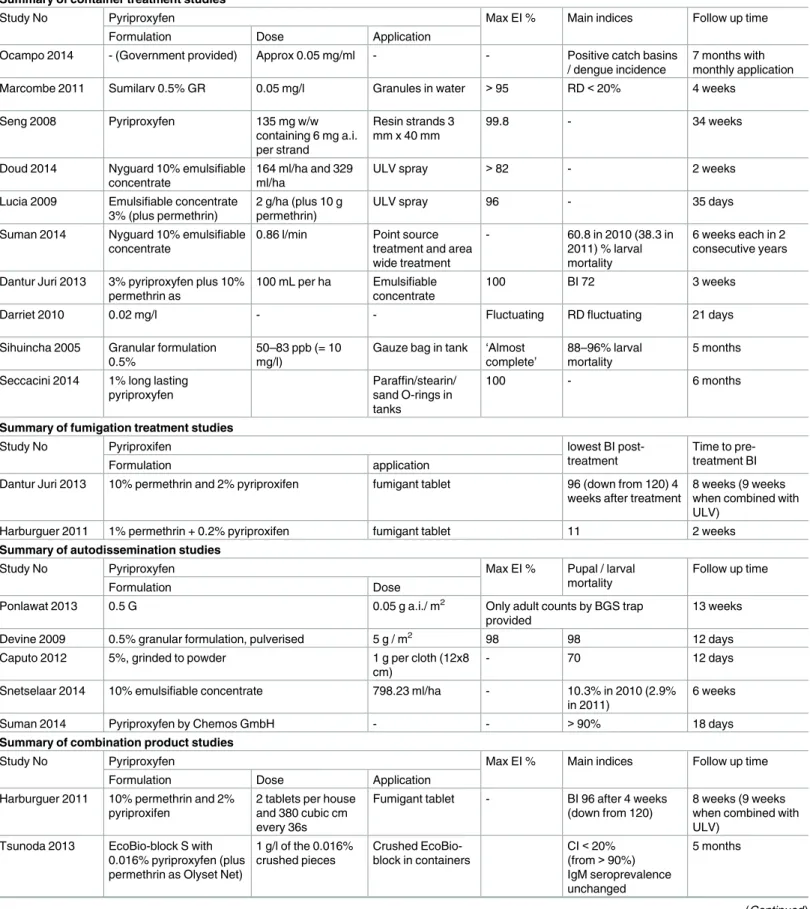
Outcome measures. The reported outcome measures differed depending on the respec-tive research question and intervention (Table 3). The most widely used outcome measure, reported by 11 of the 17 studies, was per cent adult emergence inhibition (EI) [21,22,23,24,26,
28,32,33,34,35,37].
Regarding entomological indices, three studies reported Breteau Index (BI) only [21,22,25] and one BI and Container Index (CI) [23]. Pupae per person (PPP), currently considered the most highly associated with the density of adult vectors (36), was only reported by one study [23]. Pupal mortality [25,26,27,29,33,36], larval mortality [25,26,27,29,37], Relative Density [35], adult indices [22], and Container Index [31] were also used.
Only two studies linked human transmission data. One study [31] used serological surveys (Immunoglobulin M), Ocampo [25] measured dengue case incidence, drawn from the national reporting system.
Analysis of container treatment studies
Ten studies [21,23,24,25,27,28,32,33,34,35] assessed the feasibility and efficacy of container treatment. Two studies were RCTs [25,35], the others intervention control studies. Four stud-ies were performed in an urban environment [21,23,25,27], with the largest study covering an entire town [25]; the other six [24,28,32,33,34,35] were conducted in villages and rural areas.
In six of the studies [21,23,24,28,32,35], pyriproxyfen had a significant (82–100% EI) and long lasting (up to 8 months) effect. However, the two RCTs reported less positive results with significant effects for 4 weeks only. However, it must be considered that one RCT [25] mea-sured catch basin positivity, making comparison with the other studies difficult. It also had several additional constraints such as moderateAedesindices, low pupae/person indices from the start, inability to reach the intended sample size, and the emergence of a dengue epidemic during the intervention. The other RCT [35] and one nRCT [34] reported treatment persis-tence of only 4 weeks, though initial larval densities were significantly reduced.
One study [21] found a variable larvicidal effect in 20 containers and attributed this to larvi-cide dilution, though none of the other container studies reported efficacy limitations with increasing container sizes. Notably, Sihuincha [27] treated different sizes of water tanks suc-cessfully for five months despite a high turnover of the treated water.
Regarding area-wide ULV application, two studies [23,32] recommend this method of application over a wide range of container sizes, while one [33] found it not suitable for either larval habitat treatment or auto-dissemination. The two studies that did report good results with ULV application [23,32] used pyriproxyfen combined with permethrin.
As for persistence in container treatment, slow-release formulations had the best results. Sihuincha [27] reported a mortality rate>80% over five months with application by gauze bags, Seng [28] reported similar effects over eight months with resin strands and Seccacini [24] reported 100% EI at six months using pyriproxifen-impregnated O-rings. A shorter per-sistence of four weeks was reported from a large field trial with granules in water in Martinique [35], while the longest duration of effective EI through ULV treatment was 35 days [23], and the shortest only two weeks [32].
Analysis of fumigation studies
Two studies [21,22] examined the use of fumigant canisters. Both used a combination of pyri-proxyfen and permethrin and reported a significant inhibitory effect on adult emergence of
Ae.aegyptias well as on BI. However, the size of the effect and persistence (less than 9 weeks)
Table 3. Summary of categorised results.
Summary of container treatment studies
Study No Pyriproxyfen Max EI % Main indices Follow up time
Formulation Dose Application
Ocampo 2014 - (Government provided) Approx 0.05 mg/ml - - Positive catch basins / dengue incidence
7 months with monthly application Marcombe 2011 Sumilarv 0.5% GR 0.05 mg/l Granules in water >95 RD<20% 4 weeks
Seng 2008 Pyriproxyfen 135 mg w/w
containing 6 mg a.i. per strand
Resin strands 3 mm x 40 mm
99.8 - 34 weeks
Doud 2014 Nyguard 10% emulsifiable concentrate
164 ml/ha and 329 ml/ha
ULV spray >82 - 2 weeks
Lucia 2009 Emulsifiable concentrate 3% (plus permethrin)
2 g/ha (plus 10 g permethrin)
ULV spray 96 - 35 days
Suman 2014 Nyguard 10% emulsifiable concentrate
0.86 l/min Point source treatment and area wide treatment
- 60.8 in 2010 (38.3 in 2011) % larval mortality
6 weeks each in 2 consecutive years
Dantur Juri 2013 3% pyriproxyfen plus 10% permethrin as
100 mL per ha Emulsifiable concentrate
100 BI 72 3 weeks
Darriet 2010 0.02 mg/l - - Fluctuating RD fluctuating 21 days
Sihuincha 2005 Granular formulation 0.5%
50–83 ppb (= 10 mg/l)
Gauze bag in tank ‘Almost complete’
88–96% larval mortality
5 months
Seccacini 2014 1% long lasting pyriproxyfen
Paraffin/stearin/ sand O-rings in tanks
100 - 6 months
Summary of fumigation treatment studies
Study No Pyriproxifen lowest BI
post-treatment
Time to pre-treatment BI
Formulation application
Dantur Juri 2013 10% permethrin and 2% pyriproxifen fumigant tablet 96 (down from 120) 4 weeks after treatment
8 weeks (9 weeks when combined with ULV)
Harburguer 2011 1% permethrin + 0.2% pyriproxifen fumigant tablet 11 2 weeks
Summary of autodissemination studies
Study No Pyriproxyfen Max EI % Pupal / larval
mortality
Follow up time
Formulation Dose
Ponlawat 2013 0.5 G 0.05 g a.i./ m2 Only adult counts by BGS trap
provided
13 weeks
Devine 2009 0.5% granular formulation, pulverised 5 g / m2 98 98 12 days
Caputo 2012 5%, grinded to powder 1 g per cloth (12x8 cm)
- 70 12 days
Snetselaar 2014 10% emulsifiable concentrate 798.23 ml/ha - 10.3% in 2010 (2.9% in 2011)
6 weeks
Suman 2014 Pyriproxyfen by Chemos GmbH - - >90% 18 days
Summary of combination product studies
Study No Pyriproxyfen Max EI % Main indices Follow up time
Formulation Dose Application
Harburguer 2011 10% permethrin and 2% pyriproxifen
2 tablets per house and 380 cubic cm every 36s
Fumigant tablet - BI 96 after 4 weeks (down from 120)
8 weeks (9 weeks when combined with ULV)
Tsunoda 2013 EcoBio-block S with 0.016% pyriproxyfen (plus permethrin as Olyset Net)
1 g/l of the 0.016% crushed pieces
Crushed EcoBio-block in containers
CI<20% (from>90%) IgM seroprevalence unchanged
5 months
Analysis of auto-dissemination studies
Six studies evaluated auto-dissemination. The only RCT examining auto-dissemination [30] found significant results only in their BGS trap counts. However, these are known to be the most sensitive when counts are low from the start [39]. The remaining studies [26,33,36,37], using intervention control designs, primarily demonstrated that this approach is efficacious and that it can be applied easily and at low costs.
Caputo [36] performed field experiments with wildAe.albopictusand reported an inhomo-geneous product transfer to different sentinel sites. However, it was rightly pointed out that if the approach is applied to reduceAe.albopictusadult densities, the mosquitoes themselves will disseminate the larvicide to the most attractive (i.e. most productive) natural breeding sites.
Devine [26] used 0.5% pyriproxyfen concentration in 1 l plastic containers and demon-strated overall reductions ofAe.aegyptiadult emergence of 49–84%, as opposed to 7–8% in controls. In another experiment [36] with the same pyriproxyfen concentration, the overall reduction ofAe.albopictusadult emergence was 20.8%, as opposed to 2.4% mortality in con-trols. Given that the LC50 reported forAe.albopictus(0,11 ppb; [39]) is about 10 times higher than that reported forAe.aegypti, this is a promising result.
Analysis of combination product studies
Seven of the reviewed studies combined pyriproxyfen with interventions targeting adults as well. They did not stratify the effects by product but rather as combined results. Five studies evaluated pyriproxyfen in combination with permethrin [21,22,23,29,31], one in combination with the fungusB.bassiana[35], and one with Spinosad [34].
Two of these studies were RCTs [22,31]. Both found significant changes through their respective interventions. While both used a combination of pyriproxyfen with permethrin, their application differed (fumigation versus EcoBio-block S) and so did their measured out-come values (BI versus CI and seroprevalence studies). Direct comparison is difficult but it can be summarised that they had good results that lasted for 9 weeks (fumigation plus ULV) and 5 months (EcoBio-block S), respectively. Similar results were reported in the non-RCTs.
In summary, the combination of adulticidal and larvicidal products can increase effective-ness by simultaneously controlling adults and larvae, and by expanding persistence [22].
Resistance and combination treatments
Only one study found and reported on resistance of pyriproxyfen. Marcombe [35] demon-stratedAe.aegyptibeing tolerant against pyriproxyfen presumably due to cross-resistance with temephos, as pyriproxyfen had never been used on the island of Martinique before.
Table 3. (Continued)
Lucia 2009 Emulsifiable concentrate 3% (plus permethrin)
2 g/ha (plus 10 g permethrin)
ULV spray 96 - 35 days
Limpawitthayakul 2011
Temephos 1% SG and Pyriproxifen 0,5% G
- - - Sustainable killing
effect
9/13 weeks
Dantur Juri 2013 Emulsifiable concentrate 3% (plus permethrin)
100 ml/ha ULV spray 100 in 250
ml; 20 in 20 l
- 3 weeks (250 ml)
Darriet 2010 Pyriproxyfen and/or spinosad
Pyriproxyfen 0.02 mg/l
Spinosad 0.1 mg/l
- Fluctuating RD 21 days
(pyriproxyfen), 4,5 months (mix) Snetselaar 2014 Mix of B. bassiana plus
pyriproxyfen
- Dust mix applied on
gauze
- >90% larval mortality 18 days
Community participation and acceptance
Three of the included studies [22,25,28] described community perceptions and uptake of the interventions. Seng [26; Cambodia] reported overwhelmingly positive perceptions after an ini-tial period of concern. Harburguer [22; Argentina] found the community capable and ready to participate in a mosquito control programme by using non-professional control tools (fumi-gant tablet). However, the authors also highlight the community’s reluctance to take part in training workshops, even though most applied the tablet while only 16% attended the work-shop. The third study ([25]; Colombia) describes the importance of engaging and empowering local field staff regarding design and operation of entomological surveillance activities.
Discussion
This systematic review of the CE of the juvenile hormone mimic pyriproxyfen againstAedes spp. presents evidence suggesting that pyriproxyfen can effectively control the adult emergence of immature stages of dengue vector mosquitoes in a variety of real world habitats. If the most productive breeding sites are identifiable and accessible–e.g. catch basins, water storage con-tainers—direct treatment by monthly application appears to be the most effective and feasible with controlled-release formulations having strong and long-lasting effects.
With regards to efficacy, inconsistent results were presented [11,27]. These are most proba-bly the result of differences between strains, formulations, and experimental conditions. There is a clear evidence that pyriproxyfen effectively inhibitsAedesadult emergence at concentra-tions of<1 ppb.
As to the methods of application, the evidence is highly variable. For container treatment, the effectiveness of pyriproxyfen seems to depend on factors such as the material of which the individual containers are made and the local environmental conditions. For example, Vythilin-gam [40] reported much higher levels of sustained residual activity in plastic tubs than in earthen jars, while Schaefer [41] and Glare [42] demonstrated a lower stability of pyriproxyfen at higher temperatures. In addition, there seems to be a natural inter-individual variation between containers [35]. There are contradictory reports on whether different container sizes play a relevant role, probably to be addressed by the amount of pyriproxyfen used.
Overall, the available evidence shows that a targeted treatment with a slow-release (e.g. granular) or a long-lasting (e.g. resin strands) formulation can yield an adequate EI for up to 34 weeks. However, more research is needed to define the lowest effective concentrations for each formulation and the frequency by which the treated containers should be replenished. Studies should be performed with standard containers in field trials to avoid accurate estimates of mosquito density being obscured by random variation among individual containers. Also, further work is needed to determine the impact of environmental conditions (UV light, dilu-tion, temperature, etc.) on effectiveness and persistence.
Regarding ULV application, only interventions with a product combination (e.g. permeth-rin) showed a significant effect, suggesting that ULV treatment with pyriproxyfen alone cannot be recommended. Some authors discussed the potential reasons for the failure of ULV and hypothesised that a) container openings were too small for pyriproxyfen to enter; b) treatment surfaces were too small to cover a significant number of breeding sites; c) extreme weather conditions (first year very dry, second year higher than usual precipitation) adversely impacted the larvicidal effect; d) cryptic habitats ofAe.albopictusnot accessed or e) the slow mode of action of pyriproxifen was not considered in the follow up evaluation [32,33].
According to Devine [26], auto-dissemination could be an interesting approach to reach elusive breeding sites. Sihunicha [27] showed that an exposure of 30 min to water containing 0.003 g a.i./m2pyriproxyfen allowed for horizontal transfer of effective larvicidal pyriproxyfen doses to untreated environments. The same study reports that subsequent eclosion of eggs was decreased by 70–90%.
Different ovitraps have been designed and their effectiveness tested. Extraordinarily low doses of pyriproxifen (Ae.aegypti: LC50= 0.011 ppb (11), 0.012 [27], 0.0039 ppb [43];Ae. albo-pictus: LC50= 0.11 ppb [45]) are needed for this approach [27,44]. The herein reviewed studies
reported maximum distances of 150 m (28 2013) and 200 m [45] travelled by the mosquito from the treatment sites. These are in line with Marini et al. [46] who demonstrated that gravid femaleAedes spp. travel 50–200 m from the release sites. Kaufmann et al. [47] reported longer distances of up to 3 km. Further studies are needed to prove and improve the auto-dissemina-tion strategy under field condiauto-dissemina-tions. Specifically, methods of applicaauto-dissemina-tion, concentraauto-dissemina-tions and frequencies of treatment need to be clarified.
Controlled-release/long-lasting formulations had a good effect with much longer persis-tence than other treatments. In order to improve adherence in community based approaches, such interventions should be preferred. They may even be more efficient as re-treatment would have to be less often and, therefore, the overall operation is more cost-effective as less professional personnel is involved.
Those studies that combined the application of pyriproxyfen with different adulticidal products clearly showed that effectiveness can be increased by simultaneously controlling adults and larvae, and by expanding persistence [22].
From the presented studies, there is insufficient evidence to determine what impact the level of motivation in a community could have on vector control. This question warrants fur-ther investigation in larger prospective studies. Such trials are also needed to assess whefur-ther and how communities can be motivated and control efforts sustained.
The majority of the included studies were from South and Central America, yet, Bhatt [1] postulates that Africa’s dengue burden is nearly equivalent to that of the Americas (i.e. 16 (11– 22) million infections annually, representing, 16% of the global total). Also, India is estimated to contribute 34% (i.e. 33 (24–44) million infections per year) of the global total dengue infec-tions. Further evidence is required on the effectiveness of pyriproxyfen in Africa and India to understand the influence of local environmental and societal factors.
Concluding, although pyriproxyfen is highly effective in killing the larvae of dengue trans-mitting vectors, and–to a smaller degree–also adult mosquito stages, evidence for the reduc-tion of human disease transmission is weak. Lack of evidence is primarily due to small sample sizes, inappropriate study designs and lack of relevant, standardised outcome mea-sures. Before issuing specific recommendations for the routine use of pyriproxyfen as a larvi-cide in dengue control programmes these research gaps must be addressed. Additionally, cross-resistance to pyriproxyfen has previously been reported by Macoris-Andrighetti [48] and, should it be verified, would have operational consequences for future dengue vector control. It therefore requires further attention in future studies as well as public health programmes.
Supporting information
S1 Checklist. PRISMA checklist for “Community effectiveness of Pyriproxyfen as a Den-gue Vector Control Method: A Systematic Review”.
Author Contributions
Conceptualization: Dorit Maoz, Pie Mu¨ller, Silvia Runge-Ranzinger, Raman Velayudhan, Olaf Horstick.
Data curation: Dorit Maoz, Tara Ward, Moody Samuel, Olaf Horstick.
Formal analysis: Dorit Maoz, Tara Ward, Moody Samuel, Pie Mu¨ller, Silvia Runge-Ranzinger, Joao Toledo, Ross Boyce, Raman Velayudhan, Olaf Horstick.
Investigation: Dorit Maoz, Tara Ward, Moody Samuel, Olaf Horstick.
Methodology: Dorit Maoz, Tara Ward, Moody Samuel, Pie Mu¨ller, Silvia Runge-Ranzinger, Joao Toledo, Ross Boyce, Raman Velayudhan, Olaf Horstick.
Project administration: Dorit Maoz, Tara Ward, Moody Samuel, Olaf Horstick.
Resources: Dorit Maoz, Tara Ward, Moody Samuel, Olaf Horstick.
Supervision: Pie Mu¨ller, Silvia Runge-Ranzinger, Raman Velayudhan, Olaf Horstick.
Validation: Dorit Maoz, Tara Ward, Moody Samuel, Pie Mu¨ller, Silvia Runge-Ranzinger, Joao Toledo, Ross Boyce, Raman Velayudhan, Olaf Horstick.
Visualization: Dorit Maoz, Tara Ward, Moody Samuel, Pie Mu¨ller, Silvia Runge-Ranzinger, Joao Toledo, Ross Boyce, Raman Velayudhan, Olaf Horstick.
Writing – original draft: Dorit Maoz, Tara Ward, Moody Samuel, Pie Mu¨ller, Silvia Runge-Ranzinger, Olaf Horstick.
Writing – review & editing: Dorit Maoz, Tara Ward, Moody Samuel, Pie Mu¨ller, Silvia Runge-Ranzinger, Joao Toledo, Ross Boyce, Raman Velayudhan, Olaf Horstick.
References
1. Bhatt S, Gething PW, Brady OJ, Messina JP, Farlow AW et al. (2013) The global distribution and burden of dengue. Nature 2013, Volume 496, pp 504–507https://doi.org/10.1038/nature12060PMID:23563266 2. WHO (2014) World Health Organization, Dengue factsheetwww.who.int/csr/disease/dengue/impact/
en(accessed 02.10.16)
3. WHO (2009) World Health Organization, Dengue Guidelines for Diagnosis, Prevention, Treatment and Control,http://www.who.int/tdr/publications/documents/dengue-diagnosis.pdf(accessed 18.04.17)
4. Hadinegoro SR, Arredondo-Garcı´a JL, Capeding MR, Deseda C, Chotpitayasunondh T, Dietze R, Hj Muhammad Ismail HI, Reynales H, Limkittikul K, Rivera-Medina DM, Tran HN, Bouckenooghe A, Chansin-ghakul D, Corte´s M, Fanouillere K, Forrat R, Frago C, Gailhardou S, Jackson N, Noriega F, Plennevaux E, Wartel TA, Zambrano B, and Saville M for the CYD-TDV Dengue Vaccine Working Group (2015) Efficacy and Long-Term Safety of a Dengue Vaccine in Regions of Endemic Disease. The New England Journal of Medicine, July 27,www.nejm.org/doi/pdf/10.1056/NEJMoa1506223(accessed 02.10.16)
5. Kay B (1999) Dengue vector surveillance and control. Current Opinion in Infectious Diseases, 12, 425– 432 PMID:17035807
6. CDC (2009) Centers for Disease Control, Denguewww.cdc.gov/Dengue/prevention/index.html
(accessed 02.10.16)
7. WHO (2006) World Health Organization.http://whqlibdoc.who.int/hq/2006(accessed 02.10.16)
8. Hirano M, Hatakoshi M, Kawada H, Takimoto Y (1998) Pyriproxyfen and other juvenile hormone ana-logues. Rev. Toxicol. 2: 357–394
9. Miyamoto J, Hirano M, Takimoto Y, Hatakoshi M (1993) Insect growth regulators for pest control, with emphasis on juvenile hormone analogs. Present status and future prospects. In: Duke SO, Menn JJ, Plimmer JR, eds. Pest control with enhanced environmental safety (ACS Symposium Series 524). Washington, DC: American Chemical Society. p 144–168
11. Itoh T, Kawada H, Abe A, Eshita Y, Rongsriyam Y, Igarashi A (1994) Utilization of bloodfed females of
Aedes aegypti as a vehicle for the transfer of the insect growth regulator pyriproxyfen to larval habitats.
Journal of the Am Mosq Control Assoc. 1994 Sep; 10(3):344–7
12. Ritchie SA, Paton C, Buhagiar T, Webb GA, Jovic V (2013) Residual treatment of Aedes aegypti (Dip-tera: Culicidae) in containers using pyriproxyfen slow-release granules (Sumilarv 0.5G). J Med Entomol. Sep; 50(5):1169–72 PMID:24180124
13. Liberati A, Altman D, Tetzlaff J, Mulrow C, Gotzche P, Ioannidis J, Clarke M, Devereaux P, Kleijnen J, Moher D (2009) The PRISMA statement for reporting systematic reviews and meta-analyses of studies that evaluate health care interventions: explanation and elaboration. PLoS Med 6: e1000100https:// doi.org/10.1371/journal.pmed.1000100PMID:19621070
14. Shea BJ, Grimshaw JM, Wells GA, Boers M, Andersson N, Hamel C, Porter AC, Tugwell P, Moher D and Bouter LM (2007) Development of AMSTAR: a measurement tool to assess the methodological quality of systematic reviews. BMC medical research methodology, 7, 10 https://doi.org/10.1186/1471-2288-7-10PMID:17302989
15. Invest JF, Lucas JR (2008) Pyriproxyfen as a mosquito larvicide. Sixth International Conference on Urban Pests, pages 239–245
16. Kroeger A, Lenhart A, Ochoa M, Villegas E, Levy M, Neal A, McCall PJ (2006) Effective control of den-gue vectors with curtains and water container covers treated with insecticide in Mexico and Venezuela: cluster randomised trials. BMJ; 332;1247–1252https://doi.org/10.1136/bmj.332.7552.1247PMID:
16735334
17. Lee YW, Zairi J, Yap HH, Adanan CR (2005) Integration of Bacillus Thuringiensis H-14 formulations and Pyriproxifen for the control of larvae of Ae. aegypti and Ae. albopictus. Journal of the American Mosquito Control Association, 21(1):84–89, 2005https://doi.org/10.2987/8756-971X(2005)21[84: IOBTHF]2.0.CO;2PMID:15825767
18. Yapabandara M (2005) Review of the efficacy and persistence of pyriproxyfen 0.5% granules on Anopheles sp and Aedes sp breeding sites in Sri Lanka, Proceedings of the Fifth International Confer-ence on Urban Pests, Chow-Yang Lee and William H. Robinson (editors), 2005
19. Mina NJ, Caicedo PA, Morales CA, Ocampo C (2008) Evaluacion del Piryproxyfen para el Control de los Estadios Inmaduros de Aedes aegypti y Culex quinquefasciatus en Sumideros de Cali, Colombia; Resumenes XXXV Congreso Sociedad Colombiana de Entomologia; Cali, Colombia In: SOCOLEN edi-tor. 2008
20. Seccacini E, Lucia A, Harburguer L, Zerba E, Licastro S, Masuh H (2008) Effectiveness of pyriproxyfen and diflubenzuron formulations as larvicides against Aedes aegypti. J Am Mosq Control Assoc. Sep; 24 (3):398–403https://doi.org/10.2987/5697.1PMID:18939692
21. Dantur Juri MJ, Zaidenberg M, Santana M (2013) The efficacy of a combined larvicide-adulticide in ultralow volume and fumigant canister formulations in controlling the dengue vector Aedes aegypti (Dip-tera: Culicidae) in Northwest of Argentina. Parasitol Res. Mar; 112(3):1237–46.https://doi.org/10.1007/ s00436-012-3256-4Epub 2013 Jan 16 PMID:23322325
22. Harburguer L, Beltra´n G, Goldberg L, Zerba E, Licastro S, Masuh H (2011) A new strategy for Aedes aegypti (Diptera: Culicidae) control with community participation using a new fumigant formulation. Journal of Medical Entomology. May; 48(3):577–83 PMID:21661319
23. Lucia L, Harburguer L, Licastro S, Zerba E, Masuh H (2008) Efficacy of a new combined larvicidal–adul-ticidal ultralow volume formulation against Aedes aegypti (Diptera: Culicidae), vector of dengue. Parasi-tol Res, 104:1101–1107https://doi.org/10.1007/s00436-008-1294-8PMID:19082625
24. Seccacini E, Juan L, Zerba E, Licastro S (2014) Aedes aegypti (Diptera: Culicidae): evaluation of natural long-lasting materials containing pyriproxyfen to improve control strategies. Parasitol Res., Sep; 113(9): 3355–60https://doi.org/10.1007/s00436-014-3998-2PMID:24974963
25. Ocampo CB, Minaa NJ, Carabalı´a M, Alexandera N, Osorioa L (2014) Reduction in dengue cases observed during mass control of Aedes (Stegomyia) in street catch basins in an endemic urban area in Colombia. Acta Tropica 132, 15–22https://doi.org/10.1016/j.actatropica.2013.12.019PMID:24388794 26. Devine GJ, Zamora Perea E, Killeen GF, Stancil JD, Clark SJ, Morrison AC (2009) Using adult
mosqui-toes to transfer insecticides to Aedes aegypti larval habitats. PNAS, July 14, Vol 106, No 28, p 11530– 11534https://doi.org/10.1073/pnas.0901369106PMID:19561295
27. Sihunincha M, Zamora-Perea E, Orellana-Rios W, Stancil JD, Lopez-Sifuentes V, Vidal-Ore´ VC, Devine GJ (2005) Potential use of pyriproxyfen for control of Aedes aegypti (Diptera: Culicidae) in Iquitos, Peru. J. Med. Entomol. 42 (4): 620–630 PMID:16119551
29. Limpawitthayakul M, Sornpeng W (2011) Efficacy and sustainable killing effect of Temephos 1% SG and Pyriproxifen 0,5% G against Ae. aegypti larva. Journal of the Vector-Borne Diseases, 3. Jg., Nr. 1, S. 18–26
30. Ponlawat A, Fansiri T, Kurusarttra S, Pongsiri A, McCardle PW, Evans BP, Richardson JH. (2013) Development and evaluation of a pyriproxyfen-treated device to control the dengue vector, Aedes
aegypti (L.) (Diptera:Culicidae). Southeast Asian J Trop Med Public Health. Mar; 44(2):167–78
31. Tsunoda T, Kawada H, Huynh TT, Luu LL, Le SH, Tran HN, Vu HT, Le HM, Hasebe F, Tsuzuki A, Takagi M (2013) Field trial on a novel control method for the dengue vector, Aedes aegypti by the sys-tematic use of Olyset Net and pyriproxyfen in Southern Vietnam. Parasit Vectors. Jan 11; 6:6https:// doi.org/10.1186/1756-3305-6-6PMID:23312018
32. Doud CW, Hanley AM, Chalaire KC, Richardson AG, Britch SC, Xue RD (2014) Truck-mounted area-wide application of Pyriproxifen targeting Ae. aegypti and Ae. albopictus in Northeast Florida. Journal of the American Mosquito Control Association, 30(4):291–297https://doi.org/10.2987/14-6413.1PMID:
25843135
33. Suman DS, Farajollahi A, Healy S, Williams GM, Wang Y, Schoeler G, Gaugler R (2014) Point-source and area-wide field studies of pyriproxyfen autodissemination against urban container-inhabiting mos-quitoes. Acta Trop. 2014 Jul; 135:96–103https://doi.org/10.1016/j.actatropica.2014.03.026PMID:
24713197
34. Darriet F, Marcombe S, Etienne M, Ye´bakima A, Agnew P, Yp-Tcha MM, Corbel V (2010) Field evalua-tion of pyriproxyfen and spinosad mixture for the control of insecticide resistant Aedes aegypti in Marti-nique (French West Indies). Parasites & Vectors, 3:88, Springer
35. Marcombe S, Darriet F, Agnew P, Etienne M, Yp-Tcha MM, Yebakima A, Corbel V (2011) Field Efficacy of New Larvicide Products for Control of Multi-Resistant Aedes aegypti Populations in Martinique (French West Indies). Am J Trop Med Hyg, vol. 84 no. 1118–12
36. Caputo B, Ienco A, Cianci D, Pombi M, Petrarca V, et al. (2012) The ‘‘Auto-Dissemination” Approach: A Novel Concept to Fight Aedes albopictus in Urban Areas. PLoS Negl Trop Dis 6(8): e1793https://doi. org/10.1371/journal.pntd.0001793PMID:22953015
37. Snetselaar J, Andriessen R, Suer RA, Osinga AJ, Knols BG, Farenhorst M (2014) Development and evaluation of a novel contamination device that targets multiple life-stages of Aedes aegypti. Parasit Vectors. Apr 25; 7:200https://doi.org/10.1186/1756-3305-7-200PMID:24766772
38. Fonseca-Gonza´lez I, Quiñones ML, Lenhart A and Brogdon WG (2011) Insecticide resistance status of
Aedes aegypti (L.) from Colombia. Pest. Manag. Sci., 67: 430–437.https://doi.org/10.1002/ps.2081
PMID:21394876
39. Ali A, Nayar JK and Xue RD (1995). Comparative toxicity of selected larvicides and insect growth-regu-lators to a Florida laboratory population of Aedes albopictus. J. Am. Mosq. Control Assoc. 11: 72Ð76 PMID:7616194
40. Vythilingam I, Luz BM, Hanni R, Beng TS, Huat TC (2005) Laboratory and field evaluation of the insect growth regulator pyriproxyfen (Sumilarv 0.5G) against dengue vectors. J Am Mosq Control Assoc. Sep; 21(3):296–300https://doi.org/10.2987/8756-971X(2005)21[296:LAFEOT]2.0.CO;2PMID:16252520 41. Schaefer CH, Miura T, Dupras EF, Mulligan FS, Wilder WH (1988) Efficacy, nontarget effects, and
chemical persistence of S-31183, a promising mosquito (Diptera: Culicidae) control agent. J Econ Ento-mol 81:1648–1635 PMID:3216066
42. Glare TR, O’Callaghan M (1999) Environmental and health impacts of the insect juvenile hormone ana-logue, S-methoprene. Report for the Ministry of Health New Zealand
43. Henrick C (1995) Juvenoids. Agrochemicals from natural products: 147–213
44. Iwanaga K, Kanda T (1988) The effects of a juvenile hormone active oxime ether compound on the metamorphosis and reproduction of an Anopheline vector, Anopheles balabacensis (Diptera:Culicidae). Applied Entomology and Zoology 23, 186–193
45. Wang Y, Suman DS, Bertrand J, Dong L, Gaugler R (2014) Dual-treatment autodissemination station with enhanced transfer of an insect growth regulator to mosquito oviposition sites. Pest Manag Sci. Aug; 70(8):1299–304https://doi.org/10.1002/ps.3702PMID:24307332
46. Marini F, Caputo B, Pombi M, Tarsitani G, Della Torre A (2010) Study of Aedes albopictus dispersal in Rome Italy using sticky traps in mark-release-recapture experiments. Med. Vet. Entomol. 24, 361–368
https://doi.org/10.1111/j.1365-2915.2010.00898.xPMID:20666995
47. Kaufmann C, Collins LF, Brown MR (2013) Influence of Age and Nutritional Status on Flight Performance of the Asian Tiger Mosquito Aedes albopictus (Diptera: Culicidae). Insects, Sep 1; 4(3): 404–412