Association of Maternal Immunity with
Rotavirus Vaccine Immunogenicity in
Zambian Infants
Roma Chilengi1,2*, Michelo Simuyandi1, Lauren Beach1, Katayi Mwila1, Sylvia
Becker-Dreps2, Devy M. Emperador3, Daniel E. Velasquez3, Samuel Bosomprah1, Baoming Jiang3
1Centre for Infectious Disease Research in Zambia, Lusaka, Zambia,2University of North Carolina at Chapel Hill, Chapel Hill, North Carolina, United States of America,3Centres for Disease Control and Prevention, Atlanta, Georgia, United States of America
Abstract
Introduction
Live attenuated oral vaccines against rotavirus (RV) have been shown to be less efficacious in children from developing countries. Reasons for this disparity are not fully understood. We assessed the role of maternal factors including breast milk RV-specific IgA, transpla-centally acquired infant serum RV-specific IgG and maternal HIV status in seroconversion among Zambian infants routinely immunized with Rotarix™(RV1).
Methods
420 mother-child pairs were recruited at infant age 6–12 weeks in Lusaka. Clinical informa-tion and samples were collected at baseline and at one month following the second dose of RV1. Determination of breast milk RV-specific IgA and serum RV-specific IgA and IgG was done using standardized ELISA. Seroconversion was defined as a4 fold rise in serum IgA titre from baseline to one-month post RV1 dose 2, while seropositivity of IgA was defined as serum titre40 and antibody variables were modelled on log-base 2. Logistic regression was used to identify predictors of the odds of seroconversion.
Results
Baseline infant seropositivity was 25.5% (91/357). The seroconversion frequency was 60.2% (130/216). Infants who were IgA seropositive at baseline were less likely to serocon-vert compared to their seronegative counterparts (P= 0.04). There was no evidence of an association between maternal HIV status and seroconversion (P= 0.25). Higher titres of breast milk rotavirus-specific IgA were associated with a lower frequency of seroconverson (Nonparametric test for trend Z = -2.84; P<0.01): a two-fold increase in breast milk RV-spe-cific IgA titres was associated with a 22% lower odds of seroconversion (OR = 0.80; 95% CI = 0.68–0.94; P = 0.01). There was seasonal variation in baseline breast milk rotavirus-spe-cific IgA titres, with significantly higher GMTs during the cold dry months (P= 0.01).
OPEN ACCESS
Citation:Chilengi R, Simuyandi M, Beach L, Mwila K, Becker-Dreps S, Emperador DM, et al. (2016) Association of Maternal Immunity with Rotavirus Vaccine Immunogenicity in Zambian Infants. PLoS ONE 11(3): e0150100. doi:10.1371/journal. pone.0150100
Editor:Eric A Weaver, University of Nebraska-Lincoln, UNITED STATES
Received:October 30, 2015
Accepted:February 9, 2016
Published:March 14, 2016
Copyright:This is an open access article, free of all copyright, and may be freely reproduced, distributed, transmitted, modified, built upon, or otherwise used by anyone for any lawful purpose. The work is made available under theCreative Commons CC0public domain dedication.
Data Availability Statement:Due to ethical restrictions, data are available upon request. Requests for the data may be sent to the corresponding author.
Conclusion
Low immunogenicity of RV1 vaccine could be explained in part by exposure to high anti-body titres in breast milk and early exposure to wild-type rotavirus infections. Potential inter-ference of anti-RV specific IgA in breast milk and pre-vaccination serum RV specific-IgA and IgG titres with RV1 seroconversion and effectiveness requires further research.
Introduction
Rotavirus (RV) kills half a million children each year worldwide including approximately 230,000 children in sub-Saharan Africa, making it the most significant contributor to diar-rhoea-related child deaths worldwide [1–3]. RV is a vaccine-preventable illness. The demon-strated effectiveness of RV vaccines, however, is generally low and highly variable in
developing countries [4,5]. Vaccines are among the most cost effective tools available to pre-vent infectious diseases, and international guidelines recommend widespread roll-out of RV vaccine [6,7]. Rotarix™(GlaxoSmithKline Biologicals, Rixensart, Belgium), a monovalent (RV1) attenuated human oral vaccine based on the G1P[8] RV strain [8], was recently intro-duced in the routine immunisation programme in Zambia. Its safety and efficacy have been established in healthy infants across multiple continents, including Africa [9–12]. However, the vaccine has been found less efficacious among children in low income settings as compared with middle income and industrialized countries for reasons not yet completely understood [13–15]. Indeed, in a recent multicentre trial of RV1 conducted in South Africa and Malawi, the vaccine showed substantially better efficacy in South Africa (76.9% efficacy) than in Malawi (49.4% efficacy) [16].
It has been proposed that high background rates of malnutrition; other enteric co-infec-tions; chronic diseases such as HIV, TB and recurrent malaria; co-administration of RV vac-cine with OPV; and interference from passively acquired maternal antibody may all play a role in this reduced vaccine responsiveness [17–22]. Other reports have investigated the potential inhibitory role of acquired and innate immunological components of breast milk, which have provided suggestivein-vitroevidence [21,23]. Lastly, rotavirus natural infection and disease has been known to be high during the cool dry seasons, and indeed some reports have docu-mented marked seasonal variations in rotavirus mortality and vaccine efficacy in children fol-lowing national introduction of vaccines [13,16]. In Zambia, seasonal trends for rotavirus infection have also been reported [24–26].
We set out to evaluate the possible contribution of maternal RV-specific immunity factors on failed infant seroconversion following routine RV vaccination in a cohort of 420 Zambian mother-infant pairs. Here we present findings exploring associations of maternal factors and seasonality, on infant seroconversion to RV immunisation.
Materials and Methods
Study site and participants
The study was conducted at Kamwala clinic, a peri-urban primary care health facility in Lusaka, which provides basic outpatient and maternal child health services. Kamwala has a catchment population of over 10,000 with approximately 120 new infants presenting each month. The majority of the attendees to this public facility are low-income residents of two nearby sprawling shanty compounds.
Competing Interests:The authors have declared that no competing interests exist.
Study recruitment was done between April 2013 and March 2014. We recruited participants as they presented to the facility for routine immunisation service. Mother-infant pairs were approached during the initial visit with study information. Those interested were provided detailed information. Consenting mothers were administered a simple comprehension text and those meeting the minimum understanding provided individual written consent. Mothers unable to read or write were provided information through an impartial witness who provided a signed confirmation together with thumbprint of the participant as confirmed written con-sent. The pair was eligible if: i) the mother was willing to participate voluntarily and able to provide signed informed consent (with witness in the case of illiterate participant); ii) the infant was eligible for RV1 vaccine immunization as per national policy (male or female infant, aged 6–12 weeks old); iii) the mother was willing to undergo study procedures, including question-naires, HIV counselling and testing, CD4 testing, and provide breast milk at enrolment; iv) the mother was willing to allow her infant to undergo study procedures, including full-course RV1 vaccination, phlebotomy at enrolment and 1 month post full RV1 vaccination, and presenta-tion to clinic for collecpresenta-tion of stool sample when infant had diarrhoea; and v) planned to remain in the area and was willing to come for scheduled visits for the duration of the study.
The University of Zambia Biomedical Research Ethics Committee, University of North Carolina at Chapel Hill Institutional Review Board and the Zambian Ministry of Health approved the study. This study did not require review by the Centers for Disease Control and Prevention institutional review board because only de-identified specimens were tested there. The study was conducted in accordance with the principles of the Declaration of Helsinki and in compliance with good clinical practice guidelines; ClinicalTrials.gov registration num-ber NCT 01886833.
Clinic procedures
Enrolled mothers provided demographic and medical history information and provided expressed breast milk samples. Their delivery record was reviewed for information about their HIV status, and where it was not documented, they underwent HIV counselling, testing and CD4 count measurements.
Enrolled infants received a physical examination and a baseline serum sample was taken for rotvirus-specific IgA and IgG antibodies. The infant was then administered the full expanded programme on immunisation (EPI) vaccine regimen, which included the oral RV1 and polio vaccines, and parenteral pentavalent vaccines (containing diphtheria, tetanus, pertussis, hae-mophilus influenza, and hepatitis B). They were given an appointment card highlighting the next scheduled visit (one month post the second RV dose) and were escorted home by a research assistant in order to record the physical location of their residence, as there are no street addresses in the clinic catchment area. The mothers were asked to bring the child to the clinic anytime in case of illness of any kind. Arrangements for collection of stool samples were made, in the event the child developed diarrhoea.
Laboratory procedures
Gaithersburg, Maryland). After incubation and washing, extravidin (Sigma, St. Louis, Mis-souri) was added to the wells and incubated, and then the reactions were developed with 3,30,5,50-tetramethylbenzidine (TMB; Sigma) and stopped with 1N hydrogen chloride. Optical density (OD) was determined at 450 nm with an enzyme immunoassay reader (MRX Revela-tion; Dynex Technologies, Chantilly, Virginia). IgA titres in breastmilk and serum were calcu-lated as the reciprocal of the highest dilution that gave a mean OD greater than the cut-off value (3 standard deviations above the mean OD of the negative control serum wells). RV-spe-cific IgG in serum samples was tested and analysed in the same manner as IgA except that 0.5% normal rabbit serum was added to the biotin-conjugated goat antihuman IgG antibody (KPL, Gaithersburg, Maryland) solution.
Statistical analysis
Children were defined as having seroconverted when at 1 month post immunization, the rota-virus specific-IgA titre increased by four fold or greater compared with the titre recorded before the first dose of RV1. IgA titer40 in serum was considered positive. IgA titer<20 in serum is assigned a value of 1 for the calculation of GMTs. Pearson Chi-squared test was used to investigate the association of seroconversion and categorical factors (i.e. age, sex, season, maternal HIV status, and infant seropositivity at baseline) For breast milk rotavirus specific-IgA and infant serum rotavirus specific-IgG categorized as quartiles, Wilcoxon rank-sum test for trend was used.
Multivariable logistic regression was used to identify predictors of the odds of seroconver-sion. The antibody variables were transformed into log base 2 scales and modelled as a continu-ous covariate so that the effect would be interpreted as a doubling of antibody response. Season was considered apriorias an important confounder and was modelled as a categorical variable defined as 1 for dry (i.e. May to October at time of first dose) and 0 otherwise. In the multivari-able model, covariates were included if the unadjusted P value for association with odds of seroconversion was 0.2 or less. Criteria for removing variables were set at P value<0.2, and change in coefficients of variables is not more than 10%. Likelihood ratio test was used to inves-tigate whether or not the effect of breast milk anti-rotavirus IgA on odds of seroconversion var-ies between seasons.
Geometric mean titres (GMT) and 95% confidence intervals of infant serum rotavirus spe-cific-IgA post dose 2 and breast milk rotavirus spespe-cific-IgA were calculated for Wet and Dry seasons. With two dry seasons and one wet season, GMT’s of breastmilk were compared by season as well as infant serum IgA GMTs post vaccine dose 2 using a t-test. Wilcoxon rank-sum test was used to compare the median rotavirus specific-IgA titers in pre dose 1 breastmilk between non-seroconvertors and seroconvertors. Data were analysed using Stata 14 (StatCorp, College Station, Texas, USA).
Results
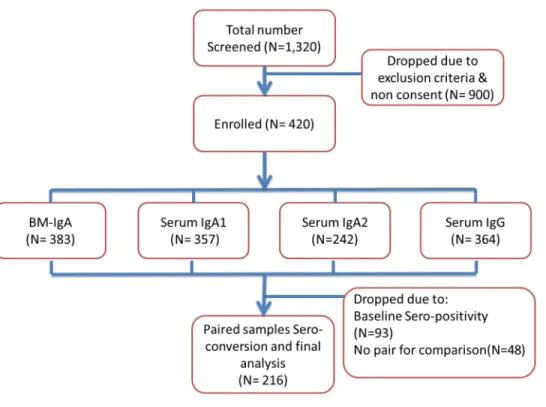
Of a total of 1320 infants and mothers were screened, 420 mother-infant pairs were successfully enrolled. The most common reason for declining to participate was unwillingness for the infant’s mother to have the infant’s blood drawn as shown inFig 1.
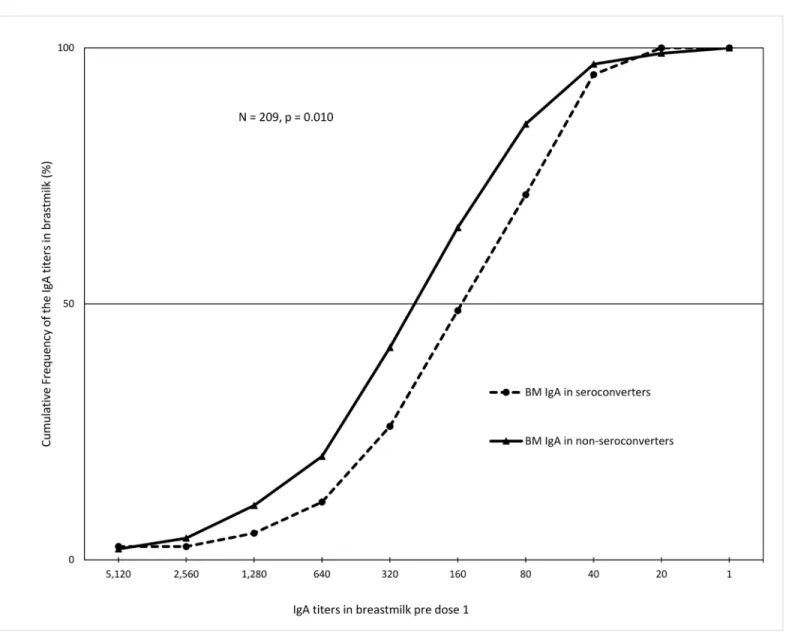
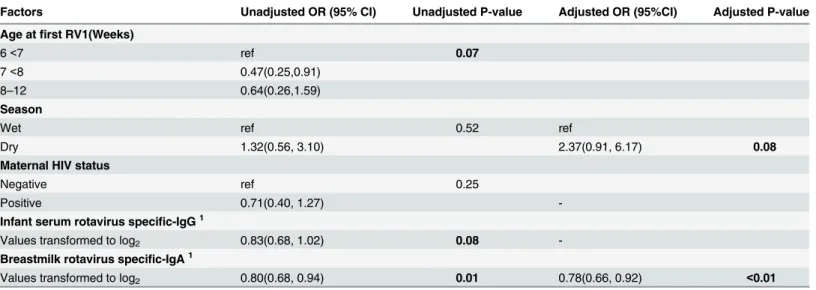
When we plotted the cumulative frequency profiles of breastmilk rotavirus specific-IgA titres by infant IgA seroconversion (defined as four-fold increase in rotavirus-specific IgA titres in post dose 2 sera when compared to the corresponding pre-immunization sera), we observed a clear separation of the curves as shown inFig 2. The median rotavirus specific-IgA titres in pre dose 1 breastmilk were significantly higher among non-seroconvertors compared with ser-oconvertors(P= 0.01). In a multivariable model with adjustment for seasonality, there was strong evidence of a 22% reduction in the odds of seroconversion, due to a two-fold increase in breast milk RV-specific IgA titres (Adjusted OR = 0.78; 95% CI = 0.66–0.92; P<0.01)
(Table 2). When we analysed RV IgG levels in a univariable analysis, the doubling of infant RV IgG levels at baseline was associated with a 17% lower odds of seroconversion (Unadjusted OR = 0.83;P= 0.08).
We performed further analysis to examine the relationship between seasonality and immune response as a cause of rotavirus vaccine failure and found that dry cold seasons were significantly associated with higher IgA titers in breastmilk of mothers (Table 3). These higher IgA titers in breastmilk during the cold dry months (May to June) were negatively associated with IgA seroconversion to RV1 vaccination in infants. We observed an inverse trend between pre-dose 1 IgA seropositivity and seroconversion, but the associations were not significant.
Discussion
In recent times, interference from maternal antibodies in breast milk has received particular attention as cause of rotavirus vaccine failure [21]. Several efforts have been made in rando-mised controlled trials of transient breastfeeding withholding around the time of vaccine administration. However, results from South Africa [27], Pakistan [28] and India [29] found no benefit from withholding breastfeeding around the time of immunisation. Although these studies did not find a benefit in RV vaccine immunogenicity with transient breastfeeding
Fig 1. Study Participants Flow chart.
withholding, our results indicate a need to seek other interventions that may diminish potential breast milk interference of RV vaccine response.
There are key considerations that need to be made in light of these reports in order to justify continued research in this field. First, it remains debatable whether the hours of withholding breastfeeding implemented in these trials were sufficient to remove that potential interference. Second, in the case of the Asian trials, lower overall seroconversion rates were generally observed (16.6% in the withholding arm and 29.1% in the immediate breastfeeding arm in Pakistan; and 26.1% and 26.6% respectively in India), while our rate was much higher at 60.2%, similar to the 61% observed in South Africa [27]. Despite the fact that different assays with dif-fering cut-offs for positivity were used in these trials, it does appear that breast milk effects could be variable depending on the background context and may still be the explanation for some of the unexplained results from various studies.
Table 1. Percentage of infants seroconverted*by infant and maternal factors, in Lusaka.
Characteristics Number of Infants (% of total) Number (%) seroconversion 95% CI Pearson Chi-square; P-value
Age atfirst RV1(Weeks) n = 406 n = 211 5.38; 0.07
6<7 249(61.3) 90(65.2) [56.8, 72.8]
7<8 115(28.3) 24(47.1) [33.7, 60.8]
8–12 42(10.3) 12(54.6) [33.6, 74]
Sex of infant n = 420 n = 216 0.03; 0.87
Female 221(52.6) 65 (59.6) [50.1, 68.5]
Male 199(47.4) 65 (60.7) [51.1, 69.6]
Season n = 393 n = 216 0.41; 0.52
Wet 86(21.9) 13 (54.2) [34.1, 72.9]
Dry 307(78.1) 117 (60.9) [53.8, 67.6]
Maternal HIV status n = 412 n = 211 1.34; 0.25
Negative 287(69.7) 88 (62.0) [53.7, 69.6]
Positive 125(30.3) 37 (53.6) [41.7, 65.1]
Baseline infant serum IgA seropositivity
n = 357 n = 216 4.19; 0.04
Seronegative 267(74.8) 105 (64) [56.3, 71.1]
Seropositive1 90(25.2) 25 (48.1) [34.8, 61.7]
Breast-milk rotavirus specifi c-IgA (Quartiles)
n = 383 n = 210 -2.84; 0.012
1 (1–80) 170(44.4) 65 (70.7) [60.5, 79.1]
2 (160) 84(21.9) 26 (54.2) [39.9, 67.8]
3 (320) 67(17.5) 19 (51.4) [35.4, 67.1]
4 (640–5120) 62(16.2) 15 (45.5) [29.3, 62.7]
Infant serum rotavirus specifi c-IgG (Quartiles)
n = 365 n = 215 -1.88; 0.062
1 (160–2560) 118(32.3) 53 (68) [56.7, 77.4]
2 (5120) 91(24.9) 32 (61.5) [47.6, 73.8]
3 (10240) 154(42.2) 44 (52.4) [41.6, 62.9]
4 (20480) 2(0.6) 1 (100)
-Total 420 (100) 130 (60.2) [53.5, 66.5]
*seroconversion = post immunization rotavirus specific-IgA titre increasedfour-fold compared with the titre recorded before thefirst dose of RV1
1Seropositivity of IgA was defined as titer1:40. 2Wicoxon rank-sum test for trend
Significant differences are shown in bold.
Our observations demonstrate the need to reconsider breast milk RV IgA carefully as a fac-tor that could explain differential vaccine effectiveness rates between low, middle, and high-income settings. Whereas there was no evidence of an association between maternal HIV status and seroconversion (62% versus 54% respectively), infant seroconversion appeared to decrease with increasing levels of breast milk anti-RV IgA titers (71%, 54%, 51 and 46% respectively for each quartile).
Our proposed association between maternal immunity and infant seroconversion is further strengthened by our observations of seasonality trends. Our findings are consistent with exist-ing epidemiological literature about RV transmission cycles: RV infections peak in the cool, dry season (April to July) and demonstrate a second, but smaller peak in the hot, dry season (October to November) [24–26,28–31]. This study has shown consistent seasonal trends through GMT IgA titer in breast milk, reflecting the epidemiologic pattern when mothers
Fig 2. Cumulative frequency profiles of RV-IgA titres in pre dose 1 breastmilk of 216 mother-infant pairs by infant IgA seroconversion post dose 2 of rotavirus vaccine.Seroconversion was defined as four-fold increase in rotavirus-specific IgA titres in post dose 2 sera when compared to the
corresponding pre-immunization sera.
would likely be getting infected. Further strengthening our argument, statistically significant differences in GMT tires have been seen by season among seroconvertors and non-seroconver-tors, suggesting a negative relationship between breastmilk IgA titre and the post-dose 2 infant serum IgA titre across seasons. This observation requires further investigations into whether infants immunized in high RV transmission seasons yield lower seroconversion IgA titers, and the suggestion that there may be some interaction between seroconversion and season. It remains to be investigated whether the risk of clinical disease from RV is higher in infants with low vaccine induced IgA titres.
Maternally acquired IgG did show a trend to affect seroconversion upon interquartile base-line titre comparisons consistent with other studies [22]; however, in our study this association did not reach statistical significance (p= 0.06). Indeed IgG has been more strongly implicated
Table 2. Maternal and infant factors independently associated with odds of seroconversion (N = 210).
Factors Unadjusted OR (95% CI) Unadjusted P-value Adjusted OR (95%CI) Adjusted P-value
Age atfirst RV1(Weeks)
6<7 ref 0.07
7<8 0.47(0.25,0.91)
8–12 0.64(0.26,1.59)
Season
Wet ref 0.52 ref
Dry 1.32(0.56, 3.10) 2.37(0.91, 6.17) 0.08
Maternal HIV status
Negative ref 0.25
Positive 0.71(0.40, 1.27)
-Infant serum rotavirus specific-IgG1
Values transformed to log2 0.83(0.68, 1.02) 0.08
-Breastmilk rotavirus specific-IgA1
Values transformed to log2 0.80(0.68, 0.94) 0.01 0.78(0.66, 0.92) <0.01
doi:10.1371/journal.pone.0150100.t002
Table 3. Rotavirus-specific IgA in Breastmilk and sera, and RV-IgA serconversion (SC), by seasons (N = 200).
Breastmilk Infant’s sera
Season n IgA pre dose 1 GMT
(95%CI)
IgA pre dose 1 positivity (%)
IgA pre dose 1 GMT (95%CI)
IgA post dose 2 GMT (95%CI)
IgA SC (%)
Dry season 2013 (May 2013–Oct 2013)
104 158 (122–204) (a) 27% 5 (4–8) 64 (37–110) 55% (d)
Rainy season 2013–14 (Nov 2013–April 2014)
31 85 (51–141) (b) 13% 5(3–10) 112 (50–252) 71% (e)
Dry season 2014 (May 2014–Oct 2014)
65 178 (140–227) (c) 20% 6 (3–9) 63 (31–130) 49% (f)
P value p = 0.0311 p = 0.1463
p = 0.0102 p = 0.0514
IgA seroconversion = post immunization rotavirus specific-IgA titre increasedfour-fold compared with the titre recorded before thefirst dose of RV1 Seropositivity of IgA was defined as titer1:40.
1t-test (a) vs (b), 2t-test (b) vs (c), 3X2-test (d) vs (e), 4X2-test (e) vs (f).
in affecting seroconversion in other studies [22,32,33]. In univariate analysis, doubling infant IgG levels appeared to be associated with a 17% reduction in the odds of seroconversion but the effect diminished after accounting for other covariates. It is apparent that VP7 and VP4-specific immunoglobulin G (IgG) play an important protective role in natural infection and vaccine-mediated immunity, especially if their production is of sufficient magnitude for them to be exuded onto the mucosal surface where infection occurs [34–40]. These previously reported data support the theory that placental transfer of RV-specific IgG impacts vaccine effectiveness. In fact, higher antibody titre and higher rates of seroconversion and protection have been observed in older children without maternal antibody, in comparison to those of younger infants [38,41], suggesting maternal serum antibodies, in addition to those found in breast milk, attenuate response to vaccine [32,42,43].
Another important finding from our study is the relatively high rate of rate of pre vaccina-tion IgA seropositives. At 25% baseline seropositivity, our findings suggest that a quarter of the infants are already exposed to rotavirus natural infection very early in life and these were less likely to serconvert after vaccination. With a borderline significance (P = 0.04), possibly because of our relatively small sample size, it remains to be concluded whether early natural exposure could also negatively influence vaccine seroconversion as previously observed in South Africa and Nicaragua [22,27,43].
The complexity and lack of understanding of seroconversion to vaccines and its meaning in terms of clinical protection still prevails at this point. Infant factors, including nutritional sta-tus, have been linked to RV diarrhoea. The relationship between malnutrition and RV vaccine efficacy remains a subject of interest for our on-going research. There are other suggestive reports that efficacy of oral vaccines is lower in poor hygiene settings where malnutrition is common [44,45]. The actual effect of protein energy malnutrition and micronutrient defi-ciency on RV vaccine safety and efficacy is however not well understood [45,46].
Based on our findings, we conclude that there is a clear trend in the seasonal peaks of breast milk IgA and corresponding troughs in infant serum IgA response to RV vaccination. This inverse relationship suggests potential interference of maternal breast milk antibodies on sero-conversion. The extent to which the effect of these maternal antibodies can be overcome by withholding breast milk for various periods of time around child immunisation remains to be demonstrated. Based on a number of studies in recent years [27,32–34], It has become clear that transient withholding of breastfeeding does not appear to help. Given the logistic chal-lenges of withholding and overwhelming benefits of breastfeeding, the scientific community seems to have largely decided to drop this transient intervention strategy. Nonetheless, we believe long-term breastfeeding has a damping effect on RV vaccines. Thus, there is need for further research into other interventions, strategies or approaches to explain this phenomenon. Lastly, it remains to be proved whether infants exposed to these high breast milk antibody titres are necessarily at higher risk of clinical disease.
As many LMICs seek to attain millennium development goals, reduction of child mortality through interventions that include“effective child vaccines”is an important strategy. Research such as ours, seeking to understand and explain challenges of achieving rotavirus vaccine impact is of great importance.
Acknowledgments
design of this work. Lastly, we thank Sung-Sil Moon and Yuhuan Wang for preparing reagents used in the assays and providing technical support. The finding and conclusions in this report are those of the authors and do not necessarily represent the official positions of Centers for Disease Control and Prevention.
Author Contributions
Conceived and designed the experiments: RC MS KM. Performed the experiments: MS DE DV BJ. Analyzed the data: RC SD MS KM LB SB DE DV BJ. Contributed reagents/materials/analy-sis tools: RC SB DE DV BJ. Wrote the paper: RC SD MS KM LB SB DE DV BJ. Provided train-ing and reagents to laboratory tests: BJ.
References
1. World Health Organization. Rotavirus vaccines.Wkly Epidemiol Rec2007; 82: 285–96. PMID: 17691162
2. Parashar UD, Burton A, Lanata C, Boschi-Pinto C, Shibuya K, Steele D, et al. Global mortality associ-ated with rotavirus disease among children in 2004.J Infect Dis2009; 200:Suppl 1:S9–S15. doi:10. 1086/605025PMID:19817620
3. Parashar UD, Gibson CJ, Bresse JS, Glass RI. Rotavirus and severe childhood diarrhoea.Emerg Infect Dis2006; 12: 304–6. PMID:16494759
4. Patel M, Shane AL, Parashar UD, Jiang B, Gentsch JR, Glass RI. Oral rotavirus vaccines: how well will they work where they are needed most?J Infect Dis. 2009; 200 Suppl 1:S39–48. Epub 2009/10/13. doi:10.1086/605035PMID:19817613.
5. Jiang V, Jiang B, Tate J, Parashar UD, Patel MM. Performance of rotavirus vaccines in developed and developing countries. Hum Vaccin. 2010; 6(7):532–42. Epub 2010/07/14. 11278 [pii]. PMID: 20622508.
6. WHO. World Health Organization. Introduction of rotavirus vaccines into national immunization pro-grammemes. Geneva., 2009.
7. WHO. WHO Strategic Advisory Group of Experts (SAGE) on Immunisation. Weekly epidemiological record. 2009; 84th year June (23): 213–236.
8. GlaxoSmithKline. RotaRix Prescribing Information. Accessed 30th May 2011 athttp://us.gsk.com/ products/assets/us_rotarix.pdf
9. Ruiz-Palacios GM, Perez-Schael I, Velazquez FR, Abate H, Breuer T, Clemens SC, et al. Safety and efficacy of an attenuated vaccine against severe rotavirus gastroenteritis.N Engl J Med2006; 354(1): 11–22. PMID:16394298
10. Linhares AC, Velazquez FR, Perez-Schael I, Saez-Llorens X, Abate H, Espinoza F, et al. Efficacy and safety of an oral live attenuated human rotavirus vaccine against rotavirus gastroenteritis during the first 2 years of life in Latin American infants: a randomised, double-blind, placebo-controlled phase III study.Lancet2008; 371(9619): 1181–9. doi:10.1016/S0140-6736(08)60524-3PMID:18395579 11. Vesikari T, Karvonen A, Prymula R, Schuster V, Tejedor JC, Cohen R, et al. Efficacy of human rotavirus
vaccine against rotavirus gastroenteritis during the first 2 years of life in European infants: randomised, double-blind controlled study.Lancet2007; 370(9601): 1757–63. PMID:18037080
12. Vesikari T, Matson DO, Dennehy P, Van Damme P, Santosham M, Rodriguez Z, et al. Safety and effi-cacy of a pentavalent human-bovine (WC3) reassortant rotavirus vaccine.N Engl J Med2006; 354(1): 23–33. PMID:16394299
13. Richardson V, Hernandez-Pichardo J, Quintanar-Solares M, Esparza-Aguilar M, Johnson B, Gomez-Altamirano CM, et al. Effect of rotavirus vaccination on death from childhood diarrhoea in Mexico.N Engl J Med2010; 362(4): 299–305. doi:10.1056/NEJMoa0905211PMID:20107215
14. Glass RI, Bresee JS, Turcios R, Fischer TK, Parashar UD, Steele AD. Rotavirus vaccines: targeting the developing world.J Infect Dis2005; 192 Suppl 1: S160–6. PMID:16088799
15. Patel M, Shane AL, Parashar UD, Jiang B, Gentsch JR, Glass RI. Oral rotavirus vaccines: how well will they work where they are needed most?J Infect Dis2009; 200 Suppl 1: S39–48. doi:10.1086/605035 PMID:19817613
16. Madhi SA, Cunliffe NA, Steele D, Witte D, Kirsten M, Louw C, et al. Effect of human rotavirus vaccine on severe diarrhoea in African infants.N Engl J Med2010; 362(4):289–98. doi:10.1056/
17. Chan J, Nirwati H, Triasih R, Bogdanovic-Sakran N, Soenarto Y, Hakimi M, et al. Maternal antibodies to rotavirus: could they interfere with live rotavirus vaccines in developing countries?Vaccine2011; 29(6): 1242–7. doi:10.1016/j.vaccine.2010.11.087PMID:21147127
18. Kvistgaard AS, Pallesen LT, Arias CF, Lopez S, Petersen TE, Heegaard CW, et al. Inhibitory effects of human and bovine milk constituents on rotavirus infections.J Dairy Sci. 2004; 87(12):4088–96. PMID: 15545370
19. Glass RI, Stoll BJ. The protective effect of human milk against diarrhea. A review of studies from Ban-gladesh.Acta Paediatr Scand Suppl. 1989; 351:131–6. Epub 1989/01/01. PMID:2692384.
20. Jiang B, Gentsch JR, Glass RI. The role of serum antibodies in the protection against rotavirus disease: an overview.Clin Infect Dis2002; 34(10):1351–61. PMID:11981731
21. Moon SS, Wang Y, Shane AL, Nguyen T, Ray P, Dennehy P, et al. Inhibitory effect of breast milk on infectivity of live oral rotavirus vaccines. Pediatr Infect Dis J. 2010; 29(10):919–23. doi:10.1097/INF. 0b013e3181e232eaPMID:20442687
22. Becker-Dreps S, Vilchez S, Velasquez D, Moon SS, Hudgens MG, Zambrana LE, et al. Rotavirus-spe-cific IgG antibodies from mothers’serum may inhibit immune responses to the pentavalent rotavirus vaccine.Pediatr Infect Dis J, 2015; 34(1):115–116.) doi:10.1097/INF.0000000000000481PMID: 25741808
23. Moon SS, Tate JE, Ray P, Dennehy PH, Archary D, Coutsoudis A, et al. Differential profiles and inhibi-tory effect on rotavirus vaccines of non-antibody components in breast milk from mothers in developing and developed countries. Pediatr Infect Dis J. 2013; 32(8):863–70. doi:10.1097/INF.
0b013e318290646dPMID:23584581
24. Mwenda J.M, Ntoto K.N, Abebe A, Enweronu-Laryea C, Amina I, Mchomvu J et al. Burden and Epide-miology of Rotavirus Diarrhea in Selected African Countries: Preliminary Results from the African Rota-virus Surveillance Network.J.Infect.Dis2010; 202(S1):S5–S11
25. Mpabalwani M, Oshitani H, Kasolo F, Mizuta K, Luo N, Matsubayashi N et al. Rotavirus gastro-enteritis in hospitalized children with acute diarrhoea in Zambia.Ann Trop Paediatr.1995; 15:39–43. PMID: 7598436
26. Cunliffe N.A, Kilgore P.E, Bresee J.S, Steele D.A, Luo N, et al, Epidemiology of rotavirus diarrhoea in Africa: a review to assess the need for rotavirus immunization. Bull World Health Organ. 1998; 76(5): 525–537. PMID:9868844
27. Groome MJ, Moon SS, Velasquez D, Jones S, Koen A, van Niekerk N, et al. Effect of breastfeeding on immunogenicity of oral live-attenuated human rotavirus vaccine: a randomized trial in HIV-uninfected infants in Soweto, South Africa.Bull World Health Organ. 2014; 92(4):238–45. Epub 2014/04/05. doi: 10.2471/BLT.13.128066BLT.13.128066 [pii]. PMID:24700991.
28. Waggie Z, Hawkridge A, and Hussey GD. Review of Rotavirus Studies in Africa: 1976–2006.JID2010: 202 (Suppl 1).S23
29. Parashar UD,Hummelman EG,Bresee JS,Miller MA,Glass RI.Global illness and deaths caused by rota-virus disease in children.Emerg Infect Dis2003; 9(5):565–572. PMID:12737740
30. WHO. Global networks for surveillance of rotavirus gastroenteritis, 2001–2008.Wkly Epidemiol Rec 2008; 83:421–428. PMID:19024780
31. Moon S, Wang Y, Shane A. L et al. Inhibitory Effect of Breast Milk on Infectivity of Live Oral Rotavirus Vaccines. Pediatr Infect Dis J. 2010 October; 29(10): 919–923. doi:10.1097/INF.0b013e3181e232ea PMID:20442687
32. Ali A, Kazi AM, Cortese MM, Fleming JA, Moon S, Parashar UD, et al. (2015) Impact of Withholding Breastfeeding at the Time of Vaccination on the Immunogenicity of Oral Rotavirus Vaccine—A Ran-domized Trial. PLoS ONE 10(6): e0127622. doi:10.1371/journal.pone.0127622PMID:26035743 33. Rongsen-Chandolaa T, Strand T.A, Goyala N, Flemd E, Rathorea S.S et al. Effect of withholding
breastfeeding on the immune response to a liveoral rotavirus vaccine in North Indian infants.Vaccine, 32S (2014) A134–A139
34. Xu J, Dennehy P, Keyserling H, Westerman L.E, Wang Y et al. Serum antibody responses in children with rotavirus diarrhea can serve as proxy for protection.Clinical and diagnostic laboratory Immunol-ogy, 2005, p. 273–279 Vol. 12, No. 2.
35. Clemens J. D, Ward R.L, Rao M.R, Sack D.A, Knowlton D.R, et al. Seroepidemiologic evaluation of antibodies to rotavirus as correlates of the risk of clinically significant rotavirus diarrhea in rural Bangla-desh.J.Infect.Dis. (1992) 165:161–165. PMID:1309372
37. Ray P. G, Kelkar S.D. Measurement of antirotavirus IgM/IgA/IgG responses in the serum samples of Indian children following rotavirus diarrhea and their mothers.J.Med.Virol. (2004) 72:416–423. PMID: 14748065
38. Velazquez FR, Matson DO, Guerrero ML, Shults J, Calva JJ, Morrow AL, et al. Serum antibody as a marker of protection against natural rotavirus infection and disease.J Infect Dis2000; 182(6): 1602–9. PMID:11069230
39. O'Ryan ML, Matson DO, Estes MK, Pickering LK. Anti-rotavirus G type-specific and isotype-specific antibodies in children with natural rotavirus infections.J Infect Dis1994; 169(3): 504–11. PMID: 8158022
40. Dennehy PH, Rodgers GC Jr., Ward RL, Markwick AJ, Mack M, Zito ET. Comparative evaluation of reactogenicity and immunogenicity of two dosages of oral tetravalent rhesus rotavirus vaccine. US Rhesus Rotavirus Vaccine Study Group.Pediatr Infect Dis J1996; 15(11): 1012–8. PMID:8933551 41. Appaiahgari MB, Glass R, Singh S, Taneja S, Rongsen-Chandola T, Bhandari N, Mishra S, Vrati S
(2014). Transplacental rotavirus IgG interferes with immune response to live oral rotavirus vaccine ORV-116E in Indian infants. Vaccine 3; 32(6):651–6. doi:10.1016/j.vaccine.2013.12.017PMID: 24374502
42. Moon SS, Groome MJ, Velasquez DE, Parashar UD, Jones S et al. Prevaccination rotavirus serum IgG and IgA are associated with lower immunogenicity of live, oral human rotavirus vaccine in South African infants.Clin Infect Dis, 2016. 62(2): p. 157–65. doi:10.1093/cid/civ828PMID:26400993
43. Humphrey JH. Child undernutrition, tropical enteropathy, toilets, and hand washing.Lancet2009; 374: 9694
44. Campbel DI, Simon HM, Elia M, Sullivan PB, Sanyang MS, Jobarteh B, Lunn PG. Chronic T Cell– Medi-ated Enteropathy in Rural West African Children: Relationship with Nutritional Status and Small Bowel Function. Paediatric Research 2003; Vol. 54, No. 3
45. Wood D, WHO IC Group (2005). WHO informal consultation on quality, safety and efficacy specifica-tions for live attenuated rotavirus vaccines. Mexico City, Mexico, 8–9 February 2005.Vaccine, 23(48– 49):5478–5487. PMID:16129525