Fine scale mapping of genomic introgressions
within the Drosophila yakuba clade
David A. Turissini, Daniel R. Matute*
Biology Department, University of North Carolina, Chapel Hill, Chapel Hill, North Carolina, United States of America
Abstract
The process of speciation involves populations diverging over time until they are genetically and reproductively isolated. Hybridization between nascent species was long thought to directly oppose speciation. However, the amount of interspecific genetic exchange (intro-gression) mediated by hybridization remains largely unknown, although recent progress in genome sequencing has made measuring introgression more tractable. A natural place to look for individuals with admixed ancestry (indicative of introgression) is in regions where species co-occur. In west Africa, D. santomea and D. yakuba hybridize on the island of São Tome´, while D. yakuba and D. teissieri hybridize on the nearby island of Bioko. In this report, we quantify the genomic extent of introgression between the three species of the Drosophila yakuba clade (D. yakuba, D. santomea), D. teissieri). We sequenced the genomes of 86 individuals from all three species. We also developed and applied a new statistical frame-work, using a hidden Markov approach, to identify introgression. We found that introgression has occurred between both species pairs but most introgressed segments are small (on the order of a few kilobases). After ruling out the retention of ancestral polymorphism as an explanation for these similar regions, we find that the sizes of introgressed haplotypes indi-cate that genetic exchange is not recent (>1,000 generations ago). We additionally show that in both cases, introgression was rarer on X chromosomes than on autosomes which is consistent with sex chromosomes playing a large role in reproductive isolation. Even though the two species pairs have stable contemporary hybrid zones, providing the opportunity for ongoing gene flow, our results indicate that genetic exchange between these species is cur-rently rare.
Author summary
Even though hybridization is thought to be pervasive among animal species, the frequency of introgression, the transfer of genetic material between species, remains largely
unknown. In this report we quantify the magnitude and genomic distribution of intro-gression among three species ofDrosophilathat encompass the two known stable hybrid zones in this genetic model genus. We obtained whole genome sequences for individuals of the three species across their geographic range (including their hybrid zones) and
a1111111111 a1111111111 a1111111111 a1111111111 a1111111111 OPEN ACCESS
Citation: Turissini DA, Matute DR (2017) Fine scale mapping of genomic introgressions within the
Drosophila yakuba clade. PLoS Genet 13(9):
e1006971.https://doi.org/10.1371/journal. pgen.1006971
Editor: David J. Begun, University of California Davis, UNITED STATES
Received: January 13, 2017 Accepted: August 9, 2017 Published: September 5, 2017
Copyright:©2017 Turissini, Matute. This is an open access article distributed under the terms of theCreative Commons Attribution License, which permits unrestricted use, distribution, and reproduction in any medium, provided the original author and source are credited.
Data Availability Statement: Fastq files are available at SRA (Bioproject: PRJNA395473; Accession numbers: D. yakuba: SAMN07407328-SAMN07407363; D. teissieri: SAMN07407364-SAMN07407376; D. santomea: SAMN07407377-SAMN07407393). Software and documentation for Int-HMM are available athttps://github.com/ dturissini/Int-HMM.
Funding: The author(s) received no specific funding for this work.
developed a hidden Markov model-based method to identify patterns of genomic intro-gression between species. We found that nuclear introintro-gression is rare between both spe-cies pairs, suggesting hybrids in nature rarely successfully backcross with parental spespe-cies. Nevertheless, someD.santomeaalleles introgressed intoD.yakubahave spread from São Tome´ to other islands in the Gulf of Guinea whereD.santomeais not found. Our results indicate that in spite of contemporary hybridization between species that produces fertile hybrids, the rates of gene exchange between species are low.
Introduction
When two species hybridize, produce fertile hybrids and persist, three outcomes are possible. First, genes from one of the species might be selected against in their hybrids thus removing “foreign” genes from the gene pool, with the rate of removal being proportional to the product of the population size and the strength of selection [1–4]. Second, some alleles will have no fit-ness effects and may be retained in the population or lost due to drift. Finally, some introduced genes could be maintained in the population because they are advantageous ([2], [3]; but see [4] for additional possibilities). Such introgressed alleles can be a source of novel genetic (and phenotypic) variation.
The frequency and fate of introgressed alleles has been investigated in only a few cases (e.g., [5–11] among many others; reviewed in [12,13]), and the susceptibility of genomes to intro-gression is the target of lively debate among evolutionary biologists. Obtaining conclusive evi-dence about the magnitude of introgression is difficult and has led to two general views in speciation research. Some maintain that genomes are co-adapted units that can tolerate very little foreign contamination [14–16]. Others argue that closely related species differ only in a few distinct genomic regions responsible for reproductive isolation and can not only tolerate considerable introgression elsewhere [2,17] but may even benefit from it [18–20]. In reality, both instances occur, but to understand how prevalent introgression is during the speciation process, we require systematic assessments of the rate and identity of introgressions in varied biological systems
Current efforts to detect introgression have found the process to be pervasive in nature (e.g., [13,21–23]). Yet, one of the main limitations of this inference is that most models of introgression are tailored to detect recent introgression where introgressed haplotypes are found in large, contiguous blocks [24]. Powerful analytic tools such as HAPMIX [25], ELAI [26], ChromoPainter [27] and others heavily rely on linkage disequilibrium or phased genomic data which makes them inapplicable to many organisms [28–30]. A second limitation is that some methods [31–33] will estimate the amount of introgression but not specific introgressed genomic regions, precluding the measuring the frequency of introduced segments. Ideally methods for detecting introgressions would be able to identify introgressed segments within individuals and not need haplotype information and/or phased genotypes which might not be available for all taxa.
Even thoughDrosophilahas been a premier system for studying how reproductive isolation evolves, until recently interspecific gene flow within the taxon has been understudied because hybrid zones were either unknown or uncharacterized. Yet, neither gene flow, nor hybrid zones are absent in theDrosophilagenus [8,34–36].
TheD.yakubaspecies clade is composed of three species (D.yakuba,D.santomea, andD.
Africa and is also found on islands in the Gulf of Guinea [38–40].Drosophila teissieri, likeD.
yakuba, is also distributed across large portions of the continent but is largely restricted to for-ests withParinari(Chrysobalanaceae) trees [41–43].Drosophila santomeais restricted to the island of São Tome´ in the Gulf of Guinea.Drosophila yakubaalso lives on São Tome´ and occurs at low elevations (below 1,450 m) and is mostly found in open and semidry habitats commonly associated with agriculture and human settlements [39,44]. In contrast,D. santo-meais endemic to the highlands of São Tome´ where it is thought to exclusively breed on endemic figs (Ficus chlamydocarpa fernandesiana, Moraceae; [45]).Drosophila yakubaand
D.santomeaproduce sterile male and fertile female hybrids, and the two species co-occur in a hybrid zone in the midlands on the mountain Pico de São Tome´ [38,44,46]. Backcrossed females and some males are fertile [47,48]. Oddly, a second stable hybrid zone composed exclusively of hybrid males occurs on top of Pico de São Tome´ largely outside the range of the two parental species [49].
WithinDrosophila, theD.santomea/D.yakubahybrid zone is the best studied for at least three reasons. First, it has the highest known frequency of hybridization: on average, 3–5% of
yakubaclade individuals collected in the midlands of São Tome´ are F1 hybrids [44]. Second, the hybrid zone is stable and has persisted since its discovery in 1999 [38,44,49,50] which makes it one of the two stable hybrid zones in the genus (along withD.yakuba/D.teissieri, see below). Third, F1 hybrids are easily identified by their characteristic abdominal pigmentation [51,52]. Advanced intercrosses are harder to identify since pigmentation patterns regress toward the parental species in just one or two generations of backcrossing [52].
Drosophila teissieriis the sister species to theD.yakuba/ D.santomea(yak/san) dyad. It is distributed throughout tropical Africa and is thought to have occupied a much larger range before humans expanded into the forests of Sub-Saharan Africa [43,53]. Even though it breeds at higher elevations (over 500m), it is commonly found in the same locations whereD.yakuba
is collected [41,43,54]. The species is thought to be a narrow specialist of the ripe fruit of Pari-nari[41,53]. The nuclear genomes ofD.yakubaandD.teissieridiffer by numerous fixed inver-sions, which were long thought to preclude hybridization ([55]but see [37,56]). Nonetheless,
D.teissieridoes produce hybrids withD.yakuba and D.santomeain the laboratory [57]. F1 females (from both reciprocal directions of the cross) and some backcrossed individuals are fertile [57]. Field collections have also found a stable and narrow hybrid zone betweenD.
yakubaandD.teissieriin the highlands on the island of Bioko at the interface between culti-vated areas and secondary forest [54].
Across both theyak/sanandD.yakuba/D.teissieri(yak/tei) hybrid zones, little is known about the genomic and geographic distributions of introgression. Multiple studies have shown that mitochondrial divergence between the three species is much lower than expected given the levels of divergence observed for the nuclear loci [37,56,58]. The discrepancy has been interpreted as mitochondrial introgression resulting in the homogenization of the mitochon-drial genome within the clade.
Despite this emphasis on mitochondrial introgression, little is known about the extent of nuclear introgression betweenD.yakubaandD.santomea. Preliminary genetic analyses [37,39] found evidence of gene flow for two autosomal loci that showed low levels of diver-gence relative to the other typed loci. Beck et al. [59] also found nuclear introgression from
D.yakubaintoD.santomeaof genes coding for nuclear pore proteins that interact with mito-chondrial gene products. No study has however addressed the possibility of gene flow between
To characterize introgression within theyakubaspecies group we developed a new statisti-cal framework to identify introgressed regions of the genome. Since linkage disequilibrium inDrosophilausually decays fast (on the order of a few hundred base pairs; [60] but see [61,62]), we were not able to use available LD-based methods to detect introgression. Our method (Int-HMM) relies on the identification of stretches of differentiated SNPs, and uses a hidden Markov Model (HMM) approach to identify introgressed regions from unphased whole genome sequencing data. The framework does not require pre-identified pure-species samples from allopatric regions, and is able to identify introgressions on the order of 1kb with low false positive rates (<1%). We used this model to quantify the magnitude of intro-gression betweenD.yakuba/D.santomeaandD.yakuba/D.teissieri. We found that nuclear introgression is rare between the two species pairs despite hybrids being identified in nature. We also found that some alleles that have introgressed fromD.santomeaintoD.yakubahave spread from São Tome´ to other islands in the Gulf of Guinea whereD.santomeais not cur-rently found.
Results
Molecular divergence and approximate species divergence times
Drosophila yakubaandD.santomeahad been previously estimated to have diverged ~393,000 years ago [51] and ~500,000 years ago [37]. Bachtrog et al. [37] also estimated the divergence time betweenD.yakubaandD.teissierito be ~1 million years ago. However, these estimates were based on only a few nuclear loci (N~15 DNA fragments). We estimated the divergence times using the number of synonymous substitutions (Ks) from 14,267 genes [57] using the same approach as Llopart et al. [63]. We had previously estimated KsbetweenD.yakubaand D.santomeaas 0.0479 and betweenD.yakubaandD.teissierias 0.1116 [57]. We then com-pared these Ksvalues to the Ksof 0.1219 betweenD.melanogasterandD.simulans[64], which are estimated to have diverged 3 million years ago [65]). Assuming comparable substitutions rates between the two groups, we obtained estimated divergence times of 1.18 million years ago for theD.yakuba–D.santomeasplit and 2.75 million years ago for the divergence time betweenD.yakubaandD.teissieri. The level of divergence between the latter pair is surprising considering thatD.yakubaandD.teissieriproduce fertile F1 females and have a stable hybrid zone on the island of Bioko, while species with similar divergence (e.g.,D.melanogasterand
D.simulanswhose divergence time is estimated to be between 3 an 5MYA; [66,67]) produce sterile or inviable hybrids ([68]; S10 Table in [57]).
PCA
Detecting evidence of introgression
Patterson’s D statistic. We first explored the occurrence of introgression using multiple
versions of the Patterson’s D statistic (i.e., ABBA BABA test, [31,33,71]). Because the test requires potentially admixed populations and a population without gene flow of the recipient species, we tested for gene flow fromD.santomeaintoD.yakuba. We usedD.yakubafrom the continent as the outgroup andD.yakubafrom São Tome´ as the potential recipient. ( Drosoph-ila santomeahas a relatively small range, and we have been unable to find bona fide allopatric populations.) We found significant introgression betweenD.yakubaandD.santomeabut the average direction of introgression depends on the choice of outgroup (Table 1). IfD.teissieriis the outgroup of the test, the most common direction of introgressionsis D.santomeainto
D.yakuba(san-into-yak). IfD.melanogasteris the outgroup of the test, the most common direction of introgressionsis D.yakubaintoD.santomea(yak-into-san). All of our other anal-yses (see below) however indicate that introgression is more common in theyak-into-san
direction indicating thatD.melanogasterreads might not map well to theD.yakubagenome due to the increased divergence betweenD.melanogasterandD.yakuba(Ks~0.26 [72]; espe-cially at regions less constrained by selection such as intergenic regions); the choice of out-group is clearly relevant.
Next, we computed Patterson’s D statistic looking for gene flow betweenD.yakubaand
D.teissieri. We focused onD.teissierifrom the hybrid zone on Bioko as the recipient popula-tion of introgression. We find evidence for introgression in this species pair (Table 1). The average direction of gene flow is fromtei-into-yak (D.yakubafrom Bioko). These results pro-vide epro-vidence that there has indeed been genetic exchange between the two species pairs that naturally hybridize in theyakubaspecies complex.
Treemix. We used the programTreemixto identify gene flow between species and popu-lations within theD.yakubaclade. We ranTreemixseparately for theXchromosome (Fig 1A, S2 Fig) and the autosomes (Fig 1B,S3 Fig). For theXchromosome,Treemixfound 2 admix-ture events withinD.yakubaand none between species. The first event goes from the lowlands of São Tome´ to the African mainland (weight = 0.21) and the second from the lowlands of São Tome´ to the islands of Prı´ncipe and Bioko (weight = 0.046). For the autosomes,Treemixfound evidence of 4 migration events, one of them between populations ofD.yakuba(weight = 0.375), the other three events between species. One of these events indicates gene flow fromD.yakuba
on the islands of Prı´ncipe and Bioko toD.santomea(weight = 0.104), the second fromD. san-tomeato mainlandD.yakuba(weight = 0.08), and the third fromD.teissieritoD.yakubaat the hybrid zone (withD.santomea) on São Tome´ (weight = 0.005). These results suggest that there has been introgression between the species in theyakubacomplex. They also suggest that introgression is more likely to occur on the autosomes than on theXchromosome. Next, we explored the fine-scale patterns of introgression in the nuclear genomes of the three species.
Table 1. D-statistic variations (D [31,32] and fd[71]) show evidence for admixture between D. yakuba (mainland, São Tome´ hybrid zone—HZ—,
and other islands—Bioko and Principe—) and D. santomea and between D. yakuba and D. teissieri. Note, that the negative numbers of D indicate that
the average direction of the introgression goes from the population assigned as putatively recipient to the population assigned as putatively donor [71].
Allopatric population Recipient population Donor population Outgroup D Z-score fd
D. yakuba mainland D. yakuba HZ D. santomea D. teissieri 0.015173 189.739 0.001862
D. yakuba mainland D. yakuba other islands D. santomea D. teissieri 0.030080 311.41 0.003607
D. yakuba mainland D. yakuba HZ D. santomea D. melanogaster -0.019728 -292.231 -0.003141
D. yakuba mainland D. yakuba other islands D. santomea D. melanogaster -0.023744 -286.188 -0.003742
D. teissieri (not Bioko) D. teissieri (Bioko) D. yakuba D. melanogaster -0.030094 -754.157 -0.002709
Linkage disequilibrium
Linkage disequilibrium decays rapidly inD.melanogaster: r2decays to 0.2 within 5,000bp ([35,60], but see [61,62]). Such rapid decay of LD seriously constrains the possibility of using long-range LD to detect admixture since most methods that use LD rely on identifying within population haplotype variation. The low levels of LD seen inDrosophilapreclude identifying haplotypes thus preventing such methods from working properly. We evaluated whether simi-lar patterns of LD decay exist in the three species of theyakubaspecies clade. We measured linkage disequilibrium (LD) for all three species in theD.yakubaclade using PLINK [73]. For both theXchromosome and the autosomes, LD declined sharply at a scale of ~300bp before leveling off (S4 Fig). At a distance of 1kb, the average r2forD.yakubawas 0.0652 for the auto-somes and 0.0464 for theXchromosome (S4A Fig), forD.santomeathe average r2was 0.1347 for the autosomes and 0.1518 for theXchromosome (S4B Fig), and forD.teissierithe average r2was 0.1517 for the autosomes and 0.134 for theXchromosome (S4C Fig). This fast decay indicated the need to develop a framework to detect introgressed alleles that does not rely on LD.
Identifying introgressed tracts
Performance of the method: Simulation results. We developed a Hidden Markov Model
(HMM) to identify specific introgressed regions, Int-HMM. First, we determined the sensitiv-ity of the method by assessing whether it could detect simulated introgressions. We simulated independent introgressions with sizes ranging from 100bp up to 100kb for both directions of
Fig 1. Treemix results for the D. yakuba clade indicate gene flow has occurred among species of the yakuba clade. Treemix trees with the
best supported number of migration edges. D. yakuba has been split into four populations: “africa” (Cameroon, Kenya, Ivory Coast), “islands” (Prı´ncipe and Bioko), “low_ST”(lowlands of São Tome´), and “hz_st”(hybrid zone on São Tome´). A) Autosomal tree with 4 migration edges. B) X chromosome tree with 2 migration edges. Other demographic scenarios are shown inS2andS3Figs.
gene flow in admixed genomes betweenD.yakubaandD.santomeaand betweenD.yakuba
andD.teissieriwith some introgressed regions being homozygous and others heterozygous. Then, we used Int-HMM on the simulated data. We found that Int-HMM correctly identified a majority of introgressed regions with the percentage of correctly identified introgressions increasing with the size of the introgressed region (Fig 2). Int-HMM is more reliable at identi-fying homozygous introgressions than heterozygous ones. For homozygous introgressions, the false negative rates were less than 10% for all introgression sizes greater than or equal to 4kb for introgressions betweenD.yakubaandD.santomeaand 2kb for introgressions between
D.yakubaandD.teissieri. For heterozygous introgressions, Int-HMM performed better with introgressions betweenD.yakubaandD.teissieriwhere the false negative rate was less than 10% for introgressions greater than or equal to 3kb. The rate did not drop to 10% forD.yakuba
andD.santomeaintrogressions until the size was at least 15kb. The model likely performs less well for smaller regions due to a relative paucity of informative markers. False positive rates were negligible in all cases and were always less than 0.3% (S2 Table).
Fig 2. Proportion of correctly identified simulated introgressions by Int-HMM. The HMM successfully identified over 80% of introgressions longer
than 10kb for all directions of introgression. It consistently performed better at identifying homozygous introgressions (homo) than heterozygous (het) ones. Additionally, it identified higher percentages of introgressions between D. yakuba (yak) and D. teissieri (tei) than those between D. yakuba and D.
santomea (san).
HMM results. We identified the specific genomic regions that had introgressed from
among species in theyakubaspecies complex. We looked for introgressed regions in both directions betweenD.yakubaandD.santomea(san-into-yak,yak-into-san) and between
D.yakubaandD.teissieri(tei-into-yak,yak-into-tei) using the newly developed Int-HMM. The HMM was run individually on the genomic data from each genotype call (SNP) which had between 933,776 and 951,384 markers forsan-into-yak, between 907,959 and 923,227 foryak-into-san, between 1,867,399 and 1,888,413 markers fortei-into-yak, and between 2,275,453 and 2,468,955 markers foryak-into-tei(S1 Table). On average the markers were sep-arated by 127-133bp forsan-into-yak, 131-133bp foryak-into-san, 64-65bp fortei-into-yak, and 49-53bp foryak-into-tei. The HMM returned a probability that each marker was either homozygous for the recipient species, heterozygous, or homozygous for the donor species; adjacent sites with identical, most-probable states were combined into tracts. We next describe the results for each species pair.
Introgression tracts:D. yakuba/D. santomea. Drosophila yakubaandD.santomea ize in the midlands of São Tome´ and form a stable hybrid zone with the highest rate of hybrid-ization known inDrosophila. We hypothesized that we would find a rate of introgression comparable with the rate of hybridization. Yet, and despite the continuous and ongoing hybrid-ization between these two species, we found evidence that introgression at the genomic level is rare. Of the 17D.santomealines we assessed, on average 0.35% of theD.santomeagenome was introgressed fromD.yakubawith individual levels ranging from 0.1% (Qiuja630.39) up to 1.04% (san_Field3) (Fig 3A,S3 Table). The introgressions in the different lines covered different genomic regions, and cumulatively, they spanned 3.48% of the genome. We found comparable levels of introgression fromD.santomeaintoD.yakubawith an average of 0.22% of the
Fig 3. Percentage of genome introgressed between each species pair. Percentage of the genome that was introgressed for each line as
determined by the cumulative length of introgression tracts identified by Int-HMM. D. yakuba has been divided into geographical populations where ‘ST: HZ’ refers to the São Tome´ hybrid zone and ‘ST: Low’ to the lowlands of São Tome´. A) san and san-into-yak introgressions. B)
yak-into-tei and yak-into-tei-into-yak introgressions.
D.yakubagenome originating fromD.santomea. Together, the introgressions across the 56 lines covered 5.56% of the genome. The magnitude of the introgressed genetic material varied almost two orders of magnitude across lines: individual levels ranged from 0.012% (3_16) up to 1.20% (Anton_2_Principe) (Fig 3A,S3 Table).
A majority of the introgressed regions were intronic (san-into-yak: 55.7%,yak-into-san: 49.3%) and intergenic (san-into-yak: 35.2%,yak-into-san: 43.1%) (S4 Table). In thesan
-into-yakdirection, the RNA coding regions (CDS, 3’ prime UTR, and 5’ prime UTR) are observed more than expected by chance. In theyak-into-san, 10kb inter and 3’ prime UTR are more likely than random to be included in introgressions. Each type of sequence had similar marker densities; thus, it is unlikely that differences in read mapping affected these results (S4 Table).
Next, we compared the magnitude of introgression for the two reciprocal directions of each cross. Globally, there was significantly more introgression fromD.yakubaintoD. santo-mea(Mann-Whitney U = 301, p = 0.0228), than fromD.santomeaintoD.yakuba. Since
D.yakubahas a geographic range that dwarfs that ofD.santomea, we also repeated the species comparison excludingD.yakubaflies from Cameroon and Kenya, collection sites completely outside ofD.santomea’s range. When onlyD.yakubalines from near the Gulf of Guinea were included, levels of introgression were the same in both directions (Mann-Whitney U = 288, p = 0.7413).
We next asked whether the magnitude of thesan-into-yakintrogression varied across
D.yakubalines from different locations. We found more introgression inD.yakubaflies col-lected within the hybrid zone withD.santomea(midlands of São Tome´; genomic average across individuals = 0.314%) than in flies collected on the island but at lower elevations outside of the hybrid zone (genomic average across individuals = 0.192%) (Mann-Whitney U = 123, p = 0.018). Surprisingly,D.yakubaflies from the hybrid zone did not have more introgression than flies from the nearby islands of Bioko (Mann-Whitney U = 41, p = 0.550) or Prı´ncipe (Mann-Whitney U = 12, p = 0.355).
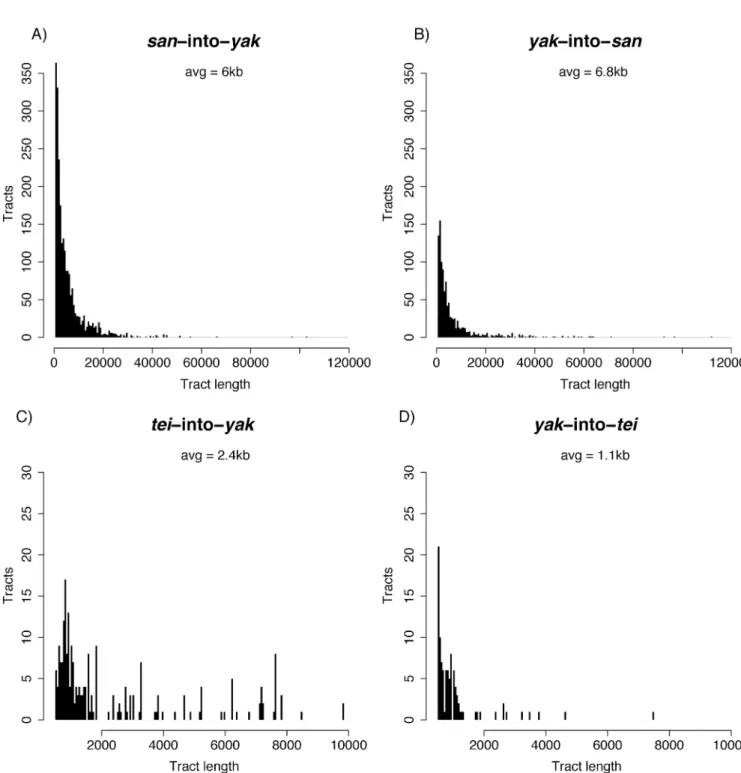
We next analyzed the distribution of sizes of the haplotypes shared across theyak/san spe-cies boundary. The average tract size for theD.yakubaintoD.santomeaintrogressions was 6.8kb with a maximum size of 112kb (Fig 4A). The average tract size forD.santomeainto
D.yakubaintrogressions was 6kb with a maximum size of 959.5kb (Fig 4B). Interestingly, the 959.5KB tract was from a line from the island of Prı´ncipe whereD.santomeais not known to currently exist (S5 Fig). The next largest tract was 120.5kb and was seen in two lines from the hybrid zone on São Tome´ (Cascade_SN6_1, Montecafe_17_17).
Introgression tracts:D. yakuba/D. teissieri. Drosophila yakubaandD.teissierialso hybridize in the highlands of Bioko in a very narrow and geographically restricted hybrid zone [54]. As expected, given their divergence and the narrow hybrid zone, introgression from
D.yakubaintoD.teissieri(yak-into-tei) was rare. Among the 13D.teissierilines, on average 0.0074% of the genome originated fromD.yakubawith individual values ranging from 0% (Anton_2_Principe, Montecafe_17_17, SJ_1) to 0.0129% (Selinda) (Fig 3B,S3 Table). Together the introgressions span 0.0669% of the genome. There was no difference in the amount ofyak -into-teiintrogression between theD.teissieripopulation on Bioko where a known hybrid zone is located and flies from outside Bioko (Mann-Whitney U = 22, P = 0.826).
For the 56D.yakubalines, on average 0.0086% of the genome of the two species has crossed the species boundary. Individual percentages ranged from 0% (cascade_2_1) to 0.0244% (2_8) (Fig 3B,S3 Table). Collectively, the introgressions span 0.0914% of the genome. In thetei
We also compared the magnitude of introgression in both directions. Similar to the hybrid zone betweenyakubaandsantomea, we found no asymmetry in the amount of introgression betweenD.yakubaandD.teissieri(Mann-Whitney U = 354.5, p = 0.5426). TheD.yakuba
lines with the highest levels of introgression fromD.teissieriwere from Cameroon and the
Fig 4. Introgression tracts are generally small. Distributions of tract sizes. Note that tracts smaller than 500bp were not included in the analysis. A) san-into-yak. The distribution has been truncated to exclude a single large 959kb tract shown inS5 Fig. B) san-into-yak. C) tei-into-yak. D) yak-into-tei.
yak/sanhybrid zone on São Tome´ (Fig 3). WhereasD.teissieriis also present in Cameroon, this species (or its plant hostParinari) has never been collected on the island of São Tome´.
Finally, we assessed the distribution of sizes of the haplotypes shared across theyak/tei spe-cies boundary. The average tract size forD.yakubaintoD.teissieriintrogressions was 1.1kb with a maximum size of 7.5kb (Fig 4C).Drosophila teissieriintoD.yakubaintrogressions were larger than those in the reciprocal cross with an average of 2.4kb and a maximum size of 9.8kb (Fig 4D). The amount of exchanged genetic material was larger in the latter direction of the cross (Mann-Whitney U = 17,034, P = 5.37×10⁻¹³).
Species pair comparisons. Since the split betweenD.yakubaandD.santomeaoccurred much more recently than that betweenD.teissieriandD.yakuba, fewer genetic incompatibili-ties will have evolved. Selection will purge alleles linked with those negatively selected alleles. Thus, we expected to find more introgression betweenD.yakubaandD.santomeathan betweenD.yakubaandD.teissieri. Indeed, there was significantly moresan-into-yakthantei -into-yakintrogression (Mann-Whitney U = 44, P<1×10⁻¹⁵) andyak-into-santhanyak -into-teiintrogression (Mann-Whitney U = 0, P = 6.96×10⁻⁶).
There are several similarities in the patterns of introgression in the two species pairs. First, in all four cross directions, introgressions were present at low frequencies (Fig 5). The average frequencies were 11.1% (san-into-yak), 11.8% (yak-into-san), 10.8% (tei-into-yak), and 15.1% (yak-into-tei).
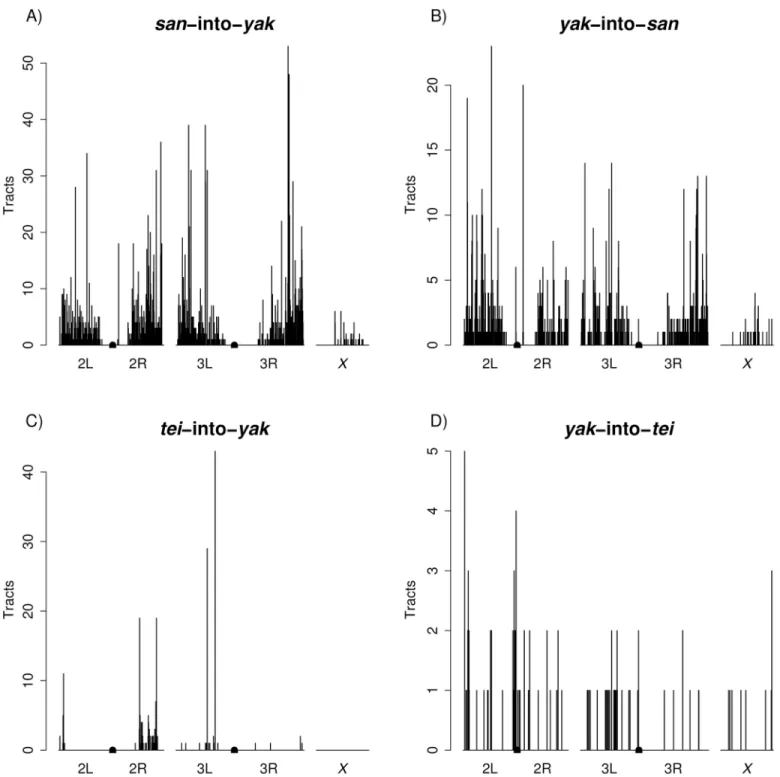
Second, for both species pairs, introgression tracts were not uniformly distributed across the genome (Fig 6). We observed less introgression on theXchromosome than on autosomes in all four directions (permutation tests;san-into-yak: P<0.0001,yak-into-san: P<0.0001,
tei-into-yak: P<0.0001,yak-into-tei: P = 0.0198;S6 Fig). Intriguingly, a region at the start of theXchromosome where we did not find anysan-into-yakintrogression and limitedyak -into-sanintrogression corresponds with a QTL implicated in hybrid male sterility between the two species [48]. Finally, we not only found lessX-linked introgression, but introgressed tracts were also shorter on theXchromosome than on the autosomes: 3.16kb versus 6.05 kb (san -into-yak), 3.34kb versus 6.9kb (yak-into-san), and 0.87kb versus 1.08kb (yak-into-tei). Nota-bly, we did not find anyX-linked introgressions fortei-into-yak.
Dating introgression
The percentage of the genome containing introgressions and the size distribution of introgres-sion tracts within a population contain information on the timing and rates of historic intro-gression. The size of introgressions we observed are surprisingly small given the stable nature of the two hybrid zones, and the observation of hybrid individuals in nature. These pattern suggest that, despite low levels of hybridization, introgression is old because recombination has broken down introgressed regions over time. To obtain a rough estimate of the age of introgression, we used the program SELAM [74]. Modeling all of the potential demographic and introgression histories would be beyond the scope of this paper. Instead we modeled the simplest hybridization with introgression scenario: a single generation pulse of introgression (i.e., hybrids are formed only once). We recorded the size of the resulting introgression tracts from 50 individuals for 10,000 generations under four different models (i.e., magnitude of the hybridization event). We ran five independent simulations each for initial migration rates m = 0.0001, 0.001, 0.01, and 0.1. We found that the percentage of the genome containing intro-gressed tracts declined to levels observed betweenD.yakubaandD.santomeawithin 100–300 generations for m = 0.0001, 100–200 generations for m = 0.001, 200 generations for m = 0.01, and 200 generations for m = 0.1 (S7 Fig). Simulated percentages fell to levels seen between
generations for m = 0.001, 6,800–7,800 generations for m = 0.01, and 7,800–8,000 generations for m = 0.1 (S7 Fig). The average length of introgressed tracts shrunk to levels seen between
D.yakubaandD.santomeawithin 1,700–6,200 generations with two runs never decreasing as much for m = 0.0001, 7,900–9,800 generations for m = 0.001, 10,000 generations with four runs never decreasing as much for m = 0.01, and no runs decreasing as much for m = 0.1 (S8 Fig). The average length decreased to levels seen betweenD.yakubaandD.teissieriwithin
Fig 5. Most introgressions are present at low frequencies. Frequencies of introgressed regions defined as inclusive sets of overlapping
2,700 generations with four runs never decreasing as much for m = 0.0001 and no runs decreasing as much for m = 0.001, 0.01, or 0.1 (S8 Fig). The small average length of observed tracts, therefore, suggests that introgression may be old and the original rate of gene flow (m; assuming a single pulse of introgression) was low.
Fig 6. Genomic distributions of introgression tracts. Centromeres are denoted by rectangles in the center of chromosomes 2 and 3. A) san-into-yak. B) yak-into-san. C) tei-into-san-into-yak. D) yak-into-tei.
Ancestral variation
Shared genetic variation between species could result from introgression but may also repre-sent genetic variation prerepre-sent prior to speciation that is still segregating in both species (i.e., incomplete lineage sorting; [75,76]). To assess how likely this scenario was, we looked at the expected number of generations after speciation before ancestral variation was lost and the expected size distribution of ancestral haplotypes. The number of generations before a neutral allele segregating in the ancestral population is lost is 39,800 generations for Ne= 104and 3,979,933 generations for Ne= 106(S10A, S10B,S11A and S11BFigs). (This of course does not account for trans-specific balancing selection.) We estimated the divergence time between
D.yakubaandD.santomeato be 1 million years (MY) and betweenD.yakubaandD.teissieri
to be 2.6MY. We then estimated the number of generations sinceD.yakubaandD.santomea
diverged to be 26.1×10⁶, 17.4×10⁶and 13.0×10⁶generations respectively for generation lengths of 14, 21, and 28 days and 67.8×10⁶, 45.2×10⁶, and 33.9×10⁶generations respec-tively forD.yakubaandD.teissieri. All of the estimates are much older than the ~4 million generations that a SNP is expected to remain polymorphic (S10A, S10B,S11A and S11BFigs). It is, therefore, unlikely that the regions of shared ancestry represent ancestral polymorphism and are much more likely to represent introgressed regions. Furthermore, the tracts we iden-tify need to contain at least 10 putatively introgressed SNPs, and the probability of indepen-dently observing so many in a row is small. These results strongly argue against ancestral polymorphism occurring in any of the two species pairs.
However, an introgressed fragment could be an ancestral haplotype block that is still segre-gating in only one of the species. If this is the case, recombination will break down ancestral haplotypes over time. We next looked at the expected distribution of fragment lengths that would still be segregating and are derived from the ancestral species. BetweenD.yakubaand
D.santomeathe 99thquantiles for expected fragment lengths assuming a divergence time of 1 MY and generation lengths of 14, 21, and 28 days were 12bp, 19bp, and 24bp respectively (S9C–S9E Fig). Assuming a divergence time of 2.6 MY (as estimated above), the respective 99thquantiles forD.yakubaandD.teissieriwere 7bp, 9bp, and 10bp (S10 Fig). All of these expected lengths are much smaller than our cutoff of 500bp and observed means of 6.0kb for san-into-yak, 6.8kb foryak-into-san, 2.4kb fortei-into-yak, and 1.1kb foryak-into-tei. Collec-tively given the small expected fragment sizes and large number of generations since ancestral polymorphism would be expected to have been lost from the recipient species make it unlikely that the introgression tracts we found are actually ancestral variation.
Adaptive introgression
Finally, we explored the possibility of introgressions that had become fixed in the recipient population. We looked for introgressions that were fixed in a population within the hybrid zone but not present in allopatric populations. We found no evidence ofsan-into-yak intro-gressions that have completely swept locally to fixation within the hybrid zone on São Tome´. We did identify three regions that had introgressions present in the majority of individuals from the hybrid zone (i.e., with frequencies greater than or equal to 50%S11–S13Figs). The first one, 2R: 19,918,908–19,927,758, is 8.9kb long, is at 50–54.6% frequency, and contains four genes (eEF5,RpL12,CG13563and the promoter and 5’ region ofppk29;S11 Fig). The second introgression, 3L: 6,225,896–6,257,088, is 31.2kb and is at 50% frequency. It contains three genes: two genes with no orthologs inD.melanogaster(FBgn0276401, and
portion ofNeurexin IV(S13 Fig). Their multiple breakpoints suggest these introgressions have been segregating withinD.yakubalong enough for multiple independent recombina-tion events to act.
We did not do a similar analysis at theD.yakuba/D.teissierihybrid zone because we only had threeD.yakubaindividuals for that population.
Discussion
We found evidence for low levels of introgression between the three species in theD.yakuba
clade which contains the two only known stable hybrid zones in theDrosophilagenus. We hypothesized that given ongoing hybridization, we would find high levels of genetic exchange between the two species pairs. Yet, in both hybrid zones, the introgressed regions of the genome are small and generally present at low frequencies. Given the divergence time between the two species and low levels of linkage disequilibrium for the three species (S4 Fig), the blocks of shared ancestry are unlikely to represent incomplete lineage sorting and instead reflect introgression. Given their small sizes, low frequencies, and non-consistent enrichment for a type of sequence, it is likely that a majority of the introgressed regions are selectively neu-tral. Since the results for the two pairs of species differ quantitatively and qualitatively, we dis-cuss them separately.
yak/san
Int-HMM detected low levels of introgression betweenD.yakubaandD.santomea; average levels of introgression are around 0.4% and never exceed 1.2%. Introgressed fragments are generally small, with average sizes of 6.8kb foryak-into-sanand 6kb forsan-into-yak suggest-ing recombination has reduced their size over multiple generations and implysuggest-ing that the introgressions are not recent.
Introgression must have occurred through hybrid females (who are fertile), as hybrid males are sterile. Introgression also must have originated in the hybrid zone in an area of secondary contact, likely the midlands of São Tome´, and subsequently spread into other areas.
Notably,san-into-yakintrogressed tracts are not limited to São Tome´. We also found intro-gressedD.santomeaalleles inD.yakubalines from other islands in the Gulf of Guinea that are far from the hybrid zone on São Tome´ (over 150km). There are two possible explanations for this distribution. First, gene flow withinD.yakubabetween islands in the Gulf of Guinea might be common allowing introgressions to easily spread throughout the archipelago. How-ever, there is some evidence of genotypic and phenotypic differentiation between different
D.yakubapopulations [44]. The second possibility is thatD.santomeais not endemic to São Tome´ but is (or once was) present on other islands in the Gulf of Guinea. Sampling on the islands of Prı´ncipe [39] and Bioko [41,54,77], has not yieldedD.santomeacollections. It is worth noting however, that these collections only inform the current distribution ofD. santo-meaand not its historical range. Regardless of the explanation, introgression between these two species pairs is limited and likely to be ancient.
yak/tei
Also using Int-HMM, we found evidence for introgression betweenD.yakubaandD.teissieri, two highly divergent species (Ks~11%). Average levels of introgression are around 0.005% and never exceed 0.025% (i.e., much lower than betweenD.yakubaandD.santomea). Most intro-gressions between these species are small and have low allelic frequencies. The average tract size forD.yakubaintoD.teissieriintrogressions was also smaller than betweenD.yakubaand
between these species is asymmetric with higher rates fromD.yakubaintoD.teissierithan in the reciprocal direction. The reasons behind this asymmetry are unclear but do not stem from differences in the magnitude of reproductive isolation between the two directions of the cross [57]. Notably,D.teissieriflies from the hybrid zone on Bioko had some of the highest levels of introgression of allD.teissierilines. A similar pattern did not hold forD.yakuba, as multiple populations ofD.yakubashow similar levels of introgression. We observed a similar pattern for theyak/sanpair:D.yakubadoes not show differences in the magnitude of introgression at different locations.
Drosophila yakubaandD.teissiericoexist over large swaths of the African continent [53], and thus it is unclear–yet likely–whether other hybrid zones exist. These results are not explained by different rates of migration betweenD.yakubaandD.teissierias they tend to move similar distances [54].
Moreover, we find that introgression fromD.teissieriis present in all lines ofD.yakuba, including those from the island of São Tome´. These results might indicate that the colonization ofD.yakubato São Tome´ occurred after hybridization betweenD.yakubaandD.teissieriand the genomes of the colonizingD.yakubaflies already contained introgressions fromD. teis-sieri. Currently there are noD.teissierion São Tome´ and there is no record ofParinari(the main substrate ofD.teissieri) on this island either. We cannot infer the ancestral range of
D.teissieriwith certainty, but it seems unlikely that this species was present on this island. Notably,tei-into-yakintrogressions do not overlap with thesan-into-yakintrogressions we observed. This rules out the possibility that putativetei-into-yakintrogressions in the hybrid zone actually are fromD.santomea.
General patterns from both species pairs
Introgression in both species pairs shows that despite strong reproductive isolating barriers, genetic exchange mediated through hybridization is possible inDrosophila. In total, over 15 barriers to gene flow have been reported betweenD.yakuba,D.santomea, andD.teissieri
[46,50,57,78,79]. Females invariably prefer males from the same species, and interspecific mat-ings are rare [46] but see [80]. Interactions between gametes from the three different species can also go awry precluding fertilization [57,77,81]. Hybrid individuals may also be inviable or show behavioral defects. Hybrid males from all interspecific crosses are sterile [38,57]. This wide variety of phenotypes is expected to reduce the amount of introgression between species pairs.
The introgressions we found in all four directions appear to be primarily selectively neutral (but see below). They were generally small, being on average only a few kilobases long, indicat-ing that they had been present in the recipient species for many generations, and recombina-tion had ample time to reduce their size. If these introgressions were ubiquitously beneficial, they would have been swept to fixation across the full geographic range or at least in local pop-ulations. We only found a handful of cases where the frequency of introgressed segments exceeded 50%, and most of the introgressions we did find were at low frequencies as expected under neutral drift.
has been found in theDrosophila simulansclade [8], in hominids [28,87], and in other mam-mals [88–90]. Our results support this hypothesis. We saw less introgression on theX chromo-some in agreement with the largeXeffect [91–93]. Such an effect has also been observed in the
yakubaspecies complex [48,94].
Our SELAM results suggest that the percentage of the genome containing introgression can decline quickly after a single generation of introgression reaching the 0.35% seen between
D.santomeaandD.yakubawithin 100 to 200 generations. This would imply that the intro-gression was relatively recent. However, the small average introintro-gression sizes that we observe would suggest otherwise. The average tract lengths from the SELAM simulations indicate that thousands of generations are necessary for the average tract size to reach the 6.8kb we see for
yak-into-san. We recognize that a single generation of introgression may not properly model the introgression history within theD.yakubaclade, but it provides a rough approximation. Existing models for estimating the magnitude and timing of admixture based on tract sizes do not perform well for old admixture events involving small tracts and when recombination has occurred between admixed fragments [30,95–97]. Our simulations also assume that intro-gressed alleles are selectively neutral, which is unlikely to be true between such highly diverged species, but modeling the genomic distributions of hybrid incompatibilities and their interac-tions is beyond the scope of this study.
Mitochondrial vs. nuclear introgression
Previous reports have found extensive evidence for mitochondrial introgression between
D.teissieriandD.yakuba[56], betweenD.santomeaandD.yakuba[37,39,58,59], and stable hybrid zones between both species pairs [49,54]. This has led to the understanding that intro-gression is common and currently occurring among species of theyakubaclade. However, introgression in the nuclear genome had not been thoroughly tested. We find little evidence of recent nuclear introgression among these three species. How can the apparently discordant levels of nuclear and mitochondrial introgression be reconciled? A joint assessment of the studies on mitochondrial introgression in theyakubaclade reveals evidence of ancient intro-gression of mitochondrial haplotypes rather than signatures of recent introintro-gression.
There are four studies of mitochondrial introgression in this clade. First, Monnerot [56] argued for extensive mitochondrial introgression betweenD.yakubaandD.teissieriusing a single mitochondrial locus (2,305 bp; fiveD.yakubalines and fourD.teissierilines); the authors did not studyD.santomeaas this species had not yet been discovered. Second, Llopart et al. [39,58] argued for extensive mitochondrial introgression betweenD.yakubaandD. san-tomea(ND4-ND5region 11D.yakubaand 10D.santomea[39], and whole mitochondrial sequences for 29D.yakubaand 17D.santomea[58]) based on lower divergence and non-monophyletic clustering of mitochondrial haplotypes. Third, Bachtrog et al. [37] included samples from the three species in theyakubaclade and reported at least one ancient mitochon-drial introgression event across the three species using two mitochonmitochon-drial loci (COIIandND5, 1,777 bp; 25 lines ofD.yakuba, 28 lines ofD.santomea, and 15 lines ofD.teissieri). Finally, Turelli et al. (in prep.) analyzed whole mitochondrial sequences from the three species in the
yakubaclade (84 lines ofD.yakuba, 25 lines ofD.santomea, and 13 lines ofD.teissieri). This effort includes twice as many lines as any of the other studies and uses whole mitochondrial genomes, and finds that mitochondrial exchange occurred among these species in the past but is not ongoing.
ago (40,000–400,000 years) from two sister groups that diverged roughly 75,000 years ago (30,000–300,000 years). One of these sister groups contains only mitochondria fromD. santo-mea; the second group contains all of the mitochondrial genomes fromD.yakubaand a few fromD.santomeaisolates. The divergence dates of these mitochondrial types are much more recent than the inferred split time from nuclear DNA for any of these species (by a factor of 6; see above) but they do not overlap with the present.
Overall, the combined mitochondrial and nuclear data are consistent with a scenario of ancient introgression in which mitochondria and nuclear genes were both exchanged in the distant past. Mitochondrial genomes subsequently accrued mutations to make the mitochon-drial clades mostly monophyletic again, while the majority of nuclear introgression has been purged out of the populations. The introgression patterns of mitochondrial genomes are thus consistent with our finding of limited nuclear introgression.
Hybridization vs introgression
Our results pose an apparent contradiction. We studied the only two stable hybrid zones known to date inDrosophila. Additionally, there seems to have been a recent event of mito-chondrial homogenization in these species that can only be explained through hybridization [37,39,56,58]. Yet, we find little introgression between hybridizing species in both cases. How to reconcile the continuous and relatively high level of hybridization with the small amount of observed genomic introgression that seems to be old?Drosophila yakubaandD.teissieri
hybridize in the island of Bioko but the hybrid zone they form is extremely narrow indicating strong selection against the hybrids. Field and laboratory experiments revealed the potential source of this selection:D.yakubaprefers open habitats whileD.teissieriprefers dense forests. Congruently,D.yakubais able to tolerate desiccating conditions, whileD.teissieriis not well suited for this type of stress. F1 hybrids between these two species show a deleterious combina-tion of traits; while they prefer open habitats likeD.yakuba, they cannot tolerate osmotic stress. This maladaptive combination of traits might preclude the possibility of these hybrids passing genes to the next generation. Indeed, while hybrids may be sampled on Bioko, no advanced-generation hybrid genotypes have been found [54].
The case ofD.yakubaandD.santomeais more puzzling because the number of hybrids produced in their hybrid zone is much higher [44]. One possible scenario is that there is also strong selection against the hybrids and they simply are not able to reproduce. At least one line of evidence indicates this is the case. Hybrid males in theyak/sanhybrid zone from one of the directions of the cross migrate towards the top of Pico de São Tome´ largely outside of the geo-graphic range of the two parental species. These males are sterile, but hybrid females, which are fertile, might show similar defects. There is evidence that hybrids from both sexes show behavioral defects [98]. The reason for this aberrant migration is unknown, but is likely to be caused by similar behavioral defects.
rates of hybridization and little introgression. The observed levels of introgression might be a relic of even higher levels of hybridization before reinforced gametic isolation was in place.
Adaptive introgression
The vast majority of introgressions were at low frequency, but we tested whether any of the alleles identified in our screen showed evidence of adaptive introgression. We find potential evidence for three alleles that have increased in frequency locally (i.e., in the São Tome´ hybrid zone; [101]) after crossing the species boundary fromD.santomeaor fromD.teissieriinto
D.yakuba. It is worth noting that given their size and the rather large number of breakpoints, these introgressions are unlikely to have enteredD.yakubain the recent past.
We found threesan-into-yakintrogressions that increased to high frequency in the hybrid zone. The first one, 2R: 19,918,908–19,927,758, contains four genes:eIF5,RpL2,CG13563, and the 5’ portion ofppk29. The most intriguing of these candidates isppk29because the gene is involved in intraspecific male-male aggression inD.melanogaster[102], and larval social behavior also inD.melanogaster[103].ppk29is also necessary for promoting courtship to females [104] and inhibit courtship towards males [104].
The secondsan-into-yakintrogression, 3L: 6,225,896–6,257,088, contains a portion of the intron ofSifand two genes with no known orthologs inD.melanogaster(GE28246,GE28581).
Sifis differentially expressed after light stimulation, and functional analyses inD.melanogaster
show a strong effect of the gene on the regulation of circadian rhythm [105]. Surprisingly, knockdowns ofSifin projection neurons result in changes in odor-guided behavior: mutants are more attracted to fermenting fruit [106,107]. Other effects of the gene show that it is impli-cated in resistance to fungal pathogens [108].
The finalsan-into-yakintrogression at high frequency in the hybrid zone, 3L: 12,187,525– 12,209,675, contains three genes:Nrx-IV,CG9760,and Rh7.Nrx-IVhuman orthologs
(CHRNA5,CHRNA7) have been implicated in alcohol dependence and natural intronic poly-morphism segregating withinD.melanogasterhas been associated with resistance to alcohol [109]. It has also been associated with resistance to fungal pathogens [108].Rh7is a rhodopsin that has been implicated in fly vision and regulation of circadian rhythm and light perception [110].
These three introgressions contain genes that could potentially be involved in adaptation, but we cannot yet claim that these alleles are adaptively introgressed. More generally, we do not yet know whether any of these genes leads to interspecific trait differences. Only careful physiological and functional study of potentially adaptive phenotypes in the three pure species and the admixed individuals will reveal to what extent these introgressed regions are truly adaptive.
Caveats
Second, all our analyses were done using aD.yakubareference genome. The greater diver-gence betweenD.yakubaandD.teissierimay also result in less ability to mapD.teissierireads in less conserved regions such as intergenic sequence thus causing us to miss introgressions.
Third, beneficial alleles would likely go to fixation quickly and would be undetectable by our approach since both species would have the same allele. Additionally, such adaptive intro-gressions that have swept to fixation could cause our method to misidentify the direction of introgression. We find evidence for three potential cases of adaptive introgressions (not fixed but at high frequency in the hybrid zone) but we do not believe that such instances are com-mon. Most genes are unlikely to be adaptive in a new genomic environment [113–115]. Since linkage disequilibrium declines precipitously on the order of a few hundred base pairs in the
Drosophilaspecies we are working with and the minimum size for introgression tracts we are reporting is 500bp, misidentified adaptive introgressions should be very rare in our dataset. A demographic assessment of the timing and likely evolutionary history of these introgressions might help resolve the issue.
Fourth, we selected markers that were fixed in the donor species with an allele frequency difference between species greater than 0.3. This cutoff was chosen because the closer the allele frequency difference is to zero, the less information the marker contains. However, in practice this means that we were unable to detect introgressions that had increased in the recipient spe-cies to frequenspe-cies greater than 0.7. Given the distribution of allele frequenspe-cies we observed, it seems unlikely that there are many introgressions at such high frequencies, but we would be unable to detect those that existed. Given the small differences between species, such introgres-sions could be difficult to detect for any method, particularly one based on allele frequencies.
Our approach is also unable to detect regions of the genome with bidirectional introgres-sion. However, given the low levels of introgression we observe (<1%) and the small sizes of introgression tracts, such overlaps are expected to be rare. A final, and related potential caveat would be that introgressions inD.yakubawere attributed separately to bothD.santomeaand
D.teissieri. However, there is a little overlap betweensan-into-yakandtei-into-yak introgres-sions with only two lines (1_5 and 1_7) each having the same overlap which spans just 2,439bp.
Conclusions
Hybridization is common across the tree of life. Hundreds of hybrid zones have been described over the last 150 years [116–119] but until recently identifying the segments of the genome that had crossed species boundaries was all but impossible. Genome sequencing has been able to identify multiple cases of recent admixture and introgression [19,120–123]. Large pieces of the genome in modern humans originated from other hominids [29,31,115,120,124– 126]. Hybridization in plants is rampant and has had deep implications in their diversification [127–130]. Systematic surveys in birds also have provided evidence that hybridization and introgression might be frequent but not ubiquitous processes ([131–133] reviewed in [134,135]). Overall, there is strong evidence that hybridization is common across animals [13,136,137], and there are clues that introgression might not be rare [19,138]. Significant progress has been made to detect introgression when migration is recent [24,139]. Ancient introgression remains a largely underexplored question because identifying small introgres-sions is challenging (but see [28,33,87]). We provide a general method to detect introgression that does not depend on having phased data or on identifying pure individuals beforehand. Additionally, our method reliably identifies introgressions even when introgression is rare. We have mapped such introgressions between two pairs of species in theDrosophila yakuba
and ongoing hybridization. Our results indicate that hybridization does not necessarily imply gene flow between species. The two species pairs in theyakubaclade likely represent the later stages of the speciation process and similar mapping efforts are necessary in species pairs that are less diverged to better understand how divergence time affects rates of hybridization and subsequent genomic introgression.
Methods
Genome sequencing
Fly collection. Drosophilalines were collected in the islands of São Tome´ and Bioko. To collect flies, we set up banana traps in plastic bottles hanging from trees. Flies were aspirated from the traps without anesthesia using a putter [140,141]. Flies were then sorted by sex and species. Males were kept in RNAlater; females were individually placed in 10mL plastic vials with instant potato food (Carolina Biologicals, Burlington, NC). Propionic acid and a pupation substrate (Kimwipes Delicate Tasks, Irving TX) were added to each vial. We collected the progeny from each female and established isofemale lines [140]. All collected stocks and popu-lations were reared on standard cornmeal/Karo/agar medium at 24˚C under a 12 h light/dark cycle. The taxonomical identification was confirmed by performing crosses with tester stocks (D. santomea: sanSYN2005; D. yakuba: Ta¨i18; D. teissieri: Selinda). Other additional lines were donated by J.A. Coyne and are listed inS1 Table.S14 Figindicates the number of fly lines used in this study from each geographic location.
DNA extraction. DNA was extracted from single female flies using the QIAamp DNA
Micro Kit (Qiagen, Chatsworth, CA, USA) kit. We followed the manufacturer’s instruction using cut pipette tips to avoid shearing the DNA. This protocol yields on average ~40ng (range: 23ng-50ng) of DNA per fly per extraction.
Library construction. For short read sequencing, we constructed libraries following two
methods. 54 libraries were built using the TrueSeq Kappa protocol (University of North Caro-lina, Chapel Hill). For these libraries, ~10 ug of DNA was sonicated with a Covaris S220 to a mean fragment size of 160 bp (range = 120–200 bp) with the program: 10% duty cycle; inten-sity 5; 100 cycles per burst; 6 cycles of 60 seconds in frequency sweeping mode. The other 12 libraries were built using Nextera kits at the sequencing facility of the University of Illinois, Urbana-Champaign. For these libraries, DNA was fragmented using Nextera kits which uses proprietary transposases to fragment DNA. Libraries were built following standard protocols [72].
Sequencing. We sequenced all libraries on Illumina HiSeq 2000 machines with v3.0
chemistry following the manufacturer’s instructions.S1 Tableindicates the sequencing type (single-end or paired-end), and coverage for each library. Libraries were pooled prior to sequencing and 6 libraries were sequenced per lane. To assess the quality of the individual reads, the initial data was analyzed using the HiSeq Control Software 2.0.5 in combination with RTA 1.17.20.0 (real time analysis) performed the initial image analysis and base calling. Run statistics for each FASTQ file was generated with CASAVA-1.8.2. Resulting reads ranged from 100bp or 150bp and the target average coverage for each line was 30X. The coverages for each line are shown inS1 Table. We obtainedD.yakubasequences for 20 previously sequenced lines (10 from Cameroon and 10 from Kenya) from [142] (S1 Table).
het = 0.01. The following filters were applied to the resulting vcf file: QD = 2.0, FS_filter = 60.0, MQ_filter = 30.0, MQ_Rank_Sum_filter = -12.5, and Read_Pos_Rank_Sum_filter = -8.0. Sites were excluded if the coverage was less than 5 or greater than the 99thquantile of the genomic coverage distribution for the given line or if the SNP failed to pass one of the GATK filters.
PCA
We used Principal Component Analysis (PCA) to assess the partition of genetic variation within theyakubaspecies complex. PCA transforms a set of possibly correlated variables into a reduced set of orthogonal variables. Sampled individuals are then projected in a two dimen-sional space where the axes are the new uncorrelated variables, or principal components. We used the R packageadegenet[148] to run separate PCA analyses for theXchromosome and autosomes and plotted the first five principal components. For all PCA, we calculate the amount of variance explained by each principal component.
ABBA—BABA tests
To calculate interspecific gene flow, we first calculated historical levels of gene flow between different species pairs in theyakubaclade with the ABBA-BABA/D statistic [31,33,71,149] using a perl script. The ABBA-BABA test compares patterns of ancestral (A) and derived (B) alleles between four taxa. In the absence of gene flow, one expects to find equal numbers of sites for each pattern. However, gene flow from the third to the second population can lead to an excess of the ABBA pattern with respect to the BABA pattern, which is what the D statistic tests for. A positive value of D indicates an excess of ABBA sites and indicates the average direction of introgression is from the putative donor to the putative recipient. A negative value of D indicates an excess of BABA sites and indicates the average direction of introgression is from the putative recipient to the putative donor [71]. We used allele fre-quencies within the specified populations (i.e., putative recipient, putative donor, outgroup) as the ABBA and BABA counts following [33,71]. We assessed the significance of ABBA--BABA test statistics using the commonly employed method of weighted block jackknifing with 100kb windows [150]. Briefly, this systematically removes consecutive non-overlap-ping portions of the genome (100kb blocks in this case) and re-estimates the statistic of interest to generate a confidence interval around it. We also estimated the proportion of the genome that was introgressed with the fdstatistic [71]. fdcompares the observed difference between the ABBA and BABA counts to the expected difference when the entire genome is introgressed.
Treemix
We usedTreeMix[32] to investigate the relationship between species and to look for evidence of historic gene flow.TreeMixestimates the most likely evolutionary history in terms of splits and mixtures of a group of populations by estimating levels of genetic drift. The analysis is done in two steps. First, it estimates the relationships between sampled populations and esti-mates the most likely maximum likelihood phylogeny. Second, it compares the covariance structure modeled by this dendrogram to the observed genetic covariance between popula-tions. The user then specifies the number of admixed events. If a pair of populations is more closely related than expected by the strictly bifurcating tree, then maximum likelihood com-parisons will suggest an admixture event in the history of those populations. We ranTreemix
geographic locations.Drosophila yakubawas partitioned into four populations: an ‘islands’ population that included lines from Prı´ncipe and Bioko, an ‘africa’ population containing the mainland African lines from the Ivory Coast, Cameroon, and Kenya, a ‘low_st’ population for the lowlands of São Tome´, and a ‘hz_st’ population for lines from the hybrid zone on São Tome´. We ranTreemixfor each dataset with m = 0 through 5 migration edges and determined the most likely number of migration events (n) by doing a log likelihood test comparing the runs with m = n and m = n—1. The most likely value of m was the largest value of n before the test was no longer significant at a 0.05 level.
Hidden Markov model
Selecting markers for the hidden Markov model. Treemixand the ABBA-BABA D sta-tistic can be used to assess whether genetic exchange has occurred between species (and pop-ulations), but they do not identify specific introgressed regions of the genome. We identified introgressed regions in all individuals from all three species using a hidden Markov model. The hidden Markov model determined the most likely genotype (the hidden state) for each SNP we used as a genomic marker. When looking for introgression from one species into another, we would ideally have allopatric and sympatric populations of the recipient species. Fixed differences between a putative donor species and an allopatric population of the recipi-ent species are informative markers that can be used to help idrecipi-entify introgression. However, allopatric populations do not exist for all of the species pairs in theyakubaclade. The ranges ofD.yakubaandD.teissierioverlap extensively, and noD.santomeaflies live more than a few miles from the hybrid zone withD.yakuba. We were, therefore, unable to identify mark-ers that were definitively associated with the recipient or donor species. Instead, we selected SNPs to be markers where the donor species was monomorphic and the allele frequency dif-ferences between the two species was greater than or equal to 30%. 30% was chosen because the smaller the allele frequency difference between species, the less informative an individual site is for identifying introgression and the noisier the data becomes as neutral mutations that are segregating at a low frequency in the recipient species are also included. Further-more, we required that every individual in the donor species and at least one individual in the recipient species had a called genotype. We also excluded sites where more than 80% of the individuals with a genotype call from GATK were heterozygous as the high frequency of heterozygotes likely indicated mapping error. For theD.santomeaintoD.yakubaanalysis, we excluded four lines fromthe D.santomeadonor population that were more similar toD.
yakubafor both PC1 and PC2 for the autosomal PCA analysis: sanSTO7, BS14, C550_39, and san_Field3. They were excluded since they were expected to have higher levels of introgres-sion which would reduce the number of markers because of the requirement that the donor species be monomorphic.
Transition probabilities. Transition probabilities determine how likely the HMM is to
move between the hidden states. The transition probabilities use two starting probabilities,a
for transitions between non-error states andaefor transitions between error states. Separate
transition probabilities and starting probabilities are calculated for each marker and depend on the distance to the next marker. We modeled the starting probabilities as Poisson variables with the parameter equal to the per site recombination rate, c, times the distance between the two sites. The parameter foraealso used a multiplier m. The multiplier ensured that it was
![Table 1. D-statistic variations (D [31,32] and f d [71]) show evidence for admixture between D](https://thumb-us.123doks.com/thumbv2/123dok_us/8272562.2191024/5.918.52.866.928.1038/table-d-statistic-variations-d-evidence-admixture-d.webp)