HOW SOCIOECONOMIC STATUS SHAPES PERCEPTIONS OF TIME: CONSEQUENCES FOR DECISION-MAKING AND ACADEMIC ACHIEVEMENT
Heidi A. Vuletich
A dissertation submitted to the faculty at the University of North Carolina at Chapel Hill in partial fulfillment of the requirements for the degree of Doctor of Philosophy in the Department
of Psychology and Neuroscience in the Graduate School of Arts and Sciences.
Chapel Hill 2020
ABSTRACT
Heidi A. Vuletich: How Socioeconomic Status Shapes Perceptions of Time: Consequences for Decision-Making and Academic Achievement
(Under the direction B. Keith Payne and Beth E. Kurtz-Costes)
Academic achievement is strongly tied to socioeconomic status (SES) in the U.S. Wealthier students perform better in school, graduate from high school at higher rates, and are more likely to enroll in college. Resource disparities are part of the problem, but they may not be the only factor driving achievement gaps. Evidence from research in behavioral economics and psychology suggests that poverty may change how distant individuals perceive the future and how likely they are to prioritize future versus immediate rewards. Theoretically, this focus away from the future and towards the present is an adaptive mechanism that helps individuals meet current needs. Nonetheless, educational contexts require pursuit of long-term goals. The primary aim of the current study was to examine whether lower SES among adolescents is associated with perceiving the future as more distant and prioritizing immediate rather than larger delayed rewards. I investigated whether this relation partly explains SES differences in academic
ACKNOWLEDGEMENTS
This research would not have been possible without the support and collaboration of the participating schools. Thank you, principals, staff members, teachers and district administrators, for your willingness to engage in this project and for all the time and effort you invested in it. Your task to ensure that students receive an excellent education is already an overwhelming one, making any additional efforts on your part a considerable act of generosity. My deepest gratitude to you.
I am equally indebted to all the students and parents who participated in this study. Thank you for your contribution to the scientific endeavor and your interest in helping generate
generalizable knowledge.
My gratitude also to the research assistants and graduate collaborators on this project, whose help was invaluable: Carley Cook, Beibei Du, Nate Priebe, Abigail Garcia-Baza, Marketa Burnett, and Janae Shaheed.
I want to acknowledge and thank the funding sources for this project: P.E.O.
International, through the P.E.O. Scholar Award, and the National Science Foundation, through its Graduate Research Fellowship.
TABLE OF CONTENTS
LIST OF TABLES ... x
LIST OF FIGURES ... xi
INTRODUCTION ... 1
The Relation between SES and Time Perception ... 2
Implications of a Shifted Time Horizon for Decision-Making ... 5
Prioritizing the Future Predicts Academic Achievement ... 8
SES Differences in Time Preferences Among Adolescents ... 10
Parents’ Influence on Adolescents’ Time Perceptions and Preferences ... 11
Differences between Perceived and Objective SES ... 13
Preliminary Studies Showing a Relation between Perceived Financial Need and Time Horizon ... 15
Summary ... 16
Current Study ... 18
Primary Aim... 18
Secondary Aims. ... 19
METHOD ... 21
Participants ... 21
Procedure ... 22
Adolescent-specific measures. ... 23
Parent-specific measures. ... 28
RESULTS ... 31
Data Reduction ... 31
Adolescent Perceived SES. ... 31
Parent Perceived SES. ... 31
Academic Motivation and Achievement ... 32
Time Horizon. ... 32
Temporal Preferences. ... 32
Preliminary Analysis ... 32
Main Analyses ... 34
The Time Horizon Model Among Adolescents. ... 34
The Role of Parents in Adolescents’ Time Horizon and Temporal Preferences. ... 36
The Time Horizon Model Among Parents... 38
The Effect of Perceived SES. ... 39
DISCUSSION ... 41
The Effect of SES versus Parents on Adolescents’ Temporal Preferences ... 42
The Role of Parents in Adolescents’ Temporal Preferences ... 45
Perceptions of the Future’s Distance ... 47
The Effects of Perceived SES ... 48
Conclusion ... 52
APPENDIX A: SES MEASURES... 54
Adolescent-reported SES ... 54
Adolescent-reported perceived wealth ... 56
Parent-reported perceived wealth ... 57
APPENDIX B: EXPLORATORY FACTOR ANALYSES ... 58
APPENDIX C: COLLEGE AND WORK PREPARATORY BEHAVIORS ... 61
APPENDIX D: PREOCCUPATION WITH EARNING MONEY ... 63
APPENDIX E: SENSATION SEEKING MEASURE ... 64
LIST OF TABLES
LIST OF FIGURES
Figure 1. Mediation model suggesting that temporal preferences account, in part, for the positive relation between SES and academic achievement
(as measure by grades). ... 36 Figure 2. Parents’ temporal preferences were more predictive
of adolescents’ temporal preferences than SES. Parents’ preferences had an indirect
effect on academic achievement (as measured by grades).. ... 37 Figure 3. SES had an indirect effect on academic through parents’ temporal
preferences for immediate rather than delayed rewards, in turn associated
with their adolescents’ temporal preferences.. ... 38 Figure 4. Perceived SES is associated with parents’ temporal preferences
above and beyond objective SES, but its indirect effect on academic
INTRODUCTION
Educational achievement gaps based on socioeconomic status (SES) are widespread and persistent. Twenty-two percent of children raised in homes with incomes below the federal poverty line do not finish high school, compared to six percent for children who have never experienced poverty (Hernandez, 2012). After high school, 81% of students from the top income quintile enter college, compared to 52% among the bottom income quintile (Kena et al., 2016). Once in college, students in the top quartile are twice as likely to graduate as those in the bottom quartile (Bailey & Dynarski, 2011). Whereas other disparities such as the Black‐White
achievement gap have decreased, the income-achievement gap has been growing over the past 50 years (Reardon, 2011).
It is easy to assume that poverty is simply a lack of resources, and that personal
perceptions of the world persist through any change in one’s external circumstances. From this perspective, a reasonable conclusion is that poor youth who underachieve simply need more resources and more information to succeed. This logic, however, leads to person-level
interpretations of behavior when youth do not take full advantage of resource-based educational interventions. For example, some theories propose that the poor hold intrinsic values that lead to disparities in outcomes (Brim & Forer, 1956; Murray, 2012). This kind of individual difference explanation does little to inform approaches for reducing disparities and neglects to consider important situational factors that can affect people’s psychology. Poverty is a context from which it may be difficult to prioritize the future for any given person, regardless of their personal
when they are in a valley, being only able to contemplate the steep climb in front of them. Like so, wealth and poverty may afford people different perspectives, the former allowing a focus on the future and its rewards, and the latter restricting attention to the present. These different perspectives could change the way that people perceive time itself. This research investigates the idea that scarcity shifts people’s time horizon—or how distant they perceive the future—with consequences for their decision-making and implications for their educational pursuits. The Relation between SES and Time Perception
The notion that socioeconomic conditions could shape perceptions of time may seem strange. However, consider this scenario: A person is struggling to make this month’s rent. To her, next month may seem far away as she looks for ways to make it through this month alone. In contrast, someone who has no concerns about this month may perceive next month as more proximal. A narrow focus on the present is rational and adaptive when people do not have enough resources. Such a focus allows individuals to devote time and energy to attaining what they need now. However, when attention on the present is amplified, the future may become more abstract, and therefore appear more remote (Trope & Liberman, 2010).
Research has not yet established a link between SES and time horizon, but there is
today to $11 tomorrow, but when the choice is between $10 in one year versus $11 in one year plus one day, he prefers $11. Another instantiation of this bias is that individuals, in general, need proportionally larger incentives to wait shorter periods. For instance, someone may accept a minimum $10 incentive to wait 1 month for a reward ($10/month rate), but accept $20 to wait three months ($6.67/month rate) and $30 to wait six months ($5/month rate), essentially placing a larger relative premium on delays that are more temporally proximal.
Evidence that lower wealth is associated with greater hyperbolic discounting has been replicated repeatedly. For instance, in a study of Ethiopian families (headed by mostly
subsistence farmers), lower wealth predicted household preferences for smaller monetary
reflect the immediate need for goods by lower wealth households, but I discuss some evidence below suggesting this explanation may be incomplete.
Subjective perceptions of distance to the future are an important component of hyperbolic discounting. In one study, participants were asked to mark on a line how long they considered the duration between today and a day three months, one year, or three years in the future (Zauberman, Kim, Malkoc, & Bettman, 2009). Participants then completed a temporal
discounting task in which they made choices between rewards differing in magnitude and in how long the delay would be to receive the rewards. Subjective perceptions of time were strongly associated with the temporal discounting rate. Rewards that were perceived as further in the future, regardless of the literal time delay, were valued less (see also Kim & Zauberman, 2009). When temporal trade-offs were plotted using perceived time rather than literal time, no
hyperbolic discounting emerged. This result suggests that distortions in people’s time horizons can, at least in part, account for an overemphasis on the present when making decisions. This finding is consistent with other studies showing that individuals who overestimate the duration of time intervals discount the value of future rewards more steeply (for a review, see Wittmann & Paulus, 2008).
Because individuals from lower-income backgrounds show a greater present-bias regarding monetary choices, it follows that they might perceive the future as further away than wealthier individuals, but this idea has not been tested yet. Instead, indirect evidence shows that there are psychological mechanisms driving the choices of low-income individuals—immediate financial need is not the sole factor explaining the present-bias. In one experiment, participants were randomized to feel poorer than their peers by receiving false feedback about their
by social comparison, not due to actual need, showed a greater preference for immediate
monetary rewards. These results suggest that the present-bias is partly driven by a psychological mechanism and not just objective economic standing. The experiment’s results also support a causal relation between SES and a present-bias (also see Haushofer, Schunk, & Fehr, 2013), and they suggest that perceived rather than actual SES is sufficient to trigger shifts in temporal choices.
Implications of a Shifted Time Horizon for Decision-Making
The implications of a shifted time horizon are significant for more than monetary choice preferences. Notions of the future could determine how individuals prioritize short-term versus long-term goal pursuits in general. For instance, in one experiment, researchers manipulated scarcity by assigning players either a high or a low number of shots to play a slingshot game (Shah, Mullainathan, & Shafir, 2012). Participants used their shots to earn points across rounds by hitting targets. Unspent shots could be used in future rounds. Analogous to payday loans (where one borrows against an upcoming paycheck), some participants were able to borrow shots from future rounds whereas others could not. “Poor” players borrowed at higher rates against future rounds compared to “rich” players. Critically, the ability to borrow against future rounds harmed the overall performance of poor players, but not rich ones. Poor players were excessively focused on the short-term goal of winning the current round and sacrificed the overall objective of maximizing points across rounds, whereas rich players did not.
the present, scanning it for opportunities to attend to the scarce domain. When domain-relevant opportunities arise (e.g., borrowing shots, cashing in money, etc.), then both models predict that those opportunities receive priority. For instance, both models would predict that youth from low SES backgrounds might prioritize opportunities to earn money over other goal pursuits. I test this possibility in the current study, but the time horizon model goes beyond predicting stronger preferences for monetary rewards over other rewards.
The time horizon model broadens the scope of the psychological shift induced by scarcity and its potential behavioral implications. By inducing an attentional shift to the present in
general, not just to the scarce domain, scarcity potentially biases people to select immediate rewards and short-term goal pursuits available across many domains, regardless of whether they are related to the experienced scarcity. This domain-general process may have optimally evolved for resolving acute scarcity, as brief shifts in time horizon likely yield useful and
of immediate gratification while sacrificing long-term well-being, consistent with the idea that time horizon may be an additional factor influencing the choices of low SES individuals.
Some explanations for the poor’s tendency to make “shortsighted” decisions point to individual-level characteristics, such as trait-level impulsivity (Murray, 2012). In contrast, the time horizon model suggests that the poor make decisions that benefit the short-term because they live in poverty—poverty itself fosters perceptual differences in time horizon, resulting in ostensibly myopic decisions. These decisions need not be detrimental. In fact, they may be functional under many circumstances, as outlined in life history theories (Kaplan & Gangestad, 2005). However, long-term goals are inextricably embedded in traditional education systems, and perceptions of the future may be critical in this context. For instance, evidence from one study shows that students who perceive the future as more temporally proximal practice more for a test, have better exam performance, and report greater motivation (Peetz, Wilson, & Strahan, 2009). In that same study, those who were experimentally induced to feel temporally close to graduation reported feeling more motivated than those who were induced to feel temporally distant from it.
Prioritizing the Future Predicts Academic Achievement
In this study, I focused particularly on the consequences of a shifted time horizon for academic achievement among adolescents. Educational contexts require students to work towards long-term goals, such as obtaining good grades, graduating, or being college-ready. Achieving those goals often requires students to prioritize long-term rewards over leisure or social activities that are immediately gratifying. Correlational evidence suggests that students’ tendency to favor delayed over immediate rewards is a powerful predictor of educational achievement (e.g., Duckworth & Seligman, 2005; Tangney, Baumeister, & Boone, 2004; see Watts, Duncan, & Quan, 2018 for null effects when delayed gratification is measured at a very young age and used to predict long-term outcomes, as in the classic "marshmallow study"). Duckworth and Seligman (2005) found that middle school students’ preference for larger, delayed rewards in a monetary delay discounting task positively predicted grades seven months later, after controlling for intelligence test scores. Similarly, college students who indicate preferences for activities aimed at long-term academic rewards (e.g., staying home and studying) over immediately rewarding activities (e.g., going to a concert) tend to have better academic outcomes (Bembenutty, 2009). Though third variables could contribute to these findings, the results are consistent with the notion that being able to prioritize the future is an important component of academic success.
Of course, students from low SES backgrounds face financial barriers to attending college, and their awareness of such obstacles may demotivate them to succeed in school
(Destin, 2017; Destin & Oyserman, 2009). In addition, much research has documented the ways in which a lack of material and social resources contributes to income-achievement gaps. For example, differences in school funding, access to books at home, family structure, and parental education all contribute to educational disparities (Bradley & Corwyn, 2002; Brooks-Gunn & Duncan, 1997; Duncan, Magnuson, & Votruba-Drzal, 2015). Yet, longitudinal studies have found that delay of gratification partially mediates the association between family income and achievement, even among young children (Evans & English, 2002; Evans & Rosenbaum, 2008). In a prospective longitudinal study, the preferences of 4.5-year-old children for immediate candy rewards instead of larger, delayed rewards mediated the relation between family income and cognitive development when the children were in Grade 5 (Evans & Rosenbaum, 2008). Among 9-year-olds too, preferences for smaller, more immediate rewards mediated the relation between family income and grades when the children were 13 years old (Evans & Rosenbaum, 2008). The current study posits that delay of gratification is not simply a product of traits or
socialization, but is also embedded in perceptions of time triggered by socioeconomic status. This factor may compound with others to create the growing income achievement gaps we observe in the U.S. today.
SES Differences in Time Preferences Among Adolescents
The current study focuses primarily on the relation between SES and time perceptions among adolescents, but most of the literature that provides evidence for the time horizon model focuses on adults. Though there is not much research to elucidate the association between SES and a present bias among adolescents, there is some evidence that adults and children have similar time preferences. One study found that delay discounting rates across children (mean age: 12), young adults (mean age: 20), and older adults (mean age: 68) followed the same function: individuals reduced the value of delayed rewards, and they were more sensitive to differences in short delays compared to long delays (Green, Fry, & Myerson, 1994). Age group differences were found in the rate of discounting, but a follow-up study noted that these age differences might have been confounded with income differences, as older adults generally have higher incomes than young adults (Green, Myerson, Lichtman, Rosen, & Fry, 1996). In that follow-up study, within the same income level, young adults (median age: 33) and older adults (median age: 71) made similar delay discounting choices (Green et al., 1996). Age differences in delay discounting were only found when age was confounded with income level (i.e., older adults with low incomes discounted rewards more steeply than young adults with high incomes).
what they would be doing in the future, children from lower SES backgrounds were more likely than high SES children to say they did not know or that they would be playing. They were also less likely to say they would be in college or working. Although the sample size for the study was small, the findings are consistent with the idea that youth from low SES backgrounds have a more difficult time imagining the future than wealthier youth. A study investigating a sample of adolescents (ages 14-16; N = 100) found results that are consistent with these ideas: The stories of middle-class adolescents extended further into the future than those of lower-class adolescents (Lamm, Schmidt, & Trommsdorff, 1976). These results support the notion that the time horizon model—which posits that SES influences how distant the future appears—is applicable not just to adults, but also adolescents. I test this hypothesis in the current study, but also examine another potential influence on adolescents’ time perceptions, which I discuss next: the role of parents.
Parents’ Influence on Adolescents’ Time Perceptions and Preferences
When studying psychological constructs in adolescence, it is important to consider the adolescents’ developmental context. Here, I turn to Bronfenbrenner’s Ecological Systems Theory (Bronfenbrenner, 1986) as a useful framework. It is clear that the family’s socioeconomic
they are also central role models and socialization agents for adolescents (Grusec & Davidov, 2007). For example, research has shown that adolescents’ attitudes about various topics, such as the environment (Grønhøj & Thøgersen, 2009), sex (Fisher, 1986), and maternal employment (Starrels, 1992), are positively correlated with those of their parents. Parent modeling of
behavior has also been shown to correlate with adolescent behavior in domains pertaining to the prioritization of short-term versus long term-rewards, such as lottery participation (Felsher, Derevensky, & Gupta, 2003), “screen time” (Totland et al., 2013), smoking (Chassin, Presson, Rose, & Sherman, 1998), drinking (Engels, Knibbe, De Vries, Drop, & Van Breukelen, 1999), and physical activity (Edwardson & Gorely, 2010), just to name a few. Thus, though SES may be associated with adolescents’ time perceptions and preferences, it is possible that the relation is indirect through parents’ time perceptions and preferences.
future orientations were in turn positively associated with their self-reports of how much their own parents talked to them about personal finances during childhood, gave them money and opened a bank account for them, and were economical compared to others. These findings suggest that the extent to which adolescents consider the future is consistent with their parents’ own considerations of the future and behaviors favoring future rewards.
Overall, these correlational studies provide evidence that parent-child dyads share similar time orientations and preferences. It is beyond the scope of this report to test specific
mechanisms by which parents could exert an influence on adolescent’s time horizons, but the role of parents in early adolescence is substantial, and it is important to examine if parents’ and adolescents’ time horizons are associated and whether they independently predict adolescent outcomes. Another question is whether parents’ time horizons account for more variance in adolescents’ time horizons than SES does, as Ecological Systems Theory would suggest. Ideally, experimental or longitudinal work would follow up these findings to establish causal effects. Differences between Perceived and Objective SES
Castellazzo, & Ickovics, 2000; Cohen et al., 2008; Senn, Walsh, & Carey, 2014; Singh-Manoux, Marmot, & Adler, 2005). In other words, some people who are of objectively low status do not perceive their status as low, whereas others who are of objective high status perceive their status as low. Given that perceived and objective SES appear to be somewhat independent constructs, it follows that they might also show different predictive validity.
Indeed, concerning health outcomes, perceived SES shows greater predictive validity than objective SES (Adler et al., 2000; Operario, Adler, & Williams, 2004; Ostrove, Adler, Kuppermann, & Washington, 2000). This finding has been replicated among adolescents
(Goodman et al., 2001; Goodman, Huang, Schafer-Kalkhoff, & Adler, 2007). In a study of 1179 adolescents ages 12-19 (M = 15.1), perceived SES was more strongly associated with self-rated health than objective SES (Goodman et al., 2007). When both measures were predictors in the same model, only perceived SES predicted self-rated health. Like in studies using adult samples, the association between perceived SES and objective SES was only moderate among adolescents (ρ = .35 with household income; ρ = .24 with parent education). These studies highlight the importance of examining the consequences of both objective and perceived SES, as they might be independently associated with outcomes.
In the current study, I postulated that shifts in time horizon are a psychological adaptation to perceiving resource scarcity. Though both objective and perceived SES might be
Preliminary Studies Showing a Relation between Perceived Financial Need and Time Horizon
In my own previous work, I found that perceived SES correlated with time horizon among a sample of 50 adolescents ages 14 and 15 (Vuletich, Moshontz, Marsh, & Payne, n.d.). Participants rated their economic position on a 10-rung income ladder representing the economic distribution of the U.S. and on a ladder representing the economic distribution of students in their school. Consistent with my hypothesis, adolescents who rated their status as lower compared to their peers also rated the future as being more distant. All of the adolescents in the sample were from families who lived below the federal poverty line, yet their perceptions of where they stood in the economic distributions of the U.S. and their school spanned from high status (top of the ladders) to low status (bottom of the ladders), with most adolescents perceiving themselves as middle class. The fact that this variation in perceived SES was associated with time horizon in a homogeneous objective SES sample suggests that perceived SES plays an important role in adolescents’ time horizon.
Next, I wanted to know if there is a causal relation between SES and time horizon. Using an adult mTurk sample from a wide range of SES, I experimentally manipulated participants’ perceptions of financial scarcity within the context of an economic game. Each participant was randomly assigned to have insufficient or sufficient money to play a “financial decisions game” that was adapted from a poverty simulator (found at playspent.org). Consistent with findings from the adolescent study, results showed that those in the low-budget condition rated the future as more distant than those in the high budget condition.
YouTube videos or completing math problems. The math problems were presented as an opportunity to practice for a placement exam to continue their education (within the context of the game). The reward of completing the math problems would manifest only in the long-run as a passing grade on the placement test. The YouTube videos were funny and immediately gratifying. As predicted by the time horizon model, participants in the low-budget condition were more likely than participants in the high-budget condition to watch the immediately gratifying YouTube videos first rather than completing the math problems. These participants also solved fewer math problems correctly than participants with high budgets. A mediation analysis suggested that delaying the gratification of watching the YouTube videos accounted for part of the relation between having a high budget and solving more math problems correctly. In other words, I found evidence that perceived financial scarcity can affect temporal choices outside the financial domain, and that the shift can have consequences for academic
performance. However, I am not aware of any studies to-date that examine relations among SES, time horizon, temporal preferences, and academic achievement within the same sample and in an ecologically valid setting.
Summary
and same-aged peers (Haskins, 2008; U.S. Department of Education, 2016). Education imparts a considerable advantage to those who partake, but it is youth from more affluent families who are more likely to do so. Thus, not only does education fall short of its equalizing potential, but in fact, it presently perpetuates cycles of poverty and wealth.
Most obviously, poverty limits the resources available to people, and there are entire fields of research dedicated to understanding exactly which missing resources affect students and to what extent. This work is essential, but not sufficient. Emerging evidence from behavioral economics and psychology research has shown that poverty changes how individuals process information (Mani, Mullainathan, Shafir, & Zhao, 2013), allocate attention (Shah et al., 2012) and how they make decisions (Haushofer & Fehr, 2014). A recent review by Haushofer and Fehr (2014) highlights evidence that the poor are more present-biased than those of higher income. In other words, they prefer immediate monetary rewards as opposed to larger, delayed monetary rewards. Though one intuitive explanation for these findings is that low-income individuals need the cash immediately, other findings are inconsistent with this strictly economic explanation. Experimental research has shown that making people feel poor by giving them false feedback on how they compare financially to their peers yields the same results. People who feel poor are more likely to choose a smaller, immediate reward rather than a larger, delayed reward (Callan et al., 2011). These findings suggest that scarcity changes the psychological mindset from which individuals make decisions, including how they choose to take advantage of available resources.
may have detrimental effects for domains that require prioritization of long-term goals, such as academic achievement. Understanding this phenomenon is important because this knowledge could enhance the effectiveness of resource-based interventions, such as pre-collegiate programs. Adolescents might be more likely to take advantage of resources offered to them for pursuing long-term goals if they can see the future as more proximal or if they can see the immediate benefits of participating in such programs.
The main model proposed in this study synthesizes diverse literatures and findings, offering an overarching, parsimonious explanation for the relations among SES, temporal choices, and income-achievement gaps. It tests for the first time if there is a relation between SES and time horizon in a large sample of adolescents, in an ecologically valid setting. One key prediction is that adolescents from lower income backgrounds are more likely than their
wealthier counterparts to perceive the future as distant. These perceptions could lead to decision-making that prioritizes the present, at the expense of academic achievement.
Current Study
The current study examines the relation between socioeconomic status (SES) and
adolescents’ time horizon. Time horizon—the perception of how distant the future is—can have downstream effects on academic achievement through the prioritization of short-term versus long-term rewards. Therefore, I also examined the associations among SES, time horizon, temporal preferences, and academic performance. To my knowledge, this is the first study to test the association between SES and time horizon while also testing links to behavioral differences in decision-making and academic outcomes.
and objective SES would be associated with perceiving the future as more distant (Hypothesis 1), which would in turn be related to prioritizing short-term instead of long-term rewards
(Hypothesis 2). Finally, I expected that these temporal preferences would be associated with worse academic outcomes (Hypothesis 3). The key hypothesis was that time horizon and temporal preferences would account, in part, for the positive association between SES and academic achievement (Hypothesis 4).
Secondary Aims. This study also had some secondary aims. One aim was to explore the extent to which parents’ and adolescents’ perceptions of the future are related to one another. I expected there to be a small to moderate correlation between parental time horizon and
adolescent time horizon (Hypothesis 5), as parents are in a position to be influential figures in adolescents’ lives. Despite this potential parental influence, I predicted that the indirect effect of SES on academic achievement through adolescents’ time horizons would still hold when
controlling for parents’ time horizon (Hypothesis 6). I also expected that parents’ time horizon would mediate the relation between parent-reported SES and parent delayed discounting (Hypothesis 7).
Another secondary aim was to explore which aspect of SES, whether objective resources or the perception of those resources, is more predictive of adolescents’ time horizon and
academic achievement. Because I postulated that shifts in time horizon are a psychological adaptation to perceiving resource scarcity, I predicted that perceived SES, rather than objective SES, would be more strongly associated with differences in time horizon (Hypothesis 8). Though both objective and perceived SES might be independently associated with academic
METHOD Participants
Participants were 202 adolescents (107 girls, 94 boys, and 1 non-binary) attending two high schools in the United States. An a priori power analysis conducted in G*Power (Version 3.1.9.2; Faul, Erdfelder, Buchner, & Lang, 2009) had indicated this sample size was sufficient to detect two-tailed correlational effects as small as r = .2 at .80 power. Most adolescents were enrolled in Grades 9 (n = 150; Mage = 14.1, SD = .4) and 10 (n = 50; Mage = 15.1, SD = .6), and two indicated being in Grade 11 (both were 16 years old). The racial/ethnic composition of the sample was 45.8% White, 29.9% Hispanic or Latino, 10% African American or Black, 9.5% biracial, 3% Native American, and 2% Asian.
A total of 126 parents (103 mothers and 23 fathers) also participated in the study1. A sensitivity analysis indicated this sample size was sufficient to detect two-tailed correlational effects as small as ρ = 0.25 at .80 power. The racial/ethnic composition of the parent sample was 48.4% White, 25.4% Hispanic or Latino, 21.4% African American or Black, 2.4% Asian or Pacific Islander, 1.6% Native American, and 0.8% biracial. The following percentage of parents reported the named category as their highest level of education: 7.1% middle school or less, 9.5% some high school, 11.9% high school diploma, 19.8% some college, 28.6% bachelor’s degree, 11.1% master’s degree, and 11.1% doctoral degree. The mean age for parents was 42.7 years (SD = 7.3), and they reported a median household income category of $50,000 to $59,999.
Procedure
At one school, recruitment and testing took place during an open house event prior to the start of the academic year in August. All the families of incoming Grade 9 students (N = 380) received information about the study by mail prior to the event. At the school-organized open house event, parents provided written consent for themselves and for their adolescent to
participate in the study. Adolescents provided written assent. The participation rate was 20.5% of enrolled Grade 9 students and 93.6% of participating adolescents’ parents. Adolescents and parents who chose to participate completed a pen-and-paper survey individually, away from other people.
At the other high school, Grade 9 and 10 adolescents (N = 495) heard classroom
presentations inviting them to participate in the study. Each student received a consent packet to take home to their parents. Parents had to provide written consent for themselves and for their adolescent to participate. Testing for adolescents took place at the beginning of October,
approximately one month after the start of the academic year. Students took an online survey on a school-provided individual laptop and gave their online assent. All testing took place
individually in a classroom setting. The participation rate at this school was 25.1% of all Grade 9 and 10 students targeted and 35.5% of participating adolescents’ parents. Parents who were interested in participating received a link to an online survey via their child. Testing for parents took place remotely at a location and date of the parents’ choosing. The parent participation rate at this school was much lower due to the recruitment method, which was indirect as opposed to in-person.
measures of SES (objective and perceived), time horizon, temporal preferences, educational aspirations and expectations (adolescent survey only), college and work preparatory behaviors (adolescent survey only), and questions regarding demographic information. Surveys were available in Spanish for Spanish-speaking parents and students. End-of-term GPA and attendance records were obtained from schools at the end of the semester.
Measures
Adolescent-specific measures.
SES. Adolescent participants reported on several objective measures of SES whose
is used instead for better reliability, but the results remain the same regardless of whether parent reports or adolescent reports are used.
Perceived SES. Adolescents’ perceptions of their socioeconomic conditions were
measured using two MacArthur ladders (Adler & Ostrove, 1999), a 5-item scale of perceived wealth (exploratory measure), and one item measuring the perception of having enough money (Vuletich & Payne, unpublished). Each MacArthur ladder had 10 rungs, and adolescents selected the rung on the ladder that best represents where they stand compared to 1) other adolescents in the U.S., and 2) other adolescents at their school. The top rung of the ladder was labeled as representing people who are the best off—who come from families who have the most money, the most education, and the most respected jobs—whereas the bottom rung was described as representing people who come from families who have the least money, least education, and least respected jobs or no job.
The 5-item scale of perceived wealth was exploratory and was meant to capture additional variance in perceived SES. Adolescents rated on a 6-point Likert scale2 their
agreement with five items regarding their family’s wealth (e.g., In my family, we can afford the things we want). The exact items appear in Appendix A.
Finally, adolescents rated how much money their family has to meet their needs, with options ranging from 1) Much less than enough to 7) Much more than enough. We have found in previous research from our lab that this item is correlated with responses to the MacArthur ladder and adds stability to the measurement of perceived SES.
Academic Motivation and Achievement. I examined behaviors, performance outcomes,
and motivational beliefs that are associated with successful high school completion and college matriculation. The theoretical framework tested in this study is new, and though I had an a priori hypothesis about the way time horizon relates to academic achievement (i.e., the further away adolescents perceive the future, the worse they do academically), the specific manifestation of this relation was exploratory. Therefore, I used five measures of academic achievement that are plausibly related to time horizon. The performance outcome was GPA, the behavioral measures were school attendance and college/work preparatory behaviors, and the motivational beliefs were educational aspirations and expectations and grade aspirations.
Grades and attendance records. End-of-term grades and attendance records were collected from each school. Grades were measured using the students’ semester GPA, and
attendance was measured as the percentage of school days during the semester that students were present. Previous grades (used as a control variable) were collected through adolescent self-report. Adolescents responded to a single item regarding their average grades during the previous academic year, with response options ranging from 1) Mostly below C’s to 6) Mostly A’s.
Educational aspirations and expectations. Educational aspirations were measured using a single item: “If nothing could stop you (e.g., money, grades), how far would you like to go in school?” Educational expectations were measured with one item: “We can’t always do what we most want. How far do you think you will actually go in school?” Options for both items ranged from 1) Some high school to 7) Doctoral degree. Items were scored such that higher values indicate aspirations and expectations for greater educational attainment.
Grade aspirations. A single item measured grade aspirations: What kind of grades do you want to have at the end of this semester? Responses ranged from 1) Mostly below C’s to 6) Mostly A’s.
Time Horizon. Perceptions of the future were measured using two separate scales. One
directly assessed adolescents’ perceptions of the future’s distance. Participants marked on a 100-mm line how long they consider the duration between “now” and various time markers, with the ends of the scale labeled 0) Very Short to 100) Very Long (Zauberman et al., 2009). The time markers were 3 months, 1 year, and 3 years in the future, presented in that order. The distance from the left anchor to the mark made by the participant represented their score for each item. The three items were averaged into a single Future’s Distance variable (α = .83).
Adolescents were instructed to select the pair that most represented how similar they felt to their future self in 3 months, 1 year, and 3 years, with more overlap signaling more similarity.
Responses to these three items were averaged to create a single composite index of perceived future-self similarity (α = .59), where higher values represent greater perceived similarity with one’s future self.
Temporal Preferences. Temporal preferences were assessed using three measures of
adolescents’ relative preference for immediate versus delayed rewards. One measure was a delayed discounting task assessing general preferences for smaller, but immediate, monetary rewards as opposed to larger, delayed ones. The second was a measure assessing adolescents’ preference for monetary rewards now as opposed to good grades or academic standing. The third measure assessed adolescents’ tendency to seek immediately rewarding experiences and
sensations.
Delay Discounting Task. In a delay discounting task, participants indicated their preference for either a smaller immediate monetary reward or a larger delayed one for each of twenty items. For all items, the smaller immediate reward was $10 now, and the larger delayed reward ranged from $11 to $30 in one dollar increments, with the temporal delay always being three months later (e.g., Pender, 1996). Participants selected which choice they preferred and received one point for each item for which they selected the delayed option. If they had more than two missing responses, their data were excluded from further analyses (19 participants met this criteria). Scores ranged from 0 to 20, with higher values indicating a stronger preference for larger delayed rewards.
getting good grades (e.g., “I wish I could work instead of going to school”). Items were on a 6-point scale from 1) Strongly disagree to 6) Strongly agree, and they were averaged to create a single composite score of job preoccupation (α = .52). Higher scores indicate stronger
endorsement that earning money now is more important than doing well in school. Exact items appear in Appendix D. Adolescents also reported whether they already had a job (yes/no; if yes, how many hours they worked per week) and their plans for finding a job during high school, which they rated on a 5-point scale from 1) Definitely no to 5) Definitely yes.
Sensation-Seeking. Participants responded to eight items regarding their tendency to seek exciting, new experiences and sensations (e.g., I would enjoy parachute jumping) (Whiteside & Lynam, 2001). This scale has been shown to be appropriate for use with adolescents. Items were on a 4-point scale, from 1) Completely disagree to 4) Completely agree. Exact items appear in Appendix E.
Parent-specific measures. In addition to answering demographic questions, parents completed measures of the following constructs: SES, time horizon, and temporal preferences. Some of the measures used with adolescents were not included in the parent survey in order to reduce survey length and incentivize parent participation. Specifically, parents only completed one measure of time horizon and one measure of temporal preferences, as described in the sections below.
SES. Parents reported their household income, education, and employment status.
(i.e., full-time, part-time, not working/unemployed). All items can be found in Appendix A. Items were scored such that higher values indicate better socioeconomic conditions, and all items were standardized and averaged to create a single composite index of parent-reported household SES (α = .65).
Perceived SES. Parents responded to the same measures of perceived SES as their
adolescents. However, some items were re-worded for adults. For instance, parents rated their subjective status on the MacArthur ladder relative to 1) other people in the U.S., and 2) other people in their neighborhood (instead of other adolescents in the U.S. or peers at their school). The exact wording for all items can be found in Appendix A.
Time Horizon. Participants marked on a 100-mm line how long they consider the
duration between “now” and various time markers, with the ends of the scale labeled 0) Very Short to 100) Very Long (Zauberman et al., 2009). As for the adolescent sample, the time markers were 3 months, 1 year, and 3 years in the future, presented in that order. The distance from the left anchor to the mark made by the participant represented their score for each item. The three items were averaged into a single Future’s Distance variable (parents α = .84).
Temporal Preferences. In a delay discounting task, parents indicated their preference for
either a smaller immediate monetary reward or a larger delayed one for each of twenty items. For all items, the smaller immediate reward was $10 now, and the larger delayed reward ranged from $11 to $30 in one dollar increments, with the temporal delay always being three months later (e.g., Pender, 1996). Participants selected which choice they preferred and received one point for each item for which they selected the delayed option. If they had more than two missing
RESULTS Data Reduction
I used principal-components factor analysis to reduce the number of items and measures assessing each of the following constructs: adolescent perceived SES, parent perceived SES, academic achievement, time horizon, and temporal preferences. For all analyses, the criteria for determining the number of components was an eigenvalue greater than one, and item loadings had to be greater than .40 to be retained. In all analyses, the correlation among factors was less than .50, therefore, Varimax rotation was used. Items or measures that did not load on to the first, predominant dimension were excluded from further analyses.
Adolescent Perceived SES. Final results and factor loadings can be found in Appendix B, Table B1. This exploratory factor analysis yielded two dimensions. The items that loaded on the first dimensions were retained: the two MacArthur ladders, two items from the perceived wealth scale (i.e., My peers at school are better off than I am [reverse coded], and My family sometimes struggles with money [reverse coded]), and the item about how much money the family has to meet their needs (i.e., much more than enough to much less than enough). These items were standardized and averaged to create a single composite index of adolescent-perceived SES (α = .80).
Parent Perceived SES. Final results and factor loadings for parent perceived SES can be found in Appendix B, Table B2. This exploratory factor analysis yielded the same two
dimensions as in the adolescent sample, composed of the same items. These items were
Academic Motivation and Achievement. Next, I examined the factor structure of the academic-related outcomes. The principal-components factor analysis yielded two dimensions: college motivation and grades (see Appendix B, Table B3 for results). The college motivation items were educational expectations, aspirations, and college preparatory behaviors (α = .67). The grades items were wanted grades and end-of-term GPA (r = .54). Attendance rate was originally part of this grades dimension, but scale reliability analyses showed that the item was problematic, bringing down the alpha coefficient to .30. Therefore, this item was removed from further analyses.
Time Horizon. I evaluated the notion that perceptions of similarity with one’s future self might be a proxy for perceptions of the future’s distance. However, these two measures were not correlated, suggesting that they are separate constructs, r(183) = 0.07, p = .344. Therefore, I retained the measure of the future’s distance as the only measure of time horizon.
Temporal Preferences. Finally, I examined if delay discounting, sensation seeking, and job preoccupation showed evidence of being a single factor measuring temporal preferences (see Appendix B, Table B4 for results). The exploratory factor analysis yielded two dimensions. The delay discounting and sensation-seeking measures loaded on to one component, and job
preoccupation loaded on to another. However, the correlation between sensation seeking and delay discounting was low and non-significant, r(166) = 0.14, p = .082. Therefore, I retained delay discounting as the only measure of temporal preferences, consistent with previous research (e.g., Callan et al., 2011; Zauberman et al., 2009).
Preliminary Analysis
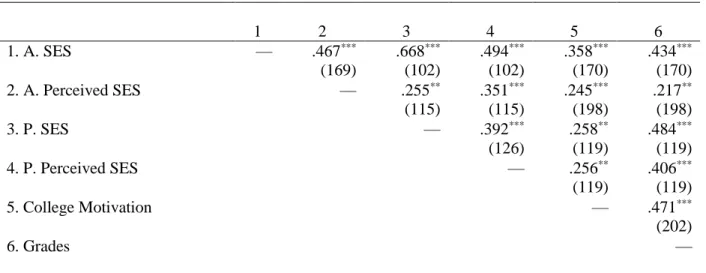
present sample, higher SES was associated with greater college motivation and better grades. These results were also true for perceived SES.
Next, I examined whether adolescents currently held a paid job, and if so, how many hours they worked per week. This information was to understand the extent to which SES may detract from school achievement because of having to work after school. The data suggest that adolescents from higher SES backgrounds were more likely to work than those from lower SES backgrounds, β = .05, p = .001. For every unit increase in SES, the odds of having a job
increased by a factor of 1.06. More descriptively, of the 32 adolescents who reported having a job, 15 of them fit the highest income category (i.e., they lived with two college-educated parents who were employed full time and did not receive government assistance). Among the
Table 1. Correlations Among SES Measures, College Motivation, and Grades.
1 2 3 4 5 6
1. A. SES — .467***
(169) .668*** (102) .494*** (102) .358*** (170) .434*** (170)
2. A. Perceived SES — .255**
(115) .351*** (115) .245*** (198) .217** (198)
3. P. SES — .392***
(126)
.258**
(119)
.484***
(119)
4. P. Perceived SES — .256**
(119)
.406***
(119)
5. College Motivation — .471***
(202)
6. Grades —
Note. A = Adolescent-reported; P = Parent-reported. *p < .05; **p < .01; ***p < .001
Main Analyses
The Time Horizon Model Among Adolescents. Hypothesis 1 was that adolescents from lower socioeconomic backgrounds perceive the future as more remote. However, SES was not associated with adolescent’s time horizon, r(166) = -0.09, p = .249. This lack of association undermines the key indirect path theorized in the time horizon model, which states that
adolescents’ perceptions of the future explain, in part, SES-achievement gaps. It is also counter to previous findings in two smaller samples of children and adolescents, which found that youth from lower SES backgrounds perceived the future as more distant (Freire et al., 1980; Vuletich et al., n.d.). Hypothesis 2 stated a correlation between time horizon and temporal preferences, but this hypothesis was also not supported in this sample, r(166) = 0.02, p = .820. Adolescents who perceived the future as more distant did not exhibit a stronger preference for immediate rather than delayed rewards compared to adolescents who perceived the future as more proximal.
The third hypothesis was that temporal preferences would be associated with
opposed to smaller immediate rewards were, as predicted, significantly associated with college motivation (r(166) = 0.25, p = .001) and grades (r(166) = 0.34, p < .001). Thus, though
perceptions of time were not associated with behavioral choices for present versus future rewards, these behavioral preferences did predict academic outcomes, replicating previous research findings in educational settings (Duckworth & Seligman, 2005).
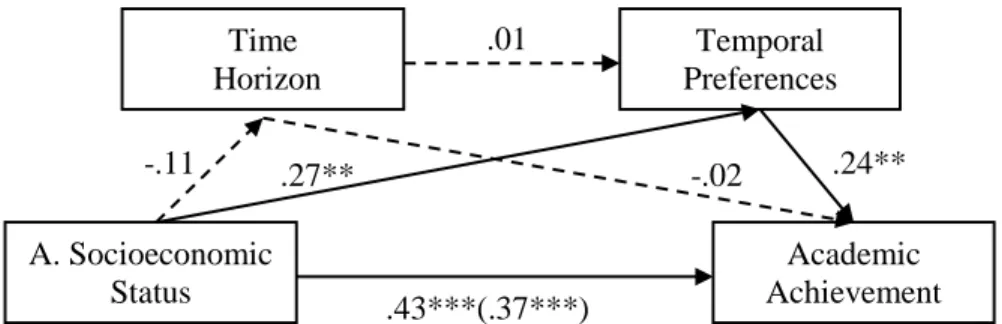
The mediation model illustrated in Figure 1 tested the indirect effect that socioeconomic status has on achievement through differences in temporal preferences. The hypothesized mediational path was from SES to achievement outcomes through adolescents’ time horizons and temporal choices (Hypothesis 4). The findings indicate that adolescent-reported SES directly relates to adolescents’ temporal preferences, bypassing time horizon (see Figure 1 for
standardized coefficients). The indirect effect of SES on academic achievement (as measured by grades) through time preferences was significant, β = .07, p = .0193. Adolescents who reported
lower SES were more likely to prefer smaller, immediate rewards as opposed to larger delayed rewards, and these preferences accounted for part of the association between lower SES and lower grades. The mediation model did not show any significant indirect effects of SES when college motivation was the outcome.
Overall, these findings suggest that adolescents from lower SES backgrounds show a behavioral present-bias that accounts, in part, for their lower academic achievement. Though these findings are correlational, they are consistent with experimental work which suggests that financial scarcity biases individuals to prefer immediate, rather than delayed, rewards at the expense of achievement outcomes (Vuletich et al., n.d.).
Figure 1. Mediation model suggesting that temporal preferences account, in part, for the positive relation
between SES and academic achievement (as measure by grades). Note: Coefficients are standardized
betas and the reduced, direct effect of SES is in parenthesis; A. = Adolescent-reported.
The Role of Parents in Adolescents’ Time Horizon and Temporal Preferences.
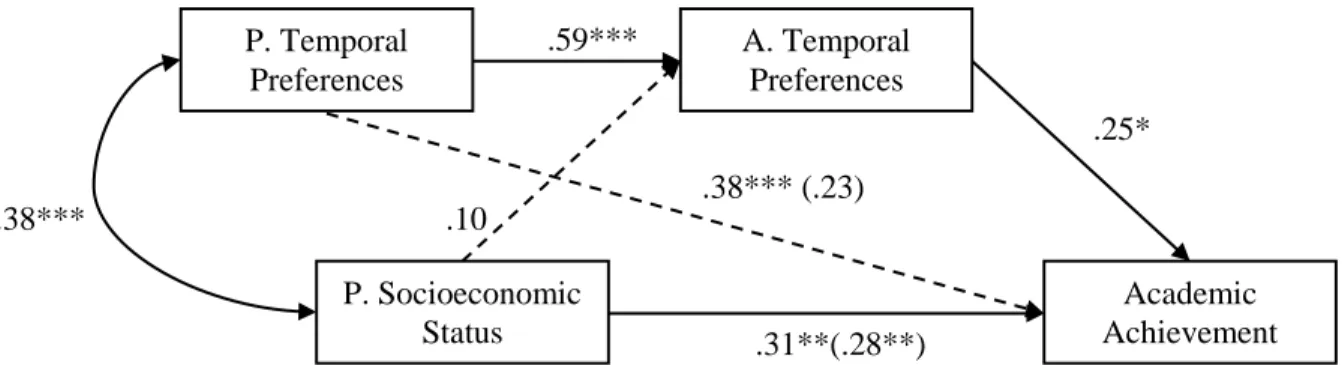
Hypothesis 5 was that adolescents’ and parents’ time horizons would be positively correlated. The data did not support this hypothesis, r(110) = 0.06, p = .510. Parents’ perceptions of the future’s distance were also not associated with their adolescents’ preferences for immediate versus delayed rewards, r(92) = -0.06, p = .562. On the other hand, the temporal preferences of parents and the temporal preferences of their adolescents were significantly and positively associated, r(82) = 0.63, p < .001. Parents and their children make similar choices between smaller, immediate rewards versus larger delayed ones. This relation was stronger than the relation between adolescents’ temporal preferences and their SES (r(145) = .27, p = .001). Hypothesis 6 stated that SES would account for unique variance in adolescents’ time horizons and temporal preferences, above and beyond the variance accounted for by parental time horizons and temporal preferences. Though time horizon was originally part of this hypothesis, I excluded it from the following analyses because only temporal preferences were significantly associated with SES, making the question about the relative effect of SES versus parents only relevant for these preferences. Figure 2 shows that SES no longer predicted
adolescents’ temporal preferences when controlling for the temporal preferences of their parents.
A. Socioeconomic Status Academic Achievement Time Horizon Temporal Preferences -.11 .01 .24** .43***(.37***)
In this model, parents’ temporal preferences, rather than SES, had a significant indirect effect on academic achievement (as measured by grades) through the temporal preferences of their
adolescents, β = .15, p = .038. This indirect effect fully mediated the relation between parents’ temporal preferences and their adolescents’ academic achievement. Parents who prioritized immediate, as opposed to delayed rewards, had children who also prioritized immediate rather than delayed rewards, and those children had lower GPA and lower grade aspirations compared children who prioritized larger, delayed rewards. Approximately 36% of the variance in high school grades was accounted for in this model. When the achievement outcome was college motivation, neither SES nor temporal choices were significant predictors.
Figure 2. Parents’ temporal preferences were more predictive of adolescents’ temporal preferences than
SES. Parents’ preferences had an indirect effect on academic achievement (as measured by grades). Note:
Coefficients are standardized betas and adjusted direct effects are in parentheses; P. = Parents’; A. =
Adolescents’.
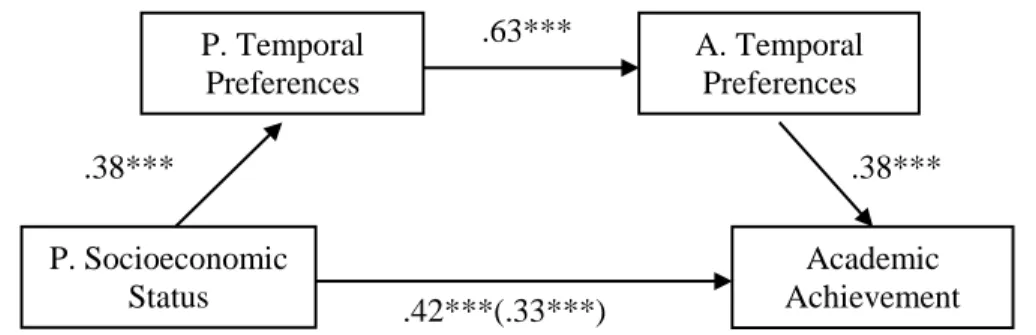
As a follow-up, I assessed the fit of a model in which SES indirectly relates to academic achievement first through the temporal preferences of parents, then through those of their adolescents, as illustrated in Figure 3. This model had good fit, indicated by a non-significant chi-square test, χ2(2) = 5.15, p = .076, and fit statistics that approximated an optimal value of 1,
P. Socioeconomic Status
Academic Achievement A. Temporal
Preferences P. Temporal
Preferences
.59***
.25*
.38*** (.23) .10
1973). The model suggests that lower SES and lower grades are associated, in part, through parental preferences for smaller, more immediate rewards that relate to their children’s similar preferences, β = .09, p = .009.
Figure 3. SES had an indirect effect on academic through parents’ temporal preferences for immediate
rather than delayed rewards, in turn associated with their adolescents’ temporal preferences. Note:
Coefficients are standardized betas and adjusted direct effects are in parentheses; P. = Parents’; A. =
Adolescents’.
The Time Horizon Model Among Parents. Among parents, the relation between SES and time horizon was as predicted. Parents who reported lower SES were more likely to rate the future as more distant, r(123) = −0.34, p < .001. Lower SES parents were also more likely to prefer smaller, immediate rewards rather than larger, delayed ones, r(100) = 0.35, p < .001. However, a mediation analysis did not lend support to Hypothesis 7 that SES would have an indirect effect on temporal preferences through parents’ time horizons, β = −0.05, p = .249. Temporal preferences and time horizons among parents were not significantly correlated, r(100) = -0.04, p = .716. These findings suggest that lower SES adults perceive the future as more distant, but these perceptions are unrelated to their preferences for immediate rather than delayed rewards. In other words, the shared variance between SES and temporal preferences
(approximately 13%) was orthogonal to the shared variance between SES and time horizon (16%).
P. Socioeconomic Status
Academic Achievement P. Temporal
Preferences
A. Temporal Preferences
.38***
.63***
.38***
The Effect of Perceived SES. Hypotheses 8 and 9 were about the relative effects of objective versus perceived SES on time horizon. I had predicted that perceived SES would be more predictive of time horizons than objective SES because the former two constructs are both subjective in nature. However, perceived SES among adolescents was not associated with their time horizon, r(192) = -0.02, p = .817. Adolescents’ perceptions of their SES were also not associated with their temporal choices, r(184) = 0.13, p = .072. Thus, contrary to hypotheses, perceived SES among adolescents did not demonstrate greater predictive validity than objective SES. In fact, it was not associated with the main constructs of interest at all.
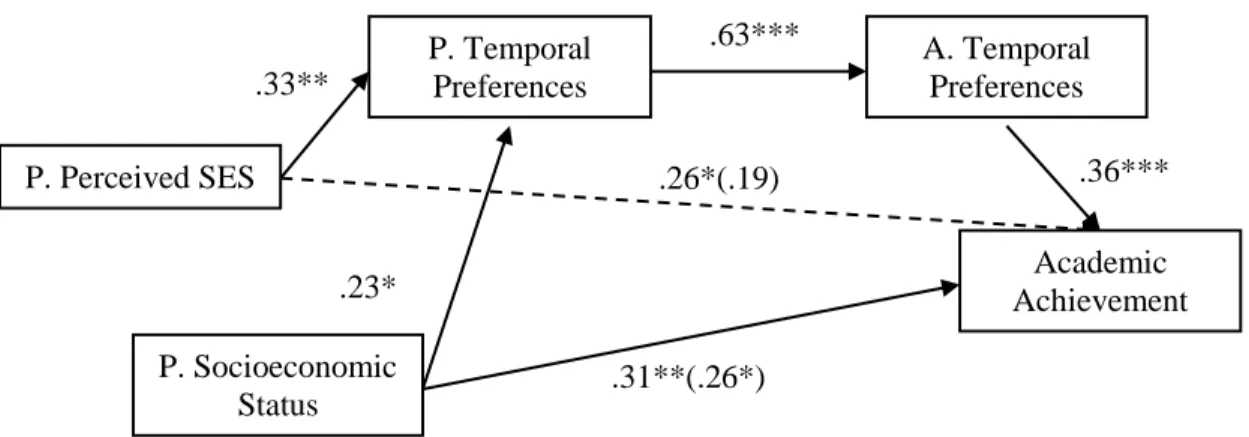
Perceived SES among parents, on the other hand, was associated with both their own temporal preferences, r(100) = 0.30, p = .002, and their adolescents’ temporal preferences, r(92) = 0.24, p = .020. Perceived SES among parents was not significantly associated with their own time horizons or their adolescents’ time horizons (both ps > .05). Figure 3 displays a model in which I tested whether perceived SES among parents predicts parents’ temporal preferences, even above and beyond objective SES, and whether perceived SES indirectly predicts
adolescents’ academic achievement through parents’ and adolescents’ temporal preferences. The results indicate that perceived SES does predict parents’ temporal preferences while adjusting for objective SES, and the indirect effect on academic achievement (as measured by grades) is significant, β = .07, p = .022. In fact, the indirect effect of objective SES on academic
Figure 4. Perceived SES is associated with parents’ temporal preferences above and beyond objective
SES, but its indirect effect on academic achievement is not significant. Note: Coefficients are
standardized betas and adjusted direct effects are in parenthesis; P. = Parents’; A. = Adolescents’. P. Socioeconomic
Status
Academic Achievement P. Temporal
Preferences
A. Temporal Preferences
.23*
.63***
.36***
.31**(.26*) P. Perceived SES
.33**
DISCUSSION
The current study examined the associations among socioeconomic status (SES),
perceptions of the future’s distance, temporal preferences for immediate versus delayed rewards, and academic achievement among a sample of adolescents (ages 14-16) and their parents. The main theoretical model postulated that conditions of financial scarcity trigger an adaptive focus on the present that makes the future appear more distant and fosters generalized preferences for immediate rather than larger, delayed rewards. These psychological adaptations to scarcity were predicted to relate to worse academic outcomes because academic success requires long-term goal pursuits. Results partly supported this model. Although socioeconomic status was not significantly related to how distant adolescents perceived the future, it was related to their temporal preferences. Adolescents from lower SES backgrounds were more likely to prefer immediate, rather than larger, delayed rewards, replicating previous findings with adult samples (for a review, see Haushofer & Fehr, 2014). These temporal preferences were, in turn, associated with lower high school grades, consistent with results from research with young children (Evans & Rosenbaum, 2008).
long-term goal means that adolescents are foregoing other more rewarding activities when they choose to engage in academic ones. In essence, doing well in school requires a tradeoff between immediate gratification and long-term goal attainment. For instance, students have to choose how to spend their limited after-school time: on homework or leisure activities. Often, they can choose how to structure their curriculum, as when choosing between an easy elective class or a more challenging core curriculum course. The results of this study suggest that adolescents who more strongly prioritize future rewards have a better GPA, higher grade aspirations, higher educational aspirations and expectations, and they also engage in more college preparatory behaviors. This preference for larger, but delayed rewards explained part of the SES-achievement gap found in the study.
The Effect of SES versus Parents on Adolescents’ Temporal Preferences
There is evidence from previous research suggesting that SES causes stronger
people secure immediate resources to meet current needs. However, though adolescents may be aware of their family’s relative economic standing and understand their basic financial situation, they are not typically responsible for meeting their own, let alone their family’s, needs.
That is exactly what I found in the current study. Adolescents demonstrated knowledge of their SES, but financial need did not determine their employment status. Adolescents were able to adequately report the educational level and employment status of their custodians as well as whether their family received government assistance, as evident by the strong correlation between their reports and those of their parents (r = .67). Their subjective perceptions of their family’s status also corresponded to those of their parents, though to a lesser extent (r = .35). Adolescents and their parents showed relative agreement regarding where they stood in the economic distribution, and on whether their family had enough money to meet their needs, struggled with money, or was “worse off” than others. Parent-child agreement on these measures suggests that adolescents are aware about the socioeconomic conditions of their family. Yet, approximately 80% of adolescents in the sample reported not having a paid job, and those who did were more likely to be from higher SES backgrounds. These data suggest that lower SES adolescents, though aware of their status, are not direct contributors to the family’s income. Nationally representative data show similar trends: adolescents from low-income families are less likely to work than adolescents from higher income families, perhaps because they have a disadvantage in finding work due to a lack of social networks and connections (Lerman, 2000). Approximately 70% of adolescents from low SES families, ages 16 and 17, do not work
Nevertheless, adolescents and their parents (or primary guardians) share a household, and any effects of SES on the adults in the household could have an indirect influence on
adolescents. This logic fits an Ecological Systems Theory perspective (Bronfenbrenner, 1986) whereby children are embedded in different levels of social systems that influence their
development. Parents constitute one of the most proximal systems to adolescents. It is through them that children are connected to other, broader systems like those linked to their parents’ occupation, income and education. These factors, though not directly part of adolescents’ daily experiences, can change the behaviors that parents model for their children, the self-regulatory skills that they impart on them, or even how well-structured they maintain the home
environment, indirectly affecting adolescent outcomes. In the current study, I found evidence that the relation between SES and adolescents’ temporal choices was no longer significant when accounting for the temporal preferences of their parents. Rather, SES was indirectly related to adolescents’ choices, and ultimately their academic achievement, through the temporal choices of their parents. Lower SES parents’ tended to prefer immediate over larger, delayed rewards, and their preferences predicted the same tendency among adolescents, resulting in lower grades. Parental and adolescent temporal preferences accounted for part of the positive relation between SES and grades. This is the first study, to the best of my knowledge, to measure delay
discounting among parent-child dyads. The findings underscore the importance of research that investigates adolescents’ temporal preferences in relation to those of their parents. Interventions that help adolescents prioritize future educational rewards may not be as effective if the
The Role of Parents in Adolescents’ Temporal Preferences
It was beyond the scope of the current study to investigate mechanisms by which parents’ time preferences are associated to those of their adolescents. Nevertheless, this is an important direction for future research. The correlation between the temporal preferences of parents and those of their adolescents was remarkably high (r = .63)—higher even than all within subject variables, some of which were theoretically related. In fact, the strength of this association was second only to adolescent and parent reports of their socioeconomic status. Yet it was parents, not SES, that more directly predicted adolescents’ temporal choices. Parents and their
adolescents were in strong relative agreement about how much money they would need to be willing to wait 3 months for a larger monetary reward.
One possibility, is that adolescents learn these behavioral tendencies from their parents through direct observation (Bandura & Mischel, 1965), socialization (Funder, Block, & Block, 1983), or guided development of self-regulation skills. For example, in a study of college students, those who reported prioritizing delayed, academic rewards over immediate
gratifications were more likely to report using self-regulatory strategies, like scheduling their study time and avoiding distracting environments (Bembenutty & Karabenick, 1998). Parents are in a unique position to confer these self-regulatory strategies to their children, helping them improve their academic performance.
It is also possible that the temporal choices of parents relate to how they structure the home environment, which in turn fosters different temporal preferences among adolescents. In lower SES households, parents are less likely to establish rituals and routines, and there tends to be more environmental stimulation (e.g., noise, crowding, foot traffic) and less physical