Both trait and state mindfulness predict lower aggressiveness
via anger rumination: A multilevel mediation analysis
Tory A. Eisenlohr-Moul, Ph.D†,
University of North Carolina at Chapel Hill
Jessica R. Peters, Ph.D,
Warren Alpert Medical School of Brown University
Richard S. Pond Jr, Ph.D, and
University of North Carolina at Wilmington
C. Nathan DeWall, Ph.D University of Kentucky
Abstract
Trait mindfulness, or the capacity for nonjudgmental, present-centered attention, predicts lower aggression in cross-sectional samples, an effect mediated by reduced anger rumination. Experimental work also implicates state mindfulness (i.e., fluctuations around one's typical mindfulness) in aggression. Despite evidence that both trait and state mindfulness predict lower aggression, their relative impact and their mechanisms remain unclear. Higher trait mindfulness and state increases in mindfulness facets may reduce aggression-related outcomes by (1) limiting the intensity of anger, or (2) limiting rumination on anger experiences. The present study tests two hypotheses: First, that both trait and state mindfulness contribute unique variance to lower aggressiveness, and second, that the impact of both trait and state mindfulness on aggressiveness will be uniquely partially mediated by both anger intensity and anger rumination. 86 participants completed trait measures of mindfulness, anger intensity, and anger rumination, then completed diaries for 35 days assessing mindfulness, anger intensity, anger rumination, anger expression, and self-reported and behavioral aggressiveness. Using multilevel zero-inflated regression, we
examined unique contributions of trait and state mindfulness facets to daily anger expression and aggressiveness. We also examined the mediating roles of anger intensity and anger rumination at both trait and state levels. Mindfulness facets predicted anger expression and aggressiveness indirectly through anger rumination after controlling for indirect pathways through anger intensity. Individuals with high or fluctuating aggression may benefit from mindfulness training to reduce both intensity of and rumination on anger.
Keywords
Aggression; Mindfulness; Anger Rumination; Anger; Anger Expression
†Corresponding Author; Present address: University of North Carolina at Chapel Hill, 2218 Nelson Highway, Suite 3, Chapel Hill, NC 27517. [email protected]. Phone: 859-317-0503. Jessica R. Peters, Alpert Medical School of Brown University, 700 Butler
HHS Public Access
Author manuscript
Mindfulness (N Y)
. Author manuscript; available in PMC 2017 June 01.Published in final edited form as:
Mindfulness (N Y). 2016 June ; 7(3): 713–726. doi:10.1007/s12671-016-0508-x.
A
uthor Man
uscr
ipt
A
uthor Man
uscr
ipt
A
uthor Man
uscr
ipt
A
uthor Man
uscr
Introduction
Mindfulness skills training, which cultivates nonjudgmental, nonreactive attention to present-moment experiences (Kabat-Zinn, 2006), shows promise as an intervention to reduce aggression (R. L. Fix & Fix, 2013; Koons et al., 2001; Lynch, Trost, Salsman, & Linehan, 2007; Robins, Keng, Ekblad, & Brantley, 2012; Singh et al., 2007; Yen, Johnson, Costello, & Simpson, 2009). To improve mindfulness-based treatments targeting aggressive outcomes, clinical scientists need more information about which specific aspects of mindfulness predict lower aggressiveness. In addition, it is important to identify the mechanisms through which mindfulness may exert these positive effects.
There are two primary pathways through which mindfulness might reduce aggressiveness. First, mindfulness may prevent aggressiveness by directly reducing the intensity of angry emotional responses. Taking a nonreactive, decentered stance towards experiences allows individuals to see potentially upsetting experiences, thoughts, and emotions as temporary events within broader contexts (Feldman, Greeson, & Senville, 2010; Sauer & Baer, 2010). This perspective may reduce the intensity of the angry emotional response and, thus, foster reflective, rather than reflexive, responding. Second, mindfulness may prevent
aggressiveness by decreasing rumination, and particularly anger rumination. Rumination is defined as uncontrollable, repetitive, unconstructive thinking about negative emotions and their causes, meanings, and consequences (Nolen-Hoeksema, 1991). Rumination on anger specifically has been shown to increase angry and aggressive behavior (Bushman, Bonacci, Pedersen, Vasquez, & Miller, 2005; Peled & Moretti, 2009) and to facilitate the formation of hostile cognitive distortions (Rusting & Nolen-Hoeksema, 1998). In contrast, remaining present-centered and nonreactive may keep individuals from engaging in these maladaptive thought cycles typically focused on past events and potential future responses. Furthermore, a nonjudgmental and accepting orientation to experience allows for the experience of angering events without the need to evaluate them, potentially reducing the impetus to ruminate. Indeed, across several studies, nonjudgment was most consistently associated with less anger rumination, with acting with awareness and nonreactivity also negatively
correlated (Moul, Peters, Chamberlain, & Rodriguez, in press; Peters, Eisenlohr-Moul, & Upton, 2013; Peters et al., 2015).
In previous work, mindfulness has been conceptualized at a variety of levels. These levels can be categorized broadly as traits—or relatively stable between-person differences in the capacity for and engagement of mindfulness processes—and states—or within-person fluctuations in the engagement of mindfulness processes that occur either as a result of intentionally using mindfulness skills (i.e., following mindfulness training) or
naturalistically (i.e., in individuals without mindfulness training). Although some writers and scientists hold the belief that mindfulness is a developed only through intensive meditation practice (Grossman & Van Dam, 2011), others begin with a conceptualization of
mindfulness as an inherent capacity present at varying levels regardless of one's meditation experience (Baer, 2014; Brown, Ryan, Loverich, & Biegel, 2011). Our conceptual
framework is more closely aligned with the latter viewpoint; we assume that these are
A
uthor Man
uscr
ipt
A
uthor Man
uscr
ipt
A
uthor Man
uscr
ipt
A
uthor Man
uscr
relatively innate human capacities that vary between people and fluctuate over time even in the absence of meditation training.
The majority of the empirical work on mindfulness and aggressive behavior uses self-report questionnaires to examine how trait-level, between-person differences in mindfulness predict aggressiveness. These studies link mindfulness facets to lower aggression, as well as lower anger intensity and anger rumination. One study utilized the Mindful Attentional Awareness Scale (Brown & Ryan, 2003), a unidimensional measure of mindfulness that assesses present-centered attention and awareness. Attentional awareness predicted lower anger, hostility, and aggression, and this association was partially accounted for by general rumination in both undergraduates and community meditators (Borders, Earleywine, & Jajodia, 2010). In contrast, a recent study of daily anger episodes found that the Accept without Judgment subscale of the Kentucky Inventory of Mindfulness Skills (now part of the Nonjudging subscale of the Five Facet Mindfulness Questionnaire) was associated with lower anger, difficulties controlling anger, and regret, but also found that Acting with Awareness was not associated with anger or aggressive responses (Kashdan, Goodman, Mallard, & DeWall, 2015). Another study used the Five Facet Mindfulness Questionnaire (FFMQ) (Baer, Smith, Hopkins, Krietemeyer, & Toney, 2006), a multidimensional measure of mindfulness. Nonjudging, acting with awareness, and nonreactivity all predicted lower aggressiveness. Nonjudging demonstrated the strongest protective associations, mediated by anger rumination (Peters et al., 2015). Therefore, preliminary evidence links mindfulness to aggressiveness via rumination (especially anger rumination); however, a failure to control for anger intensity is a central limitation of these studies.
In addition to stable individual differences, mindfulness facets also demonstrate significant state-level, within-person variability. The reliability and validity of this within-person variability in mindfulness processes have been demonstrated both in the context of
mindfulness training (Kiken, Garland, Bluth, Palsson, & Gaylord, 2015) and in longitudinal studies not involving treatment (Brown & Ryan, 2003; Eisenlohr-Moul et al., in press). Evidence from treatment studies demonstrates that within-person variance in mindfulness processes predict reduced anger and aggression (see Fix & Fix, 2013, for review). Although no longitudinal studies have examined state mindfulness and aggression, one study
demonstrates that within-person fluctuations in mindfulness are relevant to clinically-relevant interpersonal problems, which may serve as a rough proxy for aggressiveness (Eisenlohr-Moul et al., in press). In this study, state increases in the nonjudging facet of mindfulness predicted lower same-day scores on a measure of interpersonal problems, over and above the influence of trait mindfulness. While acting with awareness and nonreactivity exerted protective effects only at the trait level, nonjudgment exerted protective effects of a similar size at both the trait and state levels. Although there may be a unique role for state mindfulness in predicting angry behaviors that may undermine interpersonal relationships, Eisenlohr-Moul et al. (in press) did not directly measure anger expression or aggressiveness; therefore, more work is needed to examine the predictive validity of state mindfulness for aggressiveness.
The present study uses daily assessments to explore the predictive validity of trait and state variance in three mindfulness facets previously linked to anger and aggression (acting with
A
uthor Man
uscr
ipt
A
uthor Man
uscr
ipt
A
uthor Man
uscr
ipt
A
uthor Man
uscr
awareness, nonjudging, and nonreactivity). We also examine indirect pathways from mindfulness to aggressiveness via both anger intensity and anger rumination. We measured daily aggressiveness using daily self-reported verbal and physical aggression inclinations, self-reported anger expression, and an aggression task. Because previous work has demonstrated gender differences in the effects of mindfulness on aggressiveness (Peters et al., 2015), we also explored gender as a moderator of the effects of mindfulness. We hypothesized that trait acting with awareness, nonjudging, and nonreactivity will predict lower aggressiveness, and that state fluctuations in nonjudging will predict aggressiveness over and above trait mindfulness facets and fluctuations in other facets. We predict that effects of mindfulness on aggressiveness will be mediated by anger intensity and rumination.
Method
ParticipantsParticipants were 86 students attending a large Southeastern university. Participants presented to the laboratory as 43 unmarried heterosexual couples as part of a larger study. The average age was 19.66 years (SD = 2.82). The racial composition of the sample was as follows: 74% of participants were Caucasian, 18% were African American, 1% were Hispanic, 3% were Asian, and 4% identified as “Other”. The average relationship length was 17.61 months (SD = 20.46).
Procedure
The data collected for this study are part of a larger investigation regarding self-control and intimate partner aggression. Participants were recruited from a pool of undergraduate students. At the beginning of the study, participants came to the laboratory with their partner and completed trait measures. Participants then completed daily online measures (emailed daily) for 35 days between the hours of 4:00 PM and 1:00 AM. Following the daily diary portion of the study, couples returned to the laboratory to be debriefed and compensated with course credit and $50. All procedures performed were in accordance with the ethical standards of the local institutional research ethics committee and with the 1964 Helsinki declaration and its later amendments. Informed consent was obtained from all individual participants.
Measures
Trait Mindfulness—Participants completed the Five-Facet Mindfulness Questionnaire (FFMQ; Baer, Smith, Hopkins, Krietemeyer, & Toney, 2006), which captures five aspects of mindfulness. Only three subscales previously associated with anger and aggression were included: acting with awareness, or the tendency to attend to ongoing activity and avoid automatic pilot (example: “When I do things, my mind wanders off and I am easily
distracted”, reverse scored), nonjudging of inner experiences, or the tendency to accept one's inner state rather than judging thoughts and emotions as good or bad (example: “I tell myself I shouldn't be feeling the way I'm feeling”, reverse scored), and nonreactivity to inner experiences, or the tendency to allow provocative stimuli to come and go without necessarily reacting to them (example: “When I have distressing thoughts or images, I am able just to notice them without reacting”). For each item, participants rate themselves from 1 (never or
A
uthor Man
uscr
ipt
A
uthor Man
uscr
ipt
A
uthor Man
uscr
ipt
A
uthor Man
uscr
very rarely true) to 5 (very often or always true). Each subscale was created to reflect
average item responses. Internal consistency was excellent (acting with awareness α = .94;
nonjudging α = .96; nonreactivity α = .94). Means and standard deviations were similar to
those found in previous student samples (acting with awareness M = 3.81, SD = .68; nonjudging M = 3.62, SD = .61, nonreactivity M = 3.27, SD = .52).
Trait Anger Intensity—Participants completed two items (“Irritable” and “Hostile”) from the trait version of the Positive and Negative Affect Schedule (PANAS) (Watson & Clark, 1994) that captured the tendency to experience anger. Participants are asked to indicate the degree to which each item describes them generally on a scale from 1 (very slightly or not at all) to 5 (extremely). The anger variable was created to reflect average item
response. Reliability for this subscale was good (α = .84); the mean was 2.07 and the
standard deviation was .54. Although several other trait measures of anger are more widely used, this well-validated, affectively-focused measure was selected in order to maximize construct clarity and reduce criterion contamination with our outcomes.
Trait Anger Rumination—The Angry Rumination subscale of the Displaced
Aggression Questionnaire (DAQ) (Denson, Pedersen, & Miller, 2006) measured trait Anger Rumination. This is a 10-item measure of the tendency to ruminate on angry experiences (example: “I often find myself thinking over and over about things that have made me angry.”) Participants rated the extent to which each item was characteristic of them on a scale from 1 (extremely uncharacteristic of me) to 7 (extremely characteristic of me). The anger rumination variable was created to reflect average item response. Internal consistency
in the present sample was excellent (α = .97); the mean was 3.81 and the standard deviation
was .68.
Daily Mindfulness—Each evening, participants completed two items from each of the relevant FFMQ subscales (acting with awareness, nonjudging, and nonreactivity; Baer et al., 2006). Daily items were selected on the basis of their prototypicality and high item-total correlations (Smith, Combs, & Pearson, 2012). For acting with awareness, specific items were “I found myself doing things without paying attention to them” (reverse scored) and “I rushed through activities without really being attentive to them” (reverse scored). For nonjudging, specific items were “I thought some of my emotions were bad and inappropriate and that I shouldn't feel them” (reverse scored) and “I made judgments about whether my thoughts were good or bad” (reverse scored). For nonreactivity, specific items were “When I had distressing thoughts or images, I was able just to notice them without reacting” and “I perceived my feelings and emotions without having to react to them”. This same set of items has been found to provide reliable indices of within-person change in mindfulness, and subscales demonstrated expected within-person associations of mindfulness facets with weekly expression of psychopathology (Eisenlohr-Moul et al., in press). Daily mindfulness variables were created to reflect the average response to items in each subscale. Reliability analyses based on Cranford and colleagues (Cranford, 2006) demonstrated that mindfulness
facets reliably captured change in mindfulness facets (RC = .75-.81). State mindfulness is
defined as the daily deviation from one's average daily level of mindfulness—that is, the extent to which one is currently more or less mindful than is typical for them.
A
uthor Man
uscr
ipt
A
uthor Man
uscr
ipt
A
uthor Man
uscr
ipt
A
uthor Man
uscr
Daily Anger Intensity—Daily anger intensity was measured using the same two PANAS items described above (“Hostile” and “Irritable”). Items were changed to reflect daily anger. Participants rated their daily feelings on a scale from 0 (very slightly or not at all today) to 5 (extremely today). The daily anger variable was created to reflect the average response to the two items. Reliability analyses demonstrated that these items reliably
captured change in anger (RC = .84). As described below, state anger is defined as the daily
deviation from one's average daily level of anger intensity.
Daily Anger Rumination—Daily anger rumination was assessed using 3 prototypical items with high item-total correlations selected from the Angry Rumination subscale of the Displaced Aggression Questionnaire (Denson, Pederson, & Miller, 2006), modified to reflect daily anger rumination. Items included, “I kept thinking about events that angered me for a long time”, “I got ‘worked up’ just thinking about things that have upset me in the past”, and “I found myself thinking over and over about things that have made me angry in the past.” Participants rated items from 0 (extremely uncharacteristic of me today) to 6 (extremely characteristic of me today). The daily variable was created to reflect the average response to the three items. Reliability analyses demonstrated that these items reliably
captured change (RC = .92). State anger rumination is defined as the daily deviation from
one's average anger rumination.
Daily Self-Reported Anger Expression—Daily anger expression was measured with the Anger Out subscale of the State-Trait Anger Expression Inventory (STAXI; Spielberger & Reheiser, 2004). The 8-item Anger-Out scale measures the degree to which anger is behaviorally expressed (example: “Today, I argued with others”). Items were modified to reflect daily levels. Participants rated each item on a scale from 0 (almost always today) to 3 (almost never today). The variable was created to reflect the average response to the eight
items. Reliability analyses demonstrated that these items reliably captured change (RC = .
79).
Daily Self-Reported Aggression Inclinations—Daily verbal and physical aggression inclinations were measured using two highly prototypical items from the Physical and Verbal Aggression subscales of the Aggression Questionnaire (AQ) (Buss & Perry, 1992). Items included, “Given enough provocation, I might hit another person today” (Physical), “If I had to resort to violence to protect my rights today, I would” (Physical), “Today, my friends would say that I am somewhat argumentative” (Verbal), and “If people were annoying me today, I would tell them what I think of them” (Verbal). Items were modified to reflect daily inclinations. Participants rated each item from 0 (extremely uncharacteristic of me today) to 6 (extremely characteristic of me today). These variables reflected average responses to items in each subscale. Reliability analyses demonstrated that
these items reliably captured change in physical aggression inclinations (RC = .87) and
verbal aggression inclinations (RC = .74).
Daily Behavioral Aggression—Participants completed the voodoo doll task measure of aggression (DeWall et al., 2013). Participants were shown two pictures of the same doll: one with no pins, and one that had been stuck with 51 pins. They were instructed that this
A
uthor Man
uscr
ipt
A
uthor Man
uscr
ipt
A
uthor Man
uscr
ipt
A
uthor Man
uscr
doll represented their romantic partner and were given the opportunity to enter the number of pins that they would like to use to stab the doll (0-51). Research on magical thinking has shown that people have difficulty harming representations of liked people due to
superstitious beliefs that it could cause some harm (Rozin, Millman, & Nemeroff, 1986). Prior work has shown that participants believe that stabbing a doll representing a research confederate caused actual harm to the confederate (Pronin, Wegner, McCarthy, & Rodriguez, 2006). A recent set of studies validated the use of the voodoo doll task as a behavioral analog measure of aggression by showing that it related to actual aggression toward strangers and romantic partners, including aggression that could cause serious physical injury (DeWall et al., 2013).
Data Analyses
On average, participants provided 29.36 diaries (SD = 5.46) out of 35 possible diaries. Therefore, the number of observations at the daily level was 2,523.
Multilevel modeling—All variables exhibited moderate intraclass correlations (see Table 1), indicating significant clustering of data. Therefore, data were analyzed using multilevel models in Mplus 6.12 to account for clustering of data at both the couple and the person level, with couples at level 3, people at level 2 (i.e., the trait level), and diaries at level 1 (i.e., the daily or state level). Trait predictors were measured at a single time point at the beginning of the study. State predictors were generated using the daily diary data by person-centering each daily score to isolate the within-person component (e.g., [today's anger rumination score] – [person's average anger rumination score across all e-diaries]) such that state scores on these variables reflect deviations from one's own person-mean for each predictor variable, with positive values reflecting higher-than-usual scores for that individual and negative values reflecting lower-than-usual scores for that individual (Singer & Willett, 2003). All continuous between-person predictors were standardized to M = 0 and SD = 1. Initial null models (i.e., models with no predictors) for each variable allowed for the calculation of intraclass correlation coefficients (ICCs). In addition, they were used to estimate null model intercepts as a proxy for sample means (see Table 1; see Singer & Willett, 2003). Table 1 also lists within-person reliabilities for each measure estimated using PROC VARCOMP in SAS 9.3 (Cranford et al., 2006). All reliabilities for the measurement of change were adequate to excellent in the present study.
Zero-inflated Poisson modeling—Variables were screened for distributional normality (Tabachnick & Fidell, 2001). Because aggressiveness is relatively rare on a day-to-day basis, inspection of the distributional properties of our outcome variable revealed that it was extremely positively skewed. Furthermore, there were excessive zeroes (e.g., reports of no anger expression) that went beyond the expected frequency under the Poisson law, referred to as excessive zero-inflation. This suggests the need to model simultaneous, separate processes contributing 1) to this excess zero-inflation and 2) to the remaining continuous distribution. Fit indices (AIC, -2 log likelihood) for multilevel models specifying either a zero-inflated negative binomial (ZINB) or zero-inflated Poisson (ZIP) distribution for the dependent variable were inspected in Mplus 6.12. Model fit was improved in ZIP models compared with ZINB models in each case.
A
uthor Man
uscr
ipt
A
uthor Man
uscr
ipt
A
uthor Man
uscr
ipt
A
uthor Man
uscr
Therefore, multilevel zero-inflated Poisson regression was utilized in Mplus 6.12 to test the following models: (1) “A” paths from trait and state (daily) mindfulness to anger intensity and anger rumination (i.e., focal predictors predicting potential mediators), (2) “C” paths from trait and state mindfulness to aggressiveness outcomes (i.e., focal predictors predicting outcomes) (3) “B/C'” paths from trait and state mindfulness facets, trait and state anger rumination, and trait and state anger intensity to aggression outcomes (both focal predictors and mediators predicting aggression outcomes; see (Baron & Kenny, 1986) for discussion of paths). Standardized effects were estimated using the STDYX command in Mplus;
significance tests were based on results of raw models. Past research suggests gender may be a factor in the relations between mindfulness, anger rumination, and aggression (Peters et al., 2015); therefore, we included gender in all models, and examined the moderating impact of gender.
Multilevel ZIP models estimate a dependent variable simultaneously using a Poisson distribution and a logistic inflation factor accounting for the extent of zero-inflation; further, they execute this two-pronged approach at both the between-person (i.e., trait, level 2) and the within-person (i.e., daily, level 1) levels. All predictors were included in both portions of the ZIP model, at both between- and within-person levels, with the exception of gender which can only be modeled as a between-person variable. For the Poisson portion of the model, regression coefficients represent the impact of a one-standard deviation increase in that independent variable, if all other variables and the inflation factor are held constant, on the degree of the dependent variable. For the zero-inflated portion of the model, estimates have been reversed so as to be consistent in direction with the Poisson portion of the model; therefore, positive numbers indicate a lower probability of contributing to zero-inflation (which can be roughly interpreted to as a greater probability of angry outcomes on any given day).
Results
Predicting daily aggressiveness from trait and state mindfulness
The first set of models predicted daily aggressiveness from trait mindfulness facets (an individual's average acting with awareness, nonjudging, and nonreactivity) as well as state mindfulness facets (daily fluctuations around one's mean). Standardized estimates as well as estimated percent change in the outcome per one standard deviation increase in the predictor are provided in Tables 2 and 3 (see “Model 1” columns). With few exceptions, both acting with awareness and nonjudging predicted lower aggressiveness across outcomes at both the trait and state levels. Nonreactivity was a significant predictor of Physical Aggression Inclinations and VDT Pin Count at both the trait and state levels. Gender was not a significant moderator (all p's > .20).
Predicting daily anger and anger rumination from trait and state mindfulness
The second set of models predicted daily anger intensity and anger rumination from the same set of predictors. Standardized estimates and estimated percent change per standard deviation increase in the predictor are provided in Table 4. In the model predicting Anger Intensity, all three trait mindfulness facets predicted lower anger, and state acting with
A
uthor Man
uscr
ipt
A
uthor Man
uscr
ipt
A
uthor Man
uscr
ipt
A
uthor Man
uscr
awareness and nonjudging predicted lower anger. In the model predicting Anger Rumination, trait acting with awareness predicted lower levels, and state acting with awareness and nonjudging predicted levels.
Female gender was associated with lower average Anger Rumination at the between-person level. Models exploring gender moderation of mindfulness effects on outcomes revealed that, although the effects of mindfulness facets on Anger Intensity and Anger Rumination did not differ in the continuous portion of the model, there was an additional significant pathway from nonjudging to Anger Rumination in the zero-inflated portion of the model that
was significant in women only (Interaction γ = .68, SE = .33, t = 2.07, p = .038). Follow-up
analyses revealed that although higher state nonjudging was associated with a higher probability of contributing to zero inflation in Anger Rumination in women (i.e.,
higher-than-usual nonjudging associated with lower Anger Rumination; γ = -.52, SE = .25, t = 2.08,
p = .035), state nonjudging was not associated with probability of contributing to
zero-inflation in Anger Rumination in men (γ = .15, SE = .16, t = -.94, p = .64). In sum, although
higher-than-usual nonjudging was associated with lower Anger Intensity and Anger Rumination in both men and women (i.e., in the continuous portion of the model), among women only there was an additional pathway in which higher-than-usual nonjudging was also associated with a higher probability of contributing to zero-inflation in anger rumination (which can be roughly translated to mean no rumination at all on a given day).
Predicting daily aggressiveness from mindfulness and mediating constructs
The third set of models predicted daily aggressiveness from anger intensity, anger
rumination, and mindfulness. Standardized estimates as well as estimated percent change per one standard deviation increase in the predictor are provided in Tables 2 and 3. Both Anger Intensity and Anger Rumination were robust predictors of most aggressiveness outcomes at both levels. For all outcomes, there were no longer any significant effects of acting with awareness or nonjudging at either the between- or within-person level after the addition of Anger Intensity and Anger Rumination as predictors. Notably, trait and state direct effects of nonreactivity on aggressiveness (i.e., leftover effect of nonreactivity on outcomes not accounted for by mediators) remained after controlling for Anger Intensity and Anger Rumination. At the trait level, higher trait nonreactivity was associated with lower Verbal and Physical Aggression Inclinations, and VDT Pin Count. At the state level, deviations in nonreactivity were associated with Physical Aggression Inclinations and VDT Pin Count. An additional direct effect of acting with awareness on VDT Pin Count remained at the between-person level.
With regard to gender effects, female gender was associated with lower average Physical and Verbal Aggression Inclinations. Gender also moderated the effect of state nonjudging on
STAXI Anger Out (Interaction γ in the continuous portion of the model = -.17, SE = .086, t
= -1.97, p = .048). Follow-up analyses revealed that although higher state nonjudging was
associated with lower anger expression in women (γ = -.16, SE = .066, t = -2.53, p = .011),
state nonjudging did not significantly predict anger expression in men (γ = .005, SE = .056, t
= -.091, p = .92). Therefore, higher-than-usual nonjudging appeared to protect against anger expression among women only.
A
uthor Man
uscr
ipt
A
uthor Man
uscr
ipt
A
uthor Man
uscr
ipt
A
uthor Man
uscr
Indirect effects of mindfulness facets on aggressiveness
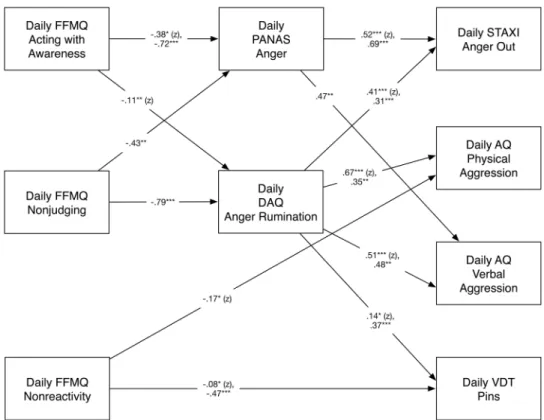
Figures 1 and 2 depict significant pathways from mindfulness facets to hypothesized mediators (Anger Intensity and Anger Rumination), significant pathways from hypothesized mediators to outcomes (STAXI Anger Out, Physical and Verbal Aggression Inclinations, and VDT Pin Count), and significant direct pathways from mindfulness facets to outcomes (i.e., significant paths when controlling for hypothesized mediators). Viable indirect pathways from mindfulness to outcomes via hypothesized mediators are listed in Table 5. Next, 99% confidence intervals for indirect effects were estimated using the Rmediation program in R (Tofighi & MacKinnon, 2011). Results can be found in Table 5. Several significant indirect pathways were identified at both levels for both acting with awareness and nonjudging; indirect effects of nonreactivity were not significant. Because the effect of state nonjudging on STAXI Anger Out was significant only in women, indirect effects involving these variables were examined in women only.
At the between-person level, trait acting with awareness showed indirect effects on
Aggression Inclinations via Anger Rumination. At the within-person level, state acting with awareness had indirect effects through anger intensity on STAXI Anger Out and Verbal Aggression Inclinations, and smaller indirect effects through Anger Rumination on STAXI Anger Out, Physical Aggression Inclinations, and VDT Pin Count. At the between-person level, trait nonjudging had significant indirect effects on STAXI Anger Out via Anger Intensity. At the within-person level, state nonjudging demonstrated indirect effects through Anger Intensity on STAXI Anger Out (women only) and Verbal Aggression Inclinations, and indirect effects through Anger Rumination on all outcomes.
Discussion
This study examined between- and within-person effects of three mindfulness facets (acting with awareness, nonjudging, and nonreactivity) on daily self-reported verbal and physical aggression inclinations, self-reported anger expression, and behavioral aggression, and investigated the role of anger rumination and anger intensity in mediating these effects. Overall, results are consistent with the hypotheses that mindfulness facets exert unique effects at the trait and state levels and that both anger intensity and anger rumination may partially mediate many of these positive effects. Similar to previous cross-sectional findings (Peters et al, 2015), acting with awareness, nonjudging, and, to a lesser extent, nonreactivity predicted lower aggressiveness.
Acting with awareness demonstrated a strong pattern of associations with aggressiveness. At the between-person level, trait acting with awareness demonstrated indirect effects on verbal and physical aggression inclinations via lower trait anger rumination. Individuals with greater trait attentional awareness may be buffered against aggressiveness due to their ability to stay anchored in the present moment, which may prevent them from being pulled to ruminate on anger experiences of the past or ways to retaliate in the future. At the within-person level, state acting with awareness demonstrated significant indirect effects on aggressiveness through both decreased anger intensity and anger rumination. Inspection of standardized and exponentiated coefficients revealed that the strongest indirect effects of state acting with awareness were through reduced daily anger intensity. That is, daily acting
A
uthor Man
uscr
ipt
A
uthor Man
uscr
ipt
A
uthor Man
uscr
ipt
A
uthor Man
uscr
with awareness exerted its strongest effects via reductions in angry affect. In sum, the tendency in general to be disengaged from the moment (low acting with awareness) may be a relatively stable risk factor for anger rumination, whereas fluctuations in attentional disengagement, rather than baseline levels, may increase momentary vulnerability to angry affect.
There was also a direct effect of trait acting with awareness on behavioral aggression, suggesting that the ability to attend to one's present circumstances reduces aggression in some manner not measured here. The acting with awareness facet captures, to a certain extent, individual differences in the underlying executive cognitive functions necessary for attention, switching, and inhibitory control. Therefore, these direct effects likely reflect the protective effects of these top-down cognitive processes, which may reduce aggression independent of one's tendency toward anger intensity or anger rumination. In addition, the direct effect may encompass processes such as reduced ego-involvement, or the extent to which one's self-esteem is invested in outcomes or experiences (Kernis, Paradise, & Whitaker, 2000; Heppner et al., 2008).
Nonjudging also demonstrated a strong pattern of associations with aggressiveness. Between people, trait nonjudging had indirect effects on anger expression via anger intensity. Individuals with greater trait nonjudging may be buffered against aggressiveness due to a lower tendency to judge experiences in ways that generate anger. At the daily level, Nonjudging demonstrated significant indirect effects on aggressiveness through both anger rumination and anger intensity. State nonjudging appeared to exert similar protective effects through both daily anger intensity and daily anger rumination. In sum, trait nonjudging may be linked to a more stable attitude toward the self likely to be associated with baseline experiences of anger, but day-today changes in judgmental reactivity to emotions and thoughts, rather than the existence of certain baseline judgment, may be what triggers problematic cycles of rumination on anger. Finally, although the impact of mindfulness facets on aggressiveness were generally invariant across gender, women did show stronger effects of daily fluctuations in nonjudging on anger rumination, and daily fluctuations in nonjudging were a significant predictor of daily anger expression only in women.
While nonreactivity did not demonstrate significant indirect paths through either anger rumination or anger intensity, it did exert direct protective effects on aggressiveness at both the trait and state levels. State nonreactivity directly predicted lower aggressive inclinations and behavioral aggressiveness, suggesting that daily fluctuations in nonreactivity may influence aggressiveness through mechanisms other than anger intensity or rumination. For example, shifts toward being less reactive to external provocations or to internal experiences of anger may facilitate reflective, rather than reflexive and potentially aggressive responses in anger-provoking situations. More general tendencies toward nonreactivity, reflected in the between-person analyses, were, however, related to reduced anger intensity, suggesting that on a more trait level, greater reactivity may be linked with stronger emotional responses.
Clinical Implications
The mediational pathways via reduced anger rumination and anger intensity suggest contexts in which mindfulness may be particularly useful as an intervention for aggression.
A
uthor Man
uscr
ipt
A
uthor Man
uscr
ipt
A
uthor Man
uscr
ipt
A
uthor Man
uscr
Strong emotions, such as anger, may contribute more to reactive aggression, such as intimate partner violence, than to proactive aggression (Derefinko, DeWall, Metze, Walsh, & Lynam, 2011). Mindfulness skills that increase awareness and acceptance of emotions may help prevent impulsive, aggressive responses to conflicts and stressors, whereas these skills may be less likely to prevent the commission of purposeful acts of violence. Mindfulness-based approaches may also be useful in reducing aggression in disorders characterized by anger rumination, such as borderline personality disorder (Baer & Sauer, 2011; Peters, Geiger, Smart, & Baer, 2014; Eisenlohr-Moul, Girdler, DeWall, & Segerstrom, 2015; Peters et al., under review).
The consistently protective effects of acting with awareness and nonjudging in the present study appear to further support the parallel approach to mindfulness training currently emphasized in treatments such as Dialectical Behavior Therapy (Linehan, 1993; 2014), where mindfulness “what” skills (i.e., acting with awareness) and “how” skills (i.e., nonjudging) are emphasized equally and integrated as early as possible. This is especially important given previous work demonstrating interactive effects of the acting with awareness and nonjudging facets on both anger rumination (Peters et al., 2013) and blood pressure (Tomfohr, Pung, Mills, & Edwards, 2014), a physiological parameter that has long been associated with heightened anger (Diamond, 1982). Therefore, it is likely important to target multiple dimensions of mindfulness in anger control interventions, including both attentional components (acting with awareness) and attitudinal components (nonjudgment and
nonreactivity).
The conflicting results from between- and within-person analyses also suggest that while certain effects of mindfulness appear to function as an overall protective trait, the same skills are likely protective when utilized in the moment, if potentially via different mechanisms. It may be important to emphasize this when conducting mindfulness-based interventions, given that practicing and increasing skills use in particular moments is likely a more useful, concrete, and attainable goal for many individuals than the more abstract goal of achieving a certain level of trait mindfulness.
Limitations
The present study has a number of limitations. First, the present study utilized a
undergraduate sample. Such samples can be broadly described as “westernized, educated, industrialized, rich, and democratic” (or “WEIRD”; Henrich, Heine, & Norenzayan, 2010), and these characteristics are not necessarily representative of the populations at highest risk for aggressive behavior. Second, examining the impact of mindfulness interventions on anger rumination and anger intensity would provide a more direct test of reductions in anger rumination as a mechanism of change. Third, the measure of anger intensity was very short and narrow in scope. Although we deliberately chose a measure of anger that would capture only the affective component so as to reduce criterion contamination, future work may benefit from the use of a longer scale that captures more anger-related affective content (e.g., “angry”, “frustrated”). Finally, the limitations of self-reported mindfulness (Grossman & Van Dam, 2011) and our measures of aggressiveness (DeWall et al., 2013) should be considered.
A
uthor Man
uscr
ipt
A
uthor Man
uscr
ipt
A
uthor Man
uscr
ipt
A
uthor Man
uscr
Acknowledgments
This work was supported by grants from the National Institute of Mental Health (T32MH093315; T32MH019927) and the National Science Foundation (1022615).
References
Baer RA. Assessing mindfulness in multiple contexts: A comment on Christopher, Woodrich, and Tiernan (2014). Mindfulness. 2014
Baer RA, Smith GT, Hopkins J, Krietemeyer J, Toney L. Using self-report assessment methods to explore facets of mindfulness. Assessment. 2006; 13(1):27–45. http://doi.org/
10.1177/1073191105283504. [PubMed: 16443717]
Baron RM, Kenny DA. The moderator–mediator variable distinction in social psychological research: Conceptual, strategic, and statistical considerations. Journal of personality and social psychology. 1986; 51(6):1173. [PubMed: 3806354]
Borders A, Earleywine M, Jajodia A. Could mindfulness decrease anger, hostility, and aggression by decreasing rumination? Aggressive Behavior. 2010; 36(1):28–44. http://doi.org/10.1002/ab.20327. [PubMed: 19851983]
Brown KW, Ryan RM. The benefits of being present: Mindfulness and its role in psychological well-being. Journal of Personality and Social Psychology. 2003; 84(4):822–848. http://doi.org/ 10.1037/0022-3514.84.4.822. [PubMed: 12703651]
Brown, KW.; Ryan, RM.; Loverich, TM.; Biegel, GM. Out of the armchair and into the streets: Measuring mindfulness advances knowledge and improves interventions: Reply to Grossman (2011). 2011. http://doi.org/10.1037/a0025781
Bushman BJ, Bonacci AM, Pedersen WC, Vasquez EA, Miller N. Chewing on it can chew you up: Effects of rumination on triggered displaced aggression. Journal of Personality and Social Psychology. 2005; 88(6):969–983. [PubMed: 15982116]
Buss AH, Perry M. The aggression questionnaire. Journal of Personality and Social Psychology. 1992 Cranford JA. A procedure for evaluating sensitivity to within-person change: Can mood measures in
diary studies detect change reliably? Personality and Social Psychology Bulletin. 2006; 32(7):917– 929. [PubMed: 16738025]
Denson TF, Pedersen WC, Miller N. The displaced aggression questionnaire. Journal of Personality and Social Psychology. 2006; 90(6):1032–1051. [PubMed: 16784350]
Derefinko K, DeWall CN, Metze AV, Walsh EC, Lynam DR. Do different facets of impulsivity predict different types of aggression? Aggressive behavior. 2011; 37(3):223–233. [PubMed: 21259270] DeWall CN, Finkel EJ, Lambert NM, Slotter EB, Bodenhausen GV, Pond RS, et al. The voodoo doll
task: Introducing and validating a novel method for studying aggressive inclinations. Aggressive Behavior. 2013; 39(6):419–439. [PubMed: 23878068]
Diamond EL. The role of anger and hostility in essential hypertension and coronary heart disease. Psychological Bulletin. 1982; 92(2):410–433. [PubMed: 7146235]
Eisenlohr-Moul TA, DeWall CN, Girdler SS, Segerstrom SC. Ovarian hormones and borderline personality disorder features: preliminary evidence for interactive effects of estradiol and progesterone. Biological psychology. 2015; 109:37–52. [PubMed: 25837710]
Eisenlohr-Moul TA, Peters JR, Chamberlain KD, Rodriguez MA. Weekly fluctuations in nonjudging predict borderline personality disorder feature expression in women. Journal of Psychopathology and Behavioral Assessment. in press.
Feldman G, Greeson J, Senville J. Differential effects of mindful breathing, progressive muscle relaxation, and loving-kindness meditation on decentering and negative reactions to repetitive thoughts. Behaviour Research and Therapy. 2010; 48(10):1002–1011. http://doi.org/10.1016/j.brat. 2010.06.006. [PubMed: 20633873]
Fix RL, Fix ST. The effects of mindfulness-based treatments for aggression: A critical review. Aggression and Violent Behavior. 2013; 18(2):219–227.
A
uthor Man
uscr
ipt
A
uthor Man
uscr
ipt
A
uthor Man
uscr
ipt
A
uthor Man
uscr
Grossman P, Van Dam NT. Mindfulness, by any other name…: trials and tribulations of sati in western psychology and science. Contemporary Buddhism. 2011; 12(1):219–239. http://doi.org/
10.1080/14639947.2011.564841.
Henrich J, Heine SJ, Norenzayan A. The weirdest people in the world? Behavioral and Brain Sciences. 2010; 33(2-3):61–83. [PubMed: 20550733]
Heppner WL, Kernis MH, Lakey CE, Campbell WK, Goldman BM, Davis PJ, Cascio EV. Mindfulness as a means of reducing aggressive behavior: dispositional and situational evidence. Aggressive Behavior. 2008; 34(5):486–496. [PubMed: 18464229]
Kabat-Zinn J. Mindfulness-based interventions in context: Past, present, and future. Clinical Psychology: Science and Practice. 2006; 10(2):144–156.
Kashdan TB, Goodman FR, Mallard TT, DeWall CN. What triggers anger in everyday life? Links to the intensity, control, and regulation of these emotions, and personality traits. Journal of Personality. in press.
Kernis MH, Paradise AW, Whitaker DJ, Wheatman SR, Goldman BN. Master of one's psychological domain? Not likely if one's self-esteem is unstable. Personality and Social Psychology Bulletin. 2000; 26(10):1297–1305.
Kiken LG, Garland EL, Bluth K, Palsson OS, Gaylord SA. From a state to a trait: Trajectories of state mindfulness in meditation during intervention predict changes in trait mindfulness. Personality and Individual Differences. 2015; 81:41–46. http://doi.org/10.1016/j.paid.2014.12.044. [PubMed: 25914434]
Koons C, Robins C, Lindseytweed J, Lynch T, Gonzalez A, Morse J, et al. Efficacy of dialectical behavior therapy in women veterans with borderline personality disorder*. Behavior Therapy. 2001; 32(2):371–390.
Linehan, M. Cognitive-behavioral treatment of borderline personality disorder. New York: Guilford Press; 1993.
Linehan, MM. DBT skills training manual. 2nd. New York: Guilford Press; 2014.
Lynch TR, Trost WT, Salsman N, Linehan MM. Dialectical behavior therapy for borderline personality disorder. Annual Review of Clinical Psychology. 2007; 3(1):181–205. http://doi.org/10.1146/ annurev.clinpsy.2.022305.095229.
Nolen-Hoeksema S. Responses to depression and their effects on the duration of depressive episodes. Journal of Abnormal Psychology. 1991; 100(4):569–582. [PubMed: 1757671]
Peters JR. The Rewarding Nature of Anger Rumination in Borderline Personality Disorder: An fMRI Investigation. under review.
Peled M, Moretti MM. Ruminating on rumination: Are rumination on anger and sadness differentially related to aggression and depressed mood? Journal of Psychopathology and Behavioral
Assessment. 2009; 32(1):108–117.
Peters JR, Eisenlohr-Moul TA, Upton BT, Baer RA. Nonjudgment as a moderator of the relationship between present-centered awareness and borderline features: Synergistic interactions in mindfulness assessment. Personality and Individual Differences. 2013; 55(1):24–28.
Peters JR, Geiger PJ, Smart LM, Baer RA. Shame and borderline personality features: The potential mediating role of anger and anger rumination. Personality Disorders: Theory, Research, and Treatment. 2014; 5(1):1–9.
Peters JR, Smart LM, Eisenlohr-Moul TA, Geiger PJ, Smith GT, Baer RA. Anger rumination as a mediator of the relationship between mindfulness and aggression: The utility of a
multidimensional mindfulness model. Journal of Clinical Psychology. 2015; 71(9):871–884. http:// doi.org/10.1002/jclp.22189. [PubMed: 25919798]
Pronin E, Wegner DM, McCarthy K, Rodriguez S. Everyday magical powers: the role of apparent mental causation in the overestimation of personal influence. Journal of Personality and Social Psychology. 2006; 91(2):218–231. [PubMed: 16881760]
Robins CJ, Keng SL, Ekblad AG, Brantley JG. Effects of mindfulness-based stress reduction on emotional experience and expression: a randomized controlled trial. Journal of Clinical Psychology. 2012; 68(1):117–131. [PubMed: 22144347]
A
uthor Man
uscr
ipt
A
uthor Man
uscr
ipt
A
uthor Man
uscr
ipt
A
uthor Man
uscr
Rozin P, Millman L, Nemeroff C. Operation of the laws of sympathetic magic in disgust and other domains. Journal of Personality and Social Psychology. 1986; 50(4):703–712. http://doi.org/ 10.1037/0022-3514.50.4.703.
Rusting CL, Nolen-Hoeksema S. Regulating responses to anger: Effects of rumination and distraction on angry mood. Journal of Personality and Social Psychology. 1998; 74(3):790–803. [PubMed: 9523420]
Sauer S, Baer RA. Mindfulness and decentering as mechanisms of change in mindfulness-and acceptance-based interventions. Assessing Mindfulness and Acceptance Processes in Clients: Illuminating the Theory and Practice of Change. 2010:25–50.
Singer, JD.; Willett, JB. Applied longitudinal data analysis: Modeling change and event occurrence. Oxford university press; 2003.
Singh NN, Lancioni GE, Winton ASW, Adkins AD, Wahler RG, Sabaawi M, Singh J. Individuals with mental illness can control their aggressive behavior through mindfulness training. Behavior Modification. 2007; 31(3):313–328. [PubMed: 17438345]
Smith, GT.; Combs, JL.; Pearson, CM. APA handbook of research methods in psychology, Vol 1: Foundations, planning, measures, and psychometrics. Washington: American Psychological Association; 2012. Brief instruments and short forms; p. 395-409.http://doi.org/
10.1037/13619-021
Spielberger, CD.; Reheiser, EC. Measuring anxiety, anger, depression, and curiosity as emotional states and personality traits with the STAI, STAXI, and STPI. In: Hersen, M.; Segal, DL.; Hilsenroth, M., editors. Comprehensive Handbook of Psychological Assessment: Personality Assessment. New York: Wiley; 2004. p. 74-80.
Tabachnick, BG.; Fidell, LS. Using multivariate statistics. New York: Harper & Row; 2001. Tofighi D, MacKinnon DP. RMediation: an R package for mediation analysis confidence intervals.
Behavior Research Methods. 2011; 43(3):692–700. [PubMed: 21487904]
Tomfohr LM, Pung MA, Mills PJ, Edwards K. Trait mindfulness is associated with blood pressure and interleukin-6: exploring interactions among subscales of the Five Facet Mindfulness Questionnaire to better understand relationships between mindfulness and health. Journal of Behavioral
Medicine. 2014; 38(1):28–38. http://doi.org/10.1007/s10865-014-9575-4. [PubMed: 24888477] Watson, D.; Clark, LA. Unpublished manuscript. University of Iowa; 1994. The PANAS-X: Manual
for the Positive and Negative Affect Schedule-Expanded Form.
Yen S, Johnson J, Costello E, Simpson EB. A 5-day dialectical behavior therapy partial hospital program for women with borderline personality disorder: predictors of outcome from a 3-month follow-up study. Journal of Psychiatric Practice. 2009; 15(3):173–182. http://doi.org/
10.1097/01.pra.0000351877.45260.70. [PubMed: 19461390]
A
uthor Man
uscr
ipt
A
uthor Man
uscr
ipt
A
uthor Man
uscr
ipt
A
uthor Man
uscr
Fig. 1. Depiction of Significant Within-Person Effects (from Multilevel Zero-Inflated Poisson Models) of FFMQ Mindfulness Facets on Daily Aggressiveness via Anger Intensity and Anger Rumination
Figure 1 Note. “(z)” refers to significant zeromodel effects. For the zero-inflated estimates, positive estimates indicate higher values of the outcome, and negative estimates indicate lower values of the outcome.
A
uthor Man
uscr
ipt
A
uthor Man
uscr
ipt
A
uthor Man
uscr
ipt
A
uthor Man
uscr
Fig. 2. Depiction of Significant Between-Person Effects (from Multilevel Zero-Inflated Poisson Models) of FFMQ Mindfulness Facets on Trait (Average) Aggressiveness via Anger Intensity and Anger Rumination
Figure 2 Note. “(z)” refers to significant zeromodel effects. For the zero-inflated estimates, positive estimates indicate higher values of the outcome, and negative estimates indicate lower values of the outcome.
A
uthor Man
uscr
ipt
A
uthor Man
uscr
ipt
A
uthor Man
uscr
ipt
A
uthor Man
uscr
A
uthor Man
uscr
ipt
A
uthor Man
uscr
ipt
A
uthor Man
uscr
ipt
A
uthor Man
uscr
ipt
Table 1
Null Model Intercepts and Intraclass Correlation Coefficients
Variable Null Model Intercept (SE)* Reliability of Change Within Person (R
C)
ICC (Person-Level)
Daily FFMQ Acting with Awareness 3.04 (.13) .75 .56
Daily FFMQ Nonjudging 3.26 (.16) .81 .56
Daily FFMQ Nonreactivity 2.78 (.94) .76 .46
Daily DAQ Anger Rumination 1.19 (1.35) .92 .38
Daily PANAS Anger 1.07 (1.40) .84 .65
Daily STAXI Anger Out 2.19 (1.89) .79 .58
Daily AQ Physical Aggression Inclinations 2.03 (1.14) .87 .56
Daily AQ Verbal Aggression Inclinations 2.89 (2.39) .74 .60
Daily VDT Pins 1.37 (1.74) N/A .72
Note. ICC = Intraclass Correlation Coefficient. SE = Standard Error. FFMQ = Five Facet Mindfulness Questionnaire. DAQ = Displaced Aggression Questionnaire. PANAS = Positive and Negative Affect Schedule. STAXI = State Trait Anger Expression Inventory. VDT = Voodoo Doll
Aggression Task.
*
A
uthor Man
uscr
ipt
A
uthor Man
uscr
ipt
A
uthor Man
uscr
ipt
A
uthor Man
uscr
ipt
Table 2
Multilevel Zero-Inflated Poisson Models Predicting Daily Aggression-Related Outcomes
Dependent Variable Anger Expression γ (SE) [%Δ] Physical Aggression Inclinations γ (SE) [%Δ]
Model 1 Model 2 Model 1 Model 2
Fixed Effects
Within-Person Model (Level 1)
Zero-Inflated Portion
Intercept (Zero-Inflated Model) -3.01 (2.31) -.54 (.34) -2.59** (.90) -1.19 (.93)
Daily Acting with Awareness -.11** (.04) [-10%] -.04 (.04) -.43* (.21) [-35%] -.15 (.15)
Daily Nonjudging -.23** (.07) 21%] -.07 (.05) -.25* (.12) [-22%] -.21 (.11)
Daily Nonreactivity .07 (.05) .04 (.04) -.14* (.06) [-13%] -.17** (.05) [-16%]
Daily Anger Intensity .52** (.19) [+68%] .09 (.08)
Daily Anger Rumination .41*** (.08) [+51%] .67*** (.17) [+95%]
Continuous Portion
Intercept (Continuous Model) .23 (.22) .07 (.32) .57** (.18) .14 (.62)
Daily Acting with Awareness -.15 (.23) .08 (.10) -.58* (.29) [-44%] -.57 (.32)
Daily Nonjudging -.70*** (.22) [-50%] -.13 (.12) -.60** (.26) [-45%] -.25 (.49)
Daily Nonreactivity -.19 (.32) -.18 (.15) .05 (.45) -.01 (.42)
Daily Anger Intensity .69*** (.08) [+99%] .27 (.50)
Daily Anger Rumination .31*** (.07) [+36%] .35** (.12) [+42%]
Between-Person Model (Level 2)
Zero-Inflated Portion
Intercept (Zero-Inflated Model) -3.01 (2.31) -.54 (.34) -2.59** (.90) -1.19 (.93)
Female -.08 (.53) .08 (.09) -.18 (.32) -.25** (.08) [-22%]
Trait Acting with Awareness -.17 (.41) .11 (.12) -.18 (.39) -.20 (.17)
Trait Nonjudging -.22 (.62) .20 (.14) -.51** (.19) [-40%] -.10 (.13)
Trait Nonreactivity -.67 (.47) -.04 (.08) -.84*** (.16) [-57%] -.34* (.16) [-29%]
Daily Anger Intensity .91*** (.07) [+148%] .41 (.36)
Daily Anger Rumination .10 (.12) .82*** (.11) [+127%]
Continuous Portion
Intercept (Continuous Model) .23 (.22) .07 (.32) .57** (.18) .14 (.62)
Female .06 (.11) .12 (.07) -.28** (.10) [-24%] -.28** (.10) [-24%]
Trait Acting with Awareness -.34** (.11) [-29%] -.13 (.09) -.14 (.12) -.08 (.13)
Trait Nonjudging -.18* (.09) -16%] -.08 (.11) -.08 (.11) .004 (.13)
Trait Nonreactivity .05 (.11) .15 (.09) .02 (.10) .04 (.11)
Daily Anger Intensity .61*** (.07) [+84%] .04 (.10)
A
uthor Man
uscr
ipt
A
uthor Man
uscr
ipt
A
uthor Man
uscr
ipt
A
uthor Man
uscr
ipt
Dependent Variable Anger Expression γ (SE) [%Δ] Physical Aggression Inclinations γ (SE) [%Δ]
Model 1 Model 2 Model 1 Model 2
Additional Model Information
Residual Variance 5902.52 5109.60 5774.66 5348.82
-2* log likelihood -3.01 (2.31) -.54 (.34) -2.59** (.90) -1.19 (.93)
Note.
* p< .05;
** p < .01;
*** p < .001.
A
uthor Man
uscr
ipt
A
uthor Man
uscr
ipt
A
uthor Man
uscr
ipt
A
uthor Man
uscr
ipt
Table 3
Multilevel Zero-Inflated Poisson Models Predicting Daily Aggression-Related Outcomes
Dependent Variable Verbal Aggression Inclinations γ (SE) [%Δ] Behavioral Aggression (Pins) γ (SE) [%Δ]
Model 1 Model 2 Model 1 Model 2
Fixed Effects
Within-Person Model (Level 1)
Zero-Inflated Portion
Intercept (Zero-Inflated Model) -2.40** (.20) -.42** (.16) .51 (.45) .68 (1.10)
Daily Acting with Awareness -.06 (.04) .001 (.04) -.10* (.04) [-10%] -.09 (.05)
Daily Nonjudging -.15 (.12) .15 (.09) .06 (.02) .10 (.06)
Daily Nonreactivity .05 (.20) .03 (.12) -.08** (.02) [-8%] -.08* (.03) [-7%]
Daily Anger Intensity .01 (.16) .07 (.07)
Daily Anger Rumination .51* (.22) [+67%] .14** (.04) [+15%]
Continuous Portion
Intercept (Continuous Model) .37* (.17) -.22 (.29) -.60*** (.18) -1.18** (.36)
Daily Acting with Awareness -.51* (.23) [-40%] -.10 (.16) -.43 (.65) -.76 (.40) Daily Nonjudging -.63** (.24) [-47%] -.37 (.25) -.06 (.93) -.66 (.69)
Daily Nonreactivity .25 (.19) .32 (.21) -.32 (.77) -.47** (.18) [-38%]
Daily Anger Intensity .47*** (.12) [+60%] .11 (.49)
Daily Anger Rumination .48*** (.13) [+61%] .37** (.12) [+46%]
Between-Person Model (Level 2)
Zero-Inflated Portion
Intercept (Zero-Inflated Model) -2.40** (.20) -.42** (.16) .51 (.45) .68 (1.10)
Female -.99*** (.04) [-63%] -.48*** (.08) [-38%] -.05 (.12) .03 (.21)
Trait Acting with Awareness -.22** (.07) [-20%] -.06 (.11) -.35** (.10) [-30%] -.75** (.19) [-53%]
Trait Nonjudging .03 (.02) .43 (.28) -.01 (.18) .04 (.29)
Trait Nonreactivity -.08*** (.01) [-8%] -.18** (.07) [-16%] .43 (.25) .44 (.24)
Daily Anger Intensity .35 (.29) .45 (.29)
Daily Anger Rumination .73*** (.09) [+108%] .08 (.39)
Continuous Portion
Intercept (Continuous Model) .37* (.17) -.22 (.29) -.60*** (.18) -1.18** (.36)
Female -.16 (.10) -.17 (.10) -.07 (.12) -.13 (.14)
Trait Acting with Awareness -.26** (.10) [-23%] -.16 (.11) -.13 (.12) .02 (.14)
Trait Nonjudging .005 (.11) .16 (.12) -.02 (.13) .05 (.19)
Trait Nonreactivity -.07 (.11) -.03 (.11) -.25** (.10) [-22%] -.27* (.10) [-24%]
Daily Anger Intensity .17 (.09) .05 (.16)
Daily Anger Rumination .53*** (.13) [+70%] .81*** (.19) [+125%]
A
uthor Man
uscr
ipt
A
uthor Man
uscr
ipt
A
uthor Man
uscr
ipt
A
uthor Man
uscr
ipt
Dependent Variable Verbal Aggression Inclinations γ (SE) [%Δ] Behavioral Aggression (Pins) γ (SE) [%Δ]
Model 1 Model 2 Model 1 Model 2
Residual Variance .87*** (.06) .75*** (.09) .90*** (.08) .81*** (.11)
-2* log likelihood 5250.73 4884.50 3501.52 2954.16
Note.
* p < .05;
** p < .01;
*** p < .001.
A
uthor Man
uscr
ipt
A
uthor Man
uscr
ipt
A
uthor Man
uscr
ipt
A
uthor Man
uscr
ipt
Table 4
Multilevel Zero-Inflated Poisson Regression Models Predicting Daily Anger Rumination and Anger Intensity from Mindfulness Facets
Dependent Variable Anger Rumination
γ (SE) [%Δ]
Anger Intensity
γ (SE) [%Δ]
Fixed Effects
Within-Person Model (Level 1)
Zero-Inflated Portion: Degree of Contribution to the zero-inflation
Intercept for Zero-Inflated Model .11 (.65) -.78* (.37)
Daily Acting with Awareness -.11** (.04) [-10%] -.38* (.18) [-32%]
Daily Nonjudging -.07 (.06) -.31 (.23)
Daily Nonreactivity .04 (.04) .04 (.28)
Continuous Portion
Intercept for Continuous Model -.27 (.20) -.23 (.18)
Daily Acting with Awareness -.34 (.29) -.72*** (.12) [-51%]
Daily Nonjudging -.79** (.23) [-55%] -.43** (.16) [-35%]
Daily Nonreactivity .11 (.39) -.04 (.22)
Between-Person Model (Level 2)
Zero-Inflated Portion: Degree of Contribution to the zero-inflation
Intercept for Zero-Inflated Model .11 (.65) -.78* (.37)
Female -.56* (.29) [-43%] -.11 (.27)
Trait Acting with Awareness -.74** (.22) [-52%] -.22 (.26)
Trait Nonjudging -.01 (.36) -.78*** (.06) [-54%]
Trait Nonreactivity -.42 (.33) .09 (.18)
Continuous Portion
Intercept for Continuous Model -.27 (.20) -.23 (.18)
Female .10 (.11) -.11 (.11)
Trait Acting with Awareness -.11 (.13) -.21* (.10) [-19%]
Trait Nonjudging -.13 (.14) .06 (.11)
Trait Nonreactivity .14 (.14) -.23* (.10) [-21%]
Additional Model Information
Residual Variance .90*** (.07) .86*** (.09)
-2* log likelihood 3015.12 3670.68
Note.
* p < .05;
** p < .01;
A
uthor Man
uscr
ipt
A
uthor Man
uscr
ipt
A
uthor Man
uscr
ipt
A
uthor Man
uscr
ipt
A
uthor Man
uscr
ipt
A
uthor Man
uscr
ipt
A
uthor Man
uscr
ipt
A
uthor Man
uscr
ipt
Table 5
99% Confidence Intervals for Indirect Effects of Mindfulness Facets on Aggressiveness via Anger or Anger Rumination
Possible Indirect Pathways μ 99% CI UL 99% CI LL
Within-Person Pathways (Daily Deviations from Person Mean)
ActAware → Anger → Daily Anger Expression -.49* -.26 -.78
ActAware→ Anger → Daily Verbal Agg. Inclinations -.33* -.10 -.64
ActAware → Anger Rumination → Daily Anger Expression -.04* -.003 -.10
ActAware → Anger Rumination → Daily Physical Agg. Inclinations -.07* -.004 -.17
ActAware → Anger Rumination → Daily Verbal Agg. Inclinations -.05NS .007 -.16
ActAware → Anger Rumination → Daily VDT Pins -.02* -.001 -.03
Nonjudging → Anger → Daily Anger Expression† -.23* -.055 -.39 Nonjudging → Anger → Daily Verbal Agg. Inclinations -.21* -.007 -.51
Nonjudging → Anger Rumination → Daily Anger Expression† -.29* -.10 -.62 Nonjudging → Anger Rumination → Daily Phys. Agg. Inclinations -.27* -.02 -.67
Nonjudging → Anger Rumination → Daily Verbal Agg. Inclinations -.37* -.06 -.85
Nonjudging → Anger Rumination → Daily VDT Pins -.29* -.03 -.70
Between-Person Pathways (Trait/Average Levels)
ActAware → Anger → Trait Anger Expression -.04NS .01 -.15
ActAware → Anger Rumination → Trait Physical Agg. Inclinations -.60* -.13 -1.17
ActAware → Anger Rumination → Trait Verbal Agg. Inclinations -.54* -.12 -1.03
Nonjudging → Anger → Trait Anger Expression -.71* -.52 -.92
Nonreactivity → Anger → Trait Anger Expression -.14NS .01 -.31
Note.
*
99% Confidence Interval for indirect effect does not include 0. NS = Not significant; 99% Confidence Interval for indirect effect includes 0.
†