www.orgchemres.org Org. Chem. Res., Vol. 4, No. 1, 23-42, March 2018.
Efficient Synthesis of Nickel(II) Complex Supported on Fe
3O
4@SiO
2Nanoparticles
as a New and Facile Catalyst for Various Multicomponent Reactions
M. Hajjami
a,*, R. Nejat
b, F. Sharifirad
aand F. Gholamian
aa
Department of Chemistry, Faculty of Science, Ilam University, P. O. Box: 69315516, Ilam, Iran
bDepartment of Chemistry, Faculty of Science, Kosar University of Bojnord,P. O. Box: 9415615458, Bojnord, Iran
(Received 29 August 2017, Accepted 31 December 2017)
In the present work, we have planned a new magnetically recoverable nanocatalyst. The obtained nanocatalyst designated as Fe3O4@SiO2@DOPisatin-Ni(II) was characterized by FTIR, XRD, SEM, EDAX, VSM, AAS and TGA techniques. It was found that Fe3O4@SiO2@DOPisatin-Ni(II) successfully catalyses the synthesis of 2,3-dihydroquinazolin-4(1H)-ones, polyhydroquinoline and 5-substituted 1H-tetrazoles in solvent free condition and PEG as a green solvent.
Keywords: Magnetically nickel(II), 2,3-Dihydroquinazolin-4(1H)-ones, Polyhydroquinoline, 5-Substituted 1H-tetrazoles
INTRODUCTION
Separation and recovering of the catalysts are fundamental steps in catalytic systems that frequently affect on process economy [1]. A heterogeneous catalyst which is often easily synthesized, easily separated from the reaction mixture and simply reused is favoured over homogeneous catalysts [2]. Although these catalysts have advantages because of the their limited surface area, the reaction rate is restricted [3]. Therefore, developing supported heterogeneous catalysts is quite essential. A possible method is use of the magnetic nano particles (MNPs) as a catalyst support which can be simply separated and recovered from the reaction mixture by applying an external magnet [1]. Also, the MNPs have attracted much attention due to their potential applications in various fields such as magnetic resonance imaging (MRI), drug delivery, supports for various catalysts [4], biomolecular sensors and magneto-thermal therapy [5].
In 1850, the first multi-component reaction (MCR) was reported by Strecker [6]. This is known as a specific synthetic strategy with some advantages including high atom economy, high selectivity [7], high bond forming *Corresponding author. E-mail: [email protected]
efficiency [8], shorter reaction time, lower cost, energy conservation and environment friendly [9]. 2,3-Dihydroquinazolin-4(1H)-ones are important class of fused heterocycles which have applications in pharmacology such as: antibiotic, antitumor, antipyretic, antidefibrillatory, analgesic, diuretic, antihypertonic, antihistamine, antidepressant, and vasodilating behavior [10].
Polyhydroquinolines are very well-known heterocycles that have attracted great attention due to their pharmaceutical properties such as: vasodilator, calcium channel blockers, hepatoprotective, bronchodilator, antiatherosclerotic, geroprotective, antitumor and antidiabetic activity [11].
Tetrazoles are an important class of aromatic five-membered heterocycles that include four nitrogen atoms [12]. These compounds have an increasingly popular functionality due to widespread applications in biological activities such as anti-inflammatory, antibacterial, antifungal, antituberculous, antiviral, cyclo-oxygenase inhibitors, anti-nociceptive, hypoglycemic and anti-cancer activities [13].
Several methods have been reported for the synthesis of 2,3-dihydroquinazolin-4(1H)-ones [14-16], polyhydro-quinoline [11,17] and 5-substituted 1H-tetrazoles [18,19]. Some reported methods have certain disadvantages such as
long reaction time, use of toxic solvent and low yields. To overcome these disadvantages, we report herein the synthesis of 2,3-dihydroquinazolin-4(1H)-ones derivative by one-pot two-component condensation of anthranilamide and aldehydes catalyst by Fe3O4@SiO2@DOPisatin-Ni(II)
in solvent free condition at 110 ºC (Scheme 2), synthesis of polyhydroquinoline by multi-component reactions of aldehyde, dimedon, ethylacetoacetate, ammonium acetate and Fe3O4@SiO2@DOPisatin-Ni(II) as catalyst in solvent
free condition at 100 ºC (Scheme 4) and synthesis of 5-substituted 1H-tetrazoles by Fe3O4@SiO2
@DOPisatin-Ni(II) in PEG at 120 ºC (Scheme 6).
EXPERIMENTAL
Preparation of Catalyst
Preparation of the magnetic Fe3O4 nanoparticles
(MNPs). Fe3O4 nanoparticles were prepared by chemical
co-precipitation of Fe3+ and Fe2+ ions. Typically, a solution was prepared from FeCl2·4H2O (2.221 g) and FeCl3·6H2O
(5.858 g) in deionized H2O (100 ml) under an N2
atmosphere and 10 ml of 30% NH4OH. The mixture stirred
about 30 min at80 ºC under vigorous mechanical stirring to produce a black solid product. The black magnetite solid product was collected by the external magnet, washed with deionized H2O and dried [20].
Preparation of Fe3O4@SiO2. The obtained Fe3O4 NPs
(1 g) was dispersed in 10 ml deionized water and 50 ml absolute ethanol, and solution by sonication for 30 min.
Then, 5.39 g PEG, 10 ml NH3 and 2 ml
tetraethylorthosilicate (TEOS) was added to the reaction mixture. The reaction mixture was stirred at room temperature for 38 h [21]. Finally the obtained particles was separated by external magnet and sequentially washed with deionized water and ethanol and dried at room temperature.
Preparation of functionalized Fe3O4@SiO2
nanoparticle with 4-(2-aminoethyl)benzene-1,2-diol (Fe3O4@SiO2@DOP). Fe3O4@SiO2 (1 g) was dispersed in
25 ml absolute ethanol using an ultrasonic bath for 30 min. Then 4-(2-aminoethyl)benzene-1,2-diol (dopamine) (1.5 g) was added to the reaction mixture and stirred at room temperature for 24 h. The resultant product was collected by an external magnet and washed with ethanol to remove unreacted species and dried at room temperature.
Preparation of the Fe3O4@SiO2@DOPisatin. The
Fe3O4@SiO2@DOPisatin was obtained via band formation
between the amino group and the active carbonyl group of isatin. In this light, initially Fe3O4@SiO2@DOP (0.6 g) was
dispersed in 25 ml absolute ethanol using an ultrasonic bath for 30 min. Then, 0.441 g isatin and 2-3 drops acetic acid was added to the reaction mixture. The reaction mixture was refluxed at 80 ºC for 24 h. Then the product was isolated by an external magnet, washed several times with ethanol and then finally dried.
Preparation of Fe3O4@SiO2@DOPisatin-Ni(II).
Fe3O4@SiO2@DOPisatin (0.3g) was dispersed in 25 ml
absolute ethanol using an ultrasonic bath for 30 min. In the next step 0.174 g Ni(NO3)2.6H2O was added to the solution
and the resultant mixture was under reflux for 24 h. The obtained catalyst was separated from the crude product using an external magnet and washed with ethanol. Then, the final catalyst was dried at room temperature.
General Procedure for the Synthesis of 2,3
Dihydroquinazolin-4(1H)-ones Derivatives
A mixture of aldehyde (1 mmol), 2-aminobenzamide (1.1 mmol) and Fe3O4@SiO2@DOPisatin-Ni(II) (0.03 g),
was stirred at 110 ºC. After completion of the reaction as indicated by TLC, the product was dissolved in hot ethanol and then catalyst was separated from the product by an external magnet. Finally, by recrystallization from ethanol, pure products were obtained.
General
Procedure
for
the
Synthesis
of
Polyhydroquinoline Derivatives
A mixture of aldehyde (1 mmol), dimedon (1 mmol), ethylacetoacetate (1 mmol), ammonium acetate (1.2 mmol) and Fe3O4@SiO2@DOPisatin-Ni (II) (0.03 g) was stirred on
an oil bath at 100 °C until the reaction was complete (TLC). After completion of the reaction, the product was dissolved in hot ethanol. Then catalyst was separated by an external magnet. Finally, the solvent was evaporated and all products were recrystallized in ethanol, which the pure products were obtained in good to excellent yields.
General Procedure for the Synthesis of
5-Substituted 1H-tetrazoles Derivatives
Fe3O4@SiO2@DOPisatin-Ni(II) (0.05 g) and PEG (3 ml)
was stirred at 120 ºC. The progress of the reaction was monitored by TLC. After completion of the reaction the catalyst was separated from the reaction mixture with an external magnet and extracted with ethyl acetate (2 × 20 ml) and HCl (1 N, 20 ml). The resultant organic layer dried over Na2SO4 (3 g). After evaporation of ethyl acetate,
corresponding 5-substituted 1H-tetrazole was obtained in good yield.
Characterization Data of Selected Compounds
2-(4-Ethoxyphenyl)-2,3-dihydoquinazolin-4(1H)-one (Entry 4, Table 2). 1H NMR (400 MHz, DMSO-d6): δH:
7.95-7.94 (b, 1H), 7.51-7.50 (m, 2H), 7.34 (s, 1H), 7.26 (s, 1H), 6.95-6.91 (m, 3H), 6.68-6.66 (m, 1H), 5.85 (s, 1H), 5.76 (s, 1H), 4.07-4.06 (q, J = 4, 2H), 1.46-1.44 (s, 3H) ppm.
2-(2-Nitrophenyl)-2,3-dihydoquinazolin-4(1H)-one (Entry 9, Table 2). 1H NMR (400 MHz, DMSO-d6): δH:
8.26 (s, 1H), 8.10-8.08 (d, J = 8, 1H), 7.89-7.87 (d, J = 8, 1H), 7.83-7.80 (t, J = 0.8, 1H), 7.69-7.62 (m, 2H), 7.31-7.26 (m, 1H), 7.04 (s, 1H), 6.80 (d, J = 1.2, 1H), 6.76-6.72 (m, 1H), 6.36 (m, 1H) ppm.
Ethyl-4-(4-bromophenyl)-2,7,7-trimethyl-5-oxo-1,4,5, 6,7,8- hexahydroquinoline-3-carboxylate (Entry 4, Table 4).1H NMR (400 MHz, DMSO-d6): δH: 9.14 (s, 1H),
7.40-7.38 (d, J = 8.4, 2H), 7.13-7.11 (d, J = 8.4, 2H), 4.84 (s, 1H), 4.01-3.96 (q, J = 6.8, 2H), 2.52-2.46 (d, J = 26.4, 1H), 2.31-2.27 (m, 4H), 2.20-2.16 (d, J = 16, 1H), 2.01-1.97 (d, J = 16, 1H), 1.15-1.11 (t, J = 7.2, 3H), 1.02 (s, 3H), 0.85 (s, 3H) ppm.
Ethyl-4-(4-hydroxyphenyl)-2,7,7-trimethyl-5-oxo-1,4, 5,6,7,8- hexahydroquinoline-3-carboxylate (entry 6, Table 4).1H NMR (400 MHz, DMSO-d6): δH: 9.05 (s, 1H),
8.98 (s,1H), 6.95-6.93 (d, J = 8.8, 2H), 6.58-6.55 (m, 2H), 4.75 (s, 1H), 4.01-3.98 (m, 2H), 2.43-2.39 (d, J = 16, 1H), 2.31-2.26 (m, 4H), 2.19-2.15 (d, J = 16, 1H), 2.00-1.96 (d, J = 16, 1H), 1.17-1.13 (t, J = 7.2, 3H), 1.02 (s, 3H), 0.87 (s, 3H) ppm.
5-(3-Chlorophenyl)-1H-tetrazole (Entry 1, Table 6).
1H NMR (400 MHz, DMSO-d
6) δH: 8.09-8.08 (m, 1H),
8.04-8.01 (m, 1H), 7.70-7.64 (m, 2H) ppm.
5-(4-Chlorophenyl)-1H-tetrazole (Entry 5, Table 6).
1H NMR (400 MHz, DMSO-d
6) δH: 8.08-8.05 (d, J = 8.4,
2H), 7.73-7.69 (d, J = 8.4, 2H) ppm.
RESULTS AND DISCUSSION
Catalyst Preparation
The details synthesis procedure of catalyst is indicated in Scheme 1. Initially the MNP of Fe3O4 was prepared by
chemical co-precipitation of Fe3+ and Fe2+ ions with a molar ratio of 2:1, in basic solution under N2 atmosphere at 80
[20]. Then, Fe3O4 nanoparticles were coated by
tetraethylorthosilicate (TEOS). The obtained Fe3O4@SiO2
was reacted with dopamine to afford Fe3O4@SiO2@DOP.
Then, for modification of Fe3O4@SiO2@DOP, isatin was
added to the Fe3O4@SiO2@DOP. In the final step,
Ni(NO3)2.6H2O was applied to obtain the final catalyst
(Fe3O4@SiO2@DOPisatin-Ni(II)).
Catalyst Characterization
The prepared catalyst was characterized by Fourier transform infrared (FT-IR, Bruker, Germany) spectroscopy, X-ray diffraction (XRD, GBC-Difftech MMA), scanning electron microscopy (SEM, FESEM-TESCAN MIRA3), energy dispersive X-ray (EDX, FESEM-TESCAN MIRA3), thermogravimetric analysis (TGA, PerkinElmer Pyris Diamond, U.K), vibrating sample magnetometer (VSM, MDKFD) and atomic absorption spectroscopy (AAS, Analyticaljena novAA400p).
Figure 1 shows the FT-IR spectra of MNPs (a), Fe3O4@SiO2 (b), Fe3O4@SiO2@DOP (c),
Fe3O4@SiO2@DOPisatin (d) and Fe3O4@SiO2
@DOPisatin-Ni(II) (e) particles. The bands cantered around 3401 cm-1 and 1625 cm-1 are, respectively, attributed to the O-H
stretching and deforming vibrations of adsorbed water. The IR spectrum of bare Fe3O4 (Fig. 1a) shows the peak at 579
cm-1 which is assigned to the Fe-O vibration. In curve (b), which is the spectrum of Fe3O4@SiO2, peaks at 1094 and
954 cm-1 is assigned to the asymmetric and symmetric stretching vibration of Si-O-Si bond. Evidently, it confirms that the silica has been successfully coated on the surface of MNPs. Also, the absorption peaks at 586 cm-1 are attributed to the stretching vibration mode of Fe-O bonds in Fe3O4. As
shown in Fig. 1c, the peaks that appeared at 579 cm-1, 954-1090 cm-1, 1500 cm-1 and 1620 cm-1 come from stretching
stretching vibration of C-N and bending of NH, respectively. Also, the presence of bands in 2359 cm-1 and
3396 cm-1 regions is assigned to C-H stretching of the ethyl
group and N-H stretching. The band formation between Fe3O4@SiO2@DOP and isatin is confirmed by a peak at
1618 cm-1. This peak is attributed to the C꞊N stretching.
Also, another band appears around 1489 cm-1 which belongs to aromatic C꞊C stretching. The C꞊O stretch of the amide group appears at 1717 cm-1 and O-H stretching band is found at 3396 cm-1. The IR spectrum of the Fe3O4@SiO2@DOPisatin-Ni(II) (Fig. 1e) indicates a bond
in 1624 belonging to the C꞊N stretching. The absorption peaks at 587 cm-1 are allocated to the stretching vibration mode of Fe-O bonds in Fe3O4. The absorption peak at
956-1094 cm-1 is characteristic of Si-O-Si bond stretching
vibration. The presence of vibration bands in 3401 cm-1, 2358 cm-1 and 1711 cm-1 demonstrated stretching of O-H, stretching CH and C꞊O amide, respectively. The peak at 1496 cm-1 concerns to C꞊C aromatic ring stretching. The peak of CH2 bending appears at 1387 cm-1 [22].
Determination of the Ni content was carried out by atomic absorption spectroscopy (AAS). According to this analysis, the exact amount of Ni in the catalyst and recovered catalyst are found to be 0.326 mmol g-1 and 0.314
Fig. 1. FT-IR spectra for the MNPs (a), Fe3O4@SiO2 (b), Fe3O4@SiO2@DOP (c), Fe3O4@SiO2@DOPisatin (d)
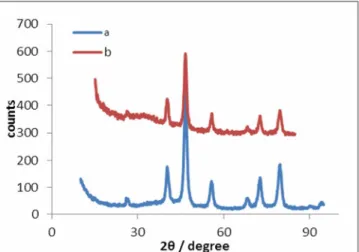
Fig. 2. The XRD pattern of Fe3O4 (a) and Fe3O4@SiO2@DOPisatin-Ni(II) (b).
C K
N K
O K
SiK
FeK
FeK
FeL
NiK NiK
NiL
keV 0
100 200 300 400 500 600 700 800 900 1000 1100 1200
0 10.00
Fig. 4. EDX spectrum for Fe3O4@SiO2@DOPisatin-Ni(II).
mmol g-1 respectively.
As presented in Fig. 2 the catalyst was characterized by peak positions at 2θ values of 23.58, 40.02, 46.46, 55.58, 66.58, 72.3 and 79.26 in the XRD pattern. The position of all peaks in the XRD pattern Fe3O4@SiO2
@DOPisatin-Ni(II) with the corresponding reflections of (111), (220), (311), (400), (422), (511) and (440) conforms to the standard XRD pattern of Fe3O4 [23]. The characteristic
diffraction peaks reflections of crystalline inverse cubic spinel structures of MNPs. The XRD pattern of catalyst indicated the stability of the crystalline phase of Fe3O4
nanoparticles during functionalization of MNPs.
One of the electron microscopes employed to show the images of a sample and recognition its morphology is scanning electron microscope (SEM). Figure 3 displays the SEM image of Fe3O4@SiO2@DOPisatin-Ni(II). It shows
spherical morphology of catalyst with an average diameter less than 84 nm.
The energy dispersive X-ray (EDX) of Fe3O4@SiO2@DOPisatin-Ni(II) indicated the presence of
C, N, O, Si, Fe and Ni in the catalyst. Weight percentages of elements obtained were 0.61, 0.22, 3.71, 1.88, 92.63 and 0.95 respectively (Fig. 4).
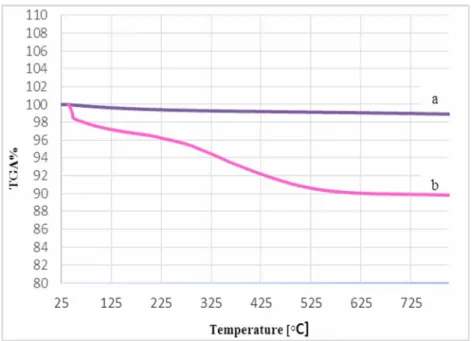
The amount of the catalyst loading and stability of the materials can be inferred from the thermo gravimetric analysis (TGA). Figure 5 shows the TGA curves of the Fe3O4@SiO2@DOPisatin-Ni(II) and bare Fe3O4
nanoparticles. The weight loss at temperatures below 200 °C is due to loss of adsorbed water or the water formed from the condensation of hydroxyl groups. The weight loss of 6% between 225-625 °C was assigned to the thermal decomposition of organic groups grafted to Fe3O4.
To investigate the magnetic properties of the catalyst, the technical of vibrating sampling magnetometry (VSM) was used. Obviously, the lower magnetic value of catalyst in comparison with MNPs is due to the coating of silica and the attached layer on the catalyst.
Catalytic Studies
Herein, after characterizing Fe3O4@SiO2
@DOPisatin-Ni(II), we examined its catalytic activity in some multi-component reaction such as synthesis of 2,3-dihydroquinazolin-4(1H)-one, polyhydroquinolines and 5-substituted 1H-tetrazoles, respectively.
Initially we selected the one-pot synthesis of 2,3-dihydroquinazolin-4(1H)-one using condensation of aldehyde, 2-aminobenzamide and catalyst in solvent free condition at 110 °C.
First, to optimize the reaction conditions for the synthesis of 2,3-dihydroquinazolin-4(1H)-ones derivative (Scheme 1), we investigated the reaction of benzaldehyde (1 mmol) with 2-aminobenzamide (1.1 mmol) and Fe3O4@SiO2@DOPisatin-Ni(II) as catalyst
in various solvents. The results showed that the highest product yield is obtained in solvent free condition. Then, the effect of the amount of catalyst on the conversion rate of the reaction was studied by varying the amount of Fe3O4@SiO2@DOPisatin-Ni(II). As
shown in Table 1, entry 4, the best results are observed using 0.03 g of catalyst. As the synthesis of 2,3-dihydroquinazolin-4(1H)-one yields is dependent to temperature, the effect of temperature was studied and temperature of 110 °C was found to be ideal temperature for this reaction (Table 1, entry 4 and 11-14).
The reaction of the various benzaldehyde derivatives, including electron-donating and electron-withdrawing groups on aromatic ring was then investigated to confirm the generality of the present method. The results of this study are summarized in Table 2.
As shown in Scheme 3, the proposed mechanism of synthesis 2-aryl-2,3-dihydroquinazolinone-4(1H)-one was indicated. The anthranilamide reacted with the carbonyl group in aldehyde activated, and the intermediate I formed. The imine intermediate II was prepared via dehydration of intermediate I. Finally, in final step, the intramolecular cyclization of imine intermediate II generated the final product [30].
In the second part of our work, we tested the catalytic activity of Fe3O4@SiO2@DOPisatin-Ni(II) in the one-pot
synthesis of polyhydroquinoline derivatives (Scheme 4). To achieve more efficient synthesis of polyhydroquinoline, reaction of 4-methylbenzaldehyde (1 mmol), dimedon (1 mmol), ethylacetoacetate (1 mmol), ammonium acetate and Fe3O4@SiO2@DOPisatin-Ni(II) as
catalyst was selected as model system, to find the optimum conditions. Firstly, the effect of different solvents, various amounts of catalyst, various amounts of ammonium acetate,
and temperature was studied on the model reaction. According to data given in Table 3, entry 1, solvent free was the most efficient condition for this reaction. The amounts of catalyst were another essential factor favoring the yield of the reaction. Use of 0.03 g of catalyst achieved maximum product yield of 97% (Table 3, entry 1). A further increase in the amount of catalyst did not indicate any considerable improvement in the yield. The effect of temperature was investigated by carrying out the model reaction at different temperatures under solvent-free condition (60 °C, 80 °C, 90 °C, 100 °C, 110 °C and 120 °C) and the best results were obtained at 100 °C (Table 3, entries1).
As shown in entry 1 of Table 3, the best results are obtained with 4-methylbenzaldehyde (1 mmol), dimedone (1 mmol), ammonium acetate (1.2 mmol), ethylacetoacetate (1 mmol) in the presence of Fe3O4@SiO2@DOPisatin-Ni(II)
(0.03 g) and solvent free condition at 100 ºC. As shown in Table 4, under optimized conditions, the scope of synthesis of polyhydroquinoline derivatives with other aldehydes was found to be quite good.
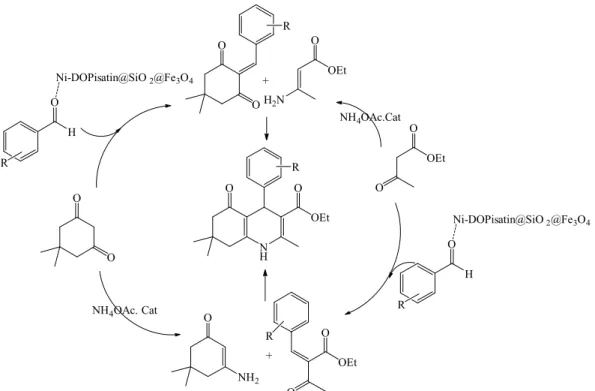
Proposed mechanism for the formation of polyhydroquinoline is shown in Scheme 5. The condensation of aldehydes with the active methylene compounds (Knoevenagel Condensation) formed the α,β-unsaturated compound. Then, the Michael-type addition of the resultant intermediates produced polyhydroquinoline [31].
In continuation of this work, we report the synthesis of 5-substituted 1H-tetrazoles by the Nickel-catalyzed [3+2] cycloaddition between the corresponding nitriles and sodium azide in PEG at 120 ºC (Scheme 6).
In the cycloaddition reaction between phenyl cyanide
Fig. 6. VSM analysis of Fe3O4 (a) and Fe3O4@SiO2@DOPisatin-Ni(II)(b).
Scheme 2. Synthesis of 2,3-dihydroquinazolin-4(1H)-one derivatives catalyzed by
and NaN3, we investigated the effect of solvents, amount of
catalyst and temperature on the formation of tetrazole. To study the effect of catalyst, phenyl cyanide (1 mmol) was treated with sodium azide (1.2 mmol) in the presence of different amounts of Fe3O4@SiO2@DOPisatin-Ni(II) and
the obtained results are shown in Table 5. As shown in Table 5, entry 2, when the reaction is carried out in the presence of 0.05 g of the catalyst, the corresponding product will be in a high yield of 91%. Among the solvents tested PEG gave a high yield of the product. Next, we examined the effect of the temperature on the synthesis of 5-substituted 1H-tetrazoles. We applied room temperature, 70 °C, 100 °C and 120 °C. Therefore, the best result was obtained in
120 °C.
The optimization of the reaction for the synthesis of 5-substituted 1H-tetrazoles with respect to the amounts of the starting materials and the catalyst led to nitrile (1 mmol), sodium azide (1.2 mmol), PEG (3 mL), and catalyst (0.05 g) at 120 ºC. We investigated the substrate scope and generality of the protocol by employing structurally various nitriles, including electron-donating and electron-withdrawing groups on aromatic ring. The results of the [3+2] cycloaddition reaction of various nitriles with NaN3
are summarized in Table 6.
A plausible mechanism for the formation of 5-substituted1H-tetrazol is shown in Scheme 7. Initially, the
Table 1. Optimization Condition for the Condensation of Benzaldehyde (1mmol) and 2-Aminobenzamide (1.1 mmol)a
Entry
Catalyst (g)
Solvent Temperature
(ºC)
Yield (%)b
1 0 -c 110 38
2 0.01 -c 110 40
3 0.02 -c 110 65
4 0.03 -c 110 95
5 0.04 -c 110 92
6 0.05 -c 110 94
7 0.03 EtOH Reflux 70
8 0.03 H2O Reflux 80
9 0.03 PEG 110 45
10 0.03 EtOAc Reflux Trace
11 0.03 -c 60 Trace
12 0.03 -c 80 43
13 0.03 -c 100 80
14 0.03 -c 120 95
Table 2. Synthesis of 2,3-Dihydroquinazolin-4(1H)-ones Catalyzed by Fe3O4@SiO2@DOPisatin-
Ni(II) in Solvent Free Condition and at 110 ºC
Entry Product Time
(min)
Yield (%)a
M. P.
(ºC) Ref.
1 60 95 223-226 [15]
2 75 98 230-232 [24]
3 60 95 176-178 [15]
4 65 94 170-173 [25]
5 70 97 210-213 [26]
6 85 93 196-198 [26]
7 90 91 197-199 [27]
8
NH NH O
Table 2. Continued
9 180 90 189-193 [27]
10 160 92 192-195 [29]
aIsolated yield.
NH2
O
NH2 Ar
O H
Ni-Dopisatin@SiO2@Fe3O4 OH
N H
N Ar
OH
H Ni-Dopisatin@SiO
2@Fe3O4
NH OH
N Ar
Ni-Dopisatin@SiO2@Fe3O4
N H
NH O
Ar +
-H2O
I
II
Scheme 3. Proposed mechanism for the synthesis of 2-aryl-2,3-dihydroquinazolinone-4(1H)-one
nanocatalyst reacts with azide to afford the [Fe3O4@SiO2@Dopisatin-Ni(II)]-N3(I) catalytic species.
Then, the [3+2] cycloaddition takes place between the CN bond of nitrile and (I) to afford the intermediate(II) and (III). Due to formation of complex(II) from precoordination of the nitrogen atom of the CN group of nitrile with (I), the cyclization step accelerates. This procedure leads to the produce of final heterocycle [22].
Recyclability of the Catalyst
Significance of heterogeneous catalyst over the homogeneous counterpart is its ease of separation from the
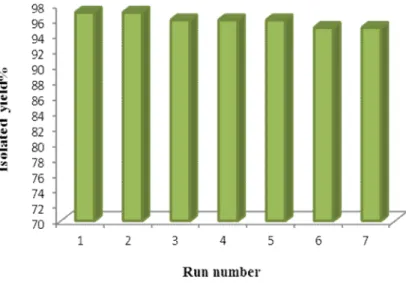
reaction mixture by an external magnet and its recyclability without any significant decrease in activity. In this light, to investigate this issue, the recyclability of the catalyst was examined using a model reaction between 4-methyl-benzaldehyde (1 mmol), dimedone (1 mmol), ammonium acetate (1.2 mmol), ethylacetoacetate (1 mmol) in the presence of Fe3O4@SiO2@DOPisatin-Ni(II) (0.03 g) and
solvent free condition at 100 ºC. After the completion of the reaction, the catalyst was easily and rapidly separated from the reaction mixture using an external magnet and washed with ethanol and dried at room temperature. Then, the recovered catalyst was applied to the next step. As shown in
Table 3. Optimization Condition for the Synthesis of Polyhydroquinoline Using 4-Methyl-benzaldehyde, Dimedone, Ammonium Acetate, Ethylacetoacetate and Catalyst as a Model Reaction in 110 min
Entry
Catalyst (g)
Ammonium acetate (mmol)
Solvent
Temperature (ºC)
Yield (%)a
1 0.03 1.2 -b 100 97
2 0.03 1.2 H2O Reflux Trace
3 0.03 1.2 EtOH Reflux 80
4 0.03 1.2 PEG 100 75
5 0.03 1.2 DMSO 100 20
6 0 1.2 -b 100 0
7 0.01 1.2 -b 100 60
8 0.02 1.2 -b 100 82
9 0.05 1.2 -b 100 97
10 0.03 1.1 -b 100 85
11 0.03 1 -b 100 71
12 0.03 1.2 -b 60 20
13 0.03 1.2 -b 80 45
14 0.03 1.2 -b 90 70
15 0.03 1.2 -b 110 97
16 0.03 1.2 -b 120 96
Table 4. Synthesis of Polyhydroquinoline Catalyzed by Fe3O4@SiO2@DOPisatin-Ni(II) in
Solvent Free Conditions at 100 ºC
Entry Product Time
(min)
Yield (%)a
M. P.
(ºC) Ref.
1
N H
O
OEt O
120 98 216-217 [31]
2 110 97 259-260 [32]
3 100 96 203-206 [31 ]
4
N H
O OEt O
Br
120 94 248-250 [31]
5 120 91 222-228 [33]
Table 4. Continued
7 120 90 182-185 [31]
8 120 97 236-240 [31]
9 180 98 177-179 [35]
10 120 95 174-180 [31]
11 120 95 248-250 [31]
Fig. 8, the catalyst can be reused over 7 times without any significant loss of its catalytic activity.
In order to show the efficiency of this procedure, we compared the results of the preparation of polyhydro-quinoline from 4-methylbenzaldehyde, dimedone, ammonium acetate and ethylacetoacetate with the results in the literature (Table 7, entry 1-5). Also, we checked the merit of Fe3O4@SiO2@DOPisatin-Ni(II) for the synthesis of
2-(phenyl)-2,3-dihydoquinazolin-4(1H)-one ((Table 7, entry 7,8) and 5-(4-Chlorophenyl)-1H-tetrazole (Table 7, entry 10, 11). As shown in Table 7, the catalyst showed a good reaction time and high yield.
CONCLUSIONS
In an effort to develop an innovative and efficient heterogeneous catalytic system for multi-component reaction, we have synthesized Fe3O4@SiO2
@DOPisatin-Ni(II) as an efficient, new and reusable catalyst for the synthesis of 2,3-dihydroquinazolin-4(1H)-ones, polyhyd-quinoline and 5-substituted 1H-tetrazoles. The advantages of the catalyst are the novelty, easy separation by an external magnet, easy preparation, functionalization without tedious condition, easy recovery and low toxicity and price. To follow the principles of green chemistry, these multi-
O
O R
O
O
O
NH2
OEt
H2N O
OEt O
O
OEt O
O R N H
O O
OEt R
H O
R
Ni-DOPisatin@SiO2@Fe3O4
+ +
NH4OAc.Cat
NH4OAc. Cat H
O
R
Ni-DOPisatin@SiO2@Fe3O4
Scheme 5. Proposed mechanism for the synthesis of polyhydroquinoline derivatives
Table 5. Optimization the Reaction Condition for the Synthesis of 5- Substituted 1H-tetrazoles Using Phenyl Cyanide, NaN3 and
Catalyst as a Model Reactiona
Entry
Catalyst (g)
Solvent
Temperature (ºC)
Yield (%)b
1 0.05 DMSO 120 20
2 0.05 PEG 120 91
3 0.05 EtOH Reflux Trace
4 0.05 PEG 100 72
5 0.05 PEG 70 20
6 0.05 PEG r.t. N.R
7 0 PEG 120 Trace
8 0.01 PEG 120 30
9 0.03 PEG 120 50
a40 min. bIsolated yield.
Table 6. Synthesis of 5-Substituted 1H-tetrazoles Catalyzed by Fe3O4@SiO2@DOPisatin-Ni(II)
in PEG at 120 ºC
Entry Product Time
(h)
Yield (%)a
M. P.
(ºC) Ref.
1 0.83 90 127-130 [36]
2 1 92 220-225 [36]
3 12 73 217-220 [22]
4 10 84 148-150 [36]
component reactions were also performed in solvent free condition or PEG. Two major novelties of this work are that, first, for the first time, Fe3O4@SiO2@DOPisatin-Ni(II) as a
new, efficient and reusable nanocatalyst is used for the synthesis of three important heterocyclic compounds; 2,3-dihydroquinazolin-4(1H)-ones, polyhydroquinoline and 5-substituted 1H-tetrazoles, and second, a green solvent of
PEG or solvent free condition is used.
ACKNOWLEDGEMENTS
This work was supported by the research facilities of Ilam University, Ilam, Iran.
Table 6. Continued
6 5 79 261-266 [36]
7 0.67 91 210-215 [36]
8 1 88 176-180 [36]
aIsolated yield.
Fig. 7. Recovery of the catalyst in the synthesis of polyhydroquinoline.
Table 7. Comparison the Results of Fe3O4@SiO2@DOPisatin-Ni(II) with other Catalysts
Entry
Condition
Time (min)
Yield (%)
Ref.
1
Bakers’ yeast (200 mg), D-glucose (300 mg), phosphate buffer (pH 7.0, 5 ml), r.t
24 h 82a [17]
2 PdCl2, Na2CO3, TBAB, THF, Reflux 4.3 h 86a [11]
3 GSA@MNPs (0.05 g), EtOH, Reflux 260 89a [31]
4 Boehmite-SSA (0.03 g), EtOH, Reflux 250 96a [38]
5 Fe3O4-SA-PPCA (10 mg), ethanol, 50 °C 110 91a [39]
6 Fe3O4@SiO2@DOPisatin-Ni(II) (0.03 g), 100 °C, solvent free 110 97a This work
7
Sc(OTf)3 (1 mol%), 5 mol% of L6 and powdered 4A˚ molecular
sieves, r.t., CH2Cl2
48 h 84b [14]
8 GSA@MNPs (0.05 g), EtOH, Reflux 55 90b [31]
9 Fe3O4@SiO2@DOPisatin-Ni(II) (0.03g), 110 °C, solvent free 60 95b This work
10 [AMWCNTs-O-Cu(II)-PhTPY (4 mol%), NH4OAc, DMF,70 °C 150 90c [40]
11 BaWO4 (0.104 mmol), DMF, 120 °C 24 h 90c [18]
12 Fe3O4@SiO2@DOPisatin-Ni(II) (0.05 g), 120 °C, PEG 100 85c This work
aSynthesis of ethyl-4-(4-methylphenyl)-2,7,7-trimethyl-5-oxo-1,4,5,6,7,8- hexahydroquinoline-3-carboxylate. bSynthesis of 2-(phenyl)-2,3-dihydoquinazolin-4(1H)-one. cSynthesis of 5-(4-Chlorophenyl)-1H-tetrazole.
REFERENCES
[1] Y. Chen, F. Zhang, Y. Fang, X. Zhu, W. Zhen, R. Wang, J. Ma, Catal. Commun. 38 (2013) 54.
[2] A. Ghorbani-Choghamarani, M. Norouzi, Appl. Organometal. Chem. 30 (2016) 140.
[3] J. Govan, Y.K. Gun’ko, Nanomaterials 4 (2014) 222. [4] M. Ghorbanloo, R. Tarasi, J. Tao, H. Yahiro, Turk. J.
Chem. 38 (2014) 488.
[5] R. Abu-Reziq, H. Alper, Appl. Sci. 2 (2012) 260. [6] A. Strecker, Liebigs. Ann. Chem. 75 (1850) 27. [7] Z. Karimi-Jaberi, R. Arjmandi, Monatsh. Chem. 142
(2011) 631.
[8] M. Hajjami, A. Ghorbani-Choghamarani, F. Gholamian, Bulg. Chem. Commun. 47 (2015) 119. [9] B.H, Chen, J.T. Li, G.F. Chen, Ultrason. Sonochem.
23 (2015) 59.
[10] M. Hajjami, A. Ghorbani-Choghamarani, Z. Yousofvand, M. Norouzi, J. Chem. Sci. 127 (2015) 1221.
[11] M. Saha, A. Kumar Pal, Tetrahedron Lett. 52 (2011) 4872.
[12] G. Aromi, L.A. Barrios, O. Roubeau, P. Gamez, Coordin. Chem. Rev. 255 (2011) 485.
[13] T. Hosseinnejad, M. Dinyari, Comput. Theor. Chem 1071 (2015) 53.
[14] T. Deng, H. Wang, C. Cai, J. Fluorine. Chem. 169 (2015) 72.
[15] S.D. Dindulkar, J. Oh, V.M. Arole, Y.T. Jeong, C. R. Chim. 17 (2014) 971.
[16] M. Ghashang, K. Azizi, H. Moulavi-Pordanjani, H.R. Shaterian, Chin. J. Chem. 29 (2011) 1617.
[17] A. Kumar, R.A. Maurya, Tetrahedron Lett. 48 (2007) 3887.
[18] J. He, B. Li, F. Chen, Z. Xu, G. Yin, J. Mol. Catal. A: Chem. 304 (2009) 135.
[19] T. Jin, F. Kitahara, S. Kamijo, Y. Yamamoto. Tetrahedron Lett. 49 (2008) 2824.
[20] M. Hajjami, F. Gholamian, RSC. Adv. 6 (2016) 87950.
[21] A. Ghorbani-Choghamarani, G. Azadi, Appl. Organometal. Chem. 30 (2016) 247.
[22] M. Esmaeilpour, J. Javidi, F. Nowroozi Dodeji, M. Mokhtari Abarghoui, J. Mol. Catal. A: Chem. 393 (2014) 18.
[23] M. Hajjami, S. Kolivand, Appl. Organometal. Chem. 30 (2016) 282.
[24] M. Singh, N. Raghav, Bioorg. Chem. 59 (2015) 12. [25] A. Ghorbani-Choghamarani, M. Norouzi, J. Mol.
Catal. A: Chem. 395 (2014) 172.
[26] A. Saffar-Teluri, Sh. Bolouk, Monatsh. Chem. 141 (2010) 1113.
[27] J. Safari, S. Gandomi-Ravandi J. Mol. Cata. A: Chem. 390 (2014) 1.
[28] J. Chen, D. Wu, F. He, M. Liu, H. Wu, J. Ding, W. Su, Tetrahedron. Lett. 49 (2008) 3814.
[29] M. Wang, T.T. Zhang, Y. Liang, J.J. Gao, Monatsh. Chem. 143 (2012) 835.
[30] F. Havasi, A. Ghorbani-Choghamarani, F. Nikpour, Micropor. Mesopor. Mat. 224 (2016) 26.
[31] M. Hajjami, B. Tahmasbi, RSC. Adv. 5 (2015) 59194. [32] J.L. Donelson, R.A. Gibbs, S.K. De, J. Mol. Catal. A:
Chem. 256 (2006) 309.
[33] A. Davoodnia, M. Khashi, N. Tavakoli-Hoseini, Chinese. J. Catal. 34 (2013) 1173.
[34] A. Ghorbani-Choghamarani, B. Tahmasbi, P. Moradi, N. Havasi, Appl. Organometal. Chem. (2016) and DOI: 10.1002/aoc.3478.
[35] A. Kumar, R.A. Maurya, Tetrahedron 63 (2007) 1946.
[36] A. Ghorbani-Choghamarani, P. Moradi, B. Tahmasbi, RSC. Adv. 6 (2016) 56638.
[37] F. Dehghani, A.R. Sardarian, M. Esmaeilpour, J. Organomet. Chem. 743 (2013) 87.
[38] A. Ghorbani-Choghamarani, B. Tahmasbi, New. J. Chem. 40 (2016) 1205.
[39] A. Ghorbani-Choghamarani, G. Azadi, RSC. Adv. 5 (2015) 9752.
[40] H. Sharghi, S. Ebrahimpourmoghaddam, M.M. Doroodmand, J. Organomet. Chem. 738 (2013) 41.