Why insurers differ from banks
October 2014
About Insurance Europe
Insurance Europe is the European insurance and reinsurance federation. Through its 34 member bodies — the national insurance associations — Insurance Europe represents all types of insurance and reinsurance undertakings, eg pan-European companies, monoliners, mutuals and SMEs. Insurance Europe, which is based in Brussels, represents undertakings that account for around 95% of total European premium income. Insurance makes a major contribution to Europe’s economic growth and development. European insurers generate premium income of more than €1 110bn, employ almost one million people and invest over €8 500bn in the economy.
Contents
Executive summary 6
Introduction 8
Section I — Why insurers differ from banks
I. Insurance 10
I.1 Non-Life Insurance 11
I.2 Life insurance 12
I.3 Insurers as investors 14
I.4 Reinsurance 18
II. Banking 20
III. Balance sheet comparison 23
IV. Overview of risks facing banks and insurers 24
IV.1 Main risks faced by insurers 24
IV.2 Main risks faced by banks 26
IV.3 Focus on two key risks 29
Section II — Questions and answers
1. Should large insurers automatically be considered systemically risky? 34
2. Are insurance activities systemically risky? 36
3. Why did AIG fail? 38
4. What is the difference between the resolution of insurers and the resolution of banks? 40
5. Are reinsurers’ activities systemically risky? 44
6. Would bank capital requirements (Basel III) also be appropriate for insurers? 48 7. What could be the consequences of imposing excessive capital requirements on insurers? 51
8. Does applying a minimum leverage ratio requirement for insurers make sense? 52
9. What is Solvency II and is this framework appropriate and sufficient for the effective
regulation of European insurance companies? 55
10. Why do insurers use derivatives? 56
11. Do insurers engage in shadow banking activities and is this problematic from a systemic
Executive summary
In the aftermath of the 2007/2008 banking crisis, a significant number of reforms have been introduced by international, European and national policymakers as a response to problems in the banking sector which have negatively impacted the entire economy. These efforts to foster sound and stable financial markets are fully supported by the insurance industry.
A worrying trend has, however, emerged. Several regulatory initiatives directed at the banking business were eventually transposed to other financial industries, without an appropriate distinction being made between the vastly different business models which make up the financial sector.
Banks and insurers have significantly different business models and play very different roles in the economy. The core activity of insurers and reinsurers is risk pooling and risk transformation, while that of banks is the collection of deposits and the issuing of loans, together with the provision of a variety of fee-based services.
Consequently, the balance sheet of insurers is economically stable, as fairly long-term policyholder liabilities are matched with assets of corresponding duration. In the case of banks, which engage in maturity transformation, assets and liabilities are not matched, and the average duration of most bank assets is generally longer than the average duration of their liabilities.
Insurers and banks also play quite different roles in relation to the efficient functioning of the whole economy. Banks are part of the payment and settlement system and through their role as credit providers they are the main transmission channel of central banks’ monetary policy. Insurers make an important contribution to economic growth by providing consumers and businesses with protection against negative events. While this role is also critical for the functioning of the economy, there is no sovereign link and the interconnections are materially different. In particular, there is no balance sheet link between insurers and there is also no “central insurer” as there is a central bank.
The risk profiles of insurance companies and banks also differ fundamentally.
Insurance companies are mainly exposed to underwriting risk, market risk and the risk of mismatch between assets and liabilities, whereas the most significant risks to which banks are exposed are credit risk, liquidity risk and market risk. Importantly, the risks faced by an insurer depend on both assets and liabilities and the way they interact. From a macroprudential point of view, the core insurance business model does not generate systemic risk that is directly transmitted to the financial system. There is far lower contagion risk, higher substitutability and lower financial vulnerability in insurance compared to banking. The financial position of insurers deteriorates at a much slower pace than that of banks and even if an insurer does run into trouble, an orderly wind-up is much easier, since insurers strive to match expected future claims by policyholders with sufficient assets; this facilitates the transfer or run-off of their portfolios.
Insurance Europe supports appropriate improvements to regulatory and supervisory standards for insurers that will maintain a sound and competitive industry and that will foster consumer confidence. But the all too common assumption that regulation which is valid for banking must be valid for insurance is wrong. Rules applied to insurance should fully reflect the profound differences between the business models and risk profiles of the two industries. Applying banking-inspired regulatory frameworks to insurers would have a materially negative impact on the sector and on the whole economy.
Introduction
The financial sector in Europe is often seen as one single intertwined industry. This is an oversimplified view, as the sector consists of different industries, each with its own objective to fulfil its customers’ diverse needs. In this context, the flawed perception that banks and insurers are similar leads to the equally flawed assumption that banking regulation can be used as a blueprint for insurance regulation. This very often results in an unsatisfactory outcome for all parties.
Banks and insurers need differentiated and specific regulatory frameworks that fully reflect the profound differences between the business models and risk profiles of the two industries. Insurance Europe has repeatedly been faced with over-simplifications on the part of some policymakers and governmental institutions, which too often seem to believe that banks and insurers are similar and that they should therefore be subjected to similar regulations. In fact, applying banking-inspired regulatory frameworks to insurers would have a material negative impact on the sector and the whole economy.
This report is organised into two sections:
•
Section I provides an overview of banks’ and insurers’ business models, key activities and value drivers by comparing and contrasting them. Particular attention is given to the different risks banks and insurers face as a consequence of their activities and to the implications of these differences for risk exposure at both institutional and system-wide level.•
Section II covers the resulting implications for the effective regulation of insurers. This is done through a series of questions which are asked and then answered; the questions address a number of topics and issues which come up often in current discussions on regulatory developments. For every question, both a short and a long answer are provided; this reflects the fact that the underlying idea behind every response is straightforward, even if complex arguments may stand behind it. The overarching message conveyed throughout is that distinct regulatory approaches are needed at company level and that an activity-based approach is the most adequate at macroeconomic level.Section I —
I. Insurance
Insurers exist to take over the risks faced by policyholders and to aggregate them into a risk pool which offers protection against a potential future negative event. Insurers are rewarded by premiums determined according to the specific profile of the risks they insure. Each policyholder should pay a fair premium according to the risk of loss that they bring into the pool.
Insurance transforms risk, from one faced entirely by a single individual to one collectively shouldered by a large number of policyholders. From a financial point of view, insurance transforms a potential large, unaffordable future loss in a much smaller one, in the form of periodic premium payments. The price of the insurance should be such that the individual is prepared to pay the smaller, known premium in return for not having to pay the unknown, potentially very large financial cost of the insured event.
The social value of insurance is significant, given that individuals and companies alike are generally risk-averse. Their fear of large losses would hinder economic activity in the absence of insurance cover. Indeed, it is fair to say that modern society could not function and thrive without insurance. Because it offers protection to individuals as well as a viable
Insurance protects people and businesses against the risk of unforeseeable events
Insurer Pool group
Premium paid to insurer Insurer pays claims from
pool € € € € € € € € € € € € € € € € € € € € € € € € € € € € € € Figure 1: Insurance is the transfer of risk
business model for providers, insurance can also be considered one of the most successful financial innovations.
Risk pooling
The pooling of risks is at the centre of an insurer’s business model and so it is essential to understand why and how it works. The pre-condition for insurance to function correctly is that the risks insured should be as uncorrelated (independent of one another) as possible. In order to achieve an exposure to such uncorrelated risks insurers need to sell diversified policies. This diversification applies to products, geographical areas or markets. The more diversified policies an insurer sells, the smaller the interdependence between insured events will become and the higher the likelihood that real losses will be close to expected losses. This is the so-called law of large numbers, which lies at the core of insurance. When it holds, insurers can cover the actual occurring losses without making recourse to capital or collecting additional premiums1.
Insurability
There are, however, intrinsic limits to what insurance products can cover. Indeed, not all risks lend themselves to be insured, for example because the risk of claims is simply too high or impossible to predict, or because the insured person has incentives to cause a claim (this is referred to as moral hazard). One of the core responsibilities insurers have is to correctly assess whether or not particular risks fall under this classification. In order for a risk to be insurable, several principles need to be observed. They do not constitute a strict formula, but rather a set of basic criteria which must be fulfilled2.
I.1 Non-life insurance
Non-life insurance is the term generally used for contracts which provide protection against the risk of adverse events with a negative financial consequence. The policyholder pays a premium in exchange for a promise to be indemnified later for the financial consequences of a covered event, subject to the conditions stipulated in the contract.
1 There are situations in which the law of large numbers doesn’t hold (eg when the correlation of risks is perfect or high). The risk associated with this can be mitigated through risk transfer instruments such as reinsurance.
2 For more details, please see Insurance Europe’s “How insurance works” booklet.
The law of large numbers lies at the core of insurance
There are limits to what insurance products can cover
A large part of these products are also called property and casualty (P&C) because they protect against property losses and/or against legal liability that may result from injury or damage to the property of others. If for an uninsured individual such events could cause bankruptcy, the P&C insurers’ business model makes taking over these risks possible. Some examples of P&C insurance products which have become a feature of daily life are motor insurance, homeowners (or renters) insurance and flood insurance (or natural catastrophe insurance in general).
Health insurance is a special type of non-life insurance which protects against the risk of incurring medical expenses. The particular characteristics of insurance schemes vary between countries and health insurance systems can be administered centrally either by a government, private insurer, non-profit entity or a combination thereof.
The success of a non-life insurance operation depends on an insurance company’s ability to correctly segment and price the risks it underwrites, pool the risks, benefit from diversification and optimise operating costs. The financial returns obtained through its investments provide non-life insurers with an additional revenue line and will impact how it prices the premiums.
I.2 Life insurance
Life insurance provides protection for policyholders against the financial consequences of death and morbidity, as well as long-term savings and pension solutions.
€229bn
P&C and accident
claims paid
€334bn
P&C and accident premiums
Figure 2: European health, P&C and accident (premiums and claims paid in 2013)
€96bn
Health claims paid
€118bn
Protection is achieved through the pooling of life (biometric) risk and it benefits households by preserving their wealth in case of an unfortunate event. Life insurance can either be purchased for an unlimited duration or for a pre-defined period of time. The former is known as whole-life insurance and is certain to offer a pay-out, given that it covers the entire lifetime of the policyholder. The latter is known as term-life insurance and it covers a certain number of years at a given premium.
There are additional functions life insurance can fulfil. First, it can take over longevity risk and so help policyholders mitigate the risk of outliving their financial assets. It does so through a product called an annuity (private pension), which converts a policyholder’s savings into a guaranteed regular income over the course of their life. This income is determined using an annuity rate, which is a percentage of the entire sum of money invested in the annuity. In the contribution phase, life insurers collect regular premiums and manage them securely for the long-term. In the pay-out phase (retirement), they provide pension benefits in an effective way.
There are several types of annuities, depending on a series of factors such as number of beneficiaries (single or joint annuities), indexation to inflation (escalating annuities), the emergence of medical conditions (enhanced or impaired annuities) and share of savings which remain invested (flexible or investment annuities). But the benefit they all have in common is that they offer a life-long income stream which is guaranteed. Such private pension solutions are of increasing importance in Europe, as public pension schemes come under strain from ageing populations. Furthermore, since there are no pre-conditions in private pension programmes, people can purchase individual pension insurance and then keep it regardless of where or by whom they are employed in Europe. With privately funded individual pension solutions, people have the freedom to choose when, how much and which coverage they want according to their situation and needs. Figure 3: European life insurance premiums and benefits paid in 2013
€618bn
Life benefits paid
€667bn
Life insurance can also serve as support for long-term private wealth building, since life insurers offer a range of investment options (such as endowment policies and unit-linked insurance policies). This constitutes an important social benefit, particularly in jurisdictions with a limited welfare state or in which citizens are less reliant on it.
I.3 Insurers as investors
3Why do insurers invest?
Insurers must invest the premiums they collect from policyholders to pay claims and benefits on their policies and to cover their operating and capital costs. In this sense, investing is a natural consequence of the insurance business model.
Given that life insurance and private pension products are particularly long-term (five to 30 years and beyond) insurers aim to invest in assets of corresponding duration. The principle of matching between assets and liabilities enables them to meet their obligations to policyholders at all times. It also means that insurers need access to a wide range of assets that enable them to match their liability needs and that allow for portfolio diversification. They also need to make use of derivatives to help improve their matching
3 For more detailed information on insurers as investors, please see Insurance Europe and Oliver Wyman’s 2013 study “Funding the future: Insurers’ role as institutional investors”.
Investing is a natural consequence of the insurance business model
Figure 4: European institutional assets under management — 31 December 2012
Sources: Insurance Europe, OECD, EFAMA, SWF Institute, Forbes
Insurance companies €8 400bn
Pension funds €4 200bn
Retail investors
€600bn Sovereign wealth funds
€300bn Endowments and foundations
€3 900bn
because there are often not enough suitable assets available (See section II, question 10). Investment returns therefore represent a core component of a number of insurance products. This large accumulation of assets backing insurers’ long-term products makes the insurance industry the largest institutional investor in Europe4.
How do insurers invest?
Insurers’ investment strategies are primarily determined by the duration and predictability of their liabilities. The former determines the time horizon over which the insurer can invest, whereas the latter determines the liquidity of the investments. Insurance liabilities are generally illiquid, as in the case of annuities or life insurance which entails predictable, long-term payments to policyholders against which insurers can make illiquid, long-term investments. But some lines of insurance, such as property insurance, are less predictable and require liquid investment portfolios.
In property and casualty insurance, the nature of liabilities is such that insurers adopt a relatively conservative asset allocation, consisting mainly of fixed income assets aligned to liabilities’ durations. Liquidity also plays a more central role in the investment strategy,
4 The Organisation for Economic Co-operation and Development (OECD) statistical yearbook identifies institutional investors as pension funds, insurance companies and investment companies, such as sovereign wealth funds. Banks are not considered institutional investors.
Figure 5: European insurers’ investment portfolio — 2012
Debt securities and other fixed-income securities Shares and other variable-yield securities and unit trusts Loans, including loans guaranteed by mortgages Investments in affiliated undertakings and participating interests
Deposits with credit institutions Land and buildings
Other investments
6% 5% 42%
11%
31%
2% 3%
Insurers’ investment strategies are determined by the duration and predictability of their liabilities
given the shorter duration of non-life contracts. Investment results are therefore a secondary earnings component for non-life insurers, after underwriting results.
If a guarantee is included in the insurance contract, it will serve as an indicator of minimum investment performance, but an insurer’s investment strategy will always be built to exceed the returns corresponding to what was guaranteed to policyholders. Insurers always seek the optimal trade-off between risk and return within the duration, liquidity and return constraints created by their liabilities.
What are the benefits of insurers’ investments?
For policyholders
Insurers’ long-term view means they can provide policyholders with a range of options for the investment-related element of their insurance products: from unit-linked exposure for those willing to accept a higher degree of risk, through profit-sharing products where the risk is shared (and there is usually a capital protection or a minimum return guarantee), to fully guaranteed annuity-type products where there is no market risk for the policyholder. Investing long-term gives policyholders the possibility to access the risk premium and implicitly the higher yields embedded in a wide range of investments which compensate for the risk of holding assets with longer maturities. Because insurers have mostly illiquid liabilities, they can also hold assets over the long-term, allowing for diversification of risk across time as well as across categories. Their long-term illiquid perspective allows insurers to have great flexibility over which assets they sell at a given time and to avoid forced sales during periods of price volatility. This gives policyholders access to the risk premium from assets whose volatility would otherwise prevent many of them from investing. Policyholders also gain access to the illiquidity premium embedded in long-term assets (the higher interest rate borrowers are willing to pay for funds committed over a long period).
Insurers have investment expertise and information services that policyholders cannot feasibly have themselves. This enables insurers to offer policyholders competitive long-term financial performance, which is essential, especially for life insurance contracts and
Access to investment expertise Choice of investment risk
pension products where benefits accumulate over time and are driven by investment performance. In the case of unit-link type products insurers offer policyholders advice and services for an optimal investment allocation of premiums. Many human behavioural biases which lead to poor individual investment decisions5 can be avoided by relying on
an institution with a long-term investment philosophy. In addition, the cost of investing (annual management charges, administration costs and indirect costs) can also be reduced. Finally, by pooling the funds of many investors, insurers give policyholders access to assets in which they would otherwise not be able to invest, such as private placements and “big ticket” items.
The combination of benefits described above is unique to insurers and is what allows them to offer long-term products at a cost that is acceptable to both policyholders and those who provide the capital to back the risks.
For the economy
The constant ability and need of insurers to invest makes them important providers of stable funding for governments, businesses and, to a lesser extent, households. Insurers’ provision of long-term funding through capital markets includes significant investment in government and corporate bonds (60% of assets industry average), covered bonds and equity. The exact allocation between these asset classes varies between companies according to the line of business they are active in. However, these are not the only means by which insurers provide long-term funding. They also fund businesses through direct lending to small and medium enterprises (SMEs), private equity and venture capital6.
Moreover, through their use of securities lending and the repo market to access short-term funding when needed, insurers can play an important role for the efficient functioning of the markets (see section II, question 11). This is particularly true for small currency areas. Because insurers are long-term investors, the asset transactions they originate can be
5 Such as over-reacting to short-term price fluctuations and buying high and selling low as a consequence.
6 For a more in-depth explanation of the rationale which underpins these investment decisions, please refer to section II, question 8.
Cost reduction
Insurers provide stable funding for economic growth
counter-cyclical. A continuous flow of premiums in periods of market volatility, combined with a predictable profile of liabilities allows insurers to hold or even buy assets that are temporarily undervalued during a downturn and to sell assets that are temporarily overvalued during a boom.
I.4 Reinsurance
Reinsurance reduces an insurer’s risk of loss by sharing it with one or more reinsurers. Put simply, reinsurance is insurance for insurers.
The principle of matching between assets and liabilities is a cornerstone of any insurer’s activity. Indeed, it’s what enables them to succeed. After assessing their own risk and solvency, insurers may determine that the risk taken on slightly surpasses the risk-bearing capacity of their portfolio of assets. They may then choose to transfer a part of this risk to a reinsurer, in exchange for a fee.
Figure 6: How insurance boosts business and GDP
€
€
Insured businesses have greater security, need to hold less capital and therefore boost consumption and investment
Insured businesses rely less on state help, so less burden on the taxpayer if disaster strikes Well-insured countries
have less need to save for emergencies, more money to invest; GDP grows
More insurance is required, richer countries have more assets to protect
Insurance is taken out, insurers invest in the economy
Source: “Lloyd’s global underinsurance report”, Lloyd’s, 2012
Reinsurance is insurance for insurers
The reinsurance company receives pieces of a larger potential obligation in exchange for some of the money the original insurer received to accept the obligation. The party that transfers its insurance portfolio to the reinsurer is known as the ceding party. Anything from a fraction of a single policy to a portfolio of policies can be ceded to a reinsurer who can provide an effective form of financing as well as protection against tail risks (which are very unlikely to materialise, but very onerous if they do).
The importance of reinsurance cannot be overstated. On the one hand, it improves the resilience of individual primary insurance companies. On the other, it helps diversify tail risk across regions and continents, given that reinsurers typically operate on a global scale and act as shock absorbers. This is a key macroeconomic role, which enhances financial stability and also enables the reinsurer to only retain a relatively small portion of the risk deriving from any single negative event. In fact, excess risk is diversified even further to other reinsurers or to capital markets through insurance-linked securities (ILS). By strengthening the industry, reinsurers make insurance broadly available and less expensive; this is of great benefit to society.
Around 5% of global primary insurance premiums are ceded to reinsurers. This risk is partially passed on through ILS to the capital markets and other reinsurers. ILS issuance is equivalent to around 0.1% of global insurance premiums7.
7 “Insurance-linked securities”, Aon Benfield, 2012.
Reinsurance enhances financial stability
II. Banking
The core activity of a bank is the collection of deposits (savings) from private, corporate and institutional customers and the extension of loans to these same groups. Deposits represent liabilities for a bank, whereas loans extended are the assets on its balance sheet. Banks play an important role in the economy, acting as intermediaries between savers who need to deposit money in accessible accounts and borrowers in need of loans for variable durations.
In the huge majority of cases, deposits have much shorter maturities than loans, so banks need to engage in what is referred to as “maturity transformation”. In this way, banks manage to meet the mismatching needs of lenders and borrowers at the same time. The key assumption on which maturity transformation relies is that all depositors will not be asking for their money back at the same time, since depositors’ needs for cash are unlikely to occur at the same time. In other words, even though in principle all depositors continuously enjoy a right of withdrawal, only a fraction of them will act upon this right at any given point in time. Therefore, confidence in the bank and the wider financial system is essential; if the sentiment is lost, this can rapidly lead to bank failure if a “bank run” occurs and all depositors attempt to withdraw their money at once (see section II, question 4).
Simple retail banks typically engage only in balance sheet activities. They specialise in assessing the credit-worthiness of borrowers, and in monitoring borrowers to ensure they meet their obligations. They are rewarded for these services by the positive spread between the interest rates they offer to savers and those they ask from borrowers. In addition, banks make sure that payment systems linking bank accounts and enabling for monetary exchange using bank deposits are functional at all times. Banks create credit and are critical for the functioning of the payment systems. In fact, most of the money in a modern economy is created by the banking sector. This unique role makes banks essential for the transmission of the central bank’s monetary policy and is as such critical to the functioning of the economy.
Confidence in the bank and the wider financial system is essential
In addition to their core activity, some banks engage in so-called off-balance sheet activities, which broadly fit into two categories: financial guarantees and derivatives. These activities became increasingly popular in the last decades — especially among large banks — and effectively added a risk management component to the activity of what were originally simple deposit and lending institutions. Investment banks have traditionally been engaging almost exclusively in these types of market activities.
Financial guarantees are essentially products through which banks back up an obligation (such as a loan) of a third party. For example, through a standby letter of credit, the bank promises to pay the beneficiary if his/her counterparty defaults on a financial obligation. Through bank loan commitments, a bank commits to extend a future loan at certain conditions (lines of credit are the most common example). A lesser-known financial guarantee is the note issuance facility, through which a bank promises to buy a firm’s debt securities at or below pre-determined interest rates.
Derivatives include swaps, options, futures, forward contracts and securitised assets. Most derivative activities are reported on the balance sheet but some remain off-balance sheet as assets if they have positive values or as liabilities otherwise. Derivatives are traded in the over-the-counter (OTC) market (largely dominated by banks) or through organised exchanges. Derivatives offer various benefits and can be used in a multitude of ways. A swap for instance is an agreement between counterparties to exchange cash flows based upon a notional principal amount of money, maturity and interest rates. OTC options, futures and forwards are non-standardised contracts which can cap the maximum interest rate on a loan to protect the customer, set a minimum interest rate on a loan to protect the bank or both. A credit risk derivative can pay the loss in bond value due to an agency rating downgrade of a bond. Interest rate futures can be used to create synthetic loans and securities.
While these off-balance sheet activities have proven very lucrative for large banks, they have also generated exposures to a series of new risks or to existing risks in new ways (eg funding risk, liquidity risk, counterparty credit risk, interest rate risk and operational risk). Under the originate-to-distribute model, banks use securitisation to transfer to the
Off-balance sheet activities have generated exposures to new risks or to existing risks in new ways
financial market some of these risks associated to loans they have extended. Securitisation is the practice of using existing assets (loans) to create new negotiable products (securities). Securitisation has justifiably acquired a bad reputation in recent years, given that the mass default of one type of security was at the root of the financial crisis (see section II, question 3). But regulators are reassessing their blanket opposition to this activity, given that high-quality securitisation can offer clear financing benefits and ease the flow of credit through the economy.
Universal banking
In the last couple of decades, credit institutions have progressively moved towards a universal banking model, a system in which they provide a wide variety of financial services, far beyond a simple commercial deposit/loan business or a simple investment bank.
This change was in some cases imposed (eg in the Second Banking Directive in Europe in 1989) or encouraged by financial deregulation (eg through the Gramm-Leach-Bliley Act in the United States in 1999). Aiming for increased risk diversification, large universal banks may now offer payments processing, loans, deposits, asset management, investment advice, securities transactions, underwriting and analysis. The financial crisis has further accelerated this process, as a number of pure investment banks failed (Lehman Brothers, Bear Stearns), others were taken over by large commercial banks (Merrill Lynch by Bank of America) and others began operating as traditional bank holding companies (Goldman Sachs, Morgan Stanley).
III. Balance sheet comparison
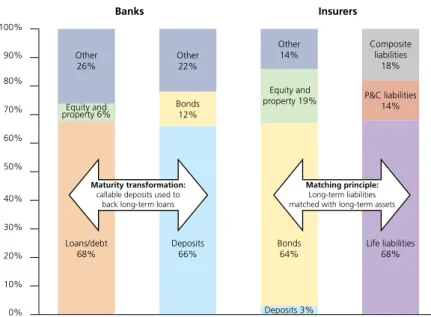
The balance sheet structures of banks and insurance companies show remarkable differences.
The balance sheet of insurers is economically stable, given that fairly long-term policyholder liabilities are matched with assets of corresponding duration. The risks faced by an insurer depend on both assets and liabilities as well as on the way these two interact.
In the case of banks, assets and liabilities are in principle not strictly “linked” and banks engage in maturity transformation, so that the average duration of most banks’ assets is longer than the average duration of their liabilities.
The balance sheet structures of banks and insurance companies show remarkable differences
Figure 7: How insurer and bank balance sheets differ
Sources: ECB; Bank of England; Oliver Wyman analysis
100% 90%
0%
Loans/debt
68% Deposits 66% Bonds 64% Life liabilities 68%
P&C liabilities 14% Composite liabilities 18% Other 14% Equity and property 19% Other 22% Bonds 12% Other 26% Equity and property 6% Deposits 3% 10% 50% 20% 60% 30% 70% 40% 80% Maturity transformation:
callable deposits used to back long-term loans
Matching principle:
Long-term liabilities matched with long-term assets
IV. Overview of risks facing banks and insurers
The stark difference between the business models of banks and insurers has a direct impact on the types of risks they are faced with. Indeed, there exist insurance-specific risks, bank-specific risks and risks which are common between the two but which impact them in different ways. In what follows an overview is provided of the risk landscape in which insurers and banks operate.
IV.1 Main risks faced by insurers
Insurance risk (underwriting risk)
Only insurers are faced with this specific type of risk. It relates to losses on an underwriting activity generated either by the inaccurate assessment of the risks insured or by unforeseen circumstances, out of an insurer’s control. Addressing it requires significant skill, data and instruments and this preoccupation lies at the core of an insurer’s management methods. This is particularly true for a number of complex exposures, such as:
•
Long tail-risks, which include longevity in life insurance and emerging risks8 innon-life.
•
Particularly violent natural catastrophe events, which have a high modelling risk9.•
Volatile lines, such as professional indemnity10, due to the reserving risk11.With the exception of natural and man-made disasters, the consequences of which can be mitigated by reinsurance, insurance risk diversifies well in sufficiently, large, homogeneous portfolios. It is not correlated to the economic cycle and impossible to eliminate entirely.
Investment risk (market risk)
Investment risk resides on the asset side of the balance sheet. As shown before, insurers
8 A risk perceived to be potentially significant but which may not yet be fully understood or allowed for in insurance terms and conditions (eg driverless vehicles, drones, cyber risk). 9 The risk of loss resulting from using models to make decisions.
10 Professional indemnity protects against a financial loss inflicted inadvertently by the policyholder to its client during work it provides to said client.
11 The risk that the actual cost of losses for obligations incurred before the valuation date will differ from expectations or assumptions.
Insurance risk diversifies well in sufficiently, large, homogeneous portfolios
aim to invest in assets of corresponding durations to those of their liabilities, to ensure that they can pay out claims as they occur, cover their operating cost and achieve a profit. But as investors, insurers are inevitably subject to a certain degree of investment (market) risk, emerging primarily from asset price fluctuations.
Since good diversification is essential to mitigate market risk, insurers need access to a broad range of assets that match their liability profile. To achieve diversification within a risk category, the insurer aims to engage in investments which are uncorrelated to a sufficient degree. Insurers always seek the optimal trade-off between risk and return within the duration, liquidity and return constraints created by their liabilities.
Asset transactions which insurers engage in can be counter-cyclical, given that insurers hold or even buy assets that are temporarily undervalued during a downturn and sell assets that are temporarily overvalued during a boom. Insurers routinely use investment policy statements, in which they define their investment philosophy, including thresholds for investment in more volatile asset classes.
Mismatch risk
The mismatch risk between assets and liabilities emerges when the economic values of the two develop differently over time. Insurance companies actively manage the mismatch risk so that their exposure to it is reduced or even eliminated by ensuring that the value of assets backed by technical provisions develops in sync with the value of the provisions. They can do this by careful asset liability management and through product design features such as profit-sharing. This is why the primary determinant of insurers’ asset allocation decisions is the duration, cash-flow profile and risk characteristics of their liabilities. Even where there are mismatches, insurers normally have an extended period of time to deal with mismatch risk, given that their liabilities are mostly long-term. This enables them to have a relatively stable and predictable funding position. Due to the particularities of the insurance business model, investment practices are fairly conservative in the insurance industry and investments are increasingly chosen to fund the expected pay-out pattern of claims.
Good diversification is essential to mitigate market risk
Mismatch risk is managed through asset-liability management and product design
IV.2 Main risks faced by banks
Credit risk
The core activity of a bank is providing a depository for savings and then transforming them into generally not very liquid assets such as housing loans and loans to businesses. Banks specialise in assessing the credit-worthiness of borrowers and in monitoring them to ensure that they meet their obligations. But a certain exposure to credit default risk (a borrower not repaying a loan in part or in full and in accordance with the agreed terms) is inherent to the banking business model. Credit risk is consequently linked primarily to activities in the banking book (ie loans granted to third parties and securities which are not actively traded by the institution but rather held until they mature). Recognising its importance for the huge majority of banking institutions, the first Basel Accord adopted in 1988 sought to address this specific risk category.
Addressing the size and complexity of credit risk exposure in banking requires high levels of skill, data, methods and instruments and is at the core of banks’ management and regulation. The Basel Committee on Banking Supervision introduced a series of sound practices12 in this respect:
•
establishing an appropriate credit risk environment•
operating under a sound credit-granting process•
maintaining an appropriate credit administration, measurement and monitoring process and•
ensuring adequate controls over credit risk.Liquidity risk
Because banks transform existing savings into loans to individuals and businesses, they perform a so-called “maturity transformation”. Consequently, the average duration of most banks’ assets is longer than the average duration of their liabilities. While assets consist to a large degree of longer-term loans, which cannot be turned into cash instantly, most deposits (liabilities) can be withdrawn immediately or at short notice. Banks also rely
12 “Principles for the management of credit risk”, Basel Committee on Banking Supervision, 2000. Exposure to credit default risk
is inherent to the banking business model
on the wholesale funding market, often with short-term maturities.
This structure accommodates the clients’ needs while also serving as a source of profit because the long-term interest rate is usually higher than the short-term one. But it also exposes banks to considerable liquidity risk if an asset cannot be sold or bought quickly enough to replace funding in a liquidity crisis. This is why banks need access to credit lines from other banks (interbank market) and from the central bank (lender of last resort guarantee). This myriad of interconnections, along with the existence of a central bank to which every bank is linked, constitutes the banking system.
Banks also hold liquid assets such as cash, government bonds or cash equivalents in order to protect themselves against this type of risk. These assets can be liquidated quickly if deposits are withdrawn or if wholesale funding at maturity cannot be replaced with new funding.
Because liquidity risk was one of the major drivers of several cases of financial distress during the recent crisis, the Basel Committee has decided to put in place new measures to address it. In the Basel III package, a liquidity coverage ratio (LCR) and a net stable funding ratio (NSFR) were introduced. The LCR ensures that banks have an adequate stock of unencumbered high-quality liquid assets that can be converted easily and immediately in private markets into cash to meet their liquidity needs for a 30 calendar day liquidity stress scenario13. This is meant to improve the short-term resilience of banks’ liquidity profile.
The NSFR calculates the proportion of long-term assets that are funded by long-term stable funding, and the requirement is that the ratio exceeds 100%14.
Market risk
While insurers and banks both invest in financial assets, they do so for different reasons. For insurers investment is a core activity generated by the need to invest their premiums until claims/benefits become due. For a retail bank, investing is not a core activity but rather a way to boost profits (their core activity is accepting deposits and granting loans).
13 “Basel III : the liquidity coverage ratio and liquidity risk monitoring tools”, Basel Committee on Banking Supervision, 2013.
14 “Basel III: the net stable funding ratio”, Basel Committee on Banking Supervision, 2014.
The Basel Committee has put new measures in place to address liquidity risk
The European Banking Authority defines market risk as “the risk of losses in on and off balance sheet positions arising from adverse movements in market prices.” As investors, banks are exposed to fluctuations in the price of financial instruments on and off their balance sheet. Therefore, market risk stems from all the positions included in banks’ trading book, as well as from commodity and foreign exchange risk positions in the whole balance sheet.
Banks use sophisticated mathematical and statistical models to quantify and manage market risk; the most well-known of these is Value-at-Risk (VaR), a model which ordinarily includes several thousand potential risk factors. However, this model has failed to capture some significant risk events in the previous decades (such as the 1998 crisis at Long Term Capital Management or the financial crisis) and there is a view that bank risk models have limitations, and that access to high-quality market data should be improved. The Basel III reform addresses these longstanding regulatory concerns with traditional VaR by imposing additional risk-based capital requirements (stressed term capital requirement, long-term incremental risk charge, comprehensive risk capital requirement and a specific risk charge). In addition, it imposes a non-risk-based leverage ratio requirement as a backstop (see section II, question 8).
Compliance risk
The compliance and regulatory landscape has shifted considerably in the past decade, evolving to become more complex. As a consequence, compliance risk is gaining an increasing importance in banking. Banks now face high costs and losses in the form of staffing needs, penalties and litigation and the unpredictable (but potentially hefty) nature of these costs of non-compliance only makes this more problematic.
Compliance failures can also cause significant reputational damage, imposing a significant drag on banks’ business performance. Since most banks are not fully equipped to deal with the new regulatory requirements in a consistent way, a long period of acclimatisation is likely to follow given the large number of new regulations aimed at banks which will enter into force in the coming years (eg new capital requirements through Basel III, the banking union package, various proposals to reform banks’ structure).
Compliance risk is gaining an increasing importance in banking
IV.3 Focus on two key risks
Liquidity risk
As shown before, banks face considerable liquidity risk because their liabilities (withdrawable deposits) have a shorter duration than their assets (long-term loans). Banks rely on the wholesale funding market and interbank market, where short-maturity loans are often contracted to cover liquidity needs. When a liquidity crisis occurs and this lending source dries up, assets can’t be liquidated fast enough to replace the short-term funding usually available.
In contrast, liquidity risk is far less problematic in insurance, for a number of reasons:
•
Insurance policyholders are typically less inclined to cancel their policies even duringperiods of market turbulence. This is because policyholders still (or even more so) value their protection in a financial downturn. Furthermore, most insurance policies impose some form of penalty for early surrender so as to dis-incentivise the policyholder from doing so. In any case, a certain risk of lapse is incorporated by the insurer in the estimation of the liability value and its expected duration.
•
On the asset side, insurers match the profile of their assets with that of theirliabilities, in terms of duration and illiquidity. In addition, insurers have access to a stable flow of cash (pure liquidity) originating from new premiums, maturing assets or investment income. Insurers are generally diversified companies, and therefore benefit considerably from risk diversification across product lines and time. This limits the extent to which large unexpected claims can occur and stabilises aggregate pay-outs. Larger single claims usually have a longer, sometimes multi-year, pay-out period and also benefit from reinsurance coverage.
•
Finally, since there is no “interinsurer” funding market similar to the interbank market, if one insurance company faces liquidity issues, this has little if any impact on the others.Systemic risk
Systemic risk is defined as the risk of disruption to the flow of financial services that is caused by an impairment of all or parts of the financial system and has the potential to have serious negative consequences for the economy. The Financial Stability Board and the International Association of Insurance Supervisors suggest assessing the systemic importance of individual financial institutions along the following criteria:
•
size - the volume of financial services provided•
interconnectedness - linkages with other components of the system•
lack of substitutability - the extent to which other components of the system can provide the same services in the event of a failure•
speed of contagion to the economyAs shown before, insurance companies and banks have very different business models and these also result in a very different potential exposure to systemic risk.
A bank’s business model relies on complex interconnections with the rest of the financial system. Banks engage in maturity transformation by acting as intermediaries between savers who deposit money into liquid accounts and borrowers in need of loans with long maturities. They rely on interbank lending for their financing needs (as a protection against liquidity risk) and can make considerable recourse to leverage. Furthermore, under the “originate to distribute” model, banks use securitisation to transfer to counterparties the credit risk they take on through extending a loan. This myriad of interconnections, along with the existence of a central bank (which acts as a lender of last resort and to which every bank is linked) constitute the banking system. As a result, the bigger a bank gets, the more interconnected it is and the more systemically risky it becomes, since its failure would create a domino effect which could seriously impair the functioning of this system.
In contrast, insurance companies are generally more financially stable the bigger they get, as the correlation between the risks faced by policyholders decreases with the total number of risks insured, according to the law of large numbers (see page 11).
Interconnectedness in insurance and reinsurance is qualitatively different from banking. In particular, insurance obligations, unlike short-term bank obligations, are not liquid and settle over a very long period of time. Underwriting risks are generally not correlated with other financial risk. This characteristic allows the insurance and reinsurance industry much more time to respond to exogenous financial market events and settle their obligations to other financial counterparties in accordance with the contract terms even under crisis conditions. The limited risk of contagion in case of an insurer’s failure is also the result of the lack of close business relationships between competing insurance companies. There is no balance sheet link between these companies and there is also no “central insurer” similar to a central bank. Thus, it becomes difficult to argue that an “insurance system” exists.
Insurers also retain almost all of the risk they underwrite on their own balance sheet, the rest being transferred to reinsurers and/or, to a very limited extent to capital markets through insurance securitisation. In any case, insurers remain completely liable to their policyholders, as even these ceded risks remain on their balance sheet.
The services that support insurance activities are readily substitutable in the market, with portfolios being transferable to alternate providers. The International Association of Insurance Supervisors study “Insurance and Financial Stability”15 recognised that
“a lack of substitutability does not appear to be an issue in the insurance industry”. Insurance markets tend to be fragmented and competitive and this allows for the smooth replacement of lost coverage in the event of an insurer failure, which makes continuity of coverage for policyholders possible. Exceptional events may cause significant changes to the underwriting conditions of certain risks and this can result in a temporary shortfall of insurance capacity and/or to sharply higher premiums. But past experience has shown that such abrupt capacity shortages were short-lived, as fresh capacity was quickly built by new entrants in the market.
Finally, financial problems develop at a much slower pace in insurance than in banking, given the extended time horizon of insurers’ liabilities, which can fall due over decades. For the insurance companies under the scope of Solvency II, there will be two solvency
capital requirements (SCR) on top of technical provisions allowing for a supervisory ladder of intervention in the case of a breach. These two elements ensure that the speed of contagion in the case of an insurer failure is very low and that both management and supervisors have enough time to deal with a potential deterioration.
The speed of contagion in the case of an insurer failure is very low
Section II —
1. Should large insurers automatically be considered systemically risky?
The short answer
No. In the case of insurers, unlike banks, size is not a good indicator of their systemic risk potential. In fact, the more diversified an insurer is and the larger the number of independent risks it insures, the more secure it becomes as it is less exposed to a single event that would require paying out all at once. In addition, insurers are not as interconnected to the wider financial system as banks are and consequently the failure of an insurer cannot set off a domino effect resulting in widespread contagion.
The detailed answer
A bank’s business model relies on complex interconnections with the rest of the financial system. Banks engage in maturity transformation by acting as intermediaries between savers who deposit money into liquid accounts and borrowers in need of loans with long maturities. They rely on interbank lending for their financing needs and can make considerable use of leverage. Furthermore, under the “originate to distribute” model, banks use securitisation to transfer to counterparties the credit risk they take on through extending a loan. These various interconnections, along with the existence of a central bank (which acts as a lender of last resort and to which every bank is linked) constitute the banking system.
As a result, the bigger a bank gets, the more systemically risky it is, since its failure would create a domino effect which could seriously impair the functioning of the financial system. This leads to “too big to fail” situations, when governments realise they can’t afford to let a bank fail, no matter how costly its rescue through public funds would be. In contrast, insurers retain almost all of the risk they underwrite on their own balance sheet, the rest (around 5%) being transferred to reinsurers and/or, to a very limited extent to capital markets through insurance securitisation. Issuance of Insurance-Linked Securities (ILS) amounted to around 0.1% of global insurance premiums in 201216. In any
case, insurers remain completely liable to their policyholders, as even these ceded risks remain on their balance sheet.
Insurance works by pooling risk, not by exchanging or transferring risk, which means that insurers and policyholders don’t have to have different attitudes towards risk for an insurance transaction to occur. The condition for an insurer’s business model to function correctly is that the risks insured should be uncorrelated (independent of one another). It follows that in order to achieve an exposure to uncorrelated risks insurers need to sell diversified policies. This diversification applies to products, geographical areas, or markets. The more diversified policies an insurer sells, the smaller the interdependence between insured events will become. This is the law of large numbers, which lies at the core of insurance. The higher the number of independent, homogenous exposures insured, the higher the likelihood that actual losses will be very close to expected and budgeted losses. Given that the actual loss is almost certainly going to be close to the expected loss, and therefore already accounted for in the original premium, insurers will manage to cover it without having to make recourse to capital or to collect additional premiums.
Consequently, insurance companies tend to become more financially stable the bigger they get, as the correlation between the risks faced by different policyholders decreases with the total number of risks insured.
If an insurer considers that the risks it has assumed surpass the risk-bearing capacity of its portfolio of assets, it may choose to transfer a part of them to a reinsurer, which further diversifies the risks by pooling them on a more global scale. In those rare situations when actual losses deviate significantly from expected losses, insurers have in place contingency plans which can involve using capital (ie own funds) to pay out claims as agreed.
Due to their constant income from premiums which are paid up front, insurers need very limited short-term refinancing and hence face only minor liquidity risks.
Furthermore, the interconnectedness between a particular insurance company and the rest of the financial system is limited. This is due to the nature of the business model which enables insurers to not be dependent on short-term market-based funding; there is
no “interinsurer” funding market similar to the interbank market, so even if an insurance company would face liquidity issues, this would have little if any impact on other insurers. In addition, there is a lack of close business relationships between competing insurance companies: there is no balance sheet link between them and there is also no “central insurer” similar to a central bank. It is therefore difficult to argue that an “insurance system” exists. As a result, the systemic risk that originates in insurance is much lower than in banking.
The Financial Stability Board and the International Association of Insurance Supervisors acknowledged that the size of an insurer, in and of itself, does not create systemic risk concerns. But in July 2013, the two organisations published a list of nine insurance companies deemed to be of systemic importance. The ranking is devised by aggregating a number of indicators, with the greatest weight going to non-traditional non-insurance activity (45%) and interconnectedness (40%). Size carries a 5% weight. Notwithstanding the low weight placed on size, the methodology produced little more than a list of large insurers. This was largely because the indicators used have a volume component based on an insurer’s aggregate size relative to other insurers included in the sample; therefore size across all categories heavily influenced the final scoring.
2. Are insurance activities systemically risky?
The short answer
No. Traditional insurance is not systemically risky. Systemic risk in insurance can only originate from a very limited number of activities undertaken on a large scale in the wrong conditions, which could have a negative impact on the wider financial system in case of failure. Systemic risk regulation should therefore target these specific activities irrespective of which company undertakes them.
Therefore, insurers should be regulated on an activity-by-activity basis. Targeting systemic risk regulation at company level instead would place an unnecessary burden on traditional insurers whose activity reduces the aggregate risk in the financial system. On the other hand, an activities-based approach would provide protection against systemic events by
subjecting all potentially systemic activities to appropriate regulatory scrutiny.
The detailed answer
Traditional insurance business has been shown not to create or amplify systemic risk, since the business is long-term, funding is generally upfront and both liquidity risk, and interconnectedness are low compared to banks.
In insurance, risks to the financial system primarily stem from activities which result in maturity transformation or liquidity strains as well as from high levels of interconnectedness. In other words, risks can develop if insurers behave like non-insurers. The focus of systemic risk regulation should be on identifying and addressing these specific situations and the insurers which undertake such activities should be the subject of enhanced regulation. But two important qualifications have to be made:
•
“Systemically relevant activities” should not be equated with non-traditional non-insurance (NTNI) activities; just because an activity is NTNI doesn’t mean it’s systemically important.•
It is not the presence of NTNI activities alone that makes an insurer systemically relevant, but the absolute size of these activities measured against the overall market size. NTNIs would need to be of a size sufficient enough that potential shocks originating from them could pose a real risk to the financial system. Since an agreed upon definition of NTNI activities does not exist so far, a better approach to systemic risk regulation could be considered.A separation should be made between those activities of an insurer that directly cause damage to financial markets or the real economy and those through which an insurer is merely hit by outside events and further transmits this shock to the economy. The former would be considered systemically risky and latter could be considered systemically relevant and would need to be addressed by standard prudential regulation.
3. Why did AIG fail?
The short answer
The crisis at AIG was caused primarily by a non-insurance subsidiary that was outside the scope of insurance regulation. It was the consequence of a blatant failure to adequately address the build-up of risk by both the management of the firm and its supervisors. The non-insurance subsidiary that caused the problems sold swaps offering loss protection to investors in assets such as collateralised debt obligations (which included sub-prime loans) without sufficient liquidity or reserves to cope with the financial crisis in 2008. However, AIG’s traditional insurance businesses remained viable at all times. Each traditional insurance business was overseen by the local insurance supervisors but in contrast, the non-insurance division was laxly-supervised by the US Office of Thrift Supervision (OTS), which was discredited and ultimately dissolved in 2011.
Effective regulation and, more specifically, greater supervisory coordination at both sectoral and international level would have prevented AIG from ever gaining a position of systemic relevance in the global swap market and from building up an excessive risk concentration in the mortgage-backed securities market.
Consequently, this event is not indicative of the systemic risk potential of the insurance industry, as it followed from non-insurance activities undertaken by a subsidiary of AIG without sufficient capital backing and risk control. Rather, it demonstrates that the primary consideration should be whether insurers are engaging in risky, non-insurance activities such as CDS underwriting on a large scale and, if so, whether these activities require specific regulatory measures to address the potential systemic risk they pose (see question 2).
The detailed answer
The bailout of American International Group (AIG) in September 2008 was, along with the failure of Lehman Brothers, one of the defining moments of the financial crisis. AIG, generally described at the time as the world’s biggest insurer and provider of coverage to
countless families and companies, would have gone under if the United States government hadn’t decided to extend an $85bn rescue package to the company, considering it too big to fail.
Even though AIG is known as an insurer, it is important to point out that its 2008 near-failure was caused primarily by a non-insurance subsidiary named AIG Financial Products (AIGFP). AIGFP had historically been tasked with underwriting risks associated with investments (eg interest risk, business cycle risk), but had switched focus in its later years to insuring Collateralised Debt Obligations (CDOs).
CDOs combine several types of debt of different quality (and risk profile) in a single security (structured in tranches). They were created by investment banks for investors who owned large quantities of mortgage-backed securities. The lower tranches of the CDO were often filled with residential loans of highly doubtful quality (sub-prime loans). In spite of this, CDOs were nevertheless awarded the highest possible rating by agencies and thus constituted a very attractive investment, so much so that the global CDO market was worth over $1 500bn in 2007.
AIGFP believed that it was very unlikely that CDOs would default en masse so considered it potentially lucrative to sell protection against the risk of default through an instrument called Credit Default Swap (CDS). However, they also ignored their exposure to market value changes in these CDOs. AIGFP therefore sold CDS without having either sufficient reserves to settle them, or enough liquidity to post collateral. As a result, its revenues surged to over $3bn in 2005, more than 17% of those of AIG Holding.
This extensive CDS-writing activity resulted in a substantial and concentrated exposure to the US housing market, with a large portion being written on prime loans. When sub-prime loans went delinquent and foreclosures rose to extremely high levels, CDOs started to fall in value and AIGFP was faced with claims it could not settle. Consequently, the AIGFP division incurred losses of $25bn. When AIG’s credit rating was lowered as a result of these losses, AIGFP also had to post more collateral for its bondholders (over $10bn), further deepening its troubles.
Losses associated to badly managed collateral originating from its securities lending operations made matters worse. The company was lending out securities such as stocks and bonds (held with a long-term view), in exchange for cash collateral. While this is part of normal securities lending operations, AIG took the unconventional decision to reinvest the majority of the cash collateral received through securities lending in highly-rated residential mortgage-backed securities (RMBS). This concentration of securities-lending collateral in RMBS was risky because it gave rise to a maturity mismatch between the securities which were being loaned and the RMBS. When a very large number of residential loans went delinquent and borrowers stopped rolling over loans and posting cash collateral, AIG was faced with what was in effect a run on its securities lending programme in September 2008 and had to pay $5.2bn in cash to securities lending counterparties in a single day. The thin cash cushion that AIG had earmarked for meeting redemptions from counterparties did not suffice to deal with this development. In summary AIG’s significant loss, sometimes misleadingly associated with the activity of securities lending, actually was the result of an extremely aggressive strategy of funding long-term investments on a short-term basis.
It has to be noted that while the activities of AIGFP were at the root of AIG Holding’s near-collapse, the holding’s traditional insurance business did not encounter any difficulty.
4. What is the difference between the resolution of insurers and the
resolution of banks?
The short answer
The unique characteristics of the insurance business model (long time horizon, illiquidity and contingency of liabilities) stand in clear contrast to those of banks; resolution regimes should closely reflect that.
The key difference between a bank’s resolution and an insurer’s resolution is that the latter can occur over an extended period of time. Given that insurers can’t be subject to a “run” as banks can be, there is no need to rush into resolution, particularly because this could generate avoidable losses for policyholders.
When devising resolution rules or guidelines for insurers, the focus should therefore not be on speed, as this could in fact be detrimental to policy holders. Instead, the toolkit made available to resolution authorities should be tailored to the specificities of insurance.
The detailed answer
Bank resolution
Banks act as intermediaries between savers who deposit money into generally liquid accounts and borrowers in need of loans with typically long maturities. This maturity transformation is an important aspect of the role of banks in the economy, as it frees up funds for investment projects with a long-term horizon, while still offering liquidity to depositors. A bank’s business model relies on a key assumption: all depositors will not be asking for their money back at the same time, since depositors’ needs for cash are unlikely to occur at the same time. In other words, even though in principle most depositors enjoy a right of instant withdrawal, only a fraction of them will act upon this right.
If confidence in a bank’s ability to repay its obligations is lost, there is a chance that most or all of its depositors will suddenly and simultaneously attempt to withdraw their funds, giving rise to a “bank run”. The bank will be able to repay the first depositors who request it, but given its inability to realise its illiquid assets in a short period of time, it will run out of money long before all its liabilities towards all its creditors are repaid.
In principle, nothing fundamental needs to go wrong within the bank for a bank run to occur. The underlying health of a bank is irrelevant if all depositors believe that the other depositors will withdraw funds. A liquidity problem can in theory occur even in the absence of an underlying solvency issue.
Another feature of banking is that the lack of confidence in one bank can be transmitted to others, given the high level of interconnectedness within that sector. This so-called “contagion” threatens the whole financial system.
When a bank run is triggered, normal insolvency procedures are not fast enough to preserve financial stability. These procedures can last for extended periods of time,