Health Informatics in Developing Countries:
Systematic Review of Reviews
Contribution of the IMIA Working Group Health Informatics
for Development
D. Luna
1, C. Otero
2, A. Marcelo
31
IMIA Health Informatics for Development Working Group Chair, and Chair of Health Informatics
Department, Hospital Italiano de Buenos Aires, Argentina
2
Oregon Health and Science University, USA, and Hospital Italiano de Buenos Aires, Argentina
3IMIA Health Informatics for Development Working Group Co-Chair, National Telehealth Center,
University of the Philippines Manila, Philippines
Summary
Objectives: An evidence-base is important for medicine and health informatics. Despite numerous publications showing the benefits of health informatics, the emergence of health infor-mation systems in developing countries has been slower than expected. The aim of this paper is to identify systematic reviews on the domain of health informatics in developing countries, and classify the different types of applications covered.
Methods: A systematic review of reviews was conducted. The literature search spanned the time period between 2000 and 2012 and included PubMed, EMBASE, CINAHL, Scopus, Cochrane Systematic Reviews, LILACS, and Google Scholar. The search term was ‘systematic reviews of health informatics in developing coun-tries’, and transparent and systematic procedures were applied to limit bias at all stages.
Results: Of the 982 identified articles, only 10 met the inclusion criteria and one more article was added in a second manual search, resulting in a total of 11 systematic reviews for the analysis.
Conclusions: Although it was difficult to find high quality resources on the selected domain, the best evidence available allowed us to generate this report and create an incipient review of the state of the art in health informatics in the developing countries. More studies will be needed to optimize the results.
Keywords
Medical Informatics, developing countries, evidence-based medicine
Yearb Med Inform 2013:28-33
Introduction
Health informatics applications are intended to support healthcare providers and organiza-tions in delivering the best care to patients. Their introduction can radically affect health care organization, service delivery and out-come. The use of modern information and communication technology (ICT) offers tremendous opportunities to support health care professionals and to increase the effi-ciency, effectiveness and appropriateness of healthcare [1]. ICT also has the potential to decrease unintended variation in practice and occurrence of medical errors [2].
Sacket defines Evidence-based Medicine as the ‘conscientious, explicit and judicious use of current best evidence in making de-cisions about the care of individual patients’ [3]. The term Evidence-Based Health Infor-matics (EBHI) was introduced subsequently [4], and was an adaptation of Sacket´s origi-nal definition to health informatics. EBHI can be understood as the conscientious, explicit, and judicious use of current best evidence about introduction and operation of Infor-mation Technology (IT) into a given health care setting [1]. Also, it has been argued that this approach provides better support for in-formation systems applied to healthcare [5]. The benefits of health information tech-nology have been sufficiently demonstrated in first world countries where numerous public and private programs that encourage the development and diffusion of health informatics have been carried out.
Devel-oping countries on the other hand have had less success with the penetration of health informatics [6, 7]. The purpose of this review is to assess the state of the art health informatics in developing countries through a systematic review of reviews. While there is a large number of non-sys-tematic narrative reviews in health IT, there are fewer systematic reviews and even less meta-analyses on this topic [8].
Objective
The aim of this work is to perform a system-atic review to summarize the evidence on the state of health informatics in developing countries. This review also investigates what types of applications were covered in these papers and what factors contributed to their success or failures..
Methods
The authors performed a systematic review on health informatics in developing coun-tries, and evaluated both quantitative and qualitative researches.
Data Source
Searches were performed for publication dates ranging from 2000 to 2012, from data sources such as PubMed, EMBASE, CINAHL, Scopus, Cochrane Systematic
Reviews, Latin American and Caribbean Health Science Literature Database (LI-LACS), and Google Scholar. Some addi-tional relevant studies were identified in a second stage from related citations in articles evaluated in the first selection.
Review Selection
Two reviewers (DL, CO) independently ex-amined titles and abstracts. Relevant review articles were obtained in full text, and as-sessed against the inclusion criteria. Inter-re-viewers agreement on inclusion as assessed using kappa statistics and any disagreements were resolved through discussion.
Inclusion and Exclusion Criteria
Due to the importance to work with quality reviews, a paper was qualified to be included in this revision if it was made with an explicit and systematic question and if the search strategy was clearly explained. All languages were included but only papers pertaining to developing countries were analyzed. Dupli-cate references were excluded.
Data Analysis
Papers were analyzed according to the principal aim of the review. Categories were defined when saturation was reached. Publications were classified according to the following criteria related to the saturation effect in the review’s analysis:
• Storage, retrieval, and data transmission / IT implementations
• Clinical decision making / Support sys-tems / Disease management
• Remote Care / Telemedicine
• Mobile health (mHealth)
Search Strategy
A first stage included PubMed, EMBASE, CINAHL, Scopus, Cochrane Systematic Reviews and LILACS databases, as well as Google Scholar. The search was limited to systematic reviews in health informatics in developing countries from 2000 to 2012,
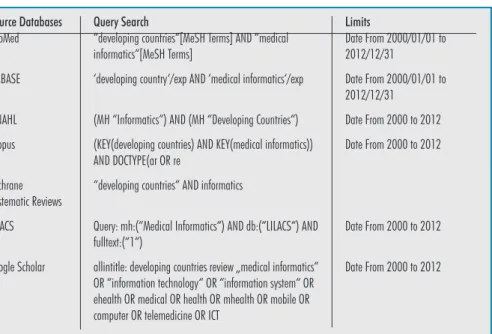
taking into account the characteristics of the search engine for each source. In a second stage a new search was performed using the reference lists cited by the articles of the first set, and further searches using related articles functionality. The different search strategies used are specified in Table 1.
Results
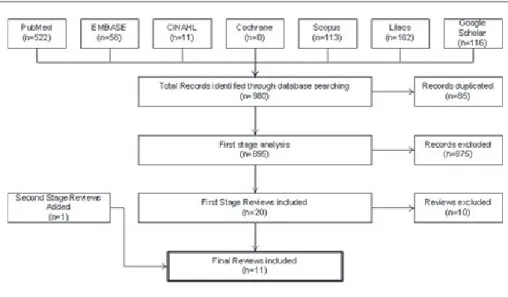
The search yielded a total of 980 publica-tions, 85 were removed because of duplica-tion, and 875 were excluded for not meeting the inclusion criteria (Fig. 1). In a deep full text analysis of the 20 reviews selected in the first stage, 10 papers were excluded because they weren’t systematic reviews (but since they included interesting data and taking into account the few quality resources avail-able, the authors decided to comment the highlights of these articles in the discussion section). In a second stage, using the refer-ence lists included in the first set of articles, further searches were made and one relevant publication was added, giving a total of 11 reviews to consider.
The inter-rater reliability (Kappa) for applying review selection criteria was 0.71 (95%CI: 0.61 to 0.80).
Review Characteristics
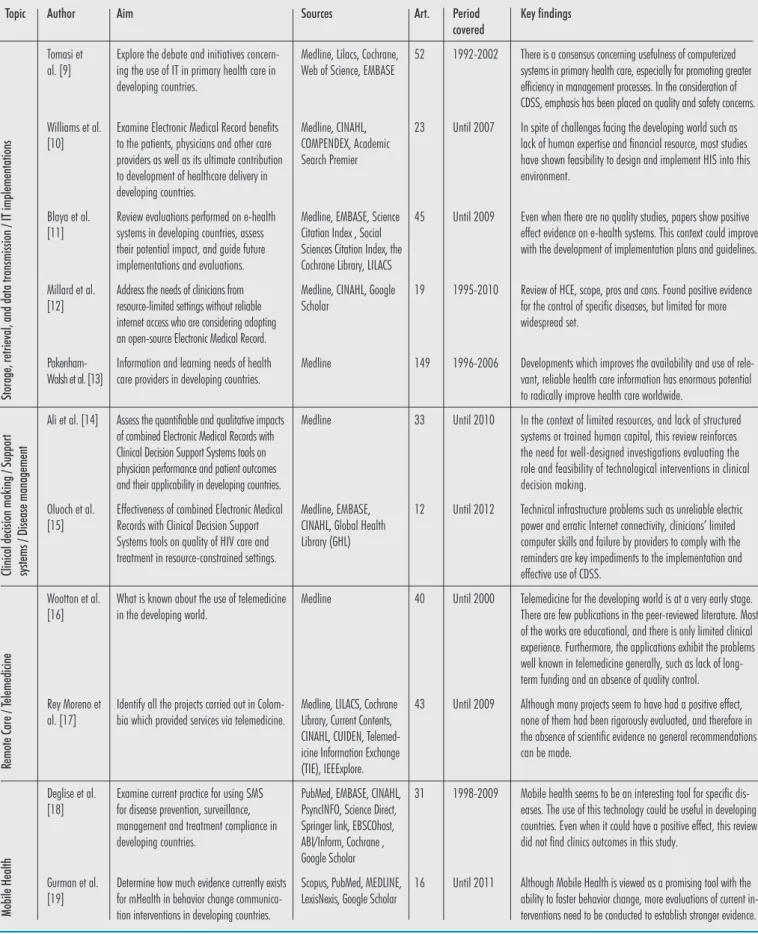
This section describes the relevant topics of each review (see Table 2 for the charac-teristics and classification criteria of the 11 reviews evaluated).
Five papers were related to the category storage, retrieval, and data transmission/ IT implementation. In the last topic, Tomasi et al [9] evaluated 52 articles, in their review concluding in first instance, the difficulty to find quality studies in this domain. Authors recognized the publication bias that could exist when working with developing countries and highlighted the low adherence to health IT in primary care setting, even when physicians recognized the usefulness of computerized systems in primary health care, especially for pro-moting greater efficiency in management processes. In the same way Williams et al [10] recognized some limitations such as lack of human expertise and financial resources and challenges with the technical infrastructure. Blayas’ review [11] concurs in the sense that developing countries are ripe for health IT implementation. Millard et al. [12] studied open-source point-of-care Electronic Medical Records (EMRs) for use in resource-limited settings without reliable internet access. Among the six open-source
Table 1 Source databases and the corresponding query search used Source Databases PubMed EMBASE CINAHL Scopus Cochrane Systematic Reviews LILACS Google Scholar Query Search
“developing countries“[MeSH Terms] AND “medical informatics“[MeSH Terms]
‘developing country‘/exp AND ‘medical informatics‘/exp (MH “Informatics“) AND (MH “Developing Countries“) (KEY(developing countries) AND KEY(medical informatics)) AND DOCTYPE(ar OR re
“developing countries“ AND informatics
Query: mh:(“Medical Informatics“) AND db:(“LILACS“) AND fulltext:(“1“)
allintitle: developing countries review „medical informatics“ OR “information technology“ OR “information system“ OR ehealth OR medical OR health OR mhealth OR mobile OR computer OR telemedicine OR ICT
Limits Date From 2000/01/01 to 2012/12/31 Date From 2000/01/01 to 2012/12/31 Date From 2000 to 2012 Date From 2000 to 2012 Date From 2000 to 2012 Date From 2000 to 2012
EMRs that they found, none met the min-imum requirements for a fully functioning EMR suitable for use in resource- limited settings. The authors recommended the necessity of an international body directly testing these products to determine their clinical functionalities and limitations. Con-cerning access to information of health care workers, Pakenham-Walsh et al. [13] found that information needs are varied and are constantly under the influence of multiple factors (professional, institutional, cultural and infrastructural).
Three reviews were focused on topics related to the category disease manage-ment and clinical decision support systems (CDSSs)”. The first one was related to diabetes [14] and found positive results in the patient’s prognosis. The second one was related to HIV [15] and highlighted the effectiveness of IT in health care, but admitted that the system was not prepared for a whole implementation. The last review, focused on Africa, introduced another com-plexity in this setting: the difficulties of the environment such as electricity access and technical support.
Telemedicine is one of the biggest challenge in developing countries, and maybe, the most diffused topic in health informatics as there are few quality studies in this issue. Two reviews were found, one from Wootton et al. [16] and one from Rey
Moreno et al. [17]. Wootton concluded that telemedicine is still at a very early stage. There are very few publications in the peer-reviewed literature and most of them are in the nature of review articles or editorials. For Wootton, telemedicine will not help directly with infrastructure problems such as the provision of sanitation or drinking water. However, it may help indirectly, by improving the organization of health-care. Also comments that faults of telemedicine occurring in the industri-alized world are occurring in telemedicine projects in developing countries. Such faults include: excessive expectations; unsustainable funding models; lack of trials and evaluation data; lack of published re-sults and sharing of expertise. Rey Moreno agree with Wootton on the poor quality of papers, and that although many projects in Colombia (his setting for the review) seem to have had a positive effect, none of them had been rigorously evaluated, and there-fore in the absence of scientific evidence no general recommendations can be made.
The last category analyzed for this review is the more recent topic discussed in health informatics: mobile health or mHealth. Two articles agree that new mobile technologies could show benefits in controlled settings like special diseases (chronic diseases for example) or specific populations, but there is a dearth of quality papers on this topic
and even less where clinical outcomes have been shown. Also, compared with the spread of mobile phones and personal devices, the development of mobile health applications has not been as high as expected [18, 19].
Evidence Synthesis
In summary, all the reviews agree that the papers evaluated are generally of poor quality. Even though the benefits of health informatics have been published and demon-strated in the literature among developed countries, developing countries have not exhibited the same behavior. Thus, authors agree on the publication bias of their review, considering the difficulty to publish, and the limited access to a peer review process for the medical informatics research teams of these countries. Even so, authors agree that the field is fertile, and the perception of health care workers is in favor of the computerization process. More quality researches are needed.
Discussion
Limitations: Some limitations inherent to
the methodology of this systematic review need to be addressed. An important limita-tion is linked to the choice of key words and search strings. The concept of Medical Informatics covers a broad spectrum: the choice of MESH terms was difficult across all databases.
By incorporating developing countries as a descriptor in our inclusion criteria, some reviews that are more general in scope and have not been indexed with this term could have been lost. In the same way the use of Mesh Terms in our search strategy in PubMed could have omitted papers indexed differently. The authors felt this could be compensated with a search on Google Scholar.
The authors chose to be more restric-tive in the Google Scholar search strategy in order to optimize results. The search strategy used keywords in the title for the purpose of improving the specificity of the search strategy.
Table 2 Characteristics of the reviews evaluated
Storage, retrieval, and data transmission / IT implementations
Author Tomasi et al. [9] Williams et al. [10] Blaya et al. [11] Millard et al. [12] Pakenham-Walsh et al. [13] Ali et al. [14] Oluoch et al. [15] Wootton et al. [16] Rey Moreno et al. [17] Deglise et al. [18] Gurman et al. [19] Aim
Explore the debate and initiatives concern-ing the use of IT in primary health care in developing countries.
Examine Electronic Medical Record benefits to the patients, physicians and other care providers as well as its ultimate contribution to development of healthcare delivery in developing countries.
Review evaluations performed on e-health systems in developing countries, assess their potential impact, and guide future implementations and evaluations. Address the needs of clinicians from resource-limited settings without reliable internet access who are considering adopting an open-source Electronic Medical Record. Information and learning needs of health care providers in developing countries. Assess the quantifiable and qualitative impacts of combined Electronic Medical Records with Clinical Decision Support Systems tools on physician performance and patient outcomes and their applicability in developing countries. Effectiveness of combined Electronic Medical Records with Clinical Decision Support Systems tools on quality of HIV care and treatment in resource-constrained settings. What is known about the use of telemedicine in the developing world.
Identify all the projects carried out in Colom-bia which provided services via telemedicine.
Examine current practice for using SMS for disease prevention, surveillance, management and treatment compliance in developing countries.
Determine how much evidence currently exists for mHealth in behavior change communica-tion intervencommunica-tions in developing countries.
Sources
Medline, Lilacs, Cochrane, Web of Science, EMBASE
Medline, CINAHL, COMPENDEX, Academic Search Premier
Medline, EMBASE, Science Citation Index , Social Sciences Citation Index, the Cochrane Library, LILACS Medline, CINAHL, Google Scholar
Medline
Medline
Medline, EMBASE, CINAHL, Global Health Library (GHL)
Medline
Medline, LILACS, Cochrane Library, Current Contents, CINAHL, CUIDEN, Telemed-icine Information Exchange (TIE), IEEExplore. PubMed, EMBASE, CINAHL, PsyncINFO, Science Direct, Springer link, EBSCOhost, ABI/Inform, Cochrane , Google Scholar Scopus, PubMed, MEDLINE, LexisNexis, Google Scholar
Art. 52 23 45 19 149 33 12 40 43 31 16 Period covered 1992-2002 Until 2007 Until 2009 1995-2010 1996-2006 Until 2010 Until 2012 Until 2000 Until 2009 1998-2009 Until 2011 Key findings
There is a consensus concerning usefulness of computerized systems in primary health care, especially for promoting greater efficiency in management processes. In the consideration of CDSS, emphasis has been placed on quality and safety concerns. In spite of challenges facing the developing world such as lack of human expertise and financial resource, most studies have shown feasibility to design and implement HIS into this environment.
Even when there are no quality studies, papers show positive effect evidence on e-health systems. This context could improve with the development of implementation plans and guidelines. Review of HCE, scope, pros and cons. Found positive evidence for the control of specific diseases, but limited for more widespread set.
Developments which improves the availability and use of rele-vant, reliable health care information has enormous potential to radically improve health care worldwide.
In the context of limited resources, and lack of structured systems or trained human capital, this review reinforces the need for well-designed investigations evaluating the role and feasibility of technological interventions in clinical decision making.
Technical infrastructure problems such as unreliable electric power and erratic Internet connectivity, clinicians’ limited computer skills and failure by providers to comply with the reminders are key impediments to the implementation and effective use of CDSS.
Telemedicine for the developing world is at a very early stage. There are few publications in the peer-reviewed literature. Most of the works are educational, and there is only limited clinical experience. Furthermore, the applications exhibit the problems well known in telemedicine generally, such as lack of long-term funding and an absence of quality control. Although many projects seem to have had a positive effect, none of them had been rigorously evaluated, and therefore in the absence of scientific evidence no general recommendations can be made.
Mobile health seems to be an interesting tool for specific dis-eases. The use of this technology could be useful in developing countries. Even when it could have a positive effect, this review did not find clinics outcomes in this study.
Although Mobile Health is viewed as a promising tool with the ability to foster behavior change, more evaluations of current in-terventions need to be conducted to establish stronger evidence.
Clinical decision making / Support systems / Disease management
Remote Care / T
elemedicine
Mobile Health
With a different strategy to mitigate this limitation, and without the limit of “devel-oping country”, we would have to analyze much more papers, and we would have thus required more resources. Because of that, we decided to perform the search as described in the method.
Strengths: This systematic review was
comprehensive, based on the most important indexed databases for medical informatics topics. Some publications from the grey literature have been probably covered since Google Scholar was included as a resource, because of its known coverage of peer-reviewed journals databases [20], and its ability to identify articles not indexed in PubMed [21].
Data sources: We performed some searches in
LILACS in order to access Latin-Americans resources. This strategy included only full text. We used Cochrane too, like a recognized source of EBM resources, but no reviews related to developing countries were found. This is not surprising since the Cochrane Col-laboration is focused on a limited number of systematic reviews related to IT interventions in health care, such as the review on CDSSs for neonatal care [22], or computerized advice on drug dosage [23], to name a few.
Some of the biggest challenges in this review dealt with the two principal topics of this analysis: Health Information Systems and Developing Countries While there is no strict definition of the term ‘Health Informa-tion System’ that covers a disparate world of meanings, the term ‘Developing Countries’ includes a wide range of countries and re-gions. In reality, the diversity of so-called developing countries could be varied. Even so, this review tried to describe a general view of these topics.
Although large programs for health informatics implementation and research are being conducted in many developing countries, more information on the impact of these applications in terms of costs are still needed [24]. Considering that despite geo-graphical and cultural differences, many of these countries share similar challenges and opportunities in the development of health informatics [25], such as limited power, poor network access, and distributed populations,
all requiring different designs and strategies in resource poor environments [26, 27].
A recent publication of WHO provides an overview of the status of health information systems (HIS) in developing countries. It showed that while there has been progress in several HIS areas, there are also major persistent gaps and virtually none of these countries has a full system of data sharing and transparent quality control in place [28]. The lack of interoperability is an evident difference in developing and developed countries [29], and for countries with scarce resources, a tri-al-and-error approach can be very costly. More comprehensive frameworks and practical tools to guide HIS implementers is needed [30, 31]. It is important to identify and develop the skills, training, and competencies, consistent with local cultures, languages, and health systems, that will be necessary to realize the full benefits of health informatics applications [32]. Several partnerships among academic in-stitutions and public and private organizations, in areas such as sub-Saharan Africa, Haiti, and Peru, are leading the way [33].
As previously stated, some of the com-ments above are part of articles not incor-porated in the review. However, we decided to summarize some interesting concepts they describe in this section.
Some important topics in health informat-ics have not been covered by our analysis. For instance, topics such as Personal Health Records (PHR), Picture Archiving and Com-munication System (PACS) or Laboratory Information System (LIS) have not been considered.
Conclusion
As is prevalent in other fields of medicine, Health informatics in developing countries lacks quality resources to develop a compre-hensive review of the state of the art. Further research and development of methodologies, guidelines and tools are needed to advance Evidence-Based Health Informatics.
Collaborative efforts that allow sharing of experiences between developed countries and emerging regions will be needed in the near future. In the same way, educational pro-grams that communicate the benefits of the
medical informatics and human resources formation can help to optimize resources and contribute in the growth of this discipline.
References
1. Ammenwerth E. Evidence Based Health Informatics. In: Hovenga E, editor. Health informatics - an over-view. Washington, DC: IOS Press; 2010. p. 427-34. 2. Bakken S. An informatics infrastructure is essential for evidence-based practice. J Am Med Inform Assoc 2001 May-Jun;8(3):199-201.
3. Sackett DL, Rosenberg WM, Gray JA, Haynes RB, Richardson WS. Evidence based medi-cine: what it is and what it isn’t. BMJ 1996 Jan 13;312(7023):71-2.
4. Rigby M. Evaluation: 16 powerful reasons why not to do it--and 6 over-riding imperatives. Stud Health Technol Inform 2001;84(Pt 2):1198-202. 5. Ammenwerth E, de Keizer N. A viewpoint on
evidence-based health informatics, based on a pilot survey on evaluation studies in health care informatics. J Am Med Inform Assoc 2007 May-Jun;14(3):368-71.
6. Hebert RJ. Economics of health informatics in developing countries. Stud Health Technol Inform 2011;164:162-7.
7. Lucas H. Information and communications tech-nology for future health systems in developing countries. Soc Sci Med 2008 May;66(10):2122-32. 8. Ammenwerth E, Schnell-Inderst P, Siebert U.
Vision and challenges of Evidence-Based Health Informatics: a case study of a CPOE meta-analysis. Int J Med Inform 2010 Apr;79(4):e83-8. 9. Tomasi E, Facchini LA, Maia MF. Health
in-formation technology in primary health care in developing countries: a literature review. Bull World Health Organ 2004 Nov;82(11):867-74. 10. Williams F, Boren SA. The role of the electronic
medical record (EMR) in care delivery develop-ment in developing countries: a systematic review. Inform Prim Care 2008;16(2):139-45.
11. Blaya JA, Fraser HS, Holt B. E-health technologies show promise in developing countries. Health Aff (Millwood) 2010 Feb;29(2):244-51.
12. Millard PS, Bru J, Berger CA. Open-source point-of-care electronic medical records for use in resource-limited settings: systematic review and questionnaire surveys. BMJ Open 2012;2(4). 13. Pakenham-Walsh N, Bukachi F. Information needs
of health care workers in developing countries: a literature review with a focus on Africa. Hum Resour Health 2009;7:30.
14. Ali MK, Shah S, Tandon N. Review of electronic decision-support tools for diabetes care: a viable option for low- and middle-income countries? J Diabetes Sci Technol 2011 May;5(3):553-70. 15. Oluoch T, Santas X, Kwaro D, Were M, Biondich
P, Bailey C, et al. The effect of electronic medical record-based clinical decision support on HIV care in resource-constrained settings: a systematic review. Int J Med Inform 2012 Oct;81(10):e83-92. 16. Wootton R. Telemedicine and developing coun-tries--successful implementation will require a shared
approach. J Telemed Telecare 2001;7 Suppl 1:1-6. 17. Rey-Moreno C, Reigadas JS, Villalba EE, Vinagre
JJ, Fernandez AM. A systematic review of tele-medicine projects in Colombia. J Telemed Telecare 2010;16(3):114-9.
18. Deglise C, Suggs LS, Odermatt P. SMS for dis-ease control in developing countries: a systematic review of mobile health applications. J Telemed Telecare. 2012;18(5):273-81.
19. Gurman TA, Rubin SE, Roess AA. Effectiveness of mHealth behavior change communication in-terventions in developing countries: a systematic review of the literature. J Health Commun 2012;17 Suppl 1:82-104.
20. Jean-Francois G, Laetitia R, Stefan D. Is the cov-erage of google scholar enough to be used alone for systematic reviews. BMC Med Inform Decis Mak 2013 Jan 9;13(1):7.
21. Nourbakhsh E, Nugent R, Wang H, Cevik C, Nu-gent K. Medical literature searches: a comparison of PubMed and Google Scholar. Health Info Libr J 2012 Sep;29(3):214-22.
22. Tan K, Dear PR, Newell SJ. Clinical decision sup-port systems for neonatal care. Cochrane Database Syst Rev 2005(2):CD004211.
23. Durieux P, Trinquart L, Colombet I, Nies J, Wal-ton R, Rajeswaran A, et al. Computerized advice
on drug dosage to improve prescribing practice. Cochrane Database Syst Rev 2008(3):CD002894. 24. Piette JD, Lun KC, Moura LA, Jr., Fraser HS,
Mechael PN, Powell J, et al. Impacts of e-health on the outcomes of care in low- and middle-income countries: where do we go from here? Bull World Health Organ 2012 May 1;90(5):365-72. 25. Marcelo A, Adejumo A, Luna D. Health
Informat-ics for Development: a Three-pronged Strategy of Partnerships, Standards, and Mobile Health. Con-tribution of the IMIA Working Group on Health Informatics for Development. Yearb Med Inform 2011;6(1):96-101.
26. Bukachi F, Pakenham-Walsh N. Information tech-nology for health in developing countries. Chest 2007 Nov;132(5):1624-30.
27. Fraser HS, Blaya J. Implementing medical in-formation systems in developing countries, what works and what doesn’t. AMIA Annu Symp Proc;2010:232-6.
28. World Health Organization. Country health information systems: a review of the current situation and trends. Geneva: World Health Organization; 2012.
29. Hammond WE, Bailey C, Boucher P, Spohr M, Whitaker P. Connecting information to improve health. Health Aff (Millwood) 2010
Feb;29(2):284-8.
30. Gordon AN, Hinson RE. Towards a sustain-able framework for computer based health information systems (CHIS) for least developed countries (LDCs). Int J Health Care Qual Assur 2007;20(6):532-44.
31. Marcelo AB. Health information systems: a survey of frameworks for developing countries. Yearb Med Inform 2010:25-9.
32. Hersh W, Margolis A, Quiros F, Otero P. Building a health informatics workforce in developing coun-tries. Health Aff (Millwood) 2010 Feb;29(2):274-7. 33. Tierney WM, Kanter AS, Fraser HS, Bailey C.
A toolkit for e-health partnerships in low-in-come nations. Health Aff (Millwood) 2010 Feb;29(2):268-73.
Correspondence to:
Daniel Luna MD, MSc PhD cand. Health Informatics Department Hospital Italiano de Buenos Aires Gascon 450, CABA,
Buenos Aires, Argentina (C1181ACH) Tel/Fax: +5411 4959 0507 E-mail: [email protected]
www.aci-journal.com
E5 35 | Ir rtu m u nd P re isä nde ru ng en v or beh al tenClinical Informatics is an emerging medical subspecialty with board examinations expected worldwide. Researchers & institutions must share information to avoid costly mistakes and assure patient safety. Applied Clinical Infor-matics, ACI, is a multidisciplinary publication that spans the fields of clinical medicine, infor-matics theory, and information technology, as applied to real-world solutions.
ACI focuses on visionary design, logistics of system deployment and implementation, and translation of lessons learned into practical solutions.
Core editorial subject matters of ACI are clini-cal information systems, administrative and management systems, eHealth systems, infor-mation technology development, deployment, and evaluation, socio-technical aspects of information technology and health IT training.
MEDLINE, the principal online bibliographic citation database of NLM‘s MEDLARS® system, is used inter-nationally to provide access to the world‘s biomedical journal literature.
The journal to bridge gaps between visionary design
and successful and pragmatic deployment in HIT
Official eJournal of
The State of the Art Contents in Biomedical & Health Informatics
Rapid publication within days to weeks after acceptance
Alert function of newly published articles via Facebook and eTOC newsletter
Articles deposited in PubMedCentral Free access to digital archive of more than 150 publications
Vivid Facebook community for feed-back and as discussion platform
Your benefits
Now indexed in