Paper ID #12136
An integrated, blended online engineering program of college-level courses
for high school students offered by a state-wide public STEM magnet school
Dr. Michael Andrew Albright, South Carolina Governor’s School for Science and MathematicsMichael Albright teaches English for the Accelerate program at the South Carolina Governor’s School for Science and Mathematics. He received his Ph.D. in English literature in 2013 from Lehigh University in Bethlehem, PA where he taught first-year composition to primarily engineering students as a graduate student. Albright specializes in drama of the early modern/Renaissance era, and his research focuses on the intersections of pedagogy, performance, and professionalization among teachers.
Dr. Karen R. Den Braven, South Carolina Governor’s School for Science and Mathematics
Karen R. Den Braven is the Director of Engineering Programs for the South Carolina Governor’s School for Science and Mathematics, a statewide magnet STEM high school. After receiving degrees in Mechan-ical Engineering from the University of California, Berkeley and Colorado State University, she spent over 25 years at the University of Idaho as a Professor and as Director of the National Institute for Ad-vanced Transportation Technology where she brought in over $10 millon in research funding. She was also advisor to the three-time National Championship SAE Clean Snowmobile Challenge Team and is a Fellow of ASME. Dr. Den Braven joined SCGSSM in early 2014 as the director of the GSSM residential engineering program and Accelerate, the new virtual engineering program for gifted high-school students in the state.
Dr. Elaine R. Parshall, SC Governors School of Science and Mathematics
Elaine R. Parshall is the Academic Coordinator for Accelerate, a blended online high-school engineering program offered to students grades 10-12 around the state. Her current responsibilities include course integration, planning summer camps and Saturday experiences, working with faculty, and general trouble-shooting for this new program. Formerly, she was the STEM Program Director and Alfred E. Christiansen Chair at St. Johnsbury Academy, St. Johnsbury, Vt,, from 2006-2012. While there, she led a FIRST Robotics team for five years. Prior to teaching, she worked at various companies as an optical engineer, and graduated from Tufts University with a Ph.D. in Electrical engineering in 1996.
c
American Society for Engineering Education, 2015
P
An integrated engineering program of blended online college
courses for high school students
(Work in Progress)
Abstract: A program has been developed to offer motivated high school students throughout the state of South Carolina an integrated set of courses in mathematics, engineering, English, and science. The curriculum was created with input from leading technology companies who want creative, articulate engineers. Most of these courses are dual-enrollment or Honors, taught by instructors who hold a terminal degree in their field and have experience in college or university classrooms. Upon completion of this program and graduation from high school, students will earn 32+ college credit hours from colleges and universities within South Carolina.
Introduction: The South Carolina Governor’s School for Science and Mathematics (SCGSSM) is a state-wide public STEM magnet school that has educated students since 1988 in a
residential setting. In 2013, Accelerate, South Carolina’s Engineering Launchpad, began in a pilot phase, offering blended online coursework with instruction delivered using live video-conferencing technology to exceptional students from across the state. Conceived as a means to draw future engineering talent from across the state, Accelerate was created to attract and prepare the next generation of creative, articulate, and agile engineers. An integrated set of college and honors courses that delivers superior science, engineering, and mathematics instruction along with valuable communication skills through dedicated English courses distinguishes Accelerate from other engineering courses offered in high schools.
Providing students with enhanced opportunities for collaboration, social engagement, and research, the program’s model of integration requires networking across disciplines and physical space. Students participate in real-time, in-person and virtual lectures, as well as week-long summer camps and Saturday experiences for hands-on activities, team-building, interaction and discussion, and problem-solving. Science courses meet two Saturdays a semester to complete hands-on laboratories. These are complemented by in-class laboratory demonstrations and online, virtual laboratory activities. Presently, instructors are developing an integrated set of desired outcomes and assessment tools informed by ABET accreditation standards. Areas of emphasis include project-based learning, design and process thinking, professionalism and ethics, and leadership and public speaking skills.
As the program expands to sites across the state, attention will be paid to short- and long-term growth, largely focusing on the program’s abilities to cultivate and maintain in-state
engineering talent in South Carolina’s colleges and universities and in industry. This paper introduces the program and preliminary research, which uniquely and specifically builds upon the notion that participation in engineering programs in high school translates into pursuit of an engineering degree on the college level and to engineering as a career.
TheSouthCarolinaGovernor’sSchoolforScienceandMathematics and Accelerate: The SCGSSM began in 1988 as an economic proposition—an incubator for technological and business development in South Carolina. SCGSSM offers college-level STEM courses to the state’s highest achieving students in its two-year residential program in the students’ junior and senior years. Around half of SCGSSM graduates leave the state to attend college, and they subsequently find jobs outside the state. The Accelerate program was created in part to counter
P
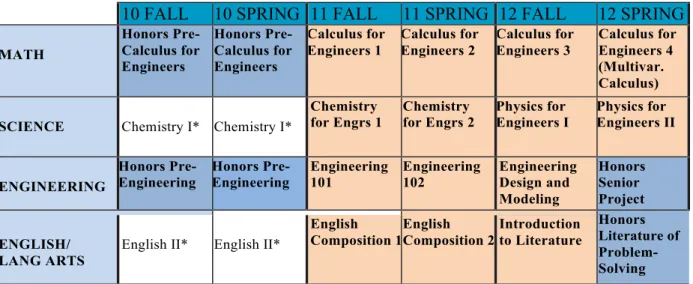
this exodus. Based on conversations with leading technology companies in the state who seek creative, articulate engineers, SCGSSM developed the Accelerate program to offer high school students throughout South Carolina an integrated set of courses in in mathematics, engineering, English, and science. The course sequence for Accelerate students is given in Table 1. Each course is either dual enrollment or Honors.
TABLE1. CurriculumOverview(forastudentqualifyingforHonorsPre-Calculusin 10thgrade). HonorsCourses(blue);DualEnrollmentCourses(tan)
10 FALL 10 SPRING 11 FALL 11 SPRING 12 FALL 12 SPRING
MATH Honors Pre-Calculusfor Engineers Honors Pre-Calculusfor Engineers Calculusfor
Engineers1 CalculusEngineersfor2 CalculusEngineersfor3 CalculusEngineersfor4
(Multivar. Calculus)
SCIENCE Chemistry I* Chemistry I*
Chemistry
forEngrs1 ChemistryforEngrs2 PhysicsEngineersforI PhysicsEngineersforII
ENGINEERING
Honors
Pre-Engineering HonorsEngineeringPre- Engineering101 Engineering102 EngineeringDesignand
Modeling Honors Senior Project Honors Literature of Problem-Solving ENGLISH/ LANGARTS
English II* English II*
English
Composition1EnglishComposition2Introduction to Literature
Applicants must project successful completion of Algebra II Honors by the end of 9th grade. *Prior to the beginning of 11th grade, students should complete:
· Biology I
· Chemistry I
· Geometry
· English II
Accelerate students take blended courses that are taught through video conferencing technology and are archived. Instructors can use a flipped classroom model and a mix of facilitated and self-paced learning. Students participate in real-time, in-person classes with face-to-face interaction and discussion, laboratory activities, and problem-solving. SCGSSM provides students with support from designated Accelerate adult facilitators working in their home high schools who serve as mentors, proctors, and conduits between the students and the Accelerate program. Chemistry and Physics students meet an additional two times a semester for laboratory work. These activities take place on SCGSSM’s campus and fulfill the
requirements for college level laboratory courses.
In addition, project-based workshops and hands-on experiences supplement courses at least once a semester and for a week in the summer. On these occasions, engineering challenges, field trips, and guest engineering speakers provide frequent exposure to the different fields of engineering. One of Accelerate’s ultimate goals with these experiences is to allow students to explore different engineering fields.
The rising sophomores' Base Camp, which occurs in the summer prior to incoming
sophomores’ coursework, has been designed to establish a beginning understanding of the Accelerate community, engineering design challenges, and teamwork, while directly
P
assessing math skills.
Integration: As a comprehensive, college-level program, Accelerate stands on the foundation of its constituent disciplines, requiring their seamless integration. While integration from subject to subject is certainly not unique to Accelerate, the program’s design as a live, online platform of blended instruction with multiple sites makes the overall task of integration much more crucial. The physical space that normally separates students from teachers and their peers is unavoidably magnified, yet the exigencies of collaborative learning and community-building remain at the core of the processes of design and professionalization central to the prospective engineers who comprise Accelerate’s student body. The program’s linked curriculum necessarily creates intersections from course to course and opens pathways for integration that minimize any perceived or actual spatial constraints.
In fact, the virtual platform and multi-site instructional landscape foster possibilities for
connection and collaboration that the traditional classroom precludes, as a wider network exists beyond the brick and mortar classroom. The Accelerate curriculum enhances these possibilities by relying on a broad-based philosophy of course integration that obfuscates abiding distinctions between “hard” and “soft” skills, blends liberal and technical subjects, and—perhaps, most importantly—combines a range of populations, talents, and experiences to produce the next generation of engineers. At the heart of the program lie six conceptual strands, or “grand
themes.” Developed in the fall semester of 2014 by Accelerate faculty and administrators, these themes reflect and inform the overall mission of integration: societal issues, ethics, engineering as a profession, communications, continuous improvement, and leadership/teamwork. Instructors across all disciplines strive to address the six themes in their individual courses, while looking for connections from class to class.
Students: The student population of Accelerate depends on numerous logistical and program-specific criteria. Most central to the Accelerate program are students who demonstrate beginning with their sophomore year in high school an interest in engineering as a future profession or career. Students selected for Accelerate must exhibit the levels of talent, drive, and capacity that typify their SCGSSM residential program counterparts. Accelerate students must also evidence strong levels of motivation and commitment to join a program that operates according to a distance-learning format with a student body that reaches beyond the physical space of the home school—an atmosphere that differs from SCGSSM’s residential program. As such, candidates for the Accelerate program are both self-selected and actively identified by district partners.
Benefits to Students: Students who are selected and enroll in the Accelerate program are in the position to reap a suite of benefits not typically available to high school students at traditional institutions. With no upfront costs or tuition except for limited travel, students have the ability to earn around 40 college credits in relevant courses, depending on major, while maintaining their status as students at their home high schools. The prospect of earning college credit appeals to Accelerate students (and their parents) who naturally gain familiarity with the format, pace, and expectations of a university education as many as three years before the majority of their peers. In addition to priming students for a university education through various means of support, Accelerate students receive a range of built-in networking opportunities that enhance their overall education. From coursework with university faculty, to Saturday experiences and summer camps supported by local industrial partners, Accelerate students become intimately familiar with South Carolina’s engineering scene from both academic and professional standpoints. Ultimately, these
P
interactions are designed to retain talent within the state.
Perhaps the most intrinsic benefit of Accelerate is its guiding ethos: integration. Just as
students’ participation in the program runs counter to the traditional high school’s structure, their academic experiences in classroom and across the program are in a category separate from their peers. As they work to earn college credits and network across the state, Accelerate students encounter a curriculum that is tailor-made to their emergent professional identities. One of the program’s course sequences, in particular, junior- and senior-level English, provides a rich site for the integration of skills, knowledge, and dispositions acquired across the program. The English component of Accelerate merges the liberal with the technical, as it reinforces the program’s overall standing as an integrated STEM initiative. The junior-level composition sequence’s cultural studies platform, for example, allows students to negotiate topics and issues near to them and their disciplines in ways that directly relate to their ongoing work as engineering students. The Accelerate English classroom thus becomes one of the program’s most important sites in making visible to internal and external stakeholders the ethos of integration that overlays and drives the program.
Program Challenges: Many of the challenges that we have experienced in offering a state-wide engineering program involve student preparedness, coordination with schools, and technology. Student preparedness varies across schools, and thus far, the college format and pace presents a significant challenge for about a third of our students. When we evaluate students’ performance in the Pre-calculus and Pre-Engineering courses for the first year of the program, our results are in agreement with other analyses of college freshman engineering students.1,2 Many students are underprepared for a college mathematics course. Around 35-40% of our sophomores have difficulties with pre-calculus, usually resulting in their withdrawal from the program. This rate of attrition reveals an uneven level in mathematics preparedness across the state. To address this issue, we will offer an Advanced Algebra course as needed to incoming sophomores in 2015-16. Beyond academic challenges, the scheduling of classes requires some creative solutions in finding a time for students from seven different sites and grades, each with their own schedule, to meet, while keeping class size small. We are currently meeting this challenge by splitting each grade into two sections, with a morning and afternoon schedule. Scheduling concerns also must take into account the adult facilitator that the schools provide for each class. The engagement of this facilitator has an impact on the outcomes for the students. As such, we would like to develop a stronger partnership among these critical personnel to ensure consistency across sites.
Providing an academic experience that parallels a live classroom using a blended, online platform presents its own set of technical challenges independent of scheduling and academics. The decisions that we initially made about what kind of technology to use were based on three pedagogical constraints. First, we desired a live classroom in which the instructor and students could all see and interact each other, and we aimed to approximate a standard classroom. Next, it was important that our instructors be able to teach from off-campus locations. To support the bandwidth requirements of high-definition video conferencing and virtual desktop access, we require that schools provide consistent access to an internet connection of 5Mbs. All of these demands requires constant coordinating with our partner sites—a challenge of its own.
FuturePlans: Since the Accelerate virtual engineering education program is still in its pilot
P
phase, there is much to be learned about this manner of providing a head start to students who are interested in engineering. In 2015-2016, the program will have all three cohorts active, from sophomores through seniors.
One of the adjustments being made in the program is to provide a supportive review of
mathematics to incoming students both before and during enrollment. To do so, we are adding an Advanced Algebra course to be taken as needed, and provide individualized mathematics review plans. A comprehensive, multi-year approach is being designed to increase readiness for advanced academic opportunities by emphasizing mathematics and critical thinking skills earlier in their middle school years. This effort is separate from the Accelerate program, but
complementary.
Financial support for this program is in transition. Presently, Accelerate’s operating budget is a combination of public and private donor funding. As the program matures, the plan is to move to public funding. With the additional intended increase in the number of active partner sites, the commensurate challenges in course scheduling and increased student load make additional levels of planning essential. Plans for 2015-2016 are to increase the number of school district partners from seven to twelve districts, with a corresponding increase in incoming sophomores from the present 50 to 75 well-qualified students. The long-term (3-5 year) goal is to increase further to 150 incoming students, for a total of about 300 students in the program at any given time.
The SCGSSM’s Accelerate Program for talented high school students is unique. With assistance and support from our school and industry partners, we are working to meet our goals of
delivering the best possible STEM education opportunities to the widest audience of SC students, and providing a renewable source of engineering talent to statewide businesses. As the program expands, we look toward assessing the college and university matriculation data and career placement statistics of our students after the program in order to have the best sense of Accelerate’s overall impact on South Carolina’s engineering landscape. In addition to
considering these raw data, the program will actively seek feedback from external stakeholders, including partner universities, professional organizations, and key industrial firms, to assess whether the program’s integrated approach has succeeded in cultivating a new generation of creative, articulate, and agile engineers.
P
References:
[1] Denise H. Bauer and Joseph Law, “Extended Abstract: Developing a First-Year Engineering Supplemental Course for Students Underprepared in Math,” FYEE 2014, Session F2B.
[2] S. A. Culpepper, C. Basile, C.A. Ferguson, J.A. Lanning, M.A. Perkins, “Understanding the Transition Between High School and College Mathematics and Science,” The Journal of Mathematics and Science: Collaborative Explorations 12 (2010): 157-67.
P