Document Version Control
Publication Version Publication Date Comments
Contents
MESSAGE FROM THE CIO... 1
INTRODUCTION ... 3
FY10–12STRATEGIC ACHIEVEMENTS ... 6
THE NEED TO REFRESH GSA’S ITSTRATEGY ... 8
FY12–15ITSTRATEGIC GOALS ... 13
PERFORMANCE MEASUREMENT IS A CONTINUOUS PROCESS ... 20
PROJECTS ALIGN TO INITIATIVES ... 24
AGENCIES CITIZENS INDUSTRY WHITE HOUSE GSA Customers & Stakeholders INTERNAL DRIVERS PROVIDE & MANAGE SMART, FLEXIBLE WORKSPACES
ENABLE KNOWLEDGE & DATA DRIVEN DECISION MAKING
PROVIDE “FIRST-IN-CLASS” SHARED SERVICES
ENABLE INNOVATIVE, SECURE IT SERVICES
PROVIDE ONE-STOP ACQUISITION SERVICES PROVIDE INNOVATIVE, GOV-WIDE PLATFORMS PROVIDE JUST-IN-TIME SUPPLIES AND SERVICES
STRATEGIC BUSINESS CAPABILITIES
INNOVATION CUSTOMER INTIMACY GSA GOALS GSA Systems from Any Location, Any Time, Any Device Efficient, Secure, Sustainable IT Environment IT GOALS Governance and Resources that Optimize Technology Customer-driven view of IT OPERATIONAL EXCELLENCE Performance Measures
Target Architecture IT Functions Enterprise Application Services Infrastructure Management Enterprise Support Services
SecurityPlanning & Governance
Projects Initiatives
M
ESSAGE FROM THE
CIO
I am pleased to present the GSA FY12–15 Information Technology Strategic Business Plan. This is a dynamic document; we revisit our strategic plans frequently to make sure that we remain true to our strategic intent while addressing the many changes in the government IT landscape. Among those changes are constrained budgets, rapid technological advancements, new government mandates, GSA’s evolving business needs, and an emphasis on providing enterprise services and collaborative work options to contribute to the Administrator’s recent direction ―More for Mission.‖
The GSA IT community is well positioned to respond to these changes. We provide IT that supports GSA’s strategic goals and enables excellence in the business of government. We take pride in delivering first-class products and services to our customers, and our high-quality solutions serve as models across government. Our commitment is to keep pace with transformative IT advances— ensuring their rapid and responsible integration to support our business functions. Our unique placement, supporting the business organizations of GSA while
having a view of the entire GSA enterprise, allows us to better serve all our customers. Thus we can model new behaviors, investigate leading technologies, and instill new ways of thinking with an undivided focus on enabling federal agencies to achieve their mission. Mobile technologies, cloud computing, and collaborative tools have transformed the way we do business, and GSA is working hard to deliver the value of these innovations to its customers. We continue to remain on the forefront of technology. Our implementation of Google Apps for Government made us the first agency to move its entire email and collaboration environment to a cloud-based platform. This achievement supported the Obama Administration’s ―Cloud First‖ strategy and solidified GSA’s reputation as being an engine of innovation in the government. We are deliberately selecting technologies such as Force.com, a platform-as-a-service cloud-based solution to significantly change how we develop, deliver, and host business applications. We need to leverage technological advancements that meet our strategic goals while keeping an eye on the improvement of operational efficiency and smarter resource management.
This plan is a living document, and one that we hope you will refer to frequently. Our website will allow you to check our progress and see exactly how the plan is being implemented—virtually and in real time.
I
NTRODUCTION
This Information Technology (IT) Strategic Business Plan supports GSA’s vision, mission, and goals of innovation, customer intimacy, and operational excellence. GSA’s mission is to use expertise to provide innovative solutions to our customers in support of their missions and, by so doing, foster an effective, sustainable, and transparent government for the American people. The GSA mission statement recognizes the convergence
of opportunity, capability, and responsibility in providing comprehensive solutions to federal agencies to allow them to achieve their missions. GSA is the central agency for acquiring
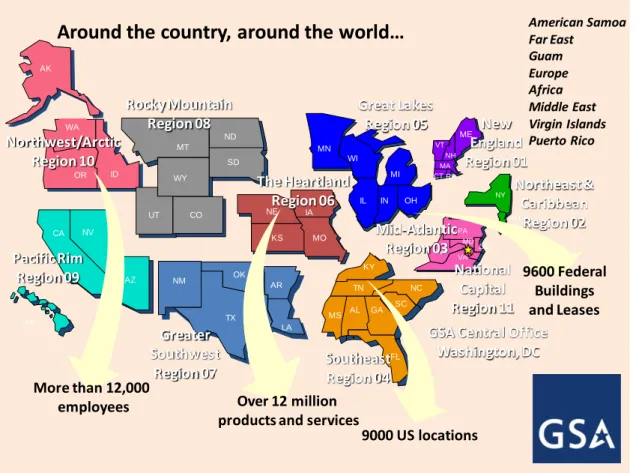
products, services, and workspace for the federal government. GSA plays a key role in developing and implementing administration policies that affect all government agencies and is a leader in developing citizen-driven information and services and citizen engagement tools. Figure 1 shows the geographic distribution of GSA regions, the international locations we serve, and the extent of work we perform.
Figure 1. Geographic Distribution of GSA and Extent of GSA Services
AK WA OR ID IA NE MO KS NM OK TX AR LA ND SD WY UT CO MT MN WI MI IL IN OH KY TN NC SC GA AL MS FL PA DE MD WV VA CA NV HI AZ NY NJ Pacific Rim Region 09 Rocky Mountain Region 08 The Heartland Region 06 Greater Southwest Region 07 Great Lakes Region 05 Northeast & Caribbean Region 02 Mid-Atlantic Region 03 National Capital Region 11 GSA Central Office
Washington, DC NH VT MA ME RI CT New England Region 01
Around the country, around the world…
Northwest/Arctic Region 10 Southeast Region 04 American Samoa Far East Guam Europe Africa Middle East Virgin Islands Puerto Rico 9600 Federal Buildings and Leases 9000 US locations Over 12 million
products and services More than 12,000
employees
“We sell information technology to people, so we need to be leaders in the field.”
Martha Johnson, GSA Administrator
In accordance with direction from OMB to federal agencies, the GSA IT Strategic Business Plan is integrated with the GSA FY12–17 Draft Strategic Plan through a common focus on the GSA mission and service to customers, stakeholders, and employees. Figure 2 contains an excerpt from the GSA Strategic Plan, discussing the link between business, IT, and enterprise architecture.
Figure 2. Excerpt from the GSA FY12–17 Draft Strategic Plan
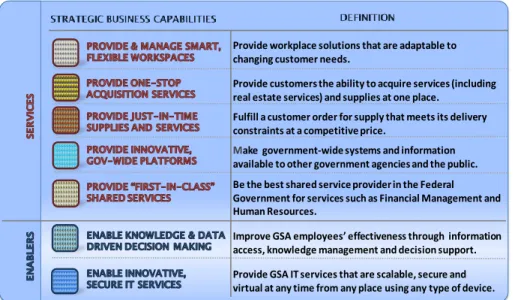
GSA has defined seven strategic business capabilities (Figure 3) that focus GSA’s strategy on the key solutions that will improve organizational effectiveness and service delivery to our customers. GSA’s focus on these business capabilities helps ensure the close alignment of our work with our strategic and business goals.
Figure 3. GSA’s Strategic Business Capabilities (February 2011) Information Technology (IT) Strategic Planning Process
GSA integrates the Strategic Plan with the IT Strategic Business Plan through a common focus on the GSA mission and service to employees, customers, and stakeholders. The 2012-2017 IT Strategic Business Plan will be tightly integrated with the Enterprise Architecture to drive sound IT investment management decisions. The Office of the Chief Information Officer (CIO), in partnership with the information technology (IT) organizations in PBS, FAS, and GSA staff offices are committed to enabling innovative and secure IT services and enabling data-driven decision making.
The GSA IT Strategic Business Plan guides IT support at GSA through four goals: •Enable GSA employees to access any system, from any location, at any time, from
any device (A3).
•Create an efficient, secure, and green technology suite that supports excellence in the business of government.
•Provide governance and resources that optimize the implementation and use of technology.
•Maintain a customer-focused view of information and technology that balances business needs and government mandates.
“
”
Fulfill a customer order for supply that meets its delivery constraints at a competitive price.
Make government-wide systems and information available to other government agencies and the public.
Improve GSA employees’ effectiveness through information access, knowledge management and decision support. Be the best shared service provider in the Federal Government for services such as Financial Management and Human Resources.
Provide GSA IT services that are scalable, secure and virtual at any time from any place using any type of device. Provide workplace solutions that are adaptable to changing customer needs.
Provide customers the ability to acquire services (including real estate services) and supplies at one place.
GSA’s lines of business and IT Directors of Services and Staff Offices (SSOs), in coordination with OCIO, provide IT that supports and enables the strategic business capabilities. Each line of business develops a strategy for how IT enables its services. These strategies are linked to the GSA IT Strategic Business Plan, and through this Plan to the GSA Strategic Plan. In this way, the GSA IT community provides
integrated IT support to GSA’s mission outlined by the strategic business capabilities shown in Figure 3.
For instance, GSA’s Public Buildings Service (PBS) CIO produces an IT Strategic Plan that describes how IT supports the PBS mission. PBS aims to be the best
commercial real estate organization in the world by building, leasing, and maintaining a portfolio of buildings to provide superior workplaces for federal employees. Real estate technology is redefining the industry, and PBS believes there is an opportunity to turn its mastery of that technology into a strategic advantage that will drive PBS’s service excellence. PBS directly pursues IT that improves its buildings and serves its customers. To this end, PBS IT will create and transform IT solutions to operate, maintain, and manage GSA-owned and -leased buildings in order to mobilize the federal workforce. In addition, PBS identifies needs that can be more appropriately met at the enterprise level and advocates for collaborative responses to these needs. This combination of independent and enterprise IT improves the PBS business and equips PBS end users with the most up-to-date, accurate, and integrated IT solutions. Similarly, GSA’s Federal Acquisition Service (FAS) CIO uses both enterprise and in-house IT solutions to support the strategic business capabilities it provides. FAS aspires to be the leading source for government solutions to make agencies more effective at what they do by providing them with expertise, management, and optimal acquisition solutions. The way people use IT to conduct their personal business is setting similar expectations in the business of government and creating an opportunity for FAS IT to develop the electronic tools that become a core component of FAS’s competitive advantage. FAS is actively engaged in IT initiatives, like End-to-End Electronic Acquisition and Supply Chain Modernization, to facilitate FAS in leveraging the buying power of the federal government and providing the services that allow agencies to focus on their missions. FAS’s electronic tools will be
available through multiple devices and enable mobility. These modernizations make FAS employees more efficient, provide FAS’s customers with a consistent and quality experience, and make it easier for its industry partners to do business with the government and provide citizens with access and transparency.
Likewise, other GSA IT Directors provide IT support for their mission-specific strategic business capabilities as shown in Figure 3.
FY10–12
S
TRATEGIC
A
CHIEVEMENTS
The GSA IT community achieved many of its planned objectives under the FY10–12 IT Strategic Business Plan, as shown in Figure 4. We responded to new opportunities, customer and technology needs, and federal mandates and initiatives in a flexible and innovative manner.
Since FY10, we have launched two major undertakings, Google Mail and Any Location, Anytime, and Any Device (A3) mobility, to respond to GSA’s evolving needs and incorporate transformative technological advancements. By switching to Google Mail, GSA expects to reduce operational costs
by 50 percent over the next five years and save more than $15.2 million.
With the development of an A3 mobility strategy whose execution continues under the first goal of this plan, the IT community supports the idea that our work is measured by what we do, not where we do it. By offering employees mobility, accessibility, and security solutions, we are enabling a more resilient, efficient, and effective workforce. A3 will continue to reduce overhead expenses—critical in a constrained budgetary climate—and reduced provisioning will also contribute to GSA’s overall Zero Environmental Footprint priority.
In 2010, GSA’s Green IT Strategic Plan postulated an expected savings of $108,000 per year by automatically powering down our 17,000 PCs when not in use at night or on weekends. When implemented
in 2011, the savings proved to be even greater ($200,000 annually). In addition, an estimated 1.6 million pounds of carbon dioxide emissions per year are being avoided.
GSA has maintained a strategic focus on improving accessibility
of applications for people with disabilities per Section 508 of the Rehabilitation Act. During the transition to cloud-based services, accessibility testing was integrated into the process as part of the Google Chrome project, including analysis and feedback to
Google on accessibility enhancements of GDocs, GCalendar, and GCollaboration. Our achievements under the FY10–12 IT Strategic Business Plan have brought significant value to GSA. The dynamic environment of government information technology presents new challenges and opportunities that warrant this refresh of the FY10–12 plan.
“The deadline for the Google rollout for our 17,000-strong workforce was Flag Day, June 14, 2011, a symbolic holiday to mark the agency’s migration to a new era.”
Sonny Hashmi, Deputy Chief Information Officer Government Computer News, October 18, 2011
“In our FY 2012 Budget Request, we committed to reduce spending...GSA will save $6 million through the implementation of VOIP telephones.”
Alison L. Doone, GSA Chief Financial Officer Letter from the Chief Financial Officer, 2011 Agency Financial Report
T
HE
N
EED TO
R
EFRESH
GSA’
S
IT
S
TRATEGY
The FY10-12 IT Strategic Business Plan was developed, and vetted, by IT and business leaders through a traditional collaborative process, but it was implemented during a time of great change in the way government does its work. It became evident in its second year of implementation that we were not
measuring some of the important things we were actually doing. We needed to refresh our plan to be a living document to meet our changing needs. Because of our leadership's agility, our capacity to integrate transformative technologies across the enterprise has increased substantially during this
time period of ―doing more with less.‖ We have been able to translate our challenges into providing better, more efficient services to a greater number of customers.
To update the plan, we embarked on a set of interviews to identify our drivers,
challenges, and priorities. We validated slightly modified goals through an OCIO-hosted Enterprise Transformation meeting of IT and business leaders. We incorporated our IT goals into the GSA Strategic Plan. Finally we developed initiatives, projects, and performance measures around our target architecture vision and functions and our CIO's priorities.
Today, our agile, flexible IT community is positioned to provide services that produce even more value for our partners across GSA, thus supporting the strategic direction of the agency. Enterprise architecture has helped identify opportunities where efficiencies can be magnified and their value increased. Development times have decreased; the need for rapid turnaround has increased. Our customers have become increasingly aware of the private sector’s ability to rapidly translate technological innovation into value, and we must strive to do the same.
In our effort to have the GSA IT Strategic Business Plan mirror our complex
environment, we participated in a visioning process for FY12–15. As part of this process we
identified drivers that will shape our future IT environment,
identified key operational challenges GSA is facing, and
reviewed our role and identified guiding priorities to support our decision making. ―America’s future depends on our capacity to innovate.”
Steve VanRoekel, Federal CIO Federal Computer Week, October 27, 2011
“Seeing around the corner often involves taking risks and taking the chance of being wrong, but the benefits to the organization are substantial.”
Casey Coleman, GSA CIO
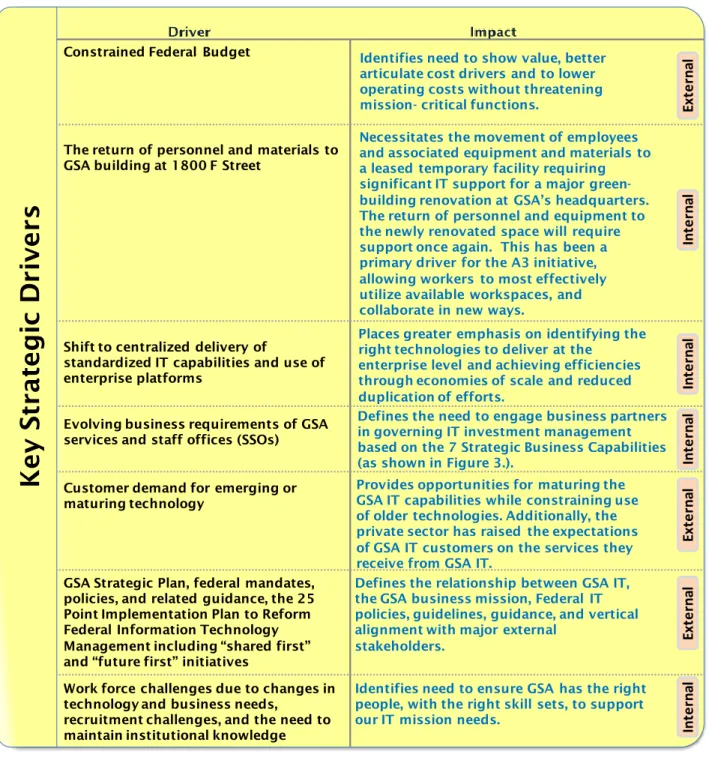
Figure 5 describes key drivers, both from internal and external sources, and their effects on our strategy.
Figure 5. Key Strategic Drivers
Constrained Federal Budget Identifies need to show value, better
articulate cost drivers and to lower operating costs without threatening mission- critical functions.
The return of personnel and materials to GSA building at 1800 F Street
Necessitates the movement of employees and associated equipment and materials to a leased temporary facility requiring significant IT support for a major green-building renovation at GSA’s headquarters. The return of personnel and equipment to the newly renovated space will require support once again. This has been a primary driver for the A3 initiative, allowing workers to most effectively utilize available workspaces, and collaborate in new ways.
Shift to centralized delivery of
standardized IT capabilities and use of enterprise platforms
Places greater emphasis on identifying the right technologies to deliver at the
enterprise level and achieving efficiencies through economies of scale and reduced duplication of efforts.
Evolving business requirements of GSA services and staff offices (SSOs)
Defines the need to engage business partners in governing IT investment management based on the 7 Strategic Business Capabilities (as shown in Figure 3.).
Customer demand for emerging or maturing technology
Provides opportunities for maturing the GSA IT capabilities while constraining use of older technologies. Additionally, the private sector has raised the expectations of GSA IT customers on the services they receive from GSA IT.
GSA Strategic Plan, federal mandates, policies, and related guidance, the 25 Point Implementation Plan to Reform Federal Information Technology Management including “shared first” and “future first” initiatives
Defines the relationship between GSA IT, the GSA business mission, Federal IT policies, guidelines, guidance, and vertical alignment with major external
stakeholders.
K
e
y
S
tr
a
te
g
ic
D
ri
ve
rs
Work force challenges due to changes in technology and business needs,
recruitment challenges, and the need to maintain institutional knowledge
Identifies need to ensure GSA has the right people, with the right skill sets, to support our IT mission needs.
Ex te rn al Ex te rn al Ex te rn al In te rn al In te rn al In te rn al In te rn al
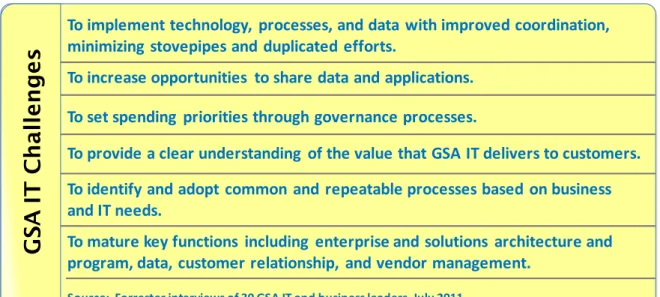
An environmental scan performed through stakeholder interviews and observations identified the major challenges the GSA IT community will work to overcome through our current strategic initiatives. Figure 6 shows these challenges.
Figure 6. GSA IT Challenges
Figure 7 lists the top six short-term IT priorities that address these challenges and move us toward achievement of our strategic goals.
Figure 7. Priorities as Identified by the GSA CIO
To implement technology, processes, and data with improved coordination, minimizing stovepipes and duplicated efforts.
To increase opportunities to share data and applications. To set spending priorities through governance processes.
To provide a clear understanding of the value that GSA IT delivers to customers. To identify and adopt common and repeatable processes based on business and IT needs.
To mature key functions including enterprise and solutions architecture and program, data, customer relationship, and vendor management.
G
SA
IT
C
h
a
ll
e
n
g
e
s
Source: Forrester interviews of 30 GSA IT and business leaders, July 2011
Planning for the move back to 18th & F Street
GSA Technology Operations (GTO) award and transition Presidential transition team planning
Enterprise deployment of Salesforce and Chatter Investment review board process maturation
Organization design and enterprise workforce practices
Sh
o
rt
T
erm
P
ri
o
ri
ti
es
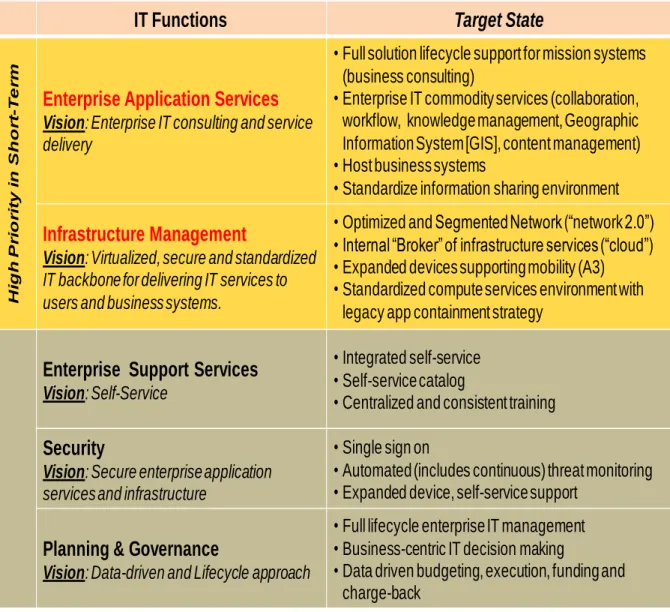
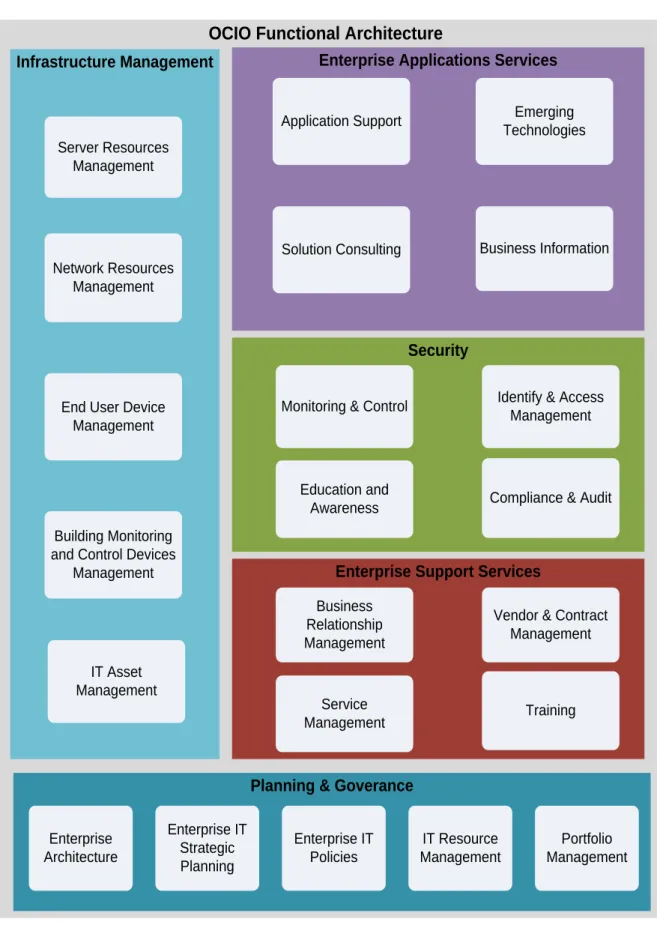
The OCIO’s enterprise architecture program is integral to identifying the future, or target, state for information technology at GSA. The enterprise architecture program is
developing a detailed technical road map to guide the initiatives and supporting projects that will allow us to achieve the business capabilities that represent GSA’s operational vision. Through the IT target architecture work, we have identified five functions that encompass needed IT work. Figure 8 describes the target state characteristics for each functional area. The first two functions, Enterprise Application Services and
Infrastructure Management, are the highest priority functions. Figure 9 shows the subfunctions within each IT function.
Figure 8. OCIO Target State Characteristics
IT Functions
Target State
H ig h P r io r it y i n S h o r t-T e r m
Enterprise Application Services
Vision: Enterprise IT consulting and service
delivery
• Full solution lifecycle support for mission systems (business consulting)
• Enterprise IT commodity services (collaboration, workflow, knowledge management, Geographic Information System [GIS], content management) • Host business systems
• Standardize information sharing environment
Infrastructure Management
Vision: Virtualized, secure and standardized IT backbone for delivering IT services to users and business systems.
• Optimized and Segmented Network (“network2.0”) • Internal “Broker” of infrastructure services (“cloud”) • Expanded devices supporting mobility (A3) • Standardized compute services environment with
legacy app containment strategy
Enterprise Support Services
Vision: Self-Service
• Integrated self-service • Self-service catalog
• Centralized and consistent training
Security
Vision: Secure enterprise application services and infrastructure
• Single sign on
• Automated (includes continuous) threat monitoring • Expanded device, self-service support
Planning & Governance
Vision: Data-driven and Lifecycle approach
• Full lifecycle enterprise IT management • Business-centric IT decision making
• Data driven budgeting, execution, funding and charge-back
Figure 9. IT Target Architecture Functions and Sub-Functions
OCIO Functional Architecture
Enterprise Applications Services
Application Support
Solution Consulting Business Information
Emerging Technologies
Enterprise Support Services
Business Relationship Management
Service
Management Training
Vendor & Contract Management
Security
Monitoring & Control
Education and
Awareness Compliance & Audit
Identify & Access Management
Planning & Goverance
Enterprise Architecture
Infrastructure Management
Server Resources Management
End User Device Management
Building Monitoring and Control Devices
Management Network Resources Management IT Asset Management Enterprise IT Strategic Planning Enterprise IT Policies IT Resource Management Portfolio Management
FY12–15
IT
S
TRATEGIC
G
OALS
To achieve our four FY12–15 goals, we have defined the outcomes desired from each goal and the specific initiatives and projects that will allow us to achieve those outcomes. Each IT goal supports a higher level GSA goal. Initiatives are high-level focus areas that will move GSA toward achievement of the related goal, as shown in Figure 10. The projects implement specific actions that we will take to deliver business. Further, we have defined specific key performance measures that will track the progress against our stated initiatives.
Figure 10. IT Strategic Goals and Initiatives
IT GOAL 1
GSA Systems from Any Location, Any Time, Any Device
INITIATIVE 1: Secure Access
Provide GSA workforce with secure access to GSA's IT resources and systems regardless of how, where or when they are working
INITIATIVE 2: IT Service Support Excellence
Transform the IT service support model, including expanding self-service capabilities
INITIATIVE 3: Application Portfolio Modernization
Transform our enterprise and legacy applications using modern technologies (e.g. middleware, web and mobile computing), architecture and frameworks to enable access from any device, anywhere and at anytime
IT GOAL 3
Governance and Resources that Optimize Technology INITIATIVE 6: Optimized IT Portfolio
Transform to a data driven IT investment management model
INITIATIVE 7: IT Workforce Transformation
Transform our enterprise-wide IT workforce to be consistent with IT trends toward commodity and service-based IT
INITIATIVE 8: Unified Vendor Management
Unify vendor management capabilities to more efficiently and effectively manage vendors
INITIATIVE 9: Compliance-Driven Business Activities
Delivering business value through compliance-driven activities; Federal Strategic Alignment to government-wide initiatives; Role-models
IT GOAL 2
Efficient, Secure, Sustainable IT Environment
INITIATIVE 4: Standardized Infrastructure Environment
Provide a standardized infrastructure environment offering virtualized, secure and sustainable network, compute and end-user device services
INITIATIVE 5: Consolidate and Broaden IT Services
Consolidate commodity IT services and broaden service offerings based on business needs
IT GOAL 4
Customer-Driven View of ITINITIATIVE 10: Effective Business Line Partnership
Establish a business relationship management capability
INITIATIVE 11: Business Systems Consulting
Provide full life cycle mission systems support
INITIATIVE 12: IT Service Delivery Excellence
Mature OCIO IT service delivery model by leveraging industry best practices
In
n
o
v
a
ti
o
n
O
p
e
ra
ti
o
n
a
l
E
x
c
e
ll
e
n
c
e
Cus
to
me
r
In
ti
ma
c
y
O
p
e
ra
ti
o
n
a
l
E
x
c
e
ll
e
n
c
e
Goal 1: GSA Systems from Any Location, Any Time, Any
Device
Here at GSA, we recognize that the work is what we do, not where we do it. Supporting a completely mobile workforce through virtual platforms, personal device support, enhanced network infrastructure, and new collaborative tools will enhance our ability to connect with each other remotely,
reduce overhead costs, contribute to our Zero Environmental Footprint goal, decrease downtime, and produce a highly engaged and productive workforce. We aspire to be a resilient, connected, and fully mobile workforce. Customers will be able to readily access support for IT services through a self-service system that is tailored to their needs.
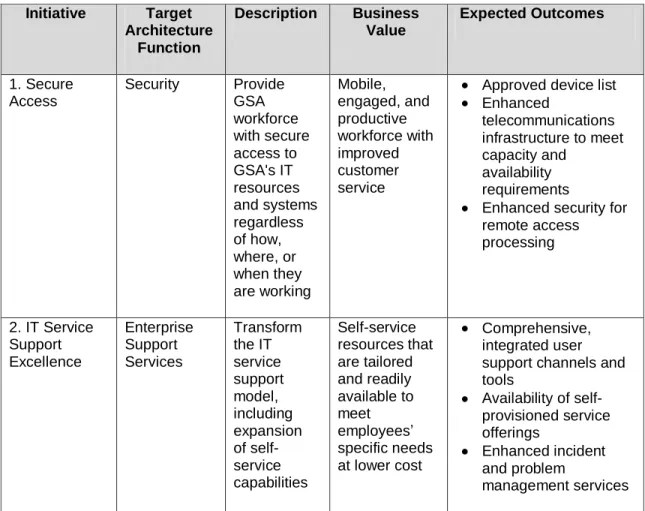
There are three initiatives for Goal 1 (see Table 1). Table 1. Goal 1 Initiatives
Initiative Target Architecture Function Description Business Value Expected Outcomes 1. Secure Access Security Provide GSA workforce with secure access to GSA's IT resources and systems regardless of how, where, or when they are working Mobile, engaged, and productive workforce with improved customer service
Approved device list Enhanced telecommunications infrastructure to meet capacity and availability requirements
Enhanced security for remote access processing 2. IT Service Support Excellence Enterprise Support Services Transform the IT service support model, including expansion of self-service capabilities Self-service resources that are tailored and readily available to meet employees’ specific needs at lower cost Comprehensive, integrated user support channels and tools Availability of self-provisioned service offerings Enhanced incident and problem management services
“The goals of our new telework policy are to make every GSA employee, with few exceptions, eligible for telework; explicitly define some of the ways in which we work, such as hot desking [hoteling] and desk sharing; and most important, empower our entire workforce to be mobile for the 21st century.”
Anthony Costa, GSA Chief People Officer Government Executive, October 31, 2011
Initiative Target Architecture Function Description Business Value Expected Outcomes 3. Application Portfolio Modernization Enterprise Applications Transform our enterprise and legacy applications using modern technologies (e.g. middleware, web and mobile computing), architecture, and frameworks to enable access from any device, anywhere, and at anytime Opportunity for collaboration among geographically disparate workforce, reducing operating costs and enabling data-driven decisions Legacy applications contained and reengineered Modernized and standard set of enterprise applications
Goal 2: Efficient, Secure, Sustainable IT Environment
We are working diligently to take a business process, function-oriented view of the work we do. This view allows us to find areas where the solutions we deliver for a single customer can be leveraged across the GSA enterprise. Identifying those solutions enables GSA to deploy IT in a more standardized manner while creating common enterprise IT solutions to best meet our customers’
needs. This will help us provide a standardized foundation of efficient, secure, and sustainable technology solutions to all customers and identify areas where innovations can be integrated to achieve our desired business functions. The standardized infrastructure and data environments will support collaboration, increased information sharing, and efficient management of IT assets; that, in turn, will give us the flexibility to support customers with a reduced carbon footprint.
“GSA is now employing Salesforce’s customer relationship management modules Force.com development platform and Chatter collaboration suite and can be used by GSA’s 17,000
employees. It is evidence of the value of cloud computing. We believe cloud computing has matured and is a vital option to the federal government.”
Casey Coleman, GSA CIO
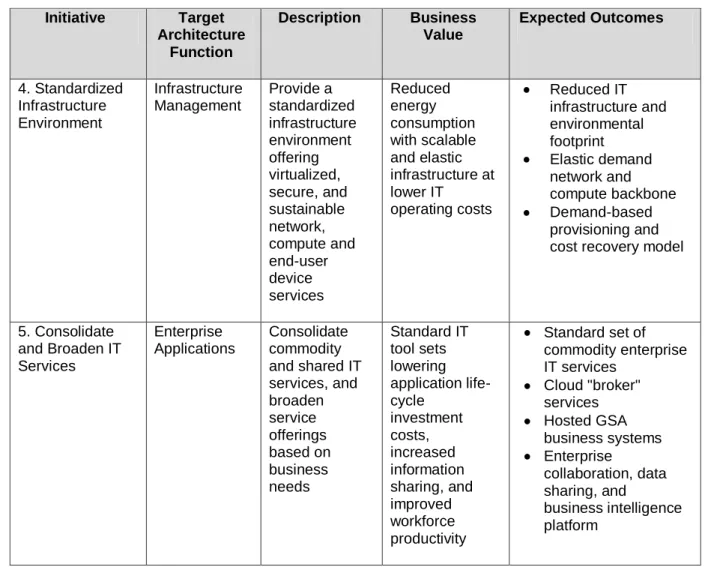
There are two initiatives for Goal 2 (see Table 2).
Table 2. Goal 2 Initiatives
Initiative Target Architecture Function Description Business Value Expected Outcomes 4. Standardized Infrastructure Environment Infrastructure Management Provide a standardized infrastructure environment offering virtualized, secure, and sustainable network, compute and end-user device services Reduced energy consumption with scalable and elastic infrastructure at lower IT operating costs Reduced IT infrastructure and environmental footprint Elastic demand network and compute backbone Demand-based provisioning and cost recovery model
5. Consolidate and Broaden IT Services Enterprise Applications Consolidate commodity and shared IT services, and broaden service offerings based on business needs Standard IT tool sets lowering application life-cycle investment costs, increased information sharing, and improved workforce productivity Standard set of commodity enterprise IT services Cloud "broker" services Hosted GSA business systems Enterprise collaboration, data sharing, and business intelligence platform
Goal 3: Governance and Resources That Optimize
Technology
Staying in front of technological
advancement means refining and maturing the underlying processes to assess how IT innovations meet our business needs, prioritizing IT investments by cost and benefit, and deciding where and how resources should be dedicated for rapid and responsible deployment of the best IT solutions. This process ensures that our
IT investments are directly aligned with our strategic intent, business needs, and desired business functions. We will focus on transforming and aligning our workforce to
organizational functions and the IT services it delivers. New vendor management capabilities will provide us the opportunity to increase the efficiency of our contract management activities.
There are four initiatives for Goal 3 (see Table 3).
Table 3. Goal 3 Initiatives
Initiative Target Architecture
Function
Description Business Value Expected Outcomes 6. Optimized IT Portfolio Planning and Governance Transform to a data-driven IT investment management model Optimized IT investments that will best meet business needs and enable data-driven decision making in leveraging IT Standard policies for application development Enterprise-supported target architecture IT investment portfolio management processes Benefits realization 7. IT Workforce Transformation Planning and Governance Transform our enterprise-wide IT workforce to be consistent with IT trends toward commodity and service-based IT Responsive, empowered, and skilled employees aligned to meet desired service delivery Enterprise IT workforce perspective IT workforce tools, practices, and processes shared across the enterprise Functional alignment of skills to target architecture
―We view IT as an investment in the productivity, morale, and success of our employees, rather than an end unto itself.”
Casey Coleman, GSA CIO
Around the Corner, Innovation in the Business of Government: A GSA Blog
Initiative Target Architecture
Function
Description Business Value Expected Outcomes 8. Unified Vendor Management Enterprise Support Services Unify vendor management capabilities to more efficiently and effectively manage vendors Improved organizational efficiency, vendor contract management, and strategic sourcing Centralized license management Formal vendor management roles and responsibilities Efficient contract management Industry liaison that centralizes vendor management Cost savings Reduced complexity and number of contracts Leveraged use of contracts across the enterprise 9. Compliance-Driven Business Activities Planning and Governance Deliver business value through compliance-driven activities; strategic alignment to government-wide initiatives; federal role models Enhanced external view of GSA as model for IT service delivery, inter-agency collaboration, and citizen services IT investment portfolio process that includes mandatory projects Accurate and timely response to OMB data calls
Goal 4: Customer-Driven View of IT
The private sector has made great strides in its customer service delivery model. GSA’s IT community can leverage advancements in this area and match the private sector’s customer-focused, scalable services.
We continue to identify how customer requirements can be met while
maintaining our standards and achieving government-mandated regulations and policies. We will focus our resources on delivering solutions and services faster and in a way that provides information on how to access the service, the price for
using the service, and the level of service customers can expect. Our approach will include dedicated account relation managers, use of customer satisfaction surveys, and monitoring metrics to ensure that service level performance targets are always met. There are three initiatives for Goal 4 (see Table 4).
Table 4. Goal 4 Initiatives
Initiative Target Architecture
Function
Description Business Value Expected Outcomes 10. Effective Business Line Partnership Enterprise Support Services Establish a business relationship management capability Improved, consistent, and measured IT services that meet customer business needs Ability to serve as trusted advisor and visionary to the lines of business Periodic customer satisfaction surveys and reviews View of account managers as strategic partners Definition around engaging the business Enhanced user productivity Clear and consistent communications 11. Business Capability Consulting Enterprise Application Services
Provide full life-cycle mission systems support
Relevant and tailored IT
services that meet customer business needs Disciplined approach to solutions life-cycle management Development of cost sharing models Technology consulting
“Helping us expand our ability to access customers would make the OCIO like a concierge for all of GSA.”
Michael Gelber, Regional Commissioner, Federal Acquisition Service, Region 9
Initiative Target Architecture
Function
Description Business Value Expected Outcomes 12. IT Service Delivery Excellence Enterprise Support Services Mature OCIO IT service delivery model by leveraging industry best practices Increased transparency of IT service offerings leading to improved customer satisfaction Service portfolio management processes defined IT charge-back recovery model defined IT service levels tracked and reported
P
ERFORMANCE
M
EASUREMENT IS A CONTINUOUS
PROCESS
Performance measurement will play a critical role in making this IT Strategic Business Plan relevant and responsive to changing conditions. Measuring performance at various levels and through different lenses will allow us to monitor incremental progress toward achieving our goals, and can help us identify where changes should be made to ensure the following:
Investments are aligned with strategic direction.
Projects are prioritized, implemented, and managed efficiently.
Projects support achievement of the desired initiative outcomes.
Initiatives move us toward the achievement of our IT goals.
Through the strategic planning process, we have identified an initial set of measures for each initiative. These high-level measures link to operational measures through project, program, and process management. Drilling down from the high-level initiative measures to the linked operational measures will enable us to perform root cause analysis and process
improvement—that is, to understand our successes and any need for improvement. OCIO is developing a knowledge portal that is intended to allow centralized monitoring of our measures. Currently, operational metrics are decentralized in a number of places (as shown in Figure 11), and some operational metrics may need to be created.
Figure 11. Centralizing Distributed Performance Measure Portals
Table 5 identifies our initial measures for each initiative, as well as primary stakeholders and linkages to the IT goals. To ensure that the IT Strategic Business Plan remains a living document that guides our decisions and actions, initiative progress will be monitored regularly. The first phase of performance measurement will involve mapping currently captured measures (Figure 11) to the new initiative measures. Then, baseline metrics, as well as targets, will be identified. Additions, deletions, and changes to initiative measures may be made as we determine how well each measure indicates achievement of goal and initiative outcomes. Each year, a review of environmental factors and initiative performance
measurement will kick off the annual zero-based budgeting cycle.
Centralizing Distributed Performance Measure Portals
GSA Sustainability Plan metrics OMB Federal IT Portfolio Dashboard GSA Strategic Plan Performance Measures OCIO Project Dashboard OCIO Managers’ APPAS Performance Plans
GSA OCIO Knowledge Portal
GSA Performance Corner IT Portfolio metrics OCIO Security Program metrics OCIO Balanced Scorecard/IPR metrics GSA Performance Corner Web metrics GSA Performance Corner SLA metrics GSA Performance Corner Instant Messaging metrics
Table 5. Initiative Performance Measures, Related Goals, and Primary Stakeholders
ID Initiative Name Performance Measures Related Goal
Primary Stakeholders
1 Secure Access Increase in number of mobile users who
securely access GSA systems Increase in number of tools and methodologies provided that support mobile users in securely accessing GSA systems via any approved device
1 Enterprise Infrastructure Information Security 2 IT Service Support Excellence
Increase in availability, quality, and use of self-service offerings
Decrease in help desk tickets for areas solvable by self-service
Decrease in average number of tickets per user 1 Enterprise Infrastructure 3 Application Portfolio Modernization
Increase in number of new and legacy applications as well as platforms in the Application Inventory that are useable via authorized mobile devices
Decrease in number of legacy applications and platforms in the Application Inventory that cannot be reengineered to be useable via authorized mobile devices
1 Enterprise Solutions Enterprise Management Services 4 Standardized Infrastructure Environment
Decrease in environmental footprint in accordance with the GSA Strategic Sustainability Performance Plan goals for electronic stewardship and data center consolidation
Increase in availability of demand-based infrastructure 2 Enterprise Infrastructure 5 Consolidate and Broaden IT Services
Increase in number of hosted commodity, shared, and/or cloud-brokered IT services made available to SSOs
Increase in availability of GSA enterprise data standards
Increase in tools and methods to facilitate enterprise-wide information sharing 2 Deputy CIO/CTO Enterprise Solutions 6 Optimized IT Portfolio
Increase % of the annual IT investment spent on new and/or enhanced projects based on Gartner’s Run, Grow,
Transform model
Increase in benefits realized as a result of standards, policy, governance, and Techstat processes
Increase in number of OCIO projects actively tracked by PMO to support a standardized project management approach 3 Enterprise Management Services Deputy CIO/CTO
ID Initiative Name Performance Measures Related Goal Primary Stakeholders 7 IT Workforce Transformation
Increase in Q-12 employee engagement survey satisfaction scores
Increase in enhanced skills capacity and capabilities aligned to meet desired service delivery
Increase in IT workforce tools, practices, and processes shared across the enterprise GS-2210 IT Community 3 Resources Management Enterprise Management Services 8 Unified Vendor Management
Increase in number of enterprise-wide contracts and licenses
Increase in number of Vendor Management Office positions with formalized roles and responsibilities
3 Deputy
CIO/CTO
9
Compliance-Driven Business Activities
Increase in number of compliance-type submissions that are well-vetted, demonstrate intended value, and are submitted on time
Increase in evidence that GSA OCIO and IT Community are recognized role models for their products and services
3 Enterprise Management Services Deputy CIO/CTO 10 Effective Business Line Partnership
Increase in positive engagements (communications, reviews, customer satisfaction surveys, meetings, consultations) among OCIO, lines of business, and other strategic partners Increase in level of user productivity
education, awareness, and end-user support 4 Deputy CIO/CTO Enterprise Solutions 11 Business Capability Consulting
Increase in number of SDLC resources, new technologies, and innovative solutions deployed to enhance GSA business capabilities such as cloud-hosted business applications Increase in number of
consultation-driven project proposals successfully implemented 4 Enterprise Solutions 12 IT Service Delivery Excellence
Increase in number of IT services that have defined cost drivers to support a charge-back model
Increase in number of IT services available in an IT service catalog Increase in number of IT services
meeting service-level agreements (SLAs) 4 Deputy CIO/CTO All OCIO Offices
P
ROJECTS
A
LIGN TO
I
NITIATIVES
The Strategic Plan is implemented through projects aligned to initiatives. The target architecture helps us validate current projects and identify projects for later years. Projects that are ongoing or proposed in the next fiscal year provide a foundation for our near-term focus. Projects will be reviewed annually as part of the zero-based budgeting cycle, and will change over time as projects are completed, as new projects are added, and as operational and budgetary needs warrant. Project alignment is important to ensuring we invest wisely.