International Journal of Communication Networks and Information Security (IJCNIS) Vol. 10, No. 3, December 2018
Available Bandwidth Estimation Tools: Metrics,
Approach and Performance
Dixon Salcedo
1, Cesar D. Guerrero
2and Roberto Martinez
31Department of Computer Science and Electronics, Universidad de la Costa, Colombia
2 Engineering and Organization Research Center, Universidad Autónoma de Bucaramanga, Colombia 3Universidad Católica de San Pablo, Peru.
Abstract: The estimation of the available bandwidth (av_bw) between two end nodes through the Internet, is an area that has motivated researchers around the world in the last twenty years, to have faster and more accurate tools; Due to the utility it has in various network applications; Such as routing management, intrusion detection systems and the performance of transport protocols. Different tools use different estimation techniques but generally only analyze the three most used metrics as av_bw,
relative error and estimation time. This work expands the information regarding the evaluation literature of the current Available Bandwidth Estimation Tools (ABET's), where they analyze the estimation techniques, metrics, different generation tools of cross-traffic and evaluation testbed; Concentrating on the techniques and estimation methodologies used, as well as the challenges faced by open-source tools in high-performance networks of 10 Gbps or higher.
Keywords: Internet measurement tools, Available bandwidth estimation, Network throughput.
1. Introduction
The last years have brought a great change in the increase in the consumption of multi-content and it is becoming more frequent for the user to choose the moment, place and format to visualize information of his preference. This phenomenon implies, for example; The migration of traditional television to multimedia consumption on the Internet, among other changes of paradigms.
In the new century has seen an increasing and continuous number of Internet users and network applications. Internet users have grown more than 900% from 2000 to 2017 [1] and as well as the use of network applications such as e-mail, voice over IP (VoIP), Peer to Peer (P2P) and video Streaming. For some of these, information on available bandwidth can be used to monitor and improve performance. The concept of bandwidth is essential for digital communications, and specifically the data packet network, which refers to the amount of data that a route can support per link or which can transmit per unit time. For many applications with high data load, such as file transfer or multimedia streaming; Managing real-time av_bw can positively impact application performance as well as interactive performance, which are more sensitive to low latencies than to high network performance, which can benefit from lower end-to-end delays associated to high bandwidth links with low latencies of data transmission [2]. The correct estimation of av_bw as a metric is important for both users and providers. For the former, estimation techniques facilitate the optimization of end-to-end transmission behavior. For the latter is taken advantage of by the administration tools can accurately monitor the use of one or more links; Internet service providers, can monitor
and verify levels of quality of service; Transport protocols can determine the best transmission rate according to the amount of bandwidth available in the network; Intrusion detection systems can generate alerts based on an unexpected increase in network utilization; Which has been studied widely [3], [4], [5], [6], [7], [8], [9]. These and other applications require an end-to-end estimate of the av_bw, because there is no control over the intermediate links through which the communication channel is established.
Table 1. ABET's developed to date
Year Tool Author
2016 NEXT-FT Kumar, Tachibana and Hasegawa
2014 BEST-AP
Dely, Kassler, Chow, Bambos, Bayer and Einsiedler
Brandshape Low and Alias
2009 ASSOLO Goldoni, Rossi and Torelli Traceband César Guerrero
2008 DCSPT Ergin, Gruteser, Luo, Raychaudhuri and Liu Wbest Li, Claypool and Kinicki
2007 YAZ Sommers, Barford and Willinge
2006 ImTCP Man, Hasegawa and Murata BART Hartikainen, Ekelin and Karlsson
2005
BET Botta, D’Antonio, Pescapé, Ventre
Owamp Shanlunov, Teitelbaum, Karp, Boote and Zekauskas
2004 DietTopp Johnsson, Melander and Björkman
2003
PTR Hu and Steenkiste Iperf The Iperf team PathChirp Vinay Ribeiro
Spruce Strauss, Katabi and Kaashoek Wren Zangrilli and Lowekamp Abing Navratil and Cottrell
Pathrate Dovrolis and Prasad
2002
IGI - PTR Ningning Hu
Pathload Jain and Dovrolis
2001 Pipechar Jin Guojun
2000 TOPP Bob Melander
1997 Pathchar Van Jacobson
1996 Cprobe Carter and Crovella
International Journal of Communication Networks and Information Security (IJCNIS) Vol. 10, No. 3, December 2018
estimation, which in turn have been implemented in estimation tools, to refine the estimation. Therefore, tools like Assolo [20], Pathload and Pathchirp use SLoPs (Self-Loading Periodic Streams) [21]; In contrast, estimators as Traceband, Abing, IGI, PTR and Wbest [22], use PP/TD (Packet Pair/Train Dispersion), and TOPP (Trains of Packet Pairs) used by the Diettopp tool. Table 1 shows and expands the tools developed to date, with their respective authors.
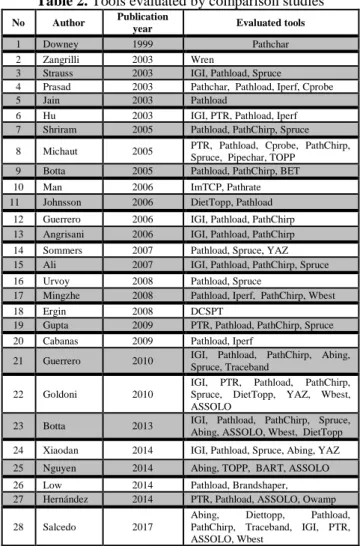
Table 2. Tools evaluated by comparison studies
No Author Publication
year Evaluated tools
1 Downey 1999 Pathchar
2 Zangrilli 2003 Wren
3 Strauss 2003 IGI, Pathload, Spruce
4 Prasad 2003 Pathchar, Pathload, Iperf, Cprobe 5 Jain 2003 Pathload
6 Hu 2003 IGI, PTR, Pathload, Iperf 7 Shriram 2005 Pathload, PathChirp, Spruce
8 Michaut 2005 PTR, Pathload, Cprobe, PathChirp, Spruce, Pipechar, TOPP
9 Botta 2005 Pathload, PathChirp, BET 10 Man 2006 ImTCP, Pathrate 11 Johnsson 2006 DietTopp, Pathload
12 Guerrero 2006 IGI, Pathload, PathChirp 13 Angrisani 2006 IGI, Pathload, PathChirp 14 Sommers 2007 Pathload, Spruce, YAZ 15 Ali 2007 IGI, Pathload, PathChirp, Spruce 16 Urvoy 2008 Pathload, Spruce
17 Mingzhe 2008 Pathload, Iperf, PathChirp, Wbest 18 Ergin 2008 DCSPT
19 Gupta 2009 PTR, Pathload, PathChirp, Spruce 20 Cabanas 2009 Pathload, Iperf
21 Guerrero 2010 IGI, Pathload, PathChirp, Abing, Spruce, Traceband
22 Goldoni 2010
IGI, PTR, Pathload, PathChirp, Spruce, DietTopp, YAZ, Wbest, ASSOLO
23 Botta 2013 IGI, Pathload, PathChirp, Spruce, Abing, ASSOLO, Wbest, DietTopp
24 Xiaodan 2014 IGI, Pathload, Spruce, Abing, YAZ
25 Nguyen 2014 Abing, TOPP, BART, ASSOLO 26 Low 2014 Pathload, Brandshaper, 27 Hernández 2014 PTR, Pathload, ASSOLO, Owamp
28 Salcedo 2017
Abing, Diettopp, Pathload, PathChirp, Traceband, IGI, PTR, ASSOLO, Wbest
Due to the number of techniques and tools in the current literature, in the area of av_bw estimation, there are many attempts by different authors to collect useful information, which servers in two ways. One is as general information about the area of estimation of estimation of av_bw and second as reference for specific specialized consultation od basic concepts, functionality of estimation approaches, characteristics of the techniques developed and performance of certain tools. In [23], [24], [25], [26], [27], [28],, treats the basic concepts of the av_bw estimation area, such as
capacity, availablebandwidth and the behavior of Internet
traffic Self-similar and Burst traffic. Also authors in [29], [2], [17], broaden the previous basic concepts of the area of the estimation and measurement of av_bw. more used and important but concentrate on new elements like Narrow link,
cross-traffic, tight link and add concepts like bulk transfer
capacity (BTC), among others. Studies such as [30], [10], [31], [32], [33], [9], [34], [35], [36], [20], [37], [38], [39], [40], [41], concentrate on analyzing the techniques developed, because each author, based on one of the two approaches, creates a technique to optimize the variables of the av_bw metric, such as estimation time, prediction, and
relative error. When developing a technique, it is implemented, evaluated and compared with studies such as [42], [11], [12], [43], [44], [45], [46], [47], [22], [48], [20], [49], [16], [50], [51], [13], [52], [53], [54], [55], show the comparative performance between two or more tools evaluated in simulated environments such as using NS-2 or NS-3, and in real network testbed Evaluate protocols, control certain network parameters, see Table 3.
All studies presented and reviewed, are important and at the time offered a relevant content according to the subject addressed, covering the needs of the area of the estimation of av_bw. This area is constantly changing, and information is growing rapidly. Due to this, our work will focus on a complete and updated summary of the av_bw concepts, metrics, variables, approaches, techniques and tools found in the current literature, concentrating on the analysis of the behavior of each estimation technique, and also; In the successes and failures offered by the most representative tools developed under these techniques.
The rest of the document is distributed as follows. In section II, we discuss the concepts of metrics related to the estimation of av_bw. Next in section II, a summary of all the estimation techniques used by the most representative tools of the area appears. In section IV, the main characteristics or
differentiating elements of the av_bw estimation tools are discussed, which have been evaluated and compared by different authors. Finally, we find as conclusions, a summary and observations.
2. Metrics related to av_bw
This section introduces four metrics related to bandwidth: capacity, available bandwidth, One-Way Delay, and Bulk-Transfer Capacity (BTC). The first two are defined for both individual links and end-to-end links, while the BTC is generally defined only by an end-to-end path.
2.1 Capacity
The capacity of a link can be defined as the lowest bit rate that it is possible to transmit along the individual segments that are found in its route. The speed at which a network segment can transfer the data is usually the transmission rate or segment capacity. Thus, the link that determines the lowest capacity in the path is the one that will determine the capacity of the entire link [2], [11].
𝐶 = 𝑚𝑖𝑛𝑖=1..𝐻𝐶𝑖, (1)
On the other hand, in a segment or link, the link layer can transmit data at a constant rate, for example, the rate of a 10-Gigabit Ethernet segment, it can handle transfer rates up to 10Gbps or less. However, in the network layer (IP), this rate is always lower because of the number of headers that are introduced. If the transmission time for an IP packet is:
𝑇𝐿3=
𝑃𝐿3+ 𝑂𝐿2
𝐶𝐿2
, (2)
where PL3 is the size of the IP packet, OL2 the size of the Layer
2 protocol header (Ethernet, PPP, among others) and CL2 is the capacity of the link At the link level. If the capacity at level 3 is:
𝐶𝐿3=
𝑃𝐿3
𝑇𝐿2
= 𝑃 𝑃𝐿3
𝐿3+ 𝑂𝐿2
𝐶𝐿2
= 𝐶𝐿2=
1
1 +𝑂𝐿2
𝑃𝐿3
International Journal of Communication Networks and Information Security (IJCNIS) Vol. 10, No. 3, December 2018
𝐶𝐿3𝐶𝐿2=
1
1 +𝑂𝑃𝐿2
𝐿3
. (4)
In this way, two protocols of the link layer can be compared, such as PPP and Ethernet. The PPP protocol has a header that occupies 8 bytes and the Ethernet header occupies 38 bytes.
It is important highlight that, there are other level 2 technologies that do not transmit at a constant rate, as is the case of networks that use IEEE 802.11n Wireless technology. In this case, transmissions are used between (54-300) Mbps, depending on the error rate found in said transmission. The first definition of capacity that was used in Equation 1 can be applied in these technologies as long as it is used in a time interval in which it is transmitting at a constant rate.
2.2Available Bandwidth
The most important indicator in this study is an end-to-end link. The av_bw of a link refers to the unused part of the total capacity of the link for a certain period of time. Therefore, although it appears that the capacity of a connection depends on the transmission rate of the technology used and the propagation medium used, it furthermore depends on the traffic load on that link that will vary with time [17], [27], [29].
Since at any point in time a new connection may arise within the link, in order to correctly measure this indicator, bandwidth measurements must be made in a time interval over which an average. This can be expressed by the following equation:
ū𝑖(𝑡, 𝑡 + 𝜏) =
1
𝜏∫ 𝑢𝑖
𝑡+𝜏
𝑡
(𝑡)𝑑𝑡, (5)
where u(x) is the av_bw at a given time instant x.
It is possible to calculate av_bw in a segment, so that if Ci is
the capacity of segment i, ui is the average utilization of that
segment in a given time interval, the mean value of av_bw Ai
can be expressed as follows:
𝐴𝑖= 𝐶𝑖(1 − 𝑢𝑖), (6)
In the same way as capacity, av_bw will be the minimum found along a link or several segments:
𝐴 = 𝑚𝑖𝑛𝑖=1..𝐻𝐴𝑖, (7)
2.3 TCP y Bulk transfer capacity (BTC)
TCP is the most important transport protocol that exists on the Internet, its use is almost 90% of traffic. Therefore, getting a measure of your performance would be of great interest to end users. Unfortunately, it is not easy to get the performance of a TCP connection. There are several factors that can influence TCP performance, such as the size of the transfers, the type of cross-traffic (UDP or TCP), the number of TCP connections that compete, the size of the initial window, etc. For example, transfers such as a typical web page depend mainly on the first congestion window, round trip time (RTT), and the TCP Slow-Start boot mechanism, instead of taking into account the bandwidth Of the route. In addition, TCP transfer performance can vary significantly when using different versions of TCP, even if the av_bw is the same [44], [56].
The BTC defines an indicator that represents the achievable performance for a TCP connection, ie, the BTC is when the maximum performance is obtained by a single TCP
connection. In the connection, all TCP congestion control algorithms must be able to be applied as specified in RFC-2581 . However, this RFC leaves some implementation details open, so a measure must also specify in detail other Important parameters about the application (or emulation) of TCP. It should be noted that av_bw and BTC are different parameters. BTC is specific for a TCP connection, whereas the av_bw does not depend on a transport protocol. The BTC depends on how the bandwidth is shared with other TCP connections, while the av_bw assumes that the average traffic load is kept constant and estimates the available bandwidth on the link.
Figure 1. Minimum av_bw in 3 different capacities network
segments.
3. Bandwidth Estimation Techniques
Within the active methods two groups can be distinguished. On the one hand those dedicated to the study of capacity and bandwidth available and on the other those that analyze the delay, its variation and the rate of packet loss. Within this group stand out the following set of techniques: Variable Packet Size Probing (VPS) estimates the ability of individual jumps. Packet Pair/Train Dispersion (PPTD) which estimates end-to-end capacity. Periodic Streams (SLoPS) which estimates the bandwidth available end-to-end. Trains Of Packet Pairs (TOPP) which estimates the end-to-end available bandwidth [29], [57].
3.1 Variable Packet Size (VPS)
The VPS method is based on the single packet delay model; You can measure the capacity of each jump or section along a link. Typical tools that are based on the VPS technique include pathchar, clink, pchar, etc. The key element of the VPS technique is to measure the RTT method from the source to each hop of the link depending on the size of the bundle \cite{Li2008}. Specifically, it is expected that the minimum RTT Ti(L) for a given packet of size L to the jump i is:
𝑇𝑖(𝐿) = 𝛼 + ∑
𝐿
𝐶𝑘
𝑖
𝑘=1
+ 𝛼 + 𝛽𝑖𝐿, (8)
where Ck is the capacity of the corresponding k jumps,
α
is thedelay of the packet up to the $i$ jump that does not depend on the size of the L polling package, and βi is the slope of the
minimum RTT until the jump i against the size of the poll package L, given by
𝛽𝑖= ∑
1
𝐶𝑘
𝑖
𝑘=1
, (9)
Repeating the minimum RTT measurement for each jump i = 1,..,H, and by linear interpolation, the estimate of the capacity at each jump i along the link is
𝐶𝑖=
1
𝛽𝑖− 𝛽𝑘−1
International Journal of Communication Networks and Information Security (IJCNIS) Vol. 10, No. 3, December 2018
3.2 Packet Pair/Train Dispersion (PPTD)
The PPTD technique consists of sending bursts of consecutive k consecutive packets of constant size (S) (k > = 2) from source to destination. The dispersion (temporal separation between packets) measured at the destination, which these packets undergo, allows to estimate the maximum rate that can be reached in the traversed network. Therefore, capacity is estimated using the following equation:
𝐶 =(𝑘 − 1) ∗ 𝑆
𝑡𝑘− 𝑡1
, (11)
where tk is the arrival time of the packet i, and t1 is the arrival
time of packet 1.
Table 3. Analysis of available bandwidth studies
Author Evaluated metric Type of traffic Utilized testbed
Downey [60] Accuracy, Av_bw,
latency ICMP packets
Internet infraestructure Zangrilli and
Lowekamp [61]
Av_bw, overhead, accuracy, estimation time, Latency
TCP and UDP
packets Real Testbed Strauss et al. [17] Accuracy, failure patterns,
overhead, UDP packets
Internet infraestructure
Prasad et al. [2] Capacity, Av_bw, Bulk-Transfer Capacity)
Variable Packet Size (VPS) probing, TCP and UDP packets.
Real testbed
Jain and Dovrolis [21]
Relative Error, Accuracy, Estimatio0 Time, Packett Size and Latency
Use TCP Packetand real cross traffic
Real testdbed
Hu and Steenkiste [19]
Accuracy, Relative Error, Estimation Time, Av_bw
TCP and UDP packets NS2 Shriram et al. [62] Accuracy, Overhead Accuracy,
Overhead Real testbed Michaut and
Lepage [63]
OWD, Delay variation, RTT,
Packet loss TCP packets Real testbed
Botta et.al. [44] Accuracy, Relative error, Av_bw,
TCP and UDP
packets Real testbed
Man et al. [46] Capacity, PPS, bandwidth
Internet Traffic-TCP packets
NS2
Johnsson et al. [64] Packet Delay Sintetic traffic Real testbed Guerrero and
Labrador [65]
Accuracy, overhead, relative error, convergence time
TCP and UDP
packets Real testbed Angrisani et al.[66] Capacity, Av_bw UDP packets Real testbed
Sommers et al. [14] Accuracy, overhead, Relative error, Av_bw
TCP and UDP
packets Real testbed Ali et al. [67] Accuracy, overhead,
response time
TCP and UDP
packets Real testbed Urvoy-Keller et al.
[68] Av_bw and time-stamp Data set. Real testbed
Mingzhe Li et al. [69]
Av_bw, relative error, overhead, cross traffic, Estimation time
Sintetic traffic generated by MGEN and iperf tool
Real testbed
Ergin et al. [70] Av_bw, dispersion, packed delay, throughput
TCP and UDP
packets Real testbed Gupta et al. [71] Data rate, number of hops,
interference amount Data set. Real testbed Cabanas et al.[72] Av_bw, accuracy No describes Real testbed
Guerrero and Labrador [73]
Tight link capacity, crosstraffic, cross-traffic packet size, Av_bw, accuracy
TCP and UDP
packets Real testbed
Goldoni and Schivi [74]
Estimation time, overhead and accuracy
TCP and UDP
packets Real testbed
Botta et al. [6] Accuracy, probing time, overhead, Av_bw
TCP and UDP
packets Real testbed
Xiaodan [75] Av_bw, accuracy, estimation
time TCP packets Real testbed Nguyen et al. [?] Av_bw, cross traffic, RTT,
packet loss rate
TCP and UDP
packets Real testbed
Low and Alias [76] Bandwidth, RTT, packet loss TCP and UDP
packets Real testbed Hernandez and
Insuasty [77]
Av_bw, accuracy, estimation
time UDPpackets Real testbed
Salcedo et, el. [78] Av_bw, overhead, relative error, estimation time
TCP and UDP packets and cross-traffic
Real testbed
However, if there is traffic from another source simultaneously with the test, there is an underestimation of the capacity as Consequence of the fact that the packages of another origin are intermingled with the ones of test increasing the dispersion of the latter. This effect is more pronounced as greater than k, since it increases the
probability that traffic from another source that circulates through the network is introduced between the test packets.
3.3 Self-Loading of Periodic Streams (SLoPS)
SLoPS measures the available \cite{Jain2003} capacity of a network path. The source sends a number of packets of the same size S (a periodic packet stream) to the receiver with a certain rate ro and with arrival rate r, the period between
packets is T=S/ro. This methodology considers variations in the
monitoring of the delays in a sense D one-way delay of the test packages. It assumes that if the flow rate ro is greater than the
available bandwidth av_bw, the flow will cause a temporary overload in the queue of the more congested node, that is, of the link that Determines the available bandwidth on the [59] path.
One-way delays (OWD's) will continue to increase as each packet of the stream is queued at the lowest av_bw (tight link) link. In the other case, if the flow rate r is less than the available bandwidth av_bw, the test packets will go through the path without causing any accumulation or agglomeration on the lowest av_bw and the delay will not increase. Based on this principle, an iterative algorithm is developed to measure and estimate av_bw. The source host (SND) sends a periodic stream
n with rate r(n) and the receiver (RCV) analyzes the variations of delays to determine if r (n) >av_bwor not and notifies the SND to increase or decrease the r(n) rate.
The source examines the trajectory with successive packet streams of different transmission rates, while the receiver notifies the source about the trend of delays in one direction of each stream. Available bandwidth estimated Av_bw may fluctuate during the measurement. SLoPS identifies such variations when it detects that the OWD delays of a flow do not show a clear tendency to increase or decrease.
3.4 One-Way Delay (OWD)
In the Figure 1 can see how the last segment A3 has the smallest
av_bw and this will be the bottleneck of the transmission at that instant of time.
It is important to note that on many occasions it is assumed that the traffic load is stationary all the way. This is only reasonable taking a short time interval since it is an indicator that varies rapidly with time. This fact is the main difference that exists with respect to the capacity, since it does not change as fast as there are no modifications in the routes or the links.
One-Way Delay (OWD) is defined as the delay experienced by the packet on the outgoing route, ie the time a packet k uses to reach its destination. This delay depends on the transmission time, latency and queue delay. The transmission time is the time the router uses to transmit a packet, which is a function of the packet size and the connection capacity. Queue latency is the time the signal uses to traverse the link, determined by the physical characteristics of the link. Queue delay is the time that a packet has to wait in the router due to cross-traffic. The first two terms are deterministic while the latter is random. Therefore, the OWD can be expressed as:
𝛺𝑘𝑘= ∑(𝑥𝑠+ 𝑑𝑠+ 𝑞𝑠)
𝑖
𝑠=0
= ∑ (𝑃𝑘
𝐶𝑠
+ 𝑑𝑠+ 𝑞𝑠)
𝑖
𝑠=0
, (12)
where xs is the transmission time of a packet of the size of Pk, ds
is the queue latency and qs is the queue delay. To measure
International Journal of Communication Networks and Information Security (IJCNIS) Vol. 10, No. 3, December 2018
which is the time it takes to go and return a packet along the link.
3.5 Trains Of Packet Pairs (TOPP)
The TOPP technique can estimate both the nominal capacity and the available capacity of several nodes in a network path [59]. The technique consists of two phases, the first consists of the technique of probing or sending trains of packet pairs, and the second, the analysis of the time stamps of the packet pairs.
In the first step or probing stage, several packet streams are sent, whose transmission rate increases linearly to a maximum rate that is greater than the available capacity of the narrowest node in the trajectory (tight link).
𝑟𝑖= [𝑟1,𝑟2,𝑟3,. . . , 𝑟𝑛], (13)
where
𝑟1= 𝑟𝑚𝑖𝑛, 𝑟2= 𝑟1𝛥𝑟, 𝑟3= 𝑟2𝛥𝑟, . . . , 𝑟𝑛−1𝛥𝑟, (14)
The size of each probe packet is constant: S1 = S2... = Sn Thus, there is a total set of packet streams that equals the number of transmission rate levels.
In the second step, from each pair of measurements (r, r'), we estimate the capacity values C and av_bw. If r is greater than the av_bw, r>av_bw of end-to-end path. The the second probe packet will be queued behind the first packet and the measured measure at the receiver will be r'<r. In the other case, if r <av_bw, then TOPP assumes that the packet pair arrives at the receiver at the same rate it had at the time it left the source. There are similarities between the SLoPS and TOPP techniques, since both are based on the self-congestion of the lower capacity node, the main differences between the two techniques are related to the statistical processing of the measurement to estimate the av_bw [2].
Table 4. Evaluated tools frequency by researches
Author Tool Frecuency
2002 IGI 9
2002 Pathload 22
2003 PTR 7
2003 PathChirp 12
2003 Spruce 11
2003 Abing 6
2004 DietTopp 3
2007 YAZ 3
2009 Assolo 4
4. ABET's performance analysis
At present, no complete comparative studies are included in the literature, which include the largest number of technical review and evaluation of evaluation tools. In 2015 [77], introduced a complete state of the art of available bandwidth, however, this work is only focused on a few databases and there are about 18 papers focused on evaluation of estimation tools.
For this review we analyze a little more than 30 works focused on the evaluation of tools of estimation of bandwidth, however, some works were discarded due to their present a greater publication boom for the years 2003-2007, where they are 14 of the 28 total documents. It should be noted that for the last 5 years the average number of tools evaluated per document is 6 tools, while for the other years. It is important to clarify that in most works the evaluations were carried out, given that the document presented a new tool, or a technique to improve the accuracy, speed or other
metric of the measure. The most evaluated tools are IGI, Pathload, PTR, PathChirp, Spruce, Abing, DietTopp, YAZ and ASSOLO, the other tools were evaluated in less than three documents. Certainly, the most evaluated tool is Pathload, with a total of 22 documents in which it was taken for comparisons, followed by PathChirp with 12 documents and Spruce with 11, see Table 4.
In terms of the environment in which the tools were evaluated, about 75% ie., about 20 documents made their measurements under a testbed test platform and a small percentage in a simulated environment, see Table 2 and Table 3. For traffic generation the most used packet generators are MGEN and D-ITG, mostly using synthetic Poisson and Bursty traffic with about 45% and 37% of the documents respectively.
The most evaluated metrics in the documents are capacity, available bandwidth, error, accuracy and estimation time, accounting for more than 75% of documents. In most works Pathload is considered as the tool that delivers the most successful results, that is to say with a minor error, but it is also considered one of the tools with the longest measurement and intrusive time. Likewise, contradictory results are presented between the performance of the tools, all of which are supported by the different measuring conditions and tests carried out, which vary considerably from one document to another.
5. Conclusions and perspectives
In the literature there were no papers focused on the revision of documentation of available bandwidth estimation tools, this being an initial work in the performance of a current evaluation work. This work is excepted to encourage more work in the area of available bandwidth to obtain greater developments in the area because in recent years the tools and techniques developed has been declining.
It was determined that the development of tools focused on the overhead caused in the estimation of available bandwidth are in an initial stage, the developments and characterizations realized in this work contribute to the generation of knowledge of later works focused on the estimation of av_bwof end-to-end network with zero overhead, which impacts on better packet transmission rates and traffic control, this makes telecommunication networks much more efficient which has been of great importance due to the great growth In their use given the new technologies.
Acknowledgement
The author Dixon Salcedo, be grateful for COLCIENCIAS and the Universidad de la Costa due to the funding of the research stay and the Universidad Autónoma de Bucaramanga, which facilitated the development of research. To the Universidad Pontificia Bolivariana, where he develops the PhD studies in Engineering.
References
[1] Internet World Stats, “World Internet Users Statistics and 2015 WorldPopulation Stats,” 2015.
[2] R. Prasad, C. Dovrolis, M. Murray, and K. Claffy, “Bandwidth estimation: Metrics, measurement techniques, and tools.,” Network, IEEE,vol. 17, pp. 27–35, Nov 2003.
[3] E. Zhang, Bandwidth Estimation for Virtual Networks. PhD thesis,University of Nebraska Lincoln, 2015.
International Journal of Communication Networks and Information Security (IJCNIS) Vol. 10, No. 3, December 2018 [5] S. Lee, K. Levanti, and H. Kim, “Network monitoring: Present
and future.,” Computer Networks, vol. 65, no. 0, pp. 84 – 89, 2014. [6] A. Botta, A. Davy, B. Meskill, and G. Aceto, “Active techniques for available bandwidth estimation: Comparison and application,” in Data Traffic Monitoring and Analysis (E. Biersack, C. Callegari, and M. Matijasevic, eds.), vol. 7754 of Lecture Notes in Computer Science, pp. 28–43, Springer Berlin Heidelberg, 2013.
[7] M. Li, Y. Wu, and C. Chang, “Available bandwidth estimation for the network paths with multiple tight links and bursty traffic.,” Journal of Network and Computer Applications, vol. 36, no. 1, pp. 353 – 367, 2013.
[8] S. Nam, S. Kim, S. Lee, and H. Kim, “Estimation of the available bandwidth ratio of a remote link or path segments.,” Computer Networks, vol. 57, no. 1, pp. 61–77, 2013. cited By (since 1996).
[9] C. Guerrero and M. Labrador., “A hidden markov model approach to available bandwidth estimation and monitoring.,” in Internet Network Management Workshop, 2008. INM 2008. IEEE, pp. 1–6, Oct 2008.
[10] B. Melander, M. Bjorkman, and P. Gunningberg, “A new end-to-end probing and analysis method for estimating bandwidth bottlenecks.,” in Global Telecommunications Conference, 2000. GLOBECOM ’00. IEEE, vol. 1, pp. 415–420, 2000.
[11] M. Jain and C. Dovrolis., “Pathload: A measurement tool for end-toend available bandwidth.,” in In Proceedings of Passive and Active Measurements (PAM) Workshop, pp. 14–25, 2002.
[12] V. Ribeiro, R. Riedi, R. Baraniuk, J. Navratil, and L. Cottrell, “Pathchirp: Efficient available bandwidth estimation for network paths..” DARPA/AFRL, NSF, Texas Instruments, SLAC - Stanford, 2003.
[13] M. Sedighizad, B. Seyfe, and K. Navaie, “Mr-bart: Multi-rate available bandwidth estimation in real-time.,” Journal of Network and Computer Applications, vol. 35, no. 2, pp. 731 – 742, 2012. Simulation and Testbeds.
[14] J. Sommers, P. Barford, and W. Willinger, “Laboratory based calibration of available bandwidth estimation tools.,” Microprocessors and Microsystems, vol. 31, no. 4, pp. 222 – 235, 2007. Special Issue with selected papers from the 11th fIEEEg Symposium on Computers and Communications (ISCC06). [15] N. Hu and P. Steenkiste, “Estimating available bandwidth using packet pair probing,” tech. rep., DTIC Document, 2002. [16] C. Guerrero and M. Labrador., “Traceband: A fast, low overhead and accurate tool for available bandwidth estimation and monitoring.,” Computer Networks, vol. 54, no. 6, pp. 977 – 990, 2010. New Network Paradigms.
[17] J. Strauss, D. Katabi, and F. Kaashoek, “A measurement study of available bandwidth estimation tools.,” in Proceedings of the 3rd ACM SIGCOMM Conference on Internet Measurement, IMC ’03, (New York, NY, USA), pp. 39–44, ACM, 2003.
[18] J. Navratil and R. Cottrell., “Abwe: A practical approach to available bandwidth estimation.,” in In Passive and Active Measurement (PAM) Workshop 2003 Proceedings, La Jolla., 2003. [19] N. Hu and P. Steenkiste., “Evaluation and characterization of available bandwidth probing techniques.,” Selected Areas in Communications, IEEE Journal, vol. 21, pp. 879–894, Aug 2003. [20] E. Goldoni, G. Rossi, and A. Torelli, “Assolo, a new method for available bandwidth estimation,” in Internet Monitoring and Protection, 2009. ICIMP’09. Fourth International Conference on, pp. 130–136, IEEE, 2009.
[21] M. Jain and C. Dovrolis., “End-to-end available bandwidth: Measurement methodology, dynamics, and relation with tcp throughput.,” Networking, IEEE/ACM Transactions on, vol. 11, pp. 537–549, Aug 2003.
[22] M. Li, M. Claypool, and R. Kinicki, “Wbest: A bandwidth estimation tool for ieee 802.11 wireless networks,” in 2008 33rd IEEE Conference on Local Computer Networks (LCN), pp. 374– 381, IEEE, 2008.
[23] W. E. Leland, M. S. Taqqu, W. Willinger, and D. V. Wilson,
“On the self-similar nature of ethernet traffic,” Networking, IEEE/ACM Transactions on, vol. 2, no. 1, pp. 1–15, 1994.
[24] R. Carter and M. Crovella., “Measuring bottleneck link speed in packetswitched networks.,” Perform. Eval., vol. 27-28, pp. 297–318, Oct. 1996.
[25] V. Paxson., “End-to-end internet packet dynamics.,” SIGCOMM Comput. Commun. Rev., vol. 27, pp. 139–152, Oct. 1997.
[26] V. Jacobson, “Congestion avoidance and control,” in ACM SIGCOMM computer communication review, vol. 18, pp. 314–329, ACM, 1988. [27] M. Allman and V. Paxson, “On estimating end-to-end network path properties,” in ACM SIGCOMM Computer Communication Review, vol. 29, pp. 263–274, ACM, 1999.
[28] K. Lai and M. Baker., “Measuring bandwidth..” Department of Computer Science, Stanford University., 1999. NTT Mobile Communications Network.
[29] C. Dovrolis, P. Ramanathan, and D. Moore, “What do packet dispersion techniques measure?,” in INFOCOM 2001. Twentieth Annual Joint Conference of the IEEE Computer and Communications Societies. Proceedings. IEEE, vol. 2, pp. 905–914, IEEE, 2001. [30] K. Lai and M. Baker., “Measuring link bandwidths using a deterministic model of packet delay.,” SIGCOMM Comput. Commun. Rev., vol. 30, pp. 283–294, Aug. 2000.
[31] S. Donnelly., High Precision Timing in Passive Measurements of Data Networks. PhD thesis, University of Waikato. Hamilton, New Zealand, June 2002
[32] X. Liu, K. Ravindran, and D. Loguinov, “Multi-hop probing asymptotics in available bandwidth estimation: Stochastic analysis.,” in Proceedings of the 5th ACM SIGCOMM Conference on Internet Measurement, IMC ’05, (Berkeley, CA, USA), pp. 15–15, USENIX Association, 2005.
[33] C. L. T. Man, G. Hasegawa, and M. Murata, “Imtcp: Tcp with an inline measurement mechanism for available bandwidth,” Computer Communications, vol. 29, no. 10, pp. 1614–1626, 2006.
[34] F. Thouin, M. Coates, and M. Rabbat, “Large scale probabilistic available bandwidth estimation.,” Computer Networks, vol. 55, no. 9, pp. 2065 – 2078, 2011.
[35] Z. Yuan, H. Venkataraman, and G. Muntean, “Mbe: Model-based available bandwidth estimation for ieee 802.11 data communications.,” Vehicular Technology, IEEE Transactions on, vol. 61, pp. 2158–2171, Jun 2011.
[36] C. Man, G. Hasegawa, and M. Murata, “Inline bandwidth measurement techniques for gigabit networks.,” Int. Journal. Internet Protoc. Technol. IJIPTCao LE THANH MAN, vol. 3, pp. 81–94, Sep. 2008.
[37] A. Shriram, Efficient Techniques for End-to-end Bandwidth Estimation: Performance Evaluations and Scalable Deployment. PhD thesis, University of North Carolina at Chapel Hill, 2009.
[38] U. C. Nguyen, D. T. Tran, and G. V. Nguyen, “A taxonomy of applying filter techniques to improve the available bandwidth estimations,” in Proceedings of the 8th International Conference on Ubiquitous Information Management and Communication, ICUIMC ’14, (New York,
NY, USA), pp. 18:1–18:8, ACM, 2014.
[39] L. Angrisani, G. Miele, R. S. L. Moriello, and M. Vadursi, “A kalman filtering based method for available bandwidth measurement,” in 2015 IEEE International Instrumentation and Measurement Technology Conference (I2MTC) Proceedings, pp. 1215–1220, May 2015.
[40] K. Watabe and K. Nakagawa, “Intrusiveness-aware estimation for high quantiles of a packet delay distribution,” in Communications (ICC), 2015 IEEE International Conference on, pp. 6169–6174, IEEE, 2015.
[41] M. Ruiz, J. Ramos, G. Sutter, J. E. L. de Vergara, S. Lopez-Buedo, and J. Aracil, “Accurate and affordable packet-train testing systems for multi-gigabit-per-second networks,” IEEE Communications Magazine, vol. 54, pp. 80–87, March 2016.
International Journal of Communication Networks and Information Security (IJCNIS) Vol. 10, No. 3, December 2018
National Science Foundation Division of Mathematical Sciences-NSF, 1997.
[43] S. Avallone, D. Emma, A. Pescape, and G. Ventre, “A distributed multiplatform architecture for traffic generation.,” in In International Symposium on Performance Evaluation of Computer and Telecommunication Systems, 2004.
[44] A. Botta, A. Pescape, and G. Ventre, “On the performance of bandwidth estimation tools,” in Systems Communications, 2005. Proceedings, pp. 287–292, Aug 2005.
[45] S. Ekelin, M. Nilsson, E. Hartikainen, A. Johnsson, J. Mangs, B. Melander, and M. Bjorkman, “Real-time measurement of end-to-end available bandwidth using kalman filtering.,” Network Operations and Management Symposium, pp. 73–84, April 2006. [46] C. Man, G. Hasegawa, and M. Murata, “A simultaneous inline measurement mechanism for capacity and available bandwidth of endto-end network path.,” IEICE TRANSACTIONS on Communications, vol. E89-B No.9, pp. 2469 – 2479, Sep. 2006. [47] A. Ali, , and F. Lepage., “Igmps, a new tool for estimating end-to-end available bandwidth in ip network paths.,” in Networking and Services, 2007. ICNS. Third International Conference on., pp. 115–115, June 2007.
[48] E. Bergfeldt, S. Ekelin, and J. Karlsson, “Real-time available-bandwidth estimation using filtering and change detection.,” Computer Networks, vol. 53, no. 15, pp. 2617 – 2645, 2009. [49] Z. Yuan, H. Venkataraman, and G. Muntean, “ibe: A novel bandwidth estimation algorithm for multimedia services over ieee 802.11 wireless networks,” in Proceedings of the 12th IFIP/IEEE International Conference on Management of Multimedia and Mobile Networks and Services: Wired-Wireless Multimedia Networks and Services Management, MMNS 2009, (Berlin, Heidelberg), pp. 69–80, Springer-Verlag, 2009.
[50] H. Zhou and W. Du., Estimating End-to-End Available Bandwidth with Single End Host., vol. 134 of Lecture Notes in Electrical Engineering, ch. 79, pp. 425–432. Springer Berlin Heidelberg., 2011.
[51] Z. Hu, D. Zhang, A. Zhu, Z. Chen, and H. Zhou, “Sldrt: A measurement technique for available bandwidth on multi-hop path with bursty cross traffic.,” Computer Networks., vol. 56, no. 14, pp. 3247 – 3260, 2012.
[52] C. Guerrero, D. Salcedo, and H. Lamos, “A clustering approach to reduce the available bandwidth estimation error.,” Latin America Transactions, IEEE (Revista IEEE America Latina), vol. 11, pp. 927–932, May 2013.
[53] P. Dely, A. Kassler, L. Chow, N. Bambos, N. Bayer, H. Einsiedler, and C. Peylo, “Best-ap: Non-intrusive estimation of available bandwidth and its application for dynamic access point selection.,” Comuputer Comunicactions., vol. 39, pp. 78 – 91, 2014. [54] W. Yao and S. Fahmy., “Flow-based partitioning of network testbed experiments.,” Computer Networks, vol. 58, no. 0, pp. 141 – 157, 2014.
[55] A. K. Paul, A. Tachibana, and T. Hasegawa, “Next-fit: Available bandwidth measurement over 4g/lte networks–a curve-fitting approach,” in 2016 IEEE 30th International Conference on Advanced Information Networking and Applications (AINA), pp. 25–32, IEEE, 2016.
[56] R. Cottrell and C. Logg., “Overview of iepm-bw bandwidth testing of bulk data transfer.,” in SLAC-PUB 9202 (T. S. work is under Contract No. DE-AC03-76SF00515.SLAC work is un, ed.), vol. 92, 2003.
[57] C. Dovrolis, P. Ramanathan, and D. Moore, “Packet-dispersion techniques and a capacity-estimation methodology,” Networking, IEEE/ACM Transactions on, vol. 12, no. 6, pp. 963–977, 2004. [58] W. Li, B. Zeng, D. Zhang, and J. Yang, Advances in Grid and Pervasive Computing: Third International Conference, GPC 2008, Kunming, China, May 25-28, 2008. Proceedings, ch. Performance Evaluation of End-to-End Path Capacity Measurement Tools in a Controlled Environment, pp. 222–231. Berlin, Heidelberg: Springer Berlin Heidelberg, 2008.
[59] Y. Xiao, S. Chen, X. Li, and Y. Li, “A new available bandwidth measurement method based on self-loading periodic streams,” International Conference on Wireless Communications, Networking and Mobile Computing, pp. 1904–1907, Sept 2007.
[60] A. Downey., “Using pathchar to estimate internet link characteristics,”SIGCOMM Comput. Commun. Rev., vol. 29, pp. 241–250, Aug. 1999.
[61] M. Zangrilli and B. Lowekamp, “Comparing passive network monitoring of grid application traffic with active probes.,” in Proceedings of the 4th International Workshop on Grid Computing., GRID ’03, (Washington, DC, USA), p. 84, IEEE Computer Society, 2003.
[62] A. Shriram, M. Murray, Y. Hyun, N. Brownlee, A. Broido, M. Fomenkov, and K. Claffy, “Comparison of public end-to-end bandwidth estimation tools on high-speed links.,” in Proceedings of the 6th International Conference on Passive and Active Network Measurement, PAM’05, (Berlin, Heidelberg), pp. 306–320, Springer-Verlag, 2005.
[63] F. Michaut and F. Lepage., “Application-oriented network metrology: Metrics and active measurement tools.,” Communications Surveys Tutorials, IEEE, vol. 7, pp. 2–24, Second 2005.
[64] A. Johnsson, B. Melander, and M. Bjorkman, “Bandwidth measurement in wireless networks,” in Challenges in Ad Hoc Networking (K. Al Agha, I. Guerin Lassous, and G. Pujolle, eds.), vol. 197 of IFIP International Federation for Information Processing, pp. 89–98, Springer US, 2006.
[65] C. Guerrero and M. Labrador., “Experimental and analytical evaluation of available bandwidth estimation tools.,” in Local Computer Networks, Proceedings 2006 31st IEEE Conference on, pp. 710–717, Nov 2006.
[66] L. Angrisani, S. D’Antonio, M. Esposito, and M. Vadursi, “Techniques for available bandwidth measurement in fIPg networks: A performance comparison.,” Computer Networks., vol. 50, no. 3, pp. 332 – 349, 2006.
[67] A. Ali, F. Michaut, and F. Lepage, “End-to-end available bandwidth measurement tools: A comparative evaluation of performances.,” CoRR (Computing Research Repository), p. 13, 2007. [68] G. Urvoy-Keller, T. En-Najjary, and A. Sorniotti, “Operational comparison of available bandwidth estimation tools.,” SIGCOMM Comput. Commun. Rev., vol. 38, pp. 39–42, Jan. 2008.
[69] M. Li, M. Claypool, and R. Kinicki, “Wbest: A bandwidth estimation tool for ieee 802.11 wireless networks,” in Local Computer Networks, 2008. LCN 2008. 33rd IEEE Conference on, pp. 374–381, Oct 2008.
[70] M. Ergin, M. Gruteser, L. Luo, D. Raychaudhuri, and H. Liu., “Available bandwidth estimation and admission control for qos routing in wireless mesh networks.,” Computer Communications., vol. 31, no. 7, pp. 1301 – 1317, 2008. Special Issue: Resource Management and routing in Wireless Mesh Networks.
[71] D. Gupta, D. Wu, P. Mohapatra, and C.-N. Chuah, “Experimental comparison of bandwidth estimation tools for wireless mesh networks,” in INFOCOM 2009, IEEE, pp. 2891–2895, April 2009. [72] V. Cabanas, J. Oliva, J. Vazquez, and M. Mayoral, “Diseño de una arquitectura de red para medicion del ancho de banda utilizando software libre,” Caos Conciencia, vol. 4, pp. 19–24, 2009.
[73] C. Guerrero and M. Labrador., “On the applicability of available bandwidth estimation techniques and tools.,” Computer Communications, vol. 33, no. 1, pp. 11 – 22, 2010.
[74] E. Goldoni and M. Schivi., “End-to-end available bandwidth estimation tools, an experimental comparison.,” in Traffic Monitoring and Analysis., vol. 6003 of Lecture Notes in Computer Science, pp. 171–182, Springer Berlin Heidelberg, 2010.
International Journal of Communication Networks and Information Security (IJCNIS) Vol. 10, No. 3, December 2018
Telecommunication Technologies (ISTT), 2014 IEEE 2nd International Symposium on, pp. 198–203, IEEE, 2014.
[77] I. Hernandez and D. Insuasty, “Protocol approach to test avbw tools in wireless environment,” VII Congreso Iberoamericano de Telematica CITA 2015, vol. 7, p. 4, 2015.