S-RLNC based MAC Optimization for Multimedia
Data Transmission over LTE/LTE-A Network
Veeresh Patil
1, Sanjeev Gupta
2and C. Keshavamurthy
31
Research Scholar, Department of Electronics and Communication, AISECT University, Bhopal, India 2 Professor, Department of Electronics and Communication, AISECT University, Bhopal, India 3
Department of Electronics and Communication, ACS College of Engineering, Bangalore, India
Abstract: The high pace emergence in communication systems and associated demands has triggered academia-industries to achieve more efficient solution for Quality of Service (QoS) delivery for which recently introduced Long Term Evolution (LTE) or LTE-Advanced has been found as a promising solution. However, enabling QoS and Quality of Experience (QoE) delivery for multimedia data over LTE has always been a challenging task. QoS demands require reliable data transmission with minimum signalling overheads, computational complexity, minimum latency etc, for which classical Hybrid Automatic Repeat Request (HREQ) based LTE-MAC is not sufficient. To alleviate these issues, in this paper a novel and robust Multiple Generation Mixing (MGM) assisted Systematic Random Linear Network Coding (S-RLNC) model is developed to be used at the top of LTE MAC protocol stack for multimedia data transmission over LTE/LTE-A system. Our proposed model incorporated interleaving and coding approach along with MGM to ensure secure, resource efficient and reliable multiple data delivery over LTE systems. The simulation results reveal that our proposed S-RLNC-MGM based MAC can ensure QoS/QoE delivery over LTE systems for multimedia data communication.
Keywords: LTE; Multimedia Broadcast, Multicast transmission; QoS, Random Linear Network Coding; MAC Optimization.
1.
Introduction
In last few years, wireless communication has gained an immense space across human presence. Communication system being an inevitable need of modern day human society encompassing civil, defense, scientific or industrial purposes has motivated academia-industries to achieve better wireless communication solution. The emerging demand of mobile communication has also raised the need of QoS/QoE provision, which seems rightfully to provide multimedia communication to the customers. In recent years, the widespread use of handheld devices, smart phones and other wireless communication devices with an array of multimedia application supports have been driving ever-rising demand for QoS assisted mobile communication solution [1]. To facilitate these demands, it is inevitable to provide a reliable communication protocol so as to ensure minimum or even negligible latency, jitter, packet drop and maximum throughput and resource utilization. To fulfill these requirements, recently EPC introduced Long Term Evolution (LTE) technology and its advanced variants commonly known as LTE-Advanced (LTE-A) that intends to serve QoS delivery to the users for different data and communication applications. The typical LTE/LTE-A systems are designed to provide high data rate communication serving an array of applications, primarily multimedia communication over, delay sensitive mission critical data transmission and major other broadband services. However, the exponential and
consistent rise in QoS/QoE demands has triggered industries to further enhance LTE/LTE-A protocol to meet QoS demands by incorporating more efficient transmission mechanism.
lower-layer wireless packet transmission, in this paper we intend to develop a robust Systematic Random Linear Network Coding (S-RLNC) scheme to be applied at the top of existing HARQ [22] to assist reliable and QoS oriented multimedia data delivery over LTE/LTE-A. In this paper, our proposed S-RLNC model based MAC protocol intends to facilitate a sophisticate and efficient RAN-wide NC MAC sub-layer that could enhance the packet delivery across a multi-hop RAN topologies, particularly LTE-A Heterogeneous Networks (HetNets) [23]. Our proposed S-RLNC model is applied in between the transport and link layer, functional at the top of MAC standard. To enhance throughput, flexible system design, dynamic and collaborative data delivery in LTE systems. In addition, our method intends to assist multimedia content delivery awareness within the lower-layer LTE RAN protocols. The proposed S-RLNC model has been examined in terms of throughput, delay, packet loss, number of redundant packets for successful multimedia packet delivery etc.
The other sections of this paper are divided as follows. Section II discusses the related work. In Section III, our proposed contribution is discussed, which is followed by the discussion of results obtained in Section IV. Section V presents the conclusion. The references used in this research are given as the end of the paper.
2.
Related Work
This section primarily discusses some of the key literatures pertaining to NC based transmission protocol or routing protocol for LTE/LTE-A networks.
Author [24] derived a NC model by exploiting infinite symbol size, and found it suitable for augmented multicast transmission efficiency. In [25] a mathematical model was derived to assess the suitability of linear multicast transmission. Considering the significance of energy efficiency, authors [26] derived a NC based distributed algorithm for data gathering over wireless sensor network. An enhanced NC based routing model was derived in [27], where authors exploited butterfly structural design to form an independent NC layer, particularly derived for computational overhead minimization. Recently, author [28] found that Random Linear Network Coding (RLNC) can be a potential solution to meet adaptive and contented conscious packet delivery over wireless network. Unlike other approaches, authors incorporated RLNC in conjunction with the higher layer media packetization and the inferior layer wireless packet transmission. It enabled a cross layer structure to assist dependable multimedia transmission. Considering LTE communication, ARQ and HARQ are two standard retransmission models available; however it has been found that the traditional ARQ/HARQ imposes signaling overheads thus introducing additional energy consumption and latency [28, 29]. In classical HARQ based LTE transmission, transmitter continues transmitting data packets till it obtains ACK from the receiver. This as a result increases retransmission probability and hence latency [9], while in multimedia communication timely data delivery with minimum delay and bandwidth utilization is must. To alleviate such issues, NC scheme can be of paramount significance as it can reduce ACK requirement significantly
[28-30]. On the other hand, to meet QoS demands of the multimedia communication, enhancing transmission rate and successful data delivery are inevitable for which NC schemes can be the potential solution [28]. HARQ based transmission, exhibits retransmission at the similar rate as the initial packet [28] and hence enabling channel adaptive transmission in highly intricate. On contrary, NC can employ current channel conditions to enable routing decision which can be efficient to reduce additional redundant packet and hence can make overall routing resource efficient.
energy-aware communication model. Here RLNC was applied to perform multicast and broadcast functions for data transmission over LTE/LTE-A networks.
Considering above literatures and respective outcomes, it is revealed that NC algorithm can be vital to ensure data transmission over wireless network; however no significant effort is made to reduce computational overheads, number of redundant packet minimization, resource efficient routing etc. Deriving a RLNC model with low computational overheads, higher packet delivery probability, better resource utilization and unwanted resource consumption avoidance can be a potential solution for multimedia transmission over LTE/LTE-A. To achieve it, in this research the focus is made on developing an enhanced RLNC algorithm to be used in between transport layer and network layer, to enhance overall communication efficiency (i.e., QoS/QoE delivery).
3.
Our Contribution
This section primarily discusses the proposed enhanced S-RLNC model based MAC optimization for multimedia data delivery over LTE/LTE-A networks.
Considering the rising QoS/QoE demands, particularly for multimedia communication over LTE/LTE-A system, in this research paper a robust systematic-RLNC based MAC optimization model is developed. Our proposed S-RLNC model is applied in between the transport layer and the network layer, where it can be stated to be functional at the top of traditional HARQ based MAC. The overall proposed multimedia multi-cast model intends to enhance packet delivery ratio, reliable transmission, minimum latency and resource efficient transmission while ensuring minimum computational overheads or signaling overhead. Undeniably, RLNC method has been found robust to assist reliable data transmission over wireless network; however realizing the multimedia data transmission, particularly over LTE/LTE-A networks, assessing and enhancing it to meet standards is inevitable. Unlike traditional NC schemes, our proposed system incorporates systematic RLNC approach with pre-coding and interleaving mechanism that assure reliable delivery while ensuring minimum or negligible data drop and retransmission probability. In addition to this, our method incorporates Multiple Generation Mixing (MGM) technique that facilitates both high data rate transmission as well as reliable communication over network. Additionally, the Iterative Buffer Flush (IBF) concept plays vital role in reducing unwanted bandwidth occupancy. This as cumulative solution makes overall transmission approach efficient and suitable for multimedia data transmission over LTE systems.
A brief of the proposed NC model and its implementation is discussed in sub-sequent sections.
3.1 Pre-Coding and Interleaving based S-RLNC for Multimedia Boradcast Multicast Services (MBMS)
The efficacy of S-RLNC algorithm for multicast transmission was assessed in our previous work [49]. Unlike classical NC schemes where NC is applied per packet manner, our proposed S-RLNC method employs RLNC for groups of packets called generations that undeniably augments the usability of NC scheme for real-time applications. It strengthens our proposed method to deal with
real-time packet erasures, delays and topology changes conditions. Considering multimedia data transmission where jitter and latency adversely affects the QoS and QoE, our proposed method is developed in such manner that it supports minimum but significant network-coded redundant packets as FEC to ensure reliability and delay-resilience. In addition, it increases the probability of decoding NC generations amidst packet erasures. These redundant NC packets perform FEC more efficiently than traditional ARQ based schemes to combat packet erasures [50]. However, realizing the fact that packet loss in major multimedia communication or internet is bursty and even a small chunk of packet loss bursts account for most of the packet losses. In our previous work [49], we incorporated redundant packets based FEC enhancement; however realizing the real-time multimedia communication over LTE/LTE-A, where in case of packet losses in multimedia-bursts, a significant amount of packet combinations from a generation could be lost such that the redundant NC packets in the generation would not be sufficient to decode an NC generation. This as a result would degrade the communication efficiency. Considering this issue, in this paper a robust Pre-Coding and Interleaving based S-RLNC model is developed that augments its efficiency to alleviate packet losses. A snippet of the proposed S-RLNC model for multimedia data transmission is discussed in the sub-sequent sections.
3.1.1 S-RLNC
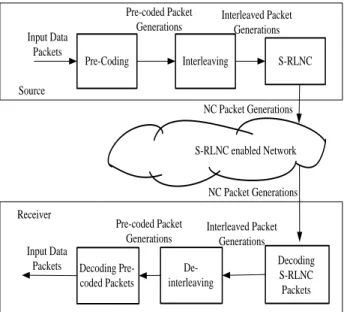
Our proposed S-RLNC model applies pre-coding and interleaving processes to retrieve lost packet combinations and to strengthen it be packet-loss resilient. One of the key novelties of the proposed model is that in this approach the random packet losses are recovered during decoding S-RLNC combinations while the burst packet losses which are spread after de-interleaving are recovered during decoding pre-coded combinations. A schematic of the proposed PCI based S-RLNC transmission model is given in Fig. 1. As depicted, our proposed model encompasses three consecutive phases, packet encoding at the source node, process at the intermediate node and packet decoding at the sink node. These processes are discussed as follows:
a) Packet Encoding at the Source Node
As stated, S-RLNC at first performs pre-coding and interleaving operations at the source so as to augment the robustness of a packet transmission against burst packet losses. Our proposed pre-coding method combined source packets linearly so as to generate a set of linear packet combinations. Consider where
, be source packets where each packet is a
matrix containing symbols from a Galois Field of size
, where F states the order of Galois field (GF).
Pre-coding process give rise to a matrix containing the linear combinations, , by performing following process (1).
(1)
manner that,
(2)
where is obtained through (3).
(3)
In (3), signifies the position of a symbol in a packet.
Pre-Coding Input Data
Packets
Source
Interleaving S-RLNC
Pre-coded Packet Generations
Interleaved Packet Generations
NC Packet Generations
S-RLNC enabled Network
NC Packet Generations
Receiver
Input Data
Packets Decoding
Pre-coded Packets
Pre-coded Packet Generations
De-interleaving
Interleaved Packet Generations
Decoding S-RLNC Packets
Figure 1. Block diagram of Pre-Coding and Interleaving assisted S-RLNC for MBMS
In our proposed model, S-RLNC has been employed to
that helps in generating or retrieving
where . Here, the generations
are obtained by means of , where individual component of refers a symbol belonging to GF of size . Thus, the output generated would be the linear packet combinations given by . Mathematically,
(4)
As depicted in (4), number of generated packet combinations, given as are retrieved and identified to be in the same interleaved group. Noticeably, the individual set of l linear packet combinations (i.e., ) originates from a single generation. Here, the key information pertaining to the S-RLNC generation, sequence number that signifies the position of a generation in the interleaved group), and the interleaved group are added to individual packet that facilitates the needed information for sink nodes so as to decode the received packet. It enables the linear packet combinations are multicast over S- RLNC enabled network.
b) Intermediate Nodes
In our proposed method, at intermediate node S-RLNC performs linear combination of the packets belonging to the same generation. Noticeably, all data packets belonging to the same generation have the same sequence number or rank and interleaved group. Therefore, at this node the S-RLNC generation, sequence number and interleaved group are appended to the output packet combinations. Once appending the data packets, intermediate node forwards it to
the sink node.
c) Packet Decoding at Sink Nodes
Consider the packets retrieved by the sink node is in the
form of
, where signifies the number of linear packet combinations pertaining to S-RLNC generation, obtained at the sink. Let,
1,2,…,m be the coefficient matrix and ZJ ×mJ=1,2,…,m
be the linear combination matrix obtained at the sink node. With these obtained variables, the sink node selects m linearly independent combinations from each generation (5).
(5)
In (5), the parameter selects linearly independent combinations from the generation, provided two conditions; and the sink node has received combinations out of linear packet combinations. Now, S-RLNC exploits the selected packet combinations and coefficients retrieved from generation for generating an interleaved generation in such manner,
(6)
In our model, the interleaved generations pertaining to an interleaved group are ordered by means of a rank value or the sequence number, which is then followed by de-interleaving so as to generate pre-coded generations. Mathematically, (7)
(7)
Here, is processed in such manner that,
(8)
In our proposed method, the combinations from each m sets of de-interleaved combinations pertaining to a pre-coded generation are taken into consideration along with their allied coefficients. Let, the selected coefficients and combinations be , then the original packets
are decoded by (9).
(9)
3.1.2 Multi-Generation Mixing Based S-RLNC for Multimedia Data Transmission
in the combination matrix. If the initial generation in the combination is one and the final generation in the combination set is z, then the position index would be
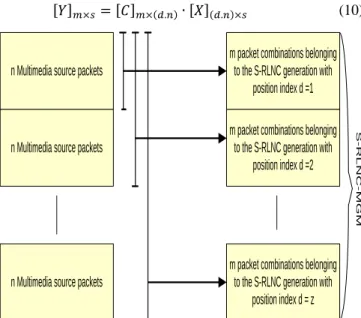
. As depicted in Fig. 2, the source node linearly
combines the initial numeral of source packets to generate a total of linear combinations, where . To ensure the successful delivery of the data packet combinations to the sink under the probability of packet loss, the z. (m-n) additionally transmits packet combination. Consider, be the source packets pertaining to the th generation in the matrix, where the individual source packet refers a matrix of the symbols obtained from the Galois Field of size , w ere F refers GF’s order. In our proposed S-RLNC model, at the source node, matrix with rank is obtained by means of the variables retrieved from the similar Galois field .
Now, from the th combination matrix, a total of output packet mixtures are obtained using (10).
(10)
n Multimedia source packets
n Multimedia source packets
n Multimedia source packets
m packet combinations belonging to the S-RLNC generation with
position index d =1
m packet combinations belonging to the S-RLNC generation with
position index d =2
m packet combinations belonging to the S-RLNC generation with
position index d = z
S
-R
L
N
C
-M
G
M
Figure 2. S-RLNC with multi-generation mixing (MGM)
The generated combinations (packet) allied with S-RLNC generations are then transmitted from the source node. As already discussed in the previous sections, the process of intermediate node is similar to the RLNC, where it encodes packet combinations allied with the similar S-RLNC generation. Sink nodes collects packet combinations from a suitable combination set. Sink nodes decode the
S-RLNC-MGM packets while the rank of the received matrix from the initial generations turns out to be .
Consider, unique packets be
, where signifies the coefficients pertinent to
generate the received packets
, in S-RLNC model the packets are decoded using (11).
(11)
Here, it should be noted that in case of packet loss, the
number of redundant packets are generated from
generations which are used to perform decoding. However, it increases the versatility of redundant packets as they are able to be used for augmenting error resilience of loss
proneness. Interestingly, in our proposed model, the redundant packets are generated for multiple-generation fixed packet combination and therefore it avoids redundant packet generation for each generation. This mechanism reduces the probability of additional bandwidth requirement (due to supplementary redundant packet transmission) and hence increases resource utilization. Furthermore, in our proposed model a novel function called Iterative Buffer Flush (IBF) has been applied that once the packet is decoded successfully at the receiver, it flushes the buffers and hence enables sufficient resource for further data transmission. It enhances resource efficacy of the proposed model, which is of vital significance for multimedia data transmission over LTE/LTE-A networks. Taking into consideration of the use of our proposed research work for multimedia data communication in LTE/LTE-A networks, we have derived our proposed S-RLNC-MGM model to cope up with content as well as network awareness to deliver QoS assured multicast transmission. A brief of the derived network and content awareness model is given as follows:
3.1.3 Network and Content Awareness of S-RLNC-MGM Model for Multicast Transmission over LTE
In our proposed S-RLNC-MGM model, to enhance the likelihood of decoding of each S-RLNC generation, it is intended to distribute redundant packet in such manner that it would assist deciding all data packets while ensuring minimum redundant packets demand. A snippet of decoding multimedia data packets at the receiver (in LTE, UEs) is given as follows:
a) Decoding Likelihood Optimization (DLO) each Generation
Our proposed S-RLNC-MGM model incorporates an optimization model to perform efficient redundant packet allocation across network that intends to increase the probability of decoding at receiver or UEs. As multicast application scenario over LTE network, in this research paper we consider source nodes, intermediate nodes and the sink nodes or customers (i.e., UEs). Here, the prime objective is to transmit the maximum possible data from the source node to the UEs by employing available resource or spectrum, efficiently. In our proposed model, the source node collects data packets from the application layer and prepares it as initial PDCP packet, which is then prepared as a sets of NC-PDCP (source) packets where z signifies the total number of generations and refers the total source packets allied with the generation having position index . Here, each source packet contains the factors selected from GF . Here, the source packets combined linearly by means of the variables selected from the similar GF so as to generate S-RLNC packets allied with multiple generations , where
signifies the total number of S-RLNC-coded packets belonging to the generation. In our model, the
Consider, the probability of a S-RLNC-MGM coded packet reaching to the UEs be . Mathematically,
(12)
Noticeably, the generation and its previous generations,
, are capable of being decoded in case
number of linearly dependent packet combinations are received from the different generations . It enables a sink or receiver (say, UEs in LTE) to decode every generations if generation (where ), is decoded and linearly independent S-RLNC-MGM coded packets are received from the generations . Consider, the probability of decoding after receiving packets from be , then it is presumed that an adequately large size of GF is considered for computation. In such cases, with , is equivalent to the probability of receiving at least S-RLNC-MGM coded packets out of the transmitted coded packets from generation . Hence,
(13)
Now, deriving by (13)
(14)
In the similar way, equals the likelihood of receiving at least packet combinations from if is decoded. Additionally, and are also capable of decoding if the sum of packet mixtures are received from the respective generations. Consequently, is estimated using (15).
(15)
Meanwhile, is estimated using (16).
(16)
Now, considering above equations (14-16), is derived into a generalized form
where, = 1. Furthermore, it must be noted that is
capable of getting decoded only when linearly independent packets are received from generations
where Consider the probability of decoding of after reaching packet combination (for z generations) be , then with d=z,
(17)
Similarly, with ,
(18)
Similarly, when d = 1,
(19)
Now, implementing (17), (18) and (19), t; a generalized form is achieved as (20).
(20)
Using (9), the average decoding probability for S-RLNC generation, , is estimated using (21).
(21)
The major significance of is that it applies the decoding probability with in such way that
(22)
where, R signifies the summation of the packet combinations capable of being transferred per multi-generation in the assigned bandwidth.
3.1.4 Received Video Quality
n1 Coded Packets
(m1-n1) Redundant Coded Packets
n2 Coded Packets
(m2-n2) Redundant Coded Packets
nz Coded Packets
(mz-nz) Redundant Coded Packets
Generation g1
Generation g2
Generation gz
Scalability Layer 1 (Data Base Layer)
Scalability Layer 2 (Multimedia data Enhancement Layer 1)
Scalability Layer z (Multimedia data Enhancement Layer z-1)
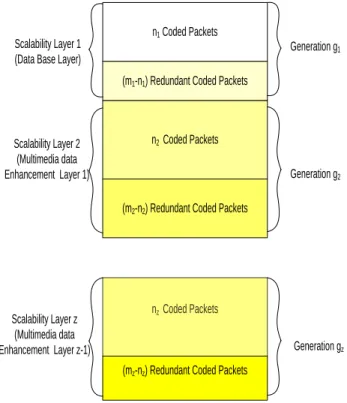
Figure 3. Multimedia data packet assignment to S-RLNC
generations in MGM approach
The retrieved multimedia quality is estimated as follows: The probability of retrieving each multimedia layer merely equal to the dth scalability layer, , is equivalent to the likelihood of decoding generations and not decoding the generation . Therefore, is obtained using (23).
(23)
Let be the multimedia (data) quality when each layer equal to the dth scalability layer is received and then the received data quality of the users is obtained as (24).
(24)
As stated, the optimal value of signifies the received data quality at the users is estimated using an enhancement model . Mathematically (25),
(25)
This is the matter of fact that the aforementioned model ensures data recovery or decoding at the receiver through efficient redundant packets; owever it can’t minimize t e likelihood of minimum decoding at the base layer of a scalable multimedia data having under average network conditions, which is highly generic problem in cellular networks or the LTE/LTE-A networks. Despite of deciding the base layer, a user (UE) cannot playback the multimedia data (say, video) constantly and therefore augmentation the likelihood of decoding at the base layer of the multimedia data at every UE would enhance the likelihood of unremitting multimedia (say, video) view, while QoS assurance. To deal with this, in our paper a redundant packet
distribution optimization has been performed. Our proposed model ensures that the sufficient and optimal number of redundant packets is distributed across network to ensure that all receivers decode multimedia data while preserving original quality.
We have applied a scalable multimedia multicast network, where the received data quality can be estimated at each UE by replacing with the likelihood of a coded data reaching each UE rather than . For example, consider the quality of data received at a user (i.e., UE ) be and let the incessant multimedia be characterized in such manner that the base scalability of the data layer is accepted through the receiver node at likelihood more than a predefined likelihood of . Thus, the likelihood of the UE receiving the base layer, can be estimated by substituting with
rather than . Here, each UE (i.e., user) can be assigned redundant packet using a score or rank value of in such way that
(26)
Thus, considering overall users in the network , the mean rank can be obtained as
(27)
The optimal value of , so that the likelihood of unremitting multimedia data at each user gets augmented while maintaining an increased average quality per user. The average quality per user can be obtained using (28).
(28)
3.2 S-RLNC-MGM Assisted MAC FOR LTE/LTE-A
is employed that uses additional RLC-level ARQ to assure RLC packet delivery [52]. However, it happens at the cost of increased redundant packets and higher signaling overheads that as a result impose additional latency and energy consumption. To alleviate these issues, in our proposed model S-RLNC has been applied at the top of the classical MAC RNC, as depicted in Fig. 4.
RLC SDU PDCP PDU
IP/PDCP Layer
RLC Layer
MAC Layer
1 (Unit) Radio Frame=10 ns
RLC Segmentation ARQ Process
RLC PDU
PDU1 MAC PDU PDU8
... PHY TB ... TB10
TB1
TTI TTI
… RLC PDU
… MAC PDU
… PHY TB
PHY Layer
... ...
Figure 4. MAC-HARQ solution
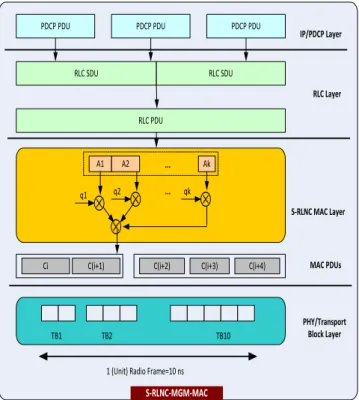
In process, the PHY TB which is a PHY layer packet mapped to a unit of PHY time-frequency resources on the wireless link called Resource Block Pair (RBP). Typically, unit PHY RBP equals 1 ms of time period also called Transmission Time Interval (TTI). In general, the PHY TB size in each TTI depends upon two factors; the AM system selected by means of the MAC scheduler that exploits information like Channel Quality Indicator (CQI) given by the UE and number of RBP of PHY RBPs assigned to the UE. The classical LTE MAC with MAC-HARQ imposes significant computational or (and) signaling overheads during FEC [53]. The predominant solution originates from the RLC layer to deliver RLC IP/PDCP packet above the eNB/UE line. This solution is the normalized method that transmits PDCP/IP packet through parallel, autonomous and time-interleaved delivery of associated disjoint segments (MAC frames), which is supported through the MAC-HARQ protocol to assist reliable multimedia data delivery (Fig. 4). In this mechanism the PDCP/IP packet is accepted once every of its RLC/MAC segments are received at the receiver or the UE [52]. Unlike traditional MAC-HARQ, we have applied our proposed S-RLNC model at the top of classical MAC protocol. Unlike classical LTE MAC, our proposed S-RLNC-MAC model does not segment the PDCP/IP packet. In our proposed model RLC layer compresses the PDCP/IP packet directly into the RLC packet that maintains the reliability of IP packets containing multimedia data components [54]. As depicted in Fig. 5, in case of bigger RLC (PDCP) packets, RLC layer concatenates multiple packets into an individual RLC packet. Further, in MAC layer, RLC message is processed with the proposed S-RLNC-MGM model where the data packet is split into K
equal-size source symbols from which a stream of S-RNLC processed symbol is generated. In our proposed model, S-RLNC-MGM with GF of size 8 has been taken into consideration to perform multicast transmission over LTE-MAC. Here, MAC S-RLNC generated suitable equal-length data packets which are collected into a MAC frame to fit the future PHY TBS. In our model, MAC frame is accumulated in the PHY TB. The received PHY TB at UE with additional redundant packets is decoded using S-RLNC-MGM MAC (decoding) sub-layer. Once receiving linearly independent encoded packets from the stream of MAC frames, the UE MAC gives back an individual ACK message deciding the RLC packet transmission. We have applied real time multimedia data packets, where realistic LTE/LTE-A EUTRAN data delivery model is developed by broadcasting image data for unicast and multicast multimedia transmission services. The image data transmission is taken into consideration where IP data streams transmit video substance to the user equipments (UEs). Here, each IP image data (say, frame) is assigned a set of time-frequency resources at the eNB/UE radio-interface, defined by means of a set of PHY RBPs above a time-sequence of TTI periods. Considering MBMS transmissions, S-RLNC-MDM exploits network conditions which have been simulated with Gilbert Elliot model, and accordingly performs resource allocation. Even exploiting channel state conditions (CSI), eNB can use and schedule certain suitable coding and modulation system over PHY TBs for upcoming TTIs. On the contrary, the currently applied 3GPP standard of multimedia broadcast, the eNB applies a fixed PHY broadcast model targeting total cellular reporting regardless of the individual UE channel conditions.
PDCP PDU
RLC SDU
PDCP PDU PDCP PDU
RLC SDU
RLC PDU
A1 A2 Ak
Ci C(i+1) C(i+2) C(i+3) C(i+4)
TB1 TB2 TB10
IP/PDCP Layer
RLC Layer
S-RLNC MAC Layer
PHY/Transport Block Layer
q1 q2 qk
1 (Unit) Radio Frame=10 ns
... ...
MAC PDUs
S-RLNC-MGM-MAC
Figure 5. S-RLNC MGM-MAC solution
of packet delivery ratio, loss ratio, delay, peak signal to noise ratio (PSNR) etc. The results obtained are discussed in the next section.
4.
Results and Discussion
In this research work, the predominant emphasis was made on developing a robust and efficient multimedia multicasting model for LTE/LTE-A system. Considering the need of QoS/QoE experience in LTE broadcast demands, here we focused on enhancing NC scheme by incorporating systematic NC scheme where only a fraction of input data is enquired to be encrypted. This enables our proposed system to be computationally efficient. The development of interleaving and coding was applied to strengthen transmission reliability. Unlike classical NC scheme, we developed a multiple generation mixing (MGM) model to strengthen or optimize redundant packet distribution across the users (here, UEs) in LTE network. Thus, the overall proposed NC scheme was derived as S-RLNC-MGM model to be further applied for LTE-MAC as a substitute or at the top of traditional LTE-MAC-HARQ. This as a result enhances overall signaling overheads by reducing iterative ARQ to the transmitter. In addition, we applied an iterative buffer flush (IBF) model that once receiving data packet at the receiver flushes transmitter buffer and hence preserves bandwidth significantly. Unlike traditional NC scheme where with each generation redundant data packet is required to be transmitted along with the data packet, we derived MGM model that transmits redundant packet at once after mixing encoded packets from multiple generation. This reduces computational complexity as well as buffer occupancy. To assess the error-proneness assessment of the proposed S-RLNC-MGM model, we assessed our proposed system with different loss conditions, which was incorporated by varying network loss pattern. We used COST231 (an enhanced Okumura Hata loss Model (OHM) which functions in the frequency range of 150-1500 MHz) to examine packet loss resiliency under varying loss conditions. Noticeably, COST231 loss model is applicable for the frequency range of 1500 to 2000 MHz, which is sufficient for LTE systems. This simulation case is applicable for the UE’s speed of 30km/ our. Our proposed system was tested with six User Equipments (UEs) distributed in a three layers (source, intermediate and sink) distributed across LTE network. We tested performance with the Galois Field of size 4, 8 and 16, and the results for each test conditions (GF=4/8/16) was examined. In S-RLNC-MGM, we applied image data as multimedia input. As sample, we applied standard images of different size such as Lena, Photographer, and Baboon to test efficacy of our proposed system in terms of PSNR, MSE etc. The simulation was done for different datasets with different GF size and packet rate. The overall simulation model is developed using MATLAB 2015a tool.
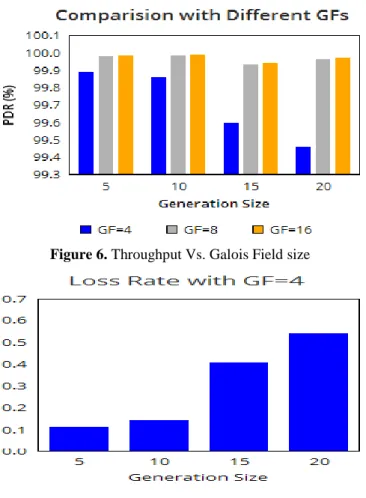
At first S-RLNC-MGM model has been examined for throughput (i.e., packet delivery ratio (PDR) and packet loss performance with different GF size and the number of generation. Since S-RLNC-MGM applies redundant packet transmission for multiple generations at a time rather than redundant packets-per generation. It enhances buffer occupancy while maintaining optimal data decoding at the receiver.
Figure 6. Throughput Vs. Galois Field size
Figure 7. Packet Loss Vs. Generations (GF=4)
Figure 8. Packet Loss Vs. Generations (GF=8)
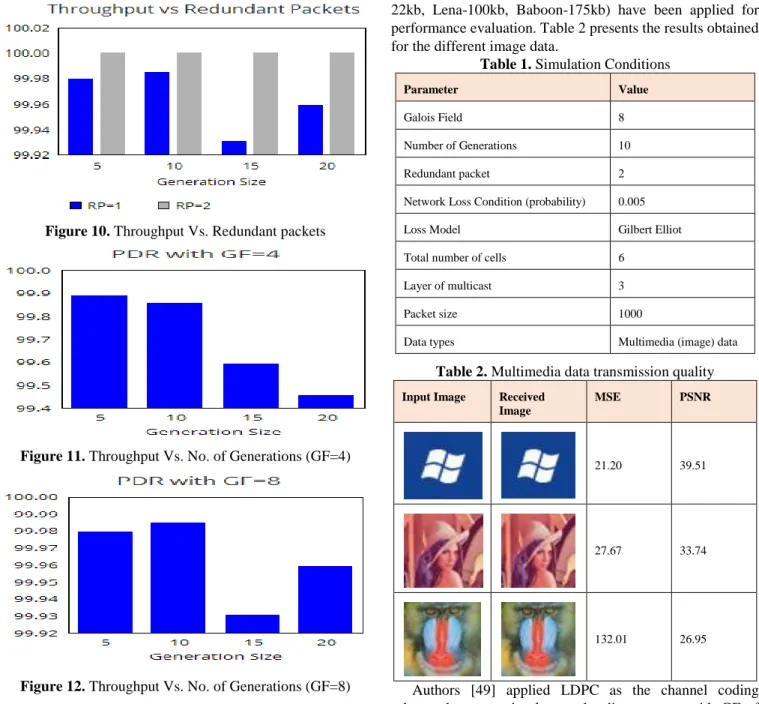
Figure 10. Throughput Vs. Redundant packets
Figure 11. Throughput Vs. No. of Generations (GF=4)
Figure 12. Throughput Vs. No. of Generations (GF=8)
Figure 13. Throughput Vs. No. of Generations (GF=16)
Considering QoS/QoE assurance in multimedia data transmission over LTE/LTE-A systems, in this research different images with different packet size are transmitted over developed routing model. Noticeably, considering above results to further examine the performance of the proposed S-RLNC-MGM model for multimedia multicast over LTE, in our research we applied the following test conditions. Here, the images of different sizes
(Windows-22kb, Lena-100kb, Baboon-175kb) have been applied for performance evaluation. Table 2 presents the results obtained for the different image data.
Table 1. Simulation Conditions
Parameter Value
Galois Field 8
Number of Generations 10
Redundant packet 2
Network Loss Condition (probability) 0.005
Loss Model Gilbert Elliot
Total number of cells 6
Layer of multicast 3
Packet size 1000
Data types Multimedia (image) data
Table 2. Multimedia data transmission quality
Input Image Received Image
MSE PSNR
21.20 39.51
27.67 33.74
132.01 26.95
model towards multimedia data transmission or multicast over LTE/LTE-A protocol standard. Recently, authors [55] developed a practical network coding (PNC) scheme for content and network aware multimedia multicast. Though, our work exploits multicast nature of the PNC proposed in [55], the implementation of our proposed S-RLNC-MGM model enables better performance in terms of multimedia data transmission.
5.
Conclusion
Considering the key QoS parameter demand over LTE systems, such as minimum delay, low or negligible latency, higher resource utilization etc, in this research paper the focus was made on deriving a robust network coding scheme for multimedia data delivery over LTE/LTE-A systems. Unlike classical network coding algorithms, this paper presented an enhanced systematic random linear network coding (S-RLNC) based transmission model, which has been armored with multiple generation mixing (MGM) and iterative buffer flush (IBF) that augments resource utilization. In addition, the use of MGM with S-RLNC strengthened proposed multimedia multicast model to ensure optimal redundant packet transmission that enhances both computational efficacy as well as resource utilization, while ensuring assured decoding at the receiver. Furthermore, realizing the practical network conditions, the proposed S-RLNC-MGM model was examined with varying network loss conditions, where it was found robust in terms of successful data delivery and decoding at the receiver. Considering the limitations of the existing LTE HARQ-MAC protocol, particularly in terms of signaling overhead, round trip time (RTT) and latency, in this research paper, the proposed S-RLNC scheme has been applied on the top of LTE-MAC has that augments existing system to deliver reliable multimedia data with almost 100% success rate (i.e., 100% packet delivery ratio) with low latency and minimum error. Considering quality preserving nature, the simulation with multimedia image data has revealed minimum mean square error and higher signal to noise ratio, which signifies its suitability for real time multimedia data transmission over LTE. In future, the proposed S-RLNC-MGM model can be applied with LTE standard simulation models with video data under dynamic network conditions etc. The usefulness of H264/SVC encoding can also be assessed to augment data rate transmission in LTE.
References
[1] A. Ajina, M. K. Nair “Cross Layered Network Condition Aware MobileWireless Multimedia Sensor Network Routing Protocol for Mission Critical Communication” International Journal of Communication Networks and Information Security (IJCNIS) Vol. 9, No. 1, April 2017.
[2] N. Hajlaoui, I. Jabri and M. B. Jemaa “Experimental Performance Evaluation and Frame Aggregation Enhancement in IEEE 802.11n WLANs” International Journal of Communication Networks and Information Security (IJCNIS) Vol. 5, No. 1, April 2013.
[3] M. Gruber and D. Zeller, “Multimedia broadcast multicast service: new transmission schemes and related challenges,” IEEE Commun. Mag., vol. 49, no. 12, pp. 176–181, Dec. 2011.
[4] D. Vukobratovic, C. Khirallah, V. Stankovic, and J. Thompson. Random Network Coding for Multimedia Delivery over LTE-Advanced. In 2012 IEEE International
Conference Multimedia and Expo (ICME), pp. 200–205, 2012.
[5] “Mobile vce: Research innovation application. Random network coding for LTE,” pp. 1–2.
[6] M. Nagajot y, S. Rad a, “Network lifetime en ancement in wireless sensor network using network coding”, International Conference on Control, Automation, Communication and Energy Conservation (INCACEC), pp. 1–4, 2009.
[7] Y. Hong, J. Xu, C. Jiang, “Lifetime Maximization in Wireless Sensor Networks wit Network Coding”, International Conf. on Wireless Communications, Networking and Mobile Computing, pp. 2527-2530, 2007.
[8] P.M. Glatz, K.B. Hein, R. Weiss, “Energy Conservation wit Network Coding for Wireless Sensor Networks with Multiple Crossed Information Flows”, 10t International Symposium on Pervasive Systems, Algorithms, and Networks (ISPAN), pp. 202-207, 2009.
[9] Y. Wang, I.D. Henning, D.K. Hunter, “Efficient Information Exchange in Wireless Sensor Networks using Network Coding”, Fourt Works op on Network Coding, T eory and Applications, pp. 1-6, 2008.
[10]H. Hamdoun, P. Loskot, “Implementing Network Coding in LTE and LTE-A,” In The first International Workshop on Smart Wireless Communications, Luton, UK, pp.1-4, 2012. [11]H. Hamdoun, P. Loskot, T. O’Farrell, and J. He, “Practical
Network Coding for Two Way Relay Channels in LTE Networks,” In Vehicular Technology Conference, 2011 IEEE 73rd, pp. 1–5, May 2011.
[12]R. A lswede, N. Cai, S. R. Li, R. W. Yeung, “Network information flow”, 1204 IEEE Transactions On Information Theory, Vol. 46, No. 4, pp.1-13, 2000.
[13]3GPP TR 36.913 v8.0.1 (Release 8), “Requirements for furt er advancement for (E-UTRA),” 2009.
[14]M. Gruber, D. Zeller, “Multimedia broadcast multicast service: new transmission sc emes and related c allenges,” IEEE Commun. Mag., vol. 49, no. 12, pp. 176–181, Dec. 2011.
[15]H. S ojania, B. Li. “Random Network Coding on t e iP one: Fact or Fiction?,” ACM NOSSDAV, Williamsburg, USA, pp. 37-42, June 2009.
[16]P. Vingelmann, F.H.P. Fitzek, M.V. Pedersen, J. Heide and H. C araf, “Sync ronized Multimedia Streaming on t e iP one Platform wit Network Coding,” IEEE CCNC, Las Vegas, USA, vol. 49, no. 6, pp. 126-132, January 2011.
[17]P. A. C ou, Y. Wu, and K. Jain, “Practical network coding,” Allerton Conference 2003, Monticello, IL, USA, pp. 1-10, October 2003.
[18]G. Liva, E. Paolini, M. C iani: “Performance vs Over ead for Fountain Codes over GFq,” IEEE Comm. Lett., Vol. 14, No. 2, pp. 178–180, 2010.
[19]P.A. Chou, Y. Wu: “Network Coding for t e Internet and Wireless Networks,” IEEE Signal Proc. Magazine, Vol. 24, No. 5, pp, 77-85, 2007.
[20]D. Vukobratovi´c,, V. Stankovi´c: “Unequal Error Protection Random Linear Coding Strategies for Erasure C annels,” IEEE Trans. Communications, Vol. 60, No. 5, pp. 1243– 1252, May 2012.
[21]B. Sc otsc , R. Lupoaie, and P. Vary: “T e Performance of Low-Density Random Linear Fountain Codes over Higher Order Galois Fields under Maximum Likeli ood Decoding,” Allerton 2011, USA, pp. 1004-1011, 2011.
[22]C. Khirallah, D. Vukobratovi´c, and J. Thompson: “Performance Evaluation and Energy Efficiency of Random Network Coding in LTEAdvanced,” IEEE Trans. Wireless Comm, Vol. 11, No. 12, pp. 4275-4285, December 2012. [23]A. K andekar, N. B us an, J. Tingfang, V. Vang i:
“LTE-Advanced: Heterogeneous Networks,” European Wireless EW 2010, pp. 978–982, 2010.
[25]R. Koetter, M. Medard, “An Algebraic Approac to Network Coding", IEEE/ACM Trans. Networking, vol. 11, no. 5, pp. 782–795, 2003.
[26]M. Nagajot y, S. Rad a, “Network lifetime en ancement in wireless sensor network using network coding”, International Conference on Control, Automation, Communication and Energy Conservation (INCACEC), pp. 1–4, 2009.
[27]Y. Hong, J. Xu, C. Jiang, “Lifetime Maximisation in Wireless Sensor Networks wit Network Coding”, International Conf. on Wireless Communications, Networking and Mobile Computing, Vol. 56, No. 2, pp 1–15, 2007.
[28]D. Vukobratovic, C. Khirallah, V. Stankovic, and J. Thompson, “Random Network Coding for Multimedia Delivery over LTE-Advanced,” In 2012 IEEE International Conference Multimedia and Expo (ICME), pp. 200–205, 2012.
[29]I. F. Akyildiz, D. M. Gutierrez-Estevez, E. C. Reyes “The evolution to 4G cellular systems: LTE-Advanced,” Physical Communication 3, pp. 217–244, 2010.
[30]R. A lswede, N. Cai, S. R. Li, R. W. Yeung, “Network information flow”, IEEE Trans. On Information T eory, Vol. 46, No. 4, pp. 1-13, 2000.
[31]S. Katti, H. Rahul, Wenjun Hu, D. Katabi, M. Medard, and J. Crowcroft. “XORs in the Air: Practical Wireless Network Coding,” IEEE/ACM Transactions on Networking, Vol. 16, No. 3, pp. 497–510, 2008.
[32]A. Kulkarni, M. Heindlmaier, D. Traskov, M. Montpetit, and M. Médard. “An implementation of network coding with association policies in heterogeneous networks,” Workshops, pp. 110–118, 2011.
[33]D. Vukobratovic, C. Khirallah, V. Stankovic, and J. Thompson. “Random Network Coding for Multimedia Delivery over LTE-Advanced,” In 2012 IEEE International Conference on Multimedia and Expo (ICME), pp. 200–205, 2012.
[34]H. Hamdoun, P. Loskot. “Implementing Network Coding in LTE and LTE-A,” In The first International Workshop on Smart Wireless Communications, Luton, UK, 2012.
[35]H. Hamdoun, P. Loskot, T. O’Farrell, and J. He. “Practical Network Coding for Two Way Relay Channels in LTE Networks,” In Vehicular Technology Conference, 2011 IEEE 73rd, pp. 1–5, May 2011.
[36]J. Jin, B. Li, and T. Kong. “Is random network coding helpful in WiMAX? In INFOCOM 2008,” The 27th Conference on Computer Communications, 2008.
[37]G. Fodor, A. Gattami, and A. Pradini, “Device-to-Device Communication and Network Coding: Friends or Foes?” IEEE Comsoc MMTC E-Letter, 9, pp. 33–35, 2014.
[38]C. Khirallah, D. Vukobratovic, and J. Thompson, “Performance Analysis and Energy Efficiency of Random Network Coding in LTE-Advanced,” IEEE Transactions on Wireless Comm., Vol. 11, No. 12, pp. 4275–4285, 2012. [39]S. Dumitrescu, M. S ao, and X. Wu, “Layered Multicast wit
Inter-Layer Network Coding,” in IEEE INFOCOM 2009, Rio deJaneiro, Brazil, BR, pp. 442–449, Apr. 2009.
[40]J. Widmer, A. Capalbo, A. Anta, and A. Banc s, “Rate allocation for layered multicast streaming with inter-layer network coding,” in Proc. of IEEE INFOCOM 2012, Orlando, Florida, pp. 2796–2800, Mar. 2012.
[41]A. Tassi, I. C atzigeorgiou and D. Vukobratović, "Resource-Allocation Frameworks for Network-Coded Layered Multimedia Multicast Services," in IEEE Journal on Selected Areas in Communications, Vol. 33, No. 2, pp. 141-155, Feb. 2015.
[42]A. Tassi, C. K iralla , D. Vukobratović, F. C iti, J. T ompson and R. Fantacci, "Reliable rate-optimized video multicasting services over LTE/LTE-A," 2013 IEEE International Conference on Communications (ICC), Budapest, pp. 5078-5082, 2013.
[43]U. Kumar and O. Oyman, "QoE evaluation for video streaming over eMBMS," 2013 International Conference on
Computing, Networking and Communications (ICNC), San Diego, CA, pp. 555-559, 2013.
[44]G. Savona and C. J. Debono, "Schedulers for MPEG-DASH compliant multi-view video over LTE," 2016 International Conference on Telecommunications and Multimedia (TEMU), Heraklion, pp. 1-6, 2016.
[45]A. Khina, T. Philosof and M. Laifenfeld, "Multicast MIMO enhancement for V2X over LTE," 2015 IEEE International Conference on Microwaves, Communications, Antennas and Electronic Systems (COMCAS), Tel-Aviv, pp. 1-5, 2015. [46]A. Tassi, I. C atzigeorgiou, D. Vukobratović and A. L. Jones,
"Optimized network-coded scalable video multicasting over eMBMS networks," 2015 IEEE International Conference on Communications (ICC), London, pp. 3069-3075, 2015. [47]N. Changuel, M. Ene, B. Sayadi and M. Kieffer, "Class-based
MDP for improved multimedia transmission over LTE," 2013 IEEE International Conference on Image Processing, Melbourne, VIC, pp. 1811-1815, 2013.
[48]A. Tassi et al., "Reliable multicast in LTE-A: An energy efficient cross-layer application of network coding," ICT 2013, Casablanca, pp. 1-5, 2013.
[49]Veeresh Patil, Sanjeev Gupta, C. Kes avamurt y “An Enhanced Network Coding Based MAC Optimization Model for QoS Oriented Multicast Transmission Over LTE Networks” nternational Journal of Computer Science and Information Security (IJCSIS),Vol. 14, No. 12, December 2016.
[50]S. Jaggi, M. Langberg, S. Katti, T. Ho, D. Katabi, and M. Medard, “Resilient network coding in t e presence of Byzantine adversaries,” in IEEE INFOCOM. 26t IEEE International Conference on Computer Communications, pp. 616– 624, 2007.
[51]M. Hallous and H. Rad a, “Network Coding with Multi-Generation Mixing: A Generalized Framework for Practical Network Coding,” IEEE Trans. Wirel. Commun., vol. 10, no. 2, pp. 466–473, 2011.
[52]H. Holma, A. Toskala, “LTE for UMTS: Evolution to LTE-Advanced,” Second Edition, Wiley, 2011.
[53]C. Khirallah, D. Vukobratovi´c, and J. Thompson: “Performance Evaluation and Energy Efficiency of Random Network Coding in LTEAdvanced,” IEEE Trans. Wireless Comm, Vol. 11, No. 12, pp. 4275-4285, December 2012. [54] T. Wiegand, G. J. Sullivan, G. Bjontegaard, and A. Luthra:
“Overview of t e H. 264/AVC video coding standard,” IEEE Trans. Circ. and Syst. for Video Tech. Vol. 13, No. 7, pp. 560–576, 2003.