CHAPTER IV
FINDS OTHER THAN POTTERY
In this chapter we will discuss the remaining finds
from the Early Neolithic I strata at Sesklo. Although the total number of artefacts, other than sherds, is rather small, making it impossible to establish a typology or to use them for comparative purposes, we want to include them for completeness sake. Hence we will give a kind of catalogue, arranged according to the type of objects. These will include the material from stratum D. As mentioned in chap-ter II, this does not contain any potchap-tery, but the faunal remains indicate that the mode of subsistence was agricultural. This brings into focus the problem of the existence or non-existence of a Pre-Pottery Neolithic. It is one of the subjects to be discussed at the end of this chapter. This will be foliowed by a few short notes on the chronology of the Early Neolithic.
IV \ CHIPPED STONE
Wc will restrict our observations to the chipped stone material from section C, for the sole reason that this is the best sample'. In total it consists of 184 fragments of obsidian or flint. Nearly half of the fragments (86) consists of generally extremely small debitage chips. Most of the latter have been recover-ed from stratum D; therefore one could conclude that this is an archaic artefact. The greatest care should, however, be exercised because many chips from higher strata will have been lost since the soil was not sieved. This would be the case especially with stratum A which has an extremely hard soil, in which microlithic fragments might easily be over-looked.
The rest consists entirely of blades. Of these nota single one has been deliberately retouched. Only a faint nibbling of the edges could be an indication of use. In the few cases where silica gloss can be seen
on one of the edges do we know for certain that the blades have been used. The fact that the vast majo-rity of the blades consists of fragments indicates that they were used until they were completely worn and needed renewal. This may be due to the fact that the raw material for manufacture was not available close to the settlement.
Among the material excavated there were many quartzflakes. Generally they are notthoughtto have served as implements, since the material is far too brittle to allow prolonged and heavy use. For this reason they were not recovered with particular care during the excavation. Quartz is, however, readily available at Sesklo, whereas both obsidian and flint have to be imported. Therefore we think it may certainly have been used, e.g. in cutting cereals and wild plants and also for other purposes not requiring an implement of particularly great strength^.
The complete absence of cores and core frag-ments, be they of flint or obsidian, is remarkable. A few possible rejuvenation flakes have been recover-ed and one or two small fragments which would resemble a core but for the fact that the scars are far too narrow for this to be convincing. Although there are numerous extremely small chips and several rather irregular debitage lumps, we assume that the implements were manufactured at an entirely diffe-rent site, e.g. at a kind of distribution centre oreven at source. Despite the fact that chips are essentially connected with tooi manufacture, the products of such activity are not known.
IV. 1.1. Obsidian (fig. 12 no 1-3; 6)
40 F I N D S O T H F R T H A N P O T T F R Y
that the provenience had to be the island of Melos,
situated some 320 km. southeast of Sesklo in the
Aegean sea.
Among the fragments were two complete blades
and 58 blade fragments. The rest (73 fragments)
consisted of debitage material, largely small chips
of a width less than 5 mm. From stratum D, only 4
blade fragments, but 24 debitage chips were
re-covered; from stratum C, 24 blade fragments and 23
chips; from stratum B, 23 blade fragments and 21
chips and from stratum A, 8 blade fragments and 5
chips.
Among the blade fragments we could discern
three groups:
a. Width around 7 mm. Length varying between 7
and 14 mm, mostly around 10 mm. One
com-plete blade, 7 mm wide, 10.6 mm long.
b. Width between 9 and 13 mm. Length varying
between 12 and 27 mm, most often 20 mm. One
complete blade 10 mm wide, 38.8 mm long.
c. Width over 15 mm. Length 16 - 17 mm.
Some blade fragments show a bulb of applied force,
indicating that they have been knapped using a
per-cussion or pressure technique. Judging from the
simplicity of shape it was the former.
IV. 1.2. Chert implements (fig. 12 no 4-5; 7-9)
The total chipped chert consists of 51 fragments.
The colours range from whitish to dark red-brown,
the latter being the most common. The material is of
granular fine quality and shows generally a rather
dull lustre. It is not locally found. It has not yet been
subjected to analysis in order to tracé its origin.
However, the chert artefacts at all Early Neolithic
sites in the plain of Larisa and its immediate
sur-roundings seem to have been manufactured of the
same material. Texture and lustre are of a similar
quality and the colour range is in all cases identical.
Possibly the material for all these implements
origi-nated from chert boulders in the piedmont fans of the
lower Pleistocene Pinios terrace (Schneider 1968, p.
38).
The bulbs of percussion indicate that the blades have
been knapped from the core using a percussion or
pressure technique. In a few cases traces of cortex
are visible on the blade.
Among the chert implements were four complete
blades, 34 blade fragments, of which five had silica
sheen on the edge(s), and 13 debitage chips. From
stratum D, 4 blade fragments and 6 debitage chips
were recovered; from stratum C, 5 blade fragments
and 3 chips; from stratum B, 15 blade fragments and
3 chips and from stratum A, 14 blade fragments and
1 chip.
As with the obsidian the blade fragments could be
divided into three groups:
a. Width around 7 mm. Length ranging between 8
and 11 mm. Two complete blades, one 20.5 mm.
and one 22 mm. long.
b. Width between 9 and 13 mm. Length ranging
between 15 and 20 mm. in one case 32.3 mm.
Two complete blades, one 44.1 and one 23.6
mm. long.
c. Width over 15 mm. Length ranging from 23 to 32
mm.
The sickle blades have not been prepared by
delibe-rate retouch (fig. 12 no 7-9). The edges show zones
of chipping as a result of use - especially the edge
with silica gloss. As to the size, sickle blade
frag-ments are slightly longer than the other fragfrag-ments:
thereisoneofwidth9mm. and length 15 mm.; three
of widths between 9 and 12 mm. and lengths of
respectively 22.9, 30.7 and 33.9 mm.; one of width
16 mm. and length 30.4 mm.
Throughout the Early Neolithic period, chipped
stone use is restricted to blades; at least this is the
case in Thessaly. We suppose that the harvesting of
cereals, the cutting of wild plants, the preparing of
meat and other food and the processing and
prepa-ring of skins were the main tasks chipped stone was
used for. They may have served another purpose
too: although wooden and bone implements may
have been the more important components of the
Early Neolithic tool-kit, they had to be
manufactu-red using chipped stone. In view of the bone analysis
(Appendix 11) it is hardly surprising that hunting
tools are virtually absent.
IV. 2. MISCELLANEOUS STONE ARTEFACTS
as-M I S C E L L A N F O U S STONH ARTFFACTS
41
semblages in Greece-^. A main division into (a) 13
polished implements and (b) 32 grinding and
poun-ding tools can be made, to which another (c) 3
doubtful stone artefacts may be added. Microscopic
analysis has not been done and generally we do not
have very clear indications of use. Stratum B
yiel-ded the largest quantity ofobjects, respectively 8,
19 and 1; from stratum C 5, 12 and 1 respectively
were retrieved. The rest are from stratum D, since
stratum A was completely devoid of these objects.
Most polished implements are made of
"green-stone", which may be serpentine or green Jasper,
probably of East Thessalian provenience, if not
from the direct neighbourhood of Sesklo. Some are
made of a local schist. The bolas have been made of
white marble of unknown provenience. Coarse
grinding slabs are made of porous rock from the
volcano at Mikro-Thive. Fine grinding slabs are of
local schist. Hand-stones and pestles are of local
cobbles, a grey stone or greenstone. The other
arte-facts are of local cobbles and of porous volcanic
rock from Mikro-Thive.
Most of these objects were used throughout the
Neolithic, or at least during the Early and Middie
Neolithic periods, at all sites in Greece. The
excep-tion is the coarse flat eelt or hoe, which seems to be
restricted to Early Neolithic 1. For the bolas and the
objects of unknown use we have no indication of
temporal or geographical distribution.
IV. 2.1. Polished stone tools
a. The heavy rounded "axe" (fig. 13 no I)
Sample: 3
Heavy pounding implement with rather blunt
edge. 7 - 1 0 cm long. Reasonably well polished
surface.
b. Flat eelt or "hoe" (fig. 13 nos. 2-3)Sample: 3
Flat chopping tooi, oval or rectangular in shape.
Edge chipped but not very sharp. 6 -10 cm long.
c. Chisel (fig. 13 no 4) Sample: 2
Narruw, slender cutting implement.
Symmetri-cal section. Sharp straight edge with two
wor-king platforms. Highly polished surface. 5-7 cm
long; 0.7 - 1.5 cm wide.
d. Adze (fig. 13 no 5-7) Sample: 2
Asymmetrical convex chopping implement.
Sharp edge. One with a second sharp edge along
the longitudinal side, where it had been cut from
the parent stone. Highly polished surface. 6 - 8
cm long; 3.5 - 6 cm wide.
e. Small axe (fig. 13 no 6) Sample: I
Almost rectangular, slightly convex chopping
implement. Symmetrical profile. Very shallow
working platform. Sharp edge. Highly polished
surface. 6 cm. long; 3.5 cm. wide.
f. Bolas (fig. 13 no 8-9) Sample: 2
Almost completely globular projectile. Slightly
tapered, perfectly smooth drill hole through
cen-tre. Both well polished. Discovered close
toge-ther, seemingly as a set. 5.75 cm high. Maximum
diameter 5.8 - 6.2 cm.
IV. 2.2. Grinding and pounding tools
a. Grinding slab, coarse Sample: 8
Oval slabs of volcanic rock which have been
ground until the upper surface showed a concave
appearance. One case has an additional
depres-sion in the centre of the upper surface. About
twice as long as they are wide - length around 35
cm.
b. Grinding slab, fine Sample: 1
Rounded slab of schist. Lower surface rough,
convex. Upper surface very smooth, strongly
concave appearance. Length 11.8 cm, width 4.1
- 6.3 cm, height 1.2 - 1.7 cm.
c. Hand-stones Sample: 21
Oval or round, disc-shaped (14) and oblong,
plano-convex (7) cobbles. The lower surface
displays a very smooth, worn appearance and
may even show a slight concavity. Smooth side
may have polishing lustre. Diameter of round
examples 6 - 10 cm. Length of oblong examples
8 - 15 cm.
42 F I N D S O T H F R T H A N P O T T F R Y
11
G R I N D I N G A N D P O U N D I N G T O O L S 43
IV. 23. Other stone artefacts Description
a. Pivot-stone Sample: 1 A roughly quadrangular, flat stone disc with a neatly outlined depression in the centre of the upper surface. Size 28 x 28 cm.
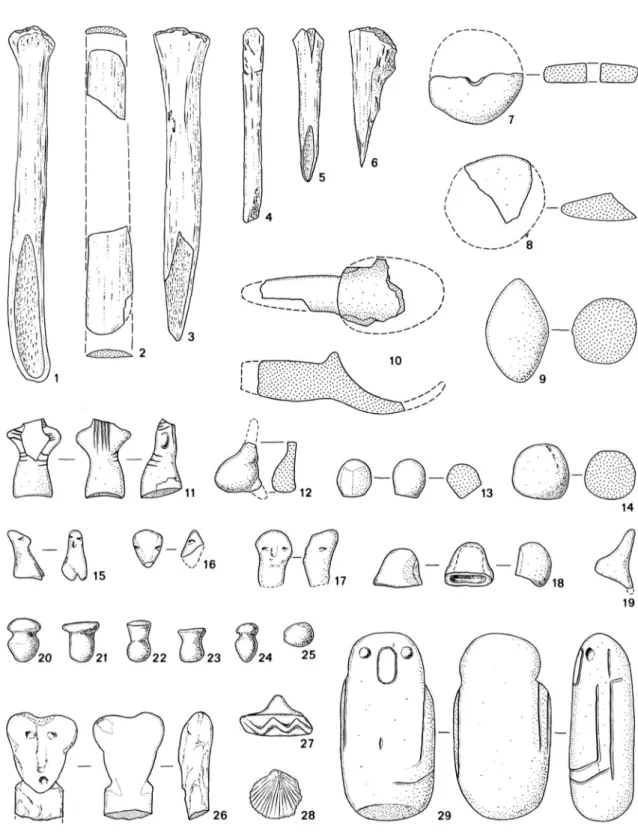
b. Perforated stone object of unknown use (fig. 13 no 11) Sample: 1 Cobbie with quadrangular flat lower surface. Two hourglass perforations from the convex up-per surface to the flat bottom, one small, one large. Flat side very smooth and abraded. Size 4.8 X 3.2 X 3.1 cm.
c. Stone "digging-stick" (fig. 13 no 12) Sample: 1 Horn-shaped fragment of volcanic rock. Lower end flattened and abraded -through pounding? Resembles present Indonesian ulek, a kind of pestle. Diameter 1.1 - 2.9 cm, length 7 cm.
IV 3. BONE IMPLEMENTS
Out of 57 fragmentary or complete specimens of worked bone artefacts, only 24 permitted identifi-cation to implement type, revealing the repertory of shapes to be very simple with no characteristic items'*. It consisted of awls, spatulas, adzes/chisels and implements considered to be pottery bumishers. With the Identification of the tooi types some problems arose, since awls and burnishers have a similar shape, except for the basal part, which is sharp in the case of the former and rounded in the case of the latter. This makes it impossible to iden-tify a fragment without a base. Microscopic analysis has not been carried out.
From stratum C and B equal amounts of these objects were recovered - 21 in each; from stratum D, 8 fragments and from stratum A, 6 fragments. We discovered that in several levels some sort of con-centration could be discerned whereas other levels did not contain any of these objects all - e.g. the bone implements of stratum B were all found in trench 1 Ie vel 7/8 and trench 2 level 2 / 3 .
All implements are present at all Greek sites throughout the entire Neolithic sequence, except for the adze/chisel which is found only during the Early Neolithic.
a. Awls (fig. 14 no 3; 5-6) Sample: 6 Long awls made out of the radius (proximal end) or tibia (distal end) of sheep/goat or pig. Be-tween 14 and 16 cm long (fig. 14 no 3). The fine awl is made of the tibia (distal end) of hare. Medium-sized piercing tooi. Length between 6 and 7.5 cm. (fig. 14 no 5). The short awl is made of the ulna (proximal end) of sheep/goat. Rather short and broad at the top - a sharp piercing tooi. Length between 5 and 6.5 cm. (fig. 14 no 6), rare.
b. Spatulas (fig. 14 no 2) Sample: 6 Made of very thin, long slivers of rib, the larger of cattle, the smaller ones possibly of pig. The ends are rounded, the sides can be rather sharp, but are not necessarily so. Have generally a highly glossy polish. No complete specimen available. From Early Neolithic III levels a com-plete one some 20 cm. long. Maximum thickness 0.4 cm.; width of the larger examples 1.8 cm. of the smaller ones around 1.3 cm. Purpose un-known. Semenov (1973 p. 178) mentions them as being used to prepare animal skins. Evans (1964p. 236) says they were used to scrape flour from grinding stones and Smoor (1976 p. 189) thinks they served as spoons.
c. "Adze or chisel" (fig. 14 no 4) Sample: 3 Implement made of the rib of sheep/goat or pig. The entire thickness of the rib has been used. The top end is cut off in a rather haphazard way; the basal end has been finished in a wedge-shape, creating a chisel. Length around 9 cm. Width varies between 0.8 and 0.95 cm. Maximum thickness ca 0.8 cm., minimum 0.15 cm. Purpo-se unknown.
; '--ï-T'-^.'-'-r.fl' •^-!f-''y^riP'''-r^^-'!^\f^Yr^
44 F I N D S O T H E R T H A N P O T T F R Y
B O N E I M P L F M E N T S 45
e. Bonc haft Sample: 1 (from Akropolis) A long bonc with a deep incision along the whole lengthof the bone (Theocharis 1967 p. 12!, plate XX C). Scrved to haft obsidian and flint blades or blade fragments for use as a sickle or reaping knife.
IV 4 FIGURINES
Figurines are rather scarce in Early Neolithic I. A division into (a) 17, possible 20, ceramic figurines and (b) 2 stone figurines can be made. We wil! confine ourselves to a mere description^ and we wül not indulge in any theories on possible functions (Hourmouziades 1973) nor will we divide them into any physiological classes (Gimbutas 1974b).
From stratum C, 8 figurines, were retrieved among which were two stone ones; from stratum B, 7; from stratum D, 1 and from stratum A, 3 figurines (or figurine fragments).
The ceramic figurines have been made of a mica-ceous, medium or fine paste. The surface colour is dark non-oxidised or dark uncertain buffish/red-dish. The core is in most cases non-oxidised. The surface is well smoothed. It is remarkable that the coffee-bean eyes, often considered characteristic of Neolithic Greek figurines are still completely ab-sent. They make their first appearance during Early Neolithic III and come to fuU development during the Middlc Neolithic period.
IV. 4.1. Ceramic figurines
a. Small sitting figurine (fig. 14 no 15)Sample: 3 Small highly schematised anthropomorphic fi-gurine of female sex. Conically shaped head and body with protruding nose. Eyes indicated by slits. Legs rendered by two frontal protruding butts. Height ranging between 1.9 and 3.2 cm; width of base between 0.9 and 1.5 cm. b. Highly schematised sitting figurine^ (fig. 14 no
12) Sample: 2 Steatopygous buttock with vertical protruding butt indicating trunk and neck. frontal protruding butt indicating legs. Height ranging between 3
and 4 cm.; width between 2 and 3 cm. c. Standing figurine (fig. 14 no 11) Sample: 5
Schematised anthropomorphic figurine, pro-bably of female sex. Some have a vertical inci-sion in the base, at the front; hence they may have been represented without legs. In all cases the head is broken off. Arms indicated by horizontal, sideways protruding butts. Waist rendered. Bottom generally slightly concave. One figurine has incisions on back and front, indicating hair, clothing and hands. Height ranging between 2.3 and 3.8 cm.; width of arms 2.4 - 2.7 cm. Diame-ter of waist 0.9 - 1.4cm.; diameDiame-terof bottom 1.8 - 2.1 cm.
This type occurs throughout the entire Early Neolithic and can be found at most Greek main-land sites.
d. "Naturalistic" figurine head (fig. 14 no 17) Sample: 2 Head broken from figurine of unknown type. Triangular or rounded face on a cylindrical-sha-ped neck. Plastic rendered nose. Eyes indicated by deep slits, mouth by round incision. Front strongly receding. Height around 3 cm; width ranges between 1.5 and 2 cm. Type occurs throughout the entire Early Neolithic at most Greek mainland sites.
e. Figurine head of schematised type (fig. 14 no 16) Sample; 3 In one case face consisting of nose only, with eyes indicated by incisions at the side. Height 1.8 cm. Otherwise cylindrical shape with incisions to indicate hair or headdress at the slightly-roun-ded top. Face cut away. Belonging to figurine of unknown type. Height 2 cm.
f. Twin figures Sample: 2 Schematic figurines, very similarto type b. They seem to have been cut lengthwise in half before the surface was given its finish, hence they have one completely flat side. The idea of hal ving figurines continues throughout the Early and Middie Neolithic, although they remain scarce. Height between 3 and 4 cm.; width between 1.5 and 2 cm.
46
F I N D S O T H E R T H A N P O T T E R YhoUowed-out bottom (fig. 14 no 18)). From the
ether, two pieces have been cut, creating two flat
sides at an angle of 90°. The bottom is flattened
(fig. 14no 13). Size(l):height 1.82 cm., width
1.54 - 2.34 cm., thickness 1.09 - 1.68 cm. Size
(2) height 1.79 cm., width 1.39 - 1.66 cm.,
thickness 1.42 - 1.61 cm. We wonder whether
these small geometrie objects are figurines at all;
possibly they form part of an early recording/
counting system, such as that described by Dr.
SchmandtBesserat (1977b fig. 1; 1978 p. 38
-48).
IV 4.2. Stone figurines
On the whole stone figurines are a rare item in the
Early Neolithic Greek assemblage of a mainland
site. During the later Neolithic periods, serpentine
and marbie would be used more often (Tsountas
1908 p. 287 - 303, plate 37). On Crete stone was a
more commonly used material during the Early
Neolithic.
a. Schematised complete figurine (fig. 14 no 29)
Carved from a large, marble-like cobble,
re-sembling a loaf-shaped hand-stone. Originally of
whitish colour, now turned brown. Surface
smooth, not polished. The separation of head and
body is markcd by rather deep notches. The nose
seems to stand out in relief, since the contours are
cut away rather deeply. The eyes are rendered by
two rather shallow depressions. The arms -the
right alongside the body, the left bent so that the
forearm rests on the belly - are given shape by
two deep parallel incisions. On the belly, a little
above the hand/forearm is a small vertical slit,
possibly indicating navel or vulva. Legs are not
rendered. It is 8.4 cm. high, has a width of 2.9
-4.4 cm., and a thickness of between 2 and 2.9
cm. Recovered from the lowest pottery hearing
levelof Early Neolithic I. No parallels in Greece.
Shows similarity to a limestone figurine from
Mureybit, dated to 7400 BC (Meilaart 1975 p. 47
fig 16).
b. Figurine head (fig. 14 no 26)
Carved in white marbie. Triangular-shaped head
on a thin neck or body; end broken. On the
whole, rather flat. Back slightly concave, giving
the impression that the head is slightly tilted
backwards. Long and straight. Slightly
protru-ding sculpted nose. Eyes and mouth indicated by
round depressions. The ears are rendered by
not-ches. On top of the head, in the centre, a hole has
been drilled, giving the face a heart-like shape.
The purpose of the hole is unknown. On the
neck/shoulder is a small slit, which may be
acci-dental. Height 4.92 cm., width between 1.74
and 3.30 cm.; thickness between 1.12 and 1.38
cm. Recovered from the lowest level of pottery
hearing Early Neolithic I. No parallels in Early
and Middle Neolithic Greece. Resembles marbie
figurines found at Late Neolithic Dimini
(Tsountas 1908 Plate 37 no 7).
IV 5. ORNAMENTS
Only a few objects recovered from the Early
Neoli-thic I strata at Sesklo could be classified in this
category, which can be divided into (a) 22 ear studs
and (b) 6 beads to which (c) some 10 possible shell
omaments may be added. Both groups a and b can
be made of clay or stone. The latter are of steatite,
"greenstone", quartz or a fine greyish stone. The
clay ones are made of a micaceous fine paste. The
surface colour is dark non-oxidised. The surface is
often burnished.
The largest number of these objects was
recover-ed from stratum D: 8 ear studs and 4 beads; from
stratum C came 8 ear studs and 2 beads; from
stra-tum B, 5 ear studs and from strastra-tum A, 1 ear stud - a
surface find at that.
Stone ear studs are found in some form all over
Greece during Early Neolithic I and 11, including the
Pre-Pottery Neolithic. Ceramic ear studs seem to be
restricted to Sesklo. Beads are present at all Greek
sites during the entire Neolithic.
Description
a. Ear studs (fig. 14 nos 20-24)
ORNAMENTS 47
provenience are hotly debated subjects, which
have not yet been resolved. Nor has the name
which they should have been decided up on. For
the moment ear stud, ear plug, nose plug and
several others are in use (a.o. Theocharis, 1974
p. 60).
Two groups can be discerned, both among
stone and ceramic ear studs. One has a rounded
upper segment and is almost mushroom-shaped
(fig. 14 no 20; 24). The other group has a flat,
often disc-like upper segment and a bulbous
lo-wer part; may become almost nail-shaped (fig.
14 no 21; 23). The steatite ones are slightly
different (fig. 14 no 22), consisting of a round
ball on which a cylinder has been mounted,
crowned by a flat disc. Height varying between
1.2 and 2.9 cm.; width between I.Oand 2.0cm.
b. Beads
Probably worn in strings or as omaments on
clothing. Stone beads are small flat discs with a
cylindrical hole in the centre. The diameter
va-ries between 0.4 and 0.6 cm., the thickness
be-tween 0. 15 and 0.2 cm. They are usually made of
steatite. Ceramic beads (fig. 14 no 25) are oval
with a cylindrical drilled hole through the short
axis. Diameter of the long axis varies between
1.4 and 1.6 cm., of the short axis between 1.1
and 1.4 cm.
c. Shell omaments
There are a few cardium shells with a hole near
the apex (fig. 14 no 28). They may have been
worn in strings (Rodden 1962 p. 285)oras single
amulets.
From stratum C comes aSpondylus shell with an
hourglass perforation, possibly worn as a kind of
amulet.
From stratum B there is a possible ring, made of a
Cardium valve. Unfortunately the object is in a
rather fragmentary state.
IV 6 MISCELLANEOUS CERAMIC OBJECTS
From the Early Neolithic I strata, 17 ceramic objects
have been recovered, divided into (a) 6 spindie
whorls, (b) 2 ceramic discs, (c) 7 sling bullets, (d) 1
spoon and (e) 1 ceramic ball - to which a seal may
possibly be added. The latter was discovered in the
highest level of stratum A; the excavator considered
it to be intrusive (Theocharis 1967 p. 118). Two of
the objects were discovered in stratum C, nine in
stratum B and se ven in stratum A.
All these types of object, except the seal, can be
found at all sites in Greece during the Early
Neoli-thic and many also during the Middle NeoliNeoli-thic and
later. Seals generally make their appearance at the
end of the Early Neolithic.
Description
a. Spindie whorl (fig. 14 no 7)
Disc made of a monochrome body sherd,
gene-rally with ground edges. Has a central
hourglass-shaped perforation. Diameter ranges between
2.5 and 5 cm., thickness between 0.4 and 0.8
cm.; diameter of perforation between 0.5 and
0.85 cm.
b. Ceramic disc (fig. 14 no 8).
Slightly dome-shaped disc made of a
mono-chrome body sherd. Edges are ground. One
shows a scar, made in an attempt to drill a hole in
the disc. Diameter ranges between 5 and 6 cm.
Thickness between 0.5 and 1.1 cm.
c. Sling bullet (fig. 14 no 9)
Egg-shaped, biconical object made of a
mica-ceous medium paste with chaff temper. Light
uncertain buffish all through. Smooth surface.
Poorly baked, especially in the lower levels.
Height ranges between 2.5 and 5 cm. Width
between 1.8 and 3 cm.
d. Spoon (Fig. 14 no 10)
Deep spoon made of a micaceous medium paste.
Light uncertain buffish surface, non-oxidised
core. Smooth surface. Length around 10 cm.
Spoon 3.5 cm. wide. Wall thickness 0.35 - 0.60
cm. Diameter of handle 1.5 cm.
e. Ceramic ball (fig. 14 no 14)
48 F I N D S O T H F R T H A N P O T T F R Y
f. Seal (fig. 14 no 27)
Oval stamp seal with a short handle. Stamp is a simple zig-zag pattern. Madeof amicaceous fine paste. Dark non-oxidised surface colour.
IV 7. THE PROBLEM OE PRE-POTTERY NEOLI-THIC
The stage to which stratum D belongs has been called the Aceramic or Pre-Pottery Neolithic, ana-logous to the non-pottery hearing Neolithic in the Near East. The term Aceramic is quite unsuitable, since the stratum yielded some ill-fired clay objects. The Pre-Pottery Neolithic has not been generally accepted, the reason being that at some sites in Thessaly it contained a very small quantity of pot-tery. To anyone who has not actually excavated a similar stratum its existence wil! remain doubtful, the doubt being augmentcd by the unfortunate cir-cumstance that at virtually all sites non-pottery hea-ring levels have been excavated almost only in trial trenches or over reiatively small areas. The only exceptions are Kythnos and Knossos.
It has been suggested that the " a c e r a m i c " could be functionally aceramic. i.e. that although the area was contemporary with other areas containing pot-tery, it featured activities not involving the use of pottery (Vitelli 1979, pers. comm.). This sugges-tion is not supported by the fact that at all sites dates for the Pre-Pottery stratum apparently precede those of the first pottery hearing Neolithic stratum (table 28).
The only way to solve this problem will be to excavate large areas at sites where the presence of Early Neolithic I, and possibly of a non-pottery hearing phase too, is suspected.
The economy is certainly of Neolithic type: the bone sample consists of domesticated animals only (Appendix II). Therefore it has to be included whe-ther it is a separate stratum or whewhe-ther it is contem-porary with the earliest pottery hearing stratum.
IV. 8. SOME NOTES ON THE CHRONOLOGY OF THE EARLY NEOLITHIC
In the previous section we mentioned dates. Al-though still rather wcakly founded, the chronology of Greck prchistory is slowly assuming a more
defi-nite shape. This is particularly due to recent excava-tions at Achilleion and at Franchthi Cave, which have yielded good sequences. From Sesklo only a few good radiocarbon dates are available; some thermoluminiscence samples have been taken, the results of which are not yet published".
The dates for the non-pottery hearing stage of the Greek Neolithic (the earliest being 8130 ± 100 BP, the latest 7755 ± 97 BP) seem to be more or iess contemporary with those of several Near Eastem sites. For the pottery hearing Early Neolithic I we have as the earliest date 7740 ± 140 and as the latest 7320 ± 50 BP.
In table 28 we have included a list of radiocarbon dates, as far as possible arranged by period. It starts with the Upper Mesolithic and ends with the last phase of the Early Neolithic. For comparative pur-poses we also give dates for the Pre-Pottery Neoli-thic of Cyprus and for several sites in Anatolia, but these will be discussed in Chapter Vlll.
Regarding the Greek dates, unless otherwise sta-ted they are taken from samples consisting of char-coal from occupation layers, often found in concen-trations and more or Iess mixed with ashy soil. On the one hand it is beyond doubt that samples taken from humt wooden posts, carbonised grain or bone collagen are more certainly associated with the ma-terial they are supposed to date than are the other samples. On the other hand one should not forget that building material for a house especially might be older than the associated archaeological context (Waterbolk 1971, p. 13). We think that for these reasons most dates may reasonably well be compa-red with one another, although dates provided by charcoal from heavy wooden posts may prove to be too early. Dates provided by carbonised grain should be more accurate than other dates.
NOTES
49
NOTES
A study of micro-wear analysis of the stonc artefacts fom the Akropolis section of Seskio has been the subject of an un-published PhD thesis by Miss Alexandra Christopoulou at the London Institute of Archaeology. She also analysed a few blade fragments from section C, found in close conjunction wiih butchercd bones. They showed a pattern, indicating that these blades had been used for butchering purposes. Until fairly recently. quartz flakes were used in threshing sicdges.
All polished stonc artefacts are being studied and will be publishcd by A. Moundrea. They coniprise all the material from the Early and Middie Neolithic.
4. The bone implements from Seskio are being studied and will be published by Mrs. A. Moundrea.
5. The bone has been analysed by C A . Schwartz.
6. All figurinc material from Seskio is being studied and will be published by Mrs. F. Egoumenides-Risopoulou.
7. Theocharis assumed that this type had its antecedents in Pre-Ncolithic periods. He compared them, as well as the closely related twin figurines of IV. 4. f, to some Palaeolithic figuri-nes and rock carvings, from the Ukraine and Bavaria and from the Dordogne, France, respectively.