Original Research Article
Knowledge, attitude and practice regarding diarrhoea and its
prevention and the use of oral rehydration therapy among mothers of
children under the age of five visiting a tertiary care hospital in
Mangalore, India
Radhika Renjith N.*, Prakash Saldanha, Sahana K. S.
INTRODUCTION
Diarrheal diseases remain the second most leading cause of and morbidity next to pneumonia among under-five mortality globally, contributing to one-fifth of child deaths. It kills more children than AIDS, malaria, and measles combined in spite of it being easily preventable in developing countries due to lack of knowledge, awareness and practice among mothers regarding diarrhoeal disease management.1
Diarrhoea can last several days and can leave the body without the water and salts that are necessary for survival. Most people who die from diarrhoea actually die from severe dehydration and fluid loss. Children who are malnourished or have impaired immunity as well as people living with HIV are most at risk of life-threatening diarrhoea. Diarrhoea is usually as symptom of an infection in the intestinal tract, which can be caused by a variety of bacterial, viral and parasitic organisms. Infection is spread through contaminated food or drinking water, or from person-to-person as a result of poor ABSTRACT
Background: Diarrheal diseases remain the second most leading cause of mortality and morbidity next to pneumonia among under-five mortality globally, contributing to 1/5th of child deaths.
Methods: Cross sectional hospital based questionnaire study conducted among 200 mothers of children within the age group of 6-60 months with diarrhoea attending the paediatric outdoor or treated in the paediatric indoor (OPD) at YMCH hospital using personal interview method. Filled up questionnaires was collected and was attached along with the filled up proforma.
Results: Of 200 mothers, 24.3% knew the correct meaning of diarrhoea, with 73.8% of them not knowing the correct cause of diarrhoea. Only 44.3% knew that it could be prevented. Majority 88.7% did not know to look for signs of dehydration. Less than half of the mothers had only heard of ORT. By using c2-test, preparation ORS was found to be associated with the mother’s education (p=0.04) proving that knowledge is better among those mothers with formal education. No association was found between ORS preparation and age of the mother (p=0.229), religion (p=0.342), and gender of the child (p=0.061).
Conclusions: The findings of this research indicate that only 73.8% of the mothers had knowledge regarding the cause of the diarrhoea and less than half 11.3% has only heard and used ORT properly.
Keywords: Awareness, Knowledge, Management, Mother, Oral rehydration therapy, Practice, Under five children Department of Paediatrics, Yenepoya Medical College Hospital, Mangalore, Karnataka, India
Received: 20 February 2019
Revised: 04 May 2019
Accepted: 30 May 2019
*Correspondence:
Dr. Radhika Renjith N.,
E-mail: [email protected]
Copyright: © the author(s), publisher and licensee Medip Academy. This is an open-access article distributed under the terms of the Creative Commons Attribution Non-Commercial License, which permits unrestricted non-commercial use, distribution, and reproduction in any medium, provided the original work is properly cited.
hygiene.2 The role of the family, especially the mother, is vital in health promotion, disease prevention and patient care. In the action’s mothers take, the minimum required is a brief and superficial examination of the dehydrated child and the amount and type of liquid fed to him/her in the case of diarrhoea, however, these actions are vital for pediatric welfare.3
Millennium Development Goals (MDGs) called for a reduction in under-five mortality by two-thirds between 1990 and 2015.3 Strategies followed by international agencies centered toward scaling up the use of ORT, zinc supplementation, and education regarding its appropriate usage for those in need with focus on cultural/hygienic factors. ORS is one of the most important medical advances of twentieth century. Low-osmolality ORS is preferred now because it reduces stool output by 20%, vomiting by 30%, and the need for intravenous fluid administration by 33% in comparison to regular ORS. Zinc supplementation reduces the duration of diarrhoea by one-fourth and 40% reduction in treatment failure and death in persistent diarrhea. Washing hands with soap is cited as one of the most cost-effective public health interventions, reducing incidence by over 40%. But only 39% children with diarrhea in developing countries receive ORT and continued feeding. Only 22% children drink more fluids of any type during diarrhea.2 It is thus proven that children die not due to the lack of interventions but due to services provided and those at risk of not being reached.
Since United Nations Secretary General launched “Every woman Every Child” initiative for women’s and children’s health in 2010, a global movement has grown that is committed to end preventable causes of death among children.4 To intensify efforts to achieve MDGs, the WHO/ UNICEF introduced Global Action Plan for Prevention and control of pneumonia and diarrhoea (GAPPD), which said that commitment to ensure 80% of world’s children having access to interventions and immunization to 90% of children will ensure elimination of diarrhea by 2025. Seven-point program was launched with two elements relating to treatment and five elements toward prevention. Two elements in treatment of diarrhea were fluid replacement with low-osmolality ORS to prevent dehydration and zinc treatment to prevent severity and duration of diarrhoea in addition to continued feeding, including breast-feeding and use of appropriate fluids available at home if ORS is not available. Preventive elements included rota and measles vaccination, promotion of early and exclusive breast-feeding with vitamin A supplementation, promotion of hand washing with soap, improvement of water supply including treatment and safe storage of household water, and promotion of community-wide sanitation.4,5
In India, Reproductive, Maternal, Newborn, Child and Adolescent Health program under National Health Mission comprehensively integrates interventions to improve child health and address factors contributing to
infant and under-five mortality. It includes Integrated Management of Neonatal and Childhood Illnesses (IMNCI), home-based newborn care, promotion of early and exclusive breast-feeding, and universal immunization. strategies, mainly focus on improving skills of health-care workers, strengthening health-care infrastructure, and involving communities through behavior change communication.3
METHODS
The present study was cross sectional hospital-based questionnaire study conducted among 200 mothers of children within the age group of six months to sixty months with diarrhoea attending the paediatric outdoor or treated in the paediatric indoor (OPD) at YMCH Hospital using personal interview method in at time period of 3 months. All those mothers who satisfy the inclusion criteria was included in the study. Data was collected from mothers by standard questionnaire method as per case record format. Questions prepared as per the IPHS (international public health standards) and prepared format validated by the institutional ethical committee. Filled up questionnaires was collected and was attached along with the filled up proforma. Scoring was done accordingly correct answer 2 points, close to correct 1 point and incorrect answer 0 point. Statistical Package of social science (SPSS) software was used for analysis of data. The main aim of this study was to assess mother’s knowledge regarding the use of ORS and practice among mothers who have diarrhoea under five children.
Study Design
This study was hospital based cross sectional study within a time period of 3 months (mothers of children within the age group of 6 months to 5 years presenting with diarrhea attending the pediatric OPD or treated in the pediatric inpatient at YMCH, Mangalore, India).
Materials and Methods
The present study obtained Institutional Ethical Committee clearance. Mothers will be consecutively selected from the outpatients of the pediatric department at YMCH, Mangalore, India. Data analysis will be done using the SPSS software.
Source of data
Consecutively selected mothers of children within the age group of 6 months to 5 years presenting with diarrhoea attending the pediatric inpatient or treated in the pediatric OPD at YMCH, Mangalore, India within a time period of 3 months.
Inclusion Criteria
or treated in the pediatric inpatient in YMCH Medical College and Hospital in past 1 year. Mothers who were willing to participate in the study included with consent.
Exclusion Criteria
Mothers who are not willing to take part in the study.
Statistical analysis
Cross sectional Study. Statistical Package of social science (SPSS) software will be used for analysis of data. t-test will be used for analysis of two quantitative variables. Chi Square test will be used to compare frequency of qualitative variables among the different groups. Comparison and correlation will be considered significant when P values comes <0.05.
Work Plan
This study will be conducted in consecutively selected mothers who present to the OPD as per the inclusion criteria. The data will be collected after the clearance is obtained from Institutional ethical committee. Mothers will be numbered serially. Readings obtained will be recorded and tabulated. Results will be expressed in terms of proportion and percentage. Zero to 3 months- synopsis presentation, data collection. Fourth month- statistical analysis, result interpretation and final presentation.
RESULTS
Among 200 mothers interviewed, more than three-fourths (212, 75.7%) were illiterates and majority of them (261, 93%) were unemployed. Of them, 70% (196) were Hindus, 27% (76) were Muslims, and 3% (8) were Christians. More than three-fourths (220, 78.5%) belonged to nuclear families. Mean age of children was 2 years 2 months. More than half of the children were male (148, 52.8%). Immunization was up to date in 93% children. Less than one-fourth of the mothers (68, 24.3%) knew the correct meaning of diarrhoea.
Table 1 shows that almost three-fourth (207, 73.8%) of the mothers did not know the correct cause of diarrhoea with some feeling indigestion of food (11.4%), dosha (1.7%), and teething (2.8%) as the cause. About 124 mothers (44.3%) knew that diarrheal diseases can be prevented.
Table 2 shows the means by which mothers felt that diarrhea can be prevented. Majority felt that giving boiled and cooled drinking water (83.9%) prevents its occurrence. Some of them also felt that proper hand washing with soap (38.7%), covering food-containing utensils (22.5%), and proper sanitation (6.4%) also prevent incidence of diarrhea. In all, 248 (88.7%) mothers did not know how to look for signs of dehydration.
Figure 1 shows that only 132 mothers (47.2%) had heard of ORS. Of those who had heard of ORS, more than three-fourth (100, 76%) knew that ORS is used in diarrhea. Information regarding ORS was received from doctors (92, 69.6%) and nurses (32, 24.3%).
Table 1: Causes of diarrhea according to the mother.
Causes of diarrhea N (%)
Contaminated food or germs 73 (26.2%) Improper sanitation 32 (11.4%)
Teething 8 (2.8%)
Indigestion of food 5 (1.7%)
Not aware of it 162 (57.8%)
Table 2: Preventive measures against diarrhea.
Precations N (%)
Proper handwash with soap and water 48 (38.7%) Proper boiling of drinking water 104 (83.9%) Proper use of ORS packets 28 (22.5%)
Proper sanitation 8 (6.4%)
Figure 1: Mothers who knows about ORT.
Figure 2: Knowledge regarding place of ORS availability.
Only 12 mothers (9%) knew that ORS packets are available in all government hospitals and that too free of cost Figure 2. Majority of them (81.8%) went to medical stores to buy it. 60 mothers (45.4%) did not know when
YES NO
108%
12% 12%
0% 20% 40% 60% 80% 100% 120%
MEDICAL STORE
GOVT/PRIVATE HOSPITAL
NOT AWARE OF IT
to start ORT and 52 (39.4%) waited for doctor’s advice to start ORT. only 87 mothers (66%) knew how to prepare ORS solution.
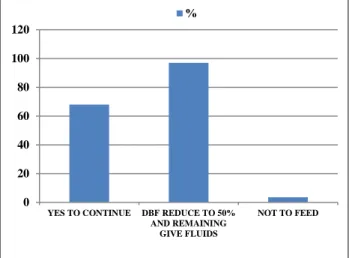
Figure 3 shows that only 68 mothers (24.3%) were aware that regular food intake should be continued during diarrheal episodes. None of the mothers had heard of rotavirus vaccine by using Z-test, preparation of ORS was found to be associated with education of the mother (p=0.04), proving that better knowledge is among those mothers with formal education. No association was found between ORS preparation and age of the mother (p=0.229), religion (p=0.342), and gender of the child (p=0.061).
Figure 3: Knowledge regarding feeding.
DISCUSSION
In present study, infection was considered as a cause of diarrhea by 26.2% mothers, which is similar to the finding in the study conducted by Uchendu UO et al. Teething was considered major cause of diarrhea by 52.6% mothers in the study conducted by Uchendu UO et al.6 but only 2.8% mothers felt so in our study. In a study carried out by Ahmed IS et al.7 40% mothers could identify signs and symptoms of dehydration but only 11.3% could identify these in our study. In present study, 34.3% mothers continued feeding during diarrheal episodes, which is better in comparison to 15% mothers in the study conducted by Omore R et al.8 In this study, 45.7% mothers stopped feeding their children during diarrhea, which is similar to the findings in a study carried out by Ahmed IS et al.7 In present study, 47.2% mothers had heard of ORS. In a similar study conducted by Pahwa S et al, 71.1% mothers, that by Kadam DM et al, 89% mothers, and that by Ahmed IS et al, 3% mothers had heard of ORS.7,9,10 In present study, 31% mothers interviewed knew the correct method of preparation of ORS in comparison to 9.1% in a study carried out by Pahwa S et al, 25% in a study by Ahmed IS et al, and 57.8% in a study by Ahmed A et al.7,9,11 Association was found between ORT knowledge and maternal education
status in this study but no such association was found in the study conducted by Uchendu UO et al.6
CONCLUSION
The findings of this research indicate that only 73.8% of the mothers had knowledge regarding the cause of the diarrhoea and less than half 11.3% has only heard and used ORT properly. Awareness regarding diarrhoea, its prevention, and ORT was found to be lacking among mothers. The gravity of this lack of awareness stems from the fact that mothers are the immediate care takers in the event of diarrheal disease in the child and there is an increased risk of the same taking into consideration the poor socioeconomic and living conditions in these slums. There is an urgent need to educate the mothers regarding the importance of preventive and treatment measures in diarrheal diseases. In general, most mothers have lack of experience, knowledge and awareness for practice of ORS preparation. Almost half of the mothers were no taken any treatment action during Diarrhoea episodes.
ACKNOWLEDGEMENTS
Authors would like to thank Dr. Prakash Saldanha, Dr. Sahana KS and all concerned persons who co-operated with the study.
Funding: No funding sources Conflict of interest: None declared
Ethical approval: The study was approved by the Institutional Ethics Committee
REFERENCES
1. World Health Organization. Diarrhoeal Disease, 2013. Available at http://www.who.int/mediacentre /factsheets/fs330/en/. Accessed 26 January 2015. 2. World Health Organization. Diarrhoe: Why
Children Are Still Dying and What Can Be Done, 2009. Available at: http://whqlib-doc.who.int/publications/2009/9789241598415_eng .pdf?ua=1. Accessed 13 January 2015.
3. Ministry of Health and Family Welfare. Child Health Programme, 2013. Available at http://www.mohfw.nic.in/WriteReadData/l892s/CH APTER 5.pdf. Accessed 13 January 2015.
4. Chan M, Lake A. Integrated action for the prevention and control of pneumonia and diarrhoea. Lancet. 2013;381(9876):1436-7.
5. World Health Organization. Ending Preventable Child Deaths from Pneumonia and Diarrhoea by 2025. The integrated Global Action Plan for Pneumonia and Diarrhoea (GAPPD), 2013. Available at http://apps.who.int/iris/bitstre am/10665/79200/1/9789241505239_eng.pdf. Accessed 30 January 2015
6. Uchendu UO, Emodi IJ, Ikefuna AN. Pre-hospital management of diarrhoea among caregivers presenting at a tertiary health institution:
0 20 40 60 80 100 120
YES TO CONTINUE DBF REDUCE TO 50% AND REMAINING
GIVE FLUIDS
NOT TO FEED
implications for practice and health education. Afr Health Sci. 2011;11(1):41-7.
7. Ahmed IS, Eltom AR, Karrar ZA, Gibril AR. Knowledge, attitudes and practices of mothers regarding diarrhoea among children in a Sudanese rural community. East Afr Med J. 1994;71(11):716-9.
8. Omore R, O’Reilly CE, Williamson J, Moke F, Were V, Farag TH, et al. Health care-seeking behavior during childhood diarrheal illness: results of health care utilization and attitudes surveys of caretakers in western Kenya, 2007-2010. Am J Trop Med Hyg. 2013;89(1):29-40.
9. Pahwa S, Kumar GT, Toteja GS. Performance of a community-based health and nutrition-education intervention in the management of diarrhoea in a slum of Delhi, India. J Health Popul Nutr. 2010;28(6):553-9.
10. Kadam DM, Hadaye R, Pandit D. Knowledge and practices regarding oral rehydration therapy among mothers in rural area of Vasind, India. Nepal Med Coll J. 2013;15(2):110-2.
11. Ahmed A, Malik IA, Iqbal M, Nawaz M, Azim S, Bukhtiari N, et al. The use of ORS in management of childhood diarrhoea by mothers in the suburbs. J Pak Med Assoc. 1990;40(8):178-82.