A Technological Approach to Teaching
Factorization
Kelly E. Kilgore Mary Margaret Capraro
Texas A&M University at College Station, U.S.A.
According to previous studies, complementing a factorization lesson with technology is beneficial, and algebra tiles have also been shown to be effective in teaching factoring by providing a visual representation for the process. A lesson on factoring trinomials is presented through a step-by-step approach as a document that can be used on an interactive whiteboard. The document is broken down into slides demonstrating how to factor with virtual algebra tiles. Using this lesson, students are given a theoretical and conceptual view of factorization.
Key words:technology, manipulatives, algebra.
My Story
Technology has become as much a part of my teaching as the curriculum. Going through my undergraduate studies, all of my field-based studies involved technology, specifically interactive whiteboards. Therefore, I observed and taught using that technology. When I went on to do my middle school student teaching, my mentor teacher used her SMARTboard (SB) on a daily basis as an integral part her lessons, using it for presentations and with interactive applets. I came to believe this was a staple in the modern classroom in contrast to when I was growing up when my teachers used an overhead. This past school year was my first year as a beginning classroom teacher. I remember walking into my classroom expecting to have an interactive whiteboard front-and-center as the “star” of my classroom. I was sadly mistaken – in front of me were two full walls of dry erase boards. After a small panic attack, I started brainstorming about how I was going to teach without a SB that I had come to think of as the lifeline in the classroom. I decided I would teach with a projector that I could hook up to my computer. In my middle school environment, team planning plays a big part. So when my
team would create presentations for lessons, we would make them ideal for interactivity since these veteran teachers had SBs in their classrooms. I managed throughout the first few month of teaching with my limited technology, but later in the Fall talk began to spread about additional SBs for the remaining classrooms. Sure enough, mid-November came and so did my board. I was elated to receive this technology into my classroom. I have used it everyday during every class period since it was installed. I cannot even
imagine going back to the overhead/dry-erase board era.
Factorization of polynomials, which is introduced in eighth or ninth grade, is a fundamental skill in solving problems in mathematics that scaffolds up leading to achievement in college level mathematics. Factoring allows students to simplify and decompose polynomials into their factors without using unhandy quadratic formulas. Current research about factoring involves implementing technology into the teaching of polynomials as a way to reach students in an inventive and interesting manner.
Previous Research
Mathematics has traditionally been taught as a paper-and-pencil activity. However, spurred on by the modern mathematics movement and its focus on problem solving, traditional methods are becoming less frequent as newer pedagogies have emerged. Technology rich environments have stimulated this change and have provided an alternative teaching method to pencil-and-paper teaching (Russell, Bebell, O'Dwyer, & O'Connor, 2003). Technology is not a catalyst for improved teaching and learning, but rather a catalyst for teachers to improve their pedagogies (Kutzler & Center, E. R. I., 2000). Strategies for instruction that teachers employ are not interchangeable with the technologies they incorporate. Rather technology can enhance teaching methodologies augmenting the conceptual mathematical knowledge gained by students (Kieran & Drijvers, 2006).
Nicaud, Bouhineau, Varlet, and Nguyen-Xuan (1999) developed an interactive learning environment called APLUSIX, which focused on factorization and allowed students to learn and discover factorization through technology. APLUSIX was designed for students to explore, form, and work factorization problems. The idea of complementing factorization with technology was also explored by Kieran and Damboise (2007). These researchers looked at the benefits of using Computer Algebra Systems (CAS), specifically TI-92s, in classrooms. To conduct a true experiment, Kieran and Damboise created identical assignments for two classes with the only
difference being one group was provided with calculators and the other was not. After a month, a paper-and-pencil posttest revealed that the experimental class showed greater improvement both technically and theoretically. This use of technology enabled students to practice factorization in high school algebra. CAS provided students with more abstract learning, better strategy formation, comprehension of skills not previously mastered, and overall improvement in factorization skills (Kieran & Drijvers, 2006). Technology provoked discussion; it generated exact answers that could be scrutinized for structure and form; it helped students to verify their conjectures, as well as their paper-and-pencil responses; it motivated the checking of answers; and it created a sense of confidence and thus led to increased interest in algebraic activity (Kieran & Damboise, 2007, p. 109).
Interactive Whiteboard Technology
SMART boards are a type of technology that has been incorporated into the mathematics classroom. They were originally designed for use in office settings and higher education classrooms and later were adapted for primary schools in the late 1990s. SMART boards are a brand of Interactive White Boards (IWB) and have been incorporated into classrooms including adaption for whole class instruction, diversity of instruction for a variety of learners, and more effective classroom management. Benefits included increased positive attitude that students demonstrated towards IWB lessons by increasing their motivation to learn (Higgins, Beauchamp, & Miller, 2007). Moffatt (2000) found SMART boards positively increased student’s positive attitude with higher interactivity when learning about tangrams. In contrast, Glover Miller, Averis, and Door (2007) found that despite the many affordances, IWBs alone do not ensure academic progress. In general, however, integration of technology in the classroom has been shown to be an important component of student success in mathematics (National Council of Teachers of Mathematics, 2000).
Specifically, SMART technology, has transformed classrooms from a chalkboard-centered environment into an interactive and dynamic setting. “Combining the simplicity of a whiteboard with the power of a computer, the SMART Board interactive whiteboard engages students and audiences around the world” (SMART, 2009). Through a program, called SMART notebook on a computer, one can create documents with a variety of tools and images through the program to enhance the lesson. This trend of interactive whiteboards has started filtering into classrooms across the country.
Manipulatives are another powerful method for engaging students (Ozel, Yetkiner, & Capraro, 2008). Leitze and Kitt (2000) described the benefits of enhanced teaching of the algebraic concept of factoring quadratic trinomials with algebra tiles. If students were comfortable factoring with algebra tiles, then they would more than likely be able to demonstrate this process through the box method because algebra tiles have a similar setup as the box method. The box method uses grouping and division in a four quadrant grid arrangement to factor polynomials. However, students write the appropriate numbers in the quadrants rather than drawing the tiles. Leitze and Kitt claimed “students benefit from seeing algebra concepts developed from such a geometric perspective” (p. 463). Thus, we developed a SMART technology lesson that brings technology and algebra tiles together.
SMART Lesson on Factorization
We created a SMART notebook document to complement a lesson on factoring trinomials. The document uses virtual algebra tiles to provide a visual depiction of factorization. It would be beneficial for students to have their own set of algebra tiles to work with while engaging in the lesson.
SMART Lesson Introduction
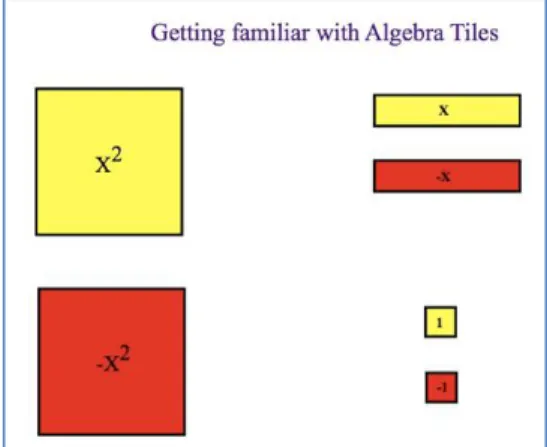
Figure 1 shows a lay-out of the algebra tiles providing a guide by which to familiarize your students. Red tiles represent negative quantities and yellow tiles represent positive quantities.
Figure 1. Lay-out guide for algebra tiles. SMART Lesson - First Example
Figure 2. Initial set up for problem 1.
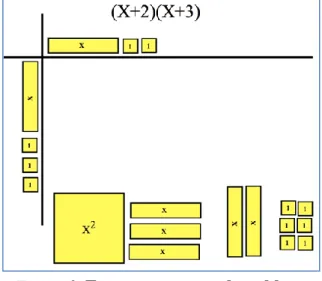
Figure 2 provides a simple example to show students that when multiplying two polynomials, the factors yield a product. The first step is showing how to set up the given problem of (x + 2) (x + 3). Start by putting the factors in the table along the vertical and horizontal lines. According to the commutative property of multiplication, order does not matter therefore we can infer that the placement of the factors on the table does not affect the product.
Figure 3. Factors set up on the table.
After setting up the factors, multiply out the factors as displayed in Figure 3. Because this set up is similar to the multiplication table, students should easily make that connection using prior knowledge.
Figure 4. Multiplication of factors.
Figure 4 gives students a visual and conceptual representation of the multiplication process known as F.O.I.L. F.O.I.L. is an acronym for first, outside, inside, and last, and this is to help the students to multiply the correct components of the factors together. The students then add up all the algebra tiles inside the chart to get their product. For the problem above, the product would be x2 + 5x + 6. The next couple of examples give other ways of multiplying polynomials with negatives. Work those with your students using the same method as above.
SMART Lesson – Second Example
Now that students have become versed with multiplying polynomials, it should be a smooth transition to working backwards and factorizing. The following figure presents the students with a polynomial to factor.
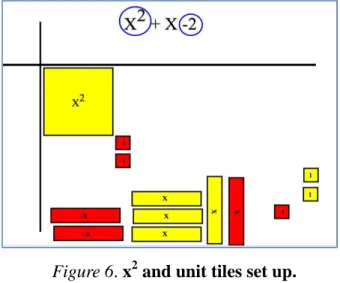
Students should always begin a problem by gathering the necessary algebra tiles corresponding to the trinomial. For the problem below the student should gather one x2, three xs, one –x, two positive unit tiles, and three negative unit tiles.
The next step is placing the x2 in the upper left corner on the table and then two red negative unit tiles diagonal from the x2 in the lower right corner (see Figure 6).
Figure 6. x2 and unit tiles set up.
This layout will give the students an organized way to initiate the problem.
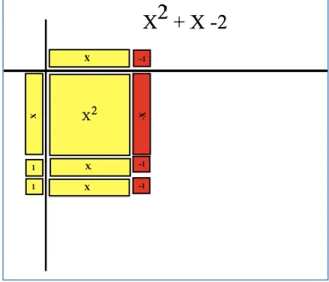
The next step in completing the table is filling in the xs inside the table.
Figure 7. Completing the rectangle.
The students can visually see the problem inside the table (Figure 7) because if they were to add up all the x2s, xs, and unit tiles, the sum would be x2 +x + - 2, the problem. In completing the rectangle, students add zero pairs consisting of x and –x, x2 and - x2, or 1 and -1. In this problem, students had to add an x and –x.
The last step in finding the factors is placing the necessary algebra tiles along the horizontal and vertical lines. This will derive the factors of the problem.
Figure 8. Factors placed on table.
Now, the students add up the xs and unit tiles along the horizontal line to obtain one of the factors, and then add up the xs and unit tiles along the vertical line to get the other factor. In this problem, the factors would be (x-1) and (x+2). Following this problem is another trinomial to be factored but with positives. This too is done in the same manner.
SMART Lesson Challenge Problems
The final example in the presentation consists of 3 trinomials to factor. This is a good place for independent work for students especially if you are able to provide algebra tiles for them.
Implementing the Lesson
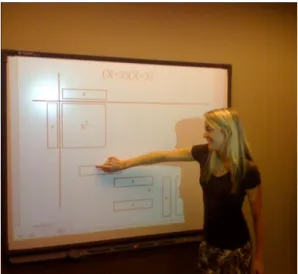
Figure 10. Ms. Kilgore implementing SMARTboard technology in factoring polynomials.
When conducting this lesson, get the students to manipulate their own algebra tiles, then have them draw a picture of their tile set up. Throughout the lesson, it is important to ask guiding questions, so the students are thinking beyond just the motions of manipulating the tiles. The lesson should start with a review on modeling multiplication. This will help the students make the connection that they are currently multiplying. With the first example the students are finding the product, and with the second example the students start with the product and need to find the factors. It is important to hold a discussion about this and determine if the students see what is happening in both situations. Below are a couple of examples of students’ work.
Figure 11. Student A’s pictorial representation of factoring 2x2-7x-4.
the same way the guided practice did by placing the x2’s in the upper left hand corner of the t-chart, and then the student put the unit tiles diagonally across from the x2s in the lower right hand corner of the t-chart. They then filled in the x tiles in the chart. The final step was setting up the factors’ tiles along the top and left side of the t-chart to match the rectangle inside the t-chart. The student discovered the factors were 2x+1 and x-4.
Figure 12. Student B’s pictorial representation of factoring (x+2)(x+1).
This student was given the problem (x+2)(x+1) to pictorially show the factors multiplied out to obtain the polynomial. First, the student placed the proper tiles from the factors along the top and left side of the t-chart. Since the student recognized the rectangle they created with their algebra tiles, they drew straight lines from the tiles already laid to create the rectangle.
This is an effective way to incorporate a manipulative into the factorization lesson, and allows students an image as a proof to factorization. The students will make a stronger connection with this concept if they are provided with a visual description of what is happening.
Connecting representations through a dynamic technological system such as the SMART board provides an excellent format for making instruction concrete. Students are able to interact with digital representations of the manipulatives as well as see the geometric connection to factoring. Students are able see visualize how zero pairs help to find solutions without changing the context of the problem. Finally, the technological solution provides the teacher with a flexible solution for instruction and a means for actively engaging student in the instruction.
References
Glover, D., Miller, D., Averis, D., & Door, V. (2005). Leadership implications of using whiteboards: Linking technology and pedagogy in management of change. Management in Education, 18(5), 27-30.
Higgins, S., Beauchamp, G., & Miller, D. (2007). Reviewing the literature on interactive white boards. Learning, Media, and Technology, 32, 213-225. Kieran, C., & Damboise, C. (2007). How can we describe the relation between the factored form and the expanded form of these trinomials? We don’t even know if our paper-and-pencil factorization are right? The case for computer algebra systems (CAS) with weaker algebra students (p. 3-105-112). Proceedings of the 31st annual conference of the International Group for the Psychology of Mathematics Education. Seoul, Korea. Kieran, C., & Drijvers, P. (2006). The co-emergence of machine techniques
paper-and-pencil techniques, and theoretical reflection: A study of CAS case in secondary school algebra. International Journal of Computers for Mathematics Learning, 11, 205-263.
Leitze, A. R., & Kitt, N. A. (2000). Using homemade algebra tiles to develop algebra and prealgebra concepts. Mathematics Teacher, 93, 462-466, 520. Moffatt, K. (2000). Evaluating the use of a SMART board to teach
transformation geometry using super tangrams. Vancouver, Canada: University of British Columbia.
National Council of Teachers of Mathematics. (2000). Principles and
standards of school mathematics. Reston, VA: Author.
Nicaud, J. F., Bouhineau, D., Varlet, C., & Nguyen-Xuan, A. (1999). Towards a product for teaching formal algebra. Retrieved March 1, 2009, from hal.archives-ouvertes.fr/docs/00/19/03/02/PDF/Bouhineau-Denis-1999.pdf Özel, S., Yetkiner, Z. E., & Capraro, R. M. (2008). Technology in K-12
mathematics classrooms. School Science and Mathematics, 108, 80-85. Russell, M., Bebell, D., O'Dwyer, L., & O'Connor, K. (2003). Examining
teacher technology use: Implications for preservice and inservice teacher preparation. Journal of Teacher Education, 54, 297-310.
SMART. (2009). Smart. Retrieved March 1, 2009, from http://smarttech.com
Authors:
Kelly E. Kilgore
Texas A&M University, U.S.A. Email: [email protected] Mary Margaret Capraro
Texas A&M University, U.S.A. Email: [email protected]