An Automated Trouble Call System
H.K. Kiyohara, J. A Jardini, Fellow, IEEE and L.C. MagriniEscola Politécnica - USP - São Paulo, SP - Brazil
Summary - The utilities need to offer an efficient telephony
system to its consumers, not only to receive their complaints about the outages or disturbances, as well to deal with the business affairs.
The traditional aprouch uses an attendant and several databases, that must be accessed until the necessary data is retrieved. This work deals with the development of a prototype of an integrated information system to help the utilities attendant receive the consumers complaints and trouble calls.
All the stages needed to provide the consumer with a consistent response are covered with the utilization of CTI (computer-telephony integration), databases and GIS (geographic information system) technologies. The integration of these technologies makes agile the access to the necessary information to identify the probable fault location and to operate the service team. It is still possible to supply the client, in a rapid way, with information about the predicted time for the conclusion of repairing services and also other city locations where there are supply problems.
Index of Terms - CTI, database, dispatch, GIS, outage, trouble
call.
I. Introduction
In the last years, utilities in Brazil have been looking for solutions for the improvement of the quality of energy supply for its consumers. A fast response in the occasion of outage can affect significantly with the consumers satisfaction. Of course the utilization of computer programs to assist in this process allows a bigger optimization of its services. The interest for new technologies has been increasing constantly, especially when regards to resources provided by GIS (Geographic Information Systems) and CAD (Computer Aided Design).
These systems arise as a tendency that the basic cartographic information is now transferred to computational environment. Since electric network data is stored in computer databases, automated routines are now available for the distribution system operators in contrast with slow procedures that would depend on handling maps and looking for occurrences throughout the utility regions.
II. Response to outage complaints
When an outage occurs, he/she usually makes a complaint over a telephone call. With the information obtained with
these complaints by consumers, technicians are able to determine actions on the network in order to re-establish the energy supply as fast as possible.
Nowadays, the general procedure to respond to customer complaints follows a service standard processing. Most of this work is manual and the information technology resources used in many utilities are minimum.
Firstly, the call is received by the attendant, that write down the complaints in a form. These forms are grouped and passed to another employee for an initial "selection" of the complaints. This procedure identifies those repeated occurrences and put them together by region. Following this procedure, one verifies whether there is a disconnection already programmed that could cause the outage in the claimant address (the service makes use of elaborated lists comprising those locations where programmed disconnection are scheduled).
If a scheduled service is not found in such a list, these occurrences are passed to the system operator to determine the location (by using maps and electric network diagrams) of the more probable point for the outage cause. The nearest service team is then called to solve the problem in loco. After the supply is reestablished, the service team provides to the Distribution System Operation Center information regarding the probable causes of outage, the services executed, the repairing and the time spent, and so forth. The process with the main steps can be seen in figure 1.
The idea in the present work is to unify all these routine stages - which are executed separately by different employees - into a unique automated trouble call process using information technology resources, making the data more reliable and the information access faster.
Other advantages obtained with the improvement of the process are as follows:
- Problems in telephonic calls (noises), that make data collection regarding the occurrence much more difficult;
Energy Interruption Complaints Attendance and record of the complaints in filing cards Dispatching of the Repair Teams Trial of the Complaints: Searching in Maps and Unifilar Diagrams
Figure 1 – Non automated Trouble Call Process
H. K. Kiyohara, J. A. Jardini and L. C. Magrini are with the Polytechnic School of Engineering, São Paulo University, São Paulo, Brazil (e-mail:
- Delays in the response to each complaint, discouraging those who need to use telephone number to access the utility service;
- Difficulties in searching outage locations both by using maps or mistakes in the provided address information.
III. Project development
The trouble call project development considered in this work took into account all stages of the response process, since the telephone call is made by the consumer until the location of the interrupted sections in the digital maps.
The automated system made use of a client-server architecture and the database was installed in dedicated computers. This measure was taken since a high reliability in the servers was needed.
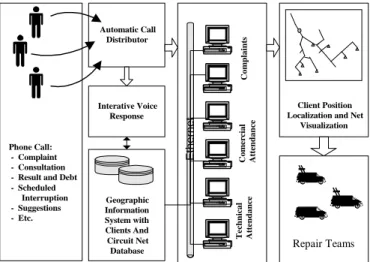
The trouble call system structure can be seen in figure 2. This system can be divided into three main parts:
- caller response process, composed by the ACD
(automatic call distributor), by the IVR (interative voice response) and by the ANI (automatic number identification);
- the Database system;
- the GIS (Geographic Information System).
IV. The Attendance Service
The callers are firstly sent to the ACD (automatic call distribution), that forwards callers to several communication channels. In that instant, each caller is to be recognized by a ANI. This device connected to the telephone line is able to identify the consumer number due to a service called ANI (automatic number identification) given by telephonic companies, that provide the telephone number at the moment the call is made. This number serves as the basis to the system locate the consumers. Following that, the caller is answered by a system of interactive voice response (IVR) that, through
messages previously recorded, define the kind of service that the consumer wants to obtain. Choosing one and depending upon the desired service, the caller does not need to be directed to an attendant. For example, if restoring the energy supply is foreseen, a recorded message may be activated to automatically warn the customer. Or in case information regarding the customer bill is desired, a recorded message can query the database and may also be utilized. Since the IVR is programmable, it relieves the system from repeated jobs that demand frequent queries to the database.
Usually, after the greeting message, a list of options of services is offered to the user. Such options are identified by code numbers, selected by the keyboard or by the telephone set. While the user selects the desirable service, the ANI, in parallel, provides to the IVR the telephone number from where the call is being carried out.
In case the telephone number is not registered in the database, a recording message requires the customer reference number, which is available in his/her bill. A new warning of complaint is opened in the computer, which fields can be edited on the screen by the system operator. Thus, the user is only requested when the system is not able to proceed by itself throughout the stages.
V. Database Management System
A database system to store information for a distribution company utilize a relational model framework, for involving a large amount of data. Such database systems allow for the use of SQL, a query language standardized by ANSI and ISO organs, that ensure data access to different databases by using various source program codes that bear this standard.
The development of a distribution company database, for involving an expressive quantity of spatial or non-spatial entities, require a well planned structure. Databases well structured allow a faster access to information regarding the electric network and the consumer, what implies in a smaller number of queries and a smaller delay during the consumer´s response. Another important aspect is that a database well designed leads to less maintenance and the ability to add new entities, since the relation between tables are consistent. The database will provide the necessary information to the callers response system, to the GIS and to the attendant.
VI. The Geographic Information System and the OpenGIS standard
The GIS is a management system that takes care of mapping geo-referenced information. It treats each spatial element as an object that can be defined as a point, a line or a polygon. Thus, a transformer is defined spatially as a point, the circuit branch as a line or a sequence of lines and a small square like a polygon. The representation of a circuit and a public area can be seen in figure 3. The types of relationships amongst spatial elements are manyfold, underlying the adjacent element, the connectivity, the continence and the nearness. A GIS should not be misunderstood with a CAD, once spatial data handling and their aims are different.
Phone Call: - Complaint - Consultation - Result and Debt - Scheduled Interruption - Suggestions - Etc. Automatic Call Distributor Interative Voice Response Geographic Information System with Clients And Circuit Net Database Comercial Attendance Technical Attendance Complaints Ethernet Client Position Localization and Net
Visualization
Repair Teams
The GIS utilization in urban areas are particularly relevant by the utilities, since nowadays it is not possible to think about a quick response to customer complaints without their identification in a specific local, like a street, a district, a county or a region. The commercial customer service agencies and the maintenance crews need to be properly distributed along the city to avoid poor quality in areas served by the company.
Since the infra-structure in a utility is basically geo-referential, the amount of entities that can be graphically represented is enormous. To avoid excesses of data and unnecessary computational processing, it is common practice to reduce the electric network to its basic entities. Its visualization allows to identify the elements of the circuit, its power flow, the distribution transformers in low and medium voltage, switching devices, the streets, etc. Each one of these entities is commonly separated in different layers, as it is the case of street and avenues in a layer, electric branches in another one, the substation transformers and so forth. This capability – existing in CAD and GIS tools makes the response system much easier, since higher speed to access the information allows a quicker response to clients.
The development of a geo-referenced database usually demands money and time, particularly for modeling and data collection (conversion of satellite images, GPS data, etc). A facility that has been implemented nowadays is the standardization of GPS data. A consortium of companies came together to create the Open GIS (Open Geo Data Interoperability Specification). Among its objectives are the definition of a spatial data standard, in order to improve the database access, thus improving the applications for the final user. This allows for an interoperability between different products available in the market, i.e. the GIS developed can be easily transferred to another database without having to re-convert or re-verify the data quality. This assures that a company is not tied to a unique product of the market. Also, the company does not have to plan the database again when its GIS is changed. Another advantage is that such standard allows for the development of additional entities in the GIS, as it is the case of electric utilities and their electric entities.
Other spatial data, as squares, public areas and sewer systems could be obtained in an external form: the town hall and other public utilities. The Open GIS has been managed to allow the participation of big companies that develop GIS and the database systems.
VII. System Process
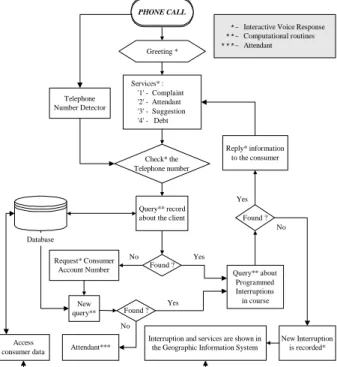
In the development of a prototype for the callers response system, the following stages were followed: when a telephone call is received, a message of greeting to the caller is produced. Simultaneously, the system obtains the incoming telephone number through the ANI and automatically queries database to identify the customer. In case the telephone number obtained by the ANI is not registered in the database, then the number of the consumer account is required to be dialed by the keyboard or telephonic device disc. If even though the customer is not identified in the database (due to a data input error on the telephone keyboard) then the caller is transferred to a system operator to identify it and to deal individually with the customer.
After customer identification, a message is provided requesting the consumer to dial the code number corresponding to the service he aims to obtain (i.e. one should press " 1" for a complaint, "2" - for bills to be paid, "3" for suggestions, etc.)
A second access is done based on data, in order to verify if the customer has the supply interrupted by a planned disconnection. In that case, the consumer is provided with the predicted time the electric energy supply will be restored. In case there is no planned disconnection that affects the consumer, the IVR transfers the caller to system operator, to register the nature of the complaint and the occurrence. At the same time, the system receives the reference number of the consumer to locate his/her address. It then should access the database to provide the pertinent information regarding the customer to the Geographic Information System. This, in turn, is displayed on the computer screen in a reduced region of the city map, indicating the transformer that supplies electric power to the consumer. The electric network fed by this transformer is then outlined by a different color, regarding those network elements affected by the outage, so that the system operator is able to provide some information regarding the system restoration during the process.
To conclude the complaint registration, the IVR issues a greeting message and the main menu for service messages is again presented to the caller.
The previous access to the consumer data is useful when the system operator registers the occurrence. In that case, the operator does not need to waste his time inserting the address and other data regarding the consumer. He does not have to worry with anything but to confirm the obtained data in automatic form, and to insert the pertinent data concerning the occurrence. In such way, the time spent by the system operator with each customer complaint is minimized, providing instantly the available information from the database. As new occurrences are being registered, more regions have their network being painted in different colors by
Figure 3 – Network visualization with a Geographic Information System
the system. Such measure allows the dispatcher of the emergency team or the system operator to verify the affected consumers in a region which are supplied by the same circuit. This proceeds allows to evaluate the probable network branch where the fault is located, minimizing the emergency restoring time. In case of planned outages, when there is already a prevision in restoring the system, the consumer is promptly informed. The graphic representation of the network affected part is indicated in another color, in order to distinguish from unexpected outages. An example of this process is shown in figure 4.
VIII. The Prototype Architecture
A prototype of this system was assembled at EPUSP-PEA for performance and functionality evaluation. This prototype uses the concept of open and distributed systems that award standardized interfaces - internationally accepted - as well as the functions are grouped in interconnected hardware modules through data communication channels.
An Ethernet net with TPC/IP protocol interconnects the machine with the Database management software and the microcomputers available to be utilized by the operator (see figure 5).
The IVR communicates with the Database management software through the serial channel, where messages on ASCII are exchanged, analogously to the connection with the ANI device.
The IVR is placed in an IBM/PC compatible microcomputer, equipped with the operational system, QNX multitask, derived from UNIX, with extensions for real time.
An interface card for Rhetorex telephony (CTI VANTAGE VPS4 model) provides interface with the ACD/telephony system.
The operators are given IBM/PC Pentium microcomputers, with MS Windows 95 installed.
The consumers database is situated, during this first version, in Pentium microcomputers utilizing MS Access 7. Such database will be transferred to a SUN ULTRA ONE platform, using the relational database management system ADABAS D.
The application responsible for handling phone calls was developed with the use of a product called Mars Voice, that presents an own language, called BDMAX. Such language offers facilities for receiving and handling phone calls and pre-recorded messages transmission according to the consumers selection. The information regarding the customer telephone number, in this version, is provided by the ANI device, developed by Roldsolft Technology. This function will be later performed by a Rhetorex product, following the necessary software implementation.
The IVR sends the telephone number to the database management system, where an application developed in MS Basic Visual receives the information and executes the consumer search. This search is executed in SQL, in a way it becomes compatible to any relational database.
Regarding the system operators, an application was developed by using the facilities of the GIS Arc View software, that allows the implementation of geographic information proceedings through a new object oriented language, denominated Avenue. The Avenue comprises objects to access relational databases using ODBC (Open Database Connectivity).
The computer code for consumer location is automatically triggered over the data communication net, by the Visual Basic software through RPC (Remote Procedure Call) resources .
IX. Access by way of Internet
A technology to be incorporated in this work is the internet as customer communication channel. Many utilitis are utilizing the internet as a form of contact with their clients. Information like customer service agencies, hints on electric energy conservation, information about legislation on consumer
PHONE CALL Greeting * Services* : '1' - Complaint '2' - Attendant '3' - Suggestion '4' - Debt Check* the Telephone number Telephone Number Detector
*- Interactive Voice Response
**- Computational routines
***- Attendant
Query** record about the client
Found ? Request* Consumer Account Number No Yes New query** Found ? No Yes Query** about Programmed Interruptions in course Found ? No Yes Reply* information to the consumer Database Attendant*** New Interruption is recorded* Interruption and services are shown in
the Geographic Information System Access
consumer data
Figure 4 – Example of an outage - response process
ELETRIC NETWORK AND CLIENT DATABASE TELEPHONE NUMBER DETECTOR PBX
COMPUTER WITH GEOGRAPHIC INFORMATION SYSTEM INTERATIVE VOICE RESPONSE PHONE CALL --COMPLAINT / SUGGESTION / INFORMATION
rights, fees charged, requests , etc, are some of the services offered by the company. However, in the case of supply interruptions one is not able to use his/her personal computer. Is it possible to use the internet to obtain information? Yes, there are services able to help the consumers. As an example, in the case of planned outages, the customers affected can be warned previously by e-mail , by way of WAP or in the company site. Another service is the registration for clients that aim to have a special service, like hospitals, police stations, and ill persons that rely on medical equipment, etc. Other form that has been expanded recently is by the WAP (Wireless Application Protocol) technology developed since 1997 by an enterprise consortium (called WAP Forum), that integrates some advantages from wireless equipment, as telephone and PDA (Personal Digital Assistant). The languages for content assembling is the WML (Wireless Markup Language) similar to the HTML (Hyper Text Markup Language), utilized in the conventional Internet.
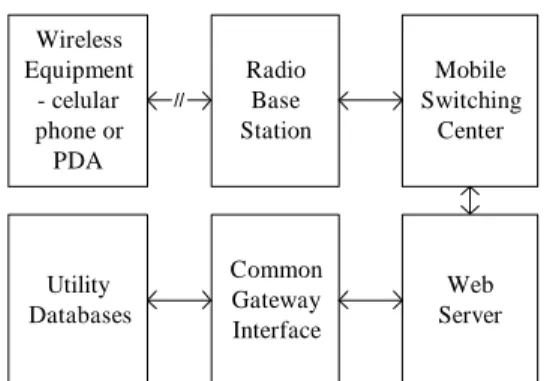
The basic structure of a WAP connection can be seen in figure 6. Through wireless communication equipment, a phone connection is realized over the closest re-transmitter station (also denominated cells, geographically spread all over the cities). In turn, this one is linked to a mobile communication center (MSC - Mobile Switching Center). The connection with the Web server is done through an interface called CGI. The CGI will convert the received data from the wireless equipment in an intelligible way by the Web server and vise versa. Once connected to the internet, either the equipment or the utility could receive or send messages.
The WAP allows the consumer to send his complaint of electric energy outage by internet instead of sending it by phone calls. With WAP, the utility should create a standard form, requesting all client data and the occurrence. Apart from avoiding phone congestion that happen to be very common when there are disconnection caused by bad weather, it can set the information traffic and assure better speed to locate the probable net fault. Another advantage is that the client can receive in any place information which the utility considers important, keeping him informed about fees or long outages, for example.
The WAP technology, however, still faces some problems that should be solved :
- Delay during data transmission - this problem
discourages consumers to use WAP as a communication channel;
- Few information that can be exchanged by way of
internet;
- Low performance of the net;
- Difficult in using GIS in a wireless equipment, etc.
X. Conclusion
The present work deals with the benefits gained with the use of information technology aiming to provide a better relationship between the utilities and its consumers.
Although each utility uses a different trouble call system, the use of these new technologies by the utilities will led to a better utilization of the companies resources.
To achieve the integration of the utilities several different information systems, including databases, GIS and telephony, the company must evolve to the open systems concepts. Theses concepts stablishes the use of standardized interfaces to allow inter-process communication in an effective way. The adoption of the Open GIS standard will assure the portability and the inter-operability between GIS tools. This will reduce the costs of development, since data will be obtained from other sources, without the need of re-work or data loss.
XI. References
[1] ALVES, D.S., Sistemas de Informação Geográfica, 1o. Simpósio de Geoprocessamento, Escola Politécnica, USP, São Paulo.
[2] CODI - Mapeamento e Cadastramento - Diretrizes para Utilização de Tecnologia de Geoprocesamento na
Gerência de Redes de Distribuição - Relatório CODI
3.2.20.02.0.
[3] GAING, Z. L., LU, C. N.; LIN, Y. T, Object Oriented Design of Trouble Call Analysis System on Personal
Computer, IEE Proceedings - Generation, Transmission
and Distribution, vol. 142, iss. 2, p 167 ~ 72, March 1995.
[4] Vivek, Utilities Sector – Industry Trends Document, Infosys Technologis Limited, March 2000.
Wireless Equipment - celular phone or PDA // Radio Base Station Mobile Switching Center Common Gateway Interface Web Server Utility Databases
Figure 6 – Data transmission structure of WAP connection between wireless equipments and the Web server
XI. Biographies
Humberto Katsuo Kiyohara was born in
January 22 nd, 1971, graduated in Electric Engineering at “Escola Politécnica da Universidade de São Paulo” - The Polytechnic School of Engineering, São Paulo University, in 1995. From the same institution he received the MSc in Electric Engineering in 1999. At present he is a researcher at “Escola Politécnica da Universidade de São Paulo” - GAGTD group.
José Antonio Jardini (M’ 1966, SM’
1978, F’ 1990) was born in São Paulo, Brazil, on March 27th, 1941. He graduated from Escola Politécnica da Universidade de São Paulo in 1963 (Electrical Engineering). From the same institution he received the MSc, PhD. Prof. Jardini is an Associate Professor and Head Professor degrees in 1971, 1973, 1991 and 1999, respectively. For 25 years he worked for Themag Engenharia Ltda., a leading consulting company in Brazil, where he conducted many power systems studies and participated in major power system projects such as the Itaipu hydro plant. He is currently Head Professor at “Escola Politécnica da Universidade de São Paulo”, where he teaches power system analysis and digital automation, and where he leads the GAGTD group, which is responsible for the study and development of automation systems in the fields of generation, transmission and distribution of electricity. He represented Brazil at SC-38 of CIGRÉ and is a Distinguished Lecturer of IAS/IEEE.
Luiz Carlos Magrini was born in São Paulo,
Brazil, on May 3rd, 1954. He graduated at “Escola Politécnica da Universidade de São Paulo” in 1977 (Electrical Engineering). From the same institution he received the MSc and PhD degrees in 1995 and 1999, respectively. For 17 years he worked for Themag Engenharia Ltda, a leading consulting company in Brazil. At present he is a researcher at “Escola Politécnica da Universidade de São Paulo” - GAGTD group.