S T R A T E G I C W H I T E P A P E R
Managed communications (MCS) have emerged in response to growing demand from enterprises for an enhanced range of network-based services that can optimize the total cost of ownership, integrate with traditional service delivery models, and guarantee an appropriate technological evolution path. Market forecasts for MCS point to a rapid growth of 10 to 15% per year over the next five years, reaching $60 billion per year worldwide — or approximately 20% of total service provider business with enterprises. Service providers looking to take a piece of this market are enhancing their enterprise service offerings — and their business relationships — by adding high-value services across the MCS range: managed business communication, managed customer interaction and managed networking.
The Fast Track for Service Providers
to High-Value Enterprise Services
Table of Contents
1 Introduction
1 Service Providers and Enterprises: The Opportunity
1 Why Managed Communications Present an Opportunity 2 New Revenue Streams, with Key Market Differentiators
2 Alcatel-Lucent Managed Communications Framework 3 MCS for Enterprise Business Transformation
5 Flexible Deployment Models – Key Factors for Success across Enterprise Segments 6 MCS – The Opportunity for Mobile Service Providers to Secure Enterprise Business
7 Combining the Right Solutions with Efficient Go-to-Market Support 8 Alcatel-Lucent Delivers Powerful Managed Communications
1 The Fast Track for Service Providers to High-Value Enterprise Services | White Paper
Introduction
Managed communications (MCS) present a major growth opportunity for service providers to move up the value chain with integrated bundles of higher-value enterprise services. These services exist in three domains: managed networking, managed business communications, and managed customer interaction.
Although the market potential for managed communication services is large, service providers will face new types of competition from global system integrators and regional integrators. Successful operators will be those who are able to transform their businesses by forming a new and different relationship with their enterprise customers, including:
• Providing a flexible range of service solutions to enterprises, complete with optimized cost structures at both the network and operational levels
• Developing solution and integration capabilities with a proper go-to-market approach that addresses different enterprise segments
• Providing solution integration, local support and maintenance capabilities
• Using effective marketing to match enterprise-segment needs with the appropriate service bundles and trusted support
Service Providers and Enterprises: The Opportunity
Why Managed Communications Present an Opportunity
The MCS market is developing rapidly. Enterprises are dealing with complex communication requirements and growing workforce mobility and prefer to focus on improving their operations rather than investing in new equipment. Industry analysts and market research findings concur that the opportunity for this market is large and strategically important. Overall forecasts point to global market growth of 10 to 15% per year over the next five years worldwide — approximately 20% of operators’ total business with enterprises. Many service providers are jumping in to take advantage of this new opportunity: for example, BT has launched fixed-mobile convergence (FMC), Orange has introduced a fixed and mobile telephony service for business customers, and KPN has successfully deployed a new portfolio and grown the small- and medium-sized business (SMB) business in the Netherlands.
Enterprises form a major part of the business for a typical incumbent fixed- or integrated-service provider, representing 15 to 30% of revenues. Enterprises are mainly relying on service providers to deliver connectivity services, including:
• Voice services on traditional PSTN/ISDN and emerging voice over IP (VoIP) services, which combine access fees and traffic minutes, as well as additional intelligent network (IN) services such as IN 800/900 and interactive voice response (IVR)
• Mobile services (essentially mobile voice traffic), which are evolving to include wireless data services and a small portion of additional corporate services such as push e-mail
• Data services, which combine transport services (e.g., leased lines, SONET/SDH and other optical transport services) and private data networking services based on mature standards (i.e., ISDN, frame relay and ATM). These services are transitioning to IP-based services, offering primarily fast-growing IP virtual private network (IP-VPN) and emerging Ethernet WAN services.
However, the perceived added value of connectivity services is relatively low, relegating the service provider to a cost category rather than a partner serviced by information technology (IT). MCS will enable enterprises to focus on the business essentials.
New Revenue Streams, with Key Market Differentiators
Today, service providers are confronted with the commoditization of traditional connectivity services. Strong price erosion in traditional data services is compensated partially, but not entirely, by the lower cost base of — and efficiency gains from — integrated IP and Ethernet adoption. This situation signals a clear need for communication services that are tuned to wide range of enterprise needs, with a high perceived value for end customers, and that are built on connectivity offerings that are critical to service-provider revenue flows.
MCS presents an opportunity for service providers to generate new revenue streams and differentiate themselves from pure-commodity competitors to build a sustainable competitive advantage. Moving up the value chain from connectivity services to higher-value managed communication services requires a transformation in terms of the relationship service providers have with enterprise customers. Service providers must focus on addressing growing requirements for more integrated, flexible and cost-effective solutions across the entire spectrum from SMBs to very large enterprises.
Transforming relationships with enterprise customers from a connectivity-cost model to business-process partnerships will enable service providers to capture a broader share of the enterprise wallet. By going beyond connectivity services to the broader domain of enterprise telecom total cost of ownership (TCO), service providers can tap into more than three times the existing addressable connectivity market. First steps in this direction include offering:
• Managed networking, with IP-VPN and Ethernet WAN capabilities on the network side • Managed business communications, enabling advanced voice applications and employee
collaboration services and a converged fixed-mobile customer experience • Managed contact centers as part of managed customer interaction services • Voice over IP-VPN to provide a converged voice and data service
• Multimedia communication and collaboration to enrich the user experience
Alcatel-Lucent Managed Communications Framework
The Managed Communications framework (see Figure 1) includes the Managed Networking Services (MNS), Managed Business Communication solution (MBC) and Managed Customer Interaction Solu tion (MCIS).
•Managed Networking Service– Encompasses a range of private wide-area data networking. Service providers are consolidating multiple, single-service overlays onto a single, converged multiservice infrastructure to increase network efficiency and reduce costs. The networking technologies being deployed are optimized for IP and Ethernet to deliver more value to providers’ customers, whose key applications are increasingly based on these technologies.
•Managed Business Communication Solution– Represents the evolution of telephony services that have traditionally been provided by enterprise private branch exchanges (PBXs) and simple voice virtual private networks (VPNs). These services are now delivered using an integration of various technol -ogy alternatives such as managed/hosted IP-PBX, IP Centrex, FMC voice VPN and virtual PBX, and FMC GSM-WiFi and CDMA-WiFi dual-mode service, with seamless call handover between mobile and fixed networks.
MBC also encompasses a full range of solutions to improve employee productivity with easier and richer interactions. Applications such as instant conferencing and collaboration services are now being integrated with business voice and converged messaging as well as presence services, to deliver rich presence capabilities and enable a unified communication/collaboration experience.
•Managed Customer Interaction Solution– Supports various forms of interactions that enterprises have with their end customers, including multichannel contact center, IVR and advanced call-routing services. These services are moving from the very large-enterprise segment to the medium- and largeenterprise segment, with fully automated selfservice and agentassisted service solutions com bined with enhanced routing services. The implementation of multitenant platforms allows serv -ice providers to offer affordable large enterprise-like platforms to SMBs, and providers can use the same solution for their internal customer contact needs.
For service providers, Alcatel-Lucent managed/hosted services enable fast time to market and pay-as-you-grow and reduce go-to-market risks. The broad end-user services include not only business voice, such as IP Centrex and IP-PBX, but also employee interaction services such as mobile e-mail and messaging.
MCS for Enterprise Business Transformation
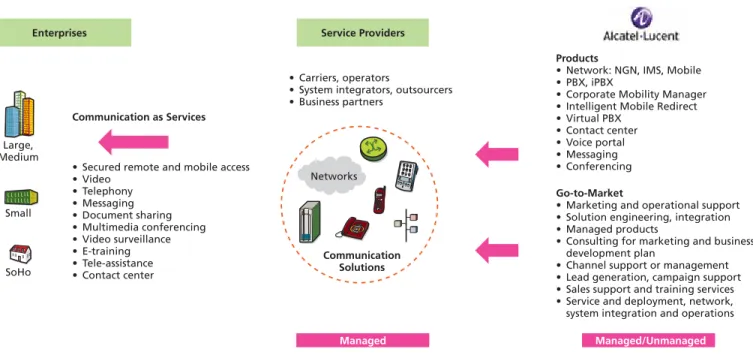
Because advanced applications such as VPN, collaboration and contact centers are not new to the large-enterprise world, MCS offerings have first been offered and adapted to large-scale businesses. This is where a network-based “managed” solution comes into play. While it is true that business communication and customer interaction require investments in people, technology and knowledge, the delivery of these services as managed services transforms the potential market opportunity. The model shown in Figure 2 summarizes the key ideas and requirements for the delivery of MCS. By combining the right set of service-provider solutions with full go-to-market support, service providers can transform their relationships with their business customers. By making traditionally expensive business services affordable, easy to purchase and simple to manage, operators can leverage network ownership into business partnerships.
The Fast Track for Service Providers to High-Value Enterprise Services | White Paper 3
Business V alue Multimedia Conferencing Messaging One Phone, One Number Contact Center Toll Free Self Service PBX on Mobile WAN-VPN-LAN Managed Business Communication Managed Customer Interaction Managed Networking Presence
Comprehensive Go-to-Market Support – Flexible Deployment Models Customer Care
Mobility
Always-on
The market has demonstrated a tendency to evolve naturally from the introduction of basic services toward those with higher value and a greater direct impact on business processes. •Step 1– Migrate from previous private data networking solutions toward VPN (e.g., managed
IP-VPN, voice VPN and Ethernet services).
•Step 2– Gradually migrate and enhance communication services from IP-based voice services, with managed business communication services deployed on IP-VPNs, to FMC services and multimedia collaboration services.
•Step 3 – Introduce advanced business interaction services (in parallel or as phased extensions). The service provider is well positioned in the connectivity and voice space to add incremental value with a logical, phased approach — a prime business consideration when service providers consider managed services as a strategic segment.
The key to building the trust required to climb the enterprise value chain involves understanding and addressing the essential “pain points” that enterprises experience today — such as growth, productivity and customer care — while keeping in mind the service priorities shown in Figure 3.
Flexible Deployment Models – Key Factors for Success across Enterprise Segments
The power of MCS is that it covers a full range of deployment models to encompass the unique requirements of each enterprise segment.
•Very large enterprise– Demand is driven by significant IT outsourcing deals, dominated by large system integrators and IT outsourcing providers. These organizations generally assume a prime contractor role for network and communication services. Research indicates that many large U.S. enterprises already outsource network management and communications to system integrators, and others are planning to implement this model. The key challenge for such enterprises is how to offer a wide range of networking and communication services while they develop partnerships with leading system integrators in their territories.
•Large enterprise– Global outsourcing approaches are less prevalent, and enterprises generally source network, communication and IT services separately. Operators compete with regional network inte -grators and team up with alternative IP-VPN service providers when needed. The key challenges are: ¬ how to optimize cost structures and productize service offerings to compete effectively with
focused, streamlined players
¬ how to develop integration capabilities in-house or using a channel approach for integration into enterprise networks
•Medium enterprise– This segment is similar to the large enterprise; however, it does not have the same level of in-house expertise. The medium enterprise has the highest cost base for information and communication technology (ICT) of any enterprise segment. Service providers operate in a competitive environment with local integrators. To be successful, service providers need to inte -grate business into their route to market (as part of a channel delivery model) or work with trusted partners to create stepped-service packages that are affordable and easy to support, enabling them to build business from the lower end of the medium-enterprise segment.
•SMB– The SMB is a high-volume, price-sensitive segment, in which competition is fragmented and needs are addressed by small, local value-added resellers (VARs). The key challenges here are: ¬ finding an effective go-to-market strategy
¬ combining integrated service bundles
¬ using package pricing for cost-effective service delivery ¬ taking a service product-specific channel approach
The Fast Track for Service Providers to High-Value Enterprise Services | White Paper 5
Overall, the most successful operators will be those that are able to:
• Provide a flexible range of service solutions to enterprises with optimized cost structures at both the network and operational levels
• Develop solution and integration capabilities using a proper gotomarket approach by enter -prise segment
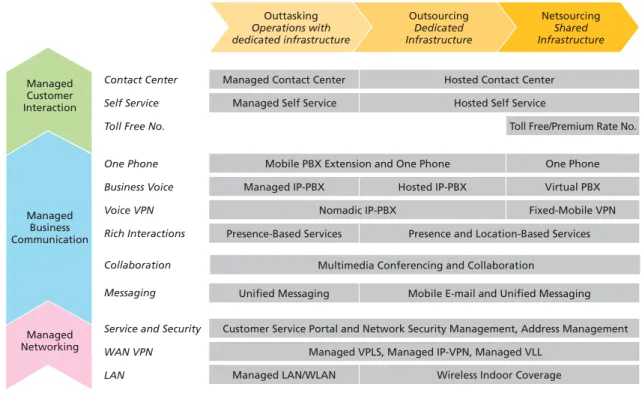
Figure 4 shows an MCS offering.
MCS – The Opportunity for Mobile Service Providers to Secure Enterprise Business
Today’s enterprises have a limited range of choices when it comes to working with mobile operators. Options for mobile usually include bundlepricing or volumediscount approaches. As more enter -prises begin to address total costs and integrate their employee communication and business processes for greater efficiency, these approaches are reaching their limits.
A large proportion of new enterprise installations are adopting VoIP, and the installed base is expected to follow this lead. In the medium term, the move toward VoIP presents new opportunities for mobile service providers to extend service offerings to a full range of communication services that combine IP and mobile services. However, mobile service providers are currently missing key capabilities: a lack of fixed-access networks and the converged go-to-market approach suited for complex services that require integration into the enterprise infrastructure.
Outtasking Operations with dedicated infrastructure Contact Center
Self Service Toll Free No.
Service and Security WAN VPN LAN One Phone Business Voice Voice VPN Rich Interactions Collaboration Messaging Outsourcing Dedicated Infrastructure Netsourcing Shared Infrastructure Managed Customer Interaction Managed Business Communication Managed Networking
Managed Contact Center
Managed IP-PBX
Hosted Contact Center
Presence-Based Services Presence and Location-Based Services
Unified Messaging Mobile E-mail and Unified Messaging
Managed LAN/WLAN Wireless Indoor Coverage Managed Self Service Hosted Self Service
Toll Free/Premium Rate No.
Customer Service Portal and Network Security Management, Address Management Multimedia Conferencing and Collaboration
Managed VPLS, Managed IP-VPN, Managed VLL
Mobile PBX Extension and One Phone One Phone
Nomadic IP-PBX Fixed-Mobile VPN Virtual PBX Hosted IP-PBX
To succeed in the mobile space, independent mobile operators need to build a strategy that applies their network assets to a combination of focused service and customer segments, incorporating the following components:
• Adopt a phased approach that starts with integrated mobile data, mobile voice VPN integrating with existing PBX, and virtual PBX services and that can be extended later with FMC services. Leveraging enterprise mobility growth trends and service providers’ mobile network assets and customer bases, mobile providers can offer mobile e-mail and other interaction and collaboration services such as mobile controlled conferencing.
• Focus on SMBs and the non-structured part of medium and large enterprises, with mobile-centric services that combine pure mobile with some fixed extensions.
• Accelerate partnerships with fixed-access providers and/or providers’ own access development with wireless access solutions.
• Develop a channel strategy geared toward supporting services that require some form of integration. The mobile divisions of integrated service-provider groups can address demands for user-centric services by teaming up with fixed divisions to develop converged communication service offerings. To date, these services have proven effective in winning market share in enterprise accounts, reduc -ing churn by deliver-ing improved cost control, simpler management for the enterprise, and seamless service with common communication features across fixed and mobile.
Combining the Right Solutions with Efficient Go-to-Market Support
Once the business strategy and the segmentation are understood, implementation is the issue. Service providers need to find a partner (or partners) capable of integrating the right solutions in the network and in the field. Solution elements must be able to provide common interfaces and core functionalities in multiple deployment scenarios and must address an infinite range of unique enterprise-customer requirements.
Beginning with one element of the MCS framework, service providers can manage progress across the full range of MCS capability in a rapid and profitable manner. For many service providers, the MCS model offers a painless way to explore the broad range of new enterprise market opportu -nities and optimize existing businesses.
To make such a business transformation successful, good technology and technology skills are required but are insufficient: it’s not only about what you sell — equally important is how you sell it! A broad range of service and business skills must also be applied to ensure profitable managed service delivery. These skills can be divided into different types, each with several components. While service providers may possess some of the skills today, an appropriate partner can provide significant assistance in one or many of the following areas.
• Go-to-market consulting, defining the best value propositions for the most receptive customers and markets:
¬ Build a baseline business case leading to a marketing strategy (What are we selling?)
¬ Build a marketing and sales plan leading to a sales channel strategy (How do we develop the most appropriate products and solutions?)
¬ Focus on the execution, leading to performance monitoring and management (How can we roll out the program in an impactful and cost-effective way?)
• Go-to-market support:
¬ business-case and business-plan development services, including objective third-party consultants for managed-service business optimization
¬ integrated support program, based on an extensive network of partners and channel-management best practices with integrators and VARs
¬ lead generation and marketing support, with collateral program-development packages and consulting support if necessary
¬ packaged channel operations for customer premises equipment (CPE) fulfillment, field support and maintenance
¬ sales training and support services, including collateral and ongoing sales support • Service and deployment, network systems integration and operations:
¬ software-integration services for providing unified service management to enterprises, up to and including network operations center (NOC) services
¬ security professional services, covering everything from security-framework design to security operations-center services
¬ white-label business for application services
¬ end-to-end service testing and support based on reference-platform integration, including third-party vendors’ equipment
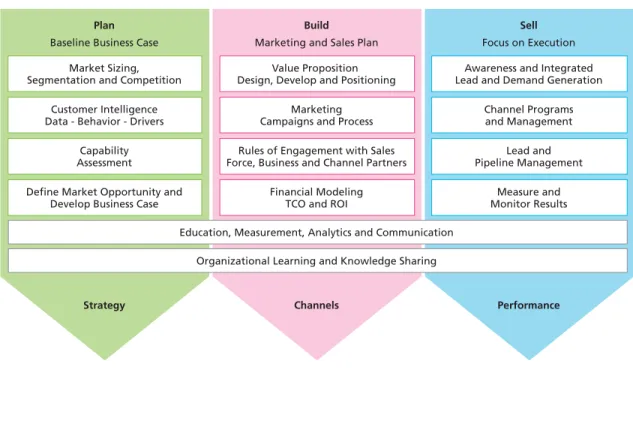
¬ joint development of specific solutions that combine CPE and network-based services Alcatel-Lucent uses a structured methodology and approach to meeting these business requirements, as shown in Figure 5.
Figure 5. Alcatel-Lucent Go-to-Market Methodology: Increase Marketing Performance and Channel Efficiency
Market Sizing, Segmentation and Competition
Value Proposition Design, Develop and Positioning
Education, Measurement, Analytics and Communication Organizational Learning and Knowledge Sharing
Awareness and Integrated Lead and Demand Generation Baseline Business Case Marketing and Sales Plan Focus on Execution
Plan Build Sell
Strategy Channels Performance
Customer Intelligence Data - Behavior - Drivers
Marketing Campaigns and Process
Channel Programs and Management Capability
Assessment
Rules of Engagement with Sales Force, Business and Channel Partners
Lead and Pipeline Management Define Market Opportunity and
Develop Business Case
Financial Modeling TCO and ROI
Measure and Monitor Results
Alcatel-Lucent Delivers Powerful Managed Communications
Alcatel-Lucent is focused on helping service providers to reinforce their position with enterprise customers by delivering profitable high-value, on-demand services to all types of enterprises, across all segments. Alcatel-Lucent offers a powerful and integrated set of solutions for cost-effectively building end-to-end services on top of traditional managed networking services and converged network solutions.
The Alcatel-Lucent MCS framework incorporates world-class, market-leading solutions in managed networking services, business communications and customer interaction services. Augmented by a comprehensive set of professional services designed especially for service providers, Alcatel-Lucent MCS solutions accelerate the deployment of new profitable services, decrease customer churn, and reduce business risk using a strong go-to-market approach that is unique in the industry. Today, Alcatel-Lucent’s proven MCS solutions are already being deployed by leading service providers around the world.