T
HE
U
SE OF
E
LECTRONIC
M
EDICAL
R
ECORDS AND
P
HYSICIANS
’
A
TTITUDES
TOWARD A
H
EALTH
I
NFORMATION
E
XCHANGE
F
INAL
R
EPORT
F
EBRUARY2010
Sponsored by and Prepared for the
Arizona Health Care Cost Containment System
Medicaid Transformation Grant (MTG) 1U0C30211A
by the
Center for Health Information
&
Research
Arizona State University
The Center for Health Information & Research (CHIR) is an interdisciplinary research group at Arizona State University. Using data to provide actionable information about health and health care in our community, CHIR is home of Arizona HealthQuery, a nationally unique patient-centric database of health information that allows researchers to follow patients over time across provider and payer. For more information about CHIR’s current initiatives as well as downloadable
publications, please visit
Professor & Director, CHIR William G. Johnson, PhD
Senior Informatics Analyst Yue Qiu, MPH
Management Research Analyst Gevork Harootunian, BS
Senior Informatics Analyst Miwa Edge, BS
Acknowledgements
The authors gratefully acknowledge the cooperation of Lisa Wynn and the staff of the Arizona Medical Board (AMB) and Elaine LeTarte and the staff of the Arizona Board of Osteopathic Examiners (ABOE). Helpful comments were provided by Dr. Anita Murcko (Medical Director,
Executive Summary
Nearly 20% of physicians in Arizona have neither internet or email access at their practice setting. Paper files remain the most prevalent method for medical records storage: only 28% of Arizona physicians have eliminated the use of paper medical records.
Cost was the most frequently cited reason for lack of EMR adoption, followed by time/training. More than 45% of physicians practicing in Arizona use some form of electronic medical record storage (EMR).
Physicians practicing in government settings and those in training (medical school, residency, or fellowships) were most likely to use basic electronic medical records (71% and 69% respectively), while EMR use was lowest among solo practitioners (25%).
Just over half (54%) of EMR users transmit medical data electronically to other parts of the health care system, such as labs or pharmacies. The others are confined to intra-practice operations. Over 50% of physicians in government settings with EMRs exchange information electronically compared to only 8% of solo practitioners with EMRs.
Approximately 58% of non EMR users would be involved in decisions to acquire an EMR.
EMR users place a higher monetary value on EMRs than non-users. A quarter of non-users thought $10,000 or more per physician would be a reasonable price to pay for an EMR system, while 42% of the EMR users considered $10,000 or more to be a reasonable amount to pay per physician.
The most trusted organization by physicians to manage a web-based health information exchange system is a “hospital system”. Health insurers/managed care organizations were the least trusted.
Introduction
It is widely believed that increased use of electronic medical records (EMRs) will improve the quality of health care and the efficiency with which it is delivered (Chaudhry et al., 2006; Sequist et al., 2007). That belief lead to the creation of the Arizona Health-e Connection and is one of the major objectives of the Medicaid Transformation Grant awarded in 2007 to Arizona’s single Medicaid agency, the Arizona Health Care Cost Containment System (AHCCCS).
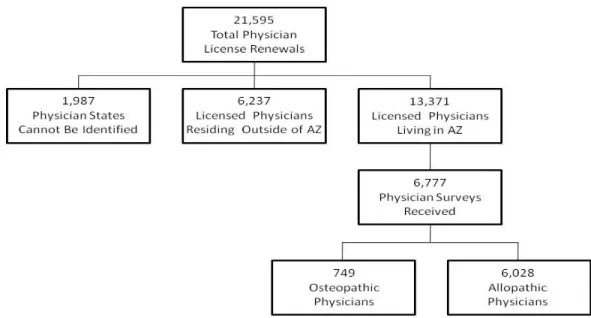
This report is the fifth and final report in a series designed to assist AHCCCS and other stakeholders in creating strategies for the expansion of EMR use and the development of regional health information exchanges. It describes the current patterns of EMR utilization, the extent to which EMRs are used to exchange information among health care entities, and the values placed on EMRs by users and non-users. It also distinguishes between those who decide on the implementation of EMRs and those who use EMRs, but who are not decision makers. This report contains results from a complete two year license renewal cycle for Arizona allopathic physicians and the complete biannual renewal cycle for all Arizona osteopathic physicians (their bi-annual renewal occurred between November 2007 and April 2008). The results presented here include the data collected for licensing allopathic and osteopathic physicians who renewed their licenses between July 17, 2007 and July 17, 2009 (21,595 eligible physicians). Out of the 13,371 physicians living in Arizona, 6,777 completed the optional survey questions (Figure 1). The detailed results presented in this report refer only to physician
Figure 1. Data Collection July 17, 2007 to July 17, 2009
Source: Arizona Medical Board (AMB), Arizona Board of Osteopathic Examiners (ABOE) Survey and Administrative Data, 2008.
Background
Most studies of EMR adoption identify the number of practices with EMRs, while this report counts the number of physicians in practices with EMRs. Thus, multiple physicians within a group practice with EMRs each report utilization of an EMR, producing a higher estimate than one which simply compares practices. The responses not affected by this methodology are those from physicians in solo practice.
Estimates of EMR adoption vary among studies with differences in design and definitions (Jha et al., 2006; Bates, 2005). Jha et al. (2006) compared results of surveys about EMR adoption that were deemed medium or high-quality from 1994 through 2005. The best estimates from their meta-analysis indicated that approximately 24% of physicians use EMRs, and only 9% have EMR systems that have functionality such as electronic prescribing. EMR adoption ranged from 13% among solo practitioners to 57% among physicians in large physician offices (50 or more physicians) (Jha et al., 2006). It was reported that almost half of Massachusetts physicians used EMRs, but less than one-quarter of practices in Massachusetts have adopted EMRs (Simon et al., 2007). The adoption rates are lower in smaller practices, especially those that are not affiliated with hospitals and do not teach medical students or residents.
The most frequently cited barriers to adoption were start-up financial costs (84%), ongoing financial costs (82%), and loss of productivity (81%). It was suggested that interventions to expand EMR use must address both financial and non-financial barriers, especially among smaller practices (Simon et al., 2007). A more recent study of a national sample of office based physicians by DesRoches et al. (2008) estimates that only 13% of office based physicians have a basic EMR system, while approximately 4% of physicians have a fully functional EMR system (DesRoches et al., 2008; Jha et al., 2009). The study also found that EMR adoption was more common in the Western U.S. than in other regions. However, the study cannot provide an estimate for Arizona due to the limited sample size for Arizona (communication with the first author). In addition, the survey sample excluded osteopathic physicians, physicians who were not members of the American Medical Association. Also excluded were residents, physicians in federally owned hospitals, retired physicians, radiologists, anesthesiologists, pathologists, psychiatrists, hospitalists, and part-time physicians who worked < 20 hours per week (DesRoches, 2008).
A Robert Wood Johnson Foundation study indicated that the proportion of physicians with access to EMRs in 2005 was closer to 24% than to 17% (Blumenthal et al., 2006; DesRoches et al., 2008). The National Center for Health Statistics (NCHS) used the 2006 National Ambulatory Medical Care Survey to measure adoption of EMRs, and found that 29% of physicians had at least a partial EMR, while 12% had a “comprehensive EMR” (Hing et al., 2006). The NCHS also released the preliminary results of a mail survey of a national sample of office based physicians in December 2008. The survey, conducted from April through August 2008 shows that 38% of physicians used full or partial EMR systems in their office based practices. Approximately 20% of the physicians used systems that included orders for prescriptions, orders for tests, results of lab or imaging tests, and clinical notes (Hsaio et al., 2008).
Comparisons among studies are difficult because of inconsistent definitions of EMRs and differences in study and/or sample design (Jha et al., 2006; DesRoches et al., 2008; Jha et al., 2009). Another problem is that many studies rely on small numbers of respondents (DesRoches et al., 2008; Jha et al., 2009). The characteristics of the physicians included in the NCHS studies and the DesRoches et al. (2008) study are substantially different from the characteristics of the physicians in our study. We have, therefore, provided an additional set of results using, to the
degree possible, the exclusions used by the other studies. For a detailed comparison of the other studies to the findings of this report, please see Appendix A.
Methods
The survey was implemented on July 17, 2007 by the Arizona Medical Board (AMB) for allopathic physicians and by the Arizona Board of Osteopathic Examiners (ABOE) on November 1, 2007 for osteopathic physicians. The data in this report represent the two year (2007-2009) allopathic physicians’ renewal cycle and the complete bi-annual osteopathic renewals for 2007. The survey questions for both groups were included with physicians’ applications for license renewal. During the period from July 2007 through July 2009, the allopathic data were collected from paper survey forms which were transmitted to CHIR for coding and data entry. The osteopathic information was collected electronically. Both licensing boards also supplied the data from the licensing applications in electronic form. CHIR then merged the survey data with the licensing data a record for each physician.
Survey Instrument
The survey questions accompanied the forms (either electronic or paper) that physicians use to apply for a license. The survey consists of six questions with sub-parts. (See Appendix B for a copy of the survey instrument.) The survey was implemented in July 2007 with minimal pre-testing to initiate the accumulation of information as early in the allopathic renewal cycle as possible and to capture the “once in every two year” renewals for osteopathic physicians that occurred beginning fall 2007. The objective was to provide AHCCCS with estimates for targeting its campaign to expand the use of EMRs as early in the process as possible. The rapid implementation of the survey would not have been possible without the close and enthusiastic cooperation of the Directors and staff of the AMB and the ABOE.
Changes in the AMB data processing system provided an opportunity to make a slight modification to the survey questions. An additional sub question was added for license applications that were submitted after September 24, 2007, namely:
What best describes the barriers to adoption of electronic medical records in your practice/organization?
Concepts and Definitions
Active license: We adopted the definitions used by the licensing boards, namely that physicians with an active license are those who maintain their license in an “active” status. The active license status however does not necessarily mean that a physician is actively practicing medicine. Some physicians with active licenses are, for example, retired or on temporary work absences. Retired physicians with active licenses are excluded from our results.
Electronic Medical Record: Physicians were given the opportunity to select any or all of the possible methods of storing their medical records. The specific survey question is:
Physicians who included “electronic file” in their responses are assumed to have access to an electronic medical record. Separate questions were asked concerning the exchange of
information using their electronic files to distinguish between intra office electronic medical records and records used to transfer information between a practice or hospital system and other users. The specific survey questions on information exchange are:
Primary care vs. specialty care: Physicians are permitted to report more than one specialty and they need not be board certified in the reported specialty. We adopt the first specialty reported and do not classify physicians by multiple specialties. Primary care is defined to include
physicians whose specialty is either family care, general practice, geriatrics, internal medicine, or pediatrics. The primary care definition does not include Obstetrics and Gynecology, following the conventions used by the AHCCCS program.
Type of Practice:Physicians were asked to select no more than two of ten types of practice organizations to characterize their practice. The categories were chosen to distinguish among types of practice or organizations likely to differ in rates of adoption of electronic medical
retained, the number of potential combinations of practice type became unwieldy, leading us to adopt a classification scheme that ordered physician choices to better obtain mutually exclusive, single categories of practice types. The ordering is as follows:
First: If physician checks fully retired or semi-retired or med school/resident or locum tenens, then s/he is
assigned to the category checked and not included in any other category.
Second: If a physician is not included in the first step above and lists government, then s/he is included only in
the government category.
Third: If a physician is not included in the first or second steps and lists administrative medicine, then s/he is
included only in the administrative medicine category.
Fourth: If a physician is not included in steps 1-3 and lists solo practice, then s/he is included only in the solo
practice category.
Fifth: If a physician is not included in steps 1-4 and lists group practice, then s/he is included only in the group
practice category.
Sixth: If a physician is not included in steps 1-5 and lists community health center, then s/he is included only in
the community health center category.
Seventh: If a physician is not included in steps 1-6 and lists solo practice, then s/he is included only in the solo
practice category.
Eighth: If a physician is not included in steps 1-7 and lists academic research/teaching, then s/he is included
only in the academic research/teaching category.
Ninth: If a physician is not included in steps 1-8 and lists hospitalist, then s/he is included only in the hospitalist
category.
Tenth: any remaining cases are listed as missing for type of practice.
Data
Allopathic physicians renewed their licenses every two years on their birthdays, while
osteopathic physicians renewed en masse every two years from November through April. A total of 21,595 physicians were projected to renew their licenses between July 17, 2007 and July 17, 2009. The renewals included 13,371 physicians who live in Arizona and an additional 6,237 physicians with Arizona licenses who live outside Arizona. The data described from this point are limited to non-retired physicians with active licenses who live in Arizona:
We estimated the number of allopathic physicians who were eligible for renewal based on birth dates and a two-year cycle. Actual renewal dates do not exactly match birth dates so the
denominator for the response rate is an estimate. Survey responses were received from a total of 6,777 physicians living in Arizona of whom: 6,028 were allopathic physicians and 749 were osteopathic physicians for an average response rate of 50.7%. The estimated response rate may be understated, since state of residence could not be identified for 677 survey respondents and 55 MD surveys were omitted because of data format problems at the licensing board.
Although the sample is quite large and the response rate is high, the best test of the extent to which a survey represents a population is to compare the characteristics of the respondents to the characteristics of the non-respondents. Since we have licensing data on all physicians, we can make that comparison. The comparisons shown in Table 1 suggest that there are no significant differences of geographic location between respondents and non-respondents. There are statistically significant, but very small absolute differences between respondents and
non-respondents in regard to gender, and primary care physicians vs. specialists. Physicians age 25-34 are underrepresented and primary care physicians are slightly over represented in the survey data. The survey results are, therefore, reasonably representative of all osteopathic physicians and of the allopathic physicians who were eligible for renewal between July 17, 2007 and July 17, 2009. In the result section, the results will be displayed into two subsections: all survey respondents, and survey respondents among AHCCCS providers vs. Non-AHCCCS providers.
Table 1. Comparison of Respondents to Non-Respondents
Characteristic Respondents N = 6,777 Eligible Physicians N =13,371 P-Value
Sex < 0.05 Female 1,791 27.3% 3,437 26.7% Male 4,769 72.7% 9,458 73.3% Age Group 25-34 438 6.5% 1,196 8.9% < 0.01 35-44 1,976 29.2% 4,000 29.9% < 0.01 45-54 2,012 29.7% 3,867 28.9% < 0.05 55-64 1,590 23.5% 2,918 21.8% 65+ 758 11.2% 1,385 10.4% Specialty < 0.01 Primary Care* 2,945 43.6% 5,446 40.9% Specialty Care 3,812 56.4% 7,865 59.1% Location N.S. Maricopa County 4,371 64.5% 8,792 65.8% Pima County 1,376 20.3% 2,626 19.6%
All Other Counties 1,030 15.2% 1,953 14.6%
Source: AMB, ABOE Administrative data May 1, 2006 – July 17, 2009. Note: Percentages are calculated on numbers of cases with non-missing values. A p-value of .05 or less implies only a 5% probability of declaring the relationship significant when in fact it is not. N.S. =no significant difference.
* Primary care is defined to include physicians who report their specialty to the licensing board as family care, general practice, geriatrics, internal medicine, or pediatrics, but does not include Obstetrics and Gynecology.
Because the results are drawn from respondents in a census of physicians, each of the respondents practicing in Arizona represents only 1.97 physicians in the eligible population. Results drawn from a sample rather than a census necessarily require much larger population weights. A recent national survey of EMR use in the United States, for example, uses a sample of 2,607 respondents to represent 494,742 physicians in the eligible population (DesRoches et al., 2008; Jha et al., 2009). Thus, if the weighting was simple (which it is not), each national survey respondent would represent 239.4 physicians.
Physicians in the VA health care system or the Indian Health Service (IHS) are not required to have an Arizona license unless they also practice outside the federal system. A recent HRSA report shows that 500 physicians are employed in the VA or IHS systems in Arizona (HRSA, 2007). The HRSA database also shows that 38.8% (194/500) of Arizona physicians (MD) with a federal license practiced in primary care during 2007. The number of Arizona physicians who
reported working in a government setting on the CHIR/AHCCCS survey is 390 MDs and 43 DOs. Each respondent represents approximately 1.97 physicians in the total population of active Arizona physicians (1/.508= weight of 1.97). Weighting the survey responses to population totals indicates that approximately 853 physicians [(390+43)*1.97] with Arizona licenses work in a government setting. The estimate includes all government settings, not just the VA and IHS but comparisons with the HRSA report suggest that the relatively large number from the survey data implies that most of the federally employed physicians have Arizona licenses.
Results
A
LLS
URVEYR
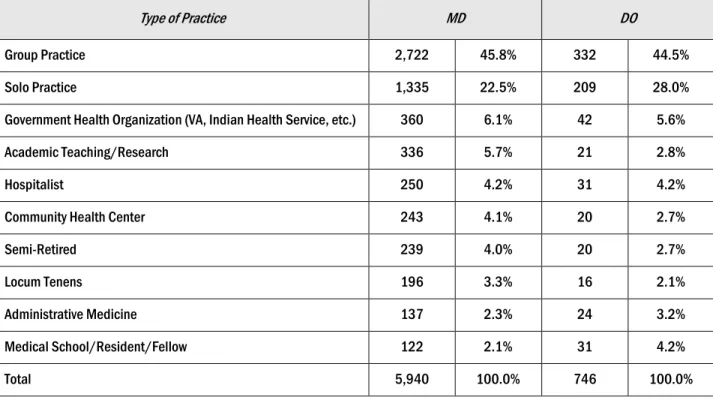
ESPONDENTSTable 2. Survey Respondents by Type of Practice (N = 6,686)
Type of Practice MD DO
Group Practice 2,722 45.8% 332 44.5%
Solo Practice 1,335 22.5% 209 28.0%
Government Health Organization (VA, Indian Health Service, etc.) 360 6.1% 42 5.6%
Academic Teaching/Research 336 5.7% 21 2.8%
Hospitalist 250 4.2% 31 4.2%
Community Health Center 243 4.1% 20 2.7%
Semi-Retired 239 4.0% 20 2.7%
Locum Tenens 196 3.3% 16 2.1%
Administrative Medicine 137 2.3% 24 3.2%
Medical School/Resident/Fellow 122 2.1% 31 4.2%
Total 5,940 100.0% 746 100.0%
Source: AMB, ABOE Survey data, July 17, 2007 - July 17, 2009. Note: 88 MDs and 3 DOs did not respond to this question (missing).
Table 2 shows the distribution of physicians by type of practice among MDs and DOs who live in Arizona and who responded to the survey. Fully retired physicians and physicians practicing outside Arizona are excluded from the results.
Communications and Medical Records
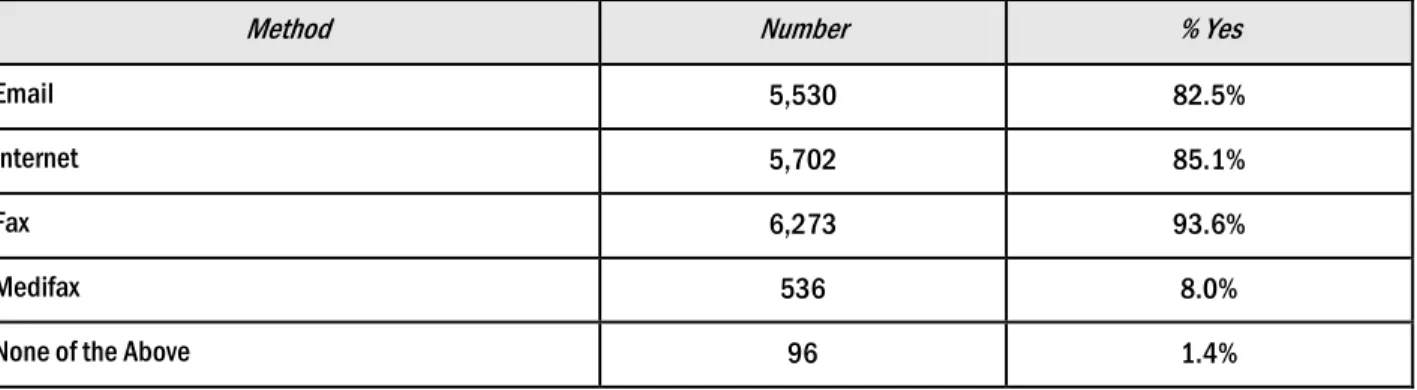
The survey asks physicians about the methods of communication, billing, and record storage in their practices. The results are shown in the next two tables. Table 3 shows that nearly all physicians have access to a fax machine but approximately one-fifth of physicians do not have access to email and/or the internet. A small percentage use Medifax, and a few physicians report that none of these methods of external communication are available in their practice
environment.
Table 3. Methods of Communication Available to Physician in Practice Environment (N = 6,699)
Method Number % Yes
Email 5,530 82.5%
Internet 5,702 85.1%
Fax 6,273 93.6%
Medifax 536 8.0%
None of the Above 96 1.4%
Source: AMB, ABOE Survey Data, July 17, 2007-July 17, 2009.
Note: Categories are not mutually exclusive. 78 physicians did not respond to this question.
Table 4. Methods of Billing (N = 6,777)
Method Number % Yes
Fax 474 7.0%
Email 326 4.8%
Internet 2,437 36.0%
Mail 2,463 36.3%
Don't know 2,544 37.5%
Billing not applicable to practice type 185 2.7%
Source: AMB, ABOE Survey Data, July 17, 2007 - July 17, 2009. Note: Categories are not mutually exclusive. There were no missing responses for this question.
The results in Table 4 describe the methods used for billing by physicians. More than one-third of the respondents did not know how their practice managed the billing process. Postal mail or the internet is the most prevalent billing methods, while a minority of physicians use fax and email in their billing process.
Table 5 examines methods of records storage among physicians. Paper files are the most prevalent storage method. Approximately 46% of physicians used paper files as their sole method of storing medical records and only 13% of the physicians rely solely on EMRs. The most prevalent use of EMRs is in combination with paper files or with scanned files. Taken together, the combinations represent the use of EMRs by more than 32% of the physicians. In total, approximately 45% of the physicians are in practices that use EMRs.
Table 5. Methods of Storing Medical Records (N = 6,387)
Method Number Yes % of total
Paper Files Only 2,911 45.6%
EMR Only 859 13.4%
Scanned Images Only 205 3.2%
Paper + Scanned Images Only 393 6.2%
EMR + Paper Only 484 7.6%
EMR + Scanned Images Only 742 11.6%
Paper + Scanned Images + EMR 793 12.4%
EMR alone or in combination* 2,878 45.1%
Source: AMB, ABOE Survey Data, July 17, 2007 - July 17, 2009. Note: 390 respondents did not identify a method of storing medical records (missing). *Data on “EMR alone or in combination” is not mutually exclusive from other categories.
Storing medical records electronically does not mean that a physician uses EMRs to exchange clinical information or has integrated the EMR into his or her practice. The information in Table 6 describes how physicians use EMRs to exchange information. The survey asked if physicians with EMRs were connected to other parts of the health care system, such as to a hospital, pharmacy, lab, or to radiology. Overall, approximately 54% of EMR users or approximately 24% of all physicians report they can connect to at least one of these areas, with laboratory
connectivity the most common connection. Radiology results were least likely to be connected to EMRs, with only 36% of physicians with EMRs or approximately 16% of all physicians able to transmit medical data to or from a radiology facility. If we define a “fully functional” EMR as one that allows connectivity with hospital(s), radiology, lab, and pharmacy data electronically, then approximately 9% of physicians in Arizona use fully functional EMRs.
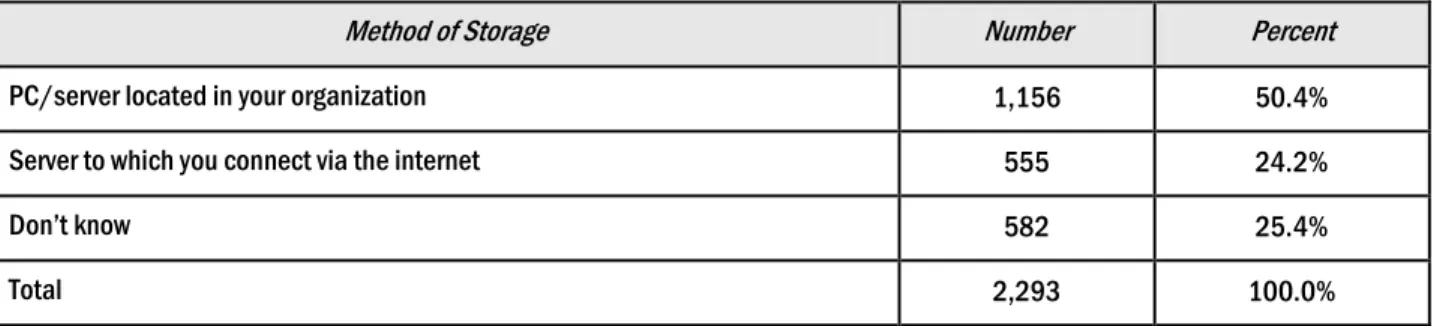
The results in Table 7 show that approximately one-half of EMR systems are stand alone systems that operate solely within a practice.
Table 6. Methods of Transmitting Medical Records (N = 2,878)
Method N Connected % of
EMR Users
% of EMR
Users % of All Eligible Physicians
Electronic File* 2,878 - 100.0% 45.1%
Electronic and Connected EMR System 1,558 100.0% 54.1% 24.1%
Connected to Hospital** 1,283 82.3% 44.6% 19.8%
Connected to Pharmacy** 1,008 64.7% 35.0% 15.6%
Connected to Lab** 1,341 86.1% 46.6% 20.7%
Connected to Radiology** 1,027 65.9% 35.7% 15.9%
“Fully Functional” EMR** 601 38.6% 20.9% 9.3%
Source: AMB, ABOE Survey Data, July 17, 2007 - July 17, 2009. Note:
*% of Electronic File was based on the calculation in table 5.
**These percentages are not mutually exclusive. % based on all survey respondents. 310 respondents did not answer the question on files. A “fully functional” EMR is one that can exchange information with each of these segments of the health care system: hospital, pharmacy, lab
and radiology.
Table 7. On-site vs. Off-site Storage of EMRs (N = 2,293)
Method of Storage Number Percent
PC/server located in your organization 1,156 50.4%
Server to which you connect via the internet 555 24.2%
Don’t know 582 25.4%
Total 2,293 100.0%
Source: AMB, ABOE Survey Data, July 17, 2007 - July 17, 2009. Note: 585 physicians with EMRs did not respond (missing).
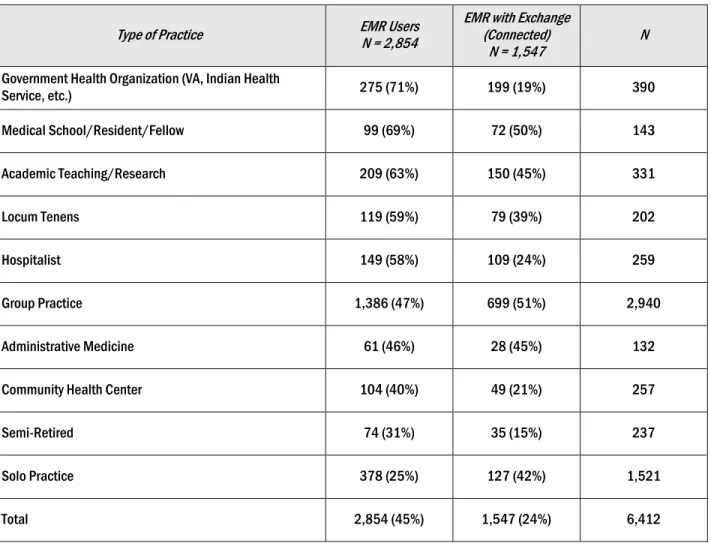
As indicated in Table 8 and Figure 2, the highest utilization rate of EMRs occurs in government settings, probably reflecting the Veteran’s Administration (VA) system. Among physicians in non-governmental settings, physicians in academic positions were much more likely to have access to EMRs than in non-academic practices. Approximately 71% of physicians in
approximately 25% (Table 8, Figure 2 & Figure 3.) It is interesting to note that about half of Arizona physicians who practice in a governmental group practice setting can exchange medical information electronically, while less than 8% of solo practitioners have that ability.
Table 8. EMR Utilization by Type of Practice
Type of Practice EMR Users N = 2,854 EMR with Exchange (Connected)
N = 1,547 N
Government Health Organization (VA, Indian Health
Service, etc.) 275 (71%) 199 (19%) 390 Medical School/Resident/Fellow 99 (69%) 72 (50%) 143 Academic Teaching/Research 209 (63%) 150 (45%) 331 Locum Tenens 119 (59%) 79 (39%) 202 Hospitalist 149 (58%) 109 (24%) 259 Group Practice 1,386 (47%) 699 (51%) 2,940 Administrative Medicine 61 (46%) 28 (45%) 132
Community Health Center 104 (40%) 49 (21%) 257
Semi-Retired 74 (31%) 35 (15%) 237
Solo Practice 378 (25%) 127 (42%) 1,521
Total 2,854 (45%) 1,547 (24%) 6,412
Source: AMB, ABOE Survey Data, July 17, 2007 – July 17, 2009. Note: 365 physicians did not respond (missing).
Figure 2. Distribution of Users by Type of Practice: Arizona Physicians (N=6,412)
Source: AMB, ABOE Survey Data, July 17, 2007 - July 17, 2009.
Figure 3. Electronic Medical Record Usage by Type of Practice: Arizona Physicians (N=6,412)
Source: AMB, ABOE Survey Data, July 17, 2007 - July 17, 2009.
Table 9 shows the distribution of EMR users by county. The rate of EMR utilization in the two most urban counties (Maricopa and Pima) is similar (42.8% vs. 44%). Physicians in Maricopa County are slightly more likely to utilize a connected EMR, although the difference is not statistically significant (See Table 10).
46% 40% 71% 47% 58% 25% 45% 21% 19% 51% 24% 42% 8% 24% 0% 10% 20% 30% 40% 50% 60% 70% 80% P er c ent E M R U s er s
Electronic Files Transmittable EMR
71% 69% 63% 59% 58% 47% 46% 40% 31% 25% 0% 10% 20% 30% 40% 50% 60% 70% 80% Government (VA/IHS/etc.) Medical School/Resident/Fellow Academic Teaching/Research Locum Tenens Hospitalist Group Practice Administrative Medicine Community Health Center Semi-Retired Solo Practice
Percent EMR Users
Table 9. Distribution of EMR Utilization by County (N = 6,435)
Location Respondents All Survey EMR Users % EMR Users Exchange Users EMR with Exchange Users % EMR with
Apache 17 9 52.9% 7 41.2% Cochise 76 33 43.4% 15 19.7% Coconino 176 76 43.2% 29 16.5% Gila 31 10 32.2% 5 16.1% Graham 19 8 42.1% 3 15.8% Greenlee 5 1 20.0% 1 20.0% La Paz 9 3 33.3% 2 22.2% Maricopa 4,371 1,871 42.8% 982 22.5% Mohave 184 66 35.9% 29 15.8% Navajo 68 32 47.0% 19 27.9% Pima 1,376 605 44.0% 370 26.9% Pinal 94 45 47.9% 29 30.9% Santa Cruz 18 4 22.2% 0 0.0% Yavapai 163 61 37.4% 33 20.2% Yuma 135 36 26.7% 20 14.8%
Source: AMB, ABOE Survey Data, July 17, 2007 – July 17, 2009. Note: Table does not include fully retired physicians. Additionally, 342 respondents did not identify a method of storing medical records
Physician Characteristics Associated with EMR Use
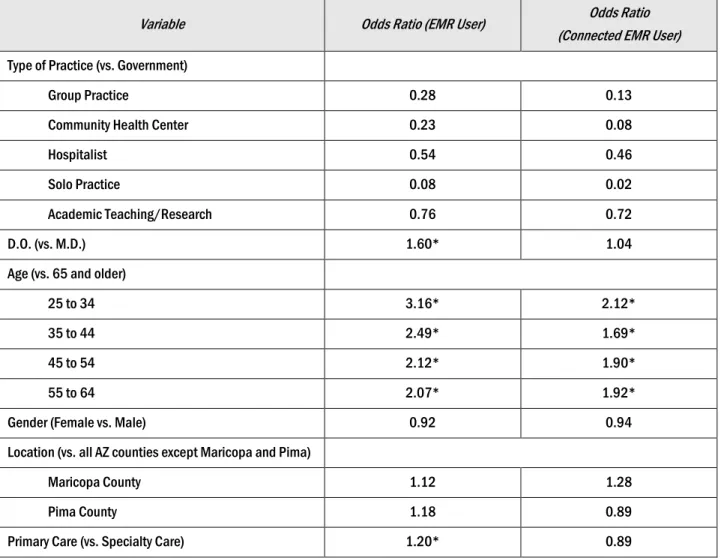
We used a multivariate logistic regression model on six variables to identify characteristics that affect the probability that a physician will be an EMR user (Table 10). The odds ratios are a measure of the strength of the relationship between two variables, holding other characteristics constant. To use an example from the table below, physicians age 25 to 34 are, all else equal, 3.2 times more likely to utilize EMRs in their practice than physicians age 65 and older. An odds ratio less than 1.0 indicates that physicians in a particular group are less likely than those in the
Table 10. Multivariate Predictors of Being an EMR User/Connected EMR User
Variable Odds Ratio (EMR User) Odds Ratio
(Connected EMR User) Type of Practice (vs. Government)
Group Practice 0.28 0.13
Community Health Center 0.23 0.08
Hospitalist 0.54 0.46
Solo Practice 0.08 0.02
Academic Teaching/Research 0.76 0.72
D.O. (vs. M.D.) 1.60* 1.04
Age (vs. 65 and older)
25 to 34 3.16* 2.12*
35 to 44 2.49* 1.69*
45 to 54 2.12* 1.90*
55 to 64 2.07* 1.92*
Gender (Female vs. Male) 0.92 0.94
Location (vs. all AZ counties except Maricopa and Pima)
Maricopa County 1.12 1.28
Pima County 1.18 0.89
Primary Care (vs. Specialty Care) 1.20* 0.89
Source: AMB, ABOE Survey Data, July 17, 2007 - July 17, 2009. Note: 1,284 observations were deleted due to missing values. *Statistically significant at p less than or equal to 0 .05.
There is a clear age gradient in the results. The odds that a physician will use an EMR
consistently and significantly decline as one moves from the younger age categories to the older ages. One can speculate that differences in culture, established work habits, facility with
computerized applications, and training experiences are similarly correlated with aging. The results confirm that physicians in government settings are, all else equal, more likely to utilize EMRs than physicians in group practice, solo practice, and community health centers. While DOs are more likely than MDs to have EMRs, the odds of utilizing a connected EMR are similar among MDs and DOs with EMRs.
It is interesting to note the absence of significant differences between EMR use by Maricopa and Pima County physicians, as well as between physicians practicing in more rural counties. The two urban counties show only slightly larger odds ratios than the rural counties. This question requires more detailed analysis.
The Decision to Implement an EMR
One objective of this survey is to identify the appropriate targets for interventions designed to increase the use of EMRs. Physicians who are not in a position to significantly influence the decision to implement should not be included in primary target group. Never the less they can have a collective effect on the probability of adoption and should not, therefore, be ignored. The data in Table 11 suggest that the average survey respondent has little influence over the decision. More than two-thirds of the physicians in practices with EMRs had no part in the decision making. Only 12% of the physicians using EMRs made the decision to implement the EMR and an additional 20% were part of a shared decision process. Among physicians without EMRs, the percentage of potential physician decision makers increases to 27% and an additional 29% of the respondents would be part of a shared decision. The higher proportion of decision makers among those without an EMR represents the lower prevalence of EMR use among solo practitioners and smaller group practices.
These results suggest that it will be beneficial to identify the decision makers (both sole and shared) among the practices that have not yet adopted EMRs.
Table 11. EMR System Purchase Decision Makers (N =5,901)
Decision maker for potential purchase of EMR system Number of EMR Users % of EMR Users Number of non-EMR Users % of non-EMR Users
Respondent was/would be decision maker 284 12.2% 875 26.8%
Shared decision 454 19.6% 950 29.1%
Decided by others 1,584 68.2% 1,444 44.2%
Total 2,322 100.0% 3,269 100.0%
Source: AMB, ABOE Survey Data, July 17, 2007 - July 17, 2009. Note: There were 556 missing responses among EMR users and 320 missing responses among non-users.
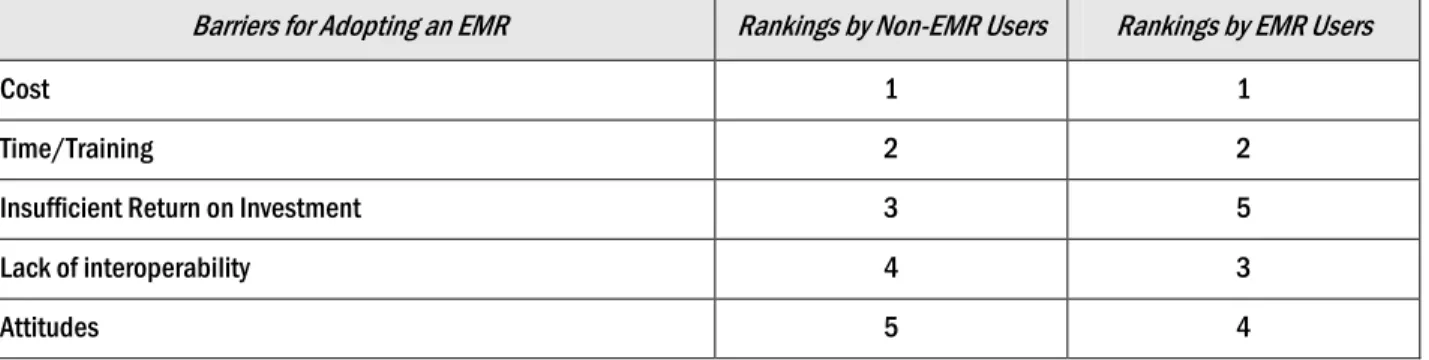
results in Table 12 show that the rankings of barriers are quite similar between users and non-users. One interesting exception is that users of EMRs rank “insufficient return on investment” last while non users rank it as third in importance. Although inferences from these data are still limited, the difference in ranking suggests that one element of an implementation strategy would be to ask current users of EMRs to share their experience with potential users.
Table 12. Barriers to Adoption of Electronic Medical Records by Non-EMR Users (N=6,467)
Barriers for Adopting an EMR Rankings by Non-EMR Users Rankings by EMR Users
Cost 1 1
Time/Training 2 2
Insufficient Return on Investment 3 5
Lack of interoperability 4 3
Attitudes 5 4
Source: AMB, ABOE Survey Data, July 17, 2007 - July 17, 2009. Note: 1=Most Important, 5=Least Important.
Attitudes towards Costs
Figure 4 displays the attitudes of physicians towards the costs of an EMR system. The responses indicate that physicians who use EMRs place a higher value on an EMR system than physicians who do not have an EMR. Alternatively, the EMR users may simply be better informed on the actual cost of an EMR system.
Figure 4. Perceived Reasonable Amount to Pay for an EMR System among Providers (N = 1,672)
Source: AMB, ABOE Survey Data, July 17, 2007 - July 17, 2009.
Note: 3,225 physicians without EMRs did not answer this question (missing). There were 1,570 missing responses of EMR users. Percentages reflect non-missing responses only.
58% 31% 11% 74% 21% 5% 0% 25% 50% 75% 100% $5,000 - $10,000 $10,000 - $20,000 > $20,000 Pe rc ent ag e of P hy sic ians
Amount (Per Provider) Current EMR Users Non-EMR Users
The majority of physicians did not express an opinion on a reasonable cost for an EMR system. Among those who responded, only 26% of non-EMR users said that $10,000 or more per physician was a reasonable amount to pay for an EMR. Among physicians who practice in an organization that utilizes EMRs, 42% believe that a reasonable price to pay for an EMR system would be over $10,000 per physician. This is similar to the percentage of physicians who said they would invest at least $10,000 per full-time physician (46%), according to the AHCCCS HIE/EHR Utility Project: Provider Focus Groups report, conducted from October through
December 2007 (AHCCCS, 2007).It may be that the physicians represented in the focus groups were more representative of EMR users.
Trust and Health Information Exchange
The adoption of an EMR system by a practice is not synonymous with participation in health information exchange (HIE). The results in Table 6 show that approximately 54% of the
physicians with access to EMRs report that they exchange information electronically with others. Survey respondents were also asked about their willingness to participate in a web based
exchange system and their level of trust with different potential managers of such a system. Less than half of the physicians (43.6%) would be willing to participate in a web based exchange system.
There is large variation in physicians’ level of trust in the types of organizations that might manage a health information exchange, with Commercial Vendor, Regional Health Information Organization and State of Arizona (AHCCCS) garnering similar levels of trust. The results, in
Table 13, show that hospital systems are the most trusted organization to manage an HIE and private health insurers are the least trusted. Beyond the substantial trust gap between hospitals and health insurers, the differences between hospital systems and most of the other alternatives are relatively small. When asked a similar question, physicians in the Provider Focus Groups report gave a different response, namely that Regional Health Information Organizations (RHIOs) and AHCCCS were more trustworthy entities than hospital systems (AHCCCS, 2007).
Table 13. Who Would You Trust to Manage the Health Information Exchange?
Type of Organization EMR Number & Percent N = 1,359 Non-EMR Number & Percent N = 1,381
Hospital System 591 43.5% 567 41.1%
Commercial Vendor 437 32.2% 490 35.5%
Regional Health Information Organization 542 39.9% 470 34.0%
State of Arizona (AHCCCS) 457 33.6% 431 31.2%
Other 217 16.0% 237 17.2%
Health Insurer/Managed Care Plan 161 11.8% 176 12.7%
Source: AMB, ABOE Survey Data, July 17, 2007 - July 17, 2009.
Note: Of the 6,777 survey respondents 3,957 did not answer this question). Percentages reflect non-missing responses only.
The Target Population
One of the important objectives of this report is to provide information on the size and nature of the population of Arizona physicians who do not use EMRs. The data presented to this point are good profiles of the characteristics of the non-EMR users. It remains to estimate the numbers of the physicians who represent the object of efforts to increase EMR utilization. The numbers are
estimated by applying the population weights (1.97 per respondent) to the numbers of survey respondents.
The distribution described in Table 14 can be viewed as a ranking of areas in terms of the likely yield per unit of effort for initiatives designed to broaden the spread of EMRs in the physician
community. The smaller the potential increase in terms of numbers of physicians per amount expended, the lower the priority for a project with a fixed budget. Some of the potentially low yield areas also are the areas where the costs of some interventions will be relatively high. If, for example, an initiative includes the provision of IT support services on an ongoing basis, counties such as Apache, Greenlee or La Paz offer small payoffs and relatively high costs in terms of travel time for support personnel.
Table 14. The Target Population of Physicians without EMRs by County
Location All Survey Respondents Survey Respondents: Non-EMR Users Population The Target
Apache 17 8 16 Cochise 76 43 85 Coconino 176 100 197 Gila 31 21 41 Graham 19 11 22 Greenlee 5 4 8 La Paz 9 6 12 Maricopa 4,371 2,500 4,925 Mohave 184 118 232 Navajo 68 36 71 Pima 1,376 771 1,519 Pinal 94 49 97 Santa Cruz 18 14 28 Yavapai 163 102 201 Yuma 135 99 195 Total 6,435 3,882 7,665
Source: AMB, ABOE Survey Data, July 17, 2007 – July 17, 2009.
Note: Table does not include fully retired physicians. Additionally, 342 respondents did not identify a method of storing medical records. The results also suggest consideration of different approaches to increase EMR utilization for different geographic areas. We know from our multivariate results, for example, that the rate of EMR use is, all else equal, at its lowest among older physicians. It seems equally likely that the required investments and the relatively short period for the return on investment will make their potential rates of adoption much lower than among younger physicians. The age and other criteria can be added to the definition of the target population to sharpen the focus of planned
interventions. The numbers of physicians that are described in Table 14 provide estimates of the target population that can be used as the baseline against which to compare the success of interventions designed to increase the use of EMRs.
Conclusion
The results show that paper records are the dominant method of storing medical records, whether as the sole medium of storage or in combination with EMRs or scanned files. EMR use is most
prevalent in government practice settings and least prevalent in private solo practices.
Approximately 45% of the physicians surveyed use some form of EMR in their practice. This comparatively high percentage is driven by the relatively large number of physicians in group practices and governmental organizations. High utilization rates also occur among academic physicians and medical school students, residents and fellows.
Additionally, we have found that older physicians (over age 45) in non-governmental practice environments, especially those in solo practices, have the lowest EMR use prevalence. As sole decision-makers, interventions that target solo practitioners may prove most fruitful, as well as initiatives aimed at the non-EMR user group practice community. Adoption efforts will need effective strategies to target these strata, as well as to identify the decision makers in a multiple physician practice. There are a total of 7,665 physicians in Arizona who do not have access to an EMR.
The physicians caring for Medicaid (AHCCCS) members have nearly identical characteristics, making Medicaid provider-targeted efforts meaningful and generalizable in Arizona as shown in previous section (Table 15-Table 26).
Efforts such as Arizona’s Medicaid Transformation Grant- funded group purchasing initiative known as the Purchasing & Assistance Collaborative for Electronic Health Records (PACeHR) are needed to address the barriers reported by both EMR and non-EMR providers such as providing training and lower implementation costs to expand the use of EMRs.
This section concludes the presentation of the primary results of the study. Our sponsor, AHCCCS, has a special interest in the examination of results specific to the physicians who treat the patients that AHCCCS insures. The next section of this report addresses that topic.
AHCCCS
VS.
N
ON-AHCCCS
P
ROVIDERSThe results in this section parallel those in the previous sections of this report. The only difference is that the results are divided to compare AHCCCS to Non-AHCCCS Providers.
Table 15. Comparison of Characteristics of AHCCCS Providers vs. Non- AHCCCS Providers
Characteristic AHCCCS Providers N = 5,682 Non-AHCCCS Provider N = 1,095 Sex (missing = 157 AHCCCS Providers and 60 Non-AHCCCS Providers)
Female 1,457 26.4% 334 32.3%
Male 4,068 73.6% 701 67.7%
Age Group (missing = 3 for AHCCCS)
25-34 288 5.1% 150 13.7%
35-44 1,604 28.2% 372 34.0%
45-54 1,759 31.0% 253 23.1%
55-64 1,369 24.1% 221 20.2%
65+ 659 11.6% 99 9.0%
Specialty (missing = 17 AHCCCS Providers and 3 Non-AHCCCS Providers)
Primary Care 2,481 43.8% 464 42.5%
Specialty Care 3,184 56.2% 628 57.5%
Location (missing = 0)
Maricopa County 3,661 64.4% 710 64.8%
Pima County 1,153 20.3% 223 20.4%
All Other Counties 868 15.3% 162 14.8%
Source: AMB, ABOA administrative data, March 2009. Note: Percentages are calculated on numbers of cases with non-missing values.
Table 15 compares the characteristics of survey respondents who are AHCCCS providers to those from Non-AHCCCS providers. Approximately fifty percent of Non-AHCCCS providers are below 45 years old, compared with 33% of AHCCCS providers. There are no significant differences between AHCCCS and Non-AHCCCS physicians in terms of specialty distribution and geographic distribution.
Table 16. AHCCCS Provider vs. Non- AHCCCS Provider by Type of Practice
Type of Practice AHCCCS Providers
N = 5,682 Non-AHCCCS Providers N = 1,095 Group Practice 2,796 49.2% 407 37.1% Solo Practice 1,341 23.6% 169 15.4% Academic Teaching/Research 328 5.8% 78 7.1%
Community Health Center 277 4.9% 55 5.0%
Hospitalist 276 4.9% 44 4.0%
Government Health Organization (VA, Indian Health
Service, etc.) 221 3.9% 149 13.6% Semi-Retired 195 3.4% 54 4.9% Administrative Medicine 94 1.6% 44 4.0% Medical School/Resident/Fellow 69 1.2% 73 6.7% Locum Tenens 11 0.2% 4 0.4% Missing 74 1.3% 18 1.6% Total 5,682 100.0% 1,095 100.0%
Source: AMB, ABOE survey data, July 17, 2007 - July 17, 2009.
Table 16 shows that approximately 50% of AHCCCS providers are in group practices compared to 37% of Non-AHCCCS providers. Solo practice is the second largest group for both
Communications and Medical Records
Table 17. Methods of Communication Available*, AHCCCS vs. Non-AHCCCS Providers
Method AHCCCS Providers Number and % Yes N = 5,618 Non-AHCCCS Providers Number and % Yes N = 1,081
Email 4,593 81.8% 937 86.7%
Internet 4,764 84.8% 938 86.8%
Fax 5,271 93.8% 1002 92.7%
Medifax 466 8.3% 70 6.5%
None of the Above 80 1.4% 16 1.5%
Source: AMB, ABOE Survey Data, July 17, 2007-July 17, 2009. Note: *Categories are not mutually exclusive. 64 AHCCCS and 14 Non-AHCCCS Providers did not respond to this question.
Table 17 shows that approximately one-fifth of AHCCCS providers have neither email nor the internet in their practices compared to one-seventh of Non-AHCCCS providers. The results in Table 18 describe the methods used for billing by physicians. More AHCCCS providers used postal mail (38% vs. 29%) or the internet (38% vs. 24%) than Non-AHCCCS providers.
Table 18. Profile of Methods of Billing*, AHCCCS vs. Non-AHCCCS Providers
Method AHCCCS Providers Number and % Yes (N = 5,682) Non-AHCCCS Providers Number and % Yes (N = 1,095)
Fax 406 7.1% 68 6.2%
Email 277 4.9% 49 4.5%
Internet 2,177 38.3% 260 23.7%
Mail 2.145 37.8% 318 29.0%
Don't know 2.062 36.3% 482 44.0%
Billing not applicable to practice type 131 2.3% 54 4.9%
Source: AMB, ABOE Survey Data, July 17, 2007-July 17, 2009. Note: *Categories are not mutually exclusive.
Table 19 shows that AHCCCS providers (47%) are more likely to only use paper files to store medical records than Non-AHCCCS providers (40%). Approximately 44% of AHCCCS providers are in practices that use EMRs, comparing to 50% of Non-AHCCCS providers.
Table 19. Methods of Storing Medical Records, AHCCCS vs. Non-AHCCCS Providers
Method AHCCCS Providers Number and % Yes N = 5,360 Non-AHCCCS Providers Number and % Yes N = 1,027
Paper Files Only 2,502 46.7% 409 39.8%
EMR Only 704 13.1% 155 15.1%
Scanned Images Only 175 3.3% 30 2.9%
Paper + Scanned Images Only 318 5.9% 75 7.3%
EMR + Paper Only 397 7.4% 87 8.5%
EMR + Scanned Images Only 611 11.4% 131 12.8%
Paper + Scanned Images + EMR 653 12.2% 140 13.6%
EMR alone or in combination* 2,365 44.1% 513 50.0%
Source: AMB, ABOE Survey Data, July 17, 2007 - July 17, 2009. Note: 322 AHCCCS Providers and 68 Non-AHCCCS Providers did not identify a method of storing medical records (missing).
*Data on “EMR alone or in combination” is not mutually exclusive from other categories.
Table 20. Methods of Transmitting Medical Records, AHCCCS vs. Non-AHCCCS Providers
Method AHCCCS Providers Number with EMR AHCCCS Providers % With EMR Providers Number Non-AHCCCS
with EMR
Non-AHCCCS Providers % with
EMR
Electronic File 2,365 100.0% 513 100.0%
Electronic and Connected EMR System 1,262 53.4% 296 57.7%
Connected to Hospital* 872 36.9% 215 41.9%
Connected to Pharmacy* 708 29.9% 190 37.0%
Connected to Lab* 958 40.5% 235 45.8%
Connected to Radiology* 710 30.0% 186 36.3%
“Fully Functional” EMR* 467 19.7% 134 26.1%
Source: AMB, ABOE Survey Data, July 17, 2007 - July 17, 2009. Note:*% based on all survey respondents. *These percentages are not mutually exclusive. A “fully functional” EMR is one that can exchange
information with each of these segments of the health care system: hospital, pharmacy, lab and radiology.
Table 20 and Figure 5 describe the distribution of methods of transmitting medical records among physicians for AHCCCS providers and AHCCCS providers. Overall,
Non-AHCCCS providers (26%) are also more likely to use fully functional EMRs than
AHCCCS providers (20%).
Figure 5. Distribution of Methods of Transmitting Medical Records, AHCCCS vs. Non-AHCCCS Providers
Source: AMB, ABOE Survey Data, July 17, 2007 - July 17, 2009.
Table 21. On-site vs. Off-site Storage of EMRs, AHCCCS vs. Non-AHCCCS Providers (N=2,293)
Storage AHCCCS Providers with EMR Number and % Yes Non-AHCCCS Providers with EMR Number and % Yes
PC/server located in your organization 958 51.7% 198 48.3%
Server to which you connect via the internet 448 24.2% 107 26.1%
Don’t know 447 24.1% 105 25.6%
Total 1,853 100.0% 410 100.0%
Source: AMB, ABOE Survey Data, July 17, 2007 - July 17, 2009. Note: 482 AHCCCS Providers and 103 Non-AHCCCS Providers with EMRs did not respond (missing).
The results in Table 21 show that there is no significant difference between AHCCCS and Non-AHCCCS providers in whether EMRs are stored in their practices or on a remote server. As indicated in Table 22, the highest utilization of EMRs occurs in group practice for both AHCCCS and Non-AHCCCS providers. AHCCCS providers in group practice are more likely to have an EMR (51%) and have an EMR with exchange (48%), than Non-AHCCCS providers who have an EMR (36%) and or an EMR with exchange (31%). However, Non-AHCCCS providers in government settings have higher utilization of EMRs (22%) and EMRs with
44% 23% 18% 14% 19% 14% 9% 50% 29% 22% 19% 24% 19% 13% 0% 25% 50% 75%
Electronic File Connected EMR
System Connected to EMR System Hospital EMR System Connected to Pharmacy EMR System Connected to Lab EMR System Connected to Radiology Fully Functional EMR
Table 22. EMR Utilization by Type of Practice, AHCCCS vs. Non-AHCCCS Providers
Type of Practice Providers with AHCCCS
EMR AHCCCS Providers with EMR with Exchange * Non-AHCCCS Providers with EMR Non-AHCCCS Providers with EMR with Exchange * Semi-Retired 60 30 14 5 2.6% 2.4% 2.8% 1.7% Medical School/Resident/Fellow 48 36 51 36 2.0% 2.9% 10.0% 12.2%
Community Health Center 90 41 14 8
3.8% 3.3% 2.8% 2.7% Group Practice 1,205 607 181 92 51.4% 48.4% 35.6% 31.3% Solo Practice 329 111 49 16 14.0% 8.9% 9.6% 5.4% Hospitalist 131 94 18 15 5.6% 7.5% 3.5% 5.1%
Government Health Organization (VA, Indian Health Service, etc.) 163 121 112 78 7.0% 9.7% 22.0% 26.5% Administrative Medicine 45 22 16 6 1.9% 1.8% 3.1% 2.0% Academic Teaching/Research 179 129 30 21 7.6% 10.3% 5.9% 7.1% Locum Tenens 95 62 24 17 4.1% 4.9% 4.7% 5.8% Total 2,345 1,253 509 294 100.0% 100.0% 100.0% 100.0%
Source: AMB, ABOE Survey Data, July 17, 2007 – July 17, 2009.
Note: 20 AHCCCS Providers and 4 Non-AHCCCS Providers with EMRs did not respond 9 AHCCCS Providers and 2 Non-AHCCCS Providers with EMR Exchange did not respond (missing).
* Provider with EMR with exchange means the provider’s EMR system is connected to facilities including Hospital, Pharmacy, Lab, and Radiology.
Table 23. Distribution of EMR Utilization by County, AHCCCS vs. Non-AHCCCS Providers Location AHCCCS Providers N = 5,682 AHCCCS Providers & EMR Users Percent of EMR Users among AHCCCS Providers Non-AHCCCS Providers N = 1,095 Non-AHCCCS Providers & EMR Users Percent of EMR Users among Non-AHCCCS Providers Apache 15 8 53.3% 2 1 50.0% Cochise 65 30 46.2% 11 3 27.3% Coconino 148 67 45.3% 28 9 32.1% Gila 29 8 27.6% 2 2 100.0% Graham 18 8 44.4% 1 0 0.0% Greenlee 4 1 25.0% 1 0 0.0% La Paz 6 3 50.0% 3 0 0.0% Maricopa 3,661 1,531 41.8% 710 340 47.9% Mohave 161 59 36.6% 23 7 30.4% Navajo 59 27 45.8% 9 5 55.6% Pima 1,153 498 43.2% 223 107 48.0% Pinal 74 35 47.3% 20 10 50.0%
Santa Cruz 18 4 22.2% 0 0 N/A
Yavapai 140 48 34.3% 23 13 56.5%
Yuma 111 29 26.1% 24 7 29.1%
Unknown County 5 2 40.0% 4 2 50.0%
Missing 15 7 46.7% 11 7 63.6%
Total 5,682 2,365 41.6% 1,095 513 46.8%
Source: AMB, ABOE Survey Data, July 17, 2007 – July 17, 2009. Note: Table does not include fully retired physicians. Additionally, 250 AHCCCS respondents and 60 Non-AHCCCS respondents did not identify
a method of storing medical records (missing).
Table 23 shows the distribution of EMR users by county. The rate of EMR utilization among Non-AHCCCS providers is slightly higher in the two most urban counties: Maricopa (48% vs. 42%), and Pima (48% vs. 43%).
Physician Characteristics Associated with EMR Use
The Decision to Implement an EMR
The data in Table 24 suggest that more than two-thirds of either AHCCCS or Non-AHCCCS providers were not or would not be the individual that decides or decided to implement an EMR. Among Non-EMR users, AHCCCS providers (58%) are slightly more likely to be decision makers than Non-AHCCCS providers (45%).
Table 24. Who Decided/Would Decide to Purchase an EMR System? AHCCCS vs. Non-AHCCCS Providers
Decision maker for potential purchase Providers AHCCCS
Number and % of EMR Users AHCCCS Providers Numbers and % of Non-EMR Users Non-AHCCCS Providers Number and % of EMR Users Non-AHCCCS Providers Numbers and % of non-EMR Users Respondent was/would be decision maker 189 (10.5%) 773 (27.8%) 25 (6.3%) 102 (21.2%)
Shared decision 343 (19.1%) 837 (30.0%) 52 (13.1%) 113 (23.4%)
Decided by others 1,263 (70.4%) 1,177 (42.2%) 320 (80.6%) 267 (55.4%)
Total 1,795 (100.0%) 2,787 (100.0%) 397 (100.0%) 482 (100.0%)
Source: AMB, ABOE Survey Data, July 17, 2007 - July 17, 2009. Note: There were 570 AHCCCS Providers and 116 Non-AHCCCS Providers missing responses among EMR users and 280 AHCCCS Providers
and 40 Non-AHCCCS Providers missing responses among Non-EMR users.
Table 25. Barriers to Adoption of Electronic Medical Records by Non-EMR Users, AHCCCS vs. Non-AHCCCS Providers
Barriers for adopting an EMR AHCCCS providers Rankings by
EMR Users Rankings by AHCCCS providers Non-EMR Users Rankings by Non-AHCCCS providers EMR Users Rankings by Non-AHCCCS providers Non-EMR Users Attitudes 4 5 5 5 Cost 1 1 1 1
Insufficient Return on Investment 5 3 3 3
Lack of interoperability 3 4 4 4
Time/Training 2 2 2 2
Source: AMB, ABOE Survey Data, July 17, 2007 - July 17, 2009.
The results in Table 25 show that the rankings of barriers are quite similar between users and non-users for both AHCCCS and Non-AHCCCS providers. Cost is considered as the number one barrier for adopting EMRs, followed by concerns for time and training.
Attitudes towards Costs
Figure 6. Perceived Reasonable Cost per Physician for an EMR System, AHCCCS vs. Non-AHCCCS Providers
Source: AMB, ABOE Survey Data, July 17, 2007 - July 17, 2009. Note: 1,276 AHCCCS Providers and 294 Non-AHCCCS Providers with EMRs did not answer this question. 2,757 AHCCCS Providers and 468 Non-AHCCCS Providers who do not use EMR did not answer this question (missing). Percentages reflect non-missing responses only.
Figure 6 compares the per physician costs of EMRs that are perceived to be reasonable by EMR users and Non-EMR users for AHCCCS and Non-AHCCCS providers. In general, the non-EMR uses set a lower limit on reasonable costs than do the users whether they are AHCCCS or non-AHCCCS providers. The results are uncertain, however, because there were a relatively large number of physicians who did not answer this question.
Trust and Health Information Exchange
Table 26. Who Would You Trust to Manage the Health information Exchange? AHCCCS vs. Non-AHCCCS Providers
Type of Organization AHCCCS Providers Number and % of EMR Users N = 1,107 AHCCCS Providers Number and % of Non-EMR Users N = 1,188 Non-AHCCCS Providers Number and % of EMR Users N = 252 Non-AHCCCS Providers Number and % of non-EMR Users N = 193 Hospital System 484 (43.7%) 482 (40.6%) 107 (42.5%) 85 (44.0%) Commercial Vendor 366 (33.1%) 429 (36.1%) 71 (28.2%) 61 (31.6%)
Regional Health Information Organization 444 (40.1%) 408 (34.3%) 98 (38.9%) 62 (32.1%)
State of Arizona (AHCCCS) 355 (32.1%) 360 (30.3%) 102 (40.5%) 71 (36.8%)
Health Insurer/Managed Care Plan 132 (11.9%) 159 (13.4%) 29 (11.5%) 17 (8.8%)
Other 177 (16.0%) 213 (17.9%) 40 (15.9%) 24 (12.4%) 57% 31% 12% 74% 22% 5% 61% 29% 10% 74% 17% 9% 0% 10% 20% 30% 40% 50% 60% 70% 80% $5,000-$10,000 $10,000 - $20,000 >$20,000
AHCCCS Providers: EMR Users (N =1,089 ) AHCCCS Providers: Non-EMR Users (N =310 ) Non-AHCCCS Providers: EMR Users (N =219 ) Non-AHCCCS Providers: Non-EMR Users (N =54 )
Table 26 describes the levels of physician’s trust in different organizations that would be candidates for the management of a health information exchange. The rankings are similar for both AHCCCS and non-AHCCCS physicians except that Non-AHCCCS providers are slightly more likely to trust AHCCCS, and AHCCCS providers prefer a Regional Health Information Organization.
References
Arizona Health Care Cost Containment System. AHCCCS HIE/EHR Utility Project: Provider Focus Groups. Phoenix: s.n., 2007.
Bates DW. Physicians and ambulatory electronic health records, Health Affairs, 2005, Vol. 24, No.5, pp.1180-9.
Blumenthal D, DesRoches C, Donelan K, et al. Health information technology in the United States: the information base for progress. Princeton, NJ: Robert Wood Johnson Foundation, 2006. Chaudhry B, Wang J, Wu S, et al. Systematic review: impact of health information technology on
quality, efficiency, and costs of medical care. Ann Intern Med, 2006;144:742-752. DesRoches CM, Campbell EG, Rao SR, et al. Electronic health records in ambulatory care -- a
national survey of physicians. N Engl J Med, 2008;359:50-60. DesRoches, Dr. Catherine. personal communication. December 2008.
Hing ES, Burt CW, Woodwell DA. Electronic Medical Record Use by Office-based Physicians and their Practices: United States, 2006. s.l. : U.S. Department of Health and Human Services, Centers for Disease Control and Prevention, 2007.
Health Resources and Services Administration (HRSA), National County-level Health Resrouce Information Database, Area Resource File, 2007.
Hsaio C, Burt CW, Rechtsteiner E, et al. Preliminary Estimates of Electronic Medical Record Use by Office-based Physicians: United States, 2008. s.l. : National Center for Health Statistics: Health E Stat, 2008.
Jha AK, Ferris TG, et al. How common are electronic health records in the United States? A summary of the evidence. Health Affairs, 2006, Vol. 25, 6, pp. w496-w507.
Jha AK, DesRoches CM, Campbell EG, et al. Use of electronic health records in U.S. hospitals. N Engl J Med, 2009;361(4):421-2.
Sequist TD, Cullen T, et al. Implementation and use of an electronic health record within the Indian Health Service. J Am Med Inform Assoc, 2007;14:191-197.
Simon SR, Kaushal R, Cleary PD, et al. Correlates of electronic health record adoption in office practices: A statewide survey. J Am Med Inform Assoc, 2007;14:110 –7.
Appendix A: Comparison to National Surveys
The results of a national survey of EMR use and attitudes toward the adoption of EMRs by physicians with AMA memberships were published on July 3, 2008 (DesRoches et al., 2008; Jha et al., 2009). The results cannot be strictly compared to the results reported here because of differences in the structure of the sample and some differences in methods. The sample design does not, for example, provide estimates for Arizona and is limited to members of the AMA. The ASU study queries all physicians who renew their Arizona licenses. The practice began in 1992 and with a few interruptions has continued. The data are not, therefore, a sample but rather a census of all physicians. Some characteristics, drawn from the information required for
licensing, are obtained for all physicians while the survey questions are voluntary and obtained from those physicians who choose to respond. Fully retired physicians were not asked to respond to the survey questions.
The national survey results are restricted to non-federal, allopathic physicians directly involved in patient care who are members of the American Medical Association. Doctors of Osteopathy were excluded. Other exclusions included physicians working in federally owned hospitals, those who requested not to be contacted; radiologists; anesthesiologists; pathologists; psychiatrists; no known address; medical school students and physicians not providing patient care.
The NCHS released the preliminary results of a mail survey of a national sample of office based physicians in December 2008. The survey, conducted from April through August 2008 shows that 38.4% of physicians used full or partial EMR systems in their office based practices. Approximately 20.4% of the physicians used systems that included orders for prescriptions, orders for tests, results of lab or imaging tests and clinical notes (Hsaio et al., 2008). As indicated in Appendix Table 1, our results are much closer to the NCHS study than the NEJM study. The difference between the two national studies is surprisingly large give the apparent similarities in sample design.
Appendix A
: Continue
Study Data Source Sample
Size Characteristics of Sample, Exclusions Percent of Physician
s with EMR* Definition of basic EMR Definition of
connected EMR Definition of fully
functional EMR Hing et al. (2007) 2006 National Ambulatory Medical Care Survey
1,311 Sample consists of non-federal, office-based
physicians who see patients in an office setting.
29.2% (B)
12.4% (F) Use of full or partial electronic records NA Can electronically order prescriptions & tests, report results to lab or radiology; manage clinical notes DesRoches
et al. (2008) Survey created by the study team and Research Triangle Institute
2,758 Sample consists of US physicians who provide direct patient care. Exclusions: D.O.s, residents, physicians in federally owned hospitals, retired physicians, radiologists, anesthesiologists, pathologists, psychiatrists, hospitalists, part-time, physicians who worked < 20 hour per week.
13% (C)
4% (F) NA EMR can store demographic data, problem lists, medication lists, and clinical notes; can order prescriptions; can view laboratory results and imaging results. (Study authors refer to this type of record as a “basic EMR”) All capabilities listed in previous column, plus enhanced order-entry management and clinical-decision support AHCCCS/
CHIR (2009) Survey created by study team and Arizona Hospital and Health Care Association; Licensing data from Arizona Medical Board and Arizona Board of Osteopathic Examiners
6,777 This sample includes Arizona-based physicians who provide direct patient care and exclude the following: DOs, residents, retired/semi-retired, physicians in government settings, radiologists, anesthesiologists, pathologists, psychiatrists, hospitalists. Specialty exclusions were for Primary Specialty. 40.8% (B) 19.9% (C) 6.1% (F) Use of electronic files as method of storing medical records
EMR that is connected to at least one of the following: hospital, radiology, lab, pharmacy EMR that is connected to all of the following: radiology, lab, pharmacy
Sample consists of all Arizona physicians with active licenses who renewed their license between July 17, 2007 and July 17, 2009. Exclusions: non-Arizona physicians, fully retired
44.5% (B) 24.1% (C) 9.3% (F)