Government of Canada
Managed Security
Services
(GC
MSS
)
A
ppendix D
: Security Control Catalogue
ITSG-33 - Annex 3 DRAFT 3.1
Information Technology
Security Guidance
Guide to Managing Security Risk
from Using Information Systems
Security Control Catalogue
ITSG-33 – Annex 3
DRAFT 3.1
DRAFT 3.1 24 September 2010 ii This page intentionally left blank.
DRAFT 3.1 24 September 2010 iii
Foreword
Annex 3 to a Guide to Managing Security Risk from Information Systems (ITSG-33) is an unclassified publication issued under the authority of the Chief, Communications Security Establishment Canada (CSEC).
Suggestions for amendments should be forwarded through departmental communications security channels to your Client Services Representative at CSEC.
Requests for additional copies or changes in distribution should be directed to your Client Services Representative at CSEC.
For further information, please contact CSEC’s ITS Client Services area by e-mail at [email protected].
Effective Date
This publication takes effect on MONTH 2010.
____________________________________________________ Colleen D’Iorio
DRAFT 3.1 24 September 2010 iv
Executive Summary
This publication is part of the security assessment and authorization framework published by the Communications Security Establishment Canada (CSEC) under Information Technology Security Guidance Publication 33 (ITSG-33), Guide to Managing Security Risk from Information Systems. It contains definitions of security controls that security practitioners can use as a foundation for selecting security controls for the protection of Government of Canada (GC) information systems.
This publication provides security control definitions that can be selected for the protection of GC information systems of very low to very high sensitivity and criticality operating in unclassified, protected, and classified domains. It can assist security practitioners during the information security implementation process when selecting security controls for specific information systems. The catalogue can also serve as the basis for developing protection profiles for specific types of information systems or specific communities of users.
There are three general classes of security controls defined within the catalogue: technical, operational, and management. Within the scope of this document, security controls are used exclusively for the protection of information and information systems.
This publication was developed giving due consideration to the GC legislative and policy framework in place at the time of publication, especially the Policy on Governement Security [Reference 1]. Where any discrepancy or conflict arises between GC legislation and Treasury Board of Canada Secretariat (TBS) policies, directives, and standards and the security controls defined herein, GC legislation and TBS policies, directives, and standards remain authoritative.
Annex 2 to this publication, which describes a recommended information security implementation process, provides guidance on how to use this catalogue to select security controls and control enhancements for information systems. See Section 1.4 for a list of related publications.
This catalogue is essentially the same as the catalogue published by the U.S. National Institute of Standards and Technology (NIST) in Special Publication 800-53 Revision 3, Recommended Security Controls for Federal Information Systems and Organizations [Reference 2], including updates as of 05-01-2010. Security control definitions have been modified slightly to adapt them to the GC context. Also, well identified new security controls have been added to align the catalogue with CSEC’s development framework for enterprise security architecture (ESA) guidelines.
DRAFT 3.1 24 September 2010 v
Revision History
Document No. Changes
DRAFT 3.1 New enhancements added: IA-2 (100), AC-17 (100).
DRAFT 3.1 24 September 2010 vi
Table of Contents
Foreword... iii
Effective Date ... iii
Executive Summary ... iv
Revision History ... v
Table of Contents ... vi
List of Tables ... xii
List of Figures ... xii
List of Abbreviations and Acronyms... xii
1.
Introduction ... 1
1.1 Purpose ...1
1.2 Scope and Applicability ...1
1.3 Audience ...2
1.4 Related Publications...2
1.5 Publication Structure ...2
2.
Publication Organization ... 3
2.1 Security Control Catalogue ...3
2.2 Classes...4
2.3 Families ...4
2.4 Security Controls ...6
2.5 How to Use the Catalogue ...7
2.6 Priority Codes...8
3.
Information Security Programs... 14
PM-1 INFORMATION SECURITY PROGRAM PLAN ... 15
PM-2 SENIOR INFORMATION SECURITY OFFICER ... 16
PM-3 INFORMATION SECURITY RESOURCES ... 16
PM-4 PLAN OF ACTION AND MILESTONES PROCESS ... 16
PM-5 INFORMATION SYSTEM INVENTORY ... 17
PM-6 INFORMATION SECURITY MEASURES OF PERFORMANCE... 17
PM-7 ENTERPRISE ARCHITECTURE ... 18
PM-8 CRITICAL INFRASTRUCTURE PLAN... 18
PM-9 RISK MANAGEMENT STRATEGY... 18
PM-10 SECURITY AUTHORIZATION PROCESS ... 19
PM-11 MISSION/BUSINESS PROCESS DEFINITION ... 19
4.
Security Control Definitions... 21
4.1 FAMILY: ACCESS CONTROL ...22
AC-1 ACCESS CONTROL POLICY AND PROCEDURES ... 22
AC-2 ACCOUNT MANAGEMENT... 22
DRAFT 3.1 24 September 2010 vii
AC-4 INFORMATION FLOW ENFORCEMENT... 25
AC-5 SEPARATION OF DUTIES ... 27
AC-6 LEAST PRIVILEGE ... 28
AC-7 UNSUCCESSFUL LOGIN ATTEMPTS ... 29
AC-8 SYSTEM USE NOTIFICATION... 29
AC-9 PREVIOUS LOGON (ACCESS) NOTIFICATION ... 30
AC-10 CONCURRENT SESSION CONTROL ... 30
AC-11 SESSION LOCK... 31
AC-12 SESSION TERMINATION... 31
AC-13 SUPERVISION AND REVIEW — ACCESS CONTROL... 31
AC-14 PERMITTED ACTIONS WITHOUT IDENTIFICATION OR AUTHENTICATION... 31
AC-15 AUTOMATED MARKING ... 32
AC-16 SECURITY ATTRIBUTES... 32
AC-17 REMOTE ACCESS ... 33
AC-18 WIRELESS ACCESS ... 34
AC-19 ACCESS CONTROL FOR MOBILE DEVICES... 35
AC-20 USE OF EXTERNAL INFORMATION SYSTEMS ... 37
AC-21 USER-BASED COLLABORATION AND INFORMATION SHARING... 38
AC-22 PUBLICLY ACCESSIBLE CONTENT... 38
4.2 FAMILY: AWARENESS AND TRAINING...40
AT-1 SECURITY AWARENESS AND TRAINING POLICY AND PROCEDURES ... 40
AT-2 SECURITY AWARENESS... 40
AT-3 SECURITY TRAINING ... 41
AT-4 SECURITY TRAINING RECORDS ... 41
AT-5 CONTACTS WITH SECURITY GROUPS AND ASSOCIATIONS ... 42
4.3 FAMILY: AUDIT AND ACCOUNTABILITY...43
AU-1 AUDIT AND ACCOUNTABILITY POLICY AND PROCEDURES ... 43
AU-2 AUDITABLE EVENTS ... 43
AU-3 CONTENT OF AUDIT RECORDS ... 44
AU-4 AUDIT STORAGE CAPACITY ... 45
AU-5 RESPONSE TO AUDIT PROCESSING FAILURES... 45
AU-6 AUDIT REVIEW, ANALYSIS, AND REPORTING ... 45
AU-7 AUDIT REDUCTION AND REPORT GENERATION ... 46
AU-8 TIME STAMPS ... 47
AU-9 PROTECTION OF AUDIT INFORMATION... 47
AU-10 NON-REPUDIATION... 48
AU-11 AUDIT RECORD RETENTION ... 49
AU-12 AUDIT GENERATION... 49
AU-13 MONITORING FOR INFORMATION DISCLOSURE ... 50
AU-14 SESSION AUDIT... 50
4.4 FAMILY: SECURITY ASSESSMENT AND AUTHORIZATION...51
CA-1 SECURITY ASSESSMENT AND AUTHORIZATION POLICIES AND PROCEDURES51 CA-2 SECURITY ASSESSMENTS ... 51
CA-3 INFORMATION SYSTEM CONNECTIONS... 53
CA-4 SECURITY CERTIFICATION ... 54
CA-5 SAFEGUARDS IMPLEMENTATION PLAN (PLAN OF ACTION AND MILESTONES) 54 CA-6 SECURITY AUTHORIZATION... 55
CA-7 CONTINUOUS MONITORING... 55
4.5 FAMILY: CONFIGURATION MANAGEMENT ...57
DRAFT 3.1 24 September 2010 viii
CM-2 BASELINE CONFIGURATION ... 57
CM-3 CONFIGURATION CHANGE CONTROL ... 58
CM-4 SECURITY IMPACT ANALYSIS ... 59
CM-5 ACCESS RESTRICTIONS FOR CHANGE ... 60
CM-6 CONFIGURATION SETTINGS ... 61
CM-7 LEAST FUNCTIONALITY... 62
CM-8 INFORMATION SYSTEM COMPONENT INVENTORY ... 63
CM-9 CONFIGURATION MANAGEMENT PLAN ... 64
4.6 FAMILY: CONTINGENCY PLANNING ...65
CP-1 CONTINGENCY PLANNING POLICY AND PROCEDURES... 65
CP-2 CONTINGENCY PLAN ... 65
CP-3 CONTINGENCY TRAINING... 67
CP-4 CONTINGENCY PLAN TESTING AND EXERCISES ... 67
CP-5 CONTINGENCY PLAN UPDATE... 68
CP-6 ALTERNATE STORAGE SITE ... 68
CP-7 ALTERNATE PROCESSING SITE ... 68
CP-8 TELECOMMUNICATIONS SERVICES ... 69
CP-9 INFORMATION SYSTEM BACKUP ... 69
CP-10 INFORMATION SYSTEM RECOVERY AND RECONSTITUTION ... 70
4.7 FAMILY: IDENTIFICATION AND AUTHENTICATION...72
IA-1 IDENTIFICATION AND AUTHENTICATION POLICY AND PROCEDURES ... 72
IA-2 IDENTIFICATION AND AUTHENTICATION (ORGANIZATIONAL USERS) ... 72
IA-3 DEVICE IDENTIFICATION AND AUTHENTICATION ... 74
IA-4 IDENTIFIER MANAGEMENT ... 74
IA-5 AUTHENTICATOR MANAGEMENT ... 75
IA-6 AUTHENTICATOR FEEDBACK ... 77
IA-7 CRYPTOGRAPHIC MODULE AUTHENTICATION ... 78
IA-8 IDENTIFICATION AND AUTHENTICATION (NON-ORGANIZATIONAL USERS)... 78
4.8 FAMILY: INCIDENT RESPONSE ...79
IR-1 INCIDENT RESPONSE POLICY AND PROCEDURES ... 79
IR-2 INCIDENT RESPONSE TRAINING ... 79
IR-3 INCIDENT RESPONSE TESTING AND EXERCISES... 80
IR-4 INCIDENT HANDLING ... 80
IR-5 INCIDENT MONITORING ... 81
IR-6 INCIDENT REPORTING ... 81
IR-7 INCIDENT RESPONSE ASSISTANCE... 82
IR-8 INCIDENT RESPONSE PLAN ... 82
4.9 FAMILY: MAINTENANCE ...84
MA-1 SYSTEM MAINTENANCE POLICY AND PROCEDURES ... 84
MA-2 CONTROLLED MAINTENANCE ... 84
MA-3 MAINTENANCE TOOLS... 85
MA-4 NON-LOCAL MAINTENANCE... 86
MA-5 MAINTENANCE PERSONNEL ... 87
MA-6 TIMELY MAINTENANCE... 88
4.10 FAMILY: MEDIA PROTECTION ...89
MP-1 MEDIA PROTECTION POLICY AND PROCEDURES ... 89
MP-2 MEDIA ACCESS... 89
MP-3 MEDIA MARKING... 90
MP-4 MEDIA STORAGE ... 91
DRAFT 3.1 24 September 2010 ix
MP-6 MEDIA SANITIZATION... 93
4.11 FAMILY: PHYSICAL AND ENVIRONMENTAL PROTECTION ...94
PE-1 PHYSICAL AND ENVIRONMENTAL PROTECTION POLICY AND PROCEDURES... 94
PE-2 PHYSICAL ACCESS AUTHORIZATIONS ... 94
PE-3 PHYSICAL ACCESS CONTROL ... 95
PE-4 ACCESS CONTROL FOR TRANSMISSION MEDIUM ... 97
PE-5 ACCESS CONTROL FOR OUTPUT DEVICES... 97
PE-6 MONITORING PHYSICAL ACCESS ... 97
PE-7 VISITOR CONTROL... 98
PE-8 ACCESS RECORDS... 98
PE-9 POWER EQUIPMENT AND POWER CABLING ... 99
PE-10 EMERGENCY SHUTOFF ... 99
PE-11 EMERGENCY POWER... 99
PE-12 EMERGENCY LIGHTING ... 100
PE-13 FIRE PROTECTION... 100
PE-14 TEMPERATURE AND HUMIDITY CONTROLS ... 101
PE-15 WATER DAMAGE PROTECTION ... 101
PE-16 DELIVERY AND REMOVAL ... 102
PE-17 ALTERNATE WORK SITE ... 102
PE-18 LOCATION OF INFORMATION SYSTEM COMPONENTS ... 102
PE-19 INFORMATION LEAKAGE ... 103
4.12 FAMILY: PLANNING ...104
PL-1 SECURITY PLANNING POLICY AND PROCEDURES... 104
PL-2 SYSTEM SECURITY PLAN ... 104
PL-3 SYSTEM SECURITY PLAN UPDATE... 105
PL-4 RULES OF BEHAVIOUR... 106
PL-5 PRIVACY IMPACT ASSESSMENT... 106
PL-6 SECURITY-RELATED ACTIVITY PLANNING ... 106
4.13 FAMILY: PERSONNEL SECURITY ...108
PS-1 PERSONNEL SECURITY POLICY AND PROCEDURES... 108
PS-2 POSITION CATEGORIZATION ... 108
PS-3 PERSONNEL SCREENING ... 109
PS-4 PERSONNEL TERMINATION ... 109
PS-5 PERSONNEL TRANSFER ... 110
PS-6 ACCESS AGREEMENTS... 110
PS-7 THIRD-PARTY PERSONNEL SECURITY... 111
PS-8 PERSONNEL SANCTIONS ... 112
4.14 FAMILY: RISK ASSESSMENT ...113
RA-1 RISK ASSESSMENT POLICY AND PROCEDURES... 113
RA-2 SECURITY CATEGORIZATION ... 113
RA-3 RISK ASSESSMENT ... 114
RA-4 RISK ASSESSMENT UPDATE... 115
RA-5 VULNERABILITY SCANNING ... 115
4.15 FAMILY: SYSTEM AND SERVICES ACQUISITION ...117
SA-1 SYSTEM AND SERVICES ACQUISITION POLICY AND PROCEDURES... 117
SA-2 ALLOCATION OF RESOURCES... 117
SA-3 LIFE CYCLE SUPPORT... 118
SA-4 ACQUISITIONS... 118
SA-5 INFORMATION SYSTEM DOCUMENTATION... 119
DRAFT 3.1 24 September 2010 x
SA-7 USER-INSTALLED SOFTWARE ... 121
SA-8 SECURITY ENGINEERING PRINCIPLES... 121
SA-9 EXTERNAL INFORMATION SYSTEM SERVICES ... 122
SA-10 DEVELOPER CONFIGURATION MANAGEMENT ... 123
SA-11 DEVELOPER SECURITY TESTING... 123
SA-12 SUPPLY CHAIN PROTECTION ... 124
SA-13 ROBUSTNESS (TRUSTWORTHINESS)... 125
SA-14 CRITICAL INFORMATION SYSTEM COMPONENTS ... 125
4.16 FAMILY: SYSTEM AND COMMUNICATIONS PROTECTION ...127
SC-1 SYSTEM AND COMMUNICATIONS PROTECTION POLICY AND PROCEDURES . 127 SC-2 APPLICATION PARTITIONING... 127
SC-3 SECURITY FUNCTION ISOLATION ... 128
SC-4 INFORMATION IN SHARED RESOURCES... 128
SC-5 DENIAL OF SERVICE PROTECTION... 129
SC-6 RESOURCE PRIORITY ... 129
SC-7 BOUNDARY PROTECTION ... 130
SC-8 TRANSMISSION INTEGRITY... 132
SC-9 TRANSMISSION CONFIDENTIALITY... 133
SC-10 NETWORK DISCONNECT ... 134
SC-11 TRUSTED PATH... 134
SC-12 CRYPTOGRAPHIC KEY ESTABLISHMENT AND MANAGEMENT ... 134
SC-13 USE OF CRYPTOGRAPHY... 135
SC-14 PUBLIC ACCESS PROTECTIONS ... 136
SC-15 COLLABORATIVE COMPUTING DEVICES ... 136
SC-16 TRANSMISSION OF SECURITY ATTRIBUTES ... 137
SC-17 PUBLIC KEY INFRASTRUCTURE CERTIFICATES ... 137
SC-18 MOBILE CODE ... 138
SC-19 VOICE OVER INTERNET PROTOCOL... 138
SC-20 SECURE NAME / ADDRESS RESOLUTION SERVICE (AUTHORITATIVE SOURCE) ... 139
SC-21 SECURE NAME / ADDRESS RESOLUTION SERVICE (RECURSIVE OR CACHING RESOLVER) ... 139
SC-22 ARCHITECTURE AND PROVISIONING FOR NAME / ADDRESS RESOLUTION SERVICE ... 140
SC-23 SESSION AUTHENTICITY ... 140
SC-24 FAIL IN KNOWN STATE... 141
SC-25 THIN NODES ... 141
SC-26 HONEYPOTS... 141
SC-27 OPERATING SYSTEM-INDEPENDENT APPLICATIONS... 142
SC-28 PROTECTION OF INFORMATION AT REST ... 142
SC-29 HETEROGENEITY... 143
SC-30 VIRTUALIZATION TECHNIQUES ... 143
SC-31 COVERT CHANNEL ANALYSIS ... 143
SC-32 INFORMATION SYSTEM PARTITIONING... 144
SC-33 TRANSMISSION PREPARATION INTEGRITY... 144
SC-34 NON-MODIFIABLE EXECUTABLE PROGRAMS ... 145
SC-100 SOURCE AUTHENTICATION ... 145
SC-101 – UNCLASSIFIED TELECOMMUNICATIONS SYSTEMS IN SECURE FACILITIES ... 146
DRAFT 3.1 24 September 2010 xi
SI-1 SYSTEM AND INFORMATION INTEGRITY POLICY AND PROCEDURES ... 148
SI-2 FLAW REMEDIATION ... 148
SI-3 MALICIOUS CODE PROTECTION ... 149
SI-4 INFORMATION SYSTEM MONITORING ... 150
SI-5 SECURITY ALERTS, ADVISORIES, AND DIRECTIVES ... 152
SI-6 SECURITY FUNCTIONALITY VERIFICATION... 153
SI-7 SOFTWARE AND INFORMATION INTEGRITY ... 153
SI-8 SPAM PROTECTION ... 154
SI-9 INFORMATION INPUT RESTRICTIONS ... 154
SI-10 INFORMATION INPUT VALIDATION ... 154
SI-11 ERROR HANDLING ... 155
SI-12 INFORMATION OUTPUT HANDLING AND RETENTION... 155
SI-13 PREDICTABLE FAILURE PREVENTION ... 156
5.
References... 157
5.1 Additional References ...161
DRAFT 3.1 24 September 2010 xii
List of Tables
Table 1 – Security Control Prioritization Codes... 8 Table 2 – Security Control Classes, Families and Priority Codes... 8 Table 3 – Relationship of Security Control to Security Object ... 162
List of Figures
Figure 1 – Security Control Catalogue Structure... 3
List of Abbreviations and Acronyms
ASCII American Standard Code for Information Interchange
BCP Business Continuity Planning
CEE Common Event Expression
CNSS Committee on National Security Systems
CONOPS Concept of Operations
COMSEC Communications Security
COTS Commercial-off-the-Shelf
CSEC Communications Security Establishment Canada
CUI Controlled Unclassified Information
CVE Common Weakness Enumeration
CWE Common Vulnerabilities and Exposures
DAC Discretionary Access Control
DHCP Dynamic Host Control Protocol
DMZ Demilitarized Zone
DNS Domain Name System
EAP Extensible Authentication Protocol
FIPS Federal Information Processing Standards
FTP File Transfer Protocol
GC Government of Canada
DRAFT 3.1 24 September 2010 xiii
GOTS Government-off-the-Shelf
HTTP Hypertext Transfer Protocol
HVAC Heating, Ventilation and Air Conditioning
ID Identifier
IEEE Institute of Electrical and Electronics Engineers
ITSB Information Technology Security Bulletin
ITSD Information Technology Security Directive
ITSG Information Technology Security Guidance
IP Internet Protocol
IPv6 Internet Protocol Version 6
MAC Media Access Control
MAC Mandatory Access Control
MITS Management of Information Technology Security
MLS Multilevel Secure
MSL Multiple Security Level
NBC National Building Code
NFC National Fire Code
NIST National Institute of Standards and Technology
PCO Privy Council Office
PDF Portable Document Format
PGS Policy on Government Security
PEAP Protected Extensible Authentication Protocol
PIN Personal Identification Number
PKI Public Key Infrastructure
PUB Publication
PWGSC Public Works and Government Services Canada
RBAC Role Based Access Control
RCMP Royal Canadian Mounted Police
SCAP Security Content Automation Protocol
SCI Sensitive Compartmented Information
DRAFT 3.1 24 September 2010 xiv
SIM Security Information Management
SSH Secure Shell
STIG Security Technical Implementation Guide
TBS Treasury Board of Canada Secretariat
TIC Trusted Internet Connection
TCP Transmission Control Protocol
TLS Transport Layer Security
UHF Ultra High Frequency
URL Uniform Resource Locator
US United States
USB Universal Serial Bus
UTC Coordinated Universal Time
UUENCODE UNIX to UNIX Encoding
VHF Very High Frequency
VPN Virtual Private Network
VoIP Voice over Internet Protocol
1. Introduction
1.1 Purpose
This publication is part of the security assessment and authorization framework published by the Communications Security Establishment Canada (CSEC) under Information Technology Security Guidance Publication 33 (ITSG-33), Guide to Managing Security Risk from Information Systems. It contains definitions of security controls that security practitioners can use as a foundation for selecting security controls for the protection of Government of Canada (GC) information systems.
The security control catalogue:
Indirectly supports GC legislation and Treasury Board of Canada Secretariat (TBS) policies, directives, and standards related to the protection of information and information systems.
Provides a catalogue of security controls for information systems to meet current departmental protection needs and changing requirements and technologies in the future.
Facilitates a more consistent, comparable, and repeatable approach for selecting and specifying security controls for GC information systems.
Creates a foundation for the development of assessment methods and procedures for determining security control effectiveness.
Improves communication by providing a common lexicon that supports discussion of risk management concepts.
1.2 Scope and Applicability
This publication provides security control definitions that can be selected for the protection of GC information systems of very low to very high sensitivity and criticality operating in unclassified, protected, and classified domains.
The publication can assist security practitioners during the information security implementation process when selecting security controls for specific information systems. The catalogue can also serve as the basis for developing protection profiles for specific types of information systems or specific communities of users.
Within the scope of this document, security controls are used exclusively for the protection of information and information systems.
This publication was developed giving due consideration to the GC legislative and policy framework in place at the time of publication, especially the Policy on Governement Security [Reference 1]. Where any discrepancy or conflict arises between GC legislation and TBS policies, directives, and standards and the security controls defined herein, GC legislation and TBS policies, directives, and standards remain authoritative.
DRAFT 3.1 24 September 2010 2
1.3 Audience
This document is aimed at a diverse audience of security practitioners including:
Individuals with information system or information security management and oversight
responsibilities (e.g., departmental security officers, chief information officers, chief technology officers, information system managers, information security managers).
Individuals with information system development and implementation responsibilities (e.g., project managers, information system engineers, information system security engineers, information system designers and developers).
Individuals with information security operational responsibilities (e.g., information system owners, information system administrators, information system security officers).
Individuals with information system and information security assessment and monitoring responsibilities (e.g., auditors, security evaluators and assessors).
1.4 Related
Publications
This publication is part of CSEC’s guidelines on security assessment and authorization. Other related guidelines are provided in the following publications:
ITSG-33 – Guide to Managing Security Risk from Information Systems
ITSG-33, Annex 1 – Glossary
ITSG-33, Annex 2 – Information Security Implementation Process
ITSG-33, Annex 4 – Security Control Profiles for Protected B Information Systems
1.5 Publication
Structure
The remainder of this publication is organized as follows:
Section 2 describes how the security controls are organized.
Section 3 contains the security control definitions.
Section 4 contains the references.
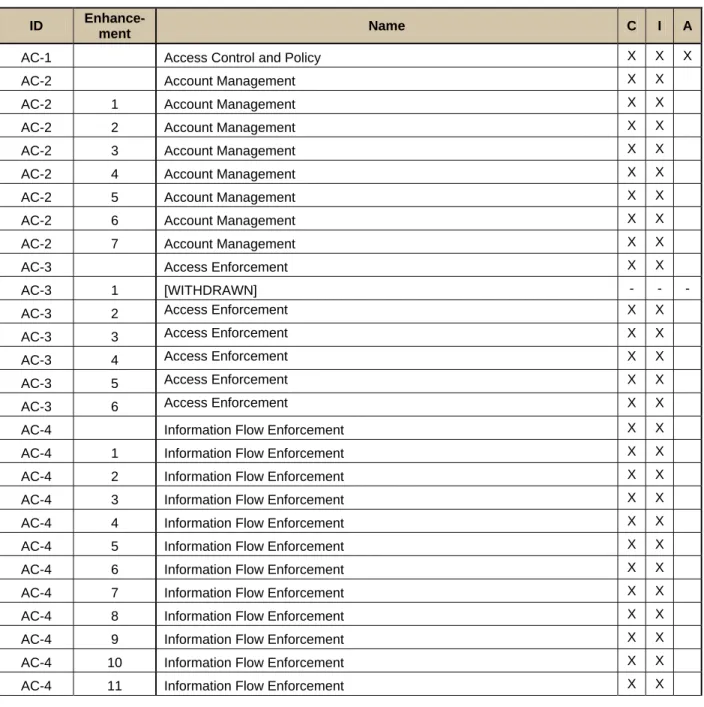
Appendix A maps the security controls to the security objectives of confidentiality, integrity, and availability that they support.
DRAFT 3.1 24 September 2010 3
2. Publication Organization
2.1 Security Control Catalogue
This publication is a catalogue of technical, operational, and management security controls for
information systems. It is intended to serve as a foundation for selecting security controls to protect GC information systems. The catalogue is essentially the same as the catalogue published by the U.S. National Institute of Standards and Technology (NIST) in Special Publication 800-53 Revision 3, Recommended Security Controls for Federal Information Systems and Organizations [Reference 2], including updates as of 05-01-2010. Security control definitions have been modified and augmented slightly to adapt the catalogue to a GC context.
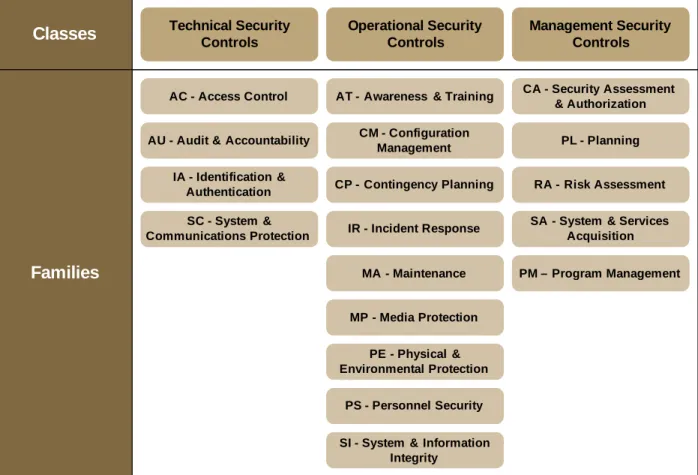
Security controls defined within this catalogue are organized by classes and families as illustrated in Figure 1. Each of these elements is described in detail in the following sub-sections.
Technical Security Controls
Operational Security Controls
Management Security Controls
IA - Identification & Authentication
AT - Awareness & Training
CM - Configuration Management CP - Contingency Planning
IR - Incident Response
MA - Maintenance
MP - Media Protection
PE - Physical & Environmental Protection AC - Access Control
AU - Audit & Accountability
CA - Security Assessment & Authorization
PL - Planning
RA - Risk Assessment
SA - System & Services Acquisition
PS - Personnel Security
Classes
Families
SC - System & Communications Protection
SI - System & Information Integrity
PM – Program Management
DRAFT 3.1 24 September 2010 4
2.2 Classes
There are three general classes of security controls defined within the catalogue: technical, operational, and management. The following definitions of the three different classes of security controls are obtained from the Federal Information Processing Standards (FIPS) Publication (PUB) 200, Minimum Security Control Requirements for Federal Information and Information Systems [Reference 5]:
Management security controls: The security controls (i.e., safeguards or countermeasures) for an information system that focus on the management of risk and the management of information system security.
Operational security controls: The security controls for an information system that primarily are implemented and executed by people (as opposed to systems).
Technical security controls: The security controls for an information system that are primarily implemented and executed by the information system through mechanisms contained in the hardware, software, or firmware components of the system.
It is important to mention that the definitions for the classes of security controls are not strict. In some cases security controls within the technical class require manual procedures performed by personnel to meet their intended security functionality, and security controls in the operational class rely on the use of technology within the information system to meet their intended security functionality.
2.3 Families
Each class of security controls is further divided into families of security controls. The technical security control class consists of the following security control families:
Access control: security controls that support the ability to permit or deny user access to resources within the information system.
Audit and accountability: security controls that support the ability to collect, analyze and store audit records associated with user operations performed within the information system.
Identification and authentication: security controls that support the unique identification of users and the authentication of these users when attempting to access the information system.
System and communications protection: security controls that support the protection of the information system itself as well as communications with and within the information system. The operational security control class consists of the following security control families:
Awareness and training: security controls that deal with the education of users associated with the information system on security awareness.
Configuration management: security controls that support the management and control of all components of the information system (e.g., hardware, software, and configuration items).
Contingency planning: security controls that support the availability of the information system services in the event of component failure or disaster.
DRAFT 3.1 24 September 2010 5
Incident response: security controls that support the detection, response, and reporting of security incidents within the information system.
Maintenance: security controls that support the maintenance of the information system to ensure its ongoing availability.
Media protection: security controls that support the protection of information system media (e.g., disks and tapes) throughout their life cycle.
Physical and environmental protection: security controls that support the control of physical access to an information system as well as the protection of the environmental ancillary
equipment (i.e., power, air conditioning, wiring) used to support the operation of the information system.
Personnel security: security controls that support the procedures required to ensure that all personnel who have access to the information system have the required authorizations as well as the appropriate clearances.
System and information integrity: security controls that support the protection of the integrity of the information system components and the information it processes.
The management security control class consists of the following security control families:
Security assessment and authorization: security controls that deal with the security assessment and authorization of the information system.
Planning: security controls that deal with security planning activities including privacy impact assessments.
Risk assessment: security controls that deal with the conduct of risk assessments and vulnerability scanning.
System and services acquisition: security controls that deal with the contracting of products and services required to support the implementation and operation of the information system.
Program Management: The information security program management controls focus on the organization-wide information security requirements that are independent of any particular information system and are essential for managing information security programs.
Table 2 provides a listing of the security controls that exist within each security control family and class. From time to time NIST withdraws security controls from their catalogue as technology, threats, and counter measures evolve. NIST leaves withdrawn security controls in the catalogue in order to provide stable identifiers for security plans and supporting implementation tools such as traceability matrices and automated risk management tools. Withdrawn security controls are also maintained in this catalogue for the same purpose.
DRAFT 3.1 24 September 2010 6
2.4 Security
Controls
An example security control (PE-2 Physical Access Authorizations) on the next page illustrates the various components used to define the security control:
Each security control is assigned a unique security control number (e.g., PE-2). All security controls starting at 100 (e.g. SC-100) are Canadian specific security controls. One hundred series controls were added in addition to the NIST 800-53 security controls to meet specific GC mandatory requirements. In cases where the Canadian name of the control differs from the original NIST name, the NIST name is stated in brackets after the Canadian name. For example, “Safeguards Implementation Plan (Plan of action and milestones)”.
A control section, which provides a description of the security control through one or more concise statements of the specific security capability needed to protect an aspect of an information system. Each statement in the control section is assigned a separate alphabetic designator (i.e., (A), (B), etc) and must be complied with in order to implement the security control. All statements starting at AA (e.g. SC-10 (AA)) are Canadian specific statements. AA series security control statements were added in addition to the NIST 800-53 security control statements to meet specific GC mandatory requirements.
An optional supplemental guidance section, which provides additional information concerning a security control to aid in its implementation, including any other associated security controls. The supplemental guidance section does not contain any security control statements that must be complied with in order to implement the security control.
An optional control enhancements section, which defines through concise statements additional security capabilities used to increase the strength of a security control. Each control enhancement is assigned a separate numeric designator (i.e., (1), (2), etc). All control enhancements starting at 100 (e.g. PE-2 (100)) are Canadian specific control enhancements. One hundred series control enhancements were added in addition to the NIST 800-53 control enhancements to meet specific GC mandatory requirements.
An enhancement supplemental guidance section, which provides additional detailed information on control enhancements, including any other related security controls. The enhancement supplemental guidance section does not contain any mandatory control enhancements that must be complied with in order to implement the control enhancement.
A references section which contains reference to Policies, directives, standards, and guidelines that apply to the security control. The purpose of this section is to provide additional information or context that the reader may find useful in selecting and implementing the security control. A reference can be broad or narrow in scope depending on the nature of the security control (e.g., GC guidelines on authentication versus a technical security configuration standard).
Many of the security controls and control enhancements contain organization-defined security control parameters. They are essentially place holders for security practitioners to specify during the selection process values that are specific to their organization’s context. The following control enhancement taken from the PE-2 control serves as a good example to illustrate organization-defined parameters:
DRAFT 3.1 24 September 2010 7 The organization reviews and approves the access list and authorization credentials
[Assignment: organization-defined frequency], removing from the access list personnel no longer requiring access.
In this case, security practitioners need to specify the actual frequency as part of the security control selection process. If a security profile containing the appropriate parameter values does not already exist during the selection process, GC policies, standards, guidelines and experience can help the security practitioners in making those specifications.
PE-2 PHYSICAL ACCESS AUTHORIZATIONS
Control:
(A) The organization develops and keeps current a list of personnel with authorized access to the facility where the information system resides (except for those areas within the facility officially designated as publicly accessible).
(B) The organization issues authorization credentials.
(C) The organization reviews and approves the access list and authorization credentials [Assignment: organization-defined frequency], removing from the access list personnel no longer requiring access.
Supplemental Guidance: Authorization credentials include, for example, badges, identification cards, and smart cards. Related control: PE-3, PE-4.
Control Enhancements:
(1) The organization authorizes physical access to the facility where the information system resides based on position or role. (2) The organization requires two forms of identification to gain access to the facility where the information system resides.
Enhancement Supplemental Guidance: Examples of forms of identification are identification badge, key card, cipher PIN, and biometrics.
(100) The organization restricts physical access to the facility containing an information system that processes classified information to authorized personnel with appropriate clearances and access authorizations.
References:
TBS Operational Security Standard on Physical Security [Reference 7].
2.5 How to Use the Catalogue
Annex 2 to this publication, which describes a recommended information security implementation process, provides guidance on how to use this catalogue to select security controls and control enhancements for information systems. See Section 1.4 for a list of related publications.
DRAFT 3.1 24 September 2010 8
2.6 Priority
Codes
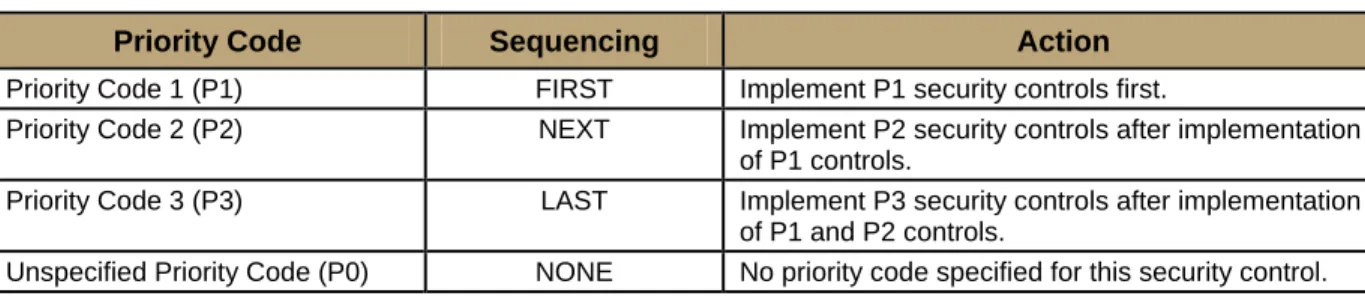
Each security control is assigned a priority code. Organizations can use the recommended priority code associated with each security control to assist in making sequencing decisions for control implementation (i.e., a Priority Code 1 (P1) control has a higher priority for implementation than a Priority Code 2 (P2) control; a Priority Code 2 (P2) control has a higher priority for implementation than a Priority Code 3 (P3) control). An unspecified Priority Code (P0) provides no sequencing decision. If a non baseline security control is selected for the information system, it is by default assigned a (P0) priority code. A review is then conducted to set the appropriate priority code for the security control in relation to the other security controls for the information system. The resulting Priority Code could be a (P1), (P2), or (P3). See Table 1.
This recommended sequencing prioritization helps ensure that foundational security controls upon which other controls depend are implemented first, thus enabling organizations to deploy controls in a more structured and timely manner in accordance with available resources. The implementation of security controls by sequence priority code does not imply the achievement of any defined level of risk mitigation until all of the security controls in the security plan have been implemented. The priority codes are used only for implementation sequencing, not for making security control selection decisions. Security control priority code assignments are specified in Table 2.
Table 1 – Security Control Prioritization Codes
Priority Code Sequencing Action
Priority Code 1 (P1) FIRST Implement P1 security controls first.
Priority Code 2 (P2) NEXT Implement P2 security controls after implementation of P1 controls.
Priority Code 3 (P3) LAST Implement P3 security controls after implementation of P1 and P2 controls.
Unspecified Priority Code (P0) NONE No priority code specified for this security control.
Table 2 – Security Control Classes, Families and Priority Codes Ctrl.
No.
Priority Code
Control Name Class
AC - Access Control
AC-1 P1 Access Control Policy and Procedures Technical
AC-2 P1 Account Management Technical
AC-3 P1 Access Enforcement Technical
AC-4 P1 Information Flow Enforcement Technical AC-5 P1 Separation of Duties Technical
AC-6 P1 Least Privilege Technical
AC-7 P2 Unsuccessful Login Attempts Technical
AC-8 P1 System Use Notification Technical
DRAFT 3.1 24 September 2010 9 Ctrl.
No.
Priority Code
Control Name Class
AC-10 P2 Concurrent Session Control Technical
AC-11 P3 Session Lock Technical
AC-12 - [WITHDRAWN] -
AC-13 - [WITHDRAWN] -
AC-14 P1 Permitted Actions without Identification or Authentication Technical
AC-15 - [WITHDRAWN] -
AC-16 P1 Security Attributes Technical
AC-17 P1 Remote Access Technical
AC-18 P1 Wireless Access Technical
AC-19 P1 Access Control for Mobile Devices Technical AC-20 P1 Use of External Information Systems Technical AC-21 P0 User Based Collaboration and Information Sharing Technical AC-22 P2 Publicly Accessible Content Technical AT - Awareness and Training
AT-1 P1 Security Awareness and Training Policy and Procedures Operational
AT-2 P1 Security Awareness Operational
AT-3 P1 Security Training Operational
AT-4 P3 Security Training Records Operational AT-5 P0 Contacts with Security Groups and Associations Operational AU - Audit and Accountability
AU-1 P1 Audit and Accountability Policy and Procedures Technical
AU-2 P1 Auditable Events Technical
AU-3 P1 Content of Audit Records Technical
AU-4 P1 Audit Storage Capacity Technical AU-5 P1 Response to Audit Processing Failures Technical
AU-6 P1 Audit Review, Analysis, and Reporting Technical AU-7 P2 Audit Reduction and Report Generation Technical
AU-8 P1 Time Stamps Technical
AU-9 P1 Protection of Audit Information Technical
AU-10 P1 Non-repudiation Technical
AU-11 P3 Audit Record Retention Technical
AU-12 P0 Audit Generation Technical
AU-13 P0 Monitoring for Information Disclosure Technical
AU-14 P0 Session Audit Technical
CA - Security Assessment and Authorization
CA-1 P1 Security Assessment and Authorization Policies and Procedures
Management
CA-2 P2 Security Assessments Management
CA-3 P1 Information System Connections Management
CA-4 - [WITHDRAWN] -
CA-5 P3 Plan of Action and Milestones Management
CA-6 P3 Security Authorization Management CA-7 P3 Continuous Monitoring Management
DRAFT 3.1 24 September 2010 10 Ctrl.
No.
Priority Code
Control Name Class
CM - Configuration Management
CM-1 P1 Configuration Management Policy and Procedures Operational
CM-2 P1 Baseline Configuration Operational CM-3 P1 Configuration Change Control Operational
CM-4 P2 Security Impact Analysis Operational CM-5 P1 Access Restrictions for Change Operational
CM-6 P1 Configuration Settings Operational
CM-7 P1 Least Functionality Operational
CM-8 P1 Information System Component Inventory Operational CM-9 P1 Configuration Management Plan Operational CP - Contingency Planning
CP-1 P1 Contingency Planning Policy and Procedures Operational
CP-2 P1 Contingency Plan Operational
CP-3 P2 Contingency Training Operational CP-4 P2 Contingency Plan Testing and Exercises Operational
CP-5 - [WITHDRAWN] -
CP-6 P1 Alternate Storage Site Operational CP-7 P1 Alternate Processing Site Operational
CP-8 P1 Telecommunications Services Operational CP-9 P1 Information System Backup Operational
CP-10 P1 Information System Recovery and Reconstitution Operational IA - Identification and Authentication
IA-1 P1 Identification and Authentication Policy and Procedures Technical IA-2 P1 Identification and Authentication (Organizational Users) Technical IA-3 P1 Device Identification and Authentication Technical
IA-4 P1 Identifier Management Technical
IA-5 P1 Authenticator Management Technical IA-6 P1 Authenticator Feedback Technical IA-7 P1 Cryptographic Module Authentication Technical
IA-8 P1 Identification and Authentication (Non-Organizational Users) Technical IR - Incident Response
IR-1 P1 Incident Response Policy and Procedures Operational IR-2 P2 Incident Response Training Operational IR-3 P2 Incident Response Testing and Exercises Operational
IR-4 P1 Incident Handling Operational
IR-5 P1 Incident Monitoring Operational
IR-6 P1 Incident Reporting Operational
IR-7 P3 Incident Response Assistance Operational IR-8 P1 Incident Response Plan Operational MA - Maintenance
MA-1 P1 System Maintenance Policy and Procedures Operational
DRAFT 3.1 24 September 2010 11 Ctrl.
No.
Priority Code
Control Name Class
MA-3 P2 Maintenance Tools Operational
MA-4 P1 Non-Local Maintenance Operational MA-5 P1 Maintenance Personnel Operational
MA-6 P1 Timely Maintenance Operational
MP - Media Protection
MP-1 P1 Media Protection Policy and Procedures Operational
MP-2 P1 Media Access Operational
MP-3 P1 Media Marking Operational
MP-4 P1 Media Storage Operational
MP-5 P1 Media Transport Operational
MP-6 P1 Media Sanitization Operational
PE - Physical and Environmental Protection
PE-1 P1 Physical and Environmental Protection Policy and Procedures Operational PE-2 P1 Physical Access Authorizations Operational PE-3 P1 Physical Access Control Operational PE-4 P1 Access Control for Transmission Medium Operational PE-5 P1 Access Control for Output Devices Operational PE-6 P1 Monitoring Physical Access Operational
PE-7 P1 Visitor Control Operational
PE-8 P3 Access Records Operational
PE-9 P1 Power Equipment and Power Cabling Operational
PE-10 P1 Emergency Shutoff Operational
PE-11 P1 Emergency Power Operational
PE-12 P1 Emergency Lighting Operational
PE-13 P1 Fire Protection Operational
PE-14 P1 Temperature and Humidity Controls Operational PE-15 P1 Water Damage Protection Operational
PE-16 P1 Delivery and Removal Operational PE-17 P1 Alternate Work Site Operational
PE-18 P2 Location of Information System Components Operational
PE-19 P0 Information Leakage Operational PL - Planning
PL-1 P1 Security Planning Policy and Procedures Management PL-2 P1 System Security Plan Management
PL-3 - [WITHDRWAN] -
PL-4 P1 Rules of Behaviour Management
PL-5 P1 Privacy Impact Assessment Management PL-6 P3 Security-Related Activity Planning Management PS - Personnel Security
PS-1 P1 Personnel Security Policy and Procedures Operational
PS-2 P1 Position Categorization Operational
DRAFT 3.1 24 September 2010 12 Ctrl.
No.
Priority Code
Control Name Class
PS-4 P2 Personnel Termination Operational
PS-5 P2 Personnel Transfer Operational
PS-6 P3 Access Agreements Operational
PS-7 P1 Third-Party Personnel Security Operational
PS-8 P3 Personnel Sanctions Operational
RA - Risk Assessment
RA-1 P1 Risk Assessment Policy and Procedures Management
RA-2 P1 Security Categorization Management
RA-3 P1 Risk Assessment Management
RA-4 - [WITHDRAWN] -
RA-5 P1 Vulnerability Scanning Management SA - System and Services Acquisition
SA-1 P1 System and Services Acquisition Policy and Procedures Management SA-2 P1 Allocation of Resources Management SA-3 P1 Life Cycle Support Management
SA-4 P1 Acquisitions Management
SA-5 P1 Information System Documentation Management SA-6 P1 Software Usage Restrictions Management
SA-7 P1 User Installed Software Management SA-8 P2 Security Engineering Principles Management SA-9 P1 External Information System Services Management
SA-10 P1 Developer Configuration Management Management SA-11 P1 Developer Security Testing Management SA-12 P1 Supply Chain Protection Management
SA-13 P1 Trustworthiness Management
SA-14 P0 Critical Information System Components Management SC - System and Communications Protection
SC-1 P1 System and Communications Protection Policy and Procedures Technical
SC-2 P1 Application Partitioning Technical SC-3 P1 Security Function Isolation Technical
SC-4 P1 Information in Shared Resources Technical SC-5 P1 Denial of Service Protection Technical
SC-6 P0 Resource Priority Technical
SC-7 P1 Boundary Protection Technical
SC-8 P1 Transmission Integrity Technical SC-9 P1 Transmission Confidentiality Technical
SC-10 P2 Network Disconnect Technical
SC-11 P0 Trusted Path Technical
SC-12 P1 Cryptographic Key Establishment and Management Technical SC-13 P1 Use of Cryptography Technical SC-14 P1 Public Access Protections Technical
DRAFT 3.1 24 September 2010 13 Ctrl.
No.
Priority Code
Control Name Class
SC-16 P0 Transmission of Security Attributes Technical SC-17 P1 Public Key Infrastructure Certificates Technical
SC-18 P1 Mobile Code Technical
SC-19 P1 Voice Over Internet Protocol Technical SC-20 P1 Secure Name/Address Resolution Service (Authoritative
Source)
Technical
SC-21 P1 Secure Name/Address Resolution Service (Recursive or Caching Resolver)
Technical
SC-22 P1 Architecture and Provisioning for Name/Address Resolution Service
Technical
SC-23 P1 Session Authenticity Technical SC-24 P1 Fail in Known State Technical
SC-25 P0 Thin Nodes Technical
SC-26 P0 Honeypots Technical
SC-27 P0 Operating System-Independent Applications Technical SC-28 P1 Protection of Information at Rest Technical
SC-29 P0 Heterogeneity Technical
SC-30 P0 Virtualization Techniques Technical SC-31 P0 Covert Channel Analysis Technical
SC-32 P0 Information System Partitioning Technical
SC-33 P0 Transmission Preparation Integrity Technical SC-34 P0 Non-Modifiable Executable Programs Technical
SC-100 P0 Source Authentication Technical SI - System and Information Integrity
SI-1 P1 System and Information Integrity Policy and Procedures Operational
SI-2 P1 Flaw Remediation Operational
SI-3 P1 Malicious Code Protection Operational SI-4 P1 Information System Monitoring Operational SI-5 P1 Security Alerts, Advisories, and Directives Operational SI-6 P1 Security Functionality Verification Operational SI-7 P1 Software and Information Integrity Operational
SI-8 P1 Spam Protection Operational
SI-9 P2 Information Input Restrictions Operational SI-10 P1 Information Input Validation Operational
SI-11 P2 Error Handling Operational
SI-12 P2 Information Output Handling and Retention Operational SI-13 P0 Predictable Failure Prevention Operational
DRAFT 3.1 24 September 2010 14
3. Information Security Programs
Organization-Wide Information Security Program Management Controls
The Policy on Government Security [Reference 1] and supporting standards (e.g. TBS Management of Information Technology Security (MITS), [Reference 8], TBS Directive on Departmental Security Management [Reference 11]) requires organizations to develop and implement an organization-wide information security program to address information security for the information and information systems that support the operations and assets of the organization, including those provided or managed by
another organization, contractor, or other source. The information security program management (PM) controls described in this section complement the security controls in Section 4 and focus on the organization-wide information security requirements that are independent of any particular information system and are essential for managing information security programs. Organizations specify the individuals within the organization responsible for the development, implementation, assessment, authorization, and monitoring of the information security program management controls. Organizations document program management controls in a information security program plan. The organization-wide information security program plan supplements the individual security plans developed for each
organizational information system. Together, the security plans for the individual information systems and the information security program cover the totality of security controls employed by the organization. In addition to documenting the information security program management controls, the security program plan provides a vehicle for the organization, in a central repository, to document all security controls from Section 4 that have been designated as common controls (i.e., security controls inherited by
organizational information systems). The information security program management controls and common controls contained in the information security program plan are implemented, assessed for effectiveness, and authorized by a senior organizational official, with the same or similar authority and responsibility for managing risk as the authorization officials for information systems. Plans of action and milestones are developed and maintained for the program management and common controls that are deemed through assessment to be less than effective. Information security program management and common controls are also subject to the same continuous monitoring requirements as security controls employed in individual organizational information systems.
Note
Organizations are required to implement security program management controls to provide a foundation for the organization’s information security program. The successful
implementation of security controls for organizational information systems depends on the successful implementation of the organization’s program management controls.
DRAFT 3.1 24 September 2010 15 PM-1 INFORMATION SECURITY PROGRAM PLAN
Control:
(A) The organization develops and disseminates an organization-wide information security program plan that: (a) Provides an overview of the requirements for the security program and a description of the security
program management controls and common controls in place or planned for meeting those requirements;
(b) Provides sufficient information about the program management controls and common controls (including specification of parameters for any assignment and selection operations either explicitly or by reference) to enable an implementation that is unambiguously compliant with the intent of the plan and a determination of the risk to be incurred if the plan is implemented as intended;
(c) Includes roles, responsibilities, management commitment, coordination among organizational entities, and compliance;
(d) Is approved by a senior official with responsibility and accountability for the risk being incurred to organizational operations (including mission, functions, image, and reputation), organizational assets, individuals, other organizations, and Canada;
(B) The organization reviews the organization-wide information security program plan [Assignment: organization-defined frequency]; and
(C) The organization revises the plan to address organizational changes and problems identified during plan implementation or security control assessments.
Supplemental Guidance: The information security program plan can be represented in a single document or compilation of documents at the discretion of the organization. The plan documents the organization-wide program management controls and organization-defined common controls. The security plans for individual information systems and the organization-wide information security program plan together, provide complete coverage for all security controls employed within the organization. Common controls are documented in an appendix to the organization’s information security program plan unless the controls are included in a separate security plan for an information system (e.g., security controls employed as part of an intrusion detection system providing organization-wide boundary protection inherited by one or more organizational information systems). The organization-wide information security program plan will indicate which separate security plans contain descriptions of common controls.
Organizations have the flexibility to describe common controls in a single document or in multiple documents. In the case of multiple documents, the documents describing common controls are included as attachments to the information security program plan. If the information security program plan contains multiple documents, the organization specifies in each document the organizational official or officials responsible for the development, implementation, assessment, authorization, and monitoring of the respective common controls. For example, the organization may require that the facilities management develops, implements, assesses, authorizes, and
continuously monitors common physical and environmental protection controls from the PE family when such controls are not associated with a particular information system but instead, support multiple information systems. Related control: PM-8.
Control Enhancements:
DRAFT 3.1 24 September 2010 16
References:
TBS Policy on Government Security [Reference 1].
TBS Operational Security Standard - Management of Information Technology Security [Reference 8].
PM-2 SENIOR INFORMATION SECURITY OFFICER
Control:
(A) The organization appoints a senior information security officer with the mission and resources to coordinate, develop, implement, and maintain an organization-wide information security program.
Supplemental Guidance: The security officer described in this control is an organizational official. For a GC organization this official is the Departmental Security Officer. Some responsibilities may be delegated to the IT Security Coordinator.
Control Enhancements:
None.
References:
TBS Policy on Government Security [Reference 1].
TBS Operational Security Standard - Management of Information Technology Security [Reference 8].
TBS Directive on Departmental Security Management [Reference 11].
PM-3 INFORMATION SECURITY RESOURCES
Control:
(A) The organization ensures that all capital planning and investment requests include the resources needed to implement the information security program and documents all exceptions to this requirement;
(B) The organization employs a business case to record the resources required; and
(C) The organization ensures that information security resources are available for expenditure as planned.
Supplemental Guidance: Organizations may designate and empower a program review board (or similar group) to manage and provide oversight for the information security-related aspects of the capital planning and
investment control process. Related controls: PM-4, SA-2.
Control Enhancements:
None.
References:
None
PM-4 PLAN OF ACTION AND MILESTONES PROCESS
Control:
(A) The organization implements a process for ensuring that plans of action and milestones for the security program and the associated organizational information systems are maintained and document the remedial
DRAFT 3.1 24 September 2010 17
information security actions to mitigate risk to organizational operations and assets, individuals, other organizations, and Canada.
Supplemental Guidance: The plan of action and milestones is a key document in the information security program and is subject to reporting requirements established by TBS. The plan of action and milestones updates are based on the findings from security control assessments, security impact analyses, and continuous monitoring activities. TBS reporting guidance contains instructions regarding organizational plans of action and milestones. Related control: CA-5.
Control Enhancements:
None.
References:
TBS Directive on Departmental Security Management [Reference 11].
CSEC ITSG-33 Guide To Managing Security Risk from Information Systems [Reference 59].
PM-5 INFORMATION SYSTEM INVENTORY
Control:
(A) The organization develops and maintains an inventory of its information systems.
Supplemental Guidance: This control addresses the inventory requirements in TSB Directive on Departmental Security Management.
Control Enhancements:
None.
References:
TBS Directive on Departmental Security Management [Reference 11].
PM-6 INFORMATION SECURITY MEASURES OF PERFORMANCE
Control:
(A) The organization develops, monitors, and reports on the results of information security measures of performance.
Supplemental Guidance: Measures of performance are outcome-based metrics used by an organization to measure the effectiveness or efficiency of the information security program and the security controls employed in support of the program.
Control Enhancements:
None.
References:
DRAFT 3.1 24 September 2010 18
PM-7 ENTERPRISE ARCHITECTURE
Control:
(A) The organization develops an enterprise architecture with consideration for information security and the resulting risk to organizational operations, organizational assets, individuals, other organizations, and Canada.
Supplemental Guidance: The integration of information security requirements and associated security controls into the organization’s enterprise architecture helps to ensure that security considerations are addressed by organizations early in the system development life cycle and are directly and explicitly related to the
organization’s mission/business processes. This also embeds into the enterprise architecture, an integral security architecture consistent with organizational risk management and information security strategies. Security requirements and control integration are most effectively accomplished through the application of the Risk Management Framework and supporting security standards and guidelines. Related controls: PL-2, PM-11, RA-2.
Control Enhancements:
None.
References:
None.
PM-8 CRITICAL INFRASTRUCTURE PLAN
Control:
(A) The organization addresses information security issues in the development, documentation, and updating of a critical infrastructure and key resources protection plan.
Supplemental Guidance: The requirement and guidance for defining critical infrastructure and key resources and for preparing an associated critical infrastructure protection plan are found in applicable GC policies, standards, and procedures. Related controls: PM-1, PM-9, PM-11, RA-3.
Control Enhancements:
None.
References:
None
PM-9 RISK MANAGEMENT STRATEGY
Control:
(A) The organization develops a comprehensive strategy to manage risk to organizational operations and assets, individuals, other organizations, and Canada associated with the operation and use of information systems; and
(B) The organization implements that strategy consistently across the organization.
Supplemental Guidance: An organization-wide risk management strategy includes, for example, an
DRAFT 3.1 24 September 2010 19
mitigation strategies, a process for consistently evaluating risk across the organization with respect to the organization’s risk tolerance, and approaches for monitoring risk over time. The use of a risk executive function can facilitate consistent, organization-wide application of the risk management strategy. The organization-wide risk management strategy can be informed by risk-related inputs from other sources both internal and external to the organization to ensure the strategy is both broad-based and comprehensive. Related control: RA-3.
Control Enhancements:
None.
References:
CSEC ITSG-33 Guide To Managing Security Risk from Information Systems [Reference 59].
PM-10 SECURITY AUTHORIZATION PROCESS
Control:
(A) The organization manages (i.e., documents, tracks, and reports) the security state of organizational information systems through security authorization processes;
(B) The organization designates individuals to fulfill specific roles and responsibilities within the organizational risk management process; and
(C) The organization fully integrates the security authorization processes into an organization-wide risk management program.
Supplemental Guidance: The security authorization process for information systems requires the
implementation of the Risk Management Framework and the employment of associated security standards and guidelines. Specific roles within the risk management process include a designated authorizing official for each organizational information system. Related control: CA-6.
Control Enhancements:
None.
References:
CSEC ITSG-33 Guide To Managing Security Risk from Information Systems [Reference 59].
PM-11 MISSION/BUSINESS PROCESS DEFINITION
Control:
(A) The organization defines mission/business processes with consideration for information security and the resulting risk to organizational operations, organizational assets, individuals, other organizations, and Canada; and
(B) The organization determines information protection needs arising from the defined mission/business processes and revises the processes as necessary, until an achievable set of protection needs is obtained.
Supplemental Guidance: Information protection needs are technology-independent, required capabilities to counter threats to organizations, individuals, or Canada through the compromise of information (i.e., loss of confidentiality, integrity, or availability). Information protection needs are derived from the mission/business needs defined by the organization, the mission/business processes selected to meet the stated needs, and the organizational risk management strategy. Information protection needs determine the required security controls
DRAFT 3.1 24 September 2010 20
for the organization and the associated information systems supporting the mission/business processes. Inherent in defining an organization’s information protection needs is an understanding of the level of adverse impact that could result if a compromise of information occurs. The security categorization process is used to make such potential impact determinations. Mission/business process definitions and associated information protection requirements are documented by the organization in accordance with organizational policy and procedure. Related controls: PM-7, PM-8, RA-2.
Control Enhancements:
None.
References:
DRAFT 3.1 24 September 2010 21
4. Security Control Definitions
This section provides the security control definitions.
The security controls in the catalogue are expected to change over time, as controls are withdrawn, revised, and added. In order to maintain stability in security plans and automated tools supporting the implementation, security controls and control enhancements will not be renumbered each time a control or enhancement is withdrawn. Notations of security controls and controls enhancements that have been withdrawn will be maintained in the catalogue for historical purposes.
Note
This catalogue has been created as a tool to assist security practitioners in their efforts to protect information and information systems in compliance with applicable GC legislation and TBS policies, directives, and standards. However, where any discrepancy or conflict arises between GC legislation and TBS policies, directives, and standards and the security controls defined herein, GC legislation and TBS policies, directives, and standards remain authoritative.
DRAFT 3.1 24 September 2010 22
4.1 FAMILY: ACCESS CONTROL
CLASS: TECHNICAL
AC-1 ACCESS CONTROL POLICY AND PROCEDURES
Control:
(A) The organization develops, disseminates, and reviews/updates [Assignment: organization-defined
frequency] a formal, documented access control policy that addresses purpose, scope, roles, responsibilities, management commitment, coordination among organizational entities, and compliance.
(B) The organization develops, disseminates, and reviews/updates [Assignment: organization-defined
frequency] formal, documented procedures to facilitate the implementation of the access control policy and associated access controls.
Supplemental Guidance: This control is intended to produce the policy and procedures that are required for the effective implementation of selected security controls and control enhancements in the access control family. The access control policy and procedures are consistent with applicable GC legislation and TBS policies, directives and standards. Existing organizational policies and procedures may make additional specific policies and procedures unnecessary. The access control policy can be included as part of the general information security policy for the organization. Access control procedures can be developed for the security program in general and for a particular information system, when required. The organizational risk management strategy is a key factor in the development of the access control policy. Related control: PM-9.
Control Enhancements:
None.
References:
TBS Operational Security Standard - Management of Information Technology Security [Reference 8].
AC-2 ACCOUNT MANAGEMENT
Control:
(A) The organization manages information system accounts, including identifying account types (i.e., individual, group, system, application, guest/anonymous, and temporary).
(B) The organization manages information system accounts, including establishing conditions for group membership.
(C) The organization manages information system accounts, including identifying authorized users of the information system and specifying access privileges.
(D) The organization manages information system accounts, including requiring appropriate approvals for requests to establish accounts.
(E) The organization manages information system accounts, including establishing, activating, modifying, disabling, and removing accounts.