Barcode Studio
Barcode Designer
V e r s io n 1 5 . 2User Manual
2 1 O c t o b e r 2 0 1 4 T EC - I T D a t e n v e r a r b e it u n g G m b H H a n s -W a g n e r - St r a s s e 6 A- 4 4 0 0 S t e yr , A u s t r i a t + + 4 3 ( 0 ) 7 2 5 2 7 2 7 2 0 f + + 4 3 ( 0 ) 7 2 5 2 7 2 7 2 0 7 7 o f f ic e @ t e c - i t . c o m w w w . t e c - i t . c o m1 Content
1 Content 2 1.1 Table of Figures 4 1.2 List of Tables 5 2 Disclaimer 7 3 Introduction 8 3.1 About 83.2 Supported Operating Systems 8
3.3 Restrictions of the Demo Version 8
4 Installation 9
4.1 Install Barcode Studio on Microsoft® Windows 9
4.2 Install Barcode Studio on Mac OS X® (10.6 or higher) 9
5 Quick-Start 10
5.1 Introduction 10
5.2 How to Create an EAN13 Barcode 10
5.2.1 Select Barcode Type (Symbology) 11
5.2.2 Enter Barcode Data 11
5.2.3 Select Output Resolution 12
5.2.4 Specify Barcode Dimensions 12
5.2.5 Fine-tune the Module Width 13
5.2.6 Set Font Style and Size 13
5.3 Barcode Templates 14
5.4 Export or Print the Barcode 15
6 Using Barcodes in Applications (Exporting Barcodes) 16
6.1 General 16
6.2 Resolution and Readability 16
6.3 Export to File 17
6.4 Copy to Clipboard (As Image) 17
6.5 Copy to Clipboard (As Metafile) 17
6.6 Export Data List 17
7 Barcode Studio User Interface 18
7.1 Main Window 18 7.2 Menu 18 7.2.1 File 18 7.2.2 View 19 7.2.3 Data List 19 7.2.4 Export 19 7.2.5 Tools 19 7.2.6 Help 20 7.3 Toolbar 20
7.4 Quality Watch – Status Section 21
7.4.1 Deviation 21 7.4.2 Quality 21 7.4.3 Character Count 21 7.4.4 Resolution 21 7.4.5 Rotation 21 7.4.6 Hint Box 21
7.5 Barcode Types and Templates 22
7.5.1 Barcode Type 22
7.5.2 Template 22
7.5.3 Filter 22
7.6 The Barcode View 23
7.7 Page General 23
7.7.1 Data 23
7.7.2 Appearance 27
7.7.3 Text Placement 29
7.8 Page Settings 30
7.8.1 Advanced Barcode Settings 30
7.8.2 Drawing 32
7.8.3 More Settings 34
7.9 Page Logos and Effects 35
7.9.1 Logos 35
7.9.2 Custom Display Settings 36
7.10.2 Text 38 7.10.3 Alignment 38 7.10.4 Text Distance 38 7.10.5 Font 38 7.10.6 Letter Spacing 38 7.11 Page Info 38 7.11.1 User Info 38 7.12 2D Settings 40 7.12.1 PDF417 / Micro PDF417 40 7.12.2 MaxiCode 42 7.12.3 Data Matrix 44
7.12.4 QR-Code / QR-Code 2005 / Micro QR-Code 45
7.12.5 Aztec Code 47
7.12.6 Codablock-F 48
7.12.7 Composite Symbology 49
7.12.8 DotCode 51
7.12.9 Han Xin Code 52
8 Data List 54
8.1 General 54
8.2 Data List View 54
8.2.1 List Content 54
8.2.2 Symbol Size / Module Width 55
8.2.3 Order 55 8.2.4 Editing 56 8.2.5 Error Status 56 8.3 File Import 57 8.3.1 Import Dialog 57 8.3.2 Data Mapping 58 8.4 Sequence Generator 61
8.4.1 Start Value / End Value / Increment 61
8.4.2 Mask 61
8.4.3 Restrict Serial Numbers to Placeholders 62
8.4.4 Random Value Generation 62
8.4.5 Preview 62
8.5 Export 63
8.5.1 Export Settings 63
8.5.2 File Name Generation 64
8.5.3 Preview 64
8.5.4 Export 64
8.6 Save as CSV file 65
8.6.1 File 65
8.6.2 File Encoding 65
8.6.3 Field Separator and Text Qualifier 65
8.6.4 First Row Contains Column Names 65
8.6.5 Save Barcode Image Files with Full Path 65
8.6.6 Barcode Image Path 65
9 Label Printing 66 9.1 General 66 9.2 Templates 67 9.2.1 Brand 67 9.2.2 Label 67 9.3 Settings 67 9.3.1 Number of Columns/Rows 67
9.3.2 Start Column / Start Row 68
9.3.3 Unit 68 9.3.4 Column Width 68 9.3.5 Row Height 68 9.3.6 Column Spacing 68 9.3.7 Row Spacing 68 9.3.8 Print Order 68 9.3.9 Page Setup 68 9.4 Preview 69 9.4.1 Preview 69 9.4.2 Tool Bar 70 9.4.3 Settings 70 9.5 Printing 70
9.5.1 Check Before Printing 70
9.5.2 Printing… 70
10 Options 71
10.1 EPS Export 71
10.1.1 Add Preview (TIFF) 71
10.1.3 Surrogate Font 72 10.2 Templates 72 10.2.1 Template Directory 72 10.3 URL Shortening 72 10.3.1 Proxy 72 10.3.2 Service 72
10.3.3 Service Specific Settings 73
11 FAQ 74
11.1 How can I encode the FNC1 character in EAN128? 74
11.2 How can I encode the FNC1 character in GS1/UCC/EAN Data Matrix? 74
11.3 Escape-Sequences are not encoded (and the scanner signals an error) 74 11.4 After saving the barcode to an image file, my barcode scanner cannot read the barcode! 74
12 Licensing 75
12.1 License Types 75
12.2 Entering your License Data 75
12.2.1 Online Activation using an Activation Key 75
12.2.2 Manual Licensing 76
12.3 Temporary Test Licenses 77
13 Contact and Support Information 78
Appendix A : Barcodes 79
A.1 Supported Barcodes 79
A.1.1 MaxiCode 79
A.2 Check Digits 79
A.3 Print Ratio 79
A.4 Format 79
A.5 Escape Sequences 79
Appendix B : Error Messages 80
Appendix C : Image Types 81
Appendix D : Command Line Parameters 82
D.1 Syntax 82
D.2 Examples 83
1.1 Table of Figures
Figure 1: Quick-Start – Barcode Studio Main Window 10
Figure 2: Quick-Start with Templates – Barcode Studio Main Window 14
Figure 3: User Interface 18
Figure 4: Toolbar 20
Figure 5: Quality Watch 21
Figure 6: Filter by Text Filter by Encodable Data 23
Figure 7: Barcode View 23
Figure 8: Data Section 23
Figure 9: Data Input Assistant 24
Figure 10: Data Input Assistant – vCalender 25
Figure 11: Data Input Assistant – GS1 Application Identifier 25
Figure 12: Add Control Character 26
Figure 13: Appearance Section 27
Figure 14: Text Placement Section 29
Figure 15: Advanced Barcode Settings Section 30
Figure 16: Drawing Section 32
Figure 17: Quiet Zones 32
Figure 18: Colors Dialog 32
Figure 19: Color Selection Dialog for Microsoft Windows 33
Figure 20: Dialog More Settings 34
Figure 21: Logos and Effects 35
Figure 24: User Info Section 38
Figure 25: Info Text 39
Figure 26: PDF417 / Micro PDF417 Properties 40
Figure 27: Macro PDF417 – Optional Settings 42
Figure 28: MaxiCode Properties 43
Figure 29: Data Matrix (ECC200) Properties 44
Figure 30: QR-Code Properties 45
Figure 31: Aztec Code Properties 47
Figure 32: Codablock-F Properties 48
Figure 33: Composite Symbology Settings 49
Figure 34: DotCode Settings 51
Figure 35: Han Xin Settings 52
Figure 36: Data List View 54
Figure 37: Error Status 56
Figure 38: File Import 57
Figure 39: Data Mapping 58
Figure 40: Import Assistant – vCard 59
Figure 41: Import Assistant – Email 60
Figure 42: URL Shortening 60
Figure 43: Sequence Generator 61
Figure 44: Export Dialog 63
Figure 45: Save as CSV File Dialog 65
Figure 46: Label Printing 66
Figure 47: Label Templates 67
Figure 48: Label Settings 67
Figure 49: Preview 69
Figure 50: Preview – Settings 69
Figure 51: Barcode is being clipped 69
Figure 52: Print Labels 70
Figure 53: Error Message 70
Figure 54: Options Dialog 71
Figure 55: Proxy Dialog 72
Figure 56: License Dialog – Online Activation 75
Figure 57: License Dialog – Manual Licensing 76
Figure 58: Request Test License 77
Figure 59: Demo Version Unlocked 77
1.2 List of Tables
Table 1: EAN13 Dimensions (not complete) 12
Table 2: Barcode Qualities 21
Table 3: Units 27
Table 4: Resolution Settings 28
Table 5: Compression 31
Table 6: Draw Modes 37
Table 7: Micro PDF417 – Modes 41
Table 8: MaxiCode – Modes 43
Table 9: Data Matrix – Modes 44
Table 10: QR-Code – Modes 45
Table 11: QR-Code – Error Correction Levels 46
Table 12: QR-Code – Mask Patterns 46
Table 13: QR-Code – Compaction 46
Table 15: Codablock-F – Modes 49
Table 16: DotCode – Modes 51
Table 17: DotCode – Symbol Size 51
Table 18: QR-Code – Error Correction Levels 53
Table 19: Format – Characters 62
Table 20: Format – Examples 62
Table 21: Sequence – File Name 64
Table 22: Font Substitution 72
Table 23: Error Descriptions 80
2 Disclaimer
The actual version of this product (document) is available as is. TEC-IT declines all warranties which go beyond applicable rights. The licensee (or reader) bears all risks that might take place during the use of the system (the documentation). TEC-IT and its contractual partners cannot be penalized for direct and indirect damages or losses (this includes non-restrictive, damages through loss of revenues, constriction in the exercise of business, loss of business information or any kind of commercial loss), which is caused by use or inability to use the product (documentation), even if TEC-IT has been advised of or TEC-IT has pointed out the possibility of such damages.
We reserve all rights to this document and the information contained therein. Reproduction, use or disclosure to third parties without express authority is strictly forbidden.
Für dieses Dokument und den darin dargestellten Gegenstand behalten wir uns alle Rechte vor. Vervielfältigung, Bekanntgabe an Dritte oder Verwendung außerhalb des vereinbarten Zweckes sind nicht gestattet.
© 1998-2014 TEC-IT Datenverarbeitung GmbH Hans-Wagner-Str. 6 A-4400 Austria t.: +43 (0)7252 72720 f.: +43 (0)7252 72720 77 http://www.tec-it.com
3 Introduction
3.1 About
TEC-IT Barcode Studio is a tool for generating and printing barcodes.
Barcode Studio creates more than 100 different barcode symbologies: linear, 2D, postal and GS1 composite barcodes are supported. All barcode parameters are adjustable. The barcodes are created as image files (e.g. for using it in your artwork), as high quality vector images (for graphics design or pre-press applications), copied to the clipboard or printed directly with any printer. Batch barcode generation with external or manual entered data is also supported.
If you have any questions, please contact us. Address: Hans-Wagner-Str. 6 AT-4400 Steyr Austria/Europe Phone: +43 / (0)7252 / 72 72 0 Fax: +43 / (0)7252 / 72 72 0 – 77 Email: [email protected] Web: http://www.tec-it.com
3.2 Supported Operating Systems
Mac OS (10.6 or higher) for Intel Windows 8 Windows 7 Windows Vista Windows XP
Windows Server 2012 and 2012 R2 Windows Server 2008 and 2008 R2 Windows Server 2003
Linux/UNIX (please refer to www.tec-it.com or request a build)
3.3 Restrictions of the Demo Version
► A demo marker across the barcode indicates that the demo version is active. The correct-ness of the barcode is not affected.
► To obtain a license key for the full version (without the demo marker) please order Barcode Studio online at http://www.tec-it.com/order/default.aspx.
4 Installation
4.1 Install Barcode Studio on Microsoft
®Windows
On Microsoft® Windows operating systems (Windows8, Windos7, Vista, etc.), Barcode Studio is
installed with the Windows Installer. If the Windows Installer is not available on the system, please download it from the following link:
http://www.microsoft.com/downloads/details.aspx?FamilyID=889482fc-5f56-4a38-b838-de776fd4138c&displaylang=en
Please follow the steps as outlined below (administrator privileges are required). 1. Open the installer by double-clicking it.
2. Follow the instructions in the installation wizard.
By default, Barcode Studio is installed in the following directories:
C:\Program Files\TEC-IT\BCStudio15 (binary files + documentation) C:\ProgramData\TEC-IT\BCStudio\15.2 (templates, option file, etc.)
4.2 Install Barcode Studio on Mac OS X
®(10.6 or higher)
For Mac operating systems (Mac OS X 10.6 or higher), Barcode Studio is provided as a zipped pkg-file.
Please follow the steps as outlined below. 1. Open the zip-file by double-clicking it.
2. Open the contained pkg-file also by double-clicking it. 3. Follow the instructions of the setup wizard.
5 Quick-Start
5.1 Introduction
This chapter will guide you through the most important functions of Barcode Studio by showing you how to create an EAN13 barcode. For more detailed explanation of the user interface and the available functions and settings, please refer to the chapters 6 to 10.
► Starting with Barcode Studio version 11 pre-defined barcode templates are available. The creation of standardized barcodes is simplified dramatically (see section 5.3).
5.2 How to Create an EAN13 Barcode
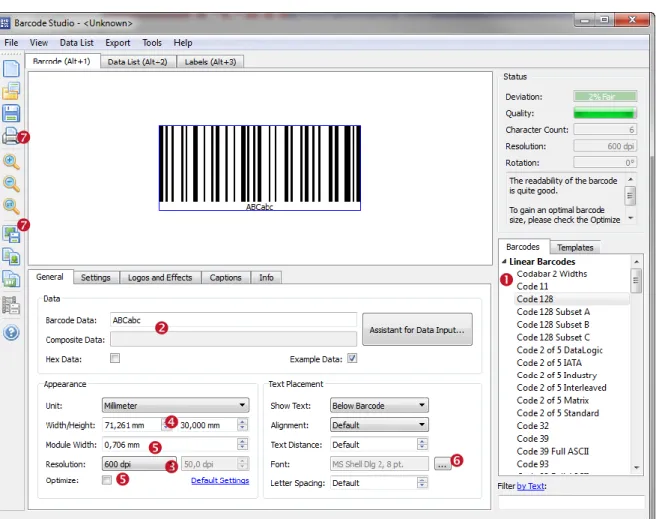
Figure 1: Quick-Start – Barcode Studio Main Window
In order to create an EAN13 barcode, please follow these steps: Select the barcode type (symbology) – see section 5.2.1. Enter the barcode data – see section 5.2.2.
Select the output resolution – see section 5.2.3. Specify the barcode dimensions – see section 5.2.4. Fine-tune the module width – see section 5.2.5. Set font style and size – see section 5.2.6.
5.2.1 Select Barcode Type (Symbology)
Select the required barcode type (symbology) in . Choose “EAN 13”.
Hint: If you press the E key, the first entry starting with an “E” will be selected.
5.2.2 Enter Barcode Data
The EAN13 barcode needs exactly 12 digits (or 13 digits including the check digit). By default you will see the sample data “123456789012” if the checkbox “Example Data” is checked.
Enter the data to be encoded in . Alternatively you can also use the Data Input Assistant (see 7.7.1.1).
The barcode view is updated after every change. The barcode cannot be drawn before you have entered the required twelve (or thirteen) digits.
If “Example Data” is not checked, the current input data may be invalid for the selected barcode (e.g. wrong characters or a wrong number of characters). In this case you will see an error message like the following:
Error: Wrong number of input characters (12 chars needed)!
For a list of the most common error messages, please refer to Appendix B.
► The 13th digit in the resulting EAN13 barcode (in this case the digit “3”) is the check digit. It
will be calculated automatically.
► If you enter 13 instead of 12 characters you need to provide the correct check digit yourself. This is not recommended. A wrong check digit may make the barcode unreadable!
5.2.3 Select Output Resolution
► Barcode Studio uses the selected resolution for computing the barcode images. Thus it is essential to adjust a resolution which leads to readable barcodes (see also section 5.2.5). ► Usually higher resolutions lead to a better barcode quality. However, at the same time it is
important that the selected resolution accords to the resolution of the output device (or of the image processing software).
The output resolution can be adjusted in . In this example the output resolution is changed to “300 dpi”. If you are planning to print the barcode on a laser printer you would most probably select a higher resolution (600 or 1200 dpi).
If you want to export the barcode as image for your web page you could also choose “Screen Resolution” or “72 dpi (BMP)”.
► If you use barcode images in pre-press applications, please take care to avoid any scaling or resizing of the generated barcode image. This may lead to inaccuracies and distortions rendering the barcode unusable. Generate the barcode image in exactly the resolution and size as required!
5.2.4 Specify Barcode Dimensions
The barcode dimensions can be modified by changing width, height, and module width.
Most label or barcode specifications require specific barcode dimensions. The following values are commonly used for EAN13:
Magnification factor Module width [mm] Width [mm] Height [mm]
0.80 0.264 (SC0) 29.83 20.73
1.00 0.330 (SC2) 37.29 25.91
1.50 0.495 (SC6) 55.94 38.87
2.00 0.660 (SC9) 74.58 51.82
Table 1: EAN13 Dimensions (not complete)
In this example we use the magnification factor 1.00.
Enter the width and the height in . The appropriate module width will be calculated automatically.
The barcode now looks like this:
5.2.5 Fine-tune the Module Width
Yet the quality of the barcode is not perfect yet (see the Quality Watch at the top right corner of the Barcode Studio application window):
To optimize the barcode quality we recommend fine-tuning the module width. You have the follow-ing possibilities to do so:
Select the option “Optimize” (see Figure 1, ).
Choose the unit “Pixel” and enter a whole-numbered value in the field “Module Width”. Increase the output resolution.
The first two options both lead to a perfect barcode quality. 5.2.6 Set Font Style and Size
The font properties are set via the “Select Font” dialog. You can open this dialog by clicking the button in the “Text Placement” section (see Figure 1 ).
5.3 Barcode Templates
The list of barcode templates contains a selection of frequently used barcode types including their default settings.
► The templates which are part of the Barcode Studio installation comply with various bar coding standards. By using these templates you create optimal barcodes and you save time for an optional certification of the barcode.
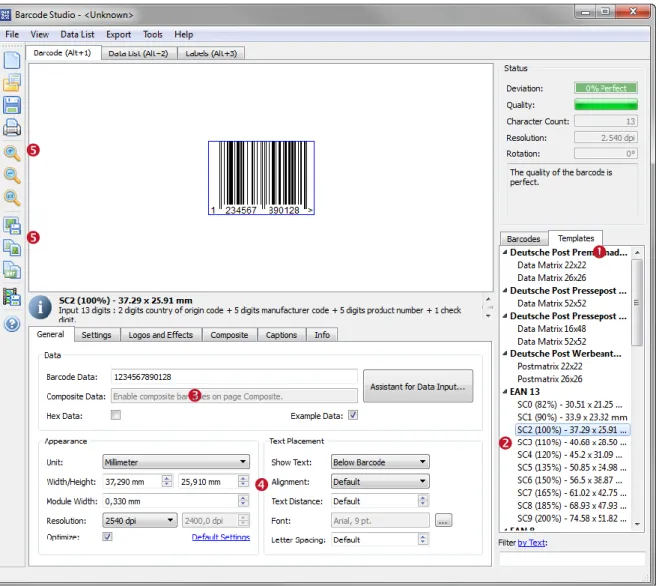
In order to create an EAN 13 barcode with default settings please perform following steps: Go to the templates list.
Select the entry “EAN 13 / SC2 (100%)…” Enter the barcode data – see section 5.2.2. Adjust any other settings if needed.
Export or print the barcode – see section.5.4.
Figure 2: Quick-Start with Templates – Barcode Studio Main Window
5.4 Export or Print the Barcode
The barcode can be used in the following ways: Export to clipboard:
The clipboard allows you to quickly insert the barcode into any application like Microsoft Word or Microsoft Excel using the keyboard shortcut Ctrl+V.
File export:
The file export creates an image file. Different bitmap and vector formats are supported. List export:
In order to export multiple barcodes at once use the data list (see chapter 8). You can either use the barcode data or a sequential number as file names.
Print:
With the print command you can print barcode labels (see chapter 9).
For further information on the barcode export, please refer to chapter 6. The data list and the label printing are explained in the chapters 8 and 9.
6 Using Barcodes in Applications
(Exporting Barcodes)
This chapter provides general instructions for using the created barcodes in applications. An explanation of the user interface and of the available barcode settings can be found in the following chapters.
6.1 General
You can export the barcodes created in Barcode Studio in the following ways: Copy the barcode to the clipboard (as image) and paste it into your application. Copy the barcode to the clipboard (as metafile) and paste it into your application.
(Available under Microsoft Windows only.) Export the barcode to an image file.
Export a series of barcode images (batch job).
Before exporting a barcode you have to adjust the required barcode settings. The size of the resulting barcode image can be controlled by changing the dimensions (width, height, and module width) and the output resolution (DPI) – see also section 7.7.2 . These settings apply to all kinds of export operations.
6.2 Resolution and Readability
► Do not resize exported barcode images with image manipulation software (like Photoshop®)!
The quality and the readability might suffer!
► Whenever possible, let Barcode Studio create the barcode in the required size and resolution to avoid resizing later on.
6.2.1.1 Barcode Quality
When exporting the barcode to a bitmap image (BMP, GIF, JPG, PNG, TIF), it must be converted from its internal resolution (high) to a graphical pixel resolution (low). During this process (raste-rizing) the module width can vary due to rounding errors.
When exporting a barcode to a vector based image format (EPS) or as metafile to the clipboard, the internal representation of the barcode symbol allows very high resolutions (which are independent of the adjusted dpi). Thus it is recommended to use vector based image formats (EPS) whenever possible. However, in the context of certain applications (e.g. web applications) it is inevitable to use bitmap images.
The readability of a barcode can be estimated by considering the quality watch (see section 7.1, ). The quality of a barcode depends on the selected output resolution, size and content. To ensure an optimal readability check the option “Optimize”.
6.2.1.2 Module Width
Larger module widths usually lead to a better readability of a barcode. In practice, for most linear barcodes, the module width should never be less than 0.19 mm.
6.3 Export to File
If you want to export a barcode as an image file, select Export ► Export Barcode… from the menu or press the keyboard shortcut Ctrl+E. In the Save Image File dialog choose a file name and select the image file type (e.g. “Bitmap (*.bmp)”). Then confirm by pressing the Save button.
The saved image can now be imported in your target application. (Example: In Microsoft® Word you
can insert the barcode image by selecting Insert ► Image ► From File… from the menu.) ► The exported barcode symbol will match the preview in Barcode Studio exactly. ► For a list of available image formats, please refer to Appendix C.
► If you export images with a bitmap based file format (see Appendix C), resizing of the imported image is not recommended!
6.4 Copy to Clipboard (As Image)
To copy the current barcode as an image to the clipboard, you have to select Copy to Clipboard (As Image) from the menu (located in the Export submenu) or from the toolbar. You can also press the keyboard shortcut Ctrl+B.
Then switch to your target application and paste the barcode (e.g. in Microsoft® Word) by pressing
Ctrl+V (or by selecting Edit ► Insert from the menu).
► Resizing barcode images may result in a loss of quality, in the worst case in unreadable barcodes.
6.5 Copy to Clipboard (As Metafile)
To copy the current barcode as vector based metafile (EMF) to the clipboard select Copy to Clipboard (As Metafile) from the menu (located in the Export submenu) or from the toolbar. You can also press the keyboard shortcut Ctrl+M.
Then switch to your target application and paste the barcode (e.g. in Microsoft® Word) by pressing
Ctrl+V (or by selecting Edit ► Insert from the menu). ► Metafiles can only be used under Microsoft® Windows.
► Due to the vector based format you may resize the imported image within your target application without heavy losses in readability.
► The resulting barcodes may differ in dependence of the selected resolution and target application from the preview in Barcode Studio in size.
6.6 Export Data List
Data lists are used for exporting a series of barcode images and/or for label printing. Such a data list can be imported, generated and edited. See also chapter 8 Data List and 9 Label Printing.
7 Barcode Studio User Interface
7.1 Main Window
Figure 3: User Interface
The main window is split into the following areas: Menu (see section 7.2)
Toolbar (see section 7.3) Barcode View (see section 7.6) Quality Watch (see section 7.4) Barcode Settings (see chapter 7)
2D Settings (available only for certain Barcode Symbologies) Barcode Types and Templates (see section 7.5)
7.2 Menu
The menu gives you access to the following functions: 7.2.1 File
New Creates a new document (with initial barcode settings). Shortcut: Ctrl+N
Shortcut: Ctrl+O
Save Settings Save Settings As…
Saves the current barcode settings (symbology, dimensions, module width, etc.) into a file. Barcode settings files have the extension .bc.
Shortcut: Ctrl+S (for Save)
Export Barcode… Exports the barcode to a picture file. Shortcut: Ctrl+E
Save As Template… Saves the current barcode settings as template file.
Refresh Templates Refreshes the template list. Shortcut: Ctrl+R
Print Barcode Info… Prints the barcode and the most important settings (size, resolution, etc.).
Print Labels… Prints the data list as labels (see also chapter 9). Shortcut: Ctrl+P
Hints for Printing:
The output resolution, and therefore the values for quality and deviation, depends on the printer settings.
Note: Inkjet printers sometimes produce better results if the bar width reduction is used (see also section 7.8.2.4).
Exit Exits Barcode Studio.
Shortcut: Ctrl+Q
7.2.2 View
Zoom In Increment the zoom in the barcode view. Shortcut: Ctrl++
Zoom Out Decrement the zoom in the barcode view. Shortcut: Ctrl+-
Reset Zoom Zoom is turned off. The barcode is shown in its original size.
Auto Zoom Auto-Zoom mode is turned on or off. In Auto-Zoom mode the zoom factor is automatically adapted to the window size.
Zoom Dialog Opens the zoom dialog.
Hint:
The zoom commands do not change the real size of the barcode, but only its view on the screen.
7.2.3 Data List
File Import… Imports data from a text file and adds it to the data list. Shortcut: Ctrl+I
Create Sequence… Creates a data sequence and adds it to the data list. Save as CSV File… Export data list as *.csv file.
7.2.4 Export
Export Barcode… Exports the barcode to a picture file. Shortcut: Ctrl+E
Copy to Clipboard (As Image)
Copies the barcode as image to the clipboard. Shortcut: Ctrl+B
Copy to Clipboard (As Metafile)
Copies the barcode as metafile to the clipboard (not available on Mac OS). Shortcut: Ctrl+M
Export Data List… Exports the data list as a series of barcode images. Shortcut: Ctrl+L
7.2.5 Tools
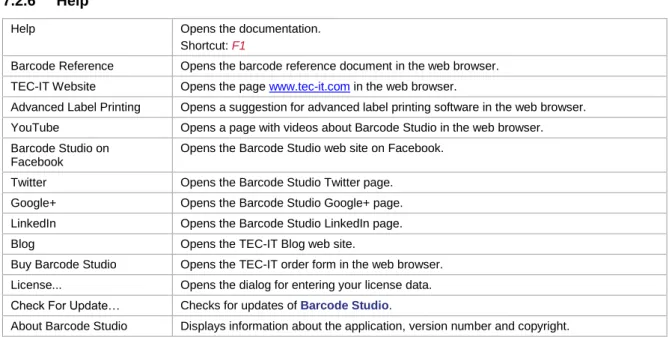
7.2.6 Help
Help Opens the documentation.
Shortcut: F1
Barcode Reference Opens the barcode reference document in the web browser. TEC-IT Website Opens the page www.tec-it.com in the web browser.
Advanced Label Printing Opens a suggestion for advanced label printing software in the web browser. YouTube Opens a page with videos about Barcode Studio in the web browser. Barcode Studio on
Opens the Barcode Studio web site on Facebook. Twitter Opens the Barcode Studio Twitter page.
Google+ Opens the Barcode Studio Google+ page. LinkedIn Opens the Barcode Studio LinkedIn page.
Blog Opens the TEC-IT Blog web site.
Buy Barcode Studio Opens the TEC-IT order form in the web browser. License... Opens the dialog for entering your license data. Check For Update… Checks for updates of Barcode Studio.
About Barcode Studio Displays information about the application, version number and copyright.
7.3 Toolbar
Figure 4: Toolbar
The toolbars offer following functions:
New Creates a new barcode (with pre-defined settings). Shortcut: Ctrl+N
Open Opens an existing barcode settings file (*.bc). Shortcut: Ctrl+O
Save Saves the current barcode settings to your hard disk. Shortcut: Ctrl+S
Print Prints the data list as labels. Shortcut: Ctrl+P
Zoom In Increment the zoom in the barcode view. Shortcut: Ctrl++
Zoom Out Decrement the zoom in the barcode view. Shortcut: Ctrl+-
Reset Zoom Zoom is turned off. The barcode is shown in its original size. Export Barcode Exports the barcode to a picture file. Shortcut: Ctrl+E
Copy to Clipboard (As Image) Copies the barcode as image to the clipboard. Shortcut: Ctrl+B
Copy to Clipboard (As Metafile) Copies the barcode as metafile to the clipboard. Shortcut: Ctrl+M
Export Data List Exports the data list as a series of barcode images. Shortcut: Ctrl+L
7.4 Quality Watch – Status Section
Figure 5: Quality Watch 7.4.1 Deviation
The less the deviation the better are quality and readability of the barcode. The deviation depends on the output resolution and the print ratio of the barcode. You can also improve the quality by changing the module width to an appropriate value. As measurement unit select “Pixel” and set the module width to an integer value (1, 2, 3, etc., 25, etc.).
The field “Deviation” will report one of the following values:
Tolerance Aberration Description
Perfect 0% Optimal output quality.
Fair 1-15% Should be readable with most barcode scanners.
Poor 16-25% May be readable.
Bad! 26-50% Not readable in most cases.
Data Loss! 51-100% Total or partly loss of information. Unreadable barcode. Table 2: Barcode Qualities
7.4.2 Quality
The quality of the barcode – the higher the deviation, the lower is the quality. 7.4.3 Character Count
Displays the number of characters in the barcode data. 7.4.4 Resolution
The current output resolution in dpi (dots per inch). 7.4.5 Rotation
The rotation of the barcode in degrees. 7.4.6 Hint Box
The hint box displays information about the current barcode quality as well as recommended actions for improving the readability.
7.5 Barcode Types and Templates
7.5.1 Barcode TypeSelect the required barcode type (= symbology) from the Barcodes list (see Figure 3, ). For a better overview the list is divided into 1D Symbologies, 2D Symbologies, Postal Codes, GS1 DataBar, HIBC Codes and SCANPAY Barcodes.
► For 2D codes like Aztec Code, Codablock-F, PDF417, MicroPDF, Micro QR-Code, MaxiCode, Data Matrix, QR-Code, GS1-DataBar Stacked and variants, as well as for all symbologies which are derived from these (HIBC, QR-Code 2005, etc.), and for all Composite Symbologies you need a 2D license. For the other symbologies a 1D license is sufficient.
If you want to learn more about the selected symbology, please examine the Barcode Reference from the Help menu.
If a filter is active the number of shown barcode types is displayed in the tab header. 7.5.2 Template
Select the required template from the Templates list. If you choose a template all previously adjusted settings are overwritten with the template settings.
You can add your current configuration to the templates by saving it with Save As Template… from the File menu. To refresh the template list choose the menu item Refresh Templates.
If a filter is active the number of shown templates is displayed in the tab header. 7.5.3 Filter
In order to find the desired barcode type or template more easily, the user can add a filter text in the field below the Barcodes / Templates list. Filters restrict the elements shown by the lists.
The user may switch between two filter options by Text or by Encodable Data, what can be done by clicking the link with the opposite text.
7.5.3.1 Filter by Text
The affected lists only show those list entries that contain the filter text or are related to it. This option applies to both, Barcodes and Templates list.
7.5.3.2 Filter by Encodable Data
Figure 6: Filter by Text Filter by Encodable Data
7.6 The Barcode View
Figure 7: Barcode View
The Barcode View shows the barcode in its actual appearance (as it will be printed).
To change the size of the barcode, enter the required dimensions in the “Appearance” section (see section 7.7.2). The quality of the barcode depends on the output resolution and on the module width. You will find a quality watch in the “Status” section (see section 7.4).
7.7 Page General
7.7.1 DataFigure 8: Data Section
7.7.1.1 Barcode Data
The barcode content is entered in the field “Barcode Data” or by using the “Data Input Assistant” . The assistant allows the input of unstructured raw data as well as the comfortable input of special data formats (e.g., the contact data for a business card). However such data formats are not supported by all barcode types. The assistant may also be used for importing barcode data from a text file.
Please note:
► Each barcode type is able to represent a specified set of data-characters. Some barcode symbologies can hold digits. Others may contain alphanumeric characters (digits + letters + punctuation characters). Again, others may use the full ASCII character set.
7.7.1.2 Data Input Assistant
Figure 9: Data Input Assistant
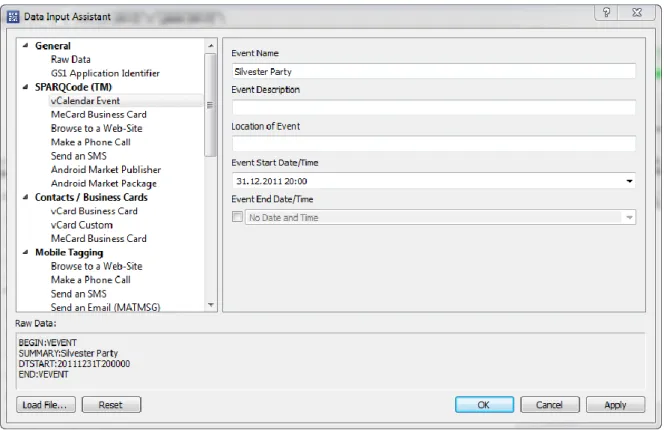
The Data Input Assistant allows you to comfortably enter the barcode data in different formats. Depending on your selection in a different input mask will be show in . E.g., if you have selected a business card format in , then will show the corresponding input fields for first name, last name, company, etc. If you have selected the GS1 format then will show a table for editing the single AIs (Application Identifiers) in the barcode (see example below). Barcode Studio will do the correct formatting for the particular barcode data automatically. The formatted data can be inspected in .
► The number of available data formats in depends on your current barcode selection. For Code 128 the editing will be restricted to raw data. For other symbologies (like QR-Code) a variety of data formats is available.
► Besides that Barcode Studio offers the possibility to specify your own data formats. If required, please contact us!
Furthermore the assistant allows you to import barcode data from a text file (button Load File…). For clearing all data fields, please use the Reset button.
The data input for the “Raw Data” format (pre-selection) is quite similar to the input in the main window. However the assistant offers you the additional possibility to enter the data in a multi-line edit control (use the button ).
Below you will find examples for editing different data formats:
Example Calendar Entry:
(As symbology the QR-Code is used)
Figure 10: Data Input Assistant – vCalender Example GS1 Application Identifier: (As symbology GS1 128 is used)
7.7.1.3 Add Control Characters
You can enter control characters directly in the edit field or use the context menu. Open the context menu by right-clicking in the edit field and choose Add Control Characters. Then select the control character to insert from the submenu.
Because control characters are represented by special character combinations (like \F for FNC1), Barcode Studio activates escape sequences automatically (see section 7.8.1.2).
Figure 12: Add Control Character
For more information on all available control characters, please refer to the “Barcode Reference” available on www.tec-it.com or via the menu Help ► Barcode Reference.
7.7.1.4 Check Digit Override
Some barcodes with a predefined number of utilizable data characters (like all EAN, UPC, Postnet and RSS-14 codes) contain a check digit on a fixed position in the barcode data.
Example:
The EAN13 code consists of 12 utilizable digits and 1 check digit on the last position ().
If you enter 12 digits as barcode data the check digit will be calculated and inserted automatically. However, you can also enter all 13 digits and override the calculated check digit.
► Note: If the barcode data already contains a check digit, the barcode is only valid if the check digit is equal to the automatically calculated check digit.
► Only if the check digit method is set to None (see section 7.8.1.1), the correctness of a check digit remains unchecked. Under normal circumstances you should not use this setting – we recommend relying on the automatic calculation of the check digit(s) by Barcode Studio.
7.7.1.5 Composite Data
The Composite Data field () is only enabled if the selected barcode type supports composite data (check if the Composite page is visible) and if a 2D Composite Component has been selected (“Auto”, “CC-A”, “CC-B” or “CC-C”) on that page.
► You can also enter the composite data in the Barcode Data field by separating the
compo-
7.7.1.6 Hex Data
If this option is selected (see Figure 8, ) the barcode data is treated as hexadecimal data. This property applies to the barcode data field and to the composite data.
Whenever Hex Data is enabled, Barcode Studio treats manually entered data as well as imported data as a hexadecimal character sequence. This sequence is internally converted to a normal character sequence before a barcode is generated.
7.7.1.7 Example Data
If the option “Example Data” is selected (see Figure 8, ), Barcode Studio provides a valid exam-ple data string for the currently selected barcode type. The data is adapted automatically if you change the symbology.
7.7.2 Appearance
Figure 13: Appearance Section
7.7.2.1 Unit
Field specifies the measurement unit for displaying and/or entering the dimensions of the bar-code. Possible values are:
Millimeter Inch
Mils (=1/1000 inch) Pixel.
7.7.2.2 Dimensions (Width, Height)
Use the settings and to change the width and the height of the barcode. The preview is up-dated immediately.
Unit Description
Millimeter The width and the height of the barcode in millimeters. The physical width (in pixels) can be calculated as follows: width (pixels) = width (mm) / 25.4 * resolution (dpi)
Inch The width and the height of the barcode in inches.
The physical width (in pixels) can be calculated as follows: width (pixels) = width (inch) * resolution (dpi)
Mils The width and the height of the barcode in mils.
The physical width (in pixels) can be calculated as follows: width (pixels) = width (mils) / 1000 * resolution (dpi) Pixel The width and the height of the barcode in pixels.
The width and the height are specified in pixels. The resulting dimension on the screen depends on the adjusted resolution (dpi).
Table 3: Units
7.7.2.3 Module Width
The module width is entered in field .
Every barcode is divided into several "modules". A module is the smallest bar (or space) segment. The module width is the fundamental measuring unit for barcodes. All bar and space widths base on this setting. A change of the module width causes a change of the barcode width and vice versa.
Exceeding the lower limit of the module width leads to unreadable barcodes (e.g., if the module width is smaller than 1 pixel). The minimum limit depends on the resolution of screen, printer, or image.
► The module width should be 0.19 mm or greater, otherwise barcode readers will have problems to scan the barcode.
7.7.2.4 Resolution (DPI)
Enter the required resolution in :
Resolution (DPI) Description
Screen Resolution The image will be exported in exact the same size as displayed in Barcode Studio.
Depending on your operating system and on the display settings within the operating system this resolution may differ. Typical values are 72, 96 or 120 dpi.
Printer Resolution Use the DPI setting of the currently selected printer. 72 dpi (BMP) Create the image with 72 dpi.
96 dpi : 2540 dpi
Create the image with the given dpi.
Higher dpi values result in larger (and more detailed) image files.
Custom Resolution… Create the image with the custom resolution added in the field aside. Table 4: Resolution Settings
► To increase the accuracy of the barcode symbol you can increase its resolution.
► Consider that the resolution set in Barcode Studio must fit to the resolution of the printer or the target application.
► Image Export: Most applications show (and print) images (and therefore barcodes exported as image) in screen resolution. If the resolution of the barcode image is higher than the screen resolution, the output size will be displayed bigger than in Barcode Studio. Example: If your screen resolution is 96 dpi and the exported image has a resolution of 300 dpi it will be displayed about 3 times as large as in Barcode Studio.
► However, only few professional layout applications consider the resolution correctly. ► The dpi value can only be stored in certain image formats!
E.g., when exporting an image as GIF file, the adjusted resolution (dpi) will not be stored. Only the formats BMP, JPG, PNG, and TIF are capable of storing the resolution.
For detailed information, please refer to Appendix C.
7.7.2.5 Optimize
If the “Optimize” option is checked, the module width of the barcode will be set to a whole-numbered pixel size (to the nearest lower value). Hereby the pixel deviation is reduced to a minimum or eliminated completely.
In other words: The barcode is printed using whole-numbered pixel sizes only. This avoids aliasing effects and guarantees an optimal scanning quality.
► This setting can be very helpful especially for lower resolutions.
► The barcode view shows the barcode symbol in optimal quality only, if the resolution was set to “Screen Resolution”. The preview is not detailed enough to display higher resolutions correctly. More detailed output can only be achieved on the according output devices (printer, image, etc.).
7.7.2.6 Reset Button
Use the link “Default Settings” to reset the barcode to its initial size. 7.7.3 Text Placement
This section describes the settings regarding the human readable text.
Figure 14: Text Placement Section
7.7.3.1 Show Text
Choose whether and where the human readable text is shown. Allowed values are No Text, Below Barcode (default), and Above Barcode.
Many barcode types, as for instance the 2D symbologies, do not have a human readable text. For these types the option cannot be changed.
Above Barcode cannot be enabled in conjunction with barcode types like EAN 8, EAN 13, UPC A, or UPC E.
7.7.3.2 Alignment
This property adjusts the alignment of the human readable text (Default, Left, Right, and Center).
7.7.3.3 Text Distance
This property adjusts the distance between the “human readable text” and the barcode (in mm).
7.7.3.4 Font
Click the button to select the font for the human readable text. The selected font is displayed in text box .
7.7.3.5 Letter Spacing
This property adjusts the spacing between the letters of the human readable text (in pt.).
7.8 Page Settings
7.8.1 Advanced Barcode Settings
Figure 15: Advanced Barcode Settings Section
7.8.1.1 Check Digit
This property specifies the check digit calculation method. In order to guarantee that the barcode data is going to be read properly a check digit can be added at the end of the utilizable data. A comparison of the barcode content with the check digit informs the scanning device (scanner) about incorrect scans and forces the device to repeat or reject the scan. The check digit calculation method is standardized for certain common barcodes types. Using check digits is mostly optional – but often recommended for particular symbologies and standards.
When set to default the check digit is calculated according to the specification of the selected barcode. Modifications are admissible for barcodes with selectable check digit methods or for special applications only.
For additional information on check digit calculation, please refer to the “Barcode Reference” available from www.tec-it.com or via the menu Help ► Barcode Reference.
7.8.1.2 Encoding / Code Pages
With the fields Encoding Mode () and Code Page () the user can affect the interpretation of the input data.
For a general overview about encoding and code pages, please refer to the “Barcode Reference” available from www.tec-it.com or via the menu Help ► Barcode Reference.
► Data is always passed as UNICODE stream to Barcode Studio. Since UNICODE charac-ters always consist of more than one byte and most of the barcode types are only able to encode one byte per character, it is not always clear how the input data should be inter-preted. So we give you the possibility to decide yourself.
► Per default the input data is converted to the selected Code Page (see below). If other kinds of interpretations are needed, you have to change this property.
You have following possibilities:
Value Description
Selected Code Page Converts the input data to the code page, which is selected in the property Code Page.
(default)
Lo-Bytes only Considers only the lower bytes of the input characters, the higher bytes are ignored. Lo- before Hi-Byte The data is passed as it is. No conversion is done. All bytes are considered. A lower
byte is passed before the higher byte.
Hi- before Lo-Byte Consider both bytes but change the order of lower and higher byte. That means a higher byte is encoded before the lower byte.
Table 5: Compression
The code page is related to the property Encoding Mode. It is only considered if the encoding mode is set to Selected Code Page. You can choose between several pre-defined code pages (e.g. ANSI, ISO 8559-1 Latin I, UTF-8, Shift-JIS…) or add the ID of a custom code page by selecting Custom Encoding… and by entering the ID in the edit field aside.
7.8.1.3 Escape Sequences
The use of escape sequences is appropriate if you need to encode control characters like carriage return or FNC1 into the barcode.
This option specifies, whether escape sequences (like “\n”) shall be translated or not (default: no). Each escape sequence starts with a backslash (“\”) and is followed by one or more characters. For a list of recognized escape sequences, please refer to the additional document “Barcode Refe-rence” available via the menu Help ► Barcode Reference or from www.tec-it.com.
► If escape sequences are activated, the backslash character can’t be used directly in the bar-code data. It must be replaced by a double back-slash “\\” in order to be enbar-coded correctly.
7.8.1.4 Bearer Bars
Select the kind of bearer bars you want to use. Bearer bars help a decoder to detect the full width of a barcode and reduce the possibility of partial scans (decoding only a part of the symbol). You can change the width of the Bearer Bars in .
7.8.1.5 Notch Height
This property adjusts the height at which the synchronization bars (e.g. the double lines in EAN on the left, center and on the right side) extend the regular barcode height.
7.8.2 Drawing
Figure 16: Drawing Section
7.8.2.1 Quiet Zone
Click the Adjust Quiet Zones… button to open the Quiet Zones dialog.
This property adjusts the sizes of the quiet zones around the barcode. The sizes can be given in several units like number of modules, Millimeters, Inches, Mils, and Pixels.
Figure 17: Quiet Zones
You can configure the quiet zone for all four sides of the barcode independently from each other. By clicking Reset Values all values are reset to zero.
7.8.2.2 Colors / Transparency
Click the Change Colors… button to open the Colors/Transparency dialog.
Click the button beside the color that you want to change. Then select the desired color in the appearing dialog.
Fore Color The foreground color of the barcode (color of the bars).
Back Color The background color of the barcode (color of the spaces).
Text Color The color of the “human readable text”.
Back Style Mode for drawing the background of the barcode. The background can be set either to transpa-rent (background shines through) or opaque (= default; background is overwritten with the background color). This setting is also relevant if you use copy and paste (clipboard).
Figure 19: Color Selection Dialog for Microsoft Windows
Because Microsoft Windows does not offer to select colors from the CMYK model by default, Barcode Studio offers a dialog where the user may choose between the color models RGB or CMYK. Change the color by selecting the color shades directly or click the button to open the system color dialog.
7.8.2.3 Rotation
This property defines the barcode rotation. Possible values are 0°, 90°, 180°, and 270°.
7.8.2.4 Bar Width Reduction
When printing on inkjet printers, the ink that is absorbed by the paper tends to diffuse. Setting the bar width reduction allows you to work against this spreading of ink. This property is also useful for laser printers with high toner saturation.
The bar width reduction can be specified in several measure units like percent of the module width, mm, Inch, and Mils. For instance, if the unit is set to percent and the value is set to 20 all bars will be narrowed by 20 percent of the module width.
► Be careful: When using this feature we recommend you to do several test scans to make sure that the barcode can be scanned correctly. A common value to start with is 15%. Setting the bar width reduction to more than 50 percent might leave the barcode unreadable!
7.8.3 More Settings
Figure 20: Dialog More Settings
7.8.3.1 Format/Subset
The format string is used for formatting the utilizable data of the barcode according to defined rules. It operates with substitute symbols to indicate how the data shall be structured.
With the format string it is possible to insert constant characters to the barcode data. Control characters make it possible to change the Subsets for Code 128, EAN 128 and UCC 128 or to define the desired start/stop character of CODABAR.
For more information on format strings, please refer to the “Barcode Reference” available from www.tec-it.com or via the menu Help ► Barcode Reference.
7.8.3.2 Print Ratio
The print ratio describes the relationship between the different bar- and space-widths of a barcode (do not mix this up with the width/height ratio of a symbol!). It is specified by a list of colon-separated-values. The list starts with n bar widths, followed by m space widths. The numbers n and m depend on the barcode type.
The single values specify a multiple of the module width: 1 “Equal to the module width”,
2 “Twice the module width”, …
You can use the Default Print Ratio as a template for a customized Print Ratio value. It shows how many different bar and space widths are used for the selected barcode type. The absolute width of a bar (or space) is calculated using the values of the print ratio multiplied with the module width.
Example: If a barcode element has 4 different bar widths and 4 different space widths, the print ratio could look like this (e.g. for Code 128): 1:2:3:4:1:2:3:4.
The first 4 numbers ("1:2:3:4") stand for the bar widths, the last 4 numbers for the space widths (in this case, they are the same). The smallest bar is "1" module wide, the next larger is "2" (thus twice as wide as the smaller bar) and so on.
► Modifications of the print ratio make only sense for special applications! E.g., for the Code 2OF5 interleaved the print ratio can vary from 1:2 to 1:3.
► Use this option with care! Barcodes may become unreadable when using wrong print ratios. For additional information on print ratios, please refer to the “Barcode Reference” on www.tec-it.com.
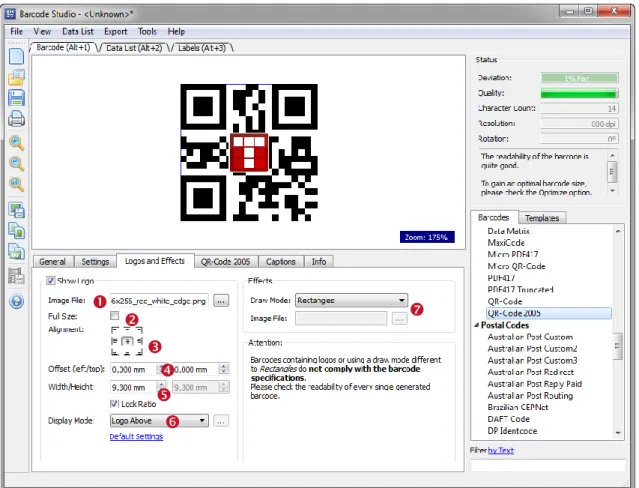
7.9 Page Logos and Effects
Figure 21: Logos and Effects 7.9.1 Logos
► Attention: The embedding of logos can endanger readability. We strictly recommend checking the readability of every single barcode.
► A change does make only sense for special applications like advertisements, fun barcodes, etc., that do not enforce the readability of the barcodes.
A logo can be displayed and changed only if “Show Logo” is checked.
7.9.1.1 Image File
Selection of the logo image file in .
7.9.1.2 Full Size
If checked the logo is stretched to the full size of the barcode (). In order to gain a useful result, you should also choose a suitable display mode.
7.9.1.3 Alignment
Defines the alignment and so the position of the logo within the barcode ().
7.9.1.4 Offset
The offset specifies the relative horizontal and vertical distance of the logo from the position given by the alignment ().
7.9.1.5 Width/Height, Lock Ratio
This setting defines the width and the height of the logo (). If “Lock Ratio” is checked, the ratio between width and height is retained when the size changes.
7.9.1.6 Display Mode
The display mode () specifies, how the logo shall be embedded into the barcode. You can choose among following options:
Logo Above The logo is drawn in front of the barcode. Logo Below The logo is drawn behind the barcode. Mask The logo is drawn only over the bars.
Custom Settings Detailed Settings by clicking . (see 7.9.2 Custom Display Settings)
7.9.1.7 Default Settings
By clicking “Default Settings” all logo settings are reset to default. 7.9.2 Custom Display Settings
Figure 22: Custom Display Settings
7.9.2.1 Display Mode
Set here the detailed display mode.
7.9.2.2 Logo Transparency
This setting defines the transparency of the logo in the range between opaque and invisible.
7.9.2.3 Transparency Color
Choosing of a single transparency color. If the selected color occurs in the logo, it is drawn transparently. (See also
in Figure 22 – white was chosen as transparency color ).7.9.3 Effects
7.9.3.1 Draw Mode
► Attention: For average use we strongly recommend to use only Draw Mode Rectangles.
Using another mode can endanger readability.
► A change does make only sense for special applications like advertisements, fun barcodes, etc., that do not enforce the readability of the barcodes.
The draw mode () specifies which shape the bars should have. Usually bars are drawn as rectangles – only this selection applies to the barcode standards. For special applications (like
Draw Mode Description
Rectangles Standard. Bars are drawn as rectangles.
Attention: For the average use we strongly suggest using only this setting.
Circles/Ellipses Bars are drawn as circles or ellipses depending on the outline of the bar.
Big Circles/Ellipses Like above, but the circles or ellipses are drawn a bit bigger. In matrix codes the circles overlap which increases the readability of the barcode in comparison to the settings
Circles/Ellipses.
Rounded Rectangles Bars are drawn as rectangles with rounded corners.
Images Bars are drawn as images. The name of the image file must be set in field Image File. Table 6: Draw Modes
7.9.3.2 Image File
If the user selects the drawing method Image, he has to enter the name of the image file (.bmp, .jpg, .gif, .png, .tif) here.
7.10 Page Captions
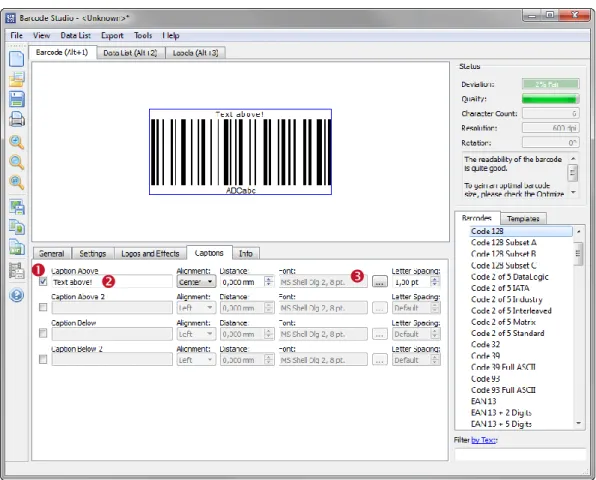
Figure 23: Captions
The texts which are specified here are printed above and below the barcode. Currently two captions above and two captions below the barcode are supported.
In order to print a caption, it must be activated. For each caption you can specify the content, the alignment, the text distance, and the font style.
7.10.1 Text Position
The checkboxes in allow you to activate one or more captions. The caption texts are printed in the following order (from top to bottom): Caption Above, Caption Above 2, barcode, Caption Below, Caption Below 2.
7.10.2 Text
In field you specify the caption text. 7.10.3 Alignment
This property adjusts the alignment of the human readable text (Left, Right, and Center). 7.10.4 Text Distance
This property specifies the distance to the next inner element: either to the barcode or to the next inner caption.
If the caption is adjacent to the barcode, then the Distance describes the space between the caption and the barcode. If an additional caption is located between the caption and the barcode, then the Distance describes the space between these two captions.
The distance may also be less than 0. So you can print captions within the barcode or on the same line with another caption.
7.10.5 Font
Click the button to select the font for the caption text. The selected font is displayed in the text box .
7.10.6 Letter Spacing
This property specifies the distance between two letters in points. The default value is 0.
7.11 Page Info
7.11.1 User Info
Figure 24: User Info Section
7.11.1.1 Title and Comment
Users can enter a title and a comment in HTML-Format. If specified, the title and the comment are displayed as info text below the barcode. The info text can be used to provide other users with important information.
Possible fields of application:
Give a short description of specific barcode settings. Provide information about the required input data format.
Advice other users to perform the necessary steps for the generation of correct barcodes. …
Figure 25: Info Text
To distribute settings with an info text, please perform following steps: ► Change all settings according to your needs.
► Enter the info text to the title/comment field. ► Save the settings to a file.
► Provide this file to all users who need it.
7.11.1.2 Template Category
The template category is used for categorizing templates in the Templates tree.
7.11.1.3 Keywords
The field Keywords contains information related to a template. It can be used as additional information for filtering the templates list.
7.12 2D Settings
7.12.1 PDF417 / Micro PDF417
Figure 26: PDF417 / Micro PDF417 Properties
The PDF417 / Micro PDF417 page is used for modifying the standard behavior of the 2-dimensional barcode types PDF417, Micro PDF417 and for all derived barcodes (PDF417 Truncated, etc.). PDF417 divides the data content into rows and columns. It is a so called “stacked symbology” with error correction capabilities.
► Be careful when modifying these adjustments. Always make a test scan in case of doubt!
7.12.1.1 Encoding Mode
Determine whether to enforce binary encoding. In Binary Encoding mode the encoding algorithm does not try to calculate the smallest possible symbol, but it uses binary encoding for all characters. This is recommended for binary input data and for barcode generation with optimal speed.
7.12.1.2 Rows [3..90]
The number of rows. This value must be between 3 and 90.
Default: The number of lines is calculated automatically based on the number of input characters. ► This property is not available for the Micro PDF417 symbology!
7.12.1.3 Columns [1..30]
The number of columns. The value must be between 1 and 30. Start-, stop- and line-indicator columns are not taken into account.
Default: The number of columns is calculated automatically based on the number of input charac-ters.
7.12.1.4 Row Height [mm]
The height of an individual row in millimeters. If specified, the barcode height will remain locked at the specified value. (Modifying the barcode dimensions will only affect the barcode width.)
7.12.1.5 Error Correction Level
The error correction level. The value can be between 0 (only error detection) and 8 (highest correction).
Default: The level is calculated automatically according to the number of input characters (minimum 2, maximum 5).
► This property is not available for the Micro PDF417 symbology!
7.12.1.6 Mode
Specifies how data is encoded as Micro PDF417. In most cases the “Default” mode is the best choice.
► Note: Often the scanner hardware does not support all modes listed below. – Please, check with your scanner first.
Mode (Enumeration) Description
Normal (Default) The input data is analyzed. Text, numeric or binary compaction mode will be used accor-dingly (to generate the smallest symbol).
UCC/EAN-128 Emulation UCC/EAN-128 Emulation mode. Transmit ]C1 or ]L3. Use compaction for Application Identifier (AI) "01" + 14 digits. Code128 Emulation Code-128 Emulation mode. Transmit ]C2 or ]L4.
Code128 FNC2 Emulation Code-128 with FNC2 on first position will be emulated. Linked UCC/EAN-128 Linked UCC/EAN-128 emulation. Transmit ]C1 or ]L3.
Indicates that the Micro PDF symbol is linked with a linear symbol (which may be required for a successful scan).
Using this mode, the following AIs can be encoded with better compaction in the given order:
Date (AI 11, 13, 15 or 17) + lot number (AI 10) + other AI’s (optional). Date (AI 11, 13, 15 or 17) + serial number (AI 21) + other AI’s (optional). Date (AI 11, 13, 15 or 17) + other AI’s (optional).
Note: This mode is not used with UCC EAN Composite Symbology (which uses linked symbols, too).
05 Macro The preamble [ ( > RS 0 5 GS precedes the encoded data. 06 Macro The preamble [ ( > RS 0 6 GS precedes the encoded data.
CC-A Data Mode For special applications only: use Base-928 compaction and process input data as byte array.
CC-B Data Mode For special applications only: use binary compaction (Base-900), prefix symbol data with reserved symbology code word.
Table 7: Micro PDF417 – Modes
► This property is not available for the PDF417 symbology!
7.12.1.7 Version
Specifies the “size” of the symbol in terms of code word-columns and Micro PDF417 rows. ► This property is not available for the PDF417 symbology!
7.12.1.8 Macro PDF417 (Structured Append)
PDF417 allows the user to spread the data across several symbols. This might be done if the data is too large to fit into a single symbol or for reasons of appearance and geometry.
The so called “Macro PDF Control Block” carries information that relates its contents to the overall data. The properties described below are mandatory for the Macro PDF functionality.
7.12.1.9 Segment Index
Index of the actual data segment in the symbol chain. It starts with 1 and is increased for each additional symbol in the data chain. Value range = 1…99999.
Note: when reading the encoded data with a scanner, the index will be zero-based.
7.12.1.10 Last Symbol
Identifies the last symbol in the data chain. If set to true, the “Last Segment Indicator” is put at the end of the Macro PDF control block.
7.12.1.11 File ID
The file id identifies all symbols, which belong to the same data chain. For reassembling, all data blocks having the same File ID are concatenated in the order of increasing segment index.
7.12.1.12 Optional Settings
These fields are optional and may be encoded into the Macro PDF417 control block on demand.
Figure 27: Macro PDF417 – Optional Settings
File name (alphanumeric) File name (variable length field).
Segment count (numeric) Total number of data segments (range 1…99999).
Time stamp (numeric) Time stamp (elapsed time in seconds since January 1, 1970 00:00 GMT).
Sender (alphanumeric) Sender (variable length field).
Addressee (alphanumeric) Addressee (variable length field).
File size (numeric) Total number of bytes encoded (variable length field).
Checksum (numeric) 16-Bit CRC checksum (using CCITT-16 polynomial x16 + x12 + x5 + 1 over the entire data).
7.12.2 MaxiCode
MaxiCode represents data, by drawing hexagonal items, which are arranged around a circular center (a so called "Bull's Eye"). The internal data structure is regulated by different "modes". The