SmartNode 4520 & 4110 Series
VoIP Gateway Routers
User Manual
Sales Office:+1 (301) 975-1000 Technical Support:+1 (301) 975-1007 E-mail:[email protected]
WWW:www.patton.com
Part Number: 07MD4524-GS, Rev. I Revised: June 21, 2012 Important
This is a Class A device and is intended for use in a light industrial environment. It is not intended nor approved for use in an industrial or residential environment.
Patton Electronics Company, Inc. 7622 Rickenbacker Drive Gaithersburg, MD 20879 USA tel: +1 (301) 975-1000 fax: +1 (301) 869-9293 support: +1 (301) 975-1007 web: www.patton.com e-mail: [email protected] Trademark Statement
The terms SmartWare and SmartView are trademarks of Patton Electronics Company. All other trademarks presented in this document are the property of their respective owners.
Copyright © 2012, Patton Electronics Company. All rights reserved. The information in this document is subject to change without notice. Patton Elec-tronics assumes no liability for errors that may appear in this document.
Warranty Information
The software described in this document is furnished under a license and may be used or copied only in accordance with the terms of such license.
Patton Electronics warrants all SmartNode router components to be free from defects, and will—at our option—repair or replace the product should it fail within one year from the first date of the shipment.
This warranty is limited to defects in workmanship or materials, and does not cover customer damage, abuse or unauthorized modification. If the product fails to perform as warranted, your sole recourse shall be repair or replacement as described above. Under no condition shall Patton Electronics be liable for any damages incurred by the use of this product. These damages include, but are not limited to, the following: lost profits, lost savings and incidental or consequential damages arising from the use of or inability to use this product. Patton Electronics specifically disclaims all other warranties, expressed or implied, and the installation or use of this product shall be deemed an acceptance of these terms by the user.
3
Table of Contents
Table of Contents ... 3
About this guide ... 6
Audience... 6
Structure... 6
Precautions... 7
Safety when working with electricity ...7
Preventing electrostatic discharge damage ...8
General observations ...9
Typographical conventions used in this document... 9
General conventions ...9
1 General information... 10
SmartNode Series VoIP routers overview...11
SmartNode 4520 Series router ...12
Ports descriptions ...14
Reset button behavior ...14
SmartNode 4110 Series router ...16
Ports descriptions ...18
Reset button behavior ...18
2 Applications overview... 20
Introduction...21
Applications for SmartNode 4110 Series...21
SIP and H.323 terminal and PSTN gateways ...21
Application—Analog line extension over IP ...22
Application—ITSP dial-in access ...22
Application—Private line automatic ringdown (PLAR) ...23
Application—Enterprise campus BRI to FXS telephony extension ...23
Application—PBX toll bypass gateway ...24
Applications for SmartNode 4520 Series...24
Application—SOHO off-premise extension ...25
Application—Single-phone PSTN and VoIP access ...26
3 Hardware installation... 27
Planning the installation...28
Installation checklist ...29 Site log ...30 Network information ...30 Network Diagram ...30 IP related information ...30 Software tools ...30 Power source ...30
4
SmartNode 4520 & 4110 Series User Manual Table of Contents
Location and mounting requirements ...31
Installing the gateway router...31
Mounting the gateway router ...31
Connecting cables ...31
Installing an interface cable on the router’s FXS and FXO interface ports ...32
Installing the Ethernet cable ...34
Connecting to external power source ...36
4 Getting started with the SmartNode... 38
Introduction...39
1. Configure IP address...40
Power connection and default configuration ...40
Connect with the serial interface ...40
Login ...41
Changing the IP address ...41
2. Connect the SmartNode to the network...42
3. Load configuration...42
Bootloader...43
Start Bootloader ...43
Start-up with factory configuration ...44
Load a new application image (SmartWare) via TFTP ...44
Load a new application image (SmartWare) via the serial link ...46
Additional information...46
5 LEDs status and monitoring... 47
Status LEDs...48
6 Contacting Patton for assistance... 51
Introduction...52
Contact information...52
Warranty Service and Returned Merchandise Authorizations (RMAs)...52
Warranty coverage ...52
Out-of-warranty service ...52
Returns for credit ...52
Return for credit policy ...53
RMA numbers ...53 Shipping instructions ...53 A Compliance ... 54 Compliance...55 EMC Compliance: ...55 Safety Compliance: ...55 PSTN Regulatory Compliance: ...55 CE Declaration of Conformity...55
Authorized European Representative...55
5
SmartNode 4520 & 4110 Series User Manual Table of Contents
FCC Part 68 (ACTA) Statement (FXO Ports)...56
Industry Canada Notice (FXO Ports)...56
B Specifications ... 58
DSP...59
Voice connectivity...59
Connectivity...59
Voice processing (signalling dependent)...59
Fax and modem support...59
Voice signalling...60
Voice routing—session router...60
IP services...60 Management...61 Operating environment...61 Operating temperature ...61 Operating humidity ...61 System...61 Dimensions...61
Weight and power dissipation...61
Power supply...62
AC version ...62
DC version ...62
Identification of the SmartNode devices via SNMP...62
C Cabling ... 64
Introduction...65
Serial console...65
Ethernet 10Base-T and 100Base-T...66
Analog FXS...68
Analog FXO...69
D Port pin-outs ... 70
Introduction...71
Console port...71
Ethernet 10Base-T and 100Base-T port...71
FXS port...72
FXO port...72
E SmartNode 4110 Series factory configuration ... 73
Introduction...74
F SmartNode 4520 Series factory configuration ... 75
Introduction...76
G Installation checklist ... 77
6
About this guide
This guide describes the SmartNode 4110 and 4520 Series hardware, installation and basic configuration. For detailed software configuration information refer to the SmartWare Software Configuration Guide and the avail-able Configuration Notes.
Audience
This guide is intended for the following users: • Operators
• Installers
• Maintenance technicians
Structure
This guide contains the following chapters and appendices:
• Chapter 1 on page 10 provides information about router features and capabilities • Chapter 2 on page 20 contains an overview describing router operation and applications • Chapter 3 on page 27 provides quick start hardware installation procedures
• Chapter 4 on page 38 describes getting started with the SmartNode router • Chapter 5 on page 47 contains definitions for the LED status indicators
• Chapter 6 on page 51 contains information on contacting Patton technical support for assistance • Appendix B on page 58 contains specifications for the routers
• Appendix C on page 64 provides cable recommendations • Appendix D on page 70 describes the router’s ports and pin-outs
• Appendix E on page 73 lists the factory configuration settings for SmartNode 4110 Series devices • Appendix F on page 75 lists the factory configuration settings for SmartNode 4520 Series devices • Appendix G on page 77 lists the tasks for installing a SmartNode 4520 or 4110 Series router For best results, read the contents of this guide before you install the router.
7
SmartNode 4520 & 4110 Series User Manual About this guide
Precautions
Notes and cautions, which have the following meanings, are used throughout this guide to help you become aware of potential Router problems. Warnings relate to personal injury issues, and Cautions refer to potential property damage.
Note Calls attention to important information.
Safety when working with electricity
The shock hazard symbol and WARNING heading indicate a potential electric shock hazard. Strictly follow the warning instructions to avoid injury caused by electric shock.
The alert symbol and WARNING heading indicate a potential safety hazard. Strictly follow the warning instructions to avoid personal injury.
The shock hazard symbol and CAUTION heading indicate a potential electric shock hazard. Strictly follow the instructions to avoid property damage caused by electric shock.
The alert symbol and CAUTION heading indicate a potential haz-ard. Strictly follow the instructions to avoid property damage.
The SmartNode contains no user serviceable parts. The equipment shall be returned to Patton Electronics for repairs, or repaired by qualified service per-sonnel.
Mains Voltage: Do not open the case when the power cord is connected. For systems without a power switch, line voltages are present within the power supply when the power cord is connected. The mains outlet that is utilized to power the SmartNode router shall be within 10 feet (3 meters) of the device, shall be easily accessible, and protected by a circuit breaker.
For AC powered units, ensure that the power cable used meets all applicable standards for the country in which it is to be installed, and that it is connected to a wall outlet which has earth ground.
WARNING WARNING CAUTION CAUTION WARNING WARNING WARNING
8
SmartNode 4520 & 4110 Series User Manual About this guide
Preventing electrostatic discharge damage
When starting to install interface cards place the interface card on its shielded plastic bag if you lay it on your bench.
For units with an external power adapter, the adapter shall be a listed Lim-ited Power Source.
Hazardous network voltages are present in WAN ports regardless of whether power to the SmartNode is ON or OFF. To avoid electric shock, use caution when near WAN ports. When detaching the cables, detach the end away from the SmartNode first.
Before opening the chassis, disconnect the telephone network cables to avoid contact with telephone line voltages. When detaching the cables, detach the end away from the SmartNode first.
Do not work on the system or connect or disconnect cables during periods of lightning activity.
In accordance with the requirements of council directive 2002/ 96/EC on Waste of Electrical and Electronic Equipment (WEEE), ensure that at end-of-life you separate this product from other waste and scrap and deliver to the WEEE collection system in your country for recycling.
Electrostatic Discharge (ESD) can damage equipment and impair electrical circuitry. It occurs when electronic printed circuit cards are improperly handled and can result in complete or intermit-tent failures. Do the following to prevent ESD:
• Always follow ESD prevention procedures when removing and replacing cards.
• Wear an ESD-preventive wrist strap, ensuring that it makes good skin contact. Connect the clip to an unpainted surface of the chassis frame to safely channel unwanted ESD voltages to ground.
• To properly guard against ESD damage and shocks, the wrist strap and cord must operate effectively. If no wrist strap is available, ground yourself by touching the metal part of the chassis. WARNING WARNING WARNING WARNING CAUTION
9
SmartNode 4520 & 4110 Series User Manual About this guide
General observations
• Clean the case with a soft slightly moist anti-static cloth • Place the unit on a flat surface and ensure free air circulation • Avoid exposing the unit to direct sunlight and other heat sources • Protect the unit from moisture, vapors, and aggressive liquids
Typographical conventions used in this document
This section describes the typographical conventions and terms used in this guide.General conventions
The procedures described in this manual use the following text conventions: Table 1. General conventions
Convention Meaning
Garamond blue type Indicates a cross-reference hyperlink that points to a figure, graphic, table, or sec-tion heading. Clicking on the hyperlink jumps you to the reference. When you have finished reviewing the reference, click on the Go to Previous View button in the Adobe® Acrobat® Reader toolbar to return to your starting point.
Futura bold type Commands and keywords are in boldface font.
Futura bold-italic type Parts of commands, which are related to elements already named by the user, are in boldface italic font.
Italicized Futura type Variables for which you supply values are in italic font Futura type Indicates the names of fields or windows.
Garamond bold type Indicates the names of command buttons that execute an action.
< > Angle brackets indicate function and keyboard keys, such as <SHIFT>, <CTRL>, <C>, and so on.
[ ] Elements in square brackets are optional.
{a | b | c} Alternative but required keywords are grouped in braces ({ }) and are separated by vertical bars ( | )
blue screen Information you enter is in blue screen font.
screen Terminal sessions and information the system displays are in screen font.
node The leading IP address or nodename of a SmartNode is substituted with node in
boldface italic font.
SN The leading SN on a command line represents the nodename of the SmartNode # An hash sign at the beginning of a line indicates a comment line.
10
Chapter 1
General information
Chapter contents
SmartNode Series VoIP routers overview...11
SmartNode 4520 Series router ...12
Ports descriptions ...14
Reset button behavior ...14
SmartNode 4110 Series router ...16
Ports descriptions ...18
SmartNode Series VoIP routers overview 11
SmartNode 4520 & 4110 Series User Manual 1 • General information
SmartNode Series VoIP routers overview
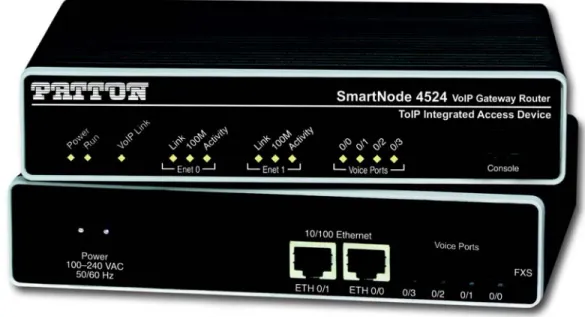
The SmartNode 4520 and 4110 Series VoIP Gateway Routers (see figure 1) combine IP routing, VPN/Secu-rity, and Quality of Service for up to 8 transparent voice and FAX calls over any IP or PSTN network. Leverage low-cost IP services with packet-voice for complete branch office voice and data connectivity.
Figure 1. SmartNode Router (SmartNode 4524 shown)
The SmartNode 4520 Series Gateway Routers, equipped with two 10/100Base-T Ethernet ports provide; voice over IP (VoIP) and Internet telephony plus Internet access routing, VPN and firewall functions, and extensive Quality of Service (QoS) functions.
The SmartNode 4110 Series Media Gateways, equipped with a single 10/100Base-T Ethernet port that pro-vide VoIP and Internet telephony.
The SmartNode VoIP Gateways and Gateway-Routers perform the following major functions:
• Voice over IP and local switching via a combination of 2 to 8 analog phone ports (FXS) and 2 to 4 analog line ports (FXO).
• Standard compliant VoIP conversion in accordance with SIP and H.323 protocols.
• Internet access and IP Routing (4520 Series only) with IP Quality of Service (QoS) support for mixed voice and data traffic.
Section “SmartNode 4520 Series router” on page 12 provides more information on the SmartNode 4520 Series. Section “SmartNode 4110 Series router” on page 16 describes the SmartNode 4110 Series.
SmartNode Series VoIP routers overview 12
SmartNode 4520 & 4110 Series User Manual 1 • General information
SmartNode 4520 Series router
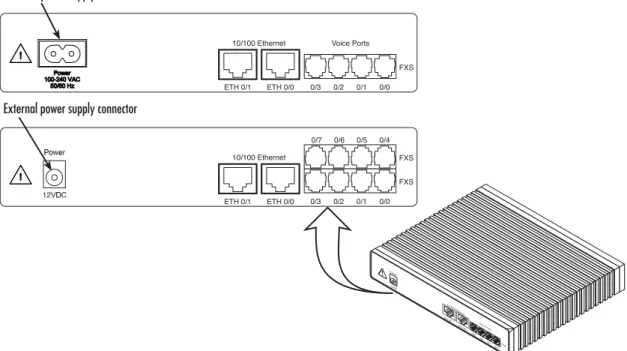
The SmartNode 4520 Series are compact VoIP Gateway Routers that support two to eight VoIP calls and var-ious combinations of FXS and FXO ports (see figure 2).
Figure 2. Examples of SN4520 Series rear panels
The following base models (each equipped with two 10/100Base-T Ethernet ports) are available: • SmartNode 4522 (2 VoIP calls)
• SmartNode 4524 (4 VoIP calls) • SmartNode 4526 (6 VoIP calls) • SmartNode 4528 (8 VoIP calls)
10/100 Ethernet 0/3 0/2 0/1 0/0 Voice Ports FXS
SmartNode Series VoIP routers overview 13
SmartNode 4520 & 4110 Series User Manual 1 • General information
The port combinations are indicated in the extension of the model code. The products the following model code conventions apply:
• JS stands for FXS ports • JO stands for FXO ports
• UI stands for integrated universal input power supply (see figure 3) • EUI stands for external universal input power supply (see figure 3)
For example, the model code SN4526/4JS2JO/EUI describes a SmartNode configured as follows: • 4 FXS ports
• 2 FXO ports
• External power supply
Note For a complete listing of available models, refer to the SmartNode VoIP page at http://www.patton.com/voip/.
SmartNode Series VoIP routers overview 14
SmartNode 4520 & 4110 Series User Manual 1 • General information
Ports descriptions
The SmartNode 4520 Series rear panel ports are described in table 2.
Reset button behavior
For those SmartNode devices that have a Reset button on the rear panel, its behavior is as follows:
• To restart the unit with the current startup configuration—Press for less than 1 second and release the Reset
button. The SmartNode will restart with the current startup configuration.
• To restart the unit with factory default configuration—Press the Reset button for 5 seconds until the Power LED starts blinking. The unit will restart with factory default configuration.
• To restart the unit in bootloader mode (to be used only by trained SmartNode technicians)—Start with the unit powered off. Press and hold the Reset button while applying power to the unit. Release the Reset button when the Power LED starts blinking so the unit will enter bootloader mode.
Table 2. Rear panel ports
Port Location Description
10/100 Ethernet ETH 0/0 & ETH 0/1
Rear panel RJ-45 connectors (see figure 16 on page 32) that connect the router to an Ethernet device (e.g., a cable or DSL modem, LAN hub or switch). Analog voice port,
FXS
Rear panel FXS RJ-11(6 position, 4 wire) connectors (see figure 16 on page 32) that connect the router with an analog terminal (a telephone, for example) FXO port. EuroPOTS support (ETSI EG201 188). FXS on-hook voltage is 48V for each FXS port.
Analog voice port, FXO
Rear panel FXO RJ-11(6 position, 4 wire) connectors (see figure 16 on page 32) that connect the router with an analog line (FXS port). EuroPOTS support (ETSI EG201 188).
Power Rear panel The gateway is available in a DC or AC power input version (see
figure 3), labeled as follows:
• AC version (Internal power supply): 100–240 VAC, 50/60 Hz, 200 mA • DC version: 12 VDC, 1.25 A
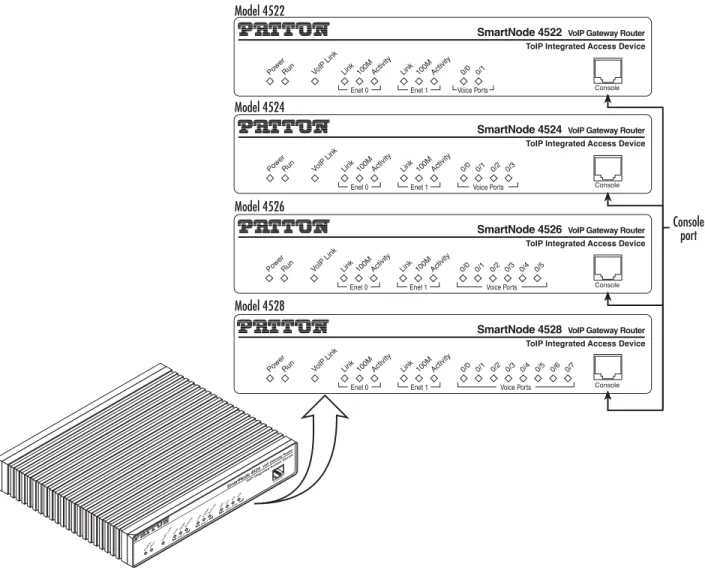
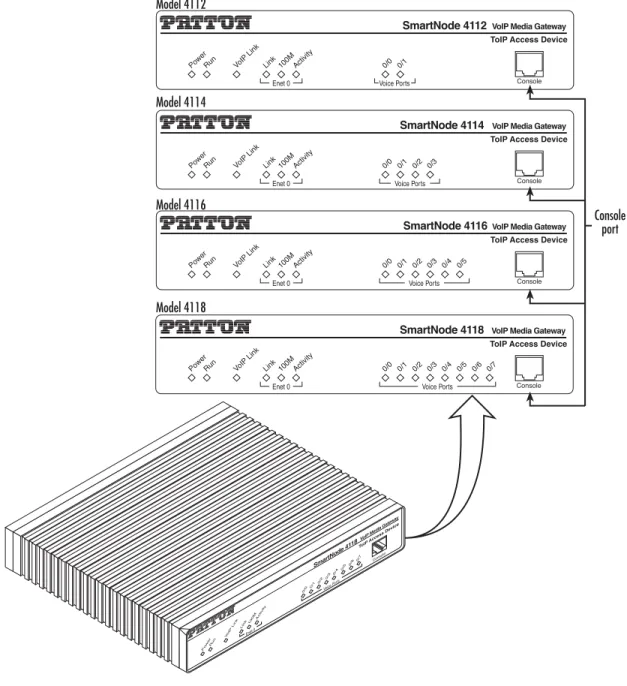
Console Front panel Used for service and maintenance, the Console port (see figure 4 on page 15), an RS-232 RJ-45 connector, connects the router to a serial terminal such as a PC or ASCII terminal (also called a dumb terminal).
SmartNode Series VoIP routers overview 15
SmartNode 4520 & 4110 Series User Manual 1 • General information
Figure 4. SmartNode 4520 Series front panels
Note For LED descriptions, refer to chapter 5, “LEDs status and monitor-ing” on page 47.
SmartNode Series VoIP routers overview 16
SmartNode 4520 & 4110 Series User Manual 1 • General information
SmartNode 4110 Series router
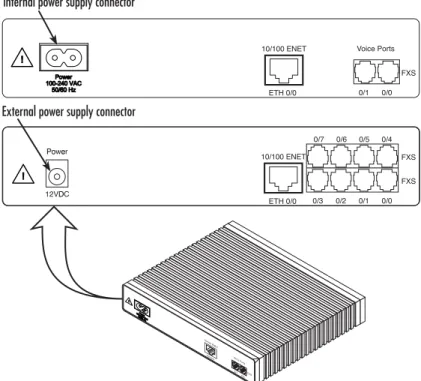
The SmartNode 4110 Series are compact VoIP Gateways that support two to eight VoIP calls and various combinations of FXS and FXO ports (see figure 5).
Figure 5. Examples of SN4110 Series rear panels
The following base models (each equipped with one 10/100Base-T Ethernet port) are available: • SmartNode 4112 (2 VoIP calls)
• SmartNode 4114 (4 VoIP calls) • SmartNode 4116 (6 VoIP calls) • SmartNode 4118 (8 VoIP calls)
0/3 0/2 0/1 0/0 Voice Ports FXS
SmartNode Series VoIP routers overview 17
SmartNode 4520 & 4110 Series User Manual 1 • General information
The port combinations are indicated in the extension of the model code. The products the following model code conventions apply:
• JS stands for FXS ports • JO stands for FXO ports
• UI stands for integrated universal input power supply (see figure 6) • EUI stands for external universal input power supply (see figure 6)
For example, the model code SN4116/4JS2JO/EUI describes a SmartNode configured as follows: • 4 FXS ports
• 2 FXO ports
• External power supply
Note For a complete listing of available models, refer to the SmartNode VoIP page at http://www.patton.com/voip/.
SmartNode Series VoIP routers overview 18
SmartNode 4520 & 4110 Series User Manual 1 • General information
Ports descriptions
The SmartNode 4110 Series rear panel ports are described in table 3.
Reset button behavior
For those SmartNode devices that have a Reset button on the rear panel, its behavior is as follows:
• To restart the unit with the current startup configuration—Press for less than 1 second and release the Reset
button. The SmartNode will restart with the current startup configuration.
• To restart the unit with factory default configuration—Press the Reset button for 5 seconds until the Power LED starts blinking. The unit will restart with factory default configuration.
• To restart the unit in bootloader mode (to be used only by trained SmartNode technicians)—Start with the unit powered off. Press and hold the Reset button while applying power to the unit. Release the Reset button when the Power LED starts blinking so the unit will enter bootloader mode.
Table 3. Rear panel ports
Port Location Description
10/100 Ethernet ETH 0/0
Rear panel RJ-45 connector (see figure 5 on page 16) that connects the router to an Ethernet device (a cable or DSL modem, LAN hub or switch, for example). Analog voice port,
FXS
Rear panel FXS RJ-11(6 position, 4 wire) connectors (see figure 16 on page 32) that connect the router with an analog terminal (a telephone, for example) FXO port. EuroPOTS support (ETSI EG201 188).
Analog voice port, FXO
Rear panel FXO RJ-11(6 position, 4 wire) connectors (see figure 16 on page 32) that connect the router with an analog line (FXS port). EuroPOTS support (ETSI EG201 188).
Power Rear panel The gateway is available in a DC or AC power input version (see
figure 6), labeled as follows:
• AC version (Internal power supply): 100–240 VAC, 50/60 Hz, 200 mA • DC version: 12 VDC, 1.25 A
Console Front panel Used for service and maintenance, the Console port (see figure 7 on page 19), an RS-232 RJ-45 connector, connects the router to a serial terminal such as a PC or ASCII terminal (also called a dumb terminal).
SmartNode Series VoIP routers overview 19
SmartNode 4520 & 4110 Series User Manual 1 • General information
Figure 7. SmartNode 4110 Series front panels
Note For LED descriptions, refer to chapter 5, “LEDs status and monitor-ing” on page 47.
20
Chapter 2
Applications overview
Chapter contents
Introduction...21
Applications for SmartNode 4110 Series...21
SIP and H.323 terminal and PSTN gateways ...21
Application—Analog line extension over IP ...22
Application—ITSP dial-in access ...22
Application—Private line automatic ringdown (PLAR) ...23
Application—Enterprise campus BRI to FXS telephony extension ...23
Application—PBX toll bypass gateway ...24
Applications for SmartNode 4520 Series...24
Application—SOHO off-premise extension ...25
Introduction 21
SmartNode 4520 & 4110 Series User Manual 2 • Applications overview
Introduction
Patton’s SmartNode Media Gateway Routers deliver the features you need for advanced multiservice voice and data network applications. They combine high quality voice-over-IP with powerful quality of service routing functions to build professional and reliable VoIP networks. This chapter describes typical applications for which the SmartNodes are uniquely suited.
Note Detailed configuration information for SmartNode applications can be found online at www.patton.com/smartnode.
Applications for SmartNode 4110 Series
The SmartNode 4110 Series device, equipped with a single Ethernet port, provides gateway and over-IP line extension services.
SIP and H.323 terminal and PSTN gateways
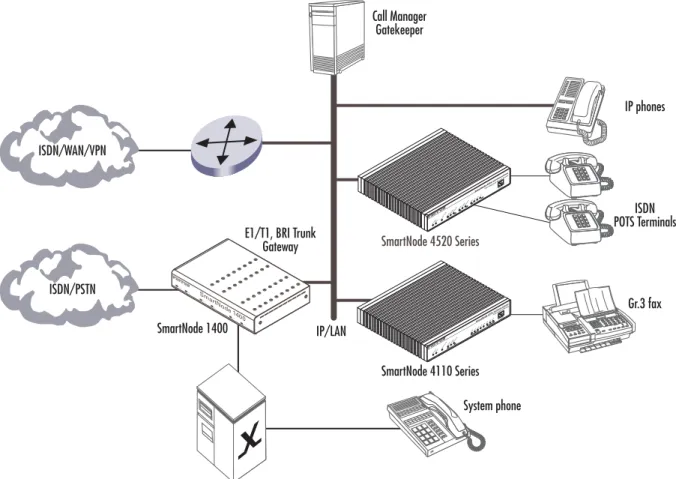
All models provide voice-over-IP and FAX-over-IP services for integration into a VoIP network running the SIP or H.323 protocol (see figure 8). The SmartNode 4110 Series supports automatic registration to a Gatekeeper or SIP server to provide analog extension services or PSTN breakout connectivity.
Applications for SmartNode 4110 Series 22
SmartNode 4520 & 4110 Series User Manual 2 • Applications overview
Application—Analog line extension over IP
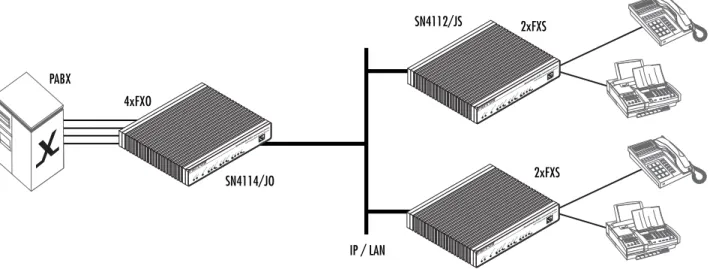
A virtual analog line can be created using an FXO and FXS model (see figure 9). The complete signaling and media (voice, fax, or modem) of the analog phone line is extended over IP. This enables a PBX analog exten-sion line to be extended to a home office or satellite office. The analog line extenexten-sion relays DTMF, hook-flash and CLI to provide full PBX feature access over the IP network (checking voice mail or joining a calling group, for example).
Figure 9. Analog line extension Application—ITSP dial-in access
An ITSP can use the SmartNode FXO gateways as dial-in access points to his Internet telephony services (see
figure 10). A user calls a local number, the FXO SmartNode picks up the call and uses a second dial-tone to dial the remote number. The system can be enhanced with a central call control server providing IVR announcements, PIN checking, and accounting for the calls.
Figure 10. ITSP dial-in access
Console
VoIP Gateway Router
ToIP Integrated Access Device SmartNode 4524 Link 100M Activity 0/0 0/10/2 0/3 Enet 0 Voice Ports Power Run VoIP Link Link 100M Activity Enet 1 Console
VoIP Gateway Router ToIP Integrated Access Device SmartNode 4524 Link 100MActivity 0/00/1 0/2 0/3 Enet 0 Voice Po rts Power Run VoIP Link Link100M Activity Enet 1 Console
VoIP Gateway Router ToIP Integrated Access Device SmartNode 4524 Link100M Activity 0/0 0/1 0/20/3 Enet 0 Voice Ports Power Run VoIP Link Link 100M Activity Enet 1 Console
VoIP Gateway Router ToIP Integrated Access Device SmartNode 4524 Link 100MActivity 0/00/1 0/2 0/3 Enet 0 Voice Ports Power Run VoIP Link Link100M Activity Enet 1 Console
VoIP Gateway Router ToIP Integrated Access Device SmartNode 4524 Link 100MActivity 0/00/1 0/2 0/3 Enet 0 Voice Ports Power Run VoIP Link Link100M Activity Enet 1
Applications for SmartNode 4110 Series 23
SmartNode 4520 & 4110 Series User Manual 2 • Applications overview
Application—Private line automatic ringdown (PLAR)
A private hot-line can be created by using two FXS models back-to-back (see figure 11). These can be found in use as courtesy phones at ATM’s, information kiosks, and emergency assistance pedestals. In this applica-tion, when one handset is picked-up, the remote handset immediately begins ringing. When the remote handset is picked-up, the speech path is completed. The end-to-end link supports voice, fax Gr.3 (2.4–14.4 kbps) with T.38 or fax- and modem bypass using a G.711 codec.
Figure 11. FXS to FXS Hotline
Application—Enterprise campus BRI to FXS telephony extension
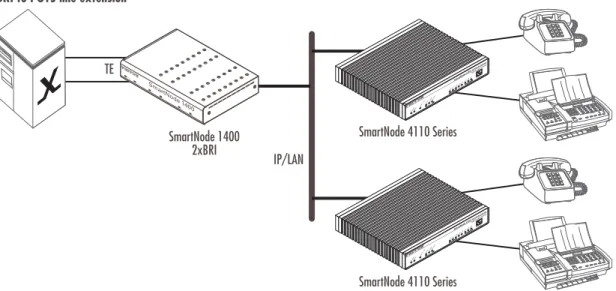
In combination with the Patton SmartNode 1000 and 2000 Series models the FXS gateways provide ISDN BRI to FXS extensions over IP (see figure 12).
Applications for SmartNode 4520 Series 24
SmartNode 4520 & 4110 Series User Manual 2 • Applications overview
Application—PBX toll bypass gateway
The gateways can be used to provide toll bypass over an IP WAN (see figure 13). The call routing in this case is provided by the PBX systems. A call routed to the FXS gateway can be relayed on a port-to-port basis or depending on the dialed-number to the remote gateway.
Note With the use of FXS ports, extension dialing on the secondary side must be done by using two-stage dialing (DTMF relay) or a call attendant. DID is not available when using a SmartNode FXS port connected to a PBX FXO port.
Figure 13. Toll bypass
Applications for SmartNode 4520 Series
SmartNode 4520 Series devices have dual 10/100Base-T Ethernet ports. The two Ethernet ports provide full featured IP routing between LAN and WAN plus Ethernet and IP layer QoS services. Voice prioritization and traffic management avoid network congestion and provide optimal voice quality. With these additional fea-tures the SmartNode 4520 series can add Internet access and data networking to any of the SmartNode 4110 Series applications described previously. The following sections show some typical combined
Applications for SmartNode 4520 Series 25
SmartNode 4520 & 4110 Series User Manual 2 • Applications overview
Application—SOHO off-premise extension
For a SOHO/telecommuter, the SmartNode 4520 Series router can provide an off-premise extension to the corporate network (see figure 14). Along with the analog line extension features, the SmartNode provides Internet access and VPN connectivity to the main office. In this configuration, the remote user will appear to be local and can take advantage of services available to local telephony and LAN users (such as file-server access, station-to-station dialing, outside trunk access, and voice mail). Additionally, the home user can take advantage of corporate dialing rates.
Figure 14. Home office networking Console
VoIP Gateway Router
ToIP Integrated Access Device SmartNode 4524 Link100M Activity 0/0 0/1 0/20/3 Enet 0 Voice Ports Power Run VoIP Link Link 100M Activity Enet 1 Console
VoIP Gateway Router
ToIP Integrated Access Device SmartNode 4524 Link100M Activity 0/0 0/1 0/20/3 Enet 0 Voice Ports Power Run VoIP Link Link 100M Activity Enet 1
Applications for SmartNode 4520 Series 26
SmartNode 4520 & 4110 Series User Manual 2 • Applications overview
Application—Single-phone PSTN and VoIP access
The SmartNode 4520 Series with a combination of FXS and FXO ports can be used to make and receive calls via PSTN and Internet calling services over the same telephone handset (see figure 15). Using individually con-figurable routing tables, an outbound call can be directed to the local PSTN connection or to an Internet tele-phony service provider (ISTP). Inbound calls from the Internet and the PSTN can ring the same phone.
Figure 15. Single-phone access Console
VoIP Gateway Router
ToIP Integrated Access Device SmartNode 4524 Link100M Activity 0/0 0/1 0/20/3 Enet 0 Voice Ports Power Run VoIP Link Link 100M Activity Enet 1
27
Chapter 3
Hardware installation
Chapter contents
Planning the installation...28
Installation checklist ...29 Site log ...30 Network information ...30 Network Diagram ...30 IP related information ...30 Software tools ...30 Power source ...30
Location and mounting requirements ...31
Installing the gateway router...31
Mounting the gateway router ...31
Connecting cables ...31
Installing an interface cable on the router’s FXS and FXO interface ports ...32
Installing the Ethernet cable ...34
Planning the installation 28
SmartNode 4520 & 4110 Series User Manual 3 • Hardware installation
Planning the installation
Before you start the actual installation, it is strongly recommended that you gather all the information needed to install and setup the device. See table 4 for an example of what pre-installment checks you might need to carry out. Having carried out the pre-installation checks enables you to install and set up your gateway router into an existing infrastructure with confidence.
Note When setting up your gateway router consider cable length limitations, and potential electromagnetic interference (EMI) as defined by the applicable local and international regulations. Ensure that your site is properly prepared before beginning installation.
Before installing the gateway router device, the following tasks should be completed:
• Create a network diagram (see section “Network information” on page 30)
• Gather IP related information (see section “IP related information” on page 30 for more information)
• Install the hardware and software needed to configure the SmartNode. (See section “Software tools” on
page 30)
• Verify power source reliability (see section “Power source” on page 30).
When you finish preparing for gateway router installation, go to section “Installing the gateway router” on page 31 to install the device.
The mains outlet that is utilized to power the equipment must be within 1 foot (3 meters) of the device and shall be easily accessible. CAUTION
Planning the installation 29
SmartNode 4520 & 4110 Series User Manual 3 • Hardware installation
Installation checklist
The installation checklist (see table 4) lists the tasks for installing a SmartNode 4520 or 4110 Series router. Make a copy of this checklist and mark the entries as you complete each task. For each SmartNode 4520 or 4110 Series router, include a copy of the completed checklist in your site log.
Table 4. Installation checklist
Task Verified by Date
Network information available & recorded in site log Environmental specifications verified
Site power voltages verified Installation site pre-power check completed
Required tools available Additional equipment available All printed documents available SmartWare release & build number verified Rack, desktop, or wall mounting of chassis completed
Initial electrical connections established ASCII terminal attached to console port
Cable length limits verified Initial configuration performed
Planning the installation 30
SmartNode 4520 & 4110 Series User Manual 3 • Hardware installation
Site log
Patton recommends that you maintain a site log to record all actions relevant to the system, if you do not already keep such a log. Site log entries should include information such as listed in table 5.
Network information
Network connection considerations that you should take into account for planning are provided for several types of network interfaces are described in the following sections.
Network Diagram
Draw a network overview diagram that displays all neighboring IP nodes, connected elements and telephony components.
IP related information
Before you can set up the basic IP connectivity for your SmartNode 4000 series you should have the following information:
• IP addresses used for Ethernet LAN and WAN ports • Subnet mask used for Ethernet LAN and WAN ports • IP addresses of central H.323 Gatekeeper (if used)
• IP addresses of central PSTN Gateway for H.323 and/or ISoIP based calls • IP addresses of central TFTP Server used for configuration upload and download
Software tools
You will need a PC (or equivalent) with a VT-100 emulation program (e.g. HyperTerminal) to configure the software on your SmartNode router.
Power source
If you suspect that your AC power is not reliable, for example if room lights flicker often or there is machinery with large motors nearby, have a qualified professional test the power. Install a power conditioner if necessary.
Table 5. Sample site log entries
Entry Description
Installation Make a copy of the installation checklist and insert it into the site log Upgrades and maintenance Use the site log to record ongoing maintenance and expansion history
Configuration changes Record all changes and the reasons for them Maintenance Schedules, requirements, and procedures performed
Comments Notes, and problems
Installing the gateway router 31
SmartNode 4520 & 4110 Series User Manual 3 • Hardware installation
Location and mounting requirements
The SmartNode router is intended to be placed on a desktop or similar sturdy, flat surface that offers easy access to the cables. Allow sufficient space at the rear of the chassis for cable connections. Additionally, you should consider the need to access the unit for future upgrades and maintenance.
Installing the gateway router
SmartNode gateway router installation consists of the following:
• Placing the device at the desired installation location (see section “Mounting the gateway router” on page 31)
• Installing the interface and power cables (see section “Connecting cables” on page 31)
When you finish installing the SmartNode, go to chapter 4, “Getting started with the SmartNode” on page 38.
Mounting the gateway router
Place the router on a desktop or similar sturdy, flat surface that offers easy access to the cables. The router should be installed in a dry environment with sufficient space to allow air circulation for cooling.
Note For proper ventilation, leave at least 2 inches (5 cm) to the left, right, front, and rear of the SmartNode gateway router.
Connecting cables
Installing router cables takes place in the following order:
1. Installing the RJ-11 voice port (FXS) cable or cables (see “Installing an interface cable on the router’s FXS and FXO interface ports”)
2. Installing the 10/100 Ethernet port cable or cables (see “Installing the Ethernet cable” on page 34)
3. Installing the power input (see “Connecting to external power source” on page 36)
Do not work on the system or connect or disconnect cables during periods of lightning activity.
The Interconnecting cables shall be acceptable for external use and shall be rated for the proper application with respect to volt-age, current, anticipated temperature, flammability, and mechanical serviceability.
WARNING
Installing the gateway router 32
SmartNode 4520 & 4110 Series User Manual 3 • Hardware installation
Installing an interface cable on the router’s FXS and FXO interface ports
The gateway comes with at least two FXS or FXO analog ports—or a combination of FXS and FXO ports—(see
figure 16) located on the back of the router. The FXS interfaces are connected to analog devices via cables (see
figure 17) terminated with RJ-11 connectors (see figure 19 and table 6 on page 33 for pin-out information). The FXO interface connects the router with analog lines via cables (see figure 18 on page 33) terminated with RJ-11 connectors (see figure 19 and table 6 on page 33 for pin-out information).
Figure 16. Rear view showing location of Ethernet and FXS connectors (SmartNode 4520 shown)
Installing the gateway router 33
SmartNode 4520 & 4110 Series User Manual 3 • Hardware installation
Figure 18. Analog FXO connection
Figure 19. RJ-11 pinout diagram Table 6. RJ-11 socket Pin Signal 3 Ring (-) 4 Tip (+) 10/100 Ethernet ETH 0/0 ETH 0/1 0/3 0/2 0/1 0/0 Voice Ports FXS
Installing the gateway router 34
SmartNode 4520 & 4110 Series User Manual 3 • Hardware installation
Note Unit must not connect directly to telecom network voltage (TNV).
Installing the Ethernet cable
The SmartNode 4520 Series has automatic MDX (auto-cross-over) detection and configuration on the Ether-net ports. Any of the two ports can be connected to a host or hub/switch with a straight-through wired cable (see figure 20 on page 34). Ethernet devices (10Base-T or 100Base-T) are connected to the SmartNode’s Ethernet ports (see table 7 for port pin-out listing) via a cable terminated with RJ-45 plugs. Because the Smart-Node 4110 Series does not have the MDX feature, a cross-over cable is required when connecting SmartSmart-Node 4110 Series devices to a host (see figure 21 on page 35).
Note Pins not listed are not used.
Figure 20. Connecting a SmartNode 4110 Series device to a hub Table 7. Ethernet 10/100Base-T (RJ-45) port pin-outs (SmartNode 4110 Series)
Pin Signal
1 TX+
2
TX-3 RX+
RX-Installing the gateway router 35
SmartNode 4520 & 4110 Series User Manual 3 • Hardware installation
Installing the gateway router 36
SmartNode 4520 & 4110 Series User Manual 3 • Hardware installation
Connecting to external power source
The router comes with an internal or external power supply. This section describes installing the power cord into the router. Do the following:
Note Do not connect the power cord to the power outlet at this time.
1. If your unit is equipped with an internal power supply, go to step 2. Otherwise, insert the barrel type con-nector end of the AC power cord into the external power supply concon-nector (see figure 22).
2. Insert the female end of the power cord into the internal power supply connector (see figure 22).
Figure 22. Power connector location on rear panel
The terminal block header to which the wires are secured pro-vides the disconnect for the SmartNode. Take proper measures to ensure that it is not permanently fastened to the receptacle mounted on the chassis.
Installing the gateway router 37
SmartNode 4520 & 4110 Series User Manual 3 • Hardware installation
3. Verify that the AC power cord included with your router is compatible with local standards. If it is not, refer to “Contacting Patton for assistance” on page 51 to find out how to replace it with a compatible power cord.
4. Connect the male end of the power cord to an appropriate power outlet.
Figure 23. Router front panel LEDs and Console port locations (SmartNode 4524 shown) 5. Verify that the green Power LED is lit (see figure 23).
Congratulations, you have finished installing the SmartNode Gateway Router! Now go to chapter 4, “Getting started with the SmartNode” on page 38.
The router power supply automatically adjusts to accept an input voltage from 100 to 240 VAC (50/60 Hz).
Verify that the proper voltage is present before plugging the power cord into the receptacle. Failure to do so could result in equipment damage.
38
Chapter 4
Getting started with the SmartNode
Chapter contents
Introduction...39
1. Configure IP address...40
Power connection and default configuration ...40
Connect with the serial interface ...40
Login ...41
Changing the IP address ...41
2. Connect the SmartNode to the network...42
3. Load configuration...42
Bootloader...43
Start Bootloader ...43
Start-up with factory configuration ...44
Load a new application image (SmartWare) via TFTP ...44
Load a new application image (SmartWare) via the serial link ...46
Introduction 39 SmartNode 4520 & 4110 Series User Manual 4 • Getting started with the SmartNode
Introduction
This chapter leads you through the basic steps to set up a new SmartNode and to download a configuration. Patton SmartNodes can be used for a wide variety of IP-based network applications. To support and ease the configuration of the SmartNodes configuration, templates for the most important applications are available on the Patton server at www.patton.com/voip.
The main steps for setting up a new SmartNode (as of release 2.00 or 2.10) are shown in figure 24.
1. Configure IP address 40 SmartNode 4520 & 4110 Series User Manual 4 • Getting started with the SmartNode
1. Configure IP address
Power connection and default configuration
First the SmartNode must be connected to the mains power supply with the power cable. Wait until the 'Run' LED stops blinking and lights constantly. Now the SmartNode is ready.
The factory default configuration for the Ethernet interface IP addresses and network masks are listed in table 8.
Both Ethernet interfaces are activated upon power-up.
If these addresses match with those of your network, go to section “2. Connect the SmartNode to the network”
on page 42. Otherwise, refer to the following sections to change the addresses and network masks.
Connect with the serial interface
The Console port is wired as an EIA-561, RS-232 port. Use the included Model 16F-561 adapter and cable (see
figure 25) between the SmartNode’s Console port and a PC or workstation’s RS-232 serial interface. Activate the terminal emulation program on the PC or workstation that supports the serial interface (e.g. HyperTerm).
Figure 25. Connecting to the terminal Terminal emulation program settings:
• 9600 bp • no parity
The Interconnecting cables shall be acceptable for external use and shall be rated for the proper application with respect to volt-age, current, anticipated temperature, flammability, and mechanical serviceability.
Table 8. Factory default IP address and network mask configuration
IP Address Network Mask
Interface Ethernet 0 (ETH0) DHCP DHCP
Interface Ethernet 1 (ETH1) 192.168.1.1 255.255.255.0
CAUTION Console VoIP Gateway Router ToIP Integrated Access Device SmartNode 4524 Link 100M Activity 0/0 0/1 0/2 0/3 Enet 0 Voice Po rts Power Run VoIP Link Link 100M Activity Enet 1
1. Configure IP address 41 SmartNode 4520 & 4110 Series User Manual 4 • Getting started with the SmartNode
• 8 bit • 1 stop bit • No flow control
Login
Accessing your SmartNode via the local console port (or via a Telnet session) causes the login screen to display. Type the factory default login: administrator and leave the password empty. Press the Enter key after the pass-word prompt.
login:administrator password: <Enter> 172.16.40.1>
After you have successfully logged in you are in the operator execution mode, indicated by > as command line prompt. With the commands enable and configure you enter the configuration mode.
172.16.40.1>enable 172.16.40.1#configure 172.16.40.1(cfg)#
Changing the IP address
Select the context IP mode to configure an IP interface.
172.16.40.1(cfg)#context ip router 172.16.40.1(ctx-ip)[router]#
Now you can set your IP address and network mask for the interface eth0. Within this example a class C net-work (172.16.1.0/24) is assumed. The IP address in this example is set to 172.16.1.99 (you should set this to an unused IP address on your network).
172.16.40.1(ctx-ip)[router]#interface eth0
172.16.40.1(if-ip)[eth0]#ipaddress 172.16.1.99 255.255.255.0 2002-10-29T00:09:40 : LOGINFO : Link down on interface eth0. 2002-10-29T00:09:40 : LOGINFO : Link up on interface eth0. 172.16.1.99(if-ip)[eth0]#
Copy this modified configuration to your new start-up configuration. Upon the next start-up the system will initialize itself using the modified configuration.
172.16.1.99(if-ip)[eth0]#copy running-config startup-config 172.16.1.99(if-ip)[eth0]#
2. Connect the SmartNode to the network 42 SmartNode 4520 & 4110 Series User Manual 4 • Getting started with the SmartNode
2. Connect the SmartNode to the network
Depending whether you connect the SmartNode to a host directly or via a hub or switch either straight-through wired or cross-over cables must be used (see figure 26).
Note The SmartNode 4520 Series is equipped with Auto-MDX Ethernet ports. Use straight-through or cross-over cables for host or hub/switch connections. The SmartNode 4110 will require the proper cable as it does not have the MDX feature.
Figure 26. Connecting the SmartNode to the network You can check the connection with the ping command to another host on the local LAN.
172.16.1.99(if-ip)[eth0]#ping <IP Address of the host>
Respectively from the host: ping 172.16.1.99
Note To ping outside your local LAN, you will need to configure the default gateway.
3. Load configuration
Download a configuration note to your PC from the support page of Patton’s Inalp web server
(http://www.inalp.ch/en/support/confignotes/) that matches your application. Adapt the configuration as described in the configuration note to your network (do not forget to modify the IP address) and copy the modified configuration to a TFTP server. The SmartNode can now load its configuration from this server. In this example we assume the TFTP server on the host with the IP address 172.16.1.11 and the configuration named SN.cfg in the root directory of the TFTP server.
172.16.1.99(if-ip)[eth0]#copy tftp://172.16.1.11/SN.cfg startup-config
Download...100%
The Interconnecting cables shall be acceptable for external use and shall be rated for the proper application with respect to volt-age, current, anticipated temperature, flammability, and mechanical serviceability.
Bootloader 43 SmartNode 4520 & 4110 Series User Manual 4 • Getting started with the SmartNode
172.16.1.99(if-ip)[eth0]#
After the SmartNode has been rebooted the new start up configuration will be activated.
172.16.1.99(if-ip)[eth0]#reload
Running configuration has been changed.
Do you want to copy the 'running-config' to the 'startup-config'?
Press 'yes' to store, 'no' to drop changes : no
Press 'yes' to restart, 'no' to cancel : yes
The system is going down
Bootloader
The bootloader ensures that basic operations, network access, and downloads are possible in case of interrupted or corrupted application image downloads. It also offers console access to the Bootloader and the capability for downloading application images (e.g. SmartWare) via the serial link of the console.
Start Bootloader
To start the Bootloader, power on the SmartNode while pressing the reset button. Open a Telnet session to the SmartNode via one of the Ethernet interfaces, or open a CLI session via the console port (if available on the SmartNode). The login display will appear. Using the credentials admin / patton, log in to the SmartNode. The following prompt will be displayed:
RedBoot>
Bootloader 44 SmartNode 4520 & 4110 Series User Manual 4 • Getting started with the SmartNode
Start-up with factory configuration
Load a new application image (SmartWare) via TFTP
The following procedure downloads the application image (SmartWare) for the mainboard. See the note below on how to download the respective CLI description file.
Step Command Purpose
1 RedBoot> fis load Copies the SmartWare application image from the
persistent memory (flash:) to the volatile memory (RAM) from where it will be executed.
2 RedBoot> go -s factory-config Starts the SmartWare application telling it to use
‘factory-config’ as startup configuration.
You can also start-up with any other configuration available in the persistent memory (nvram:) by pro-viding its name instead of ‘factory-config’.
Step Command Purpose
1 optional
RedBoot> ip_address - l
local_ip_address [/mask_len]
Sets the IP address and subnet mask of the Ethernet interface 0/0 which shall be used to receive the new application image.
mask_len is the length of the network address (or the number of 1’s within the subnet mask). See Note below.
2 optional
RedBoot> ip_address -g gateway Sets the IP address of the default gateway.
3 optional
RedBoot> ping -h tftp-server_ip_address Tests the connectivity to the TFTP server.
4 RedBoot> load -r -v -h host -b
base_address file_name
Downloads an application image into the vola-tile memory (RAM) from where the SmartNode could directly execute it.
host: IP address of the TFTP server
base_address: memory location where to store the application image. Use the default address 0x1800100
file_name: path and name of the file on the TFTP server. Note: use the image file that con-tains the whole application, not the image parts.
5 RedBoot> fis delete -n 1 Deletes the first application image. Reply with ‘y’ to the confirmation request.
6 RedBoot> fis create Stores the downloaded application image to the permanent memory (flash:).
Reply with ‘y’ to the confirmation request.
7 RedBoot> fis list -l Checks whether the image has been success-fully stored, whether it is the desired Release and Build, and whether it is valid.
Bootloader 45 SmartNode 4520 & 4110 Series User Manual 4 • Getting started with the SmartNode
Note With the Bootloader, only the Ethernet interface 0/0 is available. The Boot-loader applies the IP address, subnet mask, and default gateway that were last configured by the Bootloader itself or by another application (e.g. Smart-Ware). If an application configured the Ethernet interface 0/0 to use DHCP, the Bootloader will also use DHCP to learn the interface configuration. It can receive and apply the IP address, subnet mask, default gateway, and default (TFTP) server (transmitted as basic DHCP information ‘Next server IP address’).
Note This procedure does not download the respective CLI description file. Download it after starting up SmartWare with the following command:
copy tftp://<tftp_server_address>/<server path>/b1 flash:
Example: Downloading and storing a new application image (SmartWare)
RedBoot> ip -l 172.16.40.98/19 RedBoot> ip -g 172.16.32.1 RedBoot> ping -h 172.16.32.100
Network PING - from 172.16.40.98 to 172.16.32.100 ...PING - received 10 of 10 expected
RedBoot> load -r -v -h 172.16.32.100 -b 0x1800100 /Sn4xxx/image.bin Using default protocol (TFTP)
-Raw file loaded 0x01800100-0x0199ca6b, 1689964 bytes, assumed entry at 0x01800100 RedBoot> fis delete -n 1
Delete image 1 - continue (y/n)? y
... Erase from 0x60030000-0x601cc974: ... RedBoot> fis create
Use address 0x01800100, size 1684402 ? - continue (y/n)? y ... Erase from 0x60030000-0x601cb3ba: ... ... Program from 0x00011eec-0x00011ef4 at 0x60030000: .
... Program from 0x01800100-0x0199b4b2 at 0x60030008: ... ... Program from 0x00011eec-0x00011ef4 at 0x60030000: .
Image successfully written to flash RedBoot> fis list -l
Id Address Length State Description Entry Load Addr Version
---1 0x60030000 ---1693438 valid SmartWare R2.---10 BUILD280---15 0x01800100 0x01800100 V2.10
RedBoot> go
Starting 'SmartWare R2.10 BUILD28015' at 0x01800100 via 0x01800100
8 RedBoot> go Starts the application image that was
down-loaded into the volatile memory (RAM).
Additional information 46 SmartNode 4520 & 4110 Series User Manual 4 • Getting started with the SmartNode
Load a new application image (SmartWare) via the serial link
The Bootloader supports the ‘X-Modem’ and ‘Y-Modem’ protocols to download application images via the serial link of the console. Do the following to initiate the download:
Note This type of download takes about 25 minutes since it uses a serial link at only 9600 bps.
Additional information
For detailed information about configuring and operating guidance, set up procedures, and troubleshooting, refer to the SmartNode Series SmartWare Software Configuration Guide available online at www.patton.com/ manuals.
Step Command Purpose
1 RedBoot> load -r -v -m {
xmodem | ymodem } -b
base_address
Downloads an application image into the volatile memory (RAM) from where the SmartNode could directly execute it. ‘xmodem’ or ‘ymodem’: Specify the protocol to be used, X-Modem or Y-X-Modem
base_address: memory location where to store the application image. Use the default address 0x1800100
Execute the above RedBoot command first, then start the trans-fer from the terminal program with the command ‘Send file via X-Modem’ (or similar).
5 RedBoot> fis delete -n 1 Deletes the first application image. Reply with ‘y’ to the confirmation request.
6 RedBoot> fis create Stores the downloaded application image to the permanent memory (flash:).
Reply with ‘y’ to the confirmation request.
7 RedBoot> fis list -l Checks whether the image has been successfully stored, whether it is the desired Release and Build, and whether it is valid.
8 RedBoot> go Starts the application image that was downloaded to the vola-tile memory (RAM).
47
Chapter 5
LEDs status and monitoring
Chapter contents
Status LEDs 48 SmartNode 4520 & 4110 Series User Manual 5 • LEDs status and monitoring
Status LEDs
This chapter describes SmartNode gateway router front panel LEDs. Figure 27 shows SmartNode 4520 Series LEDs, figure 28 on page 49 shows SmartNode 4110 Series LEDs. LED definitions are listed in table 9 on page 50.
Status LEDs 49 SmartNode 4520 & 4110 Series User Manual 5 • LEDs status and monitoring
Status LEDs 50 SmartNode 4520 & 4110 Series User Manual 5 • LEDs status and monitoring
Table 9. SmartNode LED Indications
LED Description
Note If an error occurs, all LEDs will flash once per second.
Power When lit, indicates power is applied. Off indicates no power applied.
Run When lit, indicates normal operation. Flashes once per second during boot (startup).
VoIP Link When lit, indicates the gateway is registered on a gatekeeper, media gateway
con-troller, associated to a remote unit, or has an active VoIP connection. Off indicates the unit is not configured or registered and has no active VoIP connection. Flashing green indicates that the unit is attempting or has failed to associate/register
FXS (each port) Off indicates on-hook condition. Solid green when off-hook. Flashes to follow ring cadence.
FXO (each port) Off indicates on-hook condition. Solid green when off-hook. Flashes to follow ring cadence.
Ethernet (each port) • Link: Lit when Ethernet link is up.
• 100M: On when 100-Mbps Ethernet is selected.
51
Chapter 6
Contacting Patton for assistance
Chapter contents
Introduction...52
Contact information...52
Warranty Service and Returned Merchandise Authorizations (RMAs)...52
Warranty coverage ...52
Out-of-warranty service ...52
Returns for credit ...52
Return for credit policy ...53
RMA numbers ...53
Introduction 52 SmartNode 4520 & 4110 Series User Manual 6 • Contacting Patton for assistance
Introduction
This chapter contains the following information:
• “Contact information”—describes how to contact Patton technical support for assistance.
• “Warranty Service and Returned Merchandise Authorizations (RMAs)”—contains information about the RAS warranty and obtaining a return merchandise authorization (RMA).
Contact information
Patton Electronics offers a wide array of free technical services. If you have questions about any of our other products we recommend you begin your search for answers by using our technical knowledge base. Here, we have gathered together many of the more commonly asked questions and compiled them into a searchable database to help you quickly solve your problems:
• Online support—available at www.patton.com
• E-mail support—e-mail sent to [email protected] will be answered within 1 business day
• Telephone support—standard telephone support is available five days a week—from 8:00 am to 5:00 pm
EST (1300 to 2200 UTC)—by calling +1 (301) 975-1007
Warranty Service and Returned Merchandise Authorizations (RMAs)
Patton Electronics is an ISO-9001 certified manufacturer and our products are carefully tested before ship-ment. All of our products are backed by a comprehensive warranty program.Note If you purchased your equipment from a Patton Electronics reseller, ask your reseller how you should proceed with warranty service. It is often more con-venient for you to work with your local reseller to obtain a replacement. Patton services our products no matter how you acquired them.
Warranty coverage
Our products are under warranty to be free from defects, and we will, at our option, repair or replace the prod-uct should it fail within one year from the first date of shipment. Our warranty is limited to defects in work-manship or materials, and does not cover customer damage, lightning or power surge damage, abuse, or unauthorized modification.
Out-of-warranty service
Patton services what we sell, no matter how you acquired it, including malfunctioning products that are no longer under warranty. Our products have a flat fee for repairs. Units damaged by lightning or other catastro-phes may require replacement.
Returns for credit
Customer satisfaction is important to us, therefore any product may be returned with authorization within 30 days from the shipment date for a full credit of the purchase price. If you have ordered the wrong equipment or you are dissatisfied in any way, please contact us to request an RMA number to accept your return. Patton is not responsible for equipment returned without a Return Authorization.
Warranty Service and Returned Merchandise Authorizations (RMAs) 53 SmartNode 4520 & 4110 Series User Manual 6 • Contacting Patton for assistance
Return for credit policy
• Less than 30 days: No Charge. Your credit will be issued upon receipt and inspection of the equipment. • 30 to 60 days: We will add a 20% restocking charge (crediting your account with 80% of the purchase price). • Over 60 days: Products will be accepted for repairs only.
RMA numbers
RMA numbers are required for all product returns. You can obtain an RMA by doing one of the following: • Completing a request on the RMA Request page in the Support section at www.patton.com
• By calling +1 (301) 975-1007 and speaking to a Technical Support Engineer • By sending an e-mail to [email protected]
All returned units must have the RMA number clearly visible on the outside of the shipping container. Please use the original packing material that the device came in or pack the unit securely to avoid damage during shipping.
Shipping instructions
The RMA number should be clearly visible on the address label. Our shipping address is as follows:
Patton Electronics Company
RMA#: xxxx
7622 Rickenbacker Dr.
Gaithersburg, MD 20879-4773 USA
Patton will ship the equipment back to you in the same manner you ship it to us. Patton will pay the return shipping costs.
54
Appendix A
Compliance
Chapter contents Compliance...55 EMC Compliance: ...55 Safety Compliance: ...55 PSTN Regulatory Compliance: ...55 CE Declaration of Conformity...55Authorized European Representative...55
Radio and TV Interference (FCC Part 15)...56
FCC Part 68 (ACTA) Statement (FXO Ports)...56
Compliance 55
SmartNode 4520 & 4110 Series User Manual A • Compliance
Compliance
EMC Compliance: • FCC Part 15, Class A • EN55022, Class A • EN55024 Safety Compliance: • UL60950-1/CSA C22.2 No. 60950-1 • IEC 60950-1 • EN60950-1 • AS/NZS 60950-1 PSTN Regulatory Compliance: • FCC Part 68 • CS-03 • TBR 21 • AS/ACIF S002 • AS/ACIF S003CE Declaration of Conformity
We certify that the apparatus identified in this document conforms to the requirements of Council Directive 1999/5/EC on the approximation of the laws of the member states relating to Radio and Telecommunication Terminal Equipment and the mutual recognition of their conformity.
The safety advice in the documentation accompanying this product shall be obeyed. The conformity to the above directive is indicated by the CE sign on the device.
Authorized European Representative
D R M GreenEuropean Compliance Services Limited. Oakdene House, Oak Road Watchfield,