Portfolio Management:
Tools and Practices for Regulators
Prepared by:
William Steinhurst, David White, Amy Roschelle, Alice Napoleon, Rick Hornby, and Bruce Biewald Synapse Energy Economics
22 Pearl Street, Cambridge, MA 02139 www.synapse-energy.com
617-661-3248
Prepared for:
National Association of
Regulatory Utility Commissioners
Table of Contents
1. Introduction and Summary ... 1
1.1. Background and Purpose ... 1
1.2. What is Portfolio Management? ... 3
1.3. How Might PM be Applied to Particular Retail Electricity Markets?... 5
1.4. Key Conclusions ... 6
2. Portfolio Management: Objectives and Applications... 9
2.1. Portfolio Management Can Be Used to Achieve Public Policy Objectives in a Transparent Manner ... 9
2.2. Portfolio Management Can Be Applied under Any Market Structure and Regulatory Framework ... 10
2.2.1. Application of Portfolio Management in Fully Regulated Markets11 2.2.2. Applying PM in Retail Competition Markets ... 12
2.3. Portfolio Management Provides a Process and Set of Tools for Examining Complex Resource Planning and Procurement Issues... 13
3. Confronting Uncertainty and Risk... 16
3.1. Two Contexts for Portfolio Management ... 16
3.2. Integrating IRP and PM Concepts ... 17
3.3. Organizational Issues ... 19
3.4. Making and Communicating Choices about Risk Management... 20
3.5. Techniques for Analyzing Risk Exposure and Uncertainty... 22
3.5.1. Measuring Risk and Expected Benefit ... 22
3.5.2. Considering Risk in the Assessment of Resource Choices ... 27
3.5.3. Tools for Mitigating Risk ... 28
4. Tools and Data for Portfolio Management... 29
4.1. Overview... 29
4.2. Tools Available for Portfolio Management ... 29
4.2.1. Load Forecasting ... 30
4.2.2. Price Forecasting ... 31
4.2.3. Integrated System Planning... 31
4.2.4. Risk Analysis... 31
4.2.5. Managing Financial Resources and Contracts ... 31
4.3. Strengths and Deficiencies of Tools for Resource Planning and Procurement 32 4.4. Things to Consider Before Selecting Software... 33
4.5. Data Requirements for PM ... 34
5. Expertise and Staffing for Portfolio Management... 36
5.1. Staffing and Expertise for Portfolio Managers ... 36
5.2. Staffing and Expertise for Regulators... 37
6. Conclusion ... 38 Appendix A: Supply Acquisition Strategies For Default Service In States With
Retail Access
Appendix B: Integrated Resource Planning Practices in Regulated States Appendix C: Models and Tools for Portfolio Management
Acknowledgments
The authors would like to thank the National Association of Regulatory Utility Commissioners, the U.S. Department of Energy's Office of Electricity Delivery and Energy Reliability, the New York State Energy Research and Development Authority, and the Energy Foundation for funding this effort. We would also like to thank the following individuals for their invaluable comments on drafts of this report.
Raj Addepalli, New York Department of Public Service Barbara Alexander, Consumer Affairs Consultant
Annunciata Marino, Pennsylvania Public Utility Commission
Nicolas Garcia, Washington Utilities and Transportation Commission Frank Graves and Phil Hanser, The Brattle Group
Cheryl Harrington, Regulatory Assistance Project Jerrold Oppenheim, Consultant
Richard Rosen, Tellus Institute
Commissioner Richard Morgan, District of Columbia Public Service Commission Peter Zschokke, National Grid
We are grateful for the many hours of discussion and advice provided by the many
commission and utility staff who agreed to be interviewed for this project. We would also like to thank the Commissioners and staff representatives on the NARUC Energy
Resources and Environment Committee and Miles Keogh of the NARUC staff all provided invaluable input and support.
The views and opinions expressed herein are those of the authors and do not necessarily represent those of any of the reviewers.
1. Introduction and Summary
1.1. Background
and
Purpose
Ensuring that reliable retail electric service is being provided at reasonable rates is more challenging than ever.
The providers of the generation component of that retail service, regardless of the presence or absence of retail competition, face a host of major uncertainties. These include high and volatile natural gas prices, uncertain wholesale power prices,
uncertainty regarding the feasibility and economics of new generation capacity, and a wide range of possible environmental regulation futures, particularly with respect to greenhouse gas emissions. Providers must address those uncertainties when choosing supply strategies, resource mix, and ownership or contracting arrangements.
Regulators are faced with the difficult task of aligning resource plans and procurement strategies with the policy objectives of their particular jurisdiction. Those policy
objectives may include enhancing reliability, managing risk, improving the performance of wholesale and retail markets and achieving reasonable rates. In other words, they must determine whether the proposed resource plans and procurement strategies represent “the best” choices from the full range of viable alternative plans and strategies, given their objectives.
Regulators face these challenges both in jurisdictions with retail competition and fully regulated states. Some states, such as Delaware, have recently enacted legislation mandating changes to procurement policies.1 Others have grappled with these issues in various regulatory proceedings to institute new or updated procurement policies. Examples of recent relevant cases and proceedings in states with, or introducing, retail competition include:
• Illinois—Commerce Commission Docket 05-0159, Commonwealth Edison Auction, Dockets 05-0160, 0161 and 0162, Ameren Utilities
• Delaware—Executive Order No. 82
Examples of recent relevant cases and proceedings in vertically integrated states include:
• California—Rulemakings 01-10-024 and 04-04-003
• Oregon—Public Utility Commission Dockets UM-1056 and UM-1066 regarding IRP Policy
• Montana—Montana Administrative Rules, sub-chapter 20: Least Cost Planning—Electric Utilities. 38.5.2004
The parties to such proceedings must grapple with a number of questions at both a broad and detailed level. Broad questions that arise include:
1
• What level of price volatility is tolerable for customers, taking into account the means at their disposal for managing that risk?
• How can portfolio management help address public interest concerns regarding the level and stability of electricity prices?
• Over what timeframe will the proposed strategy apply?
• What level and stability of prices are expected to result during that time?
• What are the key assumptions underlying those expectations?
• How sensitive is the expected level and/or stability of prices to a change in those assumptions?
• What flexibility is there to modify the strategy in response to changes in demand or supply conditions; at what points in time is that possible; and what is the process for doing so?
• What alternative strategies were or should be considered, including energy efficiency, demand response, and renewable energy resources?
• How do those alternative strategies compare in terms of level, stability, and sensitivity of prices to changes in assumptions?
More detailed questions can also arise, such as:
• What quantity of supply should be sought in each procurement and for what contract duration(s)?
• What portions of supply should be acquired through utility-owned generation, short-term purchases (e.g. day ahead markets), short- or long-term fixed price contracts, contracts for output from renewable energy resources, and
investments in energy efficiency and demand side management (DSM)?
• When and how often should auctions, RFPs, or other procurements be held?
• How should auctions or procurements be designed to attract bids from providers of energy efficiency and renewable resources in addition to traditional supply side resources?
• Will the proposed strategy limit the ability to respond to carbon emission policies in the future?
• Will the proposed strategy limit the ability to respond to newly available resources, projects, or technologies in the future?
• Will the proposed strategy result in long-term commitments that have a high probability of exposing the provider or its customers to material stranded costs in the future?
The advantage to a portfolio management (PM) approach is that it provides regulators, utilities, and other parties with a systematic process and set of tools to answer such
questions in a transparent manner. Not only can PM reveal input data and assumptions, it can also identify and quantify the trade-offs between objectives under alternative
strategies.
The primary purpose of this paper is to provide regulators with an overview of PM tools and practices that could be applied to the procurement of electricity resources to serve retail customers.2 As will be seen, these tools and practices are valuable both in the resource planning of vertically integrated (or partially integrated) utilities and in the development and oversight of policies for default service in retail competition
jurisdictions. The report only briefly reviews the benefits of PM, as a number of other reports have described the benefits of portfolio management in detail.3 The paper then explains how PM can be implemented in states that are fully regulated as well as in states with retail competition Finally, it presents a discussion of several key technical aspects of applying PM, including modeling tools, analytical techniques, and necessary expertise.
1.2.
What is Portfolio Management?
The term “portfolio management” has a long history in the realms of finance and investment. Under that name and others, the same risk management concepts and techniques have long been applied to procurement of commodities, including electric utility procurement of fuels and purchased power and local distribution company (LDC) procurement of natural gas.4 In recent years, the term has begun to be used in the electric industry to describe actual or suggested approaches to default service resource planning and procurement in states that have restructured their electric industry.5 However,
application of portfolio management concepts need not be confined to retail choice states. First, interest in development of a set of modern planning and procurement tools for application in the electric industry has been evolving over the last several years. In its 2003 resolution on PM, the National Association of Regulatory Utility Commissioners (NARUC) encouraged state regulatory commissions to
... explore portfolio management techniques that may be applicable to their particular circumstances, under either traditional or restructured markets, and to adopt appropriate regulatory policies to facilitate effective implementation of portfolio management practices by regulated utilities.
2
Many electric utilities and load serving entities are familiar with these tools and practices, as noted earlier. 3 See, for example, Bruce Biewald, et al, Portfolio Management: How to Procure Electricity Resources to
Provide Reliable, Low-Cost, and Efficient Electricity Services to All Retail Customers Synapse Energy Economics, October, 2003. Prepared for the Regulatory Assistance Project and the Energy Foundation. Available at http://www.synapse-energy.com/Downloads/SynapseReport.2003-10.RAP.Portfolio-Management.03-24.pdf
4
Biewald, et al., and Frank C. Graves, et al., Resource Planning and Procurement in Evolving Energy Markets, The Brattle Group, prepared for The Edison Electric Institute, January 31, 2004.
5
In retail choice jurisdictions, various names are applied to this concept. Some of those are Basic
Generation Service, Standard Offer Service, Provider of Last Resort service or POLR, and Basic Utility Service. Unless discussing the regime in a particular jurisdiction, we will use these terms
In a 2004 report on resource planning and procurement in electricity markets sponsored by the Edison Electric Industry (EEI), the authors stated, “A synthesis is needed to meet customer needs for risk management and least-cost planning in the evolving industry structure that is a hybrid of competition and regulation.”6
Second, there is increasing interest in meeting future electricity requirements through a diverse mix of cost-effective resources, including energy efficiency, non-traditional renewable resources, and new technologies such as distributed generation, in addition to traditional supply side resources. For example, the Energy Policy Act of 2005 (EPAct) requires consideration of a fuel source diversity standard.7 Also, fuel diversity has been a major topic at both the 2005 and 2006 annual “Commissioners Only Summit” sponsored by National Regulatory Research Institute (NRRI). More recently, in July 2006, the President of NARUC and the Chair of EEI introduced a National Action Plan for Energy Efficiency that identifies energy efficiency as a high-priority energy resource.
This interest in applying a modern set of analytical tools to the acquisition of a diverse range of traditional and non-traditional resources is reflected in the following definition of PM, drawn from a 2006 report on clean energy policies and best practices prepared by the United States Environmental Protection Agency (EPA):
Portfolio management refers to energy resource planning that
incorporates a variety of energy resources, including supply-side (e.g., traditional and renewable energy sources) and demand-side (e.g., energy efficiency) options. The term "portfolio management" has emerged in recent years to describe resource planning and procurement in states that have restructured their electric industry. However, the approach can also include the more traditional integrated resource planning (IRP) approaches applied to regulated, vertically integrated utilities.
Thus, portfolio management as applied in the electric industry may be seen as an approach to or refinement of traditional utility resource planning, which draws upon integrated resource planning, resource procurement, and risk management.8 As such, PM encompasses three distinct components:
• developing a resource plan,
• procuring the portfolio of resources identified in that plan, and
• managing that portfolio of resources on an ongoing basis.
6
Graves, p. 3.
7
EPAct 2005 Title XII Electricity, Subtitle E, Amendments to PURPA §1251(a). 8
Not all concepts, tools and practices from financial markets can be applied directly to electric markets; some may not apply while others may need to be customized. Conversely, many of the products and tools relevant to electricity portfolio management are unique to that industry.
1.3. How Might PM be Applied to Particular Retail Electricity
Markets?
PM can be, and is being, applied in a variety of ways. In fact, the spectrum of approaches to implementing PM ranges from a narrow, passive approach at one end of the spectrum to a comprehensive, active approach at the other.
• A narrow, passive approach might be one in which planning considers only a short time frame and few resources, there is a single annual process for
purchasing 100% of requirements, and periodic reviews and updates are absent.
• A comprehensive, activeapproach might be one in which resources are selected from a broad range of resources based on multi-year, long-term scenario analysis, and procured under a variety of ownership and contracting arrangements. Under a comprehensive approach, decision-making would reflect the cost and risk
minimization benefits of diversification – diversity of fuels, diversity of
technologies, including energy efficiency and renewables, diversity of contract terms and conditions (such as start dates and durations) and diversity of financial instruments for risk management. It would also include active or ongoing
management of portfolio resources in response tochanges in customer
requirements and market conditions from day to day, week to week and month to month.
In any given state, the policy framework and objectives that govern the retail electric market, particularly electricity supply service, will be a key factor in the choice of a PM approach from this spectrum. For example, if the explicit policy objective of a state is to strongly encourage the development of a competitive retail market for all customers, the regulator may choose to support a narrow, passive PM approach for default service so that service will be relatively unattractive or provide maximum scope for retailers to differentiate themselves. On the other hand, if the explicit policy objective is reasonable rates to all customers receiving regulated retail service, the regulator may choose a comprehensive, active PM approach for default service. Similarly, a state's policy framework may assign responsibilities in certain ways, for example relying on an
Independent System Operator (ISO) or Regional Transmission Operator (RTO) to ensure reliability. The application of PM must take such divisions of responsibility into account. Given the variation in policy objectives among the states, it is not surprising that the retail competition states exhibit a range of approaches to portfolio management. Some states have essentially no PM. In other states a narrow, passive approach is being applied to the procurement and management of resources for default service. Appendix A presents key characteristics of default service procurement in the states that we surveyed. That
approach typically consists of the following components:
• a procurement strategy using fixed-price, slice-of-load contracts of one or more term lengths up to three years, possibly overlapping in a laddered sequence,9
9
In some jurisdictions, slightly longer initial term lengths were used to synchronize procurement with ISO or RTO planning and commitment cycles.
• procurement via (usually) annual auctions or request for proposals (RFPs), and
• absence of ongoing resource management between annual auctions.
There is little evidence of quantitative analysis of risks and benefits underlying the design of these procurement strategies. When contract laddering is the sole procurement tool used, it provides only limited portfolio management benefits, which are realizable only over only the length of that ladder, sometimes a very short time frame. Some states are beginning to address this limitation through new laws that explicitly try to obtain low costs over the long-term for their smaller default service customers. A variety of means have been adopted or are under discussion for this purpose. Maine, Delaware, and Maryland have each taken such steps. (See Appendix A of this report for details.) The general goal of the new policies is essentially to achieve reasonable and stable rates for default service. As a result, regulators in those states are beginning to explore ways to move to a more comprehensive, active approach.
The fully regulated states we surveyed had a comprehensive, active approach to portfolio management. Data from this survey is presented in Appendix B. In these states some form of long-term planning, which in some cases might be called "IRP," is required every few years. Procurement is not tied to an annual cycle of auctions, and ongoing
management is expected. On the other hand, while planning in most of those jurisdictions included some analyses of uncertainty generally in the form of "sensitivity analyses," extensive quantitative analysis of the risks of various alternatives from a customer or public policy perspective was not the rule.
1.4. Key
Conclusions
Our key conclusions are as follows:
• The providers of the generation component of retail electricity service face a host of major uncertainties, including future restrictions on emissions of carbon dioxide and future natural gas prices.
• Portfolio management, as applied to the provision of retail electric service, encompasses development of a resource plan, procurement of the portfolio of resources identified in that plan, and management of that portfolio of resources on an ongoing basis.
• Portfolio management provides regulators, utilities, and other parties with a systematic process and analytical tools for identifying a plan that will result in reliable service at reasonable rates. It offers transparency and tools for dealing with uncertainty and risk.
• Portfolio management can be applied to the generation component of retail service, regardless of the presence or absence of retail competition. Portfolio management approaches can be selected from a continuum ranging from comprehensive and active or narrow and passive.
• A narrow, passive approach to portfolio management may expose retail customers to rates that are higher or more volatile, than a comprehensive, active approach. A
strategy composed of a diverse mix of cost-effective resources, including energy efficiency and non-traditional renewable resources, may provide the best balance of expected cost and stable rates over the long-term.
• The policy framework and objectives that govern the retail electric market in a state influence the choice of an approach to PM in that state. Subject to policy constraints, regulators generally have authority to determine how portfolio management will be applied and by what entity.
• There is a range of computer models available for PM. They include planning models capable of addressing either (1) traditional cost-based engineering
optimization analysis of the expected costs of long-range portfolios of traditional supply-side resources,10 (2) scenario-based comparisons of long-range portfolios of traditional resources for "robustness," or (3) short- to near-term quantitative risk analysis of a wide range of physical resources and financial instruments. Most quantitative risk analysis models are financial tools that analyze risk from the perspective of the supplier rather than retail customers.
• Most of these planning models require special effort in order to include energy efficiency and renewable energy in their evaluation of resources. In addition, these tools would benefit from improving their methodologies for analyzing long-term risks and comparing long-long-term decisions under uncertainty. For example, some existing optimization models require the representation of system operation to be simplified and limit the number of resources that can be considered in a model run. Such modeling constraints can prevent the long-term costs and benefits to consumers of a diverse mix of resources from being evaluated fully. Regulators may wish to promote research and development on improvements in these areas.
• Multiple modeling tools may be needed to address all three components of PM. However, integrating their results may be challenging.
• It appears that insufficient attention is being paid to development of tools for realistic analysis of long-term risks and long-term comparison of resource options that take uncertainty into account. Regulators may wish to promote research and development of open source algorithms or software in these areas.
• Staffing and resource limitations, as well as general lack of familiarity and acceptance, may be challenges to implementing or overseeing portfolio
management at regulatory commissions. Regulators can do much to reduce such barriers over time.
• Portfolio management analysis and implementation will only be as good as the people who carry out and oversee those tasks. Managers and regulators need to consider the skills and abilities for doing so.
10
Models driven by optimization techniques may also lack fidelity in imperfect markets and situations where decision making and investment practices are suboptimal, as is often the case.
• It is not clear that the data necessary for portfolio management in the electric utility industry exist in all cases. Where it does exist, the data may be private and confidential. Certainly, some historical data series are publicly available, such as fossil fuel market prices and, more recently, electricity and weather hedge prices. Other data, such as load profiles and volatility, plant outage rates, and heat rates may be less available than in the past due to competitive pressures. Regulators and utilities can begin with data that is available, publicly or under confidentiality arrangements. They also may wish to identify new information that should be developed to maximize the feasibility and usefulness of risk analysis.
• The application of certain elements of portfolio management in the electric industry is still relatively new. Some fully regulated states and some retail choice states have begun to take action, but there is much room for improvement and certainly room for more states to implement PM. Regulators can play an important role in encouraging further improvements in, and adoption of, these concepts. Regulators may wish to promote the development of portfolio management tools that can address energy efficiency and renewable energy resources to the same degree as traditional supply-side resources at every stage of the process.
• Screening out or winnowing down major diversification options very early in a planning study or risk assessment can seriously compromise the results. The real value of those options may not become apparent until much later in those studies or assessments, when analyses of risk and uncertainty are prepared.
• Regulators will likely need to exercise considerably more oversight of risk
mitigation, in the future. Unfortunately, clear methods for conceptualizing risk in utility portfolio management are not well developed. Regulators may wish to consider exploratory proceedings to develop and communicate risk management and portfolio management goals and criteria.
2. Portfolio Management: Objectives and
Applications
Portfolio management is a process and a set of tools that can be applied in order to
achieve objectives specified by the user. It needs to be informed with the goals and values regulators want pursued.
This section presents a brief overview of the public policy objectives that regulators may seek to achieve through the application of portfolio management, as well as the manner in which portfolio management can be applied under various market structures.
2.1. Portfolio Management Can Be Used to Achieve Public
Policy Objectives in a Transparent Manner
The broad public policy objective that regulators traditionally sought to achieve with respect to retail electricity markets was reliable service at reasonable rates. This policy objective was typically set out explicitly, either in legislation or regulations. Some states changed these broad objectives when they implemented retail competition. More
recently, some states with retail competition have passed new legislation effectively requiring default service to be provided at reasonable rates. For the purposes of this report we will focus on the objectives of reliable service at reasonable rates.
Reliable service at reasonable rates is not a new objective. Regulators have a long history of reviewing utility plans and operations to determine if they satisfy that objective. Out of that history many states have developed explicit, quantitative benchmarks for certain aspects of reliable service against which regulators can assess utility plans and
operations. One such benchmark is a loss of load probability (LOLP) of one day in ten years for generating capacity adequacy.
In contrast, there are no generally accepted quantitative benchmarks for “reasonable rates.” Instead, the criteria for reasonable rates vary. This variation is driven by many factors such as differences in the availability of resources and differences in regulatory policy tradeoffs. Regulators consider a number of facts and objectives when making energy policy decisions and in determining whether rates are reasonable. Those facts and objectives vary from state to state, as do the weights that regulators apply to them. Facts and objectives that regulators in most states consider when assessing whether retail electric service rates are, or will be, reasonable include:
• The resource options commercially available,
• The costs of those resource options,
• Whether the proposed mix of resource options minimizes costs to ratepayers (i.e., minimum rates and bills), and
• Whether the proposed mix of resource options will result in stable costs to ratepayers (i.e., stable rates and bills).
Regulators may also consider fuel diversity targets, renewable energy targets, carbon dioxide targets, other environmental goals, service to low-income customers, impacts on the local economy, and flexibility to respond to major changes in market conditions and public policies over time.
The desire to achieve multiple objectives often complicates the determination of whether rates are reasonable, because the objectives are often conflicting. For example, one strategy might be to minimize costs for the year by purchasing all generation supplies from a spot (e.g., day ahead) wholesale market. This strategy might be premised upon a belief that a strategy that included any multi-month contracts at fixed prices would incur extra risk premium costs on average in the long run. On the other hand, this hypothetical purchasing strategy could result in very volatile costs that would necessitate some sort of routine rate true-up mechanism, and, as a result, lead to highly volatile rates for
customers. A second, alternative strategy might be to stabilize rates by acquiring all supplies via long-term fixed price bilateral contracts, say through a single procurement for 100% of requirements. This alternative hypothetical strategy stabilizes rates and simplifies administration, but could result in higher expected costs than the first strategy on average over time if, for example, sellers of fixed price contracts wish to and can obtain a risk premium in return for that price certainty. Neither hypothetical strategy would satisfy both objectives of minimum costs and stable costs. In contrast, a third hypothetical strategy consisting of a mix of spot purchases and fixed price contracts might partially satisfy both objectives in a balanced manner, trading off somewhat higher costs in exchange for somewhat more stable costs, and vice versa (again, assuming that fixed price term contracts require payment of a risk premium).
One major way in which states differ is the timeframe or planning horizon over which they assess the reasonableness of the rate impacts of resource decisions. In some states regulators assess reasonableness over a short-term time frame, one to three years for example. In others regulators consider the implications of the strategy and resource mix underlying the rates over the long-term of five to twenty years, as well as assess the resulting rates expected over the short-term.
Portfolio management provides regulators, utilities, and other parties to these determinations with a process, and set of tools, to select a strategy that will result in reliable service at reasonable rates and to do so in a transparent manner. Not only can it reveal input data and assumptions, it can also identify and quantify the trade-offs between objectives under alternative strategies. That transparency can, in turn, assist regulators in determining the weight to apply to each objective.
2.2. Portfolio Management Can Be Applied under Any Market
Structure and Regulatory Framework
The market structures and regulatory frameworks governing electricity supply service to retail customers vary from state to state. For the purposes of this report, those structures can be grouped under one of two broad frameworks – fully regulated or retail
competition. For simplicity, this discussion will consider the retail competition
framework to be a fully developed one where the provider of default service (usually the distribution company) is not allowed to retain a generation or merchant power function.
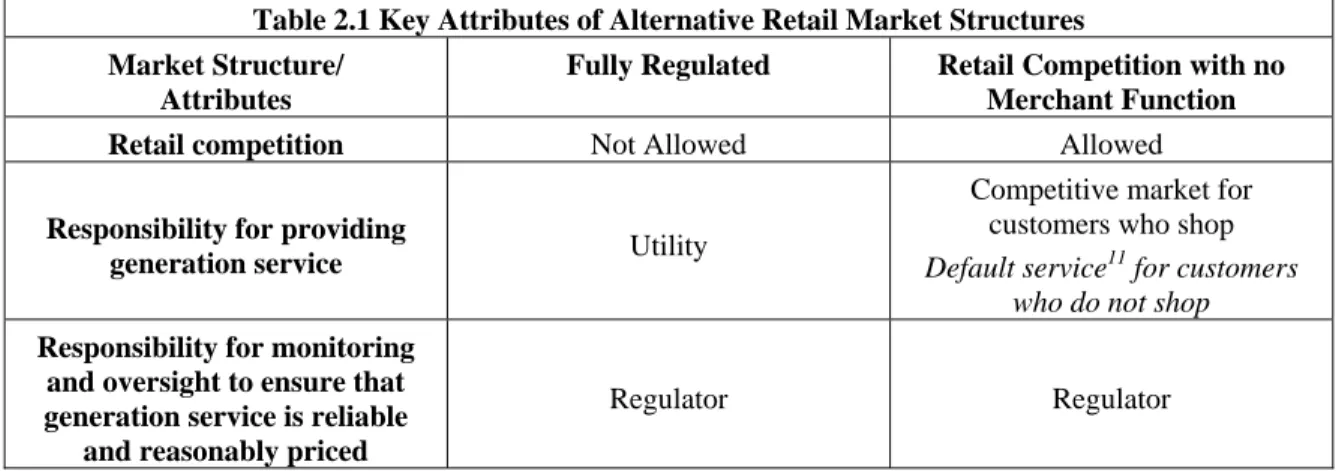
One can characterize and distinguish between those two frameworks according to the entity responsible for providing generation service and the entity responsible for ensuring that those rates are reasonable. The distinctions between the two market structures
according to those attributes are summarized in Table 2.1, below.
Table 2.1 Key Attributes of Alternative Retail Market Structures Market Structure/
Attributes
Fully Regulated Retail Competition with no Merchant Function
Retail competition Not Allowed Allowed
Responsibility for providing
generation service Utility
Competitive market for customers who shop
Default service11 for customers who do not shop
Responsibility for monitoring and oversight to ensure that generation service is reliable
and reasonably priced
Regulator Regulator
Portfolio management tools and practices can be applied to the resource decisions that need to be made under either of these frameworks.
2.2.1. Application of Portfolio Management in Fully Regulated Markets
In states with a fully regulated framework, utilities employ some form of portfolio management to select and procure the appropriate resources, implicitly or explicitly. Examples from the states that we surveyed are presented in Appendix B. In these states, portfolio management is usually intertwined with resource planning procedures, such as least cost planning or integrated resource planning, where they exist. Portfolio
management may also be a part of the fuel procurement practices for generation-owning utilities.
The specific procedures through which portfolio management is applied vary from state to state. However, the general approach through which the three basic steps in portfolio management are applied are summarized below.
1) Preparation and periodic updates of resource plans
Utilities are required to file a resource plan at least every two to three years. The plans cover a long-term horizon, typically at least ten years. They begin with a projection of customer electricity requirements over that period and then evaluate all options available to meet those projected requirements, including supply-side resources, transmission and distribution investments, demand-side resources and purchased power. In some cases, resource planning may encompass fuel
contracting for utility-owned generators, as well as plans or policies governing
11
Also known as Standard Offer Service (SOS), basic generation service (BGS), and Provider of Last Resort service (POLR)
off-system sales of power or disposal of power supply assets. That evaluation considers the reliability, economics and risk attributes of those resource options and may also address their financial, environmental and social attributes. Based upon that analysis the plan identifies a specific mix of resources and/or strategy that the utility believes will result in reliable service at reasonable rates.
Regulators review these filings. In some states, they issue an acknowledgement that the plan satisfies the filing requirements. In other states, the regulator may approve the filing, an act that may or may not effectively pre-approve any major new initiatives proposed in the plan, such as construction of new capacity or execution of a new long-term purchased power agreement, depending on that state's laws and practice.
2) Procurement
Utilities execute planned procurements by acquiring assets in the form of capacity and fuel, and then using those assets to meet the requirements of their customers. They do this through periodic investments in generation capacity of their own, routine purchases of fuel, or execution of fuel contracts or hedges for that
generation and periodic execution of power purchase agreements. In some cases, wholesale sales of power or hedges, or disposal of power supply assets may be part of this execution phase.
Regulators review the reasonableness of the costs and revenues resulting from these utility decisions. Typically those reviews occur when the utility applies for a change in its base rates. In addition, in states which allow utilities to adjust their base rates for changes in fuel and purchased power costs, those reviews may also occur annually in “fuel adjustment proceedings.”
3) Ongoing management
By ongoing management, we mean the as-needed adjustment of plans and resulting procurement actions reacting to changes in the load requirements and market conditions. As load requirements and market conditions change, the utilities modify their use of owned generation and purchased power assets
accordingly. They may increase or decrease off-system sales from capacity that is temporarily not required to serve native load, acquire new supplies, ramp up or down demand-side management programs, or take a variety of other actions. Regulators review the reasonableness of the costs resulting from these utility decisions in the same forums as the procurement decisions.
2.2.2. Applying PM in Retail Competition Markets
Portfolio management is applicable to the procurement of resources for default generation service in states with retail competition. However, as noted earlier, any decision regarding the scope and nature of portfolio management to be applied to this service is primarily a policy issue. This decision will necessarily flow from the policy framework and objectives that govern the retail electric market in the state.
This policy issue has been the subject of debate since the onset of retail competition. When retail competition was first introduced default service was expected to be either a temporary service during the transition to full competition or a true “default” service that relatively few customers would take, and then only while they were between competitive suppliers. Based upon that expectation, some regulators felt that a basic strategy and an annual procurement would be appropriate for the acquisition of supplies for default service.
Contrary to those initial expectations, most of these states have seen almost all residential customers as well as many small commercial, institutional, and industrial customers remain on default service. Given the number of customers who continue to rely on this service, and the recent sharp increases in the rates for that service resulting from the current acquisition approaches, regulators are now faced with the question of whether to require the use of a more complete and sophisticated portfolio management approach for the acquisition of power needed for default service.
If a regulator in a retail competition state is interested in such an approach, an important first step will likely be a review of the existing legislation, regulations, and orders governing that service. For example, changes may be required in order to assign responsibility for:
• more comprehensive resource planning, in terms of both time frame and a wider range of resources (e.g., energy efficiency, renewable resources);
• more latitude in procurement, including more flexibility in the timing of procurements, the quantities procured and contract duration;
• changes in procurement to encourage bids from providers of energy efficiency and renewable resources; and
• periodic analyses and updates of the acquisition strategy.
These responsibilities can be assigned to the incumbent distribution utilities or to a third party, but what is essential is that the responsibility be assigned to someone.
2.3. Portfolio Management Provides a Process and Set of Tools
for Examining Complex Resource Planning and
Procurement Issues
Resource planning and procurement have become increasingly complex over the past 20 years. Regulators need methods and tools that can be used to determine whether a particular resource plan will result in reliable service at reasonable rates.
To illustrate this challenge, consider each of the major steps involved in developing a resource plan and procuring the necessary resources.
The first step is to choose a planning horizon. Use of a reasonably long-term horizon, e.g., 20 years or more, allows a range of resources and costs to be considered, including new renewable resources that have yet to be built and anticipated carbon dioxide
required. These requirements can be forecast, but are obviously subject to uncertainty. In addition, the quantities that will be required from hour to hour and day to day are very difficult to forecast because they are so sensitive to weather and economic conditions. In retail competition markets there is additional uncertainty as to what quantity of load will switch to, or from, competitive suppliers.
The third step is to identify the viable resources and associated contracting and hedging options. These may include:
• Demand side management and energy efficiency
• Distributed generation
• Supply side resources (subject to resource availability)
o Hydro o Wind o Solar o Gas-fired o Coal-fired o Nuclear • Physical contracts o Spot o Term contract • Financial instruments
The key attributes of each resource need to be projected for the planning horizon, including the quantities available at various points in time and their corresponding costs and volatility.
The fourth step is to then identify the alternative portfolios or strategies, consisting of different mixes of these resource options that could be used to provide reliable service at reasonable rates. This may entail evaluating hundreds of possible candidate plans or portfolios in light of the many potential permutations and combinations of these resources.
This evaluation and selection problem can, in many instances, be solved mathematically using computers by formulating it as an “optimization” problem. Under this approach the computer software is told to find the optimal mix of resources that will minimize risk while minimizing expected cost.12 As one would expect, there are data and computational limits to solving this problem. For example, the assumptions for volatility and uncertainty in key inputs are notoriously difficult to characterize. Computationally, the vast number of possible resource combinations and timing of those mixes requires simplifying
assumptions (such as trimming the available resource options down to a small handful of “typical generating unit types”) to enable the models to run in a reasonable amount of time. Portfolio management provides regulators, utilities, and other parties with a process and set of tools to analyze these complex resource planning and procurement issues. As
12
noted earlier, this approach can help all parties identify the assumptions to which the results are most sensitive and can also identify and quantify the trade-offs between objectives under alternative strategies. That transparency can, in turn, assist in determining the weight to apply to each objective.
Choosing Among Portfolios with Different Costs and Risks
Once candidate portfolios have been identified, their expected costs and variability can be estimated. The figure below can begin to give a sense of how candidate portfolios compare.
Each portfolio is represented by a symbol on the graph. The vertical axis indicates the portfolio’s risk/uncertainty and the horizontal axis its expected cost. For a given expected cost, there will be one portfolio with the lowest level of risk, and vice versa. In our illustrative figure, A, B, C, and D mark four portfolios, each of which is the one that is least risky for a particular expected cost. As you move down along the curve connecting those four cases from right to left, there is a trade off in higher expected cost in exchange for less risk, i.e., more stable costs. One would always prefer a portfolio located somewhere along that line, because those portfolios represent the optimal levels of expected cost and risk.
The line connecting these “optimal” portfolios is the tradeoff curve, sometimes called the "efficient frontier." Considering only these two factors (expected cost and some particular measure of uncertainty), there is no economic reason to choose a portfolio above that frontier. However, each portfolio will have many non-economic pros and cons and there are various risk measures to consider, so the choice is never that simple. And, even along the frontier, the choice of a specific portfolio on that line will depend on what the decision-maker considers to be an acceptable tradeoff between the two objectives.
3. Confronting Uncertainty and Risk
This section will consider certain key issues regarding organization and implementation of portfolio management for regulators. The first subsection discusses why and how portfolio management applies in both fully regulated and retail choice jurisdictions. The next subsection addresses questions of organization and readiness for portfolio
management approach to risk management. The third subsection highlights the challenge of making and communicating choices about risk management. The last subsection discusses in detail ways to measure and compare the risk of resource options and portfolios.
3.1. Two
Contexts
for
Portfolio Management
As explained in Section 1 of this report, regulators from states with retail competition as well as from states with fully regulated utilities may need to address portfolio
management.
Portfolio management has emerged in states that have restructured their electric utilities as an approach for acquiring resources to provide default service. In these states
regulators and utilities responsible for implementing and overseeing default service procurement are faced with markets that do not always deliver stable, reasonably priced power in response to simple competitive procurements. Several states are moving towards a long-term view for delivering default service in the public interest. In states with fully regulated generation service, vertically integrated utilities weigh various utility-owned resource options including new generation, transmission expansion, and DSM programs as well as power purchase contracts. Fully regulated utilities and their regulators now need to enhance resource planning, such as IRP, with more and better analysis and increased consideration of uncertainty and risk. Given the complexity of current markets and market products, traditional scenario analysis will no longer suffice to guide decision-making.
A sampling of some of the major new uncertainties facing regulators and utilities in all of these states help illustrate the complexity of their planning and procurement problems:13
o Will RTOs continue to develop?
o How will politics, pressure from the insurance industry, and fuel prices affect climate change regulation? How will "early credit" programs be treated?
o Will transmission companies proliferate and will they be able to generate enough return to gain access to capital for expansion?
o Will consumer interest in “clean power” increase or wane?
o Will the United States continue to be bifurcated into regional markets and territorial markets?
13
o Will wholesale market power issues cause divestitures, just mitigation activity, or continue to erode competitive pressures?
o Will capacity expansion be driven regionally and, if so, by what mechanisms?
o Will renewables development satisfy state targets?
o Will fuel prices and environmental constraints strand some assets and speed development of new technologies?
Uncertainty and risk are addressed in the context of IRP as well as in financial risk management. Each of those perspectives emphasize detailed, quantitative analysis. IRP practice tends to emphasize refinement of long term expected or most likely cost and performance data for options. This is often supplemented with an engineering type bounding analysis, although in practice such bounding analyses often amount to simply running "plus or minus X%" scenarios or scenarios based on the range of estimates from different experts or studies. In contrast, quantitative analysis of the relative likelihood of various deviations or of how different risks interact to amplify or offset each other are relatively rare. Financial assessments of investment portfolios, on the other hand, currently emphasize detailed modeling the effects of variability and interactions of so-called "stable processes" by considering random variations in performance based on historical data for established products, but rarely consider longer term resource choices. Given the strengths and weaknesses of the analytical tools and practices of each
approach, and the planning and procurement problems in today’s markets, we expect to see a gradual convergence of the portfolio management practices for IRP-like
jurisdictions and default service procurement jurisdictions. In Section 4 of this report, we show that the current divide between the two approaches is mirrored in the software options available, too. Regulators may wish to push for a synthesis of these approaches, encouraging both rigorous detailed analysis and an understanding of the long range situation. New research and development may be necessary to accomplish this.
A portfolio management approach can also deliver side benefits to all consumers, even those who choose to shop from competitive suppliers. For example, inclusion of long term or even life-of-unit purchases from new renewable generators (or new generators not fueled by natural gas) can not only stabilize the cost of power for default service, but also lower clearing prices for all consumers by promoting new generation construction and reducing price pressure on natural gas at times of peak demand. A portfolio
management approach to meeting the power needs of default service is compatible with the development of a vibrant competitive generation industry. In fact, by providing stable long term markets, a portfolio management approach for default service can enhance the health of the currently distressed generation industry by alleviating its dependence on an unfriendly project financing market.
3.2.
Integrating IRP and PM Concepts
Portfolio management and integrated resource planning are not irreconcilable concepts. Rather, they are labels that emphasize different aspects of resource planning, all of which should be included in an ideal resource planning process.
Integrated resource planning involves the development of a portfolio of existing and new resources of all types that help achieve the lowest cost for consumers over the life of the plan. Each time an IRP is updated, an essentially new IRP is created, treating resources acquired since the previous update as committed and seeking the best selection of additions to form its new plan. Risks are usually assessed qualitatively or via scenario analysis, trying to find the resource plan that best combines a low cost with a reasonable degree of robustness against uncertainties. While IRPs can include fixed term purchased power contracts or consider disposing of committed resources, the emphasis is usually on permanent acquisition of resources.
On the other hand, portfolio management emphasizes assembling and managing a collection of resources, often entirely fixed-term purchase contracts. Diversification of expiration dates, vendors and, sometimes, term lengths is a typical tool in PM. Carefully designed competitive procurements are often the centerpiece of a PM approach,
especially when over the counter markets are not fully developed.
PM has been applied in a narrow, passive manner in some states with retail choice and default service programs. For example, New Jersey, Maryland and Delaware limited procurement for default service generation to laddered two or three year, slice of load contracts obtained via a once-a-year auction or RFP. While such selections are implicit resource plans, they arbitrarily exclude a wide array of viable resources and limit the degree of risk mitigation provided to retail consumers. Conversely, preparing an IRP in which the focus is on identification of the least cost mix of permanent generation acquisitions and there is no assessment of risk would also represent a very limited approach to portfolio management—one with few choice points, limited diversification, and few market force effects.
Clearly, IRP can be improved by harnessing competition, by comparing resource plans using quantitative measures of risk in addition to expected cost, and by subjecting portfolios to active management. Conversely, procurement for default service (or other needs) can be improved by embracing a broad range of resource alternatives, striving for least cost service over time, and focusing on the risks borne by consumers rather than only those borne by the utility.
Applying aspects of portfolio management to the development and implementation of IRPs should be viewed as a challenging but natural enhancement of IRP for vertically integrated utilities. Several states have begun to consider such a move, especially with regard to risk management.
The descriptions of IRP and PM given above are generalizations based on typical practice among the states and may not be implemented identically in every jurisdiction. In fact, various practices can be called IRP or PM and may include some beneficial features of IRP or PM, but not fully realize either concept, much less an integration of the two. In principle, they are two ways of looking at the same problem. Ideally, resources would be planned, procured, and managed in ways that are both “integrated” and reflect “portfolio management.”
3.3. Organizational
Issues
Organizational readiness and commitment are seen as critical to successful implementation of risk analysis and risk control through portfolio management. While no one person at a major utility can (or should) make all decisions regarding portfolio management, it is the chief executive officer (CEO) who ultimately bears this responsibility. The CEO can best achieve portfolio management success by dividing up portfolio management responsibilities amongst the following types of employees: chief financial officer, chief risk officer, internal auditor, accountants (internal and/or external), chief technology officer, and others. In addition, the board of directors plays a key role in helping to define the overall risk tolerance of the organization.
It is interesting to note that, under Sarbanes–Oxley compliance requirements, the CEO is now legally responsible for ensuring that company-related risks are reported to
shareholders. Not only is the CEO responsible legally, but from a practical standpoint the CEO plays a critical role in terms of setting the tone for policy implementation
throughout the organization. Unless he/she makes portfolio management a key priority for the organization, it will likely be unsuccessful.
Direction and motivation are critical to success in risk management and planning for risk management. The tone for any new direction is usually set by the leadership at the top of the organization. Thus the application of these new tools in the electric industry will benefit if regulators set out clear expectations and if utility management commit to portfolio and risk management.14
With regard to PM implementation, organizations have options. A utility could choose:
• a narrow approach focused on specific resource planning activities mandated by law or regulation,
• a broad approach focused on risk analysis and management in all aspects of the firm, or
• an "optimally scoped" approach that seeks to strengthen portfolio and risk management in targeted activities, improve processes for that purpose, and establish ongoing monitoring and improvement.
Recently, under the impetus of Sarbanes-Oxley mandates, many firms have considered how best to organize risk assessment and risk control. A number of questions about a firm's readiness for risk assessment and control should be addressed. Some of these are:
• How well has the organization implemented other change efforts?
• Is the executive management supporting the effort, visibly and effectively enough to get buy-in from the entire organization?
• How well does executive management understand the effort required to implement PM and management's role in that implementation?
14
The following material draws on Anne Marchetti, Beyond Sarbanes-Oxley Compliance: Effective Enterprise Risk Management, John Wiley & Sons, 2005.
• Is the organization committed to providing resources (people, time, money) to both the design and implementation of the effort?
Regulators seeking to implement portfolio management and risk assessment at Commissions and utilities should ensure:
• clearly articulated reasons for implementation;
• a clear connection to the strategy of the organization;
• full implementation;
• integration with existing processes and initiatives;
• active, visible leadership;
• commitment of adequate time and resources;
• timely and thorough communication among regulators, advocates, utilities and other stakeholders, as well as throughout the affected portions of the utilities, including feedback and reinforcement;
• routine progress and performance measurement and review of corrective actions; and
• skilled, trained employees at commissions and utilities.
3.4.
Making and Communicating Choices about Risk
Management
Perhaps the first concept that comes up in a discussion of portfolio management is "diversification." We have devoted considerable discussion to that topic here and elsewhere.15 A second major concept that comes up in such a discussion is "risk
tolerance." Risk tolerance refers to one’s willingness to accept the risk of an undesirable outcome when making an investment choice.
It is natural, even traditional, for portfolio planning to determine, and take into
consideration, the risk tolerance of an investment portfolio "owner" at an early stage in the process. A much more difficult problem arises in the context of applying PM to an electric utility, where the utility may be the “owner” but the costs will be paid by a large group of customers. It is difficult to express or ascertain the risk tolerance of individual customers in a meaningful way, much less whole classes of customers. While this report does not present a recipe for regulators to use in establishing the level of risk appropriate for the resource portfolio of a fully regulated utility or for a default service provider, this section attempts to clarify the issues that should be considered.
Decisions about risk should not be made in a vacuum or on a hunch. Even the sort of on-line questionnaire designed to guide personal investing decisions takes into consideration objective aspects of the investor's current situation and plans for the future. Risk
tolerance discussions for individuals are driven by such life situation factors as age,
15
Biewald, et al. Portfolio Management: How to Procure Electricity Resources to Provide Reliable, Low Cost, and Efficient Electricity Services to All Retail Customers. Synapse Energy Economics, 2003. Available at http://www.synapse-energy.com/Downloads/SynapseReport.2003-10.RAP.Portfolio-Management.03-24.pdf
dependents, taxable income and projections thereof, existing assets and liabilities, commitments, fixed expenses, health status, retirement and other plans, and so on. Regulators have been making risk tolerance judgments on behalf of ratepayers as long as they have been setting rates. Every decision to approve construction or a long term contract accepts certain risks and avoids others. Traditionally, such decisions have been made after careful qualitative and, sometimes, partially quantified consideration of the risks and uncertainties of a project under consideration and (slightly less often) the risks and uncertainties of the alternatives. However, trying to discipline or even quantify those tolerances is unbroken ground for many utilities. In fact, such discussions are typically based on evidence that amounts to the opinions of persons with a stake in the matter. An EEI report expresses the opinion that "The 'right' amount of risk-bearing for customers (in rates) is not self-evident."16 Moreover, we should not expect this job to be easy. In fact, that study calls on regulators to either specify the risk tolerance to be used or provide guidance to utilities on how it should be measured.
A finance expert might approach this question by asking regulators to name their risk tolerance (presumably something numerical, like "the probability that rates will increase by more than X% in any one year or more than Y% over five years should be less than Z%") and suggest that it would then be straightforward to determine how to deliver that level of certainty and offer to tell regulators what buying that degree of certainty will cost as of a given market day. Perhaps that could be done in theory, but there is no simple answer to the question of risk tolerance of customers. In part, this is because customers are not a homogeneous group and in part because the answer will depend on the methods used for reducing risk and their side effects.
Some would argue that rate stability is not free and all hedging comes with a cost. Others argue that long term hedges simply are not available. However, failing to hedge huge market exposure has external costs, while the absence of long-term, market-based forwards (only one of many ways to hedge risk) may be something of a self-fulfilling prophecy. Shipping companies could buy cargo and hull insurance for hundreds of years before anyone bothered to sell life insurance, but practically as soon as it was offered, life insurance was a huge success. Thus, markets for long term power contracts or other hedges may well develop if there is an adequate demand for them by buyers and sellers. How and when the risk/cost tradeoff analysis is performed during resource planning and/or procurement processes can be just as critical to sound portfolio management as the metrics used and the preferences applied, especially when assessing longer term
resources and risks. For example, as a recent national laboratory study observed, [utility] resource plans vary considerably in how they define expected risk, and how they balance the expected cost and risk of different candidate portfolios. In selecting a 'preferred' portfolio, a utility would ideally review consumer
preferences for cost-risk tradeoffs, and select the candidate portfolio that fits most closely with the risk preferences of the majority of its customers. This approach, however, is rarely used. Instead, in all of the cases we reviewed, the cost-risk
16
tradeoff (if made) is based on the subjective judgment of each utility, informed by any counsel provided by the utility’s regulators or external stakeholders.... In other words, the cost/risk tradeoff has often been made – in part based on consideration of fuel price risk – before carbon risk is considered, in which case carbon risk is sometimes relegated to helping to distinguish between a few finalist portfolios.... As a result, some of the “renewables” portfolios in our IRP sample exhibit as much or more exposure to natural gas price risk than other portfolios.... By the time carbon risk is assessed, some renewables portfolios – i.e., those best able to mitigate carbon risk – may have already been weeded out of the process, potentially leaving the model to choose from among a number of sub-optimal portfolios. 17
That study recommends "a more holistic assessment of risk, and approach to the cost/risk tradeoff" rather than a "sequential, winnowing approach." It goes on to point out that
…scenario analysis, and the risks analyzed with that technique, may end up as a mere sideshow to stochastic analysis. Related, a large and varied set of candidate portfolios should be evaluated for their ability to mitigate risks; otherwise,
analysis results may be unduly affected by the pre-selection of possible candidate portfolios.
In summary, regulators will likely need to oversee or manage risk mitigation, but clear methods for conceptualizing risk in utility portfolio management are not well developed. Regulators may find it useful to consider exploratory proceedings or alternative input methods, such as deliberative polling, but in the end, regulators will need to develop and communicate risk management and portfolio management goals and criteria to generation service providers, either proactively or in response to utilities' implicit or explicit risk management choices. Further research on this point may be of value and could begin with a systematic effort to review the techniques used by institutional investors and
manufacturers dependent on long lead time commodities, followed by analysis of how their methods may or may not be useful in utility planning and its oversight.
3.5.
Techniques for Analyzing Risk Exposure and
Uncertainty
3.5.1. Measuring Risk and Expected Benefit
Risk and uncertainty are inherent in all enterprises. But risk needs to be balanced against expected benefit. The balancing of risk and expected benefit in utility regulation differs from the balancing that occurs in business or investing. However many of the tools and metrics for measuring risk and expected benefit in business and investing can be, and have been, applied to the electric industry.
17
Ryan Wiser and Mark Bolinger, "Balancing Cost and Risk: The Treatment of Renewable Energy in Western Utility Resource Plans," The Electricity Journal, Feb. 2006; Ryan Wiser and Mark Bolinger,
Balancing Cost and Risk: The Treatment of Renewable Energy in Western Utility Resource Plans, Lawrence Berkeley National Laboratory, 2005. Available at http://eetd.lbl.gov/ea/ems/reports/58450-journal.pdf
Business managers and investors decide how much of a return they require on a
prospective investment in exchange for taking on a given level of associated risk. They then make go/no-go decisions on individual projects by measuring, implicitly or explicitly, the risk of a given project and its expected return to see if those criteria meet their
investment threshold. Bond ratings are a tool commonly used for this purpose by investors. For example, an investor may choose not to invest in highly-rated corporate bonds unless the bonds bear an interest rate of, say, 3% above the interest rate for U.S. government bonds, because even highly rated firms may fail.18 The same investor might be willing to invest in the same corporation’s common stock only if the expected return is 10% above the interest rate for U.S. government bonds, because common stock is the first type of security to suffer (i.e., to miss dividend payments or lose market value) when a firm is in financial trouble.
Rather than comparing expected return to perceived risk, utility regulators typically want to minimize rates or cost of service or both, while taking into account the degree of risk that ratepayers will face, as well as the risks to investors. Thus there is a need to balance the expected cost of a resource, or a portfolio of resources, with the risk that the actual cost of the resource may be more or less than expected at various times over the planning horizon, thereby introducing volatility into the cost of service during that period. It is also important to consider the risk that a resource choice will fail to provide necessary power (or save power in the case of DSM resources), triggering a need to buy at market rates. Finally one must consider how a given resource plan will impact the ability of the utility to attract capital. While the kinds of benefits and risks that regulators evaluate and balance are not exactly the same as those that businesses and investors consider, many of the tools and metrics available are suitable or may be adapted to either.
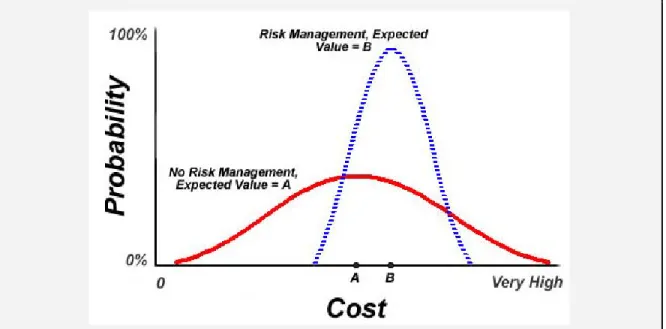
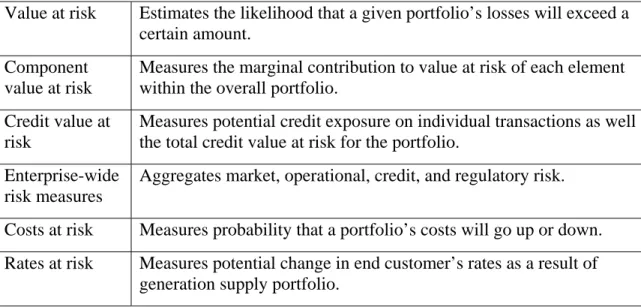
It is conceptually simple, but sometimes technically difficult, to compare different portfolios of resources based on their expected costs. Present value life cycle cost is the usual measure employed for that purpose. Unfortunately, there is currently no single, generally agreed upon measure of the risk of a resource portfolio. The accompanying text box on "Random Variables and Portfolio Management" explains portfolio risk in terms of cost uncertainty and the basic concept of comparing the riskiness of two portfolios. Appendix D of this report describes a variety of portfolio risk measures. The rest of this subsection explains a few of those risk measures and presents some key ideas about risk measurement.
18
U.S. government securities are often used as a proxy for an investment that bears no risk except for the risk that the inflation rate may change.