Performance Evaluation of a Secure Intelligent Decision Support System
for Prescribing Medication
1
Omotosho A, 2Emuoyibofarhe.O.J, and 3Olaniyi O.M 1
Department of Computer Science and Technology, Bells University of Technology, Ota, Ogun State, Nigeria
2
Department of Computer Science and Engineering,
Ladoke Akintola University of Technology Ogbomoso, Oyo State. Nigeria. 3
Department of Computer Engineering,
Federal University of Technology, Minna ,Niger State, Nigeria.
Correspondence: [email protected],
ABSTRACT
Medical prescription plays an important role in ratifying that a prescribing physician takes full responsibility for the clinical care of their patient and the outcome of such treatments. Medical prescription are typically handwritten on paper but, with the advent of electronic method of prescription, known as electronic prescription, which involves the use of ICT tools to create, support, speed up, secure and deliver medical prescriptions to pharmacies. With electronic prescription, most of the regular incidences of prescription errors which could potentially cause serious problems to patient as well as death in a severe case are expected to be reduced. This paper presents the evaluation of a secure intelligent prescription system carried out using the modified Delphi panel process recommendations for e-prescribing system. This method was used to estimate the effects of the system on improving patients’ safety, health outcomes, maintaining patient privacy, promoting clinician acceptance and prescription security. The result of the system evaluation carried out on six indices of the modified Delphi method with twenty-four recommendations showed that the system on the average met over 70% of the recommendations expected to improve medical prescription process unlike the conventional approach.
Keywords- e-Prescription, Delphi evaluation, biometrics prescription, secured prescription, intelligent systems.
1. INTRODUCTION
Electronic prescribing (e-prescribing) may substantially improve health care quality and efficiency, though the available systems are complex and their heterogeneity makes comparing and evaluating them a challenge. However, studies have shown that the paper-based approach to medical prescription is prone to errors which pose detriment to patient health, as well as increases the call-back time from pharmacist for further clarity. Unfortunately, from the reviewed works, the adoption of e-prescribing has been difficult to attain owing to numerous barriers throughout the health industry [1]. Such acceptance barriers include lack of technology trust, associated system costs, and risk of unsecure patient health and medical information.
Electronic prescribing promises to improve medical prescription writing with decision support features such as drug allergy, drug-drug interaction warnings and timely information available to physician. Likewise, majority of piloted e-prescription projects and fully deployed systems demonstrated the wide usage of smart cards for authentication and security by the prescribing physician. Though smart cards are universal, portable and safe, since they contain the holder’s identity, anyone who is able to access their information can steal their identity. Hence with improved intelligence features and security measures, electronic prescribing will greatly contribute to the health industry and their outcomes [5].
2. RELATED WORKS
Medication errors are common, and while most of such errors have little potential for harm they cause considerable extra work in hospital settings. A fraction of these errors do have the potential to cause injury, and some cause preventable Adverse Drug Effects (ADE). [2] carried out an evaluation of the impact of computerized physician order entry (POE) with decision support in reducing the number of medication errors. The research employed a prospective time series analysis, with four periods. All patients admitted to three medical units were studied for seven to ten-week periods in four different years.
The baseline period was before implementation of POE, and the remaining three were after and the sophistication of the POE increased with each successive period. The main outcome measure of the research is medication errors, excluding missed dose errors. In his conclusion, computerized POE substantially decreased the rate of non-missed-dose medication errors. A major reduction in errors was achieved with the initial version of the system, and further reductions were found with addition of decision support features. However, commercially available electronic prescribing systems may vary in their effects on patients' health outcomes and on patients' ability to manage costs.
Several factors need to be considered in determining the most relevant features. In [3], an expert panel convened to identify and recommend specific features that would enable electronic prescribing systems to advance these goals. The panel authored sixty recommendations and rated each using a modified Delphi process. Ratings identified fifty-two recommendations as clearly positive for patient safety and health outcomes and forty-three recommendations as achievable in the average clinician's office within three years. Overall, these recommendations offer a synthesis of evidence and expert opinion that can help guide the development of electronic prescribing policy.
The focus on preventing medical errors has advanced the arguments for widespread implementation of electronic prescribing. The choice of systems as well as the variation in functionality is large. Value and return on investment depend on the functionality provided. [4] also agrees that, the paper by [3] defines the functionalities that are required and desirable to ensure patient safety and quality of care. He stated that health data standards are a prerequisite for the interoperability to support electronic prescribing and he identified some of the barriers and problems in producing and adopting those standards.
A descriptive field study of ten commercially available ambulatory electronic prescribing systems, each of which had established a significant market presence was carried out by [6]. The authors compared the functional capabilities being offered by commercial ambulatory electronic prescribing systems with a set of expert panel recommendations. Data were collected from vendors by telephone interview and at sites where the systems were functioning through direct observation of the systems and through personal interviews with prescribers and technical staff. For their evaluation, the capabilities of electronic prescribing systems were compared with 60 expert panel recommendations for capabilities that would improve patient safety, health outcomes, or patients' costs. Each recommended capability was judged as having been implemented fully, partially, or not at all by each system to which the recommendation applied.
Vendors' claims about capabilities were compared with the capabilities found in the site visits. In their result, on average, the systems fully implemented 50% of the recommended capabilities, with individual systems ranging from 26% to 64% implementation. Only 15% of the recommended capabilities were not implemented by any system. Prescribing systems that were part of electronic health records (EHRs) tended to implement more recommendations. Vendors' claims about their systems' capabilities had 96% sensitivity and 72% specificity when site visit findings were considered the gold standard. [6] pointed out that, commercial electronic prescribing marketplace may not be selecting for capabilities that would most benefit patients. Electronic prescribing standards should include minimal functional capabilities, and certification of adherence to standards may need to take place where systems are installed and operating.
In conclusion, from the review works, it could be drawn that the features selected for evaluation may be modified depending on the environment of study even when evaluating based on the recommendations in [3] to effectively decide the minimal factors that would significantly contribute to patients’ treatment and outcome and this approach was utilized in this paper.
3. SYSTEM ARCHITECTURE
In the operation of the developed e-prescription system whose architecture was represented in Figure 1, a patient visits a registered physician using the e-prescribing system. Physicians access to the e-prescribing system is through multi-factor authentication that is, fingerprint biometrics scan , a user id and a password to enforce and ensure that only registered physician can generate the prescription. The physician identifies the patient record within the e-prescribing system health record. If the patient is not found, the physician registers the new patient into the system. After the consultation with the physician, the result of the medical consultation is submitted to the e-prescribing system by the physician. Based on this, the system ensures that only medications that relates to what the patient was diagnosed for are made available during prescription writing thus reducing the likelihood of selecting wrong medication.
To further reduce incidences of prescription error, the developed e-prescription system has intelligence features with which the system can generate currently selected patient medication pattern from which new prescription can be made from and this in addition help in making decision on the right medication that works well with a particular patient. The system intelligence feature also provides prescriber with information about the prescribed drug, contraindications, and other important drug prescription information. The system can as well automatically validate prescription by checking for common prescription errors such as the popular incomplete prescription errors before sending to the national prescription database.
All prescriptions generated are automatically ratified with the prescribers licence ID which can also be verified by the dispensing pharmacy and this makes prescription sources traceable and thus reducing cases of prescription forgery. The patient visits the registered pharmacy specified on the prescription to pick up the drug. Patients are also identified through their fingerprint biometrics at the pharmacy. Also, reports could also be available to the ministry of health for documentation and other relevant purposes.
Fig 1: System Architecture of the Developed Electronic Prescription System [5]
4. EVALUATION METHOD AND RESULTS
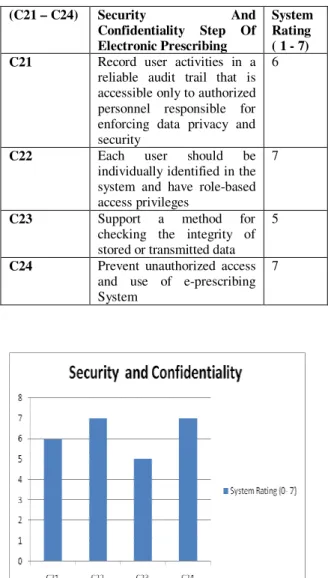
The e-prescription system evaluation was conducted at the university clinic of the Bells University of Technology, Ota, Ogun State. In evaluating the developed e-prescribing system, list of tasks are completed by the targeted users of the system with the support of a questionnaire, there responses were charted based on the modified Delphi panel process recommendations excerpt proposed for e-prescribing system in [3]. This research used an eight point rating scale that ranged from 0 to +7, where 0 represented the largest negative impact on the dimension and +7 represented the largest positive impact. Table 1, Table 2, Table 3 Table 4, Table 5, and Table 6 showed average system ratings by the medical practitioners at the Bells University Clinic. Twenty-four recommendations (C1- C24) were evaluated from six features of electronic prescribing systems. Features include: Patient Identification, Access to Patients’ Historical Data , Medication Selection , Alerts and Messages, Data Transmission and Storage, and lastly, Security and Confidentiality Step of Electronic Prescribing.
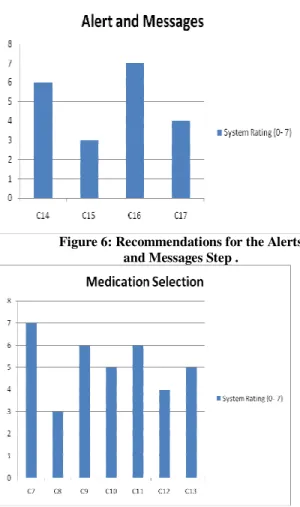
Figure 4.16 shows the chart of the recommendations for the Patient Identification Step; Figure 4.17 show the chart of the recommendations for the Access to Patients’ Historical Data Step; Figure 4.18 shows the chart of the recommendations for the Medication Selection Step; Figure 4.19 shows the chart of the recommendations for the Alerts and Messages Step, Figure 4.20 shows the chart of the recommendations for the Data Transmission and Storage Step , Figure 4.21 shows the chart of the recommendations for the Security and Confidentiality Step.
Table 1: Patient Identification Recommendation (C1 – C3) (C1 – C3) Patient Identification Step Of
Electronic Prescribing
System Rating ( 1 - 7)
C1
Make the patient’s name, gender, and date of birth or age visible in the user interface throughout the process of creating a prescription
7
C2
Import patient identification and demographic data from electronic medical record (EMR) or practice management systems (PMS) used by the health care organization
7
C3
Provide a method for manual entry of patient identification and demographic data when importing this information from an EMR or PMS is not possible
4
Table 2:
Access to Patients’ Historical Data Recommendation (C4 – C6) (C4– C6) Access to Patients’ Historical
Data Step Of Electronic Prescribing
System Rating ( 1 - 7) C4 Indicate when an external
interface that provides data for decision support is not operational
5
C5 Provide the patient’s complete current medication list, based on open prescriptions from all other clinicians, for prescribers who have care responsibility for the patient
7
C6 Provide a means for entering medications the patient is currently taking that have not been prescribed through the system and are not available through external interfaces
Table 3:
Medication Selection Recommendation (C7 – C13) Table 4: Alerts and Messages Recommendation (C14 – C17)
Table 5:
Data Transmission and Storage Recommendations ( C18 – C20)
(C18 – C20) Data Transmission And
Storage Step Of
Electronic Prescribing
System Rating ( 1 - 7) C18 Prescribers should be able
to transmit prescriptions electronically to the patient’s pharmacy of choice (mail-order or retail) 7
C19 Transmissions should use National Provider Identifiers when they become available 4 C20 Prescribers should be notified of transmission failure of a prescription to a pharmacy 6 (C7 – C13) Medication Selection Step
Of Electronic Prescribing
System Rating ( 1 - 7) C7 Display a list of medications
appropriate to the diagnosis when a diagnosis is entered
7
C8 Allow efficient prescribing without the entry of a diagnosis and with the entry of speculative or tentative diagnoses
3
C9 The display of medication options should not be influenced by promotional considerations
3
C10 Make the meaning of any symbols or special fonts immediately available during the prescribing Process
4
C11 Give prescribers immediate access to the rationale for any medication choice that the system displays as being recommended or preferred for the current patient
6
C12 Omit from suggested
medication menus options that would be medically contraindicated for the patient
3
C13 Provide for selection from the dosages and forms that are available and appropriate for a given medication
3
(C14 – C17) Alerts And Messages Step Of Electronic
Prescribing
System Rating ( 1 - 7)
C14 Alert the prescriber when a medication is selected that has a contraindication or significant precaution based on the patient’s allergies, current medications, conditions, or laboratory findings
6
C15 For every message, provide immediate access to an explanation of its rationale, including disclosure of all criteria and financial support used in its development
3
C16 Alerts and messages should display the date that the underlying decision support rules were last updated
7
C17 Provide a way for prescribers to correct or flag patient information that they believe to be erroneous
Table 6: Security & Confidentiality Recommendations (C21 – C24)
Figure 2: Recommendations for the Security and Confidentiality Step
Figure 3: Recommendations for the Patient Identification Step.
Figure 4: Patients’ Historical Data Step
Figure 5: Recommendations for the Data Transmission and Storage Step
(C21 – C24) Security And Confidentiality Step Of Electronic Prescribing System Rating ( 1 - 7) C21 Record user activities in a
reliable audit trail that is accessible only to authorized personnel responsible for enforcing data privacy and security
6
C22 Each user should be
individually identified in the system and have role-based access privileges
7
C23 Support a method for
checking the integrity of stored or transmitted data
5
C24 Prevent unauthorized access and use of e-prescribing System
Figure 6: Recommendations for the Alerts and Messages Step .
Figure 7: Recommendations for the Medication Selection Step .
5. RESULTS AND DISCUSSIONS
From Figure 2, the developed electronic prescribing system received a rating of approximately eighty-nine percent (89%) satisfying the recommendations for the security and confidentiality step in electronic prescribing. The potential users were asked to login to the application using their user_id, password and fingerprint biometric scan. Based on the consistency and standards principal, the users felt comfortable interacting with the login window due to the similarity to other input interfaces where users needs to enter his or her user name and password. They accepted that the electronic prescription system will be more secured with the inclusion of a biometric before login.
From Figure 3 recommendations for the patient identification step received a rating of approximately eighty-six percent (86%). After the users logged into the application, they were asked to search for a patient. Due to the aesthetic and minimalist design of the e-prescription system interface, the physicians did not hesitate when they looked for the search textbox located in the right corner of the window.
Also, physicians found the search feature very useful, where with just entering the first letter of the patient, a list of patients starting with that letter was displayed so it speeds up the process of entering and retrieving the patient information
In Figure 4 recommendations for the access to patients’ historical data step received a rating of sixty-seven percent (67%). Recommendation (C6), provide a means for entering medications the patient is currently taking that have not been prescribed through the system and are not available through external interfaces, has the lowest rating since most of the physicians are already used to paper prescribing this is expected because the system forces the prescriber to prescribed from drugs identified by the system and this drug database is updateable.
In Figure 5, recommendations for the data transmission and storage step for the developed e-prescribing system received a rating of eighty-one percent (81%) and this shows that the prescribers should be able to transmit prescriptions electronically to the patient’s pharmacy of choice (mail-order or retail). In Figure 6, recommendations for the alerts and messages step of electronic prescribing had a rating of seventy-one percent (71%). As this forms part of the system intelligence. As reviewed from literature alerts and messages could confused prescribing physician and they are to be kept minimum. Most of the alerts provided by the developed e-prescription system are only available based on physician request except for few like incomplete dosage and so on. In Figure 7 recommendations for the medication selection step for the system had a rating of seventy-three percent (73%). As the intelligent system only display a list of medications appropriate to the diagnosis when a diagnosis is entered and provide for selection from the dosages and forms that is available and appropriate for a given medication. In conclusion, the result of the e-prescription system evaluation showed that the system would benefit patients, the health care settings and also promises to improve and successfully replace the paper approach to medical prescription. 6. CONCLUSION
This paper reviewed papers on electronic prescription evaluations and carried out similar evaluation on a designed system using the modified Delphi panel recommendations but with minimal and specific recommendations extracted to focus on the most relevant features in the environment of settings that would have the greatest impact on the patient. The result of the evaluated system showed that the system would improve the process of medical prescription. This also indicates that the prescriber takes responsibility for the clinical care of the patient and the outcome. In the end, the research has shown that the Information and Communications Technologies opens up new opportunities for transferring medical prescription information securely and faster.
REFERENCES
[1.] Emuoyibofarhe O.J. and Omotosho .A.(2012). Development of a Secure Intelligent E-Prescription System. In proceedings of The International eHealth, Telemedicine and Health ICT Forum For Education, Networking and Business (MedTel 2012) Conference 10th Edition.18-20 April. Luxembourg.
[2.] Bates, D.W., Teich, J.M., Lee J .(1999). The Impact of Computerized Physician Order Entry on Medication Error Prevention. J Am Med Inform Assoc. 6(4):313-21. [3.] Bell, D.S., Marken, R.S., Meili, R.C., Wang, C.J.,
Rosen, M., Brook, R.H.; RANDElectronic Prescribing Expert Advisory Panel. (2004). Recommendations for Comparing Electronic Prescribing Systems: Results of An Expert Consensus Process. Health Aff (Millwood).Suppl Web Exclusives:W4-305-17.
[4.] Hammond ,W.E.(2004). The Role of Standards in Electronic Prescribing. Health Aff (Millwood). Suppl Web Exclusives:W4-325-7.
[5.] Omotosho, A. and Emuoyibofarhe.O.J.(2012). A Secure Intelligent Decision Support System for Prescribing Medication. Computing, Information Systems and Development Informatics Journal. Vol.3. No.3. pp. 9-18
[6.] Wang, C.J, Marken, R.S., Meili, R.C, Straus, J.B., Landman, A.B., Bell, D.S.(2005). Functional Characteristics of Commercial Ambulatory Electronic Prescribing Systems: a field study. J Am Med Inform Assoc. May-Jun;12(3):346-56.
Authors Brief
Omotosho Adebayo holds a Bachelor of Technology (B.Tech) degree and Master of Technology (M.Tech) degree in Computer Science both from Ladoke Akintola University of Technology, Ogbomoso, Oyo State, Nigeria. His research areas include e-Health, Telemedicine and wireless communications. He can be reached by phone on +2348051867636 and through E-mail [email protected]
Emuoyibofarhe .O. Justice (PhD) is currently a Reader in the Department of Computer Science and Engineering at Ladoke Akintola University of Technology, Ogbomoso, Oyo State, Nigeria. His research areas include neural networks, intelligent systems, wireless communication, e-Health and telemedicine. He can be reached by phone on +2348033850075 and through E-mail [email protected]
Engr OlaniyiOMikail heads the Department of Computer Engineering at the Federal University of Technology, Minna, Nigeria. He has had a progressive academic professional career, demonstrating consistent success in research and development with national and global recognition. He had his first Degree in Computer Engineering and Masters’ Degree in Electronics and Computer Engineering at the prestigious Ladoke Akintola University of Technology, Ogbomoso, Oyo State and Lagos State University, Ojo Respectively. He is a COREN Registered Engineer. His research interest borders in the area of Intelligent Systems, Information Security and Telemedicine. He can be reached by phone on +2348051719795 and through E-mail [email protected]
![Fig 1: System Architecture of the Developed Electronic Prescription System [5]](https://thumb-us.123doks.com/thumbv2/123dok_us/8714798.2359463/3.918.103.433.164.481/fig-architecture-developed-electronic-prescription.webp)