On the Decidability and Complexity of Query Answering
over Inconsistent and Incomplete Databases
Andrea Cal
`
ı
Domenico Lembo
Riccardo Rosati
Dipartimento di Informatica e Sistemistica Universit
`
a
di Roma “La Sapienza” Via Salaria 113, I-00198 Roma, Italy {cali,lembo,rosati
}@dis.uniroma1.it
ABSTRACT
In databases with integrity constraints, data may not sat-isfy the constraints. In this paper, we address the problem of obtaining consistent answers in such a setting, when key and inclusion dependencies are expressed on the database schema. We establish decidability and complexity results for query answering under different assumptions on data (soundness and/or completeness). In particular, after show-ing that the problem is in general undecidable, we identify the maximal class of inclusion dependencies under which query answering is decidable in the presence of key de-pendencies. Although obtained in a single database con-text, such results are directly applicable to data integra-tion, where multiple information sources may provide data that are inconsistent with respect to the global view of the sources.
1.
INTRODUCTION
In database applications, integrity constraints represent fundamental knowledge about the domain of interest [8, 1]. In many scenarios, data may not satisfy integrity con-straints; this happens, for instance, in data integration [20, 17], where integrity constraints enrich the semantics of the global view of a set of autonomous information sources, while such constraints may be violated by data at the sources [14, 6]. In principle, the issue of dealing with in-tegrity constraint violations is relevant in all applications involving the integration of heterogeneous information (e.g., Data Warehouses, Enterprise Resource Planning Systems, etc.). The current integration methodologies deal with this problem in a data reconciliation step, in which data are cleaned byad hocalgorithms that eliminate all violations.
In the general case of a database in which data violate integrity constraints, the problem arises of how to interpret such a database. This problem has been extensively studied in several works in the area ofinconsistent databases that
Permission to make digital or hard copies of all or part of this work for personal or classroom use is granted without fee provided that copies are not made or distributed for profit or commercial advantage and that copies bear this notice and the full citation on the first page. To copy otherwise, to republish, to post on servers or to redistribute to lists, requires prior specific permission and/or a fee.
PODS 2003, June 9-12, 2003, San Diego, CA. Copyright 2003 ACM 1-58113-670-6/03/06 ...$5.00.
have proposed a new semantic approach to the treatment of integrity constraints [15, 11, 5, 21, 3, 4, 19, 16], which we briefly illustrate in the following.
Traditionally, database theory adopts anexact interpreta-tion of data, based on theclosed world assumption [23], i.e., the interpretation of each relationrexactly corresponds to the extension ofrin the database instance. In order to cope with data inconsistencies, other assumptions about data are adopted in the literature. In particular, the interpretation of each relation r can be considered either as a superset (sound semantics) or a subset (complete semantics) of the extension ofrin the database instance. Although in many cases such assumptions are sufficient to guarantee the exis-tence of a consistent interpretation of the data, in general a less strict interpretation is needed. In particular, several studies [15, 21, 3, 19] propose a loose semantics which se-lects, among all possible databases satisfying the integrity constraints, only the ones that are “as close as possible” to the actual database instance.
In this paper, we address the problem of query answering in a relational setting under the above semantics, when key and inclusion dependencies are expressed on the database schema. Specifically: (i) we identify the frontier between decidability and undecidability of query answering for the various semantics;(ii)for the decidable cases, we establish the computational complexity of the query answering prob-lem.
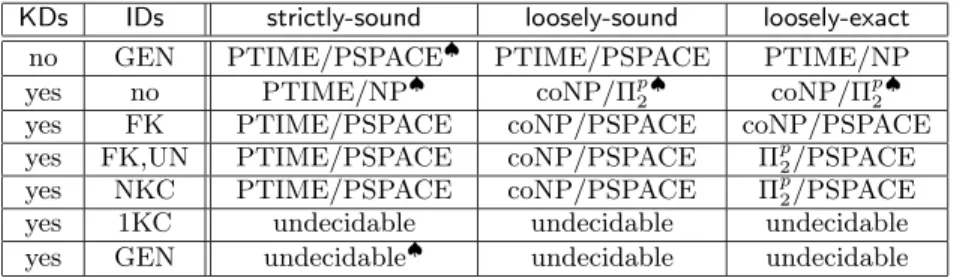
A detailed summary of the results of this paper is pre-sented in Section 6 (see Figure 1). We remark that the results we have obtained for the sound semantics extend previous studies on query containment under integrity con-straints [18], while the results for the loose semantics ex-tend known results in the field of inconsistent databases, by taking into account inclusion dependencies, which add sig-nificant complexity to the problem. In particular, the key issue in our work is that we are able to deal with infinite models for a database schema, that are to be taken into ac-count when cyclic inclusion dependencies are present in the schema.
The paper is organized as follows. In Section 2 we recall the formal framework of relational databases with integrity constraints. In Section 3 we study decidability and com-plexity of query answering under sound, complete, and ex-act semantics. In Section 4 we introduce a loose semantics for inconsistent data. In Section 5 we prove results about decidability and complexity of query answering under the loose semantics. Section 6 concludes the paper.
2.
FRAMEWORK
In this section we present the syntax and semantics of the relational model with integrity constraints. We assume that the reader is familiar with the basic notions of relational databases [1].
2.1
Syntax
We consider to have an infinite, fixed alphabet Γ of values representing real world objects, and we take into account only database instances having Γ as domain. Moreover, we assume that different values in Γ denote different objects, i.e., we adopt the so-calledunique name assumption.
Basically, in the relational model we have to account for a set of relation symbols and a set of integrity constraints, i.e., assertions on the relation symbols that express conditions that are intended to be satisfied by database instances.
In this paper we focus our attention on inclusion and key dependencies. More formally, we indicate a relational schema(or simplyschema)DBas a triplehS,I,Ki, where: • S is a set of relations, each with an associated arity that indicates the number of its attributes. The at-tributes of a relation r of arity n are represented by the integers 1, . . . , n.
• Iis a set ofinclusion dependencies (IDs), i.e., a set of assertions of the form r1[A]⊆r2[B], where r1, r2 are relations inS,A=A1, . . . , Anis a sequence of distinct attributes of r1, andB=B1, . . . , Bnis a sequence of distinct attributes ofr2.
• K is a set of key dependencies (KDs), i.e., a set of assertions the formkey(r) =A, whereris a relation in the global schema, andA=A1, . . . , An is a sequence of attributes of r. We assume that at most one key dependency is specified for each relation.
Arelational query(or simplyquery) overDBis a formula that is intended to extract a set of tuples of values of Γ. The language used to express queries over DB is union of conjunctive queries (UCQ). A UCQq of arityn is written in the form q(~x) ← conj1(~x, ~y1)∨ · · · ∨conjm(~x, ~ym), where for eachi∈ {1, . . . , m}conji(~x, ~yi) is a conjunction of atoms whose predicate symbols are inS, and involve~x= X1, . . . , Xn and~yi=Yi,1, . . . , Yi,ni, whereXkandYi, `are
either variables or values of Γ.
2.2
Semantics
Adatabase instance (or simplydatabase)Bfor a schema DB is a set of facts of the form r(t) where r is a relation of arity n in S and t is an n-tuple of values from Γ. We denote as rB the set
{t | r(t) ∈ B}. A database B for a schemaDBis said to beconsistentwithDBif it satisfies all the dependencies expressed onDB. In our framework, this means satisfying IDs inIand KDs inK. More formally:
• Bsatisfies an inclusion dependencyr1[A]⊆r2[B] if for each tuplet1 inrB1 there exists a tuplet2 inrB2 such thatt1[A] =t2[B], wheret[A] is the projection of the tupletoverA. IfBsatisfies all inclusion dependencies expressed onDB, then we say thatBis consistent with I;
• B satisfies a key dependency key(r) = A if for each t1, t2 ∈ rB with t1 6=t2 we havet1[A]6= t2[A]. IfB
satisfies all key dependencies expressed onDBwe say thatBis consistent withK.
Traditionally, the database theory essentially specifies a single database instance for a schemaDB. This means as-suming that each relationrinS has to be consideredexact, i.e., given a database instance Dconsistent with DB, r is satisfied by exactly the tuples that satisfyrinD.
On the other hand, different assumptions can be adopted for interpreting the tuples that Dassigns to relations inS with respect to tuples that actually satisfyDB. In particu-lar, tuples inDcan be considered a subset or a superset of the tuples that satisfyDB, or exactly the set of tuples satis-fyingDB. These interpretations give raise to three different semantics, calledsound,complete, andexact, respectively.
Formally, given a database instanceDforDB=hS,I,Ki, and an assumptionxforD, where x∈ {s, c, e}(for sound, complete, and exact semantics, respectively), the semantics of DB with respect toD and x, denoted semx(DB,D), is the set of database instancesBforDBsuch that:
• B is consistent withDB, i.e., it satisfies the integrity constraints inIandK;
• Bsatisfies the assumptions specified onD, i.e.: – B ⊇ Dwhenx=s(sound semantics); – B ⊆ Dwhenx=c(complete semantics); – B=Dwhenx=e(exact semantics).
It is easy to see that, whileseme(DB,D) contains at most a single database instance forDB, in generalsems(DB,D) and semc(DB,D) contain several databases for DB. Fur-thermore, in our setting it always holds that semc(DB,D) is a non-empty set for eachDBand eachD, since the empty database instance satisfies every possible set of KDs and IDs, therefore∅ ∈semc(DB,D).
Finally, we give the semantics of queries. Formally, given a database instance DforDBand an assumptionxforD, where x∈ {s, c, e}, we callanswers to a queryq of arityn with respect to DB, D and x, the set ansx(q,DB,D) = {hc1, . . . , cni | for each B ∈ semx(DB,D),hc1, . . . , cni ∈ qB }, where qB denotes the result of evaluating q over the databaseB. We recall thatqB is the set of n-tuples of val-ues of Γhc1, . . . , cni, such that, when substituting eachcifor xi, the formula∃~y1.conj1(~x, ~y1)∨ · · · ∨ ∃~ym.conjm(~x, ~ym) evaluates to true inB.
In this paper we address the decision problem associ-ated to query answering, that is, given a database schema DB, a database instance D, a query q of arity n over DB and a n-tuple t of values of Γ, to establish whether t∈ansx(q,DB,D).
Example 2.1. Consider the database schema
DB = hS,I,Ki where S contains the two relations1 player(Pname,Pteam) andteam(Tname,Tcity),I contains the ID player[Pteam] ⊆ team[Tname], stating that every player is enrolled in a team of a city, and K=∅. Assume to have the database instance
D={player(a,b),player(a,d),player(e,f),team(b,c)} 1For the sake of clarity, in the example we use names to denote attributes, rather than integers.
where a,b,c,d,e,f are values from Γ. It is easy to see that seme(DB,D) =∅, since there do not exist two tuples inteam
having d and f as first component, i.e.,D is not consistent withDB. This in turn implies that query answering is mean-ingless, since every possible fact is a logical consequence of
DB andD: for instance, the answer to the query that asks for all team names inteam, i.e., q(x)←team(x, y), is the whole interpretation domainΓ(that is, every possible value belongs to the extension of the query).
On the other hand,
semc(DB,D) ={{player(a,b),team(b,c)},{team(b,c)},∅} while sems(DB,D) contains all databases instance that can be obtained by adding toD(among others) at least one fact of the formteam(d, α)and one fact of the formteam(f, β), where α and β are values of the domain Γ. Notice that, since ∅ ∈ semc(DB,D), ansc(q,DB,D) = ∅, i.e., there is no answer to the query in the complete semantics, whereas anss(q,DB,D) ={b,d,f}.
2.3
Complexity classes
Finally, we briefly recall the complexity classes mentioned in the paper, and refer to [22] for further details. PA(NPA) is the class of problems that are solved in polynomial time by a deterministic (nondeterministic) Turing machine using an oracle forA, i.e., that solves in constant time any prob-lem inA. In particular, the complexity class Σp2 is the class of problems that are solved in polynomial time by a non-deterministic Turing machine that uses an NP-oracle, and Πp2 is the class of problems that are complement of a prob-lem in Σp2. Finally, PSPACE is the class of problems that can be solved by a Turing machine that uses a polynomially bounded amount of memory.
3.
QUERY ANSWERING
In this section we address the problem of query answer-ing in the presence of integrity constraints, under different assumptions on the data. We consider a database schema DB=hS,I,Ki, and a database instanceDforDB.
As illustrated in Section 2, when the data are consid-ered complete, then the empty database always belongs to semc(DB,D), independently of I and K; therefore, for
any query q and for any tuple t we have immediately
ansc(q,DB,D) =∅; hence, the answer to the decision prob-lem is always negative. When the data are considered exact, we have two cases:
1. D satisfies both I and K, therefore semc(DB,D) =
{D}andanse(q,DB,D) =qD. So, it is immediate to
establish whethert∈anse(q,DB,D);
2. D violates eitherI or K, therefore seme(DB,D) =∅
and anse(q,DB,D) consists of all tuples of the same
arity asq; the answer to the decision problem is there-fore affirmative, independently ofqandt.
The case where the data are considered sound is more interesting: in fact, if the inclusion dependencies inIare not satisfied, we may think of adding suitable facts toDin order to satisfy them (according to the sound semantics, we are not allowed to repair such violations by deleting facts). In this case, ifDsatisfiesK, the semantics ofDBis constituted in general by several (possibly infinite) databases, each of
which may have infinite size, since there are several ways of adding facts to D. Query answering with sound data is therefore a difficult task, that is not decidable in all cases.
We now define a restricted class of dependencies under which query answering is decidable.
Definition 3.1. Given a database schema DB = hS,I,Ki, an inclusion dependency in I of the form
r1[A1] ⊆ r2[A2] is a non-key-conflicting inclusion depen-dency (NKCID) with respect to K if either: (i) no KD is defined onr2, or (ii) the KD key(r2) =Kis in K, and A2
is not a strict superset of K, i.e.,A2 6⊃K. Moreover, the
schemaDBis non-key-conflicting(NKC) if all the IDs inI
are NKCIDs with respect toK.
Informally, a set of dependencies is NKC if no ID in I propagates a proper subset of the key of the relation in its right-hand side. We point out that the class of NKC IDs comprises the well-known class offoreign key dependencies, which corresponds to IDs of the formr1[A1]⊆r2[A2] such thatkey(r2) =A2.
We first show that, as soon as we extend the class of de-pendencies beyond the non-key-conflicting case, query an-swering is undecidable. In particular, we introduce, together with KDs, inclusion dependencies of the form r1[A1] ⊆ r2[A2] such that, if the KD key(r2) = K is in K, A2 is allowed to coverKplus at most one attribute ofr2. We will call such IDs 1-key-conflicting IDs (1KCIDs) with respect toK. A1-key-conflicting(1KC) database schema is defined analogously to a NKC schema. We first show undecidability of implication of KDs and 1KCIDs.
Theorem 3.2. The problem of implication2 for KDs and
1KCIDs is undecidable.
Proof. The proof is by reduction from the more gen-eral problem of implication of functional dependencies (FDs) and inclusion dependencies. Consider a generic instance of this problem, i.e., given a database schemaDB=hS,I,Fi, whereIis a set of IDs andFis a set of FDs, and an inclusion dependencyδ. We assume that all FDs inF are innormal form, i.e. of the formr:A→B, where a single attributeB is in the right-hand side. We construct anad hoc problem of implication of KDs and 1KCIDs, consisting of a database schemaDB1=hS1,I1,K1i, whereI1is a set of 1KCID with respect toK1, and the same dependency δ. We will show that the two problems are equivalent, i.e. (I ∪ F) |=δ if and only if (I1∪ K1) |= δ. The dependenciesI1 and K1, defined in a new database schema DB1 =hS1,I1,K1i, are constructed as follows.
• The new set of relationsS1 includes all relations inS (plus those added as below).
• I1 includes all IDs inI (plus those added as below). • Letϕbe a FD inF, of the form
r: A → B
We add to the schema an auxiliary relationrϕof arity |A|+ 1, and we add toI1 the dependencies
γ1: rϕ[A, B] ⊆ r[A, B] γ2: r[A, B] ⊆ rϕ[A, B]
2For the details about implication of database dependencies, we refer the reader to [1].
plus the key dependency
κ: key(rϕ) =A
Note that all the IDs inI2 are 1KCIDs with respect toK1. The following result, whose proof is straightforward, will be used in the rest of the proof.
Lemma 3.3. For any database B1 forDB1, we have that B1 satisfies{ϕ, γ1, γ2}if and only ifB1 satisfies{κ, γ1, γ2}.
From this result it follows that we are able to simulate general FDs by using KDs and 1KCIDs only. Now we end the reduction by showing that (I ∪ F) |=δ if and only if (I1∪ K1)|=δ.
“⇒” By contradiction, suppose (I1∪ K1)6|=δ; then there exists a databaseB1forDB1such thatB1satisfies (I1∪ K1) and violates δ. Consider a database B for DB obtained fromB1 by removing the facts associated with the relations of the formrϕintroduced in the reduction. By Lemma 3.3, Bsatisfies (I ∪ F); moreover,Bcannot satisfyδbecause B coincides withB1 on the relations inS.
“⇐” By contradiction, suppose (I ∪ K) 6|=δ; then there exists a database B for DB such that B satisfies (I ∪ F) and violates δ. We construct a database B1 for D1 that coincides withB on the relations in S, and such that the facts associated with the relations of the formrϕ, introduced in the reduction, are such that the dependencies of the form γ1, γ2 are satisfied. By Lemma 3.3, B1 satisfies (I1∪ K1); moreover, it cannot satisfyδbecauseB1coincides withBon the relations inS.
The reduction is clearly computable in a finite amount of time. Since implication of IDs and FDs is undecidable, the thesis follows.
We now show that query answering is undecidable in the presence of KDs and 1KCIDs.
Theorem 3.4. Let DB = hS,I,Ki be a 1KC database schema, D a database instance for DB, q a query of arity
noverDB, andt an-tuple of values of Γ. The problem of establishing whethert∈anss(q,DB,D)is undecidable.
Proof. The proof is analogous to a proof of PSPACE-hardness of an analogous result (addressed in the context of query containment) proved by Vardi and published in [18]. We will show a counterexample in which the problem is un-decidable. Letδ be the following inclusion dependency:
r[A1, . . . , Ak]⊆s[B1, . . . , Bk]
where r has arity n and s has arity m. Without loss of generality,δinvolves the firstkattributes ofrands respec-tively. We choose a database instanceDforDBcontaining the single factr(c1, . . . , cn). Then we consider the following boolean query:
q ← r(X1, . . . , Xn), s(X1, . . . , Xk, Yk+1, . . . , Ym) Note that the query q has a positive answer (i.e., hi ∈ anss(q,DB,D)) if and only if the fact
s(c1, . . . , ck, dk+1, . . . , dm) is in all databases in
sems(DB,D). It is immediate to see that this is true
if and only if (I ∪ K)|=δ. Since implication of 1KCIDs and KDs is undecidable, the thesis follows.
As an immediate consequence of this theorem, undecid-ability of query answering in the presence of KDs and gen-eral IDs follows. Moreover, the problem is still undecidable if we restrict to the class of instances consistent with the key dependencies.
Corollary 3.5. LetDB=hS,I,Ki be a 1KC database schema,Da database instance forDB consistent withK,q
a query of arityn overDB, andt an-tuple of values of Γ. The problem of establishing whether t ∈ anss(q,DB,D) is undecidable.
Proof. The case where D does not satisfy Kis clearly decidable, since in that case the answer to the problem is always affirmative. The claim follows immediately.
Now we come to query answering in the case of NKCIDs and KDs, and prove that this problem is decidable. To this aim, we need some preliminary results, presented in the milestone paper of Johnson and Klug [18], which ad-dresses the problem of conjunctive query containment in a database DB, in the presence of functional and inclusion dependencies. To test whether q1 ⊆ q2, we first have to “freeze” the body ofq1, considering its atoms as facts in a database instance D, and then applying the chase proce-dure to such a database. The resulting (possibly infinite) database, denoted as chase(DB,D), is constructed by re-peatedly applying, as long as it is applicable, the following rule:
Inclusion Dependency Chase Rule. Suppose there is a tuple t in rchase(DB,D), and there is an ID δ ∈ I of the form r[Xr] ⊆ s[Xs]. If there is no tuple t0 in schase
(DB,D) such that t0[Xs] =t[Xr], then we add a new tuple t
chase
inschase(DB,D) such thatt
chase[Xs] =t[Xr], and
for any attribute Ai ofs, with 1 ≤i ≤m and Ai∈/Xs,tchase[Ai] is a fresh value, not appearing
elsewhere in the database.
Johnson and Klug have proved thatq1⊆q2 if and only if q2chase(DB,D)is non-empty. Moreover, they have shown that, to check whetherqchase2 (DB,D)is non-empty, only a finite por-tion ofchase(DB,D) needs to be considered. Based on this property, they have defined a PSPACE algorithmAnswerJK,
that checks the non-emptiness ofq2chase(DB,D).
In the case of query answering, we are able to exploit the technique of Johnson and Klug. More specifically, we make use of the notion of chase as specified by the following result.
Lemma 3.6. Consider a database schemaDB=hS,I,∅i
and an instance D forDB; letq be a conjunctive query of arity n, andt a tuple of the same arity. We have that t∈
anss(q,DB,D) if and only ift∈q
chase(DB,D).
Proof (sketch).
“⇒” Since chase(DB,D) satisfies I, it belongs to
sems(DB,D). From the definition ofanss(q,DB,D), it
fol-lows thatt∈qchase(DB,D).
“⇐” Analogously to [7], it can be proved by induction on the structure ofchase(DB,D) that, for any database in-stance B ∈ sems(DB,D), there exists a homomorphismµ that sends the tuples of chase(DB,D) to the tuples ofB.
By hypothesist∈qchase(DB,D), so there exists a homomor-phismλfrom the atoms of q to the facts ofchase(DB,D); the compositionλ◦µwitnesses thatt∈anss(q,DB,D).
Based on the above property, we can apply the algorithm AnswerJK for query answering, to check whether a tuplet
belongs toanss(q,DB,D).
We now go back to NKCIDs. The most relevant property of NKCIDs is that they do not interfere with KDs, so that we can operate with NKCIDs just as if the KDs were not defined in the schema. This property is expressed by the following result.
Theorem 3.7 (Separation). Let DB = hS,I,Ki be a NKC database schema, and let DB1 = hS,I,∅i be the
database schema obtained from DB by removing the KDs. Let D be a database instance for DB andDB1, q a query
of arity n over DB, and t a n-tuple of values of Γ. We have thatt6∈anss(q,DB,D) iffDis consistent withKand
t6∈anss(q,DB1,D).
Proof. “⇒” By hypothesis t 6∈ anss(q,DB,D); this
means that there exists a database instanceB forDB that satisfiesIandK, and such thatt /∈qB. It is immediate to verify that B is also an instance for DB1 that satisfies K, and thereforet6∈anss(q,DB1,D). This proves the claim.
“⇐” By hypothesist6∈anss(q,DB1,D) andDsatisfiesK. Before we proceed further, we need to prove the following result.
Lemma 3.8. Let DB = hS,I,Ki be a database schema, with KDs and NKCIDs, andDis an instance forDB. Then chase(DB,D)satisfiesIandKif and only ifDis consistent withK.
Proof. “⇒” If Dviolates any of the key dependencies, since facts are only added (and never removed) in the con-struction of the canonical databasechase(DB,D), then also
chase(DB,D) violates the key dependencies inDB. “⇐” The proof is by induction on the structure of
chase(DB,D). First, by hypothesisDis consistent withK. For the induction step, suppose we insert inchase(DB,D) a tuple t into a relation r, on which a key dependency
key(r) = K is defined, according to the ID s[A] ⊆ r[B]. We will show that there is no violation of the key dependen-cies onr, by showing thattdoes not agree onK with any pre-existing tupletinrchase∗(DB,D), wherechase∗(
DB,D) is the portion ofchase(DB,D) constructed until the insertion oft.
According to the definition of NKCIDs, the possible cases are the following.
1. B=K. In this case we have a foreign key dependency; t and ¯t cannot agree on K, because in that case t wouldn’t have been added.
2. B ⊂ K. The two tuples differ on the values of B (otherwise only one of the two would have been added), so they differ also onK.
3. B∩K6=∅and B−K6=∅. In this caseB partially overlaps withkey(r); we necessarily haveK−B6=∅, otherwiseBwould be a strict superset ofK. Therefore tandtdiffer in the values inK−B, wherethas fresh values, thus they differa fortiorionK.
4. B∩K =∅. In this case the two tuples differ in the values inK, wherethas fresh values.
With this result in place, we are able to extend the re-sult of [18] to the case of NKCIDs and KDs. In fact, in this casechase(DB1,D) (which is identical tochase(DB,D) by construction) satisfies both I and K. Therefore, it is also a representative of all databases insems(DB,D), since sems(DB,D) ⊆ sems(DB1,D): hence, from Lemma 3.6 it follows that anss(q,DB,D) =q
chase(DB1,D). The claim fol-lows immediately.
Based on the above theorem, we define the algorithm AnswerS, that solves query answering in the case of non-key-conflicting database schemata.
AlgorithmAnswerS(DB,D, q, t)
Input:NKC database schemaDB=hS,I,Ki,
database instanceD, queryq of aritynoverDB, n-tupletof values of Γ;
Output: trueift∈anss(q,DB,D),falseotherwise;
if Dis not consistent withK thenreturntrue
elsereturnAnswerJK(DB,D, q, t)
To conclude the section, we present a complexity result for query answering in the presence of NKCIDs and KDs.
Theorem 3.9. Let DB = hS,I,Ki be a NKC database schema, D a database instance for DB, q a query of ar-ity n over DB, and t a n-tuple of values of Γ. The prob-lem of establishing whethert∈anss(q,DB,D)is PSPACE-complete with respect to combined complexity. Moreover, it is in PTIME in data complexity.
Proof. From the results in [18], it follows directly that the problem in the case of IDs alone is PSPACE-complete; being such a case a particular case of NKCIDs and KDs (when no KD is defined, any ID is non-key-conflicting), PSPACE-hardness in our general case follows trivially.
Membership is proved by showing that the algorithm AnswerS runs in PSPACE. Consider a database schema
DB = hS,I,Ki where I and K are sets of NKCIDs and KDs respectively. Given a databaseDforDB, a queryqof aritynoverG, and an-tupletof values of Γ, we want to es-tablish whethert∈anss(q,DB,D). Our algorithmAnswerS proceeds as follows. The first step, clearly feasible in PTIME (anda fortiori in PSPACE), checks whetherDsatisfiesK. If it does not, the answer is trivial; if it does, we can apply Theorem 3.7, disregardingK, and apply the PSPACE algo-rithmAnswerJK of [18]. All steps ofAnswerSare computable in PSPACE. Soundness and completeness of the algorithm follow immediately from Theorem 3.7 and from soundness and completeness ofAnswerJK [18].
Membership in PTIME in data complexity follows im-mediately since AnswerJK runs in time polynomial in data
complexity.
The above complexity characterization of the problem holds even if we restrict to instances consistent with the key dependencies.
Corollary 3.10. LetDB=hS,I,Kibe a NKC database schema,Da database instance forDBconsistent withK,q
a query of aritynoverDB, and tan-tuple of values ofΓ. The problem of establishing whether t ∈ anss(q,DB,D) is PSPACE-complete.
Proof. Membership follows immediately from the gen-eral case treated in Theorem 3.9. With regard to hardness, observe that in the case whereDdoes not satisfyKthe above algorithm solves query answering in PTIME. The claim fol-lows immediately.
4.
SEMANTICS
FOR
INCONSISTENT
DATA
In the cases we have addressed so far, the violation of a sin-gle dependency (under the sound and exact semantics) may lead to the non-interesting case in whichsemx(DB,D) =∅ (x∈ {e, s}). This does not seem reasonable when the viola-tions are due to a small set of facts. According to a common approach in the literature on inconsistent databases [15, 21, 3, 19], we now introduce less strict assumptions on data, un-der which we can getconsistent answers from inconsistent database instances.
Example 2.1 (contd.). As we have already shown,
seme(DB,D) = ∅ since D does not satisfy I, and as a
consequence query processing is trivial in the exact seman-tics. Assume now to add the key dependencykey[player] = {Pname}to K, stating that a player cannot be enrolled in more than one team. It is easy to see that now it is also
sems(DB,D) =∅, since the factsplayer(a,b) andplayer(a,d)
are not consistent withK, and it is not possible to makeD satisfyKby adding other facts to D. On the other hand, team(b,c) is consistent with the dependencies in the schema, whereas the inconsistency caused byplayer(e,f) can be re-solved under the sound semantics by adding a suitable fact to D of the form player(f, α). Therefore, rather than the whole domain Γ, the queryq(x)←team(x, y) should return the answer set{b}under the exact semantics and{b,f} un-der the sound semantics.
A possible solution to this problem is to characterize the semantics of a database schemaDB=hS,I,Kiwith respect to a database instanceDin terms of those databases that(i)
satisfy the integrity constraints onDB, and(ii)approximate “at best” the satisfaction of the assumptions onD. In other words, the integrity constraints ofDBare considered “hard”, whereas the assumptions are considered “soft”.
According to the main approaches to inconsistent databases, we now propose a modified definition of the se-mantics that reflects the above idea. Given a possibly in-consistent databaseDforDB, we define an ordering on the set of all databases consistent withDB. If B1 and B2 are two such databases, we say thatB1 is better thanB2 with respect toD, denoted asB1DB2, if:
• B1∩ D ⊃ B2∩ Dfor the sound assumption • B1− D ⊂ B2− D for the complete assumption • at least one of the two following conditions holds for
the exact assumption:
(i)B1∩ D ⊃ B2∩ DandB1− D ⊆ B2− D; (ii)B1∩ D ⊇ B2∩ DandB1− D ⊂ B2− D.
With this notion in place, we can modify the notion of semantics of a schema DB with respect to a database in-stanceDand an assumptionx, wherex∈ {s, c, e}as usual. In order to distinguish between the semantics used so far and their modified version, in the following we refer to the former as strict semantics, while we call the latter loose
semantics, and denote it with semlx(DB,D). Namely, we
call strictly-sound, strictly-complete, and strictly-exact the sound, complete, and exact semantics, whereas we respec-tively callloosely-sound,loosely-complete, andloosely-exact
the three loose semantics. More specifically, a database B consistent withDBis insemlx(DB,D) ifBis maximal with respect toD, i.e., for no other databaseB0consistent with
DB, we have thatB0
DB. It is also immediate to verify the following lemma:
Lemma 4.1. Let DB = hS,I,Ki be a database schema andDbe a database instance forDB. Then, semls(DB,D) =
S
D0sems(DB,D0)for each D0 maximal subset of D consis-tent withK.
Proof. For eachB ∈semls(DB,D) considerD0=
B ∩ D. It is easy to see that D0 is a maximal subset of
D consis-tent withK, and thatB ∈sems(DB,D0). Furthermore, for
each D0 maximal subset of
D consistent with K, if B0
∈
sems(DB,D0), thenB0∩ D0=D0, henceB0∈semls(DB,D).
With regard to answers, we indicate the set of answers to queries under the loose semantics with anslx(q,DB,D),
wherex∈ {s, c, e}as usual. It is immediate to verify that, if
semx(DB,D)6=∅for anyx∈ {s, c, e}, then the strict seman-tics and the loose one coincide, in the sense that, for each query q ansx(q,DB,D) = anslx(q,DB,D). Consequently, since (as illustrated in Section 2)semc(DB,D)6=∅for each DBand for eachD, it follows that the strictly-complete and the loosely-complete semantics always coincide.
Moreover, notice that the loose semantics is never empty, i.e., it always holds that semlx(DB,D) 6= ∅ for any x ∈
{s, c, e}, even ifsemx(DB,D) =∅.
Example 2.1 (contd.). With regard to our ongoing ex-ample we have that:
1. semle(DB,D) contains the databaseB1={player(a,b),
team(b,c)}, and all the databases of the form B2 = {player(a,d), team(b,c), team(d, α)} for each α ∈ Γ, B3 = {player(a,b), player(e,f), team(b,c), team(f, α)} for each α ∈ Γ, and B4 = {player(a,d), player(e,f), team(b,c),team(d, α),team(f, β)}for eachα, β∈Γ; 2. semls(DB,D) contains the databases of the form B3
and B4, and each database consistent with DB that can be obtained by adding facts to a database of the formB3orB4;
3. semlc(DB,D) =semc(DB,D).
Therefore, under the three semantics, the answers to the queryq(x)←team(x, y) are respectively ansle(q,DB,D) =
5.
QUERY
ANSWERING
UNDER
THE
LOOSE SEMANTICS
In this section we analyze the problem of computing an-swers to queries under the loose semantics. In particular, since (as shown in Section 4) the loosely-complete and the strictly-complete semantics coincide, we study query an-swering under the sound semantics and the loosely-exact semantics.
5.1
Query answering under the loosely-sound
semantics
We now study the query answering problem under the loosely-sound semantics. As we already said, differently from the strictly-sound semantics, given a database schema DB=hS,I,Kiand a database instance D, it always holds thatsemls(DB,D)6=∅, because we are now allowed to also
eliminate facts from D in order to satisfy integrity con-straints. Notice that, while to satisfy key dependencies we are forced to delete facts from D, inclusion dependencies must be satisfied by adding new facts, since databases in
semls(DB,D) are the ones that are “as sound as possible”, thus we have to consider only databases consistent with the constraints that “minimize” elimination of facts fromD.
We first show undecidability of query answering for 1-key-conflicting database schemata.
Theorem 5.1. Let DB = hS,I,Ki be a 1KC database schema,Da database instance forDBconsistent withK,q
a query of arityn overDB, and ta n-tuple of values from
Γ. The problem of establishing whethert∈ansls(q,DB,D) is undecidable.
Proof. Undecidability follows from Corollary 3.5 since, in the case in which D is consistent with K, t ∈
ansls(q,DB,D) ifft∈anss(q,DB,D).
As for the class of non-key-conflicting database schemata, we give a method for computing answers to a queryq un-der the loosely-sound semantics that can be informally ex-plained as follows: we first identify the maximal subsets of Dthat are consistent withK, then for each such database D0 we make use of the algorithm
AnswerSpresented in Sec-tion 3. Indeed, it can be shown that a tuple tis a consis-tent answer to a query q with respect to DB and D, i.e., t∈ansls(q,DB,D), iffAnswerS(DB,D0, q, t) returns true for each such databaseD0. More specifically, we define the fol-lowing algorithm:
AlgorithmAnswerLS(DB,D, q, t)
Input:non-key-conflicting database schemaDB=hS,I,Ki,
database instanceD,
queryqof aritynoverDB,n-tupletof values from Γ; Output:true ift∈ansls(q,DB,D),falseotherwise;
if there existsD1⊆ D
such that
(1)D1is consistent withK; (2)for eachr(t)∈ D − D1,
D1∪ {r(t)}is not consistent withK; (3)AnswerS(DB,D1, q, t) returnsfalse
then returnfalse
else returntrue
Informally, conditions (1) and (2) together check thatD1 is a maximal subset of D consistent with K; this implies the existence of a database B ∈ semls(DB,D) such that B ∩ D=D1. Then, condition (3) verifies thatt /∈qB.
Theorem 5.2. Let DB = hS,I,Ki be a NKC database schema, D be a database instance forDB, q be a query of arity n overDB, andt be an-tuple of values ofΓ. Then,
t∈ansls(q,DB,D)iffAnswerLS(DB,D, q, t)returns true.
Proof. “⇒” If t ∈ ansls(q,DB,D) then t ∈ qB for
each B ∈ semls(DB,D). From Lemma 4.1 it follows that t∈anss(q,DB,D1) for eachD1maximal subset ofD
consis-tent withK, and from soundness and completeness of algo-rithmAnswerS, it follows thatAnswerS(DB,D1, q, t) returns
truefor each such databaseD1. Hence,AnswerLS(DB,D, q, t) returnstrue.
“⇐” Suppose by contradiction that t /∈ ansls(q,DB,D)
and AnswerLS(DB,D, q, t) returns true. This implies that for each D1 maximal subset of D consistent with K, AnswerS(DB,D1, q, t) returns true. From soundness and completeness of algorithm AnswerS, it follows that t ∈ anss(q,DB,D1) for each such database D1, i.e., t∈qB for
each B ∈sems(DB,D1). From Lemma 4.1 it follows that t∈qB for each
B ∈semls(DB,D), but this contradicts the assumption.
We give now the computational characterization of the problem of query answering under the loosely-sound seman-tics in the presence of NKCIDs with respect toK.
Theorem 5.3. Let DB = hS,I,Ki be a NKC database schema, D be a database instance forDB, q be a query of arity n over DB, and t be a n-tuple of values of Γ. The problem of establishing whethert∈ansls(q,DB,D)is coNP-complete with respect to data complexity.
Proof. Membership in coNP follows from the algorithm AnswerLS(DB,D, q, t) and from Theorem 3.9. Indeed, in the algorithm the problem of establishing whether t /∈
ansls(q,DB,D), that is the complement of our problem, is
carried out by guessing a database and checking conditions (1), (2), and (3) that can be verified in polynomial time.
We prove coNP-hardness of the problem even if we restrict to database schemata without IDs. Actually, this hardness result can be immediately derived from the results reported in [10] (although obtained under a different semantics): how-ever, in the following we provide an alternative proof, in which we use a reduction of the 3-colorability problem to our problem. Consider a graphG= (V, E) with a set of vertices V and edgesE. We define a database schemaDB=hS,∅,Ki where S consists of the two binary relationsedge and col, and K contains the dependency key(col) = {1}. The in-stanceDis defined as follows:
D = {col(c, i)|i∈ {1,2,3}andc∈V} ∪ {edge(x, y)|hx, yi ∈E}
Finally, we define the query
q ← edge(X, Y),col(X, Z),col(Y, Z)
We prove thatGis 3-colorable (i.e., for each pair of adjacent vertices, the vertices are associated with different colors) if and only ifhi 6∈ ansls(q,DB,D) (i.e., the boolean query q
has an affirmative answer). In fact, it is immediate to verify that, for each possible coloringCof the graph (i.e., a set of pairs of vertices and colors, where the three colors are rep-resented by the values 1,2,3) there existsB ∈semls(DB,D)
that exactly corresponds toC, i.e.,colBis exactly the set of pairs in the coloringC. Therefore, if there exists a coloring
that is a 3-coloring, thenhi 6∈qBfor someB ∈semls(DB,D),
consequentlyhi 6∈ansls(q,DB,D). Conversely, it is immedi-ate to verify that, for eachB ∈semls(DB,D), colB∩D
cor-responds to a possible coloring of the graph. Hence, if each possible coloring is not a 3-coloring, thenhi ∈qB, therefore
hi ∈ansls(q,DB,D).
Theorem 5.4. Let DB = hS,I,Ki be a NKC database schema, Dbe a database instance for DB, q be a query of aritynoverDB, andtbe an-tuple of values ofΓ. The prob-lem of establishing whethert∈ansls(q,DB,D)is PSPACE-complete with respect to combined complexity.
Proof. Hardness follows from Corollary 3.10 and from the fact that, when D is consistent with K, t ∈
ansls(q,DB,D) if and only ift∈anss(q,DB,D).
Membership in PSPACE follows from algorithm AnswerLS(DB,D, q, t) and Theorem 3.9. Indeed, it is easy to see that conditions (1), (2), and (3) can be verified in poly-nomial space, and furthermore NPSPACE=PSPACE [22].
5.2
Query answering under the loosely-exact
semantics
We now study the query answering problem under the loosely-exact semantics. We recall that, differently from the loosely-sound semantics, in this case IDs can be satisfied by either adding or deleting facts. Hence,semle(DB,D) ac-counts for databases that minimize both elimination and insertion of facts, i.e., that are “as exact as possible”.
We first prove that query answering under the loosely-exact semantics is undecidable in the general case, i.e., when no restriction is imposed on the form of IDs and KDs.
Theorem 5.5. LetDB=hS,I,Kibe a database schema,
Da database instance forDB,qa query of aritynoverDB, andta n-tuple of values ofΓ. The problem of establishing whethert∈ansle(q,DB,D) is undecidable.
Proof. We reduce query answering in the loosely-sound semantics to query answering in the loosely-exact seman-tics. We can restrict to instances D consistent with K, since by Theorem 5.1 for this class of instances the prob-lem of establishing whethert∈ansls(q,DB,D) is undecid-able. Starting from such a problem instance (DB,D, q, t), we define a new problem instance (DB0,
D0, q0, t0
) such that t∈ansls(q,DB,D) ifft0∈ansle(q0,DB0,D0). Precisely:
• DB0=
hS0,
I0,
K0
iis obtained fromDBby: – defining S0 as the schema obtained from
S by adding an attribute to each relation inS (in the last position);
– changing each inclusion in order to propa-gate such a new attribute from r to s, i.e., I0 is obtained from I by replacing each
I = r[i1, . . . , ik] ⊆ s[j1, . . . , jk] with I0 = r[i1, . . . , ik, n] ⊆ s[j1, . . . , jk, m], where n is the arity ofrinS0 andmis the arity ofsinS0;
• D0is the set
D0
1∪ D02, whereD10 ={r(u, t0)|r(u)∈ D } and
D02={r(u, t1)|r∈ S and
uis a tuple of values of ΓD∪ {t1} }
where ΓDdenotes the set of symbols from Γ appearing inD, andt0, t1are values not belonging to ΓD. Notice that the setD0 is finite;
• if the queryqhas the form
q(~x) ← conj1(x, ~~ y1)∨ · · · ∨conjk(~x, ~yk) the queryq0is as follows:
q0(~x, Y)
←
conj1(~x, ~y1, t0)∨ · · · ∨conjk(~x, ~yk, t0)∨body
0
wherebody0is the disjunction
_
{r(u, t1) | r(u)∈ Dand there is a KD forrinK} • t0is obtained fromtby adding the valuet0at the end
of the tuplet.
It can be shown that t ∈ ansls(q,DB,D) iff
t0 ∈ ansle(q0,DB0,D0), since for each database B in semle(DB,D), there are two possible cases:
1. B∩D=D. In this case, due to the key dependenciesK, Bdoes not contain any tuple of the formr(u, t1) such that r(u) ∈ D and a key dependency forr is defined inK. Consequently,t0∈q0Bifft
∈qB. Moreover, it is immediate to verify that there exists at least one such Binsemle(DB0,D0);
2. B ∩ D ⊂ D. In this case, there exists at least one tuple inBof the formr(u, t1) such thatr(u)∈ Dand a key dependency for r is defined inK, consequently t0∈q0B for each such
B. In other words, this kind of databases does not affectansle(q0,DB0,D0), since inB
every possible tuple is in the answer ofq0. Therefore,t∈ansls(q,DB,D) ifft0∈ansle(q0,DB0,D0).
Finally, since the above reduction is effectively com-putable and since, by Theorem 5.1, establishing whether t∈ansls(q,DB,D) is undecidable, the thesis follows.
Differently from the previous semantics, in the case when the instanceDis consistent withK, we obtain a surprising result: query answering is decidable under the loosely-exact semantics even without any restriction on the form of KDs and IDs.
Theorem 5.6. LetDB=hS,I,Kibe a database schema,
Da database instance consistent withK,q a query of arity
n overDB, and tbe an-tuple of values ofΓ. The problem of establishing whether t ∈ ansle(q,DB,D) can be decided in polynomial time with respect to data complexity and is NP-complete with respect to combined complexity.
Proof. To prove the thesis, we define the following algo-rithm:
AlgorithmAnswerConsLE(DB,D, q, t)
Input:database schemaDB=hS,I,Ki,
instanceDconsistent withK,
conjunctive queryqof arityn,n-tuplet
Output: trueift∈ansle(q,DB,D),falseotherwise
D1=D;
repeat
D0=D1;
if there existsr[i1, . . . , ik]⊆s[j1, . . . , jk]∈ I
such that
for eachs(t00)∈ D1,t00[j1, . . . , jk]6=t0[i1, . . . , ik]
thenD1=D1− {r(t0)}
untilD1=D0;
ift∈qD1
then returntrue
else returnfalse
Correctness of the algorithm AnswerConsLE follows from the fact that the databaseD1 computed by the algorithm is such that (i) D1 ∈ semle(DB,D); (ii) for each B ∈ semle(DB,D), B ⊇ D1. Therefore, t ∈ ansle(q,DB,D) if
and only ift ∈qD1. It is well-known that this last condi-tion (corresponding to standard query answering over a re-lational database) can be computed in polynomial time with respect to data complexity and in nondeterministic polyno-mial time with respect to combined complexity.
Let us turn our attention on query answering under the loosely-exact semantics in the case of NKC database schemata. To this aim, we first define a particular query Q(I, t) associated with a tuple t and an inclusion depen-dencyI.
Definition 5.7. LetI be an inclusion dependency of the form r[i1, . . . , ik]⊆s[j1, . . . , jk], wherer has aritynand s
has aritym, and let tbe an n-tuple. We denote asQ(I, t)
the boolean conjunctive queryq←s(z1, . . . , zm), where, for
each` such that1≤`≤m, each z`is as follows: if there existshsuch that`=jhthenz`=t[ih], otherwisez`=X`.
In the following, the queryQ(I, t) is used in order to verify whether a database schemaDBand an instanceDimply the existence in all databasesB ∈sems(DB,D) of a fact of the
forms(t0) such thatt[i1, . . . , ik] =t 0
[j1, . . . , jk].
Below we define the algorithmAnswerLEfor query answer-ing under the loosely-exact semantics.
AlgorithmAnswerLE(DB,D, q, t)
Input:NKC database schemaDB=hS,I,Ki, instanceD,
queryqof aritynoverDB,n-tupletof values of Γ
Output:true ift∈ansle(q,DB,D),falseotherwise
if there existsD0⊆ Dsuch that
(a)D0is consistent withKand
(b)AnswerS(hS,I,∅i,D0, q, t) returnsfalseand
(c)for eachD00such thatD0⊂ D00⊆ D
(c1)D00is not consistent withKor
(c2)there existsI∈ Iandr(t1)∈ D00
such that
AnswerS(hS,I,∅i,D0, Q(I, t1),hi) returnsfalseand
AnswerS(hS,∅,∅i,D00, Q(I, t1),hi) returnsfalse
then returnfalse
else returntrue
Intuitively, to returnfalsethe algorithm looks for the ex-istence of a databaseB0 insemle(
DB,D) such thatt6∈qB0 . As in the algorithmAnswerLS, the databaseB0is represented by its intersection with the initial instanceD(denoted asD0 in the algorithm): the fact thatt6∈qB0
is verified by condi-tion (b), while the fact thatB0
∈semle(DB,D) is verified by
conditions (a) and (c) of the algorithm. In particular, con-dition (c) verifies that, for each database B00 (represented by its intersection withDdenoted asD00), it is not the case thatB00
DB0. In conditions (c1) and (c2), the symbolhi denotes the empty tuple.
Soundness and completeness of the algorithm is estab-lished by the following theorem.
Theorem 5.8. Let DB = hS,I,Ki be a NKC database schema, D be a database instance, q be a query of arityn
over S, and t be a n-tuple of values from Γ. Then, t ∈
ansle(q,DB,D)iffAnswerLE(DB,D, q, t)returns true.
Proof. In order to prove correctness of the above al-gorithm, we need a preliminary lemma. In the following, given an instance D of a database schemaDB =hS,I,∅i, we denote as chase1(DB,D) the set of new facts obtained by applying the chase rule to the facts in D, i.e., the set of facts of the form s(t2) such that there exist I = r[i1, . . . , ik] ⊆ s[j1, . . . , jk] ∈ I and r(t1) ∈ D such that t1[i1, . . . , ik] = t2[j1, . . . , jk] and there exists no s(t3) ∈ D such thatt1[i1, . . . , ik] =t3[j1, . . . , jk].
Lemma 5.9. LetD0,
D00be instances of a database schema
DB = hS,I,∅i such that D0
⊂ D00 and, for each I
∈ I of the form I = r[i1, . . . , ik] ⊆ s[j1, . . . , jk] and for
eachr(t1)∈ D00, either
AnswerS(hS,I,∅i,D0, Q(I, t1),hi)
re-turns true orAnswerS(hS,∅,∅i,D00, Q(I, t1),hi)returns true.
Then, chase(DB,D00 )− D00
⊆chase(DB,D0 )− D0
.
Proof. It is straightforward to verify that the hypothesis implies thatchase1(DB,D00)
⊆chase1(DB,D0); this in turn implies that each new fact added in chase(DB,D00) by an application of the chase rule inchase(DB,D00) is also added by the chase rule inchase(DB,D0). Consequently, the thesis follows.
We now prove the theorem.
“⇒” Suppose AnswerLE(DB,D, q, t) returns false. Then, there existsD0
⊆ Dsuch that conditions (a), (b) and (c) of the algorithm hold for D0. Let B0 =chase(
DB,D0). Now, suppose B0
6∈semle(DB,D): hence, there exists a database
instanceB00such that
B00is consistent with
KandB00
D
B0, which implies that
B00
−D ⊆ B0
−D. Since by hypothesis condition (c) holds forD0, it follows that condition (c2) holds forD00, i.e., there exists a factr(t1)
∈ D00and an inclusion
I=r[i1, . . . , ik]⊆s[j1, . . . , jk]∈ Isuch that:
1. AnswerS(hS,I,∅i,D0, Q(I, t1),hi) returns false, which implies that there is no fact in B0 of the form s(t2) such thatt1[i1, . . . , ik] =t2[j1, . . . , jk];
2. AnswerS(hS,∅,∅i,D00, Q(I, t1),hi) returns false, which implies that there is no fact in D00 of the forms(t2) such thatt1[i1, . . . , ik] = t2[j1, . . . , jk]. On the other hand, a fact of the forms(t2) such thatt1[i1, . . . , ik] = t2[j1, . . . , jk] must be present in B00, due to the pres-ence ofr(t1) inD00and to the inclusionI.
The two above conditions imply that there exists a fact of the form s(t2) in B00
− D which does not belong to B0
. Consequently, B00
− D ⊆ B0
− D does not hold, thus contradicting the hypothesis that B00
D B0. Therefore,
B0
∈ semle(DB,D), and since conditions (a) and (b) hold
forD0, it follows thatt
6∈qB0
, hencet6∈ansle(q,DB,D). “⇐” Supposet6∈ansle(q,DB,D). Therefore, there exists B0
∈semle(DB,D) such thatt6∈qB
0 . LetD0
=D ∩B0 . Since B0
∈semle(DB,D), condition (a) of the algorithm holds for B0, and since
D0
⊆ B0, condition (a) holds for
D0 as well. Fromt6∈qB0 and from soundness and completeness of the algorithmAnswerSit follows that condition (b) holds forD0. Now, suppose condition (c) does not hold forD0: then, there
exists D00
such that conditions (c1) and (c2) do not hold forD0 and
D00, i.e.,
D00 is consistent with
Kand, for each I ∈ I of the form I = r[i1, . . . , ik] ⊆ s[j1, . . . , jk] and for eachr(t1)∈ D00, eitherAnswerS(hS,I,∅i,D0, Q(I, t1),hi) re-turnstrueorAnswerS(hS,∅,∅i,D00, Q(I, t1),hi) returnstrue. By Lemma 5.9, it follows that chase(DB,D00)
− D00
⊆
chase(DB,D0)− D0. Now let B00 = chase(DB,D00): since
B0
⊇chase(DB,D0), it follows that
B00
− D ⊆ B0
− D, and by hypothesisD00
⊃ D0, therefore
B00
∩ D ⊃ B0
∩ D, hence B00
DB0. Moreover, sinceD00 is consistent withK,B00is consistent withKandI, consequentlyB0
6∈ semle(DB,D), thus contradicting the hypothesis. Therefore, condition (c) holds for D0, which implies that Answer
LE(DB,D, q, t) re-turnsfalse.
Finally, based on the above algorithm, we analyze the computational complexity of query answering under the loosely-exact semantics for NKC database schemata.
Theorem 5.10. LetDB =hS,I,Ki be a NKC database schema,Da database instance,qa query of aritynoverDB, andta n-tuple of values ofΓ. The problem of establishing whether t∈ ansle(q,DB,D) isΠ
p
2-complete with respect to
data complexity and PSPACE-complete with respect to com-bined complexity.
Proof sketch. The analysis of the algorithmAnswerLEshows that the problem is in Πp2 with respect to data complexity. Indeed, it is immediate to verify that:
• condition (a) can be verified in polynomial time; • condition (b) can be verified in polynomial time, as
shown in Section 3;
• conditions (c1) and (c2) can be verified in polynomial time: therefore, condition (c) can be verified in non-deterministic polynomial time.
Consequently, if considered as a nondeterministic procedure, the algorithm runs in Πp
2 with respect to data complexity. Hardness with respect to Πp2 can be proved by a reduction from 2-QBF validity, i.e., the validity problem for quantified boolean formulae having the form∀x∃yf(x, y) wheref(x, y) is a 3-CNF, i.e., a propositional formula in 3-conjunctive nor-mal form. The reduction generalizes the scheme employed in the proof of Theorem 5.3.
As concerns combined complexity, it is immediate to ver-ify that each of the conditions of the algorithm is computed in nondeterministic polynomial space, therefore the algo-rithm runs in nondeterministic polynomial space with re-spect to combined complexity, which proves membership in PSPACE of the problem. PSPACE-hardness can be proved by reducing query answering under loosely-sound seman-tics for databases without key dependencies to this problem. The reduction is obtained by a slight modification of the re-duction from query answering under loosely-sound seman-tics exhibited in the proof of Theorem 5.5, and observing that, if the original problem instance is such that, for each I =r[A~]⊆ s[B~] ∈ I, B~ does not cover the set of all the attributes ofs, then the derived database schemaDB0 is a NKC schema. Moreover, it is immediate to verify that re-stricting to such a kind of problem instances does not affect PSPACE-hardness of the query answering problem under the loosely-sound semantics. Finally, the reduction is mod-ified in a way such that the database instanceD0
obtained from the original instance D has size polynomial with re-spect to data complexity.
6.
DISCUSSION
6.1
Summary of results
The summary of the results we have obtained is reported in Figure 13, in which we have two distinct tables, that present, respectively, the complexity of query answering for the class of general database instances and for instances con-sistent with KDs. Each column (with the exception of the first two) corresponds to a different semantics, while each row corresponds to a different class of dependencies (speci-fied in the first two columns). Each cell of the tables reports data complexity and combined complexity of query answer-ing: for each decidable case, the complexity of the problem is complete with respect to the class reported. We have marked with the symbol♠the cells corresponding either to already known results or to results straightforwardly implied by known results.
We point out that, due to the correspondence between query answering and query containment illustrated in Sec-tion 3, all the complexity results established for the problem of query answering also hold for the conjunctive query con-tainment problem.
6.2
Related work
The problem of reasoning with inconsistent databases is closely related to the studies in belief revision and update
[2]. This area of Artificial Intelligence studies the problem of integrating new information with previous knowledge. In general, the problem is studied in a logical framework, in which the new information is a logical formula f and the previous knowledge is a logical theory (also called knowledge base)T. Of course,fmay in general be inconsistent withT. Therevised(orupdated) knowledge base is denoted asT◦f, and several semantics have been proposed for the operator◦. The semantics for belief revision can be divided intorevision
semantics, when the new information f is interpreted as a modification of the knowledge about the world, andupdate
semantics, whenf reflects a change in the world.
The problem of reasoning with inconsistent databases can be actually seen as a problem of belief revision. In fact, with respect to the above illustrated knowledge base revi-sion framework, if we consider the database instance Das the initial knowledge base T, and the set of integrity con-straintsI ∪ Kas the new informationf, then the problem of deciding whether a tupletis in the answer set of a query q with respect to the database schemaDB=hS,I,Kiand the instance D corresponds to the belief revision problem D ◦(I ∪ K) |= q(t). Based on such a correspondence, the studies in belief revision appear very relevant for the field of inconsistent databases: indeed, almost all the approaches to inconsistent databases that we have considered in this sec-tion can be reconstructed in terms of direct applicasec-tions of well-known semantics for belief revision/update in a partic-ular class of theories.
On the other hand, from a computational perspective, there are no results concerning the particular kind of belief revision/update that is of interest for database applications: in particular, the class of relational integrity constraints as revision/update knowledge has not been taken into account in the belief revision literature, where the computational 3Due to space limitations, in the present version of the paper we have not been able to include the proofs of all the results reported in Figure 1.
Data complexity/combined complexity forgeneral database instances:
KDs IDs strictly-sound loosely-sound loosely-exact
no GEN PTIME/PSPACE♠ PTIME/PSPACE PTIME/NP yes no PTIME/NP♠ coNP/Πp
2
♠ coNP/Πp 2 ♠ yes FK PTIME/PSPACE coNP/PSPACE coNP/PSPACE yes FK,UN PTIME/PSPACE coNP/PSPACE Πp
2/PSPACE yes NKC PTIME/PSPACE coNP/PSPACE Πp2/PSPACE yes 1KC undecidable undecidable undecidable yes GEN undecidable♠ undecidable undecidable Data complexity/combined complexity forkey-consistent database instances:
KDs IDs strictly-sound loosely-sound loosely-exact
no GEN PTIME/PSPACE♠ PTIME/PSPACE PTIME/NP yes no PTIME/NP♠ PTIME/NP♠ PTIME/NP♠ yes FK PTIME/PSPACE PTIME/PSPACE PTIME/NP yes FK,UN PTIME/PSPACE PTIME/PSPACE PTIME/NP yes NKCID PTIME/PSPACE PTIME/PSPACE PTIME/NP yes 1KCID undecidable undecidable PTIME/NP yes GEN undecidable♠ undecidable PTIME/NP
Legenda: FK = foreign key dependencies, GEN = general IDs, UN = unary IDs;♠= already known result.
Figure 1: Complexity of query answering under KDs and IDs (decision problem)
results mostly concern a setting in which knowledge is spec-ified in terms of propositional formulae of classical logic [12, 13]. Instead, the typical database setting is considered by the literature on inconsistent databases, which we briefly survey in the following.
The notion of consistent query answers over inconsistent databases was originally given in [5]. However, the approach in [5] is completely proof-theoretic, and no computational technique for obtaining consistent answers from inconsistent database is provided.
In [21] the authors describe an operator for merging databases under constraints which allows for obtaining a maximal amount of information from each database by means of a majority criterion used in case of conflict. Even if a large set of constraints is considered, namely the con-straints that can be expressed as first-order formulae, the computational complexity of the merging procedure is not explored, and no algorithm to compute consistent query an-swers is provided. Furthermore, the problem of dealing with incomplete databases is not taken into account. Notice also that, different from all the other studies mentioned in the following, this approach relies on a cardinality-based order-ing between databases (rather than a set-containment-based ordering).
In [15] the authors propose a framework for updating the-ories and logical databases (i.e., databases obtained by giv-ing priorities to sentences in the databases) that can be extended also to the case of updating views. The seman-tics proposed in such a paper is based on a particular set-containment based ordering between theories that “accom-plish” an update to an original theory, which is similar to the loosely-sound semantics above presented.
In [3] the authors define an algorithm for consistent query answers in inconsistent databases based on the notion of
residues, originally defined in the context of semantic query
optimization. The method is proved to be sound and com-plete only for the class of universally quantified binary con-straints, i.e., constraints that involve two database relations. In [4] the same authors propose a new method that can handle arbitrary universally quantified constraints by spec-ifying the database repairs into logic rules with exceptions
(LPe). The semantics underlying the notion of consistent query answers both in [3] and in [4] is defined on a set-containment ordering between databases, which corresponds to the loosely-exact semantics of our framework.
Moreover, a different semantics for database repairing has been considered in [10, 9]. Specifically, in such works a se-mantics is defined in which only tuple elimination is allowed; therefore, the problem of dealing with infinite models is not addressed. Then, a preference order over the database re-pairs is defined, in such a way that only minimal rere-pairs (in terms of set containment) are considered. Hence, the se-mantics is a “maximal complete” one, in the sense that only maximal consistent subsets of the database instance are con-sidered as repairs of such an instance. In [10] the authors establish complexity results for query answering under such a semantics in the presence of denial constraints, a gener-alization of key dependencies and functional dependencies, while in [9] also inclusion dependencies are considered. Such a “maximal complete” semantics is different from the com-plete semantics considered in the present paper.
Finally, [16] proposes a technique to deal with inconsis-tencies that is based on the reformulation of integrity con-straints into a disjunctive datalog program with two different forms of negation: negation as failure and classical negation. Such a program can be used both to repair databases, i.e., modify the data in the databases in order to satisfy integrity constraints, and to compute consistent query answers. The technique is proved to be sound and complete for universally quantified constraints. The semantics adopted to support
this method corresponds to our loosely-exact semantics. We point out that none of the above mentioned works provides a general solution for the case of cyclic inclusion dependencies under the semantics (both strict and loose) considered in this paper.
6.3
Future work
Although obtained in a single database context, many of the techniques and results presented here are directly applicable to data integration, where multiple information sources may provide data that are inconsistent with respect to the global view of the sources. Indeed, we believe that one important development of the research presented in this paper is towards both the computational analysis of query answering in data integration systems and the definition of effective query processing techniques in such a setting.
Moreover, we are currently working on the extension of the present framework with more complex forms of dencies, e.g., functional dependencies and exclusion depen-dencies.
7.
ACKNOWLEDGMENTS
This research has been supported by the Projects IN-FOMIX (IST-2001-33570) and SEWASIE (IST-2001-34825) funded by the EU, and by the Project D2I funded by MIUR (Ministero per l’Istruzione, l’Universit`a e la Ricerca). We would like to thank Maurizio Lenzerini and Giuseppe De Giacomo for their insightful comments about this material.
8.
REFERENCES
[1] S. Abiteboul, R. Hull, and V. Vianu.Foundations of Databases. Addison Wesley Publ. Co., Reading, Massachussetts, 1995.
[2] C. E. Alchourr´on, P. G¨ardenfors, and D. Makinson. On the logic of theory change: Partial meet contraction and revision functions.J. of Symbolic Logic, 50:510–530, 1985.
[3] M. Arenas, L. E. Bertossi, and J. Chomicki.
Consistent query answers in inconsistent databases. In
Proc. of the 18th ACM SIGACT SIGMOD SIGART Symp. on Principles of Database Systems (PODS’99), pages 68–79, 1999.
[4] M. Arenas, L. E. Bertossi, and J. Chomicki.
Specifying and querying database repairs using logic programs with exceptions. InProc. of the 4th Int. Conf. on Flexible Query Answering Systems (FQAS 2000), pages 27–41. Springer, 2000.
[5] F. Bry. Query answering in information systems with integrity constraints. InIFIP WG 11.5 Working Conf. on Integrity and Control in Information System. Chapman & Hall, 1997.
[6] A. Cal`ı, D. Calvanese, G. De Giacomo, and M. Lenzerini. Accessing data integration systems through conceptual schemas. InProc. of the 20th Int. Conf. on Conceptual Modeling (ER 2001), pages 270–284, 2001.
[7] A. Cal`ı, D. Calvanese, G. De Giacomo, and M. Lenzerini. Data integration under integrity constraints.Information Systems, 2003. To appear. [8] M. A. Casanova, R. Fagin, and C. H. Papadimitriou.
Inclusion dependencies and their interaction with
functional dependencies.J. of Computer and System Sciences, 28(1):29–59, 1984.
[9] J. Chomicki and J. Marcinkowski. Minimal-change integrity maintenance using tuple deletions. Technical ReportarXiv:cs.DB/0212004v1, 2002.
[10] J. Chomicki and J. Marcinkowski. On the
computational complexity of consistent query answers. Technical ReportarXiv:cs.DB/0204010v1, 2002. [11] P. M. Dung. Integrating data from possibly
inconsistent databases. InProc. of the 4th Int. Conf. on Cooperative Information Systems (CoopIS’96), pages 58–65, 1996.
[12] T. Eiter and G. Gottlob. On the complexity of propositional knowledge base revision, updates and counterfactuals.Artificial Intelligence, 57:227–270, 1992.
[13] T. Eiter and G. Gottlob. The complexity of nested counterfactuals and iterated knowledge base revisions.
J. of Computer and System Sciences, 53(3):497–512, 1996.
[14] R. Fagin, P. G. Kolaitis, R. J. Miller, and L. Popa. Data exchange: Semantics and query answering. In
Proc. of the 9th Int. Conf. on Database Theory (ICDT 2003), pages 207–224, 2003.
[15] R. Fagin, J. D. Ullman, and M. Y. Vardi. On the semantics of updates in databases. InProc. of the 2nd ACM SIGACT SIGMOD Symp. on Principles of Database Systems (PODS’83), pages 352–365, 1983. [16] G. Greco, S. Greco, and E. Zumpano. A logic
programming approach to the integration, repairing and querying of inconsistent databases. InProc. of the 17th Int. Conf. on Logic Programming (ICLP’01), volume 2237 ofLecture Notes in Artificial Intelligence, pages 348–364. Springer, 2001.
[17] A. Y. Halevy. Answering queries using views: A survey.Very Large Database J., 10(4):270–294, 2001. [18] D. S. Johnson and A. C. Klug. Testing containment of
conjunctive queries under functional and inclusion dependencies.J. of Computer and System Sciences, 28(1):167–189, 1984.
[19] D. Lembo, M. Lenzerini, and R. Rosati. Source inconsistency and incompleteness in data integration. InProc. of the 9th Int. Workshop on Knowledge Representation meets Databases (KRDB 2002). CEUR Electronic Workshop Proceedings,
http://ceur-ws.org/Vol-54/, 2002.
[20] M. Lenzerini. Data integration: A theoretical perspective. InProc. of the 21st ACM SIGACT SIGMOD SIGART Symp. on Principles of Database Systems (PODS 2002), pages 233–246, 2002.
[21] J. Lin and A. O. Mendelzon. Merging databases under constraints.Int. J. of Cooperative Information Systems, 7(1):55–76, 1998.
[22] C. H. Papadimitriou.Computational Complexity. Addison Wesley Publ. Co., Reading, Massachussetts, 1994.
[23] R. Reiter. On closed world data bases. In H. Gallaire and J. Minker, editors,Logic and Databases, pages 119–140. Plenum Publ. Co., New York, 1978.