Beyond the Genome 2011
Washington DC, USA. 19–22 September 2011
Published: 19 September 2011
M E E T I N G A B S T R A C T S
INVITED SPEAKER PRESENTATIONS
I1
Analysis of 2,440 human exomes highlights the evolution and functional impact of rare coding variation
Joshua Akey
Department of Genome Sciences, University of Washington, Seattle, WA 98195, USA
Genome Biology 2011, 12(Suppl 1):I18
Deep exome resequencing is a powerful approach for delineating patterns of protein-coding variation among genes, pathways, individuals and populations. We analyzed exome data from 2,440 individuals of European and African ancestry as part of the National Heart, Lung, and Blood Institute’s Exome Project, the aim of which is to discover novel genes and mechanisms that contribute to heart, lung and blood disorders. Each exome was sequenced to a mean coverage of 116×, allowing detailed inferences about the population genomic patterns of both common variation and rare coding variation. We identifi ed more than 500,000 single nucleotide variations, the majority of which were novel and rare (76% of variants had a minor allele frequency of less than 0.1%), refl ecting the recent dramatic increase in the size of the human population. The unprecedented magnitude of this dataset allowed us to rigorously characterize the large variation in nucleotide diversity among genes (ranging from 0 to 1.32%), as well as the role of positive and purifying selection in shaping patterns of protein-coding variation and the diff erential signatures of population structure from rare and common variation. This dataset provides a framework for personal genomics and is an important resource that will allow inferences of broad importance to human evolution and health.
I2
Abstract not submitted for online publication.
I3
Are clinical genomes already becoming semi-routine for patient care? Mark Boguski
Harvard Medical School, Boston, MA, USA
Genome Biology 2011, 12(Suppl 1):I16
Hardly a month goes by without a new published report of a patient’s genome being used diagnostically for clinical management in a diverse spectrum of disease areas, including gastroenterology, nephrology, neurology and oncology. The impression is that clinical genomics is already becoming semi-routine. However, a large and complex set of non-technical barriers needs to be overcome before genomics can truly be integrated into the practice of medicine and made widely available for patient care. Through the use of case studies, my presentation will elucidate issues relating to the needs and requirements of the workforce, the legal and regulatory aspects of ‘laboratory-developed tests’ and insurance reimbursement for ‘multi-analyte diagnostics’. The roles of the Food and Drug Administration, the Centers for Medicare & Medicaid Services and the College of American Pathologists will be highlighted.
I4
Interrogating the architecture of cancer genomes Peter Campbell
Cancer Genome Project, Wellcome Trust Sanger Institute, Hinxton, UK
Genome Biology 2011, 12(Suppl 1):I11
Cancer is driven by mutation. Using massively parallel sequencing technology, we can now sequence the entire genome of cancer samples, allowing the generation of comprehensive catalogs of somatic mutations of all classes. Bespoke algorithms have been developed to identify somatically acquired point mutations, copy number changes and genomic rearrangements, which require extensive validation by confi rmatory testing. The fi ndings from our fi rst handful of genomes illustrate the potential for next-generation sequencing to provide unprecedented insight into mutational processes, cellular repair pathways and gene networks associated with cancer development. I will also review the possible applications of these technologies in a diagnostic and clinical setting and the potential routes for translation.
I5
Genome-forward oncology: how do we get there? Matthew Ellis
Breast Cancer Program and the Genome Institute, Washington University in St. Louis, St. Louis, MO, USA
Genome Biology 2011, 12(Suppl 1):I13
Massively parallel sequencing is transforming our knowledge of cancer, yet the medical value of next-generation approaches has not been fully established. From a technical perspective, it is easy to envisage that, within a few years, the primary diagnostic approach for all cancers will be to assess a partial or whole cancer genome sequence; however, the adoption of this approach will ultimately depend on the development of robust and valid models for the tailoring of therapy. Thus, within a short period, the focus of genomic investigation will shift from the current emphasis on discovery in poorly annotated datasets, such as The Cancer Genome Atlas, to ambitious investigations that focus on precise clinical questions. This transition will occur in two stages. The fi rst stage will be a retrospective, ‘genome-backward’ approach, in which patients are treated blind to genomics but consent to prospective germline and tumor sequencing, as well as data sharing. In this way, models that use mutation patterns to predict treatment outcomes can be developed. In a later prospective, ‘genome-forward’ phase, therapeutic postulates that arise from genome sequencing will be used as the basis for clinical trial eligibility or stratifi cation. Specifi c examples of how these approaches are being studied in breast cancer will be discussed.
I6
Abstract not submitted for online publication.
I7
Microbial reference genomes for human metagenomics Sarah K Highlander
Department of Molecular Virology and Microbiology, Baylor College of Medicine, Houston, TX 77030, USA
Genome Biology 2011, 12(Suppl 1):I28
body. This eff ort has been expanded to include uncultured organisms, small eukaryotes, and viruses that infect prokaryotes or eukaryotes, and the current sequencing target is 3,000 microbes. An automated pipeline for prokaryotic gene calling and annotation has been established for the project, yet very few of the HMP organisms have been subjected to in-depth analysis. Comparisons of several HMP genomes have revealed substantial intraspecies diff erences and provide clues about the pathogenic and physiological potential of these organisms.
References
1. Human Microbiome Jumpstart Reference Strains Consortium, Nelson KE, Weinstock GM, Highlander SK, Worley KC, Creasy HH, Wortman JR, Rusch DB, Mitreva M, Sodergren E, Chinwalla AT, Feldgarden M, Gevers D, Haas BJ, Madupu R, Ward DV, Birren BW, Gibbs RA, Methe B, Petrosino JF, Strausberg RL, et al.: A catalog of reference genomes from the human microbiome.
Science 2010, 328:994-999.
2. Data Analysis and Coordination Center for the Human Microbiome Project [http://www.hmpdacc.org]
I8
Abstract not submitted for online publication.
I9
Next-generation clinical sequencing in a children’s hospital Stephen Kingsmore
Children’s Mercy Hospital, Kansas City, MO, USA
Genome Biology 2011, 12(Suppl 1):I21
Next-generation sequencing and analysis tools are reaching the mature stage at which mentioning their usefulness for clinical testing is not an oxymoron. Indeed, next-generation clinical sequencing has the potential to transform children’s health care, because inherited illnesses account for much of the childhood disease burden. I will discuss the fi rst year of the integration of genomic medicine for Mendelian diseases at Children’s Mercy Hospital.
I10
A glimpse at tumor genome evolution Elaine R Mardis
The Genome Institute at Washington University School of Medicine, St. Louis, MO 63108, USA
Genome Biology 2011, 12(Suppl 1):I8
Next-generation DNA sequencing has dramatically aff ected cancer genomics eff orts in several important ways. Although whole genome sequencing remains an analytical challenge, such eff orts are yielding data that elucidate the myriad ways in which a genome can be infl uenced by single point mutations, focused insertions or deletions, and large structural alterations. In addition to cataloguing somatic alterations, various correlation analyses are indicating the genes whose alterations most profoundly determine patient outcomes, patient responses to therapeutics and other important aspects of disease biology. We have recently begun exploring how the digital nature of next-generation sequencing reads allows important information about tumor cell genomic heterogeneity to be inferred, revealing the earliest mutations and how the composition of the tumor cell mass changes over time under the infl uence of stressors such as chemotherapy.
I11
Abstract not submitted for online publication.
I12
Comparative genomic analysis of mouse and human mammary tumors Charles M Perou
Lineberger Comprehensive Cancer Center, 450 West Drive, CB# 7295, The University of North Carolina at Chapel Hill, Chapel Hill, NC 27599, USA
Genome Biology 2011, 12(Suppl 1):I10
Human breast cancer is a heterogeneous disease consisting of at least fi ve molecular subtypes. With our increasing understanding of the genetic underpinnings of human breast cancer subtypes, many genetically engineered mouse models (GEMMs) have been created to mimic these subtypes. Traditionally, these GEMMs have been analyzed individually; however, when consolidated into a single dataset, these models have an increased sensitivity for detecting signifi cant overlap with human subtypes.
These associations between GEMMs and human subtypes can provide insight into the genetic alterations associated with the human subtypes and can provide a translational resource for preclinical drug testing. We previously performed an analysis of 13 GEMMs [1] and have since expanded our dataset to include 29 murine models. Using DNA expression microarrays and unsupervised hierarchical clustering, we identifi ed 17 distinct murine classes from this set of 29 models. After comparison with the human subtypes by using gene set analysis, we found that seven of our classes show statistically signifi cant overlap with fi ve human subtypes. Although we observed no statistical overlap with the human luminal B subtype, the MMTV-NeuPyMT class shows signifi cant overlap with the combined luminal A and B subtypes. Some of the new models fall into classes that have been defi ned previously, but many, such as the AIB1 and ETV6 murine models, are associated with new groups. The AIB1 and ETV6 models fall into their own classes, and each shows statistically signifi cant overlap with HER2-enriched tumors, a subtype that was not previously observed to overlap with any GEMM. These expanded analyses have identifi ed new and important models and are laying the groundwork for additional studies focused on DNA copy number changes and mutation status similarities between mice and humans. References
1 . Herschkowitz JI, Simin K, Weigman VJ, Mikaelian I, Usary J, Hu Z, Rasmussen KE, Jones LP, Assefnia S, Chandrasekharan S, et al.: Identifi cation of conserved gene expression features between murine mammary carcinoma models and human breast tumors.Genome Biol 2007, 8:R76.
I13
Reconstructing microbial communities Mihai Pop
University of Maryland, College Park, MD, USA
Genome Biology 2011, 12(Suppl 1):I24
Metagenomic studies have allowed an unprecedented view of the microbial communities that inhabit our world and our bodies. Deep sequencing data have already been generated from several environments, as well as from various human body sites. As more data are generated, we are beginning to understand the structure of our commensal microbial communities and how microbes aff ect our health. Analyzing the metagenomic data, however, poses signifi cant computational challenges, because few software tools are available that can handle the volume and characteristics of the data being generated. In my talk, I will primarily focus on the challenges posed by metagenomic assembly and will outline recent research in my laboratory aimed at meeting these challenges. I will also describe some of the analyses that can be performed on the assembled data but would not be possible in read-based analyses.
I14
Next-generation human genetics Jay Shendure
Department of Genome Sciences, University of Washington, Seattle, WA, USA
Genome Biology 2011, 12(Suppl 1):I17
Over the past fi ve years, a new generation of technologies has reduced the cost of DNA sequencing by more than four orders of magnitude, democratizing the fi eld by putting the sequencing capacity of a major genome center in the hands of individual investigators [1]. To exploit this paradigm shift, we have developed new technical methods and analytical strategies for disease gene discovery based on whole exome and whole genome sequencing. Our results to date include proof of concept [2] and the fi rst demonstration [3] that exome sequencing of a small number of individuals can be applied to solve Mendelian, single-gene, disorders such as Miller syndrome [3] and Kabuki syndrome [4]. Recently, we have also demonstrated that exome or genome sequencing of parent-child trios can be used to rapidly identify candidate genes for complex disorders such as autism [5]. We are currently extending these strategies to additional simple and complex diseases of unknown etiology.
References
1. Shendure J, Ji H: Next-generation DNA sequencing.Nat Biotechnol 2008, 26:1135-1145.
2. Ng SB, Turner EH, Robertson PD, Flygare SD, Bigham AW, Lee C, Shaff er T, Wong M, Bhattacharjee A, Eichler EE, Bamshad M, Nickerson DA, Shendure J: Targeted capture and massively parallel sequencing of 12 human exomes.
3. Ng SB, Buckingham KJ, Lee C, Bigham AW, Tabor HK, Dent KM, Huff CD, Shannon PT, Jabs EW, Nickerson DA, Shendure J, Bamshad MJ: Exome sequencing identifi es the cause of a mendelian disorder.Nat Genet 2010, 42:30-35.
4. Ng SB, Bigham AW, Buckingham KJ, Hannibal MC, McMillin MJ, Gildersleeve HI, Beck AE, Tabor HK, Cooper GM, Meff ord HC, Lee C, Turner EH, Smith JD, Rieder MJ, Yoshiura K, Matsumoto N, Ohta T, Niikawa N, Nickerson DA, Bamshad MJ, Shendure J: Exome sequencing identifi es MLL2 mutations as a cause of Kabuki syndrome.Nat Genet 2010, 42:790-793.
5. O’Roak BJ, Deriziotis P, Lee C, Vives L, Schwartz JJ, Girirajan S, Karakoc E, Mackenzie AP, Ng SB, Baker C, Rieder MJ, Nickerson DA, Bernier R, Fisher SE, Shendure J, Eichler EE: Exome sequencing in sporadic autism spectrum disorders identifi es severe de novo mutations.Nat Genet 2011, 43:585-589.
I15
Metatranscriptomics of the human gut microbiome Thomas Sichertz Pontén
Center for Biological Sequence Analysis, Department of Systems Biology, Technical University of Denmark, DK-2800 Kongens Lyngby, Denmark
Genome Biology 2011, 12(Suppl 1):I31
Our ‘other’ genome is the collective genetic information in all of the microorganisms that are living on and within us. Collectively known as the microbiome, these microbial cells outnumber human cells in the body by more than 10 to 1, and the genes carried by these organisms outnumber the genes in the human genome by more than 100 to 1.
How these organisms contribute to and aff ect human health is poorly understood, but the emerging fi eld of metagenomics promises a more comprehensive and complete understanding of the human microbiome. In the European-funded Metagenomics of the Human Intestinal Tract (MetaHIT) project [1], we combined next-generation sequencing with high-density microarrays, generating metagenomic and metatranscriptomic data for more than 400 individuals.
The combined data reveal clusters of coexisting species with diff erences in pathway and gene function activity, suggesting that there is a division of labor between the bacterial species in the human gut microbiome. Reference
1. The Metagenomics of the Human Intestinal Tract Project [http://www.metahit.eu]
I16
De novo mutations in mental retardation Joris A Veltman
Department of Human Genetics, Radboud University Nijmegen Medical Centre, PO Box 9101, 6500 HB Nijmegen, The Netherlands
Genome Biology 2011, 12(Suppl 1):I20
Recent studies have indicated that humans have an exceptionally high per-generation mutation rate of 7.6 × 10⁻⁹ to 2.2 × 10⁻⁸. These spontaneous
germline mutations can have serious phenotypic consequences when aff ecting functionally relevant bases in the genome. In fact, their occurrence may explain why cognitive disorders with a severely reduced fecundity, such as mental retardation, remain frequent in the human population, especially when the mutational target is large and comprises many genes. This would explain a major paradox in the evolutionary genetic theory of these disorders. In this presentation, I will describe our recent work on using a family-based exome sequencing approach to test this de novo mutation hypothesis in ten patients with unexplained mental retardation [1]. Unique nonsynonymous
de novo mutations were identifi ed and validated in nine genes. Six of these, identifi ed in diff erent patients, were likely to be pathogenic based on gene function, evolutionary conservation and mutation impact. The clinical relevance of these novel genes, and the ultimate proof that they cause disease, lies in the identifi cation of de novo mutations in additional patients with a similar phenotype. As such, we are currently screening approximately 1,200 patients with unexplained mental retardation for mutations in YY1, which is one of these newly identifi ed genes. In addition, we are extending our family-based exome sequencing approach to 100 patients to establish the diagnostic yield for de novo mutations in patients with unexplained mental retardation. These fi ndings, when replicated, provided strong experimental support for a de novo paradigm for mental retardation. Together with de
novo copy number variation, de novo point mutations of large eff ect could explain the majority of all mental retardation cases in the population. In my presentation, I will explain this work, as well as related work on autism [2] and schizophrenia [3].
References
1. Vissers LELM, de Ligt J, Gilissen C, Janssen I, Steehouwer M, de Vries P, van Lier B, Arts P, Wieskamp N, del Rosario M, van Bon BWM, Hoischen A, de Vries BBA, Brunner HG, Veltman JA: A de novo paradigm for mental retardation.Nat Genet 2010, 42:1109-1112.
2. O’Roak BJ, Deriziotis P, Lee C, Vives L, Schwartz JJ, Girirajan S, Karakoc E, Mackenzie AP, Ng SB, Baker C, Rieder MJ, Nickerson DA, Bernier R, Fisher SE, Shendure J, Eichler EE: Exome sequencing in sporadic autism spectrum disorders identifi es severe de novo mutations.Nat Genet 2011, 43:585-589. 3. Girard SL, Gauthier J, Noreau A, Xiong L, Zhou S, Jouan L, Dionne-Laporte A, Spiegelman D, Henrion E, Diallo O, Thibodeau P, Bachand I, Bao JY, Tong AH, Lin CH, Millet B, Jaafari N, Joober R, Dion PA, Lok S, Krebs MO, Rouleau GA: Increased exonic de novo mutation rate in individuals with schizophrenia.
Nat Genet 2011. doi: 10.1038/ng.886.
I17
Comparative analysis of the vaginal microbiome in health and disease Bryan A White1,2,3, Andres M Gomez1,2, Mengfei Ho4, Margret Berg Miller1,
Susan M Thomas1, Carl J Yeoman1, Suleyman Yildirim1, Douglas J Creedon5,
Tony L Goldberg6, Steven R Leigh1,7, Karen E Nelson8, Rebecca M Stumpf1,7
and Brenda A Wilson1,4
1The Institute for Genomic Biology, University of Illinois, Urbana, IL 61801, USA, 2Department of Animal Sciences, University of Illinois, Urbana, IL 61801, USA, 3Division of Biomedical Sciences, University of Illinois, Urbana, IL 61801, USA, 4Department of Microbiology, University of Illinois, Urbana, IL 61801, USA, 5Department of Obstetrics and Gynecology, Mayo Clinic, Rochester, MN 55905,
USA, 6Department of Pathobiological Sciences, University of Wisconsin, Madison,
WI 53706, USA, 7Department of Anthropology, University of Illinois, Urbana,
IL 61801, USA, 8J. Craig Venter Institute, Rockville, MD 20850, USA
Genome Biology 2011, 12(Suppl 1):I26
Diseases of the vaginal tract result from perturbations of the complex interactions among microbes of the host vaginal ecosystem. Recent advances in our understanding of these complex interactions have been enabled by next-generation-sequencing-based approaches, which make it possible to study the vaginal microbiome. In harnessing these approaches, we are beginning to defi ne what constitutes an imbalance of the vaginal microbiome and how such imbalances, along with associated host factors, lead to infection and disease states such as bacterial vaginosis (BV), preterm births, and susceptibility to HIV and other sexually acquired infections. We have exploited various approaches to this end: comparative analysis of reference microbial genomes of vaginal isolates; comparative microbiome, metabolome and metagenome analysis of vaginal communities from subjects deemed to be healthy and individuals with BV; and comparative microbiome analysis of vaginal communities from humans and non-human primate species. The results from comparative genome sequencing have led us to suggest that diff erent strains of the proposed pathogen Gardnerella vaginalis
set of adaptations that separates humans from other primates and is of fundamental importance to health and reproductive function.
References
1. Yeoman CJ, Yildirim S, Thomas SM, Durkin AS, Torralba M, Sutton G, Buhay CJ, Ding Y, Dugan-Rocha SP, Muzny DM, Qin X, Gibbs RA, Leigh SR, Stumpf R, White BA, Highlander SK, Nelson KE, Wilson BA: Comparative genomics of
Gardnerella vaginalis strains reveals substantial diff erences in metabolic and virulence potential.PLoS ONE 2010, 5:e12411.
2. Kim TK, Thomas SM, Ho M, Sharma S, Reich CI, Frank JA, Yeater KM, Biggs D, Nakamura N, Stumpf R, Leigh SR, Tapping RI, Blanke SR, Slauch JM, Gaskins HR, Weisbaum JS, Olsen GJ, Hoyer LL, Wilson BA: Heterogeneity of vaginal microbial communities within individuals.J Clin Microbiol 2009, 47:1181-1189.
3. Rivera AJ, Frank JA, Stumpf R, Salyers AA, Wilson BA, Olsen GJ, Leigh S: Diff erences between the normal vaginal bacterial community of baboons and that of humans.Am J Primatol 2011, 73:119-126.
4. Rivera AJ, Stumpf RM, Wilson B, Leigh S, Salyers AA: Baboon vaginal microbiota: an overlooked aspect of primate physiology.Am J Primatol
2010, 72:467-474.
I18
The Joint Center for Structural Genomics: exploration of the human gut microbiome
Ian Wilson
The Scripps Research Institute, 10550 North Torrey Pines Road, La Jolla, CA 92037, USA
Genome Biology 2011, 12(Suppl 1):I25
For more than a decade, the Joint Center for Structural Genomics (JCSG) [1] has been at the forefront of developing tools and methodologies that allow the application of high-throughput structural biology to a broad range of biological and biomedical investigations. In the previous phases of the National Institutes of Health’s Protein Structure Initiative (PSI; 2000 to 2010) [2], we explored structural coverage of uncharted regions of the protein universe [3], as well as a single organism, allowing complete structural reconstruction of the metabolic network of Thermotoga maritima [4]. In the current phase (PSI:Biology; 2010 to 2015), the JCSG is leveraging its high-throughput platform to explore the structural basis for host-microbe interactions in the human microbiome. The emerging fi eld of metagenomics has been particularly enlightening: the human gut microbiome sequencing projects have already uncovered fascinating new families and expansions of known families for adaptation to this environment. The gut microbiota is dominated by poorly characterized bacterial phyla, which contain an unusually high number of uncharacterized proteins that are largely unstudied. Their infl uence upon human development, physiology, immunity and nutrition is only starting to surface and is thus an exciting new frontier for structural genomics, where we can structurally investigate the contributions of these microorganisms to human health and disease. The JCSG is located at The Scripps Research Institute, the Genomics Institute of the Novartis Research Foundation, University of California at San Diego, the Sanford-Burnham Medical Research Institute and SSRL/Stanford University. References
1. The Joint Center for Structural Genomics [http://www.jcsg.org] 2. The Protein Structure Initiative [http://www.nigms.nih.gov/initiatives/psi] 3. Jaroszewski L, Li Z, Krishna SS, Bakolitsa C, Wooley J, Deacon AM, Wilson IA, Godzik A: Exploration of uncharted regions of the protein universe.PLoS Biol 2009, 7:e1000205.
4. Zhang Y, Thiele I, Weekes D, Li Z, Jaroszewski L, Ginalski K, Deacon AM, Wooley J, Lesley SA, Wilson IA, Palsson B, Osterman A, Godzik A: Three-dimensional structural view of the central metabolic network of Thermotoga maritima.
Science 2009, 325:1544-1549.
POSTER PRESENTATIONS
P1
RNA-Seq methods for imperfect samples: development, evaluation and applications
Xian Adiconis1, Lin Fan1, David DeLuca1, Andrey Sivachenko1, Nathalie Pochet1,
Aaron Berlin1, Sarah Young1, Gad Getz1, Aviv Regev1, Chad Nusbaum1,
Andreas Gnirke1 and Joshua Z. Levin1
1Broad Institute of MIT and Harvard, Cambridge, MA 02141, USA
Genome Biology 2011, 12(Suppl 1):P1
Next-generation sequencing of RNA (RNA-Seq) is a powerful tool that can be applied to a wide range of biological questions. RNA-Seq provides insight at multiple levels into the transcription of the genome. It yields sequence, splicing and expression-level information, allowing the identifi cation of novel transcripts and sequence alterations. We have been developing and comparing methods for samples that present a challenge: that is, those with low quantity and/or quality RNA.
RNA-Seq methods that start from total RNA and do not require the oligo(dT) purifi cation of mRNA will be valuable for such challenging samples. Such methods use alternative approaches to reduce the fraction of sequencing reads derived from rRNA. We will present results from multiple approaches, including the use of not-so-random (NSR) primers for cDNA synthesis, low-C
0t hybridization with a duplex-specifi c nuclease for light normalization and
NuGEN’s Ovation RNA-Seq kit. We demonstrated that these three methods successfully reduce the fraction of rRNA to less than 13%, even when starting from degraded RNA. We compared the performance between these methods and with ‘gold standard’ RNA-Seq data (derived from samples with large quantities of high-quality RNA), using quantitative criteria that evaluate eff ectiveness for genome annotation, transcript discovery and expression profi ling. The application of these methods to samples that contain degraded RNA and/or very low input amounts of RNA will also be presented.
P2
Viral diversity in children with diarrhea in Gambia Irina Astrovskaya1, Bo Liu1 and Mihai Pop1
1University of Maryland Institute for Advanced Computer Studies, University of
Maryland, College Park, MD 20910, USA
Genome Biology 2011, 12(Suppl 1):P2
Background Despite a decrease in the rate of mortality due to diarrhea in the past few decades, diarrhea remains one of the leading causes of childhood deaths worldwide, especially in developing countries. The known causes of disease include infection with bacteria (for example, Salmonella or Shigella), viruses (for example, rotaviruses, noroviruses or hepatitis viruses) or parasites (for example, Giardia lamblia or Cryptosporidium); however, the true agent remains unknown in up to 40% of clinical cases [1].
Recent advances in sequencing technologies allow us to explore microbial diversity in a sample, making metagenomic analysis a promising technique to characterize the viral spectrum (that is, the viral sequences and their abundances) in stool samples. By studying the genomes of particular viruses that are present in vivo, we may obtain a complete picture of the causes of diarrhea and potentially identify unknown viral pathogens.
Methods In this project, we explored viral communities present in diarrheal samples from 40 Gambian children of 18 months of age or younger. Each sample contained 4,829 to 57,778,454 pyrosequencing shotgun reads with read lengths varying from 50 to 930 bp.
Results We were able to detect and assemble sequences from known diarrhea-causing viruses (such as rotaviruses, adenoviruses and noroviruses), known human viruses (such as herpesviruses and enteroviruses) and potential diarrhea-causing viruses (such as bocaviruses, astroviruses and parechoviruses). These fi ndings were consistent with independent virology results.
In some clinical cases, sequences from classic viruses were found, but the virology results were negative.
Conclusions Annually, diarrhea causes about 1.8 million deaths worldwide. Although many causative agents are known, as many as 40% of clinical cases are attributed to unknown viral pathogens. The metagenomic analysis of pyrosequencing data allows us to investigate the role of viruses in causing diarrhea.
References
1. Finkbeiner SR, Allred AF, Tarr PI, Klein EJ, Kirkwood CD, Wang D: Metagenomic analysis of human diarrhea: viral detection and discovery.PLoS Pathog
2008, 4:e1000011.
2. Astrovskaya I, Tork B, Mangul S, Westbrooks K, Mandoiu II, Balfe P, Zelikovsky A: Inferring viral quasispecies spectra from 454 pyrosequencing reads. BMC Bioinformatics 2011, Suppl 6:S1.
P3
COSMIC: the Catalogue of Somatic Mutations in Cancer
Nidhi Bindal1, Simon A Forbes1, David Beare1, Prasad Gunasekaran1, Kenric
Leung1, Chai Yin Kok1, Mingming Jia1, Sally Bamford1, Charlotte Cole1, Sari Ward1,
Jon Teague1, Michael R. Stratton1, Peter Campbell1 and P Andrew Futreal1 1Wellcome Trust Sanger Institute, Cambridge, UK
Genome Biology 2011, 12(Suppl 1):P3
The Catalogue Of Somatic Mutations In Cancer (COSMIC) [1] is one of the largest repositories of information on somatic mutations in human cancer. The project has been running for more than ten years as part of the Cancer Genome Project (CGP) at the Wellcome Trust Sanger Institute in the UK. The data in COSMIC are curated from a variety of sources, primarily the scientifi c literature and large international consortia. The project includes information from the CGP, along with data from other consortia such as the International Cancer Genome Consortium and The Cancer Genome Atlas. In addition, COSMIC is regularly updated with the genes highlighted in the Cancer Gene Census, which curates the scientifi c literature for known cancer genes [2].
With the advent of whole exome and genome sequencing technology, the amount of data in COSMIC is increasing rapidly. The recent COSMIC release (version 53; 18 May 2011) contains 608,042 tumor and cell line samples, annotating 176,856 mutations across 19,439 genes, with 352 full exomes, 43 whole genome rearrangement screens and 4 full genomes now available. The data are updated regularly, with new releases scheduled every two months.
COSMIC provides a large number of graphical and tabular views for interpreting and mining the large quantity of information, as well as the facility to export the relevant data in various formats. The website can be navigated in many ways to examine mutation patterns on the basis of genes, samples and phenotypes, which are the main entry points to COSMIC. COSMIC also provides various options to browse the data in a genomic context. Integration with the Ensembl genome browser allows the visualization of full genome annotations, together with COSMIC data, on the GRCh37 genome coordinates. COSMIC also contains its own genome browser, which facilitates data analysis by combining genome-wide gene structures and sequences with rearrangement breakpoints, copy number variations and all somatic substitutions, deletions, insertions and complex gene mutations.
The main COSMIC website [1] encompasses all of the available data. However, within COSMIC, the Cancer Cell Line Project [3] is a specialized component, which provides details of the genotyping of almost 800 commonly used cancer cell lines, through the set of known cancer genes. Its focus is to identify driver mutations, or those likely to be implicated in the oncogenesis of each tumor.
This information forms the basis for integrating COSMIC with the Genomics of Drug Sensitivity in Cancer project [4], which is a joint eff ort with the Massachusetts General Hospital [5] to screen this panel of cancer cell lines against potential anticancer therapeutic compounds to investigate correlations between somatic mutations and drug sensitivity.
Data on somatic mutations in cancer are being produced at a rapidly increasing rate, and the combined analysis of large distributed datasets is becoming ever more diffi cult. However, COSMIC curates and standardizes this information in a single database, providing user-friendly browsing tools and analytical functions, thus ensuring its role as a key resource in human cancer genetics.
References
1. Catalogue Of Somatic Mutations In Cancer [http://www.sanger.ac.uk/ cosmic]
2. Cancer Gene Census [http://www.sanger.ac.uk/genetics/CGP/Census/] 3. Cancer Cell Line Project [http://www.sanger.ac.uk/genetics/CGP/CellLines/] 4. Genomics of Drug Sensitivity in Cancer Project [http://www.sanger.ac.uk/
genetics/CGP/translation/]
5. Massachusetts General Hospital Cancer Center [http://www.massgeneral. org/cancer/]
P4
A novel functional variant in 8q24 is associated with regulation of prostate stem cell antigen (PSCA) gene expression and bladder cancer risk
Yi-Ping Fu1, Indu Kohaar1, Adam Mumy1, Wei Tang1, Brian Muchmore1, Patricia
Porter-Gill1, Luyang Liu1, Jonine Figueroa2
, Montserrat Garcia-Closas 2, Dalsu
Baris2, Mark Purdue2, Michael Thun3, Demetrius Albanes2, Nuria Malats4,
Francisco X Real4, Manolis Kogevinas5, Alison Johnson6, Molly Schwenn7,
Stephen Chanock1, Nathaniel Rothman2, Debra Silverman2 and Ludmila
Prokunina-Olsson1
1Laboratory of Translational Genomics, Division of Cancer Epidemiology and
Genetics, National Cancer Institute, National Institutes of Health, Bethesda, MD 20892, USA; 2Division of Cancer Epidemiology and Genetics, National Cancer
Institute, National Institutes of Health, Bethesda, MD 20892, USA; 3Epidemiology
Research Program, American Cancer Society, Atlanta, GA 30303, USA; 4Spanish
National Cancer Research Center, Madrid 28029, Spain; 5Centre for Research in
Environmental Epidemiology, Barcelona 08003, Spain; 6Vermont Cancer Registry,
Burlington, VT 05401, USA; 7Maine Cancer Registry, Augusta, ME 04333, USA
Genome Biology 2011, 12(Suppl 1):P4
Background Recent genome-wide association studies (GWAS) have identifi ed allele T of a single nucleotide polymorphism (SNP), rs2294008, in the prostate stem cell antigen (PSCA) gene as a risk factor for bladder cancer [1,2]. In the present study, we aimed to fi nd additional disease-associated SNPs in the PSCA region and to explore their possible molecular function. Methods Based on information from the 1000 Genomes and HapMap 3 projects, we performed imputation analysis on 3,532 bladder cancer cases and 5,120 healthy controls of European ancestry from the stage 1 bladder cancer GWAS, within ±100 kb of the region fl anking the GWAS signal, rs2294008. The average allele dosage and best-guess genotypes were estimated and tested for association between SNP variants and bladder cancer risk by using unconditional logistic regression. Functional follow-up studies included RNA sequencing in normal and tumor bladder samples and electrophoretic mobility shift assays to examine the potentially altered DNA-protein interactions for SNPs of interest.
Results A total of 639 imputed and 37 genotyped SNPs within ±100 kb of the region of the original GWAS signal were tested for genetic association with bladder cancer. In these stage 1 GWAS samples, the SNP rs2294008 had a per-allele odds ratio (OR) of 1.09 (95% confi dence interval (CI) = 1.02 to 1.16, P = 6.93 10−4). Multivariable logistic regression analysis adjusted for the
study center, age, gender, smoking status and rs2294008 genotype revealed a novel associated variant, rs2978974 (OR = 1.11, 95% CI = 1.04 to 1.19, P = 1.62 × 10⁻³). There was low linkage disequilibrium between rs2978974 and
the original GWAS signal, rs2294008 (D' = 0.19, r2 = 0.02). Only individuals
carrying the risk variant of both SNPs had an increased risk of bladder cancer (OR = 1.24, 95% CI = 1.13 to 1.35, P = 4.69 × 10⁻⁶) and not individuals who
carried a risk variant of only one of the SNPs (P > 0.05). Stratifi ed analysis suggested that this compound eff ect of rs2294008 and rs2978974 was more signifi cant in males (OR = 1.27, P = 2.80 × 10⁻⁶) than in females (OR = 1.08,
P = 0.52).
observed that the non-risk-associated allele (G) of rs2978974, but not the risk allele (A), could bind to ELK1, a protein belonging to the ETS family of transcription factors.
Conclusions We identifi ed a SNP, rs2978974, in the PSCA region as a novel marker for bladder cancer susceptibility. There was a compound eff ect in carriers of both the rs2294008 and rs2978974 risk variants. The functional relevance of rs2978974 might be related to the loss of ELK1 regulation by the risk allele (A) and diff erential regulation of PSCA mRNA expression. References
1. Rothman N, Garcia-Closas M, Chatterjee N, Malats N, Wu X, Figueroa JD, Real FX, Van Den Berg D, Matullo G, Baris D, Thun M, Kiemeney LA, Vineis P, De Vivo I, Albanes D, Purdue MP, Rafnar T, Hildebrandt MA, Kiltie AE, Cussenot O, Golka K, Kumar R, Taylor JA, Mayordomo JI, Jacobs KB, Kogevinas M, Hutchinson A, Wang Z, Fu YP, Prokunina-Olsson L et al.: A multi-stage genome-wide association study of bladder cancer identifi es multiple susceptibility loci.
Nat Genet 2010, 42:978-984.
2. Wu X, Ye Y, Kiemeney LA, Sulem P, Rafnar T, Matullo G, Seminara D, Yoshida T, Saeki N, Andrew AS, Dinney CP, Czerniak B, Zhang ZF, Kiltie AE, Bishop DT, Vineis P, Porru S, Buntinx F, Kellen E, Zeegers MP, Kumar R, Rudnai P, Gurzau E, Koppova K, Mayordomo JI, Sanchez M, Saez B, Lindblom A, de Verdier P, Steineck G et al.: Genetic variation in the prostate stem cell antigen gene
PSCA confers susceptibility to urinary bladder cancer.Nat Genet 2009, 41:991-995.
P5
Evaluating short-read sequence data from the highly redundant, novel transcriptome of Polarella glacialis
Theodore R Gibbons1, Gregory T Concepcion1, Tsvetan R Bachvaroff 2 and
Charles F Delwiche1
1Department of Cell Biology and Molecular Genetics, University of Maryland,
College Park, MD 20742, USA; 2Smithsonian Environmental Research Center,
Edgewater, MD 21037, USA.
Genome Biology 2011, 12(Suppl 1):P5
Background Dinofl agellates are a diverse group of ecologically important eukaryotic algae, the global impact of which ranges from the large-scale primary production of oxygen [1] to devastating toxic algal blooms [2]. These organisms have exceptionally large genomes (109 to 1011 bases)
[3] and highly duplicated genes (which can occur thousands of times within a single genome) [4]. These and other unusual characteristics have made dinofl agellates diffi cult to study using traditional molecular biology techniques. Sequence data for dinofl agellates are correspondingly sparse, and not a single genome sequence has been published to date.
As part of our project called Assembling the Dinofl agellate Tree of Life (DAToL), our laboratory has sequenced the transcriptome of Polarella glacialis. Its genome is estimated to be only 3 Gb in size, making it one of the smallest known dinofl agellate genomes. Because we had to rely on de novo assemblers that had been tested using data from organisms
that are extremely divergent from dinofl agellates, we took special care in our attempts to validate the data. Before expanding our analyses to include additional dinofl agellates, we compared the results from diff erent sequencing and assembly methods.
Methods Total RNA was extracted from cultured P. glacialis. This sample was then divided and shipped to Macrogen for rRNA degradation, library preparation and sequencing. One library was sequenced on one-eighth of a Roche/454 GS FLX picotiter plate using Titanium chemistry. A second library was sequenced using one lane on an Illumina GAIIx sequencer for 78 cycles in both directions (paired end). The sequences were assembled using Newbler, MIRA, Oases and Trinity, and they were analyzed using various custom scripts.
Results The total amount of unassembled 454 sequence data added to less than one-third of the combined lengths of only those Trinity transcripts that had a signifi cant BLAST hit against a sequence in GenBank, indicating that we did not achieve complete coverage with our 454 data.
Conclusions Our primary hypothesis was that the longer read lengths of the 454 data might allow the corresponding assemblers to better resolve repetitive sequences, which could be instrumental for assembling conserved regions within highly duplicated genes. Our failure to obtain complete coverage with the 454 dataset undermined our ability to test this hypothesis, although we made several other interesting observations. Notably, despite the vas t disparity in the depth of the coverage between the 454 and Illumina assemblies, we observed unique, apparently real sequences within some of the 454 contigs.
References
1. Yang EJ, Choi JK, Hyun JH: Distribution and structure of heterotrophic protist communities in the northeast equatorial Pacifi c Ocean.Mar Biol
2004, 146:1-15.
2. Wang DZ: Neurotoxins from marine dinofl agellates: a brief review.Mar Drugs 2008, 6:349e731.
3. Hou Y, Lin S: Distinct gene number-genome size relationships for eukaryotes and non-eukaryotes: gene content estimation for dinofl agellate genomes.PLoS ONE 2009, 4:e6978.
4. Bachvaroff TR, Place AR: From stop to start: tandem gene arrangement, copy number and trans-splicing sites in the dinofl agellate Amphidinium carterae.PLoS ONE 2008, 3:e2929.
P6
A cost-eff ective and universal strategy for complete prokaryotic genome sequencing proposed by computer simulation
Jingwei Jiang1, Jun Li1 and Frederick C Leung1
1School of Biological Sciences, Faculty of Science, The University of Hong Kong,
China
Genome Biology 2011, 12(Suppl 1):P6
Background Pyrosequencing techniques allow scientists to perform prokaryotic genome sequencing and achieve draft sequences within a
Table 1 (abstract P6). Main average indices for diff erent sequencing strategies for 100 genomes (400-bp read length)
ST GCE (%) SBE (%) IDR (%) FLT (%) FDT (%) CN NB SN
6xSE+10xPE 98.26971 0.004915 0.000364 0.310807 0.4678237 50.94 331136.7 3.64
10xSE+10xPE 98.30248 0.004265 0.000322 0.2626039 0.5629617 44.75 383793.6 3.51
15xSE+10xPE 98.32861 0.003293 0.000294 0.2518801 0.6041274 43.12 397060.7 3.48
20xSE+10xPE 98.35117 0.00227 0.000293 0.2307405 0.6301239 42.3 411169.2 3.66
ST: Sequencing Strategy; GCE: Genome Coverage Rage; SBE: Single Base Error Rate; IDR: Indel Error Rate; FLT: False Gene Duplication Rate; FDT: False Gene Loss Rate; CN: Contig Number; NB: Contig N50 Size (bp); SN: Scaff old Number.
Table 2 (abstract P6). Main average indices for diff erent sequencing strategies for 100 genomes (100-bp read length)
ST GCE (%) SBE (%) IDR (%) FLT (%) FDT (%) CN NB SN
6xSE+10xPE 98.06775 0.00498 0.000339 0.4892094 0.190552 72.11 209661.1 4
10xSE+10xPE 98.09051 0.003982 0.000324 0.4596817 0.180621 63.08 240424.9 3.8367
15xSE+10xPE 98.308065 0.004018 0.000322 0.4731213 0.1733068 61.77 241163.8 3.9184
20xSE+10xPE 98.10211 0.004231 0.000339 0.4754001 0.1754001 59.65 244658.8 3.7642
[image:6.612.65.548.548.613.2] [image:6.612.65.546.650.716.2]few days. However, the sequencing results always turn out to contain several hundred contigs. A multiplex PCR procedure is then needed to fi ll all of the gaps and to link the contigs into one full-length genome sequence [1-10]. The full-length prokaryotic genome sequence is the gold standard for comparative prokaryotic genome analysis. This study assessed pyrosequencing strategies by using a simulation with 100 prokaryotic genomes.
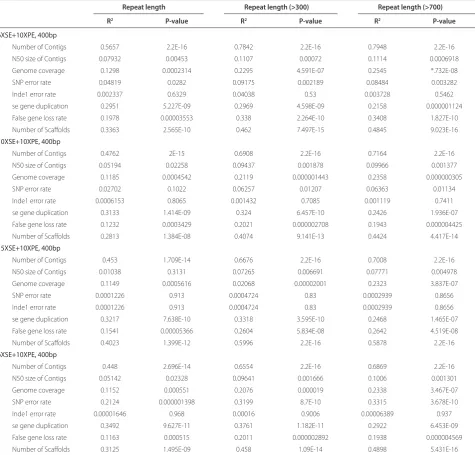
Results Our simulation shows the following: fi rst, a single-end 454 Jr Titanium run combined with a paired-end 454 Jr Titanium run may assemble about 90% of 100 genomes into <10 scaff olds and 95% of 100 genomes into <150 contigs; second, the average contig N50 size is more than 331 kb (Table 1); third, the average single base accuracy is >99.99% (Table 1); fourth, the average false gene duplication rate is <0.7% (Table 1); fi fth, the average false gene loss rate is <0.4% (Table 1); sixth, the total size of long repeats Table 3 (abstract P6). Main average indices for diff erent sequencing strategies for 100 genomes (200-bp read length)
ST GCE (%) SBE (%) IDR (%) FLT (%) FDT (%) CN NB SN
6xSE+10xPE 98.17144 0.003195 0.000334 0.4401864 0.2416131 61.15 253000.7 3.625
10xSE+10xPE 98.15661 0.004024 0.000317 0.4076573 0.2861061 54.33 290749.3 3.7188
15xSE+10xPE 98.16915 0.004743 0.000305 0.3916122 0.261398 53.47 301038.3 3.64
20xSE+10xPE 98.17177 0.004877 0.000309 0.409125 0.2509012 52.98 289864.6 3.6
Table 4 (abstract P6). Linear regression results for 100 genomes, between the genome quality indicators and, for various read lengths, the number of repeats in the genome, the total repeat length of the genome and the percentage of the total repeat length of the genome
Repeat length Repeat length (>300) Repeat length (>700)
R2 P-value R2 P-value R2 P-value
6XSE+10XPE, 400bp
Number of Contigs 0.5657 2.2E-16 0.7842 2.2E-16 0.7948 2.2E-16
N50 size of Contigs 0.07932 0.00453 0.1107 0.00072 0.1114 0.0006918
Genome coverage 0.1298 0.0002314 0.2295 4.591E-07 0.2545 *.732E-08
SNP error rate 0.04819 0.0282 0.09175 0.002189 0.08484 0.003282
Inde1 error rate 0.002337 0.6329 0.04038 0.53 0.003728 0.5462
se gene duplication 0.2951 5.227E-09 0.2969 4.598E-09 0.2158 0.000001124
False gene loss rate 0.1978 0.00003553 0.338 2.264E-10 0.3408 1.827E-10
Number of Scaff olds 0.3363 2.565E-10 0.462 7.497E-15 0.4845 9.023E-16
10XSE+10XPE, 400bp
Number of Contigs 0.4762 2E-15 0.6908 2.2E-16 0.7164 2.2E-16
N50 size of Contigs 0.05194 0.02258 0.09437 0.001878 0.09966 0.001377
Genome coverage 0.1185 0.0004542 0.2119 0.000001443 0.2358 0.000000305
SNP error rate 0.02702 0.1022 0.06257 0.01207 0.06363 0.01134
Inde1 error rate 0.0006153 0.8065 0.001432 0.7085 0.001119 0.7411
se gene duplication 0.3133 1.414E-09 0.324 6.457E-10 0.2426 1.936E-07
False gene loss rate 0.1232 0.0003429 0.2021 0.000002708 0.1943 0.000004425
Number of Scaff olds 0.2813 1.384E-08 0.4074 9.141E-13 0.4424 4.417E-14
15XSE+10XPE, 400bp
Number of Contigs 0.453 1.709E-14 0.6676 2.2E-16 0.7008 2.2E-16
N50 size of Contigs 0.01038 0.3131 0.07265 0.006691 0.07771 0.004978
Genome coverage 0.1149 0.0005616 0.02068 0.00002001 0.2323 3.837E-07
SNP error rate 0.0001226 0.913 0.0004724 0.83 0.0002939 0.8656
Inde1 error rate 0.0001226 0.913 0.0004724 0.83 0.0002939 0.8656
se gene duplication 0.3217 7.638E-10 0.3318 3.595E-10 0.2468 1.465E-07
False gene loss rate 0.1541 0.00005366 0.2604 5.834E-08 0.2642 4.519E-08
Number of Scaff olds 0.4023 1.399E-12 0.5996 2.2E-16 0.5878 2.2E-16
6XSE+10XPE, 400bp
Number of Contigs 0.448 2.696E-14 0.6554 2.2E-16 0.6869 2.2E-16
N50 size of Contigs 0.05142 0.02328 0.09641 0.001666 0.1006 0.001301
Genome coverage 0.1152 0.000551 0.2076 0.000019 0.2338 3.467E-07
SNP error rate 0.2124 0.000001398 0.3199 8.7E-10 0.3315 3.678E-10
Inde1 error rate 0.00001646 0.968 0.00016 0.9006 0.00006389 0.937
se gene duplication 0.3492 9.627E-11 0.3761 1.182E-11 0.2922 6.453E-09
False gene loss rate 0.1163 0.000515 0.2011 0.000002892 0.1938 0.000004569
[image:7.612.66.547.97.162.2] [image:7.612.68.544.193.648.2](both repeat length >300 bp and >700 bp) is signifi cantly correlated to the number of contigs (Table 4); and, seventh, increasing the read length of a pyrosequencing run could improve the assembly quality signifi cantly (Table 1-3).
Conclusions A single-end 454 Jr run combined with a paired-end 454 Jr run is a good strategy for prokaryotic genome sequencing. This strategy provides a solution to producing a high-quality draft genome sequence of almost any prokaryotic organism, selected at random, within days. It could be the fi rst step to achieving the full-length genome sequence. It also makes the subsequent multiplex PCR procedure (for gap fi lling) much easier, aided by the knowledge of the orders/orientations of most of the contigs. As a result, large-scale full-length prokaryotic genome-sequencing projects could be fi nished within weeks.
References
1. Arnold IC, Zigova Z, Holden M, Lawley TD, Rad R, Dougan G, Falkow S, Bentley SD, Müller A: Comparative whole genome sequence analysis of the carcinogenic bacterial model pathogen Helicobacter felis.Genome Biol Evol
2011, 3:302-308.
2. Stephan R, Lehner A, Tischler P, Rattei T: Complete genome sequence of
Cronobacter turicensis LMG 23827, a food-borne pathogen causing deaths in neonates.J Bacteriol 2011, 193:309-310.
3. Wibberg D, Blom J, Jaenicke S, Kollin F, Rupp O, Scharf B, Schneiker-Bekel S, Sczcepanowski R, Goesmann A, Setubal JC, Schmitt R, Pühler A, Schlüter A: Complete genome sequencing of Agrobacterium sp. H13-3, the former
Rhizobium lupini H13-3, reveals a tripartite genome consisting of a circular and a linear chromosome and an accessory plasmid but lacking a tumor-inducing Ti-plasmid.J Biotechnol 2011, 155:50-62.
4. Song JY, Jeong H, Yu DS, Fischbach MA, Park HS, Kim JJ, Seo JS, Jensen SE, Oh TK, Lee KJ, Kim JF: Draft genome sequence of Streptomyces clavuligerus
NRRL 3585, a producer of diverse secondary metabolites.J Bacteriol 2010, 192:6317-6318.
5. Gao F, Wang Y, Liu YJ, Wu XM, Lv X, Gan YR, Song SD, Huang H: Genome sequence of Acinetobacter baumannii MDR-TJ.J Bacteriol 2011, 193:2365-2366.
6. Powney R, Smits THM, Sawbridge T, Frey B, Blom J, Frey JE, Plummer KM, Beer SV, Luck J, Duff y B, Rodoni B: Genome sequence of an Erwinia amylovora
strain with pathogenicity restricted to Rubus plants.J Bacteriol 2011, 193:785-786.
7. Nam SH, Choi SH, Kang A, Kim DW, Kim RN, Kim A, Kim DS, Park HS: Genome sequence of Lactobacillus farciminis KCTC 3681.J Bacteriol 2011, 193:1790-1791.
8. Chen C, Kittichotirat W, Chen W, Downey JS, Si Y, Bumgarner R: Genome sequence of naturally competent Aggregatibacter actinomycetemcomitans
serotype a strain D7S-1.J Bacteriol 2010, 192:2643-2644.
9. Seth-Smith HMB, Harris SR, Rance R, West AP, Severin JA, Ossewaarde JM, Cutcliff e LT, Skilton RJ, Marsh P, Parkhill J, Clarke IN, Thomson NR: Genome sequence of the zoonotic pathogen Chlamydophila psittaci.J Bacteriol
2011, 193:1282-1283.
10. Lyons E, Freeling M, Kustu S, Inwood W: Using genomic sequencing for classical genetics in E. coli K12.PLoS ONE 2011, 6:e16717.
P7
Functional exploration of CCNE1 splicing forms as a possible link to bladder cancer susceptibility
Indu Kohaar1, Alexandra Scott-Johnson1, Yi-Ping Fu1, Patricia Porter-Gill1
and Ludmila Prokunina-Olsson1
1Laboratory of Translational Genomics, Division of Cancer Epidemiology and
Genetics, National Cancer Institute, National Institutes of Health, Bethesda, MD 20892, USA
Genome Biology 2011, 12(Suppl 1):P7
Background A recent genome-wide association study (GWAS) identifi ed a single nucleotide polymorphism, rs8102137, located 6 kb upstream of the cyclin E1 gene (CCNE1) on chromosome 19q12, as a risk factor for bladder cancer (odds ratio (OR) = 1.13, P = 1.7 × 10⁻¹¹) [1]. CCNE1 encodes a cell
cycle protein that regulates cyclin-dependent kinases and is therefore an important cancer susceptibility gene.
Methods This study used 42 bladder tumor samples and 41 normal bladder tissue samples (24 matched normal-tumor pairs), HeLa cells and several prostate and bladder cancer cell lines. Genotyping of rs8102137 in DNA and rs7257694 in both DNA and cDNA samples was performed using an allelic
discrimination genotyping assay. TaqMan and SYBR Green assays were used to measure the expression of the diff erent CCNE1 isoforms. The CCNE1
isoforms were cloned into a pFC14A (HaloTag) CMV Flexi Vector. Protein expression of CCNE1 isoforms in normal and tumor bladder tissues and transfected cells was analyzed by western blotting. Subcellular localization of recombinant CCNE1 splicing forms was analyzed by confocal microscopy. Results CCNE1 mRNA was expressed at a higher level in bladder tumors (n = 42) than in adjacent normal bladder tissue samples (n = 41, 3.7-fold, P = 2.7 × 10⁻¹²). However, no association was found between mRNA
expression level and the genotype of rs8102137. We observed strong allelic expression imbalance for a synonymous coding variation located in the last exon (rs7257694, Ser390Ser), which is in high linkage disequilibrium with rs8102137 (normal bladder tissue samples, n = 41, D’ = 1.0, r2 = 0.815; HapMap
CEU samples, n = 60, D’ = 0.95, r2 = 0.68). In normal and tumor tissue samples
heterozygous for both single nucleotide polymorphisms, the risk variant of rs8102137 was associated with lower expression of allele T of rs7257694 (normal samples, P = 2.2 × 10⁻⁴; tumor samples, P = 1.11 × 10⁻¹⁰). Western
blotting analysis of bladder tissue and prostate cell line lysates revealed that the allelic expression imbalance is likely to be related to two CCNE1 protein isoforms that showed a diff erential pattern of expression dependent on the rs8102137 and rs7257694 genotype. We have cloned the alternative splicing forms of CCNE1 and are currently evaluating their functional relevance. Conclusions Our results suggest that bladder-cancer-associated genetic variants of the CCNE1 gene might contribute to altered cell cycle regulation, owing to diff erential mRNA splicing producing diff erent protein isoforms of CCNE1.
Reference
1. Rothman N, Garcia-Closas M, Chatterjee N, Malats N, Wu X, Figueroa JD, Real FX, Van Den Berg D, Matullo G, Baris D, Thun M, Kiemeney LA, Vineis P, De Vivo I, Albanes D, Purdue MP, Rafnar T, Hildebrandt MA, Kiltie AE, Cussenot O, Golka K, Kumar R, Taylor JA, Mayordomo JI, Jacobs KB, Kogevinas M, Hutchinson A, Wang Z, Fu YP, Prokunina-Olsson L et al.: A multi-stage genome-wide association study of bladder cancer identifi es multiple susceptibility loci.
Nat Genet 2010, 42:978-984.
P8
Scaff Viz: visualizing metagenome assemblies Sergey Koren1,2, Todd Treangen2,3 and Mihai Pop1,2
1Department of Computer Science, University of Maryland, College Park, MD
20742, USA; 2Center for Bioinformatics and Computational Biology, University
of Maryland, College Park, MD 20742, USA; 3The McKusick-Nathans Institute for
Genetic Medicine, The Johns Hopkins University School of Medicine, Baltimore, MD 21205, USA
Genome Biology 2011, 12(Suppl 1):P8
Background Metagenomics has allowed the study of a wide range of microbial communities, from those within the sea [1,2] to those of the human body [3]. Increasingly, de novo assembly is the fi rst step in the analysis of these metagenomic samples. As the targets have increased in complexity, computational tools have started to emerge [4,5] to address the challenges presented by the assembly of these datasets. Although the targets and analyses have become more complex, the means of presenting the results has remained the same: a multi-FASTA text fi le. This presentation hides the variation that is present in the sampled biological community. The ability to navigate and view the complexity of a genomic sample may help drive novel biological insights. Here, we present a graphical visualization tool that allows the visual inspection of genome assembly graphs and the characterization of the genomic variation that is present in these graphs (that is, the diff erences between two or more related haplotypes commonly found in metagenomes or higher eukaryotes).
viewer can also output genome sequence that corresponds to any subset of the graph, including all alternative sequences present in all selected subpaths. We believe that this representation may prove to be instrumental in fi nding and characterizing structural variants such as alternative genes, alternative regulatory units or mobile genomic elements.
Results We evaluated the performance of Scaff Viz on seven datasets of varying size and complexity. We report that the run time is approximately linear with respect to the number of elements in the graph (nodes + edges). The memory scales linearly with respect to the number of nodes. Extrapolating from these factors, a graph of 250,000 contigs can be opened in approximately 2 minutes using approximately 2.5 GB of memory. Scaff Viz is scalable to large graphs and can be run on a laptop.
Conclusions We have developed a novel open-source assembly graph viewer, Scaff Viz, as a plug-in for Cytoscape. Scaff Viz supports the output of several popular assembly programs and is scalable to large metagenomic assemblies on a laptop.
References
1. Venter J, Remington K, Heidelberg JF, Halpern AL, Rusch D, Eisen JA, Wu D, Paulsen I, Nelson KE, Nelson W, Fouts DE, Levy S, Knap AH, Lomas MW, Nealson K, White O, Peterson J, Hoff man J, Parsons R, Baden-Tillson H, Pfannkoch C, Rogers YH, Smith HO: Environmental genome shotgun sequencing of the Sargasso Sea.Science 2004, 304:66-74.
2. Rusch DB, Halpern AL, Sutton G, Heidelberg KB, Williamson S, Yooseph S, Wu D, Eisen JA, Hoff man JM, Remington K, Beeson K, Tran B, Smith H, Baden-Tillson H, Stewart C, Thorpe J, Freeman J, Andrews-Pfannkoch C, Venter JE, Li K, Kravitz S, Heidelberg JF, Utterback T, Rogers YH, Falcón LI, Souza V, Bonilla-Rosso G, Eguiarte LE, Karl DM, Sathyendranath S et al.: The Sorcerer II Global Ocean Sampling expedition: northwest Atlantic through eastern tropical Pacifi c.PLoS Biol 2007, 5:e77.
3. Qin J, Li R, Raes J, Arumugam M, Burgdorf KS, Manichanh C, Nielsen T, Pons N, Levenez F, Yamada T, Mende DR, Li J, Xu J, Li S, Li D, Cao J, Wang B, Liang H, Zheng H, Xie Y, Tap J, Lepage P, Bertalan M, Batto JM, Hansen T, Le Paslier D, Linneberg A, Nielsen HB, Pelletier E, Renault P et al.: A human gut microbial gene catalogue established by metagenomic sequencing.Nature 2010, 464:59-65.
4. Laserson J, Jojic V, Koller D: Genovo: de novo assembly for metagenomes.J Comput Biol 2011,18:429-443.
5. Peng Y, Leung HC, Yiu SM, Chin FY: Meta-IDBA: a de novo assembler for metagenomic data.Bioinformatics 2011, 27:i94-i101.
6. Scaff Viz Project [http://code.google.com/p/scaff old-viewer/] 7. Shannon P, Markiel A, Ozier O, Baliga NS, Wang JT, Ramage D, Amin N,
Schwikowski B, Ideker T: Cytoscape: a software environment for integrated models of biomolecular interaction networks.Genome Res 2003, 13:2498-2504.
8. Smoot M, Ono K, Ruscheinski J, Wang P, Ideker T: Cytoscape 2.8: new features for data integration and network visualization.Bioinformatics
2011, 27:431-432.
9. Miller JR, Delcher AL, Koren S, Venter E, Walenz BP, Brownley A, Johnson J, Li K, Mobarry C, Sutton G: Aggressive assembly of pyrosequencing reads with mates.Bioinformatics 2008, 24:2818-2824.
10. Margulies M, Egholm M, Altman WE, Attiya S, Bader JS, Bemben LA, Berka J, Braverman MS, Chen YJ, Chen Z, Dewell SB, Du L, Fierro JM, Gomes XV, Godwin BC, He W, Helgesen S, Ho CH, Irzyk GP, Jando SC, Alenquer ML, Jarvie TP, Jirage KB, Kim JB, Knight JR, Lanza JR, Leamon JH, Lefkowitz SM, Lei M, Li J
et al.: Genome sequencing in microfabricated high-density picolitre reactors.Nature 2005, 437:376-380.
P9
Systems biology of bacteriophage proteins and new dimensions of the virus world discovered through metagenomics
David M Kristensen1, Arcady R Mushegian2,3 and Eugene V Koonin1 1National Center for Biotechnology Information, National Library of Medicine,
National Institutes of Health, Bethesda, MD 20894, USA; 2Department of
Bioinformatics, Stowers Institute for Medical Research, Kansas City, MO 64110, USA;
3Department of Microbiology, Molecular Genetics, and Immunology, University of
Kansas Medical Center, Kansas City, KS 66160, USA
Genome Biology 2011, 12(Suppl 1):P9
Most of the DNA viruses in the gastrointestinal tract are phages, which infect bacterial hosts. Despite phages being the most abundant organisms on Earth, as well as extremely active players in the global ecosystem, much remains
unknown about how they function in their natural environments. Advances in whole genome sequencing technologies have generated a large collection of hundreds of phage genomes, allowing deep insight into the genetic evolution of phages, and metagenomics technologies seem to promise more rewarding glimpses into their life cycles and community structures.
Recently, we developed an automated approach to assemble a collection of orthologous gene clusters of double-stranded DNA phages (phage orthologous groups, or POGs). This approach follows the well-known clusters of orthologous groups (COGs) framework to identify sets of orthologs by examining top-ranked sequence similarities between proteins in complete genomes without the use of arbitrary similarity cutoff s, and it thus represents a natural system for examining fast-evolving and slow-evolving proteins alike. This automated approach was designed to keep pace with the rapid and accelerating growth of whole genome information from sequencing projects. In particular, we employ a faster graph-theoretical COG-building algorithm that vastly improves our ability to deal with larger numbers of genomes (N) by reducing the worst-case complexity from O(N6) to O(N3 × log
N). This system encompasses more than 2,000 groups from the almost 600 known phage genomes deposited at the National Center for Biotechnology Information and is in the process of being expanded to include single-stranded DNA phages and single- and double-single-stranded RNA phages. Using this approach, we found that more than half of the POGs have no or very few evolutionary connections to their cellular hosts, indicating that these phages combine the ability to share and transduce the host genes with the ability to maintain a large fraction of unique, phage-specifi c, genes. Such genes are useful for targeted research strategies: for example, as diagnostic indicators and fundamental units of systems biology studies. We employed this set of phage-specifi c genes to probe the composition of several oceanic metagenomic samples. Although virus-enriched samples indeed contain more homologous matches to phage-specifi c POGs than a full metagenomic sample also containing cellular DNA, the total gene repertoire of the marine DNA virome is dramatically diff erent from that of known phages. In particular, it is dominated by rare genes, many of which might be contained within virus-like entities such as cellular gene transfer agents rather than true viruses. This result might suggest the necessity of radically rethinking what constitutes the ‘virus world’, because the major component of (marine) viromes could be gene transfer agents that encapsidate bacterial and archaeal genes.
P10
Genetic basis of common human disease: insight into the role of nonsynonymous SNPs from genome-wide association studies Lipika R. Pal1 and John Moult1,2
1Institute for Bioscience and Biotechnology Research, University of Maryland at
College Park, Rockville, MD 20850, USA; 2Department of Cell Biology and Molecular
Genetics, University of Maryland at College Park, College Park, MD 20742, USA
Genome Biology 2011, 12(Suppl 1):P10
Background Recent genome-wide association studies have led to the reliable identifi cation of single nucleotide polymorphisms (SNPs) at a number of loci associated with an increased risk of developing specifi c common human diseases. Each such locus implicates multiple possible candidate SNPs as being involved in the disease mechanism, and determining which SNPs actually contribute, and by what mechanism, is a major challenge. A variety of mechanisms may link the presence of a SNP to altered in vivo gene product function and hence contribute to disease risk. We have analyzed the role of one of these mechanisms, nonsynonymous SNPs (nsSNPs) in proteins, for associations found in the Wellcome Trust Case-Control Consortium (WTCCC) study of seven common diseases [1] and the follow-up work.
Methods Using HapMap data and linkage disequilibrium information, we identifi ed all possible candidate SNPs associated with increased disease risk. We then applied two computational methods [2,3], based on analysis of protein structure and sequence, to determine which of these SNPs has a signifi cant impact on in vivo protein function (SNPs3D) [4].
Conclusions Together, these data suggest a signifi cant role for nsSNPs in common human disease susceptibility.
References
1. Wellcome Trust Case-Control Consortium: Genome wide association study of 14000 cases of seven common diseases and 3,000 shared controls.
Nature 2007, 447:661-678.
2. Yue P, Li Z, Moult J: Loss of protein structure stability as a major causative factor in monogenic disease. J Mol Biol 2005, 353:459-473.
3. Yue P, Moult J: Identifi cation and analysis of deleterious human SNPs.J Mol Biol 2006, 356:1263-1274.
4. SNPs3D Project [http://www.snps3d.org]
P11
Accurate and fast estimation of taxonomic profi les from metagenomic shotgun sequences
Bo Liu1,2, Theodore Gibbons1,3, Mohammad Ghodsi1,2, Todd Treangen1 and Mihai Pop1-3 1Center for Bioinformatics and Computational Biology, University of Maryland,
College Park, MD 20742, USA; 2Department of Computer Science, University of
Maryland, College Park, MD 20742, USA; 3Biological Sciences Graduate Program,
University of Maryland, College Park, MD 20742, USA
Genome Biology 2011, 12(Suppl 1):P11
Background A major goal of metagenomics is to characterize the taxonomic composition of an environment. The most popular approach relies on 16S rRNA sequencing; however, this approach can generate biased estimates owing to diff erences in the copy number of the gene, even between closely related organisms, and owing to PCR artifacts. In addition, the taxonomic composition can also be determined from metagenomic shotgun sequences
by matching reads against a database of reference sequences. One major limitation of the computational methods that have been used for this purpose is the use of a universal classifi cation threshold for all genes at all taxonomic ranks.
Methods We present a novel taxonomic profi ler for metagenomic sequences, MetaPhyler [1], which relies on 31 phylogenetic marker genes as a taxonomic reference. Because genes can evolve at diff erent rates and because shotgun reads contain gene fragments of diff erent lengths, we propose that better classifi cation results can be obtained by tuning the taxonomic classifi er to the length of the gene fragment, to a particular gene and to the taxonomic rank. Our classifi er uses diff erent thresholds for each of these parameters, and these thresholds are automatically learned from the taxonomic structure of the reference database.
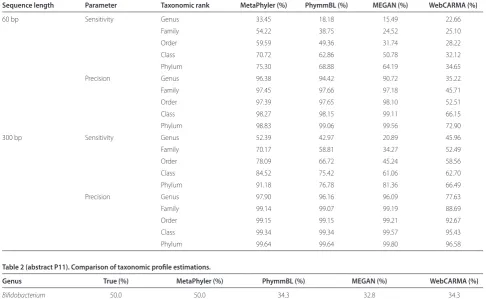
Results We have randomly simulated about 300,000 DNA sequences of 60 bp and about 70,000 DNA sequences of 300 bp from phylogenetic marker genes. Table 1 shows the performance of the phylogenetic classifi cations from MetaPhyler, PhymmBL [2], MEGAN [3] and WebCARMA [4]. The query sequence itself was removed from the reference dataset when running the programs. The sensitivity of MetaPhyler is signifi cantly higher than that of the other tools in all situations because our classifi er is explicitly trained at each taxonomic rank.
In addition, we have created a simulated metagenomic sample comprising fi ve genomes. Table 2 shows the taxonomic profi les estimated by diff erent approaches. In this setting, MetaPhyler also outperforms the other approaches by more accurately reconstructing the true taxonomic distribution.
Conclusions We have introduced a novel taxonomic classifi cation method for analyzing the microbial diversity from whole metagenome shotgun sequences. Compared with previous approaches, MetaPhyler is more
Table 1 (abstract P11). Comparison of sensitivity and precision.
Sequence length Parameter Taxonomic rank MetaPhyler (%) PhymmBL (%) MEGAN (%) WebCARMA (%)
60 bp Sensitivity Genus 33.45 18.18 15.49 22.66
Family 54.22 38.75 24.52 25.10
Order 59.59 49.36 31.74 28.22
Class 70.72 62.86 50.78 32.12
Phylum 75.30 68.88 64.19 34.65
Precision Genus 96.38 94.42 90.72 35.22
Family 97.45 97.66 97.18 45.71
Order 97.39 97.65 98.10 52.51
Class 98.27 98.15 99.11 66.15
Phylum 98.83 99.06 99.56 72.90
300 bp Sensitivity Genus 52.39 42.97 20.89 45.96
Family 70.17 58.81 34.27 52.49
Order 78.09 66.72 45.24 58.56
Class 84.52 75.42 61.06 62.70
Phylum 91.18 76.78 81.36 66.49
Precision Genus 97.90 96.16 96.09 77.63
Family 99.14 99.07 99.19 88.69
Order 99.15 99.15 99.21 92.67
Class 99.34 99.34 99.57 95.43
Phylum 99.64 99.64 99.80 96.58
Table 2 (abstract P11). Comparison of taxonomic profi le estimations.
Genus True (%) MetaPhyler (%) PhymmBL (%) MEGAN (%) WebCARMA (%)
Bifidobacterium 50.0 50.0 34.3 32.8 34.3
Bacteroides 20.0 20.4 32.1 34.3 33.8
Staphylococcus 10.0 10.2 9.4 9.1 8.9
Enterococcus 10.0 10.1 9.0 7.3 10.4
Clostridium 10.0 9.4 11.8 12.1 12.6
[image:10.612.63.550.371.670.2] [image:10.612.65.547.645.731.2]