Type and Effect Systems
Flemming Nielson & Hanne Riis Nielson
Department of Computer Science, Aarhus University, Denmark.
Abstract. The design and implementation of a correct system can be-nefit from employing static techniques for ensuring that the dynamic behaviour satisfies the specification. Many programming languages in-corporate types for ensuring that certain operations are only applied to data of the appropriate form. A natural extension of type checking te-chniques is to enrich the types with annotations and effects that further describe intensional aspects of the dynamic behaviour.
Keywords.Polymorphic type systems, effect annotations, subeffecting and subtyping, semantic correctness, type inference algorithms, syntactic soundness and completeness. Analyses for control flow, binding times, side effects, region structure, and communication structure.
1
Introduction
Static analysis of programs comprises a broad collection of techniques for pre-dicting safe and computable approximations to the set of values or behaviours arising dynamically during computation; this may be used to validate program transformations, to generate more efficient code or to increase the understanding of the software so as to demonstrate that the software satisfies its specification. We shall find it helpful to divide the techniques into the following two approaches. Theflow based approach includes the traditional data flow analysis techniques for mainly imperative and object-oriented languages; it also includes the con-straint based control flow analysis techniques developed for functional and object oriented languages; finally, it includes the use of mathematical modelling in the abstract interpretation of imperative, functional, concurrent and logic langua-ges. Theinference based approach includes general logical techniques touching upon program verification and model checking; it also includes type and effect systems developed for functional, imperative and concurrent languages and it is this latter group of techniques that we consider here.
We shall suppose that a typed programming language is given. In soft typing all programs can be typed because a “top” type can be used in the absence of meaningful “ordinary” types; this perspective is similar to that of the flow based approach and is quite useful for analysing the behaviour of programs but is less useful for enforcing the absence of dynamic errors. In this paper we focus on strong typing where no “top” type is around and where certain erroneous
programs are rejected by the type system; in this way types are not only used for analysing the behaviours of programs but also for enforcing the absence of certain kinds of dynamic errors.
The overall approach of type systems is to associate types to programs; normally the types merely describe the form of the data supplied to, and produced by, programs. The association of types to programs is done by a set of inference rules that are largely syntax-directed; since subprograms may contain free variables this needs to be relative to a type environment that maps the free variables to their types. We express the typing by means of a typing judgement that is usually a ternary relation on type environments, programs and types; it is frequently writtenΓ `p:τ wherepis the program,τ is the type, andΓ is the type environment. The main challenges of devising type systems is(i)to ensure that they are semantically correct (with respect to some dynamic semantics),(ii) to ensure that they are decidable so that types can be checked by an algorithm, and(iii)to ensure that there always is a “best” type, called a principal type, so that an algorithm can produce the intended type automatically.
Type and effect systems refine the type information by annotating the types so as to express further intensional or extensional properties of the semantics of the program [18–21]. In Section 2 this takes the form of annotating the base types or the type constructors. In Section 3 we study effect systems where the anno-tations describe certain intensional aspects of the actions taking place during evaluation. In Section 4 we further enrich the expressivenes of effects so as to obtain causal information in the manner of process algebras. We then expose the overall methodology behind type and effect systems in Section 5 and indicate those combinations of features that challenge state-of-the-art.
Further Reading. A more thorough development of the techniques of static ana-lysis can be found in [30] (particularly in Chapter 5 that deals with type and effect systems) as well as in the references given.
2
Annotated Type Systems
Many programming languages incorporate types as a static technique for en-suring that certain operations are only applied to data of the appropriate form; this is useful for ensuring that the dynamic behaviour satisfies the specification. Example 1. A Typed Language.
We shall use the following simple functional language to illustrate the develop-ment; constructs for iteration, recursion and conditionals present no obstacles and have only been left out in the interest of brevity. We shall later extend the language with side effects (as in Standard ML) and communication (as in Con-current ML) thereby suggesting that type and effect systems apply equally well to imperative and concurrent languages.
The language has expressions (or programs)eand typesτ given by: e::=c|x|fnπ x=>e0|e1 e2| · · ·
τ ::=int|bool| · · · |τ1→τ2
Here c denotes a family of constants (each of type τc), x denotes a family of variables, andπ is an identification of the function abstraction to be used in the control flow analysis to be presented in Example 2.
The typing judgements of the underlying or original type system have the form Γ `ULe:τ where the type environmentΓ maps variables to types; the definition
is as follows:
Γ `ULc:τc
Γ[x7→τx]`ULe0:τ0 Γ `ULfnπ x =>e0:τx→τ0 Γ `ULx:Γ(x)
Γ `ULe1:τ2→τ0 Γ `ULe2:τ2 Γ `ULe1 e2:τ0
That a function has type τ1 →τ2 means that given an argument of type τ1 it will return a value of type τ2 in case it terminates. ut Perhaps the simplest technique for extending the expressiveness of types is to add annotations to the type constructors or base types. One popular class of analyses that can be expressed using this technique consists of interprocedural control flow analyses which track the origins of where functions might have been defined [7, 8, 11]; this can be extended with components for tracking where functions are applied and thus has strong similarities to the classical use-definitionand definition-useanalyses of data flow analysis.
Example 2. Control Flow Analysis.
To obtain a control flow analysis we shall annotate the function type τ1 → τ2 with information,ϕ, about which function it might be:
ϕ::={π} |ϕ1∪ϕ2| ∅
b
τ ::=int|bool| · · · |bτ1 ϕ → bτ2
Soϕwill be aset of function names – describing the set of function definitions that can result in a function of a given type.
The typing judgements of the control flow analysis have the form Γb`CFAe: bτ
where the type environment Γb maps variables to annotated types. The jud-gements are defined in Table 1; note that the clause for function abstraction annotates the arrow of the resulting function type with the information that the abstraction namedπshould be included in the set{π}∪ϕof functions that could be returned. In the presence of conditionals it is essential that we use{π} ∪ϕ
b
Γ `CFAc:bτc
b
Γ[x7→bτx]`CFAe0:bτ0 b
Γ `CFAfnπ x=>e0:bτx {π}∪→ϕ τ0 b
Γ `CFAx:Γb(x)
b
Γ `CFAe1:bτ2 →ϕ τb0 Γb`CFAe2:bτ2 b
Γ `CFAe1 e2:bτ0
Table 1.Control Flow Analysis:Γb`CFAe:bτ (Example 2).
rather than {π}because the latter choice does not give rise to a conservative extension of the underlying type system: this means that there will be expres-sions that are typed in the underlying type system but that have no analysis in the control flow analysis; (this point is related to the issue of subeffecting to be discussed in Section 3.)
We should point out that we allow to replacebτ1 ϕ
1
→ τb2bybτ1 ϕ
2
→ τb2whenever ϕ1andϕ2are “equal as sets”. More generally we allow to replacebτ1byτb2if they have the same underlying types and all annotations on corresponding function arrows are “equal as sets”. To be utterly formal this can be axiomatised by a set of axioms and rules expressing that set union has a unit and is idempotent, commutative, and associative, together with axioms and rules ensuring that equality is an equivalence relation as well as a congruence; the abbreviation
UCAI is often used for these properties. ut
Subtyping and Polymorphism
Another popular class of analyses that can be expressed by annotations is the binding time analyses (e.g. [13]) which distinguish data as to whether they are static (available at compile-time) or dynamic (available at run-time); these ana-lyses form the basis ofpartial evaluation and can also be used as the basis for security analyses (e.g. [12]) that distinguish between secret and public informa-tion.
Example 3. Binding Time Analysis.
For binding time analysis we extend the language of Examples 1 and 2 with a let-construct:
e::=· · · |letx=e1 ine2
(In fact letx = e1 in e2 is semantically equivalent to (fn x => e2) e1.) The annotations of interest for the binding time analysis are:
ϕ::=β |S|D b
τ ::=intϕ|boolϕ| · · · |bτ 1 →ϕ τb2
b
The annotationSis used to model data that is available statically, Dis used to model data that is available dynamically, and β is an annotation variable that can take its values amongSand D.
A partial ordering on annotationsϕvϕ0
may be defined by:
ϕvϕ SvD
Types contain annotations on the type constructors as well as on the base types; a static function operating on dynamic integers will thus have the annotated type intD →S intD. This type system is motivated by applications to partial evaluation and this suggests imposing a well-formedness condition on types so as to rule out types like intS →D intS that are regarded as being meaningless. This is performed by the auxiliary judgement bτ . ϕ that additionally extracts the top-level annotationϕfrom the annotated typebτ:
intϕ . ϕ boolϕ . ϕ
b
τ1 . ϕ1 τb2 . ϕ2
b
τ1 →ϕ τb2 . ϕ
ifϕvϕ1 andϕvϕ2
In short, a static function is allowed to operate on dynamic data but not vice versa. Since we have annotation variables we can express a limited form of an-notation polymorphism and we usebσto denote the corresponding type schemes; for simplicity we do not incorporate type variables or type polymorphism. The typing judgements have the formΓb`BTAe:bσ where the type environment
b
Γ maps variables to type schemes (or types) andbσ is the type scheme (or type) for the expressione. The analysis is specified by the axioms and rules of Table 2 and is explained in the sequel. The first five axioms and rules are straightforward; note that the rule for function abstraction checks that the type is well-formed and that the rule forletmakes use of type schemes.
The next rule is a subtyping rule that allows to weaken the information contained in an annotated type. The subtype orderingτb≤τb0
is given by: intϕ≤intϕ0 ifϕvϕ0
boolϕ≤boolϕ0 ifϕvϕ0
b
τ0
1≤τb1 τb2≤bτ20
b
τ1 →ϕ bτ2≤bτ10 ϕ→0
b
τ0
2
ifϕvϕ0
∧ bτ0
1 ϕ0
→ τb0
2. ϕ
0
This ensures that only well-formed types are produced and that the ordering is reversed for arguments to functions; we say that bτ1 ϕ→ τb2 is contravariant in
b
τ1 but covariant in ϕand bτ2. (Think of the annotated type bτ ϕ
0
→ bτ0
as being analogous to the logical formula bτ ⇒ ϕ0
∧bτ0
and use that the inference rule expresses the monotonicity of logical implication.)
The final two rules are responsible for the polymorphism. The first rule is the ge-neralisation rulethat is used to construct type schemes: we can quantify over any
b
Γ `BTAc:bτc Γb`BTAx:Γb(x)
b
Γ[x7→bτx]`BTAe0:bτ0 b
Γ `BTAfnπ x=>e0:bτx →ϕ bτ0
if (bτx →ϕ b τ0). ϕ b
Γ `BTAe1:bτ2 →ϕ τb0 Γb`BTAe2:bτ2 b
Γ `BTAe1 e2:bτ0 b
Γ `BTAe1:bσ1 Γb[x7→bσ1]`BTA e2:bτ2 b
Γ `BTAletx=e1ine2:bτ2 b
Γ `BTAe:bτ
b
Γ `BTAe:bτ0
ifbτ ≤bτ0 b
Γ `BTAe:bτ
b
Γ `BTAe:∀(β1,· · ·, βn).bτ
ifβ1,· · ·, βn do not occur free inΓb b
Γ `BTAe:∀(β1,· · ·, βn).bτ b
Γ `BTAe: (θbτ)
ifdom(θ)⊆ {β1,· · ·, βn}and∃ϕ: (θ bτ). ϕ
Table 2.Binding Time Analysis: Γb`BTAe:bτ &ϕ(Example 3).
annotation variable that does not occur free in the type environment; this rule is usually used immediately before the rule for thelet-construct. The second rule is the instantiation rule that can be used to turn type schemes into annotated types: we just apply a substitution in order to replace the bound annotation variables with other annotations; this rule is usually used immediately after the
axiom for variables. ut
References for type systems with subtyping include [9, 10, 23] as well as the more advanced [16, 37, 38] that also deal with Hindley/Milner polymorphism (as fo-und in Standard ML). To allow a general treatment of subtyping, these papers generally demand constraints to be an explicit part of the inference system and this is somewhat more complex than the approach taken here; such considera-tions are mainly motivated by the desire to obtain principal types and in order to develop syntactically sound and complete type inference algorithms as will be discussed in Section 5. Indeed, our formulation of subtyping only allowsshape conformant subtyping, where the underlying type system does not make use of any form of subtyping, and is thus somewhat simpler than atomic subtyping, where an ordering is imposed upon base types, andgeneral subtyping, where an ordering may be imposed between arbitrary types.
Strictness analyses and classical data flow analyses can also be expressed as annotated type systems but to be useful they may require the type system to be extended with conjunction or disjunction types [4, 5, 14, 15] thereby touching
upon the logical techniques. In annotated type systems, as well as in the type and effect systems considered below, the annotations are normally sets of some kind, but linking up with abstract interpretation it should be possible to allow more general annotations that are elements of a complete lattice (that is possibly of finite height as in the “monotone frameworks” of data flow analysis); however, this possibility is hardly considered in the literature except in the case of binding time analysis where the binding times (e.g. static and dynamic) are partially ordered, c.f. [13, 24].
3
Type and Effect Systems
The typing judgements of type systems take the following general form: a type is associated with a program (or an expression or a statement) relative to a type environment providing the type (or type scheme) for each free variable; this also holds for the typing judgements used for the annotated type systems presented above. Effect systems can be viewed as an outgrowth of annotated type system where the typing judgements take the following more elaborate form: a typeand an effectis associated with a program relative to a type environment. Formally, effects are nothing but the annotations already considered, but conceptually, they describe intensional information about what takes place during evaluation of the program unlike what was the case above.
Subeffecting and Subtyping
The literature has seen a great variation in the uses to which effects have been put: collecting the set of procedures or functions called [41], collecting the set of storage cells written or read during execution [40], determining what exceptions can be raised during evaluation, and collecting the regions in which evaluation takes place [44] to mention just a few. We begin by considering an analysis for collecting the set of storage cells written or read during execution.
Example 4. Adding Imperative Constructs.
To facilitate the side effect analysis we shall add imperative constructs (resem-bling those of Standard ML) for creating reference variables and for accessing and updating their values:
e::=· · · |newπ x :=e1 ine2|!x|x:=e0
The idea is that newπ x:=e1 ine2 creates a new reference variablex for use in e2 and initialises it to the value ofe1; as above we useπ to identify the creation point. The value of the reference variablex can be obtained by writing!xand it may be set to a new value by the assignmentx:=e0. The type of a reference
cell for values of typeτ isτ refand the underlying type system of Example 1 is extended with the rules:
Γ `UL!x:τ ifΓ(x) =τ ref
Γ `ULe:τ
Γ `ULx:=e:τ
ifΓ(x) =τ ref Γ `ULe1:τ1 Γ[x7→τ1 ref]`ULe2:τ2
Γ `ULnewπ x:=e1 ine2:τ2 Example 5. Side Effect Analysis.
In the side effect analysis a reference variable is represented by a set%of program points where it could have been created; this set is called a region and has the general form {π1} ∪ · · · ∪ {πn} which we write as the set {π1,· · ·, πn}. The annotations of interest are:
ϕ::={!π} | {π:=} | {newπ} |ϕ1∪ϕ2| ∅ %::={π} |%1∪%2| ∅
b
τ ::=int|bool| · · · |bτ1 ϕ
→ bτ2|τbref%
Here bτ ref%is the type of a location created at one of the program points in the region%; the location is used for holding values of the annotated typeτb. The annotation!π means that the value of a location created atπ is accessed,π:= means that a location created at π is assigned, and newπ that a new location has been created atπ.
The typing judgements have the formΓb`SEe:bτ &ϕ. This means that under the
type environmentΓb, if the expressioneterminates then the resulting value will have the annotated typebτ andϕdescribes the side effects that might have taken place during evaluation. As before the type environment Γb will map variables to annotated types; no effects are involved because the semantics iseagerrather thanlazy.
The analysis is specified by the axioms and rules of Table 3; these rules embody the essence of effect systems. In the clauses for constants and variables we record that there are no side effects so we use ∅for the overall effect. The premise of the clause for function abstraction gives the effect of the function body and this effect is used to annotate the arrow of the function type whereas we use ∅ as the overall effect of the function definition itself: no side effects can be observed by simply defining the function. In the rule for function application we see how the information comes together: the overall effect is what can be observed from evaluating the argumente1, what can be observed from evaluating the argument e2, and what is obtained from evaluating the body of the function called. Turning to the rules involving reference variables we make sure that we only assign a value of the appropriate type to the reference variable. Also, in each of
b
Γ `SEc:bτc &∅ Γb`SEx:Γb(x) &∅
b
Γ[x7→bτx]`SEe0:bτ0 &ϕ0 b
Γ `SEfnπ x=>e0:bτx ϕ0→ bτ0 &∅ b
Γ `SEe1:bτ2 ϕ0→ bτ0 &ϕ1 Γb`SEe2:bτ2 &ϕ2 b
Γ `SEe1 e2:bτ0 &ϕ1∪ϕ2∪ϕ0 b
Γ `SE!x:bτ &{!π1,· · ·,!πn}ifΓb(x) =τbref{π1,· · ·, πn} b
Γ `SEe:bτ &ϕ
b
Γ `SEx:=e:bτ &ϕ∪ {π1:=,· · ·, πn:=}
ifΓb(x) =bτ ref{π1,· · ·, πn}
b
Γ `SEe1:bτ1&ϕ1 Γb[x7→ τb1 ref(%∪ {π})]`SEe2:bτ2&ϕ2 b
Γ `SEnewπ x:=e1 ine2:bτ2 & (ϕ1∪ϕ2∪ {newπ}) b
Γ `SEe:bτ &ϕ
b
Γ `SEe:bτ &ϕ0
ifϕ⊆ϕ0
Table 3.Side Effect Analysis:Γb`SEe:bτ &ϕ(Examples 5, 6 and 7).
the rules we make sure to record that a location at the relevant program point might have been created, referenced or assigned.
The purpose of%in the rule fornewin Table 3, and the purpose of the last rule in Table 3, is to ensure that we obtain a conservative extension of the underlying type system. The last rule is called a subeffecting rule and is essential in the presence of conditionals. The notation ϕ⊆ϕ0
means that ϕis “a subset” ofϕ0
(modulo UCAI). ut
Example 6. Subtyping for Side Effect Analysis.
The last rule in Table 3 can be augmented with a rule forsubtyping:
b
Γ `SEe:τb&ϕ b
Γ `SEe:τb0 &ϕ
ifbτ ≤τb0
The orderingbτ ≤bτ0
on annotated types is derived from the ordering on annota-tions as follows:
b
τ ≤bτ bτ
0
1≤τb1 τb2≤bτ
0
2 ϕ⊆ϕ
0
b
τ1 →ϕ bτ2≤τb
0
1 ϕ→0
b
τ0
2
b
τ ≤τb0
b
τ0
≤τb %⊆%0
b
τ ref%≤τb0
ref%0
Here ϕ ⊆ ϕ0
means that ϕ is “a subset” of ϕ0
(modulo UCAI) and similarly %⊆%0
means that%is “a subset” of %0
contravariant in bτ1 but covariant in ϕ and bτ2. Also bτ ref %is both covariant in bτ (when the reference variable is used for accessing its value as in !x) and contravariant in bτ (when the reference variable is used for assignments as in x := · · ·) whereas it is only covariant in %. This form of subtyping amounts to shape conformant subtyping because bτ1≤τb2 implies that the two annotated
types have the same underlying types. ut
Subeffecting alone suffices for obtaining a conservative extension of the under-lying type system – provided that we regard the use of % in the rule for new as being an integral part of subeffecting; the general idea is that subeffecting allows to “enlarge” the effects at an early point so that they do not conflict with the demands of the type and effect system. This reduces the usefulness of the effects but by incorporating subtyping we can “enlarge” the types at alater point; hence more informative types and effects can be used in subprograms. Coming back to our treatment of control flow analysis in Example 2 we note that basically it is a subeffecting analysis.
Polymorphism and Polymorphic Recursion
Subtyping is one of the classical techniques for making a type more useful by allowing to adapt it to different needs. Another classical technique is Hind-ley/Milner polymorphism as found in Standard ML and other functional langu-ages. Both techniques are useful for increasing the precision of the information obtainable from type and effect systems.
Example 7. Polymorphism for Side Effect Analysis.
We now once more extend the language of Examples 5 and 6 with a polymorphic let-construct:
e::=· · · |letx=e1 ine2
We also allow types to contain type variables α, effects to contain annotation variablesβ and regions to contain region variablesρ:
b
τ ::=· · · |α ϕ::=· · · |β %::=· · · |ρ
We can then define type schemes: a type scheme is a type where a (possible empty) list ζ1,· · ·, ζn of type, effect and region variables has been quantified over:
b
σ::=∀(ζ1,· · ·, ζn).bτ If the list is empty we simply writeτbfor∀().τb.
The typing judgements will be of the form Γb `SE e : bσ & ϕ where the type
scheme (or type). The clauses are as in Table 3 with the addition of the following rules:
b
Γ `SEe1:bσ1 &ϕ1 Γb[x7→σb1]`SEe2:bτ2 &ϕ2
b
Γ `SEletx =e1 ine2:τb2&ϕ1∪ϕ2
b
Γ `SEe:bτ &ϕ b
Γ `SEe:∀(ζ1,· · ·, ζn).bτ &ϕ
ifζ1,· · ·, ζn do not occur free inΓb andϕ
b
Γ `SEe:∀(ζ1,· · ·, ζn).bτ &ϕ
b
Γ `SEe: (θ bτ) &ϕ
ifdom(θ)⊆ {ζ1,· · ·, ζn}
The second and third rules are responsible for the polymorphism and are exten-sions of the last two rules of Table 2. The second rule is thegeneralisation rule: we can quantify over any type, annotation or region variable that does not occur free in the assumptionsor in the effect. The third rule is theinstantiation rule: we just apply a substitution in order to replace the bound type, annotation and region variables with other types, annotations and regions. ut Both subtyping and polymorphism improve subeffecting by giving finer control over when to “enlarge” the types; we already explained the advantage: that more informative types and effects can be used in subprograms. Since the mechanisms used are incomparable it clearly makes sense to combine both. However, as di-scussed in Section 5, it may be quite challenging to develop a type and effect inference algorithm that is both syntactically sound and complete.
Example 8. Region Inference.
Thelet-construct can be used to give polymorphic types to functions. But in the Hindley/Milner approach a recursive function can only be used polymorphically outside of its own body – inside its own body it must be used monomorphically. The generalisation to allow recursive functions to be used polymorphically also inside their own bodies is known aspolymorphic recursion but gives rise to an undecidable type system; this means that no terminating type inference algo-rithm can be both syntactically sound and complete. This insight is a useful illustration of the close borderline between decidability and undecidability that holds for the inference based approach to the static analysis of programs. Even though we abstain from using polymorphic recursion for ordinary types there is still the possibility of using polymorphic recursion for the effects an-notating the ordinary and possibly polymorphic types given to recursive fun-ctions. In this way, distinct uses of a recursive function inside its body can still be analysed in different ways. This approach is taken in an analysis known as region inference [44] that is used when implementing functional languages in a stack-based regime rather than a heap-based regime. More precisely, the memory model is a stack of regions of data items, and the analysis facilitates determining at compile-time in which region to allocate data and when to deallocate a region (rather than using a garbage collector at run-time).
The use of polymorphic recursion for effect and region annotations allows the inference system to deal precisely with the allocation of data inside recursive functions. Furthermore, the inference system implicitly incorporates a notion of constraint between annotation variables and their meaning (via a dot notation on function arrows); as discussed in Section 5 this is a common feature of sy-stems based on subtyping as otherwise principal types may not be expressible. To obtain effects that are as small as possible, the inference system uses “effect masking” [21, 39, 40] for removing internal components of the effect: effect com-ponents that only deal with regions that are not externally visible. It is unclear whether or not this system is decidable but nonetheless it has proved quite useful in practice: a syntactically sound inference algorithm has been devised and it is sufficiently accurate that a region-based implementation of Standard ML has turned out to compete favourably with a heap-based implementation. ut
Mutually Recursive Types and Effects
So far the annotations and effects have not included any type information; as we shall see in Section 5 this is essential for being able to develop type and effect inference algorithms using a two-stage approach where first the types are determined and next the effects annotating the types. It is possible to be more permissive in allowing effects to contain type information and in allowing even the shape of types and type schemes to be influenced by the type information contained in the effects; as will be explained in Section 5 this calls for a more complex one-stage approach to type and effect inference algorithms.
Example 9. Polymorphic Typing in Standard ML.
The Hindley/Milner approach to polymorphism was originally conceived only for pure functional languages. Extending it to deal with side effects in the form of reference variables has presented quite a few obstacles. As an example consider the following program fragment in an ML-like language:
let x = new nil in (· · · x:=cons(7,x) · · · x:=cons(true,x) · · ·) Here x is declared as a new cell whose contents is initially the empty list nil and it might be natural to let the type ofxbe something like ∀α.(αlist)ref; but then both assignments will typecheck and hence the type system will be semantically unsound as Standard ML only permits homogeneous lists where all elements have the same type.
Several systems have been developed for overcoming these problems (see e.g. [42]). One approach is to restrict the ability to generalise over “imperative” type vari-ables: these are the type variables that may be used in an imperative manner. It is therefore natural to adapt the side effect analysis to record the imperative type variables and to prohibit the generalisation rule from generalising over impera-tive type variables. In this way the shape of type schemes is clearly influenced
by the effect information. This idea occurred already in [39, 40, 48] in the form of an extended side effect analysis with polymorphism and subeffecting. ut
4
Causal Type Systems
So far the annotations and effects have had a rather simple structure in that they have mainly been sets. It is possible to be more ambitious in identifying the “causality” or temporal order among the various operations. As an example, we now consider the task of extracting behaviours (reminiscent of terms in a process algebra) from programs in Concurrent ML by means of a type and effect system; here effects (the behaviours) have structure, they may influence the type information (as in Example 9), and there are inference rules for subeffecting and shape conformant subtyping. These ideas first occurred in [27, 29] (not involving polymorphism) and in [2, 33, 34] (involving polymorphism); our presentation is mainly based on [33, 34] because the inference system is somewhat simpler than that of [1] (at the expense of making it harder to develop an inference algorithm); we refer to [1, Chapter 1] for an overview of some of the subtle technical details. An application to the validation of embedded systems is presented in [32] where a control program is shown not to satisfy the safety requirements.
Example 10. Adding Constructs for Communication.
To facilitate the communication analysis we shall add constructs for creating new channels, for generating new processes, and for communicating between processes over typed channels:
e::=· · · |channelπ |spawne0|sende1one2|receivee0
Herechannelπcreates a new channel identifier,spawne0generates a new parallel process that executese0, andsendv onchsends the valuevto another process ready to receive a value by means ofreceivech. We shall assume that there is a special constant()of typeunit; this is the value to be returned by thespawn
andsendconstructs. ut
Example 11. Communication Analysis.
Turning to the communication analysis the annotations of interest are: ϕ::=β|Λ|ϕ1;ϕ2|ϕ1+ϕ2|recβ.ϕ|τbchan %|spawnϕ|%!bτ |%?bτ %::=ρ| {π} |%1∪%2| ∅
b
τ ::=α|int|bool| · · · |unit|τb1 →ϕ bτ2|τbchan%
b
σ::=∀(ζ1,· · ·, ζn).bτ
The behaviourΛis used for atomic actions that do not involve communication; in a sense it corresponds to the empty set in previous annotations although it
b
Γ `COMc:bτc&Λ Γb`COMx:Γb(x) &Λ
b
Γ[x7→bτx]`COMe0 :bτ0 &ϕ0 b
Γ `COM fnπ x=>e0 :bτx ϕ0→ bτ0 &Λ b
Γ `COMe1:bτ2 ϕ0→ bτ0 &ϕ1 Γb`COMe2:bτ2 &ϕ2 b
Γ `COMe1 e2:τb0 &ϕ1;ϕ2;ϕ0 b
Γ `COM channelπ:bτ chan{π}&bτ chan{π} b
Γ `COMe0 :bτ0 &ϕ0 b
Γ `COM spawne0:unit&spawnϕ0 b
Γ `COMe1:bτ &ϕ1 Γb`COMe2:bτ chan%2 &ϕ2 b
Γ `COM sende1one2:unit&ϕ1;ϕ2; (%2!bτ) b
Γ `COMe0 :bτ chan%0 &ϕ0 b
Γ `COM receivee0:bτ &ϕ0; (%0?bτ) b
Γ `COMe:bτ &ϕ
b
Γ `COMe:bτ0&ϕ0
ifbτ ≤bτ0andϕvϕ0 b
Γ `COMe:bτ &ϕ
b
Γ `COMe:∀(ζ1,· · ·, ζn).bτ &ϕ
ifζ1,· · ·, ζndo not occur free inΓbandϕ b
Γ `COMe:∀(ζ1,· · ·, ζn).bτ &ϕ b
Γ `COMe: (θbτ) &ϕ
ifdom(θ)⊆ {ζ1,· · ·, ζn}
Table 4.Communication Analysis:Γb`COMe:bτ &ϕ(Example 11).
will be more intuitive to think of it as the empty string in regular expressions or as the silent action in process calculi. The behaviourϕ1;ϕ2 says that ϕ1 takes place beforeϕ2 whereasϕ1+ϕ2 indicates a choice betweenϕ1 and ϕ2; this is reminiscent of constructs in regular expressions as well as in process algebras. The construct recβ.ϕ indicates a recursive behaviour that acts as given by ϕ except that any occurrence ofβ stands forrecβ.ϕitself.
The behaviour bτ chan % indicates that a new channel has been allocated for communicating entities of type τb; the region % indicates the set of program points {π1,· · ·, πn}where the creation could have taken place. The behaviour
spawnϕindicates that a new process has been generated and that it operates as described byϕ. The construct%!τbindicates that a value is sent over a channel of typebτ chan %, and %?bτ indicates that a value is received over a channel of that type; this is reminiscent of constructs in most process algebras (in particular CSP).
The typing judgements have the formΓb`COMe:bσ &ϕwhere the type
environ-mentΓbmaps variables to type schemes (or types),σbis the type scheme (or type) for the expressione, andϕis the behaviour that may arise during evaluation of e. The analysis is specified by the axioms and rules of Tables 4 and have many points in common with those we have seen before; we explain the differences below.
The axioms for constants and variables differ from the similar axioms in Table 3 in thatΛis used instead of∅. A similar remark holds for the rule for function abstraction. In the rule for function application we now use sequencing to express that we first evaluate the function part, then the argument and finally the body of the function; note that the left-to-right evaluation order is explicit in the behaviour.
The axiom for channel creation makes sure to record the program point in the type as well as the behaviour, the rule for spawning a process encapsulates the behaviour of the spawned process in the behaviour of the construct itself and the rules for sending and receiving values over channels indicate the order in which the arguments are evaluated and then produce the behaviour for the action taken. The rules for generalisation and instantiation are much as before. The rule forsubeffecting andsubtypingis an amalgamation of the rules in Table 3 and Example 6. Also note that there is no%in the axiom forchannelunlike in the axiom fornewin Table 3; this is because the presence of subtyping makes it redundant. The orderingbτ ≤bτ0
on types is given by
b
τ ≤bτ bτ
0
1≤τb1 bτ2≤bτ20 ϕvϕ
0
b
τ1 →ϕ bτ2≤τb10 ϕ→0
b
τ0
2
b
τ ≤τb0
b
τ0
≤τb %⊆%0
b
τ chan%≤τb0
chan%0
and is similar to the definition in Example 6: τb1 ϕ→ τb2 is contravariant inτb1 but covariant inϕandbτ2, andbτ chan%is both covariant inτb(for when a value is sent) and contravariant inbτ (for when a value is received) and it is covariant in%. As before, the ordering%⊆%0
means that%is “a subset of” of%0
(modulo UCAI). However, the orderingϕvϕ0
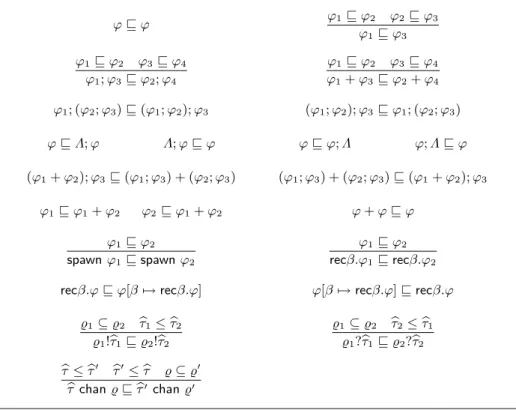
on behaviours is more complex than what has been the case before because of the rich structure possessed by behaviours. The definition is given in Table 5 and will be explained below. Since the syntactic categories of types and behaviours are mutually recursive also the definitions of
b
τ ≤τb0
andϕvϕ0
need to be interpreted recursively. The axiomatisation ofϕvϕ0
ensures that we obtain a preorder that is a con-gruence with respect to the operations for combining behaviours. Furthermore, sequencing is an associative operation with Λ as identity and we have a distri-butive law with respect to choice. It follows that choice is associative and com-mutative. Next the axioms for recursion allow us to unfold therec-construct. The final three rules clarify how behaviours depend upon types and regions:bτ chan% is both contravariant and covariant in bτ and is covariant in %(just as was the case for the type bτ chan%);%!τbis covariant in both % and bτ (because a value is sent) whereas%?τbis covariant in%and contravariant inτb(because a value is
ϕvϕ ϕ1vϕ2 ϕ2vϕ3 ϕ1vϕ3 ϕ1vϕ2 ϕ3vϕ4
ϕ1;ϕ3vϕ2;ϕ4
ϕ1vϕ2 ϕ3vϕ4 ϕ1+ϕ3vϕ2+ϕ4 ϕ1; (ϕ2;ϕ3)v(ϕ1;ϕ2);ϕ3 (ϕ1;ϕ2);ϕ3vϕ1; (ϕ2;ϕ3)
ϕvΛ;ϕ Λ;ϕvϕ ϕvϕ;Λ ϕ;Λvϕ
(ϕ1+ϕ2);ϕ3v(ϕ1;ϕ3) + (ϕ2;ϕ3) (ϕ1;ϕ3) + (ϕ2;ϕ3)v(ϕ1+ϕ2);ϕ3 ϕ1vϕ1+ϕ2 ϕ2vϕ1+ϕ2 ϕ+ϕvϕ
ϕ1vϕ2
spawnϕ1vspawnϕ2
ϕ1vϕ2
recβ.ϕ1vrecβ.ϕ2
recβ.ϕvϕ[β7→recβ.ϕ] ϕ[β7→recβ.ϕ]vrecβ.ϕ %1⊆%2 bτ1≤bτ2
%1!bτ1v%2!bτ2
%1⊆%2 bτ2≤bτ1 %1?bτ1v%2?bτ2 b
τ ≤bτ0 bτ0≤bτ %⊆%0 b
τ chan%vbτ0 chan%0
Table 5.Ordering on behaviours:ϕvϕ0 (Example 11).
received). There is no explicit law for renaming bound behaviour variables as we shall regardrecβ.ϕas being equal torecβ0
.ϕ0
when they areα-equivalent. ut
5
The Methodology
So far we have illustrated the variety of type and effect systems that can be found in the literature. Now we turn to explaining the individual steps in the overall methodology of designing and using type and effect systems:
– devise a semantics for the programming language,
– develop a program analysis in the form of a type and effect system (this is what Sections 2, 3 and 4 have given numerous examples of),
– prove the semantic correctness of the analysis, – develop an efficient inference algorithm,
– prove that the inference algorithm is syntactically sound and complete, and – utilise the information for applications like program transformations or
im-proved code generation.
Each of these phases have their own challenges and open problems that we now consider in some detail; many of these issues are rather orthogonal to the
more syntactic differences used to distinguish between the formulations used in Sections 2, 3 and 4.
Semantics. Semantics is a rather well understood area. In principle both deno-tational and operational semantics can be used as the foundations for type and effect systems but most papers in the literature take an operational approach. This is indeed very natural when the analysis needs to express further intensional details than are normally captured by a denotational semantics. But even when taking an operational approach one frequently needs to devise it in such a man-ner that it captures those operational details for which the analysis is intended. The terminstrumented semantics[17] has been coined for a class of denotational or operational semantics that are more precise about low-level machine detail (say concerning pipe-lining or the number and nature of registers) than usual. It is therefore wise to be cautious about the precise meaning of claims stating that an analysis has been proved correct with respect to “the” semantics.
The inference system. Previous sections have illustrated some of the va-riations possible when developing type and effect systems as well as some of the applications for which they can be used. However, it would be incorrect to surmise that the selection of components are inherently linked to the example analysis where they were first illustrated.
At the same time we illustrated a number of design considerations to be taken into account when devising a type and effect system. In our view the major design decisions are as follows:
– whether or not to incorporate • subeffecting,
• subtyping,
• polymorphism, and • polymorphic recursion,
– whether or not types are allowed to be influenced by effects (as was the case in Example 9 and Section 4), and
– whether or not constraints are an explicit part of the inference system (unlike what simplicity demanded us to do here).
The choices made have a strong impact on the difficulties of obtaining a synta-ctically sound and complete inference algorithm; indeed, for some combinations it may be beyond state-of-the-art (or even impossible) and in particular it may be hard (or impossible) to deal with subtyping without admitting constraints to the inference system. An important area of further research is how to identify those features of the annotated type and effect systems that lead to algorithmic intractability.
Often the type and effect system is developed for a typed programming language. It is then important to ensure that whenever a program can be typed in the
original type system then there also exists a type in the type and effect system, and whenever there exists a type in the type and effect system then the program can also be typed in the original type system. This is established by proving that the type and effect system is a conservative extension of the original or underlying type system. It is also possible to investigate whether or not the type and effect system admits principal types and effects; luckily this will always be the case if a syntactically sound and complete inference algorithm can be developed.
Further studies are needed to understand the interplay between type and effect systems and the other approaches to static analysis of programs. It is interesting to note that the existence of principal types is intimately connected to the no-tion of Moore families used in abstract interpretano-tion: a principal type roughly corresponds to the least solution of an equation system.
Semantic correctness. Many of the techniques needed for establishing se-mantic soundness (sometimes called type soundness) are rather standard. For operational semantics the statement of correctness generally take the form of asubject reduction result: if a program e has a type τ and if e evaluates toe0
then alsoe0
has the type τ; this approach to semantic correctness has a rather long history [24, 25, 49] and applies both to small-step Structural Operational Semantics and to big-step Natural Semantics [36]. It is important to stress that the correct use of covariance and contravariance (in the rules for subtyping) is essential for semantic correctness to hold.
For more complex situations the formulation of “has a type” may have to be defined coinductively [42], in which case also the proof of the subject reduction result may need to exploit coinduction (e.g. [30]), and the notions of Kripke relations and Kripke-logical relations (see e.g. [28]) may be useful when using a denotational semantics [26]. We refer to [3, 39, 40, 45] for a number of applications of these techniques.
The inference algorithm. The development of a syntactically sound and com-plete inference algorithm may be based on the ideas in [20, 41]. The simplest ap-proach is a two-stage approach where one first determines the underlying types and next determines the (possibly polymorphic) effects on top of the explicitly typed programs. The basic idea is to ensure that the type inference algorithm operates on afree algebra by restricting annotations to be annotation variables only (the concept of “simple types”) and by recording a set of constraints for the meaning of the annotation variables. This suffices for adapting the established techniques for polymorphic type inference, by means of the classical algorithm Wdeveloped in [6, 22] for Hindley/Milner polymorphism, to the setting at hand. In this scheme one might haveW(Γ, e) = (S, τ, ϕ, C) where eis the program to be typed,τ is the form of the resulting type andϕsummarises the overall effect of the program. In caseecontains free variables we need preliminary information
about their types and this is provided by the type environment Γ; as a result of the type inference this preliminary information may need to be modified as reported in the substitutionS. Finally,C is a set of constraints that record the meaning of the annotation variables. For efficiency the algorithmic techniques often involve the generation of constraint systems in a program independent representation.
In the case of polymorphic recursion decidability becomes an issue. Indeed, po-lymorphic recursion over type variables makes the popo-lymorphic type system undecidable. It is therefore wise to restrict the polymorphic recursion to an-notation variables only as in [44]. There the first stage is still ordinary type inference; the second stage [43] concerns an algorithm S that generates effect and region variables and an algorithmRthat deals with the complications due to polymorphic recursion (for effects and regions only). The inference algorithm is proved syntactically sound but is known not to be syntactically complete; indeed, obtaining an algorithm that is syntactically sound as well as complete, seems beyond state-of-the-art.
Once types and effects are allowed to be mutually recursive, the two-stage ap-proach no longer works for obtaining an inference algorithm because the effects are used to control the shape of the underlying types (in the form of which type variables are included in a polymorphic type). This suggests aone-stage appro-ach where special care needs to be taken when deciding the variables over which to generalise when constructing a polymorphic type. The main idea is that the algorithm needs to consult the constraints in order to determine a larger set of forbidden variables than those directly occurring in the type environment or the effect; this can be formulated as a downwards closure with respect to the constraint set [31, 48] or by taking a principal solution of the constraints into account [39, 40].
Adding subtyping to this development dramatically increases the complexity of the development. The integration of shape conformant subtyping, polymorphism and subeffecting is done in [3, 31, 35] that develop an inference algorithm that is proved syntactically sound; these papers aimed at integrating the techniques for polymorphism and subeffecting (but no subtyping) from effect systems [39, 40, 48] with the techniques for polymorphism and subtyping (but no effects) from type systems [16, 37, 38]. A more ambitious development where the inference system is massaged so as to facilitate developing an inference algorithm that is also syntactically complete is described in [1]; the inference system used there has explicit constraints in the inference system (as is usually the case in type systems based on subtyping).
Syntactic soundness and completeness. The syntactic soundness and com-pleteness results to be established present a useful guide to developing the infe-rence algorithm. Formulations of syntactic soundness are mostly rather straight-forward: the result produced by the algorithm must give rise to a valid inference
in the inference system. A simple example is the following: ifW(Γ, e) = (S, τ, ϕ) then S(Γ) ` e : τ&ϕ must hold; here it is clear that the substitution produ-ced is intended to refine the initial information available when first calling the algorithm. A somewhat more complex example is: ifW(Γ, e) = (S, τ, ϕ, C) then S0
(S(Γ)) ` e : S0
(τ) &S0
(ϕ) must hold wheneverS0
is a solution to the con-straints inC. The proofs are normally by structural induction on the syntax of programs.
The formulations of syntactic completeness are somewhat more involved. Given a programesuch that Γ `e:τ&ϕ, the main difficulty is to show how this
can be obtained fromW(Γ, e) = (S, τ, ϕ) orW(Γ, e) = (S, τ, ϕ, C). The solution is to formally define when one “typing” is an instance of another; the notion of lazy instance [9] is very useful here and in more complex scenarios Kripke-logical relations (see e.g. [28]) may be needed [1]. The proofs are often challenging and often require developing extensive techniques for “normalising” deductions made in the inference system so as to control the use of non-syntax directed rules. For sufficiently complex scenarios syntactic completeness may fail or may be open (as mentioned above); luckily soundness often suffices for the inference algorithm to be of practical use.
Exploitation. Exploitation is a rather open-ended area although it would seem that the integration of program analyses and program transformations into an inference based formulation is quite promising [46]. Indeed, inference-based for-mulations of analyses can be seen as an abstract counterpart of the use of at-tribute grammars when developing analyses in compilers, and in the same way inference-based formulations of analyses and transformations can be seen as an abstract counterpart of the use of attributed transformation grammars [47].
6
Conclusion
The approach based on type and effect systems is a promising approach to the static analysis of programs because the usefulness of types has already been wi-dely established. The main strength lies in the ability to interact with the user: clarifying what the analysis is about (and when it may fail to be of any help) and in propagating the results back to the user in an understable way (which is not always possible for flow based approaches working on intermediate rep-resentations). The main areas of further research concern the expressiveness of the inference based specifications, the complexity and decidability of the infe-rence algorithms and the interplay with the other approaches to static analysis of programs.
Acknowledgements. We wish to thank Torben Amtoft for working with us for many years on type and effect systems; we would also like to thank the referees for their careful reading and helpful comments.
References
1. T. Amtoft, F. Nielson, and H. R. Nielson. Type and Effect Systems: Behaviours
for Concurrency. Imperial College Press, 1999.
2. T. Amtoft, F. Nielson, and H.R. Nielson. Type and behaviour reconstruction for higher-order concurrent programs. Journal of Functional Programming, 7(3):321– 347, 1997.
3. T. Amtoft, F. Nielson, H.R. Nielson, and J. Ammann. Polymorphic subtyping for effect analysis: The dynamic semantics. InAnalysis and Verification of
Multiple-Agent Languages, volume 1192 ofLecture Notes in Computer Science, pages 172–
206. Springer, 1997.
4. P. N. Benton. Strictness logic and polymorphic invariance. InProc. Second
Inter-national Symposium on Logical Foundations of Computer Science, volume 620 of
Lecture Notes in Computer Science, pages 33–44. Springer, 1992.
5. P. N. Benton. Strictness properties of lazy algebraic datatypes. InProc. WSA ’93, volume 724 ofLecture Notes in Computer Science, pages 206–217. Springer, 1993. 6. L. Damas and R. Milner. Principal type-schemes for functional programs. In
Proc. POPL ’82, pages 207–212. ACM Press, 1982.
7. K.-F. Fax´en. Optimizing lazy functional programs using flow inference. In
Proc. SAS ’95, volume 983 ofLecture Notes in Computer Science, pages 136–153.
Springer, 1995.
8. K.-F. Fax´en. Polyvariance, polymorphism, and flow analysis. In Proc. Analysis
and Verification of Multiple-Agent Languages, volume 1192 of Lecture Notes in
Computer Science, pages 260–278. Springer, 1997.
9. Y.-C. Fuh and P. Mishra. Polymorphic subtype inference: Closing the theory-practice gap. In Proc. TAPSOFT ’89, volume 352 ofLecture Notes in Computer
Science, pages 167–183. Springer, 1989.
10. Y.-C. Fuh and P. Mishra. Type inference with subtypes. Theoretical Computer
Science, 73:155–175, 1990.
11. N. Heintze. Control-flow analysis and type systems. InProc. SAS ’95, volume 983
ofLecture Notes in Computer Science, pages 189–206. Springer, 1995.
12. Nevin Heintze and Jon G. Riecke. The SLam calculus: Programming with Secrecy and Integrity. InProc. POPL ’98, pages 365–377. ACM Press, 1998.
13. F. Henglein and C. Mossin. Polymorphic binding-time analysis. InProc. ESOP ’94, volume 788 ofLecture Notes in Computer Science, pages 287–301. Springer, 1994.
14. T. P. Jensen. Strictness analysis in logical form. InProc. FPCA ’91, volume 523
ofLecture Notes in Computer Science, pages 352–366. Springer, 1991.
15. T. P. Jensen. Disjunctive strictness analysis. InProc. LICS ’92, pages 174–185, 1992.
16. M. P. Jones. A theory of qualified types. InProc. ESOP ’92, volume 582 ofLecture
Notes in Computer Science, pages 287–306. Springer, 1992.
17. N. D. Jones and F. Nielson. Abstract Interpretation: a Semantics-Based Tool for Program Analysis. InHandbook of Logic in Computer Science volume 4. Oxford University Press, 1995.
18. P. Jouvelot. Semantic Parallelization: a practical exercise in abstract interpreta-tion. InProc. POPL ’87, pages 39–48, 1987.
19. P. Jouvelot and D. K. Gifford. Reasoning about continuations with control effects.
20. P. Jouvelot and D. K. Gifford. Algebraic reconstruction of types and effects. In
Proc. POPL ’91, pages 303–310. ACM Press, 1990.
21. J. M. Lucassen and D. K. Gifford. Polymorphic effect analysis. InProc. POPL ’88, pages 47–57. ACM Press, 1988.
22. R. Milner. A theory of type polymorphism in programming. Journal of Computer
Systems, 17:348–375, 1978.
23. J. Mitchell. Type inference with simple subtypes.Journal of Functional Program-ming, 1(3):245–285, 1991.
24. F. Nielson. A formal type system for comparing partial evaluators. In D. Bjørner, A. P. Ershov, and N. D. Jones, editors,Proc. Partial Evaluation and Mixed
Com-putation, pages 349–384. North Holland, 1988.
25. F. Nielson. The typedλ-calculus with first-class processes. In Proc. PARLE’89, volume 366 ofLecture Notes in Computer Science, pages 355–373. Springer, 1989. 26. F. Nielson and H. R. Nielson. Two-Level Functional Languages, volume 34 of
Cambridge Tracts in Theoretical Computer Science. Cambridge University Press,
1992.
27. F. Nielson and H. R. Nielson. From CML to process algebras. In Proc.
CON-CUR’93, volume 715 ofLecture Notes in Computer Science, pages 493–508.
Sprin-ger, 1993.
28. F. Nielson and H. R. Nielson. Layered predicates. In Proc. REX’92 workshop
on Semantics — foundations and applications, volume 666 of Lecture Notes in
Computer Science, pages 425–456. Springer, 1993.
29. F. Nielson and H. R. Nielson. From CML to its process algebra. Theoretical
Computer Science, 155:179–219, 1996.
30. F. Nielson, H. R. Nielson, and C. L. Hankin. Principles of Program Analysis. Springer, 1999.
31. F. Nielson, H.R. Nielson, and T. Amtoft. Polymorphic subtyping for effect analysis: The algorithm. InAnalysis and Verification of Multiple-Agent Languages, volume 1192 ofLecture Notes in Computer Science, pages 207–243. Springer, 1997. 32. H. R. Nielson, T. Amtoft, and F. Nielson. Behaviour analysis and safety
condi-tions: a case study in CML. InProc. FASE ’98, number 1382 in Lecture Notes in Computer Science, pages 255–269. Springer, 1998.
33. H. R. Nielson and F. Nielson. Higher-Order Concurrent Programs with Finite Communication Topology. InProc. POPL ’94. Springer, 1994.
34. H. R. Nielson and F. Nielson. Communication analysis for Concurrent ML. In F. Nielson, editor,ML with Concurrency, Monographs in Computer Science, pages 185–235. Springer, 1997.
35. H.R. Nielson, F. Nielson, and T. Amtoft. Polymorphic subtyping for effect analysis: The static semantics. In Analysis and Verification of Multiple-Agent Languages, volume 1192 ofLecture Notes in Computer Science, pages 141–171. Springer, 1997. 36. G. D. Plotkin. A structural approach to operational semantics. Technical Report
FN-19, DAIMI, Aarhus University, Denmark, 1981.
37. G. S. Smith. Polymorphic inference with overloading and subtyping. InProc.
TAP-SOFT ’93, volume 668 ofLecture Notes in Computer Science, pages 671–685.
Sprin-ger, 1993.
38. G. S. Smith. Polymorphic type schemes for functional programs with overloading and subtyping. Science of Computer Programming, 23:197–226, 1994.
39. J.-P. Talpin and P. Jouvelot. The type and effect discipline. InProc. LICS ’92, pages 162–173, 1992.
40. J.-P. Talpin and P. Jouvelot. The type and effect discipline. Information and
41. Y.-M. Tang.Control-Flow Analysis by Effect Systems and Abstract Interpretation. PhD thesis, Ecole des Mines de Paris, 1994.
42. M. Tofte. Type inference for polymorphic references. Information and Computa-tion, 89:1–34, 1990.
43. M. Tofte and L. Birkedal. A region inference algorithm. ACM TOPLAS, 20(3):1– 44, 1998.
44. M. Tofte and J.-P. Talpin. Implementing the call-by-value lambda-calculus using a stack of regions. InProc. POPL ’94, pages 188–201. ACM Press, 1994.
45. M. Tofte and J.-P. Talpin. Region-based memory management. Information and
Computation, 132:109–176, 1997.
46. M. Wand. Specifying the correctness of binding-time analysis. InProc. POPL ’93, pages 137–143, 1993.
47. R. Wilhelm. Global flow analysis and optimization in the MUG2 compiler gene-rating system. In S. S. Muchnick and N. D. Jones, editors,Program Flow Analysis:
Theory and Applications, chapter 5. Prentice Hall International, 1981.
48. A. K. Wright. Typing references by effect inference. InProc. ESOP ’92, volume 582 ofLecture Notes in Computer Science, pages 473–491. Springer, 1992. 49. A. K. Wright and M. Felleisen. A syntactic approach to type soundness.