Chapter 7
Inversion
Goal:
In this chapter we define inversion, give constructions for inverses ofpoints both inside and outside the circle of inversion, and show how inversion could be done using Geometer’s Sketchpad. A cartesian coordinate representation and a number of fascinating applications of inversion are also presented.
Definition 7.0.1 Let O be the center of a fixed circle of radius r in the Euclidean plane. Let P be any point in the plane other than O. An inversion in circle C(O, r), I(O, r), is a function such that if I(O,r)(P) = P0 then P0 ∈ OP and
(OP)(OP0) = r2. Here P0 is called the inverse of P, O is called the center of
inversion, and r is called the radius of inversion, and r2 is called its power.
It follows from the above definition that to each point P of the plane, other than O, there corresponds a unique inverse point P0. To make the inversion a
transformation of the plane, we add to the plane a single ideal point Ω defined to be the inverse of the center of inversion. The point Ω is considered to lie on every line in the plane.
7.1
Constructing The Inverse of a Point:
Given the circle of inversionC(O,r) and a pointP, how do you construct the inverse of P?
•
If
P
is inside the circle of inversion:
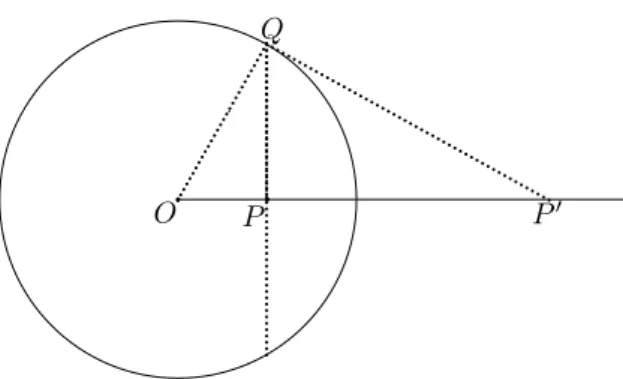
(See Figure 7.1) – Draw the rayOP.– Draw a perpendicular to OP at P. This intersects the circle of inversion in two points, label one of themQ.
– Connect the center of the circleO toQ.
– Draw a perpendicular toOQfromQ. The intersection of this perpendic-ular with OP is P0, the inverse of P.
... ... ... ... ... ... ... ... ... .... .... .... .... .... .... .... .... .... .... .... . ... ... ... ... ...
O P P0
Q
...... ......
......
Figure 7.1: Inverse of a Point Inside the Circle of Inversion
Note that ∆OP Q ∼ ∆OQP0. Hence OQ OP =
OP0
OQ. Therefore, OP · OP
0 =
(OQ)2 =r2.
•
If
P
is outside the circle of inversion:
(See Figure 7.2) – LetM be the midpoint of the segment OP.– Construct a circle centered atM of radiusM O. It intersects the circle of inversionC(O,r) in two points, Q and R and goes through O and P. – Construct the segmentQR. The intersection of QR and OP is the point
P0, the inverse of P.
.... .... .... .... .... .... .... .... .... .... .... . P P0 M O...
... ... ... ...... ..... ... ...... ...... Q R
Figure 7.2: Inverse of a point Outside the Circle of Inversion
Note that ∆OP Q ∼ ∆OQP0. Hence OQ OP =
OP0
OQ. Therefore, OP · OP
0 =
•
Using Sketchpad:
Inverting a Line: To invert a straight line in the circle of inversion C(O,r)
follow the following steps:
1. Construct the circle of inversion C and the linel. 2. Construct an arbitrary point P on the line l. 3. Construct the ray OP.
4. Construct the intersection of OP and the circle, call it Q. 5. Construct the segment OP.
6. Mark O as the center of dilation. 7. Mark the ratio r
OP. 8. DilateQ by the ratio r
OP centered atO. The image ofQ isP
0 the inverse
image ofP.
9. Hide everything except the circle, its center, the point determining its radius,P0 and the straight line l and the two point determining it.
10. Select everything and create a tool and call it invcirc.
11. Apply the tool a few times and use arc through three points to determine the image of the line.
Inverting a Circle: To invert a circle C1 in the circle of inversion C(O,r),
replacel byC1 in the steps above.
7.2
Inversion Using Coordinates:
Theorem 7.2.1 An inversion about x2+y2 =r2 is given by
(x, y)→(x0, y0) = ( xr
2
x2+y2,
yr2
x2+y2)
Proof. Since (x, y),(x0, y0) and (0,0) are collinear, we have y0
x0 =
y
x. Now
d((0,0),(x, y))·d((0,0),(x0, y0)) =r2, hence√x2 +y2
·√x02+y02 =r2and (x2+y2)· (x02+y02) = r4. Hencex02 = r4
x2+y2 −y
02andx02 = r4−y02(x2+y2)
x2+y2 =
r4
−x02xy22(x2 +y2)
x2+y2
= r
4
x2+y2 −
y2x02
x2 . Hencex
02+y2x02
x2 =
r4
x2+y2 and
x02(x2+y2)
x2 =
r4
x2+y2. Hence
x02 = r
4x2
(x2+y2)2 and x
0
= r
2x
x2+y2. Similarly, we can show that y
0
= r
2y
6
-X
Y
Figure 7.3: Inverse of(x−1)2+y2= 1in x2+y2= 1
Answer. Well, x0 = x
x2+y2 and y
0 = y
x2+y2. Hence x
0 = x
x2+1−(x−1)2 =
1 2 and
y0 = y
2x. Hence the image of a circle going through the center of the circle of inversion is a line going through the points of intersection of the two circles.
Exercise 2:
What is the image ofx= 12 under an inversion in x
2+y2 = 1?
6
?
-6
X Y
Figure 7.4: Inverse ofx=1
2 inx2+y2= 1
Answer: (x−1)2+y2 = 1
Exercise:
What is the image of x= 1 under an inversion in x2+y2 = 1? Answer: (x−1/2)2+y2 = 1/4.Exercise 3:
What is the image ofx2+2x+y2 = 0 under an inversion inx2+y2 = 1? Answer: x= 1/2.Theorem 7.2.2 If two circles are orthogonal, (their tangents at the points of
in-tersection are perpendicular), and if a diameter AB of one circle meets the other
circle in the points C and D, then OP2 =OC
·OD.
O
P
A C B D
O0
Figure 7.5: Orthogonal Circles are Inverses
Proof. ∆OP O0 is a right triangle, hence(OP)2+ (P O0)2 = (OO0)2. ButOO0 =
OC +CO0 =OC +P O0, hence (OP)2+ (P O0)2 = (OC +P O0)2. Hence (OP)2 = (OC)2 + 2
·OC ·P O0, which implies that (OP)2 = OC ·(OC + 2P O0). Hence (OP)2 =OC
·OD.
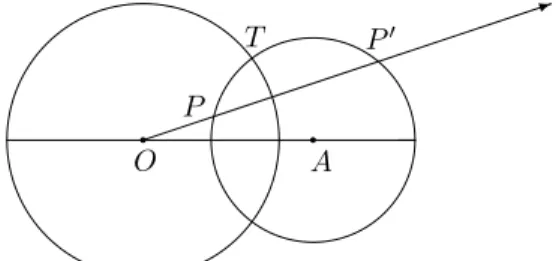
Theorem 7.2.3 A circle orthogonal to the circle of inversion inverts into itself, and, a circle through a pair of inverse points is orthogonal to the circle of inversion.
P O
T
1
A P0
Figure 7.6: Orthogonal Circles are Inverses
Proof. Given the circle of inversion C(O,r) and an orthogonal circle centered at
A. Let T be one of the points of intersection of the two circles. Now if a line through O meets this orthogonal circle at P and P0 then OP
·OP0 =OT2 = R2. Hence P and P0 are inverse points.
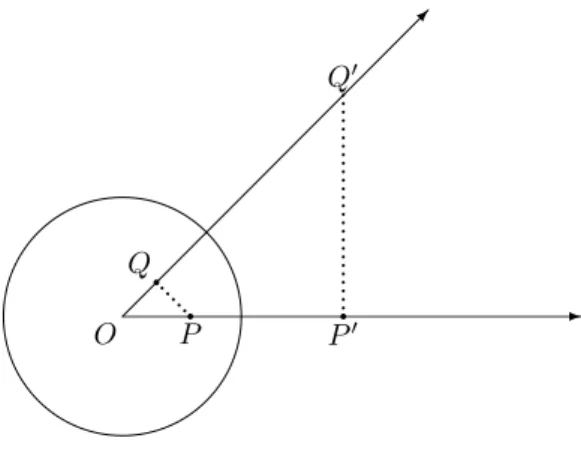
Theorem 7.2.4 IfP P0 andQ,Q0 are pairs of inverse points with respect to some
circle C(O,r), Then P0Q0 =P Q r
2
OP OQ.
Proof. If O, P, Q are noncollinear then, OP0
= OQ0
P P0
Q
.. .. .. .
.. .. .. .. .. .. .. .. .. .. .. .. .. .
Q0
O
Figure 7.7: PP Q0Q0 = r2
OP OQ
7.3
Applications of Inversion:
• Given three non-coaxial concurrent circles, construct a circle C tangent to all
three circles.
Figure 7.8: A Circle Tangent To Three Non-Coaxial Circles
Solution: Invert the circles about a unit circle centered at the point of concur-rency of the circles creating a triangle. Now construct the inscribed circle and invert this circle in the circle of inversion to create the required circle.
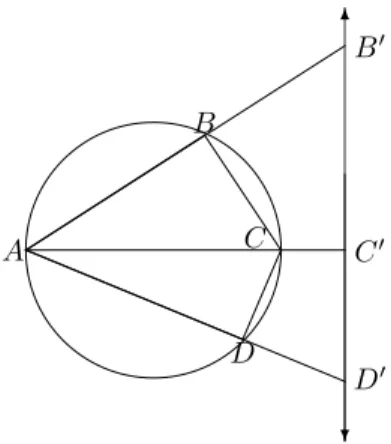
• Ptolemy’s Theorem: In a cyclic convex quadrilateral, the product of the
diag-onals is equal to the sum of the products of the two pairs of opposite sides.
Proof: Invert the circle and the convex quadrilateral about a circle centered at one of the vertices of the quadrilateral, say A. Now B0D0 = B0C0+C0D0.
Hence,
BC r
2
AB·AC +CD
r2
AC·AD =BD
r2
6
?
A
B
B0
C C0
D
D0
Figure 7.9: Ptolemy’s Theorem
Hence, BC·AD+CD·AB =BD·AC.
Homework
7.3.1 1. Find the image of the objects below under the specified inversion. (See Figures 7.10 and 7.11 )2. Prove that the inverse of the circumcircle Cc of a triangle ∆ABC with respect to the incircleCi, as a circle of inversion, is the nine point circle of the triangle ∆XY Z determined by the points of contact of Ci with the sides of ∆ABC.
6
? 6
?
6
?
-6
?
-?
6
6 6
? ?