AUSTRALIAN JOURNAL OF BASIC AND
APPLIED SCIENCES
ISSN:1991-8178 EISSN: 2309-8414 Journal home page: www.ajbasweb.com
Open Access Journal
Published BY AENSI Publication
© 2016 AENSI Publisher All rights reserved
This work is licensed under the Creative Commons Attribution International License (CC BY).
http://creativecommons.org/licenses/by/4.0/
To Cite This Article: M Parameswari and T.Sasilatha., Delay Performance in Wireless Sensor Network: A Cross Layer Analysis. Aust. J. Basic & Appl. Sci., 10(1): 457-466, 2016
Delay Performance in Wireless Sensor Network: A Cross Layer Analysis
1
M Parameswari and 2T.Sasilatha
1Department of Computer Science and Information Technology, Kings Engineering College, Chennai, India.
2HOD/ECE, Sree Sastha Insitute of Engineering and Technology, Chennai, India
Address For Correspondence:
M Parameswari, Department of Computer Science and Information Technology, Kings Engineering College, Chennai, India. E-mail: [email protected]
A R T I C L E I N F O A B S T R A C T Article history:
Received 10 December 2015 Accepted 28 January 2016 Available online 10 February 2016
Keywords:
Tweak Matrix, Abridge Matrix, chief matrix, Information Extraction, Midst Measure, and Healthcare.
In wireless sensor networks, forward error correction (FEC) coding and hybrid ARQ schemes enhances the error resiliency, FEC codes can incur communication overhead in terms of transmission and reception of additional redundant bits as well as decoding packets. Hence in this paper, we propose a complete delay performance measurement and analysis in a wireless sensor network. We shape a lightweight delay measurement system and present a robust method to calculate the per-packet delay to enhance the error resiliency of a packet through retransmission. We identify important factors from the data bit and show that the important factors are not necessarily the same as like in the Internet. Furthermore, we propose a delay model to capture those factors. We revisit several prevalent protocol designs such as active collision recovery ARC technique, Collection Tree Protocol, opportunistic routing, and Dynamic Switching-based Forwarding and show that our model and analysis are useful to practical protocol strategies. By simulation results, we show that the proposed technique reduces the computation complexity, energy consumption and delay.
INTRODUCTION
A. Wireless Sensor Network (WSN):
A Wireless Sensor Network (WSN) is a set of sensor nodes that can communicate wirelessly with each other across an extended environment.Physically, a WSN is comprised of numerous tiny sensor nodes (or sensors for short) deployed in an environment for monitoring and tracking purposes. Sensed data are aggregated and at times, stored “in-network” at sink nodes which may themselves be sensors or other nodes richer in capabilities and resources. Data are then communicated to the end users either periodically or ondemand through the sinks or a higher order node; the base station. Clearly, WSNs find numerous applications ranging from healthcare to crisis management and warfare. They are presented in various areas such as: life sciences, medical care and the vital signs, military affairs and development, and in general wherever it is needed to measure the physical quantity (Roshanzadeh, M. and S. Saqaeeyan, 2012).
B. Delay performance measurement in WSN:
Delay performance measurement and analysis, in a WSN, face nontrivial challenges. First, different from the Internet and data centers (Kompella, R., et al., 2009; Saad Bin Qaisar and Hayder Radha, 2007; Guangshuo Chen, et al., 2013), there are no effective methods in WSNs supporting per-packet delay measurement. Traditional delay measurement methods rely on network synchronization which introduces additional overhead.
In this paper, we build an infrastructure for delay measure- ment in CitySee, a large-scale WSN consisting of 1200 nodes. The infrastructure does not rely on network synchronization and thus does not introduce additional overhead. We present basic statistical characteristics based on the collected data. To system- atically and automatically identify important impacting factors from various parameters, we build a method based on Rulefit for the collected data trace. Furthermore, we quantitatively calcu- late the correlation between different impacting factors and the delay performance. Based on those important factors, we build a practical delay model and validate the model using the collected data trace. Finally, we revisit three important protocols based on the measurement results and propose a practical delay model. In summary, the contributions of this paper are as follows.
• We build a measurement infrastructure in an operational
large-scale WSN with little network overhead. Based on the collected data, we present the spatial and temporal char- acteristics of delay performance.
• We present an automatic method based on Rulefit to identify important impacting factors to the delay performance.
• We propose a practical model and validate it with the col- lected data. We show the implications to protocol designs.
C. Cross layer based analysis in WSN:
A Cross-layer approach is to make the routing layer more robust. This protocol is required for addressing medium access, robust routing, and congestion control issues with the consideration on channel effects, information fidelity and energy efficiency. It has been introduced to solve the key problems in WSN.
It is mainly introduced to reduce the effects of multi-hop routing and the broadcast nature of the wireless communication are investigated to derive the equations which rule the energy consumption, latency, and packet error rate (PER) performance of error control schemes.
Cross layer analysis considers routing, medium access control, and physical layers which is formulated. The cross layer analysis enables a comprehensive comparison of forward error correction (FEC), automatic repeat request (ARQ), as well as hybrid ARQ schemes in Wireless Sensor Networks WSNs (Kompella, R., et al., 2009; http:///www.isi. edu/nsnam/ns).
D. Problems of Existing Works:
Error control is of significant importance for Wireless Sensor Networks (WSNs) because of their severe energy constraints and the low power communication requirements. Hence, energy efficient error control is of extreme importance. Moreover, the strict energy consumption requisites, the multi-hop structure of the WSNs, and the broadcast nature of the wireless channel necessitate a cross-layer investigation of the effects of error control schemes.
Followed by the above requirements (Kompella, R., et al., 2009) a cross-layer methodology for the analysis of error control schemes in WSNs is presented such that the effects of multi-hop routing and the broadcast nature of the wireless channel are investigated. More specifically, the cross-layer effects of routing, medium access, and physical layers are considered. This analysis enables a comprehensive comparison of forward error correction (FEC) codes, automatic repeat request (ARQ), and hybrid ARQ schemes in WSNs.
In this paper Hybrid ARQ schemes aim to exploit the advantages of both FEC and ARQ schemes by incrementally increasing the error resiliency of a packet through retransmissions. HARQ works by two types. TYPE-1 if the received packet is in the form of error, it sends a negative acknowledgement (NACK) to the sender, which re-sends the packet which is coded with a more powerful FEC code. The difference in Type II is that for retransmissions, only the redundant bits are sent. This decreases the bandwidth usage of the protocol.
Forward error correction (FEC) coding and hybrid ARQ schemes improve the error resiliency compared to ARQ schemes by sending redundant bits through the wireless channel. Therefore, lower signal to noise ratio (SNR) values can be supported to achieve the same error rate as an uncoded transmission. However FEC codes incur communication /*overhead in terms of transmission and reception of additional redundant bits as well as decoding packets.
In this paper, we propose a cross-layer based error control technique for WSN. In this technique, a hybrid technique that combines automatic repeat request (ARQ) and active collision recovery ARC technique is used to enhance the error resiliency of a packet through retransmission. In case of packet failure, the re-transmission of failed packet is performed using relay nodes selected using a decentralized partially observable Markov decision process.
Literature review:
Guangshuo Chen et al have proposed a multiple attributes-based recovery algorithm which can provide high accuracy. Firstly, based on two real datasets, the Intel Indoor project and the GreenOrbs project, they reveal that such correlations are strong, e.g., the change of temperature and light illumination usually has strong correlation. Secondly, motivated by this observation, they develop a Multi-Attribute-assistant Compressive-Sensing-based (MACS) algorithm to optimize the recovery accuracy. Finally, real tracedriven simulation is performed. The results show that MACS outperforms the existing solutions. Typically, MACS can recover all data with less than 5% error when the loss rate is less than 60%. Even when losing 85% data, all missing data can be estimated by MACS with less than 10% error. However the light illumination in GreenOrbs is a little weak, as the light illumination varies considerably in nature.
Mehmet C. Vuran and Ian F. Akyildiz (Kompella, R., et al., 2009) have presented a cross-layer analysis of error control schemes. Forward error correction (FEC) coding improves the error resiliency by sending redundant bits through the wireless channel. It is shown that this improvement can be exploited by transmit power control or hop length extension through channel-aware cross-layer geographical routing protocols in WSNs. The results of their analysis reveal that for hybrid ARQ schemes and certain FEC codes, the hop length extension decreases both the energy consumption and the end-to-end latency subject to a target packet error rate (PER) compared to ARQ. They also show that the advantages of FEC codes are even more pronounced as the network density increases. On the other hand, transmit power control results in significant savings in energy consumption at the cost of increased latency for certain FEC codes. Since transmit power control increases the number of hops, this technique introduces a significant increase in latency, which is a tradeoff for the FEC codes.
Giorgio Quer et al (2013) have proposed a novel framework, called SCoRe1, for the accurate approximation of large real world WSN signals through the collection of a small fraction of data points. SCoRe1 accommodates diverse interpolation techniques, either deterministic or probabilistic, and embeds a control mechanism to automatically adapt the recovery behavior to time varying signal statistics, while bounding the reconstruction error. As an original contribution of the paper, they considered an interpolation technique based on Compressive Sensing (CS), utilizing Principal Component Analysis (PCA) to learn the data statistics and CS to recover the signal through convex optimization. This technique achieves good performance in terms of reconstruction accuracy vs network cost (i.e., number of transmissions required). Also it is robust to unpredictable changes in the signal statistics, and this makes it very appealing for a wide range of applications that require the approximation of large and distributed datasets, with time varying statistics. However the use of Spline as the interpolation technique in SCoRe1 leads to large errors.
Saad Bin Qaisar and Hayder Radha (2007) have proposed an Optimal Progressive Error Recovery Algorithm (OPERA) over WSNs. OPERA requires significantly lesser processing than would be required for complete decoding or full decoding/encoding at the sensor nodes; and OPERA significantly reduces the total number of transmissions when compared to optimal end-to-end channel coding schemes. They also use iteratively decodeable LDPC codes for this purpose. OPERA not only provides a partial processing framework, but also an algorithm to optimally map the decoding iterations over the multi hop network. They provide a comparison between our iteration assignment scheme and random iteration assignment, and show that our scheme performs considerably better. Further they developed a fairness-based OPERA scheme for the allocation of channel-decoding LDPC iterations to sensor nodes taking into consideration the life-expectancy of each sensor. However if very few bits are dropped, then it’s not fair with resource constrained nodes. Thus, a balance should be maintained between performance and energy tradeoff when forming the quantization levels.
Guangshuo Chen et al (2013) have proposed a novel sensory data recovery algorithm which exploits the spatial and temporal joint sparse feature. Firstly, by mining two real datasets, namely the Intel Indoor project and the GreenOrbs project, they find that: (1) for one attribute, sensory readings at nearby nodes exhibit inter-node correlation; (2) for two attributes, sensory readings at the same inter-node exhibit inter-attribute correlation; (3) these inter-node and inter-attribute correlations can be modeled as the spatial and temporal joint-sparse features, respectively. Secondly, motivated by these observations, they propose two Joint- Sparse Sensory Data Recovery (JSSDR) algorithms to promote the recovery accuracy. Finally, real data-based simulations show that JSSDR outperforms existing solutions. Typically, when the loss rate is less than 65%, JSSDR can estimate missing values with less than 10% error. And when the loss rate reaches as high as 80%, the missing values can be estimated by JSSDR with less than 20% error. However there is an increase in the data loss rate.
the number of retransmissions, and achieves around 25% improvement on transmission efficiency over other schemes. However the retransmission is reduced only by fewer amounts by the ACR.
Ghasem Naddafzadeh Shirazi et al (2009) have proposed decentralized partially observable Markov decision process (DEC-POMDP) model for selecting the relays to perform the cooperative retransmission. The proposed DECPOMDP model does not require global channel state information (CSI). In addition, it is robust to noise in CSI measurements. Furthermore, the proposed DEC-POMDP scheme utilizes the gradient descent learning method to eliminate the need for a wireless channel model. They show that the proposed learning method based on the DEC-POMDP model can perform near optimally in the absence of a channel model and despite its implementation simplicity. However the cost of successful packet transmission in the POMDP solution is more sensitive.
Riccardo Masiero et al (2009) have proposed a Compressive Sensing (CS) in conjunction with Principal Component Analysis (PCA) to address the task of accurately reconstructing a distributed signal through the collection of a small number of samples at a data gathering point. This scheme compresses in a distributed way real world non-stationary signals, recovering them at the data collection point through the online estimation of their spatial/temporal correlation structures. The proposed technique is hereby characterized under the framework of Bayesian estimation, showing under which assumptions it is equivalent to optimal maximum a posteriori (MAP) recovery. This provides empirical evidence of the effectiveness of their approach and proves that CS is a legitimate tool for the recovery of real-world signals in WSNs. However, the correct online estimation of the different parameters is not straightforward.
Proposed Solution: A. Overview:
In this paper, we propose a cross-layer based error control technique for WSN. In this technique, a hybrid technique that combines automatic repeat request (ARQ) and active collision recovery ARC technique is used to enhance the error resiliency of a packet through retransmission. In case of packet failure, the re-transmission of failed packet is performed using relay nodes selected using a decentralized partially observable Markov decision process.
B. HARQ:
This technique combines the Automatic Repeat Request (ARQ) and Active Collision Recovery (ACR) technique that increases the error resiliency of a packet through retransmission. Initially the source node transmits an un-coded packet or a packet coded with a lower error correction capability to the destination node through neighbor nodes. If the packet is received with error, then the receiver node sends a negative acknowledgement message to the source node. The source then resends the packet with higher error correction code.
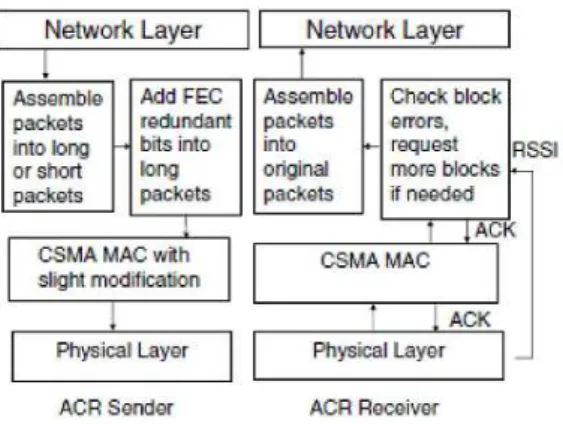
In general, the sender node converts potential collisions into LS-collisions and recovers the corrupted packets from collision using this hybrid scheme.
Fig. 1: Active Collision Recovery Technique
The following active collision recovery protocol describes the method to recover the collided packets in the form of partial error patterns.
i. Sender Side:
The steps involved in ACR sender side are as follows Let Ns be the sender node
Let PL and PS be the long and short packets
Let Q be the notification that several blocks are needed for recovery
1) Ns packets collects the packets from the network layer and categorizes as PL or PS.
2) Ns decide whether to transmit PL or PS using a probability approach and transmit to MAC layer.
If Ns
→
S
P
MAC layer Then
Ns include CRC code at end of each PS.
Else
Ns include FEC codes at end of each PL.
End if
If Ns send PS to MAC layer, it includes CRC codes at end of each PS. On the other hand, if Ns send PL to
MAC layer, it includes FEC codes at end of each PL.
Note the following:
• CRC will be used by Nr to verify the packet integrity
• FEC will be used by Nr to recover long packets without retransmission during LS-collisions.
3) In order to increase the LS-collisions, NS estimates the non-uniform distribution and introduces delay
on PS.
Estimation of non-uniform distribution
i =
(
t
+
1
)
log
x[
η
(
x
−
1
)
+
1
(1)η
= random variable with uniform distribution within the interval (0, 1) x = 10 for PLx = 20 for PS
Delay on PS
If NS senses a short packet, it waits for time z prior transmission, where z is the time to transmit the
synchronization header of the packet.
ii. ARQ scheme to Recover Lost Packets:
The following packets losses are possible during transmission. This is recovered using backup ARQ method.
o Short packets lost during LS-collisions
o Long packets that lacked sufficient blocks to be recovered by the FEC scheme o Loss due to other collision types
Following packet transmission, Ns waits for acknowledgement (Mack) message
If Mack is not received within time z
Then
Ns retransmits the previous packets
Else
If Mack is received with Q
Then
Ns retransmits the respective number of blocks instead of the entire packet.
End if
iii. Receiver Side:
The steps involved at ACR Receiver are as follows Let c be the erroneous block threshold
I. When Nr receives a packet, it verifies whether it is PL or PS.
i)
If Nr receives PsThen
It uses CRC to determine the integrity of the packet If CRC is valid
Then
Nr s
M
N
sck
→
End if End if
ii)
If Nr received PLIt uses CRC to find if there exists erroneous blocks (B) If CRC is valid
Then
Nr s
M
N
sck
→
Else
Corrupted blocks are estimated by verifying whether RSSI is high or low. End if
II. While Nr starts receiving the packets, it begins sampling the RSSI values every z time units and stores it in
an array.
If RSSI > threshold Then
Nr maps the RSSI value to the respective block B and marks it as potential corrupted block.
If B>c Then
B cannot be recovered using FEC scheme
Nr transmits a Mack to Ns requesting quality blocks.
Else
B can be recovered using FEC codes End if
III. For corrupted block Bj, if j = i.c+e, if e
≠
0, then the blocks are reconstructed using as followsBj,k = re,k
⊕
Bj,k…⊕
B (j-1)c+e,k⊕
B (i+1)c+e,k…
⊕
Bk e c c n
, 1
+
− (2)
If e = 0,
Bj,k = r0,k
⊕
B0,k…⊕
B (j-1)k⊕
B (j+1)k…⊕
B(c−1),j (3)where 0
≤
k≤
t.Here the blocks are constructed with e
≠
0 and then with e = 0. After recovering corrupted blocks, CRC validity is verified If CRC is validThen
Nr s
M
N
sck
→
End if
Fig. 2: Representation of FEC Encoding
C. Protocols:
1) Low Power Listening:
the receiver wakes up. For broadcast, the preamble lasts for a cycle duration in order to ensure that all neighboring nodes wake up once. For unicast with link-layer ACK, the sender can stop the preambles until an ACK is received or the end of a cycle. Another type of LPL protocol is receiver-initiated low-duty cycle protocol. Each node periodically wakes up and sends probe packets to see if there are transmissions intended for it. If a node has packets to send, it will keep awake and send the packets once receiving a probe packet from the receiver. Since a sender may begin to send packets at any time, the time the sender needs to wait is randomly distributed in the cycle. This introduces randomness to packet delay.
2) Collection Tree Protocol:
Collection Tree Protocol (CTP) is used to build a routing tree in the network. CTP adopts the ETX metric, the expected transmission count, as the path quality metric. Each node selects a path with minimum ETX.
3) Measurement Infrastructure:
Time synchronization can be used to measure delay in the net- work. However, time synchronization protocols in WSNs, such as FTSP, etc. incur additional traffic overhead into the network in order to maintain a global timestamp for all nodes. We use a lightweight approach to measure the end-to-end packet delay without incurring synchronization traffic. For each packet, we define the delay as the time from the packet is generated at the source node to the time that the packet is received at the sink node.
4) Routing Protocol :
We first analyze the commonly used data collection protocol
CTP in WSNs. Through analysis, we find that CTP protocol, with ETX as the routing metric, may not appropriately choose a good path. For brevity, we assume the queuing delay on each hops.
IV. Simulation Results:
A. Simulation Model and Parameters:
The Network Simulator (NS2), is used to simulate the proposed architecture. In the simulation, the mobile nodes move in a 500 meter x 500 meter region for 50 seconds of simulation time. All nodes have the same transmission range of 250 meters. The simulated traffic is Constant Bit Rate (CBR).
The simulation settings and parameters are summarized in table.
No. of Nodes 20,40,60,80 and 100
Area Size 500 X 500
Mac IEEE 802.11
Transmission Range 250m
Simulation Time 50 sec
Traffic Source CBR
Long Packet Size 512 bytes
Short packet size 128 bytes
Initial Energy 4.1J
Transmission Power 0.660
Receiving Power 0.395
Rate 50,100,150, and 250Kb
B. Performance Metrics:
The proposed Cross-layer based error control technique (CBEC) is compared with the HARQ technique [3]. The performance is evaluated mainly, according to the following metrics.
Packet Delivery Ratio: It is the ratio between the number of packets received and the number of
packets sent.
Packet Drop: It refers the average number of packets dropped during the transmission
Energy Consumption: It is the amount of energy consumed by the nodes to transmit the data packets
to the receiver.
Delay: It is the amount of time taken by the nodes to transmit the data packets.
C. Results:
1) Based on Nodes:
Nodes Vs Delay 0 2 4 6 8
20 40 60 80 100
Nodes D e la y (S e c ) CBEC HARQ
Fig. 3: Nodes Vs Delay
Nodes Vs DeliveryRatio
0 0.2 0.4 0.6 0.8 1
20 40 60 80 100
Nodes D e li v e ry R a ti o CBEC HARQ
Fig. 4: Nodes Vs Delivery Ratio
Nodes Vs Drop
0 2000 4000 6000
20 40 60 80 100
Nodes
P
k
ts CBEC
HARQ
Fig. 5: Nodes Vs Packet Drop
Nodes Vs EnergyConsum ption
0 2 4 6
20 40 60 80 100
Nodes E n e rg y (J ) CBEC HARQ
Fig. 6: Nodes Vs Energy Consumption
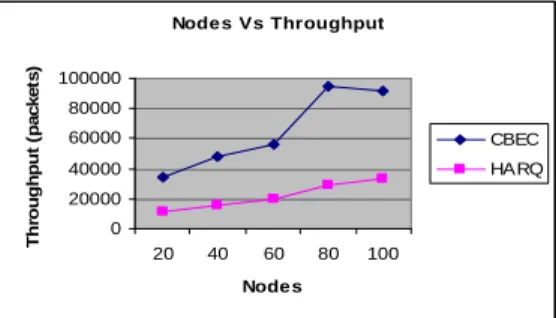
Nodes Vs Throughput
0 20000 40000 60000 80000 100000
20 40 60 80 100
Nodes T h ro u g h p u t (p a c k e ts ) CBEC HARQ
Figures 3 to 7 show the results of delay, delivery ratio, packet drop, energy consumption and throughput for varying the nodes from 20 to 100 in CBEC and HARQ protocols. When comparing the performance of the two protocols, we infer that CBEC outperforms HARQ by 42% in terms of delay, 71% in terms of delivery ratio, 33% in terms of packet drop, 31% in terms of energy consumption and 66% in terms of throughput.
2) Based on Rate:
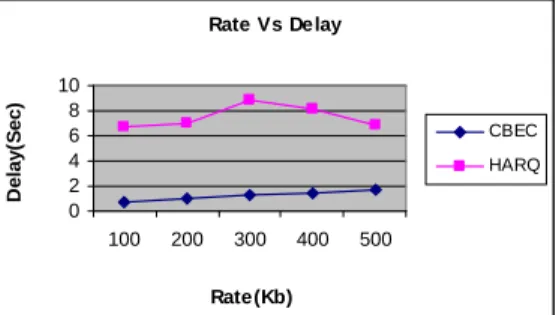
In our second experiment we vary the transmission rate as 100,200,300,400 and 500Kb.
Rate Vs Delay
0 2 4 6 8 10
100 200 300 400 500
Rate(Kb)
D
e
la
y
(S
e
c
)
CBEC
HARQ
Fig. 8: Rate Vs Delay
Rate Vs DeliveryRatio
0 0.5 1
100 200 300 400 500
Rate(Kb)
D
e
li
v
e
ry
R
a
ti
o
CBEC
HARQ
Fig. 9: Rate Vs Delivery Ratio
Rate Vs Drop
0 5000 10000 15000
100 200 300 400 500
Rate(Kb)
P
k
ts CBEC
HARQ
Fig. 10: Rate Vs Packet Drop
Rate Vs EnergyConsum ption
0 2 4 6
100 200 300 400 500
Rate(Kb)
E
n
e
rg
y
(J
)
CBEC
HARQ
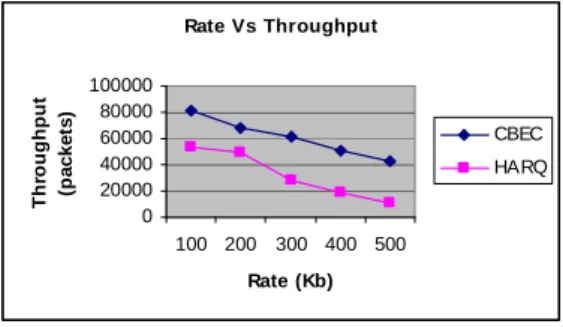
Rate Vs Throughput
0 20000 40000 60000 80000 100000
100 200 300 400 500
Rate (Kb)
T
h
ro
u
g
h
p
u
t
(p
a
c
k
e
ts
)
CBEC
HARQ
Fig. 12: Rate Vs Throughput
Figures 8 to 12 show the results of delay, delivery ratio, packet drop, energy consumption and throughput for rate 100,200,300,400 and 500Kb in CBEC and HARQ protocols. When comparing the performance of the two protocols, we infer that CBEC outperforms HARQ by 84% in terms of delay, 43% in terms of delivery ratio, 75% in terms of packet drop, 26% in terms of energy consumption and 51% in terms of throughput.
Conclusion:
In this paper, we have proposed a cross-layer based error control technique for WSN. In this technique, a hybrid technique that combines automatic repeat request (ARQ) and active collision recovery ARC technique is used to enhance the error resiliency of a packet through retransmission. In case of packet failure, we propose a lightweight delay measurement method to efficiently calculate delay without time synchronization, which is appropriate to operational networks. Furthermore, we extract different impacting parameters to delay performance with the incomplete data, propose a practical delay model to capture those factors, and validate it in a large scale network. Finally, we show the consequences of measurement and analysis to protocol design. By simulation results, we have shown that the proposed technique reduces the computation complexity, energy consumption and delay. As a future work, we propose to work on designing some better relay node selection strategies.
REFERENCES
Guangshuo Chen, Xiao-Yang Liu, Linghe Kong, Jia-Liang Lu, Wei Shu and Min-You Wu, 2013. “JSSDR: Joint-Sparse Sensory Data Recovery in Wireless Sensor Networks”, 2013 IEEE 9th International Conference on IEEE.
Guangshuo Chen, Xiao-Yang Liu, Linghe Kong, Jia-Liang Lu, Yu Gu, Wei Shu and Min-You Wu, “Multiple Attributes-based Data Recovery in Wireless Sensor Networks”, wirelesslab.sjtu.edu.cn.
Hang Liu, Hairuo Ma, Magda El Zarki and Sanjay Gupta, 1997. “Error control schemes for networks: An overview”, Mobile Networks and Applications 2.
Kompella, R., K. Levchenko, A.C. Snoeren and G. Varghese, 2009. "Every microsecond counts: Tracking fine-grain latencies with a lossy difference aggregator," in Proc. ACM SIGCOMM, pp: 255-266.
Lucas, D.P. Mendes and Joel J.P.C. Rodrigues, 2010. “A survey on cross-layer solutions for wireless sensor networks”, Journal of Network and Computer Applications, Elsevier Ltd. All rights reserved.
Network Simulator: http:///www.isi.edu/nsnam/ns
Riccardo Masiero, Giorgio Quer, Michele Rossi and Michele Zorzi, 2009. “A Bayesian Analysis of Compressive Sensing Data Recovery in Wireless Sensor Networks”, © IEEE.
Roshanzadeh, M. and S. Saqaeeyan, 2012. “Error Detection & Correction in Wireless Sensor Networks By Using Residue Number Systems”, I. J. Computer Network and Information Security.
Saad Bin Qaisar and Hayder Radha, 2007. “OPERA: An Optimal Progressive Error Recovery Algorithm for Wireless Sensor Networks”, Sensor, Mesh and Ad Hoc Communications and Networks, 2007, SECON'07 4th Annual IEEE Communications Society Conference on IEEE.
Shirazi, Ghasem Naddafzadeh, Peng-Yong Kong and C-K.Tham, 2009. “A Cooperative Retransmission Scheme in Wireless Networks with Imperfect Channel State Information”, Wireless Communications and Networking Conference, 2009, WCNC, IEEE.