ISSN: 2147-611X
www.ijemst.com
Enhancing
Flipped
Mathematics
Education by Utilising GeoGebra
Robert Weinhandl, Zsolt Lavicza, Markus Hohenwarter, Stefanie Schallert
Johannes Kepler University, Austria
To cite this article:
Weinhandl, R., Lavicza, Z., Hohenwarter, M. & Schallert, S. (2020). Enhancing flipped
mathematics education by utilising GeoGebra.
International Journal of Education in
Mathematics, Science and Technology (IJEMST), 8
(1), 1-15.
This article may be used for research, teaching, and private study purposes.
Any substantial or systematic reproduction, redistribution, reselling, loan, sub-licensing,
systematic supply, or distribution in any form to anyone is expressly forbidden.
Authors alone are responsible for the contents of their articles. The journal owns the
copyright of the articles.
Volume 8, Number 1, 2020
Enhancing Flipped Mathematics Education by Utilising GeoGebra
Robert Weinhandl, Zsolt Lavicza, Markus Hohenwarter, Stefanie Schallert
Article Info
Abstract
Article HistoryReceived:
25 September 2019
Combining new educational approaches and educational technologies can make mathematics education more adaptable to pupils‘ needs in the 21st century. Our explorative educational study aimed to identify how learning settings and learning environments should be designed to facilitate synthesising flipped approaches to education and using GeoGebra. To discover how to combine flipped approaches and GeoGebra in mathematics education, we conducted a nine-month educational study at a Viennese secondary school. In our study, we focused on pupils‘ needs, as pupils are key to combining successfully new educational approaches and using technologies. Analysing our qualitative research data following design-based and grounded theory approaches indicates that the categories (a) clear task definition and task design, (b) feedback, (c) context and benefits, and (d) single-source learning environments are important for pupils when utilising GeoGebra for enhancing flipped education.
Accepted: 22 December 2019
Keywords
Flipped learning Pupil-driven education Technology-enhanced education
GeoGebra
Introduction
The idea that young people can no longer envisage a decent life without technology may have been accurate for more than a decade (Ferchhoff, 2007). However, when technologies are integrated into education, the focus should be on learning processes and pupils rather than on technologies (Lemmer, 2013). Putting pupils and learning processes at the centre of teaching and learning is a typical feature of flipped education. In our paper, we define the term flipped education as a way of teaching and learning based on flipped classroom or flipped learning approaches. In the theoretical background section, we will provide an in-depth definition of flipped classroom and flipped learning approaches. Typical of flipped education is using technologies to support learning and teaching (Lemmer, 2013), that pupils are at the centre of developing knowledge (García-Peñalvo, Fidalgo-Blanco, Sein-Echaluce, & Conde, 2016; Wasserman, Quint, Norris, & Carr, 2015), that real-world problems should guide learning (Choi, 2013), and that learning should follow an active and hands-on approach (McNally et al., 2016). These characteristics of flipped education can contribute to education addressing 21st-century skills such as creativity or complex problem solving (Webb et al., 2018). Creativity in education also means that pupils themselves create learning artefacts which require hands-on working in education. Furthermore, dealing with real-world problems in education demands that not only standard patterns should be used to tackle or solve such problems. Rather, integrating real-world problems into mathematics education involves using complex problem solving-strategies. However, some authors criticise flipped education because, in everyday teaching and learning, this educational approach sometimes does not sufficiently exploit the potential of interplays of technologies, pedagogies and learning. For example, Weidlich & Spannagel (2014) stress that videos, which are a typical element of flipped education, are only superficially viewed by pupils. In our educational study, we have changed the technological orientation of flipped education away from exclusively using videos passively towards utilising GeoGebra for exploring mathematics. GeoGebra is a mathematical software package developed for teaching that combines CAS, dynamic 2D and 3D geometry applications, and spreadsheet features (Kaenders & Schmidt, 2014). Furthermore, since Zulnaidi, Oktavika, & Hidayat (2019) have shown in their study positive effects of using GeoGebra on pupils‘ mathematical learning outcomes and highlight that utilising GeoGebra could make pupils more active in mathematics education and increase interactions in mathematics classes, GeoGebra could be an appropriate technological key medium in our educational study.
theoretical background of our paper discusses flipped approaches to education. When examining flipped approaches to education, we will focus on flipped classroom and flipped learning approaches, and how these approaches could be combined with learning mathematics and using educational technologies. In the second part of the theoretical background, we will explain potential advantages of using the mathematical software package GeoGebra and how and why GeoGebra was integrated into our educational study. In the section methodologies, we will describe our educational study in detail, as well as how design-based research and grounded theory approaches were utilised to develop the core categories (a) clear task definition and task design, (b) feedback, (c) context and benefits, and (d) single-source learning environments. Finally, we will present how our educational study expanded the current body of knowledge and implications for practice and further research.
Theoretical Background
As we utilised, on the one hand, flipped classroom and flipped learning approaches and, on the other hand, the mathematical software package GeoGebra in our educational study, the theoretical framework section will elucidate both educational approaches, the development from flipped classroom towards flipped learning education as well as how utilising GeoGebra could improve mathematics education. Since our research aims to explore how flipped approaches to mathematics education could be combined with using GeoGebra, the focus of our study is not on the individual educational approaches and the separate views on using technologies, but on how educational approaches and utilising technologies could interact in mathematics education. As combining flipped approaches in mathematics education and using GeoGebra is at the centre of our study, the theoretical background of our paper highlights links between these two pillars of our study and how these two pillars and combining these two pillars have been implemented in our study.
Flipped Approaches in Education
Education following flipped classroom approaches has attracted much attention in the past years (O‘Flaherty & Phillips, 2015), which is particularly true for mathematics and science education (Muir & Geiger, 2016). In addition to growing interest in education following flipped classroom approaches, Esperanza, Fabian, & Toto (2016) show positive effects of flipped classroom mathematics education on pupils‘ learning outcomes and attitudes towards mathematics. Although interest in flipped education is high, and some studies have demonstrated positive effects of flipped classroom mathematics education, there is still no precise definition of this approach to education. According to many experts (e.g. Enfield, 2016; Wasserman, Quint, Norris, & Carr, 2015) it is typical of flipped classroom education that passive activities take place in pre-class phases and in in-class phases pupils utilise and extend their competencies hands-on. In our educational study, we focused our research on those phases of learning in which pupils use and expand their competencies. We aimed to explore how using technologies in flipped classroom mathematics education could increase pupils‘ hands-on learning and how such learning environments should be designed according to pupils‘ needs.
As our study focused on hands-on phases of pupils, flipped classroom education was only a partially appropriate approach, since in flipped classroom education it is still teachers who determine materials, settings or paces of teaching and learning. Among other things, to put pupils more at the centre of education, flipped classroom approaches have been further developed to flipped learning approaches (Flipped Learning Network, 2014). Typical of flipped learning approaches is that a distinction is made between learning and activities in individual learning spaces and group learning spaces and that pupils can change between these spaces individually. Characteristic of learning and activities in individual learning spaces is that knowledge, concepts and competencies are acquired. In group learning spaces, these new knowledge, concepts and competencies should then be applied creatively. Since it is characteristic of mathematics learning in a flipped learning environment that pupils actively develop and utilise knowledge in individual and group learning spaces, we have also integrated elements of flipped learning education into our study.
pre-class phases of flipped classroom education learning becomes more active compared to watching a video and that exploring new topics or being actively involved in developing knowledge is simplified according to the flipped learning approach. However, combining pupil-driven approaches such as flipped education and using mathematics software such as GeoGebra should not be seen as a trivial act. As Clarke, Ayres, & Sweller (2005) emphasise, learning mathematics and using technologies could lead to a demand-overload and thus to potential learning obstacles for students. In order to keep these learning obstacles for students as low as possible, one should be cautious when combining flipped mathematics education with utilising GeoGebra. One part of a cautious approach of combining flipped mathematics education and using GeoGebra could be to address pupils‘ requests concerning such learning environments, which is why we focused our study on exploring pupils‘ needs in technology- or GeoGebra-enhanced flipped mathematics learning environments.
GeoGebra
In order to facilitate hands-on working and learning for students, also in pre-class phases of learning or individual learning spaces of flipped mathematics education, we decided to enhance a flipped environment with utilising GeoGebra in our study. GeoGebra is a mathematical software package which offers a combination of 2D and 3D dynamic geometry software, CAS and spreadsheet features. It has been developed for learning in schools, and thus the distinctive features of schools are taken into account by GeoGebra. It is free of charge and can be used by pupils for both school and extracurricular learning (Kaenders & Schmidt, 2014; Ruppert & Wörler, 2013). According to Iriarte, Aginaga, & Ros (2014), another advantage of GeoGebra is that it operates on all standard system software and can be operated via web browsers as well. This should enable pupils to use GeoGebra in pre-class and in-class phases as well as in individual and group learning spaces and thus facilitate working actively on their knowledge development. Equally important is the GeoGebra community, which has developed more than a million applications in recent years and shares these applications via the GeoGebra homepage. The open GeoGebra applications of the GeoGebra community were significant for our study in that they should facilitate teachers in developing learning environments and support pupils in finding materials according to their learning needs and thus personalising the learning environments. According to Kaenders & Schmidt (2014), both these applications and other GeoGebra functions can be used as a ―colourful finished toy car‖ or as a ―modular system‖ in schools. GeoGebra as a colourful finished toy car means that teachers develop applications or provide applications to pupils while learning. Here, a teacher-driven approach to education is pursued. If GeoGebra is interpreted as a modular system, utilising GeoGebra should support pupils in an independent construction of knowledge. GeoGebra as a modular system corresponds to pupil-driven approaches to learning mathematics. In our educational study, both approaches to using GeoGebra were pursued. GeoGebra was used in our educational study in the way described above because Zulnaidi, Oktavika, & Hidayat (2019) were able to show positive effects of using GeoGebra in mathematics learning in a school context. It also became clear in this study that both teachers and pupils were positive about using GeoGebra in mathematics learning. Another finding of this study was that using GeoGebra made pupils more active in mathematics learning and increased interaction between pupils and between pupils and the teacher. Our study built on this insight and aimed to explore further how GeoGebra should be used in flipped mathematics education to meet pupils‘ needs, to facilitate pupils in learning hands-on, and that interactions between pupils could be enhanced.
In our educational study, we aimed to develop a learning environment that could support secondary mathematics learning by selecting elements essential to pupils from flipped classroom and flipped learning approaches on the one hand and learning processes supported by GeoGebra on the other. Our research goal was to discover how mathematics learning environments should be designed in order to achieve a pupil-driven technology extension of flipped approaches to mathematics education in secondary schools.
Our Educational Study
In order to identify design elements essential for pupils when synthesising flipped approaches and higher-level technologies in secondary mathematics education, we conducted an educational study at a secondary school. Our educational study lasted for nine months, and our educational study involved two classes with a total of 41 pupils. The classes involved were a 9th grade and a 10th grade, so pupils were from 14 to 17 years old. Directly involved in our educational study were two researchers and two teachers from the school of our educational study. One of the researchers was both actively teaching and actively collecting and analysing data in our educational study. The second researcher was passively observing lessons and actively collecting and analysing data. The two teachers of the school of our educational study were both teaching and observing in our study. One of the teachers knew the classes and taught a class in physics. For the second teacher, the pupils were entirely unknown.
We synthesised education following flipped approaches and using higher-level technologies in mathematics education at the secondary level by providing technology-enhanced learning environments which use approaches of flipped classroom and flipped learning education. Providing learning environments which are based on flipped classroom and flipped learning approaches means that, on the one hand, learning materials were made available to pupils in pre-class phases of teaching. These learning materials were intended to enable pupils to make initial contact with new content and to familiarise themselves with basic principles of new mathematical concepts before classes. Familiarising with new content in pre-class phases of instruction corresponds to flipped classroom approaches. On the other hand, elements of a flipped learning education were also utilised in our study. Integrating elements of flipped learning approaches into mathematics education means that pupils were able to switch between individual and group learning spaces, and between acquiring new knowledge and applying or testing new knowledge. In following approaches of flipped education in our study, it was vital for us to enable pupils to develop their knowledge and competencies. We also paid attention to the danger that pupils do not become overburdened by the high degree of personal responsibility they have when developing mathematical knowledge and skills independently. The aim was to avert this excessive demand by offering pupils not only constructivist learning materials such as GeoGebra applications, but also more passive learning materials on new content such as videos or texts.
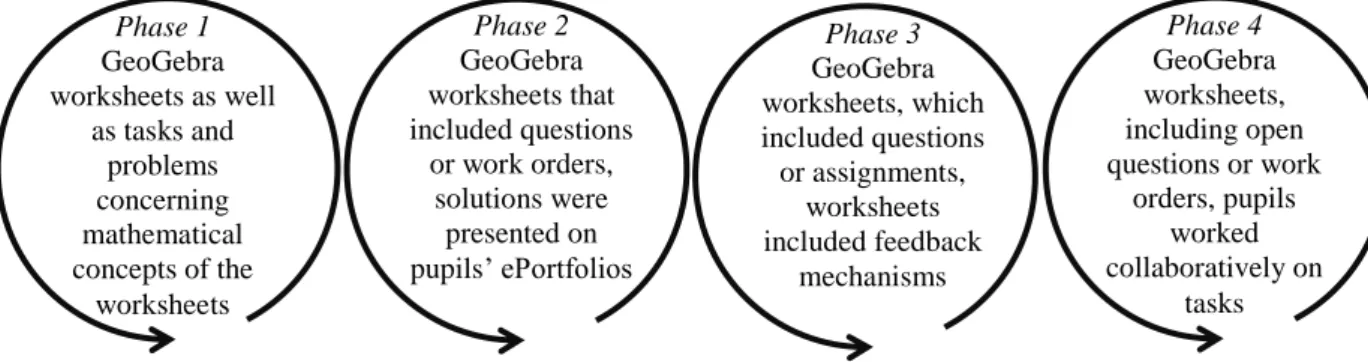
When combining flipped approaches and GeoGebra, feedback from participating teachers and pupils was collected and integrated into teaching and learning designs. Integrating feedback into the designs of our study resulted in a total of four design or application cycles of a synthesis of FA and GeoGebra (see Figure 1). In the later phases of the design cycles, successful elements of the previous design cycles were retained. Retaining successful elements of previous designs means that the new elements of later design cycles represent an extension of earlier designs.
Figure 1. Design-cycles of our educational experiment
Phase 1: The pupils were provided with GeoGebra worksheets on new content. These GeoGebra worksheets were created by the researchers and extended by further GeoGebra worksheets from the GeoGebra homepage. According to the content of the GeoGebra worksheets, pupils had to deal with tasks and solve problems in pre-class phases. These activities were communicated to the pupils with printed worksheets, and the pupils recorded their answers on the printed worksheets.
Phase 2: Pupils were provided with GeoGebra worksheets that included questions or work orders. Pupils used GeoGebra to process these questions and published their answers and justifications on their electronic portfolio page.
Phase 1
GeoGebra worksheets as well
as tasks and problems concerning mathematical concepts of the
worksheets
Phase 4
GeoGebra worksheets, including open questions or work
orders, pupils worked collaboratively on
tasks
Phase 2
GeoGebra worksheets that included questions
or work orders, solutions were
presented on pupils‘ ePortfolios
Phase 3
GeoGebra worksheets, which included questions or assignments,
worksheets included feedback
Phase 3: Pupils were provided with GeoGebra worksheets, which included questions or assignments. In addition, GeoGebra worksheets included the possibility for pupils to check their answers - i.e. GeoGebra indicated whether an answer or solution was correct. The pupils published their answers and justifications but also questions and ambiguities to work assignments on their electronic portfolio page. The pupils were instructed to comment contributions of their classmates and present constructive improvement suggestions.
Phase 4: The pupils were provided with GeoGebra worksheets, including open questions or work orders. The pupils would have to deal with these open questions or work orders in groups of four and document their solution and argumentation in a collaborative online pad.
As it was the first time for the students in our educational study that flipped approaches to mathematics education were combined with using higher-level technologies such as GeoGebra, we selected those mathematical concepts of the curriculum that we considered to be especially suitable for this approach of education. Our educational study focused on functions, vectors and analytical geometry of plane and space, trigonometry, as well as equations and systems of equations. In the treatment of functions, a particular focus was placed on power functions, polynomial functions, exponential functions and trigonometric functions. A strong focus of our educational study on functions can be explained by the assumption that using functions could facilitate mathematical modelling for students. Since students also had a higher degree of freedom in setting learning goals and topics according to the educational approaches in our study, students should also be able to model real-world situations using functions and higher-level technologies such as GeoGebra. According to Vos (2011), modelling real-world phenomena using functions and GeoGebra should lead to more authenticity in mathematics learning. This increased authenticity in mathematics learning in the learning environment of our study should also make it easier for students to link the learning processes with reality, make the learning processes more relevant, and make the learning activities more meaningful to pupils.
Methodologies
To explore design elements essential to pupils when synthesising flipped approaches to education and using higher-level technologies in mathematics education in secondary schools, we have utilised design-based research and grounded theory approaches.
Design-based Research
Potentially relevant design elements when combining flipped approaches and using higher-level technologies in mathematics education at secondary schools were explored in our study in real educational settings. We used design-based research (DBR) approaches in our educational study, as according to Kaenders & Schmidt (2014) and Ruppert & Wörler (2013) real educational settings are too complex to create laboratory conditions and therefore utilising design-based research in such situations could be fruitful. Also, utilising DBR approaches in our educational study should be appropriate, as exploring design elements central to pupils when combining flipped approaches and GeoGebra took place in authentic teaching and learning environments. According to Anderson & Shattuck (2012) and Cobb, Confrey, Disessa, Lehrer, & Schauble (2003), it is these authentic teaching and learning environments and interactions of theory and practice that are characteristic of DBR.
McKenney & Reeves, 2013), this focus on design elements and potential reasons for success or failure of design elements in real educational contexts is a typical characteristic of DBR. In order to better determine the success or failure of design elements in real educational contexts, individual specifics of respective design phases were applied over a more extended time in our educational study. This more prolonged application of respective design phases should facilitate to improve the quality of general assumptions and conclusions from individual design phases (Barab & Squire, 2004; McKenney & Reeves, 2013; Zheng, 2015). According to Zheng (2015), the quality of the results of our study should be further improved by utilising multiple design cycles and performing each design cycle multiple times in two classes. In order to further improve the quality of the results derived from our educational study, we have also analysed the data collected in our study according to grounded theory approaches.
Grounded Theory Approaches
Since our educational study took place in real learning environments and activities of pupils were examined in their familiar learning situations, grounded theory approaches (GTA) should be suitable for analysing our study according to many experts (Charmaz, 2006; Glaser & Strauss, 1999). Furthermore, Glaser & Strauss (1999) and Mey & Mruck (2011) stress that it is characteristic of GTA that social and professional networks, as well as activities of real people in these networks, are investigated. Examining real people‘s activities in their social and professional networks also applies to our study, as schools could be seen as learning and social location for pupils. In order to investigate activities of pupils in their social and professional network, researchers should play an active and sometimes participatory role. According to Breuer, Dieris, & Lettau (2009), it is typical for GTA that researchers play a central role in research processes, and Charmaz (2006) points out that in GTA studies it makes a difference who collects data and which tools are used to collect data. In order to meet the requirements of characteristics of GTA data collection, we have pursued a variety of approaches to data collection in our educational study. On the one hand, data were collected in our study by two different researchers, each with different roles in our study. One researcher was involved in our study both as a teacher and as a researcher who collects data. One purpose of the teaching researcher was to build trust between pupils and the research team, which should improve the quality of pupils‘ feedback. On the other hand, this close involvement of a researcher in our study should enable us to collect data spontaneously and on a case-by-case basis. This spontaneous and event-driven data collection should improve the depth and quality of the data. The second researcher from our study was involved in our study as a neutral researcher who collected data as well. This researcher partially observed the lessons and conducted interviews with pupils of our study. Since pupils knew that the neutral researcher was not involved in any assessment process, and the interviews were conducted anonymously, we assume that this encouraged the pupils to give honest and in-depth answers in the interviews. In addition to individual interviews with pupils, we conducted individual interviews with teachers involved in our study and group interviews with pupils. In the course of our study, we also regularly obtained written feedback from the pupils regarding lesson designs. According to these data collection approaches, we conducted 17 interviews with pupils, 4 interviews with teachers, and 2 group interviews with pupils in our educational study. Furthermore, we collected a total of more than 160 written feedback forms from the pupils in the course of our educational study. Analysing and evaluating the collected data following GTA (see Figure 2 and Table 1) indicates that the following categories could be important for pupils when combining flipped approaches to education and using GeoGebra when learning mathematics: (a) clear task definition and task design, (b) feedback, (c) context and benefits, and (d) single-source learning environments.
Results
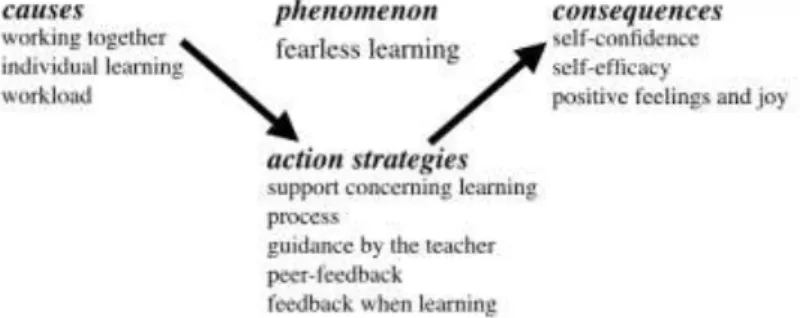
all open codes were provided with descriptions and typical interviewee statements. Next, we compared these 37 codes and supplemented them with our lesson reports and protocols of class observations. By this comparison and completion of the data, the 37 initial codes could be reduced to 21, and at the same time, a higher degree of abstraction of the codes could be achieved (see Table 1, middle column). These 21 codes were raised to a higher level of abstraction by axial coding of all researcher. By using axial coding techniques, the broken-up data should be reconnected, and the overall picture of the data should be restored. In axial encoding, the open codes were linked according to the tripartition causes – action strategies – consequences (see Figure 2). In the axial coding process, the relationship between cause and action strategies and consequences has always been evolved around a phenomenon to be investigated in detail. In this coding process, always another open code of a higher level of abstraction was placed at the centre of the investigation (phenomenon), and other codes of a higher level of abstraction were linked according to this phenomenon. In investigating these correlations, we focused primarily on action strategies.
Figure 2. Example of axial coding of combined open codes
Table 1. Codes of different levels of abstraction and associated categories
Open codes Combined open codes Categories essential for pupils
task task design explanation of tasks time
time > individual
task design
explanation of tasks time management
clear task definition and task design
number of tasks support
support concerning technologies feedback > teachers
feedback > automatic working together individual learning confidence self-confidence self-efficacy teacher as a lecturer no fear
share knowledge
freedom > time management
workload
support concerning learning process
feedback when learning working together individual learning self-confidence self-efficacy
guidance by the teacher fearless learning peer-feedback
feedback
support > mathematics sense of achievement connection to the textbook connection to the curriculum tests
assessments / grades
connection to the school-leaving examination learning aid
learning aid > graphical learning aids > interactive independent work
added value of the approach
positive feelings and joy reusability of knowledge learning assistance advantages during testing/assessments facilitation of learning
context and benefits
learning products orientation store knowledge freedom > tool choice
distribution of learning products how to operate
database of knowledge products user/pupil-friendly operation plainness
By utilising axial coding techniques as described above, initial categories could be developed. Then, we compared and merged these initial categories again. By this comparing and merging of initial categories, we were able to derive 4 categories which are essential for pupils when flipped approaches to mathematics education and GeoGebra are combined (see Table 1, right column): (a) clear task definition and task design, (b) feedback, (c) context and benefits, and (d) single-source learning environments. The relationship between open codes, combined open codes of higher abstraction levels and categories essential for pupils, is presented in Table 1. However, the relationships between open codes and combined open codes as well as between combined open codes and categories essential for pupils should not be interpreted as an unambiguous classification. Instead, these groups (cells of the respective column) and connections of groups (line by line) were developed according to most significant similarities.
Concerning the prioritisation of the significance of the individual categories, a dichotomy could be observed: clear task definition and task design as well as single-source learning environments with slightly less significance and context and benefits as well as feedback with slightly higher significance. This classification of the categories essential for pupils bases on the individual passages in the interview transcripts which correspond to open codes or the combined open codes of the individual categories. As some passages in the text could be assigned to several open codes and at times to several combined open codes, the quantification process followed an approach of the most reliable connection. Using a most reliable connection approach in the quantification process means that the text passage was assigned to the code and consequently to the category to which there was the most reliable connection. The highest number of text passages per category could be found in the category feedback. According to the open coding, 234 text passages could be assigned to this category essential for pupils. A total of 208 text passages could be assigned to the category context and benefits, which is only a slightly lower quantifiable expression of the category context and benefits compared to the category feedback. The categories clear task definition and task design, as well as single-source learning environments, have a significantly lower quantifiable value. There were 127 text passages which could be assigned to the category clear task definition and task design and 82 text passages which could be assigned to the category single-source learning environments.
We translated the quotations of pupils which are characteristic for the respective categories in the section results from German into English. In addition, we added identifiers to the quotes of the students. These identifiers indicate whether it is written feedback [W] or oral feedback [O] from the students. If it is oral feedback, we provide further information concerning gender (f female and m male) and grade (9 9th grade student and 10 10th grade student) of the student, if it is written feedback, we only provide information concerning gender.
Clear Task Definition and Task Design
Since it was typical when synthesising flipped approaches and using GeoGebra that pupils could work and learn autonomously and independently, it was important for pupils that tasks were communicated unambiguously. A clear task communication concerned on the one hand the expected activities and learning products of the pupils and on the other hand the temporal and organisational structuring. Concerning expected activities and learning products, the pupils requested detailed descriptions or the provision of sample solutions or sample learning products.
[O,f,9] It would be good if you knew exactly what you have to do – that you will be told exactly what the result at the end should be.
Concerning the temporal and organisational structuring, pupils wanted a step-by-step and linear approach. A step-by-step and linear approach means that teaching material and learning activities are divided into small portions. These small portions should then be linked to deadlines, and only when a task has been completed a new task should be communicated.
[W,10] The circumstance that there were always several tasks and different deadlines was very confusing. It would be better to do one [task] after the other.
that tasks and learning actions were varied. This desire for variety is reflected in some pupil feedback that mechanical repetition of operations in GeoGebra is fatiguing.
[O,m,10] It was annoying that there were always several GeoGebra tasks on one topic. You always had to do them all, even if you understood it [mathematical concept] after the first task.
Concerning task definition and task design, it was important for the pupils that it was explicit which learning actions and learning products had to be completed in which form and by which date. However, this clear structuring should not lead to a mechanical and repetitive completion of tasks. Overall, our study indicated that it is vital for pupils in individual learning and using higher-level technologies such as GeoGebra that tasks are clearly communicated, and frameworks unambiguously defined. However, information on tasks and learning settings should not only be communicated once but should also be available on-demand to the students.
Feedback
As enhancing flipped approaches to education through utilising GeoGebra typically involved pupils working independently over extended periods and constructing knowledge themselves, feedback was an essential element in our educational study. Feedback and suggestions concerned, on the one hand, technology-supported feedback and self-assessments and, on the other hand, individual feedback from classmates or the teacher. Technology-supported feedback and self-assessments in our educational study mean that, as a first step, pupils have made mathematical assumptions. Then, GeoGebra was used to model this assumption and, based on the results of this modelling, pupils decided whether mathematical assumptions should be retained or discarded.
[W,9] Using GeoGebra has helped me to learn, because you can find out easily if your idea is right or wrong.
Enhancing flipped approaches to education through utilising GeoGebra also means that working and learning were at times more intensive for pupils than teacher-driven approaches. In line with this increase in workload, pupils also expected more feedback on learning products created. This additional feedback could either be peer feedback or verbal or written feedback from the teacher.
[O,m,10]The good thing about the lessons with two teachers was that you could always ask questions and get immediate feedback. So, you did not have to wait long to know how to set GeoGebra to continue.
The data from our study indicated that feedback is central for students when developing mathematical competencies in learning environments based on flipped approaches and using GeoGebra. On the one hand, the feedback was important for students as students could often work and learn alone and feedback from classmates, the teacher or technology applications (automatic feedback) should provide information on whether one is on the right track. This form of feedback should strengthen students' confidence and self-confidence. On the other hand, learning mathematics in learning environments based on flipped approaches and using GeoGebra lead to a higher workload for students. For the students, it was a desire that this increased work effort is reflected in increased and in-depth feedback.
Context and Benefits
Intensive work and learning in a synthesis of flipped approaches of education and GeoGebra made it important for pupils to recognise and benefit from the added value of this intensive educational approach. The most important thing for pupils in recognising the added value of the new educational approach was that the intensive work was also reflected in tests or other formal assessments. Recognising the intensive work in tests or assessments means, on the one hand, that pupils expect that the intensive work could be turned into good grades.
[O,f,9] He [teacher] has already said that working with GeoGebra is included in the grading process, but I do not know exactly how that happens.
work in learning processes in formal assessments means that the technological skills learned should also be used in examinations. A benefit of learned technological skills in exams means for pupils that GeoGebra is not only used in learning but that GeoGebra may also be used in assessments.
[O,m,10] I mean, yes, learning was facilitated by using GeoGebra. But it would also be good if you could use it for tests.
The feedback from pupils indicated that pupils are expected to have a similar or the same learning environment and examination environment. If the learning environment and the examination environment are similar or the same, it could be easier for pupils to recognise the added value of technology-enhanced learning environments over traditional learning environments.
Single-source Learning Environments
When pupils learn mathematics in technology-enhanced learning environments, it is likely that different software products are best suited for different learning activities. Although different software products each have strengths and weaknesses, the feedback from the pupils in our study indicated that pupils would prefer a single-source approach. A single-source approach means that pupils do not want to switch between different software products in a learning process. On the one hand, pupils complained that they had to switch between different software products when creating learning products and presenting learning products.
[O,f,9] It was troublesome that one received the work orders, that one had to solve them [work orders] with GeoGebra and then give them to Mahara. I first had to copy the tasks into Word in order to make it work. That’s really laborious.
On the other hand, the pupils also wanted to be able to receive tasks and process tasks using one software package. Reducing tools for communicating and working should simplify learning processes and avoid unnecessary confusion according to pupil feedback.
[O,m,9] You always had to switch between Mahara and GeoGebra – so you can forget something [tasks] – he [teacher] should improve that.
Similar to the two points above was the feedback of the pupils concerning feedback possibilities or prototypical solutions of tasks. In this context, the pupils wanted one tool to cover the problem or task definition, the processing of the task, and any prototypical solution of a task.
[W,10] You do not know if you have got it [task] right until you get the solution. This can unsettle you when learning if you do not know if it [your solution] is right. Cannot GeoGebra show if it is correct?
Although combining flipped learning approaches and GeoGebra could provide more learning opportunities for pupils, pupil feedback indicated that even in technology-enhanced learning environments, the more the number of tools used, the harder it is. According to pupil feedback, there should be a lead tool in technology-enhanced learning environments that should also represent a common thread for pupils.
Discussion and Conclusions
Our explorative educational study aimed to explore how to design pupil-driven and technology-enhanced mathematics learning environments to facilitate hands-on learning. A pupil-driven and technology-enhanced learning environment was developed in our study by combining flipped approaches to mathematics education and using GeoGebra. Analysing the data collected using the learning environment described above indicated that categories (a) clear task definition and task design, (b) feedback, (c) context and benefits, and (d) single-source learning environments could be central for students.
unambiguous task communication. Therefore, it could be beneficial that learning frameworks are clearly defined by teachers when synthesising flipped approaches and GeoGebra. However, within these clearly defined learning frameworks, pupils should be given the highest possible freedom. This freedom should facilitate hands-on learning for pupils. Independent learning when combining flipped approaches and GeoGebra should also not happen ad hoc following pupils‘ feedback. According to pupils‘ feedback, it could be concluded that pupils would prefer a slow process leading to this independent learning approach. This slow introduction to independent learning and working is similar to the micro flip (García-Peñalvo, Fidalgo-Blanco, Sein-Echaluce, & Conde, 2016), but such an approach could be even more necessary with a GeoGebra-extended flipped approach than with first using classical flipped education.
In our educational study, it became apparent that when combining flipped approaches and GeoGebra, feedback could be an essential element of instructional designs for pupils. This feedback could be given both technologically and personally. According to Lehmann, Oeste, Janson, Söllner, & Leimeister (2015), learning materials such as quizzes or questions could also be used as feedback tools for pupils in education following flipped approaches. García-Peñalvo et al. (2016) add that teachers could also utilise these feedback tools for control purposes. The new aspect of our study is that GeoGebra could enable pupils to acquire knowledge independently and verify this knowledge independently as well. Therefore, combining flipped approaches and GeoGebra could lead to learning environments that enable learning and feedback in an autonomous and individualised way. However, following pupils‘ feedback in our study, pupils want not only technology-based feedback but also personal feedback. This personal feedback concerns both mathematical learning outcomes and technologically produced learning products. This pupils‘ need for accompanying and final feedback from teachers comes very close to teachers‘ roles as coaches or guides in classrooms according to Butt (2014) and Lemmer (2013).
Although learning in a synthesis of flipped approaches and GeoGebra could be described as pupil-driven and pupils‘ interests should be central when learning mathematics following this approach, it is still school learning. One characteristic of school learning is that learning processes and learning outcomes are graded. According to Häcker (2011), if learning processes and learning outcomes are not graded, there is a danger that pupils and their parents will attribute little importance to these learning processes and learning outcomes. This finding of the importance of performance assessment was also reflected in pupils‘ feedback of our study. Although learning in a synthesis of flipped approaches and GeoGebra was often described by pupils as positive and enjoyable, it was also crucial for the pupils to recognise how the extra work in this approach could be transformed into good grades.
Both modern flipped classroom education and teaching following flipped learning approaches are often based on a diverse mix of technologies. In flipped classroom learning environments it is often videos (e.g. García-Peñalvo, Fidalgo-Blanco, Sein-Echaluce, & Conde, 2016; Muir & Geiger, 2016), e-books (Enfield, 2016), quizzes and (multiple choice) questions (García-Peñalvo et al, 2016; Lehmann, Oeste, Janson, Söllner, & Leimeister, 2015), or tasks (Morin, Kecskemety, & Harper, 2013) which should support pupils and teachers. One pillar of flipped learning education is a flexible environment (Flipped Learning Network, 2014), which would also include modern technologies in the 21st century. Looking at flipped education from a technological perspective, it could be beneficial to use a variety of modern tools and software packages. This variety of modern technologies should be used to create and distribute videos, develop digital multiple-choice questions or integrate sophisticated learning activities into education. However, our study indicated that pupils do not want a diverse mix of technologies when learning mathematics, but that the number of tools used should be kept to a minimum. A small number of technologies should have positive impacts on the structure of learning environments and thus should facilitate pupils‘ orientation when learning.
Recommendations for Education and Further Research
Investigating combinations of flipped approaches and GeoGebra in mathematics education in a secondary school indicated that (a) clear task definition and task design, (b) feedback, (c) context and benefits, and (d) single-source learning environments would be relevant for pupils. What was interesting about our research was that when flipped approaches and GeoGebra are synthesised in mathematics lessons, both needs for structure and specifications, and pupils‘ freedom in learning are appreciated. From these partly contradictory pupil requirements, it could be deduced that teachers should clearly define organisational structures. Within these clearly defined boundaries, pupils should be given a high level of freedom in learning and discovering mathematics. Equally of note was that feedback on learning processes was still vital for independent learning. This desire for feedback or means to check learning success was very diverse according to pupils‘ feedback.
On the one hand, pupils appreciated that GeoGebra could be used to model and verify mathematical assumptions. On the other hand, in independent learning processes when synthesising flipped approaches and GeoGebra, there was a clear desire among pupils for personal feedback. Hence, for everyday applications of GeoGebra-extended flipped education, integrating various feedback possibilities into learning settings could be beneficial. These feedback possibilities should consist of automatic feedback on the one hand and personal feedback on the other.
Although it was typical for combining flipped approaches and GeoGebra in mathematics classes that pupils were able to deal with individually selected questions, the cui bono question was vital for most pupils. Cui bono or what is the point for the individual pupil if pupils invest more time and effort in mathematics learning in a learning environment based on flipped approaches and GeoGebra means that pupils want to recognise their learning investments in formal assessments and grades. To transfer time and effort invested in mathematics learning in a learning environment based on flipped approaches and GeoGebra into formal assessments means that pupils want to be tested under the same conditions under which knowledge is gathered and competencies are acquired. If testing and learning conditions are not the same or similar, it could be challenging to motivate pupils to invest more time and effort in learning in a GeoGebra-enhanced flipped environment. Similarly, the extra time and effort required to combine flipped approaches and GeoGebra should be transferred directly into assessment processes.
Our current study on combining flipped approaches and GeoGebra in mathematics education focused on pupils‘ needs. In further research steps, research perspectives regarding GeoGebra-extended flipped environment should be extended to teacher needs and how to train teachers for such approaches. Teachers should be more heavily engaged in the focus of future studies. To avoid GeoGebra-expanded flipped environments from degenerating into only theoretical educational innovations, it could be important that teachers are motivated and trained for this educational approach. Furthermore, the technological and pedagogical approach of our study could be expanded. Expanding technological and pedagogical approaches could mean that flipped learning approaches could be used in a more extensive way and new GeoGebra applications, such as virtual realities, integrated into pupil-driven learning settings.
Limitations and Acknowledgment
As the research of our explorative educational study was conducted in a Viennese inner-city secondary school, it could be assumed that the majority of the participating pupils and their parents have a high socioeconomic status and that education is of great importance in these families. This high socioeconomic status and the high significance of education could be explained by the circumstance that Vienna's inner city is one of the most expensive residential areas in Austria and that the proximity of students to the school has the highest priority in the admission processes in secondary schools in Austria. The potentially high socioeconomic status of the pupils in our study and the high importance of education in the families of the pupils should have a positive effect on the availability of technologies both in and out of schools and on pupils' familiarity with using the technologies. The high importance of education in the families of pupils could also have a positive effect on pupils' willingness to learn and their ability to work and learn independently. In further research and in verifying the results of our explorative study, those schools should also be included which do not provide such an optimal framework for combining flipped approaches to mathematics education with using GeoGebra.
References
Anderson, T., & Shattuck, J. (2012). Design-Based Research. Educational Researcher, 41, 16–25.
Barab, S., & Squire, K. (2004). Design-Based Research: Putting a Stake in the Ground. Journal of the Learning Sciences, 13(1), 1–14. https://doi.org/10.1207/s15327809jls1301_1
Breuer, F., Dieris, B., & Lettau, A. (2009). Reflexive Grounded Theory: Eine Einführung für die Forschungspraxis (2009th ed.). Wiesbaden: VS Verlag für Sozialwissenschaften.
Butt, A. (2014). Student views on the use of a flipped classroom approach: Evidence from Australia. Business Education & Accreditation, 6(1), 33–43.
Charmaz, K. (2006). Constructing Grounded Theory: A Practical Guide through Qualitative Analysis (1 edition). London ; Thousand Oaks, Calif: SAGE Publications Ltd.
Choi, E. M. (2013). Applying inverted classroom to software engineering education. International Journal of E-Education, e-Business, e-Management and e-Learning, 3(2), 121.
Clarke, T., Ayres, P., & Sweller, J. (2005). The impact of sequencing and prior knowledge on learning mathematics through spreadsheet applications. Educational Technology Research and Development, 53(3), 15–24. https://doi.org/10.1007/BF02504794
Cobb, P., Confrey, J., Disessa, A., Lehrer, R., & Schauble, L. (2003). Design Experiments in Educational Research. Educational Researcher, 32, 9–13.
Enfield, J. (2016). The Value of Using an E-Text in a Flipped Course. TechTrends, 60(5), 449–455. https://doi.org/10.1007/s11528-016-0100-1
Esperanza, P., Fabian, K., & Toto, C. (2016). Flipped Classroom Model: Effects on Performance, Attitudes and Perceptions in High School Algebra. In K. Verbert, M. Sharples, & T. Klobučar (Eds.), Adaptive and Adaptable Learning: 11th European Conference on Technology Enhanced Learning, EC-TEL 2016, Lyon, France, September 13-16, 2016, Proceedings (pp. 85–97). Retrieved from http://dx.doi.org/10.1007/978-3-319-45153-4_7
Euler, D. (2001). Manche lernen es-aber warum. Zeitschrift Für Berufs-Und Wirtschaftspädagogik, 97(3), 346– 374.
Ferchhoff, W. (2007). Jugend und Jugendkulturen im 21. Jahrhundert—Lebensformen und Lebensstile. Wiesbaden.
García-Peñalvo, F. J., Fidalgo-Blanco, Á., Sein-Echaluce, M. L., & Conde, M. Á. (2016). Cooperative Micro Flip Teaching. In P. Zaphiris & A. Ioannou (Eds.), Learning and Collaboration Technologies: Third International Conference, LCT 2016, Held as Part of HCI International 2016, Toronto, ON, Canada, July 17-22, 2016, Proceedings (pp. 14–24). Retrieved from http://dx.doi.org/10.1007/978-3-319-39483-1_2 Glaser, B. G., & Strauss, A. L. (1999). Discovery of Grounded Theory: Strategies for Qualitative Research.
New Brunswick: AldineTransaction.
González-Gómez, D., Jeong, J. S., Airado Rodríguez, D., & Cañada-Cañada, F. (2016). Performance and Perception in the Flipped Learning Model: An Initial Approach to Evaluate the Effectiveness of a New Teaching Methodology in a General Science Classroom. Journal of Science Education and Technology, 25(3), 450–459. https://doi.org/10.1007/s10956-016-9605-9
Gräsel, C., Bruhn, J., Mandl, H., & Fischer, F. (1997). Lernen mit Computernetzen aus konstruktivistischer Perspektive. Unterrichtswissenschaft, 25, 4–18.
Häcker, Th. (2011). Portfolioarbeit—Ein Konzept zur Wiedergewinnung der Leistungsbeurteilung für die pädagogische Aufgabe der Schule. In Sacher, W., Winter, F. (Hrsg.): Diagnose und Beurteilung von Schülerleistungen—Grundlagen und Reformansätze. Baltmannsweiler.
Hakkarainen, P. (2009). Designing and implementing a PBL course on educational digital video production: Lessons learned from a design-based research. Educational Technology Research and Development, 57(2), 211–228. https://doi.org/10.1007/s11423-007-9039-4
Iriarte, X., Aginaga, J., & Ros, J. (2014). Teaching Mechanism and Machine Theory with GeoGebra. In J. C. García-Prada & C. Castejón (Eds.), New Trends in Educational Activity in the Field of Mechanism and Machine Theory (pp. 211–219). Springer International Publishing.
Kaenders, R., & Schmidt, R. (2014). Zu einem tieferen Mathematikverständnis. In Mit GeoGebra mehr Mathematik verstehen (pp. 1–11). Springer.
Kim, P., Suh, E., & Song, D. (2015). Development of a design-based learning curriculum through design-based research for a technology-enabled science classroom. Educational Technology Research and Development, 63(4), 575–602. https://doi.org/10.1007/s11423-015-9376-7
Lee, J., Lim, C., & Kim, H. (2017). Development of an instructional design model for flipped learning in higher education. Educational Technology Research and Development, 65(2), 427–453. https://doi.org/10.1007/s11423-016-9502-1
Lehmann, K., Oeste, S., Janson, A., Söllner, M., & Leimeister, J. M. (2015). Flipping the Classroom – IT-unterstützte Lerneraktivierung zur Verbesserung des Lernerfolges einer universitären Massenlehrveranstaltung. HMD Praxis Der Wirtschaftsinformatik, 52(1), 81–95. https://doi.org/10.1365/s40702-014-0102-4
Lemmer, C. A. (2013). A View from the Flip Side: Using the Inverted Classroom to Enhance the Legal Information Literacy of the International LL. M. Student, A. Law Libr. J., 105, 461–491.
McKenney, S., & Reeves, T. C. (2013). Systematic Review of Design-Based Research Progress. Educational Researcher, 42(2), 97–100. https://doi.org/10.3102/0013189X12463781
McNally, B., Chipperfield, J., Dorsett, P., Del Fabbro, L., Frommolt, V., Goetz, S., … Rung, A. (2016). Flipped classroom experiences: Student preferences and flip strategy in a higher education context. Higher Education, 1–18. https://doi.org/10.1007/s10734-016-0014-z
Mey, G., & Mruck, K. (2011). Grounded Theory Reader (2nd ed.). Wiesbaden: VS Verlag für Sozialwissenschaften.
Morin, M. B., Kecskemety, K. M., & Harper, K. A. (2013). The inverted classroom in a first-year engineering course. 120th ASEE Annual Conference & Exposition, Paper ID #7230. Retrieved from https://peer.asee.org/the-inverted-classroom-in-a-first-year-engineering-course.pdf
Muir, T., & Geiger, V. (2016). The affordances of using a flipped classroom approach in the teaching of mathematics: A case study of a grade 10 mathematics class. Mathematics Education Research Journal, 28(1), 149–171. https://doi.org/10.1007/s13394-015-0165-8
O‘Flaherty, J., & Phillips, C. (2015). The use of flipped classrooms in higher education: A scoping review. The Internet and Higher Education, 25, 85–95.
Olsson, J. (2019). Relations Between Task Design and Students‘ Utilization of GeoGebra. Digital Experiences in Mathematics Education. https://doi.org/10.1007/s40751-019-00051-6
Reinmann, G. (2005). Innovation ohne Forschung? Ein Plädoyer für den Design-Based Research-Ansatz in der Lehr-Lernforschung. Unterrichtswissenschaft, 33(1), 52–69.
Ritchie, S. (2012). Incubating and Sustaining: How Teacher Networks Enable and Support Social Justice Education. Journal of Teacher Education, 63(2), 120–131. https://doi.org/10.1177/0022487111428327 Ruppert, M., & Wörler, J. (2013). Technologien im Mathematikunterricht: Eine Sammlung von Trends und
Ideen. Wiesbaden.
Tague, J., & Czocher, J. (2016). A Theoretical Approach to Ensuring Instructional and Curricular Coherence in the Flipped Classroom Model of a Differential Equations Course. International Journal of Research in Undergraduate Mathematics Education, 2(2), 223–245. https://doi.org/10.1007/s40753-016-0028-z Tracey, M. W., & Unger, K. L. (2012). A design-based research case study documenting a constructivist ID
process and instructional solution for a cross-cultural workforce. Instructional Science, 40(3), 461–476. https://doi.org/10.1007/s11251-011-9184-3
Vos, P. (2011). What Is ‗Authentic‘ in the Teaching and Learning of Mathematical Modelling? In G. Kaiser, W. Blum, R. Borromeo Ferri, & G. Stillman (Eds.), Trends in Teaching and Learning of Mathematical Modelling (pp. 713–722). Springer Netherlands.
Wang, F., & Hannafin, M. J. (2005). Design-based research and technology-enhanced learning environments. Educational Technology Research and Development, 53(4), 5–23. https://doi.org/10.1007/BF02504682 Wasserman, N. H., Quint, C., Norris, S. A., & Carr, T. (2015). Exploring Flipped Classroom Instruction in
Calculus III. International Journal of Science and Mathematics Education, 1–24. https://doi.org/10.1007/s10763-015-9704-8
Webb, M. E., Prasse, D., Phillips, M., Kadijevich, D. M., Angeli, C., Strijker, A., … Laugesen, H. (2018). Challenges for IT-Enabled Formative Assessment of Complex 21st Century Skills. Technology, Knowledge and Learning, 23(3), 441–456. https://doi.org/10.1007/s10758-018-9379-7
Weidlich, J., & Spannagel, C. (2014). Die Vorbereitungsphase im Flipped Classroom. Vorlesungsvideos versus Aufgaben—Sowiport. In Rummler, Klaus (Hrsg.), Lernräume gestalten—Bildungskontexte vielfältig denken. (Pp. 237-248). Münster u.a.. Retrieved 2016-11-06, from urn:nbn:de:0111-pedocs-101054. (pp. 237–248). Retrieved from http://sowiport.gesis.org/search/id/fis-bildung-1056293
Zengin, Y. (2018). Examination of the constructed dynamic bridge between the concepts of differential and derivative with the integration of GeoGebra and the ACODESA method. Educational Studies in Mathematics, 99(3), 311–333. https://doi.org/10.1007/s10649-018-9832-5
Zulnaidi, H., Oktavika, E., & Hidayat, R. (2019). Effect of use of GeoGebra on achievement of high school mathematics students. Education and Information Technologies. https://doi.org/10.1007/s10639-019-09899-y
Author Information
Robert Weinhandl
Johannes Kepler University Altenberger Straße 54, 4040 Linz Austria
Contact e-mail: [email protected]
Zsolt Lavicza
Johannes Kepler University Altenberger Straße 54, 4040 Linz Austria
Markus Hohenwarter
Johannes Kepler University Altenberger Straße 54, 4040 Linz Austria
Stefanie Schallert