ISSN: 2147-611X
Examination of Laboratory Perceptions
of Pre-Service Science Teachers with
Different Goal Orientations on
Inquiry-Based Analytical Chemistry Courses: A
Case Study
Burak Feyzioglu
Aydın Adnan Menderes University
To cite this article:
Feyzioglu, B. (2019). Examination of laboratory perceptions of pre-service science teachers
with different goal orientations on inquiry-based analytical chemistry courses: A case study.
International Journal of Education in Mathematics, Science and Technology (IJEMST), 7
(3),
281-310.
This article may be used for research, teaching, and private study purposes.
Any substantial or systematic reproduction, redistribution, reselling, loan, sub-licensing,
systematic supply, or distribution in any form to anyone is expressly forbidden.
Authors alone are responsible for the contents of their articles. The journal owns the
copyright of the articles.
Volume 7, Number 3, 2019 ISSN: 2147-611X
Examination of Laboratory Perceptions of Pre-Service Science Teachers
with Different Goal Orientations on Inquiry-Based Analytical Chemistry
Courses: A Case Study
Burak Feyzioglu
Article Info
Abstract
Article HistoryReceived: 26 January 2019
In this research, the laboratory perceptions of pre-service science teachers with different goal orientations in analytical chemistry courses in which an inquiry-based laboratory approach had been adopted were examined in a case study. From the interviews conducted with 37 service science teachers, 3 pre-service science teachers with different goal orientations were identified using the purposive criterion sampling method. The pre-service science teachers‘ laboratory perceptions and goal orientations were monitored for a period of 11 weeks and this process was implemented via reflective diaries, experiment reports and interviews. At the end of the research, the perceptions of the laboratory among the pre-service science teachers whose initial goal orientation had been avoidance of performance remained as confirmation and deductive during the 11 weeks. This fact notwithstanding, a change did occur in the laboratory perceptions of pre-service science teachers who had adopted a performance and mastery approach during the inquiry process. It was determined that during the inquiry process, the pre-service science teachers‘ perceptions of the laboratory were shaped by their goal orientations. This was discussed together with the underlying reasons in terms of the open-endedness and integration dimensions of laboratory perceptions.
Accepted: 02 June 2019
Keywords
Goal orientation, Perceptions of the laboratory, Pre-service science teachers,
Inquiry-based learning environment.
Introduction
In many countries, science programs have been reformed in line with inquiry-based learning goals (Abd-El-Khalick, Boujaoude, Duschl, Lederman, Mamlok-Naaman, Hofstein, Niaz, Treagust & Tuan, 2004). In science classes in which this approach is adopted, students are taught science concepts (Hadson, 1996), the science process itself, and the nature of scientific inquiry (Strippel & Sommer, 2015). In an inquiry-based learning environment, students are expected to focus on searching for answers to questions regarding the natural world (Roberts & Bybee, 2014), on hypothesizing, testing these hypotheses and interpreting the results (Osborne, Collins, Ratcliffe, Millar and Duschl, 2003). Research carried out with respect to laboratory activities also shows that students cannot adequately utilize these activities (Novak, 1988). It is observed that this is because the student‘s focus is rather on performing the experiment correctly (Hart, Mulhall, Berry, Loughran and Gunstone, 2000) and on verifying the knowledge presented in textbooks or in lectures (Watson, Prieto and Dillon 1995). Students‘ perceptions of laboratory practices are decisive in their focus on laboratory practice and they are expected to develop with the inquiry-based learning environment. However, the same amount of development may not be gained by each student, because students‘ interaction level with this environment varies. Their goal orientation is an indicator of this variation in the interaction level. Therefore, the perception of students differs with respect to their goal orientations. In this study, the laboratory perceptions of pre-service science teachers with different goal orientations were examined in an inquiry-based learning environment for 11 weeks. The difference in the development of their perceptions in this environment was explained by their goal orientations.
The Inquiry-Based Learning Environment and Perceptions of the Laboratory (Open-Endedness and Integration)
are asked and answers to these questions are explored consistently and cyclically (Osborne, Collins, Ratcliffe, Millar and Duschl, 2003). A student involved in this environment experiences in exactly the same way the process that scientists go through with the aim of searching for answers to questions regarding the natural world (Roberts and Bybee, 2014). This student tests hypothesizes, solves a problem and interprets the results. S/he is aware that each scientist utilizes different methods as required by the nature of scientific inquiry, and sees in this environment that the same results are reached through different methods (Erten, Kiray, & Sen-Gumus, 2013; Lederman, Lederman, Bartos, Bartels, Meyer, & Schwartz, 2014). S/he experiences the effects of different experiences, socio-cultural structures and creativeness (Osborne, Collins, Ratcliffe, Millar and Duschl, 2003) upon the development of scientific knowledge (Sandoval, 2005). S/he realizes that scientists recognize that making observations and measurements are core elements of scientific research (Osborne, Collins, Ratcliffe, Millar and Duschl, 2003).
Inquiry levels in all learning environments cannot be expected to be at the same level. The ‗inquiry level‘ refers to the level at which students use inquiry skills during a course. In addition, the laboratory approach adopted (laboratory approach for integration) (Domin, 1999) and the characteristics of the inquiry level (Buck, Bretz and Towns, 2008) provide information about the inquiry level of the lesson. All these characteristics of a learning environment play a determinative role in pre-service science teachers‘ perceptions of the inquiry-based laboratory approach.
Laboratory experiments have been classified as Confirmation, Structured Inquiry, Guided Inquiry, Open Inquiry and Authentic Inquiry according to their inquiry levels (Buck, Bretz and Towns, 2008). Whereas the path to be followed and the result are provided to the students at the level of the Confirmatory type of experiment, the result of the experiment is not provided at the level of Structured Inquiry. While the problem, method and purpose of the experiment are provided at the level of Guided Inquiry, only the problem case is provided to the students and they are expected to use the other skills at the level of Open Inquiry. At the level of Authentic Inquiry, students are occupied with the problems they have brought to the classroom and construct the other processes themselves. As the Confirmation level proceeds to the Authentic Inquiry level, the number of inquiry skill types used by the students increases, and they also use their high-level thinking skills more (Table 1).
Table 1. Inquiry levels in laboratory education (Buck, Bretz and Towns, 2008)
Inquiry level Problem Method and
Purpose
Analysis of the
Results Result
Confirmation Provided Provided Provided Provided
Structured inquiry Provided Provided Provided Not provided Guided inquiry Provided Provided Not provided Not provided Open inquiry Provided Not provided Not provided Not provided Authentic inquiry Not provided Not provided Not provided Not provided
The deductive approach is used in laboratory applications if it is aimed to reinforce or prove the subjects described in the course. On the other hand, the inductive approach is used if it is aimed to create a theoretical framework with experiments (Table 2). When compared to the inductive approach, it is possible to say that inquiry is at a lower level in the deductive approach. This is because in the deductive approach, the result of the experiment is already obvious prior to the experiment. The students are not expected to use their high-level thinking skills (Domin, 1999).
Table 2. Laboratory approach (Domin, 1999)
Type of approach Theoretical knowledge prior to the experiment
Deductive Provided
Inductive Not provided
research, the pre-service science teachers‘ perceptions of laboratory practices were examined in terms of the dimensions of Open-endedness and Integration set forth by Moos and Trickett (1987). Open-endedness is related to the degree to which each student is able to carry out different experiments in a laboratory environment whenever desired, and Integration is related to the degree to which activities done in a laboratory are integrated with the course subjects (Moos and Trickett, 1987).
Studies on the Perceptions of the Chemistry Laboratory
Many studies have been conducted in recent years on perceptions regarding the laboratory and most of these are works of quantitative research. The present study aimed at determining teachers‘ and students‘ perceptions of the laboratory, defining the factors that influence their perceptions, establishing models that associate perceptions with variables, and determining differences in perceptions. Burrows, Nowak and Mooring (2017) determined 8 different kinds of perception (Independent, Socialite, Explorer, Mastery, Skill Developer, Detail-Oriented, Timesaver and Apathetic) using some semi-structured questions in a project-based organic chemistry laboratory. They classified these perceptions according to their levels of difficulty. Henderson, Fisher and Fraser (2000) reported that when laboratory experiments are associated with theoretical lessons, Australian students‘ perceptions of the laboratory changed in a positive way. Lang, Wong and Fraser (2005) asserted that when laboratory experiments are associated with theoretical lessons and there are specific rules in the laboratory environment, Singaporean students‘ perceptions of the general chemistry laboratory environment were positively affected. However, these studies focused only on detecting whether or not there was a relationship between theoretical knowledge and laboratory experiments. The direction of this relationship was not queried. When the matter of inquiry-based learning is considered, it is useful to determine how the laboratory environment is perceived since the relationship between laboratory experiments and theoretical knowledge provides us with information about the inquiry level in the laboratory. Conducting experiments after a lecture may lead the students into forming a perception regarding reinforcing their knowledge, and repeating the experiments and discussing related topics. In addition, explaining the concepts involved in an experiment after its performance creates a perception about exploring and constructing the knowledge attained.
Domin (2007), Aydoğdu (2017) and Eymur (2018) associated students‘ perceptions of the laboratory with the methods used in a laboratory. Whereas some students indicated that the active learning approach had more of an effect on their learning and positively affected students' perceptions of the laboratory, some indicated that the traditional approach was more effective in terms of learning. Although these studies show that methods have a generally positive impact on students‘ perceptions of the laboratory, they do not sufficiently explain this impact. It is difficult to determine why and how perceptions are affected through only quantitative research (Nakhleh, Polles and Malina, 2003; Burrows, Nowak and Mooring, 2017). Although quantitative research can identify effects, it is inadequate in explaining how these effects occur. In this research, students‘ perceptions were examined in terms of the dimensions of Open-endedness and Integration through the use of qualitative tools. In this research, the pre-service science teachers‘ perceptions of the laboratory were examined, because there are limited studies on the laboratory perceptions of pre-service science teachers in the literature. The research in the literature on the topic of how the laboratory is perceived is predominantly based on the laboratory perceptions of students and teachers. On the other hand, determining how pre-teachers perceive the laboratory is as important a matter to be discovered since a pre-service science teacher‘s perception of the laboratory has a significant effect upon the choice of teaching methods s/he uses in his/her own professional life (Nuangchalerm and Prachagool, 2010). The perceptions of laboratory practices of pre-service science teachers are shaped by previous or current learning roles (Duru, 2006) and by the content of teacher education programs (Tatar, Yıldız Feyzioğlu, Buldur and Akpınar, 2012). The roles pre-service science teachers play in the laboratory environment, the time they spend in these roles and their levels of achievement can all shape their perceptions (Doyle, 1997; Tatar et al., 2012).
environment. With the inquiry-based laboratory approach, students realize their responsibilities in the laboratory environment if they can bring the problem to the laboratory environment themselves, think about solutions for the problem, and experience these by suggesting solutions. In addition, by making observations after choosing the appropriate tools, organizing and interpreting all the data, and achieving the solution, they can both perceive the responsibilities of and also work as scientists.
In an inquiry-based laboratory environment, it cannot be expected that each student will take on the same responsibilities and experience the learning environment at the same level. The differences between responsibilities and experiences also cause differences in how the laboratory is perceived. Another point that has not been covered sufficiently in the literature and requires to be discussed is the reason why each student does not experience and take responsibility at the same level in a learning environment. Answering this question will also indicate why there are differences between students‘ laboratory perceptions. Taking on responsibilities and experiencing at different levels can be explained with many variables (beliefs and knowledge about the nature of inquiry, beliefs about teaching and learning, etc.). In this research, these differences are explained by achievement goal orientation. It is thought that there is a strong relationship between laboratory perception and achievement goal orientation (Church, Elliot and Gable, 2001).
There are many studies in the literature in which students‘ perceptions of the laboratory have been analyzed through the dimensions of open-endedness and integration. However, these quantitative studies do not sufficiently explain the reasons for different perceptions of the laboratory. In addition, they do sufficiently point out the association between perceptions, inquiry-based learning, and goal orientation.
The Reason for the Differences in Pre-Service Science Teachers’ Perceptions of the Laboratory: Goal Orientation
In an inquiry-based learning environment, it is not expected that every pre-service science teacher‘s perception of the laboratory environment will develop in the same way, since their aims and efforts before they come to the learning environment may be different from one another. Achievement goal orientation refers to why and how individuals work to achieve the goals they set out to attain, rather than which goals they strive for to be successful. This orientation is the main factor that ensures that individuals are motivated enough to be successful (Lewis, 2018). Linnenbrink and Pintrich (2002) have explained goal orientation in terms of the dimensions of Mastery goal, Performance approach and Avoidance of Performance approach. Other researchers have analyzed it as Mastery goal, Mastery goal approach and Avoidance of Mastery goal (Jagacinski and Duda, 2001).
In the mastery goal approach, the student focuses on learning, understanding and on the task itself. For his/her development, s/he uses the standards and the process, and tries to understand the subject/task thoroughly. In the avoidance of mastery goal approach, the student may avoid making a mistake although s/he focuses on his/her own learning. In the performance approach, the student focuses on being superior, being the best and the cleverest student among the others, and being the best in comparison to others when performing the task. In the avoidance of performance approach, the student avoids being seen like a miserable and foolish person, getting the lowest mark, and being the most underperforming student of the class. Students with an avoidance of mastery goal focus on their own learning. However, students who adopt the avoidance of performance approach are interested in what others say.
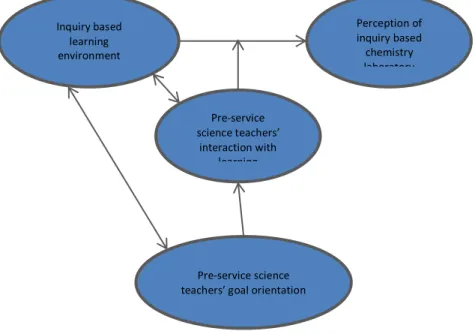
Figure I. Theoretical framework of students‘ perception of the laboratory and goal orientation
For a pre-service science teacher whose goal is to be the most successful student in a class or group and to obtain the best grade, his/her relationships with peers are based on competition (Schunk, 1996). It is even possible that this pre-service science teacher who wants to be the best in the class acts unethically and changes the results of experiments that diverge from expected results (performance approach). Moreover, pre-service science teachers who have a low level of perception in terms of open-endedness and integration also participate in the learning environment at a low level. These students determine and memorize the knowledge they consider to be important, and focus on memorizing important details, rather than adopting a holistic view (Marton and Saljo, 1976). In a laboratory environment, it is expected that pre-service science teachers who possess a surface learning strategy will also approach the problem superficially. After some time, the surface approach restrains active participation in determining and solving the problem. In this case, the pre-service science teacher prefers the experiments that lead to the correct result. For those pre-service science teachers who do not participate in the lessons actively, they do not need to make an effort to design an experiment (PO). They are not able to relate to the practices with theoretical knowledge, and surface strategies direct the students to adopt the confirmation approach (PI).
However, pre-service science teachers with an in-depth approach to searching for and formulating a meaning at the basis of their research (mastery goal orientation) participate in the learning environment more actively and establish more positive relationships with the other students. These pre-service science teachers have a high level of laboratory perception. It is expected that the process of adaptation to the inquiry-based learning environment of these pre-service science teachers will be faster than that of those who have a low level of perception, because these pre-service science teachers exhibit a more qualified participation in the inquiry-based learning environment. These pre-service science teachers do not participate in the inquiry-based learning environment with the purpose of asserting themselves and they are not anxious about having their deficiencies noticed by their teacher or peers. They focus on conceptual change, enhancement of inquiry skills and the solution to the problem. They therefore address laboratory experiments and theoretical knowledge as a whole, not separately (MI). They use the theoretical knowledge they have obtained with the aim of solving the problem, associating this with previous concepts and exploring new knowledge. They attain theoretical knowledge through different paths. For these pre-service science teachers, there is not only one source of knowledge. Experiment results, course books, teachers and the Internet are sources that generate knowledge. They can thus collect knowledge through different paths and reach a synthesis (MO).
Importance of This Study and Research Question
Pre-service science teachers‘ education life before or during their university education has a significant influence on developing their perceptions of the laboratory environment in a desired way. Tillema (1998) has stated that interaction with the learning and teaching environment plays a significant role in forming beliefs. He has also indicated that a long time period is needed for a change in beliefs, and that beliefs change gradually. Also, a perception of the laboratory in accord with this approach is required to be formed for a pre-service science teacher expected to perceive the implementation of a program that is grounded on the inquiry-based approach. This perception can be acquired only by gaining an active role in a learning environment where inquiry exists. In this way, a pre-service science teacher studying in a learning environment where inquiry exists is able to recognize the process, to query and to realize his/her own learning. By playing an active role in this environment, s/he develops empathy for his/her own teaching life. If s/he finds it reasonable and experiences that it serves the purpose, s/he internalizes the process and becomes motivated to use it. S/he gains practicability for the future. Thus, it may be easier for her/him to break free from inflexible beliefs s/he has carried from the past, and is enabled to develop the desired beliefs. In this research, an attempt will be made to explain the reasons for development of pre-service science teachers‘ perceptions of the laboratory by goal orientation. The goal orientation determines the level of interaction of pre-service science teachers with the learning environment. Knowing the reasons for development of their perceptions and the relationship between goal orientation and laboratory perceptions may guide educationalists and researchers in arranging the learning environment. For teachers and pre-service science teachers, arranging and applying positive environments makes a contribution to attaining the basic knowledge regarding how students will enhance their academic performances (Membiela and Vidal, 2017). Doing research on the reasons for changes in perceptions of the learning environment will make a contribution to the research done regarding learning environments.
The different participation levels of pre-service science teachers in the inquiry-based learning environment will also cause differences in perceptions. The purpose of this research was to examine the perceptions of the laboratory (open-endedness and integration) of pre-service science teachers with different goal orientations in an inquiry-based analytical chemistry environment for a period of 11 weeks. The reasons for the differences in their perceptions were explained by goal orientation. Each case (APO, API, PO, PI, MO, MI) in Figure 1 will be examined separately. Within this context, an answer to the following question was sought:
What are the laboratory perceptions of pre-service science teachers with different goal orientations in terms of the dimensions of open-endedness and integration over a period of 11 weeks?
Methodology of Research
Study Model
The pre-service science teachers‘ perceptions of the chemistry laboratory environment (open-endedness and integration) was examined as an illustrative case study (Davey, 1991) in the context of the analytical chemistry course offered to pre-service science teachers in the Faculty of Education of one of the state universities in Turkey. This method was used in order to determine in-depth the perceptions of prospective teachers with different aim orientations. The laboratory perceptions of pre-service science teachers with different goal orientations constitute the case studied in this research.
Sample of Research
The pre-service science teachers‘ previous learning environments had some common characteristics: experiments were not usually included in the science classes, and those that were included were demonstrative experiments conducted for verifying knowledge. The preliminary interviews indicated that practices such as detection of the problem, speculating, sharing results, observing and comparing the predictions were not included before or after the experiment. The pre-service science teachers stated that their teachers usually had not included laboratory experiments due to limited course hours, the large number of subjects to be taught, crowded classes, insufficient experimental materials, and inadequate laboratory security.
Each pre-service science teacher usually considered the laboratory environment as a place where the teacher performs experiments with the aim of reinforcing a subject after lecturing. In this environment, the students‘ perceptions did not involve entering into a dialogue with other students. Unlike the other pre-service science teachers, however, Büşra stated that students could perform teacher-controlled experiments if the experiment was suitable to the students‘ knowledge levels. All of the three pre-service science teachers stated that the teacher should decide how the experiment should be performed so that the results are reliable. They said that in the case of inadequate lab conditions, the laboratory experiments would require minimum safety measures and might be performed by the teacher in class. During the pre-interview, Büşra adopted the mastery goal approach, Raziye adopted the performance approach, and Ömer adopted the avoidance of performance approach.
Data Collection Tools and Analysis of Data
Instrument and procedures, instrument and procedures, instrument and procedures, instrument and procedures, instrument and procedures, instrument and procedures, instrument and procedures, instrument and procedures. The pre-service science teachers‘ perceptions and goal orientations were examined for a period of 11 weeks through semi-structured interviews, reflective diaries, researcher‘s notes and experiment reports, all of which they prepared after each activity.
Interview Forms (IF), Reflective Diaries (RD) and Reformed Teaching Observation Protocol (RTOP)
The semi-structured interviews were held with the pre-service science teachers before the practice sessions (preliminary), between the 6th and 7th sessions (interim), and after all sessions were completed (final) (see appendix). The pre-service teachers were then requested to prepare the reflective diaries after each activity. In order to determine the level of inquiry actualized, the sessions were observed and recorded with a camera throughout the 11 weeks (66 hours) by two independent observers. The RTOP developed by MacIsaac and Falconer (2002) was used to analyze the observations. This form consists of the dimensions of ‗planning and conducting the lesson‘, ‗content‘ and ‗class culture.‘ In addition, the content dimension includes the sub-dimensions of ‗recommended knowledge‘ and ‗procedural knowledge‘ and the class culture dimension includes the sub-dimensions of ‗cooperative learning environment‘ and ‗interaction between teacher and student.‘ The data collected for the pre-service science teachers‘ perceptions of the laboratory and their goal orientations were analyzed with the descriptive analysis approach. During the analyzing process, each interview question was addressed as a theme/dimension related to each sub-goal. The data obtained from the reflective diaries (11 forms for each activity), the interviews with the prospective teachers (preliminary, intermediate and final), the experiment reports and the RTOP form (11 forms for each activity) were analyzed as presented below (Bakiler, 2017).
The initial stage of analysis was a complete read through of the data according to the dimensions of perceptions of the laboratory environment and goal orientation.
Data not related to this study were eliminated. Expert opinion was taken to ensure that the text selection was not inaccurate.
The selected text was divided into parts for laboratory perception and goal orientation. The parts of the information were coded by reading them again.
The words used in coding were listed. Similar codes were grouped.
The text was read again by considering the codes. Quotations that supported the codes within the text were made.
The codes within the same group were associated with previously defined dimensions (open-endedness, integration, goal orientation).
inquiry levels of the experiments suggested by Buck, Bretz and Towns (2008). For a pre-service science teacher who requests the experiment to be prearranged and provided by the teacher or who obtains an available experiment from a resource, that pre-service science teacher‘s dimension of open-endedness is accepted as confirmation. Goal orientations were analyzed according to the dimensions determined by Linnenbrink and Pintrich, (2002).
Experiment reports (ER)
The experiment reports explain the level of interaction of the pre-service science teachers with the inquiry-based learning environment. With the purpose of monitoring the pre-service science teachers‘ perceptions of the laboratory environment, the teachers were requested to prepare a report for each activity. In these reports, the way the pre-service science teachers identified the problem, generated a hypothesis, designed the research, determined variables, collected, recorded and reported data, used scientific language, and utilized resources were monitored. Additionally, accuracy of the data that were collected in the reflective diaries and interviews was tested. For example, indications of the purpose of the experiment, the diversity of the experiment designed, the sources utilized while designing the experiment and associating the theoretical knowledge with the experiment result while interpreting it provide insight to the researcher as to the participants‘ perceptions and goal orientations.
Description of the inquiry-based analytical laboratory
The researcher taught the analytical chemistry courses in the laboratory environment for 11 weeks (66 course hours), using the model offered by Osborne, Collins, Ratcliffe, Millar & Duschl (2003). This model consists of the dimensions of Science and Inquiry, Diversity of the Scientific Method, Testing the Scientific Method and Thoughts, Making Observations and Measurements, Analyzing and Interpreting the Data, Hypothesizing, Making a Guess, and Creativity.
During the implementation process of the analytical chemistry courses, a problem case or a hypothesis was provided at the introduction stage of the course (1 hour), and the pre-service science teachers were asked to discuss the problem case and hypothesis. The discussion explored the truthfulness of the propositional statement in terms of detecting and solving the problem. The pre-service science teachers were asked to design and perform experiments to provide justifications for their assertions. They conducted research in groups during out-of-course hours with the aim of verifying their assertions. This research was carried out for the purpose both of forming theoretical frames and of designing experiments. The researcher provided guidance with respect to the experiments that the pre-service science teachers designed in the laboratory (2 hours) in terms of the adequacy of the experimental materials they would be using in the laboratory and the safety measures to be taken in the experimental environment.
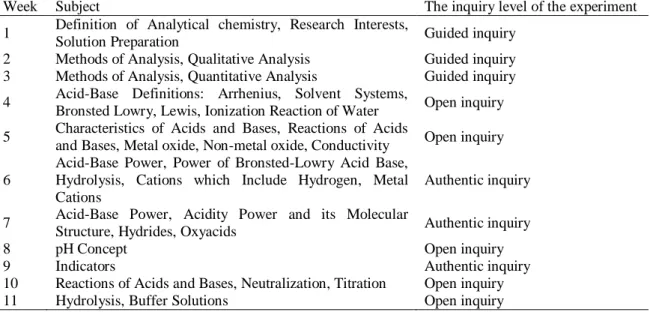
Table 3. The subjects taught during the 11-week implementation process and the inquiry levels of the experiments
Week Subject The inquiry level of the experiment
1 Definition of Analytical chemistry, Research Interests,
Solution Preparation Guided inquiry
2 Methods of Analysis, Qualitative Analysis Guided inquiry 3 Methods of Analysis, Quantitative Analysis Guided inquiry
4 Acid-Base Definitions: Arrhenius, Solvent Systems,
Bronsted Lowry, Lewis, Ionization Reaction of Water Open inquiry
5 Characteristics of Acids and Bases, Reactions of Acids
and Bases, Metal oxide, Non-metal oxide, Conductivity Open inquiry
6
Acid-Base Power, Power of Bronsted-Lowry Acid Base, Hydrolysis, Cations which Include Hydrogen, Metal Cations
Authentic inquiry
7 Acid-Base Power, Acidity Power and its Molecular
Structure, Hydrides, Oxyacids Authentic inquiry
8 pH Concept Open inquiry
9 Indicators Authentic inquiry
10 Reactions of Acids and Bases, Neutralization, Titration Open inquiry
The groups set up and performed the experiments, testing their hypotheses during the course hours (2 hours). At the end of the course, the groups were asked to explain their research methods and results, and these were compared in a discussion environment both with each other and with the available theoretical knowledge (1 hour). The pre-service science teachers prepared their experiment reports and were asked to write down the results and complete the interpretation section of the reports on an individual basis. The subjects taught during the 11-week implementation process were interrelated (Table 3). During this period, the teacher of the course did not provide the pre-service science teachers with a lecture. The teachers were requested to offer explanations after considering the theoretical frame of the subject. The courses were taught by adopting the inductive approach.
There were times during the lecture when the pre-service science teachers designated the subject of the next week‘s experiment. A question a pre-service science teacher asked during a lesson was asked in the next lesson as part of a scenario or as a direct question (6th, 7th and 9th weeks). Although the pre-service science teachers in the groups were expected to design the research, they did not always come to class with an experiment they had designed. Therefore, the inquiry level of that lesson fell and the way the experiments would be performed was prearranged and provided to the pre-service science teachers by the researcher (1st, 2nd and 3rd weeks). For instance, while they were performing an experiment about the reaction of acids and bases in the 5th week, one of the pre-service science teachers asked if an acid‘s effect upon active metals would be at the same level if the acid‘s type or concentration were to be changed. The question was not answered directly but left to the other pre-service science teachers so that a discussion environment was created to explore the answer. It was considered important that the discussion proceeded within the scope of the subject of acidity power and so the variables affecting acidity power were queried. The pre-service science teachers were asked to design an experiment for the next lessons (6th and 7th weeks).
Validity and Reliability of the Research
In this research, long-term fieldwork was carried out by collecting data continuously for a period of 13 weeks, including the preliminary interviews (in the firstweek) and final interviews (in the last week). In addition, the data relating to this research were collected via multiple tools such as interview forms (IF), reflective diaries (RD) and experiment reports (ER) so that data triangulation was actualized. With the aim of ensuring the internal validity of the research, the researcher and 2 experts continuously reviewed the activities using the RTOP observation forms. The interviews held with the pre-service science teachers were put in writing and after ensuring that the pre-service science teachers had read them, their approvals were again obtained. Thus, the confirmations of the participants in the study group were received. The information acquired with each data collection tool was associated with the related categories and supportive statements were included. These are the statements in the reflective diaries and the statements of the observers in the RTOP forms. With the aim of determining whether the researcher had correctly interpreted the data, the findings were analyzed by the 2 experts who had experience in research on laboratory perceptions and the nature of inquiry. The findings were revised and reported on the basis of the experts‘ opinions. It is possible to say that these steps contributed to minimizing the bias of the researcher.
Results of Research
Raziye
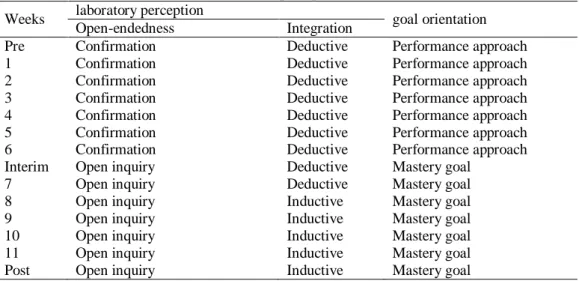
Information about each pre-service science teacher‘s laboratory perception and goal orientation for each week is presented below (Table 4).
Case: PO (Performance approach/open-endedness)
In the preliminary interview with Raziye, it was determined that she participated in the learning environment with the performance approach.
Table 4. Raziye‘s laboratory perception and goal orientation
Weeks laboratory perception goal orientation
Open-endedness Integration
Pre Confirmation Deductive Performance approach
1 Confirmation Deductive Performance approach
2 Confirmation Deductive Performance approach
3 Confirmation Deductive Performance approach
4 Confirmation Deductive Performance approach
5 Confirmation Deductive Performance approach
6 Confirmation Deductive Performance approach
Interim Open inquiry Deductive Mastery goal
7 Open inquiry Deductive Mastery goal
8 Open inquiry Inductive Mastery goal
9 Open inquiry Inductive Mastery goal
10 Open inquiry Inductive Mastery goal
11 Open inquiry Inductive Mastery goal
Post Open inquiry Inductive Mastery goal
Researcher: What are your success criteria in this lesson?
Raziye: Getting a good grade and understanding the subjects is an important success criterion for me. Researcher: Why is it important for you to get good grades?
Raziye: My mother wanted me to choose this department and profession. Her opinions are very important to me, and she may be very upset if I fail.
Researcher: So you should get a good mark so as not to upset your mother?
Raziye: Yes, it‘s as important to me as it is to my mother. I should get the best grade in the class, if I can.
Researcher: Why is this so important?
Raziye: Because when I go home, not only the points I get are asked about, but my friends‘ scores are also asked about.
Raziye stated that she had difficulties in designing the experiment until the end of the 6th activity. In the first 3 activities, she said that the teacher should give out the experiment and that she could not learn anything this way (RD).
In addition, she did not find it meaningful to carry out an experiment prior to the lecture (RD). It is possible to say that Raziye‘s perception of open-endedness was at the level of confirmation in the first 6 activities.
I have difficulties in determining a subject for an experiment. I cannot be sure of the accuracy of the experiment I bring to class. Because I cannot achieve a precise result, I have doubts and I am also a little bit afraid. I am afraid of the teacher‘s attitude. However, it was not like I had expected. I felt relieved when I saw that some of the groups also could not determine the subject. Our teacher did not scold anyone yet it would be much better if the teacher provided the experiments. In that way, there would be more of a possibility of acquiring some precise knowledge (RD-2).
As for the 4th activity, Raziye stated that she acquired the experiment setup directly from different resources (RD). It was determined that when selecting these experiment setups from different resources, she paid attention only to the subject of the experiment but ignored the problem in the activity and the variables (ER). The fact that the experiment was not designed with a detailed and in-depth process caused her to have difficulties during the experimental process (RD). This was because she encountered circumstances she had not anticipated and she ignored these circumstances during the experiment (ER).
I saw that the other groups considered concentrations and temperature when comparing solutions. I had never thought particularly about the effect of temperature before. However, it had previously been taught in a lesson that temperature has an effect upon a concentration (RD-4).
It was observed that Raziye avoided interacting with the other students until the end of the 6th activity while detecting the problem and designing a new experiment (RTOP). Her participation in the learning environment was limited because it was determined that her pre-lesson preparations were insufficient (ER).
such as detecting the problem or the variables were required, she abided by the group members‘ decisions (RTOP).
In trying to defend her arguments only with her own experiences, consulting only one resource that was at high school level and not sufficiently covering the required number of analytical chemistry subjects (ER) when preparing for class, this pre-service science teacher played a passive role.
The objectives she set down during the first 6 weeks proved to be the reason why her participation in the learning environment was limited. Rather than detecting the problem, the point Raziye was focused on as of the 1st activity until the end of the 6th activity was to impose her own opinions on the other members of the group and class (RTOP). She felt uncomfortable with the situation when her friends‘ opinions prevailed against her opinions as a result of the discussions about the 1st experiment (RD).
When I‘m performing an experiment, my intention is to act together with the group but also to bring my own opinions into the forefront (RD-3).
Until the 6th activity, Raziye was defining her objective as designing and carrying out an experiment correctly (RD). When a pre-service science teacher is focused only on carrying out an experiment correctly and explains this by saying that he/she wants to prove to the teacher and the class that he/she is right, this is related to exhibiting a performance approach.
Also, when announcing the experiment results and putting them into a report form, this pre-service science teacher preferred to hide her mistakes in the experimental process, and she did this together with her friends (ER). Changing the experiment results through manipulation is another indication that a pre-service science teacher has adopted the performance approach.
I had some difficulties because everyone wanted to do the experiment their own way and even did so. It also made me feel uncomfortable not to be using our own results in the report (RD-6).
It appears to be that, as of the 7th activity, carrying out experiments with a more in-depth approach, searching through different resources, paying more attention to details when designing the experiment (ER, RD), and even conducting pilot schemes for the experiments she had designed (RD) decreased her anxiety level during the lessons.
…considering the opinions of other students in the group, I will find out the best way for me and then I will perform the experiment after sharing my ideas with my friends and receiving their support…(RD-7).
It was important that she indicated that the process of designing the experiment had an effect on her learning (RD).
I feel that I am more active and have a more comprehensive knowledge of the subject. I realized that visuals facilitate more permanent and easy learning. I feel that designing a new experiment helps me to practice and get ready for being a teacher. I think that my level of having more comprehensive knowledge of the subject and my skills related to the experiments have been enhanced (RD-7).
Changing: PO(Performance approach/open-endedness) MO(Mastery approach/open-endedness)
This pre-service science teacher started to monitor herself. She started to consider carrying out the experiments correctly as a long-term objective, and considered exploring the knowledge a short-term objective (RD). This may have to do with this pre-service science teacher‘s goal orientation, which changed towards the dimension of learning.
There was a change in the data collection process. I learned better about how and from which resources I could do better research for a subject (RD-7).
measurement tools and measuring range, and even including the pilot scheme in the process of designing were indicators of the change that had occurred in the designing process. This pre-service science teacher indicated that this process was important for her learning because she could try different things in the laboratory environment, she felt much more comfortable, and she was able to use the laboratory as she desired (RD). It is possible to say that as of the 8th activity, Raziye‘s perception in the dimension of open-endedness was open inquiry. Her statements regarding the perception of open-endedness in the final interview were also an indication that there was a change. She explained in more detail the process of designing an experiment rather than using statements such as ―an experiment prearranged and provided by the teacher‖ or ―obtaining an available experiment from a resource.‖
Researcher: What do you experience during the process of designing an experiment? Can you please explain this process with an example?
Raziye: In the process of designing an experiment, if you have already learned the subject, you unavoidably start to visualize something. Since you have learned the subject, you start to ask questions such as, ―What kind of experiment can I design about this subject?‖ ―What are the things required for this subject?‖ In this way, I form a construct in my mind at first, and then do some research to find out if there are any examples that are in accord with it, any distinctive examples. I compare these with each other to determine how much they relate to the subject. At the end, I usually try to do the experiment by utilizing the most extensive and most advanced example.
Researcher: What were your criteria for designing experiments? According to which factors were you designing them?
Raziye: The teacher should provide the problem related to the experiment. For example, I would like the issues I am confused about to be cleared up in my experiment. So, when I‘m performing an experiment, I consider not only the relevant question but also all the questions I am confused about. For instance, I remember one time that although my friends were doing the experiment one way, I did it in 2-3 different ways, aiming to understand the different results and answering the questions in my mind. That‘s how I do the experiments.
This student‘s statements in the final interview showed that she focused on the learning process, rather than trying to prove herself to her friends and the teacher. Mastery goal orientation could be observed in the final interview.
Researcher: What did you do when you had difficulties or could not achieve your goal? (While researching, setting a goal, designing an experiment, carrying out an experiment, preparing a report, etc.)
Raziye: If I cannot achieve my goal, for example, if I cannot reach the result I was expecting to reach right at that moment, I try to find out the reason and review the knowledge I have learned. There is always a resource within easy reach and so I review it. Then, I get a little stressed and angry. And then I repeat it until I succeed, I mean until I achieve it the way it should be. My friends may have an effect on the result, and I discuss this with them if necessary. For example, in the simplest terms, on one occasion while we were doing a titration experiment, since we were drawing graphs, we decided to include our friends in twos and at certain intervals. In this way, we would not miss the inflection point and it would be easier to draw the graphs. However, some of our friends insisted that we would lose time and they could not do it correctly, so then they poured the acid in without restraint and we suddenly missed the inflection point. Although it was supposed to be 7, it decreased to 5. We were doing that experiment for the second time. We made a mistake in the first one, but this was the second time, so I got angry. I mean, that‘s why I blew my top. In addition, yes, maybe they had not learned the subject but I am not sure if they had even researched it… I, on the other hand, made an effort in that subject and tried to find out about it and did the experiment based on a plan…
Case: PI (Performance approach/integration)
With the help of the experiments performed in the laboratory, I learn through observing and performing them myself. I think laboratory studies should be carried out after the lecture. In this way, we can reinforce our knowledge about the subject, and we can feel more convinced (RD-3).
Raziye‘s opinion about the laboratory environments at the end of the 6th week was another indication of how her perception of integration was deductive.
Researcher: Which activities did you carry out in the chemistry course until this week? How did these activities affect your own learning?
Raziye: The ‗acid-base‘ subject is continually lectured. Such as how acids-bases are determined and measured, what their conductivity values are. We performed experiments on each topic under the topic of ‗acids-bases.‘ The stages treated were all different from each other. The topics were generally about acids and bases. I think a topic can be lectured thoroughly but superficially, or you can understand it through observing. When a subject is only lectured, then you can only talk about it and remember it. However, it is something very different to implement through observing. In the simplest terms, for example, we all know that a lemon is sour and we say that it is acidic. But what kind of acid? How do we know this? Or, we use litmus paper, for instance. We are able to observe and arrive at more precise answers about whether it is an acid or base. And we say, ―Here it is! Blue litmus paper turns red under acidic conditions, but you know, it‘s something different to watch this happen.‖
Researcher: In your opinion, what is the best way to learn chemistry and/or analytical chemistry? How did the implementation carried out until now affect your opinion?
Raziye: In fact, not only chemistry courses but also all courses should definitely be learned through experiments. In the end we are completely using our imagination; I mean we‘re working with things that are not tangible. In order to make this more comprehensible, then, we need to be able to make observations. Lecturing a subject thoroughly but superficially will only give you knowledge about it. But none of us can tell how and at which level we can incorporate this knowledge into our daily lives. In fact, chemistry is a part of every sphere in life. Chemicals are used in everything, ranging from the water we drink to the clothes we wear.
As can be seen in the interim interview, Raziye perceived the laboratory environment as visualization (concretization) of theoretical knowledge. She stated that her learning was more effective when the lectured subjects were observed through activities. However, it was important for her to realize that chemistry subjects are in fact related to daily life. This affected her future objectives with respect to the chemistry laboratory. Chemistry subjects are not only visualized through laboratory activities but they also become associated with daily life.
In the 7th activity, she started to indicate that doing research, designing an experiment, the experimental process, discussing and producing a report had a more powerful effect on her learning. She said that producing a report enabled her to review the whole process again and put all her knowledge together. She indicated that she had been distracted by the different opinions in the discussion environment. She stated that her previous knowledge and high school textbooks were not sufficient for participating in the discussions, designing an experiment, and preparing a report (RD). Particularly as of the 8th activity, she realized that utilizing different resources, comparing all her knowledge, designing an experiment and trying to explain the results had an effect on her learning, and she also indicated this in her reflective diaries.
I realized that relating the subjects to daily life has an effect upon my learning. The subject attracted my interest more and I felt the need to do more research. I think I learn better when a lesson is taught this way, but I don‘t feel so competent about my theoretical knowledge so I need to research more (RD-8).
Changing: PI (Performance approach/integration) MI (Mastery approach/integration)
It is possible to say that as of the 8th activity, Raziye‘s perception in the dimension of integration was inductive. Her statements in the final interview also showed that there was a change in her perceptions. In this interview she emphasized that the chemistry lessons required her to search for and find the knowledge rather than getting it directly from the teacher.
Raziye: For me, in order to learn, first of all, everyone in the learning environment should have some knowledge about the subject. Even if they do not have any knowledge, they should at least have something to say. My friends, the teacher and I must not provide the knowledge directly. The teacher should make the student think about it and allow the student to get confused. It does not matter if a student doesn‘t have the facts straight; making inquiries through ‗I wonder if…‘ will change so many things. Besides, the confusion this question causes leads everyone into a discussion.
Each student says something and then gets confused. Finally, I think everyone should do some research, find out something and all these should be discussed in the course. The teacher should evaluate deficiencies and mistakes and make a summary of the subject. I think that is how it should be. The teacher must not provide the knowledge directly and the students should not be left only with the knowledge they have learned.
Ömer
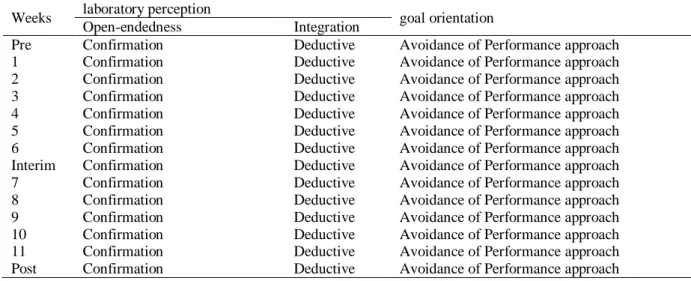
Ömer‘s laboratory perception and his goal orientation are given in table 5.
Table 5. Ömer‘s laboratory perception and goal orientation
Weeks laboratory perception goal orientation
Open-endedness Integration
Pre Confirmation Deductive Avoidance of Performance approach
1 Confirmation Deductive Avoidance of Performance approach
2 Confirmation Deductive Avoidance of Performance approach
3 Confirmation Deductive Avoidance of Performance approach
4 Confirmation Deductive Avoidance of Performance approach
5 Confirmation Deductive Avoidance of Performance approach
6 Confirmation Deductive Avoidance of Performance approach
Interim Confirmation Deductive Avoidance of Performance approach
7 Confirmation Deductive Avoidance of Performance approach
8 Confirmation Deductive Avoidance of Performance approach
9 Confirmation Deductive Avoidance of Performance approach
10 Confirmation Deductive Avoidance of Performance approach
11 Confirmation Deductive Avoidance of Performance approach
Post Confirmation Deductive Avoidance of Performance approach
Case: APO (Avoidance of Performance approach / open-endedness)
In all the activities, Ömer‘s objective was to design a new experiment correctly and complete it without a mistake (RD). In fact, his motivation for this was that he was anxious that the teacher and peers would realize his deficiencies. Unlike the other pre-service science teachers, Ömer indicated in the 1st interview that he was dissatisfied with having his mistakes realized by the other pre-service science teachers or the teacher.
Researcher: How was your teacher lecturing the chemistry subjects in the high school you graduated from?
Ömer: Our teacher lectured the subject the best she could and asked us to take notes. Sometimes she provided us with notes she had prepared and held exams every couple of weeks.
Researcher: What were you doing during the courses?
Ömer: As a matter of fact, we were usually under stress. We were anxious about going to the blackboard.
Researcher: Why?
Ömer: Because when you made a mistake or could not solve the question you would get a poor mark and also suffer criticism.
Researcher: Well, what is your opinion about the chemistry courses at the university?
Ömer: Here I don‘t have the problems I used to have in high school. But I am still careful. I am getting used to the course and the teacher nowadays. But I am still trying not to make any mistakes. It will not be good if people see where I‘m deficient.
he was adopting the avoidance of performance approach, and he continued to adopt this approach during the 11 weeks.
In all the activities, Ömer‘s perceptions of open-endedness did not change and remained the same (confirmation). The experiments he designed were in fact some other experiments he had obtained from other resources. At the end of the 2nd activity, he stated in his reflective diary that he was upset because he could not design the experiment.
My objective in this lesson is to design a new experiment correctly and complete it without a mistake. However, it is not always possible to design a new experiment. Therefore, I am a little bit sorry that I could not design one (RD-2).
Moreover, at the end of the 3rd activity, he indicated that the research he did prior to the experiment was unrelated to it (RD). Although he had the objective of designing the correct experiment, the experiments he brought to class were either unrelated to the problem, or not at a level that included all the variables.
In this activity, I saw that the experiment I designed is not relevant to the subject. To tell the truth, I am upset because of this. And, because of this, I had to do an experiment that my teacher provided (RD-3).
The reason this pre-service science teacher put up resistance to change may be based on the fact that during the 11 weeks, he studied and attended the lesson with the objective of making the teacher think that he was interested in the subject, rather than of actually learning. He defined his objective in all the activities as designing an experiment correctly and carrying it out completely (RD). This pre-service science teacher‘s objective was ―Appearing to be successful in this lesson is only possible if we design the experiments correctly and perform them without a mistake.‖ This was indicated at the end of the 3rd activity and was the same at the end of the 11th activity.
Due to his deficiencies and the mistakes he made in determining the problem and the variables, the experiment mechanisms that this pre-service science teacher designed were either unrelated to the subject, or not at a level that included the subject to the fullest extent (ER). Although he wrote up his deficiencies in his reflective diaries as of the 6th activity, he did not make an effort to remedy the situation. The process was the same until the end of the 11th activity (ER).
Researcher: How do you design an experiment? How much time do you allocate for it? (Final interview)
Ömer: Designing an experiment… Hmm… It does not take too much time for me. It is enough to spend fifteen or twenty minutes. For example, since I search for experiments on the Internet, I can imagine and design an experiment in my own way on the basis of those experiments. Maybe the experiments we design are not that good but we can learn many things from them. It takes only ten-fifteen minutes for me.
It was determined that this pre-service science teacher attended the activities that he had made preparations for usually by utilizing high school textbooks and websites with scientific resources requiring inquiry (ER). He attended the 4th, 8th and 10th activities without making any preparation (ER, RTOP).
It is not possible to say that this student displayed a consistent performance in all activities. Sometimes he did not even make any pre-lesson preparations and this affected his role during the course. He only watched the discussions. We cannot say that he played an active role in designing and carrying out the experiments. He usually followed the instructions of his friends (RTOP-8).
Studying by adopting the surface study approach in all activities may be the reason why this pre-service science teacher participated less in the classroom and the group while detecting a problem, designing and carrying out an experiment, putting his observations into a report form, and sharing his report. In fact, although he indicated his deficiencies in his reflective diaries (1st, 4th and 6th weeks), he made an insufficient effort to prepare for the activities and during the activity process. Although he participated in the 6th and 9th activities with more pre-lesson preparations, in comparison to the other activities, he did not display a consistent performance during the 11 weeks.
than by using theoretical knowledge. This was not enough in the discussion environment (RTOP-4th week).
Although he tried to participate more actively in the process of carrying out the experiment, he played a passive role in solving the problem he encountered. For example, in comparing acid strengths, he used concentrated acids but did not prepare their solutions. Without considering the acid concentration, comparing only according to their H-numbers caused him to make mistakes. He terminated the experiment without making an effort to correct his mistake (RTOP-6th week).
Performing the study with the aim of making the teacher think as if he were interested in the lesson may be one of the most important reasons for this. Although he indicated in the final interview that the conceptual change model had an effect upon his own learning, implementing previous habits may be related to goal orientation. It is possible to say that this pre-service science teacher was adopting the avoidance of performance approach during the process of designing and carrying out the experiment.
Case: API (Avoidance of Performance approach / integration)
This pre-service science teacher indicated during the preliminary, interim and final interviews and in his reflective diary that if an experiment is carried out after the lecturing, learning will be more permanent. The inquiry-based mastery goal that was applied in the analytical chemistry lessons for a period of 11 weeks also could not change the point of view that he had carried over from his previous experiences. Although he spoke about conceptual change in the final interview, he emphasized that he definitely needed to listen to the subject in a lecture in order to learn.
Researcher: Did this type of lecturing have an effect upon your learning?
Ömer: Yes, I was able to learn this way. I researched the theoretical knowledge and I could disprove my misconceptions during the experiment. Just like saying: ―Before the experiment, this is what I thought, but it seems that I was wrong. So I disproved my theoretical knowledge and I needed to gain new theoretical knowledge.‖ I mean, it was a kind of exchange of the theoretical knowledge in my mind.
Researcher: Can you please give an example?
Ömer: For example, in the last experiment we performed, we estimated the pH value as 7. Strong acid, weak base, NH3 and HCI. So I estimated the pH value at 7 considering that there would be a neutralization reaction… After the experiment, the result we found was 5.28, if I‘m not mistaken. So the pH value was not 7. It was even lower than 7. I mean, I always thought it would be 7 and expected it to be 7 in that experiment. So pH is not always 7. I learned that it could change according to the acid-base equilibrium. This kind of thing stuck in my mind.
Researcher: So, for your own learning, what should a teacher do in the learning environment?
Ömer: What should a teacher do in the learning environment? Hmm.. Of course the teacher should give a lecture on the subject.
Researcher: When should she lecture?
Ömer: When should she lecture? Hmm…, She should give the lecture on the subject when she comes into the classroom, She can also ask questions such as, ―What do you know about this subject?‖ or ―Before we start the lesson, do you have any opinions about the subject? Please tell me what they are.‖ She can use brainstorming as pre-lesson preparations.
Researcher: Why should we do this? Who needs this?
Ömer: In fact, brainstorming makes us think. For example, maybe many of us, even I, may know about that subject, but when you ask us a question, I may not be able to give you an answer. Everyone may be in such a mood. I mean, my friends may get a bad impression of me and I may look bad in front of my friends. I may also say something wrong. Even though I know the correct answer, I may not be able to tell it to you. What you do there as a teacher, is to make us think. After thinking about the subject, for sure, all of us will have a question mark in our minds.
Researcher: What should a teacher do then?
Ömer: Then I think she should lecture some parts of the subject. She can solve problems or make the students solve them, and she can assign homework about the subject, for example, or provide some questions.
He said that the instability was cleared up after the experiment. Although this pre-service science teacher realized that meaningful learning was effective in his own learning, he continued to believe that laboratory activities should be carried out after a lecture. This can be explained by Omer‘s goal orientation.
Researcher: You‘ve seen that the cognitive instability was cleared up with the environment in analytical chemistry so far. What do you think about the processing of this method?
Ömer: The teacher should give a lecture on the subject. I don‘t think I‘ve ever learned otherwise. Researcher: Why?
Ömer: Because my research and my findings can be incomplete and inaccurate and I can‘t always do good research. I also do not always perform well in the laboratory.
Researcher: Why do you do research and experiment?
Ömer: I should do research because of designing the right experiment. I have to do the right experiment to get the right result.
Researcher: Why is it important to achieve the right result?
Ömer: If the other students in the class did, we could do it. I‘m sorry if I couldn‘t. Obviously, I don‘t want you and my friends to see that.
Büşra
Büşra‘s laboratory perception and her goal orientation are given table 6.
Table 6. Büşra‘s laboratory perception and goal orientation
Weeks laboratory perception goal orientation
Open-endedness Integration
Pre Confirmation Deductive Mastery goal
1 Confirmation Deductive Mastery goal
2 Confirmation Deductive Mastery goal
3 Confirmation Deductive Avoidance of Mastery goal
4 Confirmation Deductive Avoidance of Mastery goal
5 Confirmation Deductive Mastery goal
6 - - -
Interim Open inquiry - Mastery goal
7 Open inquiry Inductive Mastery goal
8 Open inquiry Inductive Mastery goal
9 Open inquiry Inductive Mastery goal
10 Open inquiry Inductive Mastery goal
11 Open inquiry Inductive Mastery goal
Post Open inquiry Inductive Mastery goal
Case: MO (Mastery approach / open-endedness)
Büşra expected the experiment to be provided by the teacher in the first 3 activities. However, as of the 4th activity, she tried to carry out the experiments she found from different resources. She made much more of an effort to design an experiment as of the 7th activity.
This student was aware of the effect of the discussion environment on the process of designing an experiment.
I think the discussion environment plays an important role in our learning. This is because I come across different opinions, and I can better understand the problems our teacher provides us with (RD-1).