National Oceanic and Atmospheric Administration
NATIONAL MARINE FISHERIES SERVICE
West Coast Region
1201 NE Lloyd Boulevard, Suite 1100
PORTLAND, OREGON 97232
July 17, 2020
Dr. Guillermo Compeán, Director
Inter-American Tropical Tuna Commission
8901 La Jolla Shores Drive
La Jolla, California 92037
Dear Dr. Compeán:
The United States hereby notifies the Inter-American Tropical Tuna Commission (IATTC) that the
management measures applying to U.S. fishing vessels in the overlap area have changed.
The United States has vessels listed on both the IATTC Regional Vessel Register (RVR) and the Western
and Central Pacific Fisheries Commission’s (WCPFC) Record of Fishing Vessels. The United States
notified the IATTC Secretariat on June 13, 2016, that U.S. vessels would be subject to the conservation
and management measures of the WCPFC while operating in the overlap area. The 2016 letter also noted
that management measures of the IATTC would no longer apply to U.S. fishing vessels operating in the
overlap area, with the exception of regulations governing the IATTC RVR.
The National Marine Fisheries Service published a final rule on June 22, 2020 (
85 FR 37376
), changing
management in the overlap area. Under the June 2020 final rule, all IATTC management measures apply
in the overlap area, and some WCPFC management measures continue to apply in the overlap area. The
June 2020 final rule is effective on July 22, 2020 (GMT), except for several revised reporting
requirements, which are delayed pending completion of a domestic approval process. Table 1 in the final
rule indicates which IATTC and WCPFC management measures will apply to U.S fishing vessels in the
overlap area.
The United States requests the Secretariat circulate to Members and Cooperating Non-Members a list of
decisions by Members who have notified the IATTC regarding under which Commission their vessels
operate while fishing in the overlap area.
Please direct any questions on this matter to Lyle Enriquez at
[email protected]
or (562)
980-4025.
Sincerely,
Barry A. Thom
Regional Administrator
cc:
David Hogan, U.S. Department of State
Andrew Lawler, U.S. Commissioner to the IATTC
William Fox, Jr., U.S. Commissioner to the IATTC
Mike Thompson, Alternate U.S. Commissioner to the IATTC
John Zuanich, Alternate U.S. Commissioner to the IATTC
Ryan Wulff, NMFS West Coast Region Assistant Regional Administrator Sustainable Fisheries
Division
14947 U.S.C. 158(d)(1)(A).
150See U.S. Census Bureau, 2017 NAICS Definitions, NAICS Code ‘‘517919 All Other Telecommunications’’, https://www.census.gov/cgi-
bin/sssd/naics/naicsrch?input=517919&search= 2017+NAICS+Search&search=2017.
151Id. 152Id.
153See 13 CFR 121.201, NAICS code 517919. 154U.S. Census Bureau, 2012 Economic Census of
the United States, Table EC1251SSSZ4,
Information: Subject Series—Estab and Firm Size: Receipts Size of Firms for the United States: 2012, NAICS code 517919, https://factfinder.census.gov/
bkmk/table/1.0/en/ECN/2012_US/51SSSZ4// naics∼517919.
155Id. 1565 U.S.C. 603(c)(1)–(c)(4).
Governmental entities are, however, exempt from application fees.149
9. All Other Telecommunications. The ‘‘All Other Telecommunications’’ category is comprised of establishments primarily engaged in providing
specialized telecommunications services, such as satellite tracking, communications telemetry, and radar station operation.150This industry also includes establishments primarily engaged in providing satellite terminal stations and associated facilities connected with one or more terrestrial systems and capable of transmitting telecommunications to, and receiving telecommunications from, satellite systems.151Establishments providing internet services or voice over internet protocol (VoIP) services via client- supplied telecommunications connections are also included in this industry.152The SBA has developed a small business size standard for All Other Telecommunications, which consists of all such firms with annual receipts of $35 million or less.153For this category, U.S. Census Bureau data for 2012 shows that there were 1,442 firms that operated for the entire year.154Of those firms, a total of 1,400 had annual receipts less than $25 million and 15 firms had annual receipts of $25 million to $49, 999,999.155Thus, the Commission estimates that the majority of ‘‘All Other Telecommunications’’ firms potentially affected by our action can be considered small.
E. Description of Projected Reporting, Recordkeeping and Other Compliance Requirements
10. This Report and Order does not adopt any new reporting, recordkeeping, or other compliance requirements.
F. Steps Taken To Minimize Significant Economic Impact on Small Entities, and Significant Alternatives Considered
11. The RFA requires an agency to describe any significant alternatives that it has considered in reaching its
approach, which may include the
following four alternatives, among others: (1) The establishment of differing compliance or reporting requirements or timetables that take into account the resources available to small entities; (2) the clarification,
consolidation, or simplification of compliance or reporting requirements under the rule for small entities; (3) the use of performance, rather than design, standards; and (4) an exemption from coverage of the rule, or any part thereof, for small entities.156
12. This Report and Order does not adopt any new reporting requirements. Therefore, no adverse economic impact on small entities will be sustained based on reporting requirements. In keeping with the requirements of the Regulatory Flexibility Act, we have considered certain alternative means of mitigating the effects of fee increases to a particular industry segment. For example, The Commission’s annual de minimis threshold of $1,000, replaced last year with a new section 9(e)(2) annual regulatory fee exemption of $1,000, will reduce burdens on small entities with annual regulatory fees that total $1,000 or less. Also, regulatees may also seek waivers or other relief on the basis of financial hardship. See 47 CFR 1.1166.
G. Federal Rules That May Duplicate, Overlap, or Conflict
13. None.
V. Ordering Clauses
14. Accordingly, it is ordered that, pursuant to the authority found in sections 4(i) and (j), 9, 9A, and 303(r) of the Communications Act of 1934, as amended, 47 U.S.C. 154(i), 154(j), 159, 159A, and 303(r), this Report and Order is hereby adopted.
15. It is further ordered that the
Report and Order shall be effective 30
days after publication in the Federal
Register.
16. It is further ordered that the amendment adopted in section III A shall be effective 90 days after notice to Congress, pursuant to section 159A(b) of the Communications Act of 1934, as amended, 47 U.S.C. 159A(b),
17. It is further ordered that the Commission’s Consumer and
Governmental Affairs Bureau, Reference Information Center, shall send a copy of this Report and Order, including the Final Regulatory Flexibility Analysis in this document, to Congress and the Government Accountability Office pursuant to 5 U.S.C. 801(a)(1)(A).
Federal Communications Commission.
Cecilia Sigmund,
Federal Register Liaison Officer.
[FR Doc. 2020–11348 Filed 6–19–20; 8:45 am]
BILLING CODE 6712–01–P
DEPARTMENT OF COMMERCE National Oceanic and Atmospheric Administration
50 CFR Part 300 [Docket No. 200528–0149] RIN 0648–BH59
International Fisheries; Eastern Pacific Tuna Fisheries; Western and Central Pacific Fisheries for Highly Migratory Species; Area of Overlap Between the Convention Areas of the Inter- American Tropical Tuna Commission and the Western and Central Pacific Fisheries Commission
AGENCY: National Marine Fisheries Service (NMFS), National Oceanic and Atmospheric Administration (NOAA), Commerce.
ACTION: Final rule.
SUMMARY: Under authority of the Western and Central Pacific Fisheries Convention Implementation Act (WCPFCIA) and the Tuna Conventions Act, NMFS issues this final rule that revises the management regime for U.S. fishing vessels that target tunas and other highly migratory fish species (HMS) in the area of overlapping jurisdiction in the Pacific Ocean between the Inter-American Tropical Tuna Commission (IATTC) and the Commission for the Conservation and Management of Highly Migratory Fish Stocks in the Western and Central Pacific Ocean (WCPFC). The rule applies all regulations implementing IATTC resolutions in the area of overlapping jurisdiction and some regulations implementing WCPFC provisions. NMFS is undertaking this action based on an evaluation of the management regime in the area of overlapping jurisdiction, in order to satisfy the obligations of the United States as a member of the IATTC and the WCPFC, pursuant to the authority of the Western and Central Pacific
Fisheries Convention Implementation Act (WCPFCIA) and the Tuna
Conventions Act.
DATES: This rule is effective on July 22, 2020, except for 50 CFR 300.218, which is delayed. NOAA will publish a document in the Federal Register announcing the effective date.
1A cross-endorsed observer is an observer that is ‘‘cross-endorsed’’ pursuant to a Memorandum of Cooperation between the WCPFC and the IATTC that specifies a process to allow the observer to meet the observer requirements of both organizations.
ADDRESSES: Copies of supporting documents prepared for this final rule, including the regulatory impact review (RIR) and the environmental assessment (EA), as well as the proposed rule (84 FR 60040; November 7, 2019), are available via the Federal e-rulemaking Portal, at www.regulations.gov (search for Docket ID NOAA–NMFS–2018– 0049). Those documents are also available from NMFS at the following address: Michael D. Tosatto, Regional Administrator, NMFS, Pacific Islands Regional Office (PIRO), 1845 Wasp Blvd., Building 176, Honolulu, HI 96818.
A final regulatory flexibility analysis (FRFA) prepared under authority of the Regulatory Flexibility Act is included in the Classification section of the
SUPPLEMENTARY INFORMATIONsection of this document.
Written comments regarding the burden-hour estimates or other aspects of the collection-of-information
requirements contained in this rule may be submitted to PIRO at the address listed above, by email to OIRA_
[email protected], or by fax to
(202) 395–5806.
FOR FURTHER INFORMATION CONTACT: Rini Ghosh, NMFS PIRO, 808–725–5033.
SUPPLEMENTARY INFORMATION:
Background
On June 12, 2018, NMFS published an advance notice of proposed rulemaking in the Federal Register (83 FR 27305) seeking public input about whether it should change the management regime for fishing vessels that target tunas and other HMS in the area of overlapping jurisdiction in the Pacific Ocean between the IATTC and the WCPFC. On November 7, 2019, NMFS published a proposed rule in the Federal Register (84 FR 60040) proposing to revise that management regime. The proposed rule was open for public comment until November 22, 2019.
This final rule is issued under the authority of the WCPFCIA (16 U.S.C. 6901 et seq.) and the Tuna Conventions Act (16 U.S.C. 951 et seq.). The United States is a member of both IATTC and WCPFC. NMFS implements decisions of WCPFC under the authority of the WCPFCIA and decisions of IATTC under the authority of the Tuna Conventions Act. The convention areas for the IATTC (IATTC Area) and WCPFC (WCPFC Area) overlap in the Pacific Ocean waters within an area bounded by 50° S latitude, 4° S latitude, 150° W longitude, and 130° W longitude (‘‘overlap area’’).
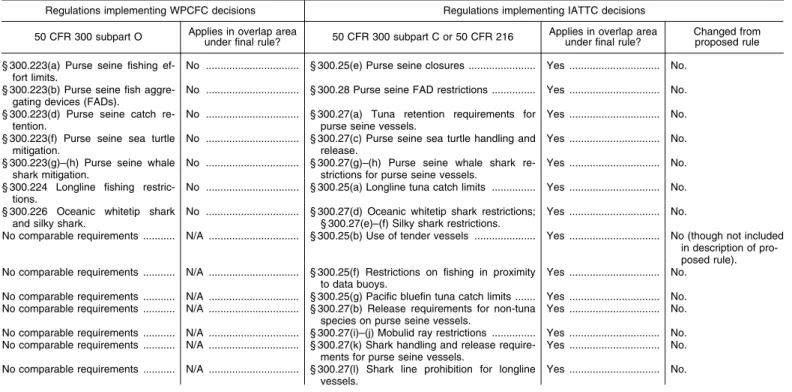
This final rule changes management of the overlap area in accordance with
WCPFC and IATTC decisions (described below) regarding the overlap area. Specifically, this final rule changes management of the overlap area so that all NMFS regulations implementing IATTC resolutions apply in the overlap area. NMFS regulations implementing WCPFC conservation and management measures that place limits or restrictions on catch, fishing effort, and bycatch mitigation no longer apply in the overlap area, except that existing WCPFC regulations prohibiting transshipments at sea from or to purse seine vessels continue to apply. A few regulations implementing WCPFC conservation and management
measures, will continue to apply in the overlap area for the reasons described below, in the section that follows Table 1.
The WCPFC and IATTC decisions addressing the overlap area (IATTC Recommendation C–12–11, ‘‘IATTC– WCPFC Overlap Area,’’ and the WCPFC decision documented in ‘‘Summary Report of the Ninth Regular Session of the Commission for the Conservation and Management of Highly Migratory Fish Stocks in the Western and Central Pacific Ocean,’’ Manila, Philippines, 2– 6 December, 2012, paragraph 80, hereafter ‘‘WCPFC–IATTC joint decision on the overlap area’’), broadly indicate that a member of both commissions, such as the United States, may decide and notify both commissions which commission’s conservation and management measures it intends to apply.
In the proposed rule, NMFS proposed that regulations implementing WCPFC measures that control fishing activity, such as purse seine fishing restrictions, longline fishing restrictions, and bycatch mitigation measures would no longer apply in the overlap area, and that WCPFC management measures related to monitoring, control, and surveillance (MCS) would continue to apply. NMFS stated in the proposed rule that it currently implements, and would continue to implement, the MCS measures pursuant to its obligations under the Convention on the Conservation and Management of Highly Migratory Fish Stocks in the Western and Central Pacific Ocean (WCPF Convention).
As described in more detail in the Comments and Responses section below, NMFS received comments on the proposed rule expressing concern regarding continued application of WCPFC MCS management measures in the overlap area. In particular, U.S. purse seine industry representatives indicated that the requirement for vessels to carry WCPFC observers in the
overlap area is unnecessary and would make fishing in the overlap area more logistically complicated and unduly burdensome than if the rule did not continue to apply that requirement in the overlap area. If this requirement continues to apply, vessels would continue to need to carry two observers (an IATTC observer and a WCPFC observer) or carry a cross-endorsed observer1when fishing the overlap area.
NMFS has reexamined the proposed rule and believes the following
regulations, proposed to be maintained in the overlap area in the proposed rule, need not apply in the overlap area for the United States to fulfill its obligations under the WCPF Convention:
• Transshipment observer
requirements (50 CFR 300.215(b) and (d));
• general requirements to carry WCPFC observers (50 CFR 300.215(c)(1) and (2));
• transshipping, bunkering, and net sharing requirements (50 CFR
300.216(b)(2)–(3) and (c)); • transshipment reporting
requirements (50 CFR 300.218(b) and (d));
• discard reporting requirements (50 CFR 300.218(e));
• net sharing reporting requirements (50 CFR 300.218(f));
• daily purse seine fishing effort reports (50 CFR 300.218(g)); and
• purse seine observer coverage (50 CFR 300.223(e)).
Therefore, this final rule removes the above WCPFC regulations, in addition to those WCPFC regulations identified in the proposed rule, from application in the overlap area.
Under this final rule, a few other WCPFC regulations continue to apply in the overlap area, as explained in more detail below in the section describing the action.
The preamble to the proposed rule provides additional information on all relevant IATTC and WCPFC regulations, including additional information on the regulations that previously applied in the overlap area and the development of the proposed rule, which is not repeated here.
The Action
This final rule changes the definition of ‘‘IATTC Convention Area’’ at 50 CFR 300.21 to include the overlap area with respect to all the regulations at 50 CFR part 300, subpart C, with the effect that
2NMFS published a proposed rule on January 24, 2020 (85 FR 4250), to implement provisions in IATTC Resolutions C–19–01 (‘‘Amendment to Resolution C–18–05 on the Collection and Analysis of Data on Fish Aggregating Devices (FADs)’’), C– 19–05 (‘‘Amendment to the Resolution C–16–06 Conservation Measures for Shark Species, with
Special Emphasis on the Silky Sharks
(Carcharhinus Falciformis), for the Years 2020–
2021’’), and C–18–07 (‘‘Resolution on Improving Observer Safety At Sea: Emergency Action Plan’’), and AIDCP Resolution A–18–03 (‘‘On Improving Observer Safety At Sea: Emergency Action Plan’’).
3This list includes those regulations that NMFS proposed removing from application in the overlap area under the proposed rule, as well as the additional regulations described above that were not included in the proposed rule.
all regulations at 50 CFR part 300, subpart C, now apply in the overlap area (except in cases where particular regulations apply to more specific areas within the IATTC Area). The
requirements under the Marine Mammal Protection Act and the Agreement on the International Dolphin Conservation Program (AIDCP), including observer requirements at 50 CFR 216.24(e), which already applied in the overlap area, continue to apply under the final rule. Table 1, below, lists the specific regulations, including citations, implementing WCPFC management measures and IATTC management measures that apply in the overlap area under the final rule. A detailed
description of these regulations is provided in the proposed rule preamble and below.
In addition to those IATTC
regulations described in the proposed rule, this final rule will apply several newly implemented IATTC regulations in the overlap area. Subsequent to publication of the proposed rule, NMFS published a final rule that expands the requirement for vessel owners to obtain International Maritime Organization (IMO) numbers to include smaller U.S. vessels fishing for tuna and tuna-like species in the IATTC Area and relaxes
the restrictions on retention of
incidental catch by purse seine vessels (84 FR 70040; December 20, 2019; corrected in 85 FR 8198; February 13, 2020). Under that final rule, all purse seine vessels are required to release all billfish, ray (except mobulid ray), dorado, and other fish species, except tuna, tuna-like species, and fish retained for consumption aboard the vessel. That final rule became generally effective on January 21, 2020; however, new or revised requirements related to
collection of information, including the new IMO number requirements, are not yet in effect. The regulations
implementing this rule are found at 50 CFR part 300, subpart C, and are applicable in the overlap area.2
Under this final rule, the following regulations at 50 CFR part 300, subpart O, which implement WCPFC
conservation and management measures, no longer apply in the overlap area:3
• Transshipment observer
requirements (50 CFR 300.215(b) and (d));
• general requirements to carry WCPFC observers (50 CFR 300.215(c)(1) and (c)(2));
• transshipping, bunkering, and net sharing requirements (50 CFR
300.216(b)(2)–(3) and (c));
• purse seine fishing effort limits (50 CFR 200.223(a));
• purse seine fish aggregating device (FAD) restrictions (50 CFR 300.223(b));
• purse seine catch retention requirements (50 CFR 300.223(d));
• purse seine observer coverage (50 CFR 300.223(e));
• purse seine sea turtle bycatch mitigation requirements (50 CFR 300.223(f));
• whale shark bycatch mitigation requirements (50 CFR 300.223(g)–(h));
• longline bigeye tuna catch limits (50 CFR 300.224(a));
• oceanic whitetip and silky shark interaction mitigation (50 CFR 300.226); and
• reporting requirements that are associated with the regulations listed above that would no longer apply in the overlap area (transshipment reporting requirements at 50 CFR 300.218(b) and (d); discard reporting requirements at 50 CFR 300.218(e); net sharing reporting requirements at 50 CFR 300.218(f); daily purse seine fishing effort reports at 50 CFR 300.218(g), and whale shark reporting requirements at 50 CFR 300.218(h))
Table 1 shows the regulations that apply and no longer apply in the overlap area under the final rule.
T
ABLE1—T
ABLE OFR
EGULATIONSU
NDER THEF
INALR
ULERegulations implementing WPCFC decisions Regulations implementing IATTC decisions
50 CFR 300 subpart O Applies in overlap area under final rule? 50 CFR 300 subpart C or 50 CFR 216 Applies in overlap area under final rule? Changed from proposed rule § 300.223(a) Purse seine fishing
ef-fort limits.
No ... § 300.25(e) Purse seine closures ... Yes ... No. § 300.223(b) Purse seine fish
aggre-gating devices (FADs).
No ... § 300.28 Purse seine FAD restrictions ... Yes ... No. § 300.223(d) Purse seine catch
re-tention.
No ... § 300.27(a) Tuna retention requirements for purse seine vessels.
Yes ... No. § 300.223(f) Purse seine sea turtle
mitigation.
No ... § 300.27(c) Purse seine sea turtle handling and release.
Yes ... No. § 300.223(g)–(h) Purse seine whale
shark mitigation.
No ... § 300.27(g)–(h) Purse seine whale shark re-strictions for purse seine vessels.
Yes ... No. § 300.224 Longline fishing
restric-tions.
No ... § 300.25(a) Longline tuna catch limits ... Yes ... No. § 300.226 Oceanic whitetip shark
and silky shark.
No ... § 300.27(d) Oceanic whitetip shark restrictions; § 300.27(e)–(f) Silky shark restrictions.
Yes ... No.
No comparable requirements ... N/A ... § 300.25(b) Use of tender vessels ... Yes ... No (though not included in description of pro-posed rule). No comparable requirements ... N/A ... § 300.25(f) Restrictions on fishing in proximity
to data buoys.
Yes ... No. No comparable requirements ... N/A ... § 300.25(g) Pacific bluefin tuna catch limits ... Yes ... No. No comparable requirements ... N/A ... § 300.27(b) Release requirements for non-tuna
species on purse seine vessels.
Yes ... No. No comparable requirements ... N/A ... § 300.27(i)–(j) Mobulid ray restrictions ... Yes ... No. No comparable requirements ... N/A ... § 300.27(k) Shark handling and release
require-ments for purse seine vessels.
Yes ... No. No comparable requirements ... N/A ... § 300.27(l) Shark line prohibition for longline
vessels.
T
ABLE1—T
ABLE OFR
EGULATIONSU
NDER THEF
INALR
ULE—Continued
Regulations implementing WPCFC decisions Regulations implementing IATTC decisions
50 CFR 300 subpart O Applies in overlap area
under final rule? 50 CFR 300 subpart C or 50 CFR 216
Applies in overlap area under final rule?
Changed from proposed rule § 300.212 WCPFC vessel permit
en-dorsements.
Yes ... § 300.22(b) IATTC vessel register requirements Yes ... No. § 300.213 Vessel information
re-quirements for fishing in foreign exclusive economic zones (EEZs).
Yes ... No comparable requirements ... N/A ... No.
§ 300.214 Compliance with Laws of Other Nations.
Yes ... No comparable requirements ... N/A ... No. § 300.215(c)(3), (c)(4), and (c)(5)
Accommodating observers.
Yes ... § 216.24(e) Purse seine observers * ... Yes ... No. § 300.215(b), (c)(1), (c)(2), and (d)
Observers and Transshipment ob-servers.
No ... No comparable requirements ... N/A ... Yes.
§ 300.216(b)(1) Purse seine trans-shipment at sea.
Yes ... § 300.25(c) Purse seine transshipment require-ments.
Yes ... No. § 300.216(b)(2)–(3) and (c)
Trans-shipping, bunkering and net shar-ing.
No ... No comparable requirements ... N/A ... Yes.
§ 300.217 Vessel identification ... Yes ... § 300.22(b)(3)(ii) IMO numbers ... Yes ... No. § 300.218 Reporting and
record-keeping requirements.
Yes ** ... § 300.22 Recordkeeping and reporting require-ments.
Yes ... Yes.** § 300.219 Vessel monitoring system Yes ... § 300.26 Vessel Monitoring System ... Yes ... No. § 300.221 Facilitation of enforcement
and inspection.
Yes ... No comparable requirements ... N/A ... No. § 300.223(e) Purse seine observer
coverage.
No ... § 216.24(e) Purse seine observers * ... Yes ... Yes. No comparable requirements ... N/A ... § 216.24 Requirements for U.S. purse seine
vessels fishing under the requirements of the AIDCP (e.g., vessel and operator permit re-quirements, requirements for fishing on dol-phins, etc.) *.
Yes ... No.
* These regulations also implement provisions of the Marine Mammal Protection Act and the Agreement on the International Dolphin Conservation Program, and are not located at 50 CFR part 300, subpart C, but instead are located at 50 CFR part 216, subpart C.
** The transshipment reporting requirements at 50 CFR 300.218(b) and (d), the discard reporting requirements at 50 CFR 300.218(e), the net sharing reporting re-quirements at 50 CFR 300.218(f), the daily purse seine fishing effort reports at 50 CFR 300.218(g), and the whale shark reporting rere-quirements at 50 CFR 300.218(h) no longer apply in the overlap area. The whale shark reporting requirements were described as no longer applicable in the overlap area under the proposed rule. However, the other requirements listed here that no longer apply in the overlap area are changes from the proposed rule.
Note: Titles of regulation sections have been modified in some instances to include additional descriptive information.
The narrative that follows provides an explanation of why certain WCPFC regulations continue to apply in the overlap area, while other WCPFC regulations no longer apply in the overlap area, under this final rule. The narrative is organized into topic areas.
Recordkeeping and Reporting
The regulations at 50 CFR 300.218(a) for catch and effort reporting continue to apply in the overlap area under the final rule. NMFS is required to maintain these provisions to fulfill its obligations under the WCPF Convention (see Annex III, Article 5, requiring vessel operators to ‘‘record and report vessel position, catch of target and non-target species, fishing effort, and other relevant fisheries data’’).
The regulations for transshipment reporting and notices at 50 CFR 300.218(b) and (d) apply to transshipment of fish caught in the WCPFC Area and transshipped
anywhere. Thus, they continue to apply to transshipments of fish caught in the WCPFC Area outside the overlap area and transshipped inside the overlap area under this final rule. However, these regulations no longer apply to
transshipments of fish caught in the overlap area and transshipped in the overlap area.
The reporting requirements at 50 CFR 300.218 (e), (f), (g), and (h), regarding purse seine discards, purse seine net sharing, daily purse seine fishing effort, and whale shark encirclements no longer apply in the overlap area.
Vessel Authorizations and Information
The requirements for vessel owners and operators to apply for and obtain from NMFS an endorsement to fish in the WCPFC Area (WCPFC Area Endorsement) and to provide certain information to NMFS if the vessel is used for fishing in waters under the jurisdiction of a nation other than the United States (50 CFR 300.212 and 50 CFR 300.213) continue to apply in the overlap area. The United States is required by the WCPF Convention to prohibit fishing vessels entitled to fly its flag to fish beyond its areas of national jurisdiction unless they have been authorized to do so and the United States must also ‘‘maintain a record of fishing vessels entitled to fly its flag and authorized to be used for fishing in the [WCPF] Convention Area beyond its
areas of national jurisdiction’’ and ‘‘ensure that all such fishing vessels are entered in that record’’ (Article 24, Paragraphs 2 and 4). Accordingly, to continue to fulfill these requirements, NMFS is maintaining the regulations at 50 CFR 300.212 and 300.213 in the overlap area.
Vessel Identification
The vessel identification requirements at 50 CFR 300.217 continue to apply in the overlap area. The requirements include specific vessel marking
requirements as well as requirements for obtaining IMO numbers. NMFS must maintain the marking requirement to fulfill its obligations under both the WCPF Convention (see Annex III, Article 6, Paragraph 3, stating that vessels must be ‘‘marked and identified in accordance with the FAO Standard Specifications for the Marking and Identification of Fishing Vessels or such alternative standard as may be adopted by the Commission’’) and the
regulations implementing the High Seas Fishing Compliance Act (see 50 CFR 300.36). NMFS is maintaining the requirement for obtaining IMO numbers in the overlap area (50 CFR 300.217(c)).
A parallel IATTC regulation (50 CFR 300.22(b)) imposes the same
requirement, so maintaining orremoving the WCPFC regulation in the overlap area would have no effect on vessel owners and operators at this time. As noted above, NMFS has published a final rule that expands the requirement for vessel owners to obtain IMO numbers to include smaller U.S. vessels fishing for tuna and tuna-like species in the IATTC Area (84 FR 70040;
December 20, 2019; corrected in 85 FR 8198; February 13, 2020).
Observers
The majority of the requirements implementing WCPFC conservation and management measures regarding observers no longer apply in the overlap area under this final rule. However, the requirements for accommodating observers at 50 CFR 300.215(c)(3), (4), and (5) continue to apply in the overlap area, as they apply in all locations where a WCPFC observer is on board the vessel. The specific provisions regarding accommodation of WCPFC observers at 50 CFR 300.215(c) will continue to apply in the overlap area so there is no gap in these requirements, which are intended for the safety and well-being of WCPFC observers, just because the vessel has entered the overlap area.
Transshipment and Net Sharing
Requirements implementing the WCPFC decisions regarding
transshipment and net sharing no longer apply in the overlap area under this final rule, except for the prohibition on transshipments at sea from or to purse seine vessels at 50 CFR 300.216(b)(1). NMFS is required to maintain the purse seine transshipment prohibition to fulfill its obligation under the WCPF Convention (see Article 29, Paragraph 5, stating that ‘‘transshipment at sea by purse seine vessels operating within the Convention Area shall be prohibited’’). Regulations that implement IATTC management measures for
transshipment also include prohibitions on at-sea transshipment for purse seine vessels (50 CFR 300.25(c)).
Vessel Monitoring System (VMS)
Regulations implementing WCPFC VMS measures continue to apply in the overlap area under this final rule (50 CFR 300.219). NMFS is required to maintain the VMS provisions in order to fulfill its obligations under the WCPF Convention (see Article 24, Paragraph 8, stating that ‘‘[e]ach member of the Commission shall require its fishing vessels that fish for highly migratory fish stocks on the high seas in the
Convention Area to use near real-time satellite position-fixing transmitters while in such areas’’).
NMFS implements the WCPFC VMS requirements so that the vessel owner and operator must continuously operate the VMS unit at all times, except that the VMS unit may be shut down while the vessel is at port or otherwise not at sea, provided that the owner and operator follows certain steps (50 CFR 300.219(c)(3)). Thus, similar to the requirements regarding accommodation of WCPFC observers, these regulations are not specific to a particular
geographic area and continue to apply in the overlap area under this final rule.
Compliance With Laws of Other Nations
Regulations regarding compliance with laws of other nations (50 CFR 300.214) continue to apply in the overlap area under this final rule. NMFS is required to maintain this provision in order to fulfill its obligations under the WCPF Convention (see Annex III, Article 2, stating that vessel operators must ‘‘comply with the applicable national laws of each coastal State Party to this Convention in whose jurisdiction it enters and shall be responsible for the compliance by the vessel and its crew with such laws and the vessel shall be operated in accordance with such laws’’).
Facilitation of Enforcement and Inspection
Regulations for facilitating enforcement and inspection (50 CFR 300.221) continue to apply in the overlap area under this final rule. NMFS is required to maintain the regulations found in 50 CFR 300.221(a) in order to fulfill its obligations under the WCPF Convention. 50 CFR 300.221(a)(1) requires certain documentation be carried onboard, as required by Annex III, Article 6, Paragraph 1 of the WCPF Convention. This provision states that ‘‘the authorization issued by the flag State of the vessel and if applicable, any license issued by a coastal State Party to this Convention, or a duly certified copy . . . shall be carried on board the vessel at all times and produced at the request of an authorized enforcement official of any member of the Commission.’’ 50 CFR 300.221(a)(2) requires continuous monitoring of certain radio frequencies, as required by Annex III, Article 6, Paragraph 4 of the WCPF Convention, which states that vessel operators ‘‘shall ensure the continuous monitoring of the international distress and calling frequency 2182 khz (HF) or the international safety and calling
frequency 156.8 Mhz (channel 16, VHF– FM) to facilitate communication with
the fisheries management, surveillance and enforcement authorities of the members of the Commission.’’ Title 50 CFR 300.221(a)(3) requires that an up- to-date copy of the International Code of Signals (INTERCO) is on board and accessible at all times, as required by Annex III, Article 6, Paragraph 5 of the WCPF Convention. Title 50 CFR 300.221(a)(4) requires specific provisions for facilitating the work of WCPFC transshipment monitors, as required by Annex III, Article 4, Paragraph 2, which states ‘‘[t]he operator shall allow and assist any person authorized by the Commission or by the member of the Commission in whose designated port or area a transhipment takes place to have full access to and use of facilities and equipment which such authorized person may determine is necessary to carry out his or her duties, including full access to the bridge, fish on board and areas which may be used to hold, process, weigh and store fish, and full access to the vessel’s records, including its log and documentation for the purpose of inspection and
photocopying. The operator shall also allow and assist any such authorized person to remove samples and gather any other information required to fully monitor the activity. The operator or any member of the crew shall not assault, obstruct, resist, delay, refuse boarding to, intimidate or interfere with any such authorized person in the performance of such person’s duties. Every effort should be made to ensure that any disruption to fishing operations is minimized during inspections of trans[s]hipments.’’
The regulations at 50 CFR 300.221(b) set forth specific requirements regarding boarding and inspection on the high seas. NMFS is required by the WCPF Convention to implement procedures for boarding and inspection established by the WCPFC (see Article 26,
Paragraph 3, stating that Commission members ‘‘shall ensure that fishing vessels flying its flag accept boarding by duly authorized inspectors in
accordance with such procedures’’). The regulations found in § 300.221(b) implement those WCPFC procedures (Conservation and Management
Measure (CMM) 2006–08, ‘‘Western and Central Pacific Fisheries Commission Boarding and Inspection Procedures’’), and therefore, NMFS is maintaining these provisions in the overlap area.
The regulations at 50 CFR 300.221(c) require transiting fishing vessels to store gear when transiting in an area they are not authorized to fish, as required by Annex III, Article 6, Paragraph 6 of the WCPF Convention (‘‘At all times when
[a] vessel is navigating through an area under the national jurisdiction of a member of the Commission in which it does not have a license to fish, and at all times when the vessel is navigating on the high seas in the Convention Area and has not been authorized by its flag state to fish on the high seas, all fishing equipment on board the vessel shall be stowed or secured in such a manner that is not readily available to be used for fishing’’).
Comments and Responses
NMFS received 10 comment letters in response to the proposed rule, several of which included similar comments. Below, NMFS summarizes the matters raised in each of the individual comment letters, grouping similar comments together, and provides a response to each of these matters.
Comment 1: Several commenters
expressed support for changing management of the overlap area so that regulations implementing IATTC decisions rather than regulations implementing WCPFC decisions would apply. One commenter stated that the IATTC rules are fairer, more
transparent, and more clearly delineated in terms of the rules to be applied than are the WCPFC rules, thus reducing considerable uncertainty with respect to potential violations. According to the commenter, the IATTC regime
establishes a more level playing field for the U.S. fleet when compared to other fleets; the management measures are more effectively monitored and enforced to ensure that everyone is abiding by the same rules. The commenter also stated that for these reasons, applying the IATTC rules to the overlap area would benefit the U.S. tuna purse seine fleet, which, according to the commenter, operates at a significant competitive disadvantage to its foreign competitors, and has been recently reduced in size by approximately one quarter due to the adverse economic conditions affecting the fleet. According to the commenter, if adopted and applied correctly, this proposed change could be one important step to mitigate these conditions and stabilize the current situation. It would also respond to some of the concerns of American Samoa Governor Moliga regarding the adverse effects of current conditions on the economy of American Samoa.
Response: NMFS acknowledges the
comments. This final rule maintains the regulations in the proposed rule that apply IATTC management measures in the overlap area.
Comment 2: Several commenters
expressed concern that the proposal to continue the requirement for purse
seine vessels to carry WCPFC observers on all fishing trips in the overlap area would make fishing in the overlap area more logistically complicated and more expensive than if those regulations did not continue to apply in the overlap area. One commenter stated that more U.S. purse seine vessels are choosing to fish exclusively in the IATTC Area for all or a significant part of the year, rather than in the exclusive economic zones (EEZs) of Pacific island parties to the South Pacific Tuna Treaty. If the requirement to carry a WCPFC observer continues in the overlap area, vessels would continue to need to carry two observers (an IATTC observer and a WCPFC observer) or to carry a cross- endorsed observer when fishing in the overlap area. Commenters stated that all cross-endorsed observers are WCPFC observers that receive additional training from the IATTC to operate in the IATTC Area and that there are no cross-endorsed observers from the IATTC that are similarly approved to operate in the WCPFC Area. One commenter stated that a vessel
departing from a port in the IATTC Area has two options for obtaining a WCPFC observer: (1) Fly the observer to the port of departure, at the cost of the travel as well as lost fishing time of a week or more; or (2) steam to Christmas Island or other port to pick the observer up, again at the loss of significant fishing time and fuel costs in excess of $20,000.
One commenter stated that it is important to note that purse seine vessels currently fishing exclusively in the IATTC Area do not embark cross- endorsed observers and thus are not able to fish in the overlap area. According to the commenter, maintaining the existing observer requirements for the overlap area would perpetuate this inequity, run counter to the proposed rule’s specified intent of applying IATTC rules instead of WCPFC rules in the overlap area, and
significantly reduce the potential benefits of the proposed rule to the purse seine fleet. The commenter also stated that the EA for the proposed rule shows that requiring cross-endorsed observers and other WCPFC MCS measures in the overlap area in addition to IATTC regulations would not provide any additional conservation benefit.
Commenters requested NMFS to modify the proposed rule so that purse seine vessels fishing exclusively in the IATTC Area, including the overlap area, not be required to carry WCPFC
observers, and be subject to only the IATTC-related observer requirements. One commenter stated that it
understood that this is the practice of all others that are Contracting Parties to
both the WCPF Convention and the Convention for the Strengthening of the Inter-America Tropical Tuna
Commission Established by the 1949 Convention between the United States of America and the Republic of Costa Rica (Antigua Convention), and NMFS’ rationale for maintaining both
requirements is unclear. According to the commenter, NMFS’ 2016 rule regarding the overlap area did continue to apply both WCPFC and IATTC observer requirements for purse seine vessels, but stated that NMFS only continued to apply the IATTC observer requirements at 50 CFR 300.22(b) to fulfill U.S. obligations under the AIDCP (2016 final rule; 81 FR 24501; April 26, 2016). The proposed rule does not similarly identify any U.S. treaty obligations that would be undermined or abrogated by following the clear intent of the WCPFC–IATTC joint decision on the overlap area. The commenter stated that the proposed rule draws an unwarranted and unsupported distinction between conservation and management measures for fish stocks and those for MCS purposes that runs contrary to the decisions of both organizations and fails to acknowledge that all WCPFC decisions related to the operations of fishing vessels, including those for MCS purposes, are
implemented by binding conservation and management measures. The commenter stated that with respect to the continued application of certain WCPFC rules in the overlap area, the concern is not with the application of the requirements themselves. The concern is that the continued application of the WCPFC MCS measures in the overlap area appears to require vessels to carry cross-endorsed observers, which, as noted, will unnecessarily limit the benefits of the proposed rule for vessels fishing exclusively in the IATTC Area. Another commenter stated that it did not believe that there are issues relating to legal obligations for carrying an observer under either the WCPF Convention or the Antigua Convention, since both conventions require purse seine vessels just to carry an observer, and do not specify that the observer needs to be a WCPFC observer or an IATTC observer.
Response: As stated above, NMFS has
reconsidered the specific WCPFC observer coverage requirements for purse seine vessels in 50 CFR
300.223(e). We agree that NMFS need not apply the observer provisions in 50 CFR 300.223(e) in the overlap area in order for the U.S. to fulfill its obligations under the WCPF
WCPFC observer and an IATTC observer, or a cross-endorsed observer, would not provide any additional conservation or monitoring benefit, and may be cost-prohibitive for vessels fishing in the IATTC Area who wish to enter the overlap area. However, for the reasons discussed above, the
requirements for accommodating observers at 50 CFR 300.215(c)(3) continue to apply in the overlap area.
In response to the comment that the proposed rule did not identify any U.S. treaty obligation that would be
undermined by continuing to apply certain WCPFC regulations in the overlap area, NMFS has identified specific provisions of the WCPF Convention which impose continuing requirements upon NMFS in the overlap area. NMFS is continuing to apply WCPFC regulations which are necessary to continue to fulfill its obligations under the WCPF Convention. Please see discussion above for a description of these obligations.
Comment 3: One commenter objected
to NMFS’ conclusions that the proposed rule would not have any
disproportionate economic impacts based on vessel size, gear, or homeport and that the rule would only bring modest increases in compliance costs to purse seine vessels. According to the commenter, the purse seine observer coverage requirements under the proposed rule would permanently prevent some vessels that are active on the IATTC Regional Vessel Register (RVR) from being able to fish in the overlap area. The commenter stated that since publication of the 2016 final rule, repeated requests have been made to NMFS to assist in getting IATTC observers approved as cross-endorsed observers, but there are still no IATTC observers that are cross-endorsed observers. In addition, the commenter stated that the WCPFC and the Pacific Islands Forum Fisheries Agency (FFA) have stated that a WCPFC observer will never be placed on board a vessel that is not on the WCPFC Record of Fishing Vessels. Thus, according to the
commenter, U.S. purse seine vessels that are on the IATTC RVR but not on the WCPFC Record of Fishing Vessels would not be permitted to fish in the overlap area under the proposed rule. The commenter stated that unlike IATTC vessels from every other nation, and any U.S. flagged purse seine vessel that operates in the WCPFC Area outside of the overlap area, its vessel would be completely excluded from fishing in the overlap area, and suffer the resulting disproportionate economic impact simply because it operates from a port in the eastern Pacific Ocean (EPO)
instead of the western and central Pacific Ocean (WCPO).
In addition, the commenter stated, for vessels that are on both the IATTC RVR and the WCPFC Record of Fishing Vessels and operate from ports in the EPO, the requirement to carry a WCPFC observer results in trip delays and tens of thousands of dollars in additional costs for every fishing trip in the overlap area. According to the commenter, it takes the IATTC approximately 24 hours to assign an observer to a vessel leaving out of a port in the EPO, but the process to obtain a WCPFC observer that is a cross endorsed-observer is substantially more burdensome. The commenter stated that it takes at least two weeks advance notice to have a cross-endorsed observer assigned to a vessel in the EPO, if such as an observer is even available. According to the commenter, once the vessel owner notifies the FFA that a cross-endorsed observer is needed, the FFA begins the process of finding an observer who is willing to travel to South America. The vessel owner must then pay for a round trip ticket for the observer and obtain all required visas for the travel, which amount to approximately $6,000 per trip. If the FFA cannot provide an observer willing to travel to South America, a vessel based out of an EPO port must travel with an IATTC observer on board, cross into the WCPFC Area and pick up a WCPFC observer, and then enter the overlap area. Such a trip takes at least four days out of the way to get to the closest port in the WCPFC Area, which costs upwards of $20,000 in fuel costs, in addition to the crew and other vessel costs and lost fishing time.
Response: Please see the response to
Comment 2, above, regarding application of WCPFC purse seine observer coverage requirements in the overlap area under this final rule. The WCPFC observer coverage requirements for purse seine vessels found in 50 CFR 300.223(e) no longer apply in the overlap area under this final rule. The analysis in the FRFA below, provides an updated discussion of the compliance costs of the final rule, including a discussion of potential disproportionate economic impacts. NMFS notes that the requirement to carry a WCPFC observer on U.S. purse seine vessels when in the overlap area was not newly proposed in the proposed rule (i.e., it was an existing requirement). Thus, the proposed rule would not have introduced any new compliance costs regarding observers for U.S. purse seine vessels when fishing in the overlap area, and would not have led to disproportionate economic impacts based on vessel size, gear, or homeport.
Comment 4: One commenter
questioned why the WCPFC is giving up or ceding its right to determine fishing regulations in the overlap area.
Response: Under the WCPF
Convention, the WCPFC continues to have management competence over the overlap area. However, the WCPFC and IATTC decided that members of both commissions, like the United States, can choose whether to apply WCPFC management measures or IATTC management measures in the overlap area (see WCPFC–IATTC joint decision on the overlap area). Table 1, above, shows the domestic regulations implementing WCPFC decisions and which regulations implementing IATTC decisions that NMFS is applying in the overlap area under this final rule.
Comment 5: One commenter stated
that the use of FADs can pose a serious risk to young fish populations,
specifically juvenile yellowfin and bigeye tuna. The commenter requested that the more stringent FAD restrictions enacted through the WCPFC-derived regulations remain in effect and not be replaced by regulations implementing IATTC measures. According to the commenter, populations of younger yellowfin and bigeye tuna tend to congregate near FADs much more frequently than their adult counterparts. The commenter stated that FADs are believed to be effective because they provide fish with a sense of security from lurking predators in the open sea, and that younger fish seek this
protection much more than adult fish. The commenter provided information regarding the behavioral tendencies of fish around FADs and cited a
publication by the Pew Environment Group. According to the commenter, FADs place juvenile fish populations at risk of being overfished, which can lead to sharp declines in overall fish
populations, and place our natural resources in jeopardy. The commenter stated that the regulations implementing the WCPFC 5-month FAD prohibition period should remain in effect in the overlap area.
Response: As stated in the EA, the
change in application in the overlap area from the WCPFC purse seine fishing effort limits and FAD restrictions to the IATTC purse seine fishing seasonal closures and FAD restrictions could affect the fishing patterns and practices of U.S. purse seine vessels fishing in the overlap area, leading to greater fishing effort in the overlap area and possibly greater flexibility and fishing opportunities in the WCPO as a whole. However, when agreeing on the joint WCPFC–IATTC decision on the overlap area, the WCPFC and IATTC
recognized that a member may choose to apply the conservation and management measures of only the WCPFC or the IATTC. Moreover, as stated in the EA, because many other factors contribute to the status of the stocks (fishing activities by non-U.S. fleets, oceanographic conditions, etc.), and because the overlap area is a small part of the total area available for fishing in the Pacific Ocean, the direct and indirect effects to fish stocks from implementation of this final rule is expected to be small. The stocks of skipjack tuna, yellowfin tuna, and bigeye tuna in the Pacific Ocean are not currently in an overfished condition or experiencing overfishing (except the EPO stock of yellowfin tuna).
Comment 6: One commenter stated
that the overlap area is an important fishing ground for the U.S. purse seine fleet based in American Samoa, due to the geographic proximity of the overlap area to American Samoa. The
commenter also stated that U.S. purse seine vessels do not have to pay access fees for fishing on the high seas in the overlap area, unlike the access fees needed to fish in the EEZs of the Parties to the Nauru Agreement, Tokelau, and the Cook Islands. According to the commenter, the current practice of applying both the WCPFC and IATTC management measures to the overlap area is redundant and is a wasteful use of compliance, monitoring, surveillance and regulatory resources. Similarly, the commenter stated, the proposed rule seems wasteful and operationally impractical in that it requires both IATTC observers and WCPFC observers or a cross-endorsed observer for fishing in the overlap area. According to the commenter, cross-endorsed observers are not always available, so U.S. purse seine vessels operating from American Samoa may not be able to fish in the overlap area if an IATTC observer or a cross-endorsed observer is unavailable. The commenter stated that the
American Samoa government is trying to attract fishing vessels to operate out of American Samoa so that the canneries will have access to their catch; locally based U.S. purse seine vessels are critically important for the supply of tuna to the dependent economy. The commenter stated that U.S. purse seine vessels need access to the overlap area, but access would be effectively blocked if the vessels have to take observers from both the WCPFC and the IATTC and such observers or cross-endorsed observers are not available.
Response: NMFS acknowledges the
comment. However, the term ‘‘current practice’’ in the comment is unclear to NMFS and NMFS does not know
whether the commenter is referring to the regulatory changes described in the proposed rule or to regulations that were already in effect. Table 1 above details the regulations that were already in effect, the regulations that go into effect under this final rule, and the changes from the proposed rule. Please see the response to Comment 2, above, regarding application of WCPFC purse seine observer requirements in the overlap area under this final rule. The WCPFC observer coverage requirements for purse seine vessels found in 50 CFR 300.223(e) no longer apply in the overlap area under this final rule. U.S. purse seine vessels operating from American Samoa must comply with the IATTC observer measures for purse seine vessels found in 50 CFR 216.24(e) when operating in the overlap area, which can be satisfied by carrying either an IATTC observer or a cross-endorsed observer. The current list of cross- endorsed observers includes 86 individuals (list dated September 26, 2019), all from Pacific Island countries, and thus, they are generally more readily available to depart from American Samoa than are IATTC observers.
Comment 7: A commenter stated that
there is no need to have an area of overlap between two fishing commissions that manage tuna.
According to the commenter, the IATTC covers more overall territory and the IATTC’s distribution of fishing zones is more precise and evenly spaced. Thus, the commenter stated, it would be more efficient for the overlap area to be managed by the IATTC, but questioned what those on the U.S. west coast and in the Pacific islands would receive in return. According to the commenter, the proposed rule does not seem to provide a detailed solution to revoking territory from the WCPFC.
Response: NMFS acknowledges the
comment. However, the matter raised by the commenter is outside the scope of this rulemaking. The WCPF Convention specifies the WCPFC’s area of
competence, which includes the overlap area, and the Antigua Convention specifies the IATTC’s area of
competence, which includes the overlap area. As these boundaries are
established by international agreement, NMFS has no authority to alter them.
Comment 8: A commenter stated that
there may be protocols in place between the IATTC and the Secretariat of the Pacific Community (and by extension WCPFC) for sharing observer data for vessels carrying IATTC observers in the overlap area. The commenter requests that NMFS consider whether any such arrangement might be sufficient to
address the concerns expressed (by the same commenter) regarding the need for U.S. purse seine vessels fishing in the overlap area to carry a cross-endorsed observer.
Response: NMFS acknowledges the
comment. As detailed in the response to Comment 2, above, the WCPFC purse seine observer coverage requirements at 50 CFR 300.223(e) no longer apply in the overlap area under this final rule.
Comment 9: One commenter
requested protection for tuna fisheries and the areas where tuna live.
Response: NMFS acknowledges the
comment. As detailed in Table 1, above, NMFS regulations that implement conservation and management measures for tuna fisheries apply in the overlap area under this final rule.
Changes From Proposed Rule
In this final rule, several regulations implementing WCPFC decisions, which would have applied in the overlap area under the proposed rule, no longer apply in the overlap area. These regulations are as follows:
• Transshipment observer
requirements (50 CFR 300.215(b) and (d));
• general WCPFC observer coverage requirements (50 CFR 300.215(c)(1) and (2));
• transshipping, bunkering, and net sharing regulations (50 CFR
300.216(b)(2)–(3) and (c)); • transshipment reporting
requirements (50 CFR 300.218(b) and (d));
• discard reporting requirements at (50 CFR 300.218(e));
• net sharing reporting requirements at (50 CFR 300.218(f));
• daily purse seine fishing effort reports (50 CFR 300.218(g)); and
• purse seine observer coverage (50 CFR 300.223(e)).
The reasons for these changes from the proposed rule are described in greater detail above in the Background section.
This final rule also includes an administrative change to the definition of Effort Limit Area for Purse Seine, or ELAPS, to further clarify that the regulations at 50 CFR 300.223(a) implementing WCPFC purse seine fishing effort limits, no longer apply in the overlap area, and an administrative change to the definition of overlap area. Based on NMFS’ reexamination of the proposed rule, NMFS believes these administrative changes will help clarify the intent of the final rule.
Classification
The Assistant Administrator for Fisheries has determined that this final
rule is consistent with the WCPFCIA, the Tuna Conventions Act, and other applicable laws.
Coastal Zone Management Act (CZMA)
NMFS determined that this action is consistent to the maximum extent practicable with the enforceable policies of the approved coastal management program of American Samoa, the Commonwealth of the Northern Mariana Islands (CNMI), Guam, and the State of Hawaii. NMFS submitted
determinations to Hawaii and each of the Territories on February 7, 2019, for review by the responsible state and territorial agencies under section 307 of the CZMA. The CNMI replied by letter dated March 7, 2019, stating that based on the information provided, it has determined that the action will be undertaken in a manner that is consistent to the maximum extent practicable with the enforceable policies of the CNMI’s coastal management program. Hawaii replied by letter dated February 15, 2019, stating that, because the overlap area is outside of the jurisdiction of the Hawaii Coastal Zone Management Program’s enforceable policies, it would not be responding to the consistency determination. No responses were received from Guam or American Samoa, and thus, concurrence with the respective consistency
determinations is presumed (15 CFR 930.41).
Executive Order 12866
This final rule has been determined to be not significant for purposes of Executive Order 12866.
Executive Order 13771
This final rule is considered an Executive Order 13771 deregulatory action.
Regulatory Flexibility Act (RFA)
A final regulatory flexibility analysis (FRFA) was prepared as required by section 604 of the RFA. The FRFA incorporates the initial regulatory flexibility analysis (IRFA) prepared for the proposed rule. The analysis in the IRFA is not repeated here in its entirety. A description of the action, why it is being considered, and the legal basis for this action are contained above in the
SUMMARYsection and this
SUPPLEMENTARY INFORMATIONsection of the preamble of this final rule. The FRFA analysis follows:
Significant Issues Raised by Public Comments in Response to the IRFA
NMFS received one comment that responded specifically to the IRFA. Comment 3, above, objected to NMFS’
conclusions regarding disproportionate economic impacts and compliance costs. Several other comments on the proposed rule related to NMFS’ assessment of the economic effects of the proposed rule, and thus could be relevant to the IRFA. See the discussion above summarizing Comments 1, 2, 3, and 6 and NMFS’s responses to those comments.
Description of Small Entities to Which the Rule Will Apply
For RFA purposes only, NMFS has established a small business size standard for businesses, including their affiliates, whose primary industry is commercial fishing (50 CFR 200.2). A business primarily engaged in commercial fishing (NAICS code 114111) is classified as a small business if it is independently owned and operated, is not dominant in its field of operation (including its affiliates), and has combined annual receipts not in excess of $11 million for all its affiliated operations worldwide.
The final rule would apply to owners and operators of U.S. commercial fishing vessels used to fish for HMS in the overlap area, including longline vessels, albacore troll vessels, and purse seine vessels. The number of such vessels is the number authorized to fish in both the IATTC Area and WCPFC Area. The numbers as of January 27, 2020, as reflected on the IATTC RVR and the WCPFC Record of Fishing Vessels, were 144 longline vessels, 25 albacore troll vessels, and 15 purse seine vessels.
Based on limited financial
information about the affected fishing fleets, and using individual vessels as proxies for individual businesses, NMFS believes that all of the affected longline and albacore troll fishing entities, and almost 85 percent of the purse seine fishing entities, are small entities as defined by the RFA; that is, they are independently owned and operated and not dominant in their fields of operation, and have annual receipts of no more than $11.0 million. Within the purse seine fleet, analysis of the average revenue, by vessel, for the three years of 2016–2018 (most recent data available) reveals that average annual revenue among vessels in the fleet was about $9.0 million, and the 3- year annual averages were less than the $11 million threshold for 12 of the 15 vessels on both the RVR and the WCPFC Record of Fishing Vessels.
Recordkeeping, Reporting, and Other Compliance Requirements
The reporting, recordkeeping and other compliance requirements of this
final rule are described earlier in the preamble, as well as in the preamble to the proposed rule. The classes of small entities subject to the requirements and the expected costs of complying with the requirements are described in this Classification section of this final rule.
As described in the Paperwork Reduction Act (PRA) subsection below, this final rule contains a revised collection-of-information requirement subject to review and approval by OMB under the PRA.
Fulfillment of the requirements under the final rule is not expected to require any professional skills that affected vessel owners and operators do not already possess.
For longline fishing entities, although as previously described there are about 144 such entities that are authorized to be used for fishing in the overlap area, there has been very little fishing activity in the overlap area (and no longline fishing activity at all since 2010), and NMFS has not identified any factors affecting the longline fishing status quo. The overlap area is distant from the general areas of operation of the U.S. longline fisheries in the Pacific Ocean. Moreover, the longline bigeye tuna catch limit for the WCPFC area is 3,554 metric tons (mt) per year, while the longline bigeye tuna catch limit for the IATTC area through 2020 is 750 mt per year for vessel over 24 meters in overall length. Thus, at least for large vessels that are capable of making the trip to the overlap area, the change in management of the overlap area from WCPFC regulations to IATTC regulations is not expected to provide an increased incentive to fish in the overlap area. Consequently, NMFS expects the final rule to have little or no effect in terms of recordkeeping, reporting, or other compliance requirements for affected longline fishing entities.
For albacore troll fishing entities, NMFS does expect fishing activity in the overlap area, so affected troll fishing entities could experience effects from the final rule. Under the final rule, two substantive sets of requirements that implement conservation and management measures for fishing activity are newly applied to the overlap area: The regulations to implement IATTC conservation and management measures that restrict fishing in proximity to data buoys (50 CFR 300.25(f)), and the regulations to implement IATTC conservation and management measures prohibiting the retention of mobulid rays (with limited exceptions) and requiring that they be handled and released in specified manners (50 CFR 300.27(i)–(j)). The new data buoy requirements could increase