International Journal of Trend in Scientific Research and Development (IJTSRD)
Volume 5 Issue 1, November-December 2020 Available Online: www.ijtsrd.com e-ISSN: 2456 – 6470
Evaluation of the Post Stroke Checklist (PSC):
A Qualitative Study
Deeksha Tomar
1, Mr. Rama Kumar Sahu
21
Occupational Therapist,
2Lecturer,
1,2
Department of Occupational Therapy, Swami Vivekanand National Institute of
Rehabilitation Training & Research Olatpur, Bairoi, Cuttack, Odisha, India
ABSTRACT
Background: Stroke is a disease that occurs due to hypoxic damage, ischemia, infarction, or hemorrhage and is a major disease that causes diverse squeal such as movement disorders. The World Health Organization (WHO) estimated that 15 million people worldwide and 130/100000 individuals in India experience a stroke every year. Of these, a third are left permanently disabled, impacting the clients quality of life as well as placing burdens on family, health systems and the wider community.
Objective: The purpose of study is to evaluate the feasibility and usefulness of the PSC with modified referral prompts in clinical practice and assess its relevance to stroke survivors in Odisha.
Methods: - A total of 50 subjects fulfilling criteria were taken from the Department of Occupational Therapy (D.O.T), SVNIRTAR for the study. A total 10 Occupational Therapists from Department of Occupational Therapy, SVNIRTAR participated in administrating the PSC. Prior to completing Post Stroke Checklist with the subjects, training to the therapist/clinicians demonstrating how PSC would be administered. Mini Mental State Examination was done to determine whether concepts and items were understood by the patients in the same way as the Therapists/ Clinicians intend to say. Post Stroke Checklist was then administered in a Qualitative face to face interview in all the subjects on one to one basis. Finally, subjects were provided with a satisfaction questionnaire to rate their level of satisfaction for Post Stroke Checklist.
Results: Patient Satisfaction with the PSC assessment was high, with an average rating of 8.26/10. Patient rating of satisfaction that the PSC identified their needs was also high. Clinician satisfaction with PSC varied greatly between the patients they assessed; however satisfaction was generally high. The average rating was found to be 8.8/10 with maximizing the clinician ease to identify the patient needs and making referrals.
Conclusion:- Thus, the finding suggest that PSC is a viable and useful measure for identifying long term stroke care needs in a clinical practice setting. Current study shows that the PSC is able to identify a wide range of unmet needs; with life after stroke.
KEYWORD: Stroke, Quality of Life, Stroke Impact Scale, Mini Mental State Examination, psychological state
How to cite this paper:Deeksha Tomar | Mr. Rama Kumar Sahu "Evaluation of the Post Stroke Checklist (PSC): A Qualitative Study" Published in International Journal of Trend in Scientific Research and Development (ijtsrd), ISSN: 2456-6470, Volume-5 | Issue-1, December 2020, pp.1274-1279, URL: www.ijtsrd.com/papers/ijtsrd38236.pdf Copyright © 2020 by author (s) and International Journal of Trend in Scientific Research and Development Journal. This is an Open Access article distributed under the terms of
the Creative
Commons Attribution
License (CC BY 4.0)
(http://creativecommons.org/licenses/by/4.0)
INTRODUCTION
The World Health Organization (WHO) estimated that 15 million people worldwide and 130/100000 individuals in India experience a stroke every year. Of these, a third are left permanently disabled, impacting the clients quality of life as well as placing burdens on family, health systems and the wider community (Jeyaraj Durai et al., 2012).
Various long term problems such as memory loss, spasticity, urinary incontinence, pain and cognitive impairment are experienced by stroke survivors. The impact of these long term problem are significant and contribute to an overall decrease in quality of life among many stroke survivors, impacting there social relationships, emotional well-being,
physical functioning and independence.(Anthony B. Ward et at., 2014)
Quality of Life (QoL) is a multi-dimensional construct that consists of at least three broad dimensions: physical, mental and social. It is described as “an individual’s” perception of their position in life in the context of the culture and value systems in which they live and in relation to their goals, expectations, standards and concerns. It is a broad ranging concept affected in a complex way by the persons “physical health, psychological state, level of independence, social relationships and their relationship to salient features of their environment.” The co-morbidities and life style
changes associated with stroke can put substantial burden on survivors of stroke and their caregivers, which ultimately can affect their QoL. (Jozef A. Opara et at., 2010)
The assessment of QoL after stroke is becoming common with the recognition that evaluation of treatment should include quality as well as quantity of life measures. Some of the stroke specific quality of life measures available are: 1. Stroke adapted sickness impact profile (SA-SIP30): It is
an adaptation of sickness impact profile scale (SIP) designed to avoid great length of the SIP. It is a 30 question instrument with 8 sub-groups including Body Care and Movement, social Interaction, mobility, communication, emotional behaviour, household management, alertness behaviour and ambulation. 2. Stroke Impact Scale (SIS): It is 8 domains and 64 items
questionnaire that ask the client to rate his/her own recovery progress. Its covered Domains are strength, hand function, activities of daily living, mobility, communication, memory and thinking, emotion and participation.
3. Stroke Specific Quality of Life Measure (SS-QoL): It is an interview based 12 domain questionnaires with 49 items. Its covered Domains are mobility, energy, upper extremity function, work/ productivity, mood, self-care, social roles, family roles, vision, language, thinking, personality.
4. Ferrans & Powers Quality of Life Index: It is a stroke specific evaluation that cover domains like Health & functioning, social and economic, psychological/ spiritual and family.(Jozef A. Opara et al.,2010) Despite the existence of National Stroke Guidelines for the Management of post stroke care there is currently no standardised process that enable health care providers to identify opportunity for intervention and manage referral to appropriate services. Due to which the prevalence of long term stroke problems, often goes unidentified or untreated although potentially amenable to effective intervention and the common fragmentation of health care systems and the needs of client are not fully addressed. .(Anthony B. Ward et at., 2014)
To address this gap, the Global Stroke Community Advisory Panel (GSCAP), an international multidisciplinary group of stroke experts, develop the post stroke checklist (PSC), designed to be an easy to use tool to assist health care professionals in identifying treatable post stroke problems and facilitate referral for care with the goal to improve the standard of long term management provided to stroke survivors and to improve their quality of life.
GSCAP identified key long term problem areas for stroke clients which had the greatest impact on their quality of life and could be addressed by evidence based intervention. 11 stroke problem areas are included in PSC: Secondary prevention, activities of daily living, mobility, spasticity, pain, urinary incontinence, communication, mood, cognition, life after stroke and relationship with care giver. .(Anthony B. Ward et at., 2014)
PSC has gained international recognition from various stroke network and is endorsed by WHO therefore, an attempt has been made in this present study to evaluate the feasibility and usefulness of the PSC in clinical practice and assess its
relevance to stroke survivor with modified referral prompt according to the available health service in India especially taking Odisha state into account.
AIM OF THE STUDY
To evaluate the feasibility and usefulness of the PSC with modified referral prompts in clinical practice and assess its relevance to stroke survivors in Odisha.
HYPOTHESIS
Experimental Hypothesis:
Post Stroke Checklist is feasible and useful in clinical practice for stroke survivors in Odisha.
Null Hypothesis:
Post Stroke Checklist is neither feasible nor useful in clinical practice for stroke survivors in Odisha.
METHODOLOGY Subject and Setting:
A total of 50 subjects fulfilling criteria were taken from the Department of Occupational Therapy (D.O.T), SVNIRTAR for the study.
A total 10 Occupational Therapists from Department of Occupational Therapy, SVNIRTAR participated in administrating the PSC.
Inclusion Criteria:
Subjects with post stroke duration of 6 months to 5 years.
Post Stroke Hemiplegic Subjects of both the sex with either Right/Left side involvement.
Subjects within the age group between 18-75 years. Subjects with MMSE score of 18 or above were taken. Exclusion Criteria
Subjects with cognitive impairment with MMSE<18. Subjects presenting with aphasia.
Subjects with post stroke duration of <6 months. Screening Tools
Mini Mental State Examination Instrument Used:
Post Stroke Checklist (PSC) with modified referral prompts for use in India: PSC has been developed to help healthcare professionals identify decline or changes in post-stroke function and cognition that may respond well to treatment and/or referral.
Outcome Measure:
1. Post Stroke Checklist Satisfaction Questionnaire 2. The Pragmatic Content and face validity Test PROCEDURE:
For Therapist/Clinician: Prior to completing Post Stroke Checklist with the subjects, training to the therapist/clinicians demonstrating how PSC would be administered was provided and after using Post Stroke Checklist, Clinicians/therapists were given satisfaction questionnaire to rate their level of satisfaction for Post Stroke Checklist. They also completed the PRAC- Test at the end of the study to assess their overall views about PSC.
For Clients: A total of 50 Subjects fulfilling the inclusion criteria was selected from Department of Occupational Therapy, SVNIRTAR for the study. The subjects were explained the purpose of study and was requested to participate in the study followed by obtaining the consent form.
Mini Mental State Examination was done to determine whether concepts and items were understood by the patients in the same way as the Therapists/ Clinicians intend to say. Post Stroke Checklist was then administered in a Qualitative face to face interview in all the subjects on one to one basis. Finally, subjects were provided with a satisfaction questionnaire to rate their level of satisfaction for Post Stroke Checklist.
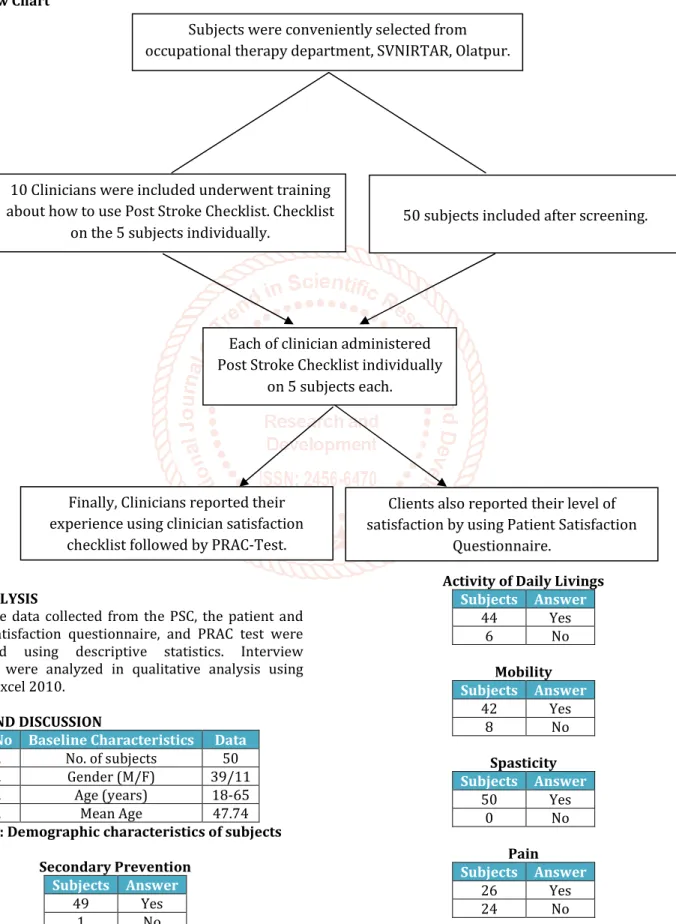
Figure Flow Chart
DATA ANALYSIS
Quantitative data collected from the PSC, the patient and clinician satisfaction questionnaire, and PRAC test were summarized using descriptive statistics. Interview transcripts were analyzed in qualitative analysis using Microsoft Excel 2010.
RESULT AND DISCUSSION
S. No Baseline Characteristics Data
1. No. of subjects 50
2. Gender (M/F) 39/11
3. Age (years) 18-65
4. Mean Age 47.74
Table 4: Demographic characteristics of subjects Secondary Prevention
Subjects Answer
49 Yes
1 No
Activity of Daily Livings
Subjects Answer 44 Yes 6 No Mobility Subjects Answer 42 Yes 8 No Spasticity Subjects Answer 50 Yes 0 No Pain Subjects Answer 26 Yes 24 No
Subjects were conveniently selected from occupational therapy department, SVNIRTAR, Olatpur.
10 Clinicians were included underwent training about how to use Post Stroke Checklist. Checklist
on the 5 subjects individually.
50 subjects included after screening.
Each of clinician administered Post Stroke Checklist individually
on 5 subjects each.
Finally, Clinicians reported their experience using clinician satisfaction
checklist followed by PRAC-Test.
Clients also reported their level of satisfaction by using Patient Satisfaction
Continence Subjects Answer 39 Yes 21 No Communication Subjects Answer 27 Yes 23 No Mood Subjects Answer 39 Yes 11 No Cognition Subjects Answer 28 Yes 22 No
Life After Stroke
Subjects Answer 45 Yes 5 No Carer Relationship Subjects Answer 12 Yes 38 No Sample Characteristics:
Demographic data and clinical information related to the client sample are shown in Table 4. The average age of client was 47.74 with age range in between 18-65 years. The greater part of clients was male (78%).
The study involved 10 Occupational therapists who used PSC with post stroke clients. The therapist and client were individually asked to report about the level of satisfaction with PSC for this purpose Patient Satisfaction Checklist and Clinician Satisfaction Checklist respectively were used. Patient comprehension and relevance of the PSC: Observation of the PSC assessment indicated that the PSC items were generally well understood by clients when read aloud to them by the clinicians. The cognitive debriefing interviews indicated that the clients generally understood and interpreted the items as intended. In addition, the data indicated that the PSC items were mostly relevant to patients, with most clients reporting that they currently experience or have recently experienced the impacts measured.
Most clients appeared to be using the correct recall period of since your stroke or last assessment’ when answering the questions. Some clients attended the assessment with a family member or carer, who also helped the client respond to the PSC items. In some of these cases, the carer interpreted the item in a different manner to the client, or disagreed with the client’s response and encouraged them to change their answer. In these instances, the clinician marked down the client’s final answer.
Observation of the PSC administration also indicated that the items were interpreted consistently between clinicians. In some instances, there was discordance between the clinicians and the client’s interpretation of certain items. Clients spontaneously reported several symptoms and impacts on different areas of daily life during the concept elicitation interviews. The impacts discussed varied greatly between clients.
Feasibility of the PSC:
The PSC recognize a vast range of unmet needs. The most frequently experienced problem for client was spasticity, reported by 100% of clients (Table 8). Life after stroke was also frequently reported (90%) shown in Table 13 and Graph 9, as was Activity of Daily Living 88% (Table 6). Secondary prevention was the least frequently reported problem, reported by 2% of clients (Table 5)
The average time taken to administer the PSC was 10.44 minutes.
Satisfaction with the PSC:
Patient Satisfaction with the PSC assessment was high, with an average rating of 8.26/10. Patient rating of satisfaction that the PSC identified their needs was also high; however, the data indicated that patients believe they are not so likely to receive the health and/or care needed.
Clinician satisfaction with PSC varied greatly between the patients they assessed; however satisfaction was generally high. This suggests that the variability of clinician satisfaction between the patients is due to how the PSC performs with individual patients rather than due to individual clinician.
0 1 2 3 4 5 Easy to explain Concise Precise Informative Practical Simple Exhaustive Quick to complete Unbiased Enhances communication with patient Helps with therapeutic decision making
Average Score
Positive responses from clinicians regarding the content and use of the PSC
The average rating was found to be 8.8/10 with maximizing the clinician ease to identify the patient needs and making referrals.
In terms of clinicians overall views of the PSC, their response regarding the content and ease of use of PSC as measured with PRAC-Test was predominantly positive, with most clinicians indicating that the PSC is easy to explain, concise, practical and quick to complete. These terms were endorsed by 9/10 clinicians, while 8/10 agreed that PSC is unbiased and informative.
Thus, the finding suggest that PSC is a viable and useful measure for identifying long term stroke care needs in a clinical practice setting. Current study shows that the PSC is able to identify a wide range of unmet needs; with life after stroke and ADL being the most frequently identified issues for stroke survivors. Patient and clinician feedback stipulated that majority were highly satisfied with the PSC assessment and its ability to correctly identify their needs. PSC was predominantly understood by patients and considered pertinent to their needs as shown by the qualitative interviews with stroke patients and observation of the PSC assessment.
CONCLUSION
The findings suggest that the Post Stroke Checklist is a feasible and useful measure for identifying long term stroke care needs in a clinical practice setting. The items were generally well understood and considered relevant to stroke survivors, indicating the Post Stroke Checklist is a feasible, useful and relevant measure of poststroke care.
References:
[1] Asplund K, Ashburner S, Cargill K, Hux M, Lees K, Drummond M. Health care resource use and stroke outcome. Multinational comparisons within the GAIN International trial. Int J Technol Assess HealthCare 2003; 19:267–77.
[2] Bagneux V, Barnes N, Arnold B. Development of a standardized faceand content validity test to evaluate patient questionnaires for clinicalpractice. PRO Newsletter 2007; 39:12–4. [Jan 1, 2007]
[3] Braun V, Clarke V. Using thematic analysis in psychology. Qual ResPsychol 2006; 3:77–101. [4] del Ser T, Barba R, Morin MM et al. Evolution of
cognitive impairment after stroke and risk factors for delayed progression. Stroke 2005; 36:2670–5. [5] Department of Health 2007. The national stroke
strategy. Available at
http://webarchive.nationalarchives.gov.uk/+/www.d h.gov.uk/en/Healthcare/Longtermconditions/Vascul ar/Stroke/DH_099065 (accessed January 2013). [6] Dong Y, Sharma VK, Chan BP et al. The Montreal
Cognitive Assessment (MoCA) is superior to the Mini-Mental State Examination (MMSE) for the detection of vascular cognitive impairment afteracute stroke. J Neurol Sci 2010; 299:15–8.
[7] Feigin VL, Barker-Collo S, Parag V et al. Auckland Stroke Outcomes Study. Part 1: gender, stroke types, ethnicity, and functional outcomes5 years poststroke. Neurology 2010; 75:1597–607.
[8] Gamaldo A, Moghekar A, Kilada S, Resnick SM, Zonderman AB, O’Brien R. Effect of a clinical stroke on the risk of dementia in a prospective cohort. Neurology 2006; 67:1363–9.
[9] Kim JS. Post-stroke pain. Expert Rev Neurother 2009; 9:711–21.
[10] Lynch EB, Butt Z, Heinemann A et al. A qualitative study of quality oflife after stroke: the importance of social relationships. J Rehabil Med2008; 40:518–23. [11] McKevitt C, Fudge N, Redfern J, Sheldonkar A, Crichton S, Wolfe C. AStroke Survivor Needs Survey. 1-1-2010. London, The Stroke Association, 2010. [12] Murray CJ, Vos T, Lozano R et al. Disability-adjusted
regions, 1990–2010: a systematic analysis for the Global Burden of Disease Study 2010.Lancet 2012; 380:2197–223.
[13] Murray J, Ashworth R, Forster A, Young J. Developing a primarycare-based stroke service: a review of the qualitative literature. Br J Gen Pract 2003; 53:137–42. [14] National Institute for Health and Clinical Excellence 2008. Stroke: diagnosis and initial management of acute stroke and transient ischaemic attack (TIA).
Available at
http://www.nice.org.uk/nicemedia/live/12018/413 31/41331.pdf (accessed January 2013).
[15] US Department of Health and Human Services. Food and Drug Administration 2009. Guidance for Industry: patient-reportedout come measures: use in medical product development to support labelin
claims. Available at
http://www.fda.gov/downloads/Drugs/Guidances/U CM193282.pdf (accessed January 2013).
[16] Urban PP, Wolf T, Uebele M et al. Occurence and clinical predictors of spasticity after ischemic stroke. Stroke 2010; 41:2016–20.
[17] Venketasubramanian N, Pwee KH, Chen CP. Singapore ministry of health clinical practice guidelines on stroke and transient ischemic attacks. Int J Stroke 2011; 6:251–8.
[18] Wissel J, Olver J, Sunnerhagen KS. Navigating the post stroke continuum of care. J Stroke Cerebrovasc Dis 2013; 22:1–8.
[19] World Stroke Organization 2013. Available at http://www.world-stroke.org (accessed January 2013).