W
HATA
REM
UTUALF
UNDS?
LESSON DESCRIPTIONThe students form class investment clubs that work much in the way mutual funds do. They invest $3,000 (300 shares at $10 a share) in up to six stocks. One year later they revalue their shares and determine whether shares in their class investment clubs have increased or decreased in value. Finally, they read about mutual funds and learn that the concept behind mutual funds is similar to the concept behind their class investment clubs.
INTRODUCTION
A mutual fund is a pool of money invested by a manager with the goal of increasing the value of each share of the fund for its investors. A mutual fund provides diver-sifi cation, spreads risk, and provides the convenience of buying and selling shares in the fund on any business day. These are the reasons why more Americans invest through mutual funds than directly in the stock, bond, or money markets.
CONCEPTS Diversifi cation Liquidity Load
Mutual fund Net asset value Risk and reward OBJECTIVES
Students will be able to:
• Explain how mutual funds work.
• Identify the advantages and disadvan-tages of investing in mutual funds.
• Use the terminology of mutual funds.
• Calculate the value of an investment on a per-share basis.
CONTENT STANDARDS
Voluntary National Content Standards
in Economics, 2nd Edition
• Standard 2: Effective decision
mak-ing requires comparmak-ing the additional costs of alternatives with the additional benefi ts. Many choices involve doing a little more or a little less of something: few choices are “all-or-nothing” deci-sions.
• Standard 10: Institutions evolve and
are created to help individuals and groups accomplish their goals. Banks, labor unions, markets, corporations, legal systems, and not-for-profi t orga-nizations are examples of important institutions. A different kind of insti-tution, clearly defi ned and enforced property rights, is essential to a market economy.
National Standards in K-12 Personal
Finance Education, 3rd edition
• Financial Responsibility and
Decision Making Standard 4: Make
fi nancial decisions by systematically considering alternatives and conse-quences.
• Saving and Investing Standard 1:
Discuss how saving contributes to fi -nancial well-being.
• Saving and Investing Standard 2:
Explain how investing builds wealth and helps meet fi nancial goals.
• Saving and Investing Standard 3:
Evaluate investment alternatives.
• Saving and Investing Standard 4:
Describe how to buy and sell invest-ments.
TIME REQUIRED 60 minutes
MATERIALS
• Slides 6.1, 6.2, and 6.3
• One copy of Activity 6.1, 6.2, 6.3, and 6.4 for each student.
PROCEDURE
1. Explain to the students that they are going to learn about mutual funds. More Americans invest in stocks and bonds through mutual funds than in any other way.
2. Tell the students that a mutual fund is like an investment club with thousands of members. An investment club is any group of people who pool their money, invest, and share the profi ts or losses. The class is now going to form invest-ment clubs with just a few members. 3. Organize the class into groups of no
more than fi ve members each. Tell the students that each group is an invest-ment club. Investinvest-ment club members will have to make some decisions about where to invest their money.
4. Distribute a copy of Activity 6.1 to
each student. Discuss Activity 6.1 and make sure the students understand these major points:
• Each club has $3,000 to invest. • The club sold 300 shares at $10
each to members to raise the mon-ey that thmon-ey will invest.
• They may buy any of six stocks. They must buy at least three stocks, but they may divide their money among all six stocks if they wish to do so.
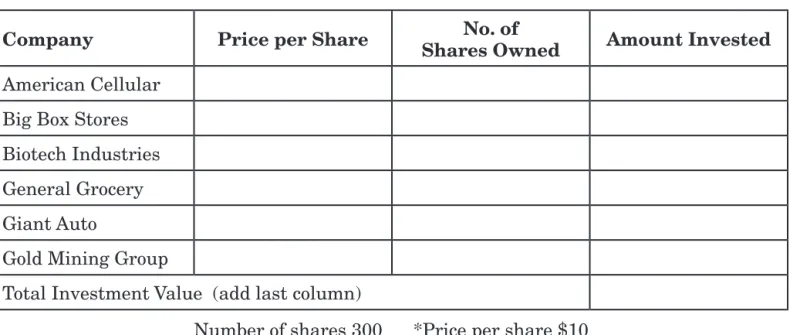
• They must invest the entire $3,000. • They must fi ll out the chart at the
end of Activity 6.1. The investment value must be $3,000 (total of the last column). The price per share will be $10 ($3,000 / 300).
5. Give the groups about 15 minutes to make their investment decisions and complete the charts. Be sure to check their math because the rest of the ac-tivity will not work unless their math is correct.
6. Distribute a copy of Activity 6.2 to
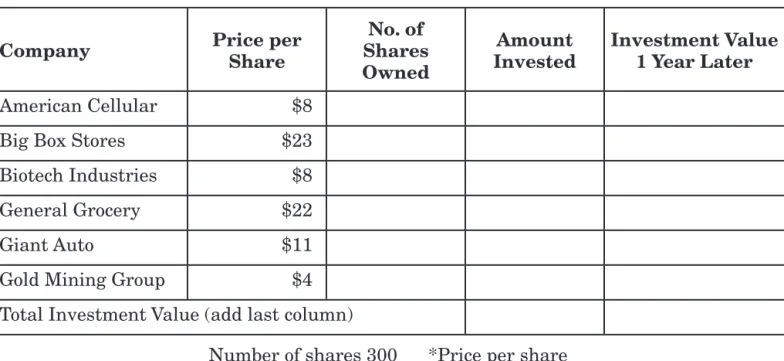
each student. Explain that it is now one year later. The value of the shares of stock they could have bought has changed. Column 2 of Activity 6.2 shows the new per-share price of the stocks. How well did their selected stocks perform?
7. Display Slide 6.1 as an example of
how the chart should be completed. Make sure the students understand that this is an example; their charts will differ depending on which stocks they purchased and how many shares they purchased.
8. Ask the groups to complete their charts and check the math. The amount in-vested will still be $3,000, and the number of shares of stock owned will be the same as in Activity 6.1. The price of the stocks and the investment value of the fund will have changed.
9. Ask the following questions about what happened to the clubs’ investments: A. Did the price per share of the
in-vestment club increase or decrease? (Answers will vary.)
B. What determined whether the price per share of the investment club increased or decreased? (The investment value one year later, which is determined by the price of the stocks purchased.)
C. If you had a real investment club and bought stocks, what would in-crease the value of the investments one year later?
(Choosing stocks that increase in price or pay high dividends.) D. Assume that more students want
to join your investment club and purchase shares. What price would you charge them? Why?
(The price per share one year later or the price per share on the day they want to buy shares. At that price, they buy shares equal to what the shares are worth on that day.) 10. Display Slide 6.2. Explain that
mutu-al funds work like the students’ invest-ment clubs, but with more investors. Stress the key features of mutual funds including price per share, role of the fund manager, and fees.
11. Distribute a copy of Activity 6.3 to each student. The students should read it and answer the questions at the end. 12. Display Slide 6.3. Make the point
that mutual funds are not all the same. They have different investment objec-tives. Some mutual funds concentrate on reducing risk and have relatively low returns. Some offer greater poten-tial rewards along with greater risk. 13. Discuss the answers to the Questions
for Discussion at the end of Activity 6.3:
A. What is a mutual fund?
(A pool of money used by an invest-ment company to buy a variety of stocks and bonds.)
B. A friend tells you, “All mutual funds are the same.” How do you reply to your friend?
(Your friend is wrong. Mutual funds have different investment objectives and buy different stocks and bonds.
Different funds have different man-agers and different styles.)
C. What is an advantage of buying a load fund? What is a disadvan-tage?
(Advantage: A salesperson or in-vestment advisor provides help in choosing a fund. Disadvantage: A load fund costs more because the investor must pay a sales commis-sion.)
D. What is an advantage of buying a no-load fund? What is a disadvan-tage?
(Advantage: There is no sales com-mission, and therefore the cost is less. Disadvantage: The investor must select the fund without advice from a fund representative. The investor must do his or her own research.)
E. What should you consider when de-ciding which mutual fund to buy? (Performance, cost, convenience, and your tolerance for risk. Have the students elaborate on these con-siderations.)
F. More Americans own mutual funds than individual stocks and bonds. Why do you think this is so? (Mutual funds provide diversifi ca-tion, professional management, and ease of buying and selling. It is safer to have money invested in 200 stocks or bonds than in only a few; mutual fund investors spread the risk.)
G. If your class participates in a stock market simulation that allows you to buy mutual funds, what type of fund should you buy? Why?
(Because stock market simulations are for a short time period, you
would probably buy a high-risk, high-reward fund. You might win big or lose big, but if instead you buy safer funds, you have little chance of winning a short-term game.)
H. What are the advantages and dis-advantages of buying index mutual funds rather than actively man-aged funds?
(Index funds provide more diversifi -cation and lower management fees. Index funds are designed to provide returns similar to returns from an unmanaged market index. Actively managed funds can provide higher returns, although studies show most actively managed funds have under-performed index funds.) I. If you want to buy a mutual fund
so that you will have money to buy a house 10 years from now, what type of fund should you buy? Why? (You would buy a fund that you think would increase the most in value over the 10 years; you would look for funds with consistently good long-term records.)
CLOSURE
14. Tell the students that every mutual fund must provide potential investors with a prospectus. Tell them that they will now apply their knowledge by reading some statements from a pro-spectus.
15. Distribute a copy of Activity 6.4 to each student. Have the students read the activity and answer the questions. 16. Discuss the answers:
A. You worry a lot about the stock market and you want to limit the risk of losing your money. Would you buy this fund?
(No. It is an aggressive growth fund specializing in small companies.) B. Does this fund charge a sales
com-mission? (No.)
C. Is it good or bad for investors that this fund charges no 12b-1 fees? (It is good for investors. Some funds charge up to an additional 1 per-cent, which is used to advertise the fund.)
D. How much does this fund charge in fees?
(.91 percent)
E. In your opinion, how does the fund’s past performance look? (It did well last year, losing less money than most indexes, which are averages of groups of stocks or funds. During the 10-year period, it beat all averages. A fund should compare its performance not only to the general market but to indexes that track stocks it buys and other similar stocks. The Russell 2000 is a small-company index, and the Lipper index is for funds specializ-ing in small stocks.)
F. Does this mean the fund will per-form well in the future?
(Not necessarily. Past performance does not guarantee future perfor-mance. Nevertheless, the fund’s track record is good. A prospective investor should check to see if the fund’s investment manager has changed.)
ASSESSMENT
Multiple-Choice Questions
1. A mutual fund without a sales charge is called
a. a load fund. b. a no-load fund. c. a 12b-1 fund.
d. an aggressive growth fund. 2. Which of the following statements
about mutual funds is true?
a. All mutual funds are the same. b. Mutual funds allow investors to
spread risk among several stocks and bonds.
c. Load funds do not charge a sales commission but invest in lower-quality stocks.
d. Many mutual funds do not charge management fees.
3. A 12b-1 fee is a
a. sales commission. b. management fee.
c. fee to pay for fund advertising. d. fee to pay the fund’s brokerage
commissions.
4. In a mutual fund, the price per share that investors pay is called the
a. net asset value. b. management fee. c. load.
d. 12b-1 charge.
Constructed-Response Items
1. Which factors should an investor con-sider before purchasing a mutual fund? (Students should discuss performance, cost, goals, and convenience.)
2. Your grandparents gave you $1,000 to help pay for your college education. You will graduate from high school in four years. What type of mutual fund should you buy?
(Although answers will vary, students should evaluate risk and reward. Since four years is a short time in which to invest the $1,000, students might argue that lower-risk mutual funds such as bond funds or income funds might be appropriate, but much will depend on each student’s tolerance for risk and other circumstances.)
Gen i Connection
Mission 10 of the Gen i Revolution game is all about mutual funds—what they are, as well as the advantages and disadvantages of investing in them. In this mission, students take on the role of operatives advising a student investment club on how to invest in mutual funds. Along the way, students learn that a mutual fund is a pool of money invested by a manager. They learn how to read a mutual fund table. Importantly, they recognize that mutual funds provide diversifi cation. The 4-1-1 tutorial session is similar to Activity 6.1. The print version allows students to choose the amounts of shares they buy. In the 4-1-1, the shares are already chosen, but it has the advantage of being more interac-tive. For the mission conclusion, students solve mutual fund questions and make recommendations about appropriate mutual funds to the investment club.
Gen i Refl ection
Gen i Revolution Mission 10 introduces the idea of a student investment club. Some college and university business programs offer this sort of investment ex-perience to their students. If your school began offering such a club, would you want to join it? Discuss the factors that would infl uence your decision.
The members of your class have decided to form investment clubs. Class members may buy as many shares in a club as they like, for $10 per share. Each club sold 300 shares and col-lected $3,000. Now it’s time to invest the money.
Your club held its fi rst meeting and decided to invest in stocks. The club members proposed different stocks to buy. Here is a rundown on the stocks proposed.
1. American Cellular, $5 per share
This is a new cellular company that features high-tech services such as advanced video. So far, the company has not made a profi t, but it expects to do very well soon.
2. Big Box Stores, $20 per share
Big Box Stores is one of the leading discount retailers in the country. Same-store sales have increased steadily in each of the last fi ve years.
3. Biotech Industries, $10 per share
Biotech Industries is a pharmaceutical company that specializes in developing cutting-edge drugs. It has some profi table products, but so far its profi ts are small.
4. General Grocery, $20 per share
This is a leading grocery store chain. Sales are generally steady and do not change much with the economy’s ups and downs. However, some experts predict that the growing trend toward eating out in restaurants will hurt future sales.
5. Giant Auto, $10 per share
Giant Auto is one of the three leading automobile manufacturers in the world. The com-pany’s profi ts depend on economic conditions. Profi ts are high in times of strong economic growth and poor in bad times or recessions.
6. Gold Mining Group, $5 per share
GMG is a gold-mining company. The price of gold often rises in bad times or recessions and falls in good times.
Your club decided to invest all 300 shares or $3,000 in at least three of these companies. De-cide how to invest the money, and record your investments in Table 1.
A
CTIVITY6.1
Table 1: Making Investment Choices
Company Price per Share Shares OwnedNo. of Amount Invested
American Cellular Big Box Stores Biotech Industries General Grocery Giant Auto
Gold Mining Group
Total Investment Value (add last column)
Number of shares 300 *Price per share $10
One year later, the prices of your investments have changed. The price per share of each investment is listed in Table 1 below.
Complete the chart to determine how well your investment club did. The value of your in-vestment depends on the companies in which you invested.
Table 1: One Year Later
Company Price per Share Shares No. of
Owned
Amount
Invested Investment Value 1 Year Later
American Cellular $8
Big Box Stores $23
Biotech Industries $8
General Grocery $22
Giant Auto $11
Gold Mining Group $4
Total Investment Value (add last column)
Number of shares 300 *Price per share
*The price per share is the total investment value (one year later) divided by the number of shares.
A
CTIVITY6.2
A mutual fund is a pool of money similar to the money collected by a class investment club. A fund manager decides how to invest the money, with the goal of increasing the value of each share of the fund for the investors. That will happen only if the value of the invest-ments chosen by the fund manager increases.
Investors may buy shares of open-end mutual funds each business day for the net asset value (NAV, in the fund listing), the investment value of each share. The net asset value is calculated each day by dividing the total value of the investments by the number of shares. This is how you calculated the value of the shares of your investment club. You may also sell your shares in an open-end mutual fund on any business day and receive the NAV.
More Americans invest through mutual funds than by any other investment method. There are thousands of mutual funds. There are stock mutual funds, bond mutual funds, stock and bond mutual funds, and money-market funds. There are mutual funds that specialize in almost any type of stock or bond. Some mutual funds, called index funds, buy the stocks that allow investors’ returns to match a particular index—for example, the Standard & Poors Index of 500 large stocks. Index funds can provide more diversifi cation than actively man-aged funds. In addition, the management fee of an index fund (discussed later) should be lower because the fund manager does not have to research which stocks to buy and sell. For this reason, many experts advise buying a fund that tracks a broad market index if only one fund is bought.
Some mutual funds buy high-risk investments and some buy low-risk investments. How can you choose the right mutual fund? Here are some factors to consider.
1. Performance. Buy mutual funds that you believe will perform well. Performance is the
most important factor to consider. However, your consideration of performance must be tempered by how much risk you are willing to take. A mutual fund prospectus lists the stocks or bonds a fund owns and provides information on the fund’s performance. But past performance does not guarantee that the fund will do as well in the future. The fund manager is a key to a fund’s performance. It is a good thing if the fund manager has had favorable results and has worked for the fund for a signifi cant period of time.
2. Cost. A mutual fund company makes money by charging investors various fees. These
fees are a cost to investors. The lower the costs, the better it is for investors—as long as performance is strong. Here are some typical costs of mutual funds:
• Some funds charge a load. A load is a sales commission. It is usually a percentage of the price, and it can be as high as 8 percent. A front-end load is paid when you buy shares, and a back-end load is paid when you sell shares. A no-load fund does not charge a sales commission. If you need help in choosing a fund, you might consider paying an investment advisor a load or commission for advice. If you do not need help, choose a no-load fund.
• All funds charge a management fee and have expenses. The lower the management fee and the expenses, the better it is for investors.
A
CTIVITY6.3
• Some mutual funds charge a 12b-1 fee. This fee, which can be as high as 1 percent of the fund’s value, is used by the company to advertise the fund to the public. Unless the fund has great performance, it is better to avoid funds with 12b-1 fees.
3. Convenience. A fund that provides good service is very helpful to investors. Are the
statements easy to read? Are the fund’s service representatives knowledgeable and helpful? Is it easy to make additional investments in the fund? Can you buy small amounts of the fund? Can you exchange shares in the fund for shares in another of the company’s funds? Some fund families have dozens of different funds for different invest-ment objectives.
Advantages of Investing in Mutual Funds
Why buy a mutual fund? After all, you can buy stocks and bonds directly. Many investors fi nd that buying mutual funds provides several advantages over buying individual stocks and bonds. These advantages can make the extra costs worthwhile.
1. Professional management. When you buy a mutual fund, a professional money
man-ager chooses your stocks. The performance of your investment club depended on which stocks you bought. A professional manager might be able to make these choices better than you can. If you don’t think this is true, you can buy an index fund. An index fund follows a stock average, attempting to match the performance of the average. For ex-ample, a Standard & Poors 500 Index fund can simply buy all 500 stocks that are in the index, in that way seeking to match the index’s performance. The investor gets average performance. Over the years, a majority of actively managed funds have failed to beat average performance.
2. Diversifi cation. Diversifi cation means you spend your money on several stocks and
bonds rather than just a few. If one or two stocks or bonds in your mutual fund decrease sharply in value, your loss will be less than if you own only a few stocks or bonds. If a class investment club bought only one stock, it could have a greater loss or greater gain than if the club bought several stocks. Your risk is greater the fewer stocks you buy. A mutual fund may own 500 or more different stocks.
3. Liquidity.Liquidity refers to the ease with which an asset may be exchanged for cash.
A home is usually a valuable asset, but it is not a highly liquid asset because it cannot be exchanged for cash until the owner succeeds in selling it, which may take some time and effort. A mutual fund, by contrast, is a highly liquid asset. If you own shares in a mutual fund, you can sell your shares at the net asset value (NAV) on any business day. Of course, you may need to sell the fund for less per share than what you paid for it, and lose money.
4. Investment objective. There is a mutual fund for almost any objective or goal. When
you determine your goals and the risks you are willing to take, you can probably fi nd a mutual fund that matches them.
Questions for Discussion
A. What is a mutual fund?
B. A friend tells you, “All mutual funds are the same.” How do you reply to your friend?
C. What is an advantage of buying a load fund? What is a disadvantage?
D. What is an advantage of buying a no-load fund? What is a disadvantage?
E. What should you consider when deciding which mutual fund to buy?
F. More Americans own mutual funds than individual stocks and bonds. Why do you think this is so?
G. If your class participates in a stock market simulation that allows you to buy mutual funds, what type of fund should you buy? Why?
H. What are the advantages and disadvantages of buying index mutual funds rather than actively managed funds?
I. If you want to buy a mutual fund so that you will have money to buy a house 10 years from now, what type of fund should you buy? Why?
1. All mutual funds must supply potential investors with a prospectus. A prospectus is a document that provides information about the fund’s investment objectives, investment strategy, past performance, costs, and other charges. The bullet points below present ex-cerpts from one fund’s prospectus. Read the exex-cerpts, including the table showing
Aver-age Annual Total Returns.
• The fund is an aggressive stock fund seeking long-term capital growth primarily through investments in small, rapidly growing companies.
• Investing in smaller companies generally involves greater risk than investing in larger companies. Stocks of small companies are subject to more abrupt or erratic price movements than the stocks of larger companies.
• The fund is 100 percent no-load. There are no 12b-1 fees.
• The fund’s annual management fee and other expenses are .91 percent. These ex-penses are deducted from the fund’s assets.
• The table below summarizes the fund’s average annual returns for one year, fi ve years, and 10 years.
Average Annual Total Returns
Fund Intervals 1 year 5 years 10 years
Returns before taxes -2.84% 8.07% 13.75%
Returns after taxes on distributions -3.33 6.37 11.03 Returns after taxes on distributions
and sale of fund shares -1.30 6.27 10.56
Russell 2000 Growth Index -9.23 2.87 7.19
Russell 2000 Index 2.49 7.52 11.51
S&P 500 Stock Index -11.89 10.70 12.94
Lipper Small-Cap Fund Index -9.32 6.45 10.29
2. Then use your understanding of the prospectus to answer the following Questions for
Discussion:
A. You worry a lot about the stock market and want to limit the risk of losing your money. Would you buy this fund?
A
CTIVITY6.4
B. Does this fund charge a sales commission?
C. Is it good or bad for investors that this fund charges no 12b-1 fees?
D. How much does this fund charge in fees?
E. In your opinion, how does the fund’s past performance look?
One Year Later: An example
This is an example of what might have happened to a class investment club’s shares of stock.
Company Price per Share
Number of Shares Owned
Amount Invested
Investment Value One Year Later American Cellular $8 100 $500 $800 Big Box Retail $23 50 $1,000 $1,150 Biotech Industries $8 0 0 $0 General Grocery $22 0 0 $0 Giant Auto $11 100 $1,000 $1,100 Gold Mining Group $4 100 $500 $400 Total Investment Value (add last column) $3,000 $3,450
Number of shares 300 *Price per share $11.50
*The price per share is the total investment value (one year later) divided by the number of shares. LEARNING, EARNING, AND INVESTINGFORA NEW GENERATION © COUNCILFOR ECONOMIC EDUCATION, NEW YORK, NY
LESSON 6 - WHAT ARE MUTUAL FUNDS?
How Mutual Funds Work
• The price per share changes every day and depends on the value of the investments.
• The value of the investments depends on the performance of the as-sets chosen by the fund manager. Unlike members of an investment club, mutual fund investors do not decide which stocks or bonds the fund will buy or sell. The fund manager does that.
• A mutual fund charges investors for the fi nancial management it pro-vides. The investor may also pay brokers’ fees and other costs. These costs are deducted from the value of the investments. The lower these costs, the higher the investors’ returns from a set of holdings.
• Some mutual funds charge a sales commission called a load. The higher the load, the less the actual investment made on behalf of the investor. Lower loads are better for investors, other things being equal.
LEARNING, EARNING, AND INVESTINGFORA NEW GENERATION © COUNCILFOR ECONOMIC EDUCATION, NEW YORK, NY
LESSON 6 - WHAT ARE MUTUAL FUNDS?
S
LIDE6.1
Types of Mutual Funds
Low Risk and High Risk and
Low Potential Reward High Potential Reward Money
mar-ket funds (short-term securities)
Bond funds (corporate or longer-term government bonds)
Income funds (high-yield stocks and bond funds)
Growth funds (larger company stocks; long-term capital gains)
Aggres-sive growth funds (smaller company stocks; short- and long-term capital gains).
LEARNING, EARNING, AND INVESTINGFORA NEW GENERATION © COUNCILFOR ECONOMIC EDUCATION, NEW YORK, NY
LESSON 6 - WHAT ARE MUTUAL FUNDS?