BONDING AND
STRUCTURE
*
Introduction
The types of chemical bond and the structure of crystal
lattices ultimately determine the properties of a chemical
substance. These properties govern the practical uses of
these substances in our daily lives.
In this chapter
5.1 Properties and classification
page 92
5.2 Lattices
page 94
8]VeiZg
Figure 5.1
Quartz, SiO
2, is a three-dimensional covalent network
lattice. Each silicon atom is bonded to four oxygen
atoms and each oxygen atom is bonded to two silicon
02/0%24)%3 !.$
#,!33)&)#!4)/.
Properties of elements, compounds and mixtures
Iron is a metal that is widely used in modern society. It is extracted from ore bodies located in various regions of Australia including Western Australia. The physical and chemical properties of the ore (a mixture) and its pure components are quite different.Red-brown haematite, iron (III) oxide, is an important iron mineral. In Australia, this mineral is mined extensively and transported to blast furnaces for conversion to iron and steel.
The properties of this compound and its component elements are listed in table 5.1.
Table 5.1 Properties of iron (III) oxide and its elements
Substance iron oxygen iron (III) oxide
Appearance grey-silvery
lustrous metal
colourless gas red-brown solid
Density (g/cm3) 7.9 0.0013 5.2 Melting point (°C) 1535 –219 1565 Boiling point (°C) 2750 –183 Solubility in water (g/100 g) insoluble 0.004 insoluble Reaction with hydrochloric acid
forms iron (II) chloride and hydrogen gas
no reaction forms iron (III) chloride and water
Iron is used extensively in building construction, where it is nor-mally alloyed with other elements to improve its strength, hardness and durability. Steelmaking in Australia is an important economic enterprise as it contributes significantly to our national wealth. The magnetic nature of iron leads to its extensive use in magnets, compasses and electromagnets.
Remember
Before beginning this section, you should be able to: • classify compounds into
groups based on common chemical characteristics • identify a range of common
compounds using their common names and chemical formulae.
Key content
By the end of this section, you should be able to:
• identify differences between physical and chemical properties of elements, compounds and mixtures • describe the physical
properties used to classify compounds as ionic, covalent molecular or covalent network
• perform a first-hand investigation to compare the properties of some common elements in their elemental state with the properties of the compound(s) of these elements (such as magnesium and oxygen).
chemical properties: the properties relating to the chemical reaction of a substance with other chemicals (such as acids, bases and oxidising agents)
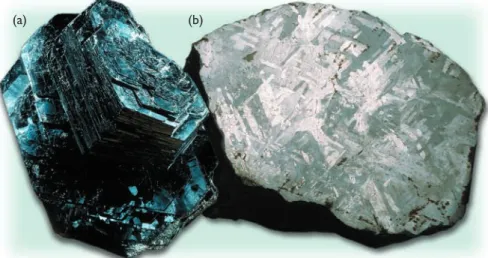
Figure 5.2 Iron oxide (a) and iron (b) have
different crystal structures and different properties. In its pure, anhydrous form, iron (III) oxide (haematite) is ochre brown, but is sometimes black.
*#&
Comparing the properties of a compound and its component elements5.1
PRACTICAL
ACTIVITIES
(a) (b)Classification of chemical compounds
Physical properties can be used to classify compounds into three groups or types of lattice. These groups are:
• ionic compounds
• covalent molecular compounds • covalent network compounds.
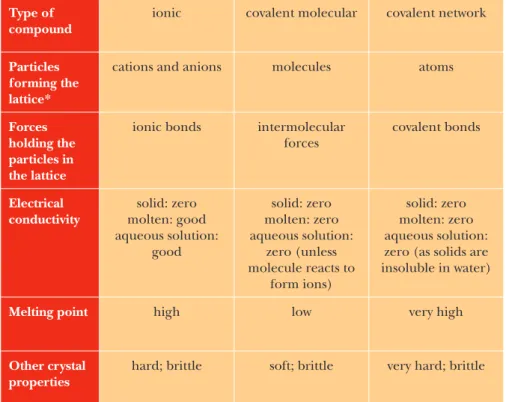
Table 5.2 shows the characteristic physical properties of each of these crystal lattice structures, shown in figure 5.3. (Note: Melting points less than 500 °C are generally called ‘low’, those between 500–1500 °C are called ‘high’, and those greater than 1500 °C are called ‘very high’. There are, however, exceptions to this.)
Table 5.2 Physical properties of crystal lattices. Type of
compound
ionic covalent molecular covalent network
Particles forming the lattice*
cations and anions molecules atoms
Forces holding the particles in the lattice
ionic bonds intermolecular
forces covalent bonds Electrical conductivity solid: zero molten: good aqueous solution: good solid: zero molten: zero aqueous solution: zero (unless molecule reacts to form ions) solid: zero molten: zero aqueous solution: zero (as solids are insoluble in water)
Melting point high low very high
Other crystal properties
hard; brittle soft; brittle very hard; brittle
*‘Lattice’ is the geometric arrangement of particles in a crystalline solid.
Figure 5.3 Particle diagrams of crystal
lattice groups
Covalent molecular
Ionic Covalent network
– – – + – – + + + – + +
Identify the crystal lattice group to which compound X belongs based on the following physical properties: white, crystalline solid; melting point 41 °C; boiling point 182 °C; soluble in water; non-conductor of electricity in the solid, molten and aqueous states.
X is a covalent molecular compound. It has zero electrical conductivity in all states, so cannot be ionic. It has low melting and boiling points, which is not characteristic of covalent networks. Therefore, X is a covalent molecular compound.
SOLUTION
Figure 5.4
Uranium is a heavy, radioactive metal.
,!44)#%3
Metallic lattices and properties
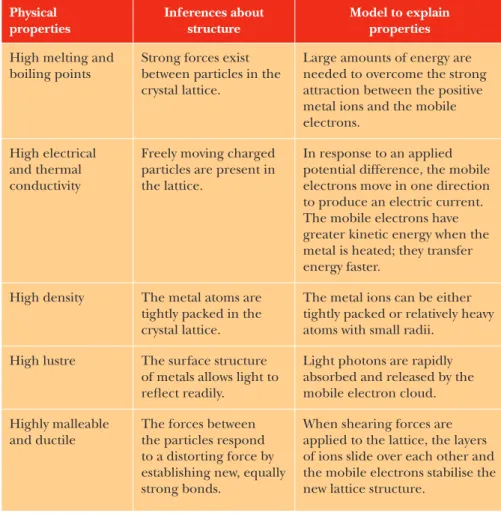
Metals generally have a range of properties that distinguish them from other substances. These physical properties allow us to make inferences about the structure of the metallic crystal. Table 5.3 lists these metallic properties, inferences that could explain these properties and a model to explain the properties.
*#'
*#'
5.1
QUESTIONS
1. Use the data in table 5.1 to explain why iron (III) oxide cannot be a simple mixture of iron and oxygen.
2. Iron metal dissolves slowly in dilute
hydrochloric acid to form iron (II) chloride. (a) Identify the gas produced in this reaction. (b) Write a balanced chemical equation for
this reaction.
(c) Describe the differences between this reaction and the reaction of iron (III) oxide and dilute hydrochloric acid. (Hint: Use table 5.1.)
3. Identify the crystal lattice groups into which compounds can be classified.
4. Name the crystal lattice group to which each of the following statements applies.
(a) The lattice is composed of discrete molecules.
(b) The lattice has a three-dimensional network of covalent bonds.
(c) The crystals do not conduct electricity except when melted.
5. Identify the crystal lattice groups to which compounds A and B belong based on the following physical properties.
Substance A:
white; crystalline; density 2.0 g/cm3;
melting point 770 °C; boiling point 1437 °C;
solubility in water 36 g/100 g water; aqueous solution conducts electricity. Substance B :
white; crystalline; density 2.1 g/cm3;
melting point 24 °C; boiling point 173 °C; reacts with water to produce a solution that conducts electricity; solid does not conduct electricity; does not conduct electricity when melted.
Remember
Before beginning this section, you should be able to: • classify compounds into
groups based on common chemical characteristics.
Table 5.3 Properties of metallic lattices Physical properties Inferences about structure Model to explain properties High melting and
boiling points
Strong forces exist between particles in the crystal lattice.
Large amounts of energy are needed to overcome the strong attraction between the positive metal ions and the mobile electrons.
High electrical and thermal conductivity
Freely moving charged particles are present in the lattice.
In response to an applied potential difference, the mobile electrons move in one direction to produce an electric current. The mobile electrons have greater kinetic energy when the metal is heated; they transfer energy faster.
High density The metal atoms are tightly packed in the crystal lattice.
The metal ions can be either tightly packed or relatively heavy atoms with small radii.
High lustre The surface structure of metals allows light to reflect readily.
Light photons are rapidly absorbed and released by the mobile electron cloud. Highly malleable
and ductile
The forces between the particles respond to a distorting force by establishing new, equally strong bonds.
When shearing forces are applied to the lattice, the layers of ions slide over each other and the mobile electrons stabilise the new lattice structure.
Key content
By the end of this section, you should be able to:
• distinguish between metallic, ionic and covalent bonds • describe metals as
three-dimensional lattices of ions in a sea of electrons
• describe ionic compounds in terms of repeating three-dimensional lattices of ions • explain why the formula for
an ionic compound is an empirical formula
• identify common elements that exist as molecules or as covalent lattices
• explain the relationship between the properties of conductivity and hardness and the structure of ionic, covalent molecular and covalent network compounds • choose resources and process
information from secondary sources to construct and discuss the limitations of models of ionic lattices, covalent molecules and covalent and metallic lattices • perform an investigation
to examine the physical properties of a range of common substances in order to classify them as metallic, ionic or covalent molecular or covalent network substances and relate their characteristics to their uses.
Model of a metallic crystal
The model of the metallic crystal, shown in figure 5.5, has the following features.
1. Positive metal ions (rather than neutral atoms) are arranged in a regular three-dimensional lattice.
2. A ‘cloud’ or ‘sea’ of delocalised electrons moves throughout the lattice.
3. Delocalised electrons have been lost from the valence shell of each metal atom and belong to the lattice as a whole.
4. The attraction between the positive metal ions and the delocalised electron cloud stabilises the lattice.
5. The attraction between the metal ions and electron cloud is called the metallic bond. Metallic bonds are strong chemical bonds.
delocalised electrons:electrons that are not bound to any one atom but are free to move throughout the lattice
metallic bond:a strong
attractive force that holds metal ions in their crystal lattice; the attraction between metal ions and the sea of mobile electrons
delocalised electrons:electrons that are not bound to any one atom but are free to move throughout the lattice
metallic bond:a strong
attractive force that holds metal ions in their crystal lattice; the attraction between metal ions and the sea of mobile electrons
Fixed metal ions Negative electron cloud (mobile) + + + + + + + + + + + + + + + + + + + + + + + + Metallic bonding maintained + + + + + + + + + + + + + + + + + + + + + + + + + + + + + + Shearing force
Figure 5.5 (a) Metallic lattice (b) Malleability of a metallic lattice
Oxide ion
Titanium ion
Titanium oxide
Ionic lattices and properties
Ionic crystals are characterised by a continuous three-dimensional arrange-ment of cations and anions. Attraction between oppositely charged ions is called an ionic bond, which are strong chemical bonds. Generally, ionic solids have high melting points because of the strong ionic bonds through-out the lattice. These ionic bonds also explain the hardness of ionic crystals. However, ionic crystals are brittle and shatter when hammered. Shearing forces cause ions of similar charge to come in close contact, leading to strong repulsion, so the crystals shatter.
Unlike metallic lattices, ionic lattices do not have free electrons or free ions to carry charge if a voltage is applied across the crystal, so ionic crystals do not conduct electricity. If a crystal is melted or dissolved in a suitable solvent such as water, the ions are no longer bound to the lattice and are free to move. Such molten salts or ionic solutions are good electrical conductors.
Figure 5.6 shows some common ionic lattices. Note that the ions are arranged in several different patterns depending on their size.
Figure 5.6 Ionic lattices: (a) titanium oxide and (b) calcium carbonate
Figure 5.7
Fool’s gold is the mineral pyrite, FeS2. It is an ionic crystal. Calcium ion Carbonate ion at centre Calcium carbonate (a) (b)
Empirical formulae
The empirical formula of a compound represents its atomic or ionic composition expressed as a simple whole number ratio.
Examples:
1. Ethane is a covalent molecular compound with the molecular formula C2H6. Its molecules are composed of two atoms of carbon bonded to six atoms of hydrogen. The C : H ratio of 2 : 6 is not the simplest ratio. The simplest ratio is 1 : 3, so the empirical formula of ethane is CH3. 2. Benzene is also a covalent molecular compound. Its molecular formula
is C6H6. The C : H ratio of 6 : 6 is not the simplest ratio. The simplest ratio of atoms is 1 : 1, so the empirical formula of benzene is CH.
Chloride ion
Sodium ion
Ionic compounds present a different problem because their lattices are continuous in three dimensions, and there are no discrete molecules as in molecular compounds. Consequently, chemists identify the simplest repeating unit of the crystal and call it the unit cell. In the unit cell, there are some ions that belong to that cell only, while others at edges and cor-ners belong partly to other cells. When these fractions of ions are taken into account, the simplest ratio of ions can be determined for the unit cell. This simple ratio is the empirical formula of the ionic compound. Let us examine an example for sodium chloride; figure 5.8 shows its cubic unit cell.
The unit cell for sodium chloride shows the following: • One sodium ion is at the centre of the cell.
• Twelve sodium ions occupy the centre of each edge. These ions are shared by a total of four unit cells.
• Eight chloride ions occupy the corners of the cell. These ions are shared by a total of eight unit cells.
• Six chloride ions occupy the centres of each face of the cell. Two adjoin-ing unit cells share these ions.
Thus, for sodium chloride, the total number of sodium ions belonging to each unit cell: r1
1 124 1 3 4
and the number of chloride ions: r
18 8 r12 6 1 3 4.
The ratio of sodium ions to chloride ions is 4 : 4 or 1 : 1, so the empirical formula of sodium chloride is NaCl.
When we write the chemical formula of an ionic compound, we are writing its empirical formula. This represents the ratio of ions throughout the whole crystal lattice.
Figure 5.8
Unit cell for sodium chloride
Covalent network lattices and properties
Covalent network compounds, such as silicon dioxide (shown in figure 5.9) and silicon carbide, are composed of a three-dimensional array of atoms linked by strong covalent bonds. Such a structure is very strong and rigid, which explains the hardness of such substances. Like ionic crystals, they shatter under high shearing forces.
Covalent network compounds, as well as covalent network elements such as diamond, have very high melting points. For example, silicon dioxide has a melting point of 1713 °C and silicon nitride has a melting point of 1900 °C. They do not conduct electricity in the solid state as
Write the empirical formulae for the following ionic compounds: (a) barium bromide
(b) iron (III) sulfide.
Use the valency rules to work out the chemical formula of each ionic compound. This will also be its empirical formula.
(a) valency of barium 2;
valency of bromide 1; empirical formula is BaBr2 (b) valency of iron (III) 3;
valency of sulfide 2; empirical formula is Fe2S3
SOLUTION
DATA
ANALYSIS
5.3
Comparing the properties of crystals
there are no free electrons or ions to allow conduction. Covalent network compounds are also highly insoluble in common solvents.
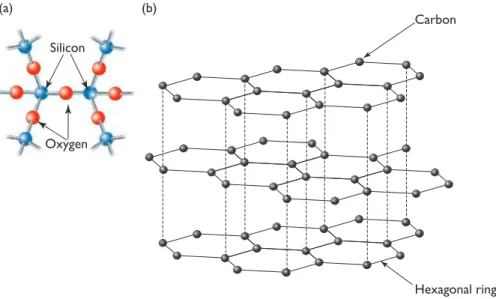
Carbon in the form of graphite is an example of a covalent network crystal (shown in figure 5.9). It does conduct electricity due to the pres-ence of free electrons along one axis of the lattice. Diamond (which is also a form of carbon) forms a strong covalent network lattice, so does not conduct. It is the hardest natural substance.
Figure 5.9
Covalent network structure of (a) silicon dioxide and (b) graphite
Figure 5.10
Structures of covalent molecular crystals: (a) carbon dioxide and (b) iodine Carbon Hexag Carbon dioxide Oxygen Iodine molecules (I2) Iodine
Covalent molecular lattices and properties
Covalent molecular lattices, such as ice and dry ice (solid carbon dioxide) contain discrete molecules arranged in various geometric patterns. These molecules are held in place within the lattice by intermolecular forces, which are not as strong as normal chemical bonds. Comparatively little energy is required to break these attractive forces, so such crystals have low melting points. These weak forces also make these crystals soft and readily deformable.
The absence of mobile charge carriers (such as electrons in metals, or ions in molten ionic salts) means that such crystals do not conduct electricity, even when melted or dissolved in a suitable solvent. Figure 5.10 shows the lattice structures of some covalent molecular compounds.
It is also important to remember that some common non-metals, such as sulfur, iodine and phosphorus, also form covalent molecular crystals. Such crystals have low melting points and readily shatter when subjected to shearing forces. (a) (b) (a) (b) Silicon Oxygen Modelling crystal lattices
PRACTICAL
ACTIVITIES
5.2
SYLLABUS FOCUS
8. USING KEYS TO CLASSIFY CRYSTALS
Dichotomous keys can be used to classify crystals into lattice groups based on measured physical properties. Two different ways of representing a dichotomous key are shown below. The first is a written key where you make choices (A or B) at each step. The second is a diagrammatic key that allows you to make choices and move along different paths of the key as you respond to each question.
Written key
1A. The solid crystal conducts electricity. ... 1B. The solid crystal does not conduct electricity. ... 2A. The melted crystal conducts electricity. ... 2B. The melted crystal does not conduct electricity. .. 3A. The solid has a very high melting point
(much higher than 500 °C). ... 3B. The solid has a very low melting point. ...
. Metallic crystal
. Go to 2. . Ionic crystal
. Go to 3.
. Covalent network crystal . Covalent molecular crystal
Figure 5.11
Diagrammatic key to classify crystals
Crystals Does the solid crystal
conduct electricity?
Is the crystal black? Does the melted crystal conduct electricity? No Graphite, covalent network crystal Metallic crystal Yes Yes No Ionic crystal
Does the crystal have a very high melting point, much greater than 500 ºC? Yes No Covalent network crystal Covalent molecular crystal Yes No Diagrammatic key
5.2
QUESTIONS
1. Classify the following substances into one of the four crystalline groups: ionic, metallic, covalent network or covalent molecular. (a) Cobalt (b) Silicon nitride (c) Barium iodide (d) Nickel oxide (e) Phosphorus (f) Diamond
2. Sonja was provided with an unknown solid X. Her teacher asked her to devise some laboratory tests that would allow her to determine the type of bonding in the crystal. Describe the tests that Sonja will conduct. 3. Explain, in terms of structure and bonding,
the following differences in physical properties.
(a) Manganese has a high melting point (1244 °C) and oxygen has a low melting point (–219 °C).
(b) Zinc conducts electricity but zinc oxide does not.
(c) Nickel is lustrous but nickel oxide is dull. (d) Tungsten has a much greater density
than aluminium.
4. Use the model of the structure and bonding within a metallic crystal to explain the following properties of silver.
(a) Silver has a high melting point (962 °C). (b) Silver is an excellent electrical conductor. (c) Silver is lustrous when new but gradually
becomes coated in a black deposit. (d) Silver is malleable and ductile. 5. Ahmed placed some iodine crystals in a
beaker and gently heated the beaker. The iodine crystals sublimed to produce purple vapours.
(a) Classify iodine into its correct lattice group.
(b) Explain why iodine vapour forms so readily on heating the solid.
(c) Ahmed observed that, when the iodine vapour came into contact with a cold surface, fine crystals of iodine reformed. Write an equation for this process. (d) Classify the process in (c) as physical or
chemical.
6. Substance K consists of white, waxy crystals that melt readily at 51 °C. The substance does not conduct electricity when solid or melted.
(a) Classify substance K into one of the four crystalline groups. Justify your answer. (b) Predict whether this waxy solid would be
soluble in water or kerosene. Justify your answer.
7. Some white crystals were found in an unlabelled bottle. The crystals did not dissolve in water or kerosene. They did not conduct electricity in the solid state.
(a) Explain whether or not the information above is sufficient to classify this white substance into a crystalline group. (b) The crystals were heated until they
melted and found to be a good
conductor. Classify the crystals into their correct group.
8. Graphite is a black solid. Some chemists consider it to be an unusual non-metal. (a) Identify the element present in graphite. (b) Name two physical properties of graphite
that are not typical of non-metals. (c) Classify graphite into its correct lattice
group.
Figure 5.12
Graphite is made of flat sheets of carbon atoms. Weak dispersion forces hold these flat sheets together. Graphite is used in pencils because the sheets of carbon readily rub off onto the paper. It is also used as dry lubricant.
SYLLABUS FOCUS
9. USING INSTRUCTION TERMS CORRECTLY
When answering questions, it is important to know what the instruction terms (verbs) require you to do. Here is an example.
‘Discuss’
This instruction term requires you to identify issues and provide points for and against.
Example:
Discuss the issues associated with modelling a metallic crystal. Answer:
Physical models do not reveal all the essential features of a metallic crystal. It is simple to show the location of each metal ion in the lattice using either ball-and-stick or space-filling models, but the representation of the mobile electron cloud is very difficult. The use of animation is more suitable for showing the nature of the pervading electron cloud throughout the lattice. Animated models can also show why metals are lustrous and good electrical conductors.
SUMMARY
• Elements and compounds differ in their physical and chemical properties. The properties of these materials determine their use. • Crystalline solids can be classified as metallic, ionic, covalent
network or covalent molecular lattices.
• Metallic bonds are found in metals. These bonds are formed by interaction of the mobile electron cloud and the positive metal ions in the lattice.
• Ionic bonds are found in ionic compounds. They are the attractive forces between oppositely charged ions.
• Covalent bonds are formed by the sharing of electron pairs between neighbouring atoms. Covalent bonds link atoms in a molecule.
• The properties of different crystals can be related to their lattice structures and the types of chemical bonding within the lattice. • Metallic crystals, ionic crystals and covalent network crystals have
strong three-dimensional bonding throughout the lattice. • Covalent molecular crystals have weak bonding between the
molecules in the crystal lattice. MODULE
REVISION 1
5.1
COMPARING THE PROPERTIES
OF A COMPOUND AND ITS
COMPONENT ELEMENTS
Aim
To compare the properties of magnesium, oxygen and magnesium oxide
Safety issues
• Wear safety glasses throughout this experiment.
• Do not look directly at magnesium as it burns;
the light may damage your eyes.
• Identify other safety issues relevant to this
experiment by reading the method.
Materials
• 2 gas jars and lids • teaspoon
• manganese dioxide
• 10 mL measuring cylinder
• 3% hydrogen peroxide
• 3 strips of magnesium ribbon, about 4 cm long • tongs
• watch glass
• test-tube holder
• 4 test tubes and stoppers • 1 mol/L hydrochloric acid
• magnesium oxide
Method
Ensure that your safety glasses are on. Part A: Oxygen gas and magnesium metal
1. Prepare a gas jar of oxygen by placing half a teaspoon of manganese dioxide powder in a gas jar and adding 10–20 mL of 3% hydrogen peroxide. Allow air to be expelled initially and then cover the jar with a gas jar lid. Record your observations.
2. Examine the samples of magnesium ribbon and describe their appearance.
3. Support a 4 cm strip of magnesium ribbon with a pair of tongs. Ignite the end of the magnesium and allow it to burn over a watch glass.
4. Repeat step 3 by igniting a second strip and allowing it to burn in the gas jar of oxygen prepared in step 1 above. Compare the combustion of magnesium in air and oxygen. 5. Place a 4 cm strip of magnesium in a test tube
and add 5 mL of dilute hydrochloric acid. Observe and record your observations. 6. The following data has been gathered for
oxygen gas and magnesium. Use this data to write a comparison of these two elements.
PRACTICAL
ACTIVITIES
PRACTICAL
ACTIVITIES
Oxygen
• discovered in 1773 by Karl Scheele, Sweden • colourless
• odourless
• supports combustion (rekindles a glowing
wooden splint)
• melting point –219 °C • boiling point –183 °C
• solubility in water 0.004 g/100 g water • thermal conductivity 0.0026 J/s/m/K
(compared with 80 J/s/m/K for iron)
• electrical conductivity 0 • structure: diatomic molecule
Magnesium
•
discovered in 1808 by Humphry Davy, England
• silvery-grey solid • malleable and ductile • melting point 650 °C • boiling point 1110 °C • insoluble in water • thermal conductivity 156 J/s/m/K (compared with 429 J/s/m/K for silver) • electrical conductivity 22 MS/m (compared with 63 MS/m for silver)
Part B: Magnesium oxide
1. Examine a sample of magnesium oxide and describe its appearance.
2. Heat a small sample of magnesium oxide in a dry test tube over a Bunsen flame. Determine whether the solid is stable when heated.
3. Place a very small amount of magnesium oxide in a small clean test tube and test its solubility in 5 mL of tap water. Stopper the tube and shake thoroughly. Record your observations.
4. Test the solubility of a very small amount of magnesium oxide in 5 mL of dilute hydrochloric acid. Record your observations. 5. The following additional data has been
collected for magnesium oxide. Use this data and your observations in the above tests to write a description of this compound and compare its properties with those of its component elements.
Results and analysis
1. Record all your observations in an appropriate format.
2. Magnesium metal and magnesium oxide both react with hydrochloric acid to produce a solution of magnesium chloride.
(a) Write balanced chemical equations for each of these reactions.
(b) Identify any differences between these two chemical changes.
Conclusion
Write a brief conclusion for this experiment.
5.2
MODELLING CRYSTAL LATTICES
Aim
To construct and describe a variety of crystal lattices
Materials
• graphite ball-and-stick model • molecular modelling kits
• table tennis balls, plasticine or similar • foam balls
• toothpicks
Method
Divide into groups. Each group should construct a different model. All groups can observe and discuss these models.
Part A: Metallic crystal — sodium
Sodium is an active metal with a body-centred cubic lattice. Use 9 balls of the same size and colour to construct the unit cell of its crystal lattice. The unit cell represents the simplest unit of the crystal lattice. The lattice is made up of repeating unit cells. Use the ball-and-stick model in figure 5.13 as a guide to each of the three layers of the cell.
PRACTICAL
ACTIVITIES
PRACTICAL
ACTIVITIES
Figure 5.13
Ball-and-stick model of unit cell of sodium
Magnesium oxide
• melting point 2852 °C • boiling point 3600 °C • insoluble in water Layer 1 — 4 atoms Layer 2 — 1 atom Layer 3 — 4 atomsDATA
ANALYSIS
Part B: Ionic crystal — caesium chlorideCaesium chloride also forms a body-centred cubic crystal, but the caesium ion occupies the centre of the cell and the eight chloride ions occupy the corners. Caesium ions are about 5% smaller in radius than chloride ions. Use this description to make your model. Select one coloured ball for the caesium ion and select eight balls of a different colour for the chloride ions.
Part C: Covalent network crystal — graphite
Figure 5.9b shows a ball-and stick model of the graphite lattice. Use foam balls and toothpicks to construct a space-filling model of part of this lattice.
Part D: Covalent molecular crystal — carbon dioxide
Figure 5.14 shows a ball-and-stick model of the unit cell of solid carbon dioxide. Use the molecular model kit or plasticine and toothpicks to construct enough carbon dioxide models to build the unit cell.
Results and analysis
1. Draw clear, labelled diagrams of each model constructed.
2. Discuss the advantages and limitations of the models.
Conclusion
Write a brief conclusion for this experiment.
5.3
COMPARING THE PROPERTIES
OF CRYSTALS
Part A
Properties of four solid substances (A, B, C and D) were investigated by experiment.
1. Process the data in table 5.4 and classify these solids into one of the four crystalline groups. Justify your conclusions.
2. Another twenty crystals were tested. The students found that most ionic crystals dissolved in water but not in kerosene, and that most covalent molecular crystals dissolved in kerosene but not water. They found that metallic and covalent network crystals did not dissolve in either solvent. The students used this new information to create a key to classify crystals. Here is the beginning of the key.
Complete the key.
Part B
Read the following description of the properties of substance E and then answer the questions
that follow.
Substance E is composed of clear, red crystals. When the red crystals are heated, they crackle and change into a blue liquid, which cools to form a blue solid. Heating also produces vapour of substance X. The vapour is allowed to condense to form a colourless liquid that is a non-conductor of electricity. The colourless liquid of substance X
is cooled until it forms a white solid. The solid of substance X does not conduct electricity. The red crystals of substance E are found to be quite soluble
1A. The crystal does conduct electricity. ... Metallic crystal 1B. The crystal does not conduct electricity. ...
Go to 2.
1A. The crystal does conduct electricity. ... Metallic crystal 1B. The crystal does not conduct electricity. ...
Go to 2.
DATA ANALYSIS
Figure 5.14
Ball-and-stick model of carbon dioxide unit cell
1 molecule in the centre of 14 molecules of carbon dioxide
in the unit cell
5 molecules in the top layer
Carbon dioxide molecule
5 molecules in the bottom layer
in water, but they do not dissolve in kerosene. Neither the red crystals nor the blue solid conducts electricity, although the red, aqueous solution of substance E is a good conductor.
1. Classify substance E into one of the four crystalline groups. Justify your conclusion. 2. Classify substance X into one of the four
crystalline groups. Justify your conclusion. 3. Explain the structural relationship between the
red and blue solids.
DATA
ANALYSIS
Table 5.4
Substance A B C D
Appearance dull, black lustrous, silvery yellow crystals white crystals
Melting point (°C) 3974 419 113 decomposes
Effect of heating to 1000 °C in a vacuum
no visible change forms a
silvery liquid turns to red-brown, viscous liquid crackles; brown gas forms Appearance after heating
no effect silvery solid brown solid yellow solid forms
Solubility in water insoluble insoluble insoluble soluble
Solubility in kerosene insoluble insoluble soluble insoluble
Electrical conductivity of solid crystal
good good zero zero
Electrical conductivity of melted crystal good zero Electrical conductivity of aqueous solution good