On the Use of Variable Complementarity for
Feature Selection in Cancer Classification
Patrick E. Meyer and Gianluca Bontempi
Universit´e Libre de Bruxelles, (CP 212), 1050 Bruxelles, Belgique, (pmeyer,gbonte)@ulb.ac.be
home page:http://ulb.ac.be/di/mlg/
Abstract. The paper presents an original filter approach for effective feature selection in classification tasks with a very large number of input variables. The approach is based on the use of a new information theo-retic selection criterion: the double input symmetrical relevance (DISR). The rationale of the criterion is that a set of variables can return an information on the output class that is higher than the sum of the infor-mations of each variable taken individually. This property will be made explicit by defining the measure ofvariable complementarity. A feature selection filter based on the DISR criterion is compared in theoretical and experimental terms to recently proposed information theoretic cri-teria. Experimental results on a set of eleven microarray classification tasks show that the proposed technique is competitive with existing fil-ter selection methods.
1
Introduction
issues, it is typically necessary to reduce the number of variables before starting a learning procedure. Furthermore, selecting features (i.e. genes) can increase the intelligibility of a model while at the same time decreasing measurements and storage requirements [1]. A number of experimental studies [2–4] have shown that irrelevant and redundant features can dramatically reduce the predictive accuracy of models builded from data.
Feature selectionis a topic of machine learning whose objective is selecting, among a set of input variables, the ones that will lead to the best predictive model. We can formulate this problem as a stochastic optimization problem since the search for the best subset have to be conducted on the basis of sta-tistical estimates of the accuracy associated to a given subset. Two well-known approaches in feature selection combine a search strategy with a stochastic eval-uation function: the filter approach and the wrapper approach (see [3, 2]). In the wrapper approach, the evaluation function is the validation outcome (e.g. by leave-one-out) of the learning algorithm itself. In the filter approach, examples of evaluation functions are probabilistic distance, interclass distance, information theoretic or probabilistic dependence measures. These measures are often con-sidered as intrinsic properties of the data, because they are calculated directly on the raw data instead of requiring a learning model that smoothes distributions or reduces the noise.
As a consequence of the increasing number of variables in datasets, search algorithms have evolved from exhaustive search [5] to heuristic search [2, 6–8] and evaluation functions are moving from learning algorithms (in the case of wrappers) [3, 2, 6, 7] to fast dependence measure such as mutual information (in the case of filters) [9–12]. Formal definitions of relevance [2, 8] and redundancy [10] have been developped in order to guide the search and render algorithms faster.
This paper will focus on the use of filter techniques for feature selection in supervised classification tasks. In particular, we present an original filter ap-proach based on a new information theoretic selection criterion, called thedouble input symmetrical relevance (DISR). This criterion combines two well known in-tuitions of feature selection: first, a combination of variables can return more information on the output class than the sum of the information returned by each of the variables taken individually. This property will be made explicit by defining the notion ofvariable complementarity. Secondly, in absence of any fur-ther knowledge on how subsets of dvariables should combine, it is intuitive to assume a combination of the best performing subsets of d−1 variables as the most promising set. This intuition will be made formal by the computation of a lower-bound on the information of a subset of variables expressed as the average of information of all its sub-subsets.
search strategy are compared. In our experiments we compare the filter based on DISR with four state-of the art approaches: a Ranking algorithm [12] and three filters based on the same search strategy˜: the forward selection. The three state-of-the-art criteria are the Relevance criterion [8], the Minimum Redudancy Maximum Relevance criterion [9] and the Conditional Mutual Information Max-imization criterion [11]. The assessment of the different filters is obtained by measuring the classification accuracy of several learning algorithms which adopt as inputs the set of variables returned by each of the filter methods. For our benchmark purposes, we use eleven public-domain multi-class microarray gene expression datasets. The experimental results show that the proposed technique is competitive with existing filter selection methods.
The outline of the paper is the following. Section 2 will introduce the basic notions of information theory and our definition of variable complementarity. Section 3 recalls four state-of-art information theoretic criteria which have been proposed in literature to deal with the feature selection problem. Section 4 pro-vides the theoretical justification of the DISR information theoretic criterion. Section 5 illustrates the experimental results. The conclusions are summarized in Section 6.
2
Information theoretic notions for feature selection
This paper deals with supervised multi-class classification. We will assume ei-ther that all the variables are discrete or that they can be made discrete by a quantization step. Hereafter, we will denote by Y the discrete output random variable representing the class and by X the multi-dimensional discrete input random variable.
In qualitative terms, feature selection boils down to select, among a set of potential variables, the mostrelevantones. At the same time it would be appeal-ing that these selected variables are notredundant. The notions of relevance and redundancy can be made more formal thanks to the use of dependency measures [2, 10].
Let us first introduce some concepts of information theory:
Definition 1. [13] The conditional entropy ofY givenZ, denoted byH(Y|Z) is defined as:
H(Y|Z) =−X
y∈Y
X
z∈Z
p(y, z) logp(y|z) (1)
and theI(X;Y|Z) is the conditional mutual information.
Definition 2. [13] The conditional mutual information of the random variables
X andY givenZ is defined as:
I(X;Y|Z) =H(X|Z)−H(X|Z, Y) (2)
Definition 3. Relevance.
Consider three random variables X,Y and Z and their joint probability distri-bution pX,Y,Z(x, y, z). If H(Y|Z) = 0, then the variable relevance of X to Y
given Z, denoted by r(X;Y|Z), is zero. Else if H(Y|Z)6= 0, then the variable relevance ofX toY givenZ is defined as:
r(X;Y|Z) =I(X;Y|Z)
H(Y|Z) (3)
According to this definition the relevance is a function 0 ≤ r(X;Y|Z) ≤ 1 that measures the relative reduction of uncertainty of Y
provided byX once the value ofZ is given.
In the following, we rather consider as measure of relevance the classical (non-normalized) mutual information, i.e. I(Xi;Y|XS), where Xi denotes an
input variable andXS a subset of variables not containingXi.
The formalization of the notion of relevance makes explicit one of the major challenges in feature selection: the mutual information between an input variable
Xiand the output classY isconditionally dependent. This means that an input
variable Xi having a significative relevance to Y given XS, can return a null
relevance conditioned on an other variable. The following two examples may serve to better illustrate this idea.
Example 1. Consider the four random variables Y, Xi, XS and XM such that
Y =Xi+XS andXM =X2i.
Given XS, Xi has a large relevance (I(Xi;Y|XS) = H(Y|XS)), while its
rele-vance goes to zero in the case where it is conditioned toXM (i.e.I(Xi;Y|XM) =
0). In this example, Xi andXM have both a high mutual information with the
output Y but a low conditional mutual information when conditioned to the other variable.
The next example shows that the relevance can also increase by conditioning.
Example 2. Consider the three random variablesY, XiandXS such thatY and
Xiare independent andY =Xi+XS.
In this case the mutual information ofXi withY is zero (I(Xi;Y) = 0) whereas
the conditional mutual informatione increases up when conditioned to XS (i.e.
I(Xi;Y|XS) =H(Y|XS)).
Several definitions of a relevant variable and a redundant variable have been well defined in the literature, see [2, 3, 10].
These examples show that it is hard to predict, in terms of relevance, the joint effect of several input variables on an output variableY.
As shown in Example 1 the mutual informationI(Xi,j;Y) of a set{Xi, Xj}
are considered separately. In this case we say that the two variables are comple-mentary. Note thatvariable complementarityshould warn us against eliminating variables with null mutual information with the output (i.e.I(Xi;Y) = 0) since
the joint information of two random variablesI(Xi,j;Y) can be higher than the
sum of their individual informations I(Xi;Y) andI(Xj;Y).
Variable complementarity was underlined experimentally in [1] and explained in [15] as a second order term of the M¨obius representation of the mutual information. It can be useful to define the notion of complementarity between two variables with respect to an output Y as the difference between the joint mutual information and the sum of the ”individual” mutual informations. We introduce then the following measure:
Definition 4. The complementarity of two random variables Xi and Xj with
respect to an output Y is defined as,
CY(Xi, Xj) =I(Xi,j;Y)−I(Xi;Y)−I(Xj;Y) (4)
whereXi,j={Xi, Xj}.
We define two variables as complementary if their measure of complemen-tarity with respect to Y is positive. We remark also that a negative value of the complementarity can be taken as a measure of the redundancy of a pair of variables for the task of predictingY.
The example 2 is an illustration of complementarity between Xi and XS
since in that case:
I(Xi,S;Y)> I(Xi;Y) | {z }
0
+I(XS;Y) (5)
Another illustration of complementarity is given by the well-known XOR problem [2, 1]:
Example 3. Xor problem:
X1 1 1 0 0
X2 1 0 1 0
Y =X1⊕X20 1 1 0
We see thatX1 and X2 have a null mutual information with the output, once
they are taken individually (i.e. I(X1;Y) = 0, I(X2;Y) = 0). However, when
they are taken together the mutual information I(X1,2;Y) =H(Y)>0 of the
subset is positive.
Complementarity explains why an apparently irrelevant combination of vari-ables can eventually perform efficiently in a learning task. In the following sec-tion, we will proceed to a critical survey of information theoretic approaches existing in literature, by stressing when and where the notion of complementar-ity is taken into account.
3
State of the Art
it is its low complexity computational cost (O(d×N) wheredis the number of variables andN is the number of samples) in the case of discrete variables. The following sections will sketch four state-of-the-art filter approaches that use this quantity.
3.1 Variable Ranking (Rank)
The ranking method returns a ranking of variables on the basis of their individual mutual information with the output. This means that, givenn input variables, the method first computes n times the quantity I(Xi, Y), i = 1, . . . , n, then
ranks the variables according to this quantity and eventually discards the least relevant ones [12].
The main advantage of the method is its rapidity of execution. Indeed, only
n computations of mutual information are required for a resulting complexity
O(n×2×N). The main drawback derives from the fact that possible redundancies between variables is not taken into account. Indeed, two redundant variables, yet highly relevant taken individually, will be both well ranked. As a result, a model that uses these two variables is dangerously prone to an increased variance without any gain in terms of bias reduction. On the contrary, two variables can be complementary to the output (i.e. highly relevant together) while each of them appears to be poorly relevant once taken individually (see Example 2 or Example 3). As a consequence, these variables could be badly ranked, or worse eliminated, by the ranking filter.
3.2 Filters Combining Relevance and Redundancy Analysis
Although the variable ranking algorithm is reputed to be fast, it may be poorly efficient as it only relies on individual relevance. Recently, new algorithms that combine relevance and redundancy analysis offer a good trade-off between ac-curacy and computational load as the Fast Correlation Based Filter [10]. Also, some heuristic search methods such as the best first search (also known as the forward selection) can be combined efficiently with information theoretic criteria in order to select the best variable given a previously selected subset.
Forward Selection is a search method that starts with an empty set of vari-ables. At each step, it selects the variable that brings the best improvement (according to the selection criterion). As a consequence, each selected variable does influence the evaluations of the following steps. This hill-climbing search selects a subset of d < n variables in d steps and explores only Pdi=0(n−i) evaluations.
In the following sections, several information theoretic criteria existing in the literature and that can be easily combined with the forward selection, are presented.
approach consists in updating a set of selected variables XS with the variable
Xi featuring the maximum relevanceI(Xi;Y|XS). This strategy prevents from
selecting a variable which, though relevant toY, is redundant with respect to a previously selected one.
In analytical terms, the variable XREL returned by the relevance criterion
is,
XREL= arg max Xi∈X−S
{I(Xi;Y|XS)} (6)
where X−S =X\XS is the set difference between the original set of inputsX
and the set of variablesXS selected so far1.
Although this method is appealing, it presents some major drawbacks. The estimation of the relevance requires the estimation of several multivariate densi-ties, a problem known to be ill-posed. For instance, at thedth step of the forward search, the search algorithm asks for n−d evaluations where each evaluation requires the computation of a (d+ 1)-variate density. It is known that, for a large
d, the estimations are poorly accurate and computationally expensive. For these two reasons we recently assisted to the adoption of selection criteria based on bi- and tri-variate densities only.
Minimum Redundancy - Maximum Relevance criterion (MRMR) The minimum redundancy - maximum relevance criterion [9] consists in selecting the variable Xi among the not yet selected features X−S that maximizes ui−zi,
where ui is a relevance term andzi is a redundancy term. More precisely, ui is
the relevance ofXito the outputY alone, andzi is the mean redundancy ofXi
to each variablesXj ∈XS already selected.
ui=I(Xi;Y) (7)
zi =
1
d
X
Xj∈XS
I(Xi;Xj) (8)
XM RM R= arg max Xi∈X−S
{ui−zi} (9)
At each step, this method selects the variable which has the best trade-off relevance-redundancy. This selection criterion is fast and efficient. At step dof the forward search, the search algorithm computesn−devaluations where each evaluation requires the estimation of (d+ 1) bi-variate densities (one for each already selected variables plus one with the output). It has been shown in [9] that the MRMR criterion is an optimal first order approximation of the conditional relevance criterion. Furthermore, MRMR avoids the estimation of multivariate densities by using multiple bivariate densities.
Note that, although the method aims to address the issue of redundancy between variables through the term zi, it is not able to take into account the
1
complementarities between variables. This could be ineffective in situations like the one of Example 2 where, although the set{Xi, XS}has a large relevance to
Y, we observe that
1. the redundancy termzi is large due to the redundancy ofXi andXS
2. the relevance termui is small sinceXi is not relevant toY.
Conditional Mutual Information Maximization Criterion (CMIM) This approach [11] proposes to select the featureXi∈X−S whose minimal
con-ditional relevanceI(Xi;Y|Xj) among the selected featuresXj∈XS, is maximal.
This requires the computation of the mutual information ofXi and the output
Y, conditional on each feature Xj ∈ XS previously selected. Then, the
mini-mal value is retained and the feature that has a maximini-mal minimini-mal conditional relevance is selected.
In formal notation, the variable returned according to the CMIM2criterion is,
XCM IM = arg max Xi∈X−S
{ min
Xj∈XS
I(Xi;Y|Xj)} (10)
This selection criterion is powerful. It selects relevant variables, it avoids re-dundancy, it avoids estimating high dimensional multivariate densities and un-like the previous method, it does not ignore variable complementarity. However, it will not necessary select a variable complementary with the already selected variables. Indeed, a variable that has a high complementarity with an already selected variable will be characterized by a high conditional mutual information with that variable but not necessarily by a high minimal conditional information (see example 3).
In terms of complexity, note that at thedth step of the forward search, the algorithm computes n−d evaluations where each evaluation following CMIM requires the estimation ofdtri-variate densities (one for each previously selected variable).
In the following chapter, we propose a new criterion that deals more explicitly with complementary variables.
4
Double input symmetrical relevance (DISR) criterion
A lower bound on mutual information In this section, we derive a lower bound on the the mutual information between a subsetXS and a target variable
Y. It is shown [16] that this quantity is lower bounded by the average of the same quantity computed for all the sub-subsetsXS−i =XS\Xi ofXS.
Theorem 1. : Let XS = {X1, ..., Xd} be a subset of d variables of X and
XS−i=XS\Xi , i∈1, . . . , da subset ofXS that does not contain the variable
Xi. Then,
2
I(XS;Y)≥
1
d
X
i∈S
I(XS−i;Y) (11)
The theorem expresses that the mutual information of a subsetSand a target variableY is lower bounded by the quantityL(I(XS;Y)), that is the average of
the same quantity computed for all the sub-subsets XS−i ofXS.
In the following, we will use this theorem as a theoretical support to the following heuristic:without any additional knowledge on how subsets of d vari-ables should combine, the most promising subset is a combination of the best performing subsets of (d−1 variables).
Criterion Given a fixed number d of variables, we can write the problem of feature selection in the following form:
Sbest= arg max
S :|S|=d I(XS;Y) (12)
In other words, the goal of feature selection is to find the subset of dvariables which maximizes the mutual information with the outputY.
Our idea consists in replacing the maximization of the quantityI(XS;Y) by
the maximization of its lower boundL(I(XS;Y)):
max
S: |S|=d
I(XS;Y)≥ max S :|S|=d
X
i∈S
I(XS−i;Y) (13)
Replacing again the right-hand term by its lower bound and recursively until we have subsets of two variables:
≥max
S X
i∈S X
j∈S
I(XS−(i,j);Y)≥max
S X
i∈S X
j∈S
I(Xi,j;Y) (14)
In other words, without any information on how to combine subsets made of more than two variables, the most promising subset (the best bound) is the one with the highest sum of mutual information on all the combinations of two variables. We choose to stop the recursivity at two variables because it is the minimal size of subset that can capture variable complementarity (i.e.
I(Xi,j;Y) =I(Xi;Y) +I(Xj;Y) +CY(Xi;Xj)). Note that this strategy, when
we stop the recursion at one variable, boils down to the ranking approach. A similar approach has been developped in [15] based on the M¨obius rep-resentation of mutual information. However, in order to improve the selection procedure we use here a normalized measure of mutual information very close to the symmetrical uncertainty presented in [10]: thesymmetrical relevance. Definition 5. Given two random variables X,Y a joint probability distribution
p(x, y), the symmetrical relevance SR(X, Y)is defined as:
SR(X;Y) = I(X, Y)
This definition expresses that symmetrical relevance is a function 0≤SR(X;Y)≤ 1 that indicates the “concentration” of mutual information “contained” inp(x, y).
As a consequence, our resulting criterion is the following:
XDISR= arg max Xi∈X−S
{ X
Xj∈XS
SR(Xi,j;Y)} (16)
The main advantage in using this criterion for selecting variables is that a complementary variable of an already selected one has a much higher probability to be selected than with other criteria. As this criterion measures symmetrical relevance on all the combination of two variables (double input) of a subset, we have called the criterion: thedouble input symmetrical relevance (DISR). At the
dth step of the forward search, the search algorithm computesn−devaluations where each evaluation requires the estimation of dtri-variate densities (one for each previously selected variable). In the next section, the DISR criterion is assessed and compared with the other heuristic search filters discussed in the Section 3.
Table 1 summarizes the methods discussed so far in terms of some peculiar aspects: the capacity of selecting relevant variables, of avoiding redundancy, of selecting complementary features and of avoiding the computation of multivari-ate densities.
5
Experiments
A major topic in bioinformatics is how to build accurate classifiers for cancer di-agnostic and prognostic purposes on the basis of microarray genomic signatures. This task can be considered as a challenging benchmark for feature selection algorithms [9] given the high feature to sample ratio.
We use eleven public domain multi-class datasets from [17] (Table 2) in order to assess and compare our technique with the state-of-the-art approaches.
As far as the implementation of the three learning methods is concerned, we used the algorithms made available by the R statistical language [19].
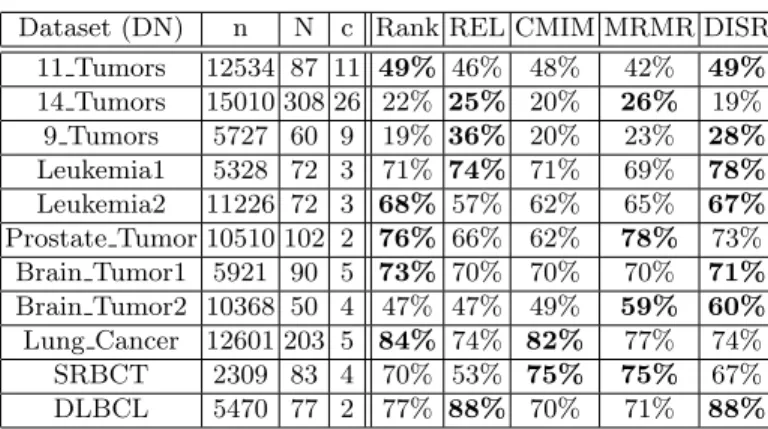
According to Table 2, the DISR criterion outperforms slightely all the other methods in terms of average accuracy. Furthermore, our method is one of the two best methods for 7 out of 11 datasets.
Table 3 reports the significant wins, ties or losses (at 0.1 and 0.2 significance levels of a paired two-tailed t-test, respectively) of the DISR criterion against all the other. We remark that in the case a 3-Nearest Neighbor, the DISR criterion is equivalent to MRMR and better than all the other methods. For a naive Bayes classifier, the performances of the DISR are slightly lower. This is not surprising because the benefits of the DISR criterion are related to variable complementarity whereas the success of a naive Bayes classifier typically relies on the opposite, that is variable independence. As far as the SVM classifier is concerned, at the 0.1 significance level, DISR appears to be slightly better than both REL and CMIM, and slightly worse than RANK and MRMR. However, at 0.2 significance level the DISR outperforms all the other methods except MRMR.
criterion rank REL MRMR CMIM DISR
relevance selection V V V V V
redundancy avoidance − V V V V
complementarity selection − V − − V multivariate density avoidance V − V V V
Table 1.Qualitative comparison of different information theoretic filters, according to different aspects: relevance selection, redundancy avoidance, complementarity selection and multivariate densities avoidance.
6
Conclusion and future work
This paper formalized an original notion in feature selection: variable comple-mentarity. Also, a lower bound on the mutual information of a subset of variables with the output was demonstrated. On the basis of these considerations, we pro-posed a new selection criterion: the double input symmetrical relevance (DISR). The experimental session shows that this criterion is promising in high feature-to-sample ratio classifaction tasks like gene expression microarray datasets. Note that in gene selection, variable complementarity can be biologically meaningful since it is common to observe combination of genes acting together.
Dataset (DN) n N c Rank REL CMIM MRMR DISR 11 Tumors 12534 87 11 49% 46% 48% 42% 49% 14 Tumors 15010 308 26 22% 25% 20% 26% 19% 9 Tumors 5727 60 9 19% 36% 20% 23% 28% Leukemia1 5328 72 3 71% 74% 71% 69% 78% Leukemia2 11226 72 3 68% 57% 62% 65% 67% Prostate Tumor 10510 102 2 76% 66% 62% 78% 73% Brain Tumor1 5921 90 5 73% 70% 70% 70% 71% Brain Tumor2 10368 50 4 47% 47% 49% 59% 60% Lung Cancer 12601 203 5 84% 74% 82% 77% 74% SRBCT 2309 83 4 70% 53% 75% 75% 67% DLBCL 5470 77 2 77% 88% 70% 71% 88%
Table 2. The 11 datasets of microarray cancer fromhttp://www.tech.plym.ac.uk. The columnn represents the number of probes in the microarray, the columnN the number of samples and the columnc the number of classes. The remaining columns contain the average accuracy of each selection method averaged over the three classifiers (SVM, 3-NN, naive Bayes). The accuracy of the two best methods for each dataset is typed in bold face.
W/T/L VS DISR Rank REL CMIM MRMR Rank REL CMIM MRMR 3-NN 0/9/2 1/8/2 1/7/3 2/7/2 1/5/5 1/7/3 1/7/3 2/7/2 Naive Bayes 3/8/0 2/7/2 1/8/2 1/9/1 4/7/0 3/6/2 1/8/2 1/9/1 SVM 2/9/0 2/6/3 2/6/3 2/8/1 2/6/3 3/4/4 2/5/4 3/5/3
References
1. Guyon, I., Elisseeff, A.: An introduction to variable and feature selection. Journal of Machine Learning Research3(2003) 1157–1182
2. Kohavi, R., John, G.H.: Wrappers for feature subset selection. Artificial Intelli-gence97(1-2) (1997) 273–324
3. Blum, A., Langley, P.: Selection of relevant features and examples in machine learning. Artificial Intelligence97(1997) 245–271
4. Provan, G., Singh, M.: Learning bayesian networks using feature selection. In: in Fifth International Workshop on Artificial Intelligence and Statistics. (1995) 450–456
5. Almuallim, H., Dietterich, T.G.: Learning with many irrelevant features. In: Pro-ceedings of the Ninth National Conference on Artificial Intelligence (AAAI91), AAAI Press (1991) 547–552
6. Caruana, R., Freitag, D.: Greedy attribute selection. In: International Conference on Machine Learning. (1994) 28–36
7. Aha, D.W., Bankert, R.L.: A comparative evaluation of sequential feature selection algorithms. Artificial Intelligence and Statistics5(1996)
8. Bell, D.A., Wang, H.: A formalism for relevance and its application in feature subset selection. Machine Learning41(2) (2000) 175–195
9. Peng, H., Long, F.: An efficient max-dependency algorithm for gene selection. In: 36th Symposium on the Interface: Computational Biology and Bioinformatics. (2004)
10. Yu, L., Liu, H.: Efficient feature selection via analysis of relevance and redundancy. Journal of Machine Learning Research5(2004) 1205–1224
11. Fleuret, F.: Fast binary feature selection with conditional mutual information. Journal of Machine Learning Research5(2004) 1531–1555
12. Duch, W., Winiarski, T., Biesiada, J., Kachel, A.: Feature selection and ranking filters. In: International Conference on Artificial Neural Networks (ICANN) and International Conference on Neural Information Processing (ICONIP). (2003) 251– 254
13. Cover, T.M., Thomas, J.A.: Elements of Information Theory. John Wiley, New York (1990)
14. Yang, H., Moody, J.: Feature selection based on joint mutual information. In: In Advances in Intelligent Data Analysis (AIDA), Computational Intelligence Meth-ods and Applications (CIMA), Rochester New York, ICSC (1999)
15. Kojadinovic, I.: Relevance measures for subset variable selection in regression problems based on k-additive mutual information. Computational Statistics and Data Analysis49(2005)
16. Meyer, P.: Information theoretic filters for feature selection. Technical report, Universite Libre de Bruxelles ((548) 2005)
17. web: (http://www.tech.plym.ac.uk/spmc/bioinformatics/microarray cancers.html) 18. Scott, D.W.: Multivariate Density Estimation. Theory,. Wiley (1992)