
https://www.phoenixpub.org/journals/index.php/jaar 119 Journal of Applied and Advanced Research, 2018: 3(4) 119−127
http://dx.doi.org/10.21839/jaar.2018.v3i4.221
ISSN 2519-9412 / © 2018 Phoenix Research Publishers
Research Article – Atmospheric Sciences
A study of some cloud microphysical parameters over Iraq using satellite data
Murtadha A. Fadhil*, Kais J. Al-Jumaily
Department of Atmospheric Sciences, College of Science, Mustansiriyah University, Baghdad, Iraq
(Received: 23-07-2018; Accepted 22-08-2018; Published Online 25-08-2018)
٭Corresponding author
Abstract
Studying clouds is a top priority among many atmospheric scientists because clouds are one of the greatest unknown factors in predicting changes in the Earth’s climate. Clouds play an important role in maintaining the energy balance because they can reflect, absorb, and radiate energy. The aim of this research is to investigate the properties of clouds over Iraq using data acquired by the Moderate Resolution Imaging Spectroradiometer (MODIS)on board Aqua Satellite for water and ice clouds. The results showed that daily mean cloud top pressure patterns during spring months are higher than other months and cloud top temperature patterns reached their highest values during summer months. The results also indicated that the ice cloud effective particle radius is relatively large during summer while cloud optical thickness assume its largest values in winter months. It was found that the highest values of precipitation rate over Iraq occurred during March to mid-April. Correlation aanalysis between optical thickness and liquid water path over Iraq that these two parameters are positively correlated and the correlation for water cloud was better that that for ice clouds. Case studies of heavy precipitation events over Iraq showed that the maximum values of the most cloud properties variables were located ahead of the storm center.
Keywords: Clouds, Properties, MODIS, Precipitation, Iraq
Introduction
During the past decades, significant advances have been made in measuring cloud properties of clouds using in site and remote sensing techniques, and these measurements made a great improvements in understanding the micro and macro physics processes inside clouds. Cloud affects many areas of meteorology of the earth such as weather forecasting, atmospheric radiation, weather modification, climate, aerosols, atmospheric chemistry. In addition, cloud can also affects many areas that interacts with the atmosphere including aviation, remote sensing, communication systems, agriculture, and water resources (Smith and Owens, 2003).
The formation of clouds depends on various factors and variables that mainly determine type of clouds and control the amount of precipitation at any given place. Warm clouds form in regions where air temperature is above freezing level while cold clouds are initiated in colder regions. Microphysical properties such as cloud size distribution, cloud effective radius, and liquid water content directly determine the type and amount of precipitation (Stull, 2016).Numerous research have been carried out on the microphysical properties of clouds. Most recently, Hazra et al. (2013) studied cloud microphysical properties over India. Cecchini et al. (2014)investigated typical droplet size distributions for different types of precipitation systems and cloud condensation nuclei concentrations in southeastern Brazil using numerous instruments. Iwabuchi et al. (2014) have developed an IR method to retrieve cloud optical thickness and cloud-particle effective radius by using the 8.5, 11, and 12 μm bands of the Resolution Imaging Spectroradiometer (MODIS) on board the Aqua satellite. Li
et al. (2015) used active remote sensing instruments and reported the occurrence of a globally averaged multilayered
cloud was 25 to 28 %. Iwabuchi et al. (2016) reported on the retrieval of radiative and microphysical properties of clouds from multispectral infrared measurements. The aim of this research is to investigate the properties of clouds over Iraq using data acquired by the Moderate Resolution Imaging Spectroradiometer (MODIS) on board Aqua Satellite for water and ice clouds.
Materials and Method
Iraq lies between 29°5- to 37°15- N latitudes and 38°45- to 48° 45-E longitude. Iraq is a country in Western Asia spanning most of the northwestern end of the Zagros mountain range, the eastern part of the Syrian Desert and the northern part of the Arabian Desert. Iraq shares borders with Jordan to the west, Syria to the northwest, Turkey to the north, Iran to the east, and Kuwait and Saudi Arabia to the south. Iraq has a narrow section of coastline. The average annual temperature is varies from 8.5ºC to 49°C. The summer temperature range is between 16ºC– 49ºC while the winter temperature range is between 8.5ºC - 14ºC.Rainfall is low in central and southern of Iraq (100-200mm) but it concentrates in northern of Iraq which reach about 1000mm and falls in November to April (Al-Falahi, 2008). Roughly 90 percent of the annual rainfall occurs between November and April, most of it in the winter months from December through March. The remaining six months, particularly the hottest ones of June, July, and August, are dry. Except in the north and northeast, mean annual rainfall ranges between ten and seventeen centimeters.
https://www.phoenixpub.org/journals/index.php/jaar 120 every 1 to 2 days, acquiring data in 36 spectral bands, or
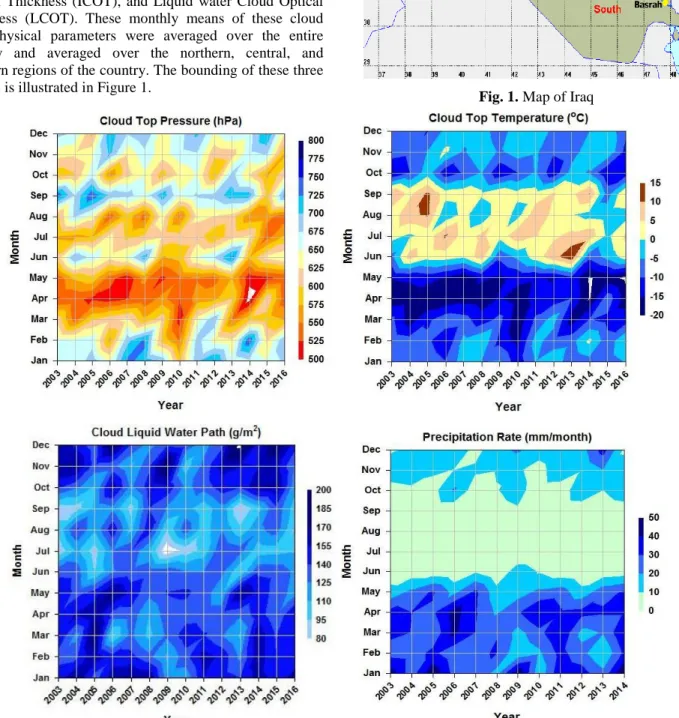
groups of wavelengths. These data will improve our understanding of global dynamics and processes occurring on the land, in the oceans, and in the lower atmosphere. MODIS is playing a vital role in the development of validated, global, interactive Earth system models able to predict global change accurately enough to assist policy makers in making sound decisions concerning the protection of our environment. The online software package was used to extract the data is Aqua Giovanni display system. The system provide maps and digital data stored in NetCDF. The microphysical parameters selected for this study include; Cloud Top Pressure (CTP), Cloud Top Temperature (CTT), Cloud Liquid Water Path (CLWP), Precipitation Rate (PR), Ice Cloud Effective Particle Radius (ICEPR), Liquid water Cloud Effective Particle Radius (WCEPR), Ice Cloud Optical Thickness (ICOT), and Liquid water Cloud Optical Thickness (LCOT). These monthly means of these cloud microphysical parameters were averaged over the entire country and averaged over the northern, central, and southern regions of the country. The bounding of these three regions is illustrated in Figure 1.
Fig. 1. Map of Iraq
Fig. 2. Monthly means of cloud top pressure, cloud top tempearture, cloud liquid water path, and precipitation rate over Iraq for the period 2003-2016
Figure 2 shows the variations of CTP, CTT, CLWP, and PR monthly means, averaged over the entire country,
https://www.phoenixpub.org/journals/index.php/jaar 121 during the spring months (Mar-May). The CTT extends
from -20oC to 15oC and the lowest values occur during the
spring months (Mar-May). The CLWP ranges from 80 g/m2
to 200 g/m2 and usually small value occurrence usually
happen during summer month (Jun-Aug). The PR variations shows the period from mid-winter to end of spring is
characterized by heavier precipitation that higher precipitation while no precipitation falls during the period from Jun to Sep. The results also show that no distinct increasing or decreasing trends are apparent in all four parameter but there is fluctuations from one to year to another.
Fig. 3. Monthly means of ice cloud effective particle radius, water cloud effective particle radius, ice cloud optical thickness, and water cloud optical tickness over Iraq for the period 2003-2016.
Figure 3 gives the variations of ICEPR, WCEPR, ICOT, and LCOT. ICEPR ranges between 22 and 38 µm while
WCEPR ranges between 9 and 16 µm. Normally, ICEPR is larger than WCEPR.
https://www.phoenixpub.org/journals/index.php/jaar 122
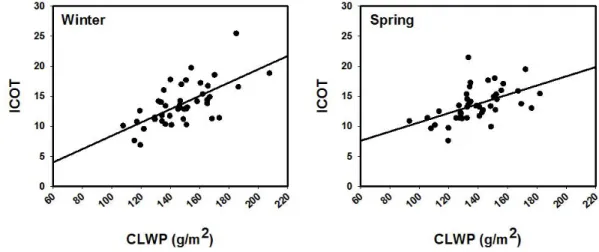
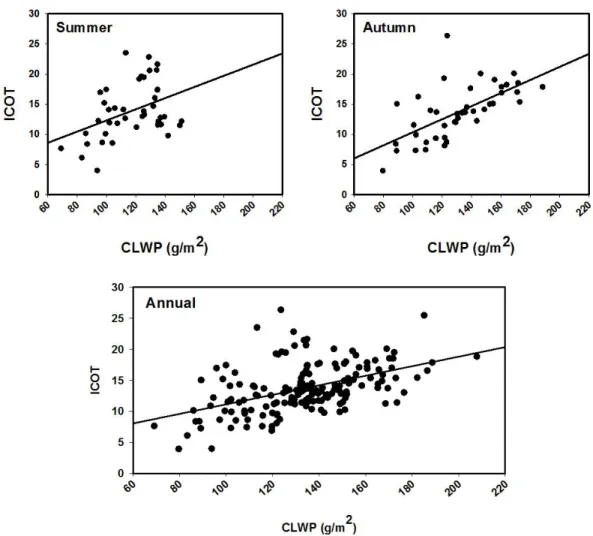
Fig.4. Seasonal and annual correlations between ice cloud optical thickness and cloud liqud water path over Iraq.
The results indicate that ICEPR is large during summer while WCEPR is large during spring. The ICOT spans from 4 to 28 and the WCOT extends from 9 to 30. The maximum value of ICOT can be reached during any month of the year but most likely during relatively warm months while the maximum WCOT happens during winter months. In order to investigate the relationship between cloud effective particle radius and liquid water path plots between these parameters were established for seasonally and annually means averaged over an area bounded by 28-38oN and 38-50oE
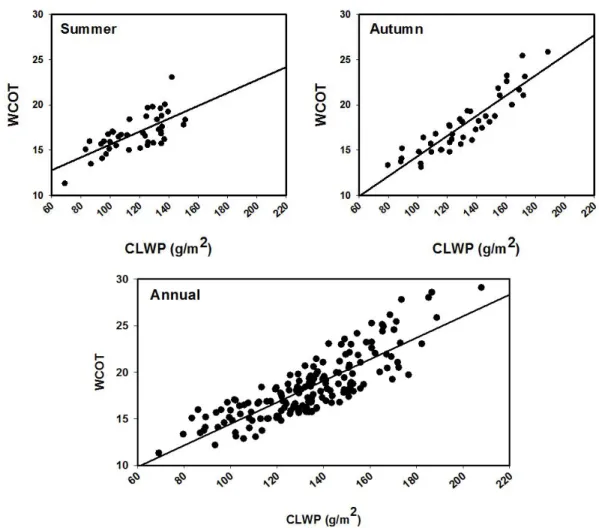
which covers the entire Iraq. Figure 4 shows the correlations between ICOT and CLWP for winter, spring, summer, autumn, and annual. It is seen that ICOT is weakly correlated with CLWP. The correlation coefficients were
0.42, 0.27, 0.16, and 0.40 for winter, spring, summer, and autumn respectively indicating that the fair correlations existed during winter and autumn. The annual correlation coefficient was 0.23. Figure 5 gives the correlations between WCOT and CLWP for winter, spring, summer, autumn, and annual. It is obvious that WCOT is better correlated with CLWP than ICOT. The correlation coefficients were 0.87, 0.83, 0.47, and 0.82 for winter, spring, summer, and autumn respectively indicating that the high correlations existed during winter, spring, and autumn. The annual correlation coefficient was 0.69. These results reflects the nature of cloud activities over Iraq. Clouds mostly forms during winter, spring, and autumn and most of these clouds are products of warm cloud processes.
https://www.phoenixpub.org/journals/index.php/jaar 123
Fig. 5. Seasonal and annual correlations between water cloud optical thickness and cloud liqud water path over Iraq
https://www.phoenixpub.org/journals/index.php/jaar 124
Fig. 6. Seasonal and annual correlations between ice cloud optical thickness and cloud liqud water path over northern, central, and southern regions of Iraq.
Fig. 7. Seasonal and annual correlations between water cloud optical thickness and cloud liqud water path over northern, central, and southern regions of Iraq
https://www.phoenixpub.org/journals/index.php/jaar 125 for the three climatically distinct regions; the northern, the
central, and the southern. Figures 6 and 7 gives the annual correlations of the cloud microphysical properties for the three regions for the ice and water clouds respectively.
It can be that the correlation between the optical thickness and the liquid water path for the water type clouds is better than
that for ice clouds. The correlation coefficients for water clouds were 0.77, 0.75, and 0.83 for the northern, central, and southern regions respectively.
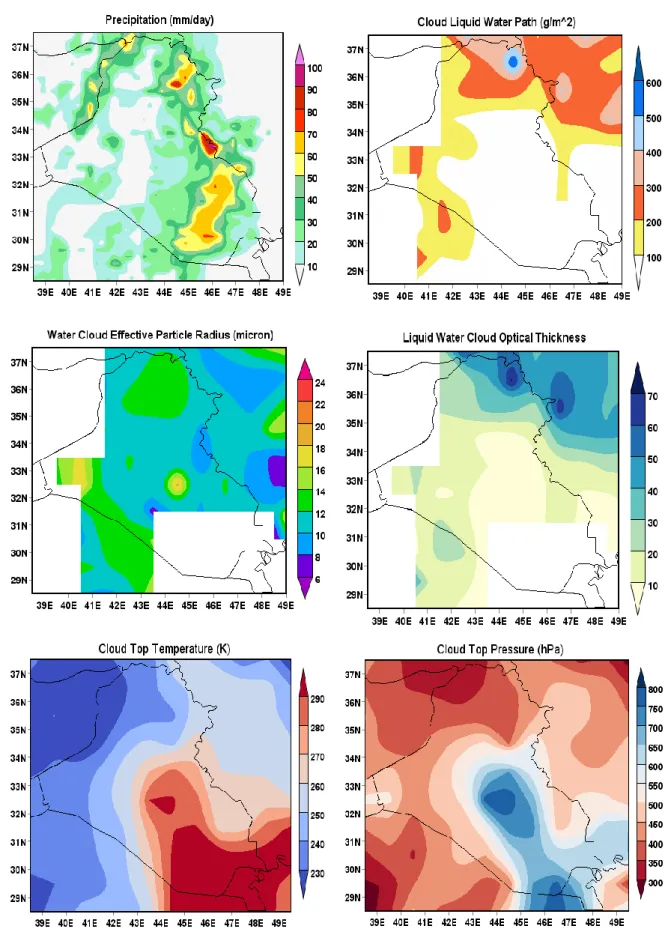
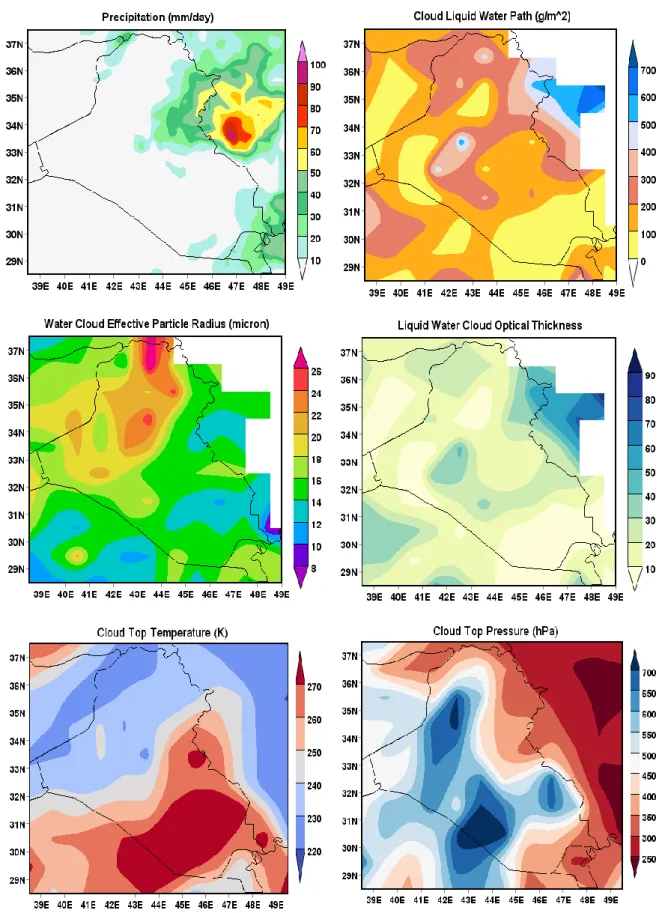
Two extreme rain events occurred over Iraq were considered to investigate the behaviors of the cloud parameters inside rainstorm.
https://www.phoenixpub.org/journals/index.php/jaar 126
Fig. 9. Precipitation rate and cloud microphysics parametes for rainstrom event over Iraq on Oct 28, 2014
Figure 8 shows the daily rainfall and cloud parameters for Jan 27, 2014. During that day, two rainstorms merged over Iraq. The first storm developed over the Red Sea and crossed Saudi Arabia towards Iraq and the second storm came from the Mediterranean Sea. These two storms resulted in rainfall of more 60 mm on the southern region, the eastern strip with Iraq, and the northwestern borders with Syria. It is obvious that the higher values of CLWP, WCEPR, and WCOT are located outside the heavy rain areas.
https://www.phoenixpub.org/journals/index.php/jaar 127 are associated with high-pressure levels (low altitudes).
Figure 9 illustrates the results for the second extreme rain event. This event which occurred on Oct 28, 2015, came from the Red Sea. Rain of more than 60 mm covered the eastern border area with Iran. It is seen that the behaviors of the cloud parameters are quite similar to those of the previous case.
Conclusions
In this work, some water and ice cloud properties measured by MODISover Iraq for the period 2003 to 2016 were analyzed and correlations wereestablished between cloud optical thickness and cloud liquid water path. It was found that the lowest cloud top pressure and lowest cloud top temperature occur during spring month. This may be attributed to the strong convections processes inside clouds that usually initiated and developed during that time of the year. Cloud liquid water path and precipitation have their lowest values during summer months. The cloud effective particle radius for ice cloud are larger than those of water clouds due to their nature of origins. The cloud optical thickness for water reaches their higher values during winter while for ice the higher values can happen in any time of the year. The monthly means of the cloud properties showed no district increasing or decreasing trends over the 14 years period but fluctuations from one to another usually occur. Correlations analysis indicated that optical thickness for water is better correlated with liquid water path than ice. Analysis of two extreme rainstorm event over Iraq indicated that the maximum values of the cloud properties variables were located outside the heavy rain area. This due to the fact that the fall of rain drops affect those variables.
References
Al-Falahi, A.A., (2008). Middle East Water and Livelihoods Initiative. ICARDA, Aleppo 7-9 July, 2008.
Cecchinia, M.A., Machadoa, L.A.T. and Artaxob, P. (2014). Droplet size distributions as a function of rainy system type and cloud condensation nuclei concentrations. Atmospheric Research, 143, 301-312. Hazraa, A., Mandalb, V., and Chenc, J. P., (2013). Study of
cloud microphysical properties over India during CAIPEEX using a mesoscale model with new cloud microphysical scheme. Part I. Journal of Atmospheric and Solar-Terrestrial Physics, 93, 29-44.
Iwabuchi H., Yamada, S., Katagiri, S., Yang, P., and Okamoto, H., (2014). Radiative and microphysical properties of cirrus cloud inferred from the infrared measurements made by the moderate resolution imagingspectroradiometer (MODIS). Part I: retrieval method. Journal of Applied Meteorology and Climatology, 53:1297–1316.
Iwabuchi, H., Saito, M., and Tokoro, Y. (2016). Retrieval of radiative and microphysical multispectral infrared measurements. Progress in Earth and Planetary Science, 3, 32.
Li J., Huang J., Stamnes K., Wang T., Lv, Q., and Jin, H. (2015). A global survey of cloud overlap based on CALIPSO and CloudSat measurements. Atmospheric Chemistry and Physics, 15, 519–536.
Smith, S. M., and Owens, H. B., (2003). Investigating the climate system clouds and the earth’s radiant energy system. [Available online at http://www.strategies.org/CLASS.html ].

![An Efficient Method For The One-Pot, Four-Component Benzaldehyde Based Synthesis of 3-Methyl-1,4-Diphenyl-7,8-Dihydro-1H-Furo[3,4-E]Pyrazolo[3,4-B]Pyridin-5(4H)-Ones Catalyzed by Alum in Environment-Friendly Media.](data:image/gif;base64,R0lGODlhAQABAIAAAP///wAAACH5BAEAAAAALAAAAAABAAEAAAICRAEAOw==)