INTRODUCTION
Vegetable oils are easily degraded via autoxidation process when exposed to heat and light. The degradation process occurs due to the presence of unsaturated constituents which lead to the formation of secondary products. Some of the degraded compounds lead to the development of various volatile constituents such as aldehydes and ketones which are responsible for the rancidity/ off-flavour of vegetable oils1-4. Several volatile
Solid phase microextraction analysis of
volatile constituents of heated palm olein and selected oils
MUHAMMAD NOR OMAR¹, NOR NAZUHA MUHD NOR² and NOR AINI IDRIS³
¹International Islamic University Malaysia, Kulliyyah of Science, 25200 Indera Mahkota, Kuantan, Pahang (Malaysia). ²Universiti Putra Malaysia, Faculty of Educational Studies,
43400 UPM Serdang, Selangor (Malaysia).
³Malaysian Palm Oil Board, No 6 Persiaran Institusi Bandar Baru Bangi, 43000 Kajang Selangor (Malaysia).
(Received: August 03, 2009; Accepted: September 10, 2009)
ABSTRACT
Effect of heating on the development of volatile aroma constituents of palm olein and selected oils was studied. The aroma constituents of heated oils were collected using a solid-phase microextraction (SPME) headspace technique with an adsorbent of a divinylbenzene/carboxen (50/ 30µm) on polydimethylsiloxane (PDMS) fibre. The extracted volatiles were desorbed from the fibre in the injection port of the gas chromatograph at 250oC and the aroma constituents were identified by GC-MS. The analytical data showed that compounds responsible for the rancidity, i.e hexanal, 2E,4E-heptadienal and 2E,4E-decadienal increased significantly when the oils were heated above 100oC while there were no significant changes in their amounts when heating below 60oC. Meanwhile, the volatile contents were slightly increased when the oils were heated at 80oC. In palm olein, the hexanal content before heating (1.5 µg/g ) was similar with its content (1.6 mg/g) after heating at 60oC. However, when palm olein was heated between 100oC and 180oC the hexanal content increased to 6.4 µg/g and 8.7 mg/g respectively. Similar patterns were also observed when soybean, sunflower and corn oils were heated. In soybean oil, the hexanal content before heating was 3.2 µg/g and rose to 13.2 µg/g after heating at 180oC. The concentration of hexanal in sunflower oil increased from 3.6 µg/g to 12.7 mg/g when the oil was heated at 40oC and 180oC respectively. Meanwhile in corn oil, the hexanal contents before heating and after heating at 180oC were 2.8 µg/g and 13.5 µg/g respectively.
Key words: Aroma constituents, rancidity, vegetable oil.
constituents, i.e. hexanal and pentanal, have been commonly used as indicators of lipid oxidation, since these off-flavour components have very low threshold values5,6. Other volatiles, such as 1-penten-3-one, 4-(Z)- heptenal, 2,4-(E,E)-heptadienal and 2,6-(E,Z)-nonadienal, have been characterized as contributors to the fishy off-flavour in fish oil and fish products7-9.
826 Omar et al., Orient. J. Chem., Vol. 25(4), 825-832 (2009)
techniques. Among the adsorption techniques, solid-phase microextraction (SPME) trapping, which is developed by investigators at the University of Waterloo10-12, is widespread in the field of environmental chemistr y and toxicology13-14. Recently, a septum-free SPME injector device is introduced to detect the presence of aldehyde in oxidized lipids15. Until now, information on the utilization of the SPME techniques for characterizing the origin and oxidative state of vegetable oils based on the determination of the aroma and volatile compounds is limited16-19. The main purpose of the present study is to evaluate the SPME technique in analyzing volatile constituents during heating of palm olein and other selected vegetable oils.
MATERIAL AND METHODS
Palm olein, soybean oil, sunflower oil and corn oil were obtained from the local stores in mid-December 2008 and analyses were carried out between Januar y and June 2009 at Food Bioprocess and Biotechnology Laboratory, the International Islamic University Malaysia (IIUM). The volatile constituents were collected using a SPME technique with a divinylbenzene/carboxen (50/ 30µm) on polymethylsiloxane (PDMS) on a stable-flex fibre (Supelco, Bellefonte, USA) as an adsorbent. The gas chromatographic (GC) and gas chromatograpy-mass spectrophotometric (GC-MS) analysis were carried out using a HP5890 Gas chromatograph (Agilent, Palo Alto, USA) and a HP 5971A mass selective detector (Agilent, Palo Alto, USA).
Headspace extraction of volatiles
The oil sample (5 g) was subjected to accelerated oxidation by heating at 40°, 60°, 80°, 100°, 120°, 140°, 160° and 180°C in a 15-ml open vial. The internal standard solution, i.e. n-dodecane (5 µg/g) was injected into the headspace vial for the pur pose of quantification of the volatile constituent. After heating the sample for 30 min., the volatiles from the oil were collected using a SPME headspace sampling system as previously described13. The PDMS fibre was placed in the headspace vial 3 mm above the surface of the oil.
Gas chromatographic analysis
The polydimethylsiloxane (PDMS) fibre
was injected into a HP5890 Gas Chromatograph (Agilent, Palo Alto, USA) equipped with a fused silica capillary column (Ultra 1, 50m × 0.32 mm × 0.52 mm; µAgilent, Palo alto, USA) and FID detector. Helium was applied as a carrier gas at a constant flow rate of 1.0 ml/min and the peak areas were calculated by a HP3396B integrator (Agilent, Palo Alto, USA). Quantitative analysis of the volatile constituent was calculated using n-dodecane as an internal standard according to method previously reported (20-21). Operating condition: Injector and detector temperatures were 230°C and 250°C respectively; the oven temperature was programmed from 70°C to 220oC at a rate of 4°C/ min.
GC-MS analysis
A HP 5890 model gas chromatograph equipped with the same column as GC analysis was directly interfaced to the ion source of a HP 5971A mass spectrometer (Agilent, Palo Alto, USA). Working condition: GC as above with He column head pressure 25 kPa, MS: transfer line temperature 280oC, ion source temperature 182oC, and MS identification of the compounds was made according to the mass spectra of the standards and by applying NIST 98 library.
RESULTS AND DISCUSSION Volatile constituents of heated palm olein
Fig. 1 shows the GC chromatogram of the SPME headspace volatiles collected from palm olein after heating at 100oC for 30 min. It was found that at least 21 volatile constituents have been identified using a GC-MS spectroscopic technique. The major compounds collected in the headspace of heated palm olein were 2-butanone (peak 3), 3-methylbuten-l-ol (peak 6), hexanal (peak 8), 2E,4E-heptadienal (peak 16) and 2E,4E-decadienal (peak 19). As comparison, the volatile constituents of other oils, i.e. soybean oil, sunflower oil and corn oil, were also analyzed. Hexanal and 2E,4E-decadienal were found in high amounts in all heated samples.
Effect of heating on volatile constituents of palm olein
Fig. 1: GC chromatogram of the SPME headspace volatile aroma of heated palm olein
828 Omar et al., Orient. J. Chem., Vol. 25(4), 825-832 (2009)
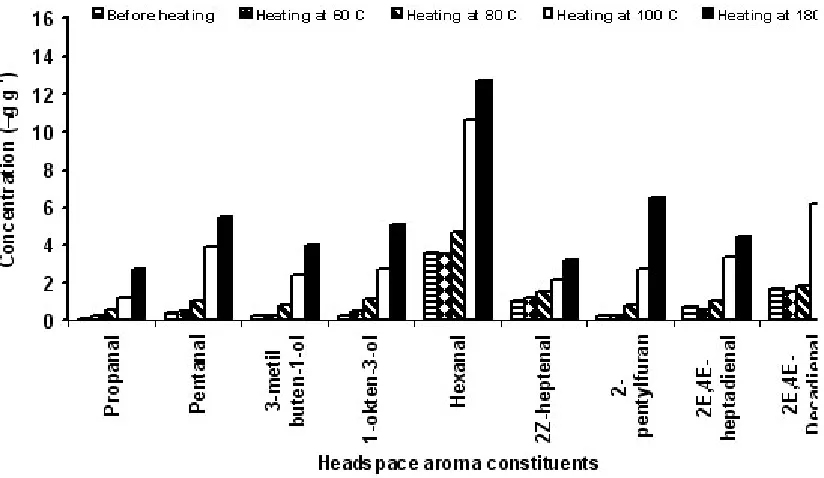
Headspact aroma constituents
Fig. 3: Changes of headspace volatile constituents of heated soybean oil
Fig. 4: Changes of headspace volatile constituents of heated sunflower oil palm oil was carried out. It was found that there
was no significant changes in the volatiles formed in the headspace of the palm olein before and after heating at 60oC. This indicated that, no oxidation/
Headspact aroma constituents
Fig. 5: Changes of headspace volatile constituents of heated corn oil
830 Omar et al., Orient. J. Chem., Vol. 25(4), 825-832 (2009)
Fig. 7: 2E,4E-heptadienal content of heated palm olein and selected oils
was no decomposition products developed when the oils were stored at 60oC for 8 hr ²¹. Meanwhile, the volatile contents were slightly increased when the oil was heated at 80oC. However, the formation of the volatiles showed a significant increase when the oil was heated at and above 100oC (Fig 2). For example, n-hexanal was rapidly increased from 1.5 µg/g (before heating) to 8.7 µg/g after heating at 180oC (frying temperature) whilst 2E,4E-heptedienal rose from 2.3 µg/g to 10.3 µg/g. A similar pattern also occurred when soybean and sunflower oils were heated (Fig. 3, & 4). In soybean oil, the hexanal content increased from 3.2 µg/g to 13.3 µg/g after heating at 180oC whilst 2E,4E-heptadienal increased from 2.4 µg/g to 12.2 µg/g after heating at frying temperature. Meanwhile, in sunflower oil oil, the hexanal content increased from 3.6 µg/g to 12.7 µg/g after heating at 180oC whilst 2E,4E-heptadienal increased from 0.7 µg/g to 4.5 µg/g after heating at frying temperature. Selke and co-worker obtained a similar trend during their study on headspace volatiles of heated soybean oil²². However the changes of volatiles in heated corn oil was slightly different (Fig. 5). Although the hexanal content increased, the concentration of 2E,4E-heptadienal was unchanged. A similar result was also observed by other researchers when analyzing headspace volatiles of heated corn oil20.
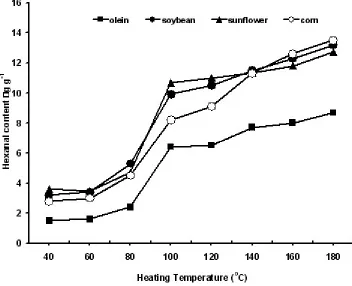
Fig. 6 shows that the hexanal concentration of heated palm olein was significantly low compared to other selected oils. This indicated that palm olein was more stable towards oxidation at higher temperature due to lower concentration of linoleic acid23.
Other rancidity constituent, i.e. 2E,4E-heptadienal showed a different trend. Corn oil and
sunflower oil contained less concentration of 2E,4E-heptadienal compared to palm olefin and soybean oil (Fig 7). Its content in corn oil was significantly unchanged while in sunflower oil the change was rather small.
Fig. 8 shows that the 2E,4E-decadienal concentration of heated palm olefin was significantly low compared to other selected oils when heating at and below 100oC and180oC. It showed that the quantity of this compound was closely related to the unsaturation degree of the oils. Palm olein was expected to produce lower quantity of decadienal as compared to other liquid oils²³.
CONCLUSION
Volatile flavour constituents of heated palm olefin has been characterized and identified using the SPME headspace adsorption technique followed by GC-MS analysis.
The analytical data showed that the compounds responsible for the off-odour (rancid), i.e hexanal, pentanal, 2E,4E-heptadienal and 2E,4E-decadienal increased rapidly when the oils were heated above 100oC while at 60oC and below there were no significant changes in amount of the compounds. Nevertheless, the amount of the volatile contents increased slightly when the oil was heated at 80oC.
ACKNOWLEDGMENTS
Part of this study has been carried out at Malaysian Palm Oil Board (MPOB) and the authors would like to thank the Director General of MPOB for financial support (PD14).
REFERENCES
1. Davis B.M. and McEwan M.J., J. Agric. Food Chem. 55: 3334 (2007).
2. Robards K., Kerr A.F. and Patsalides, E., Analyst 113: 213 (1998).
3. St. Angelo A.J., Crit. Rev. Food Sci. Nutr., 36: 175 (1996).
4. Frankel E. N., J. Am. Oil Chem. Soc., 70:
767 (1993).
5. García-Martínez M.C., Márquez-Ruiz G., Fontecha J. and Gordon M.H., Food Chemistry 113: 926 (2009).
832 Omar et al., Orient. J. Chem., Vol. 25(4), 825-832 (2009)
A., Ishida T., Matsuda H., Takamura H. and Matoba T., J. Food Sci. 73: S83 (2008). 8. Koelsch C.M., Downes T.W. and Labuza
T.P., J. Food Sci., 56: 816 (1991).
9. Milo C. and Grosch W., J. Agric. Food Chem., 43: 459 (1995).
10. Arthur C., Belardi R., Pratt K., Motiagh S. and Pawliszyn J., J. High Resol. Chromatogr., 15: 741 (1992).
11. Arthur C.L. and Pawliszyn J., J. Anal. Chem., 62: 2145 (1990).
12. Zhang Z. and Pawliszyn J., J. Anal. Chem., 65: 1843 (1993).
13. Doleschall F., Recseg K., Kemeny Z. and Kovari K., Eur. Lipid Sci. Technol., 105: 333 (2003).
14. Belardi R. and Pawliszyn J., Water Pollu. Res. J. Can., 24: 179 (1989).
15. Arato S., Ito H., Miyashita K., Hayakawa K. and Itabashi Y., J. Oleo Sci., 58: 17 (2009).
16. Ribeiro L.H., Freitas A.M.C. and da Silva M.D.R., Talanta. 77: 110 (2008).
17. Bentivenga G., D’Auria M., De Luca E., De Bona A. and Mauriello G., Riv. Ital. Sostanze Grasse, 78: 157 (2001).
18. Keszler A., Heberger K.L. and Gude M., J. High Resol. Chromatogr., 21: 368 (1998). 19. Doleschall F., Kemeny Z.S., Recseg K. and
Kolavari K., Eur. Lipid Sci. Technol., 104: 14 (2002).
20. Snyder J.M., Frankel E.N. and Selke E., JAOCS., 62: 1675 (1985).
21. Snyder J.M., Frankel E.N., Selke E. and Warner K., JAOCS., 65: 1617 (1988). 22. Selke E. and Frankel E.N., JAOCS, 64: 749
(1987).