UNIT 4
SOLUTIONS AND SOLUBILITY
Goals
8.2 Defining a Solution
Homogeneous mixture:
Heterogeneous mixture:
Solutions:
Solute: Solvent:
Examples:
Solute in Solvent Example of Solution Gas in gas
Gas in liquid Gas in solid Liquid in gas Liquid in liquid Liquid in solid Solid in liquid Solid in solid
Non-electrolytes:
3 categories of electrolytes: 1. Salt:
2. Acids:
3. Bases:
Therefore, conductivity tests can be used to determine the type of solute: electrolyte or nonelectrolyte.
Type of solution: 1. Acidic:
2. Basic:
3. Neutral
8.3 Explaining Solutions
Goals
“Nothing in the world is as soft and yielding as water. Yet for dissolving the hard and inflexible, nothing can surpass it.” Tao Te Ching, ca. 500 B. C.
How do substances dissolve?
REMINDER: INTERMOLECULAR FORCES
*intermolecular force: attractive force between molecules *2 types: 1- Van der Waals forces
a) dipole-dipole forces b) London dispersion forces 2- Hydrogen bonds
1. Dipole-dipole forces *
2. London dispersion forces *
* *
3. Hydrogen Bonds *
1. MOLECULAR SUBSTANCES Examples:
1. Sugar in water.
C C C C C O O C C C C O OH H H OH OH H H2C
H
H H2C
O H
H
C H2OH
H OH H OH O H O H H O H H O H H O H H
The molecule above is sugar. Sugar contains many O-H bonds. O-H bonds are polar because “O” is much more electronegative than “H”.
-O-H+
C12H22O11(s) + H2O C12H22O11(aq) Examples
i) oil in gasoline: miscible * both are non-polar (London dispersion force)
ii) sugar in water: solution * both are polar
iii) oil and water: do not mix * oil is non-polar, water is polar RULE: Like dissolves like
2. IONIC COMPOUNDS
(www.wou.edu/las/physci/ch412/hydrolysis.htm)
ionic compounds dissociates in water to form electrically charged particles in solutions – cation, anion.
Positive ions (cations): surrounded by the negative ends of water molecules (O).
Negative ions (anions): surrounded by the positive ends of water molecules (H).
How ionic compounds dissolve in water *
* * *
*
NaCl(s) Na+(aq) + Cl-(aq) K2SO4(s) 2 K+(aq) + SO42-(aq)
Water the Universal Solvent *
*
Writing Dissociation Equations
Only ionic equations undergo dissociation
When writing dissociation equations, the solid compound is always written on the left side of the equation and the ions it releases are written on the right.
Sample Problem 1: Writing a Dissociation Equation
Step 1. Determine the chemical formulas and number of each ion in the compound, keeping each polyatomic ion intact.
Step 2. Write the chemical equation. The compound is on the left and the aqueous ions are on the right.
Write the dissociation equation for K3PO4 (s)
Surfactants
A compound able to reduce the surface tension of a solvent and has a hydrophobic and hydrophilic part.
Describe how an oil stain can be removed from a shirt using detergent (p.387)
HOMEWORK: p. 389, 1-10, 13-16
EXPERIMENT #1
DOES LIKE DISSOLVE LIKE?
SAFETY CAUTIONS: Toluene, ethylene glycol, ethanol and mineral oil are flammable. Toluene, ethanol and ethylene glycol are toxic. Wear eye protection. Avoid contact with liquids. Solid iodine stains skin and clothing, and iodine vapour is harmful. Avoid contact with the solid and inhalation of the vapour.
Introduction: Most people know that sugar dissolves in some liquids but not in others. What factors determine whether one substance will dissolve in another? The solubility of one substance in another depends on the nature of the two substances involved. For example, there are attractive forces between the molecules of sugar in a sugar crystals, and there are attractive forces between the water molecules in pure water. In order for sugar to dissolve in water, the water must be able to overcome the attractive forces that the sugar molecules have for each other, and the sugar must be able to overcome the attractive forces that the water molecules have for each other. This can be accomplished by the attraction between the sugar molecules and the water molecules. Thus, the polarities of the substance(s) being dissolved and the solvent are important in determining whether or not a solution will result. In this experiment, you will attempt to dissolve nonpolar, polar, and ionic substances in solvents of different polarity. You will use the results to formulate some principles concerning the effect of molecular polarity on solubility.
Purpose: To study the effects of molecular polarity on the solubility of a substance in a liquid solvent.
Materials: water (H2O)
ethylene glycol (C2H4(OH)2)
toluene (C7H8)
mineral oil (mixture of hydrocarbons, CxHy)
ethanol (C2H5OH)
sodium chloride (NaCl) sucrose (C12H22O11)
iodine
15 small test tubes 5 beakers (250 mL) stoppers
Figures:
Ethylene glycol Toluene Ethanol
Procedure:
Part 1 – Miscibility: Solubility of Liquids
A. Obtain approximately 15 mL of the following four liquids: water, ethylene glycol, toluene and mineral oil. Place approximately 5 mL of water in three test tubes. To the first test tube, add approximately 5 mL of ethylene glycol. To the second test tube, add approximately 5 mL of toluene. To the third test tube, add approximately 5 mL of mineral oil. Stopper the test tubes and shake them well. Observe the contents of each tube carefully to determine how well or badly water dissolves in the other three. Record your results.
B. Place approximately 5 mL of ethylene glycol in two test tubes. To the first test tube, add approximately 5 mL of toluene, and to the second, add 5 mL of mineral oil. Stopper the test tubes and shake them well. Observe the contents of each tube carefully and record your results.
C. Place approximately 5 mL of toluene in one test tube. Add approximately 5 mL of mineral oil. Stopper the test tube and shake well. Observe the content and record your results.
Part 2 – Solubility of Solids in Liquids of Varying Polarity
In this part of the lab, you will use only three liquids: water, ethanol, and vegetable oil (not pentyl alcohol).
A. Using small test tubes, test the solubility of sodium chloride in each of the three liquids by adding small amounts of the solid to a separate sample of each liquid, with mixing. Record your observations.
B. Repeat Part 2, step A using iodine instead of sodium chloride. C. Repeat Part 2, step A using sucrose.
Observations/Results:
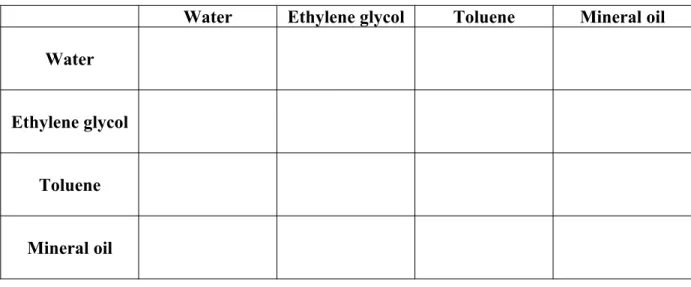
Prepare two tables. The first table will include the observations and results from Part 1. Remember to include a title. The second table will summarize the observations and results from Part 2.
Table 1: Miscibility of liquids
Water Ethylene glycol Toluene Mineral oil
Water
Ethylene glycol
Toluene
Mineral oil
Discussion
Answer the following questions: Part 1
1. Do water, ethylene glycol, toluene, and mineral oil dissolve in each other? Indicate which substances dissolve in each other and which do not. Use your knowledge of intermolecular forces and polarity to explain your results.
Part 2
1. Use your knowledge of chemical bonding to decide whether iodine is a polar or a nonpolar molecule.
2. In which type of solvent is iodine more soluble? Explain.
3. In which type of solvent is sodium chloride more soluble? Are your results for dissolving sodium chloride consistent with the rule “like dissolves like”? Explain. 4. Sucrose is definitely a molecular, not an ionic, compound. (Recall, water solutions of
sucrose do NOT conduct electricity.) Why then, does sucrose dissolve so much better in water than in less polar solvents?
Conclusion A 4-5 line summary of your results in sentence form.
Questions
1. Acetic acid, CH3COOH, dissolves well in both water and ethanol. Explain why.
8.5 Solubility and Saturation Goals
Solubility:
Examples
Compound Solubility at 25oC (g/L)
Mg(OH)2 BaSO4 NaCl
Therefore, Mg(OH)2 is more soluble than BaSO4 and NaCl is more soluble than Mg(OH)2.
*Solubility is temperature dependent. When the temperature is raised the solubility of a solid in a liquid increases.
1. Unsaturated solution :
2. Saturated solution : 3. Supersaturated solution :
How to make a supersaturated solution: *
Solubility Categories Maximum concentration at SATP High
Low Insoluble
Equilibrium
solute + solvent solution dissolving
recrystallizing
Factors affecting solubility Solids in Liquids
Liquids in liquids:
Gases in liquids:
Solubility curve p. 394 Examples
1. At 70oC, you would have to dissolve 48 g of KCl in 100 mL H2O to have a saturated solution.
2. What type of solution would you have if you dissolved 25 g of NaCl in 100 g of H2O at 30oC?
3. What mass of KCl can be dissolved in 23 g of H2O at 90oC?
At 90oC, approximately 54 g of KCl can be dissolved in 100 g of H2O. Therefore,
At 90oC 12.42 g of KCl can be dissolved in 23 g of H2O.
4. What temperature is required to dissolve 76 g of KNO3 in 100 g of H2O? T = 46oC
Plotting Solubility Curves
Purpose: You will determine the temperature at which a certain amount of potassium nitrate is soluble in water. You will then dilute the solution and determine the solubility again.
Materials: large test tube balance
Stirring wire 400 mL beaker
Two-hole stopper to pipette or burette fit the test tube with a
thermometer
hot plate retort stand with ring, clamps
potassium nitrate, KNO3 distilled water
Procedure
1. Put the test tube inside a beaker for support. Place the beaker on a balance pan. Set the reading on the balance to zero. Then measure 14.0 g of potassium nitrate into the test tube.
2. Add one of the following volumes of distilled water to the test tube, as assigned by your teacher: 10.0 mL, 15.0 mL, 20.0 mL, 25.0 mL, 30.0 mL. Use a pipette to measure the volume.
3. Pour about 300 mL of tap water into the beaker. Set up a hot-water bath using a hot plate, retort stand, and ring.
4. Put the stirring wire through the second hole of the stopper. Insert the stopper, thermometer, and wire in to the test tube. Make sure that the thermometer bulb is below the surface of the solution. 5. Place the test tube in the beaker. Secure the test tube and thermometer to the retort stand, using
clamps. Begin heating the water bath gently.
6. Using the stirring wire, stir the mixture until the solute completely dissolves. Turn the heat source off, and allow the solution to cool.
7. Continue stirring. Record the temperature at which crystals begin to appear in the solution. 8. Remove the stopper from the test tube. Carefully add 5.0 mL of distilled water. The solution is
now more dilute and therefore more soluble. Crystals will appear at a lower temperature. 9. Put the stopper, with the thermometer and stirring wire, back in the test tube. If crystals have
already started to appear in solution, begin warming the water bath again. Repeat steps 7 and 8. 10. If no crystals are present, stir the solution while the water bath cools. Record the temperature at
which crystals first begin to appear.
11. Dispose of the aqueous solutions of potassium nitrate in the labelled beaker in order to recover the KNO3.
Observations
Table 1: Mass of KNO3 (g), volume of water (mL), and the temperatures at which the solutions crystallized (o C)
Calculations
1. For each volume of H2O above, calculate how much solute dissolves in 100 mL of water. This represents the solubility of KNO3 at the temperature at which you recorded the first appearance of crystals. Use the following equation to help you.
Table 2: Mass of KNO3 (g), volume of water (mL), and the solubility of KNO3 (g/100 mL)
Mass of KNO3 (g) Volume of H2O (mL) Temperature (oC) Solubility (g/100mL)
2. Plot these data on graph paper. Set up your graph sideways on the graph paper (landscape position). Plot solubility on the vertical axis. (The units are grams of solute per 100 mL of water.) Plot temperature on the horizontal axis. Draw the best smooth curve through the points. (Do not simply join the points.) Label each axis. Give the graph a suitable title.
Application
1. Use your graph to interpolate the solubility of potassium nitrate at a) 60oC __________ b) 40oC __________
2. Use your graph to extrapolate the solubility of potassium nitrate at a) 80oC __________ b) 20oC ___________
3. At what temperature can 40 mL of water dissolve the following quantities of potassium nitrate? Show your calculations.
a) 35.0 g
8.6 Concentration
Goals
Concentration: * * Formula
Molarity: the number of moles of solute per 1 litre of solution. Very common unit of concentration.
where C is molarity (mol/L), n is number of moles, and V is volume (L). Examples:
1. 12.0 g of NaOH is dissolved in enough water to make 150.0 mL of solution. What is the molarity of this solution?
To prepare this solution, 5.24 g of NaOH is put into a flask and diluted to 75.0 mL. A 1.75 M solution would result.
3. Calculate the volume of solution required to prepare a 0.250 M HCl with 0.50 moles of solute.
To prepare this solution, 2.0 L of water is required.
4. Calculate the volume of solution required to prepare a 0.65 M CaCl2 with 25.0 g of solute.
8.7 Solution Preparation
Goals
Standard Solutions (stock solution): a solution for which the precise concentration is known.
Two methods to prepare standard solutions:
From a solid
* *
Dilution of standard solutions *
*
Examples:
1. How many litres of 18.0 M H2SO4 must one use to make 500.0 mL of a 3.70 M solution?
Stock solution: C = 18.0 mol/L and V=?
Method 1
For the diluted solution
Volume of stock solution required
One requires 103 mL of 18.0 M H2SO4 diluted to 500.0 mL to form a 3.70 M solution.
Method 2
2. What is the molarity of a NaOH solution made by diluting 35.0 mL of a 4.7 M NaOH solution to a total volume of 100.0 mL?
The molarity of the diluted solution is 1.6 M.
Activity 8.7.1 – A standard solution by dilution, p. 413 HOMEWORK: p. 402 #11-13
ESTIMATING CONCENTRATION OF AN UNKNOWN SOLUTION
Purpose: Copper(II) sulfate, CuSO45H2O, is a soluble salt. Solutions of this salt are blue in
colour. The intensity of the colour increases with increased concentration. In this
investigation, you will prepare copper(II) sulfate solutions with known concentrations. Then you will estimate the concentration of an unknown solution by comparing its colour intensity with the colour intensities of the known solutions.
Safety Precautions: Copper(II) sulfate is poisonous. Wash your hands at the end of this investigation.
Materials: pipette 5 test tubes
balance 4 beakers
CuSO45H2O distilled water
labels volumetric flask
eye dropper
Procedure
Part 1 – Making solution with known concentrations
1. Develop a method to prepare 100.0 mL of 0.500 mol/L aqueous CuSO45H2O solution.
Include the water molecules that are hydrated to the crystals, as given in the molecular formula, in your calculation of the molar mass. Prepare the solution.
2. Label a beaker. Transfer the solution you prepared in Step 1 to the beaker. Save the solution until the end of the lab.
3. Develop a method to dilute part of the 0.500 mol/L CuSO4 solution, to make 100.0 mL of
0.200 mol/L solution. Prepare the solution. Transfer the solution to a labeled beaker. 4. Prepare 100.0 mL of 0.100 mol/L solution, using the solution you prepared in step 3.
Transfer the solution to a labeled beaker.
5. Repeat set 4 to make 100.0 mL of 0.0500 mol/L CuSO4, by diluting part of the 0.100
mol/L solution you made. Transfer to a labeled beaker. Part 2 – Estimating the concentration of n unknown solution
1. You should have four labelled beakers containing CuSO4 solutions with the following
concentrations: 0.500 mol/L, 0.200 mol/L, 0.100 mol/L, 0.0500 mol/L. Your teacher will give you a fifth solution of unknown concentration. Record the letter that identified this unknown solution.
2. Label each test tube, one for each solution your prepared. Pour a sample of each solution into a test tube. The height of all the test tubes should be the same. Use a medicine dropper to add or take away solution as needed. (Be careful not to add water, or a solution of different concentration, to a test tube.)
3. Compare the colour of the unknown solution with the colours of the other solutions. 4. Use your observations to estimate the concentration of the unknown solution.
Analysis
1. Show all your calculations done in order to prepare the solutions.
2. Describe any possible sources of error for Part 1 of this investigation.
3. What is your estimate of the concentration of the unknown solution?
Conclusion
1. Obtain the concentration of the unknown solution from your teacher. Calculate the percentage error in your estimate.
8.8 Concentrations and Consumer Products
Goals
Percentage Concentration
A common equation used to calculate concentration in Chemistry
A more general equation for the concentration, c, of a solution is
C= quantity of solute quantity of solution
The labels on many consumer products, including hydrogen peroxide and vinegar, give concentrations expressed as a percentage concentration.
Percentage Volume/Volume (% V/V)
Percentage Weight/Volume (% W/V)
The concentrations of consumer products may also be given in terms of a percentage weight/volume, % W/V or c w/v
For example, the product label on a bottle of hydrogen peroxide of 6% W/V means that 6 g of every 100 mL of solution is the solute
Percentage Weight/Volume (% W/W)
The concentration of some medications and concentrated acids are often expressed as a percentage weight/weight, % W/W or c w/w
Benzoyl peroxide is an active ingredient in many acne creams. The 5 %
concentration expressed as % W/W, means that about 5g of every 100g solution is benzoyl peroxide.
Parts per Equivalent to Units for these
concentrations
Equation Application
9.1 Reactions in Solution
Goals
In describing reactions that occur in solution, it is often desirable to write the equation for the reaction in ionic form, indicating the ionic species that actually exist in solution.
Example: Describe the reaction of a solution of BaCl2 with a solution of Na2SO4 to form the insoluble solid BaSO4 we would write
In writing a total ionic equation for reactions in water:
1. We indicate all soluble ionic materials as ions, followed by (aq).
2. All substances that react with water to form ions are written as ions followed by (aq).
3. All insoluble ionic solids are written with (s) following their formula. 4. All soluble unionized species are written with their molecular formula followed by (aq).
5. In the above equation, we note that the sodium and chloride ions are unchanged and are present on both sides of the equation. Since they are not undergoing chemical reaction, they can be referred to as spectator ions.
The net ionic equation is a statement of the chemistry that occurred, namely, aqueous barium 2+ ion reacted with aqueous sulfate ion to form solid barium sulfate.
What are the products and the net ionic equation for the reaction between H2C2O4 and Pb(NO3)2?
To predict the products of the reaction (Remember Solubility Rules, p. 137, Table 1):
1. Identify the ions. Oxalic acid contains H+ and C2O42-ions; lead(II) nitrate contains Pb2+ and NO3- ions.
2. Swap the ions. The H+ goes with the NO3- to form HNO3 on the product side. The C2O42- goes with the Pb2+ to form PbC2O4 on the product side.
3. Classify the products. At least one of the products must be either a) a weak electrolyte or b) an insoluble salt, or no reaction occurs. In your reaction, the lead(II) oxalate is an insoluble salt, and the nitric acid is a soluble strong acid. To write the net ionic equation:
1. Balance the equation.
2. Break all strong electrolytes into ions. In your reaction, oxalic acid is NOT a strong electrolyte. You'll have to carry it over into the ionic equation
unchanged. You also can't consider the lead(II) oxalate a strong electrolyte because it remains a solid:
This equation is called a "complete ionic equation" or "total ionic equation" because all the strong electrolytes are written as ions.
4. Eliminate spectator ions. These are ions that appear on both sides of the
equation (and so, are unchanged by the reaction). The nitrate ion is the only spectator in this reaction.
This last equation is the net ionic equation.
9.2 Waste Water Treatment
Water Treatment Assignment
Waste water = sewage = anything that gets flushed out Problems with discharging sewage into rivers, lakes, etc. * still done by some municipalities
* three major problems
disease transmission (infectious diseases may be transmitted by contact with feces).
Oxygen depletion of rivers – bacteria requires oxygen to decompose organic waste. BOD (Biological Oxygen Demand) measure the use of dissolved oxygen by bacteria. High BOD indicates high concentration of organic matter, therefore large quantities of oxygen are being used up. Results in low oxygen level = problems for anything living in the water.
Release of nitrates and phosphates – decomposition of organic matter = release of nitrates and phosphates = stimulate rapid growth of aquatic plants and algae = death of bottom-dwelling plants (light blockage) and oxygen depletion (decomposition of organic waste – more plants to decompose).
Waste water treatment
9.2 Hard Water Treatment
Hard water is fine for many uses around a home. To water a garden, wash down a driveway and general outdoor lawn care, most water, as it comes from a well or from a municipal treatment plant, works fine. But for indoor use such as bathing, showers, doing dishes and washing clothes, shaving, washing china and flatware, and dozens of other uses, hard water is not as efficient or convenient as "soft water." For instance:
What causes hard water?
in many communities, the water contains dissolved ions, usually
Difficult to get a lather with this water. Reason: these ions react with ingredients in the soap to give a precipitate.
To reduce hardness
1) water softeners are added to remove these “hardness ions” (Na2CO310H2O – washing soda)
Any “hardness” ions combine with carbonate ion from water softener. Now Ca2+ can’t interfere with the soap.
C C C C
H H H H
NaSO3 NaSO3 NaSO3 NaSO3
Ca2+ Ca2+
C C C C
H H H H
O3S SO3 O3S SO3
Ca Ca
9.3 Qualitative Chemical Analysis
Goals
Qualitative Analysis:
1. Colour
a) Colours of Aqueous Solutions *
*
ION SOLUTION COLOUR
Groups 1, 2, 17 Cr2+(aq) Cr3+(aq) Co2+(aq) Cu+(aq) Cu2+(aq)
Fe2+(aq) Fe3+(aq) Mn2+(aq)
Ni2+(aq) CrO42-(aq) Cr2O72-(aq) MnO42-(aq)
Example: Sample Problem 1 p. 438 B. Flame Tests
ION FLAME COLOUR
H+ Li+ Na+
K+ Ca2+
Sr2+ Ba2+ Cu2+
Pb2+ Zn2+
C. Sequential Qualitative Chemical Analysis *
* * p.
Example:
1. A solution contain either lead(II) ions or strontium ions, or possibly both or neither. Design an experiment that involves two diagnostic test, one for each ion.
Lead(II) ions form a low-solubility compound with chloride ions, while strontium ions do not precipitate. Add a sodium chloride solution to the test solution, if precipitate forms, then lead(II) ions are likely present.
Add enough NaCl(aq) to react with all lead(II) ions, so that the lead(II) ions do not interfere with subsequent experiments.
9.5 Quantitative Analysis
Goals
Quantitative Analysis:
Solution Stoichiometry:
* Steps: 1. 2. 3. 4.
Example 1
What volume of 14.8 mol/L NH3(aq) would be needed to react completely with each 1.00 kL (1.00 m3) of 12.9 mol/L H3PO4(aq) to produce fertilizer?
Step 1
2NH3(aq) + H3PO4(aq) (NH4)2HPO4(aq)
Step 2
Step 4
Example 2
Calculate the volume of 2.00 mol/L silver nitrate solution that is needed for 12.0 g of copper metal to react according to the following equation.
Cu(s) + 2AgNO3(aq) Cu(NO3)2(aq) + 2Ag
Step 1: Convert from gram to moles
Step 2: Use mole ratios to find required
Example 3
Given BaCl2(aq) + 2AgNO3(aq) Ba(NO3)2(aq) + 2AgCl(s)
What is the % yield when 200.0 mL of 0.0912 mol/L BaCl2 is mixed with 50.0 mL of 0.131 mol/L AgNO3 and 0.84 g of AgCl is recovered.
1. Find limiting reagent
2. Calculate % yield
10.1 Understanding Acids and Bases and 10.2 Acid-Base Theories
Goals
Properties of Acids and Bases
ACIDS BASES
Sour taste (vinegar) Bitter taste (baking soda)
Turns blue litmus Turns red litmus
Arrhenius Definition of Acids and Bases
Acid: produces H+ (or H3O+) when dissolved in water
H3O+ = hydronium ion
Base: produces OH- when dissolved in water.
Bronsted-Lowry Definition of Acids and Bases
Acids:
HF + H2O H3O+ + F
NH3 + H2O NH4+ + OH
-H2O: acts as an acid and a base =
Strength of Acids and Bases
Strong Acids: ionize (splits up into ions) almost 100% in water
* *
Weak acids: ionize poorly in water
HC2H3O2 + H2O C2H3O2- + H3O+ * not many of these ions present in solution * mostly acetic acid (HC2H3O2)
Strong Bases:
Weak Bases:
Conjugate acids and conjugate bases
* these differ by only one proton
Examples
HCl Cl
SO42- HSO4
-Reactions with water
H C H H C O O H + O H H H C H H C O O -O+ H H H
acetic acid water acetate ion hydronium
ion
Triprotic
donates three acidic protons
10.2 pH of a Solution Goals
pH: a measure of acid strength *Remember*
(1) Bronsted-Lowry definition for acids and bases: *acid –
*base – (2) Arrhenius definition:
*acid – *base –
*By these definitions all acid contain at least one acidic proton = H+. *HA is a symbol used to represent
[H+] = [ ]
*If a lot of H3O+ is produced the solution is very acidic.
In pure water
H2O + H2O H3O+(aq) + OH-(aq) *
*.
*[H3O+] = *[OH-] =
Because both concentrations are equal water is said to be neutral. Therefore, if [H3O+] = [OH-] neutral
[H3O+] > [OH-] [H3O+] < [OH-] NOTE: [H3O+][OH-] = 1.0 x 10⁻¹⁴
Ie. in water: [H3O+][OH-] =
*Expressing hydronium concentrations in scientific notation isn’t very convenient. The pH scale was developed to make the expression of H3O+ concentration more convenient.
pH = -log[H3O+]
Examples
1. pH of water: pH =
= = =
pH scale
increasing increasing [H3O+] = [H3O+] = [H3O+] =
pH < 7 pH = 7 pH > 7
NOTE: dissociate: ionic
Ionize: molecular/covalent
Homework p. 475 1-12
0 7 14
10.3 Acid-Base Reactions
Goals
Neutralization reaction *
*
Example 1.
HCl + NaOH NaCl + H2O
How does this happen?
Acid: HCl + H2O H3O+(aq) + Cl-(aq) Base: NaOH + H2O Na+(aq) + OH-(aq) Acid + Base
The H3O+ and OH- become water. Therefore, the solution is no longer acidic or basic.
2. KOH + HNO3 ?
Acid: Base:
Example:
What is the molarity of a H2SO4 solution that requires 35.0 mL of 1.5M NaOH to neutralize 20.0 mL of the solution?
H2SO4 + 2NaOH 2H2O + Na2SO4
Therefore,
Therefore,
Therefore,
Acid-Base Titration p.476
*an analytical lab technique used to determine the concentration of a given solution (acid or base)
*neutralization reaction is carried out quantitatively
*an acid/base indicator is used to pinpoint the neutralization point of the reaction (ENDPOINT)
Indicator: molecule which has a different colour in acid than it does in base. Examples: phenolphthalein – colourless in acid, pink in base
Bromothymol blue – yellow in acid, blue en base Buret: measures volume very accurately.
Erlenmeyer flask
Acid/Base of unknown concentration + indicator
COMPLETE: Investigation 10.3.2 – Titration Analysis of Vinegar, p. 488