337
A REVIEW OF CYCLODEXTRINS POTENTIAL IN INCREASING
PETROLEUM HYDROCARBONS BIODEGRADATION
MARIANA MARINESCU, ANCA LACATUSU, EUGENIA GAMENT, GEORGIANA PLOPEANU, MARINESCU MIHAI
Keywords: cyclodextrins, biodegradation, petroleum hydrocarbons, polluted soils.
ABSTRACT
Petroleum hydrocarbons are organic pollutants that are released into the environment mainly due to anthropogenic activities and are considered as priority pollutants. The petroleum hydrocarbons degrading microorganisms occur in most environments, where hydrocarbons may serve as organic carbon sources. Bioremediation is based on the use of microorganisms or microbial processes to degrade environmental contaminants, and offers several advantages over the conventional chemical and physical technologies. It can be a cost effective, environmental friendly technology. The intensity of biodegradation is influenced by several environmental factors, such as quality, quantity and activity of the indigenous microbial populations, levels of nutrients, aerobic conditions, pH, temperature, water content and other soil properties. Moreover, low biodegradability and bioavailability of the contaminants / pollutants may limit the biodegradation in a contaminated / polluted site. Cyclodextrins have successfully been used in soil cleaning technologies as solubiliser carrier molecules. These molecules can transfer the insoluble contaminants / pollutants from the soil surface to the aqueous phase by complex formation. In the aqueous phase the microorganisms can degrade the contaminants / pollutants much easier partly because these molecules become available for the microbial cells, partly because the entrapment of contaminants by cyclodextrins reduces their toxicity. The effects of cyclodextrins on the hydrocarbon contaminants in soils (solubilisation, enhancement of desorption from soil, toxicity and bioavailability modulation, catalytic and stabilising effects) have been recently reviewed. Addition of cyclodextrins in aqueous washing solutions has been shown to increase the removal efficiency several times, while being non-toxic agents.
INTRODUCTION
With the establishment of the first human collectivities, the start of socio-economic development, the exacerbation of the industrial and post-industrial revolution, so on, people was not content with nature as such, and with the intelligence and creative spirit that defined, began to adapt it and transforms according to its needs. Unfortunately, the harmful side-effects of human activity have also emerged, becoming more frequent and aggressive, some with unforeseeable and even irreversible impacts on the environment
quality, plants and animals life, people’s existence. All this has led to the appearance,
development and aggravation of a totally new phenomenon, very complex and increasingly extensive and dangerous, which encompassed on a global scale, all the countries and continents, identified as environmental pollution (Szejtli et al., 1994; Bardi et al., 2007).
338
soils polluted with crude oil products, especially in areas with large oil fields. Meanwhile, this concern has expanded into a wider area, becoming an increasingly diverse activity sphere, with the use of more and more categories of depollution methods and processes, commonly known as decontamination, of polluted soils with crude oil, both in the field of scientific research and in the field of practical applications for preventing and combating soil pollution with oil and / or petroleum products. Depending on the pollution type, source and intensity of pollution, the ecological recovery of the polluted soils is established.
For soils decontamination polluted with petroleum hydrocarbons, physical, chemical and biological methods were used. The physico-chemical processes that occur between the pollutant particles and the soil particles are important and essential in soil remediation. The main physicochemical processes occurring in crude oil polluted soils are biodegradation or microbial degradation of hydrocarbons, hydrocarbon evaporation, hydrocarbon sorption or retention on soil particles, hydrocarbon solubility and hydrocarbon volatilization. Of all these, research has shown that bioremediation, especially in the case of crude oil pollution, is a superior, efficient and much cheaper method compared to physical or chemical methods. Indeed, in recent years, bioremediation of soils polluted with petroleum hydrocarbons is a real challenge of modern scientific research (Rahman et al., 2003). Bioremediation can be achieved in-situ and ex-situ. Bioremediation is based on the ability of microorganisms to use petroleum hydrocarbons as a source of carbon and energy. It is considered to be the most efficient because, in addition to the lower cost, it has no irreversible effects on the pedogenic characteristics of the affected soil (Voiculescu et al., 2003).
MATERIAL AND METHOD. RESULTS.
The pollution phenomena cause significant changes in the phytopathosphere and zoospharas, as well as microorganisms, leading to the disappearance of a large number of species, resulting in the decrease of soil fertility, the most important property of the soil, which allows to support vegetal and animal life and, implicitly, man.
Although it possesses self-regenerative capacity, the specific conditions of formation make it impossible for the soil to recover once it has been destroyed, as it can not reproduce the conditions and the millennial history of its formation. It is possible to create at most a body with similar functions. Until the last decades, the soil has been primarily looked at by fertility, or by the ability to sustain plant life, only as the main means of production in agriculture, lately recognizing that the existence and development of human society will also be conditioned future of the abundance and quality of terrestrial higher plants, which must provide people with food and raw materials for clothing, shelter, medicines and other requirements. Potentially polluting elements of soils include oil hydrocarbons, considered among the strongest soil pollutants.
Romania, as a producer country with a tradition in crude oil processing, is unfortunately affected by accidental, undesirable phenomena that lead to pollution of the environment with crude oil, petroleum products and residues from the crude oil processing. The main sources of pollution are: extractive activity, processing and transport of crude oil and petroleum products, resulting pollutants from these sources affecting both air, surface and underground waters, vegetation and, in particular, soil. In the crude oil extraction areas, along with crude oil pollution, there is also a wastewater pollination, salty, capable of causing a strong salinisation of soils that become practically unproductive and are completely removed from the economic circuit (Voiculescu et al., 2003).
339
soil becomes more anaerobic, the number and metabolic activity of bacteria decreases. Crude oil is rich in organic carbon (98% hydrocarbons), increases C/N ratio in soil, negatively impacting microbiological activity and plant nutrition with nitrogen.
Given that pollution with crude oil, petroleum products and residues affects the soil's capacity to support life itself, improvement of the remediation methodology, adapted to the conditions in Romania, is necessary.
Microbial degradation or biodegradation is the main process by which microorganisms degrade crude oil. Biodegradation of hydrocarbons can take place under aerobic or heavier conditions under anaerobic conditions. In the presence of oxygen, most organic compounds are rapidly mineralized by microorganisms. During the biodegradation process, carbon is completely oxidized to carbon dioxide that delivers energy, and part is used to form new microorganisms. Cycloalkanes are a minor component in crude oil and are relatively resistant to attack by microorganisms. By the biodegradation process, petroleum hydrocarbons can be partially or totally transformed by a series of microorganisms. Polynuclear aromatic hydrocarbons are often not completely degraded by microorganism-mediated processes.
In recent years, the bioremediation of soils polluted with petroleum hydrocarbons is a real challenge for modern scientific research. Bioremediation can be: in-situ and ex-situ. Depending on the degree of pollution, the appropriate soil bioremediation technology is chosen: biostimulation, inoculation with selected microorganisms, bioventing, stimulation with surfactants, phytoremediation, use of agricultural land, natural attenuation, co-metabolism, bioreactors, land loosening, biopile composting (static / mechanical stirring).
The cyclodextrins application, in particular to increase the bioavailability of polynuclear aromatic hydrocarbons, was first studied by Reid et al., 1998, 2000.
Cyclodextrins can interact and form with complex organic compounds soluble in the aqueous phase (Szejtli et al., 1996). Due to their increased solubility and bioavailability in the presence of cyclodextrins, they can be used to remediate soils and waters contaminated with hydrocarbons (Fava et al., 1998). In the bioremediation technologies of polluted soils with petroleum hydrocarbons, cyclodextrin solutions were injected to increase the method efficiency (Boving et al., 2003).
Cyclodextrins characterization
Cyclodextrins are non-reducing cyclic oligosaccharides. From this class, the most important and accessible is β-cyclodextrin. Cyclodextrins can be obtained by a relatively simple technology, following fermentative prehydrolysis of starch.
The synthesis and characterization of new polymeric materials by chemical transformation of cyclodextrin to produce polyelectrolyte products is justified for:
i) diversification of the range of biodegradable natural polyelectrolites with
biomedical uses;
ii) the superior valorisation of polysaccharides as renewable resources;
iii) completing the polysaccharide chemical modification database and
340
Figure 1 Cyclodextrins structure (Szejtli, 1982)
Cyclodextrins are cyclic oligomers consisting of non-reducing glucose units formed
from 6 to 13 units linked by -1,4-D-glucopyranose linkages. They are synthesized along
with other linear oligosaccharides by enzymatic degradation of starch by cyclodextrin
glucosyl transferases generated by Bacillus macerus. The most commonly synthesized
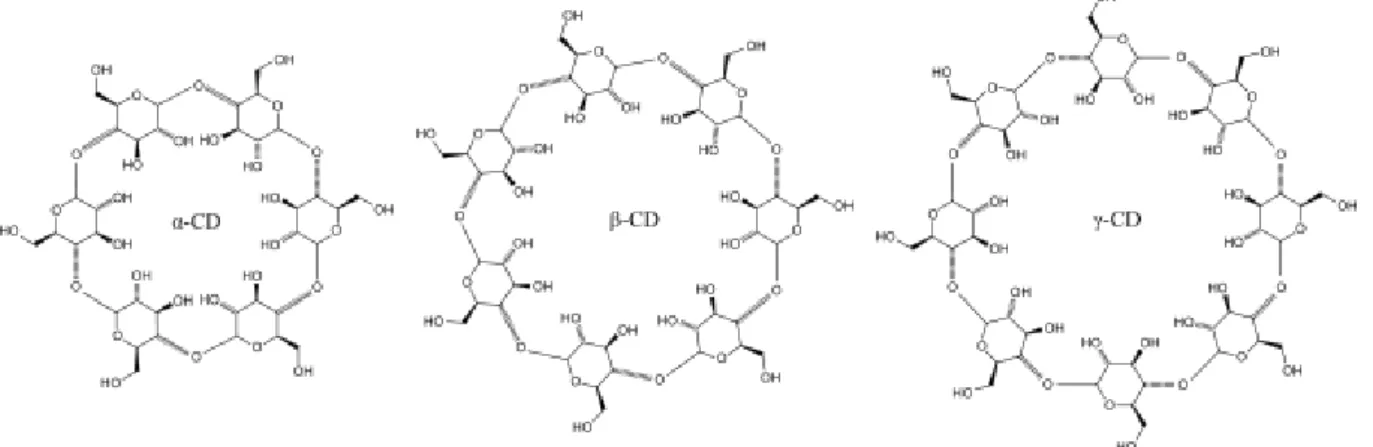
and studied are cyclodextrins with 6, 7 or 8 glucose units, called α-, β-, γ-cyclodextrin (Figure 2). It has been demonstrated by calculations that, due to steric hindrances, rings with a number of less than 6 units can not be formed. In 1961, superior homologues were
synthesized, namely -, -, -, -cyclodextrins, but which can not be isolated by selective
precipitation, and their ability to complex is negligible. Among the cyclodextrins most
studied and accessible was -cyclodextrin (Szejtli, 1982, 1988).
Figure 2 Structure of -, - and -cyclodextrins (Szejtli, 1982)
Hydroxyl groups from C-2 and C-3 carbon atoms in the adjacent glucopyranosol units form hydrogen bonds that stabilize the form of the molecule and at the same time
significantly affect the water-solubility of cyclodextrin: 14.5 g/100 mL of -cyclodextrin; 1.8
g/100 mL of -cyclodextrin; 23.2 g/100 mL -cyclodextrin. By studying the
hydrogen-deuterium exchange in DMSO by NMR spectroscopy, intramolecular hydrogen bonds have been shown to be made by the secondary hydroxyl groups. Following the NMR
spectroscopy of -cyclodextrin in DMSO- d6 at 25°C and 80°C it was observed that the
protons of the α- and β-cyclodextrin hydroxyl groups had lower chemical shifts (Figure 3),
indicating that that hydrogen bonds in -cyclodextrin are more potent than -cyclodextrin,
and those in β-cyclodextrin are more potent than -cyclodextrin.
341
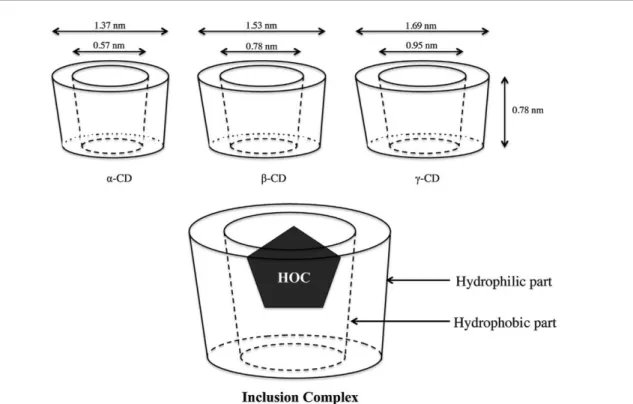
Figure 3 Structure of native cyclodextrins and inclusion complex formed with petroleum hydrocarbons (HOC) (Trellu si colab., 2016)
Cyclodextrins can be considered as a trunk of cone in which the secondary hydroxyl groups are arranged on a large basis, and the primary hydroxyl groups based on the small cone trunk. The dimensions of the three shapes shown above, namely the diameters of
the inner cavity, are: 5.7; 7,8 and 9,5 Å for -, - and -cyclodextrin, respectively. With the
increase in the diameter of the cyclodextrin cavity, it can accommodate a larger number of water molecules, so in aqueous solution the bound water molecules will differ energetically less and less from those in the solvent mass.
α, β and γ-cyclodextrins are cyclic oligosaccharides formed from 6, 7 or 8 α -1,4-glycosidic units (Szejtli, 1982). Because they have hydrophobic cavities and hydrophilic coatings, they are water-soluble. In this way, hydrocarbon solubility increases. The three α,
β and γ natural cyclododecines are completely and readily biodegradable (Chunli et al.,
2011).
The effect of β-cyclodextrins on the hydrocarbon solubility in the aqueous phase was investigated by Huipeng et al., 2015. The relation between hydrocarbon solubility and β-cyclodextrin concentration was determined and the hydrocarbon distribution coefficient between β-cyclodextrins and water (Kcw) was calculated.
CONCLUSIONS
Research results indicate that cyclodextrins increase hydrocarbons biodegradation significantly. Non-inclusion interactions may play a role in increasing bioavailability. Studies in which hydrocarbon mixtures were used in the presence of cyclodextrins indicate that the reduction in hydrocarbon concentration, both in the presence and absence of cyclodextrins, is influenced by chain length.
Cyclodextrins are also nontoxic and readily degradable in the soil, do not pose any risk to soil life.
342
ACKNOWLEDGMENT
The financial support provided by Ministry of Education and Research – project no. PN 16 07 03 08 Bioremediation of soil polluted with crude oil by using β-cyclodextrin.
BIBLIOGRAPHY
1. Bardi , L., Martini, C. , Opsi, E.F., Bertolone, E., Belviso, E., Masoero, G, Marzona, M., Ajmone Marsan, F., 2007 – Cyclodextrin-enhanced in situ bioremediation of polyaromatic
hydrocarbons-contaminated soils and plant uptake, J Incl Phenom Macrocycl Chem, 57:439–444,
DOI 10.1007/s10847-006-9231-x.
2. Boving T., McCray J.E., Blanford W., 2003 – Comparison of Two Cyclodextrin Remediation Approaches: Line-drive versus Push–pull, Abstracts Programs of the Geological Society of America, 35(6), p. 371.
3. Chunli, W., Maoan, D., Duu-Jong, L., Xue, Y., Wencheng, M., Zheng, Z., 2011 –
Electrokinetic remediation and microbial community shift of β-cyclodextrin-dissolved petroleum hydrocarbon-contaminated soil, Appl Microbiol Biotechnol, 89:2019–2025, DOI
10.1007/s00253-010-2952-1
4. Fava F., Di Gioia D., Marchetti L, 1998 – Cyclodextrin effects on the ex-situ bioremediation of a chronically polychlorobiphenyl-contaminated soil, Biotechnology and Bioengineering 58, p. 345-355.
5. Huipeng, G., Xiaorong, G., Yaming, C., Li, X., Lingyun, J., 2015 – Influence of Hydroxypropyl-β-cyclodextrin on the Extraction and Biodegradation of DDT, o,p′-DDT, p,p′-DDD, and p,p′-DDE in Soils, Water Air Soil Pollut (2015) 226: 208, DOI 10.1007/s11270-015-2472-9.
6. Rahman K.S.M., Thahira-Rahman J., Kourkoutas Y., Petsas I., Marchant R., Banat I.M.,
2003 – Enhanced bioremediation of n-alkanes in petroleum sludge using bacterial consortium amended with rhamnolipid and micronutrients, Bioresource Technology 90, p. 159–168.
7. Reid B.J., Semple K.T., Jones K.C., 1998 – Prediction of bioavailability of persistant organic pollutants by a novel extraction technique, In: Contaminated Soil ’98, vol. 2, Thomas Telford,
London, p. 889-990,.
8. Reid B.J., Stokes J.D., Jones K.C., Semple K.T., 2000 – Nonexhaustive cyclodextrin-based extraction technique for the evaluation of PAH bioavailability, Environmental Science and Technology 35, p. 3174-3179.
9. Riding M.J., Doick K.J., Martin F.L., Jones K.C., Semple K.T., 2013 –Chemical measures of bioavailability/bioaccessibility of PAHs in soil: Fundamentals to application, Journal of Hazardous Materials 261, 687– 700
10. Szejtli J., 1982 – Cyclodextrins and their inclusion complexes, In: Proc First Int Symp on Cyclodextrins, Akademiai Kiado, Budapest, D. Reidel Publishing, Dordrecht, p. 95–109.
11. Szejtli J., 1988 – Cyclodextrin thechnology, Kluwer Academic Publishers, Dordrecht, The Netherland, p. 1–393.
12. Szejtli J., 1994 – Medicinal applications of cyclodextrins, Med Res Rev, 14(3), p. 353– 86.
13. Szejtli J., 1996 – Inclusion of Guest Molecules, Selectivity and Molecular Recognition by Cyclodextrins, In Szejtli J & Osa T (Eds) Comprehensive Supramolecular Chemistry, Vol 3, p. 189-203, Pergamon - Oxford.
14. Trellu C., Mousset E., Pechaud Y., Huguenot D., van Hullebusch E.D., Esposito G., Oturan M.A., 2016 – Removal of hydrophobic organic pollutants from soil washing/flushing solutions: A critical review, Journal of Hazardous Materials 306, 149–174.
15. Voiculescu A.R., Dumitru M., Toti M., 2003 – Decontaminarea Solurilor Poluate cu Compuşi