202
Copyright © 2018. IJEMR. All Rights Reserved.
Volume-8, Issue-4, August 2018
International Journal of Engineering and Management Research
Page Number: 202-207
DOI:
doi.org/10.31033/ijemr.v8i4.13242
Anatomy of a Textile Cluster – Problems and Prospects of Textile
Business Owner with Respect to Business Expansion and Operations
Nalini Palaniswamy1 and Muruganandam Duraiswamy2
1
Assistant Professor, Department of Management Studies, Kumaraguru College of Technology, INDIA
2
Associate Professor, Department of Management Studies Bharathiar University Post Graduate Extension Centre, INDIA
1
Corresponding Author: [email protected]
ABSTRACT
The study on Anatomy of a textile cluster - problems and prospects of textile business owners with respect to business expansion and operations was carried out to find the problems and prospects of Erode textile cluster as a pilot survey with a sample size of 80 respondents. The primary study was carried out in two stages. An exploratory study was done among the textile merchants and textile buyers to understand the nature, administration, status, problems and scope of the textile merchants in Erode Cluster. Firstly, the researcher had personnel interview with the officials of four major textile markets namely, Texvalley, Gani market, Ashokapuram market, and central market.Secondly an interview schedule
was carried with a structured questionnaire . The interview schedule was prepared with four variables namely business factors, financial factors, marketing factors and market facility concerned. Each items in the variable was measured with a 5 point Likert scale. And there were few items which captured their present level operations and future plans. The results revealed the present status of their operations which is a key in factors for planning for a better operational efficiency for next level.
Keywords-- Textile owners, Problems of textile business, Business operations, Textile cluster
I.
INTRODUCTION
Textile industry is more flourishing industry in India. The textile industry in India was known for its quality and craftsmanship. The European traders first encountered fine cotton cloths from India carried by Arab merchants in Mosul in present day Iraq. so they started refereeing it as "Muslin". Also when Portuguese first came to India in search of Spices the cotton which they took back from India was named as " Calico". Calico was name derived from Calicut. In early 18th centuries the England was worried on the popularity of Indian textiles especially the cotton textiles. Many laws and legislations was passed to enact and protect the indigenous producer of textiles in England. However Indian textiles and garments continued dominate the world trade in late 18th century. The first stage of production was spinning and later weaving was majorly carried out by men of different communities in India. Like Tanti in Bengal, Julahas or momins in North India, and Devangs in south India. Handloom weaving was the major occupation for livelihood of millions of Indians. The development of cotton Industries in many countries in late 90s has affected the Indian Textile industries. The major challenges were competing with countries like British textiles in the European and American markets.
Due to many Macro factors and external market influences development of mills and lead to transformations of employments. Also, in 19th century there were raise of weaving mills, spinning mills and also the composite mills. Equally in late 90s SSI power loom units also increased. In 20th century SITP was implemented to facilitate setting up of textiles units with appropriate support infrastructure. cotton prices are also aligned with global prices. in Budget 2016-2017 government had allotted around USD701.9 million for textile industry. Major focus of the budget was to attract manufacturers, Initiatetechnology, upgradation and setup integrated textile parks etc., The textile industry in India contributes to 7% of industry output in value terms ,2% of India's GDP and to 15% of the country's export earnings. With over 45 million people employed directly. the textile industry in India is the largest sources of employment generation in the country. The traditional sectors like handloom, handicrafts and small scale power loom units are biggest source of employment for millions of people in rural and semi-urban areas.
203
Copyright © 2018. IJEMR. All Rights Reserved.
business. Any business man gets motivated only whenthey have business growth led with higher revenue and sales. To ensure a sustainable growth the traditional way of doing business has to change and the business owners has to step into new avenues for growth. With huge potential and entrepreneurial skills, the textile merchants of Erode cluster are having un addressed problems to take their business to the next step. The Erode power loom cluster has grown in terms of volume, value and variety over the last few decades and has become one of the active markets for cotton goods in the country. However, over the last few years the cluster has lost its prideful place due to labour shortage, obsolescence and margin erosion. To overcome these problems, it was felt necessary to erase the ‘low quality’ image of the cluster and make it look attractive even for the quality conscious buyers. This can be achieved only by establishing linkages with national and export markets, ensuring patronage of ‘quality-seeking’ buyers, reducing role of middlemen and shifting competition from price-based to design, variety, quality, time and differentiation based. The textile cluster in Erode is not completely stated as organized toserve the world-class market. The major stake holders of this cluster is the weavers, traders and merchants who are involved in production, value addition and selling. The government on the other side is bringing many interventions to improve their presence and business operations and opportunities among National and International levels. To plan and implement any interventions among textile business owners it is mandatory to understand the nature, administration, status, problems and scope of thistextile businessowners in expansion and operation, Also, it is important to understand the various factors influencing and their level of influence to the textile merchants and textile buyers.
II.
REVIEW OF LITERATURE
The major problems faced by textile industry are very specific to the infrastructure,obsolete machinery,lack of trained manpower, decentralised and fragmented nature of industry. In addition to this challenges the exporting community face tariff and non-tariff barriers. In domestic markets the industry must be prepared to meet the growing competition from three sources viz., from imported goods coming into market at lower price and lower import duties, the foreign company producing textiles in India with their trademarks and latest technology and lower prices due many external factors(Textiles, n.d.)
The study conducted among handloom cooperative societies working in Kannur districts revelled its importance. The handloom sectors are known for its heritage and tradition of excellent craftsmanship. It provides livelihood of weavers and craftsmanship. The growing International brands and lifestyle changes is affecting the sector to great extent. The MSME is also running many programs to address the problems of textile clusters. The major problems in handloom is low productivity,technology interventions,
poor market segments, competition from power loom, lack of innovations and low wages and credit facilities. the various interventions have improved their operations and performance like trust building among societies design interventions, design developments, branding, participating in international trade shows, interaction with textile associations for exports. This cluster activities interventions have increased domestic production, confidence among merchants and weavers, exports, identifying their needs has improved the operational efficiency (premavalli et all 2015). The textile and apparel industry can be broadly divided into two segments - yarn and fibre, and processed fabrics and apparel. India accounts for 14 per cent of the world's production of textile fibres and yarns (largest producer of jute, second largest producer of silk and cotton, and third largest in cellulosic fibre). India has the highest loom capacity (including hand looms) with 63 per cent of the world's market share.
The domestic textile and apparel industry in India is estimated to reach US$ 141 billion by 2021 from US$ 67 billion in 2014. Increased penetration of organised retail, favourable demographics, and rising income levels are likely to drive demand for textiles. India is the world's second largest exporter of textiles and clothing.
Textile and apparel exports from India are expected to increase to US$ 82 billion by 2021. Readymade garments remain the largest contributor to total textile and apparel exports from India, contributing 40 per cent to total textile and apparel exports. Cotton and man-made textiles were the other major contributors with shares of 31 per cent and 16 per cent, respectively.
Rising government focus and favourable policies is leading to growth in the textiles and clothing industry. The Ministry of Textiles is encouraging investments through increasing focus on schemes such as Technology Up-gradation Fund Scheme (TUFS). To promote apparel exports, 12 locations have been approved by the government to set up apparel parks for exports. As per the 12th Five Year Plan, the Government plans to provide a budgetary support of US$ 4.25 billion to textiles. Free trade with ASEAN countries and proposed agreement with European Union will also help boost exports
The government has extended the duty drawback facility on all textile products and increased rates in some cases for one year to boost exports in the sector. The government is also planning to conduct roadshows to promote the country's textiles in non-traditional markets like South America, Russia and select countries in West Asia. The review on textile industries highlights the importance and immediate need for understanding the problems of textile merchant and buyers.
III.
METHODOLOGY
204
Copyright © 2018. IJEMR. All Rights Reserved.
respect to Business Expansion and operations. The studywas carried out to understand at a pilot level aboutthe textile merchants in the four markets of Erode. Constituting a population of nearly 7000-10,000 textile business owners. The primary study was carried out in two stages. An exploratory study was done among the textile merchants and textile buyers to understand the nature, administration, status, problems and scope of the textile merchants in Erode districts. Firstly, the researcher had personnel interview with the officials of four major textile markets namely, Texvalley, Gani market, Ashokapuram market, and central market. The main focus of the interview is to understand the anatomy of the different markets and various administration and operation taken up by the administrators. of the respective textile markets. The textile business owners are classified as weavers, merchants and traders. Every markets have combination of this three segments. The markets operate on 3 days Ashokopuram market operate from Sunday evening 7.00 pm to Monday afternoon 11.00 a.m.. The Gani market and central markets operate from 7 pm on Monday to Wednesday 11.00. Secondly an exploratory study was conducted among various Textile buyers and textile sellers based on which a structured interview schedule was prepared and the same was collected from the 80 sample respondents from all the four markets. The sampling design used was Non-probability convenience sampling. Theinterview schedule was prepared with four variables namely business factors, financial factors, marketing factors and facility concerned. Each items in the variable was measured with a 5 point Likert scale. And there were few items which captured their present level operations and future plans. The overall Cronbach alpha score for the items was
Cronbach's Alpha
N of Items
.814 46
IV.
SCOPE OF THE STUDY
Erode District lies on the extreme north of Tamil Nadu. Now Erode District consists of 9 taluks viz., Erode, Modakkurichi, Kodumudi, Perundurai, Bhavani, Anthiyur, Gobichettipalayam, Sathyamangalam and Thalavadi. There are 4 Municipalities in the district viz., Sathyamangalam, Bhavani, Gobichettipalayam, and PunjaiPuliampatti. The other four Municipalities in the district viz. Periasemur, Kasipalayam, Surampatti and Veerappanchatram have been merged recently with Erode Corporation. There are 42 Town Panchayats, 230 Village Panchayats and 375 Revenue Villages. There are 14 Community Development Blocks in the district. In the Industrial map of Tamil Nadu, Erode district has a place of unique importance with 40.32 percent of population depending on non-agricultural sector. Industries and trade naturally occupy a place of prominence in the economy of the district. The industry which has been able to totally withstand the onslaught of
modernisation has been the handloom weaving. Erode, Chennimalai and other places of the districts still hold their way and the district is noted for its handloom products, which include cotton sarees, bed-spreads, towels, furnishing fabrics etc. Two other important production centers are Bhavani and Jambai.
The cotton textile industry in Coimbatore and handloom industry in Erode district have encouraged the growth of various ancillary industries to meet the needs of the textile mills. Chennimalai, Erode, Gobichettipalayam etc., are important centres where cotton ginning is carried on a large scale. There are also important dying works in Erode, Chennimalai and Bhavani. A number of factories engaged in cotton fabric printing are functioning in Erode.As mentioned above the district has huge potential and their livelihood is majorly depended on textile related business. The study will surely help to understand their needs better which will help the textile owners to improve their performance for business growth and day to day operations.
Respondents profile
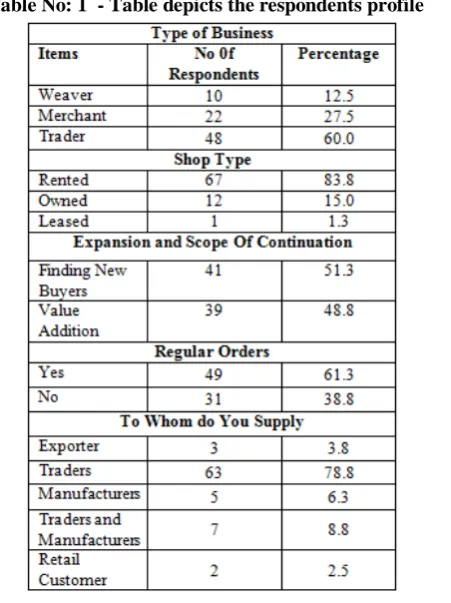
As tabulated below in table No 1 -Merchants and traders are higher in the markets compared to the weavers (27.5% and 60.0% respectively). The average year of existence in textile business of the respondent collected was 3 years. The shop type afforded by the textile business owners are mostly rented and it is a huge burden. In spite of sales made on any particular weak they are subjected to pay the rents. Almost 61.3% of the respondents get regular orders. The textile owners do not have good business orders from export markets its hardly 3.8 %. Majority market is from the traders or the resellers.
205
Copyright © 2018. IJEMR. All Rights Reserved.
The major four factors studied is presented inthe following charts. There were four major factors studied namely business factors, financial factors, marketing factors and facility concerned. Each items in the variable was measured with a 5 point Likert scale. Whereas 1 remains low and 5 being high. The business factors (chart No 1) depicts the mean score of the various business factors influence in the operations of textile owners. Awareness of government policies seems to be high. Followed by capacity utilisation. Capacity swaps, affordability of technology for production, taking up of
family business etc., seems to bit on the high side. Investment risk and also infrastructural problems is at higher side.
Availability of labour is also becoming major issues because of the low attractiveness towards selecting the textile business has their employmentoptions
Chart 1: Chart showing the mean value of the business factors among the textile merchants
The other major factors for any business is the financial factors. The mean value from the factors collected and presented in chart 2. The values reveal that raising of own capital has high mean value so most of the textile owners are using their own money in business
expansions. Also, they feel compare to other businesses the textile business ROI is higher. The capital raised from other sources like friends and relatives, financial relatives, commercial and cooperative banks. The mean value of interest payments also seems to be lower.
Chart 2: chart showing the mean value of the financial factors of the textile merchants
Marketing factors revealed various important factors concerned with textile business and its mean value to the individual items is presented in chart no 3. Awareness of market knowledge, identifying buyers and good transport facilities has higher mean values
206
Copyright © 2018. IJEMR. All Rights Reserved.
moderate. Improving all this will increase their global presence.Chart No 3: Chart showing the Mean value of the marketing factors among the buyers
The markets even though sell more identical products the textile buyers prefer to sell their products in any of the four different markets due to many reasons. The facilities and their ranking on the present facility is recorded in a five-pointscale and the mean value is
presented below in chart No:4. Logistics, transport, ATM, bank, parking has higher mean value and they are comfortable. The upgradation techniques like fashion institute, training institutions are not more accessible for their upgradation and betterment.
Chart No:4 The chart showing the rating by the textile merchants on the present facility
V.
RESULTS, DISCUSSIONS AND
CONCLUSION
The Erode textile cluster has huge potential in bringing volume and value for textile business in serving the needs of the value chain of textiles industry. Understanding the importance of the clusters it is right time for the policy makers, the local bodies and business
207
Copyright © 2018. IJEMR. All Rights Reserved.
more identical. it’s important to bring in a required levelof interventions for better visibility and presence to erase the ‘low quality’ image of the cluster and make it look attractive even for the quality conscious buyers. This can be achieved only by establishing linkages with national and export markets, ensuring patronage of ‘quality-seeking’ buyers, reducing role of middlemen and shifting competition from price-based to design, variety, quality, time and differentiation based.
Also the above findings are based on the pilot samples of 80 respondents. The same study will be continued with a higher sample size to generalise the study results. The reliability score ensures the adequacy of the items collected to find the research factors. The same study can be replicated in different textile clusters.
REFERENCES
[1] Abramov, I. (2007). Responsible business : Weaving the fabric of a stable marketplace. American Business Law Journal,44(2), 223–236.
[2] Amann, E., Lau, B., & Nixson, F. (2009). Did China hurt the textiles and clothing exports of other asian economies, 1990 – 2005 ?. Oxford Development Studies, 37(4), 333-362.
https://doi.org/10.1080/13600810903305190
[3] Aruna, N. (2015). Problems faced by micro, small and medium enterprises – A special reference to small entrepreneurs in Visakhapatnam. IOSR Journal of
Business and Management, 17(4), 43–49.
https://doi.org/10.9790/487X-17454349
[4] Bhandari, A. K., & Ray, S. C. (2012). Technical efficiency in the Indian textiles industry : A non-parametric analysis of firm-level data. Economic
Working Papers, 109–125.
https://doi.org/10.1111/j.1467-8586.2010.00381.x [5] Bonet, A., & Dı, P. (2010). Textile industry indicators for management. Total Quality Management
& Business Excellence, 21(1), 1–9.
https://doi.org/10.1080/14783360903492470
[6] Ms. K.Rani & Ms. B. Thilagavathi. (2017). A study on problems faced by power loom industries in somanur
region of Coimbatore district. International Journal of
Commerce, Business and Management,6(5), 42–46.
[7] Goli, K. C., & Deshmukh, B. B. (2014). A review on redesign of drive system for textile powerloom machine to prevent downtime and improve reliability of system. International Journal of Engineering Trends and Technology,12(1), 50–52.
[8]Umesh Singh, M. K. Singh, & Mohan Singh. (2103 August). Failure analysis of bridle chain used for hoisting in mines. Journal of Chemical Engineering and Materials Science, 4(3), 38-45.
[9] Akamatsu K. (1962). A historical pattern of economic growth in developing countries. Journal of Developing Economies, 1(1), 3-25.
[10] Koszewska, M. (2013). A typology of polish consumers and their behaviours in the market for
sustainable textiles and clothing. International Journal
of Consumer Studies,37(5), 507–521.
[11] Vaughan Reimers, Bryce Magnuson, & Fred Chao. (2016). The academic conceptualisation of ethical
clothing. Journal of Fashion Marketing and
Management: An International Journal, 20(4), 383.
[12] HaeJung Kim, Stacy H. Lee, & Kiseol Yang.
(2015). The heuristic‐systemic model of sustainability
stewardship: Facilitating sustainability values, beliefs and practices with corporate social responsibility drives
and eco‐labels/indices. International Journal of
Consumer Studies, 39(3), 249-260.
[13] Cosette M. Joyner Armstrong, Kim Y. Hiller Connell, Chunmin Lang, Mary Ruppert-Stroescu, & Melody L. A. LeHew. (2016). Educating for
sustainable fashion: Using clothing acquisition
abstinence to explore sustainable consumption and life
beyond growth. Journal of Consumer Policy, 39(4), 417.
[14] Indrajit Ray. (2009). Identifying the woes of the cotton textile industry in Bengal: Tales of the nineteenth century. JSTOR, 62(4), 857–892.