http://www.jscdss.com
Vol.2 No.4 August 2015: 1-5 Article history:
Accepted 3 June 2015 Published online 3 June 2015
Journal of Soft Computing and Decision
Support Systems
Simulation of Class-Based Weighted Fair Queue Algorithm on an IP Router Using
OPNET
Idris Zakariyya a,*, M Nordin A Rahman a
a
Faculty of Informatics and Computing, University Sultan Zainal Abidin, Besut, Terengganu, Malaysia
* Corresponding author email address: [email protected]
Abstract
Network traffics management and congestion control are becoming complex and critical issue due to the emergence of modern multimedia internet applications. Industries and universities are facing critical challenges of providing the required internet services demanded by the users. Global and rapid internet accesses by the users slow down the network performance and lower the quality of service. Efficient scheduling mechanism plays a significant role in the sharing of network resources effectively during the period of congestion. As part of the resource allocation scheme, each router must implement certain scheduling algorithm that governs the order of packets transmission in a network. In this paper a class-based weighted fair queue (CBWFQ) algorithm is proposed and simulated along side with first-in-first-out (FIFO) and custom queue (CQ) scheduling algorithms on an IP router using OPNET simulation software. The arrivals and service rate of the applications traffics classes considered follows the poisons and exponential distribution based on Markov-Chain queuing model. The HTTP, FTP, video and voice application traffics are configured in the network environment using the applications and profiles configuration objects. Additionally, discrete event simulations statistics are collected and recorded. Simulations graphs of various scenarios are generated and analyzed critically. Results revealed an efficient performance improvement of the class-based weighted fair queue algorithm compared with the custom queue and first-in-first-out queuing scheduling algorithms. In terms of packets loss and queuing delay, CBWFQ algorithm demonstrated an excellent performance with a very low probability of dropping packets and minimal queuing delay. Overall, the study contributed in the use of scheduling algorithm on network routers and switches for proper traffic control and management during congestion.
Keywords: Algorithm, Markov-Chain, Packets scheduling, Traffic management, OPNET simulator
1. Introduction
Due to the emergence of modern multimedia real time applications, internet traffics growth instantly. Applications and services introduce rapidly to the internet changes the dynamic nature of the increases in global internet traffics. As predicted by Cisco virtual networking index Sanjose (2013) forecast white paper in the year 2017, there will be almost 3.6 billion internet users in the world; and an estimated of 1.4 zettabytes global internet traffic growth. Network traffic control becomes critical challenge for various organizations to provide the required internet services that satisfies users.
Thus, the differentiated service packet-switched network provides quality of service guarantee to different traffic classes in the internet in a scalable manner. In a high-speed network packet scheduling algorithms controlled congestion by routing traffics to their destination. However, various numbers of researches have been done in the area of quality of service, packet scheduling discipline and computer modelling and simulations (Vijayakumar et al., 2013; Balogh and Medvecky, 2010; Zakariyya and Rahman, 2015; Shalangwa, 2014; Kassim and Ismail, 2011;
Mohammed et al., 2013; Szilẚgyi, 2015; Rastogi and Srivastava, 2013; Mahiddin, 2014).
An implementation of queuing algorithm in multipath dynamic routing studied by Vijayakumar et al. (2013) contributed in securing voice over IP (VoIP) data transfer. Similarly, in the Balogh and Medvecky (2010) simulation of priority based queuing disciplines and their comparison using network simulator 2 (NS2) is presented and also explored the effects of packets scheduling mechanism in maintaining network resources.
2
E-ISSN: 2289-8603
the effects of different congestion management algorithms on VoIP. An overview and classical performance of each algorithm in managing network traffic during congestion was elaborated. The goal of Srivastava (2013) is to compare the performance of various queuing scheduling algorithm. The effectiveness of each of the algorithm in routing packet was demonstrated. Similarly, Mahiddin et al. (2014) also compared the performance of queuing algorithm in wireless network environment using OMNET simulator. With the proposed packets queuing scheme the expected fairness was attained.
This research differs from the previous ones through the simulation and implementation of a class-based weighted fair queue algorithm in managing networks traffic using powerful oriented simulation software OPNET. However, both real and non real time traffics are considered during network design and simulation. Also, critical comparison is investigated with the custom queue and priority queue and the effectiveness of the algorithm in transmitting packet during the period of congestion is recorded.
Even-though the technique enforces fairness and ensures that minimal application bandwidth is guaranteed. But do not consider the delay sensitive application as the highest priority traffics class during transmission as a result of that has the lowest probability of dropping packets. Also, work best for small number of packets. Alternatively, for real time applications, low latency queue (CBWFQ and PQ) or priority queue (PQ) is more preferable approach.
Queuing algorithms plays an important role in the sharing and managing network resources effectively. The proposed simulation of the class-based weighted fair queue algorithm shows the impacts of packet queuing algorithm in a router. Additionally, the analysis and comparison with FIFO and CQ also revealed the performance improvement of the proposed algorithm.
2. Packet scheduling algorithms
2.1 custom queuing
Custom queue (CQ) (see Fig. 1) is designed for network environment that need to guarantee a minimal level of service to all protocols. In addition, uses the weighted round robin techniques to allocate certain percentage of bandwidth to mission critical data, but also assured predictable throughput for other traffic. In general, custom queue provide a guaranteed level of service for all traffic, by allowing non system queue to uses the reserved bandwidth during transmission. The unused bandwidth is dynamically allocated to any protocols that require it.
2.2 First-in-First-out
First-in-First-Out is the default queuing algorithms implemented on a network routers or switches. The algorithm maintained one common buffer upon which packets are transmitted. Packets from the output buffer are transmitted based on first come first serve principle. During the period of congestion, packets get dropped from the
output buffer. This causes tremendous packets delay during transmission due to the allocation of one common buffer to each packet on service.
Fig. 1. Custom queue.
2.3 Class-based weighted fair queue
Class basedweighted fair queue (CBWFQ) scheduling discipline used to guarantee bandwidth to each class of service in a network during the period of congestion. Similarly, uses the scheduling techniques of weighted fair queuing (WFQ) to assigned weight to a different class of service. In addition, priorities are given to certain mission critical traffic classes in the router. But, also enforces fairness by reserving a specific bandwidth to be used by other classes that have utilized their allocated bandwidth. Traffic classes are configured based on access list, protocols, source and destination IP address. The queue limit is configured to determine the maximum number of packets a traffic classes can accommodate. This techniques work best in routing both the real and non real time traffics in a network. It also have the minimum queuing delay of transmitting a packets compared with the custom queue and first-in-first-out.
3
E-ISSN: 2289-8603
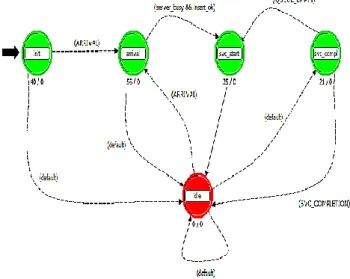
Fig. 2 above depicted the customize process model of weighted fair queue. Additionally, illustrated the logical processes / states involve during packets arrival on a queue, service started through completion respectively. The details description of each respective step is fully outlines from the reception of packets up-to successful transmission. This is the basis scheduling algorithm through which class-based weighted fair queue algorithm operates. The steps involves are stated below:
I. Init state (Initial State)
Initialize all variables and statistics.
II. Arrival State
Step 1: Get the incoming packet.
Step 2: Get information about the packet: packet length and packet arrival time. Store the arrival time.
Step 3: Compute Virtual Finish time (VFT) for each packet in a queue in service using equation 1 below.
( ) ( ( ) ( )) ( ) ⁄ (1)
Step 4: Queue the packet in the sub-queue. Check if the server is busy then jump to service start state, else jump to an idle state.
III. Srvc_Start (Service Start)
Step 1: Determine which sub-queue to serve.
Step 2: Serve the packet with the lowest calculated VFT and schedule packet when service is completed.
Step 3: Update statistics
Step 4: Sets the server busy state variable to true and return to the idle state.
IV. The Srvc_complete state (Service Complete)
Step1: Remove packets from its sub-queue Step2: Retrieve its finish time, update the VFT Step 3: Update statistics
Step 4: Send the packet; if there are other packets waiting to be sent, jump to service start state otherwise to the idle state.
3. Experimental simulation scenario with OPNET
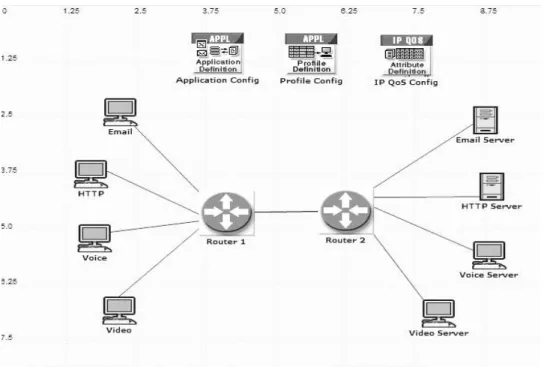
A simple Ethernet model environment was designed and constructed for the simulation of a class-based weighted fair queue, custom queue and first-in-first-out queue on a router. The model depicted in Fig. 2 was developed using OPNET simulation software version 14.5 for investigation. In the topological model, four Ethernet workstations clients are configured to send email, HTTP, video and voice traffic to the specified servers. The potential bottleneck link between router 1 and router 2 were configured using the IP QoS configuration object to routes the network traffics to their destination. Additionally, CBWFQ, FIFO and CQ queuing algorithms were implemented on the critical bottleneck router (router1). In the model, class-based weighted fair queue, custom queue and first-in-first-out queuing were properly configured using IP QoS. All links in the networks were connected through 100 Mbits/sec (100 BaseT), except the potential point-to-point bottleneck DS1 link connecting router 1 and router 2 as shown in Fig. 3 below is the depicted topological network model.
4
E-ISSN: 2289-8603
3.1 Configuration
The network clients involved were properly configured using the application, profile and IP QoS configuration objects.
Email was configured as heavy with size 200 Mbits/sec to deliver the best-effort (0) type of service (TOS). Additionally, HTTP traffic class was also configured to supports heavy internet browsing using an excellent effort (3) service model.
Moreover, voice applications were configured to provide pulse code modulation (PCM) quality speech service with the support of an interactive voice (6) services. In the video configuration, clients are capable of supporting video cassette recorder (VCR) using streaming multimedia (4) services. Quality multimedia video services were considered during the configuration. Also, the network environmental setting was design to ease the configuration processes.
4. Simulation results
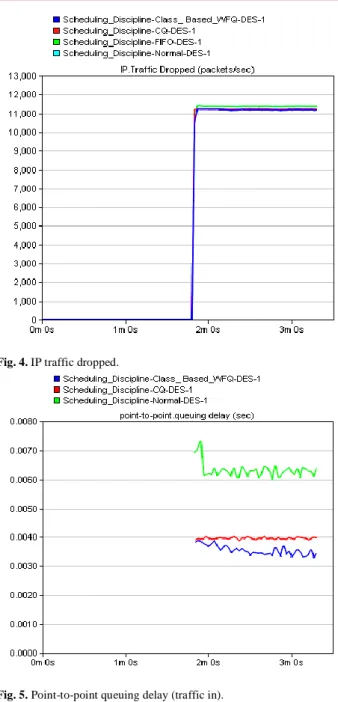
The constructed LAN model environment was simulated and various scenario graphical results were generated. During the simulation experiment, discrete event statistic was collected. The obtained graphs results were clearly observed and recorded. For each scenario graphs, blue line represent class-based weighted fair, red line represent first-in-first-out and green line represent the custom queue respectively. Additionally, throughput, queuing delay, packet loss and jitter performance measures are considered. In term of the IP packet drop, class-based weighted fair algorithm have the lowest packets loss probability in comparison with the custom queue and the first-in-first-out queue as shown clearly in Fig. 4 below. As a result of that, traffics sent by class-based weighted fair queue are extremely higher than that of custom queue and first-in-first-out, and also the optimum throughput was achieved.
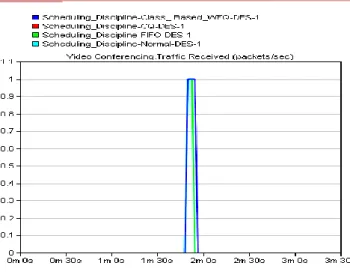
The lowest point-to-point queuing delay in second provided by the class-based weighted fair queue indicates its significant improvements over custom queue and first-in-first-out. From the graph shown in Figs. 5 and 6 below, CBWFQ have the lowest queuing delay as compared to CQ and FIFO. Meanwhile, video conferencing traffic sent and received using the CBWFQ, CQ and FIFO mechanism are studied and examined. As illustarted clearly in Figs. 7 and 8 graphs, class-based weighted fair queue sent almost all the applications traffic to the destination with little packets loss.
Consequently, the simulation model has outlined the essential feature of the class-based weighted fair queue in managing network resources during the period of congestion. In addition the effects of the algorithm in efficient packet transmission are also study and analyzed. As presented graphically, simulation results revealed the relevance of the algorithm in enforcing fairness among different traffic classes in a network.
Fig. 4. IP traffic dropped.
Fig. 5. Point-to-point queuing delay (traffic in).
5
E-ISSN: 2289-8603
Fig. 7. Video conferencing traffic received.
Fig. 8. Video Conferencing Traffic Sent. 5. Conclusion
Congestion control is an active area of study due to the dynamic increases of internet traffics. The development of modern multimedia applications that require much of the network resources is making congestion control a critical aspects of consideration. Sanjose (2013) forecast white paper, predicted that in the year 2017, there will be almost 3.6 billion internet users in the world. For that reason organization faces the challenges of providing the required service that can satisfies customer requirements.
In this study, simple ethernet simulation model is design and implemented in-order to investigate the performance of a class-based weighted fair queue, custom queue and fifo queue on a router. The simulated network environment consists of four different clients generating and transmitting email, http, video and voice traffic through router 1 via the bottleneck link to the clients servers. The link connecting the two routers is the potential bottleneck that routed traffics to destination. Simulation results revealed that class-based weighted fair queue has the lowest packet drop probability as compared to first-in-first-out and custom queue respectively.
The overall performance signified the reliability and effectiveness of the proposed class-based weighted fair queue during packets transmission on a network router. The highest throughput attained and minimal queing delay is an indication that traffic classes are conformed with their
bandwidth requirements. Also, application traffic classes have been sent to their destined servers. This research study examines that class-based weighted fair queue work best for mission critical and traditional applications. However, for the delay sensitive applications, low latency queue is more prefarable due to the priority given to multimedia applications like the video and voice during services on a buffer.
This study contributes immensely for the uses of packets scheduling algorithms in managing network resources to ease congestion. Also can help industries and university network administrators to set the acceptable policy for allocating and managing internet bandwidth to provide the required quality of service.
Despite, the siginificant improvement acheived, further research is due to enhance the modelling process to provide support for scalable network architecture with large number of packets.
Acknowledgment
The authors would like to thank the reviewers for their specific and helpful comments.
References
Balogh, T., and Medvecky, M. (2010). Comparison of priority queue based scheduling algorithms. International Society for Science and Engineering, Elektroreveu Journal, 1(1), 1- 8.
Calif., San Jose. (2013). Cisco virtual networking index forecast white paper. http://newsroom.cisco.com/release/1197391/
Emad, Aboelela. (2003). Network simulation experiments manual .third edition: Morgan Kaufmann.
Hussein, A., Mohammed, Adnan, Hussein, Ali, and HawraaJassim, Mohammed. (2013).The affects of different queuing algorithms within the router on QoS VoIP application using OPNET. International Journal of Computer Networks and Communication, 5(1), 117-124
Kassim, M., Ismail, Jumari, M., K. and Yusof, M., I. (2011). A survey: bandwidth management in an IP based network. World academy of science, engineering and technology, 6(2), 332-339. Mahiddin, A., Hasyifah, R., and W., N., Shuhadah, W., Nik. (2014).
Performance comparison of packet queuing algorithm in wireless networks. International Journal of Information Technology & Computer Science, 13(2), 18-24.
Shalangwa, D.A. (2014). Evaluation of bandwidth performance in a corporate network by using simulation model. Journal of engineering and technology research, 6(1), pp. 1-5.
Shubhangi, Rastogi, and Samir, Srivastava. (2013). Comparative analysis of different queuing mechanism in heterogeneous networks. International Journal of Advanced Research in Computer and Communication Engineering, 2(8), 3075-3079. Szabolcs, Szilẚgyi. (2015). The effects of different congestion
management algorithms over VoIP performance. International Journal of Advanced Computer Science and Applications, 6(2), 66-70.
Tommy, Svenson, and Alex, Popescu. (2003). Development of laboratory exercise based on OPNET modeller. Thesis, Department of electrical engineering, Bleking Institute of Technology.
Vijayakumar, M., Karthikeyani, V., and Omar, M. (2013). Implementation of queuing algorithm in multipath dynamic routing architecture for effective and secured data transfer in VoIP. International Journal of Engineering Trends and Technology, 4(4), 1226-1230.