92
IMPACT OF IRRIGATION REGIME AND APPLICATION OF KAOLIN ON
THE STOMATAL CONDUCTANCE AND LEAF WATER POTENTIAL OF
PEPPER AND TOMATO
Marija Ćosić1*, Ružica Stričević1, Nevenka Djurović1, Ljiljana Prokić1
, Milena Marjanović1, Djordje Moravčević1 1University of Belgrade, Faculty of Agriculture, Nemanjina 6, 11080 Zemun, Serbia
*e-mail: [email protected], telephone +38111 4413243
Keywords: irrigation regime, kaolin, stomatal conductance, leaf water potential.
ABSTRACT
The effect of different irrigation regimes and the application of kaolin on stomatal conductance and leaf water potential of pepper (Capsicum annuum L.) and tomato
(Lycopersicon esculentum Mill.), is discussed in the paper.The experiment was set up by a completely randomized block system with three replications. The peppers were observed in three, and tomatoes in two treatments of irrigation regimes. The kaolin treatments of both crops were: a) control without kaolin (C) and 5% kaolin suspension (K).
The results of these studies show that the application of deficit irrigation treatments and kaolin treatment have no statistically significant effect on stomatal conductance and leaf water potential of pepper and tomato plants.
INTRODUCTION
Agriculture is the largest consumer of fresh water, and with the application of irrigation, the amount comes up to 70% of the total available water (Fischer et al., 2007). Successful agricultural production, especially of vegetables and fruits, cannot be imagined without irrigation. Given that water is a limited resource, research should go in the direction of finding the different systems and measures to conserve water and achieve satisfyingly economically profitable yields.
The application of deficit irrigation and kaolin suspension might be some of the options for mitigating negative effects of drought caused by climate change and for saving water in agricultural production. The application of deficit irrigation aims to save irrigation water, increase water use efficiency and achieve optimal yields (Topcu et al., 2007). By applying the strategy of deficit irrigation, crops are systematically exposed to moderate levels of stress due to a lack of water for a certain period or during the entire vegetation, which results in lowering yields, but also to cost savings and increased efficiency of water use (English and Raja, 1996; Pereira et al., 2002). Basically, the method of deficit irrigation is to reduce the amount of irrigation water to such extent to cause the adaptive response of plants to drought, enabling them to increase the efficiency of water use and maintain yields, while increasing the quality of fruit (Savic, 2008). Before a decision is made on the application of deficit irrigation regimes, it is important to assess its impact on different cultures on the basis of many years of experimental research (Scholberg et al., 2000; Igbadun et al., 2008).
93
vegetables, as well as being suitable for organic farming (Glenn and Puterka, 2005). Boar et al. (2015) have followed the effect of kaolin on a variety of crops (tomatoes, peppers, zucchini, eggplant, beans and clementines). Their results indicate that the kaolin had the biggest impact on reducing stomatal conductance, which contributed to reduction in transpiration and improved the water regime of plants, reducing the net assimilation. Kaolin can be, in addition to its positive effects in controlling pests and reducing heat stress, successfully used as antitranspirant to mitigate the effects of drought stress, salinity and preserving water in arid regions such as the Mediterranean (Boari et al., 2015).
The aim of this study was to investigate the effects of different irrigation regimes and application of kaolin on stomatal conductance and leaf water potential of peppers and tomatoes.
MATERIALES AND METHODS
The experiment in Stara Pazova was set up by a completely randomized block system with three replications. The peppers were observed in three, and tomatoes in two treatments of irrigation regimes. In both culture treatments of kaolin served as a control treatment (C) with no treatment with 5% kaolin suspension and treated with 5% suspension of kaolin (K).
The pepper irrigation regimes and kaolin treatment were: i) full irrigation without kaolin (FC) and full irrigation with kaolin (FK), ensuring 100% of crop evapotranspiration (ETc); ii) deficit irrigation without kaolin (R1C) and deficit irrigation with kaolin (R1K), at 80% of ETc and iii) deficit irrigation without kaolin (R2C) and deficit irrigation with kaolin (R2K) at 70% of ETc. Two tomato irrigation treatments and kaolin treatment were studied: i) full irrigation without kaolin (FC) and full irrigation with kaolin (FK), covering 100% of ETc, and ii) deficit irrigation without kaolin (DC) and deficit irrigation with kaolin (DK), at 50% of ETc.
The stand density of pepper cv. Elephant Ear (paprika) was 60,000 plants per hectare.The tomato was of the determinate type, Rio Grande cultivar, with stand density of 30,000 plants per hectare. In both treatments the soil in the paired rows, under the plants, was covered with black plastic mulch over the 60%.
The soil in the study area is of the carbonate chernozem type, developed in loess. Its morphological, hydrophysical and agrichemical properties are conductive to farming. The quality of this soil is founded upon its cross-sectional depth, mechanical composition with nearly equal proportions of sand, silt and clay fractions, good texture – clayey loam (USDA, 2006), and superior physical and chemical properties.
The climate is continental, with Central European and Mediterranean components. The annual precipitation average over the past 20 years is 637 mm (maximum 911 mm and minimum 352 mm). The average precipitation total during the growing season (from April to September) is 366 mm (maximum 663 mm and minimum 193 mm). Figure 1 shows average monthly precipitation totals and mean monthly air temperatures.
94
Fig.1. Mean monthly air temperatures and precipitation totals.
Table 1 Monthly mean temperature (Tavg) and precipitation
during the growing cycles of pepper and tomato
Month/ Year 2011
Tavg
(°C) ∑Precipitation (mm)
May 16.9 94.8
June 21.3 23.0
July 23.3 41.1
August 23.7 5.3
September 21.8 28.9
Average/Sum 21.4 193.1
Irrigation was done by the drop-by-drop method. Table 2 shows irrigation depths and frequencies on all treatments. The irrigation frequency depended on current climate conditions (amount and distribution of rainfall and ETc).
Table 2 Seasonal irrigation amount (I, mm) and watering number (W, n.)
Bell pepper (cv Elephant Ear)
Tomato (cv Rio Grande)
Year 2011 Year 2011
Treatment I (mm) W (n.) Treatment I (mm) W (n.)
F 450 25 F 270 15
R1 378 21 D 162 9
R2 270 15
A 5% kaolin suspension (Surround WP, 95% purity) was applied from the time of flowering to the time of ripening. The suspension was prepared in situ, immediately prior to use, and was applied by means of 15L backpack sprayers. The amount of kaolin varied depending on the plant’s phenophase. Kaolin was applied seven times because of heavy rainfall in July, which washed out the kaolin from the plant.
Five times during the growing season the conductivity of stoma was measured (gs
in µmol m-2
s-1) using porometers (AP4, Delta-T, Cambridge, U.K.) and leaf water potential (Ψl in MPa) in a pressurized chamber (Soil Moisture Equipment Corp., Santa Barbara, CA,
95
The collected experimental data were processed by statistical methods using IBM SPSS V. 20 statistical software. The effects of the studied factors, the irrigation regimes and the kaolin application, as well as their interactions were assessed applying the variance method for the two-factorial, completely random block system experiment.
RESULTS AND DISCUSSIONS
The analysis of the measured conductivity of stoma during the growing seasons of peppers and tomatoes shows certain variations. It can be noted that the watering regime has an impact on stomatal conductance – the higher the level of irrigation, the higher stomatal conductance. When it comes to kaolin, a clear conclusion cannot be given because sometimes stomatal conductance in both cultures was sometimes higher in the treatments with kaolin than in the treatments without kaolin and vice versa (Fig. 2). What we can safely conclude is that the stomatal conductance in the treatment of full irrigation, with and without the use of kaolin on peppers and tomatoes is higher compared to other treatments.
Fig.2. Stomatal conductance of peppers and tomatoes on all treatments
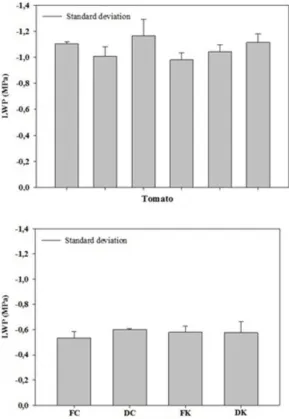
Figure 3 shows the results of measurements of leaf water potential of peppers and tomatoes. The treatment of deficit irrigation affected the leaf water potential. In the conditions of intensive irrigation leaf water potential was lower in both cultures. As with stoma conductivity, a clear conclusion about the impact of kaolin on leaf water potential cannot be made, because it was sometimes lower in the treatments with kaolin compared to treatments without kaolin and vice versa.
96
Figure 4 shows the relations between leaf water potential and stomatal conductance of peppers and tomatoes. Certain correlation can be noted, i.e. the higher the stomatal conductance, the potential is lower. Also, it can be seen that in the treatment of deficit irrigation the stomatal conductance is lower and leaf water potential is higher.
Fig.4. Relations between leaf water potential and stomatal conductance of peppers and tomatoes on all treatments
97
Figure 5 shows the average values of stomatal conductance of peppers and tomatoes during the research period. In this case, we can see the influence of the regime of irrigation on stomatal conductance of peppers and tomatoes – the more intense the irrigation is, the stomatal conductance is higher. When it comes kaolin, a clear conclusion cannot be given because the stomatal conductance is sometimes higher in the treatments with kaolin (R1K treatment of peppers and FK of tomatoes), and sometimes lower.Figure 6 shows the average values of leaf water potential of peppers and tomatoes in all tested treatments. In both cultures there are very small differences in LWP between treatments with different supply of water and treatments with and without the use of kaolin.
Fig. 6. Average values of leaf water potential of peppers and tomatoes in all tested treatments during the research period
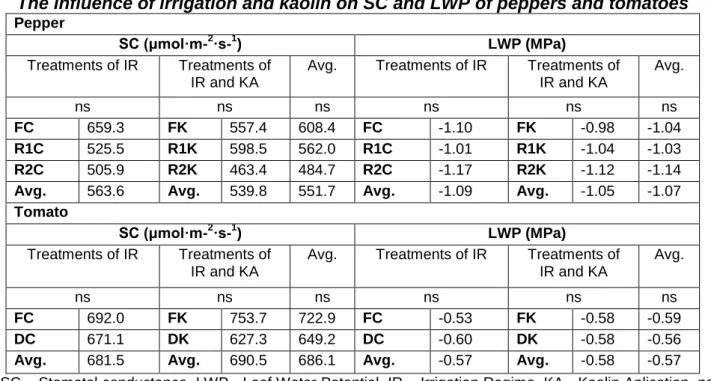
Based on the analysis of variance of average values of stomatal conductance and leaf water potential of peppers and tomatoes (Tab. 3) it can be concluded that neither the irrigation regime, nor the application of kaolin have significantly affected the SC and LWP of peppers and tomatoes.
The average stomatal conductance of pepper varies from 463.4 μmol·m-2·s-1
in RK2 to 659.3 μmol·m-2·s-1
in FC treatment. Leaf water potential ranges from -0.98 MPa in FK treatment to -1.17 MPa in R2C treatment. Here it can be noted that kaolin influenced the lowering of the potential which is in accordance with the results obtained by Boari et al. (2015), noting that kaolin influences the improvement of the water regime of the plant.
The average stomatal conductance of tomatoes goes from 627.3 μmol·m-2·s-1
in DK to 753.7 μmol·m-2·s-1
in FK. Here it is observed that kaolin can help save water as antitranspirant, in deficit irrigation treatments with and without the application of kaolin the stomatal conductance is lower. Leaf water potential in all treatments of tomato is quite balanced, it is the lowest in FC treatment 0.53 MPa) and the highest in DC treatment (-0.60 MPa).
98
(2014) have found that water stress significantly reduces stomatal conductance and increases the leaf water potential of pepper. The same observations were made by Romero et al. (2010) with grapevine. Cantor et al. (2016) also point out that the maximum stomatal conductance of tomatoes can be found in full irrigation treatments.
Application of kaolin impacts the reducing of conductivity of stoma and evaporation (Cantore et al., 2009; Boari et al., 2014), which improves the water regime of the plant (Le Grange et al., 2004; Lombardini et al., 2005; and Shellie King, 2013a, b). For well-irrigated beans, kaolin influenced the decrease in stomatal conductance and transpiration (Boari et al., 2015). These results are consistent with the results of Tworkoski et al, (2002) also on the beans and Ananda Coomaraswamy et al, (2000); Cantor et al. (2009) on tomatoes and tea. Boari et al. (2015) point out that kaolin has the greatest impact on reducing stomatal conductance, which contributed to reducing transpiration and improving the water regime of plants, reducing the net assimilation.
Table 3 The influence of irrigation and kaolin on SC and LWP of peppers and tomatoes
Pepper
SC (μmol·m-2·s-1
) LWP (MPa)
Treatments of IR Treatments of IR and KA
Avg. Treatments of IR Treatments of
IR and KA
Avg.
ns ns ns ns ns ns
FC 659.3 FK 557.4 608.4 FC -1.10 FK -0.98 -1.04
R1C 525.5 R1K 598.5 562.0 R1C -1.01 R1K -1.04 -1.03
R2C 505.9 R2K 463.4 484.7 R2C -1.17 R2K -1.12 -1.14
Avg. 563.6 Avg. 539.8 551.7 Avg. -1.09 Avg. -1.05 -1.07
Tomato
SC (μmol·m-2·s-1
) LWP (MPa)
Treatments of IR Treatments of IR and KA
Avg. Treatments of IR Treatments of
IR and KA
Avg.
ns ns ns ns ns ns
FC 692.0 FK 753.7 722.9 FC -0.53 FK -0.58 -0.59
DC 671.1 DK 627.3 649.2 DC -0.60 DK -0.58 -0.56
Avg. 681.5 Avg. 690.5 686.1 Avg. -0.57 Avg. -0.58 -0.57 SC – Stomatal conductance, LWP - Leaf Water Potential, IR – Irrigation Regime, KA - Kaolin Aplication, ns - not significant
CONCLUSIONS
These studies led to the conclusion that neither the use of irrigation regime, nor the application of kaolin has significantly affected the stomatal conductance and leaf water potential of tomatoes and peppers. Therefore, in conditions of climate change and drought, irrigation can be deficit and kaolin can be applied without significantly affecting very important physiological parameters such as SC and LWP which was the main objective of this research.
99
ACKNOWLEDGMENT
The paper was produced within the scope of the TR 37005 Project funded by the Serbian Ministry of Education and Science.
BIBLIOGRAPHY
1. Anandacoomaraswamy, A., De Costa, W.A.J.M., Shyamalie, H.W., Campbell, G.S.,
2000 - Factors controlling transpiration of mature field-grown tea and its relationship with yield. Agric. Forest Meteorol. 103, 375–386.
2. Boari, F., Cucci, G., Donadio, A., Schiattone, M.I., Cantore, V., 2014 -Kaolin influences tomato response to salinity: physiological aspects. Acta Agric. Scand., Sect. B: Plant Soil Sci., http://dx.doi.org/10.1080/09064710.2014.930509.
3. Boari, F., Donadio, A., Schiattone, M. I., Cantore, V., 2015 -Particle film technology: A supplemental tool to save water. Agric. Wat. Manage. 147, 154–162.
4. Campos, H., Trejo, C., Peña-Valdivia, C. B., García-Nava, R., Conde-Martínez, F. V., & Cruz-Ortega, M. R., 2014 -Stomatal and non-stomatal limitations of bell pepper (Capsicum annuum L.) plants under water stress and re-watering: Delayed restoration of photosynthesis during recovery.Environmental and Experimental Botany,98, 56-64.
5. Cantore, V., Pace, B., Albrizio, R., 2009 -Kaolin-based particle film technology affects tomato physiology, yield and quality. Environ. Exper. Bot. 66, 279–288.
6. Cantore, V., Lechkar, O., Karabulut, E., Sellami, M. H., Albrizio, R., Boari, F., Todorovic, M. 2016 -Combined effect of deficit irrigation and strobilurin application on yield, fruit quality and water use efficiency of “cherry” tomato (Solanum lycopersicum L.).Agricultural Water Management, 167, 53-61.
7. English, M., Raja, S.N., 1996 -Perspective on deficit irrigation. Agric. Water Manage. 32, pp. 1–14.
8. Fischer, G., Tubiello, F.N., van Velthuizen, H., Wiberg, D.A., 2007 - Climate change impacts on irrigation water requirements: effects of mitigation, 1990–2080. Technological Forecasting and Social Change 74, 1083–1107.
9. Glenn, D.M., Puterka, G.J., 2005 -Particle films: a new technology for agriculture. Hortic. Rev. 31, 1–44.
10. Glenn, D. M.,2012 -The mechanisms of plant stress mitigation by kaolin-based particle films and applications in horticultural and agricultural crops. Hort. Science, 47 (6), 710-711.
11. IBM Corp. Released 2011 - IBM SPSS Statistics for Windows, Version 20.0. Armonk, NY: IBM Corp.
12. Igbadun, H.E., Salim, B.A., Tarimo, A.K.P.R., Mahoo, H.F., 2008 - Effects of deficit irrigation scheduling on yields and soil water balance of irrigated maize. Irrigation Sci. 27, pp. 11–23.
13. Le Grange, M., Wand, S.J.E., Theron, K.I., 2004 - Effect of kaolin applications on apple fruit quality and gas exchange of apple leaves. ActaHortic. 636, 545–550.
14.Lombardini, L., Harris, M.K., Glenn, D.M., 2005 - Effects of particle film application on leaf gas exchange, water relations, nut yield, and insect populations in mature pecan trees. HortScience 40, 1376–1380.
15. Romero, P., Fernández-Fernández, J. I., & Martinez-Cutillas, A., 2010 -
Physiological thresholds for efficient regulated deficit-irrigation management in wine grapes grown under semiarid conditions. American Journal of Enology and Viticulture 61(3), 300-312.
16. Pace, B., Boari, F., Cantore, V., Leo, L., Vanadia, S., De Palma, E., Phillips, N.,
100
17. Pereira, L.S., Oweis, T., Zairi, A., 2002 - Irrigation management under water scarcity. Agricultural Water Management, 57, pp. 175–206.
18.Savic, S., 2008 - The physiological mechanisms of tomato (Lycopersiconesculentum L.) productivity regulation in drought stress conditions. PhD thesis, Faculty of Agriculture, University of Belgrade, Serbia.
19. Shellie, K., King, B.A., 2013a - Kaolin particle film and water deficit influence red winegrape color under high solar radiation in an arid climate. Am. J. Enol. Vitic. 64, 214– 222.
20. Shellie,K.,King,B.A., 2013b -Kaolin-based foliar reflectant and water deficitinfluence Malbec leaf and berry temperature, pigments, and photosynthesis. Am. J. Enol. Vitic. 64, 223–230.
21.Scholberg, J., McNeal, B.L., Jones, J.W., Boote, K.J., Stanley, C.D., Obreza, T.A.,
2000 - Growth and canopy characteristics of field-grown tomato. Agron. J. 92, pp. 152–
159.
22.Tworkoski, T.J., Glenn, D.M., Puterka, G.J., 2002 -Response of bean to application of hydrophobic mineral particles. Can. J. Plant Sci. 82, 217–219
23.Topcu, S., Kirda, C., Dasgan, Y., Kaman, H., Cetin, M., Yazici, A., Bacon, M.A.,
2007 - Yield response and N-fertiliser recovery of tomato grown under deficit irrigation. European Journal of Agronomy, 26, pp. 64–70.
24. USDA, 2006 - Keys to Soil Taxonomy, Tenth edition. Soil Survey Staff, United States Department of Agriculture NRCS.